
Latest Insights On
GenAI, Tech, and Digital Transformation
Stay updated with expert insights, success stories, and real-world applications of cutting-edge technology.
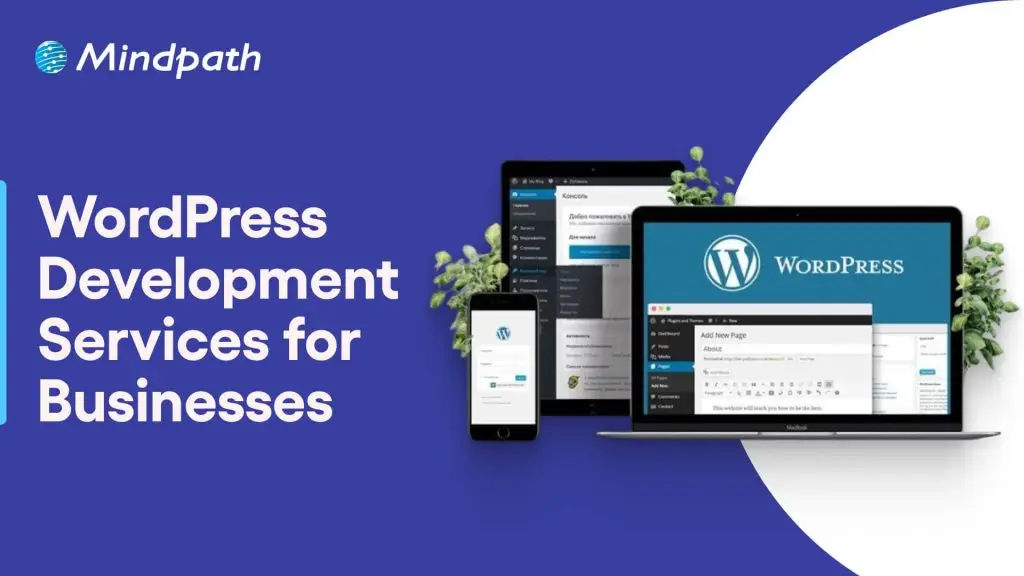
WordPress development services help businesses build, customize, and maintain websites that support their operational goals, customer experience, and online growth. Depending on business requirements, these services can include custom website development, e-commerce functionality, third-party integrations, performance optimization, security, and ongoing maintenance.
Choosing the right solution involves more than selecting a theme or installing plugins. Businesses need a website that reflects their brand, supports their customers’ needs, performs reliably, and can adapt as the organization grows. Working with the right website development company can help align technical decisions with these goals.
Key Takeaways
- 01
WordPress development services cover custom websites, plugins, integrations, e-commerce, performance, security, and maintenance. - 02
Businesses should select services based on their goals, website complexity, customer needs, and future growth plans. - 03
A well-built WordPress website can support usability, search visibility, operational efficiency, and digital sales. - 04
Businesses should evaluate security practices, performance, integration requirements, ownership, and ongoing support before choosing a development partner. - 05
Regular maintenance and performance monitoring help keep a WordPress website reliable as business requirements change.
What are WordPress Development Services?
WordPress development services involve building, customizing, improving, and maintaining websites using WordPress, a content management system (CMS). These services help businesses create websites that match their brand identity, deliver the required functionality, and provide a manageable platform for publishing and updating content.
Depending on project requirements, a WordPress development team may create custom themes, develop plugins, integrate third-party systems, configure WooCommerce, improve website speed, and implement security measures. The scope can range from developing a business website to building a more complex digital platform with specialized functionality.
For example, a professional services company may need a lead-generation website with service pages and contact forms, while an online retailer may require product catalogs, payment processing, inventory integrations, and order management.
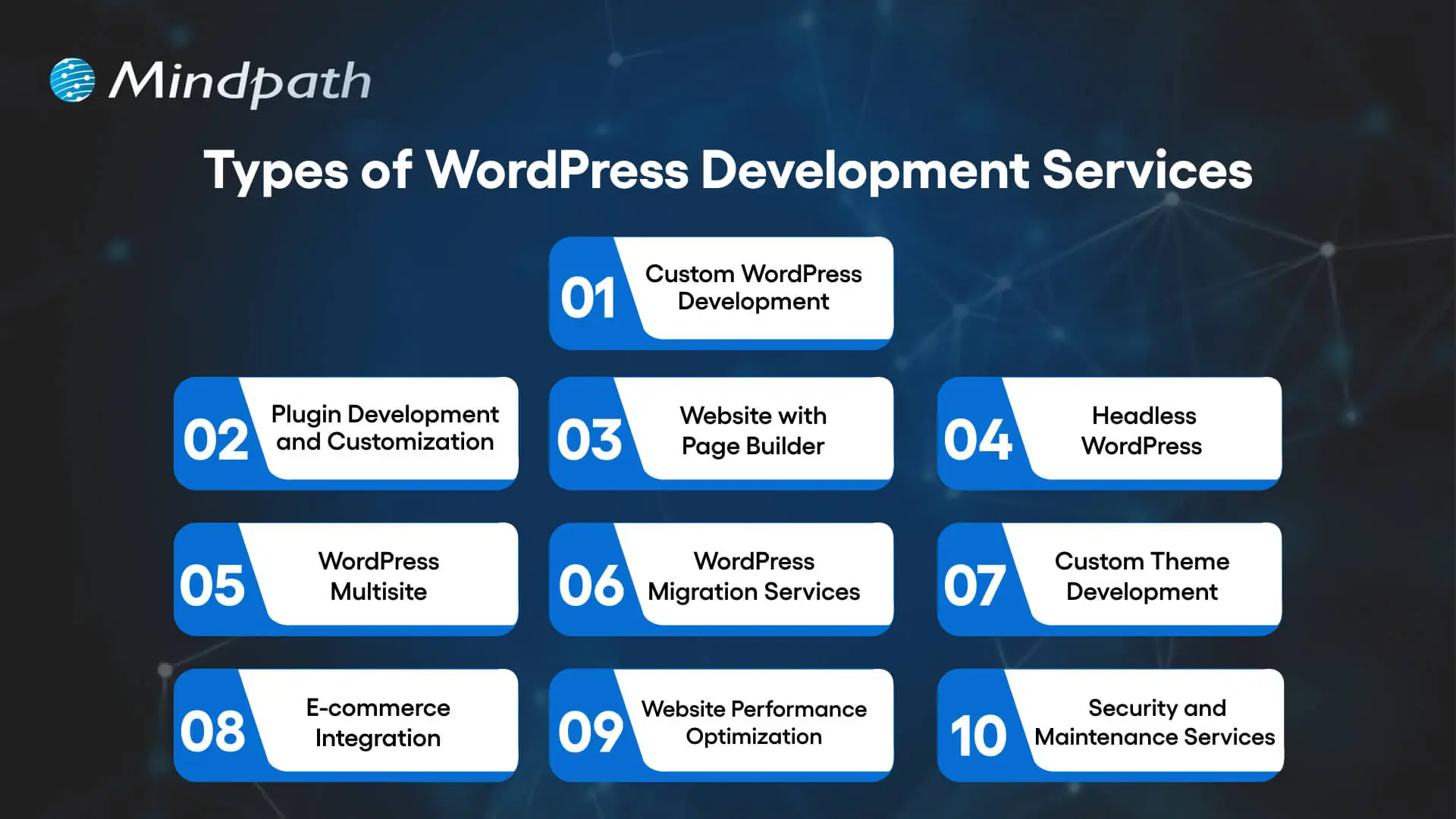
Types of WordPress Development Services Businesses Can Choose
Businesses can choose individual WordPress services or combine several based on their website’s current condition and long-term goals. Understanding the main options helps organizations identify the capabilities they need before starting a project.
1. Custom WordPress Development
Custom WordPress development creates website functionality and layouts around specific business requirements. Instead of relying entirely on a ready-made theme, a development team can build tailored page templates, content structures, custom fields, and workflows.
Business use case: A consulting firm may need industry-specific service pages, detailed case studies, and lead forms connected to its customer relationship management (CRM) system.
Learn more about custom WordPress development and how it supports tailored website requirements.
2. Plugin Development and Customization
WordPress plugins add functionality to a website. Businesses can use existing plugins for common requirements or commission custom plugin development when their workflows need capabilities that available solutions do not adequately support.
Business use case: A company may need a custom booking workflow, a specialized reporting dashboard, or an integration between its website and an internal business application.
Before adding a plugin, businesses should evaluate its maintenance history, compatibility, security, licensing, and effect on website performance.
3. Page Builder Website Development
Page builder solutions such as Elementor, Divi, and Beaver Builder help teams create and manage page layouts through visual editing interfaces. They can be useful when marketing teams need to update landing pages and campaign content without relying on developers for every change.
Business use case: A marketing team can build campaign landing pages and update calls to action while following an established design system.
The choice of page builder should consider editing flexibility, accessibility, maintainability, and its impact on page performance.
4. Headless WordPress Development
Headless WordPress separates the WordPress content management back end from the front-end experience. WordPress manages content, while a separate front end built with technologies such as React can display that content through APIs.
This architecture can offer greater front-end flexibility and support content delivery across multiple interfaces. However, it also introduces additional development, hosting, integration, and maintenance requirements.
Business use case: An organization that delivers content across a website and other digital channels may consider headless WordPress when a traditional WordPress setup cannot meet its requirements efficiently.
5. WordPress Multisite Development
WordPress Multisite allows multiple websites to run within a single WordPress installation. It can help organizations manage related websites centrally while sharing selected administrative resources.
Business use case: A company with multiple brands, regional websites, or departmental sites may benefit from centralized administration.
Businesses should assess user permissions, plugin compatibility, content ownership, and the consequences of shared infrastructure before choosing Multisite.
6. WordPress Migration Services
WordPress migration services help businesses move a website from another CMS, hosting environment, or existing WordPress installation. A structured migration process covers content, media files, databases, redirects, integrations, and testing.
Business use case: A company moving from a legacy CMS to WordPress may need to preserve important URLs, maintain access to existing content, and reduce disruption during the transition.
Migration planning should include backups, redirect mapping, staging tests, analytics checks, and post-launch monitoring to identify issues early.
7. Custom WordPress Theme Development
Custom theme development creates the visual structure and reusable page layouts of a WordPress website. A theme can be designed around a company’s brand guidelines, content requirements, and user journeys.
Business use case: A growing company may need a consistent design across service pages, landing pages, case studies, and blog articles.
A well-structured theme can also make future design updates easier to manage, provided the implementation follows maintainable development practices.
8. E-commerce Development and WooCommerce Integration
WooCommerce extends WordPress with e-commerce capabilities. Development services can include product catalogs, shopping carts, checkout flows, payment gateways, shipping configuration, and integrations with inventory or order management systems.
Business use case: A retailer can manage products and online orders through a WordPress-based store while integrating relevant payment and fulfillment services.
Businesses should review transaction security, checkout usability, mobile performance, product management, and expected traffic before launching an online store.
9. WordPress Performance Optimization
Performance optimization improves how quickly and reliably a WordPress website loads and responds. Depending on the underlying issues, work may include image optimization, caching, database maintenance, code improvements, hosting configuration, and reducing unnecessary scripts or plugins.
Business use case: An e-commerce business experiencing slow product pages can investigate performance bottlenecks to improve browsing and checkout experiences.
Businesses can monitor Core Web Vitals, server response times, page load behavior, and real-user performance to assess improvements.
10. WordPress Security and Maintenance
Security and maintenance services help keep a WordPress website updated, monitored, and recoverable. Depending on the agreement, they may include core, theme, and plugin updates; backups; vulnerability checks; access controls; malware monitoring; and incident support.
Business use case: A business that relies on its website for leads or online sales may need scheduled maintenance, tested backups, and a defined process for resolving security or availability issues.
For additional guidance, read our resource on safeguarding against common WordPress vulnerabilities.
What Should Businesses Expect From a WordPress Development Partner?
Businesses should expect a development partner to understand their goals, define the project scope, explain technical decisions, and establish clear criteria for evaluating the finished website. The exact deliverables depend on the project, but several practices are important across most engagements.
| Expectation | What it should include | Business value |
|---|---|---|
| Requirements and planning | Defined scope, priorities, timelines, and acceptance criteria | Reduces misunderstandings and scope-related delays |
| Design and usability | Brand alignment, responsive layouts, accessible navigation, and clear user journeys | Helps visitors find information and complete important actions |
| Technical development | Appropriate themes, plugins, integrations, and maintainable implementation | Supports required functionality without unnecessary complexity |
| Performance and security | Testing, optimization, updates, access controls, and backup planning | Reduces avoidable operational risks |
| SEO readiness | Crawlable pages, suitable URL structures, metadata support, and redirect planning where needed | Helps search engines discover and understand website content |
| Testing and launch | Functional, mobile, browser, integration, and launch checks | Helps identify issues before they affect visitors |
| Post-launch support | Documented ownership, maintenance responsibilities, and support arrangements | Makes ongoing website management more predictable |
Business Benefits of Professional WordPress Development Services
Professional WordPress development can help businesses create a website that supports marketing, sales, customer service, and day-to-day operations. The value depends on how well the website is planned, implemented, and maintained.
1. Website Functionality Aligned With Business Goals
A website should support specific business objectives rather than simply look attractive. Custom page templates, forms, integrations, and content structures can help visitors find relevant information and take actions such as requesting a quote, booking a consultation, or purchasing a product.
2. Better User Experience Across Devices
Responsive design, clear navigation, readable content, and accessible interactions help people use a website across desktop, tablet, and mobile devices. A well-planned user experience can reduce friction when visitors explore services or complete important tasks.
Businesses can also review our WordPress web accessibility guidelines to understand how inclusive design practices support a wider range of users.
3. More Manageable Website Operations
WordPress provides a content management interface that allows authorized team members to update pages, publish articles, and manage media. Appropriate roles, reusable templates, and editorial workflows can reduce the effort required for routine website updates.
4. A Foundation for Search Visibility
A technically sound WordPress website can support SEO through accessible content, logical internal links, suitable page titles, descriptive metadata, mobile usability, and efficient performance. These foundations help search engines access and interpret content, although they do not guarantee higher rankings.
Businesses should also review indexing, canonical URLs, structured data where appropriate, XML sitemaps, redirects, and the quality of the content published on the website.
5. Improved Security and Reliability
A structured development and maintenance process can reduce avoidable risks associated with outdated software, excessive permissions, vulnerable plugins, and inadequate backups. Security measures should reflect the website’s functionality, data sensitivity, and business importance.
For related technical guidance, see our WordPress and PHP compatibility guide.
6. Flexibility as the Business Grows
A well-planned WordPress website can be extended as requirements change. Businesses may add new service pages, integrate marketing systems, introduce e-commerce functionality, or improve existing workflows without rebuilding the entire website for every new requirement.
The ability to scale depends on the site’s architecture, hosting resources, integration design, and the quality of its implementation.
7. Better Control Over Website Costs
The right development approach can help businesses avoid unnecessary plugins, duplicated functionality, and expensive rework. However, the total cost of ownership also includes hosting, premium extensions, maintenance, security, licensing, and future improvements.
Businesses should compare the expected long-term cost of a proposed solution rather than choosing a provider based only on the initial development quote.
How to Choose the Right WordPress Development Services
The right service provider should be able to connect technical recommendations with your business objectives. Before making a decision, evaluate the following areas.
1. Define Your Website Requirements
Identify the website’s main purpose, target audience, essential features, content needs, integrations, and expected growth. A company website, an online store, and a content-heavy publishing platform will have different technical requirements.
2. Review Relevant Experience
Look for projects that demonstrate experience with similar functionality, industry requirements, integrations, or performance challenges. Ask how the provider approached the work and how the finished website meets the original requirements.
3. Assess Technical and Security Practices
Ask about plugin selection, code quality, access permissions, backups, update procedures, testing, and recovery plans. The provider should be able to explain the approach in terms your business team can understand.
4. Confirm SEO and Performance Requirements
Discuss URL structures, redirects, mobile usability, page performance, indexing, and analytics before development begins. If the project replaces an existing website, make sure the team has a plan to preserve valuable URLs and monitor changes after launch.
5. Clarify Ownership and Ongoing Support
Confirm who owns the website code, domain, hosting account, licenses, content, and administrator credentials. Review the support agreement, maintenance schedule, response expectations, and costs for future changes.
6. Compare Scope, Not Just Price
Review each proposal against the same requirements. Compare deliverables, exclusions, testing, integrations, documentation, launch support, and post-launch services before evaluating the total price.
Businesses evaluating external partners can also read our guide to choosing the right website development company.
How Much Do WordPress Development Services Cost?
The cost of WordPress development services depends on the website’s scope, design requirements, custom functionality, integrations, migration needs, performance targets, and ongoing support. A straightforward business website generally requires a different level of effort from a custom e-commerce platform or a complex, integrated digital experience.
| Cost factor | What affects the cost |
|---|---|
| Design complexity | Custom layouts, responsive behavior, accessibility, and design system requirements |
| Custom functionality | Specialized workflows, custom plugins, user roles, and advanced features |
| Integrations | CRM, payment, inventory, marketing, analytics, and other external systems |
| Migration requirements | Content volume, URL mapping, data transformation, redirects, and testing |
| Performance and security | Optimization, infrastructure configuration, security controls, and monitoring |
| Ongoing maintenance | Updates, backups, troubleshooting, licenses, hosting, and support coverage |
Before approving a proposal, ask for a clear breakdown of development deliverables, recurring expenses, assumptions, exclusions, and change-request costs. This helps businesses budget more accurately and compare providers on a consistent basis.
Common Mistakes to Avoid When Investing in WordPress Development
Even a well-funded website project can create avoidable problems when business requirements and technical decisions are not aligned. Businesses should watch for these common mistakes.
- Choosing based only on the initial quote: A low upfront price may exclude testing, integrations, documentation, or maintenance.
- Installing too many plugins: Unnecessary or poorly maintained plugins can increase complexity and security risks.
- Ignoring performance during development: Heavy themes, oversized images, and excessive scripts can affect user experience.
- Leaving SEO until launch: URL changes, missing redirects, and incorrect indexing settings can create avoidable search visibility issues.
- Skipping backup and recovery planning: Businesses need a practical process for restoring the website after a failure or security incident.
- Failing to clarify ownership: Domain access, hosting accounts, licenses, and administrator credentials should be clearly assigned.
Build a WordPress Website Around Your Business Goals
WordPress development services can help businesses build websites that support their brand, customer experience, marketing activities, and digital operations. The right approach depends on the required functionality, integration needs, security expectations, performance goals, and plans for future growth.
Before starting a project, define the outcomes your website needs to deliver and evaluate providers against those requirements. A clear scope, appropriate technical choices, thorough testing, and a practical maintenance plan can help create a website that remains useful as your business evolves.
At Mindpath’s WordPress development services, businesses can explore solutions for custom themes, plugin development, e-commerce integration, performance optimization, and website maintenance. Discuss your requirements with a development team to identify an approach that fits your website goals.
Have you ever thought to yourself about how AI can interpret images, voices, or texts so accurately? Well, it is due to the rapid growth of the role of vector databases in AI applications. Standard databases do a good job of storing structured data, while much of AI work involves dealing with complex and unstructured information. Vector databases provide methods for storing and comparing information which allow machines to recognize patterns, context, and meaning much faster and with higher accuracy.
As AI systems become more intelligent, the demand for methods to support thinking beyond the simple data is also increasing. Vector databases provide that opportunity for AI to correlate information, learn from it, and generate more impactful results. They are quickly becoming the framework of modern AI innovation. In this blog, we will take a look at the power of vector databases in AI applications and why they are a necessary future element of intelligent systems.
Key Takeaways
- 01
Vector databases help AI applications search and compare information based on meaning and context. - 02
They support AI use cases such as semantic search, RAG, recommendations, and computer vision. - 03
Vector embeddings convert text, images, audio, and other data into numerical representations that AI can compare. - 04
Fast similarity search allows AI systems to retrieve relevant information from large and complex datasets. - 05
Vector databases can act as a memory layer for AI systems and agents that need to store and retrieve contextual information.
Looking for a way to enhance personalization with the help of AI in your apps using a vector database? Explore Mindpath’s AI development services, which provide expert guidance and knowledge on how to maximize the value of the vector database to elevate your AI capabilities.
What is a Vector Database for AI?
A vector database is a specific type of database that enables storing and searching for data represented as vectors. Vectors are sets of numbers that represent the meaning or features of data such as text, images, and audio. Instead of searching for exact matches of data, a vector database searches for similar items, based on the context, illuminating AI’s capacity to perform at a more intelligent level based on context.
In basic terms, it works like the brain of AI systems that require memory and comparison. A vector database in AI enables quick and accurate data searches among very large and complex datasets. They are often used in applications such as chatbots, recommendation engines, and image searches where the response time and clearly related results mean everything.
In simple terms, a vector database helps AI applications store, search, and retrieve information based on meaning rather than exact keyword matches.
Curious how AI chatbots can boost engagement and revenue? Discover AI Chatbot examples to learn how vector database-driven intelligence improves customer interactions.
How Does a Vector Database Work?
Vector databases assist artificial intelligence to comprehend and look through data in terms of meaning rather than precise words. Data is stored as numbers that illustrate what the data depicts. This helps AI connect ideas, find similarities, and give more accurate and useful results.
1. Creating vector embeddings
AI models process raw data to create vectors, which are sets of numbers that represent the meaning of the data. Vectors are mechanisms for AI to understand the connections among different data points.
2. Storing and indexing vectors
The vectors are kept within a vector database, which can be indexed with smart indexing methods, such as HNSW (Hierarchical Navigable Small World) or IVF (Inverted File Index). The role of vector databases in AI applications here is to store, group, and quickly find similar data when needed.
3. Performing similarity search
When the search begins, it will convert the query into a vector, which it begins to compare to other stored vectors. The database returns the closest elements based on meaning, so the AI can accurately and relevantly respond to the user.
Looking to optimize AI models without heavy computational costs? Explore Low-Rank Adaptation (LoRA) to discover techniques that improve vector database-powered AI efficiently.
Role of Vector Databases in AI Applications
The importance of the vector database for the AI application is becoming more necessary and prevalent as AI works with larger and more complicated data. Below are the main ways in which it helps and enhances the AI systems.
1. Smarter Search with Meaning
An AI application that utilizes a vector database can perform searches on meaning, rather than just a specific word. It finds things that are contextually similar in vector space; this is a lot more precise and much more human-like. This is incredibly useful, because the AI system can determine what users mean, not simply what they type.
2. Supporting Retrieval-Augmented Generation (RAG)
Vector databases provide large language models with access to current facts, knowledge, and data points from the public domain. The user’s inquiry is converted to a vector, which retrieves information from data similar to that represented in the user’s question. The information and materials retrieved help the AI provide responses that are elevated in relevance and made to be factually accurate.
3. Managing Complex Data Types
The role of vector database in AI application is to be able to manage unstructured data including images, text, and audio. A vector database does this by representing the unstructured data as numerical vectors that convey meaning. This allows AI to be able to compare unstructured data types more easily.
4. Enabling Fast Similarity Search
Vector databases leverage novel algorithms to identify similar items quickly, even among massive datasets. This capability is crucial for a number of artificial intelligence (AI) applications that depend on real-time results. The vector database in the AI application in this case is to return results quickly and still maintain precision.
5. Improving Recommendations
Recommendation systems utilized vector databases to recommend similar attributes to items or products that users had liked before. AI uses patterns in the vectors and can customize content for each individual. This leads to a more meaningful and engaging experience for the user.
6. Powering Computer Vision
In computer vision, a vector database in AI helps identify and compare images or videos efficiently. It supports tasks like face recognition, image search, and visual content filtering. By finding visually similar vectors in AI systems it improves speed and accuracy.
7. Building AI Memory
The role of the vector database in AI applications is that it is a dependable memory mechanism for the AI agents. It strengthens the AI agent’s ability to store and retrieve information in support of reasoning and decision-making. Thus, vector capacity increases the multi-step capabilities of AI agents when solving complex tasks.
8. Hybrid and Refined Search
Vector databases have the ability to merge traditional filters like date or category with similarity search. This hybrid effort increases the precision and relevance of a search result. Users can quickly and clearly find exactly what they are looking for.
Wondering how AI systems focus on the most important information in complex datasets? Discover the Attention Mechanism to learn how it enhances AI performance in combination with vector databases.
Ready to Build Smarter AI Solutions with Vector Databases?
Vector databases are transforming how AI systems process and understand information. They enable faster searches, handle complex data, and make AI responses more meaningful and accurate. As technology continues to advance, the role of vector databases in AI applications will remain central to building intelligent and scalable solutions across industries.
At Mindpath, our AI development services combine the power of vector databases with advanced machine learning models to build smarter and more efficient systems. We help businesses create intelligent applications that learn, adapt, and deliver real results. Partner with us to design AI solutions that drive innovation and long-term success.

Businesses all over Canada are always under pressure to make apps that are fast, scalable, and able to handle real-time interactions in today’s digital-first economy. Your backend technology is very important for long-term success, whether you’re a startup launching your first product or a big company updating old systems. Node.js has become one of the most powerful and widely used backend technologies available today.
This in-depth guide will help you understand Node.js and its benefits, developer skills, hiring models, costs, and best practices if you want to hire NodeJS developers in Canada. This article is set up to give you a full, useful guide to hiring the best Node.js developers in Canada.
Why You Should Hire NodeJS Developers?
Cities like Toronto, Vancouver, Montreal, and Ottawa are at the forefront of innovation in Canada, which is one of the fastest-growing tech hubs in the world.
Important Reasons to Hire in Canada
1. Highly Skilled Talent Pool
Canadian developers are known for having a lot of technical knowledge.
2. Quality Education System
The best universities make good software engineers.
3. Stable Economy
Canada is a safe place to do business.
4. Time Zone Advantage
Works well with businesses in the US.
5. Strong Work Ethics
Employees who are professional and dependable.
For North American businesses, hiring NodeJS developers in Canada guarantees high-quality work and easy communication.
Important Skills for NodeJS Developers
You need to look at both technical and interpersonal skills when hiring expert NodeJS developers.
1. Core Technical Skills
- Strong knowledge of JavaScript (ES6+)
- Proficiency in Node.js frameworks like Express.js or NestJS
- Experience with REST APIs and GraphQL
- Understanding of asynchronous programming
- Familiarity with databases (MongoDB, MySQL, PostgreSQL)
- Knowledge of Git and version control
2. Advanced Technical Skills
- Microservices architecture
- Cloud services (AWS, Azure, Google Cloud)
- Docker and Kubernetes
- CI/CD pipelines
- Security best practices
3. Soft Skills
- Problem-solving mindset
- Communication skills
- Ability to work in agile teams
- Time management
A good developer should be able to write clean code and know how to make a program work for a lot of users.
Hiring Models for NodeJS Developers
The size, budget, and timeline of your project will help you choose the best hiring model.
1. In-House Developers
- People who work full-time
- Best for projects that will last a long time
- Higher cost because of benefits and infrastructure
2. Freelancers
- Cost-effective and adaptable
- Great for small or short-term projects
- Can be hired right away
3. Dedicated Developers
- Only work on your project
- Best for new businesses and teams that are growing
4. Remote NodeJS Developers
- Get access to talent from all over the world
- Cut down on the costs of doing business
- A hiring process that goes faster
Step-by-Step Process to Hire NodeJS Developers in Canada
Hiring the right Node.js developers in Canada requires a well-planned and structured approach. With a rapidly growing tech ecosystem and increasing demand for skilled professionals, businesses need a clear hiring strategy to identify the right talent, reduce risks, and ensure long-term project success.
Step 1: Identify Your Project Needs
Begin by clearly defining your project requirements in detail. This includes outlining the scope of the project, core features, and expected outcomes. Determine whether you are building a real-time application, API, SaaS platform, or enterprise solution. Additionally, establish your budget, timeline, and preferred technology stack. A well-defined project plan not only helps you communicate your vision effectively but also ensures you attract developers who are aligned with your technical and business objectives.
Step 2: Select the Appropriate Hiring Model
Choosing the right hiring model is crucial for balancing cost, flexibility, and control. Evaluate whether you need full-time developers for long-term collaboration, freelancers for short-term or specialized tasks, or remote development teams for scalability. Consider factors such as project complexity, duration, and internal resources. Making the right choice at this stage can significantly impact productivity, communication, and overall project efficiency.
Step 3: Develop a Comprehensive Job Description
Create a detailed and well-structured job description that clearly communicates your expectations. Include required technical skills such as proficiency in JavaScript, Node.js frameworks (e.g., Express.js, NestJS), API development, and database management. Define roles, responsibilities, deliverables, and the level of experience needed. A strong job description not only attracts qualified candidates but also filters out unsuitable applicants, saving time during the hiring process.
Step 4: Explore Talent Through Multiple Channels
To find the best Node.js developers in Canada, use a combination of sourcing channels. Leverage professional networks like LinkedIn, freelance platforms such as Upwork, and specialized tech job boards. You can also explore developer communities, referrals, and recruitment agencies. Using multiple channels increases your reach and improves your chances of finding experienced and reliable developers in a competitive market.
Step 5: Review and Shortlist Candidates
Carefully evaluate candidate profiles by reviewing resumes, portfolios, and past work experience. Focus on previous projects that are similar to your requirements and assess their contributions. Checking GitHub repositories can provide insights into coding standards, problem-solving approaches, and real-world experience. Shortlisting the right candidates ensures you move forward with individuals who have both the technical expertise and relevant experience.
Step 6: Conduct Technical and Practical Assessments
Assess candidates through a combination of technical interviews, coding tests, and real-world problem-solving exercises. Evaluate their understanding of Node.js concepts such as asynchronous programming, event-driven architecture, API integration, and database handling. Practical assessments help you determine how candidates approach challenges, write efficient code, and perform in real project scenarios.
Step 7: Complete Hiring and Ensure Smooth Onboarding
Once you have selected the right candidate, finalize the hiring process by offering competitive compensation and clearly defining roles, responsibilities, and expectations. Provide structured onboarding, including access to tools, documentation, and workflows. A smooth onboarding process helps developers integrate quickly into your team, improves productivity, and sets the foundation for long-term success.
Cost of Hiring NodeJS Developers in Canada
There are several factors that influence the cost of hiring a NodeJS developer in Canada, including experience level, geographic location, and the hiring model you choose.
1. Hourly Rates
(Based on Glassdoor and market salary data)
- Junior Developers: $30 – $50/hour
- Mid-Level Developers: $50 – $90/hour
- Senior Developers: $90 – $140+/hour
2. Annual Salaries
(Source: Glassdoor Canada & Payscale)
- Junior: ~$60,000 – $75,000/year
- Mid-Level: ~$75,000 – $100,000/year
- Senior: ~$100,000 – $130,000+/year
Factors Affecting Cost
1. Developer Experience
Senior developers charge significantly higher rates
2. Geographic Location
Cities like Toronto and Vancouver have higher salaries
3. Project Complexity
Advanced applications (SaaS, real-time systems) cost more
4. Engagement Model
In-house, freelance, or outsourcing impacts pricing
5. Technology Stack
Skills like cloud, DevOps, and microservices increase cost
Hiring developers who work from home can save you a lot of money while still getting good work done.
Why Hiring Dedicated NodeJS Developers in Canada is a Smart Long-Term Investment?
Hiring dedicated NodeJS developers in Canada is one of the most effective ways to build scalable, high-performance applications while maintaining quality and long-term consistency. For businesses looking to hire NodeJS developers in Canada, dedicated developers offer greater reliability, stronger collaboration, and better project control. This hiring model is especially beneficial for startups, growing businesses, and enterprises that need continuous development and long-term technical support.
Key Benefits of Hiring Dedicated NodeJS Developers in Canada
1. Full Commitment to Your Project
Dedicated developers work exclusively on your project, ensuring steady progress, faster delivery, and minimal distractions.
2. Consistent Focus and Higher Productivity
Since they are fully involved in your project, dedicated NodeJS developers in Canada can maintain momentum, meet deadlines, and deliver quality results consistently.
3. Better Understanding of Business Goals
Over time, dedicated developers gain deeper insights into your business objectives, workflows, and user needs, leading to more tailored and effective solutions.
4. Improved Code Quality and Maintainability
Continuous involvement helps maintain coding standards, improve system performance, and reduce technical debt.
5. Faster Issue Resolution and Support
Dedicated developers can quickly identify and fix bugs, performance issues, or technical challenges, reducing downtime and improving efficiency.
6. Seamless Team Integration
Dedicated NodeJS developers act as an extension of your in-house team, aligning with your processes, communication tools, and project workflows.
7. Scalability and Flexibility
This model makes it easier to scale your team up or down based on project demands without disrupting progress.
8. Long-Term Cost Efficiency
Although the initial investment may be higher, dedicated developers reduce costs related to hiring, onboarding, and managing multiple short-term resources.
9. Greater Control and Transparency
You benefit from direct communication, better visibility into progress, and more control over timelines, priorities, and deliverables.
Common Mistakes to Avoid When Hiring Dedicated NodeJS Developers in Canada
- Not clearly defining project requirements
- Hiring based only on cost rather than expertise
- Ignoring communication and collaboration skills
- Skipping technical interviews or coding tests
- Choosing the wrong hiring model for your project
Hiring dedicated NodeJS developers in Canada can provide significant long-term value when done correctly. By choosing the right talent, setting clear expectations, and avoiding common mistakes, businesses can build stronger development teams, improve product quality, and achieve faster, more sustainable growth.
Hire Top NodeJS Experts in Canada to Accelerate Your Business
Businesses that want to make high-performance, scalable apps should hire NodeJS developers in Canada. Canada is a great place to hire both local and remote developers because it has a lot of talented people, low prices, and a growing tech ecosystem.
You can confidently hire expert NodeJS developers who will help you reach your business goals and get great results if you know what skills they need, how to hire them, how much it will cost, and what the best practices are.

Companies need backend technologies that can handle real-time data, are quick, and can grow with the business in today’s digital-first economy. Node.js is now one of the most popular backend tools for building SaaS platforms, fintech apps, and business software.
California is one of the best places to find Node.js developers because it is home to Silicon Valley and some of the biggest tech companies in the world. You need to know a lot about skills, costs, hiring models, and market demand to hire the right people here.
This guide gives you a complete, research-based look at how to hire NodeJS developers in California. It covers everything from the skills and costs to the steps you need to take and the best ways to do it.
Key Benefits of Hiring NodeJS Developers
Node.js is popular because it is fast and can make apps that can grow. Its event-driven, non-blocking architecture makes it great for modern apps like APIs, real-time apps, and microservices. Let’s dive in to understand the key benefits of hiring nodejs developer in California.
1. High performance and Scalability
Node.js is great for apps that get a lot of traffic because it can handle many requests at the same time.
2. Faster development
Node.js uses JavaScript on both the front end and the back end, which makes development faster and more productive.
3. Strong Ecosystem
NPM, which stands for Node Package Manager, lets developers use thousands of libraries to get their work done faster.
4. Ideal for Real-Time Applications
A lot of people use Node.js to build live apps like messaging apps and streaming services.
5. The Availability of Skilled Workers in California
California has a strong tech ecosystem that helps businesses find the best workers.
What Skills Should You Look for in a Node.js Developer?
You need to know what skills a developer needs in order to hire the right one. Not all JavaScript developers know a lot about Node.js.
1. Core Technical Skills
- A lot of experience with JavaScript (ES6+).
- Getting the back end to work with Node.js
- Familiarity with frameworks like NestJS or Express.js
- Creating RESTful APIs
- Taking care of databases like MySQL, MongoDB, and PostgreSQL
- Version control tools like Git
2. Advanced Skills (For Experienced Developers)
- The structure of microservices
- Cloud platforms, such as AWS, Azure, and Google Cloud
- Computing without servers
- Making things work better
- Best ways to keep things safe
Senior developers often make more money because they can design systems that can grow and handle complex architectures.
3. Soft Skills
- Being able to solve problems
- The ability to talk to people
- Working as a team
- Managing time
Strategic Hiring Models: Choosing the Right Fit for Your Node.js Project
When looking to hire Node.js developers in California, businesses are no longer restricted to traditional hiring methods. Depending on your project’s budget, timeline, and security requirements, you have four distinct hiring models to choose from. Selecting the right one is critical for balancing cost with technical output.
1. In-House Hiring
Building an internal, full-time engineering team is the traditional route, ideal for core product development that requires deep institutional knowledge.
2. Freelance Developers
For short-term projects, bug fixes, or highly specialized micro-tasks, hiring independent freelancers from platforms like Upwork or Toptal can be an attractive option.
3. Dedicated Developers
This model involves partnering with a specialized IT agency to “hire” full-time developers who work exclusively on your project but remain legally employed by the agency.
4. Remote & Distributed Developers
With the rise of robust remote work infrastructure, you are no longer limited by geographical borders. You can hire full-time or contract developers who work entirely from home.
The Cost of Hiring NodeJS Developers in California
When budgeting for your next major software project, relying on anecdotal salary data, Reddit threads, or outdated job boards is a fast track to under-budgeting. If you want to secure top-tier talent in one of the most competitive tech ecosystems in the world, you need to understand the actual market rates.
To give you an accurate, transparent look at the current landscape, we cross-referenced real-world agency pricing with official government labor statistics from the U.S. Bureau of Labor Statistics (BLS) and the California Employment Development Department (EDD).
Because the government classifies Node.js engineers under the broader “Software Developers” category, we can use their highly regulated data to validate exactly what elite talent costs in the Golden State today.
1. Annual Salary Benchmarks (Full-Time / In-House)
If your goal is to hire an in-house, full-time Node.js developer, the baseline costs are substantial. You are competing directly with Silicon Valley giants and well-funded startups.
- The Baseline Average: Historical BLS data and active job aggregators have long placed the median tech salary in California around $137,600.
- The Current Competitive Rate: As demand for advanced back-end architecture and highly scalable applications grows, the official BLS mean annual wage for Software Developers in California has surged to $173,780.
- The Silicon Valley Premium: If you are hiring in hyper-competitive tech hubs like the San Jose-Sunnyvale-Santa Clara metropolitan area, you must pay a premium. The government reports an average annual salary of $199,800 for top-tier engineers in these regions.
Keep in Mind: These numbers represent base salaries. When you factor in recruitment costs, health benefits, equity, and equipment, the true cost of an in-house hire is often 20% to 30% higher than their base pay.
2. Hourly Rates & The “Agency Markup” Explained
For many agile companies, hiring full-time W-2 employees is not the most efficient solution. Choosing to work with dedicated freelancers or a staff augmentation agency changes the pricing model to an hourly rate.
Our market research shows that hiring a mid-level to senior Node.js developer on a contract basis generally costs between $80 and $150+ per hour. Here is exactly how that aligns with official government data:
- The Government Base Rate: The BLS reports the mean hourly base wage for a developer in California is $83.55, climbing to $96.06 in Silicon Valley.
- The Fully Loaded Cost: It is critical to understand that the BLS tracks raw W-2 base pay. When you hire through an agency or a premium contractor, the hourly rate includes overhead, software licenses, healthcare benefits, and the agency’s operational margin.
This standard 20% to 40% markup perfectly explains why a base wage of $83–$96 per hour translates directly to the $120 to $150+ per hour billing rate you will see on professional agency proposals.
California is expensive, but it also houses the most innovative and experienced developers in the world. Paying these rates ensures you are securing engineers who possess the elite architectural knowledge required to build secure, scalable, and high-performance Node.js applications that won’t break under pressure.
Step-by-Step Guide to Hire Node.js Developers in California
Hiring top-tier Node.js developers in California means navigating one of the world’s most dynamic and fiercely competitive tech ecosystems. To attract and secure high-impact engineers who can drive your vision forward, you must execute a strategic, rigorous, and highly targeted hiring process that filters out the average and hones in on the exceptional.
Step 1: Define Precise Project Requirements
Begin by pinpointing the exact architectural scope, determining whether you are constructing a high-frequency trading platform, a globally scaled SaaS product, a real-time communication tool, or a complex enterprise backend. Clearly define the necessary tech stack, including proficiency in databases and cloud infrastructure. Establishing firm timelines, budget constraints, and core deliverables at this stage creates a roadmap that ensures alignment and prevents costly scope creep down the line.
Step 2: Strategically Select Your Hiring Model
Building an in-house team might be essential for highly secure, proprietary projects requiring deep institutional knowledge. Conversely, you might opt for remote developers across the US or adjacent time zones to optimize costs without sacrificing synchronous collaboration. If your goal is to rapidly scale for a specific sprint or product launch, partnering with vetted agencies to onboard dedicated Node.js developers can provide immediate, high-impact momentum without the long-term commitments of traditional employment.
Step 3: Craft a High-Impact, Technical Job Description
Clearly outline the day-to-day responsibilities, key deliverables, and performance expectations, which serves a dual purpose: it acts as a magnet for highly qualified candidates who thrive on clarity, while simultaneously functioning as an immediate filter to deter applicants who lack the requisite depth of experience.
Step 4: Deploy Sourcing Strategies
Actively scout open-source contributors on GitHub and technical forums to find nodejs developers who demonstrate genuine passion and peer-validated skills. Furthermore, leverage internal referral networks or collaborate with elite, specialized technical recruitment agencies that maintain exclusive pipelines of passive, high-caliber candidates who are not actively browsing public job listings.
Step 5: Conduct Technical Evaluations
Assess their ability to design scalable backend architectures, seamlessly integrate complex databases, and identify performance bottlenecks under heavy load. By presenting them with assignments mirroring your actual codebase or architectural challenges, you gain unparalleled insight into their practical problem-solving methodologies and coding standards.
Step 6: Assess Soft Skills and Cultural Alignment
Evaluate candidates’ adaptability, time management, and approach to teamwork, particularly their receptiveness during code reviews and their ability to mentor junior peers. Ultimately, you are looking for developers who not only write exceptional code but also elevate the entire team’s dynamic and align seamlessly with your company’s core values and operational tempo.
Step 7: Finalize Hiring and Execute Onboarding
Provide the new developer with immediate, frictionless access to all required repositories, project management tools, and comprehensive system documentation so they can begin familiarizing themselves with the architecture on day one. A meticulously planned onboarding phase minimizes friction, accelerates the developer’s path to their first code commit, and establishes a foundation of trust and productivity that secures long-term retention.
Ready to Bypass the California Hiring Headache?
You can work with some of the best tech experts in the world if you hire Node.js developers in California. But it costs a lot and there are a lot of other people who want it. Finding NodeJS developers in California is the most important thing, whether you hire them in person or online. We at Mindpath have a dedicated team of nodejs developer from mid to high level experience. Contact us today with your requirements and we’ll provide you with the best nodejs developer in California.

Did you ever wish you could brainstorm new concepts, create beautiful visuals, or write codes without any creative personnel or technical expertise? Now that there are well-developed generative AI tools for content creation and code generation, this is not a dream anymore. These smart tools are enabling users to develop quality content and working code in a matter of minutes. Whether it is writing blogs or coming up with generative code snippets, these tools are aiding productivity and creativity in industries.
All you need is the right tool to witness the magic. Here, in this blog, you will learn about generative AI for code generation and content development. In addition to that, we will discuss some of the most essential aspects that will allow you to select a generative AI tool without any confusion.
Want to improve your business content creation and coding capabilities without increasing the workforce? Mindpath’s Generative AI development services build custom GenAI solutions that deliver consistency and measurable results.
What are Generative AI Tools?
Generative AI tools are software applications powered by machine learning models that create new content, such as text, images, audio, video, and code, in response to user prompts. Popular examples include ChatGPT, Midjourney, and Claude. Gen AI is changing creative work by automating repetitive processes, and since these tools are trained on huge amounts of data, they can generate context-aware content that benefits teachers, marketers, developers, and designers alike.
Here is how generative AI can help in code and content creation.
1. Produce beautiful marketing images.
2. Write social posts, emails and articles.
3. Computerize routine development processes.
4. Write code using various languages.
Whether you are a marketer who wants to optimize the content or a developer who needs to quickly get the code finished, generative AI can serve as your creative partner.
Wondering where generative AI is making the biggest impact? Discover generative AI use cases to explore real-world applications across industries.
Let’s now learn about the most popular generative AI tools for content creation and code generation and know how to select the appropriate one for your business.
Generative AI Tools for Content Creation
Generative AI has enabled more scalable, faster, and smarter content creation processes across industries. Here are some popular tools assisting with ideation, editing, and drafting.
1. Copy.ai
It generally focuses on generating short-form content. Businesses can use it to generate taglines, headlines, and relevant email subject lines. Copy.ai is an ideal option for quick ideation and A/B testing across multiple campaigns.
2. Jasper
This AI-based tool is an advanced writing assistant that is developed for sales teams, marketers, and brands in need of conversion-driven and persuasive content. It comes with built-in templates as well as SEO integration. Jasper can assist you with the social media posts, landing pages, and advertising.
3. Hypotenuse AI
This tool specializes in generating e-commerce-focused content and product descriptions. It is also able to develop SEO-friendly blogs depending on the nature of your brand so that you can gain organic traffic. Using this, you can maintain a consistent brand tone for your marketing content.
4. ChatGPT
This versatile tool is an excellent option for long-form writing, conversational content, and brainstorming. It is flexible in style and tone, and is therefore excellent for emails, product description, and blogging.
Wondering how tools like ChatGPT generate human-like responses? Explore the Large Language Models (LLM) guide to understand the technology powering content and code creation.
Wondering which AI tool is best for content creation? Well, that entirely depends on your requirement. You should choose generative AI tools for content creation considering your audience base, content format, workflow requirement, and platform.
Top Generative AI Tools For Code Generation
AI coding tools are not here to replace developers; they are here to enhance their efficiency and capabilities. Well, if you want to experience it, here are some of the best generative AI tools for code generation that you can try.
1. Tabnine
It is a deep-learning code assistant and can easily adapt to every developer’s style. The platform supports IDEs and multiple languages. Besides, it offers privacy-first deployment along with team-based training. With this tool, you can ensure context-aware code generation.
2. Qodo
It is an AI-based code quality platform, which provides comprehensive test cover, compliance, and code integrity. It can easily be incorporated into CI pipelines, JetBrains, VS Code, and IDEs. Qodo also promotes features like code explanation, SDLC coverage, and automated test development.
3. GitHub Copilot
This tool is built in with Visual Studio Code and provides smart code completion, automatic snippet generation and real-time suggestions. It supports several programming languages and assists programmers to code more quickly and with minimum errors.
4. Replit
It is a browser-based coding platform that offers AI-powered contextual code generation and auto-completion. In addition, it is also capable of detecting errors and breaks down complicated code snippets efficiently with a reasonable explanation. Replit also supports real-time collaboration and rapid prototyping.
Interested in AI-powered image and media generation? Explore our Stability AI guide to see how Stability AI tools support creative workflows.
Tips to Choose the Right Generative AI Tools
Selecting the best generative AI tools for your needs requires a strategic approach. After all, not all the tools are the same, and one tool can’t fulfil all your wishes. However, you don’t have to worry at all, as here we have listed down some useful tips that will help you make an informed decision.
1. Know Your Goals
Always begin by learning about the core objectives. Understand whether you need a tool for editing multimedia, writing SEO-optimized content, or generating code. With a clear goal, it will be easier for you to match tools to particular tasks.
2. Pilot Various Tools
Extensively test multiple AI tools and compare their output quality, feature alignment, and usability. Piloting can help you find out which tools perfectly fit your existing workflows and adapt to your technical and creative style.
3. Customization and Training
Opt for generative AI tools that allow quick tuning, model training, and brand voice adaptation. Flexibility in customization ensures the results are consistent and relevant.
4. Integration Compatibility
While searching for generative AI tools for content creation, you should ensure that they will integrate with your existing tools, like IDEs, CMS, etc. A seamless integration will reduce friction and increase productivity while supporting your future scalability.
5. Support and Community
Some tools can be a little challenging to get started with. However, a tool with strong documentation and active forums will be easy to use. A growing community will accelerate learning and help you troubleshoot different issues.
Keep these points in mind and align your organizational goals with the tool’s capabilities to find the best solutions. Only the right one can help enhance creativity as well as productivity.
Want to stay ahead of emerging AI innovations? Check out generative AI trends to learn what’s shaping the future of AI tools.
Challenges and Considerations in Gen AI
As generative AI platforms become essential to code and content creation, many ethical considerations and challenges demand attention. Read to know more about this.
1. Ownership Conflict
One of the major concerns is ownership. Who truly owns AI-generated outputs- the developer, the platform, or the users? We all know that the current legal frameworks are not designed for technological innovation. This has created confusion around licensing, distribution rights, and copyright. Every organization should establish transparent internal policies that clearly state ownership.
2. Ethical Grey Zones
Generative AI tools are trained on massive datasets, and that data may carry bias, cultural blind spots, and misinformation. Without proper oversight, those flaws can be seen in outputs. Organizations should consider ethical AI and focus more on fairness, transparency, and, of course, accountability. Speaking about the responsible use of models, it includes proper auditing models, flagging problematic content, and aligning outputs with societal values.
3. Human Judgment Still Matters
Undoubtedly, generative AI tools have impressive capabilities. However, they are not infallible. These tools can misinterpret prompts, offer irrelevant content, and hallucinate facts. That’s why human oversight will remain essential for quality checks. Editorial review, domain expertise, and critical thinking are irreplaceable.
4. Access Gaps
Powerful AI tools often need significant resources such as financial investment, computing power, and technical expertise. This may create obstacles for small creators and teams. Eliminating such issues is important for equitable innovation. Affordable pricing, inclusive design, and open-source models can lead to vast adaptation.
Addressing these issues will ensure that generative AI tools evolve responsibly and can benefit various users.
Wondering how businesses can adopt generative AI responsibly? Discover generative AI for business to learn strategies that balance innovation, cost, and accessibility.
Generative AI Tools – What’s There in the Future?
The future of generative AI tools for content and code creation is evolving rapidly. The trends indicate more accessible, intelligent, as well as collaborative experiences. In the future we shall be able to observe:
- Stunning multimodality features combining images, audio, code, and text generation.
- More developed and elaborate fine-tuning of industry-specific code standards and writing.
- The risk of errors will be reduced as AI will be able to comprehend context on a profound level.
- AI will function as a technical and creative partner, helping businesses boost productivity.
- AI-powered content and code creation will become more accessible to small businesses, startups, and non-technical users.
Curious how generative AI is reshaping business operations? Explore our generative AI revolution blog to see how it is transforming content creation and the future.
Generative AI Tools- Driving Innovation in Code and Content
Generative AI tools for content creation and code generation are transforming the way developers and businesses operate. These tools are driving high-speed innovation, increasing the power of creativity, and improving quality. Whether you need to write interesting marketing copy or just want to automate some of your coding tasks, these tools can help you with this seamlessly.
Mindpath’s AI development services have been leading this revolution and assisting businesses in embracing the potential of generative AI. Using our experience in offering tailored AI solutions and fine-tuning, you can have your AI tools aligned per your specific needs. With us, you can strategically select the best generative AI tools for content creation or code generation. Shine out in this changing online scenario with us!

In this generative AI revolution, one name that stands out as a leader of open-source AI models is Stability AI. The company has introduced many powerful AI models that have completely changed the way of generating digital content. This Stability AI guide explains what the platform is, how its models work, and how they can be used for digital content creation.
Key Takeaways
- 01
Stability AI provides open-source AI models for generating images, audio, text, video, and 3D content. - 02
Stable Diffusion is one of Stability AI’s best-known models for creating images from text prompts. - 03
Stability AI models can be accessed through hosted platforms, browser-based interfaces, or local installations. - 04
Different Stability AI models support use cases ranging from image generation and language tasks to 3D and audio creation. - 05
Businesses and creators can use Stability AI to produce digital content, automate creative workflows, and explore new AI-powered possibilities.
If you are looking to explore the most powerful, flexible, and accessible toolkit to create audio, videos, images, and more, this Stability AI guide is for you. Read on to find out what it is and the various models offered by Stability AI. Besides, here you will find the answer to an important question: “How can I use Stability AI?”
Want to explore Stability AI but need guidance on turning its capabilities into real business value? Mindpath provides end-to-end AI development services that bring your AI ideas to life with reliable, future-ready solutions.
What is Stability AI?
Let’s start this Stability AI guide by understanding the basics – what Stability AI is. Stability AI is a renowned company that was established in 2019. It strives to provide powerful and open-source AI models to perform different tasks. The brand is known for its Stable Diffusion model, a powerful image generation model.
Different from other platforms, Stability AI releases the source code and the weights of their models, as it emphasizes openness. This has made it a top choice among startups, hobbyists, and artists. Developers can easily fine-tune and build upon various models offered by Stability AI. The product portfolio of Stability AI expands beyond just image creation. The ecosystem includes multiple models for all types of digital content.
Must Read: Generative AI Tools for Content Creation
So, how does Stability AI work? Its models learn patterns from datasets and use those learned patterns to generate content based on user inputs.
How Does Stability AI Work?
In general, Stability AI creates as well as trains various foundational models, or we can say large neural networks. These models can generate content based on the patterns they have learned from different datasets. All these models are trained utilizing diffusion techniques, and the most popular of these is Stable Diffusion.
It basically starts with random noise. Next, by reversing the diffusion process, it eliminates the noise for generating realistic images that are based on the prompts of the user. For language-related tasks, Stability AI has advanced models such as StableVicuna and Stable LM. Stability AI wants to make modern AI technologies easier to access by making AI models open-source and offering comprehensive documentation.
Want to know what makes generative AI models so powerful? Discover the attention mechanism to learn how neural networks focus on important information during generation.
Understanding Various Stability AI Models
In order to maximize the use of Stability AI, it is essential to learn about its fundamental models. After all, these models are the basis of the incredible functionality of this platform. Continue reading this Stability AI guide and explore the key models. This will assist you in choosing the right one for your needs.
1. Stable Diffusion 3.5
This represents the ability of Stability AI to create an image based on text. This model produces high-quality and detailed images based on the user’s prompt. It is available in different sizes, like Medium, Turbo, and Large. It demonstrates a perfect combination of speed and quality. Whether you need an AI model for concept design, artwork, social media posts and product mockups, you can count on it.
2. Stable Diffusion XL
Even though it is an old model, it can still produce high-resolution and large images without compromising detail. It balances between quality and performance. This is the reason why this model is still being used by many workflows and community UIs.
3. Stable LM 2 12B
It is one of the popular Stability AI models, well-known for various types of natural language processing tasks. It supports 12 billion parameters and performs efficiently for tasks like question answering and text generation, as well as summarization.
4. Stable Point Aware 3D
We can say that it is a groundbreaking AI model for quick yet efficient 3D content generation. It can convert 2D images into detailed 3D models. It has made 3D modelling more accessible and easier than before. This model is valuable for industrial design, VR/ AR and gaming industries.
5. Stable Audio Open 1.0
This particular model lets users to create sound effects, instrumental tracks and music using text prompts. Using this, you can produce original audio content without worrying about royalty constraints. As the model is open-source, you can also fine-tune it for different projects.
You don’t need to learn about all these models at once. Just begin with Stable Diffusion as it is simple to learn.
Curious how generative AI models like Stability AI actually work? Read the Large Language Model (LLM) guide to gain clear insights into how these models process data and generate intelligent outputs.
How Can I Use Stability AI?
Stability AI can be used through hosted platforms, browser-based interfaces, or local installations. The right approach depends on your technical skills, desired level of control, and available computing resources.
1. Utilizing a Hosted Platform
This is the most convenient and quickest method of using Stability AI. You don’t have to deal with configuring the tools or downloads. All you have to do is use platforms such as DreamStudio or others using Stability AI models.
You can sign up for an account with platforms like Sinkin AI, Playground AI, DreamStudio, Childdrop or Invoke AI. Then, type your text prompt and click on the Generate button to view the result.
It is an ideal method if you want to learn the potential of Stability AI without developing any technical skills.
2. Online UI Built on Stable Diffusion
Do you want to have better control without dealing with code? There are many third-party websites offering easy-to-use interfaces developed on Stable Diffusion. These sites provide you with advanced features such as upscaling, guidance scale, negative prompts and more.
The best part is that you still don’t have to worry about local installation and spending money on high-end GPUs.
3. Run Stability AI Models Locally
This approach should be used when a user has a strong GPU and decent technical abilities. With this method, you can run AI models on your own system. It gives you maximum control, and you can switch between various models as per your needs.
Furthermore, you can even find-tune models and add LoRA. What’s more? Once configured, you can use features like outpainting, inpainting and more.
Local installation can be challenging and has a steeper learning curve. But in the long run, you will find it more secure, fast as well as highly customizable.
In short, as a beginner, you can prefer to follow the first two methods. After developing the required skills and knowledge, you can install the models locally and enjoy more creative possibilities.
Looking to customize AI models for your projects? Read OpenAI’s Fine-Tuning API tutorial to discover techniques for fine-tuning AI models and improving performance.
Real-World Stability AI Examples
Let’s end this Stability AI guide with some Stability AI examples that show the ways businesses and individuals are utilizing Stability AI.
1. For Creators
Using Stability AI image generator, creators can generate album covers, concept arts, book illustrations and more. The media tools make it easy to create unique visuals for digital campaigns and branding.
2. For Businesses
Organizations can use Stability AI to automate various tasks and save resources as well as time. Stability AI enables the creation of quality digital content, whether it is a video or a prototype design of a new product. These examples clearly show that you don’t need to be a technically skilled individual to leverage the power of Stability AI. It is one of the most effective AI solutions for small businesses, helping them streamline operations and create professional content without heavy technical expertise.
Want to understand how AI agents improve the performance of Stability AI? Explore the role of AI Agents to see how they guide generative processes and expand what Stability AI can achieve.
Ready to Explore the Full Potential of Stability AI?
Stability AI makes generative technology more accessible with powerful open-source models for images, audio, text, and 3D content. From beginners to businesses, anyone can create, experiment, and innovate by choosing the right tools, platforms, and workflows.
At Mindpath, we provide expert AI development services to help you turn Stability AI capabilities into real business outcomes. From model integration to deployment and optimization, our team ensures scalable, efficient, and future-ready solutions. Partner with us to build smarter AI-driven solutions.
AI solutions for small businesses help owners and startup teams automate routine work, improve customer communication, analyze business information, and create content with fewer manual steps. These solutions range from ready-to-use AI applications to custom systems integrated with a company’s existing software. The right choice depends on the business problem, available budget, team capacity, and data requirements.
Key Takeaways
- 01
AI solutions for small businesses can support content creation, customer service, marketing, bookkeeping, reporting, and routine workflow automation. - 02
The main benefits include reduced manual effort, more consistent workflows, faster access to information, and better support for business decisions. - 03
Tools such as ChatGPT, Microsoft 365 Copilot, HubSpot AI, Canva Magic Studio, and customer support platforms serve different business needs. - 04
Businesses should compare features, pricing, integrations, privacy controls, and expected value before selecting an AI solution. - 05
Starting with a measurable, low-risk use case helps small teams test AI, review the results, and expand adoption responsibly.
Small businesses do not need to build a complex AI system to benefit from the technology. They can begin with focused tasks such as drafting emails, organizing customer enquiries, summarizing documents, analyzing sales data, or preparing marketing content. By selecting tools that solve specific problems and measuring their results, smaller teams can evaluate AI’s value before making a larger investment.
What are AI Solutions for Small Businesses?
AI solutions for small businesses are tools and applications that use artificial intelligence to assist with specific business activities. Depending on the product, they may generate text, summarize information, answer customer questions, classify documents, analyze data, recommend actions, or automate parts of a workflow.
These solutions include ready-to-use software, AI features built into existing business platforms, and custom applications developed for particular requirements. A small retailer might use AI to prepare product descriptions, while a professional services firm could use it to summarize documents or organize client enquiries. A startup with more specialized needs might integrate an AI model with its customer relationship management system or internal knowledge base.
The objective is not to introduce AI into every process. It is to identify tasks where AI can provide practical value while maintaining appropriate human review, data protection, and quality standards. Businesses can begin with AI for customer service or other focused applications before considering more advanced implementations.
Benefits of AI Solutions for Small Businesses and Startups
Small businesses often work with limited budgets and lean teams. AI can help address some operational constraints by assisting with repetitive tasks and making business information easier to use. The actual benefits depend on the chosen tool, the process being improved, and how effectively the solution is implemented.
1. Increased Productivity
AI writing assistants, summarization tools, and workflow applications can help employees complete routine tasks with fewer manual steps. For example, a team member could use AI to prepare a first draft of a proposal, summarize a lengthy report, or organize notes from a meeting.
Employees should still review the output for accuracy and relevance. Measuring time saved and the amount of rework required can help businesses determine whether the tool improves productivity.
2. Improved Customer Engagement
AI can support customer communication by helping businesses draft personalized messages, answer common questions, summarize support conversations, and organize incoming requests. AI-enabled chatbots can also handle selected routine enquiries when connected to reliable information sources.
Businesses should make it easy for customers to reach a human representative when an issue is sensitive, complex, or outside the system’s capabilities. Customer satisfaction and resolution quality are more useful measures than automation volume alone.
3. Automation of Repetitive Tasks
AI-enabled applications can assist with tasks such as scheduling, document classification, data extraction, email drafting, and processing routine enquiries. When connected to business software, they may help coordinate multiple steps in a workflow.
Not every repetitive task requires AI. Fixed, predictable processes may be better suited to conventional automation. Businesses should choose the simplest approach that reliably addresses the problem.
4. Better-Informed Business Decisions
AI-powered analytics tools can help business owners summarize sales records, identify patterns, compare performance indicators, and prepare forecasts. These insights can support decisions about inventory, marketing campaigns, staffing, and customer retention.
AI-generated analysis should be checked against the underlying data and business context. Owners remain responsible for interpreting results and considering factors the system may not capture. Read our guide to AI decision-making use cases for related applications.
5. More Consistent Marketing and Content
AI tools can help small teams generate content outlines, prepare social media drafts, rewrite product descriptions, and adapt messages for different channels. They can also support brainstorming and editing when a business has limited in-house marketing resources.
Human review remains important for factual accuracy, brand voice, originality, and audience relevance. AI-generated content should reflect the company’s expertise and actual offerings rather than relying on generic material.
6. Support for Business Growth
As a business grows, the volume of customer enquiries, transactions, documents, and internal coordination can increase. Suitable AI tools may help a small team manage some of this additional work without immediately adding manual steps to every process.
Growth still depends on product quality, customer demand, sound operations, and effective management. AI can support these activities, but it does not guarantee revenue growth or eliminate the need for skilled employees.
11 AI Solutions Small Businesses Can Consider
The right AI tool depends on the work a business needs to improve. Some applications focus on writing and content creation, while others support customer service, marketing, accounting, analytics, or online store management. The following options reflect the tools covered in this guide; available features, product names, integrations, and plans may change over time.
| Tool | Primary use | Potential business application | What to evaluate |
|---|---|---|---|
| ChatGPT | Writing, analysis, brainstorming, and general assistance | Drafting emails, preparing outlines, summarizing documents, and organizing ideas | Output accuracy, data handling, and suitability for the task |
| Microsoft 365 Copilot | Assistance within supported Microsoft applications | Working with documents, email, meetings, and business data | Plan availability, application support, and organizational permissions |
| HubSpot AI | Marketing, sales, and CRM assistance | Supporting outreach, CRM workflows, and customer communication | Existing CRM setup, feature availability, and pricing |
| Shopify Sidekick | Assistance for Shopify merchants | Supporting store-related tasks and understanding store information | Shopify plan, supported capabilities, and store requirements |
| Grammarly | Writing and communication support | Reviewing grammar, clarity, tone, and professional messages | Language support, integrations, and data policies |
| Canva Magic Studio | Visual design and content creation | Preparing marketing graphics, social content, and presentations | Design requirements, brand consistency, and usage rights |
| Bookkeeping.ai | Bookkeeping-related assistance | Supporting transaction organization and financial workflows | Accounting integrations, accuracy, and review requirements |
| Zendesk AI | Customer service and support workflows | Supporting ticket classification, responses, and service operations | Support volume, integration needs, and plan availability |
| Tableau Pulse | Business intelligence and metric insights | Reviewing business performance and key indicators | Data sources, analytics requirements, and licensing |
| Buffer | Social media management | Planning posts and coordinating social media activity | Supported channels, scheduling needs, and available AI features |
| Lumen5 | Video content creation | Turning written material into video content | Video formats, branding needs, licensing, and plan limits |
1. ChatGPT
ChatGPT can assist small businesses with drafting content, brainstorming ideas, summarizing information, analyzing supported data, and preparing customer communication. For example, a business owner could use it to draft a product description, organize a meeting agenda, or create an initial response to a frequently asked question.
The tool is most useful when employees provide clear context, review the output, and adapt it to the business’s needs. Sensitive customer information and confidential company data should only be shared in accordance with the organization’s privacy requirements and the tool’s applicable data controls.
2. Microsoft 365 Copilot
Microsoft 365 Copilot brings AI assistance into supported Microsoft applications and workflows. Depending on the plan and configuration, businesses may use it to help draft documents, summarize meetings, work with email, or analyze information in supported applications.
It may be useful for small teams that already rely on Microsoft 365. Before adopting it, businesses should review licensing, supported features, data access permissions, and how the tool works with their existing documents and collaboration practices.
3. HubSpot AI
HubSpot offers AI capabilities across parts of its customer relationship management, marketing, sales, and service platform. Depending on the available features and plan, businesses can use AI assistance to support content creation, customer communication, sales workflows, and the organization of CRM information.
For a small business managing leads and customer relationships, the main consideration is how well the platform fits its current sales process. Review available integrations, automation limits, data quality requirements, and pricing before moving essential workflows into a new system.
4. Shopify Sidekick
Shopify Sidekick is an AI assistant designed for Shopify merchants. Depending on the supported capabilities, it can help store owners work with store information, understand business activity, and carry out selected store-management tasks.
An online retailer should assess whether the available features address its actual needs, such as managing product information or reviewing store performance. Verify the current availability and scope of features for the store’s plan before relying on them in daily operations.
5. Grammarly
Grammarly provides writing assistance that can help businesses improve grammar, clarity, tone, and professional communication. It may be useful when preparing proposals, customer emails, internal documents, and marketing copy.
Writing assistance can reduce editing effort, but it cannot replace subject-matter review. Employees should confirm names, figures, contractual details, and other important information before sending or publishing a document.
6. Canva Magic Studio
Canva Magic Studio provides AI-powered features for supported design and content workflows. Small businesses can use available capabilities to help prepare social media graphics, presentations, promotional materials, and other visual assets.
These tools can help teams produce initial design concepts, but the results should be checked for brand consistency, readability, factual accuracy, and appropriate use of visual assets. Important brand materials may still require review by a professional designer.
7. Bookkeeping.ai
Bookkeeping.ai is a bookkeeping-focused option to evaluate when looking for support with financial administration. Depending on its current capabilities and integrations, a tool in this category may help organize transaction information, support reconciliation workflows, or prepare financial summaries.
Financial records require a high degree of accuracy. Before adopting any bookkeeping tool, verify its supported accounting systems, data security practices, audit trail, and review process. Reconciliation results, tax-related information, and financial reports should be checked by a qualified person where appropriate.
8. Zendesk AI
Zendesk offers AI capabilities for customer service workflows. Depending on the configuration and plan, these may support ticket classification, response assistance, customer self-service, and other support operations.
Businesses with recurring customer enquiries can assess whether these features reduce manual triage and help representatives resolve cases efficiently. They should also define escalation rules for sensitive issues, complaints, and requests that require human judgment.
9. Tableau Pulse
Tableau Pulse is designed to help users engage with business metrics and data insights through supported analytics capabilities. Small businesses with organized sales, marketing, or operational data may use business intelligence tools to review performance and identify areas that need attention.
The usefulness of analytics depends on accurate data, well-defined metrics, and appropriate interpretation. Businesses should confirm that the product fits their data sources, licensing requirements, reporting needs, and level of analytical complexity.
10. Buffer
Buffer helps businesses organize and schedule social media content across supported platforms. Its available AI-assisted features may help users brainstorm ideas or prepare and adapt post drafts.
For a small marketing team, the main benefit is having a more organized publishing workflow. Content should still be reviewed for accuracy, brand voice, platform requirements, and relevance to the intended audience.
11. Lumen5
Lumen5 is a video creation platform that can help turn written material into video content using supported templates and media features. Small businesses may evaluate it when adapting blog posts, scripts, or other content into videos for marketing and communication.
Before choosing a video tool, assess the available formats, editing controls, branding options, media licensing, and export limits. Generated videos should be reviewed for visual consistency, captions, factual accuracy, and accessibility.
How to Choose the Right AI Solution for Your Small Business
The best AI solution is not necessarily the one with the largest feature set. Small businesses should choose tools based on their most pressing needs, existing systems, budget, and ability to maintain the solution over time.
1. Identify a Specific Business Problem
Start by identifying a task that consumes time, creates avoidable errors, or delays customer service. Examples include drafting routine emails, sorting enquiries, preparing reports, or organizing product information. Define what a successful improvement would look like before choosing a tool.
2. Compare Features and Total Cost
Compare the features required for the task rather than paying for capabilities the team may not use. Consider subscription costs, usage limits, setup time, integration expenses, training, and ongoing maintenance when estimating the total cost of adoption.
3. Check Integrations and Compatibility
An AI tool is easier to adopt when it works with the software the business already uses. Check whether it integrates with existing email, accounting, CRM, e-commerce, or collaboration systems. Also consider whether information can be exported if the business changes tools later.
4. Review Privacy and Security
Understand what information the tool processes, how data is stored, who can access it, and what controls are available. Avoid entering sensitive business, financial, employee, or customer information into a service without reviewing its data handling practices and the business’s obligations.
5. Test Before Expanding
Run a small pilot with a defined workflow and a limited group of users. Compare the results with the existing process, including time required, error rates, output quality, and user experience. Expand adoption only when the results justify the cost and the risks are adequately managed.
How Small Businesses Can Implement AI Step by Step
A practical implementation process helps small teams move from experimentation to reliable use without committing to a large project too early.
1. Document the Current Workflow
Record how the task is completed today, who is involved, which systems are used, and where delays or errors occur. This provides a baseline for evaluating whether AI improves the process.
2. Select a Low-Risk Use Case
Choose a task where errors can be identified and corrected easily, such as preparing internal summaries or drafting marketing content. Keep a human reviewer involved while the team evaluates the output.
3. Configure the Tool and Set Guidelines
Define the information employees can use, the tasks the AI may support, the outputs that need review, and the situations that require escalation. Provide examples and instructions that help employees use the tool consistently.
4. Train Employees and Review Results
Show employees how to use the tool, recognize unreliable output, protect confidential information, and report problems. Collect feedback from the people using the system and compare performance with the original baseline.
5. Expand Based on Evidence
If the pilot produces meaningful improvements, consider applying the approach to similar tasks. Review the cost, accuracy, employee experience, and operational risks before expanding to more complex workflows or introducing greater automation.
Challenges of Using AI in Small Businesses
AI tools can be accessible, but adoption still involves practical considerations. Recognizing these challenges early can help small businesses select suitable applications and avoid unnecessary expense.
1. Cost and Subscription Management
Multiple subscriptions, usage-based charges, integrations, and training can increase the total cost of adoption. Businesses should review recurring expenses and confirm that the solution provides enough value to justify its ongoing cost.
2. Accuracy and Reliability
AI-generated text, analysis, or recommendations can contain errors or omit important context. Establish review procedures for customer-facing content, financial information, legal documents, and other outputs where mistakes could have significant consequences.
3. Privacy and Data Protection
Small businesses may handle confidential client records, financial information, or employee data. Review the provider’s data practices, set appropriate access controls, and ensure that employees understand what information can be entered into AI tools.
4. Employee Training and Adoption
A tool may not deliver value if employees do not understand how to use it or when to question its output. Provide practical training, clear usage guidelines, and a process for sharing feedback and resolving problems.
5. Choosing the Right Level of Automation
Not every task should be automated completely. Begin with AI assistance or draft generation when human judgment is important. Allow systems to take actions only when permissions, testing, monitoring, and recovery procedures are appropriate for the task.
The Future of AI Solutions for Small Businesses
AI tools continue to develop across content creation, analytics, customer support, workflow automation, and business software. Small businesses may increasingly encounter AI features built directly into applications they already use, reducing the need to adopt a separate tool for every task.
AI agents may also help coordinate multiple steps across connected systems, while low-code and no-code platforms can make selected workflows easier to configure. However, more advanced capabilities may introduce additional costs, integration requirements, and governance needs.
Rather than adopting technology based on predictions alone, businesses should evaluate new features against real operational needs. Tools that fit existing processes, protect business data, and deliver measurable improvements are more useful than systems selected simply because they are new.
Choose AI Solutions That Support Your Business Goals
AI solutions for small businesses can support everyday work across customer service, marketing, content creation, reporting, and operations. The most effective approach is to start with a clear business problem, choose a tool that fits the team’s requirements, and measure whether it improves the existing process.
As requirements become more specialized, businesses may need integrations or custom AI applications that connect their data, workflows, and existing systems. A planned approach helps teams balance potential benefits with cost, reliability, privacy, and ongoing maintenance.
Mindpath provides AI development services for businesses evaluating tailored AI solutions. Discuss your goals and technical requirements to determine whether an existing tool, an integration, or a custom application is the right fit.
Key Takeaways
- 01
Web development technologies include the languages, frameworks, architectures, and tools used to build and maintain websites and web applications. - 02
AI, headless CMS, progressive web apps, serverless computing, and WebAssembly support different website and application requirements. - 03
Front-end and back-end frameworks should be selected according to project complexity, performance, integrations, and team expertise. - 04
Businesses should evaluate accessibility, security, scalability, maintenance costs, and compatibility before adopting new technologies. - 05
The right technology stack supports business goals when it is backed by clear requirements, testing, and ongoing performance monitoring.
In 2026, technologies like AI, JavaScript frameworks, headless CMS, serverless platforms, and PWAs offer diverse web development solutions. The best technology stack depends on business goals, project complexity, budget, existing systems, and team expertise. This guide explores key web technologies, compares popular frameworks, and helps businesses choose the right stack.
What are Web Development Technologies?
Web development technologies include the languages, frameworks, libraries, protocols, and tools used to build and maintain websites and web applications. HTML structures pages, CSS styles them, JavaScript adds interactivity, and back-end technologies manage application logic, data, and authentication. APIs, cloud services, CMS platforms, and security tools further support modern web projects. Choosing the right technologies improves user experience, maintainability, and cost efficiency.
Major Web Development Trends to Consider in 2026
Technology choices are influenced by changes in user expectations, development practices, and business requirements. The following trends are useful considerations when planning a website or web application.
- Performance and efficiency: Lightweight interfaces, efficient data requests, caching, and performance monitoring help improve responsiveness.
- Accessible user experiences: Semantic HTML, keyboard navigation, readable content, and assistive technology support help make websites usable by more people.
- Scalable architectures: Modular applications, suitable cloud services, and well-designed APIs can support changing traffic and feature requirements.
- AI-assisted experiences: AI can support search, content workflows, personalization, and selected customer interactions when implemented with appropriate controls.
- Security and privacy: Secure authentication, dependency management, data protection, and ongoing testing are essential throughout development.
- Resource-efficient development: Efficient code, optimized assets, and appropriate infrastructure can reduce unnecessary processing and resource use.
These trends should inform technology decisions rather than dictate them. A small business website may need a simple content management system, while a complex enterprise application may require a more specialized architecture.
Key Web Development Technologies in 2026
The following technologies address different parts of the web development process. Their suitability depends on the features required, the systems involved, and the resources available to maintain the application.
1. Artificial Intelligence and Machine Learning
AI and machine learning help developers automate coding tasks, generate tests, identify issues, and add features such as recommendations, forecasting, and personalization. Tools like TensorFlow.js and scikit-learn support different AI use cases. Businesses should evaluate data quality, privacy, accuracy, costs, and human oversight before implementing AI to solve specific problems.
Related reading: AI in web development.
2. Headless CMS Architecture
A headless CMS separates content management from the front end, delivering content to websites and apps through APIs. For example, WordPress can provide content to a Next.js or Vue front end.
This approach offers flexibility, customized designs, and multi-channel publishing. However, it may require additional resources for hosting, caching, content previews, and maintenance.
Related reading: Programming languages and their evolution.
3. Progressive Web Apps
Progressive Web Apps (PWAs) use web technologies to deliver app-like experiences, including installation, offline access, caching, and notifications where supported. They help businesses reach users across devices without building separate native apps. However, features vary by browser and operating system, so compatibility testing is essential.
Related reading: Progressive web apps.
4. Jamstack Architecture
Jamstack combines decoupled front ends, APIs, and prebuilt markup to build fast, scalable websites. It suits marketing websites, blogs, documentation, and landing pages by improving delivery performance through pre-rendering and caching. However, dynamic features may require additional APIs, server-side functions, and infrastructure.
5. Serverless Platforms and Edge Computing
Serverless platforms like AWS Lambda and Azure Functions let developers run code without managing servers, supporting APIs, scheduled tasks, and automated workflows. Edge computing processes data closer to users, potentially reducing latency. Both approaches can improve efficiency, but businesses should consider costs, execution limits, cold starts, and workload requirements.
Related reading: The role of edge computing.
6. HTMX
HTMX extends HTML with attributes that allow developers to make HTTP requests and update parts of a page without writing large amounts of custom JavaScript. It can work well with server-rendered applications that return HTML fragments.
Potential use cases include forms, internal dashboards, administrative interfaces, and applications with server-driven interactions. HTMX may simplify some front-end workflows, but it does not replace JavaScript in every situation. Highly interactive interfaces may still need additional client-side logic.
7. WebAssembly
WebAssembly (Wasm) is a binary instruction format that enables supported code to run in compatible environments, including web browsers. It can be useful for computationally intensive tasks such as image processing, simulations, audio processing, and selected graphics applications.
WebAssembly can complement JavaScript when a workload benefits from compiled code or an existing library written in another language. It is not a universal replacement for JavaScript, and performance depends on the workload, implementation, and interaction with browser APIs.
8. Motion UI and Interface Animation
Motion design uses transitions, animation, and visual feedback to help users understand how an interface behaves. Examples include showing that a form has been submitted, indicating a change in navigation state, or helping users understand the relationship between interface elements.
Animations should support usability rather than distract from content or slow down important tasks. Developers should consider reduced-motion preferences, accessibility, device performance, and the impact of animation on page responsiveness.
Related reading: ReactJS web development.
Popular Front-End Web Development Frameworks
Front-end frameworks and tools help developers build interfaces, manage components, organize code, and optimize development workflows. The following options serve different purposes and should not all be treated as direct substitutes.
| Technology | Primary purpose | Suitable use cases |
|---|---|---|
| React | JavaScript library for building component-based user interfaces. | Interactive dashboards, complex interfaces, and single-page applications. |
| Next.js | React framework with routing and multiple rendering options. | Content-driven websites, e-commerce platforms, and full-stack React applications. |
| Vue.js | Progressive JavaScript framework for building interfaces. | Interactive features, web applications, and projects that benefit from gradual adoption. |
| Svelte | UI framework that compiles components into optimized JavaScript. | Interactive applications where a compiler-based component approach fits the project. |
| Tailwind CSS | Utility-first CSS framework for styling interfaces. | Consistent design systems, responsive layouts, and rapid UI implementation. |
| Vite | Development server and build tool for modern web projects. | Fast local development and production builds for supported front-end frameworks. |
| Framer | Visual website design and publishing platform. | Marketing sites and visually driven websites that fit its platform capabilities. |
For example, React can be used to build interface components, Next.js can provide application-level features around React, and Tailwind CSS can handle styling. Vite serves a different role as a build tool. Teams should select a combination that meets the project’s rendering, deployment, accessibility, and maintenance needs.
Popular Back-End Web Development Technologies
Back-end technologies handle application logic, data access, authentication, integrations, and communication between services. The right option depends on the complexity of the application, performance requirements, available expertise, and the systems it needs to connect with.
| Technology | Primary purpose | Suitable use cases |
|---|---|---|
| Node.js | JavaScript runtime for server-side applications. | APIs, real-time applications, and I/O-heavy services. |
| Express.js | Minimal web framework for Node.js. | HTTP APIs, web servers, and lightweight back-end services. |
| Laravel | PHP framework with common web application features. | Business applications, APIs, and database-driven websites. |
| Ruby on Rails | Full-stack web framework with convention-based development. | Data-driven web applications and early-stage product development. |
| Go | Programming language suited to concurrent and networked services. | APIs, cloud services, and microservices. |
| Spring Boot | Java framework for building stand-alone, production-oriented applications. | Enterprise applications, APIs, and service-based systems. |
| Supabase | Backend platform built around PostgreSQL and related services. | Applications needing database, authentication, storage, and API capabilities. |
These options have different operating models. Node.js and Go are runtimes or languages, while Express.js, Laravel, Rails, and Spring Boot provide frameworks. Supabase is a managed backend platform rather than a traditional back-end framework. Understanding these distinctions helps teams make more accurate technology comparisons.
Related reading: Improving web performance with Node.js development.
How to Choose the Right Web Development Technology Stack
A technology stack should support the product’s requirements and the team’s ability to build, operate, and maintain it. Consider the following factors before making a decision.
1. Define the Business and Technical Requirements
Identify the main purpose of the website or application, its target users, essential features, expected traffic, and integration requirements. A content-focused website and a real-time collaboration platform have different architectural needs.
2. Evaluate Performance and Scalability
Consider page loading, response times, data processing, traffic patterns, and future growth. Select technologies that meet realistic performance requirements, and validate them with testing rather than relying only on framework popularity.
3. Check Compatibility and Integration Needs
Review how the proposed stack will connect with existing databases, APIs, identity providers, content systems, and business applications. Verify that supported integrations meet security and data-handling requirements.
4. Assess Security and Accessibility
Evaluate authentication, authorization, input validation, dependency management, and data protection. For the front end, consider semantic markup, keyboard navigation, readable contrast, and assistive technology compatibility from the beginning.
5. Consider Developer Expertise and Support
Assess the team’s experience, documentation quality, available libraries, community resources, and long-term maintenance requirements. A technically capable framework may still be a poor fit if the organization cannot support it reliably.
6. Compare Total Cost of Ownership
Account for development, hosting, licensing, third-party services, testing, maintenance, monitoring, and future upgrades. Open-source software may reduce licensing costs, but it still requires implementation and operational resources.
7. Test Before Committing
Build a small proof of concept when important requirements are uncertain. Test the riskiest integrations, performance constraints, or user interactions before committing to a large implementation.
Why Web Development Technologies Matter for Business Growth
Technology choices affect more than the development process. They influence how customers use a digital product, how easily a business can introduce new features, and how much effort is required to maintain the system.
- Better user experiences: Responsive interfaces, accessible design, and reliable performance help users complete tasks more easily.
- Operational efficiency: APIs, automation, and integrated workflows can reduce repetitive manual work.
- Search visibility: Crawlable content, suitable rendering, clear information architecture, and strong performance can support SEO.
- Scalable delivery: Suitable infrastructure and application architecture can help a product accommodate growth.
- Improved maintainability: Well-structured code, automated testing, and supported dependencies make changes easier to manage.
- Informed decisions: Analytics and appropriate monitoring help teams evaluate how the product performs against business objectives.
These benefits depend on implementation quality and ongoing management. Choosing a modern framework alone does not guarantee higher conversions, better rankings, or lower costs. Businesses should measure results against a clear baseline and improve the application as user needs change.
Build a Business-Ready Website With the Right Technology Stack
Web development technologies provide the foundation for websites and applications that support customer experiences, business processes, and digital services. From front-end frameworks and back-end platforms to AI, serverless computing, and modern content architectures, each option serves a different purpose.
The right approach starts with clear business requirements and considers performance, security, accessibility, integration, scalability, and long-term maintenance. Careful selection and ongoing evaluation help organizations build digital products that can adapt as their needs evolve.
Mindpath provides web development services to help businesses plan and build websites and web applications aligned with their goals. Our approach focuses on choosing suitable technologies, designing effective user experiences, and building maintainable solutions for evolving business requirements.
To keep your technology strategy aligned with changing needs, read our guide to web development trends.

In 2026, web design trends are redefining what modern websites look and feel like. Designers are moving beyond conventional layouts, blending user-centric principles with bold aesthetics — from kinetic typography and immersive 3D elements to AI-driven personalization and accessibility-first standards. The goal is to craft websites that are not just beautiful, but also interactive, human-centric, and memorable.
As technology advances and expectations of users evolve, staying ahead of new trends in web design is crucial for businesses to stand out. Whether you are optimizing your local business site or creating a new one, these top web design trends in 2026 will surely trigger ideas and enhance your digital experience. Keep reading to explore some leading web design trends that are set to define modern websites with Mindpath.
If you are looking to implement these latest modern web design trends in your business, you require expertise. Mindpath offers web development service that helps you stay ahead of your competitors and deliver a website tailored to your business needs by turning your ideas into reality.
Focus On Smart Design For A Smarter Web
In 2026, web design is no longer a choice between personality and performance: it is a combination of both. Modern web design balances high-speed performance with immersive, human-centric storytelling. Designers are leveraging design systems and frameworks that deliver super-fast load times without sacrificing brand storytelling, visual impact, or interactive depth.
This shift has created a new era where creative expression and technical precision go hand in hand. Websites are getting smarter, emotionally resonant and leaner, resulting in a digital experience where design creates a lasting impression and functionality drives engagement.
Wondering who can bring these design trends to life? Discover our website design company blog to see how the right team can turn trends into impactful websites.
Let’s talk about the trends that businesses need to focus on to achieve designs that deliver.
21 Web Design Trends to Consider in 2026
Trends in web design are driven by advanced technologies and a desire to develop sites that are highly functional, interactive, memorable, and have elements to showcase a brand’s identity authentically. From sustainable designs to hyper-personalized interfaces, here are 21 web design trends to consider.
1. Expressive Fonts and Maximalist Typography
Typography is a major visual element in every website. Businesses can expect to see layered, bold, and oversized text that will be the centerpiece of a web page. Besides, web designers are now creating playful, custom typefaces along with high-contrast pairings for a powerful statement.
2. Micro Animations/ Interactions
Small details can make a huge impact. Micro interactions can help reinforce actions and guide users. For example, button ripples, hover effects, form feedback, or loading indicators. These are subtle yet powerful and can enhance the overall user experience.
3. Experimental Navigation
Are you still using dropdown and hamburger menu designs? Well, it’s time to take a break. 2026’s trending web designs focus on scroll-as-navigation, gesture-based, and radial navigation styles, increasing engagement.
4. Brutalist Designs with Some Modern Twists
A reaction template-driven, overly polished designs, brutalism is back, but with a modern twist. This modern style features unpolished, raw elements, bold typography, subtle animations, and pops of color. This design can be an ideal way to add a unique attitude and authenticity to websites.
5. Illustration-led Web Design
This is gaining popularity among web designers in 2026 for conceptual clarity, quick load times, as well as brand originality. Utilizing illustrations offers a visually engaging alternative to heavy images, making them an excellent choice for service-based websites.
Also Read: Web Development Technologies
6. Immersive Scrolling
Most websites are now becoming cinematic due to the integration of scroll-triggered animations. As users move down pages, elements zoom or fade in, crafting a narrative-like or dynamic user journey. With this, you can make a simple scrolling into an immersive experience.
7. Dark Mode and Custom Palettes
Dark mode has become a standard design, but designers are tweaking it to add more effects. You can now see custom dark mode and palettes that utilize rich grays along with muted tones, offering a more branded and sophisticated experience while reducing strain on the eyes.
8. Monochromatic Design
It is a simple yet powerful visual approach that utilizes a single base color and its different tones, tints, and shades throughout websites. Such designs emphasize cohesion, elegance, and simplicity. The distraction factors will be less as it creates a unified aesthetic.
9. Hyper-Personalized Interfaces
Inclusion of machine learning and AI in web design has enabled a new level of customization. Websites will adapt their layout and content to every user, providing them with dynamic content and tailored recommendations based on their browsing history.
10. Sustainable Web Design Trends
In 2026, the focus will be more on developing environmentally-friendly websites. While designing and developing websites, developers would prioritize eco-friendly hosting providers, accessibility, and streamlined code. These things help lower carbon emissions related to the internet.
Curious how AI is transforming modern web experiences? Explore our AI in Web Development blog to learn how smart features enhance usability and performance.
11. Sci-Fi Gaming and Futuristic UI Aesthetics
Website interfaces inspired by sci-fi films and games are getting popular. How about HUD-style overlays, neon glows, glitchy transitions, etc.? These designs can create high-tech and bold digital experiences.
12. Bento Grid Layouts
Influenced by the elegance of the Japanese bento box, this design utilizes a modular grid of boxes. These layouts offer an efficient and clean way to organize information in a structured way. These website layout ideas are an ideal option for complex content websites and portfolios.
13. Neumorphism Web Design Trends
It combines flat and skeuomorphism design using minimal contrast and soft shadows for a monochromatic and clean look. It suits web apps but requires proper handling of UX to avoid usability problems.
14. Power of White Space in Web Design
Emphasizing negative space in a web design can enhance focus and clarity by balancing content with open, clean areas. Strategic use of typography and spacing boosts readability, creates an intuitive experience, and guides user attention. You can consider Apple.com as an example.
15. Custom Mouse and Cursors Interactions
Custom cursors can play a major role in branding. Designers use them to instill interactive flair and personality, with responsive shapes, sparkly trails, brand logos, and more. It may look simple, but it works well in making a website look unique.
Must Read: Web Development vs Software Development
16. 3D Elements
Another popular modern web design that can make your site look stunning is the use of 3D elements. From interactive product demonstrations to full-screen 3D backgrounds, these elements add realism and depth, making your site more immersive and captivating.
17. Smart and Dynamic Videos
Videos on websites are becoming ambient design elements. They are generally looped seamlessly, silent, and optimized for faster performance. By using videos on homepages, you can make the website engaging without reducing the site’s speed.
18. Gamified Designs
When talking about 2026’s web design trends, we can’t ignore these designs. These designs add game-like elements to websites, like challenges, rewards, or points, enticing visitors to spend more time on websites.
19. Combining Photos with Graphical Elements
Web designers are getting creative by combining photography with beautiful graphical overlays. For instance, elements like arrows, doodles, or collage elements can add a unique layer of creativity.
20. Detailed Footers in Web Design Trends
Enhanced footers are now redefining web design and development trends. A footer has evolved from a basic contact section into a content-rich, dynamic section, playing a crucial role in brand storytelling. Check out the website of 360gardalife for inspiration.
21. Collage-Like Scrapbook Layouts
These layouts create an asymmetrical, layered, and handcrafted feel. These designs mimic a scrapbook with text and images scattered in a compelling way. With it, you can add an artistic, human touch while avoiding those rigid grid systems.
Planning a new web application for your business? Discover our Web App Development Roadmap blog to understand each stage and avoid common pitfalls.
Top Modern Website Design Examples
Are you searching for the best web design inspiration? Well, here are some modern website design examples you should check out.
1. Stripe
Utilizes minimal UI, geometric shapes, and interactive visuals to craft a conversion-focused and sleek website.
2. Apple
The design combines 3D product previews, cinematic storytelling, seamless transitions, etc., for better user engagement.
3. Spotify
Combines animated CTAs, dark mode, and bold colors to provide users with an immersive and personalized music discovery platform.
4. Mantis Pro
A perfect combination of high-contrast visuals, bold fonts and amazing layouts while emphasizing speed and performance.
5. Datel
Includes layers, visuals, scroll animations, and modern typography that clearly highlight the brand’s product innovation and tech-forward approach.
6. Velux
The design has interactive sliders, soft gradients, and natural imagery that help the brand support its vision, i.e., promoting sustainability.
These cool website designs clearly showcase how their functionality and design can be combined to craft memorable user experiences.
Looking to make your website more engaging and user-friendly? Read about UI/UX Design Trends to learn what design elements boost interaction and retention.
Website Design Trend: More Innovations in the Future
Whether you are creating a new website or planning to revamp the existing one, here are some future-forward website design trends that you should consider.
1. Voice User Interface
Voice search and commands integration streamline navigation and offer users hands-free browsing, enhancing accessibility.
2. AI-Powered Design
Various AI tools personalize content, optimize UX, and automate layouts, making a website faster, and smarter.
3. IoT
Websites connected with smart devices can offer real-time data, personalized automation and remote-control features.
4. Accessibility-First Design
Focus on inclusive designs to ensure easy access for every user, including people with disabilities, through keyboard navigation, alt text, and readable fonts.
5. Minimalistic Design
The best web design utilizes strategic whitespace, focused content, and a clean layout to enhance readability, mobile performance while reducing load time
6. Integration of Blockchain
This will ensure enhanced security and transparency for identity verification and transactions on modern websites.
7. 3D Visuals
3D elements add visual depth, interactivity, and realism, especially for immersive storytelling and product showcases.
Apart from these web design trends, collaboration between developers and designers is vital. This will help you ensure that your new website is not just visually great, but also secure, high-performing and stable.
Looking for the right team to bring your web ideas to life? Read our Website Development Company blog to see what to look for before hiring.
Create Web Designs that Move your Business Forward
The future of web design is an exciting combination of purpose, interactivity, sustainability, and authenticity. By incorporating these 21 web design trends 2026, businesses can craft a website that will not just look incredible, but also create an effective and engaging experience.
For businesses looking to translate trending website designs into a visually appealing and high-performing website, partnering with an expert is crucial. This is where they can count on Mindpath. We offer web development services that integrate advanced technologies, a customer-centric approach, bespoke web design solutions, and follows the latest web development trends to create websites that every business needs. Let us craft digital experiences for businesses that engage, inspire, as well as convert.
Frequently Asked Questions

Artificial intelligence has become one of the trending topics of discussion in the domain of technology, largely due to LLMs. Large language models or LLMs have made it possible to talk with AI and complete different types of actions, such as generating content or writing code. The impact of LLMs has not only redefined the conventional norms for interacting with technology but also provided new perspectives on information processing. Therefore, more people want to learn about LLMs and how they work. Let us discover how LLMs have become a powerful force in the AI landscape with an overview of their fundamentals.
Want to turn the power of LLMs into real business value? Discover Mindpath’s LLM Development Services to develop intelligent applications that automate workflows, enhance customer experiences, and improve productivity.
What are Large Language Models?
The obvious questions on the mind of any beginner are “What are Large Language Models?” and how they work. You can think of them as AI models which use deep learning, a sophisticated form of machine learning that leverages neural networks. Neural networks are a type of computational system designed along the lines of the human brain, with the interconnected layers represented neurons. LLMs rely on deep learning as it helps in finding intricate patterns in massive training datasets.
The definition in any Large Language Models beginner guide also focuses on the size of LLMs. You must know that the “Large” in LLMs is not an exaggeration as LLMs are built by training on large amounts of data. The data used to train LLMs is obtained from various sources, including the internet, books and many other sources of information. The large amount of training data ensures that LLMs have capabilities for recognizing, translating, predicting and generating human-like text.
Want to customize a large language model for your specific use case? Explore our OpenAI Fine-Tuning API tutorial to learn how to fine-tune LLMs for better accuracy and performance.
How Do Large Language Models Work?
The features of LLMs create questions about the special component that makes them so powerful. Most of the answers to “what is LLM?” focus on the transformer architecture and the attention mechanism. Transformer architecture refers to a neural network design created to process sequential data like text. Conventional models experienced troubles in learning the long-range dependencies in sentences. However, transformers changed the game by introducing the self-attention mechanism.
Almost every LLM definition sheds light on the impact of the self-attention mechanism on the working of LLMs. Self-attention mechanism of transformer architecture measures the significance of different words in a sentence with respect to each other, irrespective of their position. It helps in improving contextual understanding, which serves useful in generating coherent and relevant text.
The design of the transformer architecture involves an encoder and decoder. The encoder transforms the input text into numerical representations, which capture the syntax and semantic meaning of the input text. Subsequently, the decoder uses the numerical representation to craft the output sequence, on the basis of the context offered by the encoder.
Curious how large language models understand context and relationships between words? Discover our attention mechanism explained blog to learn the core concept that powers modern LLMs.
How Do LLMs Learn to Respond to Instructions?
Do LLMs work only with the data used for their training? The basic explanation for LLM means that it uses massive amounts of data in its training. However, it is only the initial stage of training, where the LLM gains general understanding of language from different datasets. The process is known as pre-training and involves subjecting an AI model to unsupervised learning. Pre-training empowers AI models to predict the next word in a sentence based on the preceding words. The pre-training process helps the LLM in understanding grammar, factual knowledge, statistical patterns and syntax of language.
Another crucial process that you may come across in a large language model tutorial is fine-tuning. Once the pre-training process is complete, you can use fine-tuning to prepare the model for domain-specific tasks. Fine-tuning involves the use of smaller datasets focused on the corresponding domain to optimize language models for certain tasks. For instance, you can fine-tune an LLM to serve support for medical diagnosis or creation of legal document summaries.
Prompt engineering is also another notable element in the world of LLMs as it focuses on creating effective instructions. You can take any introduction to LLMs and find insights on the significance of prompt engineering. The best thing about prompt engineering is that you can craft effective instructions to draw desired outputs from LLMs. With prompt engineering, you can teach language models how to work on new tasks without an extensive overhaul.
Concerned about how AI will impact careers and job roles in technology? Explore how AI is redefining job roles in tech to learn how professionals can adapt and stay competitive.
Key Concepts of Large Language Models
As a beginner, you must know some of the most crucial concepts required to work with LLMs. The essential concepts related to LLMs that you should learn before using the models include tokens, embeddings, context window, temperature and model parameters. Let us discover more about the significance of these concepts for LLMs.
1. Tokens
A review of different examples of LLMs will help you know that language models break down text into smaller units. The small units or tokens can be words or characters in the sentence, represented as numbers. Tokens help language models understand natural language and respond to user queries.
2. Embeddings
Embeddings are the numerical representation of tokens, which capture their semantic meaning. Words with similar meaning will have embeddings close to each other in a multi-dimensional space. The embeddings help the model understand the context and relationship between different words in text.
3. Model Parameters
Another important addition among concepts of LLM for beginners points at model parameters. The model parameters are the weights and biases in a neural network, capable of encoding the complete knowledge of the model. New LLMs come with billions and some with trillions of parameters. Adding more parameters improves the performance of LLMs albeit with the burden of increasing demand for computational resources.
4. Context Window
The context window represents the maximum amount of text that the model can evaluate at once. You can think of the context window of a LLM as its short-term memory as the model does not take information outside the context window for the current processing step.
5. Temperature
The description of different large language models examples also showcases the importance of temperature for language models. Temperature is responsible for determining the level of creativity and randomness in the output of language models. Lower temperatures lead to creation of deterministic models while higher temperature introduces more randomness, leading to creative responses. However, higher temperature also means that the responses may be less predictable.
Looking for efficient ways to adapt large language models without high computational costs? Explore our Low-Rank Adaptation (LoRA) blog to learn how lightweight fine-tuning improves LLM performance.
Real-World Applications of LLMs
The popularity of LLMs can be attributed to the growing number of their use cases in the real world. As the capabilities of LLMs continue to expand and evolve, they can serve as key ingredients for innovation in any industry. The following real-world applications of LLMs can help you measure their significance in the domain of technology.
1. Customer Support Chatbots
One of the notable examples which serve the ideal answer to ‘why are large language models’ is the broad range of advanced chatbots and virtual assistants. LLMs can power chatbots to provide automated and personalized customer support anytime. The capabilities of language models help chatbots in answering complex queries and streamlining customer service operations through contextual understanding and sentiment analysis.
2. Content Generation
LLMs are also popular in the field of content generation, ranging from essays to marketing materials. You can find examples of language models like ChatGPT serving millions of users with content creation benefits. Language models can accelerate the content creation process by providing ideas, initial drafts or even creating new content from scratch.
3. Coding
The use cases of LLMs in the real world also draw attention towards their applications in generating code. One of the notable examples of language models used in code generation is GitHub Copilot. It uses language models to provide real-time coding suggestions and generate complex programs, thereby improving developer efficiency.
4. Education and Professional Training
LLMs are becoming more important in the domain of education and training as they can offer personalized learning experiences. AI chatbots in the field of education can not only generate educational content but also provide personalized explanations. Language models can offer the benefit of adaptive learning systems that teach according to the expertise of learners.
5. Business Operations
With the consistently increasing levels of sophistication in deep learning models, LLMs will offer stronger foundation for improving productivity in business operations. LLM-based tools can help businesses address different issues, such as improving employee efficiency, summarizing meetings and automating routine, repetitive tasks. Language models will define the future of competitive advantage by facilitating workflow streamlining in different departments.
Curious about the real impact of AI chatbots on customer engagement and sales? Discover AI chatbot examples that increased conversions to learn how intelligent chatbots drive measurable results.
Do LLMs Have Limitations?
Yes, language models also have limitations such as lack of access to knowledge, computational resources, AI hallucination and biases. LLMs cannot deliver relevant responses when they don’t have the data required for pre-training or fine-tuning. At the same time, you cannot trust the responses of pre-trained LLMs which do not update their knowledge base.
Language models, especially the ones relying on deep learning, require high-end computational resources. As a result, implementing LLMs comes at a significant cost. On top of it, you cannot undermine the threat of AI bias and hallucinations that might lead to discriminatory or completely irrelevant output.
Transform Business Innovation with Large Language Models
The fundamentals of LLMs reveal that they are an integral component of the modern AI landscape. During the process of understanding large language models, you can learn how they work with the transformer architecture. On top of it, the introductory guide on LLMs revealed the essential concepts, such as context window, tokens and embeddings. Mindpath’s AI development services support businesses in applying LLM technology effectively to create intelligent solutions.

The significance of a robust online presence for any business extends beyond just adapting to new trends. Businesses that offer intuitive and dynamic user interfaces in their web and mobile apps stand out of the crowd. You can hire React JS developers and capitalize on the power of the most popular open-source JavaScript library in the world. The extensive ecosystem and innovative features of React JS have made it one of the top favorites of developers for creating high-performance web applications. Let us learn why React JS developers are the best picks for your next web project.
If you are looking for ReactJS experts for your next project, Mindpath ReactJS development services will assist you in achieving business goals.
Why is ReactJS the Preferred Choice for Modern Web Development?
The first thing that you might want to know before you hire React developers is the reason to choose React. You can find multiple libraries and frameworks for web projects with various features to craft responsive and dynamic applications. What makes React JS a special choice? React JS offers a wide range of benefits for creating robust web applications, whether it is a single-page website or a comprehensive enterprise-level solution.
The popularity of ReactJS web development has increased due to its features, such as virtual DOM, declarative nature and component-based architecture. Developers can work on individual components without continuity issues and reusable code ensures cost-effectiveness. Furthermore, the ease of use in ReactJS makes it easier to learn for developers as compared to other frameworks.
Another reason to trust ReactJS for your next web project is the flexibility for mobile development. You can hire React Native developer and create mobile apps to attract more users for your web project. React developers can use their expertise to work with React Native easily and offer the advantage of cross-platform development.
Want to understand how much your business should invest in skilled ReactJS talent? Learn the real cost of hiring ReactJS developers to make informed financial decisions.
Top Reasons to Hire ReactJS Developers
The rapidly evolving domain of web development calls for special attention to selecting the right technology stack. ReactJS is one of the most powerful tools in web development with a diverse array of features. On top of it, you should hire react developer because you need the right talent to help you make the most of the advantages of ReactJS. The following advantages of working with ReactJS developers can help you understand why you need to hire one now.
1. Faster and Efficient Development
The best thing about hiring React developers is the assurance of faster development with precision. ReactJS developers can use their knowledge of the component-based architecture of the JavaScript library to create reusable component for web applications. The ReactJS developer job description does not focus on reinventing the wheel for every new feature or update. On the contrary, ReactJS developers can utilize a library of carefully designed components to reduce development time.
The focus on speed in ReactJS does not imply that you might have to compromise with efficiency. On the contrary, you can find more efficient development lifecycles with the consistency in different areas of web applications. ReactJS developers can harness these features of React to help you transform promising ideas into tangible applications at faster pace.
2. High-Performance Applications
Businesses should actively seek React developer hiring platforms to seek the best talent for creating high-performance web projects. Users need lightning-fast applications which load within seconds and offer a seamless user experience. React developers can use the virtual DOM feature of ReactJS to create high-performance applications. The virtual DOM is a virtual representation of the UI of an application that helps in identifying the minimum changes required before updates to the actual browser DOM.
React developers can use the virtual DOM feature to ensure that only the relevant parts of a web application are updated rather than the entire application. As a result, the web app can offer higher responsiveness and performance. Users can experience fluid interactions and seamless transition even in complex and data-intensive applications. With applications that offer higher performance, any business could rely on ReactJS developers to achieve higher user retention and lower bounce rates.
Also Read: ReactJS Trends
3. New Prospects for Scalability
Scalability has been one of the biggest challenges for any business that works on web projects. It is important to remember that every business is a constantly evolving and growing entity. As your business grows, your web applications must also reflect the changes. The biggest reason to trust a React JS developer in 2025 is their ability to build scalable web applications. React developers can leverage features like the modular structure and efficient state management to enhance scalability of your apps.
Developers can use ReactJS to create applications that can manage increased traffic and accommodate new features without affecting their performance. As a result, your web application powered by ReactJS can cater to an expanding user base without a complete makeover. React developers have the talent to build applications with a long-term vision to ensure that the apps deliver desired returns as the business grows.
4. Code Quality and Maintenance
Some business owners might assume that they can use the services of React developers to create web applications and be done with them. However, the best platforms for React JS development services not only focus on creating high-performance apps but also pay attention to their maintenance. Professional React developers follow an organized approach to development of your web application. The developers comply with best practices for writing clean and modular code with clear documentation.
Apart from ensuring high code quality, React developers also take care of maintenance for your web applications. Interestingly, the commitment to code quality plays a vital role in enhancing maintenance and long-term health of your application. Cleaner code is easier to debug and offers new developers an advantage by helping tem catch up with the project easily. The emphasis on maintenance reduces future technical debt and enhances the agility of web applications.
Want to ensure your React apps run smoothly even under heavy traffic and complex operations? Learn the best techniques to optimize ReactJS performance for scalable and efficient development.
5. Capitalize on New Technologies
Another crucial reason to choose experienced React developers is their ability to capitalize on new technologies. You must know that the domain of web development is expanding and evolving with the rise of new methodologies and technologies. The advantage of choosing developers from platforms that offer ReactJS services is the ability of the developers to navigate through emerging advancements.
As you come across new updates in the React ecosystem, experienced developers can help you make the most of them for your web project. For example, the React ecosystem has recently introduced the Context API and Hooks. On top of it, ReactJS has also introduced the Next.js framework for server-side rendering and generating static sites. Developers from trusted React development companies can work with these new technologies due to their continuous efforts in upskilling.
6. Art of Creating Unique User Experiences
You cannot miss the capabilities of React developers to create unique and appealing user experiences while creating web applications. Businesses know that a good web application does not boast of a lot of features. On the contrary, an expert ReactJS developer will aim to offer the best feeling and experience to users. React developers can leverage their skills to create visually stunning and intuitive user interfaces that capture the attention of users.
The ability of developers to understand subtle nuances of user interaction helps them translate design ideas into dynamic components for web applications. As a result, the web apps created by React developers can respond seamlessly to different user actions. The intuitive user experiences feel natural and establish the foundation for stronger connection between users and a business.
Also Read: Benefits of ReactJS Development Sevices
7. Knowledge of a Large and Growing Community
The general assumption while hiring React developers is that you will hire only one developer. Interestingly, you bring a lot more to the table when you hire React developers as they have the power of collective intelligence. ReactJS has one of the biggest and most active developer communities with an extensive network of developers constantly involved in sharing knowledge, solutions and best practices.
The strength of the community empowers React developers to tackle complex challenges or special requirements in web projects. With the assurance of faster problem-solving and continuous innovation, React developers can offer cutting-edge solutions and the wealth of collective intelligence and experience.
8. Focus on Core Activities
While the web application project is one of the priorities for a business, it is not the only activity business owners should be worried about. Hiring the best React JS development services ensures that business owners get more time for core business activities. If you manage an in-house team of developers, then you will have to take out some time to supervise their work. On the other hand, a professional development company can take the burden off your shoulders.
ReactJS developers can help you have the peace of mind you need while creating a new web application. With experts on the job, you can worry about other things such as marketing and sales strategies for web applications. The expertise of a React developer can help you capitalize on emerging innovations and architectural patterns to create modern and secure apps. That’s something every business owner will want while beginning a new web project.
Looking to future-proof your web applications with a technology that scales as your business grows? Discover the strategic top reasons to choose ReactJS for Progressive Web App development for business owners.
Build Better Applications When You Hire ReactJS Developers
The decision to choose a professional developer from a ReactJS development company might be the best one for business owners. Experienced developers working with professional development companies can bring a treasure trove of knowledge and skills to your web project. Learn more about the best practices to pick a React developer to translate your ideas into high-performance web applications.

Technology has helped in transforming various industries, including finance, retail, and tourism. The advent of travel technology has created new opportunities to enhance the value propositions in tourism, alongside enhancing productivity. Which technology has had the biggest influence on the travel and tourism industry? You can find the answers to this question in an overview of the top technological trends in tourism.
The transformative impact of different technologies has created endless possibilities for enhancing guest experience and customer service. With the adoption of technology in travel and tourism, businesses can find an effective solution to add value to the lives of customers. Let us learn about the top technology trends that have the potential to revolutionize tourism.
Technology is redefining the travel experience, and businesses must adopt these technologies to stay ahead in the competitive market. Mindpath’s services in AI development, custom chatbots, and web development will support your business journey towards digital transformation.
What is Travel Technology?
Travel technology refers to the use of digital tools, software, artificial intelligence, automation, and connected platforms that improve travel planning, booking, customer service, and operational efficiency. It enables travel agencies, hotels, airlines, and tourism businesses to deliver personalized experiences while reducing manual processes and improving business performance.
The travel and tourism industry came to a halt for almost a year in response to the global pandemic in 2020. However, change was inevitable, and the tourism industry recognized the importance of embracing technology and digital transformation like other sectors. The introduction of tech in tourism brought a new wave of opportunities to address existing flaws and pursue innovation in delivering better customer experiences.
According to the World Travel and Tourism Council, the total global economic contribution of the tourism sector is expected to be almost $11.7 trillion in 2025 (Source). For an industry with such potential, technology is no longer a luxury as organizations compete with each other to achieve an advantage.
The basic premise of travel technology involves the use of IT, e-commerce, and other technologies in the domain of travel and tourism. It primarily aims at enhancing the customer experience while assisting businesses and employees in the tourism and hospitality sector.
One of the best examples of the use of technology in the domain of travel and tourism points at mobile apps for booking trips online. The apps not only provide an easy solution to book tickets and hotels but also represent a shift towards technology-driven experiences in tourism.
Struggling to keep up with changing traveler expectations and digital innovation? Explore our blog digital transformation for businesses to learn how technology drives efficiency, personalization, and growth.
Why Travel Technology is Essential for Modern Tourism?
The example of online booking apps in the travel and tourism sector is not the only instance of the use of technology in the industry. As companies embrace technology in the tourism industry in various forms, it is reasonable to wonder about its relevance. How will technology help in the travel, tourism, and hospitality sector? Technology can help in streamlining and automating processes that require consistent human involvement. As a result, businesses can reduce costs and staffing requirements while achieving better financial results.
The impact of technology in the domain of travel and tourism is also evident in easier access to advanced data insights. With the help of technology, businesses can collect huge amounts of data to improve informed decision-making. In-depth understanding of customer behavior and market trends can help a business create better strategies. The use of technology in the tourism industry will also create the ideal grounds for continuous innovation. Businesses in travel and tourism can leverage technology to stay relevant and attract new customers with improved experiences.
Curious which technologies help travel apps scale and perform globally? Discover our blog mobile app development technologies to learn how modern development stacks support innovation in the travel industry.
Top Travel Technology Trends to Watch
The utility of technology in the travel and tourism sector is not limited to booking apps. You can find different technologies in the tourism industry making waves with their ability to revolutionize travel experiences. What are the notable tech trends that will have a significant impact on tourism? The following technology trends will stand out as the biggest contenders for transforming the travel and tourism sector.
1. Sustainable Technology
The growing awareness of the environmental impact of tourism has led many people to think of sustainable solutions. Therefore, travel and tourism companies have to think of innovative technological solutions that have minimal impact on the environment.
Sustainability will be one of the keywords for tourism technology of the future, as evident in the existing customer behavior trends. For instance, more travelers prefer eco-friendly destinations and use technology for all travel-related needs that reduce the wastage of natural resources.
2. Artificial Intelligence
If you take a look around in the modern technological landscape, AI might be the brightest trend you will notice among other technologies. Artificial intelligence has redefined the benchmarks of efficiency in the approaches to embracing technology in the travel industry with its diverse capabilities. AI and machine learning can bring a lot of benefits to travel and tourism businesses in customer service, demand forecasts, and service recommendations.
Many companies in the travel and tourism sector leverage AI and ML to predict customer demand and offer personalized recommendations. How would you feel if a travel operator recommends hotels and restaurants that serve your favorite food? AI can also help travel and tourism companies in the form of chatbots and smart virtual assistants. The AI-powered solutions can not only answer customer queries but also offer personalized itineraries and travel plans.
3. Augmented and Virtual Reality
The evolution of virtual reality and augmented reality has offered new ways to experience the world around us, along with virtual worlds. AR/VR technologies provide one of the most promising examples of the potential of travel industry technology to offer better customer experiences. Augmented reality helps in changing how travellers think about their experiences before booking their vacations or business trips.
The best example of using AR/VR technologies is evident in the case of some airline companies that help passengers experience the in-flight facilities before boarding the flight. Travellers can also get 360-degree virtual tours of hotels or travel destinations while sitting in their homes with AR/VR technologies. Augmented and virtual reality will emerge as the most powerful marketing tools for travel and tourism companies.
Also Read: Top AI Trends
4. Hyper-Personalization
Another big trend that redefines the utility of technology in tourism is hyper-personalization. The emphasis on hyper-personalization has increased significantly as travel and tourism companies want to deliver exactly what their customers want. Artificial intelligence has made this easier as innovative AI solutions can help in personalizing travel experiences to varying degrees of customer satisfaction.
Travel and tourism companies can leverage AI to generate personalized recommendations and plans for their customers. Custom AI tools can help travel operators find insights from analysis of past behavior, weather conditions, and preferences of travelers. The extensive use of information technology for tourism has enabled easier access to huge collections of user data. Subsequently, those insights can help the companies recommend personalized travel plans that improve customer satisfaction while achieving business efficiency.
5. Voice Search and Voice Control
Voice assistants are one of the prominent highlights in the existing tech landscape. The growing dependence on voice assistants for search is one of the travel tech trends that is hard to ignore. Almost half of all travelers search for travel accommodations and book tickets through voice commands. It is just a matter of time before voice search and voice control become the norm in tourism and hospitality.
Voice search has already become an attractive feature in hotels that allow guests to control room temperature and adjust lighting. You can expect this technology to grow in the future and promote innovations in the travel industry while attracting new customers. Voice assistants in hotel rooms can also help customers request hotel services without interacting with the front desk, thereby improving their experience.
6. Generative AI
The utility of generative AI in travel and tourism also deserves special mention among notable tech trends in the industry. Generative AI can blend tourism and technology in an intuitive manner with the help of language models like ChatGPT. Travel and tourism companies can use ChatGPT or similar tools to create new content for their marketing efforts. On top of it, the language models can help companies provide prompt replies to customer queries and enhance customer satisfaction.
The significance of generative AI in strengthening the technology tourism connection is visible in its different use cases. One of the foremost outcomes of adopting generative AI tools in tourism is the assurance of better productivity. For instance, generative AI tools can help companies with booking and reservations, alongside providing personalized solutions to customer queries.
Wondering how travel businesses can leverage AI beyond basic automation? Learn from our blog about generative AI use cases in diverse industries to see how intelligent content and virtual assistants drive engagement.
Build Better Customer Experiences with Travel Technology
The top tech trends in travel and tourism showcase that customer experience is the biggest goal of the industry’s transformation. Artificial intelligence, AR/VR, sustainable technology, and voice control are a few of the notable trends that will shape the future of travel technology and the industry itself. Without effective solutions to tap into these technologies, your business is not going anywhere. What do you think is the biggest tech trend that your travel and tourism business should be capitalizing on?
We, at Mindpath, specialize in services for AI development, custom chatbot development, and custom web development. Our end-to-end IT solutions cater to the needs of various sectors, including the travel and hospitality industry. Over the years, our experts have looked at the evolution of technology and the tourism industry from close quarters. We have created many customer success stories with our strategic approach to every project. Contact us to discover the next big tech trend for your travel and tourism company now.
Join our Newsletter!
categories
Join the world's largest training library and unlock new opportunities!
Featured Posts




Turn Insights Into
Real Business Solutions
Exploring trends is only the beginning. Whether you’re planning AI adoption, modernizing legacy systems, or building scalable software, our experts help transform ideas into practical business outcomes.