
Latest Insights On
GenAI, Tech, and Digital Transformation
Stay updated with expert insights, success stories, and real-world applications of cutting-edge technology.
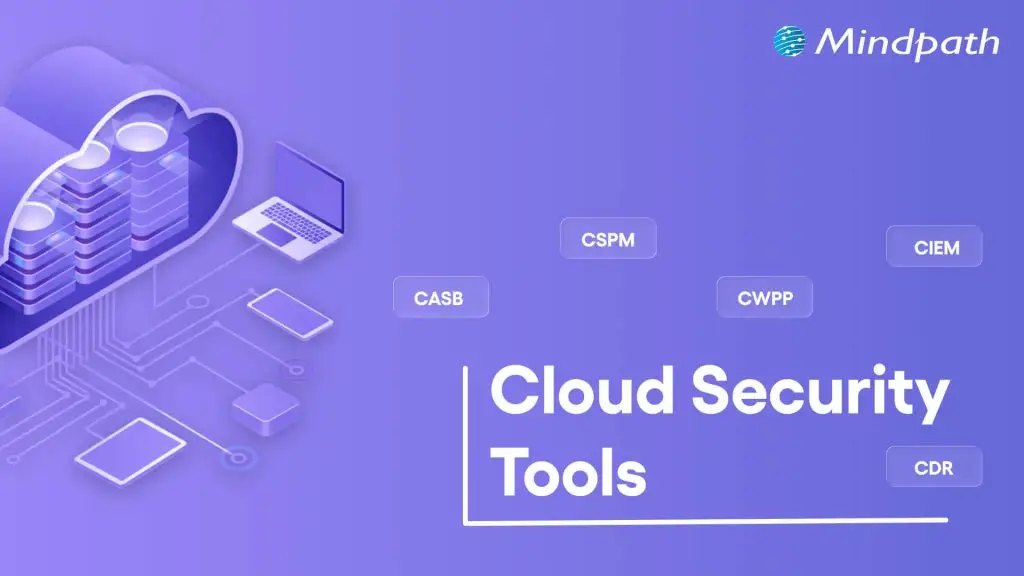
The rising popularity of cloud computing technology in the business world has automatically led to the popularity of cloud security tools. If you leverage cloud solutions in any manner, you need to be aware of the top cloud-based security tools that are available in the market right now. These tools can certainly make or break the cloud cybersecurity posture of your organization.
Now is the best time to learn about the top 10 cloud security tools. The insight can definitely empower you to derive optimum benefits from these tools while leveraging cloud computing technology. It is time to dive into the world of the best cloud security tools.
Want to stay ahead of evolving cloud security threats with the right tools? Mindpath’s Cloud Infrastructure Services combine expert management with advanced security tools to keep your cloud safe and optimized.
What are Cloud Security Tools?
Cloud security tools include a diverse range of technologies, practices, and controls. They collaborate in order to protect data, the cloud infrastructure, along with all the applications within the cloud environment. The main objective of cloud computing security tools is to defend users against internal or external cybersecurity threats. They also play a catalytic role in mitigating business disruptions that may be caused by power outages, natural disasters, or other kinds of serious events.
Business entities need to bear in mind that the need for cloud security solutions is multidimensional in nature. Encryptions as well as antimalware tools help shield applications and data from possible threats. Similarly, firewalls are responsible for regulating traffic flows to cloud resources for determining which data can pass through. Identity and Access Management (IAM) solutions make sure that only authorized individuals can be given access to resources on the cloud. The role of cloud security tools and solutions is of high strategic importance for organizations.
Wondering how emerging trends are shaping cloud security? Check out the latest cloud computing trends to learn what’s driving secure cloud adoption.
Top 10 Cloud Security Tools
Now that you have a basic understanding of cloud computing security solutions, it is essential to look at some of the top cloud security products that are available to you. You need to familiarize yourself with the most popular tools so that you can choose the best product that can meet all your needs perfectly.
1. Auth0
Auth0 is a well-known identity and access management solution that is available in the market today. It can enhance cloud security by offering secure authentication as well as authorization for applications, users, and APIs. It is a highly developer-friendly platform that offers flexible security solutions.
It is highly adaptable in nature, which makes it extremely suitable for businesses of varying sizes. Its robust APIs, coupled with extensive integration options, make it simpler to embed identity and access management into the applications of organisations without compromising the experience of users.
2. Datadog
Datadog is a highly versatile and robust cloud monitoring platform. It integrates in a seamless manner with popular cloud service providers such as AWS, Google Cloud, and Microsoft Azure. The real-time analytics, as well as customizable dashboards, make it easy for businesses to not only track but also to secure their cloud environments. The tool offers the right kind of insights that businesses require in order to maintain security while scaling their operations in a flexible manner.
3. Microsoft Defender for Cloud
These cloud security products offer robust security solutions for Google Cloud, Azure, and AWS. The best thing about this tool is that it perfectly integrates with the Microsoft ecosystem of other security solutions. Some of its core offerings include vulnerability management, threat detection, and compliance monitoring. The built-in automation feature can even help business organizations to detect and mitigate different types of cybersecurity risks and threats.
Also Read: AI in Cybersecurity
4. Wiz
Wiz is a robust cloud security platform that offers complete visibility along with protection across diverse cloud environments. This tool is capable of continuously scanning the cloud infrastructure, containers, and virtual machines for the purpose of identifying misconfigurations.
It also helps locate vulnerabilities as well as compliance risks. It adopts an agentless approach, unlike conventional agents. It connects directly to cloud service providers for rapid deployment. It not only correlates security findings to highlight the most critical risks, but it also helps teams prioritize the remedial solution.
5. Sysdig
Sysdig is among the popular cloud security tools that can monitor as well as safeguard cloud native applications and services. With the help of this tool, business entities can ensure real-time compliance. A unique feature of this cloud security tool is that it makes use of an open-source threat detection engine. This tool can scan container images prior to their deployment, thereby preventing vulnerabilities. Some of the other offerings of Sysdig include runtime protection, visibility, and cloud audit activities.
Planning to build scalable applications without managing servers? Check out our blog on serverless architecture in cloud computing to learn how it simplifies deployment while supporting secure and efficient workloads.
6. Tenable Cloud Security
Tenable Cloud Security is a popular tool in the market that can safeguard your cloud workloads. It can even monitor threats and assess vulnerabilities in an effective and efficient manner. It is considered to be an ideal solution for dynamic cloud environments. With Tenable, you can customize your security policies and streamline the compliance of your cloud infrastructure. You can leverage the continuous monitoring feature in order to keep a constant tab on cloud activities on a frequent basis.
7. Check Point Cloud Guard
Check Point Cloud Guard is a holistic cloud security platform. It has been designed to protect workloads, assets, and applications across private, public, and hybrid cloud environments. It serves as a useful tool since it offers advanced threat prevention along with posture management and network security.
It offers proper visibility into configurations and helps in detecting misconfigurations as well as vulnerabilities on the cloud. Check Point Cloud Guard helps business entities maintain a solid cloud security thanks to its AI-driven threat intelligence coupled with unified management.
Must Read: Benefits of AI
8. Palo Alto Networks Prisma Cloud
Palo Alto Networks Prisma Cloud is a highly scalable cloud security tool that is available in the market today. It safeguards hybrid environments along with multi-cloud environments. This tool places high emphasis on proactive detection of cloud computing threats and their mitigation. You can leverage this tool to ensure there is seamless compliance as well as risk assessment management. This solution integrates advanced analytics along with AI insights to strengthen security on the cloud.
9. Trend Vision One Cloud Security
Trend Vision One Cloud Security is among the best cloud native security tools that you can find today. It is designed to secure cloud environments throughout their entire lifecycle. This tool offers visibility along with compliance management and threat detection. It effectively integrates cloud workload protection and cloud security posture management, which can help in the identification of vulnerabilities and misconfigurations on a real-time basis. It helps business entities detect, investigate, and respond to threats quickly since it is powered by AI-driven analytics and threat intelligence.
10. CrowdStrike Falcon Cloud Security
In order to address cloud security risks, you can choose CrowdStrike Falcon Cloud Security. It serves as a comprehensive platform that can secure your workloads, containers, and the entire cloud infrastructure. These cloud security solutions offer real-time visibility and threat detection. You can use the flexible tool in order to update or change your cloud security strategy. This tool can connect with the cloud ecosystems and identify and resolve cloud computing attacks and risks. You can also discover misconfigurations and ensure data security.
There exists a diverse range of cloud computing security tools today. You need to know your needs well. The insight can certainly help you choose the right tools and solutions in order to deal with cloud computing vulnerabilities and risks.
Looking to improve cloud security as environments become more complex? Learn more about cloud-native development and how it supports secure and scalable apps.
Final Words
You need to familiarize yourself with the best cloud security tools that are available for users today. Your ideal choice depends on diverse factors such as your needs, the features of the tool, and many more. Some of the top tools that exist today include Auth0, Datadog, Microsoft Defender for Cloud, and many more. You need to know the strengths of each of these tools so that you can effectively identify the tool that perfectly aligns with your needs.
Mindpath’s excellent managed cloud services can help businesses effectively identify and choose the best cloud computing security solutions. The experts will use their capabilities and experience to help businesses find the best security solution that perfectly aligns with their business needs and expectations. You can definitely rest assured by partnering with the trusted name.
Selecting the appropriate SaaS development services may seem like walking through a rapidly shifting technological environment. Businesses in the present day require solutions that are innovative, scalable, and flexible. You may end up comparing different providers, and each one of them claims to have unique expertise. The difficulty lies in finding a service that is consistent with your objectives and generates real value. It involves thinking outside the box and taking into account teamwork, problem-solving, and sustainability. So, how are you going to find a service that best suits your business vision?
The key is to find a partner that is knowledgeable about your growth strategy and technology needs. Successful SaaS development services engage both hands-on experience and progressive innovation. When you are seeking options, make sure you take into account compatibility with your team, development strategy, and scalability. You require a clear understanding of procedures, communication, and delivery schedule. This blog will help you make the right decision in your SaaS development journey. Let’s dive in together!
Want to choose the right partner to build scalable and efficient SaaS software for your business? Mindpath’s SaaS Development Services provide expert developers and custom solutions to deliver growth-oriented applications.
Understanding Software-as-a-Service (SaaS) Development
SaaS development refers to the development, deployment, and maintenance of software applications delivered over the Internet as a service. These applications are cloud-based, unlike the conventional software. They are available to users either on a web browser or on an app interface. An effective SaaS development service makes applications to be scalable, secure and user-friendly. It concentrates on delivering constant updates and excellent user experiences across all devices.
SaaS development needs proper software engineering and cloud knowledge. Developers should also know what customers require and what is trending in the market. This understanding enables the creation of software, which is efficient, reliable, and sustainable. SaaS development focuses on cooperation, problem-solving, and constant enhancement in order to fulfill business objectives. It guarantees the product to expand with the user requirements without compromising the performance or security at any point.
Want to understand how SaaS can streamline your operations and drive business growth more efficiently? Discover our guide on the benefits of SaaS to explore how it enhances scalability, flexibility, and cost savings.
The following are reasons why businesses today require SaaS development services:
1. Cost Optimization
SaaS reduces start-up infrastructure and the cost of licensing. Companies enjoy the benefit of stable prices and expenditure.
2. Scalable Architecture
SaaS software development is capable of scaling users and features in an easy way. The systems can easily adapt to growth and demand.
3. Anywhere Accessibility
The use of the cloud allows remote and distributed teams. Users can be able to work anywhere safely.
4. Rapid Deployment
The SaaS solutions take a shorter time to launch via browsers. This minimizes the setup time and fast-tracks time to value.
5. Simplified Maintenance
Service providers deal with updates, security, and performance. SaaS developers assist in lowering internal IT workloads.
6. Innovation Readiness
SaaS solutions are compatible with contemporary tools and artificial intelligence. This helps companies remain competitive and data oriented.
Wondering how AI can transform your SaaS product with automation and predictive capabilities? Read our guide on the benefits of AI to discover its impact on growth and efficiency.
Key Steps to Choose the Right SaaS Development Services
The choice of SaaS development services requires a clear idea, planning, and business orientation. The most important steps to selecting SaaS application development services that facilitate long-term growth are as follows.
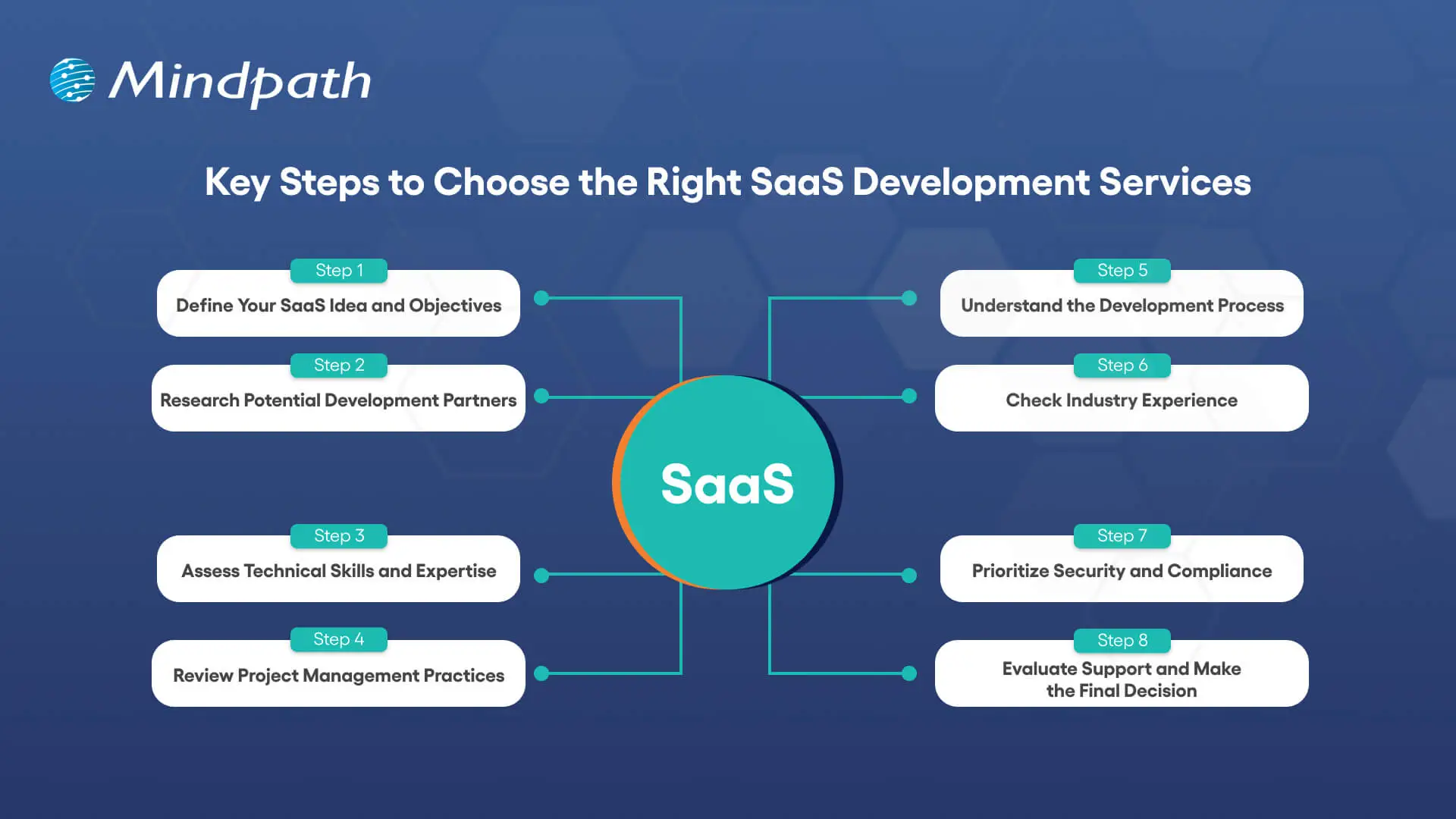
1. Define Your SaaS Idea and Objectives
Be clear about your SaaS concept, what problem it will address, and who your audience will be. Clear goals contribute to the alignment of attributes, functionality, and business objectives in the long run. This transparency enables the SaaS development services to create a product that is focused and efficient.
2. Research Potential Development Partners
Begin by doing research on credible SaaS development companies that have a successful track record with SaaS projects. Check their portfolios, case studies, and feedback from clients to determine credibility. This study can assist you in narrowing down partners who can provide scalable solutions.
3. Assess Technical Skills and Expertise
Evaluate the technical competence of the in-house development team in the front end, back end, and cloud computing. Ensure that they know the process of developing secure and scalable SaaS applications. Well-developed technical capabilities reduce the development risks and improve the overall performance of the product.
4. Review Project Management Practices
Understand how the company manages schedules, work and communication in the development process. Agile project management is flexible and responds more rapidly to changes. Analytical thinking will ensure consistency and quality in development.
5. Understand the Development Process
Inquire about their entire development cycle such as designing, testing, and implementation. Make sure that security and performance, as well as scalability, are considered at an early stage. A trusted Saas development platform enhances easier cooperation and implementation.
6. Check Industry Experience
Experience in the industry helps teams to know more about your business challenges. Experienced developers are able to foresee risks and recommend workable improvements. This results in improved custom SaaS development projects.
7. Prioritize Security and Compliance
Make sure that the development team has good security standards and compliance requirements. The process of development should include data protection and compliance with regulations. This ensures the safety of user information and builds up confidence in the product.
8. Evaluate Support and Make the Final Decision
Evaluate the capacity of the company to offer long-term support and maintenance. Constant improvement and interaction are key to successful products. Select SaaS development services, which reflect your growth plans and vision.
Want to stay ahead in the competitive market by understanding how SaaS is evolving? Discover our guide on SaaS trends to explore the latest innovations shaping the future of the industry.
Ready to Transform Your Business with SaaS?
Selecting the appropriate SaaS development services will keep your company competitive, scalable and efficient. Successful SaaS products are the result of clear planning, technical expertise and strong project management. Using systematic steps assists in choosing partners who provide secure, reliable and innovative solutions. Having the right team ensures your software keeps up with the business requirements and enhances performance and user satisfaction.
At Mindpath, we provide professional custom SaaS development services based on your business objectives. We are a team of prolific developers and present scalable, secure, and user-friendly solutions. Our priorities are innovation, a smooth partnership, and continuous support to achieve optimal performance of your SaaS product. Mindpath is the choice that ensures a future-proofed platform that is designed to expand with your users and business vision.
The world is experiencing a huge technological transition, driven by emerging AI trends. This shift is justified by the active development of Artificial Intelligence and powerful AI models. They are high-end neural networks that have the capability to generate code, pictures, videos, and text. The selection of the top AI models can be a breakthrough for a company.
Whether you are launching new products or developing your strategy of content, the best AI models can make all the difference. However, which is the most appropriate one to meet your business requirements? Well, there is no need to fret about it, as this best AI models list contains the top 10 options that are dominating the AI arena. Let’s have a look.
Ready to implement advanced AI models but unsure which ones can truly move your business forward? Mindpath offers expert AI development services that help you build customised, high-performance AI solutions tailored to your goals.
AI Models – Understand the Basics
Before we dive deep into the list of most popular AI models, let’s understand what AI models actually are.
AI models refer to complex computer programs that are used to interpret different patterns and provide results depending on the data. These models power modern tools that code, comprehend languages, and create images.
While certain top AI models are built to perform simple tasks, others focus on domain-specific tasks. The use of AI tools and models is growing with time. In fact, more than 88% of businesses are now using AI tools, and in 2004, it was 78% (Source: McKinsey).
Another report for Gartner informs that total spending on generative AI is projected to cross USD 644 billion in 2026, around a 76% increase from 2025. These numbers clearly prove the rising importance of AI for today’s business.
Want to understand the different kinds of artificial intelligence? Explore types of AI to learn about ANI, AGI, and ASI, and how each is applied in real-world scenarios.
Now, let’s talk about the top AI models you can opt for in 2026 that can support your workflows and business growth.
Top 10 AI Models for Modern Businesses
The best AI models are not just designed to process data. In fact, they have the ability to think and create. Some models can interact like humans, and some can easily explain complex logic. Here are the 10 most popular AI models that define innovation and power.
1. GPT-5
When talking about which AI models are the most popular right now, we can’t ignore GPT-5. Developed by OpenAI, this is the most powerful AI model available to all. It can handle multiple tasks, including code generation, audio, images and text creation. GPT-5 is now powering tools like ChatGPT and Microsoft Copilot.
This model helps users plan, write and solve issues with ease. Besides, it supports ultra-long conversations. That means when you use it, you will feel like interacting with an intelligent assistant. GPT-5 is a versatile model and can be used for personal productivity apps or enterprise tools.
Want to customise AI models for your specific needs? Check out our OpenAI Fine-Tuning API tutorial to learn step-by-step how to fine-tune models for better performance and accuracy.
2. Claude Sonnet 4.5
It is one of the most advanced AI models by Anthropic. Claude Sonnet is developed for power users looking for deep reasoning, speed and precision. This model offers impressive results on maths, long-running tasks and coding.
It is an excellent option for businesses that prioritize ethical AI, reliable automation and compliance. With a 200K token input and powerful tools like content editing, it can handle various complex workflows easily.
3. Gemini 3
Searching for top AI models that can help you bring your ideas to life? Gemini 3 can be a top choice. Developed by Google DeepMind, this model supports sophisticated reasoning and helps users learn and create anything they want.
People like to use Gemini, as it is smart and feels intuitive. Whether you want to analyze complex data, summarize documents, or brainstorm new ideas, Gemini can be your reliable assistant.
4. DeepL
Another popular AI model you can consider is DeepL. It offers quick and accurate translation services. It is popular for its amazing human-like output and impressive accuracy. The model supports multiple languages, more than 30 languages.
Content creators, businesses, and professionals use it for translating documents, emails, and websites. Recently, the company introduced DeepL Write, which helps users with spelling, grammar, and more.
5. Grok 4.1
It is xAI’s most powerful and intelligent AI model and is integrated into X. The model is designed for collaborative, creative, and emotionally intelligent interactions. As a result, all conversations feel more engaging and natural.
The model is generally trained on social media data and can be easily adapted to evolving internet culture. Built on a large-scale reinforcement learning infrastructure, it offers a more compelling and perceptive experience.
Also Read: Benefits of AI
6. Mistral AI’s Mistral Large 2
Mistral Large is an advanced and high-performance language model introduced by Mistral AI. The model is capable enough to handle advanced reasoning and multilingual tasks. It is optimized for accuracy and speed. If you are developing chatbots or want to optimize technical workflows, you can give it a try.
Different from other Mistral models, it activates all parameters and offers consistent results. It can achieve an accuracy rate of 84 percent for code generation (Source: Mistral AI).
7. DeepSeek VL
The AI models list will remain incomplete without covering this particular AI model. This open-source Vision Language model is quite efficient for real-world language and vision applications. It can understand logical diagrams, scientific literature, charts, diagrams, web pages, and more.
Educators and researchers utilize it to analyze scientific papers and make complex concepts easy to understand. The company is now working on a new model that can perform multi-step and complex actions with less human input.
8. Llama
Introduced by Meta, Llama models are developed based on an open-source approach. The latest model released by the company is Llama 4, and it includes two multimodal models, such as Llama 4 Maverick and Llama 4 Scout.
All these models can process short videos, images, and text. As these are based on a MoE- Mixture-of-Experts architecture, they demonstrate increased efficiency. Its open-source nature provides developers with better control and flexibility. You can fine-tune it as per your requirements.
9. Stable Diffusion
It is an open-source AI image creation model based on the Stable Diffusion XL model. The model is popular for generating high-quality images using various text inputs such as frame, presets or style.
Besides, it can also replace or add parts of any images through “outpainting”. Whether you need help for digital storytelling, concept art or marketing, Stable Diffusion can offer you a perfect kickstart. Its speed, community-driven ecosystem and flexibility make it one of the top AI models among designers, artists and content creators.
Wondering how AI can understand and generate human-like text? Check out our Large Language Model (LLM) blog to learn how LLMs power smarter applications and chatbots.
10. Cohere Command R+
This powerful large-language model is built for accuracy, speed and smooth private deployment. It is developed for enterprise-grade search and document analysis. By combining real-time document processing with large language models, it offers accurate question answering and summarization.
Thanks to its API-first design, you can easily integrate it into your existing system. Most businesses are using it for customer support, legal discovery and knowledge management. In an environment where context and accuracy are vital, this model offers reliable performance.
Tips to Choose the Right AI Models
Well, it is common to feel overwhelmed as the options are more. However, by considering these simple tips, you can come up with an informed decision.
1. Understand how you want to use an AI model, for content creation or other purposes.
2. Now, consider your budget as well as your technical skills. If you are using a model for the first time, you can go for GPT 5 or Gemini. Mistral and Llama require technical skills.
3. Don’t forget to check context length. Longer context windows are good for performing multi-step tasks.
4. Go for the free web version and test models properly. Compare the results before making your final decision.
Want to know how AI models focus on important information? Read our attention mechanism explained blog to understand this key concept behind modern AI and LLMs.
Let the Experts Help You Choose the Best AI Models
The AI model arena is evolving rapidly. Some top AI models such as GPT-5 and Gemini, are establishing a new level of accuracy and performance. Specialised models, such as Cohere and Stable Diffusion, on the other hand, are dominating their niches.
Still don’t know which top AI models to use for your business? Allow Mindpath to help to make the right decision. Our team can help you identify, deploy, and fine-tune AI models best suited for you. We also help businesses with AI development services, which guarantee scalability and performance.
Frequently Asked Questions
In the fast-changing business world, AI agents are making a big impact by helping businesses work faster and smarter. As a business owner, you can certainly consider using AI agents for the purpose of automating repetitive tasks and gaining data-driven insights that can help in making strategic decisions. In fact, the strategic integration of AI agents by retail businesses has shown a 30% decline in operational costs, reports Experro in AI Agent Statistics 2025. It shows that when used well, AI agents can boost business efficiency and give a strong competitive edge.
AI agents have definitely cemented their place in the business realm of the 21st century within a short span of time. Although the novel technology is in its nascent stage, it has shown immense promise. Let us explore the role of AI agents in the modern business landscape.
Looking to build AI agents that collaborate to solve complex business challenges? Explore Mindpath’s Multi-Agent System Development Services to create intelligent, scalable systems that automate workflows and improve decision-making.
What are AI Agents?
An AI agent is a software system that can perceive its environment, make decisions, and autonomously take multi-step actions to achieve a specific goal, without requiring constant human input. Unlike traditional chatbots, AI agents go well beyond natural language processing. Their core capabilities include problem-solving, decision-making, tool use (such as web search and APIs), and direct interaction with external systems.
What makes AI agents unique is their ability to break down complex tasks, learn from mistakes, and operate autonomously across enterprise applications. They can solve tasks relating to software design and code generation. Additionally, they are capable of solving tasks relating to conversational assistance as well as IT automation. AI agents basically utilize advanced natural language processing techniques for the purpose of comprehending and responding to the inputs of users.
Curious how AI agents can improve your organisation’s choices? Discover AI in Decision Making to learn how intelligent systems enhance efficiency, reduce risks, and support strategic planning.
Benefits of Using AI Agents In Business Operations
The use of AI in business operations has gained momentum in recent years. Business entities of different natures and sizes have been integrating the capabilities of artificial intelligence in order to simplify and streamline their operations. Furthermore, the emergence of AI agents has been nothing less than a boon for businesses. Some of the popular AI agent examples that you may come across today include Siri as well as Google Assistant.
Some of the top benefits that businesses enjoy by adopting AI agents in their processes and operations include:
1. Increased level of productivity
AI agents undoubtedly increase the overall productivity of business entities. This is possible since AI agent software is able to automate repetitive and time-consuming tasks. Businesses can leverage AI agents and ensure that their human employees can be free to focus on more complex and high-value tasks and processes. This automatically increases the output of businesses.
2. Cost savings
AI agents deliver considerable cost savings for business entities by automating routine operations and minimizing the requirement for labour. With the help of AI agents, you can also decrease operational expenses in a number of areas, such as customer service. Furthermore, by relying on AI agents, the possibility of errors is reduced significantly.
3. Better customer experience
The incorporation of AI agents by businesses creates an opportunity to enhance customer experience. With the help of AI agents, such as chatbots, businesses can offer personalized responses to their customers. Moreover, these AI agents can ensure to respond to the queries and complaints of customers instantly. Therefore, the overall satisfaction level of customers can be enhanced if businesses use AI agents. In fact, the introduction of AI agents in the customer service landscape is nothing new today.
4. Improved operational efficiency
Businesses are able to accelerate their workflows and streamline their processes by leveraging AI agents. AI agents create an opportunity for businesses to coordinate diverse processes and decrease delays. So, businesses are able to focus on their priority areas and optimize their operations. Furthermore, the 24/7 availability of AI agents ensures that there is productivity in an ongoing manner without any downtime.
Wondering how AI agents can directly impact customer engagement? Explore AI Chatbot Examples to discover how intelligent automation improves conversions and customer support.
Revolutionary Impact of AI Agents on Business Operations
In the digital era, numerous digital tools and technologies have come into existence that have been adopted by businesses. However, a technology that is full of promise is none other than the AI Agent. Several business entities have witnessed the power of AI agents. In order to understand the revolutionary nature of AI agents, you need to take a look at their key impacts:
1. Automation
AI agents are optimizing the workflows of businesses through automation. They serve as valuable tools that can automate complicated or complex tasks that would otherwise need human resources. AI agent automation is undoubtedly one of the main areas that has undergone change in the modern business landscape. This shift certainly represents a major change in how businesses operate and handle tasks while ensuring resource optimization. Automation has definitely been acting as a key driver when it comes to modernizing business operations.
2. Data-Driven Insights
The data-driven insights that are powered by AI agents have the potential to help businesses make strategic decisions. As a business owner, you can definitely consider integrating AI agents into your decision-making process. Since AI agents are capable of analyzing a large volume of data, your business can strategically utilize them to uncover patterns and trends. Using AI agents in decision-making is of high strategic value since it can empower businesses to optimize their processes and forecast demands. Moreover, through the data-driven insights, you will be capable of detecting risks that may not be noticed by human beings.
3. Improved Customer Service and Support
The impact of AI business transformation can be felt in the area of customer service and support. The activities that are undertaken in the customer service domain are typically repetitive, and they are high in volume. In recent times, businesses have been integrating AI agents in their customer service function in order to promptly respond to the needs of the customers. This shift has been creating value not only for businesses but also for customers. Business entities are able to promptly respond to their customers thanks to AI agents. Similarly, customers do not have to wait for long hours to get their queries resolved.
4. Increased Scalability
Heightened scalability through AI agents has certainly been transforming business operations today. This is because organizations are able to handle a high workload without having to increase their human resources. While adopting conventional models, businesses had to hire more staff to meet demand. However, that is not the case when it comes to AI agents. AI agents are capable of managing high volumes of tasks in an autonomous manner. Hence, there is efficient as well as rapid scaling that creates value for businesses.
Want to tailor AI agents for your specific business needs? Explore OpenAI Fine-Tuning to discover how you can customize models for smarter, task-specific intelligence.
Best Practices While Incorporating AI Agents
In order to derive optimum value from AI agents, it is fundamental for businesses to adopt best practices. Such practices can play a catalytic role and enable your business to transform its operations in the intended manner. Some of the best practices that business entities need to bear in mind are:
1. Maintaining expert oversight
It is true that AI agents are capable of making decisions in an independent manner. However, human experts need to have the final authority over the decisions made by AI agents. As AI agent development is still a new concept, the role of human beings cannot be negated. Furthermore, it is crucial to set clear guidelines relating to the level of autonomy of the agents.
2. Provision of internal data for training
Business entities need to bear in mind that the effectiveness of AI agents depends on the data used for training. As a business owner, you need to make sure that the AI agents remain connected with the appropriate data sources. This step is crucial to increasing the overall effectiveness of AI agents in the business context.
3. Fostering a collaborative mindset
The staff should understand how AI agents work so that they can be optimally put to use. Members from the technical and non-technical teams must work together to gain a detailed insight into the key features and functionalities of AI agents. They need to locate areas where AI-based automation can alleviate or remove challenges.
4. Emphasis on regular training
Business firms must arrange training workshops and other educational sessions so that their team members can cultivate essential skills to leverage AI agents. The team members need to be updated about the latest developments in the AI landscape.
Looking to see how AI agents can boost your business growth? Explore AI in Business Strategy to discover how autonomous systems align with long-term goals and competitive advantage.
Final Words
AI agents have certainly emerged as a revolutionary force in the contemporary business realm. Business firms can leverage these novel tools to streamline their work processes. Moreover, you can make use of AI agents to simplify how you handle your work and operations. In the prevailing business era, AI agents can certainly act as a lifesaver for your business and help you accomplish your business goals and objectives in an efficient and effective manner.
Mindpath offers world-class AI development services that perfectly meet the needs of modern businesses. You must leverage these services so that your business can be equipped to capitalize on AI agents in an optimal manner. Our top-notch solutions can certainly transform your business processes and practices while giving you a competitive edge against your rivals and competitors.
When companies get ready to build a reputable online position, finding well-suited WordPress development services is a critical step. It involves building a functional website that loads quickly and continues to engage the visitor. In a competitive marketplace, companies will be expecting advanced features, secure environments, and designs that reflect their brand. This is where those with professional experience can deliver outstanding results.
What can companies realistically expect from investing in these services? Expectations generally revolve around the key themes of customization, scalability, and ongoing support that allow a business to scale without the technical pieces creating problems. When working with the right website development company, companies can explore solutions that are practicable, innovative, and in line with their goals. In this blog, we will discuss what companies should expect from WordPress services.
Want to build a visually appealing site with a team that thinks beyond code and provides guidance? Mindpath offers wordpress development services that combine design, performance, and transform your website into a powerful business tool.
Understanding WordPress Development Services
The WordPress development service provides businesses with the ability to build, customize, and maintain websites with the WordPress CMS; designing custom themes, building plugins, and making sure the site runs smoothly. They also take an active role in enhancing load time, security, and ensuring mobile adaptability. This way, every website is professional-looking and working efficiently for the user.
These services also involve e-commerce integration through tools such as WooCommerce, so businesses can sell products online with ease. Professionals offer routine updates, troubleshooting, and assistance that keep websites functioning well. Organizations can have scalable and user-friendly platforms that are capable of evolving with their needs.
Types of WordPress Development Services
Companies today utilize top WordPress development services for building secure, flexible, and manageable websites. These services offer an array of different solutions for different business needs and establish solid organic growth online.
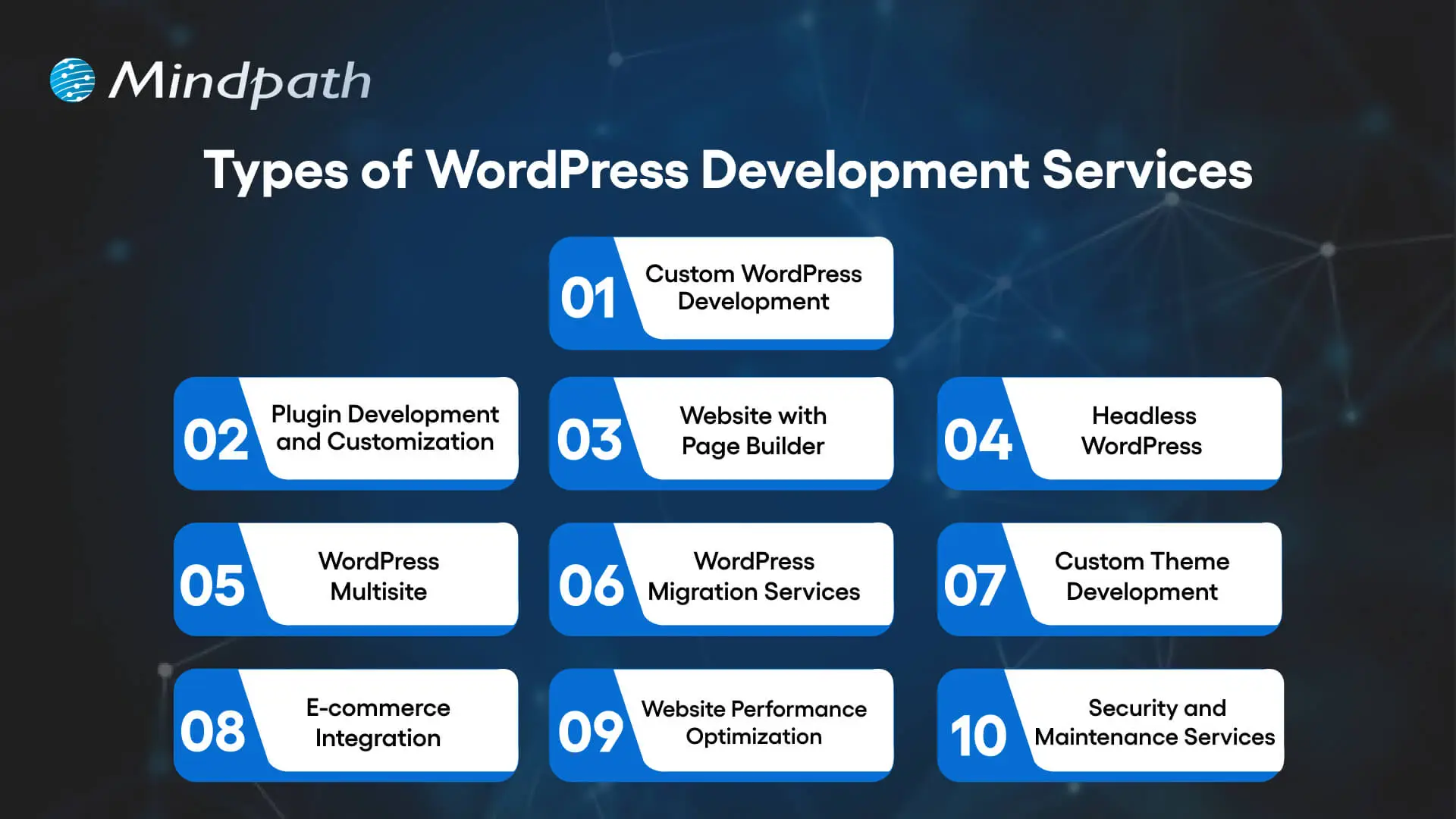
1. Custom WordPress Development
Custom WordPress development service is aimed at developing websites with custom designs and functions. Developers use tools such as ACF to create custom fields and, in all cases, deliver solutions that meet the needs of the businesses.
2. Plugin Development and Customization
Plugins are used to expand the functionality of a WordPress website to suit particular needs. Developers can build new plugins or customize existing plugins to provide the functions that a business needs exactly.
3. Website with Page Builder
The use of a website page builder like Elementor, Divi, or Beaver Builder makes the design visually attractive and allows for more options for a non-technical person to build and design layouts.
4. Headless WordPress
Headless WordPress separates the back-end and front-end of WP in order to allow a developer to use frameworks like React or Vue.js. This gives you faster speeds and finer items of design customization.
5. WordPress Multisite
Businesses with more than one website can use Multisite to manage many WordPress sites in one installation. An example of a use case would be if a business has a brand site and sub-blogs.
Wondering how to make your WordPress site accessible to all users? Read our web accessibility guidelines blog to learn best practices for inclusive design.
6. WordPress Migration Services
Many times, proper attention is needed when migrating a website to WordPress to ensure there are no downtimes or loss of data in the transition. Specialists assist with a seamless transition by safely transferring the content, settings and functionality from the old website.
7. Custom Theme Development
A custom theme is developed to define an identity and aesthetic style for the website. This service makes certain that the website presents a unique look and feel that fits the brand guidelines.
8. E-commerce Integration
Companies can leverage WooCommerce to transform WordPress into a completely functional online store. Developers will add features like shopping carts, secure payment processing, and product catalogs.
9. Website Performance Optimization
Enhancing website loading speed and overall performance improves user experience and SEO rankings. Developing professionals are working on caching solutions, code optimization, etc. to keep sites and pages loading quickly.
10. Security and Maintenance Services
Continual updates and security are critical to protecting you from threats/downtime. Developers provide site monitoring, timely fixes, and sometimes other unrelated maintenance and management tasks to keep everything operating normally.
Concerned about WordPress security risks? Check out safeguarding common WordPress vulnerabilities to protect your site from common threats.
Advantages of Custom WordPress Development Services
Teaming up with a WordPress web development company you trust provides businesses with additional advantages beyond simply having a website. With professional support, businesses can custom-build solutions that improve performance, provide security, and give assurance of future growth.
1. Expert Knowledge
Expertise in WordPress development will add real value to your website project. WordPress developers code in PHP, CSS, and JavaScript, manage a secure database, and generate a high-quality website design. They can also integrate analytics tools that allow you to track user behavior and engagement trends informing better business decisions.
2. Personalized Solutions
Professional WordPress development services create unique websites that are configured for your specific business needs. They select the appropriate compatible plugins and themes for your site and may develop custom WordPress plugins, if necessary, for unique functionality and features. This guarantees you have a completely customized site that will also not detract from your site’s speed and responsiveness.
3. Save Time and Cost
Partnering with dedicated WordPress development service providers will accelerate website development while ensuring quality work. Their professionals will be effectively using the right tools to work through plugin integration, debugging and theme customization. While there can be an initial investment, it is cost-effective because you can save later on maintenance and updating in the future.
4. Strong Website Security
A competent team providing WordPress application development services uses security measures to ensure your site remains secure. Firewalls, encryption and periodic security audits are some examples of techniques they may use to assess the risk of unauthorized access to your site. As a result, they use these techniques to secure sensitive data and deliver your site reliably.
Want to ensure your WordPress site runs smoothly? Read our WordPress and PHP compatibility guide to understand which PHP versions and practices work best.
5. Better User Experience
Optimization of WordPress site design centers on performance, responsiveness, and usability. Expert designers develop mobile-friendly layouts and seamless user journeys to lower bounce rates. Better user experience leads to increased engagement and higher business revenue overall.
6. Scalable Solutions
Utilizing proficient WordPress development services allows for flexibility in alignment with your business growth. For example, you can hire developers for specific projects like custom WordPress development or for e-commerce extensions, allowing for flexibility in resourcing and flexibility during transitions with the business.
7. SEO-Friendly Content
Developing your website with an expert WordPress development company will position your site to succeed with SEO. They will optimize themes, use meta tags, and initiate your site with several SEO plugins to help showcase your content and reach your intended audience, all while providing a better chance of ranking well in search engines.
8. Access to Latest Trends
WordPress development services are focused on keeping your site fresh in design, technology, and user experience. They all update your site with new features, mobile betterment, and use of new tools to keep ahead of other sites. It is a benefit for your site to meet standards while exciting users.
Ready to Transform Your Website with Expert WordPress Development Services?
Investing in professional WordPress development services ensures your website is fast, secure, and tailored to your business needs. These services offer customization, scalability, and ongoing support to enhance user experience, improve SEO, and drive growth. Companies can rely on experts to deliver solutions that keep their websites modern, functional, and aligned with their brand goals.
At Mindpath, our WordPress development services provide businesses with custom themes, plugin development, and e-commerce integration. We optimize your website for peak performance, security, and user engagement. With our expert team, you can focus on growing your business while we handle all aspects of website design, development, and ongoing support.
Have you ever thought to yourself about how AI can interpret images, voices, or texts so accurately? Well, it is due to the rapid growth of the role of vector databases in AI applications. Standard databases do a good job of storing structured data, while much of AI work involves dealing with complex and unstructured information. Vector databases provide methods for storing and comparing information which allow machines to recognize patterns, context, and meaning much faster and with higher accuracy.
As AI systems become more intelligent, the demand for methods to support thinking beyond the simple data is also increasing. Vector databases provide that opportunity for AI to correlate information, learn from it, and generate more impactful results. They are quickly becoming the framework of modern AI innovation. In this blog, we will take a look at the power of vector databases in AI applications and why they are a necessary future element of intelligent systems.
Looking for a way to enhance personalization with the help of AI in your apps using a vector database? Explore Mindpath’s AI development services, which provide expert guidance and knowledge on how to maximize the value of the vector database to elevate your AI capabilities.
What is a Vector Database for AI?
A vector database is a specific type of database that enables storing and searching for data represented as vectors. Vectors are sets of numbers that represent the meaning or features of data such as text, images, and audio. Instead of searching for exact matches of data, a vector database searches for similar items, based on the context, illuminating AI’s capacity to perform at a more intelligent level based on context.
In basic terms, it works like the brain of AI systems that require memory and comparison. A vector database in AI enables quick and accurate data searches among very large and complex datasets. They are often used in applications such as chatbots, recommendation engines, and image searches where the response time and clearly related results mean everything.
Curious how AI chatbots can boost engagement and revenue? Discover AI Chatbot examples to learn how vector database-driven intelligence improves customer interactions.
How Does a Vector Database Work?
Vector databases assist artificial intelligence to comprehend and look through data in terms of meaning rather than precise words. Data is stored as numbers that illustrate what the data depicts. This helps AI connect ideas, find similarities, and give more accurate and useful results.
1. Creating vector embeddings
AI models process raw data to create vectors, which are sets of numbers that represent the meaning of the data. Vectors are mechanisms for AI to understand the connections among different data points.
2. Storing and indexing vectors
The vectors are kept within a vector database, which can be indexed with smart indexing methods, such as HNSW (Hierarchical Navigable Small World) or IVF (Inverted File Index). The role of vector databases in AI applications here is to store, group, and quickly find similar data when needed.
3. Performing similarity search
When the search begins, it will convert the query into a vector, which it begins to compare to other stored vectors. The database returns the closest elements based on meaning, so the AI can accurately and relevantly respond to the user.
Looking to optimize AI models without heavy computational costs? Explore Low-Rank Adaptation (LoRA) to discover techniques that improve vector database-powered AI efficiently.
Role of Vector Database in AI Application
The importance of the vector database for the AI application is becoming more necessary and prevalent as AI works with larger and more complicated data. Below are the main ways in which it helps and enhances the AI systems.
1. Smarter Search with Meaning
An AI application that utilizes a vector database can perform searches on meaning, rather than just a specific word. It finds things that are contextually similar in vector space; this is a lot more precise and much more human-like. This is incredibly useful, because the AI system can determine what users mean, not simply what they type.
2. Supporting Retrieval-Augmented Generation (RAG)
Vector databases provide large language models with access to current facts, knowledge, and data points from the public domain. The user’s inquiry is converted to a vector, which retrieves information from data similar to that represented in the user’s question. The information and materials retrieved help the AI provide responses that are elevated in relevance and made to be factually accurate.
3. Managing Complex Data Types
The role of vector database in AI application is to be able to manage unstructured data including images, text, and audio. A vector database does this by representing the unstructured data as numerical vectors that convey meaning. This allows AI to be able to compare unstructured data types more easily.
4. Enabling Fast Similarity Search
Vector databases leverage novel algorithms to identify similar items quickly, even among massive datasets. This capability is crucial for a number of artificial intelligence (AI) applications that depend on real-time results. The vector database in the AI application in this case is to return results quickly and still maintain precision.
5. Improving Recommendations
Recommendation systems utilized vector databases to recommend similar attributes to items or products that users had liked before. AI uses patterns in the vectors and can customize content for each individual. This leads to a more meaningful and engaging experience for the user.
6. Powering Computer Vision
In computer vision, a vector database in AI helps identify and compare images or videos efficiently. It supports tasks like face recognition, image search, and visual content filtering. By finding visually similar vectors in AI systems it improves speed and accuracy.
7. Building AI Memory
The role of the vector database in AI applications is that it is a dependable memory mechanism for the AI agents. It strengthens the AI agent’s ability to store and retrieve information in support of reasoning and decision-making. Thus, vector capacity increases the multi-step capabilities of AI agents when solving complex tasks.
8. Hybrid and Refined Search
Vector databases have the ability to merge traditional filters like date or category with similarity search. This hybrid effort increases the precision and relevance of a search result. Users can quickly and clearly find exactly what they are looking for.
Wondering how AI systems focus on the most important information in complex datasets? Discover the Attention Mechanism to learn how it enhances AI performance in combination with vector databases.
Ready to Build Smarter AI Solutions with Vector Databases?
Vector databases are transforming how AI systems process and understand information. They enable faster searches, handle complex data, and make AI responses more meaningful and accurate. As technology continues to advance, the role of vector databases in AI applications will remain central to building intelligent and scalable solutions across industries.
At Mindpath, our AI development services combine the power of vector databases with advanced machine learning models to build smarter and more efficient systems. We help businesses create intelligent applications that learn, adapt, and deliver real results. Partner with us to design AI solutions that drive innovation and long-term success.
Businesses all over Canada are always under pressure to make apps that are fast, scalable, and able to handle real-time interactions in today’s digital-first economy. Your backend technology is very important for long-term success, whether you’re a startup launching your first product or a big company updating old systems. Node.js has become one of the most powerful and widely used backend technologies available today.
This in-depth guide will help you understand Node.js and its benefits, developer skills, hiring models, costs, and best practices if you want to hire NodeJS developers in Canada. This article is set up to give you a full, useful guide to hiring the best Node.js developers in Canada.
Why You Should Hire NodeJS Developers?
Cities like Toronto, Vancouver, Montreal, and Ottawa are at the forefront of innovation in Canada, which is one of the fastest-growing tech hubs in the world.
Important Reasons to Hire in Canada
1. Highly Skilled Talent Pool
Canadian developers are known for having a lot of technical knowledge.
2. Quality Education System
The best universities make good software engineers.
3. Stable Economy
Canada is a safe place to do business.
4. Time Zone Advantage
Works well with businesses in the US.
5. Strong Work Ethics
Employees who are professional and dependable.
For North American businesses, hiring NodeJS developers in Canada guarantees high-quality work and easy communication.
Important Skills for NodeJS Developers
You need to look at both technical and interpersonal skills when hiring expert NodeJS developers.
1. Core Technical Skills
- Strong knowledge of JavaScript (ES6+)
- Proficiency in Node.js frameworks like Express.js or NestJS
- Experience with REST APIs and GraphQL
- Understanding of asynchronous programming
- Familiarity with databases (MongoDB, MySQL, PostgreSQL)
- Knowledge of Git and version control
2. Advanced Technical Skills
- Microservices architecture
- Cloud services (AWS, Azure, Google Cloud)
- Docker and Kubernetes
- CI/CD pipelines
- Security best practices
3. Soft Skills
- Problem-solving mindset
- Communication skills
- Ability to work in agile teams
- Time management
A good developer should be able to write clean code and know how to make a program work for a lot of users.
Hiring Models for NodeJS Developers
The size, budget, and timeline of your project will help you choose the best hiring model.
1. In-House Developers
- People who work full-time
- Best for projects that will last a long time
- Higher cost because of benefits and infrastructure
2. Freelancers
- Cost-effective and adaptable
- Great for small or short-term projects
- Can be hired right away
3. Dedicated Developers
- Only work on your project
- Best for new businesses and teams that are growing
4. Remote NodeJS Developers
- Get access to talent from all over the world
- Cut down on the costs of doing business
- A hiring process that goes faster
Step-by-Step Process to Hire NodeJS Developers in Canada
Hiring the right Node.js developers in Canada requires a well-planned and structured approach. With a rapidly growing tech ecosystem and increasing demand for skilled professionals, businesses need a clear hiring strategy to identify the right talent, reduce risks, and ensure long-term project success.
Step 1: Identify Your Project Needs
Begin by clearly defining your project requirements in detail. This includes outlining the scope of the project, core features, and expected outcomes. Determine whether you are building a real-time application, API, SaaS platform, or enterprise solution. Additionally, establish your budget, timeline, and preferred technology stack. A well-defined project plan not only helps you communicate your vision effectively but also ensures you attract developers who are aligned with your technical and business objectives.
Step 2: Select the Appropriate Hiring Model
Choosing the right hiring model is crucial for balancing cost, flexibility, and control. Evaluate whether you need full-time developers for long-term collaboration, freelancers for short-term or specialized tasks, or remote development teams for scalability. Consider factors such as project complexity, duration, and internal resources. Making the right choice at this stage can significantly impact productivity, communication, and overall project efficiency.
Step 3: Develop a Comprehensive Job Description
Create a detailed and well-structured job description that clearly communicates your expectations. Include required technical skills such as proficiency in JavaScript, Node.js frameworks (e.g., Express.js, NestJS), API development, and database management. Define roles, responsibilities, deliverables, and the level of experience needed. A strong job description not only attracts qualified candidates but also filters out unsuitable applicants, saving time during the hiring process.
Step 4: Explore Talent Through Multiple Channels
To find the best Node.js developers in Canada, use a combination of sourcing channels. Leverage professional networks like LinkedIn, freelance platforms such as Upwork, and specialized tech job boards. You can also explore developer communities, referrals, and recruitment agencies. Using multiple channels increases your reach and improves your chances of finding experienced and reliable developers in a competitive market.
Step 5: Review and Shortlist Candidates
Carefully evaluate candidate profiles by reviewing resumes, portfolios, and past work experience. Focus on previous projects that are similar to your requirements and assess their contributions. Checking GitHub repositories can provide insights into coding standards, problem-solving approaches, and real-world experience. Shortlisting the right candidates ensures you move forward with individuals who have both the technical expertise and relevant experience.
Step 6: Conduct Technical and Practical Assessments
Assess candidates through a combination of technical interviews, coding tests, and real-world problem-solving exercises. Evaluate their understanding of Node.js concepts such as asynchronous programming, event-driven architecture, API integration, and database handling. Practical assessments help you determine how candidates approach challenges, write efficient code, and perform in real project scenarios.
Step 7: Complete Hiring and Ensure Smooth Onboarding
Once you have selected the right candidate, finalize the hiring process by offering competitive compensation and clearly defining roles, responsibilities, and expectations. Provide structured onboarding, including access to tools, documentation, and workflows. A smooth onboarding process helps developers integrate quickly into your team, improves productivity, and sets the foundation for long-term success.
Cost of Hiring NodeJS Developers in Canada
There are several factors that influence the cost of hiring a NodeJS developer in Canada, including experience level, geographic location, and the hiring model you choose.
1. Hourly Rates
(Based on Glassdoor and market salary data)
- Junior Developers: $30 – $50/hour
- Mid-Level Developers: $50 – $90/hour
- Senior Developers: $90 – $140+/hour
2. Annual Salaries
(Source: Glassdoor Canada & Payscale)
- Junior: ~$60,000 – $75,000/year
- Mid-Level: ~$75,000 – $100,000/year
- Senior: ~$100,000 – $130,000+/year
Factors Affecting Cost
1. Developer Experience
Senior developers charge significantly higher rates
2. Geographic Location
Cities like Toronto and Vancouver have higher salaries
3. Project Complexity
Advanced applications (SaaS, real-time systems) cost more
4. Engagement Model
In-house, freelance, or outsourcing impacts pricing
5. Technology Stack
Skills like cloud, DevOps, and microservices increase cost
Hiring developers who work from home can save you a lot of money while still getting good work done.
Why Hiring Dedicated NodeJS Developers in Canada is a Smart Long-Term Investment?
Hiring dedicated NodeJS developers in Canada is one of the most effective ways to build scalable, high-performance applications while maintaining quality and long-term consistency. For businesses looking to hire NodeJS developers in Canada, dedicated developers offer greater reliability, stronger collaboration, and better project control. This hiring model is especially beneficial for startups, growing businesses, and enterprises that need continuous development and long-term technical support.
Key Benefits of Hiring Dedicated NodeJS Developers in Canada
1. Full Commitment to Your Project
Dedicated developers work exclusively on your project, ensuring steady progress, faster delivery, and minimal distractions.
2. Consistent Focus and Higher Productivity
Since they are fully involved in your project, dedicated NodeJS developers in Canada can maintain momentum, meet deadlines, and deliver quality results consistently.
3. Better Understanding of Business Goals
Over time, dedicated developers gain deeper insights into your business objectives, workflows, and user needs, leading to more tailored and effective solutions.
4. Improved Code Quality and Maintainability
Continuous involvement helps maintain coding standards, improve system performance, and reduce technical debt.
5. Faster Issue Resolution and Support
Dedicated developers can quickly identify and fix bugs, performance issues, or technical challenges, reducing downtime and improving efficiency.
6. Seamless Team Integration
Dedicated NodeJS developers act as an extension of your in-house team, aligning with your processes, communication tools, and project workflows.
7. Scalability and Flexibility
This model makes it easier to scale your team up or down based on project demands without disrupting progress.
8. Long-Term Cost Efficiency
Although the initial investment may be higher, dedicated developers reduce costs related to hiring, onboarding, and managing multiple short-term resources.
9. Greater Control and Transparency
You benefit from direct communication, better visibility into progress, and more control over timelines, priorities, and deliverables.
Common Mistakes to Avoid When Hiring Dedicated NodeJS Developers in Canada
- Not clearly defining project requirements
- Hiring based only on cost rather than expertise
- Ignoring communication and collaboration skills
- Skipping technical interviews or coding tests
- Choosing the wrong hiring model for your project
Hiring dedicated NodeJS developers in Canada can provide significant long-term value when done correctly. By choosing the right talent, setting clear expectations, and avoiding common mistakes, businesses can build stronger development teams, improve product quality, and achieve faster, more sustainable growth.
Hire Top NodeJS Experts in Canada to Accelerate Your Business
Businesses that want to make high-performance, scalable apps should hire NodeJS developers in Canada. Canada is a great place to hire both local and remote developers because it has a lot of talented people, low prices, and a growing tech ecosystem.
You can confidently hire expert NodeJS developers who will help you reach your business goals and get great results if you know what skills they need, how to hire them, how much it will cost, and what the best practices are.
Companies need backend technologies that can handle real-time data, are quick, and can grow with the business in today’s digital-first economy. Node.js is now one of the most popular backend tools for building SaaS platforms, fintech apps, and business software.
California is one of the best places to find Node.js developers because it is home to Silicon Valley and some of the biggest tech companies in the world. You need to know a lot about skills, costs, hiring models, and market demand to hire the right people here.
This guide gives you a complete, research-based look at how to hire NodeJS developers in California. It covers everything from the skills and costs to the steps you need to take and the best ways to do it.
Key Benefits of Hiring NodeJS Developers
Node.js is popular because it is fast and can make apps that can grow. Its event-driven, non-blocking architecture makes it great for modern apps like APIs, real-time apps, and microservices. Let’s dive in to understand the key benefits of hiring nodejs developer in California.
1. High performance and Scalability
Node.js is great for apps that get a lot of traffic because it can handle many requests at the same time.
2. Faster development
Node.js uses JavaScript on both the front end and the back end, which makes development faster and more productive.
3. Strong Ecosystem
NPM, which stands for Node Package Manager, lets developers use thousands of libraries to get their work done faster.
4. Ideal for Real-Time Applications
A lot of people use Node.js to build live apps like messaging apps and streaming services.
5. The Availability of Skilled Workers in California
California has a strong tech ecosystem that helps businesses find the best workers.
What Skills Should You Look for in a Node.js Developer?
You need to know what skills a developer needs in order to hire the right one. Not all JavaScript developers know a lot about Node.js.
1. Core Technical Skills
- A lot of experience with JavaScript (ES6+).
- Getting the back end to work with Node.js
- Familiarity with frameworks like NestJS or Express.js
- Creating RESTful APIs
- Taking care of databases like MySQL, MongoDB, and PostgreSQL
- Version control tools like Git
2. Advanced Skills (For Experienced Developers)
- The structure of microservices
- Cloud platforms, such as AWS, Azure, and Google Cloud
- Computing without servers
- Making things work better
- Best ways to keep things safe
Senior developers often make more money because they can design systems that can grow and handle complex architectures.
3. Soft Skills
- Being able to solve problems
- The ability to talk to people
- Working as a team
- Managing time
Strategic Hiring Models: Choosing the Right Fit for Your Node.js Project
When looking to hire Node.js developers in California, businesses are no longer restricted to traditional hiring methods. Depending on your project’s budget, timeline, and security requirements, you have four distinct hiring models to choose from. Selecting the right one is critical for balancing cost with technical output.
1. In-House Hiring
Building an internal, full-time engineering team is the traditional route, ideal for core product development that requires deep institutional knowledge.
2. Freelance Developers
For short-term projects, bug fixes, or highly specialized micro-tasks, hiring independent freelancers from platforms like Upwork or Toptal can be an attractive option.
3. Dedicated Developers
This model involves partnering with a specialized IT agency to “hire” full-time developers who work exclusively on your project but remain legally employed by the agency.
4. Remote & Distributed Developers
With the rise of robust remote work infrastructure, you are no longer limited by geographical borders. You can hire full-time or contract developers who work entirely from home.
The Cost of Hiring NodeJS Developers in California
When budgeting for your next major software project, relying on anecdotal salary data, Reddit threads, or outdated job boards is a fast track to under-budgeting. If you want to secure top-tier talent in one of the most competitive tech ecosystems in the world, you need to understand the actual market rates.
To give you an accurate, transparent look at the current landscape, we cross-referenced real-world agency pricing with official government labor statistics from the U.S. Bureau of Labor Statistics (BLS) and the California Employment Development Department (EDD).
Because the government classifies Node.js engineers under the broader “Software Developers” category, we can use their highly regulated data to validate exactly what elite talent costs in the Golden State today.
1. Annual Salary Benchmarks (Full-Time / In-House)
If your goal is to hire an in-house, full-time Node.js developer, the baseline costs are substantial. You are competing directly with Silicon Valley giants and well-funded startups.
- The Baseline Average: Historical BLS data and active job aggregators have long placed the median tech salary in California around $137,600.
- The Current Competitive Rate: As demand for advanced back-end architecture and highly scalable applications grows, the official BLS mean annual wage for Software Developers in California has surged to $173,780.
- The Silicon Valley Premium: If you are hiring in hyper-competitive tech hubs like the San Jose-Sunnyvale-Santa Clara metropolitan area, you must pay a premium. The government reports an average annual salary of $199,800 for top-tier engineers in these regions.
Keep in Mind: These numbers represent base salaries. When you factor in recruitment costs, health benefits, equity, and equipment, the true cost of an in-house hire is often 20% to 30% higher than their base pay.
2. Hourly Rates & The “Agency Markup” Explained
For many agile companies, hiring full-time W-2 employees is not the most efficient solution. Choosing to work with dedicated freelancers or a staff augmentation agency changes the pricing model to an hourly rate.
Our market research shows that hiring a mid-level to senior Node.js developer on a contract basis generally costs between $80 and $150+ per hour. Here is exactly how that aligns with official government data:
- The Government Base Rate: The BLS reports the mean hourly base wage for a developer in California is $83.55, climbing to $96.06 in Silicon Valley.
- The Fully Loaded Cost: It is critical to understand that the BLS tracks raw W-2 base pay. When you hire through an agency or a premium contractor, the hourly rate includes overhead, software licenses, healthcare benefits, and the agency’s operational margin.
This standard 20% to 40% markup perfectly explains why a base wage of $83–$96 per hour translates directly to the $120 to $150+ per hour billing rate you will see on professional agency proposals.
California is expensive, but it also houses the most innovative and experienced developers in the world. Paying these rates ensures you are securing engineers who possess the elite architectural knowledge required to build secure, scalable, and high-performance Node.js applications that won’t break under pressure.
Step-by-Step Guide to Hire Node.js Developers in California
Hiring top-tier Node.js developers in California means navigating one of the world’s most dynamic and fiercely competitive tech ecosystems. To attract and secure high-impact engineers who can drive your vision forward, you must execute a strategic, rigorous, and highly targeted hiring process that filters out the average and hones in on the exceptional.
Step 1: Define Precise Project Requirements
Begin by pinpointing the exact architectural scope, determining whether you are constructing a high-frequency trading platform, a globally scaled SaaS product, a real-time communication tool, or a complex enterprise backend. Clearly define the necessary tech stack, including proficiency in databases and cloud infrastructure. Establishing firm timelines, budget constraints, and core deliverables at this stage creates a roadmap that ensures alignment and prevents costly scope creep down the line.
Step 2: Strategically Select Your Hiring Model
Building an in-house team might be essential for highly secure, proprietary projects requiring deep institutional knowledge. Conversely, you might opt for remote developers across the US or adjacent time zones to optimize costs without sacrificing synchronous collaboration. If your goal is to rapidly scale for a specific sprint or product launch, partnering with vetted agencies to onboard dedicated Node.js developers can provide immediate, high-impact momentum without the long-term commitments of traditional employment.
Step 3: Craft a High-Impact, Technical Job Description
Clearly outline the day-to-day responsibilities, key deliverables, and performance expectations, which serves a dual purpose: it acts as a magnet for highly qualified candidates who thrive on clarity, while simultaneously functioning as an immediate filter to deter applicants who lack the requisite depth of experience.
Step 4: Deploy Sourcing Strategies
Actively scout open-source contributors on GitHub and technical forums to find nodejs developers who demonstrate genuine passion and peer-validated skills. Furthermore, leverage internal referral networks or collaborate with elite, specialized technical recruitment agencies that maintain exclusive pipelines of passive, high-caliber candidates who are not actively browsing public job listings.
Step 5: Conduct Technical Evaluations
Assess their ability to design scalable backend architectures, seamlessly integrate complex databases, and identify performance bottlenecks under heavy load. By presenting them with assignments mirroring your actual codebase or architectural challenges, you gain unparalleled insight into their practical problem-solving methodologies and coding standards.
Step 6: Assess Soft Skills and Cultural Alignment
Evaluate candidates’ adaptability, time management, and approach to teamwork, particularly their receptiveness during code reviews and their ability to mentor junior peers. Ultimately, you are looking for developers who not only write exceptional code but also elevate the entire team’s dynamic and align seamlessly with your company’s core values and operational tempo.
Step 7: Finalize Hiring and Execute Onboarding
Provide the new developer with immediate, frictionless access to all required repositories, project management tools, and comprehensive system documentation so they can begin familiarizing themselves with the architecture on day one. A meticulously planned onboarding phase minimizes friction, accelerates the developer’s path to their first code commit, and establishes a foundation of trust and productivity that secures long-term retention.
Ready to Bypass the California Hiring Headache?
You can work with some of the best tech experts in the world if you hire Node.js developers in California. But it costs a lot and there are a lot of other people who want it. Finding NodeJS developers in California is the most important thing, whether you hire them in person or online. We at Mindpath have a dedicated team of nodejs developer from mid to high level experience. Contact us today with your requirements and we’ll provide you with the best nodejs developer in California.
FAQs:
1. How much does it cost to hire a NodeJS developer in California?
The average salary is between $137,000 and $138,000 a year, but it can be as low as $90,000 and as high as $175,000 or more, depending on how much experience you have.
2. Is it possible to hire NodeJS developers who work from home for projects in California?
A lot of people do use remote developers, and they can be a lot cheaper, costing between $20 and $90 an hour.
3. What skills should a NodeJS developer have?
Some important skills are knowing how to use the cloud, how to build APIs, how to manage databases, and how to understand microservices.
4. How long does it take to hire a NodeJS developer?
It usually takes 5 to 8 weeks to hire someone through a staffing agency. It can take even longer through more traditional methods.
5. Should I hire a full-time NodeJS developer or a freelancer?
Freelancers are great for small or short-term jobs, but dedicated developers are better for big, long-term projects.
Did you ever wish you could brainstorm new concepts, create beautiful visuals, or write codes without any creative personnel or technical expertise? Now that there are well-developed generative AI tools for content creation and code generation, this is not a dream anymore. These smart tools are enabling users to develop quality content and working code in a matter of minutes. Whether it is writing blogs or coming up with generative code snippets, these tools are aiding productivity and creativity in industries.
All you need is the right tool to witness the magic. Here, in this blog, you will learn about generative AI for code generation and content development. In addition to that, we will discuss some of the most essential aspects that will allow you to select a generative AI tool without any confusion.
Want to improve your business content creation and coding capabilities without increasing the workforce? Mindpath’s Generative AI development services build custom GenAI solutions that deliver consistency and measurable results.
What are Generative AI Tools?
Generative AI tools are software applications powered by machine learning models that create new content, such as text, images, audio, video, and code, in response to user prompts. Popular examples include ChatGPT, Midjourney, and Claude. Gen AI is changing creative work by automating repetitive processes, and since these tools are trained on huge amounts of data, they can generate context-aware content that benefits teachers, marketers, developers, and designers alike.
Here is how generative AI can help in code and content creation.
1. Produce beautiful marketing images.
2. Write social posts, emails and articles.
3. Computerize routine development processes.
4. Write code using various languages.
Whether you are a marketer who wants to optimize the content or a developer who needs to quickly get the code finished, generative AI can serve as your creative partner.
Wondering where generative AI is making the biggest impact? Discover generative AI use cases to explore real-world applications across industries.
Let’s now learn about the most popular generative AI tools for content creation and code generation and know how to select the appropriate one for your business.
Generative AI Tools for Content Creation
Generative AI has enabled more scalable, faster, and smarter content creation processes across industries. Here are some popular tools assisting with ideation, editing, and drafting.
1. Copy.ai
It generally focuses on generating short-form content. Businesses can use it to generate taglines, headlines, and relevant email subject lines. Copy.ai is an ideal option for quick ideation and A/B testing across multiple campaigns.
2. Jasper
This AI-based tool is an advanced writing assistant that is developed for sales teams, marketers, and brands in need of conversion-driven and persuasive content. It comes with built-in templates as well as SEO integration. Jasper can assist you with the social media posts, landing pages, and advertising.
3. Hypotenuse AI
This tool specializes in generating e-commerce-focused content and product descriptions. It is also able to develop SEO-friendly blogs depending on the nature of your brand so that you can gain organic traffic. Using this, you can maintain a consistent brand tone for your marketing content.
4. ChatGPT
This versatile tool is an excellent option for long-form writing, conversational content, and brainstorming. It is flexible in style and tone, and is therefore excellent for emails, product description, and blogging.
Wondering how tools like ChatGPT generate human-like responses? Explore the Large Language Models (LLM) guide to understand the technology powering content and code creation.
Wondering which AI tool is best for content creation? Well, that entirely depends on your requirement. You should choose generative AI tools for content creation considering your audience base, content format, workflow requirement, and platform.
Top Generative AI Tools For Code Generation
AI coding tools are not here to replace developers; they are here to enhance their efficiency and capabilities. Well, if you want to experience it, here are some of the best generative AI tools for code generation that you can try.
1. Tabnine
It is a deep-learning code assistant and can easily adapt to every developer’s style. The platform supports IDEs and multiple languages. Besides, it offers privacy-first deployment along with team-based training. With this tool, you can ensure context-aware code generation.
2. Qodo
It is an AI-based code quality platform, which provides comprehensive test cover, compliance, and code integrity. It can easily be incorporated into CI pipelines, JetBrains, VS Code, and IDEs. Qodo also promotes features like code explanation, SDLC coverage, and automated test development.
3. GitHub Copilot
This tool is built in with Visual Studio Code and provides smart code completion, automatic snippet generation and real-time suggestions. It supports several programming languages and assists programmers to code more quickly and with minimum errors.
4. Replit
It is a browser-based coding platform that offers AI-powered contextual code generation and auto-completion. In addition, it is also capable of detecting errors and breaks down complicated code snippets efficiently with a reasonable explanation. Replit also supports real-time collaboration and rapid prototyping.
Interested in AI-powered image and media generation? Explore our Stability AI guide to see how Stability AI tools support creative workflows.
Tips to Choose the Right Generative AI Tools
Selecting the best generative AI tools for your needs requires a strategic approach. After all, not all the tools are the same, and one tool can’t fulfil all your wishes. However, you don’t have to worry at all, as here we have listed down some useful tips that will help you make an informed decision.
1. Know Your Goals
Always begin by learning about the core objectives. Understand whether you need a tool for editing multimedia, writing SEO-optimized content, or generating code. With a clear goal, it will be easier for you to match tools to particular tasks.
2. Pilot Various Tools
Extensively test multiple AI tools and compare their output quality, feature alignment, and usability. Piloting can help you find out which tools perfectly fit your existing workflows and adapt to your technical and creative style.
3. Customization and Training
Opt for generative AI tools that allow quick tuning, model training, and brand voice adaptation. Flexibility in customization ensures the results are consistent and relevant.
4. Integration Compatibility
While searching for generative AI tools for content creation, you should ensure that they will integrate with your existing tools, like IDEs, CMS, etc. A seamless integration will reduce friction and increase productivity while supporting your future scalability.
5. Support and Community
Some tools can be a little challenging to get started with. However, a tool with strong documentation and active forums will be easy to use. A growing community will accelerate learning and help you troubleshoot different issues.
Keep these points in mind and align your organizational goals with the tool’s capabilities to find the best solutions. Only the right one can help enhance creativity as well as productivity.
Want to stay ahead of emerging AI innovations? Check out generative AI trends to learn what’s shaping the future of AI tools.
Challenges and Considerations in Gen AI
As generative AI platforms become essential to code and content creation, many ethical considerations and challenges demand attention. Read to know more about this.
1. Ownership Conflict
One of the major concerns is ownership. Who truly owns AI-generated outputs- the developer, the platform, or the users? We all know that the current legal frameworks are not designed for technological innovation. This has created confusion around licensing, distribution rights, and copyright. Every organization should establish transparent internal policies that clearly state ownership.
2. Ethical Grey Zones
Generative AI tools are trained on massive datasets, and that data may carry bias, cultural blind spots, and misinformation. Without proper oversight, those flaws can be seen in outputs. Organizations should consider ethical AI and focus more on fairness, transparency, and, of course, accountability. Speaking about the responsible use of models, it includes proper auditing models, flagging problematic content, and aligning outputs with societal values.
3. Human Judgment Still Matters
Undoubtedly, generative AI tools have impressive capabilities. However, they are not infallible. These tools can misinterpret prompts, offer irrelevant content, and hallucinate facts. That’s why human oversight will remain essential for quality checks. Editorial review, domain expertise, and critical thinking are irreplaceable.
4. Access Gaps
Powerful AI tools often need significant resources such as financial investment, computing power, and technical expertise. This may create obstacles for small creators and teams. Eliminating such issues is important for equitable innovation. Affordable pricing, inclusive design, and open-source models can lead to vast adaptation.
Addressing these issues will ensure that generative AI tools evolve responsibly and can benefit various users.
Wondering how businesses can adopt generative AI responsibly? Discover generative AI for business to learn strategies that balance innovation, cost, and accessibility.
Generative AI Tools – What’s There in the Future?
The future of generative AI tools for content and code creation is evolving rapidly. The trends indicate more accessible, intelligent, as well as collaborative experiences. In the future we shall be able to observe:
- Stunning multimodality features combining images, audio, code, and text generation.
- More developed and elaborate fine-tuning of industry-specific code standards and writing.
- The risk of errors will be reduced as AI will be able to comprehend context on a profound level.
- AI will function as a technical and creative partner, helping businesses boost productivity.
- AI-powered content and code creation will become more accessible to small businesses, startups, and non-technical users.
Curious how generative AI is reshaping business operations? Explore our generative AI revolution blog to see how it is transforming content creation and the future.
Generative AI Tools- Driving Innovation in Code and Content
Generative AI tools for content creation and code generation are transforming the way developers and businesses operate. These tools are driving high-speed innovation, increasing the power of creativity, and improving quality. Whether you need to write interesting marketing copy or just want to automate some of your coding tasks, these tools can help you with this seamlessly.
Mindpath’s AI development services have been leading this revolution and assisting businesses in embracing the potential of generative AI. Using our experience in offering tailored AI solutions and fine-tuning, you can have your AI tools aligned per your specific needs. With us, you can strategically select the best generative AI tools for content creation or code generation. Shine out in this changing online scenario with us!
Frequently Asked Questions
In this generative AI revolution, one name that stands out as a leader of open-source AI models is Stability AI. The company has introduced many powerful AI models that have completely changed the way of generating digital content. In this comprehensive Stability AI guide, we will discuss more about this platform.
If you are looking to explore the most powerful, flexible, and accessible toolkit to create audio, videos, images, and more, this Stability AI guide is for you. Read on to find out what it is and the various models offered by Stability AI. Besides, here you will find the answer to an important question: “How can I use Stability AI?”
Want to explore Stability AI but need guidance on turning its capabilities into real business value? Mindpath provides end-to-end AI development services that bring your AI ideas to life with reliable, future-ready solutions.
What is Stability AI?
Let’s start this Stability AI guide by understanding the basics – what Stability AI is. Stability AI is a renowned company that was established in 2019. It strives to provide powerful and open-source AI models to perform different tasks. The brand is known for its Stable Diffusion model, a powerful image generation model.
Different from other platforms, Stability AI releases the source code and the weights of their models, as it emphasizes openness. This has made it a top choice among startups, hobbyists, and artists. Developers can easily fine-tune and build upon various models offered by Stability AI. The product portfolio of Stability AI expands beyond just image creation. The ecosystem includes multiple models for all types of digital content.
Must Read: Generative AI Tools for Content Creation
Now that you learn about Stability AI, it’s time to move into an important question in this Stability AI guide, i.e., how does it work?
How Does Stability AI Work?
In general, Stability AI creates as well as trains various foundational models, or we can say large neural networks. These models can generate content based on the patterns they have learned from different datasets. All these models are trained utilizing diffusion techniques, and the most popular of these is Stable Diffusion.
It basically starts with random noise. Next, by reversing the diffusion process, it eliminates the noise for generating realistic images that are based on the prompts of the user. For language-related tasks, Stability AI has advanced models such as StableVicuna and Stable LM. Stability AI wants to make modern AI technologies easier to access by making AI models open-source and offering comprehensive documentation.
Want to know what makes generative AI models so powerful? Discover the attention mechanism to learn how neural networks focus on important information during generation.
Understanding Various Stability AI Models
In order to maximize the use of Stability AI, it is essential to learn about its fundamental models. After all, these models are the basis of the incredible functionality of this platform. Continue reading this Stability AI guide and explore the key models. This will assist you in choosing the right one for your needs.
1. Stable Diffusion 3.5
This represents the ability of Stability AI to create an image based on text. This model produces high-quality and detailed images based on the user’s prompt. It is available in different sizes, like Medium, Turbo, and Large. It demonstrates a perfect combination of speed and quality. Whether you need an AI model for concept design, artwork, social media posts and product mockups, you can count on it.
2. Stable Diffusion XL
Even though it is an old model, it can still produce high-resolution and large images without compromising detail. It balances between quality and performance. This is the reason why this model is still being used by many workflows and community UIs.
3. Stable LM 2 12B
It is one of the popular Stability AI models, well-known for various types of natural language processing tasks. It supports 12 billion parameters and performs efficiently for tasks like question answering and text generation, as well as summarization.
4. Stable Point Aware 3D
We can say that it is a groundbreaking AI model for quick yet efficient 3D content generation. It can convert 2D images into detailed 3D models. It has made 3D modelling more accessible and easier than before. This model is valuable for industrial design, VR/ AR and gaming industries.
5. Stable Audio Open 1.0
This particular model lets users to create sound effects, instrumental tracks and music using text prompts. Using this, you can produce original audio content without worrying about royalty constraints. As the model is open-source, you can also fine-tune it for different projects.
You don’t need to learn about all these models at once. Just begin with Stable Diffusion as it is simple to learn.
Curious how generative AI models like Stability AI actually work? Read the Large Language Model (LLM) guide to gain clear insights into how these models process data and generate intelligent outputs.
How Can I Use Stability AI?
If you are wondering, “How can I use Stability AI?” then you are not alone. Well, the good news is that there is no specific answer to this question. You can get started with this platform through different methods. Check out the below sections to explore the methods.
1. Utilizing a Hosted Platform
This is the most convenient and quickest method of using Stability AI. You don’t have to deal with configuring the tools or downloads. All you have to do is use platforms such as DreamStudio or others using Stability AI models.
You can sign up for an account with platforms like Sinkin AI, Playground AI, DreamStudio, Childdrop or Invoke AI. Then, type your text prompt and click on the Generate button to view the result.
It is an ideal method if you want to learn the potential of Stability AI without developing any technical skills.
2. Online UI Built on Stable Diffusion
Do you want to have better control without dealing with code? There are many third-party websites offering easy-to-use interfaces developed on Stable Diffusion. These sites provide you with advanced features such as upscaling, guidance scale, negative prompts and more.
The best part is that you still don’t have to worry about local installation and spending money on high-end GPUs.
3. Run Stability AI Models Locally
This approach should be used when a user has a strong GPU and decent technical abilities. With this method, you can run AI models on your own system. It gives you maximum control, and you can switch between various models as per your needs.
Furthermore, you can even find-tune models and add LoRA. What’s more? Once configured, you can use features like outpainting, inpainting and more.
Local installation can be challenging and has a steeper learning curve. But in the long run, you will find it more secure, fast as well as highly customizable.
In short, as a beginner, you can prefer to follow the first two methods. After developing the required skills and knowledge, you can install the models locally and enjoy more creative possibilities.
Looking to customize AI models for your projects? Read OpenAI’s Fine-Tuning API tutorial to discover techniques for fine-tuning AI models and improving performance.
Real-World Stability AI Examples
Let’s end this Stability AI guide with some Stability AI examples that show the ways businesses and individuals are utilizing Stability AI.
1. For Creators
Using Stability AI image generator, creators can generate album covers, concept arts, book illustrations and more. The media tools make it easy to create unique visuals for digital campaigns and branding.
2. For Businesses
Organizations can use Stability AI to automate various tasks and save resources as well as time. Stability AI enables the creation of quality digital content, whether it is a video or a prototype design of a new product. These examples clearly show that you don’t need to be a technically skilled individual to leverage the power of Stability AI. It is one of the most effective AI solutions for small businesses, helping them streamline operations and create professional content without heavy technical expertise.
Want to understand how AI agents improve the performance of Stability AI? Explore the role of AI Agents to see how they guide generative processes and expand what Stability AI can achieve.
Ready to Explore the Full Potential of Stability AI?
Stability AI makes generative technology more accessible with powerful open-source models for images, audio, text, and 3D content. From beginners to businesses, anyone can create, experiment, and innovate by choosing the right tools, platforms, and workflows.
At Mindpath, we provide expert AI development services to help you turn Stability AI capabilities into real business outcomes. From model integration to deployment and optimization, our team ensures scalable, efficient, and future-ready solutions. Partner with us to build smarter AI-driven solutions.
Some business owners still think artificial intelligence, or AI, is only for big tech companies. Maybe it is true. But it has also become a crucial element for startups and small businesses. In fact, AI solutions for small businesses are helping them work faster, efficiently and smarter.
With this, you can easily use AI for customer service, simplify operations and scale faster. This blog will decode the AI solutions for business and answer the important question of how it can be used in startups. Besides, you will also get to know how to get started with this.
Want to use AI more effectively but don’t know how to implement it affordably? Mindpath’s AI development services build practical, budget-friendly AI solutions that fit your business goals and accelerate your growth.
What are AI Solutions for Small Businesses?
Artificial intelligence may sound complex, but for startups and small businesses, it is surprisingly very practical. AI solutions for small businesses are practical, ready-to-use tools that automate repetitive tasks, improve customer support, and analyze business data without needing an in-house engineering team. These tools combine language processing and machine learning to help in business operations. They can greatly streamline your workflows, improve communication with customers, and offer detailed reports.
Most importantly, they automate various tasks so small teams can work faster and save money. Different from massive enterprise systems, AI tools for small businesses are generally affordable, accessible, and scalable. That’s why more small business owners are using AI tools to attain more with fewer resources. As per a study by Entrepreneur.com, nearly 68 per cent of small businesses have deployed AI to manage their daily business operations.
Curious about the technology behind modern AI solutions? Explore top AI Models to understand which models power today’s most effective business applications.
Benefits of AI Solutions for Small Businesses and Startups
Small businesses generally experience a shortage of resources, such as insufficient personnel and a limited budget. The introduction of AI became an excellent solution. Read on to understand the benefits it offers.
1. Increased productivity
AI tools reduce manual errors and streamline workflows. Besides, the support for smarter task management. This, in turn, helps a team to focus on other important tasks.
2. Enhanced Engagement
With the help of responsive support, personalised marketing and smarter chatbots, you can create meaningful interactions. It will lead to higher satisfaction and increased loyalty.
3. Task Automation
You can easily automate various repetitive tasks such as scheduling, invoicing, data entry and more. Your team can invest more time in customer relationships and strategy.
4. Improved Decision Making
AI in decision-making helps provide you with predictive analytics and detailed insights. Based on these reports, you can come up with informed decisions with maximum clarity.
By using modern AI solutions, small businesses can operate like a large business. And handling complex tasks would be easier for them.
Wondering how AI can impact small business growth? Read detailed benefits of AI to discover how AI improves efficiency, productivity, and decision-making.
Best AI Solutions Small Businesses Can Use
No matter whether you have an e-commerce store or a small boutique, if you are using the right AI solutions or tools, you can scale faster. Let us guide you with this by suggesting some of the best tools you can opt for.
1. ChatGPT
We are all well aware of this tool. It helps businesses generate content and automate customer service. You can deploy it to draft tailored emails and write blogs. Furthermore, it can be trained to answer common FAQs. By lowering workload and enhancing communication, this tool can help your team to offer consistent and quick support.
Curious how tools like ChatGPT work? Discover our Large Language Models (LLMs) blog to learn how LLMs help automate content, communication, and workflows.
2. Microsoft 365 Copilot
It is designed to add the functionalities of generative AI into various Office applications. The tool supports MS Outlook, Word, Teams, etc. Using this, startups can efficiently automate various tasks, including data analysis, content generation and email drafting. When used with Excel, it can detect business trends by analysing data. This saves time and increases productivity.
3. HubSpot AI
It is designed to help businesses streamline their marketing operations. For example, it can automate customer segmentation, email campaigns, and lead scoring. Furthermore, the tool can analyse the behaviour of customers and generate tailored content. On the other hand, its marketing and CRM platform can help small businesses simplify outreach and scale easily.
4. Shopify Sidekick
Shopify Sidekick is a powerful AI assistant that can automate customer queries and store management. Besides, it can help in analytics reporting. By deploying this for your online store, you can answer common customer questions and detect popular products.
5. Grammarly and Superhuman Go
Grammarly is a popular AI writing assistant that works well in checking style, clarity and grammar across documents, blogs, emails and more. Superhuman Go, a part of Grammarly, can suggest replies, summarise reports or threads and speed up email writing. Using these tools, small businesses can write professional business proposals, emails as well as marketing copy.
Looking to go beyond writing assistance and create content? Explore generative AI tools for content creation to see how small businesses use AI to generate high-quality content.
6. Canva Magic Studio
This AI-powered solution can generate various marketing content based on your inputs. It helps in creating social media posts, videos, graphics and more. You can also use it to create logos, promotional flyers, invitations, etc. It’s simple to use, and you can create stunning graphics without the help of professional designers.
7. Bookkeeping.ai
Managing invoicing and bookkeeping is a complex and time-consuming task. What if you can automate these tasks? Well, this is possible through Bookkeeping.ai. The tools can reconcile various accounts, categorise transactions and create detailed reports. With this tool, you can lower the risk of errors and avoid financial losses. Without hiring a dedicated accountant, you can make financial management easier for your small business.
8. Zendesk AI
You all know that customer experience is vital for every business. If you are looking for an ideal AI solution for this, give Zendesk AI a try. It offers customer chatbots, automated ticketing and human-like responses. Apart from this, it can categorize as well as prioritize support tickets, detect trends and offer data-driven recommendations. All these things will lead to increased customer satisfaction.
9. Tableau Pulse
Data-driven decision-making has become a new standard for every business. Small businesses can use Tableau Pulse to visualize key trends, and project demand. Besides, it helps interpret complex marketing and financial data. Your marketing team can use it to analyze multiple KPIs, driving growth and engagement. Tableau Pulse has simplified business intelligence for non-technical users.
10. Buffer
Buffer has made social media management simple and efficient. It allows businesses to post on different social media platforms from a single dashboard. Buffer comes equipped with a built-in AI assistant that can produce engaging content and help your team brainstorm new ideas. It is an excellent option for lean teams that want to ensure a consistent online presence.
Curious about the different forms of artificial intelligence behind such tools? Read types of AI to understand ANI, AGI, and ASI and how each powers modern business applications.
11. Lumen 5
AI solutions for small businesses like Lumen 5 have significantly reduced the obstacle to video creation. Video is an effective way to reach target customer, and small businesses can use it to promote their brands using engaging videos. It comes with a text-to-video tool, and you can generate a video from your scripts or blog posts. Besides, it has a huge media library as well as voiceover options. Within a few minutes, you can create a short professional video for your brand.
With the right AI tools for small businesses, you will be able to automate, scale, and optimize workflows. In fact, these tools are your secret weapon for managing tasks smarter.
The Future of AI Solutions for Small Businesses
It can be said that AI solutions for small businesses are getting more accessible and powerful. The more advanced models are unlocking new opportunities for startups and businesses. With time, pre-trained models will become common in different industries. What’s more? Edge AI will facilitate offline functionalities.
Experts have also predicted that chatbots and voice assistants will behave more naturally. That means users will enjoy human-like interactions. We may also see massive integration of artificial intelligence with low-code platforms. Small businesses that adopt AI solutions early will surely enjoy a competitive edge in innovation, as well as efficiency.
Want to improve real-time customer interactions? Explore conversational AI to learn how AI-powered chat and voice assistants help businesses deliver faster and more personalised conversations.
AI Solutions- Supporting Small Businesses to Expand
AI solutions for small businesses and startups are truly reshaping how they compete, operate and grow. On the other hand, AI solutions startups are supporting innovation by offering intelligent and scalable tools that can help these businesses achieve their desired goals.
Are you thinking about deploying these modern tools to support your business operations? Well, you have made an excellent decision. But to leverage the full power of AI tools, you need to choose a trusted partner like Mindpath. We are here to assist businesses in choosing the right tools. With our tailored AI development services, you can easily unlock new levels of efficiency and impact.
Frequently Asked Questions
If you think that web development is all about building a website, you are wrong! Web development is more about creating a scalable, intelligent digital experience that can help businesses convert visitors into loyal customers. In 2026, new web development technologies are changing how web apps and websites are developed and scaled, unlocking more engagement, efficiency, and growth potential.
Whether you are an enterprise or a startup, here are the top website development technologies that would play an important role in your business growth in 2026.
Looking to unlock new possibilities by integrating the latest web development technologies into your business? Partnering with Mindpath Web development services will offer you professional expert guidance on how to implement these technologies for your business growth.
What are Web Technologies?
Before exploring the latest web development technologies, let’s understand what it means. Web technologies are the tools, protocols, languages, and frameworks used to build, run, and maintain websites and web apps. This includes front-end technologies like HTML, CSS, and JavaScript that shape what users see and interact with, back-end technologies like Python, PHP, and databases that power the server side, and protocols like HTTP/HTTPS that let browsers and servers exchange data. Beyond this, the ecosystem also covers Web APIs, full-stack frameworks, and performance optimization tools, among others.
Leveraging the right set of web development tools and technologies is crucial to creating a fast, scalable, and secure website that can support business growth.
Major Technological Trends to Consider in 2026
A number of overarching web development trends are significantly shaping the process of web development. These are:
1. Technologies and web development practices that focus on efficiency and speed will be important.
2. Accessible, engaging, and intuitive interfaces are necessary to retain users and drive conversions.
3. Businesses are looking for solutions that can grow with them, easily accommodating expanding features and increasing traffic.
4. Customizing experiences for users through machine learning and AI will become a necessity for businesses.
5. Businesses would focus more on sustainable web development practices.
With these key trends in mind, let’s explore the vital web development technologies that every business should consider in 2026.
Need solutions tailored to your business requirements? Explore more about custom web application to see how personalized apps improve performance and engagement.
Key Web Development Technologies List
Staying updated with the latest web development technologies is crucial for crafting websites and web apps that are flexible, future-ready, and fast. Here is a list of pivotal technologies shaping the process of web development.
1. Machine Learning and Artificial Intelligence
While creating the top web technologies list, it would be wrong to avoid machine learning and AI in web development. AI-powered tools are automating various web development processes, like coding and testing. Besides, these tools also help streamline content generation and boost user personalization.
On the other hand, Machine Learning models and libraries such as Scikit-learn, TensorFlow.js, and PyTorch help make a website capable of real-time analytics and more adaptive. As a result, businesses can now make intelligent/informed decisions.
2. Headless CMS Architecture
Headless separates the front-end from the back-end. This allows developers to utilize modern programming languages, tools, and frameworks to develop customized websites and apps that perform smoothly across different platforms.
With the help of tools such as GraphQL and WordPress REST API, WordPress’s capabilities can be combined with advanced front-end technologies such as Next.js, Vue, and React.
3. Progressive Web Apps
Progressive Web Apps or PWAs combine mobile and web experiences, enabling seamless performance, push notifications, and offline access to enhance user engagement as well as retention. PWAs can be installed from the browsers; users don’t need to use app stores for this. Furthermore, these apps utilize HTTPS or TLS for data exchange to keep data secure.
4. Jamstack
Jamstack combines JavaScript, APIs, and Markup together, allowing developers to separate front-end and back-end. This web development architecture ensures quick load times, improved SEO, robust CDN distribution, and higher security. This can be used for content-heavy websites, service booking platforms, or landing pages.
5. Edge Computing and Serverless Platforms
Serverless platforms such as Oracle Cloud Functions, AWS Lambda, and Microsoft Azure allow the creation and deployment of web solutions without managing infrastructure. While using these platforms, developers just need to focus on writing code, and the cloud service providers will handle tasks like server provisioning, maintenance, scaling, etc.
Edge computing helps bring processing near to the sources, significantly reducing latency and cost while improving privacy, security, and other features for businesses.
6. HTMX
It allows developers to create dynamic web interfaces utilizing HTML attributes, lowering the use of heavy JavaScript frameworks. HTMX simplifies the development process and makes web apps offer faster performance. It can be an excellent option while developing form-heavy web apps, admin dashboards, and internal CRMs.
7. WebAssembly
WebAssembly, or Wasm, allows browsers to run high-performance code like Rust and C++ at high speed. This means heavy or complex computations, such as video editing, gaming, cryptography, and 3D rendering, can now be done on the web. It is an ideal option for interactive learning platforms and simulation tools.
8. Motion UI
Using motion UI frameworks, it is possible to animate interfaces. Businesses can boost user engagement through smart navigation cues, dynamic transitions, polished visual effects, and more. In short, motion UI elevates the intuitiveness and appeal of your websites and web applications.
Want to build faster and dynamic websites? Check out our ReactJS Web Development Guide to learn how ReactJS powers modern web apps.
Most Popular Web Development Frameworks For 2026
Here is a table of the most popular web development frameworks businesses must adopt for a successful web development process.
Front-end Technologies (List)
| Framework | Key Features | Ideal For |
| Tailwind CSS | Rapid prototyping and utility-first | Landing page and modern UI |
| React | Virtual DOM, and reusable components | Interactive dashboards, SPAs |
| Vue.js | Flexibility, reactive components, and lightweight | Small to medium-sized web applications |
| Next.js | React-based, SSR, API integration, and routing | Scalable and SEO-friendly platforms |
| Svelte | Compact code, fast, and no virtual DOM | Lightweight web applications |
| Framer | Motion, and Animation | Dynamic and engaging UI |
| Vite | A huge plugin system, TypeScript support, and CSS processing | Small to large web applications |
Back-end Technologies (List)
| Frameworks | Key Features | Ideal For |
| Laravel | MVC, PHP, and elegant syntax | APIs, CMS, and e-Commerce |
| Node.js | JS on server, and non-blocking I/O | Real-time web apps and APIs |
| Express.js | Minimalist Node.js, performant, and clean | Microservices and APIs |
| Supabase | Open-source, REST API, branching, and custom domain | Data-driven and scalable web applications |
| Ruby on Rails | Convention over Configuration, active record, dynamic data magic, and scaffolding | Web platforms and MVPs |
| Go | Scalable, fast, and concurrency | APIs and microservices |
| Spring Boot | Java-based, auto-configuration, command line interface, and externalized configuration | Large-scale and enterprise-grade web apps |
Want to boost your website’s speed and scalability? Learn about web performance with Node.js to see how it powers web applications.
Why Businesses Should Embrace New Web Development Technologies?
Modern web development plays a vital role in shaping the way businesses interact with their customers. It can influence market share, conversion rates, operational efficiency, and engagement. However, some significant advantages of using new technologies in web development are:
1. PWAs, motion design, and voice UIs can make the digital experience for users more memorable.
2. APIs and the use of low-code platforms mean businesses can launch new products and features quicker than ever.
3. Fast-loading web architectures like Jamstack or AMP and semantic code lead to improved visibility, increasing the reach.
4. Blockchain and serverless platforms make it easier to handle global users as well as business compliance.
To witness these benefits, businesses should have a solid plan regarding the adoption of these web development technologies. Check out the section below to know more.
Planning a web app as part of your technology strategy? Check out our web app development roadmap blog to understand each stage for building scalable and efficient applications.
How to Adopt These New Web Development Technologies?
If you are considering using these new web development technologies, then here are some tips to keep in mind to make the process hassle-free.
1. Ensure that the technology you want to use can support your business growth.
2. Choose one that offers enough documentation, resources as well as community support.
3. Check whether the new technology will work well with your existing tools.
4. Verify whether it meets data protection and compliance needs.
5. Ensure that the new tool can help boost speed, UX, UI, and accessibility.
6. While choosing between proprietary and open-source technologies, consider the cost factor and capabilities of both technologies.
Want your web applications to be user-friendly and engaging? Read our UI/UX Design Trends blog to learn design practices that enhance usability and retention.
Creating a Course for Digital Dominance
Well, it is quite clear that businesses in 2026 must consider web development not just as a functional need, but as a crucial element for growth and innovation. With the help of the web development technologies list outlined above, businesses will be able to position themselves to engage with their customers effectively, innovate, and streamline their processes while supporting substantial growth.
This is where Mindpath comes in. With a team of experienced and certified developers and a successful track record in creating dynamic and responsive websites, Mindpath empowers organizations through its web development services to translate their visions into digital reality. Besides, we leverage cutting-edge web development technologies. We understand the latest web development trends and can help you make informed technological decisions so that you can maintain your digital dominance.
If scaling your digital presence and attaining measurable growth is your goal, Mindpath brings a perfect combination of skills, innovation, collaboration, and strategy to convert your vision into results. Begin your journey to a successful digital transformation in this evolving digital landscape with us!
Frequently Asked Questions
Join our Newsletter!
categories
Join the world's largest training library and unlock new opportunities!
Featured Posts
Turn Insights Into
Real Business Solutions
Exploring trends is only the beginning. Whether you’re planning AI adoption, modernizing legacy systems, or building scalable software, our experts help transform ideas into practical business outcomes.