Latest Insights On

GenAI, Tech, and Digital Transformation 

Stay updated with expert insights, success stories, and real-world applications of cutting-edge technology.

DevOps for businesses

Managing the challenge of digital transformation in a rapidly evolving business landscape has become significantly difficult for every business owner. The necessity of DevOps for businesses is clearly visible in the fact that businesses must embrace adaptability and innovation to deliver value to their customers. DevOps aims to address the inefficiencies associated with traditional methodologies for software development and IT operations.

The biggest problem with the conventional approaches to software development and IT operations was that both of them were isolated from each other. DevOps offered a solution to the problem by promoting collaboration between the two teams. An overview of DevOps fundamentals and its benefits can help you learn about its actual potential.

Unlock the full potential of your software development in your business with Mindpath’s DevOps service. Contact us to get expertise on how to optimize development workflows and enhance collaboration between your teams.

Understanding the Basics of DevOps

Before discovering the utility of DevOps for business, it is important to understand its meaning and fundamental concepts. The adoption of DevOps for enterprise applications has become a necessity for every business owner due to the setbacks of the old ways. The traditional approach invited conflicts between the software development and IT operations teams, which had different priorities. While the development team focused on faster release of new features, the operations team emphasized reliability and stability.

DevOps helped in bridging the gap between the development and IT operations teams by ensuring alignment of their goals. How does DevOps achieve such an impressive feat? DevOps is more than just an amalgamation of ‘development’ and ‘operations’ as it represents a cultural philosophy that helps in streamlining and automation of software delivery. The distinctive collection of tools and set of practices followed in DevOps make it different from other approaches to software development.

You can notice the direct impact of DevOps business benefits through the example of an orchestra. What will happen if every musician in the orchestra is a specialist and works independently? On the contrary, an orchestra where collaboration is the norm will encourage musicians to share notes and work with each other to deliver their best performance. DevOps also aims to bring software developers and operations engineers on the same page in a similar manner to ensure that businesses deliver high-quality and reliable software.

Looking to optimize your CI/CD pipeline with smarter automation and streamlined processes? Visit our blog on DevOps Best Practices to discover the strategies high-performing teams use to achieve consistent, stable releases.

Foundations of DevOps

The best way to measure the significance of DevOps in the modern technological landscape involves understanding its core principles. Interestingly, every successful DevOps transformation initiative showcases the impact of the CALMS principles. CALMS stands for culture, automation, lean, measurement, and sharing, all of which represent the core principles of DevOps. The following sections will help you discover the significance of each principle in the world of DevOps.

1. Culture

Culture is undoubtedly the most crucial aspect in DevOps as it fosters a culture of collaboration, shared responsibility, communication, and empathy. The principle promotes an environment where team members don’t blame and learn from failures.

2. Automation

The second principle, i.e., automation, aims to address the issues emerging from repetitive manual tasks that are prone to errors. Automation in DevOps encompasses automated builds, testing, infrastructure provisioning, deployment, and monitoring.

3. Lean Principles

DevOps also adopts lean principles to reduce waste and enhance the value of every project. The common approaches to align with lean principles include streamlining all workflows, reducing bottlenecks, and ensuring continuous process improvement with data and feedback.

4. Measurement

Measurement is a crucial principle in every DevOps strategy for business applications as it offers comprehensible insights into performance. DevOps needs metrics and data not only to track performance but also to identify potential areas for improvement. Some of the notable metrics used in DevOps include mean time to recovery, change failure rate, lead time for changes, and deployment frequency.

5. Sharing

The final addition among DevOps principles, which showcases why it is important for businesses, is sharing. DevOps calls for real-time knowledge sharing and transparency between development and IT operations teams. Sharing in DevOps entails the use of shared tools, collective problem-solving, and open communication to foster collective intelligence.

Aiming to reduce risks while accelerating releases through automation? Explore our DevSecOps Guide to discover practical strategies that combine automated security with efficiency and collaboration.

Is DevOps Beneficial for Businesses?

Any business owner reading about DevOps right now is likely to be worried about the benefits it will bring to their business. Once you find out how DevOps helps businesses, you can discover why it is a productive approach to stay relevant in the digital landscape. DevOps can unlock new avenues for the success of businesses with the following benefits.

1. Faster Software Delivery

Speed is the key differentiator between successful and failed businesses in the era of digital transformation. DevOps accelerates the complete software delivery pipeline from conceptualization to production by leveraging continuous integration and continuous delivery practices. The CI/CD practices help in automatically building, testing, and releasing code changes more frequently. As a result, DevOps can ensure that new features, updates, and bug fixes can reach customers in a few hours or days. Businesses can rely on DevOps practices to achieve a competitive edge and adapt quickly to market changes.

2. Better Product Quality

The strategic benefits of DevOps for businesses also focus on enhancing product quality and reliability. DevOps combines continuous monitoring with automated testing and deployment to create high-quality software. Most of the business use cases of DevOps benefit from the proactive identification of issues in the early phases of development. Businesses can also rely on continuous feedback loops that empower teams to identify and address problems quickly, thereby ensuring more stable applications.

3. Efficiency and Cost Reduction

You can notice how early identification of errors in the development phase can help a business reduce costs with DevOps. At the same time, you must know that DevOps automation helps in reducing the workload on human resources. Business owners can use their valuable personnel to focus on more strategic and innovative work rather than wasting time on repetitive tasks. On top of it, streamlined processes also help in reducing waste and optimizing the allocation of resources. The outcomes of these changes will translate into huge amounts of savings in the long run.

4. Enhanced Security and Compliance

Security and compliance are the key requirements to become a trustworthy business in the eyes of customers and governments. Interestingly, the benefits of DevOps for startups and giant corporations emphasize how security has become an integral component of DevOps. The seamless integration of security practices in all stages of the development lifecycle, including coding, testing, and deployment, strengthens security. Some of the notable security practices integrated with DevOps include vulnerability scanning, compliance policies and automated security checks. The security measures not only reduce risks but also help in maintaining compliance with relevant regulations.

5. Collaboration and Agility

The most noticeable benefit of DevOps is the unification of software development and IT operations teams. Developers and operations engineers work in collaboration and share knowledge and tools, thereby reducing friction, blame games, and misunderstandings. As a result, DevOps creates a more productive and cohesive work environment. The advantages of collaboration, complemented with DevOps practices like containerization, help in enhancing the scalability of infrastructure and applications. Therefore, DevOps can allow a business to adapt quickly to changing demands, such as entry into new markets or a sudden rise in user traffic.

Aiming to optimize your DevOps strategy this year? Explore our blog on DevOps Trends to see which practices and technologies are helping organizations accelerate releases and reduce risks.

Identifying the Challenges for DevOps Adoption

The advantages of DevOps for businesses have provided a clear glimpse of its potential to drive a business towards success. On the other hand, adopting DevOps also brings some formidable challenges to the table. DevOps is not only about adopting new tools, practices, or methodologies but also a strategic shift for the whole organization. Some of the common challenges for DevOps include cultural resistance, lack of clear vision, legacy systems, and lack of skills.

Each challenge presents distinct setbacks and demands unique solutions with a carefully planned strategy. For instance, cultural resistance is the biggest obstacle that can create further problems without training and upskilling employees. Similarly, the lack of a clear vision for adopting DevOps will create difficulties in identifying the ideal metrics for success. On top of it, legacy systems will not welcome DevOps instantly, and the integration of DevOps practices in such systems will take a lot of time.

Business owners can address these challenges by fostering a culture of continuous learning and improvement. Investments in training and upskilling employees with the necessary skills and knowledge can pay off in the long run. In addition, the success of DevOps solutions for business growth depends significantly on the selection of the right tools. Most important of all, business leaders must also showcase active interest in driving cultural change and allocating relevant resources for DevOps projects.

Looking to combine fast DevOps practices with automated security checks? Check out our blog on DevOps vs DevSecOps to understand how DevSecOps adds proactive, automated safeguards to every stage of your pipeline.

Are You Prepared to Transform Your Development Process with DevOps?

The examples of businesses that have successfully adopted DevOps can provide a clear impression of the utility of DevOps. Many readers might have assumed that DevOps is a recent technological innovation due to its futuristic vision. As a matter of fact, the outline of DevOps business benefits is long enough for any business owner to ignore. The principles of DevOps not only improve the quality of software development but also the agility of a business.

Do you want to stay ahead of your competition in embracing DevOps? We at Mindpath help businesses streamline their software development pipelines with automation and collaboration without an extensive overhaul. Our world-class DevOps services offer a promising solution to every business owner seeking a reliable platform to capitalize on an innovative approach to software delivery. Consult with our experts and discover the best strategy to adopt DevOps advantages in your organization now.

Frequently Asked Questions

1. How long does it typically take to see results after adopting DevOps?

The timeline depends on the organization’s size, existing processes, and readiness for change. Some improvements, like faster deployments, can appear early, while cultural and process maturity may take months. Consistent effort and clear goals are key to achieving sustainable DevOps outcomes.

2. Is DevOps suitable for small businesses or only large enterprises?

DevOps is suitable for businesses of all sizes. Small businesses can benefit from faster development cycles and improved efficiency, while larger enterprises gain better scalability and coordination. The approach can be adapted based on resources, making it flexible for different business needs.

3. What skills are essential for teams transitioning to DevOps?

Teams need a mix of technical and collaborative skills, including knowledge of automation tools, cloud platforms, and continuous integration practices. Equally important are communication, problem-solving, and the ability to work across functions to support a shared development and operations approach.

4. How does DevOps support continuous improvement in software development?

DevOps encourages regular feedback, monitoring, and iterative changes throughout the development cycle. By continuously analyzing performance and user feedback, teams can make quick improvements, fix issues early, and enhance the overall quality and reliability of software over time.

5. What is the first step a business should take before implementing DevOps?

The first step is to assess current workflows, identify gaps, and define clear objectives. Understanding existing challenges and aligning teams around shared goals helps create a strong foundation. This ensures that DevOps adoption is structured, purposeful, and aligned with business priorities.

Discover DevOps for businesses – enhancing collaboration, reducing costs, and driving innovation for faster, high-quality software delivery.
DevOps challenges

DevOps has played a crucial role in transforming conventional approaches to software development. Businesses utilize DevOps to ensure faster software delivery with improved quality and better collaboration between development and operations teams. However, the discussions about DevOps challenges don’t come into the limelight, with most of the emphasis being on the benefits of DevOps.

Most of the teams working with the DevOps approach experience many struggles and roadblocks, which can be frustrating at times. Awareness of the prominent challenges for DevOps and their solutions can help a business owner find the best strategic approach for DevOps implementation. This post will help you discover some of the prominent challenges in DevOps and their potential solutions.

Don’t know how to tackle the challenges in the DevOps process? Our experts will provide practical strategies that help you move forward and streamline your operations. Contact us to get personalized support to achieve successful DevOps implementation.

Why does DevOps Face Challenges?

The most common answers to “What is DevOps?” paint it as a combination of software development and IT operations. However, you need to dive a little deeper to understand what DevOps actually entails. DevOps is not about introducing a new department in the organization or bringing a specific set of tools for better results. As a matter of fact, DevOps is a paradigm shift that requires businesses to change how they think about collaboration and communication.

You can notice that success in DevOps initiatives is more about the cultural and philosophical shift rather than the technical aspects. Even with the undeniable benefits of DevOps attracting the eyes of business owners, there is no way to ignore the challenges. Many organizations fail in DevOps implementation due to their inability to recognize the challenges that are not purely technical.

Exploring the Most Prominent DevOps Challenges

The utility of DevOps is clearly evident in the different advantages like faster time to market, easier recovery from incidents, reduced deployment failures, and enhanced efficiency. However, a lack of awareness of the challenges with DevOps can lead businesses to waste resources and end up with substandard results. The following sections will help you learn about the most critical challenges for DevOps implementation.

1. Cultural Resistance and Fragmentation

The most prominent challenge for DevOps is the cultural shift that comes with it. The traditional approach to software development involved development and operations teams working in silos. Both teams had different goals, mindsets, and metrics for the same project, thereby leading to conflict. For instance, developers focus on faster delivery and innovation, while the operations team emphasizes stability above everything.

The fundamental difference between the two teams can create problems in the adoption of the DevOps methodology for new projects. One of the notable problems that arises from differences between the development and operations teams is the ‘us vs. them’ mentality. In addition, professionals in both teams accustomed to traditional workflows will showcase resistance to new tools and practices. Furthermore, the lack of active involvement of leadership also creates difficulties for the cultural shift required in DevOps.

2. Complexity of Tools and Integration Process

Any business that wants to embrace DevOps can capitalize on a wide range of tools for every phase of the software development lifecycle. You can find DevOps tools for almost everything, including CI/CD, security, version control, and monitoring. The assurance of access to so many tools offers the flexibility to choose any tool according to your needs. At the same time, it also creates challenges for DevOps projects as choosing the right tools can be a considerably daunting task. Some businesses end up adopting a lot of tools that don’t align with each other, thereby leading to inefficiencies.

Businesses have to face difficulties in achieving seamless integration between different DevOps tools. On top of it, DevOps teams must learn about a wide range of tools, which calls for investing a lot of time in training. The challenges due to the complexity of tools also focus on the inconsistencies in development, testing and production environments that lead to deployment failures.

Looking to optimize your CI/CD pipeline with smarter automation and streamlined processes? Visit our blog on DevOps Best Practices to discover the strategies high-performing teams use to achieve consistent, stable releases.

3. Lack of Attention to Security

The next prominent challenge for businesses in the adoption of DevOps is the lack of attention to security. Since DevOps aims at ensuring faster software delivery, most of the focus of DevOps solutions is on speed. However, businesses forget about security until the final stages of the software development cycle. Pushing security to the later stages of development as an afterthought is responsible for many challenges in DevOps. One of the most critical outcomes of ignoring security till the last stage of development focuses on compliance issues. Without integrating security practices from the beginning, any DevOps initiative is likely to face regulatory penalties.

The delayed attention to security results in the discovery of bugs and errors in the final stages of development. As a result, businesses have to spend more resources and time fixing such errors. The possibilities of bugs passing undetected through different stages of development can lead to the creation of insecure code. The problems arising from insecure code, such as data loss and breaches, can damage the reputation of an organization.

4. Rigidity of Legacy Systems

Most of the organizations embracing DevOps work with legacy systems and applications in their infrastructure. The adoption of DevOps for businesses with legacy systems is a daunting task, as the old systems were not designed for agile paradigms. You can think of monolithic architectures that involve large and tightly coupled applications, which create difficulties in frequent modification, testing, and deployment.

The automation-first principle in DevOps is not applicable in legacy processes that rely heavily on manual configuration and deployment. Businesses have to go through nightmares to discover the complex dependencies in legacy systems during transformation efforts. At the same time, businesses must also remember that older systems have more security vulnerabilities, making it difficult to integrate them into a DevOps pipeline.

Planning to integrate security into your DevOps workflow? Explore our blog on DevSecOps to learn how automated security checks and continuous monitoring strengthen every stage of development.

Discovering the Ideal Solutions to DevOps Challenges

The insights on challenges for DevOps reveal that adopting a unified approach to development and IT operations is not easy. However, businesses can overcome these challenges by following a holistic approach to address the limitations of people, processes, and technology. The following sections offer an overview of some of the proven solutions to the challenges of DevOps implementation.

1. Culture of Collaborating and Sharing Responsibility

The foremost addition among the biggest DevOps trends points to efforts to break down silos and establish cross-functional teams. DevOps initiatives require shared goals around desired business objectives rather than focusing on KPIs of individual departments. Business owners must foster open communication and transparency between teams to create new paths for collaboration and knowledge sharing. Most important of all, leaders must showcase active participation in the projects and communicate with team members. When all team members share the same goals and responsibilities, the chances of cultural resistance and conflicts are reduced by a huge margin.

2. Adoption of Standardized Combination of Tools

The large assortment of tools for DevOps is obviously one of the most complex challenges for business owners. However, the solution suggests that adopting a standard set of tools with a thoughtful approach can prevent confusion. For instance, businesses must identify the critical areas for automation while choosing DevOps services and select tools that perform the best in the concerned areas. Most important of all, businesses must choose tools that facilitate easier integration with existing systems. Platforms such as Azure DevOps or GitLab can be the best picks for DevOps with their integrated version control, project management, and CI/CD capabilities.

3. Security from Early Stages

Another proven solution to a formidable DevOps challenge is the adoption of security as a shared responsibility in all stages of the development cycle. Integration of security practices and tools in the early stages of development can involve scanning the source code during development and testing applications to identify vulnerabilities in the running state. DevOps teams should also use techniques like software composition analysis to recognize and resolve open-source vulnerabilities. The other proven solutions to embrace security in the early stages include automated security checks for CI/CD pipelines and security training.

Looking to combine fast DevOps practices with automated security checks? Check out our blog on DevOps vs DevSecOps to understand how DevSecOps adds proactive, automated safeguards to every stage of your pipeline.

Want to Simplify DevOps and Achieve Faster Time to Market?

The overview of the notable DevOps challenges and the solutions recommended for them showcases that embracing DevOps is not easy. On the other hand, a holistic and strategic approach to fighting against the challenges can help businesses embrace DevOps easily. The right DevOps strategy will not only ensure faster time to market but also achieve new benchmarks of competitive advantage.

We at Mindpath have been serving our clients with end-to-end IT solutions, including DevOps services tailored to their needs and vision. Our experts have the experience required to understand the client’s vision and offer relevant solutions. Talk to our DevOps consultants and discover the ideal way to make the most of DevOps benefits now.

Frequently Asked Questions

1. Why do some DevOps implementations fail despite having the right tools?

Failure often happens when organizations focus only on tools and ignore cultural alignment. Without proper collaboration, shared goals, and leadership support, even the best tools cannot deliver results. DevOps success depends equally on mindset, communication, and well-defined processes.

2. How can organizations measure the success of their DevOps adoption?

Success can be measured through key indicators such as deployment frequency, lead time for changes, system reliability, and recovery time after failures. These metrics help assess efficiency, stability, and the overall impact of DevOps practices on business performance.

3. What role does leadership play in overcoming DevOps challenges?

Leadership plays a critical role in driving cultural change and setting clear goals. Strong leadership ensures team alignment, encourages collaboration, and supports continuous improvement. Without active involvement from leadership, DevOps initiatives may struggle to gain momentum and direction.

4. How can teams manage the transition from legacy systems to a DevOps environment?

The transition should be gradual, starting with identifying critical systems and modernizing them step by step. Breaking monolithic systems into smaller components, automating processes, and testing continuously helps reduce risks and ensures a smoother shift to DevOps practices.

5. Why is continuous learning important in a DevOps environment?

DevOps involves evolving tools, practices, and technologies. Continuous learning helps teams stay updated, adapt to changes, and improve their workflows. It also enables better problem-solving and ensures that teams can effectively handle new challenges as they arise.

Discover key DevOps challenges and effective solutions to streamline development and operations, and boost deployment efficiency.
generative AI for customer service

In the technology-driven era, the customer service landscape has undergone a transformational change.  A key technology that has been serving as a catalyst is generative AI. The rising popularity of generative AI for customer service is evident, as about 65 % of leaders in customer service intend to leverage the technology along with conversational AI to boost customer satisfaction (Source: IBM). 

The emergence of Gen AI has been nothing short of transformational for businesses. One of the main areas that has witnessed a remarkable change because of Gen AI is customer service. The novel technology has undoubtedly broadened the boundaries of customer support. Business entities across diverse industries can focus on enhancing customer experience with AI, especially generative AI. Let’s explore how modern businesses can capitalize on Generative AI in customer service.

If you are looking to leverage the user experience with the use of Gen AI. Contact us to unlock the full potential of Gen AI in enhancing your customer support and delivering personalized services.

An Insight into Generative AI

Before answering the question – How generative AI is improving customer service, it is crucial to have clarity on Gen AI. Generative AI refers to the specific branch of Artificial Intelligence that is capable of creating new content in the form of text, audio, video, and image formats. The output of Generative AI mainly depends on the type of data that it has been trained on.

In recent years, Generative AI has undoubtedly been considered a major breakthrough in the AI landscape. It has not only expanded the boundaries of Artificial Intelligence but also redefined how individuals and businesses interact with AI technology. The functionality of generative AI is not restricted to generating new content. It can also generate chat responses, create deepfakes, and personalize interactions.

Wondering how artists and creators are adapting to AI? Discover how Generative AI is changing the creative industry, and see how automation and imagination now work together.

Role of Generative AI in Customer Service

Customer service is the specific domain where companies offer support and assistance to their customers. The assistance could be offered prior to, during, or after the purchase of their offering. Regardless of the timing of such service, the role of customer service is indispensable since it can have a major influence on the overall experience and satisfaction of customers. At present, the customer service arena has undergone revolutionary change thanks to the adoption of Gen AI by businesses.

Generative AI for customer service has been a boon in the business world. It has certainly equipped businesses to automate their customer service function. As a result, the overall efficiency of business entities to promptly respond to the queries and concerns of their customers has increased significantly. Today, the role of GenAI customer service is of high strategic importance for businesses. By leveraging the core capabilities of Generative AI, businesses are able to redefine how they deliver support to their customers.

Curious about how generative AI is applied in real-world scenarios? Explore Generative AI Use Cases to discover how businesses leverage AI for content, design and innovation.

Key Benefits of Generative AI-based Customer Service

The strategic deployment of Generative AI technology in a customer service setting can give rise to a host of benefits for businesses.  In order to take advantage of the novel technology in an optimum manner, it is a must for businesses to understand its potential at an in-depth level. Some of the major benefits that can arise for businesses by integrating generative AI in customer service include:

1. Prompt Response

By integrating Gen AI-powered customer service, businesses are able to promptly respond to the concerns or queries of their customers. Customers do not have to wait for long hours to get support from businesses. Gen AI undoubtedly empowers businesses to respond to their customers instantly. Moreover, thanks to the use of Gen AI in customer support, businesses are able to offer 24/7 assistance to their customers. This automatically increases the overall convenience of customers and strengthens their association with businesses.  

2. Personalization of Interactions

One of the chief benefits of gen AI in customer support is that it facilitates personalization. As a result, business entities can tailor the interaction to meet the exact needs of their customers. Generative AI technology is basically capable of accessing customer data and past interactions, thereby personalizing the conversations. The integration of Generative AI for chatbots has been revolutionary since it has taken personalization to the next level. Thus, in the competitive business environment, businesses are able to have meaningful conversations as well as interactions with their customers.  

3. Better Productivity of Customer Service Agents

One of the benefits of AI in support teams revolves around the higher productivity of agents. Thanks to the automation of conversations with customers, the workload of customer service agents has significantly reduced. Therefore, they are able to focus on complex interactions and deliver value to customers. Moreover, the possibility of customer service agents suffering from burnout and fatigue can also be significantly reduced.

Must Read: Generative AI Trends 

4. Downside of Gen AI in Customer Service

Although Generative AI technology has been disrupting customer service like no other technology, it has also given rise to a few concerns. In order to get a holistic insight into the potential of Gen AI, it is crucial to take into consideration its shortcomings. By having a comprehensive insight into these next-gen customer service solutions, businesses can leverage the novel technology in an optimal manner.

5. Hallucinations 

One of the major shortcomings revolves around hallucinations. There may be a number of occasions when Gen AI may generate inaccurate or counterfeit responses that may seem plausible. However, due to their inaccuracy, the risk of misinformation may arise. Furthermore, customers may be on the receiving end because of this particular flaw. In sensitive industries such as healthcare or finance, it may act as a major hindrance for both businesses and customers.

6. Absence of domain knowledge

Another downside that businesses need to take into consideration is the lack of domain knowledge. Unless and until companies fine-tune Gen AI prior to its implementation, there may arise knowledge-related gaps. Due to such gaps, Gen AI may not be able to address complex queries that may be asked by customers. As a result, the results may not be relevant and useful for customers.  

7. High reliance on automation

The excessive reliance on automation has the potential to affect the personalization component of the interaction. When customers may expect to get empathetic and emotionally sensitive responses, generative AI may not be the ideal customer service solution to meet their needs. As a result, the issue relating to emotional disconnect may arise, diminishing customer satisfaction.  

It is imperative for businesses to take into account the positives as well as the negatives of Gen AI. It can certainly create an opportunity for businesses to capitalize on the core capabilities of Gen AI and redefine how they deliver customer service. As a result, they can strategically leverage Gen AI to strengthen their association with their target audience.

Trying to keep up with rapid AI advancements? Read Generative AI Revolution to learn how this transformation is redefining business and creativity.

Looking to Redefine Your Customer Experience with AI?

The customer service realm has undergone a dynamic change in recent years due to the adoption of Generative AI by businesses. Even though Gen AI is still in its nascent stage, it holds immense promise, especially in the customer service setting. It is essential to bear in mind the associated benefits as well as drawbacks of the generative AI technology.

The novel technology has given rise to a plethora of opportunities for firms to redefine how they interact and engage with their customers while extending customer support to them. In order to leverage Generative AI, you can choose Mindpath as your success partner. The novel digital solutions offered by the company can help businesses take advantage of Gen AI capabilities and enhance their customer service. Thus, businesses across diverse industries and sectors can strategically deploy Gen AI to reshape their customer interactions.

Frequently Asked Questions

1. How does generative AI handle complex or sensitive customer queries?

Generative AI can manage many queries effectively, but complex or sensitive issues often require human involvement. It works best when combined with human oversight, where AI handles routine interactions and escalates critical or nuanced cases to trained support professionals for accurate resolution.

2. What type of data is required to make generative AI effective in customer service?

Generative AI relies on high-quality, structured, and relevant data such as past customer interactions, FAQs, and product information. Well-prepared data ensures accurate responses, better personalization, and improved reliability, making it essential for delivering consistent and meaningful customer support experiences.

3. How can businesses maintain trust while using generative AI in customer interactions?

Trust can be maintained by ensuring transparency, accuracy, and clear communication. Informing users when they are interacting with AI, regularly monitoring responses, and providing easy access to human support helps build confidence and ensures a reliable customer experience.

4. What measures can reduce errors or hallucinations in generative AI responses?

Regular model monitoring, fine-tuning with domain-specific data, and implementing validation layers can significantly reduce errors. Combining AI outputs with predefined rules or human review ensures more accurate and dependable responses, especially in scenarios where precision is critical.

5. How does generative AI scale customer support operations effectively?

Generative AI can handle a large number of simultaneous interactions without delays, making it highly scalable. It allows businesses to manage increasing customer demands efficiently while maintaining response speed and consistency, without the need to proportionally increase support staff.

Discover how Generative AI is revolutionizing customer service with automation, efficiency, enhancing customer experience and more.
progressive web apps

Many companies are now looking into progressive web apps to improve their ways of communicating with people using mobile devices. This solution has the capability of being responsive and reliable, while providing users with an experience that reflects expectations in today’s world. Companies are wishing to provide users with something that has simplicity and speed. This change is not only about changing ideal trends, but rather the relationships that effectively span through the utilization of mobile devices and help establish long-term commitment to retention.

This shift to a modern approach is allowing organizations to rethink how they plan differently today for mobile-first users. It enables organizations to offer something new with a sense of reality and cost-effectiveness. Users benefit without even realizing what goes on behind the scenes, while businesses reap the benefits by providing an experience that works. This blog will ultimately help you understand why so many people are considering this path forward. Let’s dive in!

Want to develop a Progressive Web Application and increase your business growth four times? Contact us and talk to our experts, they will help you achieve your business objective with an unexceptional progressive web app. 

What is a Progressive Web App?

A Progressive Web App (PWA) is a modern type of web application that works like a regular app but runs through a web browser on any device. It combines the best parts of websites and mobile apps, allowing users to access it easily without needing to download anything. PWAs can work offline and continue running in the background, giving people a smooth and reliable experience wherever they are.

Businesses are turning to PWAs to offer better performance and engagement for their customers.  According to Gartner, more than 50% of consumer-facing apps will be PWAs by 2027, showing just how important this technology is becoming for the future of digital experiences. A survey by Grand View Research reveals that the global PWA (progressive web app) market is expected to reach $9,425.9 million by 2030, growing at a rate of 30.5% from 2024 to 2030.

Also Read: ReactJS for Progressive Web App Development 

Benefits of PWAs (Progressive Web Apps)

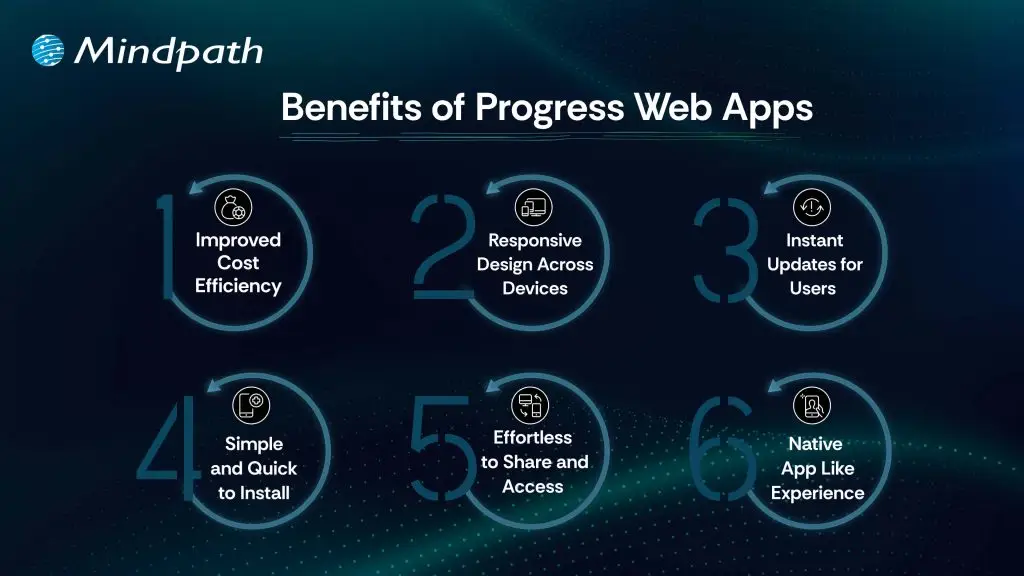
Adopting PWA is genuinely beneficial for companies trying to remain competitive in a mobile-first environment. These solutions offer the advantages of both web and native apps features to provide users with a seamless experience. The following are some key benefits to consider:
Benefits of PWAs (Progress Web Apps (1)

1. Cost Efficiency

Developing a web app is often much more affordable than building a native app. Instead of creating separate versions for web, iOS, and Android, one project works across all major platforms. A progressive web app iOS solution uses a single codebase, which keeps development simple and costs less. Ongoing updates and maintenance are also easier and more budget-friendly than managing multiple native apps.

2. Responsive Design Across Devices

The responsive design makes PWA development valuable for reaching users on any device. A single PWA can adapt to mobile phones, desktops, laptops, or tablets without needing separate builds. For example, it works just as well on a Google Pixel phone as it does on a Windows computer. This approach helps businesses offer a consistent experience everywhere while keeping development simple.

3. Instant Updates for Users

A PWA stays current whenever it’s online, so users always see the latest version. There’s no need to download or install updates manually. New features and content appear automatically without extra steps. This makes the experience smooth and hassle-free for everyone.

4. Simple and Quick to Install

A progressive web app makes installation easy for users. There’s no need to visit an app store or follow long steps to get started. Everything happens right in the browser with just a few clicks. This gives users faster access to content without any extra hassle.

5. Effortless to Share and Access

PWA can be shared easily through a direct URL, just like any standard website. This means users can pass it along to others without any special steps or downloads. It works smoothly across devices, making access simple and convenient. This flexibility helps businesses reach a wider audience with minimal effort.

6. Native App-Like Experience

A progressive web app offers many of the same features people love about native apps. It works even when there’s little or no internet connection, keeping access smooth and reliable. Push notifications help keep users engaged and informed on most devices. With home screen installation and familiar mobile navigation, it gives users a true app-like experience.

Worried about keeping your apps secure? Explore Application Security Best Practices to learn essential strategies for protecting your web and mobile applications.

Real-World Examples of PWAs

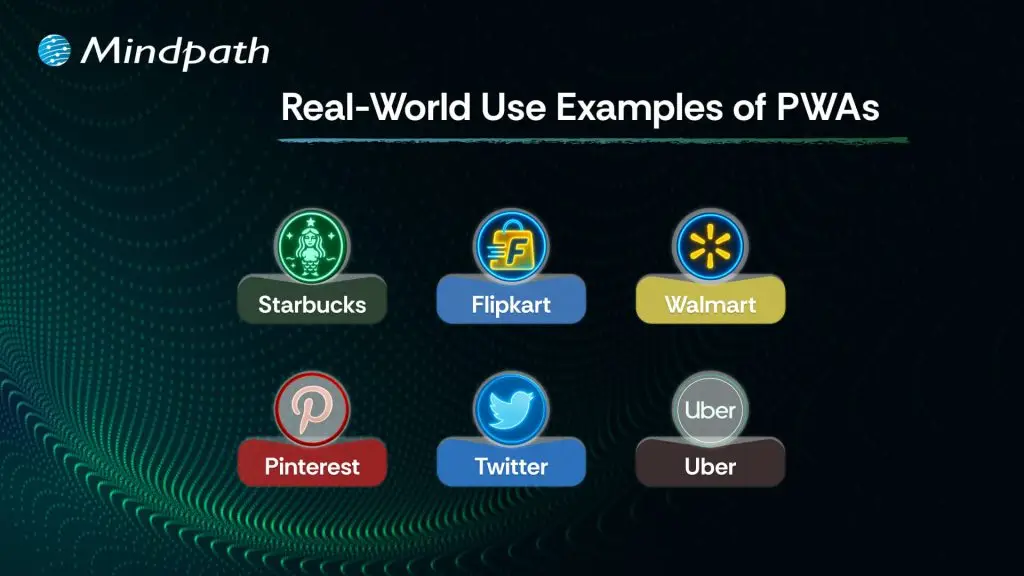
Many leading brands are proving the value of this technology through real progressive web app examples. These practical cases show how businesses can offer faster, more reliable experiences that keep users engaged.
Real world use examples of pwas

1. Starbucks

Starbucks created a PWA to boost customer engagement with a smoother ordering process and rewards program. This solution replaced its old mobile site to offer a consistent experience on any device. Customers can easily customize drinks, check store details, and view nutrition information.

2. Flipkart

Flipkart’s PWA helps shoppers enjoy a smooth browsing experience, even with poor connections. Users can explore product categories, special deals, and bestsellers with ease. This approach keeps customers engaged longer and makes online shopping more accessible across India.

3. Walmart

Walmart uses a PWA to handle thousands of products while making ordering and delivery seamless. Geo-tracking shows top-selling items nearby to personalize recommendations. Push notifications to keep users updated on deals and new arrivals.

4. Pinterest

Pinterest launched a PWA to expand its global reach with a faster, lighter site. Compared to its old version, the new app loads quicker and uses less data. This led to more time spent, higher ad engagement, and improved click-through rates.

5. Twitter

Twitter Lite was one of the first big brands to adopt a PWA to boost daily user activity. It consumes less data, loads quickly on slower networks, and still feels like a native app. As a result, page views, tweets sent, and overall engagement increased significantly.

6. Uber

Uber is a strong example of progressive web app design focused on speed and convenience with minimal storage use. It loads quickly, even when the network is weak, so users can book rides without delays. Depending on the location, people can also order food or rent bikes and scooters.

Looking to build a robust web application? Discover choosing the right tech stack for your web application and make informed decisions on frameworks, languages, and databases.

Are You Looking to Elevate Your Digital Presence?

Progressive web apps prove that businesses can deliver fast, reliable, and engaging user experiences without the high costs of traditional apps. With examples like Starbucks, Flipkart, and Uber leading the way, it’s clear that investing in this approach helps brands stay competitive in a mobile-first world. Adopting the right strategy ensures you get the most out of modern application development services.

At Mindpath, we develop future-ready AI solutions that unlock the true value of progressive web apps. Our expert web application development services help you create mobile-first experiences that are cost-effective, secure, and easy to maintain. From planning to launch, we ensure your app stands out and keeps your customers engaged. Let’s shape your next success story together.

Frequently Asked Questions

1. How do Progressive Web Apps support long-term user engagement?

PWAs improve engagement by offering fast load times, smooth navigation, and app-like interactions. Features like offline access and push notifications help users stay connected without interruptions, creating a more reliable experience that encourages repeated usage and strengthens long-term user relationships.

2. Are Progressive Web Apps suitable for all types of digital products?

PWAs work well for many use cases, especially where speed, accessibility, and cross-device compatibility are important. However, highly complex applications that require deep hardware integration may still benefit from native development, depending on specific technical requirements and performance expectations.

3. How do PWAs impact user acquisition and accessibility?

PWAs are easy to access through a simple URL, removing barriers like app store downloads. This makes it easier for new users to try the application instantly. Faster access and lower data usage also help reach users in areas with limited connectivity.

4. What makes PWAs a practical choice for mobile-first strategies?

PWAs are designed to perform well on mobile devices with responsive layouts and optimized performance. They adapt to different screen sizes and network conditions, ensuring consistent experiences. This makes them highly effective for businesses focusing on mobile-first user behavior.

5. How do PWAs simplify updates and feature rollouts for businesses?

PWAs update automatically when users access them online, eliminating the need for manual downloads or approvals. This allows businesses to roll out new features, fix issues, and improve performance quickly, ensuring users always interact with the latest version of the application.

full stack development trends

The full-stack development landscape is changing rapidly, and 2026 is already showing great possibilities for new ideas and better tools. Getting familiar with the newest full-stack development trends can help developers, startups, and businesses create smarter solutions. User needs are increasing, along with the requirement for flexible and efficient development solutions, which means teams are taking a fresh look at how they build, test, and scale applications. Knowing how to navigate these changes can have a significant impact next time whenever you develop a new item or launch a new product.

With speed, scalability, and seamless user experience as the new focus, developers are integrating advanced front-end technologies with back-end solutions to develop modern digital products. With cloud platforms available everywhere and low-code solutions evolving more rapidly, full-stack development is moving to a whole new level.  These solutions are transforming processes that not only save time but also improve quality and naturally foster greater teamwork. In this blog, we will provide further insight into the most important trends shaping full-stack development in 2026.

Want to stay ahead in this competitive market requires the right expertise. Mindpath’s Full Stack Development Services offer comprehensive solutions tailored to modern business needs.

Understanding Full-Stack Development

Full-stack development refers to building both the front-end and back-end of a software application. Let’s dive in to understand! Every application has two main sections. The front-end is what users see and interact with, like buttons, images, and forms. The backend encompasses all the activities that take place in the background – saving data, running logic, interacting with other systems, etc.

Each side requires different skill sets and tool sets. Full-stack development combines both sides into one process. Full-stack development enables developers to create complete applications and allows us to develop the application seamlessly from the user interface through the server and database. This means that the application includes both of those components as one shared system, which makes development more efficient and organized.

Ready to level up your development strategy? Explore this blog highlighting the major benefits of full-stack development in building robust and efficient applications.

Some advantages of full-stack development include:

1. A full-stack developer saves money by doing both front-end and back-end work, minimizing the need for multiple specialists.

2. They speed up the development process by working across the entire tech stack, ensuring faster delivery and smooth collaboration.

3. With strong knowledge of current tools and trends, they support modern full-stack development by integrating advanced features like AI and responsive design.

4. Full-stack developers take full ownership of the codebase, simplifying responsibility and streamlining debugging.

5. They deliver well-rounded, quality solutions by working across the UI, backend logic and business processes, database activities and data expansion, and testing.

6. They even provide ongoing support and maintenance, which ensures long-term stability, security, and enhancement.

Thinking about improving your web application strategy? Explore full stack-development for web projects and learn how integrated development drives efficiency.

Top Full-Stack Development Trends 2026

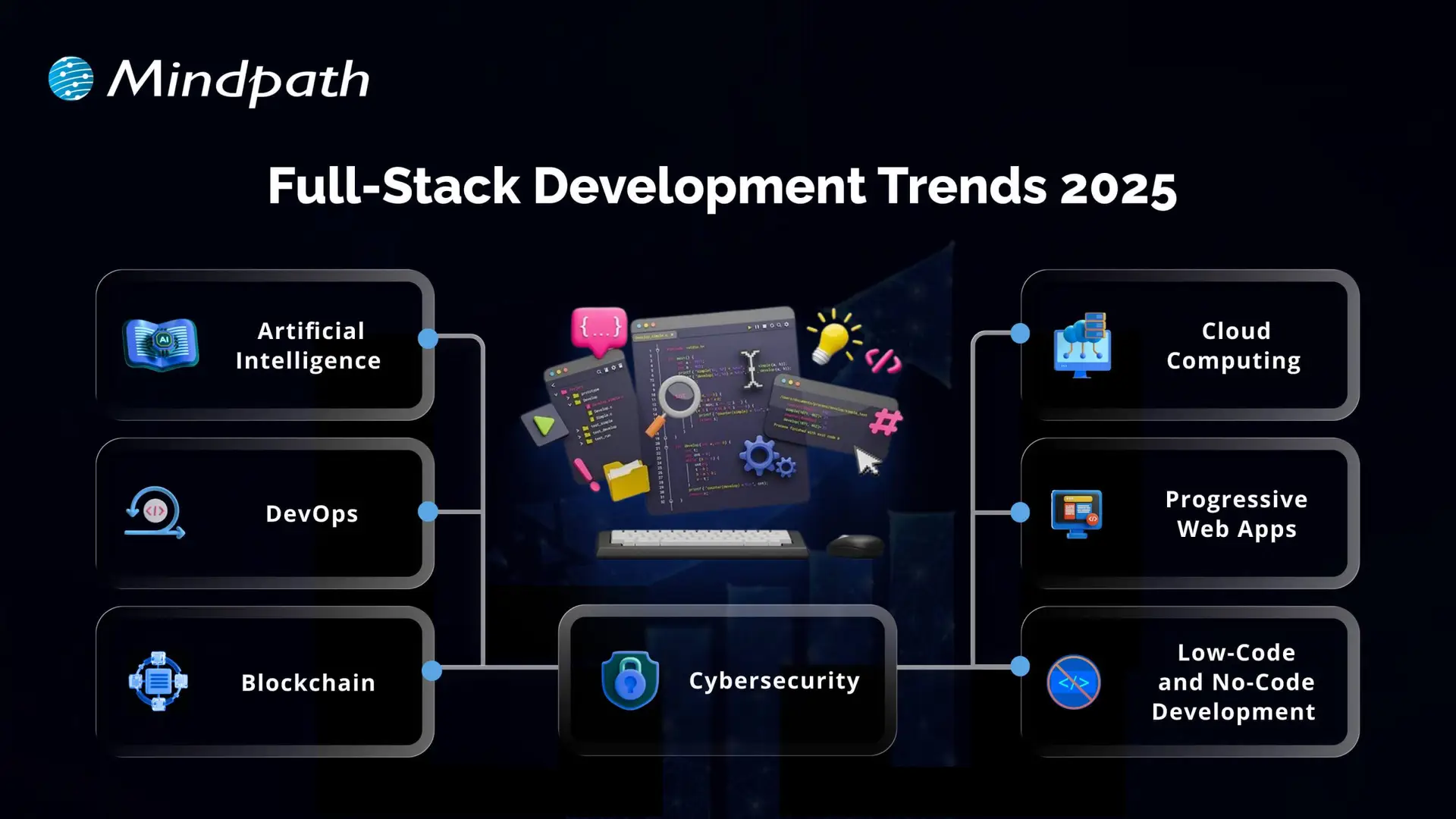
As technology continues to grow, developers are embracing smarter tools and faster methods to build complete applications. The emerging trends in full-stack development are shaping how teams work, improve performance, and deliver better user experiences in 2026. Here are the top trends to watch:
Full-Stack Development Trends 2025

1. Artificial Intelligence

Artificial Intelligence is one of the key full-stack development trends shaping how modern applications are built. It helps solve complex problems faster and allows systems to work without human interruption. Full-stack developers are well-suited for AI roles because they understand both design and logic, making it easier to build intelligent solutions. As the future of full-stack development evolves, AI will play a major role in improving performance and user experience.

2. Cloud Computing

Cloud computing is a fast-growing technology that allows access to data storage, processing power, and other resources over the internet. It supports the future tech stack for developers by offering flexibility, easy scaling, and pay-as-you-go pricing. Full-stack cloud developers are in demand to build and manage cloud-based applications that support collaboration and performance. To grow in this area, developers should understand IaaS, PaaS, SaaS and gain hands-on experience with platforms like AWS, Azure, and Google Cloud.

Also Read: Cloud Computing Trends

3. DevOps

DevOps is a practice that combines development and operations to improve how software is built, tested, and deployed. It helps teams work better together and use tools like continuous integration and delivery to release updates faster. DevOps plays an important role in improving application speed, quality, and reliability. As part of full-stack development trends, it supports the demand for efficient workflows and strong collaboration in building modern applications.

4. Progressive Web Apps

Progressive Web Apps (PWAs) are web applications that offer an app-like experience using modern browser features. They work offline, load quickly, send push notifications, and can be installed on devices without using much storage. As part of web development trends 2026, PWAs help businesses reach more users, especially on mobile, while keeping development simple and cost-effective. Their flexibility and performance make them a smart choice for companies looking to improve user experience.

5. Blockchain

Blockchain is a secure and transparent technology that stores data across a network of computers, making it difficult to change or hack. It is widely used in industries like finance and healthcare to protect transactions and manage decentralized systems. As part of full-stack development trends and the latest trends in web development, blockchain allows developers to build safer and more reliable applications. To work in this area, full-stack developers need skills in decentralized tools, enterprise systems, and Web3 architecture.

Must Read: AI in Cybersecurity

6. Cybersecurity

Cybersecurity is the practice of protecting systems, networks, and applications from online threats like malware, phishing, and DDoS attacks. It has become a key part of full stack development trends as developers need to build secure applications from the ground up. Companies are now including cybersecurity in their future tech stack for developers to keep data and systems safe. Full-stack developers aiming to work in this field should learn network security, web application security, cryptography, and secure coding practices.

7. Low-Code and No-Code Development

Low-code and no-code development platforms allow users to build websites and apps with minimal or no programming skills. These tools are growing as part of full stack development trends because they save time, reduce costs, and make development accessible to more people. While they are great for simple projects, they may not be suitable for complex or large-scale solutions. As part of the trends in software development, LCNC tools offer fast results and full-stack capabilities for quick product launches.

Curious about how development roles differ in modern projects? Explore Front End vs Back End vs Full Stack Developer to see how each contributes to building applications.

Ready to Leverage Full-Stack Development Trends for Your Next Project?

Full-stack development trends are shaping how modern applications are built, improved, and maintained. With advancements like AI, cloud, DevOps, and PWAs, developers and businesses can achieve faster, smarter, and more secure results. Staying updated with these trends will help you build stronger digital products that meet the growing demands of users in 2026 and beyond.

At Mindpath, we offer expert full-stack development services tailored to your business goals. Our skilled developers handle everything from front-end design to back-end logic, delivering complete, scalable solutions. If you’re looking to hire full-stack developers who understand the latest tools and technologies, our team is here to help you build your web and mobile applications with confidence and efficiency.

hiring full stack developer for MVP

The scale of innovation in the modern business landscape is growing consistently, calling for more efficient approaches to create digital solutions. Businesses choose to build MVPs or Minimum Viable Products before investing a huge amount in production. The benefits of hiring full-stack developer for MVP development have been drawing the limelight towards full-stack development services. 

Some business owners think about the possible ways in which full-stack developers can help with MVP development. With full-stack developers, businesses don’t have to hire multiple developers or set up a perfect team to create their MVP. Let us learn about the different ways in which full-stack development services contribute to the success of MVP.

Are you looking to turn your MVP idea into a market-ready product? Mindpath’s Full Stack Development Services will give you access to versatile developers who can handle both front-end and back-end seamlessly.

The Rise of Full Stack Developers

Full-stack development has emerged as one of the prominent alternatives to traditional development approaches. Businesses that have to hire full-stack developer for MVP development must know what a full-stack developer brings to the table. You must notice the term “full-stack” to understand the role of full-stack developers. It represents the complete technology stack or collection of technologies used to create a functional application. Full-stack developers are professionals who have expertise in frontend and backend development.

The versatility of full-stack developers empowers them to bridge the gap between what users see in an application and the underlying infrastructure that powers the application. On top of it, full-stack development also requires knowledge of other aspects such as version control, API integration, and database management. Businesses can find different technology stacks for full-stack development, like MERN, MEAN, LAMP, and Python-based stacks. Every technology stack offers a combination of powerful technologies used to create intuitive applications. 

Advantages of Creating a Minimum Viable Product (MVP)

The Minimum Viable Product or MVP is a trending buzzword in the digital landscape and a strategic solution for efficient product development. Imagine a situation in which a business has invested thousands of dollars in developing an app without a MVP. What will the business do if the target customer base of the organization does not like the app? The business would end up losing the money it invested in the app. 

Let us assume another scenario in which companies hire full-stack developer to create an MVP before rolling an app into production. The MVP is a minimal version of the software or application with limited features for the early adopters. Businesses create MVPs to test their digital products in the early stages of development and learn from the feedback of users to create effective solutions. The following advantages of a MVP will help you understand its significance in the dynamic business landscape.

1. Faster and Cost-Effective Development

One of the prominent advantages of MVPs is the assurance of faster time to market for new digital products and services. MVP focuses on achieving rapid deployment with essential features to gain an early advantage in the target market. 

Businesses can create MVPs without spending a lot on developing a product with full features and gather user feedback. As a result, the MVP can help in testing concepts and identifying the strengths and weaknesses of the application without unwanted expenses.

2. Risk Mitigation from User Feedback

The most distinctive highlight of MVP app development is the opportunity to interact directly with early adopters. Their feedback can help a business find valuable insights into the preferences, pain points, and requirements of users. Developers can use the feedback to ensure that the final product meets user expectations. Interestingly, MVP development involves continuous testing, feedback, and refinement to create more user-friendly and robust applications.

Feedback from users with a minimalistic version of the final product helps in reducing risks for businesses. For instance, business owners don’t have to invest extensively in concepts that their target audience does not like. Early feedback from users helps in identifying potential issues and implementing necessary modifications to reduce risks. 

3. Competitive Edge in the Market

The Minimum Viable Product also helps a business measure market interest and demand for their digital product. It can validate innovative ideas, while negative feedback opens new possibilities for timely modifications before investing a lot in app development. 

The ability to introduce a unique product in the market with limited features allows a business to gain a competitive advantage. Businesses can leverage MVPs to showcase their presence and build brand awareness before competitors jump in. On top of it, the MVP also offers an easy way to generate initial revenue that can be used to support product enhancements and development costs.

Want to stay ahead of the competition and build a truly impactful MVP? Discover the latest Full Stack Development Trends to leverage cutting-edge technologies, streamline development, and maximize your product’s success

Why Should You Hire Full Stack Developers for MVPs?

If the MVP is an important concern for businesses, then they might need specialists for the same. Is MVP development with full-stack developers a feasible choice for your business? The following benefits of working with full-stack developers will help you understand why they are the ideal choices for MVP projects. 

1. Cost Reduction

The cost of a MVP project is significantly less than that of a full-fledged development project. Interestingly, full-stack developers can reduce the cost of MVP development further with their versatility in frontend and backend technologies. Businesses don’t have to hire multiple specialists, thereby reducing the overall development costs. Startups and small enterprises can make the most of this advantage to create impactful MVPs with limited resources.

2. Faster Development

Hiring a full-stack developer is also a proven solution for accelerating the development process. Full-stack developers can contribute to the MVP success strategy with their expertise in frontend and backend domains to ensure seamless integration of all essential components. The streamlined development process supports faster iterations and offers flexibility for refining the product on the basis of users’ feedback. The speed of MVP development helps companies in validating innovative ideas and approving them for production to gain a competitive advantage.

3. Versatile Skillset

Full-stack developers are the ideal picks for MVP development due to their ability to make informed decisions according to the complete development stack and business goals. You can rely on them for end-to-end implementation, starting from creating interactive user interfaces to designing robust server-side architectures. The versatility of full-stack developers also empowers them to switch roles in the MVP development project without conflicts.

4. Lesser Communication Overhead

The next prominent advantage of hiring a full-stack developer for MVP is the assurance of efficient communication. Businesses don’t have to invest a lot of time in communicating with multiple specialists for a MVP project. If a business hires specialists for frontend and backend development, then it will have to monitor their work. On the contrary, full-stack development requires communicating only with a single person. The straightforward communication helps in reducing the possibilities of errors and increases the chances of overall success of the MVP project.

5. Easier Maintenance

With full-stack developers, businesses can avoid all worries about maintenance of the MVP project. Full-stack developers can leverage their expertise in different technologies to address the maintenance requirements, such as bug fixes, updates, and enhancements. On top of it, full-stack developers can implement changes quickly while ensuring compatibility and consistency between different development phases. 

6. Quicker Prototyping

If you have an innovative idea for an app and fail to develop it before your competitor, then you might lose the competitive edge. The value of full-stack development for startups, especially in the case of MVP development, is visible in faster prototyping. Businesses could build working prototypes for their innovative ideas and allow stakeholders to interact with the product. Faster prototyping helps in making necessary changes in the early stages of development and gives opportunities to outsmart the competition.

If you’re not sure what skills to look for in a full-stack developer, start by understanding the key factors that make one successful. Discover Things to Consider Before Hiring a Full Stack Developer to see what expertise can help your MVP stand out.

Challenges of Hiring Full Stack Developers for MVP Projects

The advantages of working with full-stack developers on MVP projects showcase why you need one right now. At the same time, business owners must pay attention to the challenges of hiring full-stack developers. For instance, it is difficult to find full-stack developers with the exact skills required for your MVP development projects. 

Businesses can capitalize on all the benefits of full-stack development only if they hire developers with experience in handling frontend and backend development. It is also important to know that full-stack developers are better picks for small and medium-sized projects. However, hiring only one full-stack developer for large and complex projects may not be the best choice for a business owner.         

Ready to Build Your MVP with the Right Full-Stack Team?

The decision to bring a full-stack developer into your workforce for MVP development is right for many reasons. For starters, you can build the Minimum Viable Product quickly and obtain user feedback to implement relevant modifications in the early stages. On the other hand, choosing a full-stack developer may be one of the toughest challenges for business owners.

At Mindpath, we offer full-stack development services personalized to align with client requirements and vision. We have helped multiple clients bring their vision to reality in the form of intuitive, user-friendly, and robust applications. Our experience and commitment to serving the best results in MVP development make us the best pick for startups and big corporations. Find the ideal resources to create your next MVP project right now.

Frequently Asked Questions

1. When is the right time to hire a full-stack developer for an MVP project?

The ideal time is during the early planning or prototype stage. Bringing in a full-stack developer early helps shape the product architecture, avoid rework, and ensure smooth development from the start, leading to faster validation and more efficient use of resources.

2. How can a full-stack developer support better product decisions during MVP development?

A full-stack developer understands both user-facing features and backend logic, which helps in making balanced decisions. This ensures that features are not only functional but also scalable, improving the overall quality and usability of the MVP from the beginning.

3. What should be evaluated before selecting a full-stack developer for an MVP?

It is important to assess practical experience, familiarity with relevant technology stacks, and the ability to handle end-to-end development. Strong problem-solving skills and an understanding of business goals also play a key role in ensuring successful MVP delivery.

4. How does working with a full-stack developer impact long-term product growth?

A well-built MVP creates a strong foundation for future development. A full-stack developer ensures clean architecture and scalable code, making it easier to expand features, handle increased users, and adapt to changing business needs without major redevelopment.

5. Can a full-stack developer manage changes effectively during MVP iterations?

Yes, full-stack developers are well-equipped to handle frequent changes during MVP cycles. Their ability to work across different layers of the application allows quicker updates, smoother adjustments, and better alignment with user feedback throughout the development process.

ReactJS for Progressive Web App development

Creating applications that are fast, dependable, and smooth on all devices is important for every company today, right? So, when you think of building something like that, ReactJS for Progressive Web App development may be a wise option for you. It allows you to create applications that give the experience of a native application without the cost or intricacy. There are many modern companies already using this approach to enhance performance and keep users invested with consistent user experiences.

ReactJS offers speed, flexibility, and user-centric features that are perfectly aligned with progressive web app goals. ReactJS has reusable components and fast rendering, making it easy for developers to build responsive and high-performance apps. PWAs built with ReactJS are responsive and load fast, work offline, and allow a smooth mobile experience that users will enjoy. In this blog, we will examine the top reasons why ReactJS is great for developing PWAs.

Looking to engage users with fast and seamless web applications? At Mindpath, we offer ReactJS development services where our experts help you create user-focused Progressive Web Apps that give users a smooth digital experience.

Understanding the Fundamentals of PWAs

Progressive Web Apps (PWAs) are modern web applications that function like mobile apps. With a PWA, you can open it in a web browser, but it behaves like a real app on your phone or computer. They are designed to function seamlessly across all devices (smartphones, tablets, or desktops), which is nicer than having separate mobile websites, apps, and desktop apps.

Progressive Web Apps are created using HTML, CSS, and JavaScript. They are fast to load; they work when users are offline and can send push notifications. They also allow access to certain phone functionality, such as the camera or location. PWAs can help businesses save time and money since they must build one app that can work everywhere.

Looking for specialists who can handle complex front-end challenges in your business? Learn why partnering with an expert React Development Company is a smart move.

Advantages of Using ReactJS for Progressive Web App development

Using ReactJS for PWA development is a great choice for creating secure and fast web applications. With the growing ReactJS trends, developers hope that they can deliver seamless and user-friendly experiences. Here is how ReactJS is perfect for your PWAs.
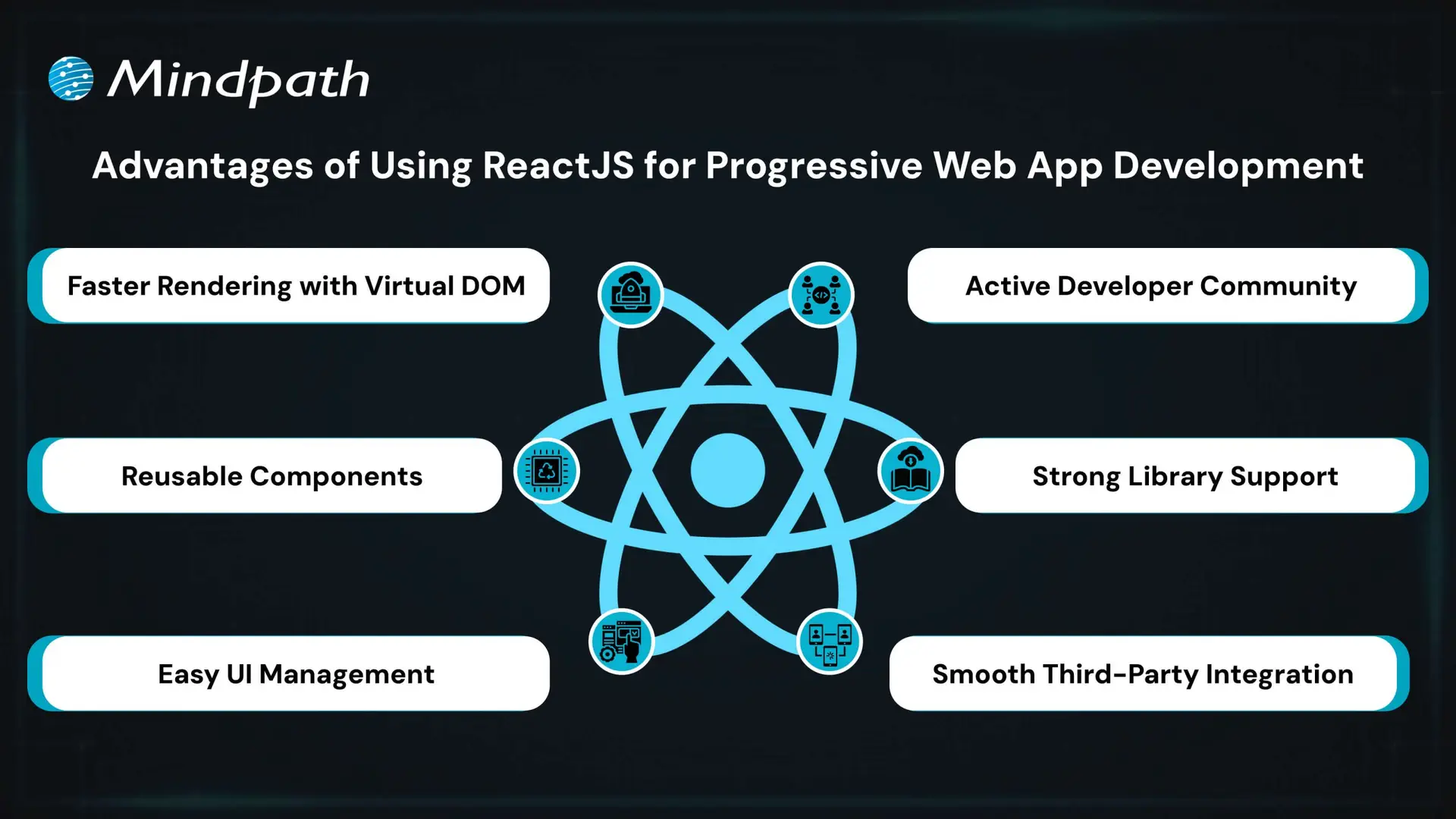
Advantages of Using ReactJS for Progressive Web App development

1. Faster Rendering with Virtual DOM

React uses a Virtual DOM to update only the parts of the page that change. This speeds up performance and ensures a smooth user experience. It’s ideal for building fast and responsive ReactJS PWA solutions.

2. Reusable Components

React’s component-based structure allows developers to reuse code across the app. This makes it easier to manage the app and scale it as it grows. It’s a key reason why teams choose ReactJS for progressive web app development.

3. Easy UI Management

React follows a declarative style for creating user interfaces. This makes it simple to manage and update interactive elements in the app. It helps deliver a smooth and engaging ReactJS progressive web app experience.

4. Active Developer Community

React has a strong global community that shares solutions, tools, and tutorials. This support helps developers solve problems faster and stay updated. It also contributes to the future of ReactJS in modern web development.

5. Strong Library Support

React has many libraries like React Router and Redux that simplify routing, data flow, and offline features. These tools help developers add advanced features to PWAs with less effort. They make building a PWA with React more efficient and reliable.

6. Smooth Third-Party Integration

React works well with tools needed for Progressive Web Apps, such as service workers and web app manifests. These tools help enable offline access, background syncing, and “Add to Home Screen” functionality. This makes it easier to implement full PWA capabilities when building with React.

Want to keep your large React app fast and responsive as it scales? Discover the best practices for optimizing React performance for large applications.

Steps to Set Up a React PWA

Getting started with React is a smart move when building modern web apps that work offline and feel like native apps. If you’re planning to use React for progressive web app development, here are the key steps to set it up properly.
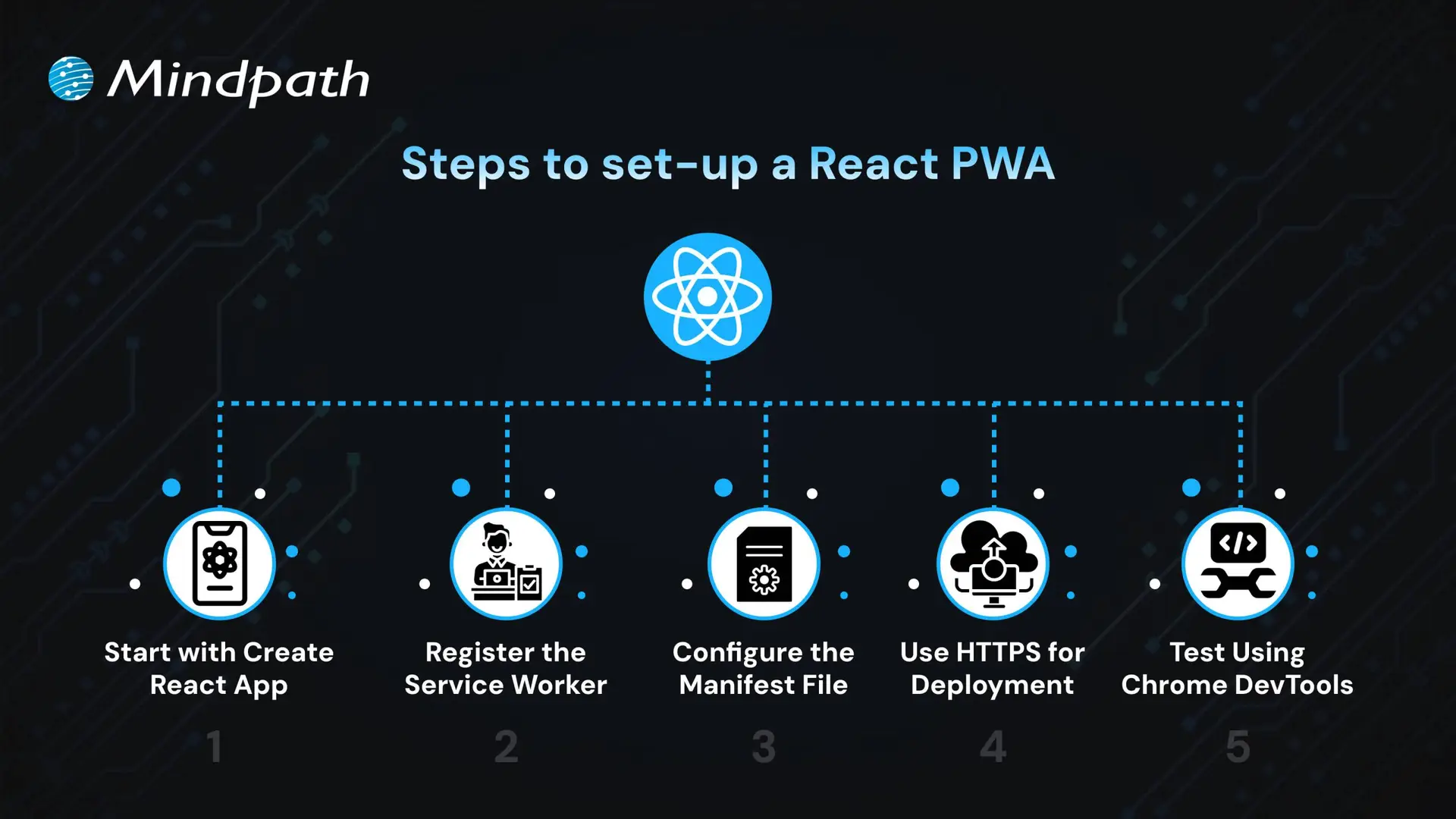
Steps to Set Up a React PWA

1. Start with Create React App

The easiest way to begin is by using Create React App, which includes built-in support for PWAs. It sets up a basic structure with everything needed for ReactJS PWA development, including service workers and a manifest file. CRA also optimizes the build process, making your app production-ready. This setup ensures you have a strong foundation to build a scalable and responsive PWA.

2. Register the Service Worker

To activate offline support, register the service worker by calling ‘serviceWorkerRegistration.register()’. This enables background caching, which is key to building a progressive web app with React that works without an internet connection. A registered service worker allows the app to cache assets and serve them even when the network is unavailable. It also helps improve performance by reducing server requests, ensuring a better user experience in the future of web development.

3. Configure the Manifest File

Update the manifest.json file in the public folder to define your app’s name, icons, theme color, start URL, and display mode. These settings control how your app appears when installed on a device. A properly configured manifest ensures your PWA looks and feels like a native app. This also helps in enabling features like splash screens and full-screen display, supporting the growth of progressive web apps with React development.

4. Use HTTPS for Deployment

For security, PWAs must be served over HTTPS. Local development through CRA handles this, but for live deployment, ensure your server uses a valid HTTPS setup. A secure context is required for service workers and features like push notifications. Using HTTPS also improves user trust and SEO performance.

5. Test Using Chrome DevTools

Use Chrome DevTools to inspect and test your PWA setup. You can verify service worker status, cached files, and manifest settings. Lighthouse audits can also help you improve your app based on best practices for React for progressive web app development. Testing ensures your PWA meets performance, accessibility, and usability standards.

Seeking a development approach that reduces complexity while enhancing functionality? Read why React Web Development is ideal for modern projects.

Ready to Build a Powerful PWA with ReactJS?

ReactJS offers all the essential tools to build fast, reliable, and interactive web apps that feel like native experiences. Its reusable components, strong ecosystem, and smooth performance make it a top choice for modern applications. Choosing ReactJS for progressive web app development is a future-focused decision that brings real value to your business.

At Mindpath, we deliver expert ReactJS development services tailored to your goals. We build responsive, scalable, and feature-rich PWAs with smooth offline access and high performance. Our experienced team uses the latest tools and trends to create apps users love. Partner with Mindpath and bring your next ReactJS PWA to life with speed and quality.

Frequently Asked Questions

1. How do Progressive Web Apps compare to traditional mobile applications in terms of maintenance?

Progressive Web Apps are easier to maintain because they use a single codebase across devices. Updates are applied centrally and reflected instantly for all users, unlike native apps that require separate updates and approvals. This reduces long-term maintenance effort and ensures consistency.

2. What factors should be considered before choosing ReactJS for PWA development?

It is important to evaluate project complexity, performance requirements, and scalability needs. ReactJS works best when applications demand dynamic user interfaces and fast updates. Compatibility with existing tools and the availability of skilled developers also play a key role in the decision.

3. How does a PWA built with ReactJS handle poor or unstable network conditions?

PWAs use service workers to cache important assets and data, allowing the application to function even with limited or no internet connectivity. This ensures a stable experience, reduces loading time, and keeps essential features accessible during network interruptions.

4. Can ReactJS PWAs support advanced features like push notifications and device access?

Yes, ReactJS PWAs can support features such as push notifications, location tracking, and limited hardware access through browser APIs. These capabilities enhance user engagement and allow web applications to deliver experiences closer to native mobile applications.

5. How scalable are ReactJS-based PWAs for growing user demands?

ReactJS supports scalable architecture through component-based development and efficient state management. As user demand increases, applications can be expanded with minimal disruption. This makes it easier to handle higher traffic, add new features, and maintain performance over time.
Discover why ReactJS is perfect for Progressive Web App (PWA) development. Learn how Mindpath can help you build high-quality PWAs.
Node js libraries for AI

 As we know, with Node.js libraries, adding AI to your projects is becoming easier. These Node.js libraries for AI can offer you the ability to develop apps that can think, respond, and learn over time. If you enjoy working in JavaScript and you are curious about the new AI features like chatbots, smart predictive features (like those in Google Assistant), and apps that recognize voice input, then now is your chance. You don’t need to begin from scratch. If you use the right libraries, you can build smarter apps at less cost and more value.

These Node.js AI libraries come with beginner-friendly options that are powerful enough for advanced applications. You can add new features such as understanding language, detecting images, or performing machine learning without deep knowledge of AI. They are built to seamlessly integrate into your existing Node.js stack, enabling you to save time and effort in your development workflows. In this blog post, we’ll discuss some of the best libraries to quickly get started with AI in Node.js applications.

Are you looking to elevate your business’s web development with the use of Node.js? At Mindpath, we offer Node.js development services that aim to grow your business by providing reliable and AI-powered web solutions tailored to your unique needs.

Importance of Integrating AI into Node.js Applications

Node.js is increasingly becoming a leading option for creating smart, dynamic applications because it is lightweight and driven by events. Thus, can Node.js be used for AI? Yes, it can! Developers are already using Node.js as an API or tool for AI with tools like TensorFlow.js and Natural. In the 2024 Developer Survey by Stack Overflow, JavaScript continued to be the most popular programming language, which means that Node.js is a great starting ground for AI initiatives.

Integrating Node.js with AI applications allows developers to make applications that change and adapt in real-time. The asynchronous nature of Node.js allows developers to execute several operations simultaneously, making it a good platform for artificial intelligence features like chatbots and live prediction tools. More and more AI libraries support Node.js, as development can happen more quickly. As demand for AI using more efficient and adaptable models rises, Node.js is a new practical, scalable programming option for any developer who wants to create smart digital experiences.

Let us have a quick look at the benefits of integrating AI in Node.js applications:
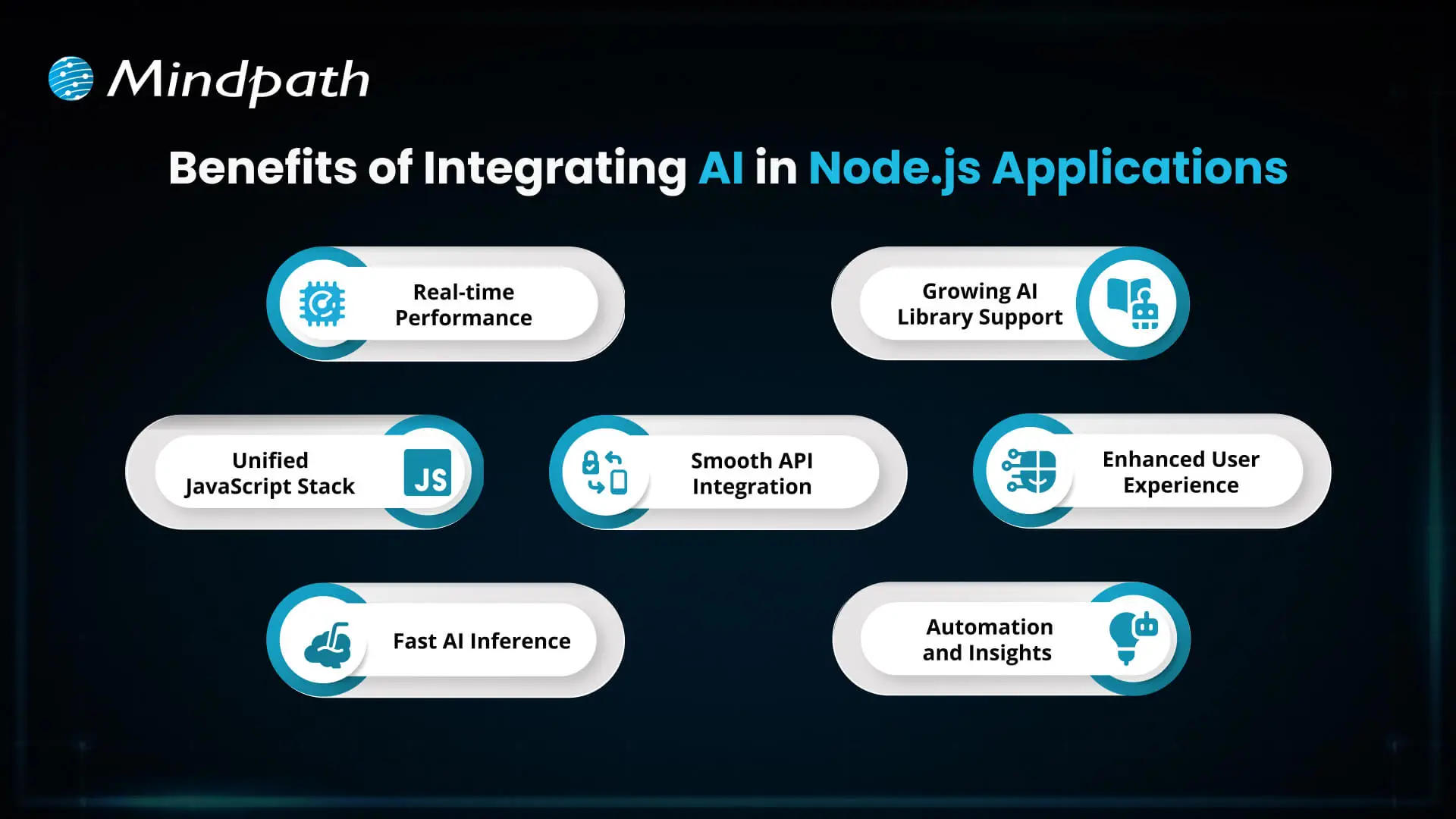
Benefits of Integrating AI in Node.js Applications

1. Real-time Performance

AI integration with Node.js handles real-time tasks like chatbots and fraud detection efficiently with its non-blocking, event-driven architecture. It supports thousands of concurrent requests, delivering quick and responsive AI features.

2. Unified JavaScript Stack

With Node.js AI integration, developers can use JavaScript for both frontend and backend, including AI features. This reduces context switching and makes the development process faster and more efficient.

3. Fast AI Inference

Node.js runs on the V8 engine, which ensures high-speed execution for AI models. This is perfect for real-time predictions like dynamic pricing or personalized recommendations.

4. Smooth API Integration

Node.js makes it easy to connect with external AI services and pre-trained models through APIs. It works well with AI built in other languages like Python, enabling flexibility in integration.

6. Growing AI Library Support

The Node.js ecosystem offers a wide range of AI libraries via npm, such as TensorFlow.js and ONNX.js. These tools allow developers to implement machine learning directly in JavaScript.

7. Enhanced User Experience

AI features like intelligent chat, personalization, and predictions improve how users interact with your app. Node.js helps deliver these features in a fast and seamless way.

8. Automation and Insights

AI in Node.js apps can automate repetitive tasks and analyze data in real-time. This leads to smarter applications that save time and improve performance.

Looking to streamline your web development in 2025? Check out our blog on Top 25 NodeJS Libraries in 2025 to find the best tools that will help you build powerful and efficient applications.

What are the Top Node.js Libraries for AI Integration?

Building intelligent apps is now simpler with the rise of Node.js artificial intelligence libraries that support machine learning, NLP, and smart automation. These powerful AI Node.js libraries help developers create responsive and data-driven features without complex setups. Here are some of the best Node.js libraries for AI integration:
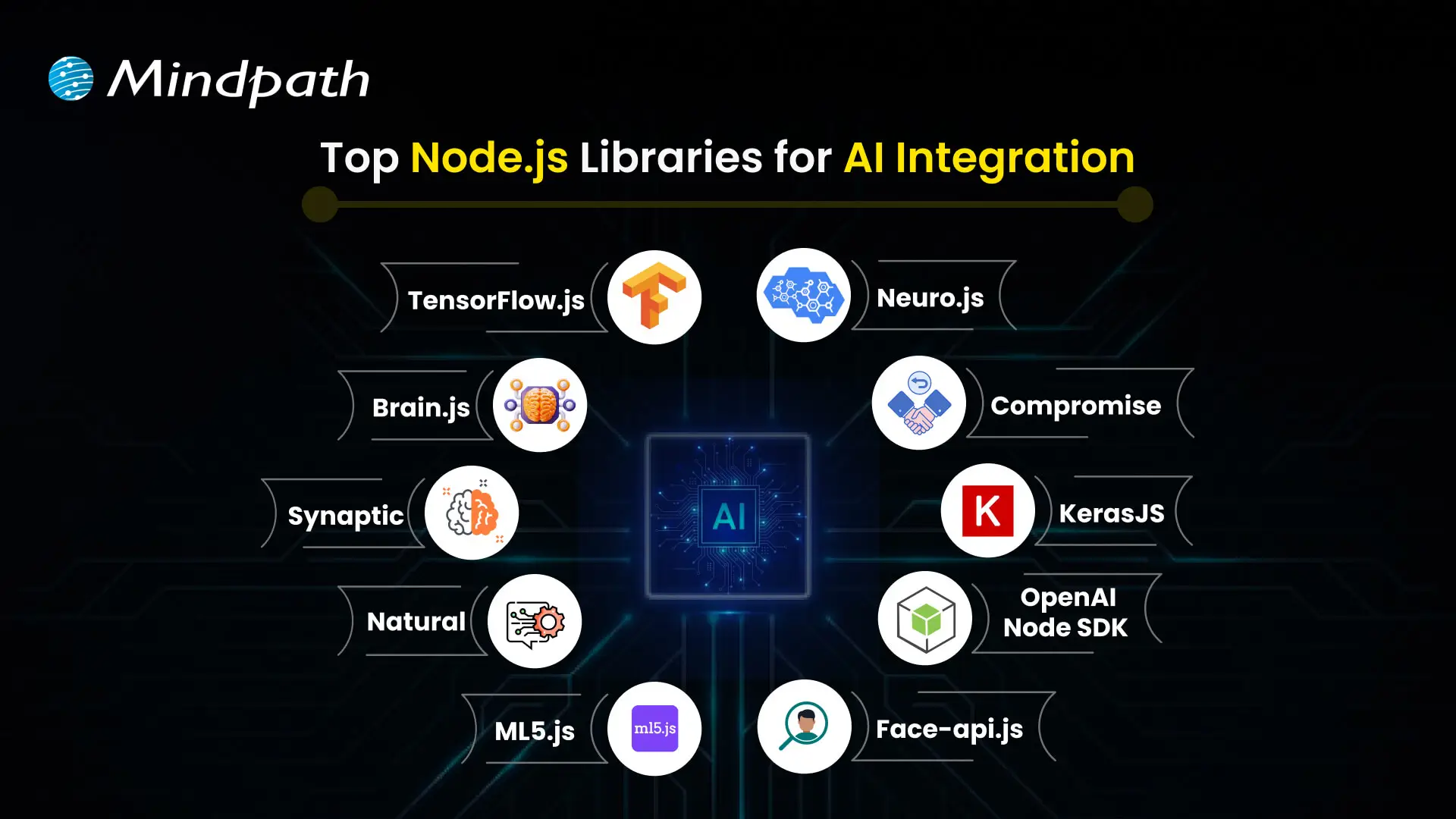
Top Node.js Libraries for AI Integration

1. TensorFlow.js

TensorFlow.js is one of the top Node.js libraries for machine learning, allowing developers to build, train, and run models entirely in JavaScript. It works both in the browser and with Node.js, making it versatile for a wide range of projects. The library is a good example of how Node.js libraries for AI can power real-world communication tools.

2. Brain.js

Brain.js is a simple neural network library that’s ideal for beginners working on small AI projects. It uses JavaScript to make machine learning accessible without complex configuration. Found in the list of useful npm libraries, it helps developers get started quickly with AI-powered features.

3. Synaptic

Synaptic offers a flexible system for creating different types of neural networks, including feedforward and recurrent ones. It supports supervised and unsupervised learning, giving developers options based on their use case. As one of the advanced Node.js libraries for AI, it works well for experimental and custom AI models.

4. Natural

Natural is a powerful Node.js natural language processing library that provides tools like stemming, classification, tokenization, and sentiment analysis. It’s great for applications that need to work with text data in real-time. This is one of the most complete Node.js libraries for AI when it comes to language-based features.

5. ML5.js

ML5.js is built on TensorFlow.js but focuses on simplicity and creative use, making it perfect for artists, designers, and beginners. It lets you easily create interactive AI experiences on the web. As part of the growing set of npm AI tools, it balances power with ease of use.

6. Neuro.js

Neuro.js focuses on building intelligent features for chatbots and virtual assistants using JavaScript. It’s tailored for tasks in NLP and conversational AI. The library is a good example of Node.js support for AI development in real-world communication tools.

7. Compromise

Compromise is a fast and lightweight library for real-time text processing. It’s designed for performance and currently supports only English, making it efficient for many use cases. As part of the JavaScript libraries used in NLP, it’s a useful choice for developers needing quick language insights.

8. KerasJS

KerasJS is a browser-based library that allows you to run deep learning models built with Keras using JavaScript. It supports several pre-trained models like Inception v3 and ResNet, useful for tasks such as image recognition and sentiment analysis. As one of the top Node.js libraries for machine learning, it offers flexibility for deploying models in web environments, with Node.js support in CPU mode.

9. OpenAI Node SDK

The OpenAI Node SDK helps developers connect easily with models like GPT and Codex for generating text, images, and code. It simplifies integration with OpenAI services using Node.js. Available among advanced npm libraries, it enables powerful generative AI in modern apps.

10. Face-api.js

Built on TensorFlow.js, face-api.js provides tools for face recognition, detection, and expression tracking. It runs on both browsers and Node.js, making it suitable for cross-platform apps. As part of modern Node.js libraries for AI, it brings computer vision capabilities to JavaScript projects.

Choosing the right libraries is just the start; you can also enhance Web Performance with Node.js Development Services, which are built to support advanced AI workflows.

Looking to Enhance Your App with Node.js and AI?

The growth of powerful Node.js libraries for AI integration is making it easier to build applications that think, learn, and adapt. AI libraries will help a developer create smarter, faster, and more sensible digital experiences, from real-time predictions, natural language processing, to so much more. With JavaScript at the core, the path to intelligent development is now more accessible.

At Mindpath, we provide professional Node.js development services for current and future applications that are powered by AI. We build intelligent backend systems, provide seamless API integrations, and build scalable features with Node.js, and when combined with AI, we are empowered to deliver increasingly smarter solutions. If you are looking to build an application soon, then we are ready to provide fast, reliable, and intelligent solutions focused on performance and innovation.

Frequently Asked Questions

1. How should the right Node.js AI library be selected for a specific project?

The choice depends on the project’s goal, complexity, and data requirements. Lightweight libraries work well for simple tasks, while advanced frameworks are better for deep learning or large-scale models. Evaluating performance, community support, and integration flexibility helps ensure the right fit.

2. Is it necessary to have strong AI knowledge to use Node.js AI libraries effectively?

Basic understanding of AI concepts is helpful, but many Node.js libraries are designed to simplify implementation. Pre-trained models, clear documentation, and API-based integrations allow developers to add intelligent features without deep expertise in machine learning algorithms.

3. How do Node.js AI integrations handle performance in real-time applications?

Node.js supports non-blocking operations, which allows multiple processes to run simultaneously. This makes it suitable for handling real-time AI tasks like predictions or interactions, ensuring fast responses while maintaining efficiency even under high user demand.

4. What are the common challenges when integrating AI into Node.js applications?

Challenges often include managing large datasets, ensuring model accuracy, handling latency, and maintaining scalability. Proper architecture, efficient APIs, and optimized models are essential to overcome these issues and ensure smooth, reliable AI functionality within applications.

5. How secure are AI integrations in Node.js applications?

Security depends on how data is handled and processed. Using secure APIs, encrypting sensitive data, and following best practices for authentication and access control are essential. Regular monitoring and updates also help maintain the integrity and safety of AI-powered systems.

Discover top Node.js libraries for AI integrations and learn to enhance your applications with machine learning, NLP, and more.

Have you ever wondered to yourself what the future of AI is going to look like? AI will affect how people will live and interact with technology. AI is incorporated in all daily activities, whether that is assisting in a task, giving suggestions, or helping create a seamless process. As technology advances and matures, it will change the way people think, the way people work as well as the decisions people make.  

The future with artificial intelligence certainly has the potential to transform everything from how we communicate and learn, to problem-solving and creativity. The benefits of AI are enabling people to make better decisions, manage time, and explore scenarios like never before. So, what does this growing presence of AI mean for how the world operates? And how might the future of artificial intelligence cultivate the future we are heading towards? In this post, we will explore how AI in a whole new way is changing how we operate in the world. 

Curious how AI can revolutionize your business? At Mindpath, we deliver cutting-edge Artificial Intelligence Development Services to help you innovate and grow. 

The Evolution of Artificial Intelligence (AI)

Artificial Intelligence (AI) refers to the work of developing computer systems that can carry out human-like functions that usually require human intelligence, like learning, problem-solving, and decision-making. In the end, it is making machines that work like people. In today’s world, the use of AI has become normal. You can see the impact of artificial intelligence in homes, schools, and workplaces.  

The artificial intelligence story began in the 1950s as a result of Alan Turing and his idea about machine thinking. In the 1960s, research and early AI development continued to evolve with John McCarthy’s work on the LISP programming language, a powerful language that increased early AI research. During the 1970s and 1980s systems were developed based on rules (known as expert systems), which set the stage for the eventual widespread use of AI.  

By the 1990s, AI began data-driven learning instead of following a strict set of rules. This transformation indicated the beginning of machine learning and neural networks made AI accessible to new areas like language processing and robotic applications for personal and industrial use. Therefore, using models such as GPT-3 and GPT-4, people are currently using AI in more creative and practical ways which generates powerful representations of what artificial intelligence means to us. 

Must Read: AI for Customer Services

The Impact of AI on Future

Artificial intelligence is becoming a key part of the future, with its growing role in daily life and global progress. As technology advances, we can already see AI transforming the future through smarter systems, faster decisions, and improved services. Here are some important areas where artificial intelligence is shaping what comes next.

1. Empowering Human Creativity

AI is taking over routine and repetitive tasks, giving people more time to focus on creative thinking and emotional intelligence. This leads to more meaningful jobs and greater fulfillment at work. Generative AI tools now help writers, designers, and developers move faster with fresh ideas. RAG techniques also improve the quality of AI-generated content. This marks a powerful shift in how people work and innovate.

2. Smarter Decision-Making Ahead

AI in decision-making helps process large amounts of information quickly, offering insights that humans might overlook. This leads to better decisions in areas like personal finance, education, and health. AI agents are becoming more advanced, supporting real-time choices with logic and learning. They’re able to adapt and respond in changing environments. This is a glimpse into how artificial intelligence will change the world.

3. Personalized Education Experiences

AI systems can customize educational paths for each student, improving learning outcomes. These platforms offer real-time feedback, progress tracking, and tailored content. With multimodal AI, students can now learn through text, images, audio, and even interactive content. This enhances understanding and makes learning more engaging. These smart tools are clear future of AI examples already reshaping classrooms.

4. Building a More Inclusive World

AI is helping people with disabilities by providing real-time support tools like voice commands and screen readers. Multimodal AI systems enhance accessibility by understanding both speech and visual cues. This leads to more independence and easier access to services. Inclusive tech design is becoming a priority across sectors. These innovations reflect a growing bond between artificial intelligence and future equity.

Ready to stay ahead of your competitors to build a unique identity in the market? Explore how conversational AI is helping businesses to achieve smarter operations, stronger customer engagement, and sustainable growth.

5. Driving Sustainable Innovation

AI in business strategy plays a growing role in protecting the environment by predicting climate patterns and reducing waste. Digital twins are being used to test and simulate sustainability strategies safely. These models help industries make smarter, more eco-friendly decisions. AI systems also support energy efficiency and cleaner production. Technology is becoming a vital part of building a sustainable planet. 

6. Advancing Safety and Security

AI helps monitor public areas, detect threats, and respond to emergencies. In cybersecurity, it can identify unusual behavior and stop attacks in real time. AI-powered tools work constantly to secure data and systems. As digital threats grow, AI’s role in safety becomes more critical. These AI trends will shape safer environments both online and offline. 

7. Making Services Instantly Accessible

AI assistants and chatbots are helping people access answers and services instantly. These tools are improving with better voice understanding and faster responses. AI literacy is becoming important as users interact more with these systems. The trend is helping people become more confident using technology daily. This also marks a major step in the future of AI in business.

8. Redefining Innovation Through Collaboration

AI is evolving into a true partner in creativity and problem-solving. Generative AI and AI agents now work side-by-side with humans on design, research, and product development. This leads to faster innovation and new discoveries. These collaborations go beyond automation; they spark new ideas. This is the heart of innovation powered by smart technology. 

Curious to know how Gen AI is transforming multiple sectors? Explore our blog on generative AI use cases to discover how businesses are evolving, growing, and creating opportunities in the fast-paced world.

Strategic Approaches to an AI-Driven Future

Artificial intelligence is rapidly reshaping the way we live and work. To stay ahead, it’s essential to adopt smart, forward-looking strategies that align with this evolving landscape.

1. Set a Clear AI Vision

Identify where AI can add the most value to your goals, such as customer service or analytics. Create a step-by-step plan, prioritize key areas, and communicate the strategy clearly across teams.

2. Promote Innovation at Every Level

Encourage different teams to work together and explore new AI ideas through small test projects. Support a culture that treats both success and failure as part of learning and progress.

3. Build and Grow AI Skills

Offer training to help your current team understand and work with AI. Hire skilled professionals and promote continuous learning to stay updated with AI trends.

4. Embed Ethics into AI Use

Create clear guidelines to keep your AI systems fair and transparent. Regularly check for bias and support responsible AI use through proper oversight.

5. Evolve with AI Advancements

Keep up with new AI technologies and adjust your strategy as things evolve. Make sure your data is organized, and AI is integrated into key business activities. 

Aiming to leverage the power of artificial intelligence, understanding the technologies that drive it has become a crucial advantage. To dive deeper into the tools and technologies behind AI innovation, explore our detailed guide on the AI programming languages.

Ready to Shape the Future with AI?

Artificial intelligence is not just changing how we work and think; it is shaping the world around us in powerful ways. As AI continues to grow, it brings smarter tools, more creative opportunities, and better decision-making for individuals and businesses. The future will belong to those who embrace these possibilities early.

At Mindpath, we offer expert AI development services to help you harness the power of artificial intelligence in your business. Our team builds smart, scalable, and ethical AI solutions that drive growth and innovation. Whether you’re starting small or scaling big, Mindpath is your trusted technology partner for an AI-ready future. 

Frequently Asked Questions

1. What makes AI a long-term transformative technology rather than just a trend?

AI continuously evolves by learning from data and improving its performance over time. Unlike static technologies, it adapts to new information and use cases. This ability to scale, learn, and integrate across systems makes it a foundational technology shaping long-term global progress.

2. How does AI balance automation with the need for human involvement?

AI handles data-intensive and repetitive processes, while humans provide judgment, context, and ethical oversight. This balance ensures decisions remain accurate yet responsible. The combination strengthens outcomes by merging computational efficiency with human reasoning and accountability.

3. Why is data quality important for the future success of AI systems?

AI systems rely heavily on data to learn and make predictions. Poor or biased data can lead to inaccurate or unfair outcomes. High-quality, well-structured data ensures reliable insights, better performance, and trustworthy results, making it a critical factor in successful AI adoption.

4. How is AI contributing to more sustainable and efficient systems?

AI improves efficiency by optimizing resource use, reducing waste, and predicting outcomes more accurately. It enables better planning and smarter operations, which support sustainability goals while maintaining productivity. This makes AI an important tool for long-term environmental and operational balance.

5. What role does continuous learning play in adapting to AI advancements?

As AI technologies evolve rapidly, continuous learning helps individuals and organizations stay relevant. Keeping up with new tools, methods, and ethical practices ensures better adoption and usage. This approach builds confidence and supports long-term success in an AI-driven environment.

Explore how is AI transforming future, impacting data privacy, job markets, and business automation. Learn about Mindpath’s AI Services.
AI in Decision Making

Do you know that 75% of leaders believe that AI gives them a major edge when it comes to making smart decisions? That’s a big number, isn’t it? Through this, we get an idea of how much trust today’s decision makers are placing in AI. If you ever thought about how AI can help in better business decisions, you are not alone. Today, AI in decision-making has developed into a legitimate, trusted resource for leaders embracing the opportunity to work with greater clarity and confidence.

Artificial intelligence is becoming more prevalent in various industries today to aid in planning, minimize uncertainty, and achieve increased efficiency. It is assisting teams with understanding the needs of customers, forecasting demand, and many other areas. AI is quickly becoming a valuable business partner in day-to-day decision-making. Pretty fascinating, right? In this blog, we will review practical implementations and the advantages of using artificial intelligence in decision-making. So, let us dive in!

Ready to elevate your decision-making with AI? Discover how Mindpath’s advanced AI solutions can transform your business strategies and drive success. 

What is AI Decision Making?

Artificial intelligence decision-making refers to computer systems that support intelligent decision-making based on data. Think of it as a super advanced program to assess large volumes of data (i.e., numbers, text, images, sensors, etc.) and determine the best action. These systems process information and provide intelligent actions following rules or models, including sophisticated models like neural networks. AI systems can also learn from previous decisions and improve performance over time through machine learning.

Unlike conventional methods that require human effort for collecting, cleaning, and analyzing information, AI can take any combination of messy and complicated input and not get confused with too many opinions or fatigued by too many details. AI moves quickly, doesn’t miss patterns, and continually learns. This makes artificial intelligence a useful mechanism for businesses that deal with enormous amounts of data and need to make clean decisions quickly and accurately.  

Curious about bringing AI into your business but unsure how to begin? Read our blog: Is Your Business Ready for AI?

Benefits of AI in Decision Making

Using AI for decision-making is becoming a key part of how modern businesses operate. With AI adoption on the rise, it’s important to understand what makes this technology so valuable in today’s decision-making process.  

1. Boost Productivity

AI works like a nonstop helper that gives decision makers quick answers and useful insights. It saves time by handling data and helps people focus on bigger tasks. With decision maker AI, you can get more done without working extra hours.

2. Lower Risks

AI benefits help in spotting problems early by studying past data and finding patterns. It can warn decision makers about things like fraud or sudden changes in the market. This helps businesses act early and avoid big mistakes.

3. Make Faster Decisions

AI looks at data quickly and gives answers in real time, helping businesses respond fast. It saves time by doing the hard work of sorting and studying information. This helps decision makers act faster and stay ahead in a fast-moving market.

4. Improve Efficiency

AI helps speed up tasks by collecting and studying data without delays. It shows decision makers the right information fast and helps fix weak spots in the process. This means teams can work better and get more done every day.

5. Ensure Consistency

AI follows the same rules every time, which helps make decisions fairer and steadier. It removes personal bias and uses data to guide choices in the same way for everyone. This helps businesses build trust and keep their work smooth and reliable.  

Curious to know how AI can enhance your e-commerce strategy and give your business a competitive edge? Read our detailed blog on how AI in e-commerce is transforming the future.

Real World Use Cases of AI in Decision Making

Real-world use cases of AI in decision-making highlight how this technology supports smarter choices in everyday business. Many industries are using AI to handle complex tasks, spot patterns, and guide important decisions with greater confidence.

1. Sales

In sales, AI in business strategy studies customer data to help teams focus on the best leads and plan better strategies. It suggests the right prices, products, and ways to talk to customers based on what works best. AI also checks team performance and gives ideas to improve sales results.

2. Manufacturing

The role of AI in decision-making is helping manufacturers keep machines running smoothly by spotting problems before they happen. It also helps manage materials, workers, and production by studying live data and showing the best way to use resources. AI gives useful ideas to improve processes and keep product quality high at every step. 

3. Marketing

In marketing, AI for customer service helps teams understand different customer groups and choose the best ones to focus on. It studies what people like and helps create content and ads that feel more personal and effective. By checking results from ads and social media, AI supports better decisions that improve marketing success.

Also Read: AI in Healthcare

4. Finance

AI helps financial experts find market trends by studying large amounts of data and giving clear insights. It also checks for possible risks and suggests safer ways to manage money and plan investments. With this support, decision makers can adjust portfolios and make smarter financial choices.

5. Customer Relationship Management

AI helps businesses understand what customers need by studying their behavior and feedback. It supports better decisions in improving service, keeping customers happy, and reducing the chance of losing them. AI also shows the best ways and times to talk to customers for stronger relationships. 

6. HR Operations

AI helps HR teams find the right candidates faster by quickly checking resumes and matching skills. It also looks at how employees are doing at work and gives useful ideas to support their growth. AI suggests fair pay and benefits by studying company budgets and market trends, helping keep employees happy and motivated.

Ready to leverage the transformative power of AI? Explore our blog AI transforming the future, to learn how to create a clear strategy and successfully adopt AI technologies in your organization

Ready to Make Smarter Business Decisions with AI?

AI in decision-making is helping businesses move faster, reduce risk, and improve results. It supports better planning, smarter insights, and more consistent actions. Many industries are now using AI as a trusted tool for everyday decisions. With the right approach, AI becomes a reliable partner that helps businesses grow with confidence.

At Mindpath, we deliver AI development services tailored to your unique business goals. Our expert team builds intelligent solutions that help you work smarter and stay ahead. With a focus on innovation, performance, and simplicity, we are here to support your digital journey. Let’s build intelligent systems that shape your future. 

Frequently Asked Questions

1. How can AI really help in making faster business decisions?

AI can process large volumes of data in real time, identify patterns, and provide actionable insights quickly. This allows decision-makers to respond promptly to market changes, optimize operations, and reduce delays in critical business decisions without relying solely on manual analysis.

2. Does AI completely replace human judgment in decision-making?

AI does not replace human judgment but complements it. It provides data-driven insights, highlights trends, and reduces errors, enabling decision-makers to focus on strategy and creativity while leaving repetitive or data-heavy analysis to the AI system.

3. Can AI help reduce risks in business operations?

Yes, AI identifies potential risks by analyzing historical and real-time data. It can detect early signs of fraud, supply chain disruptions, or market fluctuations, allowing businesses to act proactively and minimize losses, improving overall decision accuracy and reliability.

4. How does AI improve efficiency in decision-making?

AI processes data faster than manual methods, highlights critical insights, and identifies weak spots in operations. This allows teams to make better decisions quickly, streamline workflows, and achieve higher productivity.

5. How does AI ensure consistent and unbiased decision-making?

AI applies the same rules and data-driven models every time it analyzes information. Unlike humans, it is not influenced by emotions or personal bias, ensuring fair, repeatable, and consistent decisions, which builds trust and reliability across business operations.

top AI trends

AI trends are growing at an accelerated rate, creating new opportunities and challenges for leaders in today’s workforce. From intelligent automation to advanced data analysis, AI is delivering smarter and leaner business processes, and playing a critical role in AI in decision-making. Fascinating, isn’t it? AI now permeates companies of all sizes for improving decision-making and performance. These transitions are already contributing to how businesses will operate and compete across every industry in 2026!

It is vital to keep up with the trends in AI because they are directly relevant to how businesses grow, change, and ultimately fulfill growing expectations. The faster leaders recognize trends, the smarter they can invest and prepare their teams, in order to gain an advantage over their competitors. If you do not pay attention to these trends, you may run the risk of missing advancements in tools, significant improvements in workflows, and smart strategies.

Want to know what are the top AI trends for 2026? This blog will provide you with all the AI trends business leaders will want to be aware of and should pay particular attention to in 2026.

Wondering how to get started with AI development the right way? Our AI Development Services can help you build impactful solutions from concept to deployment.

What is Artificial Intelligence (AI)?

Artificial Intelligence (AI) is a type of technology that helps computers in thinking, learning, and making choices like people. It allows machines to use language, read information, and analyze data to give helpful responses. In business, AI is primarily being utilized to make workflow quicker and smarter.

For example, AI allows an organization to better appreciate the needs of its customers, and provide its products or services to them, when they need them, in a timelier manner. AI functions for businesses efficiently by helping cut down the time taken for a task that people typically take a lot longer to do. AI can minimize errors, take care of repeated and tedious work, and it can operate indefinitely without breaks.

It means that an organization can receive a product quicker, save time to increase productivity, and use their time to pursue other important goals. AI can also help organizations improve the quality of their products and services by being able to produce and share insights derived from their data, helping ensure smarter, and more informed decisions.

Let us know about some AI statistics that highlight how organizations are adopting and managing AI technologies in 2026:

  • According to Statista, the AI market is expected to reach US$244.22 billion in 2026 and grow to US$1.01 trillion by 2031, with a CAGR of 26.60%.
  • As per McKinsey AI report, more than three-quarters of organizations now use AI in at least one business function.
  • An artificial intelligence survey from Forbes reveals that 25% of enterprises will deploy AI agents in 2026 to handle complex, multi-step tasks.
  • Analytics Insight states that 80% of retail executives plan to accelerate AI adoption through automation by the end of 2026.

Is your business missing out on the advantages AI can offer? Explore the benefits of AI from increasing efficiency and cutting costs to making smarter, data-driven decisions that drive growth.

Top AI Trends for 2026

Trends in artificial intelligence are shaping how businesses operate, innovate, and grow in 2026. As more companies start using AI to improve workflows and decision-making, these key developments are driving real impact across industries.

1. AI Reasoning Gets Smarter

Among the latest developments in AI, one major shift is its growing ability to reason and make sense of complex situations. In 2026, large language models can think more like humans, helping businesses go beyond basic insights. They now support smarter planning and stronger decision-making. This means companies are using AI not just to understand data, but to act on it more confidently.

2. Generative AI Reshaping Content Strategy

The best artificial intelligence trend in 2026 is the rise of generative AI in content creation. It allows businesses to create text, visuals, and videos instantly from basic prompts. This helps teams produce more personalized content at scale without extra effort. It’s making content strategies faster, smarter, and more effective across industries.

Also Read: Top GenAI Trends 

3. AI Agents Redefining Business Efficiency

One exciting use of AI in business is the rise of intelligent AI agents that act like real team members. These smart tools handle tasks like finding new leads, managing admin work, and analyzing data in real time. By doing this, they help teams work faster and focus on bigger goals. Companies are now seeing lower costs and fewer errors due to these advanced AI systems.

4. Multi-Agent Systems Streamlining Workflows

A new shift in AI is the use of multiple agents working as a team to handle complex business tasks. Each AI agent focuses on a specific job, like customer service or finance, and they all work together smoothly. This makes it easier to automate detailed processes that once needed people to manage them. The result is faster work, better accuracy, and stronger connections between business systems.

5. Industry-Driven AI in Action

Different industries are now using AI in ways that fit their unique needs. Sectors like finance, healthcare, insurance, and manufacturing are leading the way because they already follow strong rules around data and systems. These fields need custom AI tools for tasks like managing claims, tracking supply chains, or handling appointments. Tailored AI solutions are helping these industries work faster, meet rules, and serve people better.

How is AI reshaping the way websites are built and optimized? Explore our detailed article on AI in Web Development to see how it’s driving smarter design, faster deployment, and better user experiences.

6. GPUs Powering the Future of AI

A key new technology in AI is the growing use of GPUs to run advanced models. These powerful chips help process large amounts of data quickly, which is essential for AI tasks. As AI adoption grows, the demand for GPUs is rising across both cloud and on-premise systems. They now play a central role in building fast, efficient, and scalable AI infrastructure.

7. A Shift Towards Small Language Models (SLMs)

One trend catching the eye of artificial intelligence companies to invest in is the move from large to small language models. These smaller models, called SLMs, can do many of the same tasks as LLMs but use fewer resources. They are faster, cheaper to run, and easier to manage, making them a smart choice for everyday use. With techniques like pruning and knowledge sharing, SLMs are becoming more efficient without losing quality.

8. Businesses Turn to Open-Source AI

Open-source AI is becoming a strong choice for businesses that want more freedom and flexibility. Unlike closed systems, open-source models let companies build and manage AI tools on their own, keeping data private and costs lower. They can also fine-tune models using their own data to get better results. This shift is helping more businesses create powerful AI solutions without relying on big tech providers.

9. RAG Brings More Accuracy

One growing method to reduce wrong answers from AI is called Retrieval-Augmented Generation, or RAG. It helps AI pull information from reliable and current sources, making responses more accurate. While it improves relevance, it doesn’t always provide personalized answers without added context. Still, RAG is becoming a valuable tool for businesses looking to make AI more useful and trustworthy.

10. Swarm Learning Driving AI Progress

Swarm learning is a new way for AI systems to grow by sharing what they learn with each other. Instead of learning alone, connected AIs exchange knowledge in real time. This helps them improve faster and solve problems more efficiently. It’s a smart way to build stronger AI by working as a team.

Looking for smarter ways to handle customer queries and optimize workflows? Explore our blog to see how conversational AI chatbots can transform your business.

Is Your Business Aligned with the Top AI Trends?

AI trends are reshaping how businesses grow, compete, and deliver value across every industry. From reasoning models to open-source tools and AI agents, these trends are helping companies simplify operations, improve decision-making, and stay ahead. By understanding what’s emerging in 2026, leaders can better prepare for new opportunities and future success.

At Mindpath, we offer AI development services that align with the latest AI trends and business goals. We create intelligent tools, automation systems, and custom AI models that improve decision-making and increase efficiency. Our solutions are built to fit your operations, boost productivity, and support long-term growth. With Mindpath, businesses gain reliable and future-focused AI support.

Frequently Asked Questions

1. How can businesses practically start adopting the top AI trends without major disruption?

Businesses can begin by identifying small use cases like automation or data analysis and gradually scaling. Starting with pilot projects helps test results without risk. With proper planning and training, teams can smoothly adopt new technologies while maintaining daily operations and minimizing disruption.

2. Why are the top AI trends important for long-term business growth?

The top AI trends help businesses stay competitive by improving efficiency, reducing costs, and enabling smarter decisions. Companies that adopt these trends early can respond faster to market changes, improve customer experiences, and build stronger strategies for sustainable long-term growth.

3. How do AI agents differ from traditional automation tools in real business scenarios?

AI agents go beyond simple automation by making decisions, learning from data, and handling multi-step tasks independently. Unlike traditional tools, they adapt to situations and improve over time. This makes them more useful for complex workflows that require intelligence and flexibility.

4. What challenges should leaders consider before implementing AI trends in their organization?

Leaders should consider data quality, integration with existing systems, team readiness, and ethical concerns. Proper planning, clear goals, and employee training are essential. Addressing these challenges early ensures smoother adoption and helps businesses gain maximum value from AI investments.

5. How are the top AI trends influencing everyday employee roles and responsibilities?

The top AI trends are shifting employee roles toward more strategic and creative tasks. Routine work is increasingly automated, allowing teams to focus on problem-solving and innovation. Employees also need to learn new skills to work effectively alongside AI-powered tools and systems.

offshore software development for business growth

Would you like to grow your business quickly without spending a lot of money? If so, offshore software development may be an appealing option for you. Many companies today are choosing this model due to the cost-saving element, access to global talent, and keeping pace with digital technology. So, for companies that want to grow fast and provide more resources to their primary company without the pressure on their in-house or workforce, offshore development is a viable choice.

Now with this increased interest, offshore development services in 2026 are perceived as a way to stay agile and innovate faster while providing the continued influx of technology in the marketplace. Businesses of all sizes, including small startups and large enterprise clients, are increasingly leveraging offshore teams to produce robust and dependable software solutions. In this blog, we will explore why this trend is growing and how your organization can benefit from it.

Ready to take your business to the next level? Partner with Mindpath for expert offshore development services that drive innovation, efficiency, and growth. Contact Us!

What is Offshore Development?

Offshore development refers to hiring a software development team from abroad to either build or manage your software projects. It’s a form of software development outsourcing and allows companies to choose to work with teams located in different countries. It is beneficial for companies to consider going offshore for lower costs, accessing greater developer skill sets, and spending their time on their core business processes.

For instance, if a company in the UK hires a software development team from India to develop its web application, the rates in India will be cheaper than in the UK, while still maintaining high-skilled developers. Thus, using offshore development can help a company scale quickly and effectively with good quality work.

According to a Business Research Insights Survey, the software offshore market was worth roughly USD 160.9 billion in 2024, and is on track to reach USD 413 billion by 2033, with a CAGR of 11.04%.

Offshore Development Benefits for Businesses

There is a growing number of businesses opting for offshore teams to deliver their software needs. The benefits of offshore development have made it a popular option for organizations seeking smart and adaptable options for growth. Let’s have a look:
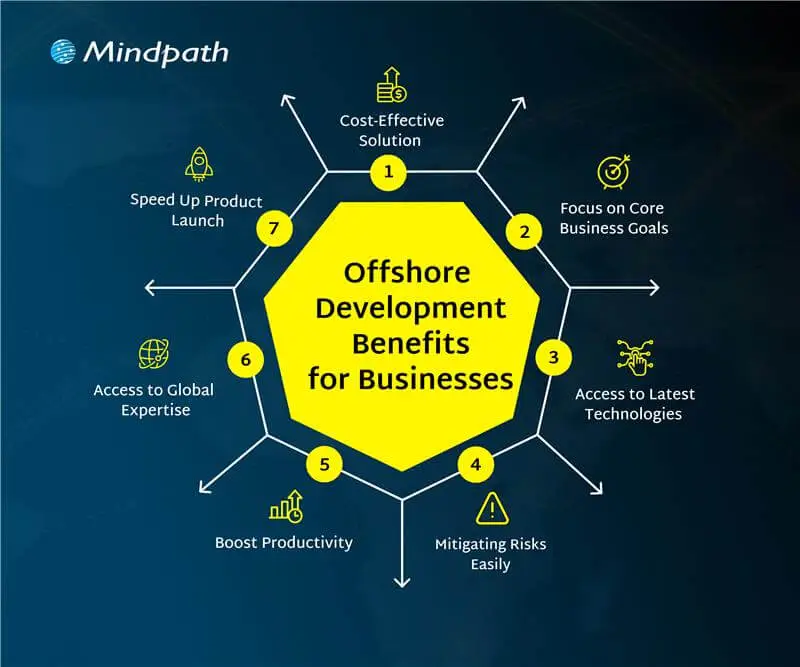
offshore development benefits for businesses

1. Cost-Effective Solution

Offshore development services help businesses lower their software development costs without losing quality. Companies can hire skilled developers from countries where salaries are more affordable compared to local markets. This approach offers a smart way to achieve cost-effective software development without compromising on results. The money saved can then be used in other important areas like marketing, research, or improving infrastructure.

2. Focus on Core Business Goals

Offshore development lets companies’ hand over routine tech tasks to external teams. This helps free up internal staff to work on more important goals and long-term plans. With fewer day-to-day responsibilities, businesses can focus better on innovation and growth. It also gives them more time to strengthen their position in the market.

3. Access to Global Expertise

Working with global software development teams allows companies to tap into a wide range of skills and knowledge. They can bring in experts who specialize in tools or technologies that are hard to find or too expensive locally. This helps businesses build better solutions and stay updated with the latest trends. It also brings fresh ideas and faster problem-solving from experienced professionals around the world.

Also Read: Qualities of a Good Software Engineer

4. Mitigating Risks Easily

Working with offshore teams helps reduce risks that may affect your local operations. This includes not just natural disasters or political changes, but also technical issues like system failures or delays in development. Offshore partners can quickly step in to handle problems and share responsibility when challenges arise. This setup keeps your projects moving and makes your business more stable and prepared.

5. Boost Productivity

Offshore teams usually have clear roles and focus on getting results. This helps manage projects better and use resources more effectively. Many offshore developers work in well-organized environments that support smooth and efficient work. As a result, they often deliver high-quality work on time and sometimes even ahead of expectations.

6. Access to Latest Technologies

Offshore teams give businesses access to modern tools like AI, cloud computing, blockchain, and IoT. Many offshore developers already have experience with these technologies and know how to use them well. This helps companies stay up to date and try new ideas without spending extra on training or new systems. It also supports faster innovation and better tech solutions.

7. Speed Up Product Launch

Tech talent outsourcing helps businesses work faster by using teams in different time zones. When one team finishes their day, the offshore team can continue the work, keeping the project going around the clock. This constant progress helps fix issues quickly and speeds up development. As a result, companies can launch their products sooner and meet deadlines with ease.

Want to know how this round-the-clock development approach works best ? Understanding the stages of the software development life cycle helps ensure offshore teams collaborate efficiently while maintaining quality and timelines.

Are you facing any confusion between offshore software development and onshore software development? Let us learn about the difference between them.

Offshore vs Onshore Development: A Comparison Table

When planning a software project, businesses often choose between offshore and onshore development based on their goals, budget, and timeline. Both options have their own advantages and challenges. The table below gives a clear comparison to help you decide which model suits your business needs best.

Factor 

Onshore Development 

Offshore Development 

Definition  Development done by a local team Development handled by a team in another country
Location Within the same country Access to cost-effective global locations
Proximity Easy access to the team Remote but manageable with clear planning
Cultural Fit  Shared work culture Diverse perspectives and global work culture
Communication Face-to-face communication possible Efficient digital communication tools
Talent Base Limited to local skills Broader access to global tech talent
Language Barrier Minimal language issues Clear strategies help overcome language gaps
Time Zone Same time zone, easy scheduling 24/7 progress through time zone advantage
Work Cycle Fixed to local business hours Continuous work with round-the-clock development

Looking to Scale Smartly with Offshore Software Development?

Offshore software development continues to be a smart and flexible solution for businesses in 2026. It helps reduce costs, improves access to global talent, and supports faster innovation. By using offshore teams, companies can stay competitive, scale quickly, and focus on their main business goals. No matter if you’re a startup or an established company, offshore development can support your long-term growth.

At Mindpath, we offer reliable offshore development services tailored to your business needs. Our expert teams are equipped with the latest tools and technologies to deliver high-quality solutions on time. With a focus on communication, transparency, and results, Mindpath helps you build the right IT outsourcing strategy for long-term success.

Frequently Asked Questions

1. How do offshore development services ensure quality work when teams are remote?

Offshore teams follow structured processes, regular updates, and clear communication to maintain quality. Many companies also use agile methods, testing practices, and performance tracking tools. With the right planning and collaboration, remote teams can deliver reliable and high-quality results consistently.

2. Is offshore software development suitable for small businesses or only large enterprises?

Offshore software development is suitable for both small businesses and large enterprises. Startups can benefit from lower costs and faster development, while larger companies use it to scale operations. It offers flexibility for any business aiming to grow efficiently without heavy investment in local hiring.

3. What challenges can businesses face with offshore development, and how can they manage them?

Common challenges include time zone differences, communication gaps, and cultural differences. These can be managed by setting clear expectations, using collaboration tools, and scheduling regular meetings. A well-defined workflow and strong project management help ensure smooth coordination and project success.

4. How do offshore development services help businesses stay competitive in a fast-changing market?

Offshore development services give access to global talent, faster delivery cycles, and modern technologies. This allows businesses to innovate quickly and adapt to market changes. With continuous development and cost savings, companies can focus more on strategy and stay ahead of competitors.

5. What factors should be considered before choosing an offshore development partner?

It is important to check the partner’s experience, technical expertise, communication approach, and past projects. Understanding their work process and support system is also key. Choosing the right partner ensures better collaboration, smoother execution, and long-term project success.

Discover the benefits of offshore development, including cost savings, access to skilled talent, and enhanced flexibility.

Join our Newsletter!

categories

Join the world's largest training library and unlock new opportunities!

Featured Posts

Ready to Leverage GenAI for
Software Development?

Form automation to innovation, let’s turn your ideas into intelligent, AI-driven solution.