

Latest Insights On
GenAI, Tech, and Digital Transformation
Stay updated with expert insights, success stories, and real-world applications of cutting-edge technology.
The advantages of ReactJS have made every business owner think about its utility in developing web projects. It is the most powerful and commonly used JavaScript library for creating intuitive interfaces. If you want React developers in your team, then you must know the ReactJS developer skills that you should look for in candidates.
The declarative approach and component-based architecture of ReactJS have revolutionized front-end development completely. Knowing what skills to look for saves time and hiring costs. The right developer brings structure, speed, and scalability to your project. In this article, we break down the core ReactJS developer skills every successful web project depends on.
Want to hire ReactJS developers for your next web project? Explore more on Mindpath’s React JS development services to get expertise in developing a web application aligned with your business goals.
Discovering the Skillset of Expert ReactJS Developers
The general assumption about the skillset of ReactJS developers is that they know how to work with React. However, fluency in React itself is not the only addition in the React skill set for any developer. React developers must have a broader skillset beyond the library to craft impactful web projects. The following skills can help business owners identify the best React developers for their next web project.
1. HTML and CSS
The foremost addition in a list of ReactJS skills is the combination of HTML and CSS, which play a crucial role in organizing the styling of the web experience. React developers must know the concepts of semantic HTML and how to use the right HTML tags for better SEO and accessibility. ReactJS developers should have an in-depth understanding of the fundamentals of CSS, such as selectors, CSS Grid, responsive design principles, and the box model.
Apart from CSS fundamentals, the essential React skills for developers also include knowledge of CSS preprocessors and frameworks. Developers can use the pre-processors to streamline styling workflows and improve ease of maintenance in larger projects.
2. JavaScript ES6
JavaScript ES6 or ECMAScript 2015 brought many interesting features to the domain of modern web development. When you hire React developer for the next web project, you should check their level of fluency in JavaScript ES6. The distinctive features of JavaScript ES6, such as arrow functions, template literals, and ES6 classes, make React web development more efficient. For instance, arrow functions can ensure simpler syntax for functions and intuitive management of the context.
ReactJS developers must know how to leverage ES6 classes for a more structured use of JavaScript along the lines of component-based architecture. Developers can also use features like template literals to embed expressions in strings, thereby creating cleaner code.
3. Event Handling and DOM Manipulation
The virtual DOM in React is one of its distinctive features. All the listings for React JS developer jobs showcase the necessity of learning about DOM manipulation. At the same time, you must know that direct DOM manipulation is not required in React. On the other hand, developers must know the process through which the browser renders and interacts with the Document Object Model. DOM manipulation is required in scenarios where you want to build interactive and dynamic user interfaces.
Another crucial addition among skills required for ReactJS developer is event handling. It focuses on responding to different user events through event listeners and callback functions. Therefore, React developers must know the fundamentals of event delegation, capturing, and bubbling.
4. Git
You cannot think about hiring React developers who don’t know how to work with Git, the most popular version control system. Git helps in promoting team collaboration and source code revision management to ensure efficiency in the development lifecycle. ReactJS developers must know the fundamental concepts, such as commits, repositories, branches and merges. On top of it, developers must also know how to work with branching strategies, hosting platforms of Git and conflict management.
Git is a promising tool for frontend development with React as it provides the ideal foundation for collaborative development. Developers who know how to work with platforms like GitLab and GitHub can ensure better efficiency in team collaboration, project management and code reviews.
Must Read: Cost of Hiring ReactJS Developer
5. Redux
The list of technical skills you should search in the profiles of ReactJS developers also includes Redux. It is a specialized library used for state management in larger and more complex React applications. The cost of hiring ReactJS developers is justified when you notice how fluency in Redux can offer credible benefits to your web projects. The most promising features of Redux include centralized state management, application scalability and predictable state updates.
Redux works with a single storage for all states of an application, thereby ensuring consistency in management of state transition. Efficient state management also serves as a catalyst for easier scalability and managing increasing complexity without vulnerability to bugs. Centralized state management with Redux also ensures predictability in the behavior of your web applications, thereby facilitating easier maintenance and debugging.
6. JavaScript XML or JSX
Every ReactJS developer must know how to work with JavaScript XML or JSX. It is also one of the notable additions among react developer must-have skills as it serves a critical role in ensuring simpler development and management of UI components. JSX helps developers write HTML-like structures in JavaScript, offering a seamless blend of markup and JavaScript logic. JSX also provides an easier solution for creating and managing the user interface components of their web applications.
The other notable applications of JSX include data and logic integration. JSX can help in injecting data and logic directly into the UI, thereby ensuring dynamic content rendering, required for modern web applications. On top of it, the declarative nature of JSX ensures that the code is easily readable and accessible for debugging.
7. React Hooks
Professional ReactJS developers must also have strong command on React Hooks, a revolutionary feature for state management. Hooks have introduced new perspectives on managing React features in functional components. It is one of the essential ReactJS developer job skills and aspiring developers must know about the important hooks they must learn to create web applications.
The notable React Hooks that a developer must know include ‘useState’, ‘useEffect’, ‘useRef’ and ‘useContext’. Each hook serves a distinct function such as providing direct access to DOM elements or managing component-specific state. On top of it, ReactJS developers must know how to create reusable logic through custom hooks.
8. Testing, Debugging and Performance Optimization
The most important skill that you can find in expert React developers is testing and debugging skills. You can find answers to “why hire React developers?” in their skillsets that focus on comprehensive testing to create robust apps. The notable testing methods include unit testing, that involves testing the individual components independently or integration testing. React developers must also know how to work with debugging tools and browser developer tools to inspect the code.
Apart from testing and debugging, React developers must also know the best practices for performance optimization. Skilled ReactJS developers can use different techniques such as virtualization, code splitting and bundle size optimization to craft responsive applications.
Want to improve your application’s speed without increasing development time or infrastructure costs? Discover how optimizing React performance benefits business owners looking for efficiency and ROI.
Mandatory Soft Skills
Most of the discussions about skills of ReactJS developers focus only on the technical skills. Choosing a React JS development service for capitalizing on the expertise of skilled developers also requires attention to soft skills. You need developers who have the capabilities for critical thinking and problem-solving with efficient solutions. React developers must have skills for clear and concise communication that empowers them to work in collaboration with other teams.
React developers should also have attention to detail for crafting intuitive user experiences and writing code without bugs. Most important of all, ReactJS developers should strive to learn continuously and improve their skills to stay updated with emerging technologies and recent ReactJS trends.
Are You Hiring the Right ReactJS Developer for Your Project?
Choosing the wrong developer costs more than just time. The right ReactJS skills decide whether your web project scales or struggles long term. Businesses that hire with clarity build faster, iterate smarter, and deliver better user experiences consistently. Knowing exactly what to look for puts you ahead from day one.
The thought of hiring a developer from a reputed ReactJS development company might seem like a challenge. Interestingly, you can find the best ReactJS developers at Mindpath for your next web project; they help you build modern web solutions. The notable technical skills of React developers include knowledge of HTML and CSS, JSX, JavaScript ES6, React Hooks and direct DOM manipulation. On top of it, ReactJS developers must also have soft skills such as communication, adaptability, critical thinking and problem-solving. Learn how to pick the best ReactJS developers for your web projects now.
Software development has evolved beyond the traditional approaches that required separate frontend and backend development teams. The need for full-stack development is evident in the new digital landscape, where user requirements and business goals change in an instant. Full-stack software development offers a strategic option to develop user-friendly and robust applications without paying a fortune.
With the growing competition to establish a strong digital presence, business owners must pick a reliable development approach, like full-stack. However, it is also important to learn what full-stack software development entails before embracing it. Let us discover more about the full-stack approach and how businesses can use it to develop their software applications.
Thinking of adopting full-stack development for your next project? Mindpath’s full stack development services will help you with the integration of front-end and back-end expertise that your business needs.
Understanding Full Stack Fundamentals
Full-stack has emerged as the most valuable strategy for software development that allows businesses to meet the emerging user requirements and business goals. It follows an end-to-end approach for developing software applications, involving both the frontend and backend. The answers to “What is full-stack development?” also emphasize how it can enhance cost-effectiveness, agility, and efficiency. You can understand full-stack in a better way by breaking it down into the two primary components.
1. Frontend Development
The frontend development deals with the client-side aspect of the application, or the part of the application that users see. It includes everything a user sees of an application on their smartphones or web browsers. The important elements of the frontend of an application include the design, images, layout, navigation menus, buttons, text, and anything that users can interact with.
The most important technologies for frontend development in the full-stack approach include HTML, CSS, and JavaScript. In addition, full-stack developers must also have a strong command of frontend frameworks and libraries. HTML serves as the foundation for arranging web content, while CSS helps in styling the interface by controlling fonts, layout, responsiveness, and colors.
The search for answers to “what is full-stack web development” will also help you understand the significance of JavaScript. It is a popular programming language that helps developers add dynamic and interactive elements to web pages. Most important of all, frameworks and libraries like Angular, Vue, and React simplify frontend development while empowering developers to create complex user interfaces without sacrificing responsiveness.
Planning to use full-stack development for your next web project? Before that, read about the future of full-stack development for web projects!
2. Backend Development
The backend of a software application focuses on the server-side aspects of the application, which drive its functionalities. Backend development deals with logic, communication, and data storage, which work in the background and are never visible to users. The full-stack development definition describes the backend as the “brains” behind the working of an application. The backend processes requests from the frontend, interacts with databases, and sends data back to the frontend.
Backend development for a software application requires fluency in programming, backend frameworks, server management, APIs, and database management. The notable programming languages used to create backend logic include Python, Java, Ruby, Node.js, and PHP. Developers should also know how to leverage the relevant backend frameworks for each programming language. For instance, Ruby on Rails is ideal for Ruby, while Express.js is for Node.js, and Django is the best backend framework for Python.
Also Read: Full-stack development with Node.js
Database management and server management are also integral requirements for full-stack developers. Backend development is incomplete without databases, as they help with the storage and management of application data. Database management may involve the use of relational databases like MySQL and SQL Server or NoSQL databases such as MongoDB. Backend development also requires an in-depth understanding of best practices for configuring and managing web servers. Another important requirement for backend development focuses on APIs that establish rules and protocols for communication between different software components.
The answer to such a question is quite obvious and points to any developer who knows frontend and backend development. One of the significant highlights in any full-stack developer definition is the proficiency in frontend and backend development technologies. On top of it, full-stack developers must be fluent in security practices and DevOps to offer productive end-to-end software development solutions. Full-stack developers know how every layer of an application works, thereby empowering them with a holistic view of the development process.
The versatility of full-stack developers makes them one of the most valuable resources for businesses in the new technological landscape. Full-stack developers can create responsive web layouts, implement database integration, manage testing and debugging, and write server-side logic. On top of it, they also work in collaboration with UI/UX designers and other teams to develop efficient applications.
Understanding the differences between front-end, back-end, and full-stack developers is key to building an effective development team. Learn more about the distinct responsibilities of each developer in our blog: Front-end vs Back-end vs Full-stack developer
Workflow of Full Stack Development
The definition of full-stack indicates that combining frontend and backend development can serve promising advantages for businesses. At the same time, it is also important to wonder about the workflow in full-stack projects. Where does full-stack begin, and how does it integrate frontend and backend development in a single workflow? You can find the answer by reflecting on the full stack definition once again, by focusing on the end-to-end aspect of the process.
Full-stack developers begin with the planning stage and end with the deployment and maintenance stage. The following steps in the full-stack workflow can help you understand how the holistic approach blends the traditionally different sides of software development.
1. Planning
The first step in the full-stack workflow involves planning and identifying essential features and technical specifications for the application. Full-stack developers collect information about essential requirements and understand the scope of the project. The developers also collaborate with different stakeholders to come up with an outline of the features desired in the application and its technical specifications.
2. Frontend Development
After finalizing the design, the next step in full-stack development focuses on the frontend of the application. The frontend development starts with a definition of the project structure and selecting the relevant technologies like HTML and CSS. The full-stack developer will implement the user interface in this step while ensuring accessibility and responsiveness.
At the same time, developers must ensure that the frontend complies with important design guidelines. The other crucial tasks in the frontend development stage include the creation of reusable components and the integration of backend APIs to fetch and display data.
3. Backend Development
The next step in the full-stack software development workflow focuses on backend development and integration of the backend logic with the frontend. Developers can create the backend of a full-stack application with server-side scripting languages like Python, Node.js, or Ruby. In addition, developers also employ the relevant database management system for the application according to its requirements.
Apart from creating and implementing the server-side logic, full-stack developers also create RESTful APIs and address data management needs. The backend development stage also calls for attention to the security and scalability of applications. Therefore, developers have to implement comprehensive authentication and authorization mechanisms and follow the best practices for data validation.
4. Testing
Before launching the application, full-stack developers will implement comprehensive testing plans to find errors and bugs. Developers have to define unit tests, end-to-end tests, functional tests, and integration tests to measure the utility of the application in different scenarios. Writing the tests in the early stages of development helps in creating applications that align with the desired goals and requirements of features. It also ensures that the application is easy to maintain, reliable, and adheres to the desired specifications.
Following the testing process, developers work to achieve seamless integration of frontend and backend components. The process involves establishing communication between the frontend and backend with uninterrupted data flow and error management. Full-stack developers rely on testing on a wide range of devices, scenarios, and browsers to identify and resolve performance issues. As a result, they can ensure easier integration of frontend and backend components without conflicts.
5. Deployment and Maintenance
The final stage in the full-stack workflow or deployment focuses on preparing the application for the production stage. The deployment stage involves the configuration of essential server environments and setting up continuous integration and continuous deployment pipelines with DevOps. Full-stack developers must also ensure that the application has been optimized for production in the deployment stage.
Some of the important requirements for deploying a full-stack web application include database migration, scaling to adapt to the user traffic, and server provisioning. Once the deployment is complete, developers monitor the application performance to identify any anomalies. If they find any issues, then developers will address them, followed by providing continuous maintenance and updates.
Hiring the right talent can make or break your MVP. Learn why hiring a Full-Stack Developer for MVP Success can make your product development faster and more efficient
Popular Technology Stacks for the Full Stack Developer
The doubts of a business owner before adopting the full-stack approach also focus on the choice of technology stack. Technology stacks refer to the combinations of technologies used by full-stack developers to create software applications. You must also know that the full-stack developer’s salary depends a lot on the candidate’s fluency in different stacks.
The most popular technology stack alternatives include MERN, MEAN, LAMP, LEMP, and Python-based stacks. Each stack features distinct technologies serving different roles in the development cycle.
1. MERN
The MERN stack represents the combination of MongoDB, Express.js, React.js, and Node.js. MongoDB serves as the NoSQL database while React.js offers the frontend development library. Node.js works as the JavaScript runtime for the backend, and Express.js is the relevant backend framework for it. Developers can work with a single programming language as all components in the MERN stack are JavaScript-based.
2. MEAN
The MEAN stack includes similar components to the MERN stack, albeit with the exception of the Angular framework for frontend development. It is a popular choice for full-stack web solutions due to Angular, which offers a more structured framework for frontend development. At the same time, developers can capitalize on the advantages of working with a complete JavaScript ecosystem in the MEAN stack.
3. LAMP and LEMP
The LAMP tech stack includes Linux as the operating system, Apache as the web server, PHP as the server-side programming language, and MySQL as the relational database. It is a traditional tech stack, implemented in content management systems such as WordPress. The LEMP stack is similar to LAMP, albeit with a different web server, Nginx, which offers high performance and efficient management of concurrent connections.
4. Python-based Stacks
Python is also one of the most popular server-side programming languages for its readability. The effectiveness of full-stack development with Python also depends on its comprehensive collection of libraries and strong community. Python-based stacks can use different Python web frameworks, frontend frameworks, and relational databases, depending on the project requirements. The common choices for Python web frameworks include Django and Flask, while frontend framework choices include React and Angular.
Looking to reduce time and costs, and take full advantage of full-stack expertise. Discover how Mastering Full-Stack Development with Node.js can help businesses in streamlining workflows as well as boost project ROI.
How Does Full Stack Help Your Business?
As a business owner, you might wonder if full-stack is an effective approach to software development. Businesses can capitalize on the full-stack development benefits to get best outcomes for their businesses.
1. Faster and Efficient Development
The most promising advantage of full-stack software development is the speed of development. It reduces the dependencies between isolated frontend and backend development teams as a single developer takes responsibility for multiple aspects of the project. Full-stack developers can achieve faster iterations, release features quickly, and ensure faster time to market for new products, services, and updates.
2. Cost Savings
The next notable highlight in full-stack developer skills is the ability to offer the services of frontend and backend developers, along with database specialists, in one package. Businesses don’t have to hire different professionals for these roles, which reduces the costs of recruitment, onboarding, and other operational costs.
3. Flexibility and Consistency
Another promising advantage of working with full-stack developers is the assurance of flexibility in agile environments that demand rapid changes. Full-stack developers will quickly adapt to address the requirement of urgent attention to specific areas of an application. On top of it, the unified and consistent architecture ensures easier integration between the frontend and backend components without compatibility issues.
Want to accelerate your development process? Explore how a freelance full-stack developer can create interactive user interfaces and oversee deployment and maintenance.
Ready to Build Smarter, Faster Applications With Full Stack Development?
The value of full-stack development for any business is about following a holistic approach to software development. The unique approach not only reduces costs but also provides a solution to avoid delays and deliver the best user experiences in applications. With the support of a full-stack developer, your business can navigate through the complexities of the digital landscape with ease.
We at Mindpath specialize in end-to-end software development and have helped clients create intuitive applications in different industries. Our commitment to deliver the best results stems from our ability to understand the client’s requirements and identify the best resources for their projects. Contact us to figure out the ideal course for your next software development project.
React continues to shape modern front-end development, with changes in rendering, performance optimization, developer tooling, and application architecture influencing how teams build web applications. Understanding the latest ReactJS trends can help developers and businesses make informed decisions about technology choices, maintainability, and user experience.
In 2027, React development involves more than building reusable UI components. Server Components, the React Compiler, TypeScript, modern frameworks, and AI-powered interfaces are influencing how applications are designed and maintained. This guide covers ten important ReactJS trends, their practical applications, and the considerations businesses should evaluate before adopting them.
Key Takeaways
- 01
React Server Components and modern rendering strategies give developers more options for organizing application logic and delivering content. - 02
The React Compiler can automate certain performance optimizations, reducing the need for some manual memoization when properly configured. - 03
TypeScript, testing tools, and improved debugging workflows help teams maintain larger React applications with greater confidence. - 04
AI-powered interfaces, reusable design systems, and React Native create opportunities for richer digital experiences across web and mobile products. - 05
Businesses should evaluate ReactJS trends based on measurable performance, security, accessibility, development needs, and long-term maintenance costs.
How ReactJS Has Evolved
Since its introduction in 2013, React has developed from a library focused on building interactive user interfaces into a broader ecosystem supported by frameworks, development tools, and rendering capabilities. Its component-based approach remains central to how developers organize interfaces, while newer features address application performance, asynchronous updates, and server-side rendering patterns.
React 18 introduced concurrent rendering capabilities, including automatic batching and improvements to Suspense. React 19 added features such as Actions, the use API, support for document metadata, and stable React Server Components for compatible environments. Subsequent releases continue to evolve the library and its development workflows.
The React team’s official release notes are the best reference for version-specific changes. Developers should check compatibility and migration guidance before upgrading an existing application.
For a broader view of React’s development direction, read the React roadmap.
ReactJS Features and Updates to Understand in 2027
React’s recent development has focused on improving application architecture, rendering, data handling, and developer workflows. The following capabilities are particularly relevant when planning or modernizing a React project.
1. React Actions and Modern Hooks
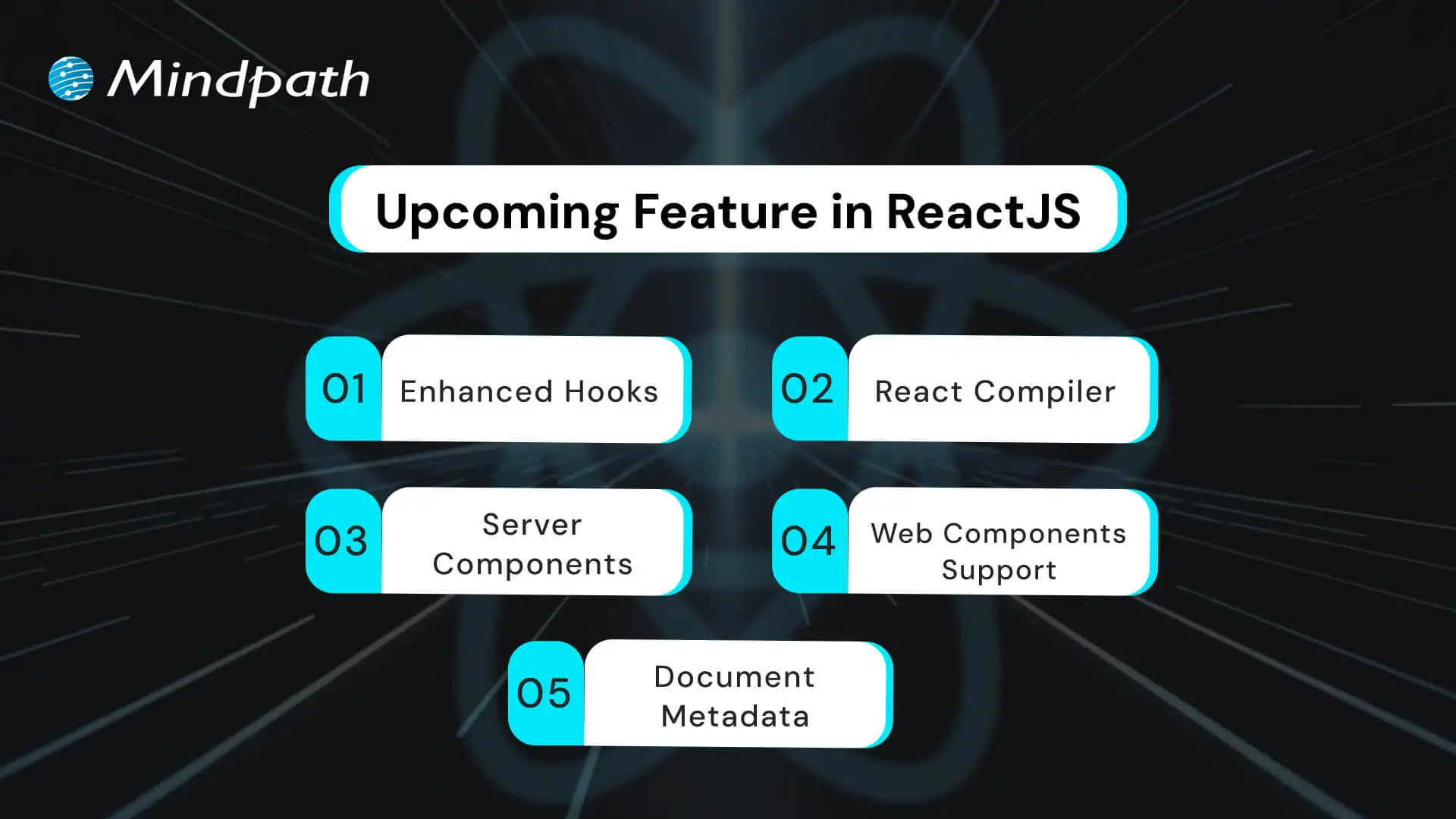
React 19 introduced Actions and APIs such as useActionState and useOptimistic to help manage common asynchronous workflows. These capabilities can simplify form submissions, pending states, error handling, and optimistic interface updates.
For example, a customer portal can display a pending state while a user updates account information. An interface may also show an expected change immediately while the application waits for the server to confirm the operation.
These APIs do not eliminate the need for backend validation, error handling, or secure data processing. They provide building blocks for managing the user experience around asynchronous operations.
2. React Compiler and Automatic Optimization
The React Compiler reached its first stable release in October 2025. It can automatically optimize React components and Hooks through memoization, reducing the need for some manual performance optimizations.
Traditionally, developers may use techniques such as memo, useMemo, and useCallback to avoid unnecessary calculations or rendering work in appropriate situations. The compiler can handle certain optimizations automatically when the code meets its requirements.
Teams should still measure performance, review compiler compatibility, and follow the recommended setup process. The compiler is not a substitute for efficient data fetching, sensible component design, or profiling real application behavior.
3. React Server Components
React Server Components allow components to render in a server-side or build-time environment separate from the client application. In compatible frameworks, they can help developers keep selected data access and rendering work on the server instead of sending all of that logic to the browser.
This approach can be useful for content-heavy pages, product catalogs, and applications that retrieve information from server-side data sources. Server Components and Client Components serve different purposes, so teams need to understand which features require browser-side interactivity.
Server Components do not automatically guarantee faster applications or better security. Performance depends on the architecture and delivery strategy, while sensitive operations still require correct authorization and data handling. Teams should also use compatible framework and bundler implementations.
4. Document Metadata and Custom Element Support
React 19 introduced native support for rendering document metadata elements, including title and meta tags, from components. It also improved support for custom elements, making it easier for React applications to interact with standards-based web components.
Metadata support can simplify some implementations by allowing page-specific titles and descriptions to be declared closer to the relevant content. However, larger applications may still benefit from framework-level metadata management for route handling, canonical URLs, and other SEO requirements.
Custom element support can also help teams integrate existing web components into a React interface. These capabilities are established features rather than merely upcoming React updates; the important consideration is how well they fit the application’s architecture.
Top ReactJS Trends to Watch in 2027
The following trends reflect how teams are using React and its surrounding ecosystem to develop modern digital products. Some are based on established React capabilities, while others are broader development practices that continue to influence React projects.
1. Server-First Application Architecture
One of the important ReactJS trends is the growing use of server-oriented rendering and data access patterns. Server Components, server-side rendering, and static generation provide different ways to deliver content and manage work across server and client environments.
For example, a product listing page may render much of its content on the server while using Client Components for interactive filters, cart controls, or other browser-side actions.
The right approach depends on how frequently the content changes, whether a page requires user-specific data, the infrastructure available, and the application’s performance goals. Server-first architecture is not mandatory for every React application, especially when a simple client-rendered interface is sufficient.
2. Automated Performance Optimization with React Compiler
The React Compiler is changing how developers approach certain rendering optimizations. Instead of relying exclusively on manually added memoization, teams can use compiler-supported optimization to reduce some unnecessary recalculations and re-renders.
This can make performance-oriented code easier to maintain, particularly in interfaces with many reusable components. However, results vary with the application, its dependencies, and the code being compiled.
Developers should still use profiling tools, monitor Core Web Vitals for public-facing websites, and investigate expensive rendering, network requests, or large JavaScript bundles. Automated optimization works best as part of a broader performance strategy.
3. Concurrent UI and Responsive Interactions
React’s concurrent rendering capabilities allow rendering work to be prioritized so that urgent interactions can remain responsive while less urgent updates are prepared. Features such as transitions and Suspense help developers manage updates and loading states in suitable application designs.
For example, a search interface may keep text entry responsive while results update in the background. A complex dashboard can use loading boundaries to display useful interface elements while selected content is being prepared.
These capabilities require thoughtful implementation. Suspense boundaries, transitions, data loading, and error states should be designed around actual user journeys rather than added without a clear purpose.
4. TypeScript for More Maintainable React Applications
TypeScript continues to be a useful choice for React teams that need clearer contracts between components, reliable data models, and maintainable codebases. It adds static type checking to JavaScript and can identify certain mistakes during development before the application runs.
For example, a reusable component can define the properties it accepts, while an API response can be represented using an explicit data type. These practices help teams understand how different parts of an application fit together.
TypeScript does not prevent every runtime error, validate untrusted API data automatically, or replace testing. Teams still need appropriate runtime validation, automated tests, code reviews, and consistent development practices.
5. Better Developer Tooling and Testing Workflows
React development increasingly relies on tools that help teams inspect component behavior, diagnose rendering issues, test user interactions, and automate code-quality checks. React Developer Tools, browser profiling tools, testing libraries, and static analysis can help identify problems earlier in the development process.
A reliable workflow may combine component tests, integration tests, end-to-end testing, accessibility checks, and continuous integration. These practices are especially important for applications with complex workflows or frequent releases.
Tools should be selected based on the project’s requirements, team familiarity, and maintenance needs. Adding more tools is not inherently better if they create duplicated checks or unnecessary complexity.
6. AI-Powered User Interfaces
React is frequently used to build interfaces for applications that include AI-powered features. These may include conversational assistants, content generation tools, semantic search, document summarization, recommendation interfaces, and AI-supported workflow automation.
React can manage the interactive interface while backend services handle model requests, data retrieval, permissions, and business logic. Streaming responses and clear loading states can help users understand that a request is in progress.
AI-powered interfaces need more than an attractive front end. Developers should plan for latency, errors, usage limits, privacy, access controls, and the possibility of inaccurate model responses. AI output should be presented with appropriate context and verification options when accuracy matters.
7. Performance, Accessibility, and User Experience
Performance remains an important consideration for React applications, but user experience depends on more than rendering speed. Developers must also consider navigation, keyboard access, readable layouts, error recovery, responsive design, and how quickly users can complete important tasks.
Useful practices include code splitting, efficient data fetching, optimized assets, accessible components, and testing with real devices. Public-facing websites should also monitor Core Web Vitals and investigate issues identified through performance measurements.
The best optimization priorities come from evidence. Teams should identify the pages and interactions that create friction, measure the impact of changes, and avoid adding complexity for improvements that do not meaningfully benefit users.
8. React Native and Shared Product Experiences
React Native remains relevant for businesses that want to build mobile applications using React concepts and JavaScript or TypeScript. It provides a separate development approach from React for the web, while allowing teams to share selected business logic and development knowledge where appropriate.
A company may offer a React web portal alongside React Native mobile apps. Shared validation rules, API clients, and domain logic can sometimes be reused, while navigation, UI components, and device integrations may require platform-specific implementations.
Cross-platform development should be evaluated against the required native capabilities, accessibility, performance, release process, and available skills. Code reuse can be valuable, but it does not remove the need for platform-specific testing and maintenance.
9. Modern Frameworks and Faster Development Toolchains
Frameworks and build tools influence how React applications handle routing, rendering, data loading, bundling, testing, and deployment. Tools such as Vite and frameworks such as Next.js offer different workflows and capabilities depending on the project.
A lightweight client-rendered application may need a different setup from a content-heavy website that benefits from server rendering or static generation. Developers should choose a toolchain based on deployment requirements, integrations, team experience, and long-term maintenance.
Faster local builds and convenient development feedback can improve day-to-day productivity. However, build speed alone should not determine the architecture. Production performance, security, reliability, and upgrade paths also matter.
10. Design Systems and Reusable UI Components
As applications grow, design systems and shared component libraries help teams maintain consistent visual patterns and interactions. A design system may include typography, spacing, colors, accessible form controls, navigation patterns, buttons, tables, and documented component behavior.
In a React project, reusable components can reduce duplicated implementation and make updates more consistent across pages. A shared component library can also help multiple teams work from common interface standards.
To be effective, a design system needs clear documentation, accessibility testing, versioning, and a process for handling changes. Teams should avoid creating abstractions for every small variation when a simpler component would meet the requirement.
How Businesses Can Evaluate ReactJS Trends
Not every new capability needs to be adopted immediately. Businesses should evaluate ReactJS trends based on the problems they are trying to solve, the constraints of their existing applications, and the value a change is expected to deliver.
1. Start with a Specific Business or User Need
Identify whether the priority is page performance, maintainability, a new interactive feature, a better mobile experience, or a more efficient development workflow. A clear goal helps teams choose relevant technologies instead of adopting tools simply because they are new.
2. Review Compatibility and Migration Requirements
Check React version requirements, framework support, dependencies, deployment constraints, and migration risks before introducing a new feature. For established applications, a phased rollout may be safer than changing multiple architectural elements at once.
3. Test Performance and Usability
Use profiling, automated tests, accessibility checks, and real-user feedback to evaluate whether a change improves the application. Record a baseline before implementation so that results can be compared objectively.
4. Account for Security and Maintenance
Review dependency health, access controls, data handling, update policies, and operational responsibilities. AI features and server-side capabilities may introduce additional data and security considerations that need to be addressed before deployment.
5. Measure Results Before Scaling
Start with a limited pilot when possible. Measure outcomes such as task completion time, error rates, page performance, development effort, and user feedback. Expand the implementation when the results support the original objective.
Challenges to Consider When Adopting New ReactJS Practices
New features and tools can improve development workflows, but adoption also introduces trade-offs. Businesses and development teams should consider these common challenges.
1. Compatibility and Migration Complexity
Older applications may depend on libraries, build tools, or patterns that are not immediately compatible with newer React capabilities. Teams should review upgrade guides, test critical workflows, and schedule migrations according to risk and business priorities.
2. Performance Is Not Automatic
Server Components, compilers, and modern toolchains provide useful options, but no single feature guarantees an optimal user experience. Applications still need careful data fetching, asset management, error handling, and performance testing.
3. Learning Curve and Team Readiness
New rendering patterns and tools may require changes to how developers structure components, load data, and test interfaces. Documentation, code reviews, training, and incremental adoption can help teams build confidence without disrupting delivery.
4. Security and Data Governance
Server-side rendering and AI integrations introduce important questions about access permissions, sensitive information, API usage, and data retention. Teams must ensure that server-only logic and credentials remain protected and that user-specific data is handled correctly.
What Is Next for ReactJS Development?
React’s continued development points toward more flexible rendering strategies, automated optimization, improved asynchronous workflows, and closer integration with modern application frameworks. At the same time, broader engineering practices such as TypeScript, accessibility testing, reusable design systems, and AI integration are shaping how React applications are built.
The most useful direction for a business is not necessarily the newest feature. It is the combination of technologies and development practices that addresses real user needs, supports the product roadmap, and remains maintainable over time.
Teams should follow official release notes, test upgrades in controlled environments, and regularly review their performance, security, and accessibility requirements. This approach helps businesses adopt relevant changes while avoiding unnecessary technical complexity.
Final Thoughts
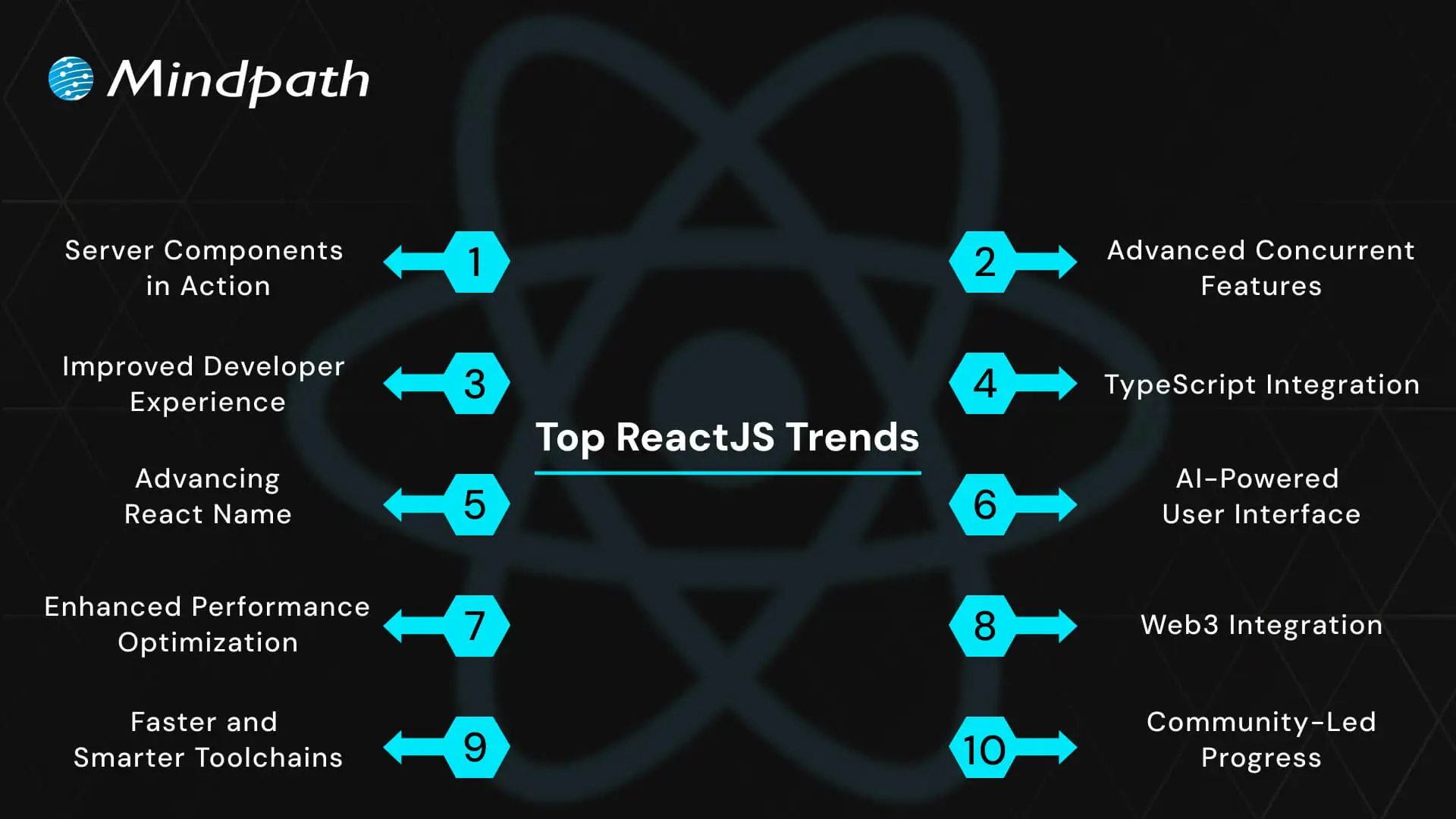
The key ReactJS trends in 2027 include server-oriented application architecture, React Compiler, concurrent UI patterns, TypeScript, improved developer tooling, AI-powered interfaces, performance and accessibility, React Native, modern frameworks, and reusable design systems.
Each trend offers opportunities, but the right choice depends on the application’s goals, technical requirements, team capabilities, and long-term maintenance plan. By evaluating changes carefully and measuring their impact, businesses can keep their React applications aligned with evolving user expectations and development practices.
At Mindpath, we help businesses build and modernize digital products around their technical and operational requirements. Our ReactJS development services support organizations planning interactive, maintainable, and scalable web applications.

The way people interact with websites and web applications continues to evolve. Users now expect digital experiences that are personalized, visually engaging, accessible, and easy to navigate. As a result, businesses are placing greater emphasis on user interface (UI) and user experience (UX) design to create products that meet changing user expectations.
Key Takeaways
- 01
AI-driven personalization helps web applications adapt content, recommendations, and interactions to individual user preferences. - 02
Immersive elements such as 3D visuals, augmented reality, and virtual reality can make digital experiences more engaging when used purposefully. - 03
Interactive design uses meaningful animations, transitions, and feedback to guide users through website and application interactions. - 04
Dark mode gives users an alternative visual setting that can improve comfort in certain environments and support interface preferences. - 05
Sustainable UI/UX design prioritizes efficient code, optimized assets, and lightweight interfaces to reduce unnecessary resource consumption.
The latest UI/UX design trends reflect this shift. From AI-driven personalization and immersive interfaces to interactive elements and sustainable design, these developments are influencing how businesses approach web application development. A well-planned user experience can also deliver measurable business value. UXCam, for example, highlights the widely cited estimate that every $1 invested in UX can generate $100 in return, although actual results depend on the product, audience, and implementation.
Whether you are building a new web application or improving an existing website, understanding these trends can help you make more informed design decisions. Here are five UI/UX developments shaping web experiences in 2026 and beyond.
5 UI/UX Design Trends Shaping Web Experiences in 2026
Web design is no longer limited to creating attractive pages. Businesses must consider how users navigate a website, understand its content, interact with its features, and complete their intended tasks. This makes UI/UX design an important part of web application development.
The following UI/UX design trends highlight how modern interfaces are becoming more adaptive, interactive, and efficient. Each trend offers opportunities for businesses to improve their digital products, provided it addresses a genuine user need.
1. AI-Driven Personalization
Artificial intelligence is changing how businesses personalize digital experiences. Instead of presenting identical content and interfaces to every visitor, AI-powered systems can use relevant user preferences, browsing behavior, and interaction history to deliver more tailored experiences.
For example, an e-commerce website can recommend products based on a customer’s previous interactions. A content platform can suggest relevant articles, while a business application can highlight frequently used features based on a user’s activity.
AI-driven personalization can also support adaptive interfaces. Depending on the application, businesses can use AI to adjust recommendations, organize relevant information, or provide contextual assistance. These capabilities help make digital interactions more relevant to individual users.
How Businesses Can Apply AI-Driven Personalization
- Display product or content recommendations based on relevant user preferences.
- Provide contextual suggestions based on user activity.
- Use AI-powered assistants to help users complete tasks.
- Adapt content presentation to different user needs and usage patterns.
- Give users control over personalization and how their data is used.
However, personalization should not come at the expense of user privacy or control. Businesses should use appropriate data practices, provide clear choices, and make sure personalized recommendations genuinely improve the experience.
2. Immersive Elements and 3D Experiences
Another important UI/UX design trend is the use of immersive visual elements. Three-dimensional graphics, augmented reality (AR), and virtual reality (VR) are creating new ways for users to interact with digital products and services.
Traditional websites primarily present information through text, images, and standard interface components. Immersive elements can make these experiences more interactive by allowing users to visualize products, understand spaces, or interact with digital environments.
For example, an e-commerce platform can use AR to help customers preview how furniture might look in their homes. Real estate businesses can offer virtual property tours, while product websites can use 3D models to show different product angles and details.
Common Applications of Immersive UI/UX Design
- 3D product visualization: Allows users to view products from different angles and understand their features.
- Augmented reality: Places digital objects within a user’s real-world environment through supported devices.
- Virtual reality: Creates simulated environments for product demonstrations, training, and virtual experiences.
- Interactive visual storytelling: Uses motion and visual elements to communicate information in a more engaging way.
Immersive design should always serve a clear purpose. Heavy 3D elements and complex animations can affect loading speed and usability if they are not optimized. Businesses should consider device compatibility, accessibility, and performance before implementing these features.
3. Interactive Design and Microinteractions
Modern users expect websites and applications to respond clearly to their actions. This is one reason interactive design and microinteractions have become important parts of modern UI/UX design.
Interactive design goes beyond adding animations to a website. It focuses on creating meaningful responses to user actions. For example, a button can change its state when clicked, a form can display validation messages, and a progress indicator can show how much of a process remains.
Microinteractions are small interface responses that help users understand what is happening within an application. They can confirm an action, provide feedback, or guide users towards the next step.
Examples of Interactive Design
- Button feedback: Visual changes when users hover over, click, or select a button.
- Form validation: Immediate messages that help users correct missing or invalid information.
- Loading indicators: Progress animations that communicate when a process is running.
- Navigation transitions: Subtle transitions that help users understand changes between interface states.
- Notifications: Confirmation messages that appear after an action, such as saving a form or updating a profile.
Well-designed interactions can reduce uncertainty and make an application easier to use. However, unnecessary animations and distracting effects can interrupt user journeys. Every interaction should have a clear purpose and should not slow down important tasks.
4. Dark Mode and Flexible Interface Themes
Dark mode has become a familiar feature across websites, mobile applications, and desktop software. Although it is not a new UI/UX design trend, it continues to be relevant because users increasingly expect control over how digital interfaces appear.
Dark mode uses darker backgrounds with lighter text and interface elements. It can be particularly useful in low-light environments and may help reduce perceived screen brightness. Its suitability, however, depends on the type of application, the surrounding environment, and individual user preferences.
For example, productivity tools, analytics dashboards, media applications, and development platforms often offer dark themes. Content-heavy websites and e-commerce platforms may benefit from providing both light and dark modes so users can select their preferred appearance.
Best Practices for Implementing Dark Mode
- Offer a clear option to switch between light and dark themes.
- Maintain sufficient contrast between text, backgrounds, and interface components.
- Ensure icons, images, charts, and other visual elements remain readable.
- Keep the visual hierarchy consistent across both themes.
- Respect the user’s system-level theme preference where appropriate.
- Test both themes across different devices and screen sizes.
Dark mode should not be treated as a purely decorative feature. A well-implemented theme should preserve readability, accessibility, and consistency throughout the application.
5. Sustainable and Performance-Focused Design
Sustainability is becoming an important consideration in digital product development. Websites and applications rely on servers, networks, devices, and digital resources, all of which consume energy. Sustainable UI/UX design focuses on reducing unnecessary resource usage while maintaining a useful and accessible user experience.
One way to achieve this is through efficient interface design. Lightweight pages, optimized images, clean code, and fewer unnecessary animations can reduce the amount of data and processing required to load and operate a website.
Minimalist design also plays a role. By removing unnecessary visual elements and prioritizing essential content, designers can create interfaces that are easier to navigate and potentially more efficient to maintain.
Ways to Make UI/UX Design More Sustainable
- Optimize images and media: Use suitable formats, compression, and responsive image sizes.
- Reduce unnecessary animations: Avoid resource-intensive effects that do not improve usability.
- Improve page performance: Minimize unnecessary scripts and optimize resource loading.
- Use efficient layouts: Prioritize essential content and avoid excessive interface elements.
- Write maintainable code: Use efficient development practices to reduce unnecessary complexity.
- Design for accessibility: Make digital products usable by people with different needs and abilities.
Sustainable design is not simply about reducing visual elements. It involves making thoughtful decisions about performance, accessibility, content, and technical implementation. These practices can also support a faster and more consistent user experience.
How to Choose the Right UI/UX Design Trends for Your Business
Not every design trend is suitable for every website or application. Businesses should evaluate new design approaches based on their audience, product requirements, technical capabilities, and business objectives.
Before implementing a trend, consider the following factors:
1. Understand Your Users
Identify your target audience, their expectations, common challenges, and the tasks they want to complete. User interviews, surveys, usability testing, and analytics can help reveal which improvements are most valuable.
2. Identify the Problem You Want to Solve
Choose a design trend because it addresses a specific usability or business problem, not simply because it is popular. For example, AI personalization may help users find relevant content, while microinteractions can provide clearer feedback during important actions.
3. Evaluate Performance and Accessibility
Consider how a proposed design change will affect page speed, responsiveness, accessibility, and compatibility across devices. Visual improvements should not make the application slower or harder to use.
4. Test Before Full Implementation
Create prototypes and test them with representative users before introducing major interface changes. Usability testing and A/B testing can help you understand whether a new design actually improves the user experience.
5. Measure the Results
Track relevant performance indicators after implementation. Depending on the application, these may include task completion rate, conversion rate, engagement, navigation errors, page performance, and user satisfaction.
The Future of UI/UX Design in Web Application Development
The future of UI/UX design will continue to be shaped by changing user expectations and improvements in technology. AI-driven personalization, immersive interfaces, interactive components, flexible themes, and sustainable design are influencing how businesses approach digital product development.
However, adopting every new trend is not the goal. Businesses need to identify which design approaches solve real user problems and support their product objectives. A successful interface should balance visual appeal with usability, accessibility, performance, and consistency.
Build Better Digital Experiences With the Right UI/UX Approach
The five UI/UX design trends discussed in this article highlight how web experiences are evolving in 2026. AI-driven personalization can make interactions more relevant, immersive elements can improve product visualization, and microinteractions can make interfaces easier to understand. Dark mode gives users more visual flexibility, while sustainable design encourages efficient digital experiences.
For businesses, the priority should be to implement these trends strategically. Understanding user needs, testing design decisions, and monitoring performance can help create web applications that are both visually engaging and practical to use.
Mindpath helps businesses develop modern digital solutions that align with their requirements. By combining thoughtful design with reliable web development practices, businesses can build applications that support meaningful user experiences and long-term growth.
Have you ever considered how AI and business actually fit together? You may have heard a lot about AI being faster and smarter, but is your business actually prepared for it? Many people are excited about new technology, but they often overlook whether they have a solid foundation. Take a second to think about it- is your business possibly ignoring some signs that say you are not prepared for AI yet?
AI can help any business develop, but starting without preparation can create issues. There are companies that jump into AI without having the right tools or people, or even ideas. This could waste valuable time and resources and lead to frustration. Integrating AI in business strategy from the start ensures you’re prepared and can identify potential challenges early. In this blog post, you’ll learn five easy indicators that show your business may not be ready for AI yet.
Want to future-proof your business with AI? We at Mindpath offers exceptional AI development services that help your business get AI-ready and unlock next level of growth!
What Being ‘AI Ready’ Really Looks Like?
Being ready for AI means your business has the right people, tools, and plan to make it work well. When you think about AI and business together, it’s more than just buying new software. You need good data that’s easy to use, a team that knows how to work with AI, and clear goals that AI can help you reach. A business ready for AI knows how to bring people and smart technology together.
Look at Amazon. They show how AI in e-commerce can work side by side with business to help customers and save money at the same time. This happens because they plan ahead and know exactly how AI will help. If you want your business to be ready to use AI, start by checking your data, training your team, and making a simple plan that fits your real needs. When you get this right, AI in business can really help you grow.
What is an AI Readiness Checklist?
An AI Readiness Checklist is a simple tool that helps you see if your business is really ready to use AI in the right way. It covers important things like your data, your technical tools, and how well your team understands AI. When you think about AI helping your business grow, this checklist shows you what’s strong and what needs more work.
A good AI checklist looks at your technical setup, the quality of your data, your team’s skills, and whether your company is open to new ways of working. This way, you can fix any gaps before you bring AI into your business. By using an AI checklist, you can make sure you’re set up for success and get real value from AI in business.
How is AI reshaping the way websites are built and optimized? Explore our detailed article on AI in Web Development to see how it’s driving smarter design, faster deployment, and better user experiences.
AI Readiness Checklist for Businesses
Before you bring AI into your daily operations, it’s important to know where you stand. A good AI readiness checklist will help you see if your business is truly prepared for this step. Here are the key areas to focus on as you plan your AI and business journey.

1. Robust Data Foundations
Good data is the backbone of any artificial intelligence business idea. Check that your data is clean, organized, and ready for AI tools to use well. Strong data governance keeps your insights trusted and prepares your business for AI integration.
2. Leadership and Team Alignment
A strong AI and business plan starts with people who believe in it. Make sure leaders fully support your strategy and teams understand the goals. A clear roadmap and open communication help everyone move toward strategic AI adoption together.
3. Technology and Process Readiness
Your tools and workflows must support AI smoothly. Research the best AI solutions for your existing systems and test them with pilot projects. Use simple frameworks to track results and find the best areas for automation.
4. Governance, Ethics, and Security
Responsible AI needs strong rules and security in place. Create clear ethical guidelines and monitor how AI works in your company. A good AI checklist helps protect your artificial intelligence business ideas and builds trust for the long term.
5. Financial Planning and ROI
Every digital transformation roadmap needs clear budget planning. Create realistic budgets, show expected returns, and track savings as you go. This makes it easier to get leadership buy-in and keeps AI and business costs under control.
Looking to streamline your business operations and enhance customer experiences? Discover how conversational AI chatbots can help your business transform its workflows and boost efficiency in our blog.
5 Signs Your Business is Not Ready for AI
Many companies jump into AI without checking if they’re really prepared. Missing a few basics can lead to wasted time and money. Here are five signs that show your business is not ready for AI yet.

1. Stuck in Paper-Heavy Processes
Paper forms, files, and manual approvals slow down daily work and limit growth. AI needs clean, digital data that is easy to find and process. If you’re still tied to paper, you’ll struggle to get real results from AI. Going digital is the first step to connect AI and business ideas that really work.
2. Running on Outdated Technology
Old systems can hold you back from adding smart AI tools. If your technology can’t talk to modern platforms, your AI plans won’t go far. Keeping rigid, legacy software in place only adds roadblocks. Updating your systems is essential for future-proofing your business with AI.
3. Poor Data Quality and Structure
Messy or incomplete data will confuse even the best AI tools. AI needs clear, well-organized data to find patterns and deliver insights. If your data is spread everywhere and filled with errors, you’re not ready yet. A strong data foundation helps your AI and business strategy succeed.
4. No Clear Data Strategy in Place
Without a clear plan, your data might be scattered, outdated, or not useful at all. AI can’t do much if it doesn’t have good data to work with every day. A strong data strategy shows what to collect, how to store it, and who can use it. This is key for turning business ideas AI into real results and leveraging AI in decision-making.
5. Lack of Real-Time Data Insights
AI works best when it has fresh, up-to-date information at its fingertips. If you only rely on old monthly reports, you will miss the full power of AI. Real-time data helps AI spot changes and take action fast. It’s a big step for future-proofing businesses with AI in any industry.
Want to future-proof your AI strategy? Don’t miss our insights on the Top AI Trends in 2025 every business should be ready for.
Ready to Make AI and Business Work Together?
Preparing your business for AI means more than just buying new tools. It’s about building strong data foundations, modern systems, and a clear strategy that connects people and technology. Knowing the signs that you’re not ready yet can save time, money, and stress. With the right plan, AI can help your business grow stronger together and bring real results.
Mindpath’s expert AI development services help you create practical, future-ready solutions. Our team works closely with you to plan, build, and integrate AI into your daily operations. We focus on clean data, secure systems, and smart strategies that fit your business needs. Let us help you connect AI and business in ways that truly work.
Have you ever asked yourself what makes a web application run perfectly while another one continues to crash, raise issues, or slow down? The answer often relates to tech stack alternatives. Think of technology stack choices as the foundation and building blocks of your project. They can make your web application more robust or scalable, and easier or harder to maintain. So, how do you know which technologies should run your next big idea? It’s a decision that impacts the success of your project.
The options can seem endless, but if you understand your desired outcomes and the function of every piece of the technology stack, then this decision doesn’t need to feel too overwhelming. When you pick the right combination of tools, you could save yourself a lot of time and money. In this blog, we are going to explain the basics/fundamentals for web application tech stacks, highlight important considerations, and hopefully help you feel confident in regard to choosing the right technology stack for your web application project. So, let’s explore!
Planning to build a new web application? Mindpath’s web development services will help you in choosing the right tech stack and developing applications as per your business needs.
What is a Technology Stack?
A technology stack, or tech stack, is a combination of tools, frameworks, and programming languages that work together to build and run a web application. It serves as the base for your project. Each part of the stack reflects a specific function. Whether handling user actions or managing data behind the scenes, and effectively, they all need to work together if your application is going to function well.
Finding the right combination will have a significant effect on how your application performs and compounds. A prudent choice will allow you to build an organized, flexible, and scalable web application that you can easily maintain and grow as your needs change.
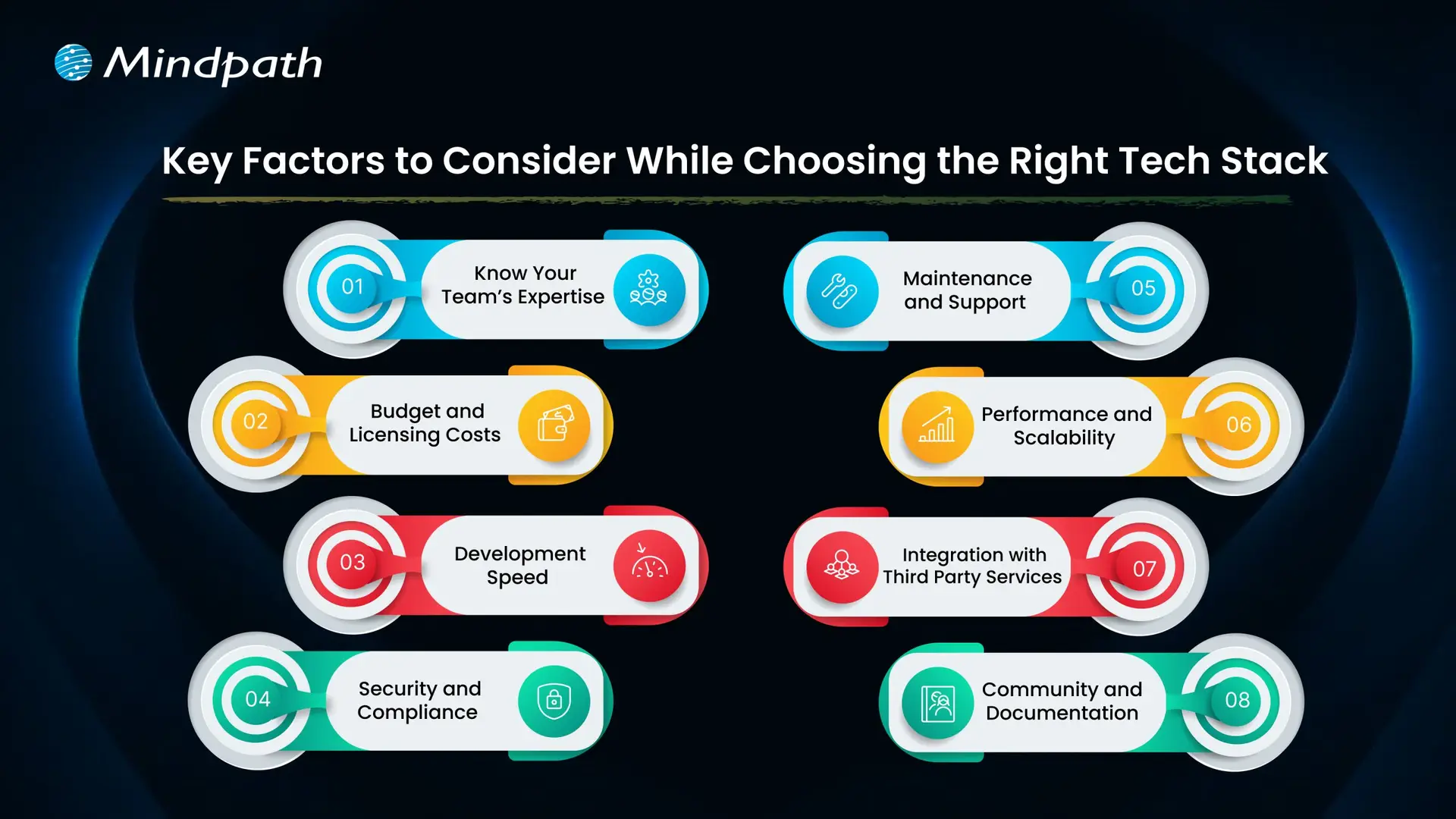
Key Factors to Consider While Choosing the Right Tech Stack
Choosing the right tech stack for web development is one of the most important things you’ll do to ensure the success of your project. The tools and technologies you decide to use will dictate how your application performs, scales, and is kept secure. Here are some key factors to keep in mind while selecting the best tech stack for web development.

1. Know Your Team’s Expertise
Look at what technologies your team already knows well. Using familiar tools can help you develop faster and avoid extra training costs. Make sure the tech stack matches your team’s size and experience to keep the project on track.
2. Budget and Licensing Costs
Think about any licensing fees for paid tools and compare them with free, open-source options. Remember to plan for costs related to maintenance, updates, and security. Also, include cloud service expenses that may grow as your project expands.
3. Development Speed
Getting your product ready fast can be a big advantage, especially for new businesses. Choosing proven frameworks and useful libraries can help your team build features quickly. This saves time and lets you focus on improving your web app for users.
4. Security and Compliance
Prioritizing security is essential, especially if your application handles sensitive data. Choose a tech stack that supports robust security features and aligns with industry regulations. This will help protect user information and maintain compliance as your project grows.
Must Read: Application Security Best Practices
5. Maintenance and Support
Choose technologies that have strong community or vendor support so you can get help when needed. A reliable tech stack with regular updates will make it easier to fix issues and improve your application over time. This helps you avoid unexpected costs and keeps your project stable in the long run.
6. Performance and Scalability
Make sure your tech stack can handle the speed and load your application needs. If you expect real-time processing or heavy traffic, choose tools that keep response times fast. This helps your web app run smoothly as more users come on board.
7. Integration with Third-Party Services
Check that your tech stack works well with the third-party services your app needs. Good API compatibility makes it easier to connect features like payments, analytics, or social media. This saves time and helps your app deliver a smooth user experience.
8. Community and Documentation
Choose technologies with an active developer community and plenty of shared resources. Strong documentation makes it easier for your team to build, test, and maintain your web application. This support can save time and help solve issues more quickly.
Wondering how your tech stack fits into the bigger picture of web app development? Explore our comprehensive Web App Development Roadmap for 2026 to see how each decision impacts your project’s success.
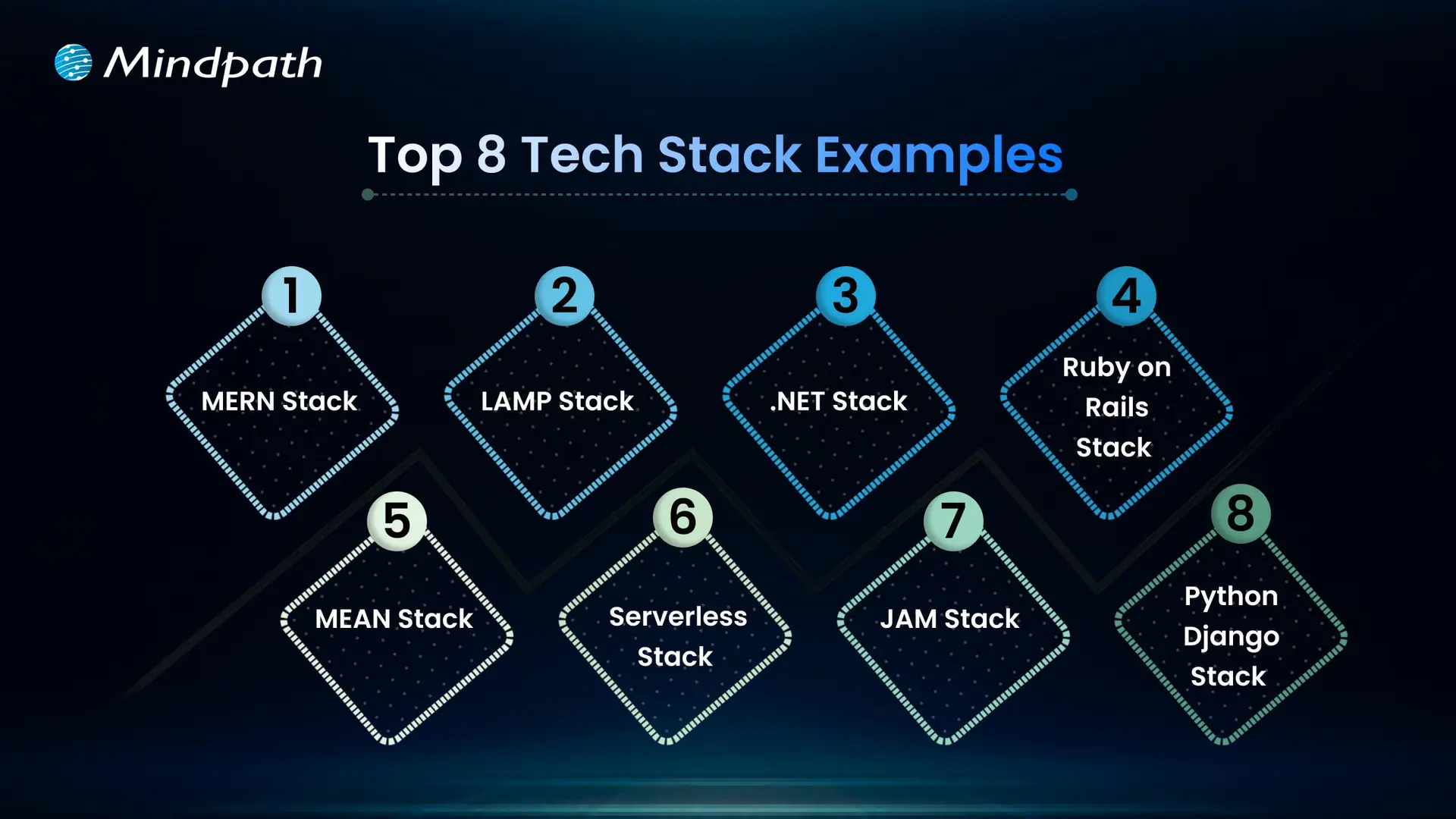
Top 8 Tech Stack Examples
Exploring technology stack examples can help you see what works best for different types of projects. Here are some of the most popular examples to consider in 2026.

1. MERN Stack
MERN includes MongoDB, Express.js, React, and Node.js for flexible, dynamic sites. It’s widely chosen as a modern web application stack for responsive interfaces.
2. LAMP Stack
The LAMP stack combines Linux, Apache, MySQL, and PHP to build reliable, cost-effective websites. It is one of the oldest and most trusted web stacks in use today.
3. .NET Stack
The .NET stack is known for secure, large-scale enterprise applications. Many companies choose this web dev stack for its strong integration with Microsoft tools.
4. MEAN Stack
The MEAN stack uses JavaScript across MongoDB, Express.js, Angular, and Node.js. This tech stack for web development is popular for real-time and single-page apps.
5. Ruby on Rails Stack
Ruby on Rails offers a simple, clean approach for rapid web projects. This technology stack example is still a favorite for startups and MVPs.
6. Python-Django Stack
The Python-Django stack helps developers build powerful sites quickly. Many prefer this as a flexible web development stack with great community support.
7. JAM stack
JAM stack uses JavaScript, APIs, and Markup to deliver fast static sites. It is considered one of the best tech stacks for web development for content-heavy projects.
8. Serverless Stack
Serverless architecture removes the need to manage servers directly. It’s a growing example of a tech stack that cuts costs and improves scalability.
Not sure if your business really needs a custom web application? Discover the key signs that your business needs a custom web application that indicate it’s time to invest in a tailored solution for your needs.
Need Help Choosing the Right Tech Stack for Your Web Project?
Selecting the right tech stack for web development shapes how well your application performs, scales, and adapts over time. By knowing your goals, team strengths, and key factors like security, costs, and integrations, you can make informed choices that save you time and money. A thoughtful approach will help you build a reliable, future-ready web application that supports your business growth.
At Mindpath, we help you build secure, high-performing web applications with the best-fit tech stack for your needs. Our experts offer end-to-end web application development services, covering design, development, testing, and support. We make sure your solution stays flexible, scalable, and easy to maintain as your business grows. Let’s create a web app that works for you.
Frequently Asked Questions
1. How do you choose the right tech stack for a web application without overcomplicating the decision?
Start with three clear questions: What does the application need to do, who will build it, and what is the budget? Matching the tech stack to team expertise, project complexity, and long-term scalability requirements eliminates most confusion. Overthinking the decision often leads to choosing unnecessarily complex technologies that slow development considerably.
2. Can switching tech stacks midway through a web project cause serious problems?
Significantly yes. Changing the tech stack mid-development typically means rebuilding foundational components, retraining the team, and resetting timelines entirely. The cost and disruption are rarely justified unless the original choice was fundamentally flawed. Making a thoroughly researched decision before development begins is always far more efficient than course-correcting later.
3. Is an open-source tech stack always better than a paid licensed one?
Not necessarily. Open-source stacks eliminate licensing fees but may require more internal expertise for maintenance, security patching, and troubleshooting. Paid stacks often include vendor support and compliance features that save time in regulated industries. The right choice depends entirely on team capability, budget structure, and specific application requirements.
4. How does the tech stack choice directly affect a web application’s long-term scalability?
Certain technologies handle growing traffic and expanding features far more gracefully than others. A stack chosen purely for rapid initial development may create serious performance bottlenecks as user numbers increase. Evaluating scalability requirements honestly at the planning stage prevents expensive infrastructure overhauls that become necessary when applications grow beyond their original technical foundations.
5. Does the size of a developer community really matter when selecting a technology stack?
Considerably more than most people initially expect. An active community means readily available documentation, faster bug fixes, regular framework updates, and easier access to experienced developers when hiring. Technologies with shrinking or inactive communities gradually become liabilities, making maintenance harder and recruitment significantly more difficult as fewer developers maintain proficiency in them.
The fast-paced growth of the digital landscape has not only empowered businesses but also made them think about their online presence. Companies have been hiring ReactJS developers to capitalize on the diverse capabilities of ReactJS for creating robust user interfaces. The notable features of ReactJS include the virtual DOM, a thriving ecosystem, and modular architecture. Let us find out the important factors you must keep in mind while hiring React developers.
Want to hire ReactJS expert for your next project? Discover how Mindpath’s ReactJS development services will help you achieve your specific business goals.
What Should You Keep in Mind While Hiring ReactJS Developers?
The search for expert ReactJS developers has gained momentum as a response to more businesses turning towards online platforms. However, business owners might experience some trouble in hiring React developer as they will find it difficult to understand coding nuances and technical jargon. At the same time, finding the best React developer who can also be a cultural fit is a huge challenge.
Hiring managers must also go through a massive talent pool of React developers to find the top expert for their next web project. On top of it, employers have to look for more than just technical skills in React developers to create successful web projects. The following checklist can help you hire the best ReactJS developers for your web projects.
1. Specify the Project Requirements
One of the foremost factors to consider when hiring ReactJS developers is the outline of project requirements. You should know your project scope and complexity level to identify the ideal React developer who would align with your project vision. The project requirements should not be limited to defining the type of project, but also the timeline, desired features, budget, and complexity.
With a clear impression of these aspects of your project, you can determine the skills and experience required from candidates. For instance, you will need a junior developer for smaller tasks and a senior developer for leading initiatives to scale up web projects.
2. Never Compromise with Technical Fluency
The easiest solution to challenges in hiring expert ReactJS developers involves focusing on the technical skills of applicants. You need developers who know more than the fundamental concepts of React and have various crucial technical skills. Candidates must have strong understanding of JavaScript features such as arrow functions, closures and destructuring.
Applicants for React developer jobs should also have in-depth understanding of the important concepts in ReactJS. Some of the important React concepts include React Hooks, component lifecycle methods, virtual DOM and reconciliation. People applying for ReactJS developer jobs must also know how to work with state management libraries such as Redux.
The other crucial technical skills in a checklist for hiring ReactJS developer include fluency in HTML and CSS, version control with Git and API integration. Aspiring React developer must also know how to work with testing frameworks, build tools and package managers like NPM. Another prominent technical skill that React developers must have is performance optimization.
Want to keep your large React app fast and responsive as it scales? Discover the best practices for optimizing React performance for large applications.
3. Optimizing the Interview Process
The effectiveness of your hiring process depends a lot on the quality of the interview. If the resume serves as an advertisement, then the interview helps you test the product. Employers should divide the interview process into different stages to evaluate the distinct competencies of applicants. The best practices for hiring ReactJS developers suggest that the interview must include technical assessment, portfolio review, live coding session and behavioral interview. Each stage in the interview process will help you measure the overall proficiency of candidates rather than focusing on specific areas of expertise.
The technical assessment should have coding challenges to test the problem-solving skills and coding style of applicants. You can find out whether they use efficient algorithms, data structures and React concepts in their code. Hiring managers should choose live coding sessions in interviews for senior React developer roles. The portfolio review involves checking for active contributions of candidates on GitHub and their past projects. Employers can use the portfolio review to find out whether the applicant has problem-solving skills.
The technical assessment and portfolio review must be accompanied with behavioral interview questions. The best react developer hiring tips point out that behavioral interview questions can help you learn more about the developer. For example, you can find out how they approach complex issues, their preferred development workflow and their preferences for collaboration. The behavioral interview will help you understand the capabilities of a React developer applicant on a more personal level.
4. Don’t Forget the Soft Skills
Among the many factors that you should keep in mind while hiring React developers, the list of soft skills will never lose its significance. As a matter of fact, soft skills like communication, adaptability, problem-solving and collaboration are essential requirements for almost every job. Why are soft skills important for ReactJS developers? Soft skills serve as the catalyst for transforming a group of individuals into a powerful team.
Most of the guides on how to hire ReactJS developers also focus on other soft skills such as attention to detail, proactivity and accountability. React developers need attention to every detail of the UI development process as it can help in crafting robust and engaging user experiences. On top of it, proactivity implies that the candidate will be always ready to take initiative. At the same time, accountability can ensure that the developers take responsibility for all their actions.
5. Determine Realistic Compensation
The most crucial highlight in the hiring process is the cost of hiring ReactJS developers. Hiring managers must offer a compensation package that fits perfectly with the role and responsibilities of the developer. For example, junior developers can earn between $70,000 and $90,000 while senior developers can earn more than $150,000.
The ideal way to make sure that the candidates feel that the compensation is right involves a clear job description and smooth onboarding process. Tell the developers what they have to do on the job to make them understand why they are being paid a specific amount. In addition, try to include programs for continuous learning and growth of developers.
Looking for specialists who can handle complex front-end challenges in your business? Learn why partnering with an expert React Development Company is a smart move.
Looking to Hire a ReactJS Developer Who Truly Understands Your Business Goals?
The answers to “What are the key things to consider before hiring a ReactJS developer?” focus specifically on project requirements, technical skills, soft skills and the interview process. On top of it, determining the ideal compensation for ReactJS developers is also an important concern in the hiring process.
Do you need professional ReactJS development services for your next web application? At Mindpath Tech, we have the best developers who can handle all your frontend development needs. Our team of proficient ReactJS developers has the experience of working on multiple projects. We not only offer the assurance of efficient web development but also resourceful solutions to optimize your digital presence. Join us and work with top-tier ReactJS talent on your revolutionary web app right now.
ReactJS has been one of the most popular JavaScript libraries for user interface development. You might want to hire ReactJS developer for your next project to capitalize on the interesting features of ReactJS. Since its arrival in 2013, ReactJS has been a leading tool for frontend development with capabilities to develop high-performance user interfaces. Let us discover how you can find the best React developers in 2025 for your team.
Are you planning your next project and you need a ReactJS developer? Explore how Mindpath’s ReactJS development services can help bring your concept to life and help you achieve your business objectives.
Why is ReactJS Popular in 2025?
With so many libraries and frameworks emerging every year, it is reasonable to wonder about the reasons for which ReactJS is still popular. You should know that the demand for skilled ReactJS developers is still strong in 2025 as React is the cornerstone of modern web development. Businesses want to hire ReactJS developers for their web projects to capitalize on the various features of ReactJS.
One of the foremost reasons to choose React for frontend development is the backing of Meta, a tech giant. ReactJS was created by Meta, and even after becoming open-source, the library gets maintenance and support at par with the highest standards.
The other promising reasons to pick ReactJS for interface development include the component-based architecture, declarative syntax, cross-platform capabilities, and the virtual DOM. Each feature of ReactJS gives a strong reason to pick the best ReactJS developers for your next project.
The component-based architecture ensures that developers can create reusable UI components, thereby reducing the development time and ensuring easier maintenance. The declarative syntax of ReactJS enhances the predictability of code, which makes it easier to debug. On top of it, the virtual DOM helps in improving performance by avoiding direct modifications to the browser DOM.
Many companies also want to hire react native developers as ReactJS offers cross-platform development support with React Native. ReactJS is a versatile choice for businesses that want to leverage mobile apps for expanding their digital presence. Most important of all, ReactJS is still popular because it has a strong community that is growing continuously with new tools, libraries, continuous updates, and extensive resources.
Know Your Requirements to Hire React Developers
The search for skilled React developers might be a challenging task for hiring managers in 2025. Why? The competition among businesses to hire react developer also means that you can find a crowd of applicants for the job of React developers. Therefore, hiring managers must start their search for talented React developers with a clear understanding of their specific requirements. You have to keep the following points in mind while creating the job listing or description of the role.
1. Definition of Project Scope and Complexity
The first thing that you need to know before hiring React developers is the scope of your project. Are you building a single-page application or a complex web portal? Do you need interactive visualizations or have plans to scale up in the future? The answers to these questions can guide you through the React developer hiring process without obstacles. For instance, simpler projects will require a junior developer while complex web applications need senior developers who know API integration, state management and performance optimization.
2. Experience of the Developers
The next aspect of determining your hiring requirements from ReactJS developers is their seniority and experience. It is important to remember that the complexity of a project provides a clear direction when you have to determine the experience level you need in React developers. Junior developers might have less than two years of experience while mid-level React developers have two to five years of experience. Senior developers are the ideal picks for leading projects and making critical decisions, owing to their experience of more than five years.
3. Technical Skills of ReactJS Developers
Another prominent highlight in the process of creating a job description for ReactJS developers is the list of technical skills. You must specify the exact ReactJS developer skills that you need from a React developer in your team. The most important technical skills required from React developers include strong command over JavaScript and core ReactJS concepts, JSX, API integration and state management. You should also know that ReactJS developers must be fluent in HTML and CSS, testing frameworks, debugging and version control.
4. Soft Skills of ReactJS Developers
If you want ReactJS developers who can solve your problems, then you must focus on soft skills. Developers with problem-solving ability, communication skills, adaptability and attention to detail can serve as valuable assets for any organization. For instance, problem-solving skills can empower developers to break down complex problems and come up with efficient solutions. Similarly, adaptability enables ReactJS developers to understand new technologies and embrace change. Furthermore, communication skills and teamwork can help developers work effectively in different environments while tapping into the benefits of collaboration.
Are you missing out on the potential efficiency ReactJS offers for modern web apps? Discover the essential benefits of ReactJS development services to maximize your investment.
Searching for ReactJS Developers in the Right Places
The competition between ReactJS developers is high and with a vast talent pool, hiring managers often worry about the places to recruit React developers. If you know the right place to post listings for React developer jobs, then you can have an easier hiring process. Here are some of the top places to search for the best ReactJS developers.
1. Online Job Search Platforms
The best place to start listing ReactJS developer jobs is LinkedIn, the most popular professional networking platform. It is a great choice for posting job vacancies and searching directly for candidates with advanced filters, based on skills and experience. Some of the other notable job search platforms to hire dedicated developers for ReactJS projects include Indeed, Glassdoor and Monster. Hiring managers can use these job portals to post detailed job descriptions and attract a larger base of applicants for ReactJS development roles. Special job boards such as Stack Overflow Jobs and Discord communities can also help you find talented ReactJS developers.
2. Freelance Platforms
Another notable approach to hire resources for any business is freelancing. Some businesses want to hire remote ReactJS developers according to their budget or strategic plans. For example, remote work can empower developers to improve their productivity with better work-life balance. You can come across multiple freelance platforms such as Upwork and Fiverr to find ReactJS developers for small tasks or short-term projects. Freelance platforms also help you discover developers with specialized skills required for certain projects. One of the reasons to choose freelance platforms is the safety net of their rigorous scrutiny process, which ensures that you work with top-tier ReactJS developers.
3. Professional Networks, Communities and References
If you don’t find a React developer for your next project on different online platforms, job boards and freelance platforms, then you must choose the next best option. Businesses can hire expert ReactJS developers from professional networks and communities. For instance, GitHub is one of the best places to find a lot of ReactJS developers and measure their skills on the basis of their open-source contributions, coding style and portfolio. Developer conferences or React forums can help in obtaining references and identifying skilled developers. Always remember that references from industry contacts can help in identifying talented candidates who can also be the perfect cultural fit in your organization.
Is your current team struggling to handle large-scale React applications? Learn why hiring a React Development Company might be the smarter choice.
Steps for Hiring the Best ReactJS Developers in 2025
After identifying the important requirements from ReactJS developers and the sources to hire top-tier talent, you need a strategic plan. The plan can not only streamline the hiring process but also offer the ideal template to make informed hiring decisions. You must keep the following points in mind to ensure the most productive hiring process to add talented ReactJS developers in your team.
Step 1: Design an Appealing Job Description
If you want the best ReactJS developers for your next project, then you must create an appealing advertisement. The job description serves as the ad to hire React developer on different platforms and makes the first impression on potential candidates. Experts recommend that the job description must be clear and concise to attract top talent among ReactJS developers. How can you design an attractive job description for React developer roles? You can start by mentioning a clear title that reflects the duties desired from the candidate. The job description must also provide a detailed company overview which shows why your company is a great place to work.
The job description must also include a list of the responsibilities for ReactJS developers in your organization. At the same time, you should also add the list of required skills for the job. While listing the responsibilities and skill requirements, you must be specific about them. On top of it, you must mention some additional skills that you need from ReactJS developers. The most important element that will complete your ReactJS developer job description is the outline of compensation and benefits.
Step 2: Use the Best Screening Techniques
Once you put the job description as a listing on different platforms, you will receive a lot of applications. The initial screening process is mandatory in all cases, whether you want to hire JavaScript developers or ReactJS developers. You can begin the initial screening process with a review of the resume and portfolio of candidates. It is important to check the experience of applicants in ReactJS projects and their work history. Hiring managers must also find out if candidates have contributed to open-source projects with ReactJS.
The effectiveness of the initial screening procedure for ReactJS developers also depends on how effectively you review their code. You should check the quality, structure and ease of maintenance of the code in different projects in a candidate’s portfolio. Automated coding assessment platforms can prove useful in measuring the proficiency of candidates in ReactJS development. The initial screening process may also involve a phone call for reviewing the communication skills, interests in role and salary expectations of applicants.
Step 3: Follow a Structured Approach to Interviews
Interviews for ReactJS developer roles might not be as simple as you have imagined. You should hire React programmers only after a multi-stage interview process for comprehensive evaluation of all candidates. The essential stages that you should include in an interview for ReactJS developer jobs include technical interview, system design interview and behavioral interview. Technical interviews must involve live coding exercises focused on core ReactJS concepts, algorithms and data structures. Hiring managers can provide real-world scenarios with coding challenges to evaluate the hands-on coding proficiency of candidates.
The system design interview is a type of advanced technical interview tailored for senior roles. The primary focus in the system design interview is on scalability, design patterns, complex systems and architecture. Candidates for senior React developer roles must be asked to design scalable React applications or recommend the structure for a large-scale project. Finally, the behavioral interview can serve as a useful tool to measure the soft skills of candidates. Behavioral interviews help in evaluating whether the candidate will be a perfect fit in an organization.
Step 4: Salary of ReactJS Developers in 2025
Another important step in the process for hiring ReactJS developers in 2025 focuses on determining the ideal salary. Awareness of the salary expectations can help a business identify the best compensation for React developers working on their projects. The cost of hiring ReactJS developer depends on various factors including location, experience, employment type, company size and specialized skills. The average annual salary of ReactJS developers in the USA varies between $70,000 and $180,000.
Seeking a development approach that reduces complexity while enhancing functionality? Read why React Web Development is ideal for modern projects.
Mistakes You Should Avoid While Hiring ReactJS Developers
The most crucial step in the process of hiring ReactJS developers is to acquire awareness of common mistakes. For instance, some employers focus a lot on the cost of hiring and go for cheaper options that lead them to problems in the long run. It is important to choose talent that will pushes your project forward on the path to long-term success. Ambiguity in the job description might also be one of the notable mistakes while hiring React developers.
If you want to hire dedicated ReactJS developers, then you must also pay attention to common pitfalls in technical and behavioral assessment of candidates. On top of it, recruiters must also pay attention to the references of a candidate and use updated interview questions.
Ready to Hire a ReactJS Developer Who Delivers Real Results?
You can hire the best talent for ReactJS development in 2025 by focusing on a systematic plan for the hiring process. Hiring managers can rely on professional ReactJS development services to find a way around the intricacies of the hiring process. Professional service providers can help you work with top-tier talent that you can choose according to your project requirements.
Mindpath Tech is your one-stop destination for hiring the best ReactJS developers with years of professional experience. We have been crafting visually appealing web apps and strengthened our reputation as one of the top end-to-end IT solutions provider. Consult with our experts and find ReactJS developers with the most relevant skills for your next project now.
Have you recognized how AI for customer service is changing the way you receive services from your favorite brands? Perhaps you’ve engaged with a virtual assistant at midnight or received an immediate answer without waiting on hold. It feels good, right? That’s the benefit of smart technology working behind the scenes for you. Companies all around the world are now depending on AI to deliver fast, friendly, and 24/7 customer support. It’s amazing that using AI is transforming the future of customer service; every interaction you have will ultimately be quicker and more personal.
The adoption of smart tools is indeed one of the most important ways businesses gain an edge and keep you satisfied in 2026. From chatbots that understand your problem much better than any human agent to virtual agents that don’t get tired of responding, it makes you feel like somebody is listening and making sure you are being helped every time you reach out. The benefits of chatbots help brands get better at solving problems faster and even predict what you might want next, resulting in an environment that you would love to come back to. In this blog, you’ll learn about the top benefits of using AI for customer service in 2026.
Planning to gain a competitive edge by providing exceptional customer support? Mindpath’s AI development services can help you deliver exceptional customer experience and unlock growth!
What is AI in Customer Service?
AI in customer service is all about using intelligent technology to support customers in accessing customer support efficiently and conveniently. It includes services like chatbots and virtual assistants that can understand questions, respond to questions, and fix basic issues 24/7. This means consumers can access customer support for basic requests and not wait in long queues or hold to speak with a person.
With AI taking care of regular tasks such as order tracking, password resets, or account changes, human agents can dedicate their time and energy to more personalized or complex issues that need a human touch. AI can also provide insight into the customer’s previous interactions to make the service seem more tailored to the customer and more supportive in general. AI in business strategy helps businesses to better understand the needs of customers. Overall, AI makes the service process faster, more efficient, and more comfortable for both businesses and customers.
Must Read: Gen AI for Customer Service
Benefits of AI for Customer Service
There are numerous advantages of AI for customer service that are changing the way customer relations are formed. Companies today use intelligent tools to improve the performance of their service and the way they follow through on solving problems. Let’s look closely at what makes this initiative worthwhile.

1. Better Customer Experience
AI can help create a better experience in customer service by making every interaction easier and more efficient for the customer. People are more comfortable engaging in conversations with chatbots and virtual assistants to get instant answers to their questions than they ever were before. AI tools such as agent assist and sentiment analysis can break down what customers want and prioritize how to respond, which allows support teams to drive a faster and more personal experience to satisfy customers.
2. 24/7 Customer Support
One of the main benefits of AI is that it offers businesses the opportunity to provide customer support 24/7 and every day of the year. With customer service AI tools such as virtual agents and voice bots, customers can get help immediately, even outside normal business hours. This has the impact of conveniences customers and keeping them happy. It also demonstrates how the benefits of AI chatbots improve customer service, making it quicker, easier, and always available.
3. Fewer Handovers to Human Agents
With smarter chatbots today, AI tools for customer service are becoming more human-like in their conversations and helping customers with simple questions. As a result, customers receive a quick answer, without having to wait for a human agent. Support teams now spend more time aiding customers with complex issues which require a more human touch. This solution was designed to balance the workload and ultimately improve the overall support experience.
4. Cost Effective Solution
Using AI customer services helps companies spend less on handling customer questions and problems. Chatbots and voice bots can answer many requests on their own, which means fewer calls and messages for human agents. These AI tools work all day and night without extra pay or breaks. This saves money on hiring, training, and keeping large support teams.
5. Boosted Productivity for Support Teams
AI makes customer service agents more productive by handling simple tasks automatically. It can sort and route requests and even suggest answers, so agents work faster and more accurately. This means they have more time to focus on complex problems that need a human touch. So, AI helps support teams get more done and provide better service.
6. Valuable Customer Interaction Insights
Using AI to track how customers feel during calls gives businesses a clearer picture of every interaction. It helps measure customer satisfaction and see where service can improve. Managers can also spot training needs for their team based on these insights. Looking at past data, AI can even help predict what customers might expect in the future.
7. Reduce Agent Workload and Burnout
Working in customer service can be stressful and lead to burnout when agents handle too many repetitive tasks. AI helps by taking care of simple questions and routine work, so agents have more time for important tasks. This reduces daily pressure and keeps the workload more balanced. Over time, it can help teams feel more supported and less burned out.
Want to know if your business is ready to implement AI in the right way? Explore our blog – AI Readiness Checklist.
Examples of Utilizing AI for Customer Service
Companies across industries are finding new ways to use AI to improve how they help their customers. This smart technology is making customer service more effective and reliable than ever. Let’s explore some real-world examples of how this is happening.

1. AI Chatbots for 24/7 Customer Support
Conversational AI chatbots help businesses assist customers in getting answers any time, day or night. They can handle common questions, check orders, and even help with returns. This keeps support teams free for more complex problems.
2. AI Voice Bots for Natural Conversations
AI voice bots answer calls and talk to customers naturally, just like a human agent. They can share product details, update accounts, or book appointments. This reduces routine calls for human teams and keeps service smooth.
3. AI Speech Analytics for Improved Service Quality
AI speech analytics tools listen to customer calls to find useful patterns. They help managers see what customers care about and how agents are doing. This helps improve service and spot issues early.
4. Sentiment Analysis for Deeper Customer Understanding
Sentiment analysis uses AI to understand how a customer feels during a call. It looks at tone and pitch to score conversations as positive, neutral, or negative. This helps companies see where they can do better and train their teams.
5. Generative AI for Smarter Agent Assistance
Generative AI helps support agents work faster by giving them ready-made answers. It pulls information from your knowledge base and CRM, so agents don’t waste time searching. This means customers get quicker, more accurate help.
Ready to adopt the recent trends of Gen AI into your business? Read our detailed blog on Gen AI trends, which provides a deeper understanding of how to implement Gen AI into your business for future growth.
Ready to Unlock the Full Potential of AI for Customer Service?
Using AI for customer service is one of the smartest ways to keep your customers happy and your support teams working smoothly. From 24/7 chatbots to tools that understand customer feelings, AI makes service faster and more personal. By adding these smart solutions now, businesses can handle more requests, save time, and build stronger customer trust for the future.
At Mindpath, we provide custom AI development services that help companies improve customer service and stay ahead of the curve. Our team can build AI chatbots, voice bots, analytics, and more, all tailored to your business goals. We focus on making your service more efficient and personal. Connect with our experts to see how our AI development services can transform your customer experience.
The whole world has welcomed artificial intelligence into almost every aspect of everyday life. At the same time, the concerns for careful and responsible use of AI have also been coming under the limelight. One of the notable highlights associated with responsible AI usage points at GenAI hallucinations, which can affect the credibility of generative AI. The use cases of generative AI have opened the doors to numerous opportunities for businesses worldwide across different sectors.
The arrival of generative AI improved efficiency across different areas, including the development of marketing materials and streamlining customer service. Generative AI also promises massive shifts in the conventional approaches to work. However, the insidious threat of generative AI hallucinations places huge roadblocks in the path to large-scale adoption of AI. Let us learn more about GenAI hallucinations and how to avoid them.
Deploying GenAI successfully requires more than just technology, it needs expertise and precision. Our AI development services help businesses design, train, and implement models that deliver reliable and consistent results.
Understanding GenAI Hallucinations
Artificial intelligence has been modeled to think, act and work like humans. Just like humans come up with false or misleading answers when they don’t know how to respond to some questions, AI may also do the same. The basic explanation for generative AI hallucination is almost the same as generative AI models can offer nonsensical answers as factual responses. Businesses must know that AI hallucinations can invite legal challenges, affect critical decisions and lead to loss of trust.
You can get a better idea about GenAI hallucinations when you know why AI models hallucinate. AI hallucinations are the result of the approaches through which AI models learn and generate new content. Assume that a student has read multiple books in the library but has not learned how to use his knowledge in the real world. The student can connect different ideas and present convincing ideas, although some of them might not have any plausible impact.
Curious how Generative AI is transforming industries? Explore our blog on Generative AI Revolution to understand the innovations shaping the future of AI and its business applications.
Common Reasons Underlying GenAI Hallucinations
The definition of AI hallucination suggests that it represents any situation where generative AI models present false and nonsensical answers as factual output. At this point of time, you might want to dive deeper into the gen AI hallucination meaning to identify the factors that lead to AI hallucinations. The most common culprits for AI hallucinations include insufficient or biased training data, complex prompts, model architecture and overfitting.
Generative AI models learn from the training data and their effectiveness depends on the quality of data. If the data contains biases or is incomplete, then the AI models will reflect the same flaws in output of the models. Similarly, unclear prompts can also lead AI models to generate made-up information just to serve responses. The internal working and learning approach of gen AI models are also some of the notable factors responsible for hallucinations.
The consequences of these factors can be far-reaching, especially in terms of legal conflicts. On top of it, businesses should worry about AI hallucinations as they can have a negative impact on customer trust, operational efficiency and brand reputation. You can find gen AI hallucination examples in which lawyers were fined for wrong citations and businesses had to incur massive losses due to fabricated financial forecasts.
For instance, an attorney in New York used ChatGPT to conduct legal research for an injury claim. The federal judge noted that the lawyer had provided quotes and citations that never existed. The generative AI tool had not only made them up but also suggested that they were available in all major legal databases.
Wondering how businesses are putting Generative AI into action today? Explore our blog on Generative AI Use Cases in diverse industries to see real-world applications driving innovation across sectors.
How Can You Avoid GenAI Hallucinations?
Businesses must understand the consequences of AI hallucinations and follow a multi-layered approach to address the limitations. The best way to avoid them involves a combination of human oversight and technical safeguards. On top of it, businesses must follow a culture of critical evaluation with generative AI to prevent hallucinations. The following points can play a major role in strengthening a business with protection from hallucinations.
1. Pay Attention to Data Quality and Governance
The foremost solution to GenAI hallucinations is data quality as high-quality data is essential for creating reliable generative AI systems. What can a business do to ensure high-quality training data for their generative AI systems? The easiest way to remove hallucination in generative AI models is through cleaning your training data. It is important to clean the training data by removing duplicates, irrelevant entries and outdated information. On top of it, businesses must also use robust data cleaning methods to ensure accuracy, timeliness, validity and consistency.
The next crucial recommendation for improving data quality involves building a knowledge base for each business. The knowledge base will serve as a reliable source of truth, which offers company-specific and accurate information. In addition, businesses should also use diverse and representative data to reduce bias.
2. Choosing and Enhancing Gen AI Models
The choice of a generative AI model can have a significant influence on the possibilities of AI hallucinations. You should know how to identify the language model for specific tasks. For example, you may need advanced models like GPT-4 for complex applications while lighter models will be useful for simpler tasks. However, choosing the right AI models may be difficult in certain cases.
The list of ways to solve the problem of hallucinations in AI also points at techniques like Retrieval-Augmented Generation or RAG. The primary advantage of RAG is the ability to connect generative AI models to external data sources in real-time. With the help of RAG, AI models retrieve relevant information for responding to different queries. As a result, the models are less likely to hallucinate and will provide factual responses.
3. Prompt Engineering
The way you interact with generative AI models also affects the quality of their output. You must learn about the importance of prompt engineering in eliciting desired responses from AI models. Businesses can avoid GenAI hallucinations by following the best practices of prompt engineering. The first recommendation anyone would give for prompt engineering is to maintain accuracy in prompts. When you give clear and detailed instructions with the relevant context to an AI model, you can expect credible responses.
Businesses can also use advanced prompting techniques to improve accuracy alongside understanding the decision-making process of AI models. Effective prompt engineering can also help you fight against AI hallucinations by repeating key instructions at the beginning and end of the prompts to obtain desired responses.
4. The Human Element
The overview of some ChatGPT hallucination examples, like the one involving a New York attorney, suggests that human intervention could have solved the problem. Rather than trusting the output of AI models blindly, businesses should choose the human-in-the-loop validation approach. Continuous feedback loops for checking AI outputs against actual data can play a vital role in reducing AI hallucination.
Businesses should also implement critical evaluation training to help employees evaluate generative AI outputs. On top of it, every business must offer transparency into the working of their AI models to reduce confusion in the event of AI hallucinations.
What’s next for intelligent technologies? Read our blog on Generative AI Predictions to learn about the emerging trends defining the future of AI.
Is Your Business Protected Against the Risks of GenAI Hallucinations?
The answer to ‘what is an AI hallucination’ establishes a direct link between quality of data, prompting techniques and human-in-the-loop validation. AI hallucination is the result of the ways in which AI models learn and respond to user queries. With the growing adoption of generative AI, businesses must avoid GenAI hallucinations to protect their brand and avoid financial losses. Learn more about the effective solutions to AI hallucination now.
At Mindpath, our AI development services help businesses design, train, and deploy generative AI models built for reliability and accuracy. From data governance frameworks to RAG implementation, the team ensures every AI solution delivers consistent, trustworthy outputs that align with real business goals and minimize hallucination risks at every stage.
The pace of digital transformation makes every business think about the best ways to create intuitive, user-friendly, and visually appealing web applications. Thus, many businesses have been looking for the best ways to hire ReactJS developers in Canada and capitalize on the economies of scale. As one of the most business-friendly countries, Canada offers many reasons to choose it for any business venture.
ReactJS is the most powerful framework for frontend development, trusted by big companies such as Netflix. You can capitalize on the skills of ReactJS developers to create web apps that not only resonate with your values but also help you achieve business goals. Let us discover the notable aspects that you should keep in mind to find competent React developers for your next web project.
Want to take your web projects to new heights? Mindpath’s ReactJS developers in Canada deliver tailored solutions by creating responsive and engaging applications that will align with your business needs.
Tapping Into the Tech Scene in Canada
Many readers would have assumed that Canada is not the ideal destination for hosting technology-based businesses. On the contrary, hiring ReactJS developers in Canada might be easier than in other locations due to its tech-savvy workforce and innovative spirit. Canada has emerged as one of the prime destinations for top-tier tech talent for many reasons. Along with a highly educated workforce, the country also hosts a thriving startup ecosystem.
Canada has some of the most popular educational institutions in the world, such as the University of British Columbia and the University of Toronto. The institutions produce graduates with impeccable fluency in technical skills, and many institutions offer specialized programs for software engineering. As a result, the workforce in Canada boasts a significant number of developers who are fluent in ReactJS.
Another prominent reason to consider Canada as a prime tech hub is the growing ecosystem of tech companies. For instance, Toronto harbors the Silicon Valley of the North, while Vancouver is home to multiple startups. Businesses can look for options to hire React developers in Canada, as the country attracts top talent and also hosts events where React developers showcase their skills. Most important of all, the cost of hiring React developers in Canada is more competitive than the hiring costs in the USA or other major destinations.
Want to improve your application’s speed without increasing development time or infrastructure costs? Discover how optimizing React performance benefits business owners looking for efficiency and ROI.
Weighing the Relevance of ReactJS in 2025
New technologies and frameworks for web development can make old frameworks obsolete. However, ReactJS is still a powerhouse for web development even after more than a decade of its arrival. It was created by Meta, which still takes responsibility for its maintenance even after making it open-source. Apart from the fact that it was created by a tech giant, ReactJS is a powerful frontend development framework due to its distinctive features.
Business owners and hiring managers want to explore the React developer job market in Canada to capitalize on the utility of ReactJS. The component-based architecture of the framework helps in creating reusable UI components that ensure better speed and scalability in development. The other notable features of ReactJS include the virtual DOM and its declarative syntax, which make it easier for developers to develop high-performance web apps.
Virtual DOM is a revolutionary feature of ReactJS as it ensures code stability and better performance with the assurance of a limited number of direct modifications in the actual DOM of browsers. On top of it, the thriving ReactJS community also offers a collection of tools and learning resources that help developers address project complexities with ease.
Skills Required in Top ReactJS Developers
Almost anyone in the tech landscape can become a ReactJS developer, as it is comparatively easier to learn than other frameworks. However, basic knowledge of ReactJS concepts does not make a developer the ideal pick for your web projects. The answers to “What skills should a ReactJS developer in New York have?” will help you understand that React developers’ skills must have a mix of technical and soft skills. In addition, companies searching for React developers in Canada will need developers who understand the local tech landscape.
1. Technical Skill Requirements from React Developers
Since ReactJS is a JavaScript framework, hiring managers should choose developers who have an in-depth understanding of JavaScript. It is important to ensure that ReactJS developers have a strong command of the latest ES6+ specifications of JavaScript. Fluency in functional and asynchronous programming is an essential skill that helps ReactJS developers in creating syntactically effective solutions. The important technical skills of ReactJS developers also include mastery of ReactJS concepts such as props, state management, hooks, and components. Professional ReactJS developers are also fluent in advanced features such as the React Router, Redux, and Context API.
The list of ReactJS developer skills to look for also focuses on knowledge of frontend development tools. For instance, developers must know how to work with build tools like npm and yarn. On top of it, proficiency in HTML and CSS makes a ReactJS developer capable of optimizing web apps for easier navigation. The other important skills required for ReactJS developers include the ability to understand API integration and testing. Recruiters should check whether candidates for React developer jobs know how to work with testing frameworks like the React Testing Library.
2. Soft Skill Requirements from ReactJS Developers
As a business owner, you must understand the importance of having ReactJS developers who know how to work in an organization. You cannot have technical experts who don’t know how to communicate or solve problems with innovative approaches. Most of the React developer hiring tips emphasize the necessity of having soft skills that help a developer navigate the business aspect of their job. The essential soft skills required from ReactJS developers include critical thinking, adaptability, communication, and attention to detail.
Developers without critical thinking abilities are likely to be stuck with emerging problems. Critical thinking skills can help ReactJS developers think of innovative solutions to problems from unconventional perspectives. React developers must also be adaptable to changes in the technological landscape and stay updated with new features of ReactJS. Furthermore, a React developer with attention to detail can ensure that a business gets the most efficient web apps without multiple reworks.
Want your app to be future-ready and easy to maintain? Learn how ReactJS for app development helps businesses create flexible, efficient, and scalable applications.
Ideal Hiring Model for ReactJS Developers
The hiring model defines the approach a business adopts to use the services of ReactJS developers. You can find different hiring models, such as in-house developers, freelancers, remote developers, or professional agencies. If you want to know ReactJS developer hourly rates, then you might need developers for short-term projects or to address specific skill requirements. Depending on the requirements, businesses can choose one of the following hiring models to tap into the expertise of ReactJS developers.
1. In-House Developer Teams
Many organizations have in-house developer teams to work on web development projects. However, organizations without a hefty budget for hiring developers, such as startups, will find it difficult to recruit in-house developers. In-house ReactJS developers can offer many advantages, such as direct control over how they work. On top of it, businesses can ensure that in-house developers align with the company culture in their work. In-house React developers are more likely to follow the company’s vision and values.
2. Remote ReactJS Developers
The next big option for any hiring manager to bring ReactJS developers on board is remote work. Recruiters can choose remote ReactJS developers in Canada from various platforms that offer access to pre-vetted talent. Remote developers can help a business avoid the trouble of hiring a full-time employee. The biggest advantage of choosing remote developers for ReactJS projects is the assurance of capitalizing on a global talent pool.
3. Professional ReactJS Development Services
Among the many options to add the most competent ReactJS developers to your organization, professional development services will stand tall. Why? Business owners don’t have to worry about how to hire ReactJS developers while working with professional development services. Professional ReactJS development agencies have teams of experienced developers who have worked on multiple web development projects. As a result, businesses can get the output of an in-house developer team from professional React development services without any concerns about managing resources.
Looking to scale your tech team without the overhead of traditional hiring? Read the key benefits of hiring remote developers to access global talent, reduce costs, and boost productivity.
Strategic Process for Hiring ReactJS Developers in Canada
The awareness of essential skills and hiring models to welcome ReactJS developers into your organization can provide a strong foundation to create the hiring process. You don’t have to think about ReactJS developer cost in Canada from the beginning. On the contrary, the following steps will help you with a strategic approach to pick the right talent for ReactJS web development projects.
1. Prepare a Job Description for Top-Tier Talent
The hiring process always starts with the creation of a job description that outlines key responsibilities, job title, and skills required for the job. Some hiring managers also choose to add the estimated salary in the job description. However, it is important to understand that the job description is the best resource to attract the top ReactJS talent in Canada to any company. Applicants for ReactJS developer jobs use the job description to understand what to expect from the job.
The job description helps in understanding the complexity of projects that developers have to work on and the level of experience required for the projects. As a result, the job description ensures that only qualified candidates apply for the ReactJS developer jobs.
2. Explore the Ideal Platforms to Find Talent
Hiring managers can use the job description to find the best talent only when published on the right platforms. The ideal platforms that can support your efforts to hire ReactJS developers in Canada include professional networking platforms and job boards. LinkedIn is one of the best examples of professional networking platforms to find skilled ReactJS developers. You can publish job listings on LinkedIn and also review the qualifications of candidates from their profiles directly.
The other notable places to find expert ReactJS developers include job boards like Glassdoor and Indeed. Businesses should also consider exploring online forums and visiting community meetings for ReactJS developers to pick the best talent for their web projects.
3. Screening and Interview Process
The most crucial part of the hiring process deals with the screening of candidates and the interview process. The screening process must focus on the assessment of the job applications and resumes of applicants. Hiring managers can also call candidates to interact with them over the phone or via video calls. It will help in determining whether they will be an ideal fit for the job. The first call helps in finding a lot about the communication skills and technical fluency of candidates in React development.
Once you have completed the screening, the hiring process will shift towards interviews. The interviews for hiring ReactJS developers must include a comprehensive assessment of coding capabilities and understanding of React concepts. Live coding sessions, simulated coding challenges, and questions on core React concepts can help in testing the candidate’s practical skills.
4. Know the Hiring Costs
Another crucial aspect of hiring React developers is the hiring cost. Many people assume that hiring costs only focus on the salary of ReactJS developers. The answers to “What is the cost of hiring a ReactJS developer in Canada?” will also include the recruitment and onboarding costs. Recruitment costs include the costs of publishing job descriptions and the expenses for the screening and interview process. The onboarding costs include costs for training and the resources and equipment provided to qualified candidates after the interview.
The average annual salary of a ReactJS developer in Toronto is around CAD $68,000 for entry-level roles (Source). You can also find some platforms that predict that the average salary of React developers is almost $140,000 per year (Source). While the salary forms a major chunk of the hiring costs, it can vary according to location, experience, and responsibilities.
Do you want your web project to succeed with the right React development partner? Explore how choosing the right ReactJS development company can maximize ROI, speed, and long-term scalability.
Want to Hire the Best ReactJS Developers in Canada?
The insights into the process of hiring professional React developers in Canada can help you recruit the best talent. With a tech-savvy workforce and thriving ecosystem of innovation, Canada is a promising destination for business growth. As businesses grow, they need proficient ReactJS developers to create engaging and intuitive web apps for their digital presence.
Mindpath offers Canada-based ReactJS development services to businesses of all sizes across various industries. Our reputation as an end-to-end IT solutions provider revolves around catering to the client’s vision and requirements. On every project, all our team members use their experience as well as insights to design elegant solutions. Connect with us and discover the ideal roadmap to create your next web project right now.
New Jersey is gradually emerging as a popular tech hub with many big enterprises and budding startups setting up their base in the Garden State. These organizations want to hire ReactJS developers in New Jersey to create the most attractive interfaces that grab the attention of customers. The demand for skilled ReactJS developers is on the rise due to the growing competition among businesses to establish a robust online presence.
Do you want to build dynamic web apps that can stand up to the emerging benchmarks of performance? ReactJS offers you the best open-source framework to translate your ideas into real web solutions that bridge the gap between your business and customers. This post offers a comprehensive guide to understanding the important things to keep in mind while hiring React developers in New Jersey.
Looking to engage your users with an interactive and seamless web application? Mindpath’s expert ReactJS developers in New Jersey specialize in creating solutions that are perfectly aligned with business goals.
Exploring the Tech Landscape in New Jersey
The first thing that you must know before hiring ReactJS developers is the way in which New Jersey is an ideal place for ReactJS projects. The demand for Hiring ReactJS developers in New Jersey is growing consistently as the state harbors a vibrant and thriving tech landscape. It is also important to remember that cities like Princeton, Jersey City, and Newark are gradually emerging as notable technology hubs. On top of it, the arrival of major corporations and startups in New Jersey has also made the state more attractive for skilled tech professionals.
Another prominent factor that contributes to the growth of the tech landscape in New Jersey is the presence of academic institutions that contribute to the state’s talent pool. The React Developer Job Market in New Jersey has also been gaining momentum owing to its geographical proximity to New York. New Jersey might have a higher cost of living than the national average. However, it has a lower living cost than New York, which makes it a promising choice for top-tier tech talent.
Is ReactJS Still Relevant in New Jersey in 2025?
The world has progressed a lot since the arrival of ReactJS in 2013. With many new frontend development tools and frameworks in the market, it is reasonable to wonder about the reasons to choose ReactJS. Before you hire React developer in New Jersey, you must know why ReactJS is still a powerful framework for designing intuitive web apps. The one thing that no one can take away from ReactJS is the fact that it was developed by Meta, one of the biggest tech giants in the world. On top of it, it is an open-source JavaScript library, making it easier to access and understand.
The most prominent features of ReactJS that have been responsible for its popularity are the component-based architecture, declarative syntax, and virtual DOM. Component-based or modular architecture of ReactJS enables developers to break down UIs into smaller and reusable components. The reusable components play a crucial role in accelerating development and improving efficiency. On top of it, the declarative syntax helps in declaring exactly how you want the user interface to look. The virtual DOM helps in enhancing performance by identifying the most efficient approach to update the actual DOM.
Businesses have been searching for React developer hiring tips to capitalize on these features and build high-performance, maintainable, and scalable web applications. ReactJS is also a powerful choice for web UI development with its massive community that offers a treasure of libraries, tools, and resources. The actively growing community also offers the assurance of faster and efficient development alongside support for troubleshooting.

Curious why businesses are choosing ReactJS for their web projects? Discover the top benefits of React JS development services that make web applications more scalable and maintainable.
Crucial Skills to Look for in ReactJS Developers
Choosing the best ReactJS developers in New Jersey is not all about finding developers who know ReactJS. Business owners and hiring managers must verify whether candidates for React developer jobs have the essential skills required to address the responsibilities. The list of crucial ReactJS developer skills to look for in candidates includes a blend of technical and soft skills. Furthermore, employers should also keep an eye on candidates with skills that may add more value to web projects.
1. Core Technical Skills
You cannot expect to hire ReactJS developers without any technical skills. Every ReactJS developer must have an in-depth understanding of ReactJS and its core principles. The candidate must know about the component lifecycle, React hooks, the virtual DOM, state management, and props. In addition, React developers must be fluent in the ES6+ specifications of JavaScript with proficiency in new JavaScript features. The notable modern JavaScript features include arrow functions, modules, restructuring, and promises.
The answers to “What skills should a ReactJS developer in New York have?” will also focus on state management libraries such as Redux, routing libraries like React Router, and version control tools like Git. ReactJS developers must have a strong command of these aspects of ReactJS development to deliver effective results. On top of it, candidates for ReactJS developer jobs should know how to work with HTML and CSS, build tools, and API integration.
2. Must-Have Soft Skills
The skill requirements for React developer jobs also focus beyond the code as technical fluency alone cannot lead to success. Hiring managers must look for developers who have the soft skills required to work as part of an organization in changing environments. The essential soft skills required for a ReactJS developer include problem-solving, communication, collaboration, attention to detail, and adaptability.
Soft skills are the most crucial influencers of ReactJS developer cost in New Jersey as businesses need developers who create and nurture projects with other teams. You cannot expect a ReactJS developer without problem-solving skills to come up with an innovative UI design for your next web app. On the contrary, a developer with critical thinking can break down the problem and come up with elegant solutions.
Communication and collaboration are essential skills for React developers as they help in fostering teamwork. With multiple experts working in coordination on web development projects, ReactJS developers can achieve the best output. Furthermore, adaptability is a useful skill in the modern technology landscape, where new technologies and trends can lead to changing requirements for web development.
3. Bonus Skills
The search for skilled ReactJS developers may also bring you across some candidates with additional skills. Will the additional skills of the candidates be of any value to your business? Organizations that want to hire ReactJS developers in New Jersey must know the bonus skills that are nice to have in React developers. For instance, developers with fluency in server-side rendering frameworks like Next.js are a huge plus for employers.
The other additional skills that you can look for in React developer job applicants include TypeScript, testing frameworks, performance optimization, and UI component libraries. Each additional skill enhances how developers work and offers the assurance of a better final output. On top of it, knowledge of web accessibility standards and practical experience with cloud platforms like AWS and Azure can make ReactJS developers more useful.
Is your business looking for a reliable framework to power modern web experiences? Learn how React web development can improve performance, usability, and scalability.
Selecting the Ideal Hiring Model to Recruit React Developers
The choice of a hiring model is also another crucial decision in the hiring process. Most important of all, the answers to “What is the cost of hiring a ReactJS developer in New Jersey?” depend significantly on the hiring model adopted by an organization. Businesses can choose in-house developers, remote developers, freelancers, or professional ReactJS development services. Each hiring model presents distinct implications for your web development project, and you should choose one according to your requirements.
1. In-House ReactJS Developers
In-house ReactJS developers become a part of an organization’s internal teams and its culture. Business owners can have direct control over in-house developers and their work. In-house developers will be deeply integrated into the business as they align with the company’s values and vision. The biggest setback of choosing in-house ReactJS developers is the time-intensive recruitment process and the higher cost of hiring.
2. Remote Developers and Freelancers
Hiring managers can choose remote ReactJS developers in New Jersey to avoid the troubles that come with hiring in-house developers. Remote developers can work dedicatedly on web projects without imposing the costs of hiring a full-time employee. Freelancers, vetted thoroughly for their skills and experience, can also help businesses complete web projects with desired results.
3. Professional ReactJS Development Services
As a business owner, you must know that professional service providers are a trusted pick for any project. The experience of New Jersey-based ReactJS development services in web development projects across different industries can work in your favor. For instance, you will get to work with the best ReactJS developers without the need to manage them. As a result, businesses can also get relief from the burden of management overhead.
Is your business struggling to find the right tech talent locally? Discover the Key benefits of hiring remote developers to explore how remote teams expand your access to skilled developers worldwide.
Steps in the Process to Hire ReactJS Developers
Once you are familiar with the prerequisites before hiring, the next step is about preparing for the hiring process. Hiring managers might come up with many complex ideas to make the hiring process more meticulous and effective. On the contrary, you can rely on the following steps to hire the best ReactJS developers for your web projects.
1. Create an Attractive Job Description
Many people don’t know that the job description gets half the job done in the hiring process. How? The job description provides an outline of the job title, key responsibilities, skill requirements, and complexity of the job. As a result, the right applicants who check all the boxes in the job description will apply for the job.
Hiring managers can attract top ReactJS talent in New Jersey with job descriptions when created in the best way possible. You can create better job descriptions with details about the web projects and the level of experience required for the job.
2. Find the Best Platforms to Discover Talent
The job description is obviously the most powerful resource to help businesses get the best ReactJS developers. At the same time, hiring managers need to identify the right places to publish the job descriptions and seek talent. Professional networking platforms like LinkedIn or job boards can be some of the top places to begin with.
Hiring managers can also opt for unconventional approaches and visit online forums, conferences, and meetings between React developers to interact with them. Business owners can always rely on professional ReactJS development services to capitalize on the skills and experience of pre-vetted developers.
3. Comprehensive Screening and Interview
The screening process helps in picking the most capable candidates from the multiple applications for React developer jobs. In the initial screening, hiring managers must review the resume and portfolio of applicants. Hiring managers can also opt for a phone call or video call to evaluate their communication skills and experience of candidates.
After the screening is complete, you must have a structured interview process. The mandatory steps in an interview to hire ReactJS developers in New Jersey include coding challenges in simulated exercises, live coding sessions, and code reviews. The interview questions should test the depth of knowledge of the applicants about React concepts, JavaScript fundamentals, and UI design. Most important of all, the interview must also include questions to test the behavioral competence of candidates. Behavioral interview questions should measure whether the applicant will fit into the organization’s culture.
4. Know the Costs of Hiring ReactJS Developers
The most crucial aspect in any hiring process is the cost of hiring ReactJS Developers to the organization. Hiring managers look for ReactJS developer hourly rates when they need freelancers or remote developers. On the contrary, the salary or the hourly compensation does not represent all hiring costs.
According to ZipRecruiter, the average annual salary of ReactJS developers in New Jersey is almost $130,000 (Source). On the other hand, Glassdoor indicates that ReactJS developers can earn around $119,000 on average in New Jersey (Source). The hiring costs will not only include the salary but also the recruitment and onboarding costs.
Looking for a trusted partner to build scalable and high-performing React applications for your business? Explore how a React development company can turn your ideas into reliable, growth-driven digital solutions.
Ready to Find a ReactJS Developer in New Jersey Who Actually Delivers?
The task of finding a competent and experienced ReactJS developer in New Jersey can be significantly challenging for hiring managers. After reading a guide on how to hire ReactJS developers, you can get the confidence to pick the top ReactJS talent for your business. If you think that hiring ReactJS developers is a tough job, then you can rely on professionals.
We have the solutions for end-to-end web development at Mindpath with a team of experienced developers. Our specialization in ReactJS has helped us earn the trust of clients with outputs that deliver desired results. We strive to complete every project in alignment with the client’s vision while offering the assurance of cost-effectiveness and efficiency. Reach out to us for developing elegant as well as scalable web applications.
Join our Newsletter!
categories
Join the world's largest training library and unlock new opportunities!
Featured Posts
Turn Insights Into
Real Business Solutions
Exploring trends is only the beginning. Whether you’re planning AI adoption, modernizing legacy systems, or building scalable software, our experts help transform ideas into practical business outcomes.