
Latest Insights On
GenAI, Tech, and Digital Transformation
Stay updated with expert insights, success stories, and real-world applications of cutting-edge technology.
Every business in any industry you can think of depends heavily on their customers and how well they engage with the business. The two most prominent sectors that cannot compromise with customer engagement are retail and ecommerce. With the growing adoption of generative AI in retail and ecommerce, business leaders have been trying to figure out ways to leverage generative AI to enhance customer engagement.
According to a report by McKinsey, generative AI can add almost $4.4 trillion to the global economy in different use cases (Source). On top of it, around 75% of the value delivered by generative AI will be focused on four areas, which also include marketing. This is where retail and ecommerce businesses can look for an opportunity as generative AI can transform interactions with customers.
Looking to transform your business with intelligent automation and creative AI insights? At Mindpath, we implement Generative AI developement services strategies that empower companies to innovate faster and make smarter decisions.
Understanding the Rise of Generative AI in Retail and Ecommerce
Few years ago, no one would have believed that artificial intelligence will become a part of everyday lives of people. The arrival of generative AI changed the narrative and you can witness generative AI use cases in retail and ecommerce transforming how brands engage with customers. Generative AI can not only help in generating text and images but also offers the opportunity to extract valuable insights.
You can witness the growing influence of generative AI in the domain of retail and ecommerce through some statistics about generative AI.
- McKinsey has predicted that generative AI could add value of $400 billion to $660 billion annually in the retail and consumer packaged goods sector (Source).
- NVIDIA has pointed out that almost 90% of retail businesses have been actively using AI in different operations (Source).
- The adoption of generative AI in the world of ecommerce can lead to 300% growth in revenue and a 150% rise in conversion rates (Source).
All these numbers showcase exactly why business leaders in retail and ecommerce want to discover the true potential of generative AI. The estimates of value derived from generative AI create curiosity regarding the different ways in which retail and ecommerce businesses can leverage generative AI.
Wondering how AI can do more than just enhance customer experiences in retail? Discover the real-world applications of generative AI in business in this detailed guide.
How Does Generative Improve Customer Engagement?
A major share of the impact of generative AI applications in retail and ecommerce will revolve around customer engagement. Many people will believe that the use cases of gen AI in retail and e-commerce focus on automation alone. However, generative AI brings a novel blend of automation, automated content generation, and deep analysis, enabling hyper-personalized interactions, 24/7 intelligent self-service, and the ability to anticipate customer needs before they arise. This combination introduces benefits for both consumers and marketers.
The ideal approach to understand how retail and ecommerce businesses can leverage gen AI will involve a review of its use cases.
1. Making Every Customer Experience Feel Personal
All brands in the retail and ecommerce space consider personalization as their top priority to grow their market share. You must have noticed how digital retail and ecommerce platforms provide the “You May Also Like” sections below product pages. However, the problem arises when the products recommended in those sections are completely irrelevant. Would you buy an electric bulb when you are purchasing wires to repair a circuit box?
The first step to harnessing generative AI for improvement in customer engagement begins with improving personalization. Generative AI can help with comprehensive analysis of browsing history and purchasing patterns of customer to find valuable insights. In addition, the utility of generative AI in sentiment analysis can also help in identifying what customers actually want.
The power of generative AI can enhance personalization and makes every customer feel that the brand thinks about them. With the help of generative AI, brands can present more accurate product suggestions and use targeted promotions for relevant audience. The improvements in customer experience through personalization play a vital role in enhancing customer engagement.
2. Transforming Supply Chain Operations with Smart Decisions
Ask any retailer about their biggest concerns and they will obviously speak of supply chain management. Can you imagine the plight of a business owner who has a lot of stock or runs low on stock? In both cases, the business is suffering from ineffective supply chain management. The introduction of generative AI in ecommerce turned things around by providing a powerful tool for data analysis. Generative AI can easily facilitate comprehensive analysis of historical sales data and trends along with external factors to draw accurate demand forecasts.
How does the analysis of historical sales data and external sales factors improve customer engagement? You can think of a retail or ecommerce business that uses generative AI to predict if the demand will increase before the holiday season. As a result, it can avoid scenarios where it has run out of stock in the middle of the holiday season.
Generative AI also makes supply chain operations a lot smarter with accurate predictions for deliver times. In ecommerce, customers can get real-time updates on shipping status and delivery dates with better transparency. You can clearly notice how generative AI enhances customer engagement by streamlining supply chain management and enhancing transparency.
3. Turning Customer Interactions into Productive Conversations
The endless wait for replies from customer service representatives has come to an end with the arrival of generative AI. You can notice generative AI use cases in ecommerce evolving beyond the benefits of automated customer service. Generative AI serves as the driving force behind creation of virtual assistants and conversational AI chatbots that make online shopping more seamless. The AI-powered assistants can simulate conversations that customers are likely to have with in-store sales executives.
Big brands in the retail and ecommerce space like Walmart and Amazon have introduced AI chatbots to provide customer assistance. How are these chatbots assisting customers in their shopping experiences? Customers can use them to track prices during peak shopping seasons, such as during Black Friday sales. The chatbots also help customers in comparing products and creating shopping lists without any complaints.
The AI-powered virtual assistants bridge the customer experience gap between shopping online and in-store purchases. Generative AI empowers chatbots to use customer data and find out what exactly customers are looking for. The personalized guidance in their interactions with customers gets better as the virtual assistants learn continuously and offer accurate recommendations.
4. Supercharging Marketing Efforts with Generative AI Content
The search for top use cases of generative AI in online commerce and digital retail spaces will also lead you to marketing. Without targeted marketing, brands cannot retain customers and lose a major share of customer engagement. The larger generative AI market sheds light on how generative AI applications enhance the work of marketing professionals. Generative AI works like the young marketing intern who can work endlessly for hours while churning out creative ideas.
Retail and ecommerce brands have been using generative AI to craft compelling product descriptions, social media posts and ad copies. The best thing about leveraging generative AI to supercharge your marketing efforts is the opportunity to use genuinely out-of-the-box content. For instance, some retail companies use generative AI to create multiple versions of ad copies and test them.
Generative AI also opens the doors for creating highly personalized marketing content, including personalized email and SMS campaigns. Brands can design product descriptions that offer the highest conversion rates. Tailoring your marketing content to the target audience ensures that the content appeals to the audience and improves engagement.
Want to know which AI solutions are truly transforming customer experiences in retail? Explore actionable agentic AI examples here to enhance your customer engagement.
Ready to Transform Customer Engagement With Generative AI?
The ability to leverage generative AI in retail and ecommerce has offered a new ray of hope for customer engagement. You can witness the use cases of generative AI transform different aspects of how brands engage with their customers. For example, you can witness generative AI revolutionizing marketing with automated content generation. At the same time, generative AI drives virtual assistants and also reviews the sentiment in customer reviews.
Mindpath is your reliable partner in developing generative AI solutions tailored for the retail and ecommerce spaces. We have helped many brands establish strong foundations in customer engagement performance by providing the best-in-class generative AI solutions. You can consult with our experts and discover the ideal ways to incorporate generative AI and increase customer engagement.
Frequently Asked Questions

Curious about what the future holds for ReactJS? Wondering how this powerful framework will evolve in the coming years? As we look ahead to 2025, there are exciting trends that every developer should know. What innovations will reshape web development, and how can you stay ahead of the curve? In this blog, we will dive into the ReactJS trends 2025 which will shape the future of development!
ReactJS is a free tool developed by Facebook that makes it easier to create user interfaces for websites and apps. It makes it easier for developers to construct interactive and dynamic features by dividing them down into smaller, more manageable components. These components can be reused and changed individually, which makes the development process more efficient and organized. React.js is intended to simplify the creation and maintenance of user interfaces, hence boosting performance and user experience.
Knowing the ReactJS trends for 2025 is vital since it keeps developers up to date on the newest improvements. Following these trends allows developers to create better, quicker, and more user-friendly websites. It also enables businesses to leverage cutting-edge technology to keep their websites and applications up-to-date and competitive. Staying informed about these trends allows you to enhance your abilities, solve challenges more quickly, and build projects that are ready for the future.
So, want to know about the ReactJS trends for 2025? Let’s dive in!
ReactJS Trends 2025
1. AI and Machine Learning in React
By 2025, AI and machine learning will play a far larger role in React development. Developers will begin to use AI technologies to help them create code quicker, rectify errors, and enhance website performance more quickly. This will make React development much faster and easier.
React will also integrate with machine learning technologies, enabling developers to create smarter apps. These apps will be able to recognize photos, comprehend voice or text, and forecast user behavior. This will make websites and applications more dynamic, intelligent, and capable of providing superior user experience.
2. Growing React Libraries
One of React’s greatest advantages is its ecosystem, which will continue to improve by 2025. We can anticipate additional frameworks and tools to make React even more powerful for tasks like data management, page navigation, information retrieval, and server-side website optimization.
Popular technologies such as Next.js and Gatsby will continue to evolve, providing developers with new options to build fast websites that include static pages, server-side rendering, and smart routing. New libraries will also be released to assist developers in addressing new issues while working with React. This will make the React ecosystem even more diverse and useful, allowing developers to create even better websites and applications.
3. Boosting React Performance
As apps expand in size and complexity, React developers will need to prioritize improving their performance. By 2025, we anticipate seeing new methods for making React apps quicker and more efficient. This will involve lowering code file size, enhancing lazy loading, and optimizing website rendering.
One technique to improve speed is to use better code splitting, which involves just loading the necessary sections of the code and keeping programs lightweight. Another option is progressive hydration, which makes server-rendered components more interactive by loading them in phases. Furthermore, better caching strategies will assist in eliminating superfluous data loading, allowing websites to load faster and offering a more seamless user experience.
4. React Native for More Mobile Apps
React Native, the mobile version of React.js, has gained popularity since its introduction. The language and components used for web development can be used to create mobile applications for both iOS and Android. With the increased need for mobile apps, we predict even more developers to choose React Native for their projects by 2025.
One of the key advantages of React Native is that it allows developers to reuse code across both platforms, which speeds up and simplifies app development. It also features a growing number of native modules and third-party connections that provide more functionality. By 2025, we can anticipate advancements in the design of React Native, which will optimize speed and bring the experience even closer to that of native apps.
5. Better Tools for Developers
By 2025, we can anticipate significant advancements in the tools that developers utilize for React. React DevTools, ESLint, and Prettier have already made it easier to develop applications. We can anticipate integrated development environments (IDEs) like VS Code to improve further, including greater support for React’s unique features like hooks and smart code suggestions. This will enable developers to create apps more quickly and precisely.
In addition, we should expect increasingly powerful tools that employ AI to analyze code and discover flaws. These new tools will allow developers to produce more dependable code with less effort, speeding up and smoothing out the development process.
6. React Server Components Rising
One of the most interesting recent developments in the React ecosystem is the release of React Server Components. These components enable developers to execute portions of their apps on the server while maintaining the familiar React API for client-side components. This implies that apps can render more effectively, lowering the amount of JavaScript transmitted to the client while improving overall speed.
By 2025, we predict React Server Components will be required for developing high-performance, server-driven apps. They will assist developers in creating apps that load quicker and perform better, particularly in scenarios with sluggish internet connections or restricted bandwidth. This will improve the overall user experience.
ReactJS Development Services at Mindpath
Mindpath specializes in high-quality ReactJS programming services suited to your specific requirements. Our professional developers keep up with the current trends, guaranteeing that we offer high-quality apps that function remarkably well.
We optimize speed using tactics such as code splitting and lazy loading to provide users with quick and smooth experiences. Our experience in integrating AI and machine learning improves functionality and interactivity. Furthermore, our React Native services allow us to develop cross-platform mobile apps for Android and iOS, maximizing reach and efficiency. Mindpath is committed to helping you realise your vision with unique ReactJS solutions, providing complete assistance from idea to implementation and beyond.
End Thought!
As we look toward 2025, the trends shaping ReactJS development promise to revolutionize how we build applications. From the integration of AI and machine learning to the rise of React Server Components, these advancements will enhance performance, user experience, and developer efficiency. At Mindpath, we are dedicated to leveraging these trends to create innovative, high-quality applications that meet your unique needs. By staying ahead of the curve, we empower our clients to thrive in an ever-evolving digital landscape.
Ready to elevate your project with cutting-edge ReactJS solutions?
Partner with Mindpath today to discuss how we can bring your vision to life!

Have you ever wondered how top companies make quick, informed decisions that keep them ahead of the competition? That’s where decision intelligence comes in! But what does this mean for businesses like yours? How can harnessing decision intelligence help you navigate uncertainty and drive success? In this blog, we will explore the fascinating world of decision intelligence and uncover its potential. So, let’s dive in!
What is Decision Intelligence?
Decision Intelligence (DI) is the way organizations utilize artificial intelligence (AI) to make smarter decisions. It focusses on achieving results that assist the organization to achieve its objectives. Companies can employ Decision Intelligence to improve the efficiency of each department and increase overall performance. A firm, for example, can utilize DI to analyze sales data, better understand client preferences, and develop new methods to generate profit. Businesses can become more efficient and productive by leveraging smart technology to support their choices.
Why is Decision Intelligence Important for Businesses?
Decision intelligence is important because it enables businesses to make rapid and precise decisions by combining AI and data. This implies that firms can resolve problems more quickly and better satisfy their customers’ requirements. Companies that use Decision Intelligence can collect and analyze data using smart technologies to predict the best results for their decisions. However, Decision Intelligence does not replace people in decision-making processes. Instead, it empowers people by improving their access to all corporate data. This allows them to comprehend the full picture and make the best decisions possible. Businesses can use Decision Intelligence to make data-driven choices at all levels. Additionally, it improves their operational visibility, which can offer thrilling outcomes that could revolutionize their success!
Benefits of Decision Intelligence (DI)
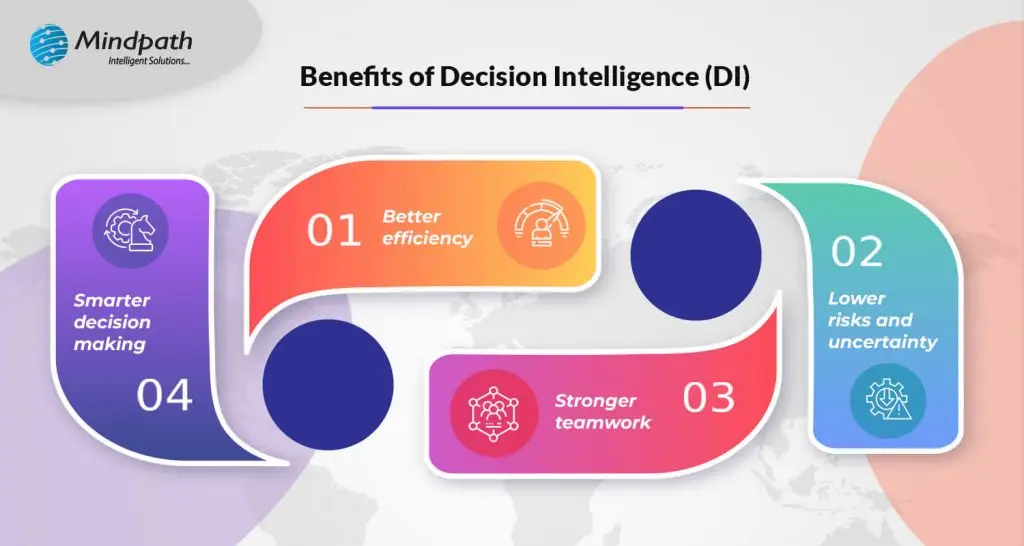
1. Better efficiency
One of the primary advantages of Decision Intelligence is its capacity to increase organizational efficiency. Decision Intelligence allows leaders to make faster and more informed decisions by delivering the relevant information at the right time. When leaders have access to real-time data, they can quickly analyze circumstances and comprehend the consequences of their decisions. This urgency is essential in today’s fast-paced corporate climate, when delays can result in missed opportunities or bad consequences. For example, if a corporation observes a rapid shift in client behavior, Decision Intelligence can assist executives in immediately analyzing the data, allowing them to adjust their strategy without wasting time.
Furthermore, Decision Intelligence enables organizations to simplify their operations. When executives have easy access to important insights, they can eliminate superfluous processes in the decision-making process. This not only saves time, but also allows teams to focus on what is genuinely important, resulting in improved cooperation and more successful outcomes. As a result, businesses using Decision Intelligence become more responsive. They can adjust to market developments, client requirements, and internal issues more quickly and adaptably.
2. Lower risks and uncertainty
Another significant benefit of Decision Intelligence is its capacity to assist organizations in reducing risks and uncertainties. While risks are always there in business, Decision Intelligence enables businesses to detect possible dangers earlier. Organizations can detect warning indicators, such as diminishing customer satisfaction, and take proactive efforts to resolve issues before they worsen.
In addition to recognizing risks, Decision Intelligence enables firms to investigate several potential consequences of their actions. Organizations can utilize predictive analytics to model numerous scenarios and better understand the possible consequences of their decisions. This competence allows leaders to balance the benefits and drawbacks of many alternatives, making it simpler to select the best course forward while minimizing unwanted consequences. Furthermore, decision intelligence enables organizations to design effective risk management methods. Companies that anticipate possible issues might develop plans to limit their effect. For example, if a company expects supply chain interruptions, it might seek alternate suppliers ahead of time.
3. Stronger teamwork
Improved teamwork is another significant advantage of Decision Intelligence. Decision Intelligence helps stakeholders align throughout the organization by providing a single source of truth for data and analytics. When everyone has access to the same correct information, it is simpler for teams to communicate effectively and collaborate on common goals.
With Decision Intelligence, different departments can turn to the same data, minimizing misconceptions and promoting a cohesive strategy. This transparency guarantees that everyone understands the same thing, whether it’s about sales objectives, customer feedback, or operational issues. When teams understand their common goals and have accurate facts to back up their talks, they can work more effectively. Furthermore, Decision Intelligence promotes collaboration by breaking down the barriers between departments. When individuals from several departments exchange thoughts and data, it results in improved problem-solving and new solutions.
4. Smarter decision-making
Improved decision-making is a major advantage of Decision Intelligence. Executives can more effectively recognize and analyze distinct scenarios by utilizing analytics in key moments. This helps people to better assess the probable repercussions of their choices, resulting in more informed judgements.
When leaders use data-driven insights, they can consider the benefits and drawbacks of several solutions before making a decision. For example, if a firm is thinking about releasing a new product, Decision Intelligence can help executives evaluate market trends and client preferences. This thorough examination enables them to make the best choice that matches the company’s objectives.
Also Read: 5 Conversational AI Trends To Watch Out For In 2024
Decision Intelligence Services at Mindpath
Mindpath’s Decision Intelligence services help organizations make informed choices by integrating advanced analytics with human insights. Unlike traditional artificial intelligence, which mostly automates processes and makes predictions, our methodology assists executives in evaluating many scenarios and outcomes, ensuring they have a comprehensive perspective of their corporate objectives.
By offering a single source of truth for data, we encourage stakeholder engagement and minimize divisions between departments. This alignment enables everyone to work towards shared goals, resulting in better informed, effective decision-making throughout the organization.
Wrapping Note!
In today’s fast-paced corporate environment, decision intelligence is essential for organizations attempting to succeed in the face of uncertainty. Companies can make better, quicker choices by integrating modern analytics and human insights. The benefits like increased efficiency, lower risks, stronger cooperation, and better decision-making, show how Decision Intelligence can alter operations and drive performance.
At Mindpath, we are dedicated to assisting organizations in achieving their objectives by using decision intelligence. By offering a single source of truth and encouraging cooperation, we enable organizations to successfully handle problems and grasp opportunities. Mindpath’s Decision Intelligence services can help you unleash your organization’s full potential.
Ready to transform your business with smarter decision-making?
Partner with Mindpath’s Decision Intelligence services for data-driven success.

The retail industry has undergone a great transformation due to its widespread adoption of IT outsourcing services. Recently, the global IT sourcing service market size is expected to reach USD 752.08 billion by 2031. So, by outsourcing the major IT functions like technical support, infrastructure management, and site development, your retail business can prioritize its core approaches. Further, you can strategize better features for satisfying your customers in the long run.
The following approach has made many retail businesses stick to better process agility. So, you can easily adapt to changing market demands without worrying about handling IT operations internally. Let us further analyze how retail IT sourcing can smartly empower your business.
Why Retailers are Facing Growing Technology Pressure?
As per the trends of McKinsey, around 40% of consumers claimed to switch their retailers or brands. So, such a pattern is putting retailers under constant pressure to innovate something unique while maintaining streamlined daily operations. Moreover, customers are more into fast proceedings and personalized approaches while being mindful about data security. Most importantly, they demand consistent experience throughout offline and online platforms.
To meet such valuable preferences, you need to rely on modern retail IT solutions.
But assigning the whole task to your in-house team can be a bit challenging. Rising IT operational charges might hamper you, along with inefficient skills. Further, an unresponsive system might impact your sales. This is why outsourcing experts can be your ultimate option.
What is Retail IT Outsourcing?
In retail IT outsourcing, you need to partner with an external technology provider to manage your IT functions. Such skilled professionals can help you with innovative retail IT services that can upgrade your business operations while encouraging customer experience.
So, instead of depending upon huge internal teams, your business can leverage the authenticity of experienced professionals. Further, outsourced teams come with better experience and industry knowledge. Such adoption can also allow your retail business to follow its core responsibilities.
Wondering how evolving digital solutions are influencing modern retail operations? Read our Digital Transformation Trends blog to uncover the strategies defining the future of retail.
Why Retail IT Sourcing Makes Sense for Modern Retailers?
Here you can discover why outsourcing retail industry IT services can be beneficial and how it can help your business gain a competitive edge. Further, it allows you to discover many influential opportunities that you might have missed to date.
1. Cost-Efficiency Without Compromising on Quality
Retail IT outsourcing services can be financially helpful while saving on expenses. When you outsource the IT team, it can minimize the operational charges that include labor expenses. For example, your company can save up to 70% on its labor costs by discovering the talent pool in countries with minimal wage standards.
Such financial flexibility allows businesses to channelize the resources more effectively.
2. Better Customer Experience
Outsourcing can essentially make your customer experience better by offering them 24/7 support along with multilingual service. This can help your customers get efficient and timely assistance, no matter what time zone they follow. Moreover, this approach is beneficial for retail businesses that have a global customer base.
Moreover, through IT outsourcing, businesses and modern retailers can integrate modern service solutions like social media support and live chat.
3. Flexibility and Scalability
One of the most detailed advantages of retail outsourcing services is its scalable features. You can easily broaden your operations or make them minimal as per the market requirements and seasonal peaks. Further, this flexibility is essential in fast-paced e-commerce businesses, where your customers need frequent changes as per the trends.
Must Read: AI in E-commerce
4. Prioritize Core Competencies
If you prefer retail IT sourcing for your non-core functions, you can easily focus on the core competencies of your business. Some of the major elements include brand strategy, product development, and market expansion. Such focus can allow your business to innovate and prove its uniqueness in the crowded market.
5. Technological Advancements
Outsourcing allows retail businesses access to the trendiest technological advancements without any in-house investments. Additionally, outsourced partners also bring specialized expertise in modern tech like big data analytics, machine learning, and AI.
6. Improved System Reliability
Downtime in your retail business can directly influence your customer trust and sales. So, outsourced retail IT services proactively monitor the systems while managing the updates.
Ready to enhance retail efficiency with intelligent solutions? Explore AI and business strategies that drive innovation and accelerate sustainable growth.
What are Some Eminent Retail Industry IT Services That Can Be Outsourced?
Understanding the massive scope of retail IT sourcing can help you acknowledge the best functions that need to be outsourced.
1. Inventory Handling
This type of outsourcing mainly involves tracking stock levels and managing reorders. It can also align your warehouse functions. A professional team will always use modern tools to verify the inventory quickly while lessening the chances of overstocking or running out of products.
2. Managed IT Support
This approach includes maintaining hardware and software, monitoring systems, handling updates, and backups. Further, managed services can encourage your operations while lessening the efforts of your internal teams.
3. Managing Cloud Infrastructure
Cloud-related retail IT services can encourage scalability while adopting real-time visibility. Further, outsourcing cloud management can assure you of great performance and cost efficiency without any internal defects.
4. Technical Support
Professional outsourced teams can help your retail company resolve the technical issues quickly while ensuring your system performs well. Further, it accesses your in-house team to leverage the best features for its customers.
This approach can give rise to quick resolutions while keeping your online operations intact.
5. Custom Development
Retailers generally require applications that remain streamlined. Starting from inventory tracking tools to engagement patterns, everything has to be in shape. So, outsourced retail IT solutions can build and integrate such functions precisely while prioritizing your core requirements.
Challenges You Might Face Without IT Outsourcing
As retail operations have become more technology-driven, managing IT internally can give rise to a series of risks. Some of the eminent ones have been given below.
- Frequent system crashes.
- Limited access to professional IT knowledge.
- Difficulty in following the trendiest retail technologies.
Struggling to scale your retail systems efficiently? Read how custom software development can help you deliver personalized retail journeys.
Conclusion
Outsourcing retail IT services has become extremely important for businesses that want growth while keeping their operations intact. So, partnering with outsourcing providers can help your company have access to expertise in order fulfillment, technical support, and much more. Further, you can think of innovations while being customer-focused in this rapidly evolving retail environment.
If you also want to seek quality-oriented and dependable outsourced IT services, Mindpath stands as your top choice. We offer tailored retail IT outsourcing services that are designed to support your modern retail operations while helping you adopt long-term digital success.
Frequently Asked Questions
The digital revolution has been empowering itself rapidly, and this is leading to a need for complex tech in business management. This is why organisations are dealing with hiring issues while keeping the prices minimal. Staff augmentation has turned out to be a strategic approach to deal with such risks.
Key Takeaways
- 01
IT staff augmentation helps businesses address hiring gaps while keeping workforce costs manageable. - 02
Key trends include hybrid workforce models, AI-led recruitment, offshore and nearshore hiring, and cybersecurity staffing. - 03
Businesses are also prioritising communication skills, continuous skill advancement, and cloud infrastructure expertise. - 04
Short-term, long-term, on-demand, and team augmentation models provide different ways to scale technical talent. - 05
Staff augmentation can reduce hiring uncertainty, administrative workloads, and barriers to adopting new technologies.
The IT staff augmentation service is growing drastically and is ready to touch USD 857.2 billion by the year 2032. Further, it is growing at a rate of 13.2%. So, instead of being a niche workforce strategy, staff augmentation has become a mainstream model. In this blog, we will go through some reliable IT staff augmentation trends and why your business should acknowledge them.
Looking for a reliable partner to power your IT initiatives? Mindpath delivers premium staff augmentation services tailored to help you scale with confidence and drive project success.
What is the Meaning of Staff Augmentation?
Staff augmentation meaning is simple and viable for everyone. It is a flexible outsourcing strategy that allows your company to elevate their in-house with external professionals on a temporary or specific-period project basis. Traditional hiring can be time-consuming and rigid for many professionals. On the other hand, staff augmentation enables your business to quickly bring on experts with specific skills as per your requirements.
This is just like empowering your existing workforce with in-time talent. This approach can help you fill in the expertise gaps while managing seasonal demands. Most importantly, it can accelerate your strategic initiative.
- Staff augmentation allows you to add or reduce team members as per the needs of your projects.
- It can reduce the overhead charges of full-time hiring like taxes, benefits and long onboarding cycles.
- You can be assured of skill-specific resourcing like cloud computing, AI and cybersecurity.
What are Some Top IT Staff Augmentation Trends to Leverage in 2026?
Let us go through some leading and meaningful IT staff augmentation trends that can make your hiring process viable in the current competitive landscape.
1. Hybrid Workforce Models
As per the recent research of ISACA, around 75% percent of employees prefer hybrid work practices. This has made many organisations leverage hybrid models. This is not only a smart recruitment approach, but a cost-efficient deal. Such Staff augmentation models can improve your team’s collaborative mediums.
Further, hybrid setups are essentially beneficial for companies that handle complicated development cycles. Around 25% of employers in the US are delivering a hybrid work culture to their workers.
2. AI and Modern Tech Implementation
AI-rich recruitment is no longer an option. It has become a mainstream necessity for employers. With the integration of AI-led tools, you can give rise to a faster and better screening assessment. Further, you can recruit skill sets that match your project requirements.
Such tools can also predict your future workforce needs. Additionally, automation and chatbots can enrich your team’s communication.
3. Adoption of Offshore and Nearshore Professionals
One of the incredible IT staff augmentation trends in the recent scenario is the hiring of offshore and nearshore experts. Nowadays, organisations are prioritising balancing factors like time zone compatibility, risks and cultural efficiency. Many organisations have claimed a reduction in operational charges due to such a viable option.
4. Cybersecurity Staff Augmentation
The trends and patterns of cyber threats have been increasing drastically. So, staff augmentation should be your foremost priority. Companies are willing to hire specialised compliance experts or security engineers through staff augmentation models to protect their infrastructure. This is becoming possible without even creating large in-house teams. Further, this approach can help you work within a regulated environment.
Must Read: AI in Cybersecurity
5. Communication-Oriented Hiring
No doubt, technical skills are important. But along with this, it is important for you to prioritise skills like collaboration and better communication. Staying in sync can help your team work towards a better goal without any mishaps.
With the rise in remote work, soft collaboration skills can facilitate better operations across multiple nations.
6. Changing Skill Advancement
As per the recent IT staff augmentation trends, organisations are valuing systems to facilitate continuous upliftment. So, IT teams are generally going through multiple training programs. Manpower is getting updated with the development of modern technologies. So, your preparation of future-rich teams can diminish your dependency on outside hiring.
7. Cloud Infrastructure Staffing
With the growth of cloud adoption, cloud infrastructure staffing is becoming prominent. Businesses are majorly augmenting teams with DevOps engineers, cloud architects and platform specialists. Such a trend can align seamlessly with DevOps staffing and cloud-centric strategies.
Wondering how companies stay flexible while scaling their teams quickly? Learn more about what is staff augmentation and why it’s a game-changer for modern businesses.
What are the Major Types of Staff Augmentation Models?
Understanding the different types of staff augmentation models can help you choose the right approach while keeping your decisions intact. Here, you can go through some main models that work potentially.
1. Short-term Augmentation
This type of process is appealing for quick turnarounds and urgent technical fixes. It generally lasts from a few weeks to several months.
2. Long-term Augmentation
When your company requires ongoing support for extensive projects, long-term augmentation can offer you continuity. Such types of staff augmentation can help you with deeper integration with your internal teams.
3. On-demand Augmentation
This model values hiring talent when your business requires it. The process remains flexible and mainly adopted in agile development criteria.
4. Team Augmentation
Instead of hiring individual talent, you can hire an entire team that can match your internal workflows.
Every types of staff augmentation vary in commitment and integration approaches. The choice completely depends on your project needs and workforce maturity.
Not sure which AI advancements are shaping staff augmentation trends? Explore the top AI models helping businesses stay competitive.
What are the Potential Benefits of IT Staff Augmentation?
The benefits of IT staff augmentation generally remain unmatched. Starting from saving your costs to hiring top talent, it can help your workflow remain streamlined. Let us discover some of the most essential benefits of staff augmentation in this section.
1. Minimal Hiring Uncertainty
With the help of staff augmentation, your company can approach top talent when you require it instead of being worried about long-term commitments. Moreover, there will be fewer chances of hiring inefficient profiles, as you are going for specialised individuals for specific tasks or projects.
2. Manageable Administrative Workloads
If your organisation is considering the help of staff augmentation providers, you can remain unburdened about the extra administrative work. Further, the providers can handle your payroll and other HR centric works. This approach can prevent you from extreme charges while saving your resources.
3. Adoption of New Technologies
With the usage of staff augmentation models, businesses can explore and experiment with advanced technologies without being tense about investing in large-scale solutions. As a result, you can hire experts to try out technologies when you require them.
Want to know how AI can enhance recruitment efficiency and strengthen your extended workforce strategy? Read our insights on Generative AI in HR to see how HR teams are leveraging intelligent automation.
What are Some Challenges of Adopting Staff Augmentation?
While staff augmentation can make you aware of many benefits, it also highlights certain challenges, as given below.
- Your augmented teams might struggle to understand your internal work culture.
- Misalignment can occur when the external workers are not completely informed. So, use structured communication channels.
- External access to systems can give rise to compliance risks.
- Your team might prioritise their skill development.
Conclusion
As IT staff augmentation trends have been shifting rapidly, your business needs a strategic augmentation partner to fulfill the hiring requirements. Starting from your remote workforces to data scientists, your augmented teams can help your companies navigate complicated digital transformations.
Partnering with professional providers ensures your organisation can pick the right expertise at the right time without compromising quality or alignment. Here, Midpath can be your ultimate preference. Experts in this company can understand your changing needs while helping you leverage the right talent solutions.
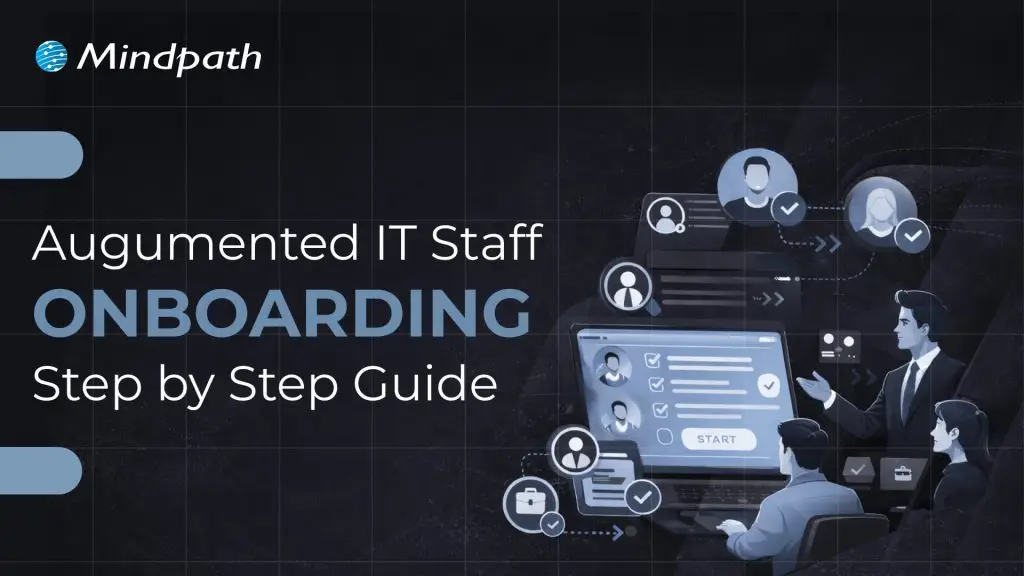
Businesses are in constant need of scaling their IT workforce in the current scenario. This is why many organizations have turned to staff augmentation. It is a viable approach to bring in the external IT experts to work along with your internal teams. As per recent ISACA studies, around 75% of employees are prioritizing hybrid work environments. This has made IT staff augmentation even more powerful.
However, simply hiring augmented professionals is not enough. Without a structured approach, even the most talented developers might struggle to integrate properly with your workflow. In this guide, we will go through some practical steps for staff augmentation onboarding. This can help you successfully adopt remote or hybrid teams while maintaining precise collaboration.
Need a cost-effective way to scale your team with qualified IT talent on demand? At Mindpath, we offer flexible staff augmentation services to help businesses hire top-tier developers and specialists without long-term commitments.
What is Augmented Staff Onboarding and How It Can Upgrade Your Operations?
IT staff augmentation is all about hiring experts temporarily from a third-party organization. Further, the extended team will help your business grow while accelerating the project workflow. They will work under your management while filling the skill gaps.
With proper augmented staff onboarding, you can easily tackle the risks and expenses related to traditional hiring models. A company leveraging these services will match you with all the resources you require for a limited timeframe. Here are the benefits that make staff augmentation an attractive prospect.
1. Minimal Cost
If we compare it to full-scale hiring, augmented staff is a much more budget-friendly solution. Your vendor will cover their recruitment charges and benefits. However, the pricing structure completely depends on the region or the offshore companies you are selecting.
2. Outstanding Productivity
Unlike freelancers or outsourced teams, integrating augmented teams can be managed in real time. You can collaborate with them and encourage your productivity.
3. Global Pool of Talent
With IT staff augmentation, you are breaking the limits of the local talent pool. Further, casting a wider net offers you a better chance of finding skills that exactly match your business objectives.
For your knowledge, an effective onboarding process can upgrade your business productivity by 70%. Organizations with a streamlined onboarding process can boost new hire retention by 82%.
Want to stay ahead of evolving workforce strategies and technology demands? Discover the latest staff augmentation trends that are transforming how businesses scale teams and adopt hybrid work models.
A Detailed Step-by-Step IT Staff Onboarding Process
Integrating augmented professionals into your team needs more than an orientation meeting. So, here is a structured approach to ensure seamless integration of augmented teams into your existing workforce.
1. Define the Roles and Project Expectations
Before the augmented team starts working on your project, you should clearly define your expectations. Moreover, you need to be precise about your project goals and milestones. Make the experts know their individual responsibilities and reporting structure.
Clear expectations can eliminate any type of confusion while allowing your team members to start contributing faster. In the recent scenario, average tech skills are becoming outdated. So, identify their gaps and bring in experts who can make an immediate impact.
2. Prepare the Technical Environment
One of the biggest onboarding delays happens when new employees wait to access new tools and systems. So, before your staff augmentation onboarding, make sure they have access to development environments and other collaboration tools. They should also be aware of your security credentials and permissions.
Offering access to project management tools and collaboration platforms ensures everyone can trace the task and can update the feedback in real time. The new team should be responsible enough to immediately begin exploring the system architecture and your project structure.
3. Conduct a Structured Orientation Session
Orientation can be tagged as the first official step in the remote team onboarding. So, this session should introduce augmented staff to the company’s mission and culture.
You should be vocal about your company’s goals and values. Further, you can discuss the overview of your products or services. Give an introduction to key stakeholders and be sure about the project timelines.
You can also schedule a one-on-one session with the managers or team leads to explain the expectations. This approach will ensure augmented professionals completely understand the bigger picture.
Planning to streamline your recruitment process and onboard experts faster? Check out how staff augmentation hiring enables businesses to quickly integrate skilled professionals into their teams.
4. Introduce Augmented Staff to Your Internal Team
A major challenge in staff augmentation is generating a sense of belonging. So, if your external professionals are not feeling connected enough, the overall collaboration can suffer.
You can introduce your team members through virtual team meetings. Further, you can make informal introductions with your major stakeholders. This is one of the major steps in staff augmentation onboarding as it encourages collaboration.
5. Assign a Mentor or Guide
Assigning a mentor can speed up the learning process. The mentor can help the new members understand the internal workflows. Further, they can answer queries regarding the tools or other internal systems.
A dedicated point of contact can minimize communication gaps, and the augmented staff will also understand who to approach when they find something challenging. This approach can encourage productivity while strengthening collaboration between the internal and external teams.
A professional point of contact can easily fill in the communication gaps, and the external staff will also understand who to contact when they face any issues. This step can upgrade your productivity while strengthening the collaboration efforts.
6. Regarding a Clear Communication Channel
Communication is the backbone of successful staff augmentation onboarding. So, when your team works across multiple regions or time zones, clear communication becomes essential.
To ensure clear communication, define your communication protocols and response expectations. Conduct a meeting and use an individual collaboration platform to assess the doubts of your team. Your organization should also welcome queries and concerns of the augmented staff. In this way, professionals will feel comfortable sharing their innovations or ideas.
Want to optimize your team collaboration while keeping operational costs under control? Discover how cost effective IT staff augmentation helps businesses maintain efficiency and productivity without increasing hiring expenses.
7. Provide Training and Resources
Even experienced professionals or IT specialists need time to understand a company’s internal systems. So, your stretched team should have proper access to your documentation process.
Continuous training and workshops can upgrade the knowledge while making your team understand the overall project environment.
8. Verify Performance and Progress
Your onboarding process shouldn’t be for the first weeks. You should acknowledge continuous feedback to make your external staff know your project needs. Your managers should also check the performance of your team every week. Assess their work and give them reviews for better work processing.
These sessions can help you identify early opportunities to improve collaboration and overall productivity.
9. Follow up on the Onboarding Process
Your business should assess the importance of the onboarding process. Most importantly, consider the concerns and feedback of your internal team. Companies that refine their onboarding strategies over time can scale their augmented teams more effectively while increasing productivity.
Wondering which workforce model best fits your business needs and long-term goals? Learn the key differences between staff augmentation vs managed services to make a more informed decision.
Conclusion
If your business needs quick and scalable IT talent, staff augmentation can be an ideal solution. However, your IT staff onboarding process should be streamlined enough. It can simplify the process while making your augmented teams match the existing workflows.
Companies like Mindpath can help your business upgrade its IT capabilities. Our expert team leverages efficient strategies and streamlined staff augmentation. Our approaches have already been beneficial for many industry leaders. We can be your perfect match for fulfilling the digital transformation your company demands.
The software development market size is expected to reach USD 1.11 trillion by 2031. Software development is all about building applications and programs that are used on our mobile devices and computers. This is why the trend of hiring offshore developers has escalated drastically due to the global shortage of skilled IT talent. Further, offshoring experts can be cost-effective while lowering your overhead charges.
As per a detailed survey of Manpower, around 76% of employers in the recent scenario lack the right talent in the IT sector. So, businesses growing with escalating digital demands need offshore development to stay competitive without overburdening their budgets.
Let us explore the major steps involved in choosing the right offshore developers while preventing common pitfalls.
Looking to scale your team quickly without long hiring delays? At Mindpath, we offer expert staff augmentation services to fill your talent gaps efficiently.
Who are Offshore Developers?
Offshore developers are software engineers, QA testers, and other tech professionals who work remotely from overseas locations to support your software development needs. Businesses hire them to reduce labour costs, tap into global talent pools, and scale their tech teams quickly, without the overhead of local hiring. These professionals span a wide range of roles, including backend engineers, DevOps experts, QA testers, frontend developers, and more.
When you hire offshore developers, make sure to maintain collaboration through advanced communication tools and effective workflows. Further, they also value structured project management processes.
What are Some Advantages of Hiring Offshore Developers?
Hiring offshore developers can be extremely beneficial for your company while unlocking potential opportunities. Some of the convenient aspects have been given here for your reference.
1. Enjoy Access to Global Technical Expertise
Local hiring markets majorly suffer from skill shortages and high competition. So, offshore software engineers give your business access to a wider pool of experienced professionals. Further, the experts will have utmost knowledge about emerging technologies like data engineering and AI to make your software perform effectively.
This global rich can make it easy for you to hire offshore development with industry-rich skills that you might not get locally.
2. Faster Development Cycles
Your team will be distributed across different time zones. This can support faster development cycles without hampering quality. So, while your one team signs off for the day, the other one will continue to make progress.
3. Cost Optimization with Sacrificing Quality
One of the most essential advantages of offshore hire is cost-effectiveness. Your company can easily reduce the development charges while still working with skilled professionals. Additionally, lower operational charges allow your business to invest more in product innovation and customer satisfaction.
Planning to scale your project without overspending? Explore our comprehensive guide on offshore software development strategies for expert insights.
What are Some Different Ways to Hire Offshore Developers?
It is very important for you to pick the right engagement model to achieve success. So, consider the values of hiring offshore developer as they are flexible and businesses can adapt them as per the project requirements.
1. Project-Oriented Offshore Development
This type of model suits businesses with a clear and defined scope while holding clarity about their budget and timeline. You can hire offshore developers to leverage specific features or applications. This makes it convenient for short-term or fixed-requirement projects.
2. Dedicated Teams
A dedicated offshore team majorly works on your project and functions as an extension of your in-house team. Additionally, this approach can benefit your long-term projects or evolving projects. This is efficient when you want to strengthen your team by scaling it up.
3. Offshore Staff Augmentation
Such an offshore development model allows your company to strengthen existing teams by adding software engineers with specific skill sets. This approach is extremely useful during peak workloads.
How to Hire Industry-Leading Offshore Developers?
You can go through the steps below to make your offshore hiring process effective and result-oriented. Moreover, these streamlined steps have always been advantageous for many leading tech giants.
1. Assess Your Requirements
Before you pick any offshore developers, it is necessary for you to understand your requirements. Figure out what you actually want to achieve from the project and what features it should include. As different projects require different skill sets, determine the specific talent you need from your offshore developers.
Set a timeline for your project and assess how much you are willing to spend on this development success. This approach can narrow down your search while fulfilling your requirements on time.
2. Search for Desirable Candidates
Once you are assured about your project requirements, you can start searching for the right candidate. Browse online platforms and efficient job portals to find reliable candidates. Further, you can value the recommendations and referrals of your colleagues and friends to find talented developers.
You can also search in the professional networks and communities to find a suitable offshore development team that strives for better results.
3. Conduct Interviews and Verify the Candidates
Prepare a list of useful questions before you conduct any interviews. Always include those questions that can help you assess the candidate deeply. You can ask about their experience in custom software development and how they are committed to their service. Further, you can also assess their technical expertise.
You can also ask them to explain certain concepts and how they can easily solve multiple levels of project risks. Also, verify their communication skills and how transparent they are with their points of view.
4. Onboard Your Developers
Once you are done with hiring the best developers from around the globe, you can onboard and manage them as per your project requirements. Further, to be assured of successful communication and effective collaboration, use necessary tools like Skype and Slack.
How to Evaluate the Talent of Offshore Developers?
Hiring an offshore development team requires more than just reviewing the resumes. So, a detailed assessment can ensure you are getting your hands on the right professionals.
1. Communication Expertise
Your offshore development team will work remotely. So, it becomes essential for them to value clear communication. You need to assess if they are capable of explaining multiple technical concepts, and they must respond to your feedback quickly.
2. Technical Knowledge
It is necessary to go through the offshore developers’ previous projects. Moreover, consider experts who have experience working with similar type of technologies that your industry prioritizes on daily basis.
3. Problem-Solving Techniques
Offshore developers should also be aware of authentic analytics skills instead of just coding knowledge. They should innovate and instead of strictly working on instructions.
Are you finding it challenging to keep your offshore development team aligned and productive? Learn about top remote work tools that simplify team management.
Conclusion
Hiring offshore developers comes with its own incredible benefits. However, the complete process of picking the right development team might feel challenging to you. So, if you are willing to leverage the expertise of the best offshore team of developers, then Mindpath can be your ultimate solution.
We bring a trusted expertise in custom software engineering and staff augmentation. With a focus on quality and long-term collaboration, we help businesses turn their offshore development into a competitive benefit.
Enterprise technology leaders are under constant pressure to leverage innovations while managing operational expenses effectively. Moreover, software development, digital product engineering or AI integration needs skilled expertise. So, hiring full-time experts can sometimes go out of your budget. In such a situation, staff augmentation has emerged as a strategic workforce model. It enables your company to minimize development costs without compromising on quality.
As per the recent trends by Verified Market Research, IT staff augmentation is ready to touch USD 857.2 billion by 2032. Unlike traditional hiring models, staff augmentation allows your company to extend its in-house teams on demand. Let us further discuss how cost-effective IT staff augmentation can boost your operations.
Looking for reliable staff augmentation solutions to fill critical skill gaps in your team? At Mindpath, we offer customized staff augmentation services that connect you with highly skilled professionals for seamless project execution.
What is Cost-Effective IT Staff Augmentation?
IT staff augmentation is a flexible outsourcing model where businesses temporarily integrate external technology professionals into their existing teams. These specialists work alongside your internal staff to fill skill gaps, support ongoing projects, and accelerate development timelines, without transferring project management control.
- Cost-effective IT staff augmentation allows you to retain full control over the project management while benefiting from the external expertise.
- This approach is viable for companies that demand specialized technical skills for short-term projects.
- It is also essential for people who want to scale their development teams quickly.
- So, if you are looking forward to reducing IT hiring costs, this staff augmentation can be flexible without any long-term commitments.
As per the recent reports, around 26% of cybersecurity jobs go unfilled in the U.S because of the talent gap. Further, tech skills only last for 2.5 years, which requires constant up-skilling.
Curious about how to seamlessly integrate external experts into your existing workflows without delays? Discover how effective augmentation staff onboarding can streamline collaboration and boost productivity from day one.
Why Affordable IT Staffing Can Be Your Smartest Choice in 2026?
It takes around 35 days to hire IT professionals in the US. So, here, affordable IT staffing can be a great choice for you in the current age. Let us go through the reasons why IT staffing is convenient for your business.
1. It Prevents Exceptional Budgets
Augmentation can easily reduce the recruitment charges, employee overheads and training expenses. For example, outsourcing Indian staff allows organizations in the US to optimize their staff augmentation pricing without compromising on quality aspects.
2. It Offers Faster Access to Talent
Global organizations can easily select specialists from a huge pool of worldwide talent. So, instead of waiting for months, you can achieve the talent that your company desires.
3. Flexibility
Businesses can easily scale their team up or down as per the needs of their projects. So, you don’t need to deal with long-term contracts and inefficient headcount.
4. Bridge Your Skills Gaps
To seek digital transformation, you require niche expertise in cybersecurity, AI or cloud technologies. So, IT staff augmentation ensures you can hire the needed experts quickly. This approach is also viable for short-term project requirements.
5. Achieve Collaborative Terms
With remote work setting the trends, cost-effective IT staff augmentation can enable your company to work seamlessly with professionals from all around the globe.
Planning to scale your tech team quickly while maintaining efficiency in a remote-first environment? Check out how IT staff augmentation helps businesses access global talent while ensuring seamless collaboration.
Why Traditional IT Hiring is Expensive?
To understand the true values of staff augmentation, it is necessary to look at the expensive side of traditional hiring, as mentioned below.
1. Recruitment Expenses
You need to go through a series of steps, like job postings, recruiting agencies and internal HR resources. These aspects can increase your overall hiring charges.
2. Time-Taking Hiring Process
Finding the right candidate can take a long time. So, this aspect can delay your projects and overall productivity.
3. Training Approaches
Your new employees might require thorough training sessions and onboarding guidance to understand your workplace culture and functionality.
4. Essential Add-Ons
A company needs to offer a series of benefits to its employees for a long-term partnership. All these get added to the overall cost.
5. Risk of Hiring Wrong Candidates
Hiring the wrong candidate can result in project delays and additional recruitment expenses.
For businesses that handle multiple technology initiatives, these costs can quickly escalate their budget. So, you can easily reduce IT hiring costs through staff augmentation.
Wondering whether there’s a more flexible and cost-efficient alternative to traditional hiring models? Learn the key differences in staff augmentation vs managed services to make a more informed business decision.
A Quick Comparison between IT Staff Augmentation and Traditional Hiring
Here, you can go through the individual approaches of IT staff augmentation and traditional hiring through a table.
| Major Elements | Traditional Hiring | Affordable IT Staffing |
| Time to Hire | Comparatively slow and takes between 3 and 6 months. | You can access quick onboarding within one to two weeks. |
| Cost | Remains High | Comparatively low |
| Flexibility | Fixed employees are hard to scale. | Offers on-demand scaling. |
| Suitable For | Long-Term Projects | Dynamic and for specialized roles. |
How to Successfully Implement Staff Augmentation?
To upgrade your budget effectiveness and IT workforce optimization, your team requires a proper integration approach as given below.
1. Define Clear Skill Requirements
Always make sure to understand the precise technical expertise required by your company. Whether you need cloud engineers or developers, always stay strong with your decisions.
2. Prefer a Strategic Expert
Selecting the right partner ensures your access to professionals with proven industry-grade knowledge. Experts will always streamline the staff augmentation strategies with effective transformation goals. This can help the augmented teams to integrate effortlessly with the existing core team.
Looking to hire the right talent without long recruitment cycles or overhead costs? Discover how staff augmentation hiring can help you quickly onboard skilled professionals aligned with your project goals.
Major Challenges that Most Businesses Face in IT Staff Augmentation
While IT staff augmentation leverages a series of benefits, you should also understand the challenges related to this hiring model. Further, being aware of these factors can help your business manage the augmented teams more efficiently while maximizing the value of your investments.
1. Getting Along with the Internal Team
One of the biggest risks is ensuring the augmented experts get along with your team members effectively. Differences in workflows and time zones might give rise to coordination gaps. So, it is essential to handle them efficiently.
2. Picking the Right Talent Partner
The success of cost-effective IT staff augmentation mainly depends on the quality of professionals being hired. So, working with unreliable teams can lead to skill mismatches while delaying your productivity & project delivery.
3. Maintaining Consistent Project Communication
When your team includes both in-house teams and external professionals, maintaining consistent communication can be a bit tough for you. Moreover, without proper coordination, you might slow down the progress, and it can affect your project quality.
4. Managing Security Elements
When your external professionals access the internal systems or sensitive data, your organization must include essential security measures. Additionally, you should implement strict access controls.
Despite all these challenges, businesses that adopt the right management practices can still leverage the essentiality of affordable IT staffing to build scalable teams.
Wondering how businesses are evolving their workforce strategies while maintaining security and efficiency? Discover the latest IT staff augmentation trends that are shaping how organizations scale teams and manage distributed talent securely.
Conclusion
Your enterprise must innovate continuously in this vast technology landscape. Traditional hiring models somehow limit your agility while increasing the fixed expenses. So, cost-effective staff augmentation can work as an alternative approach by providing flexible access to specialized talent.
Organizations that want to boost their technological relevance in a cost-efficient way, such as providers like Mindpath, can make a difference. Clients from all around the world have believed in our expertise, and this has led us to become an industry expert. So, schedule an appointment with us and let our professionals handle your requirements.
In the year 2025, the debate of WordPress vs Webflow is hotter than ever. This is because business entities and content creators are looking for the best platform to build secure as well as SEO-friendly websites. It is true that WordPress has been dominating the CMS market thanks to its vast plugin ecosystem coupled with high flexibility. But it is essential to bear in mind that Webflow has been gaining momentum with designers as well as startups, thanks to its no-code visual editor along with built-in hosting.
In case you are wondering, is Webflow better than WordPress? You need to look at the main difference between these tools. You need to know which one is better so that you can choose the tool that perfectly aligns with your needs. The guide breaks down everything you need to know while choosing Webflow or WordPress.
Choosing the right platform makes all the difference when it comes to performance and growth for your online presence. Explore Mindpath’s WordPress development services for expert guidance on what your business needs.
A Deep Dive into WordPress
WordPress is the most popular content management system (CMS) in the world, currently powering over 40% of all websites on the internet. It lets you create, build, and manage your own website without needing coding knowledge. WordPress has gained massive popularity thanks to its ease of use coupled with flexibility, making it an ideal tool for beginners, professionals, and businesses alike.
At its core, WordPress is a free, open-source content management system. This means anyone can use, modify, or distribute it at no cost, and it’s continually improved by a global community of developers. One of the biggest strengths of WordPress is its SEO-friendly structure. The novel platform generates clean and crawlable code that adds value to search engines’ index content efficiently. Users can even leverage useful plugins such as Yoast SEO and Rank Math for optimizing titles and meta descriptions that can improve the visibility in search results.
An Insight into Webflow
Webflow is a cloud-based visual web development platform that lets you design, build, and launch responsive websites without writing code. It bridges the gap between design and development by letting users design visually on a canvas while the platform automatically generates clean, production-ready HTML, CSS, and JavaScript in the background. This makes Webflow a favorite among designers who want creative freedom without relying on developers.
A standout feature of Webflow that you need to be aware of is related to its design flexibility. Users have the option to create fully custom layouts as well as animations without having to write a single line of code. Webflow basically combines the best of graphic design tools with the functionality of a content management system (CMS), generating clean HTML, CSS, and JavaScript behind the scenes as you design. For businesses that need more tailored solutions, custom WordPress development offers similar flexibility with the added power of plugins, themes, and scalability, allowing organizations to build websites that precisely meet their unique requirements. It serves as a valuable tool for businesses and startups that wish to leverage its ability to deliver professional and responsive websites effectively and efficiently.
Must Read: WordPress Developer Checklist
Comparison Between WordPress and Webflow
Now that you have an insight into Webflow and WordPress, it is time to look at the difference between these novel tools. Developers as well as businesses need to understand the difference between WordPress and Webflow so that they can make a wise selection. The core differences have been presented by focusing on specific areas such as ease of use, design, customisation, and many other features.
1. Ease of Use
Webflow offers a visual no-code editor. It is highly appealing to designers as well as marketers. In fact, it is great for rapid prototyping along with pixel-perfect layouts. On the other hand, WordPress requires setup with a theme or page builder. So beginners may take some time to learn how to use the tool. However, developers with proper knowledge and experience can get full control over the tool. Thus, while discussing Webflow vs WordPress, a major difference between them revolves around the ease of use.
2. Design and Customization
Webflow serves as an ideal tool for making custom designs without requiring any coding. The responsive control built in can ensure that users can derive optimum value from the tool even if they have limited coding-related skills. On the other hand, WordPress has a large ecosystem of themes as well as plugins. These elements make it highly customizable in nature. But this maturity also makes it plugin-dependent at times.
3. SEO Features
Webflow provides built-in SEO tools such as meta tags and schema options. It even delivers strong performance when it comes to integrated hosting. However, WordPress relies on plugins such as Yoast SEO for advanced SEO control. Thus, this feature makes WordPress extremely powerful, which is capable of precise optimization. You need to bear in mind that, starting from Webflow to WordPress, the role of top SEO features is a must for users.
Stuck deciding whether WordPress or Drupal is a better match for your business? Our WordPress vs Drupal guide breaks down key differences to help you pick the perfect solution.
4. Security
While talking about WordPress vs Webflow, it is a must to take into account the security aspects. Webflow is certainly more secure by default in comparison to WordPress. This is mainly because it offers built-in security features such as DDoS and SSL protection. The top-notch security feature of Webflow acts as its major strength. When it comes to WordPress, the security mainly depends on users. You need to manage separate security plugins and carry out frequent maintenance in order to prevent vulnerabilities. In order to boost the level of security, you need to make sure that you, as a user, maintain cybersecurity resilience while developing your website.
5. Performance
Webflow is capable of offering better out-of-the-box performance. This is mainly because of integrated hosting coupled with a global Content Delivery Network and clean code. On the other hand, when it comes to WordPress, its performance mainly depends on the chosen hosting and plugins. The selected theme can also impact the performance that is delivered by the tool. If you use Webflow, your website can load faster by default. But if you choose WordPress, you can rest assured about the site performance if you choose appropriate hosting.
6. Pricing
If you are wondering – is Webflow similar to WordPress in terms of pricing, the answer is no. The pricing of WordPress is variable in nature. You may have to incur separate costs for different things, such as hosting and a domain. Similarly, the price also depends on the chosen plugins and themes. So it may seem cheaper initially, but its price may increase with additional functionality. When it comes to Webflow, the pricing is based on the all-inclusive subscription model. It can become expensive for you if you opt for higher-tier plans.
Want to make sure your WordPress site is accessible to everyone? Check out our post on improve WordPress web accessibility to learn practical steps for making your site more inclusive and user-friendly.
WordPress vs Webflow – Comparison Table
The difference between WordPress and Webflow has been presented in the table below. You need to understand how Webflow and WordPress are different from each other so that you can choose the ideal tool wisely. The insight can surely guide you to decide which platform you intend to use to fulfil your specific needs.
| Features | Webflow | WordPress |
| Ease of Use | No Coding Knowledge needed | Coding knowledge is not strictly needed but can help for advanced customization |
| Design and Customization | Highly flexible in nature | Availability of extensive themes for customization |
| SEO Features | Built-in SEO tools | Availability of SEO friendly structure |
| Security | High security | Low security |
| Performance | High optimization for speed | Performance depends on hosting |
| Pricing | Subscription-based pricing model | Variable pricing model |
Final Winner Between WordPress and Webflow
You must choose Webflow if you prioritize visual design control along with built-in hosting. Webflow is the better choice if you need to manage your website in a simple way. It is well-suited for small business entities as well as startups that want to launch their site quickly with a clean and modern design.
WordPress is an ideal choice for you if you are looking for scalability and advanced SEO capabilities, along with flexibility through plugins. In such cases, WordPress can certainly act as a stronger platform that can meet your needs perfectly. The platform is best-suited for enterprises and e-commerce stores that wish to have full control over SEO as well as integrations.
Therefore, both Webflow and WordPress serve as useful tools. You need to choose between WordPress and Webflow by considering your needs. In case you are wondering – Does Webflow work with WordPress? The good news is, yes! Webflow can definitely work along with WordPress if you utilize the official Webflow Pages plugin. It will certainly allow you to build pages in Webflow while serving them on your WordPress site.
Worried about security risks and vulnerabilities on your WordPress site? Read our guide on safeguarding WordPress vulnerabilities to learn how to protect your site and keep it secure against threats.
Final Words
The emergence of WordPress and Webflow has been transformational in the prevailing business world. Both these platforms have their unique strengths and advantages. The ultimate choice between WordPress and Webflow in the year 2026 mainly depends on the goals of your website and your budget. You also need to take into consideration the long-term growth plan before making the choice between WordPress and Webflow.
If you wish to derive optimum value from WordPress, you need to partner with a reliable partner. Mindpath’s top-grade WordPress development services can certainly help you develop a world-class website. It can offer the ultimate go-to solution in terms of scalability as well as limitless customization. You can also take advantage of the advanced SEO-friendly structure in order to boost the online visibility of your website. It can certainly give an edge to businesses in the competitive business world.
Businesses are embracing new technologies like AI to improve different business functions. Generative AI in HR operations is helping organizations move from traditional processes to smarter, more adaptive models. In addition to automating repetitive tasks, it can extract useful insights from large datasets and improve hiring practices.
Key Takeaways
- 01
Generative AI helps HR teams move from traditional processes to smarter and more adaptive hiring practices. - 02
AI can speed up resume screening and help create accurate, role-specific job descriptions. - 03
Generative AI can support personalized onboarding, employee guidance, and performance reviews. - 04
HR teams can use generative AI to analyze data, automate repetitive work, and make informed decisions. - 05
Generative AI can improve employee experiences while supporting consistent and inclusive HR practices.
According to Gartner, the number of HR leaders planning or actively deploying generative AI increased from 19% in June 2023 to 61% in January 2025 (Source). This growth highlights how HR professionals are recognizing the potential of generative AI to transform HR processes. By exploring its applications and benefits, organizations can better understand how to integrate this technology into their operations.
Understanding the Impact of Generative AI in HR Processes
Generative AI is becoming an important part of modern HR operations. It introduces automation, scalability, and intelligent assistance that can improve traditional HR processes. By understanding these capabilities, HR professionals can identify opportunities to modernize recruitment and prepare for future workforce needs. Consequently, strategic AI adoption can help organizations build more adaptable hiring practices.
1. Faster Resume Screening
Reviewing hundreds or even thousands of resumes manually can be time-consuming for recruiters. Generative AI tools can simplify this process by extracting relevant information and organizing candidate details. As a result, HR teams can review applications more efficiently.
These tools can analyze resumes to identify candidates based on skills, experience, and role requirements. They can also help recruiters organize suitable applications for further review. However, human oversight remains important to ensure fair and accurate hiring decisions.
2. Creating Effective Job Descriptions
Creating clear job descriptions is another important part of recruitment. HR leaders must communicate responsibilities, qualifications, and expectations in a way that attracts suitable applicants. Generative AI can help draft accurate, role-specific descriptions based on the information provided.
Additionally, AI tools can help HR teams review job descriptions for clarity and potentially biased language. Recruiters can then refine the content to make it more inclusive and relevant to the position. This approach can improve job postings while helping organizations reach a wider range of candidates.
3. Delivering Real-Time Employee Guidance
Employee onboarding is an important stage of the hiring process, yet it can create challenges for HR leaders. Traditional onboarding documents may not answer every new employee’s questions or provide guidance for individual needs. Generative AI can help organizations create personalized onboarding journeys and make the transition into a new role easier.
For example, HR teams can use AI to support interactive walkthroughs and orientation programs. AI chatbots can also operate as helpdesks within HR portals, providing quick answers about leave policies, appraisals, compliance, and compensation. Consequently, employees can access relevant information without waiting for a response from HR staff.
4. Streamlining Performance Reviews
Generative AI can also support performance reviews by helping HR teams organize feedback and summarize employee achievements. These capabilities can make it easier to review information against established performance criteria. However, AI does not automatically eliminate unconscious bias, so human judgment and fair evaluation standards remain essential.
HR departments can use generative AI to analyze performance information across relevant business metrics. The technology can help prepare summaries and identify areas that may need further discussion. Furthermore, HR leaders can use these insights to develop more consistent performance management frameworks.
Unraveling the Top Benefits of Generative AI in HR Management
One of the biggest benefits of generative AI in HR is its ability to reduce manual and repetitive workloads. By automating routine activities, HR professionals can devote more time to employee well-being, talent development, and succession planning. In addition, organizations can improve operational efficiency while providing better support to their workforce.
1. Smarter Decisions Powered by Data
Generative AI gives HR professionals additional ways to analyze workforce data and identify useful insights. For example, it can help summarize employee feedback, examine satisfaction trends, and explore patterns related to attrition. Consequently, HR teams can use evidence to support workforce planning rather than relying on intuition alone.
2. Reduced Costs and Efficient Operations
Generative AI can help HR departments reduce administrative costs by automating repetitive tasks. Activities such as interview scheduling, data entry, and processing routine leave requests can require considerable staff time. With appropriate automation, HR professionals can focus on responsibilities that require human judgment and personal interaction.
Furthermore, automated workflows can reduce duplicated effort and improve the consistency of administrative processes. This allows organizations to use their resources more effectively while maintaining essential HR services.
3. Enhanced and Consistent Employee Experiences
Generative AI can help HR teams provide personalized support throughout the employee journey. For example, AI assistants can answer common HR questions and suggest relevant training resources. As a result, employees can access information more easily while receiving guidance suited to their needs.
In addition, AI tools can help standardize routine communications across departments. HR teams should still review important messages and ensure that employees can contact a human representative whenever personal assistance is needed.
4. Creating More Diverse and Inclusive Workplaces
Promoting diversity and inclusion remains an important goal for HR leaders. Generative AI can help review job descriptions for potentially biased language and suggest more inclusive wording. It can also support the consistent presentation of candidate information during recruitment.
However, AI systems can reflect biases present in their training data or evaluation criteria. Therefore, organizations should regularly audit their tools, use fair assessment standards, and maintain human oversight. These measures can help support equitable hiring and access to professional development opportunities.
How Can Generative AI Future-Proof HR Practices?
HR leaders must adapt to emerging technologies and changing workforce expectations. Generative AI offers opportunities to modernize recruitment, improve employee support, and simplify routine processes. To understand its long-term value, organizations should explore practical applications that align with their HR goals and operational requirements.
1. Smart Resume Parsing
Generative AI can make resume screening faster by extracting relevant information from candidate applications. Instead of manually reviewing every document, recruiters can use AI-assisted tools to organize details such as qualifications, experience, and skills. This helps HR professionals identify suitable candidates more efficiently.
Nevertheless, automated screening should support rather than replace recruiter judgment. Human reviewers should check candidate suitability against job requirements and monitor the process for unfair outcomes.
2. AI-Assisted Interviews
Interviews are another area where generative AI can support recruitment. For example, AI tools can help prepare role-specific questions, organize candidate responses, and generate interview summaries. These capabilities can reduce administrative work and help recruiters prepare for follow-up discussions.
However, using AI to conduct or evaluate interviews requires careful planning. Organizations should communicate how the technology is used, protect candidate information, and ensure that hiring decisions involve appropriate human review.
3. Enhancing the Candidate Experience
Generative AI can improve the candidate experience by making recruitment information easier to access. Applicants may receive timely updates about interview schedules, application stages, and assessment requirements. In addition, AI assistants can answer common questions and help candidates understand what to expect during the hiring process.
Clear communication can reduce uncertainty and make recruitment more organized. At the same time, organizations should ensure that candidates have access to accurate information and a human contact when they need further assistance.
Final Thoughts
Generative AI has the potential to reshape HR operations and support more efficient hiring practices. From resume screening and employee onboarding to performance reviews and candidate communication, its applications can reduce repetitive work and improve access to information. However, successful adoption requires careful implementation, reliable data, and appropriate human oversight.
Mindpath provides generative AI solutions for businesses exploring digital transformation across different functions. Our tailored solutions can help organizations identify practical opportunities for automation and improve existing workflows. Connect with our team to explore how generative AI can support your HR operations and business objectives.
Automated machine learning is a process of automating the complex machine learning process that traditionally requires in-depth technical expertise. It is a valuable practice of automating the end-to-end development of ML models. So, if you are asking what AutoML is, it uses non-experts to generate and implement artificial intelligence systems. Other than this, it can align the AI workflows for keen developers and data scientists.
Due to its heavy usage, automated machine learning market value will reach USD 22.3 billion by 2035. Similarly, AutoML tools can simplify your ML model creation capabilities.
Ready to simplify your machine learning processes with the power of AutoML? Contact us today to discover how automated solutions can accelerate your AI journey and drive better results.
What is AutoML Through a Practical Perspective?
If we define AutoML through a practical perspective, it is a framework that automates the complete lifecycle of building, training, testing, and deploying machine learning models. So, instead of manually assessing the algorithms and parameters, AutoML systems can intelligently experiment with multiple combinations. This can help you land on the most efficient solution.
How Does AutoML Process?
After learning what is AutoML, let us proceed towards its working process. So, the solution works by creating a series of machine learning pipelines to handle the given task, and afterwards it identifies the optimal choice. Moreover, model assessment and selection are automated as part of the iterative process of picking the best solution. Here, you can go through the working steps of automated machine learning.
1. Data Creation and Pre-processing
In this step, developers gather raw data and integrate it into a training dataset. With proper data preparation, your training data will remain free from any type of bias and encourage your model to be successful. Accurate data can offer you more authentic predictions and insights.
You should connect the automated machine learning platform with the training data source. Further, you should remember that the data preparation process occurs before the deployment of an AutoML solution. The AutoML solution preprocesses and cleans the data efficiently. So, thorough data processing can also sharpen your AI model performance vastly.
2. Feature Engineering
After we define the AutoML pre-processing step, let us get into feature engineering. So, data features are the major elements of a dataset that ML models use to make predictions or any integral decisions. Feature engineering is a transformative procedure through which a data scientist gathers new information from input data. Further, they prepare it for machine learning.
Automated feature engineering automates the process of finding the feature space and fills the missing values while selecting the best features to use. However, it can be very difficult for you to build a single feature manually. So, let AutoML AI handle the task for you.
3. Model Selection along with Hyperparameter Tuning and Training
Now, as you are well aware of what is AutoML, can you identify which model is required for the use case? When it comes to traditional machine learning, model selection needs expert knowledge about AI model types along with their abilities and limitations.
AutoML tools can easily enhance the traditional process. It helps in automatically creating and training several models at a time with a series of hyperparameter configurations and algorithms. There are many AutoML solutions that put together multiple models in a process called ensemble learning.
4. Testing and Validating the Solution
Data scientists are required to validate the progress of an ML algorithm during the training phase. After the training, the following model is tested with new datasets to assess its performance in real-world conditions. The performance of the model is verified with metrics that include an F1 score, a confusion matrix, etc.
5. Deployment of the Model
Model generation is just the initial phase in the timeline of the product. Thorough models need to be made available to users and should be assessed for their performance. This step ensures they are reliable and serving with accuracy. So, without any automation, development teams need to write scripts and generate systems to integrate the model into the operations.
This structured automation enables organizations to garner faster outcomes with consistent quality. So, when teams define AutoML, they can express it as a productive multiplier that eliminates the gap between raw data and actionable intelligence.
Ready to take AutoML to the next level? Check out how large language models are transforming machine learning with smarter predictions and advanced automation.
Why Automated Machine Learning is Reliable for Modern Businesses?
The increasing importance of automated machine learning is directly related to the growing demand for AI-driven data. Traditional machine learning pipelines need extensive manual intervention, which can significantly limit your speed and scalability. So, automation eliminates such barriers and enables your businesses to operate AI more efficiently.
Major reasons organizations have been adopting automated machine learning include,
1. Consistent model performance.
2. Faster delivery to market for AI solutions.
3. Non-experts can improve their accessibility.
4. Better usage of data science teams.
Planning to leverage machine learning without a large data science team? Explore AI solutions for small businesses to see how AutoML and intelligent tools help streamline processes.
How Do Multiple Industries Use AutoML?
As per the recent scenario, the AutoML market has a CAGR of 38.0%. A series of industries has been adopting AutoML to verify patterns in huge datasets.
1. Telecommunications
These companies can use AutoML to predict which customers are more likely to renew their contracts. This is how the following companies can enhance their decision-making abilities, starting from marketing to customer service.
2. Insurance
AutoML is capable of simplifying the working structure of insurance companies while encouraging their actuarial processes. So, insurers can get more time for in-depth analysis and validation. This is how they can justify their policies to regulators.
3. Data Science
AutoML is generally useful for non-experts, but it can also empower pro data scientists. So, AutoML accesses data scientists to use several algorithms to find the best models effectively.
Curious how to customize AI models for specific tasks? Explore OpenAI’s Fine-Tuning API guide to learn how fine-tuning enhances AutoML workflows and delivers more accurate, tailored results.
What Type of AutoML Tools Have Been Signifying Their Performance in the Market?
There is a series of AutoML tools that creators have been utilizing in recent scenarios. Let us learn about them.
1. Auto-pyTorch
This is an autoML solution curated to automate the ML projects generated with PyTorch.
2. AutoKeras
This is known to be an open-source tool built on the Keras library and TensorFlow.
3. Lale
This is an open-source, semi-automated Python library that helps ensure seamless integration with scikit-learn pipelines.
4. Google Cloud AutoML
It is Google’s AutoML solution available on its Cloud platform for ML.
These are some of the eminent AutoML tools you need to be knowledgeable about. Similarly, AutoML AI has also been seeking the attention of users because of its endless capabilities. This represents the combination of artificial intelligence with automation techniques to optimize machine learning workflows. So, instead of completely depending on static rules, AutoML AI systems can learn from your previous experiments and enhance your future model selections.
Looking to optimize large language models efficiently? Explore Low-Rank Adaptation (LoRA) to learn how it enables fast and resource-friendly fine-tuning for LLMs alongside AutoML workflows.
Advantages of AutoML over Traditional Machine Learning
AutoML serves plenty of advantages over traditional and manual machine learning workflows by reducing complexities and accelerating execution abilities.
1. Quick Model Development
AutoML effectively reduces the time needed to build machine learning models by automating data preparation. Further, it incorporates faster feature engineering, algorithm selection, and hyperparameter tuning.
2. Minimal Skill Barrier
Traditional machine learning needs strong knowledge in programming, statistics, and model optimization. So, AutoML minimizes such a barrier by enabling you to build an effective model without intense data science knowledge.
3. Reduces Human Error
Manual experimentation can give rise to mistakes in pre-processing, feature selection, and tuning. On the other hand, AutoML standardized the workflows by reducing inconsistencies and errors caused by manual approaches.
4. Consistent Evaluation
AutoML ensures models are properly trained, tested, and compared with the usage of consistent evaluation metrics. So, this makes your performance reliable and enables organizations to make data-driven decisions.
Curious how AutoML builds smarter AI systems? Explore AI models to learn how different architectures and algorithms power automated machine learning and enhance predictions.
Disadvantages and Other Concerns
While AutoML can offer an endless automation facility, it can’t completely replace the human expertise requirements. So, it is necessary to understand its disadvantages to be a responsible user.
1. Risk of Over-Fitting
AutoML might create highly authentic models that perform well on training data. But, somehow, they might lack good performance on new data if you do not validate them precisely. So, it is necessary to monitor them continuously.
2. Dependence of High-Range Data
AutoML systems depend heavily on the quality of input data. So, poor data can’t offer you authentic predictions that you desire, no matter how effective the automation process is.
3. Lags Behind in Transparency
This limitation can be a risk in regulated industries where decisions need to be transparent.
Final Words
Understanding what is AutoML necessary for industries that want to remain competitive in this data-driven economy. By automating the complicated aspects of machine learning, AutoML can empower your business to be faster and more scalable with AI initiatives. This is where Mindpath comes as your ultimate partner.
Here, you can get modern AutoML solutions to transform your raw data into meaningful and valuable insights. Further, you can streamline your decision-making abilities while adopting scalability. As a user, the experts here can help you adopt the best features of AutoML that can make you understand the deep learning systems more efficiently.

Have you ever wondered how some online stores seem to know exactly what you want? What if your shopping experience could be personalized just for you, making it faster and easier than ever? As AI continues to evolve, it’s transforming e-commerce in ways we never thought possible. How is this technology changing the way we shop, interact with brands, and make purchases? In this blog, we will explore how AI is reshaping e-commerce and what it means for the future of online shopping.
The term artificial intelligence, or AI, describes computer programs created to carry out operations that normally call for human intellect. This includes understanding speech, decision-making, and pattern recognition. Artificial Intelligence (AI) comprises several technologies, including natural language processing (NLP), deep learning, and machine learning.
Artificial intelligence (AI) plays a key role in e-commerce today, revolutionizing how firms run and connect with customers. E-commerce companies can employ AI to better make decisions and improve the entire buying experience by using user data. AI is a vital tool in the rapidly changing world of e-commerce since it helps online companies remain competitive and adapt to shifting customer requirements.
Want to know more? Let’s dig in!
How is AI Transforming E-commerce?
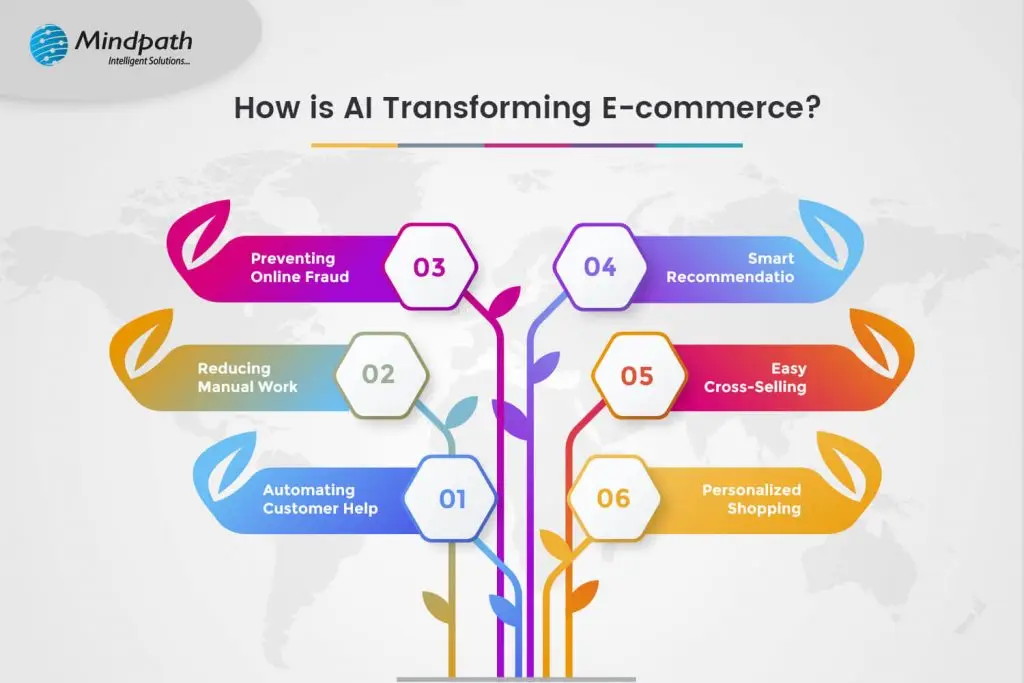
1. Automating Customer Help
Chatbots and virtual assistants are fantastic for offering customer care online. They make use of artificial intelligence (AI) to determine the needs of customers. Natural language processing (NLP) is the ability for chatbots to understand queries and requests. They learn and become more skilled at serving clients as they engage with them more.
Chatbots are a great resource for customers and online retailers alike. They never require a break and are constantly accessible, even late at night. They are polite, calm, and typically know the answers to a lot of queries. They take care of basic questions so that human agents can concentrate on more complex problems. Recent advancements in AI have made chatbots even more intelligent, which gives customers greater confidence when interacting with them. Many customers are willing to purchase goods from chatbots, particularly since some of those can offer exclusive offers just for them.
2. Reducing Manual Work
Artificial intelligence (AI) is revolutionizing e-commerce by replacing routine everyday operations that usually call for human labor. This change lessens the need for a big workforce while enabling organizations to run more effectively.
While it is unfortunate that automation can result in the loss of certain retail associates, many businesses believe artificial intelligence (AI) offers more opportunities for cost savings and productivity gains. Businesses can optimize their processes and lower human error by entrusting AI with routine jobs. Over time, this can result in clients receiving faster service and having a more responsive purchasing experience. So, adopting AI will ensure that employees can participate in more meaningful ways and help e-commerce businesses prosper in a competitive marketplace.
3. Preventing Online Fraud
E-commerce businesses face a serious threat from online fraud, which costs them billions of dollars annually. Thankfully, AI offers sophisticated methods to address this issue. Machine learning algorithms have made the task of manually reviewing transactions for unusual patterns, which once required a large number of personnel, faster and simpler.
To identify suspicious activity, these algorithms can instantly evaluate millions of data points. An AI system can detect abnormalities rapidly, such as when someone tries to commit fraud by inputting the wrong delivery address and flags the entry for evaluation. E-commerce companies can drastically lower financial losses and safeguard both themselves and their clients from fraud by utilizing AI for fraud detection. This makes everyone’s online buying experience safer.
4. Smart Recommendations
AI-driven recommendations raise the bar for personalization in online shopping. AI is able to examine a customer’s browsing history, previous purchases, and even their interactions with items, unlike traditional businesses. This makes it possible for AI to make tailored product recommendations and anticipate what a buyer might be interested in.
Customers will find shopping easier and more fun thanks to these very accurate recommendations that are customized to everyone’s tastes. AI helps buyers find the proper items by making relevant suggestions; this increases the likelihood of a purchase and improves the entire shopping experience. Brick and mortar establishments are just unable to match this level of customization.
5. Easy Cross-Selling
AI enables e-commerce companies to provide customers with product recommendations while they buy. AI can employ their past purchases and preferences to suggest relevant products that customers might like to add to their basket while they are checking out. Businesses can more easily provide appropriate ideas by deploying AI-powered recommendation engines, which leverage data on frequently purchased goods. Customers are encouraged to purchase more as a result, increasing revenues through upselling and cross-selling without being intrusive.
6. Personalized Shopping
Personalization is essential in e-commerce to provide a customized purchasing experience for each unique client. Customization strengthens the bond with clients, encouraging loyalty and improving the pleasure of buying. Personalized experiences are increasingly expected by many customers, but not all merchants have completely integrated them into their platforms.
AI has greatly enhanced the personalization of e-commerce by analyzing vast volumes of user data and providing real-time insights. This enables websites to function as personal shopping advisors by making product recommendations and presenting customized discounts. Through customization of the purchasing experience, businesses can raise revenue and establish enduring bonds with their customers.
AI Development Services at Mindpath
Wrapping Up!
Ready to transform your e-commerce business with the power of AI?
At Mindpath, we specialize in creating intelligent solutions tailored to your needs.
Join our Newsletter!
categories
Join the world's largest training library and unlock new opportunities!
Featured Posts
Turn Insights Into
Real Business Solutions
Exploring trends is only the beginning. Whether you’re planning AI adoption, modernizing legacy systems, or building scalable software, our experts help transform ideas into practical business outcomes.