
Latest Insights On
GenAI, Tech, and Digital Transformation
Stay updated with expert insights, success stories, and real-world applications of cutting-edge technology.

The radical growth in the amount of data generated by devices connected to the internet created concerns regarding the traditional approaches to computing and data storage. Many companies have shifted their business models towards cloud computing to accommodate the demand for storing more data, while also paying attention to cloud security. However, the search for answers to ‘what is edge computing’ is gaining momentum due to the limitations of cloud computing. One of the biggest setbacks of cloud computing is the latency, which is a direct outcome of the distance between users and cloud data centers.
Edge computing has emerged as a promising alternative by providing a distributed computing model in which computation and data storage are closer to the source of data generation. Understanding the strengths and limitations of edge computing offers the ideal foundation to integrate it effectively in enterprise operations.
Is your business struggling to act on data fast enough to stay competitive? Contact us to deliver real-time processing to power faster and smarter decisions.
Discovering the Ideal Definition of Edge Computing
Edge computing is a distributed IT architecture that processes and stores data as close to its source as possible, such as on local servers, IoT devices, or edge nodes, rather than routing all raw data to a centralized cloud. By keeping computation near the point of data generation, it minimises long-distance network travel, dramatically reducing latency, bandwidth consumption, and operational bottlenecks.
Upon searching for edge computing definition on different platforms, you will come across multiple entries. The most common definition of edge computing paints it as a distributed computing approach that involve shifting computing resources as close as possible to the source of data generation. It involves carrying out data processing tasks on or near the devices on the edge, thereby reducing network costs and latency requirements.
The “edge” in edge computing refers to any network endpoint near the data source, including routers, switches, local servers, IoT sensors, and integrated access devices. The defining requirement is physical or network proximity to the device generating data, rather than reliance on a distant central data center.
Also Read: Cloud Security Risk
Understanding the Components in Edge Computing Architecture
You might have many questions about the way in which edge computing overcomes the challenges with cloud computing. The basic edge computing meaning does not shed light on the fact that edge computing works with different components. Without understanding the architecture of edge computing, you cannot figure out how it is better than cloud computing. A breakdown of the important components in edge computing architecture can help you decipher how edge computing works.
1. Edge Devices
Edge device refers to the actual device on the edge, such as a camera, IoT device or a sensor. It is the source where raw data is generated and serves as the first point of contact in the edge computing architecture. The edge device can support minimal processing tasks, such as data filtering.
2. Edge Gateways
The next crucial component after edge computing devices is the edge gateway, which serves as a data aggregator. Edge gateway is the place where the system aggregates data from multiple devices and deals with basic analytics and preprocessing tasks.
3. Edge Servers
You cannot think about using edge computing for real-time tasks without edge servers in the picture. Edge servers handle the local processing tasks for real-time applications and running AI inference models or containerized workloads. As a matter of fact, edge servers take care of critical data on a temporary basis before sending it to the cloud.
4. Network Layer
The network layer helps in ensuring the use of 5G, LAN, Wi-Fi or satellite connection for connecting edge components to each other and the cloud.
5. Data Center or the Cloud
The data center or the cloud in edge computing architecture is useful for long-term storage and in-depth analytics. It also facilitates easier prospects for model training alongside the utilities like component orchestration and centralized management.
Want to understand how edge computing enables faster and real-time applications closer to users? Check out serverless architecture in cloud computing to learn how scalable workloads run without managing servers.
Unraveling Real-World Use Cases of Edge Computing
The introduction to edge computing also creates curiosity about the different ways in which businesses can use it. You can find edge computing examples in almost every industry and even in your daily lives. Learning about the real-world use cases can help you get a better idea of how edge computing can revolutionize the future of computing.
1. Retail
Edge computing serves the ideal resource for real-time processing and analytics in the retail sector to provide seamless customer experiences. Retailers can use edge computing in inventory management, customer analytics and personalized advertising to improve operations as well as the customer experience.
2. Manufacturing
The widespread use of edge computing in IoT applications provides the foundation for leveraging the new computing approach in manufacturing. IoT devices allow manufacturers to monitor their equipment, production lines and quality control. With the help of edge computing, manufacturing processes gain the benefit of automation, thereby ensuring faster manufacturing.
3. Autonomous Vehicles
The examples of different types of edge computing applications in the real world will be incomplete without mentioning autonomous vehicles. Edge computing can provide the lowest levels of latency required for processing input data from cameras. The low latency plays a major role in enhancing safety and navigation in autonomous vehicles.
4. Smart Cities
If you talk about autonomous vehicles among use cases of edge computing, then you should not leave smart cities from the discussion. The faster and localized data processing with edge computing offers a formidable boost for various tasks in smart cities. Edge computing has the potential to streamline energy optimization, public safety monitoring and real-time traffic management.
Wondering how edge computing environments stay secure against modern threats? Discover cloud computing attacks to understand how attackers target distributed systems and how to protect them effectively.
Does Edge Computing Have Any Variants?
Most of the discussions about edge computing focus only on its definition, its applications and benefits. The search for answers to ‘how does edge computing work’ does not lead you to the more intricate details of the new computing approach. You should also know that edge computing works at different levels with distinct utilities in different scenarios.
1. Regional and Local Edge
The regional and local edge locations help in extending the capabilities of cloud computing with reduced latency. The regional hubs work like the cloud to facilitate compute and storage services near end-users. Positioning of regional and local edge hubs before the last-mile network ensures that they can support applications which need moderate latency and enhanced data throughput.
2. On-site Edge Computing
Another notable variant of edge computing is on-site edge computing in which edge servers and devices are present in the physical premises of an organization. The on-site edge computing systems are more reliable choices for mission-critical applications as they enable real-time decision making without external networks. On-site edge computing also provides the assurance of more autonomy, control and security for enterprises.
3. Device Edge Computing
The diverse applications of edge computing also draw references to device edge computing with IoT endpoints. Device edge computing involves a combination of IoT devices, embedded systems and sensors which interact directly with the physical environment. The utility of device edge computing is primarily evident in distributed edge networks as they reduce data transfer and support localized actions.
Curious how edge computing fits into the rapidly evolving cloud landscape? Check out the latest cloud computing trends to learn how innovations like edge, AI, and distributed cloud are shaping the future.
How Can Edge Computing Help Your Business?
Edge computing offers significant advantages that make it a better alternative to cloud computing. As a matter of fact, the benefits of edge computing make it a powerful option for many emerging use cases.
1. Lower Latency
One of the most notable entries among the benefits of edge computing is low latency. With the help of local processing, edge computing ensures that the data never goes to the cloud for processing. As a result, edge computing can ensure significantly faster response times, which is essential for time-sensitive applications.
2. Enhanced Reliability
The local processing in edge computing ensures that it does not have to depend on external networks or resources. You can notice that the advantages of edge computing don’t give up on you in times of outages. You will not need a stable internet connection at all times to make the most of edge computing in real use cases.
3. Reduced Bandwidth Costs
Edge computing plays a major role in reducing network congestion, which ultimately leads to lower operating costs. With limited data transfer to the cloud, edge computing provides the assurance of improved performance in limited bandwidth. As a result, edge computing can help you avoid the costs of uninterrupted high-speed internet connectivity.
4. Better Flexibility
The isolated processing on devices in edge computing not only showcases how the power of computing can come at low costs but also with more flexibility. Edge computing allows you to add more connected devices without the urgency to connect them to central servers. On top of it, edge computing also facilitates hybrid scaling with the help of cloud resources and flexibility for deploying new edge nodes with growing demand.
Planning to build applications optimized for edge environments? Explore about cloud-native development to learn how modern architectures support scalable, resilient, and edge-ready applications.
Final Thoughts
Edge computing is a new paradigm that aims to revolutionize compute and data storage services. It provides a better alternative to cloud computing by enabling data processing on the devices at the network edge. The difference between cloud and edge computing is clearly evident in latency and resource requirements. Edge computing consumes significantly fewer resources than traditional cloud computing and delivers lowest latency. The adoption of edge computing in smart cities, autonomous vehicles and smart manufacturing units is a proof of how the new computing approach is better than its predecessors.
Mindpath is a leading end-to-end IT solutions provider with years of experience in catering to clients from different industries. We specialize in edge computing solutions tailored to modern specifications and capable of delivering the best results in alignment with your business goals. Take the first step to embrace the power of edge computing in your business with us.
Frequently Asked Questions
Have you ever wondered how artificial intelligence (AI) could impact our lives if left unchecked? As AI continues to evolve, ensuring its safe and responsible use has become a major concern. What exactly is AI safety, and why is it so important for the future? In this blog, we’ll explore what AI safety means and why it’s needed to protect both humanity and technological progress. So, let’s dive in!
Want to use AI to simplify your business and stay ahead of the competition? At Mindpath, we offer AI development services that help businesses innovate and grow.
What is AI Safety?
AI safety is the act of ensuring that artificial intelligence systems function properly without causing damage or creating unexpected risks. It entails developing rules and policies that govern how AI is created, developed, and used. The objective is to avoid mistakes, safeguard customers, and guarantee that AI works as developers planned. AI safety entails ensuring that algorithms are dependable, data is secure, and systems adhere to ethical and legal guidelines. This helps ensure that AI benefits society while posing minimal hazards.
Why is AI Safety Important?
AI safety is particularly essential because as AI grows more powerful, it will have an impact on many aspects of our lives, including how we work, interact with computers, and make decisions. Without adequate safeguards, AI can worsen inequality by favoring specific groups or making unjust decisions based on biased data. Another important reason for AI safety is to keep AI from being used harmfully, such as distributing misleading information or compromising privacy. By prioritizing safety, we can ensure that AI contributes to the improvement of our environment rather than creating difficulties. This makes AI safety essential for creating a better, more equitable future for everyone.
Best Practices for Ensuring AI Safety
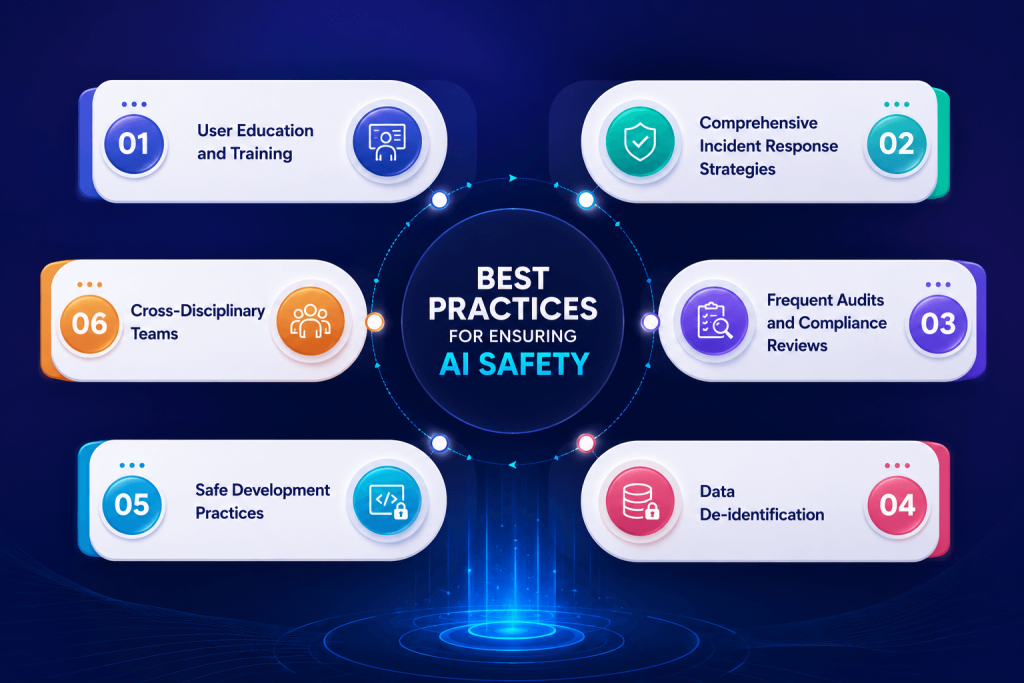
1. User Education and Training
Teaching individuals responsible AI development is essential for ensuring their safety and effectiveness. This training should include how to use the AI appropriately, identify possible hazards, and learn how to prevent them. When consumers understand how AI works, they can use it responsibly and promptly identify any concerns that require reporting. Trained users are also better able to offer useful feedback, which can aid in the AI’s effectiveness. They can offer improvements, report errors, and confirm that the AI is operating properly. This produces a cycle of continual development, gradually increasing the AI’s reliability.
Furthermore, user training fosters a sense of responsibility and awareness, lowering the risk of unintentional abuse or security breaches. Organizations that engage in user education guarantee that their AI systems are not only appropriately utilized, but also safer and more effective in the long term.
2. Comprehensive Incident Response Strategies
Developing a strong incident response plan helps organizations quickly detect, report, and resolve AI safety issues while reducing risks and maintaining system reliability. Regular training, practice exercises, and updates ensure teams are prepared for new threats and understand their responsibilities. Clear communication with stakeholders, users, and regulators during incidents also builds trust and shows the organization is handling the situation responsibly.
3. Frequent Audits and Compliance Reviews
Conducting frequent audits and compliance checks is essential for guaranteeing AI safety. These audits should evaluate Artificial Intelligence systems to ensure that they meet established safety standards, ethical norms, and regulatory requirements. By completing these assessments on a regular basis, organizations can find possible hazards and areas where they may not be compliant, allowing them to make required modifications and improvements swiftly.
These audits not only assist in detecting flaws, but they also encourage accountability and openness inside the organization. They urge teams to take AI safety seriously and make sure that everyone understands the necessity of following standards.
4. Data Confidentiality
Data confidentiality is a crucial strategy for ensuring privacy in AI operations. This method entails eliminating personally identifying information (PII) from data sets, rendering it hard to link data back to people. Techniques like k-anonymity, differential privacy, and synthetic data creation are frequently employed to safeguard individual privacy while still making the data relevant for training and analysis.
Organizations can use anonymized data to build AI models while protecting user privacy. Users will feel more confident knowing their personal information is secured, which helps to create trust. Furthermore, anonymized data can comply with numerous privacy standards, allowing organizations to avoid legal concerns while still gaining important insights.
5. Secure Development Lifecycle
A secure development lifecycle (SDL) is essential for assuring AI safety. This strategy incorporates security precautions into all stages of AI development, from planning and design to implementation, testing, and deployment. This lifecycle’s key practices include undertaking security risk assessments, adhering to secure coding standards, and thoroughly testing to find and fix vulnerabilities.
Organizations that include security throughout the development process can spot possible concerns early and mitigate risks before the AI system goes live. Furthermore, security measures must be updated on a regular basis to respond to new threats and technological advancements. This proactive strategy not only contributes to the development of safer AI systems, but it also improves general technological reliability and confidence.
6. Cross-Disciplinary Teams
Utilizing cross-disciplinary groups in AI research is essential for improving AI safety by providing a varied variety of viewpoints and experience. These teams should include professionals from a variety of domains, including ethics, psychology, law, and particular industrial areas, as well as AI experts. This variety is essential for addressing the difficult issues of AI safety because it assures that the systems built are not just technically strong, but also socially responsible and ethically sound.
Cross-disciplinary groups can detect possible concerns that people focused primarily on technical elements might have ignored. This collaborative approach fosters a more thorough grasp of the implications of AI systems, resulting in better decisions and more deliberate solutions.
AI Safety with Mindpath
Mindpath is committed to ensuring the safety and security of AI. Our approach is focused on ensuring that AI systems function effectively and do not cause harm. We take significant precautions to secure users and data, ensuring that everything is handled appropriately. We give training to users to assist them understand how to utilize AI safely. Our teams comprise specialists from several domains, including ethics and technology, to ensure that we cover all elements of AI safety.
We periodically check our systems to detect possible hazards and enhance our procedures. We also employ techniques such as data confidentiality to safeguard people’s personal information. By following a secure development methodology, we ensure that safety is included in every stage of the AI creation process.
Final Thought!
In a society dominated by artificial intelligence, understanding and prioritizing AI safety is essential for establishing a responsible technology environment. As previously discussed, successful AI safety measures include user education, robust incident response techniques, frequent audits, data confidentiality, a secure development lifecycle, and collaboration among cross-disciplinary teams.
At Mindpath, we are committed to following these guidelines, ensuring that AI systems not only function well but also adhere to the highest safety and ethical standards. We hope to increase trust and confidence in artificial intelligence technology by taking proactive actions to reduce risks and secure user data. As we traverse the difficulties of AI development, our dedication to safety will play an important part in defining a future in which AI serves as a beneficial force for society, empowering individuals and promoting equitable progress.

Generative AI Use Cases Across Different Industries
1. Finance And Trading
Generative AI is revolutionizing the financial and manufacturing industries by increasing efficiency and optimizing operations. In finance, it creates algorithmic trading strategies by analyzing past market data and executing exact trades.
It also offers predictive market analysis, which assists specialists in forecasting trends, as well as high-frequency trading by developing rapid algorithms for swift order execution. It also enhances risk management and fraud detection by monitoring transactions for unusual trends, therefore safeguarding customers from identity theft. In manufacturing, generative AI improves efficiency by finding bottlenecks and lowering costs. It provides predictive maintenance by anticipating equipment breakdowns and reducing downtime.
AI also improves supply chain management by analyzing logistics and inventory data to ensure timely delivery and optimal resource utilization.
2. Healthcare
Generative AI is transforming the healthcare industry by improving diagnostics, medication development, and personalized treatment strategies. In medical imaging, AI aids in the creation of synthetic MRI, CT, and X-ray pictures, allowing for more precise diagnosis and treatment planning. It improves image quality and detail, allowing medical experts to more accurately spot abnormalities.
Generative AI speeds up drug discovery by optimizing chemical structures and anticipating medication interactions, allowing researchers to better understand potential adverse effects. It also creates customized drug delivery systems to guarantee that drugs reach their intended targets with minimal adverse effects.
Furthermore, generative AI promotes personalized medicine by analyzing genetic data to find genetic markers, allowing healthcare practitioners to customize treatment programs for patients. By anticipating therapy responses based on previous patient data, AI enables clinicians to optimize methods for better results and recommend patient-specific medicine compositions.
3. Gaming and Virtual Reality
Generative AI is transforming the gaming and virtual reality landscape by making games more interesting and immersive. In gaming, AI contributes to the creation of engaging game material by analyzing how people play and what they enjoy, ensuring that each player’s experience is unique and suited to their tastes. AI also aids in the creation of enormous gaming worlds that change with each play session, providing players with fresh experiences.
Non-player characters (NPCs) in video games are becoming smarter, acting more like real people and responding to how players interact with them. This enhances the game experience and makes it seem more realistic.
Furthermore, Artificial Intelligence may adapt game stories based on player decisions, resulting in a personalized storytelling experience that keeps players engaged. AI is used in virtual reality (VR) to build realistic and engaging worlds, making VR experiences more pleasurable, whether for gaming or teaching. AI even creates virtual landscapes and interactive features, resulting in spectacular and responsive VR content.
4. Cybersecurity
Generative AI is helping to strengthen cybersecurity by enhancing how we detect and avoid threats. It analyses large amounts of data, such as network traffic and user behavior, to swiftly identify potential security concerns. This implies that risks can be addressed before causing harm.
Intrusion Detection Systems (IDS) driven by artificial intelligence (AI) monitor networks and systems for suspicious activity. They notify security professionals in real time if they discover something strange, therefore keeping systems safe.
Another key use of AI is behavioral analysis, which involves learning what normal behavior looks like. If it notices anything unexpected, such as abnormal patterns from a person or system, it might alert you to a potential problem.
Generative AI is also beneficial for detecting advanced dangers that are difficult to spot. It searches through previous data and network behavior to detect these clever attacks. AI can detect irregularities in network traffic, allowing organizations to respond to possible breaches before they get worse. AI can also assist identify insider threats, which are security dangers posed by persons within an organization. By analyzing how people interact and access information, it can detect odd behavior that may suggest a problem.
5. Autonomous Vehicles
Generative AI is transforming autonomous vehicles by improving their safety and efficiency. AI uses real-time data from sensors and traffic to assist autonomous vehicles make speedy choices. It recognizes items such as pedestrians and other cars, assuring appropriate reactions. Adaptive cruise control systems adjust speed in response to traffic, whereas collision avoidance systems forecast and prevent accidents.
AI also generates virtual surroundings for testing, allowing engineers to replicate various driving situations, including bad weather. This guarantees that vehicles perform reliably in real-world circumstances. Additionally, AI simulates interactions with pedestrians and bicycles, assisting vehicles in securely engaging with road users.
6. Robotics
Generative AI is improving robotics by making them smarter and more adaptive. It lets robots learn from their environment and adapt to changes, allowing them to deal with unforeseen events. AI enables robots to interpret human motions and expressions, resulting in improved communication and collaboration. This means they can operate comfortably among others in common settings like factories or houses.
In manufacturing, for example, generative AI optimizes how machines and people collaborate, increasing productivity by coordinating jobs and motions. This collaboration increases efficiency while also making it easier for robots to assist human workers.
7. Fashion Industry
Generative AI is transforming the fashion industry by enhancing the way designers and businesses produce, promote, and sell garments. AI helps designers produce original fashion ideas by analyzing trends and styles, making it easier for them to experiment with new looks. For marketing purposes, AI can generate blog entries and social media material that engage customers, keeping companies new and relevant. It also helps you write appealing advertisements for certain audiences.
Additionally, generative AI assists companies in understanding what customers think of their products through sentiment analysis, predicting which things will be popular, and forecasting future trends. It can also power virtual fashion advisers who suggest clothing based on a person’s style and preferences, making shopping more personal.
Generative AI Services at Mindpath
Mindpath uses the potential of generative AI to accelerate innovation and improve business operations. We create unique AI models that optimize workflows, enhance decision-making, and increase productivity in a variety of sectors.
Our artificial intelligence solutions automate content production for blogs, social media, and marketing materials, ensuring that your outputs are both engaging and relevant. We also use generative AI for intelligent data analysis, which allows organizations to foresee trends, comprehend attitudes among customers, and make intelligent choices.
Furthermore, our AI-powered virtual assistants improve client interactions by offering personalized advice and help, resulting in a better overall user experience. We also provide generative AI in design, which creates unique concepts for goods, marketing campaigns, and branding that stand out in a competitive market.
Wrapping Notes
Generative AI is changing the way businesses function, increasing innovation and efficiency across several industries. Its potential ranges from increasing innovation in fashion to revolutionizing safety in autonomous vehicles. Businesses that adopt cutting-edge technology find new ways to improve operations, enhance consumer experiences, and stay ahead of market trends. Mindpath is devoted to using the potential of generative AI to provide organizations with bespoke solutions that drive growth, optimize operations, and generate creativity. The future has arrived, and with generative AI, the possibilities are endless.
Wondering how generative AI can reshape your industry?
Mindpath specializes in AI-driven solutions that unlock new possibilities.

What if your business could automate creative tasks, generate innovative product designs, or even personalize customer interactions without manual effort? How are companies across different industries already harnessing the power of Generative AI to solve challenges and improve efficiency? Could Generative AI be the key to unlocking new levels of innovation and growth for your business? In this blog, we will explore the use cases of Generative AI that is shaping the future of business operations.
Generative artificial intelligence (generative AI) is a form of AI capable of producing new content and ideas, such as conversations, stories, images, videos, and music. AI technologies aim to replicate human intelligence in nontraditional computer tasks such as image identification, natural language processing (NLP), and translation. Generative AI represents the next phase in artificial intelligence. You can teach it to understand human language, programming languages, art, chemistry, biology, or any other complicated topic. It leverages previously trained data to tackle new issues. For example, it can acquire English vocabulary and compose a poem using the words it processes. Your organization can utilize generative AI for a variety of applications, including chatbots, media production, and product development and design.
So, let’s explore the use cases of Generative AI!
Use Cases of Generative AI
1. Cybersecurity And Fraud Prevention
Many cybersecurity organizations are leveraging generative AI to improve their solutions for detecting suspicious activity on consumer networks and systems. These AI systems can accurately anticipate acts of fraud by analyzing transaction patterns and user behaviors.
This technology enables firms to respond swiftly to possible attacks, which improves their entire security posture. Generative AI continually learns from fresh data, adjusting to evolving risks and assisting security teams in staying one step ahead of hackers. As cyber threats get more complex, using AI for fraud detection and cybersecurity is becoming increasingly important for businesses looking to secure their assets and retain customer trust.
2. Drug Discovery
Generative AI is revolutionizing drug development by modelling complicated molecules and predicting their interactions faster than existing approaches. This technique has the potential to greatly speed up the development of new drugs.
It enables pharmaceutical firms to forecast drug interactions, reuse current drugs, and develop personalized treatments based on a patient’s genetic profile. Furthermore, new AI-powered platforms are being developed to focus on healthcare and improve drug discovery procedures. Many in the biotech and pharmaceutical sectors think that generative AI will transform how new drugs are found and created, opening the path for speedier and more effective therapies.
3. Marketing Assistance
Many experts feel that marketing support is one of generative AI’s primary capabilities. This technology can generate personalized marketing materials, analyze consumer data, and help with content production. It simplifies processes like content creation and social media administration, allowing marketing professionals to focus on more essential operations while saving time and money.
Generative AI can also conduct market analysis by examining product feedback and forecasting client difficulties before they occur. Understanding client feedback is essential for product firms; they must know what their consumers like or dislike, predict developing trends, and recognize regional preferences.
4. Coding Assistants
One of the most popular uses for generative AI is as a coding assistant. This technique can produce simple software code, freeing programmers to concentrate on more sophisticated tasks.
Coding assistants help programmers stay focused by delivering solutions right in the code rather than requiring them to look for answers online. By leaving a remark, developers may let the AI finish their work, allowing them to keep their “flow state” and remain productive. Generative AI is particularly beneficial in web development since it can generate website code rapidly and effectively, decreasing the time and cost of upgrades. Even people with less technical knowledge may utilize technologies such as ChatGPT to create and implement code on their websites, making the development process more accessible.
5. Digital Assistants
Many big IT businesses are supporting generative AI digital assistants, also known as copilots, despite some CIOs’ concerns about the return on investment. These assistants can search for information inside the organization, prepare papers and PowerPoint presentations, and summaries email threads and video conversations. They can also produce supply chain documentation, such as supplier quote requests.
Some videoconferencing programs now include transcription and summary features, while independent applications can do similar duties. Grammarly, for example, may help you repair faults in grammar, spelling, and punctuation. Digital assistants can also be adapted to individual needs. For example, if a corporation routinely acquires delicate chemical or biological components, generative AI can add appropriate handling instructions to the purchase order.
6. Business Process Enhancement
Generative AI is proving to be very effective in improving business processes within organizations. Companies are increasingly utilizing this technology to boost efficiency in workflows that are vital to their operations and customized for their respective sectors. In industries such as banking and insurance, some organizations are using generative AI to assist underwriters in appraising prospective clients.
This method allows underwriters to work more effectively and conduct faster, more accurate risk evaluations, which is essential for the success of fintech businesses that rely on prompt funding decisions. Generative AI successfully empowers professionals, allowing them to focus on more strategic duties and increasing overall productivity.
7. Advanced Chatbots
While simple chatbots that recognize words and phrases have been available for a while, modern chatbots powered by generative AI can conduct more lifelike conversations and handle a broader variety of client demands. Generative AI for language and AI agents is gaining popularity as a top emerging technology. These smart chatbots are intended to handle client enquiries more efficiently, resulting in considerable cost savings for enterprises.
Although there are worries about inaccuracy, particularly in how they process requests, the impact of minor errors is frequently minimal. This enables businesses to improve customer service while successfully controlling related risks, making sophisticated chatbots an important tool in customer care.
Generative AI Services at Mindpath
Mindpath offers generative AI services to help organizations improve their operations and promote innovation. We create compelling content, analyze massive datasets for important insights, and provide intelligent chatbots for effective customer care. We also priorities personalizing client experiences based on individual preferences and automating repetitive chores to free up your team’s time. By utilizing our generative AI solutions, you may enhance your business processes, save time, and remain competitive in today’s fast-paced marketplace.
Final Note
Generative AI is changing the way organizations function by offering creative solutions that increase efficiency, creativity, and consumer relationships. By automating monotonous operations, personalizing experiences, and providing strong analytical tools, generative AI allows organizations to focus on strategic goals and achieve higher success. As businesses across sectors continue to use the possibilities of this technology, they are not only tackling present difficulties but also opening new avenues for development and innovation. Embracing generative AI might be the key to being competitive in today’s quickly changing industry. At Mindpath, we are dedicated to assisting your company in fully utilizing generative AI, ensuring that you remain at the forefront of your industry.
Is your business ready to embrace the power of generative AI?
Mindpath offers tailored AI services to help you stay ahead in your industry.

Curious about how artificial intelligence is transforming the world? Dive into the future with OpenAI’s o1 Model! What if I told you that this cutting-edge technology is setting new benchmarks for AI capabilities? How does it compare to its predecessors, and what groundbreaking advancements does it bring to the table? In this blog, we will explore the revolutionary features of OpenAI’s o1 Model and uncover how it’s reshaping the landscape of AI technology. So, let’s dive in!
Overview of OpenAI o1 Model
OpenAI has now released a preview of their latest AI models, the o1 series, often known as Project Strawberry or Q*. These new models are meant to think more thoroughly before offering solutions, making them especially good at tackling complicated issues in science, math, and coding.
The o1 series stands out because it exceeds the capabilities of previous AI models. For example, the o1-preview model excels at difficult arithmetic issues, answering 93% of AIME math questions and outperforming human specialists in several scientific assessments. Along with this, OpenAI has introduced the o1-mini, a more economical version that maintains good coding skills while costing 80% less, making it an excellent choice for developers.
Key Features of OpenAI o1 Model
1. Better Safety Measures
2. Enhanced STEM Performance
The o1 models have shown outstanding performance in a variety of academic challenges. They succeed at programming competitions, demonstrating their strong coding and problem-solving talents. In maths competitions, the models have also demonstrated their abilities by achieving admirably on high-level exams. These results demonstrate the o1 models’ exceptional ability to tackle challenging STEM problems, making them very useful tools for both coding and mathematical problem solving. This impressive achievement demonstrates their capacity to deal with complex and intricate issues, establishing a new benchmark for AI in academic and technological fields.
3. Diverse Data Training
The o1 models were trained using a wide range of data sources, including public information, private content, and carefully curated datasets. This diversified training guarantees that the models are well-versed in a wide range of general knowledge and specialized subjects. By combining diverse forms of data, the o1 models develop a thorough grasp of both popular and unique issues. This thorough and diverse training improves not only their conversational skills, but also their thinking abilities, allowing them to handle a wide range of enquiries and scenarios with more accurateness and relevancy. This method makes the o1 models extremely adaptable and capable of providing intelligent and contextually appropriate replies.
4. Affordable and Cost-Effective
OpenAI’s o1-mini model is a cost-effective alternative to the more complex o1-preview, costing 80% less while still achieving excellent performance in domains like mathematics and coding. The o1-mini, designed exclusively for developers, delivers great precision and consistent results at a fraction of the cost, making it an excellent solution for applications that require cost control. This targeted pricing makes powerful AI technology available to a broader variety of customers, including educational institutions, startups, and small enterprises. OpenAI’s cheaper alternative enables these organizations to harness strong AI capabilities without considerable financial burden, boosting greater adoption and innovation in a variety of areas.
5. Greater Fairness and Less Bias
The o1-preview model surpasses GPT-4 in terms of bias and fairness. It excels at reducing stereotyped responses, resulting in more balanced and unbiased answers. In fairness evaluations, the o1-preview model consistently picks the most suitable and impartial responses, demonstrating a significant increase in its ability to handle confusing or complicated queries. This achievement not only improves the model’s capacity to provide fair replies, but it also demonstrates OpenAI’s dedication to developing AI systems that are more aware of and responsive to ethical problems. The o1-preview approach contributes to more inclusive and polite AI interactions by reducing bias and boosting fairness, making it a desirable tool for applications that need impartiality.
6. Monitoring Thought Processes and Detecting Deception
OpenAI incorporates experimental techniques into the o1 models to track their reasoning process, allowing the system to determine when it is presenting misleading or purposely incorrect data. This “chain-of-thought” monitoring aids in the detection and reduction of misleading behavior, hence increasing the model’s reliability and credibility. Early findings indicate encouraging progress in reducing the hazards associated with AI-generated misinformation.
The o1 models represent a significant advancement in AI thinking, notably in STEM fields such as mathematics, computing, and scientific problem solving. These models, including the high-performing o1-preview and the low-cost o1-mini, are intended to successfully handle difficult jobs. They also include better safety and ethical safeguards, such as rigorous testing and red teaming, to ensure more responsible AI implementation.
AI Developemnt Services at Mindpath
Final Note
OpenAI’s o1 models are pushing the limits of artificial intelligence with improved problem-solving ability, fairness, and safety features. They symbolize a new age of AI in which ethical considerations and sophisticated thinking coexist to solve hard problems in STEM and beyond. Whether you’re searching for high performance or low-cost solutions, the o1 series delivers with accuracy and dependability. Mindpath uses the power of these ground-breaking models to provide bespoke AI solutions that help organizations innovate, automate, and grow. With our experience and OpenAI’s cutting-edge technology, your organization is well-positioned to prosper in the rapidly developing world of AI-driven solutions.
Want to leverage advanced AI?
Unlock the potential of OpenAI’s o1 model with Mindpath’s expert AI development.

Are you struggling to keep your business ahead in an increasingly competitive market? Wondering how leading companies are innovating faster, reducing costs, and delivering personalized experiences? What if there was cutting-edge technology that could unlock new levels of creativity and efficiency for your business? Could Generative AI be the missing piece in your strategy for success? In this blog, we will explore how generative AI is impacting your business. So, let’s dive in!
What is Generative AI?
Generative AI is a type of technology that employs complex algorithms to generate new and realistic material based on previously learnt data, such as writing, photos, or even noises. These algorithms function by training on massive volumes of data, allowing them to recognize patterns and produce material that appears to be unique. The most powerful types of generative AI are based on what are known as foundation models, which are trained on massive datasets without the requirement for specific labels. This enables the AI to learn in a more flexible manner and tackle a wider range of tasks.
Why is Generative AI Important?
Generative AI is essential because it boosts creativity by creating new content based on patterns learnt from data. It also personalizes user experiences, enabling firms to adjust information to specific customer requirements and interests. Furthermore, generative AI promotes cooperation by working alongside individuals, using their talents to create greater results. This technology also speeds up procedures, increasing operational efficiency. Furthermore, its broad effect spans sectors, providing greater insights into artificial and human intelligence, propelling innovation and understanding forward.
How Does Generative AI Impact Businesses?
1. Improved Customer Experience
Improving customer experience is a prominent application of generative AI, giving organisations a valuable tool for improving interactions. Businesses can create more engaging and rewarding consumer experiences by implementing dynamic AI agents that provide human-like replies, hence strengthening connections.
These AI-powered chatbots, based on advanced language models, provide more nuanced and intelligent replies, enhancing interactions and making customers feel heard and understood. Beyond direct connection, generative AI is an invaluable support mechanism for customer care personnel. These AI agents use natural language processing (NLP) to listen to discussions between agents and clients, instantly collecting relevant information to help in real time. This increases service quality and cuts response time and the workload of human agents.
2. Personalized Learning
Generative AI systems excel in adaptive learning, which enables them to constantly improve by incorporating feedback and analyzing new data. This constant modification improves their effectiveness, allowing them to offer outcomes that better match user preferences and company objectives. For example, in a corporate environment, generative AI can be used to improve marketing strategy by analyzing consumer interactions and feedback. As the system better understands client preferences and behaviors, it will create more focused and successful marketing efforts. Furthermore, it may tailor recommendations and information to particular client demands, resulting in more personalized and effective interactions. This skill not only improves the efficiency of marketing activities, but also allows organizations to remain flexible and responsive to changing market trends.
3. Data Generation
Generative AI provides considerable data synthesis benefits. These AI algorithms can mix and interpret massive volumes of data to generate significant insights by analyzing many datasets. For example, in the financial business, generative AI can build predictive models by analyzing market patterns, customer behavior, and economic statistics. These models assist organizations in making sound investment decisions by offering a clearer view of future market movements. Generative AI, which harnesses the power of data synthesis, helps organizations in many industries to access actionable insight, offering them a competitive advantage in today’s data-rich environment.
4. Increased Efficiency and Productivity
Generative AI improves efficiency and productivity by automating difficult and time-consuming operations, allowing firms to optimize workflows and better allocate resources. For example, in the manufacturing industry, AI can deliver optimized production plans that decrease waste and increase overall efficiency. In customer service, generative AI can assist support agents by summarizing tickets, proposing relevant replies, and selecting the best tone for conversations. This allows agents to resolve enquiries faster and more correctly, increasing productivity and enhancing customer service quality. Businesses that use generative AI can boost productivity, save operating costs, and improve performance across several departments.
5. Reduced Time and Costs
Generative AI saves time and money by automating processes that previously needed significant human effort. For example, in architecture and design, AI can quickly generate architectural plans based on certain factors, considerably speeding up the design process and minimizing manual labor. AI can also analyze stakeholder comments and market trends to produce new product ideas and improve designs more effectively. This capacity to analyze massive amounts of data quickly not only reduces operating costs, but also shortens project timeframes and improves resource al__cpLocation, resulting in increased overall efficiency for enterprises.
6. Boosted Creativity
Generative AI greatly increases creativity by allowing organizations to efficiently create a diverse range of interesting and unique content. In the advertising sector, for example, AI-powered solutions can create intriguing ad copy, eye-catching images, and even dynamic video material. This feature not only speeds up the creative process, but also allows firms to experiment with new thoughts and ideas without the constraints of physical labor.
Beyond advertising, generative AI may help with a variety of creative tasks, from designing distinctive product packaging to creating interactive customer experiences. It’s an effective tool for brainstorming and refining ideas, allowing teams to push creative limits and remain ahead of trends. By automating repetitive operations and providing new viewpoints, generative AI enables firms to sustain a steady flow of creative content while remaining competitive in a constantly evolving market.
Generative AI Services at Mindpath
Mindpath provides a variety of services that leverage generative AI to help your business succeed.
Our artificial intelligence (AI) can generate interesting material, such as ad copy, graphics, and even motion pictures, all personalized to your specifications. This means less time spent on manual labor and more time for creativity.
We also utilize AI to analyze data and produce valuable insights, allowing you to make better decisions. Whether you need new marketing ideas or better methods to understand your consumers, our generative AI services will help you stay competitive in today’s fast-paced environment.
Wrapping Up!
Generative AI is a game changer for organizations, providing creative solutions for increasing creativity, streamlining processes, and improving consumer experiences. By automating complicated activities and delivering important insights, it allows businesses to cut expenses while staying competitive. As more firms use this technology, those that use generative AI will be better positioned to promote development, respond to market changes, and achieve long-term success. Embracing generative AI is more than simply a technological advancement; it is a strategic step towards a more dynamic and efficient future. At Mindpath, we offer tailored generative AI solutions that streamline processes, cut costs, and elevate customer experiences. Embrace the future with Mindpath and unlock new opportunities for growth and innovation in today’s fast-paced market.
Ready to elevate your business with cutting-edge technology?
Discover how Mindpath’s generative AI solutions can transform your operations and drive success.

Are you ready to take your project to the next level with top-notch React developers? But how do you ensure you’re hiring the right talent? With so many factors to consider, finding the perfect React developer can be overwhelming. In this blog, we will explore the key considerations before hiring the perfect React developers which can be beneficial for your project.
React is a popular technology for developing websites and web applications. It is a JavaScript library that assists developers in creating user interfaces, which are the components of a website or app that users interact with. React makes it easy to create and manage interactive components like buttons, forms, and menus. It enables developers to create these features in a modular manner, allowing them to reuse and change portions of their website without beginning from scratch.
Need skilled ReactJS developers to build fast, scalable web applications for your business? At Mindpath, we offer experienced ReactJS developers to deliver high-quality, custom web solutions.
React developers are important because they specialize in designing dynamic and efficient user interfaces for websites and applications. Their proficiency with React, a popular JavaScript package, allows them to create highly interactive and responsive elements that improve the user experience. React developers can employ React’s modular architecture to quickly manage complicated data and ensure smooth performance, making applications easier to update and maintain. Their ability to work with other technologies and frameworks, like Flux and React Native, broadens their effect, allowing them to contribute to web and mobile projects.
So, let’s dig in to explore the key considerations to make your hiring process smooth and successful!
Key Considerations Before Hiring React Developers
1. Deep Knowledge of ReactJS Basics
When hiring React developers, make sure they have a thorough knowledge of React’s key features. They should be conversant with JSX, which allows them to seamlessly combine HTML with JavaScript to create components. It is also essential that they grasp the Virtual DOM, which is a technology that allows React to refresh web pages rapidly by handling changes effectively.
These abilities are vital because they allow developers to construct quick, dynamic websites and apps. Make sure the developer is familiar with these aspects in order to efficiently manage the demands of modern web development.
2. Proficiency In HTML/CSS
When hiring a React developer, make sure they are familiar with HTML and CSS. They should be able to write HTML tags to structure web pages and use CSS to design them. Understanding concepts such as the box model and flexbox is essential for layout and design.
They should also understand how to utilize a CSS reset to ensure that styles appear consistently across various browsers, as well as how to use media queries to make websites look appealing on all platforms, from phones to desktops. An excellent React developer must understand these fundamental front-end abilities in order to create well-designed and effective websites.
Must Read: Top ReactJS Trends
3. Strong JavaScript Skills
A React developer must be proficient in JavaScript, as it is the fundamental language used in React. They must be able to generate reusable components, which are critical for developing efficient and maintainable user interfaces. Strong JavaScript skills also entail understanding how to manage application state, execute asynchronous processes, and interact with various front-end frameworks and tools. Mastery of these JavaScript foundations enable a React developer to create robust, engaging, and high-performance websites and apps.
4. Expertise In Writing Clean Code
A React developer should excel at producing code that is straightforward and understandable. Well-organized and simple code not only speeds up development, but also makes it easier to detect and correct mistakes. Clear coding conventions guarantee that when the project is passed on to another developer or team, they can easily comprehend and work with the current codebase. This is essential for sustaining and expanding the project over time. Clean coding techniques also assist in reducing technical debt, improving team cooperation, and ensuring that future upgrades or alterations may be deployed efficiently without creating new issues.
5. Experience With ReactJS Workflows
A React developer should be familiar with data structure frameworks and processes such as Flux or Redux. These technologies are essential for managing application state and complicated data relationships, particularly in large-scale or dynamic applications. Flux and Redux enable to simplify data flow and manage state changes and asynchronous updates.
Understanding these routines is essential but developers must first master the fundamentals of React. A solid React foundation guarantees that they can successfully integrate and use these advanced tools. Mastery of data management libraries helps the developer’s ability to develop strong and scalable applications, as well as overall code quality and maintainability.
6. Familiar With REST APIs
Many applications require frontend components to be integrated with external data sources, therefore React developers must be familiar with REST APIs. A REST API enables developers to link React apps to back-end systems and get or transmit data such as user information, goods, or content. Understanding how to communicate with APIs is essential for creating dynamic, data-driven apps.
A React developer should be familiar with HTTP request methods such as GET, POST, PUT, and DELETE, which are often used in REST APIs. They should also understand how to handle answers, failures, and data formats like JSON. A strong understanding of REST APIs enables developers to effectively connect their React code to other services and databases, resulting in a seamless user experience.
7. Experienced With Unit Testing and Tools
Experience with unit testing, Git, GitHub, and other React developer tools is essential for effective development. Many firms use Git and GitHub to store and maintain their work, therefore React engineers must be familiar with these technologies. Daily development tasks include change tracking, branching, code merging, and resolving merge conflicts.
Unit testing also guarantees that each component of the code functions as intended, which aids in the early detection of errors and the maintenance of code quality. Developers that are familiar with unit testing technologies such as Jest or Mocha can validate their work more effectively, resulting in more dependable and stable apps. Together, these technologies serve to shorten the development process and promote communication, resulting in more efficient project workflows and higher-quality output.
Hire ReactJS Developers at Mindpath
At Mindpath, we make it simple to engage experienced ReactJS developers for your project. Our method is straightforward, ensuring that you receive the greatest personnel and outcomes. From understanding your requirements to providing ongoing assistance, we are with you every step of the way. This is how it works:
1. Requirements Gathering
Start by contacting us to discuss your project’s goals and needs. We’ll review your requirements and create a detailed plan that includes our approach, timeline, and estimated cost.
2. Shortlist The Right Talent
We carefully select ReactJS developers who are a perfect match for your project. You can interview and choose the developers who best fit your needs.
3. Project Kick-off
Once your team is ready, we kick off the project with a clear plan and timeline. Our team stays in close contact, providing regular updates and making sure everything aligns with your vision.
4. Ongoing Support
We continue to support you throughout the development process and even after the project is done, ensuring that all your goals are met, and the project runs smoothly.
Wrapping Up!
Finding the right React developers is essential for creating dynamic and efficient apps. Skilled developers specialize in React.js, JavaScript, HTML/CSS, and the tools required for seamless integration and performance. Mindpath ensures that you have access to the best React expertise, resulting in clean code, scalable architecture, and optimized user experience. With the correct Mindpath team, your project is positioned for success, guaranteeing that web applications match the highest modern development standards.
Artificial intelligence (AI) and augmented reality (AR) are complementary technologies that can make digital experiences more interactive and context-aware. AI helps systems interpret data, recognize patterns, and generate recommendations, while AR places digital information over a view of the physical environment. When combined, they can provide users with relevant visual guidance, interactive product experiences, and assistance during real-world tasks.
Key Takeaways
- 01
Artificial intelligence and augmented reality combine data-driven capabilities with digital information displayed in a real-world view. - 02
AI can support object recognition, personalization, contextual assistance, and interaction within AR applications. - 03
Healthcare, retail, manufacturing, education, entertainment, and navigation offer potential applications for AI-powered AR experiences. - 04
Successful AI and AR solutions depend on reliable data, suitable devices, responsive interfaces, privacy safeguards, and thorough testing. - 05
Businesses should select use cases with clear user needs and measurable outcomes before investing in more complex AI-powered AR experiences.
Businesses can apply artificial intelligence and augmented reality in areas such as healthcare, retail, manufacturing, education, and technical support. For example, AI can help identify an object or interpret a situation, while an AR interface presents instructions or contextual information to the user. The value of this combination depends on the quality of the underlying data, the accuracy of the AI system, and how well the experience fits the user’s needs.
Understanding Artificial Intelligence and Augmented Reality
What is Artificial Intelligence?
Artificial intelligence is a field of computing focused on systems that perform tasks such as recognizing patterns, interpreting language, making predictions, and generating content. Depending on their design and training, AI systems can process large amounts of information and produce outputs that help people complete tasks or make decisions.
AI technologies include machine learning, computer vision, natural language processing, and generative AI. These capabilities can support applications such as image recognition, voice interaction, recommendation systems, and intelligent assistance. For a broader overview, read our guide to AI models.
What is Augmented Reality?
Augmented reality is a technology that adds digital content to a view of the physical environment. Depending on the application and device, users may see virtual objects, labels, instructions, animations, or other information through a smartphone, tablet, headset, or smart glasses.
Unlike virtual reality, which typically immerses users in a computer-generated environment, AR adds digital elements to their view of the real world. Businesses can use it to present product previews, display maintenance instructions, support navigation, and create interactive learning experiences.
AR experiences may use cameras, sensors, spatial mapping, and tracking technologies to position digital content. The available capabilities depend on the device, application, and environment in which the experience is used.
How Do Artificial Intelligence and Augmented Reality Work Together?
AI and AR can work together by connecting intelligent data processing with a visual interface. AI can interpret information from images, sensors, user input, or connected systems. The AR application can then display relevant digital information within the user’s view of the physical environment.
For example, consider a technician repairing industrial equipment. A computer vision model may help identify a component from a camera image, while an AR application displays the corresponding maintenance instructions. The technician can use the information to guide the repair, subject to the accuracy of the recognition system and the suitability of the instructions.
The Main Steps in an AI-Powered AR Experience
1. Capture Environmental or User Data
The application receives information from a camera, device sensors, user commands, or connected business systems. The type and amount of data collected depend on the use case and the device’s capabilities.
2. Interpret the Information with AI
AI can help recognize objects, interpret spoken instructions, classify images, or identify patterns in the available data. The system uses these results to determine which information or action may be relevant.
3. Position and Display Digital Content
The AR application presents relevant content, such as labels, visual instructions, or three-dimensional objects. Tracking and spatial understanding help position the content appropriately within the user’s view.
4. Respond to User Interaction
Users may interact through touch, voice, gestures, or other supported controls. Depending on the application, AI can help interpret the interaction and update the information displayed.
5. Evaluate and Refine the Experience
Developers can evaluate recognition accuracy, tracking stability, response time, usability, and task completion. Feedback and testing results can guide improvements to the AI model, AR interface, and overall workflow.
Benefits of Combining Artificial Intelligence and Augmented Reality
Combining AI with AR can make digital information more relevant to the user’s surroundings and task. The benefits depend on the quality of the implementation, the environment, and whether the experience solves a real user problem.
1. Personalized User Experiences
AI can use permitted user preferences, interaction history, or contextual information to help tailor the content displayed in an AR application. For example, a shopping application could prioritize product information based on a user’s selected preferences, while a training application could adjust the sequence of guidance based on task progress.
Personalization should be transparent and respect user privacy. Businesses should collect only the information needed for the intended experience and provide appropriate controls over data use.
2. Improved Object Recognition
Computer vision models can help AR applications recognize objects, components, signs, or visual features. This can make it easier to display relevant information in context, such as product details in a retail environment or component labels during equipment maintenance.
Recognition accuracy can vary with lighting, camera quality, object appearance, and environmental conditions. Applications should be tested under realistic conditions and provide suitable alternatives when the system cannot confidently identify an object.
3. More Natural Interaction
AI-powered speech recognition and language processing can enable users to interact with some AR applications through voice commands. Gesture recognition may also support hands-free control when the device and application provide that capability.
These options can be useful when a user is working with equipment or needs to keep their hands available for another task. However, voice and gesture controls should complement accessible alternatives rather than become the only way to use an application.
4. Contextual Assistance
AI can help determine which information is relevant to a user’s current task, while AR can present that information directly within the user’s view. In a maintenance setting, this could mean displaying a component label, a safety instruction, or the next step in an approved procedure.
Contextual guidance can reduce the need to switch between screens or search through documents. Its usefulness depends on the accuracy of the underlying information and whether the instructions are appropriate for the specific situation.
5. More Efficient AR Content Development
AI tools can assist content teams with tasks such as generating draft text, organizing product information, creating concept assets, or preparing variations of digital content. These capabilities may help teams develop and maintain AR experiences more efficiently.
Generated content still requires review for accuracy, visual quality, licensing considerations, and suitability for the target device. AI-assisted creation does not remove the need for AR design, development, optimization, and testing.
6. Interactive Training and Learning
AI-powered AR can combine visual instructions with interactive exercises. For example, learners could view a simulated equipment assembly, receive contextual prompts, and access explanations when they encounter a difficult step.
Training applications may adapt guidance based on task performance, where appropriate data and reliable evaluation methods are available. Businesses should assess learning outcomes and task accuracy rather than assuming that an immersive experience automatically improves retention.
7. Scalable Personalization
AI can help organizations adapt AR content for different products, users, or operating contexts. A manufacturer, for instance, could maintain a shared library of equipment instructions while displaying the relevant version for a particular model or maintenance task.
Scaling such experiences requires consistent content, dependable data integrations, device compatibility, and a clear process for updating information. Personalization should improve usability without introducing unnecessary complexity.
Real-World Applications of Artificial Intelligence and Augmented Reality
AI and AR can support a range of business and consumer experiences. The following examples describe practical application scenarios. The exact capabilities available in a deployed solution depend on its design, data sources, hardware, and implementation.
1. Healthcare and Medical Training
Healthcare applications can combine AI-based image analysis or information processing with AR-based visualization. Depending on the system, medical professionals may use visual overlays to review anatomical information, plan procedures, or support training and simulation.
For example, a training application could display anatomical structures in a three-dimensional learning environment and provide explanations through an AI-enabled interface. Clinical use requires appropriate validation, reliable source information, privacy safeguards, and professional oversight. AI-generated guidance should not be treated as a substitute for clinical judgment.
2. Retail and Virtual Product Experiences
Retailers can use AR to let customers preview products in their surroundings or visualize selected items before purchasing. AI can support related functions such as product recognition, recommendation, and personalization when suitable data is available.
For example, a home furnishings application could allow a customer to place a virtual representation of a product in a room. AI may help recommend compatible items or organize product suggestions based on stated preferences. Product dimensions, appearance, and compatibility should be represented accurately to avoid misleading customers.
3. Manufacturing and Equipment Maintenance
Manufacturing teams can use AR to display assembly instructions, component labels, and maintenance procedures. AI can support visual inspection, anomaly detection, or the retrieval of relevant technical documentation.
For example, a technician could view step-by-step repair instructions through a supported AR device while an AI system helps identify the equipment model or locate a relevant maintenance document. The instructions should come from approved technical sources, and safety-critical work must follow established procedures.
4. Entertainment and Interactive Experiences
AI and AR can be combined in interactive games, camera effects, and digital experiences that respond to a user’s surroundings. AI may help recognize faces, objects, gestures, or scenes, while AR adds virtual elements to the camera view.
Developers can use these capabilities to create responsive effects and interactive environments. They should also consider device performance, accessibility, age-appropriate design, and consent when applications process images or other personal information.
5. Navigation and Remote Assistance
AR navigation can display directional cues over a camera view, while AI can support the interpretation of surroundings or the retrieval of relevant information. In workplace settings, similar capabilities may help technicians follow instructions or receive remote assistance.
For example, a field service worker could view the next inspection step on a supported device and access relevant technical information without repeatedly switching applications. Navigation and remote assistance systems should account for positioning errors, changing conditions, and situations where users need to focus on their physical surroundings.
6. Education and Skills Development
Educational applications can use AR to present three-dimensional models, interactive demonstrations, or visual explanations. AI can help answer questions, provide additional explanations, and organize learning content based on a learner’s needs.
For example, a science lesson could use AR to visualize a complex structure while an AI-enabled assistant explains its parts. Educators should review the generated explanations and ensure that the experience supports the learning objectives instead of distracting from them.
Artificial Intelligence and Augmented Reality Compared
AI and AR serve different primary purposes, even when they are combined in the same application. Understanding their roles helps businesses decide which capabilities are necessary for a particular solution.
| Aspect | Artificial Intelligence | Augmented Reality | Combined AI and AR |
|---|---|---|---|
| Primary role | Processes information, recognizes patterns, and generates predictions or content. | Adds digital content to a view of the physical environment. | Connects intelligent processing with contextual visual information. |
| Typical inputs | Text, images, audio, sensor data, or structured records. | Camera feeds, device sensors, spatial data, and user input. | Relevant data and environmental information, depending on the application. |
| Typical output | Predictions, classifications, recommendations, or generated content. | Visual overlays, virtual objects, labels, and interactive content. | Context-aware visual guidance or interactive experiences. |
| Example | Recognizing a component in an image. | Displaying a label over a component. | Recognizing a component and displaying relevant instructions in context. |
| Key considerations | Model accuracy, data quality, privacy, and evaluation. | Tracking, device compatibility, usability, and performance. | Integration reliability, end-to-end testing, privacy, and user safety. |
Challenges of Combining AI and AR
Although AI-powered AR offers useful possibilities, businesses need to evaluate the technical and operational challenges before deploying it. A successful implementation requires more than connecting an AI model to an AR interface.
1. Data Quality and Recognition Accuracy
AI results depend on the quality and relevance of the input data. Poor lighting, unfamiliar objects, incomplete records, or changing environments can reduce recognition accuracy. Solutions should be tested with representative conditions and provide clear fallback behavior when the system cannot produce a reliable result.
2. Device and Performance Limitations
AR applications need to maintain responsive tracking and stable visual placement while managing processing, battery, and connectivity constraints. Businesses should evaluate whether the intended devices can support the required AI workloads and whether processing should take place locally, in the cloud, or through a combination of both.
3. Privacy and Security
Applications that use cameras, microphones, location information, or user interaction data may process sensitive information. Organizations should minimize data collection, secure connected systems, define access controls, and clearly explain how information is used and retained.
4. Integration Complexity
AI models, AR frameworks, enterprise systems, and content platforms may use different data formats and interfaces. Teams need to plan how information moves between components, how errors are handled, and how content and models will be updated over time.
5. User Experience and Accessibility
Visual overlays can obscure important information or become difficult to use in bright, crowded, or physically demanding environments. Designers should test readability, interaction methods, accessibility, and the placement of content so that digital elements do not interfere with the user’s primary task.
How Businesses Can Get Started with AI-Powered AR
Businesses should begin with a defined problem rather than adopting AI and AR simply because the technologies are available. A focused use case makes it easier to evaluate feasibility, estimate costs, and determine whether the experience provides practical value.
1. Identify the User Need
Choose a task where contextual visual information could help users work more effectively. Examples include product visualization, guided maintenance, interactive training, or access to information while working with physical equipment.
2. Select the Necessary Capabilities
Determine whether the solution needs object recognition, speech processing, recommendations, spatial tracking, or other capabilities. Not every AR application needs AI, and not every AI application benefits from AR. Select only the components that support the intended outcome.
3. Evaluate Data and Devices
Confirm that the required data is available and suitable for the use case. Assess device compatibility, connectivity, processing requirements, privacy considerations, and the conditions in which the application will be used.
4. Build and Test a Focused Prototype
Develop a limited version that demonstrates the core user journey. Test recognition accuracy, visual tracking, response time, usability, and failure scenarios before expanding functionality or integrating the solution into critical business workflows.
5. Measure Business Outcomes
Define success measures based on the problem being solved. A training application might measure task completion and assessment results, while a maintenance solution could evaluate task duration, error rates, and the need for repeat assistance. Use the findings to decide whether to improve, expand, or reconsider the implementation.
Build More Contextual Digital Experiences with AI
Artificial intelligence and augmented reality can work together to connect intelligent data processing with useful information displayed in the physical environment. Applications in healthcare, retail, manufacturing, education, and technical support show how the combination can help people interact with information in more contextual ways.
Businesses considering AI-powered AR should start with a clear user need, select appropriate capabilities, and test the experience under realistic conditions. Attention to data quality, privacy, device performance, accessibility, and measurable outcomes can help teams determine whether the solution is suitable for wider adoption.
Mindpath provides AI development services to help businesses evaluate and build intelligent digital solutions. Discuss your requirements with the team to identify an approach that aligns with your product goals and technical needs.

Manufacturers all over the world have been under pressure to meet emerging challenges in an environment with limited resources. The prominent setbacks for the manufacturing industry include supply chain shortages and talent gaps. However, the advent of digital twin technology serves as the best example of how technological innovation can shape the future of manufacturing. Digital twins can not only enhance capacity but also ensure more efficiency and resiliency in manufacturing operations.
The growing demand for fast-paced and continuous operations in manufacturing creates various limitations. Digital twins offer virtual representations of production lines, equipment or the whole factory to help manufacturers with more effective decision-making. Manufacturers must know about the utility of digital twins and how they can unlock untapped value to prepare factories of the future.
Looking to harness digital twin technology to gain deeper insights and future-proof your business? Contact us for expert guidance and tailored solutions that help turn digital twin innovation into real-world impact.
What is Digital Twin Technology?
The foremost highlight in any introduction to digital twins will focus on their definition. The most common answers to ‘what is digital twin technology’ paint them as a live, virtual model of a physical object, system or process. Digital twins rely on sensors and IoT devices to capture real-world data, which is then fed into a computer simulation that imitates the behavior, conditions and performance of its physical counterpart.
This is what sets digital twins apart from a standard computer model, a digital twin updates constantly using live data, rather than staying static once it’s built. Digital twins help with continuous monitoring and analysis of objects, systems or products throughout their complete lifecycle. In addition, digital twins can also feature external processes and crucial variables that can influence the performance of real-world assets.
One of the significant highlights of digital twins is that they work with data flowing between the object and its virtual representation in real-time. The two-way flow of data ensures the most accurate simulations of the physical world. Businesses can also use multiple digital twins together to create models for more complex systems, aimed at a larger digital transformation strategy.
Digital twins provide a clear impression of how something works and predicts its behavior in future scenarios. As a result, they can help in accelerating innovation and improving efficiency along with making well informed decisions. You can come across use cases of digital twins in predictive maintenance, product development, supply chain optimization and process optimization.
Breaking Down the Architecture of Digital Twins
If you want to capitalize on the power of digital twins in diverse use cases, then it is important to know their architecture. You can find digital twin providers like IBM, Microsoft, General Electric and Siemens with solutions that provide a comprehensive suite of services. The digital twin examples may feature hardware layers, synchronization services, data processors and other tools to draw the most accurate simulations of real objects and processes. However, awareness of the architecture of digital twins can help you figure out exactly what you need to make the most of the innovative technology.
1. Physical Asset
The physical asset in digital twins can be any real-world object, process or system that you want to study or monitor within virtual environments.
2. Virtual Model
The virtual model in digital twins is the digital representation of the physical asset that you want to know more about.
3. Data Sources
One of the notable highlights in the answers to ‘what is a digital twin’ points at the two-way flow of data between the physical asset and the virtual model. Data sources are an integral component in digital twin architecture as they ensure accuracy in virtual representations. Internet of Things or IoT devices serve as data sources by recording relevant metrics for creating digital twins.
4. Data Pipelines
Data pipelines are used for transmitting sensor data to the virtual model in real time. They play a vital role in ensuring that the digital twin is synchronized with the physical asset.
5. Feedback Loop
The feedback loop helps in sending control signals or insights from the virtual model to the physical asset. It serves as a promising component for optimizing performance and efficiency alongside enhancing decision-making.
6. Analytics Engine
Digital twins needs an analytics engine running on AI or machine learning to detect patterns and facilitate predictive analytics. The functionalities of the analytics engine helps in drawing accurate simulations alongside offering support for effective asset tracking.
7. Visualization Dashboard
The visualization dashboard is another crucial component that completes the digital twin definition by providing access to the virtual representation. You can use the visualization dashboard to interact with the two-dimensional or 3D representation of the physical asset.
Breaking Down the Working Mechanism of Digital Twins
The uses of digital twins can vary by huge margins across different industries and applications. You must also know that digital twins follow some common steps that you will find in every example.
1. Data Collection
Organizations can start their digital twin projects by embedding sensors on a physical object to capture its performance, operating environment and condition. The digital twin meaning in case of IoT applications revolves around using smart objects that feature in-built sensors to collect and share data continuously. In the case of IT environments, teams can create digital representations of computers, applications and software with virtualization technologies. Subsequently, the teams can use software agents to collect data from the digital asset for supporting the digital twin.
2. Creation of the Virtual Model
The primary focus of digital twins aligns with the creation of digital replicas of certain objects or systems. Virtual modeling involves using the data collected from the physical asset to create a digital model. It is important to define digital twins with key attributes that help them offer realistic reactions to variables. The variables can refer to interactions with the physical asset or its environmental conditions. The attention to virtual modeling ensures that digital twins can offer reliable and accurate simulation of the responses of the physical assets in different conditions.
3. Real-Time Data Integration
You cannot think of a digital twin without live data integration as it ensures continuous communication between the digital twin and physical asset in real time. Live data integration offers a dynamic feedback loop that can help organizations with performance optimization and enhancements in system reliability. The two-way data exchange also helps in efficient predictive maintenance by anticipating issues ahead of time. Most of the organizations automate the real-time data exchange process to focus on more critical and strategic tasks.
4. Analysis and Decision-Making
Digital twins offer the most promising solutions to experiment safely within virtual environments. You find better answers to ‘how do digital twins work’ in manufacturing plants where digital twins can help in finding out how an upgrade may affect efficiency and performance. The best thing here is that manufacturers don’t have to implement the upgrade directly to measure its impact. On top of it, analytics engines used in digital twins can recommend operational changes to make the changes more cost-effective.
Variants of Digital Twins
Most of the discussions about digital twins don’t emphasize the fact that you can find different types of digital twins. Organizations can deploy different variants of digital twins in one production environment with the advantage of learning from different levels of physical assets.
1. Product Twins
Product twins refer to the virtual representations of products after the ideation stage or throughout the complete lifecycle. You can use product digital twins for design improvements, enhancing service satisfaction and manufacturing efficiency.
2. Process Twins
The variety of digital twin applications also draws attention towards the use of process twins that help in understanding how different systems work with each other. Process twins offer visualization of the interactions between systems and suggest actionable feedback to improve quality standard or process speed.
3. Part Twins
Part twins or component twins focus on the most granular level of larger systems. The primary goal of part twins revolves around measuring the insights from basic components of larger systems. Component twins serve a promising role in understanding the performance of certain components and identifying larger problems before they happen.
4. Place Twins
The largest deployment of digital twins can happen in the form of place twins. You can find examples of place twins in factory twins, which simulate a complete physical location or place. In some cases, you may assume similarities between process twins and place twins. However, place twins also include spatial data, such as climate, context and temperature of the physical location.
Unraveling the Use Cases of Digital Twins
Organizations in different industries leverage digital models to understand complex systems and promote innovation. Digital models have also proved as the most useful tools for efficient optimization and predictive equipment maintenance. You can find a digital twin use case in almost every major industry with widespread applications.
1. Construction of Physical Structures
Digital twins can prove to be the most useful tools for engineers to design durable and safe physical structures, such as buildings, bridges and dams. For example, digital twins can help engineers determine whether a specific design for a bridge can enhance its durability. As a result, engineers can identify any setbacks and make changes in the design before starting construction.
2. Healthcare
Another promising area where digital twins can offer significant advantages is in the domain of healthcare. Digital twins can come up with crucial insights from forecasts of disease progression to identify how patients will respond to different treatment options. Furthermore, healthcare professionals can use digital twins to enhance diagnosis through detailed modeling that helps in understanding how interactions between organs can affect health.
3. Urban Planning
You can also notice the benefits of digital twins in urban planning applications, especially for traffic supervision. City models use spatial data, IoT object data and AI analytics to determine how new transportation systems or infrastructure upgrades will affect the city’s environment and traffic. Digital twins serve a pivotal role in planning for smart cities and urban planning experts aim to tap into their power to enhance sustainability and quality of life.
Identifying the Advantages of Digital Twin Technology
The use cases of digital twins across different industries reveal their potential to revolutionize digital transformation. You can notice how digital twins offer more visibility into complex systems while opening doors for experimentation without real-world changes. An overview of their advantages can help you understand how they can unlock the future.
1. Faster Research and Development
How do you think a business can step into the future ahead of time? Without research and development, companies cannot experiment with new product designs, manufacturing processes or workflows. The advantages of digital twins make it easier to experiment within a virtual environment, thereby opening the doors for accelerated innovation. Digital twins offer a more cost-effective and safer approach to research and development without the need for real tests.
2. Scalability
Companies can stay competitive in the modern business landscape only by adapting to changes in product demand, customer priorities and economic conditions. Digital twins offer virtual environments where you can adjust parameters and test configurations safely before full-scale deployment. You can also connect digital twins to live systems and ensure that they can continuously transmit their scaling adjustments in real time to the physical asset.
3. Operational Efficiency
The next crucial outcome of digital twin technology is the assurance of enhanced operational efficiency. Digital twins can provide the insights required to achieve operational efficiencies throughout the value chain. Organizations can use different datasets to collect real-time data on physical asset and production performance. With more visibility into the asset or process bottlenecks, digital twins can help in crafting potential solutions.
Final Thoughts
The progressive use of digital twins is a perfect example of how the world is welcoming innovation and preparing for the future. Digital twins provide the easiest solution to multiple problems that affect efficiency, cost-effectiveness and productivity in different industries. With the help of virtual models that mimic real-world assets, companies can reinvent their manufacturing, services and internal management.
Mindpath is one of the leading destinations for digital twin app development with years of expertise in end-to-end IT solution development. We are proud to have team members who are eager to learn and specialize in new technologies, including digital twins. Our experts are familiar with the use of popular tech stacks for digital twin development in alignment with your business goals. Consult with our team and build your first digital twin right now.
Frequently Asked Questions

Ever wondered how secure your business really is in today’s digital age? What if we tell you that there are better ways to protect your digital assets from emerging threats? As cyber-attacks become more sophisticated, it’s essential to stay ahead of the curve. In this blog, we’ll explore effective strategies to enhance your business’s cyber security.
Cybersecurity refers to protecting your computer systems and data against cyber-attacks. These risks include hackers attempting to steal or destroy your data, malware that locks your files until you pay a fee, and attacks that interrupt your business. With so many gadgets and more skilled hackers, it is essential to employ numerous levels of security. This includes employing tools to detect and resolve issues, as well as ensuring that your people and procedures are prepared to respond. Cybersecurity is all about integrating smart technology and behaviors to keep your digital world safe. Cybersecurity is essential because it protects us from online threats that might lead to catastrophic consequences, such as identity theft or data loss. Our everyday lives rely on secure systems like power plants, hospitals, and banking. If these systems are not secured, they can harm everyone.
So, let’s dive in to explore the ways in which we can increase cyber security!
Ways to Increase Cyber Security
1. Regular Updates
To keep your computers safe, update them on a regular basis. This includes desktop computers, laptops, and mobile devices. Keep your operating systems and web browsers up to date to guard against emerging threats. Check for updates to any software on your computer, including security programs. Cloud-based software often updates automatically, so you don’t have to worry about it. If the employees use mobile devices for work, make sure they maintain their software up to date, particularly security programs. This helps keep all your gadgets safe.
2. Training Employees
Make sure your staff are aware of your company’s security plan. Begin by developing a cybersecurity policy that specifies best practices and processes for keeping information secure. This policy ought to specify what procedures to take if there is a security breach. Encourage staff to adopt strong, unique passwords for all accounts and devices. They should use different passwords for their PC, mobile devices, and corporate accounts. Whenever possible, enable two-factor authentication. This provides an additional security layer by needing a second device or code to complete the sign-in procedure. This helps to safeguard your accounts even when passwords are stolen. Additionally, provide regular training for your employees on cybersecurity. This helps them stay informed about the latest threats and best practices.
3. Limiting Access
Make sure that only authorized individuals have access to company computers and accounts. Even trustworthy people should not access information or equipment that they are not authorized to use. For example, do not allow a customer to use a work laptop to search something up. Different workers may require varying degrees of access depending on their positions. Ensure that staff do not reveal their account details. For example, an accountant should never share their accounting software password with a salesman. When feasible, build unique logins for each employee. This enables you to restrict and limit what each individual may access depending on their function, therefore improving overall security.
4. Securing Wi-Fi
If your business’s Wi-Fi is not sufficiently safeguarded, it might pose a security concern. Make sure your Wi-Fi is password-protected so that only employees have access to it. Ideally, keep the WiFi password secret from employees. If you need to provide Wi-Fi connectivity to customers, create a separate network exclusively for them. This guest network should be separate from the network of your company to avoid unauthorized access to important files and data. Keeping these networks distinct helps secure your company’s information from potential security attacks.
5. Create Backups
To avoid data loss, back up your computer’s information on a regular basis. If files are stolen or go missing, maintaining a backup allows you to restore them. Make sure that all vital data is backed up. For example, if you have vendor information on your desktop, keep a copy on the cloud. Both copies should be encrypted and password-protected to prevent unauthorized access. This way, if something goes wrong, you’ll still have access to vital data.
6. Create Mobile Action Plan
Mobile devices may be a security issue, especially if they hold sensitive information or provide access to your business network. To reduce these dangers, ask users to password lock their devices and encrypt their data. Encourage them to use security programs to protect their information, particularly while accessing public networks. In addition, create explicit protocols for reporting missing or stolen devices. This allows you to respond swiftly to security breaches and guarantees that your data and network are protected.
7. Passwords and Authentications
Ensure that staff use unique passwords for each account and update them every three months. To improve security, use multi-factor authentication (MFA), which needs more than just a password to access accounts and typically includes a second form of verification, such as a code texted to a mobile device. Additionally, check with providers who handle sensitive data, such as banking services, to determine if they provide MFA for your accounts. This extra step helps to secure your information from unauthorized access.
Increase Your Cyber Security at Mindpath
At Mindpath, we make it easier to safeguard your company from cyber-attacks. We assist you in increasing your security by using strong passwords, keeping software up to date, and implementing additional levels of protection such as multi-factor authentication. Our staff guarantees that your data is safe and secure, providing you peace of mind while enabling you to concentrate on your company. Let us assist you in keeping your digital world safe!
Wrapping Up!
Cybersecurity is more essential than ever in today’s digital environment. You can significantly boost your company’s cyber security by applying the measures we’ve covered, which include frequent updates, complete staff training, restricted access, secure Wi-Fi, dependable backups, a mobile action plan, and strong password restrictions. Our web development services are devoted to assisting you in navigating these challenges with ease. Our team is committed to providing you with the resources and assistance you require to safeguard your digital assets and keep your peace of mind.
Ready to fortify your business against cyber threats?
Connect with Mindpath for top-notch security solutions tailored to your needs.

Web scraping with Node.js allows developers to collect and use website data quickly and efficiently. It is useful to make smarter decisions, automate tasks, and enhance digital projects. The process is easy and feasible as Node.js is speedy and is compatible with JavaScript. Mastering this skill will create new prospects of dealing with real-time information and putting it into practical use in the contemporary web development projects.
This blog describes the concept of web scraping and how web scraping works in a step-by-step manner. You will get to know what web scraping is, why you should use Node.js, and how to begin using it in your projects. All ideas are simple to comprehend and straightforward. At the end, you will have a clear background on how to effectively gather, store and utilize web data for real-life applications.
Planning to gather web data efficiently for your business? Mindpath offers expert Node.js development services to create fast, scalable scraping solutions.
What is Node.js Web Scraping?
Web scraping with Node.js lets developers collect website data automatically and use it for real projects. Node web scraping refers to the creation of scripts that will retrieve web documents. These scripts read their contents and retrieve information such as prices, contacts, or news. It is easy to process static sites with such tools as Axios or Cheerio. The interactive websites can be managed with the aid of Puppeteer. The speed and efficiency of Node.js ensure a more scalable and faster scraping.
The Node web scraping operates by making requests, retrieving HTML, and extracting data on the page. JavaScript is used to handle both the static and dynamic sites. Using Node.js, developers have the ability to automate the process of logging in to a website. They can click buttons and gather information on numerous websites simultaneously. This strategy makes the process effective, valid, and prepared to apply it in the real world.
Curious why developers choose Node.js for large-scale web scraping? Explore the advantages of Node.js to see how its performance and event-driven model simplify data extraction.
Key Benefits of Web Scraping with Node.js
High-speed and efficient web scraping with Node.js provides developers with a quick and efficient tool to deal with web data. It assists teams to process vast information without any additional effort. These are the best advantages that make Node.js a robust option in the collection and use of data in real projects.
1. Fast and Efficient Processing
A Node.js scraper does not have to wait to make a number of web requests. Node.js web scraping will allow you to gather massive data within a short time.
2. Handles Modern Websites
It is common to use dynamic JavaScript loading content on websites today. Such tools as Puppeteer or Playwright allow developers to see a complete page and obtain data correctly.
3. Single Language Development
JavaScript can be utilized by developers to perform front-end and backend scraping. This makes coding easier and allows the workflow to be similar.
4. Wide Range of Tools
Node.js scraper may utilize such libraries as Axios to make requests, Cheerio to process them, and Puppeteer to automate. These are the tools that can make web scraping using Node.js flexible to any project.
5. Scalable for Growth
The ability to work with large number of data streams simultaneously makes Node.js relevant to the large-scale web scraping project. It is capable of expanding along with your data requirements.
6. Easy Integration
Scraped information is often included in the form of JSON, which is automatically processed by the Node.js. This information may be inputted directly into web applications, databases, or analytics pipelines.
7. Automates Repetitive Tasks
Web scraping with Node.js provides an ability to log in, click on buttons, and scroll the pages automatically. A scraper made with Node.js saves time and makes the data collection regular.
8. Real-Time Data Monitoring
Using a Node.js scraper, it is possible to make continuous updates on the sites. This assists in the collection of new information within a short time to analyze or report.
Looking to ensure your Node.js scraping applications run fast and efficiently? Check out web performance with Node.js to learn how optimization techniques improve speed, scalability, and reliability.
Steps to Build a Node.js Web Scraper
Web scraping with Node.js lets developers collect data efficiently and apply it to real projects. A scraper to build needs the right planning and procedures. The key actions to develop a Node.js web scraper and begin the data extraction process successfully include the following.
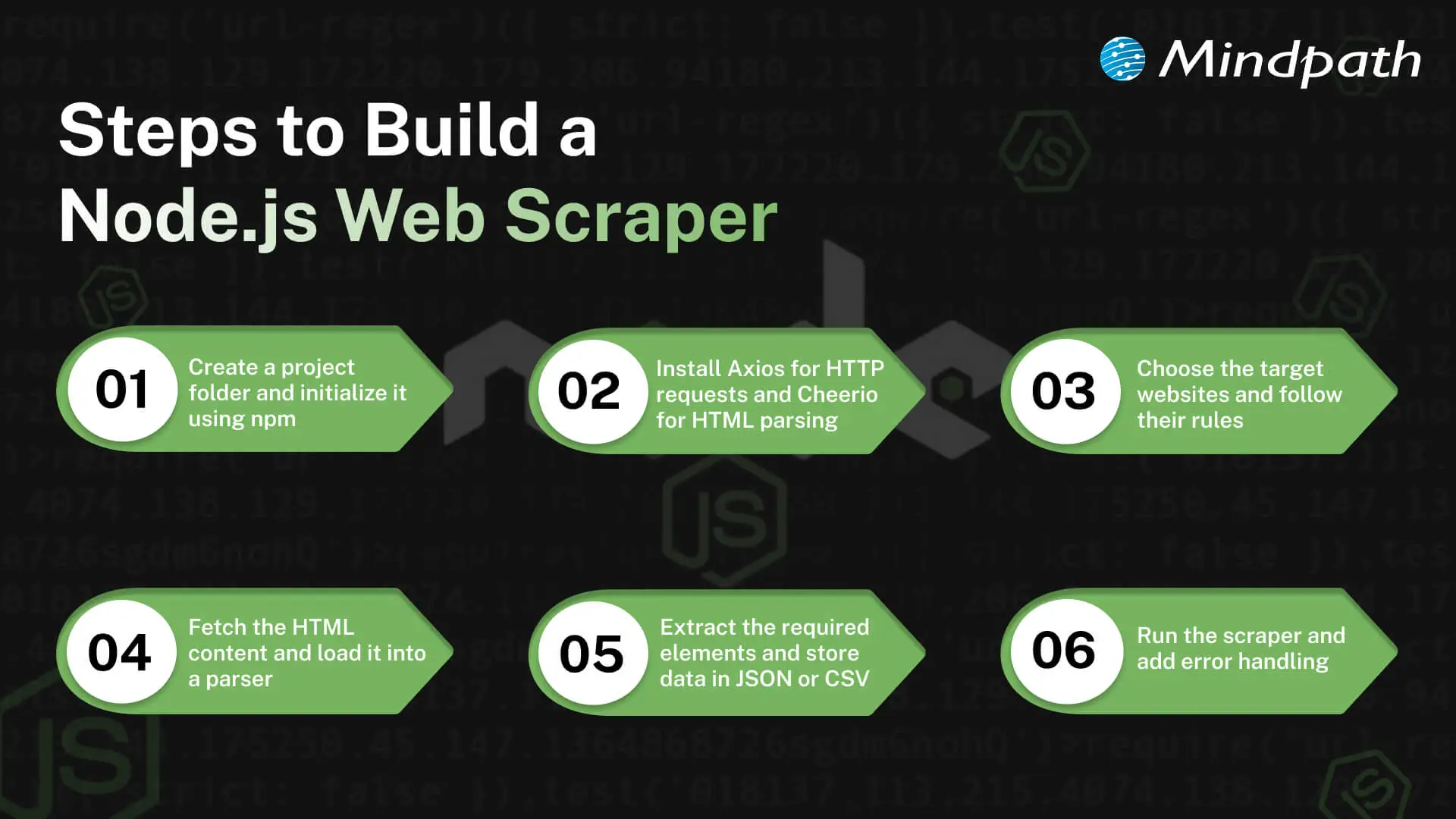
1. Set Up Your Project
Make a new project folder and get it started using npm. This prepares your Node.js environment for web scraping with Node.js. The project will manage all dependencies through a package.json file.
2. Install Necessary Libraries
Install such tools as Axios to make the HTTP requests and Cheerio as the HTML parsing tool. The libraries simplify the creation of a Node.js scraper. They give you the core tools for web scraping with Node.js.
3. Choose Target Websites
Choose the sites that you would like to scrape. Ensure that you are obeying their rules and law. Target selection helps to make sure your web scraping of Node.js is safe and effective.
4. Fetch and Parse Pages
Get the HTML of the page using Axios or any other HTTP library. Load it into Cheerio or other similar to navigate and choose elements. The next thing that needs to be done is to prepare your data that your Node.js scraper will extract.
5. Extract and Organize Data
Even define the information you require, such as prices, titles, or links. It should be collected using CSS selectors. Export the data that has been extracted in a simple, easy-to-use format: JSON, CSV, or database.
6. Execute and Improve
Install and run your Node.js scraper and verify the output. Include error management and rate limiting to prevent problems. Refining your process ensures web scraping with Node.js runs smoothly and efficiently.
Looking to simplify web scraping with Node.js? Explore essential Node.js libraries to make data extraction faster and more reliable.
Ready to Unlock the Power of Web Scraping with Node.js?
Web scraping with Node.js allows developers to collect and use data efficiently, making it easier to support smarter decisions, automation, and digital innovation. By understanding the right tools, techniques, and workflows, businesses that hire Node.js developer can work seamlessly with both static and dynamic websites, manage large datasets, integrate data into applications, and gain real-time insights to enhance project prosperity
Mindpath is a trusted Node.js development company offering expert web and Node.js development services to build fast, scalable, and secure applications. Their team creates custom solutions for web scraping, data integration, and automation. With experience in modern technologies, they deliver efficient and reliable results. Choosing Mindpath ensures your Node.js projects run smoothly, save time, and meet your business goals with high-quality support.
The digital experiences are developing very fast, and front end trends are taking the lead in this development. You can already see smarter interfaces and quicker interactions defining user expectations. However, do existing strategies hold enough power to maintain? Teams have reconsidered the design and building process. With the heightening expectations, each detail begins to count.
Simultaneously, new tools and technologies keep on transforming development practices. Such a change throws opportunities and the perpetual pressure to change. You must operate fast without compromising on performance. Consequently, knowing the future becomes a key to success in the long run. In this blog, see how such changes will affect the current strategies in development and user experience.
Want to adopt new frontend trends without breaking your existing system? Our full-stack development services at Mindpath help you integrate innovation while keeping everything stable and secure.
Why Must a Business Have Idea on Frontend Trends?
Front end technology trends keep on transforming the mode through which businesses serve digital experiences as 2026 advances. Organizations are now working on developing faster, smarter, and more responsive interfaces. This change compels the teams to remain conscious of emerging technology and user demands.
Meanwhile, front-end development is very important in aligning technology with business objectives. Organizations strive to develop smooth digital experiences and embrace new technologies and practices. As this continues to evolve, innovation remains at the core of all digital strategies.
Want to better understand how different layers of development impact performance and scalability? Explore the role of front-end and backend in building efficient digital experiences.
The main reasons why it is important to learn about the frontend trends in 2026 include:
1. Speed Impacts Results
Users are more likely to stay on faster websites. Strong front end concepts not only enhance load time but also help to increase conversions.
2. User Experience Drives Engagement
Keeping running on a website is a very important factor that users consider when choosing to stay or not. So, it is very important to have interfaces which are smooth and intuitive.
3. First Impressions Build Trust
Since users form their opinion within seconds, they are very influenced by design that is why it is so crucial. An up-to-date frontend immediately creates a sense of trust and reliability.
4. Adaptability Keeps You Relevant
The pace at which digital expectations evolve is very rapid. Companies, in order to remain competitive, need to continuously refresh their consumer experiences.
5. Performance Boosts Visibility
Search engines appreciate a quick website and you can improve your rankings and overall exposure by making your site faster. Speeding up your site can have a great effect on your SEO and total brand awareness.
6. Scalable Systems Reduce Costs
Today’s programming allows for effortless expansion. It downturns the needs for major redesigns and utilizes fewer resources.
Latest Trends in Frontend Development
Frontend trends 2026 are changing the way people design and deliver modern interfaces. Companies concentrate more on making user experiences speedy, intelligent, and extremely captivating.
1. Shift Toward Edge and Performance
Applications are nowadays getting closer to their users in order to deliver faster response times. Doing so, performance and user experience get a significant boost.
2. Evolving Framework Ecosystem
Current toolsets make the development process much easier by providing pre-integrated features and offering a great level of adaptability. These changes align very well with the major frontend frameworks trends that are shaping the development of large-scale applications.
3. Strong Focus on Type Safety
Type safety is a must for making dependable applications. It guides teams in keeping codebases clean and nearly without errors.
4. Smarter React Capabilities
React is changing all the time and comes with new ways to optimize. These changes can lessen the amount of work and make your app run faster.
Curious about how modern frameworks are shaping faster and smarter interfaces? Discover the latest reactjs trends driving frontend innovation in 2026.
5. Design Systems for Consistency
Reusable components are the key to consistent design across platforms. They also help teams to maintain brand identity while speeding up the development process.
6. Bold and Engaging UI Styles
These days, modern interfaces incorporate striking visuals and animations that grab users’ attention. Besides being eye-catching, such designs are able to create a more emotionally engaging experience for users.
7. Rise of AI in Development
AI tools are revolutionizing the developer’s working experience radically. They contribute heavily to speeding things up and making frontend development more productive.
8. Growth of Micro Frontend Architecture
Large applications now use modular frontend structures. This approach improves scalability and team collaboration.
Looking to choose the right approach for building scalable applications? Read about backend vs front end developer roles and how they influence project success.
Ready to Adapt to the Next Wave of Frontend Innovation?
Frontend trends are influencing the way businesses create contemporary online experiences. Knowledge of the changing front end technologies list also enables organizations to remain competitive and provide superior user experiences. With the increasing expectations, it is important to embrace the appropriate strategies. Companies that keep pace with such shifts have the potential to enhance business performance, participation, and digital sustainability.
At Mindpath, we are offering frontend solutions that are aligned to the contemporary business requirements and user expectations. Our team is dedicated to developing scalable, high performing applications using the most recent tools and practices. We enable businesses to keep up with the pace of change and provide stable and user centered digital experiences.
Frequently Asked Questions
1. How do front-end trends impact everyday business growth and customer experience
Frontend trends influence how users interact with digital platforms. Faster load times, smoother navigation, and modern design directly affect engagement. Businesses that align with these changes often see better retention, improved satisfaction, and stronger overall digital performance.
2. Why is it important to keep updating the frontend of a website regularly?
User expectations and technologies change quickly. Regular updates help maintain performance, security, and usability. An updated frontend ensures compatibility with modern devices and browsers while keeping the experience relevant and efficient for users.
3. How can frontend trends 2026 help improve website performance and speed?
Frontend trends 2026 focus on optimizing loading speed and reducing delays. Modern tools and techniques improve responsiveness and efficiency. This leads to better user experiences, lower bounce rates, and stronger engagement across digital platforms.
4. What are some practical ways businesses can adapt to front-end trends without major disruptions?
Businesses can start with small improvements like optimizing performance and updating design elements. Gradual adoption of new tools and frameworks helps maintain stability while improving the overall experience without affecting ongoing operations.
5. How do front-end trends influence long-term digital strategy and scalability?
Frontend trends guide how applications are built for growth and flexibility. Following these trends helps create scalable systems that adapt to future needs. This ensures consistent performance and supports long-term digital expansion effectively.
Join our Newsletter!
categories
Join the world's largest training library and unlock new opportunities!
Featured Posts


Turn Insights Into
Real Business Solutions
Exploring trends is only the beginning. Whether you’re planning AI adoption, modernizing legacy systems, or building scalable software, our experts help transform ideas into practical business outcomes.