Latest Insights On
GenAI, Tech, and Digital Transformation
Stay updated with expert insights, success stories, and real-world applications of cutting-edge technology.
Ever wondered why many businesses are rushing into sustainable tech? Why is it so crucially important in today’s fast-changing world? In this blog we will explore how sustainable technology is changing business, and why it is essential. Understanding how these technologies work and the value they can bring to business enterprises can help in meeting regulatory requirements, enhancing brand reputation, and enhancing environmental performance. We can learn how embracing sustainable technology is already helping companies meet today’s needs while positioning themselves for a successful and responsible tomorrow.
So, let us dive in!
What is Sustainable Technology?
Sustainable technology is the design and use of technology to benefit the environment, society, and the economy. This means two things: creating technology with eco-friendly processes and materials and using technology to help solve environmental and social problems. Other examples include solar panels, which provide clean energy, and software enabling businesses to trace their environmental footprint.
While developing sustainable technology, companies are very considerate about the resources used, their origin, and how to reduce the negative effects in the form of pollution or electronic waste. Businesses use sustainable technologies to realize some of the desired environmental targets, such as reducing fossil fuel use or source reduction of waste.
For example, they can work on an electric car or initiate projects that reduce carbon emissions. Businesses can also make use of technologies such as Artificial Intelligence to find areas where it can slash down on waste and reduce emissions, thus switching over to renewable energy sources and decreasing their carbon footprint.
Sustainable Technology Solutions That are Revolutionizing Modern-day Businesses
1. AI-Powered ESG Reporting
AI-powered ESG reporting is the intelligent and faster way for a business to track its efforts toward sustainability. In sharp contrast to manual methods of ESG reporting, AI-driven methods are not only far more accurate but also have the dexterity to bring out results within a remarkably short time, incomparably faster than human ability. Using the AI, businesses would be updated in real time—basically, companies can directly see what effect any sustainability change they make will have. Such technology can scan documents, analyze keywords against them, and store important data from relevant files for easy retrieval at reporting time. This automation not only saves time and money but also gives the accuracy of the ESG data.
2. Embracing Digital Documentation
The digital revolution makes it easy and secure for businesses to create, share, store, and edit important documents. The shift to digital can reduce office waste by a potential 70% since the average office worker uses around 10,000 sheets of paper yearly. The switch from paper to digital can be challenging, but with OCR technology, it allows the user to quickly scan physical pages and digitize them into documents. This reduces the burden of using too much paper and makes files accessible to all. Additionally, file storage in the Cloud is another area that companies should consider. Cloud computing uses less energy compared to running many different servers for companies, and the amount of storage space can increase as required with less hassle.
3. Remote Work Technology
Most of the business units have adopted work from home throughout the pandemic and closed doors to offices for good. It saves the carbon print left if one must commute to their workplace every day. Such a change is made possible with the help of technologies that include workflow technology, tools for integration, e-mail, apps for screen recording, and instant messenger applications. The use of this technology has reduced significantly the need to travel to conferences and other business events, which means a concurrent reduction in carbon emissions. However, the sustainability benefits of remote working depend on the set-up of the home office by the employee. For example, the carbon footprint of an employee may be considerably reduced when the job requires driving more than 6 km to work. In contrast, when the driving distance is less or if public transport is used, home-working may increase CO2 emissions because of the additional use of energy in the home. Hence there is a need to encourage employees to be green at home.
4. The Internet of Things (IoT)
The IoT is the network of connected devices, including smart home devices and sensors. Businesses can apply IoT in PACE dimensions related to understanding their ecological footprint and emission reduction. IoT makes workspaces more energy-efficient through monitoring and controlling devices. Some companies that deliver products have the potential to reduce their environmental impact with smart fleets. IoT-enabled fleets send vehicle data back to the office through telematics, which will enable managers to plan efficient routes that can save fuel and be more effective. This data might underline the best driving practices that would help further cut fuel use and boost sustainability.
Sustainable Technology Use Cases
1. Decreasing Carbon Footprints
Sustainable technologies help companies transition from a linear economy, where the use of raw materials is very high, to a circular economy, which is based on leasing, recycling, refurbishing, repairing, re-using, and sharing products as far as possible. This space, therefore, helps companies lower their carbon footprints while serving the interests of both the people and the planet. Sustainable technologies now assist companies in keeping track of crucial ESG metrics, including energy use, emissions, and water consumption. This will enable businesses to understand their position in trends of sustainability, beef up actions to cut emissions, and, as a result, help in answering healthy regulatory requirements and improving the environmental performance of the company.
2. Improving Brand Reputation
Sustainability is important for reputation and success. It attracts a workforce and investors sensitive to environmental and social issues in the world. Sustainable technologies attract environmentally aware talent and meet the needs of investors who value transparency of information. Sustainable technologies help businesses keep track of and improve their efforts in sustainability. For example, IoT devices track energy consumption, allowing them to benchmark and, therefore, report on progress, demonstrating commitment to sustainability.
3. Meeting Regulatory Requirements and Global Standards
Regulations are constantly changing, with laws like the Corporate Sustainability Reporting Directive (CSRD) requiring companies to report on their environmental impact. Even without mandatory rules, companies are encouraged to follow the United Nations’ Sustainable Development Goals (SDGs), which promote environmentally friendly technologies. To stay ahead, organizations should use sustainable technologies that track, measure, and report their ESG performance. This helps them meet current and future regulatory requirements and global standards.
4. Visualizing Supply Chains
One of the ways in which sustainable technologies make a difference is through complete transparency, which can be used to improve supply chains. For instance, AI can trace carbon emissions to identify ESG opportunities and risks. Machine learning is applied in demand forecasting and fleet management to avoid waste and achieve higher energy efficiency. Moreover, with the help of such technologies, companies can be kept updated with their partners and suppliers, which is useful in ESG reporting. Tools like GRI or TCFD require reporting on Scope 3 emissions, which are related to operations outside the company’s direct influence. This helps businesses to be ahead and give a cleaner picture of the supply chains.
Curious About How Mindpath Can Transform Your Tech?
Find out how our bespoke solutions in modernization and AI can benefit your business.
Mindpath: A Leader in Innovative IT Solutions
Mindpath is a forerunner in IT innovation and offers customized solutions for your business. We are an Innovation Centre focused on staff augmentation—bringing experienced and qualified professionals to integrate with your team for any short- or long-term project. Our modernization services upgrade legacy systems and optimize processes for better efficiency, security, and long-term growth. We are leaders in digitization. Therefore, we have State-of-the-Art Web Development and App Solutions to enhance your presence online. In addition, with our excellence in bespoke chatbot development and artificial intelligence, your business will harness the very latest technology available to help give you that edge.
Conclusion
In the current world complexities, businesses have found sustainable technology to be central to their way of growth and competitiveness. Evermore, innovations that businesses embrace these days are the ESG reporting powered by AI, digital documentation, remote work technology, and the IoT, which help these companies in the reduction of their environmental impacts and bring about an increase in operational efficiency and reputation. These technologies are pivotal for organizations to meet regulatory requirements, visualize their supply chains, and, of course, their sustainability targets. The commitment to sustainability practices is not a fad but a strategic edge, one that imbibes the global norm of standards and sets the pace toward long-term success.
Mindpath leads in IT innovation and can help your business grow. Staff augmentation by Mindpath deals with the integration of top professionals in your team for the implementation of various short- and long-term projects. Besides that, our modernization services update your legacy systems and aid in enhancing your company’s efficiency and security. Advanced web and application development with bespoke chatbot and AI solutions complete the comprehensive services in ensuring our business stays at the cutting edge of technology.
Get In Touch!
Ready to Innovate?
Discover how Mindpath’s tailored IT solutions can transform your business.
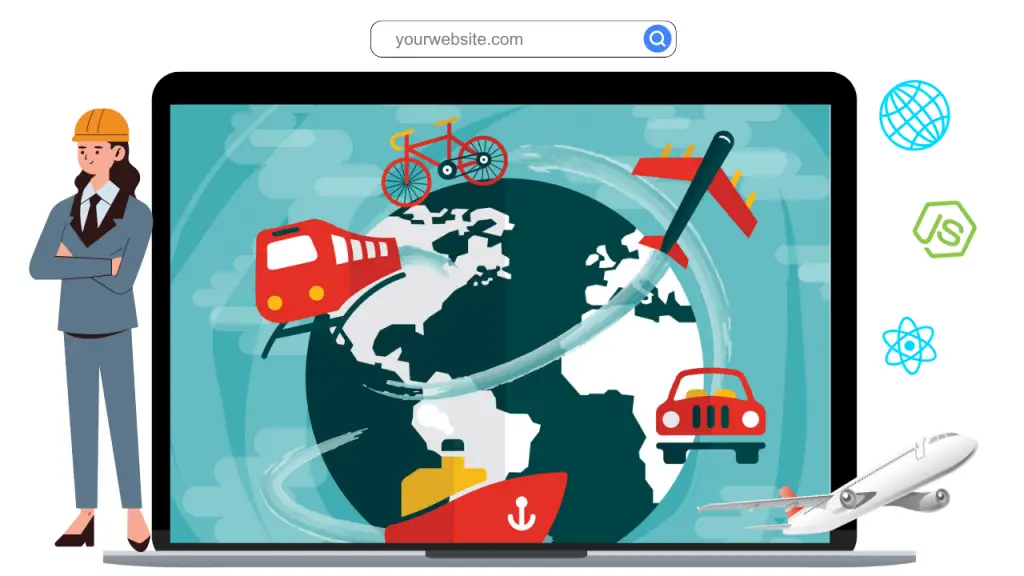
Have you ever wondered how something you ordered online magically arrives at your doorstep only a few days after clicking “buy”? Or how companies manage to deliver millions of packages all around the world so fast? The answer lies in the digitization in the transportation and logistics industries. In this blog, we are going to explore the notable real-world use cases of digital transformation of logistic and transportation industry. So, let us dive in!
What Is Digital Transformation In Logistics And Transportation Industry?
In today’s fast-moving world, old ways of doing things in logistics and transportation simply make it very difficult to keep up with increasing demands for speed and great service. Many logistics companies these days seek to solve the problem by digital transformation: basically, updating archaic systems with modern technologies that automate tasks and provide a better experience for customers. Though the logistics industry is far ahead of most digital technology applications compared to many other sectors, several gaps remain.
Digital transformation is important in package delivery as it plans routes better by using GPS and optimization software to deliver goods quickly; improves customer experience through the ability of real-time tracking; and makes operations more efficient by automating recurring tasks like sorting packages or inventory.
However, difficulties persist in the form of high costs of new technology and employee training, and problems of data security. Despite these challenges, the opportunities for growth and improvement remain immense. A digital transformation in logistics businesses would keep them well ahead of their competition and meet the ever-raising expectations of the consumer of the present day. Digital transformation is no longer an option for logistics and transportation companies; it is a necessity. Companies that refuse to innovate are left behind; those ready for change will thrive in the digital age.
Statistic Report For Digital Transformation In Logistics And Transportation Industry.
The digital transformation in transport and logistics is growing rapidly. In 2018, the global market of the Digital Transformation in Transportation and Logistics industry was US$54.92 billion and is pegged to reach US$145.28 billion by 2025, at a CAGR of 13.0%. The market is expected to reach USD 22.17 billion by 2028 from an estimated value of USD 7.15 billion in 2018, growing at a CAGR of 11.5% during the forecast period. The growth rate underscores robust digital technology adoption that solves problems like underutilized assets, supply chain inefficiencies, and poor demand-supply matching. Digital transformation improves connectivity and visibility across traditionally isolated systems that helps stakeholders collaborate with each other more effectively along the supply chain.
The major names associated with making this change a reality include IBM, Oracle, Samsung, SAP, and Tech Mahindra. Each of these vendors is developing robust new platforms that will be useful in driving this change. While the market expands across regions such as North America, Europe, Asia Pacific, South America, and the Middle East and Africa, operational and customer experience efficiency lies in automation and real-time data analytics. This demand for technologies underpins the requirement of innovation in the creation of effective and resilient logistics networks that answer today’s demand for speed and excellence.
Benefits Of Digital Transformation In Logistics And Transportation Industry
1. Cost Reduction
Digital transformation saves a lot of money for logistics companies. Automation decreases labor costs, as repetitive tasks are taken care of, hence requiring fewer people to do those jobs. Data helps in the optimization of delivery routes, hence cutting fuel costs and the carbon emission rate. Digital tools make it possible to do more with less, whether it be warehousing, managing inventory, or handling transportation and last-mile delivery. That means companies will work more efficiently and reduce their operational costs.
2. Improve In Efficiency
Digital transformation solves these very issues in many ineffective supply chains that lack real-time transparency. Automated warehousing and inventory management reduce manual labor and, in turn, human error. With the digital tools available, firms can track their shipments and inventory in real time, knowing where everything is at any moment. Greater visibility allows one to respond to change in the fastest way possible without any delays. Digital technology also projects demand so that a company can have the right product at the right time, therefore reducing overstock and/or running out of stock items.
3. Improves Customer Experience
Processing orders at speed and with transparency—these are the current demands of customers in the marketplace. Companies that outperform these expectations will create satisfied customers with the help of digital tools. Web and mobile apps empower customers to track their orders in real-time and raise issues. AI-driven chatbots extend instant support, answering questions within a snap of fingers, round the clock. Predictive analytics enables personalized product recommendations, letting customers feel important. Digital solutions ensure that customers are kept happy and loyal by making services faster, more transparent, and more personalized.
4. New Business Model
The digital transformation opens new, exciting ways of providing services beyond simple transportation. For example, delivery takes on a different dimension with speed through drone deliveries and self-driving trucks. Digital freight marketplaces connect shippers to extra space carriers, easing the way to find and work available resources. Such solutions open opportunities for value growth and increasing revenues. The accomplishment and differentiation of leading logistics players in a changing market can be driven by such technologies.
Use Cases of Digital Transformation in Logistics and Transportation Industry
1. Predictive Analytics and Big Data
Predictive analytics and big data greatly help in doing tasks related to forecasting demand and inventory management. Advanced algorithms embedded in predictive analytics examine large amounts of data for discovering patterns and trends. In doing so, this greatly assists businesses in predicting what may be needed later and adjusting the level of inventory accordingly. Something like Snowflake enables organizations to share past and current data in a bid to improve planning and make information more accessible to all.
2. Telematics and Internet of Things (IoT)
Telematics and IoT bridge the gap in asset monitoring and shipment tracking. IoT-enabled devices close the blind spots by sensing and transmitting the data in real-time. For instance, GPS and RFID tags assist in locations and conditions, like the tracking of shipment location, which allows route optimization and, therefore, better utilization of the assets.
3. Cloud-based Computing
It allows flexibility, remote access, and security by transcending the constraints of traditional on-premises data centers and legacy IT systems. Cloud computing is one of the technologies that will help companies involved in shipping and logistics scale easily, allow access to any data from any part of the world, and increase overall efficiency. With the ability to rapidly adapt through cloud-based solutions, companies can easily streamline their operations, securing their data much better and increasing manifoldly in performance as well as competitiveness.
4. Artificial Intelligence (AI)
Artificially intelligent technologies can come up with advanced algorithms that analyze heaps of data and deliver valuable insights from them. These technologies are focused on the optimization of logistics operations by calculating multitudes of variables and learning from new data continuously available. AI improves route planning, reduces inefficiency, and raises overall operational performance. This will give rise to more efficient and effective logistic operations if companies apply AI in making smarter decisions, streamlining processes, and better meeting customer needs.
5. Mobility as a Service (MaaS)
Traditional modes of transportation usually do not rise to the convenience and sustainability expected of them today. Mobility as a Service looks to bridge this gap and provide one amazing app in which users can discover and book a ride from a range of choices, including public transit, ride-hailing, car-sharing, bikes, or scooters. MaaS makes getting around easier while reducing the environmental effect by integrating the services of all different means of transport. Research has demonstrated that people could be flexible with their travel; this would mean that they no longer require their own vehicle with the integration of these services.
Contact Us!
Looking to revolutionize your logistics?
Mindpath offers cutting-edge solutions to boost efficiency and cut costs.
Transportation and Logistic Development Services at Mindpath
We, at Mindpath, provide a range of services that can empower logistics companies, transportation providers, and supply chain managers to take on the challenge of using technology for much smoother and more efficient operations.
1. Custom Chatbot Development:
Our chatbots help customers who are running transportation and logistics businesses provide better customer support: answer inquiries, manage bookings, track shipments, and be available 24/7 to keep customers happy at a reduced cost.
2. Website Development:
Strong presence in online media is quite important. Our group creates user-friendly, visually appealing, and search engine-friendly websites for logistics businesses. This would provide dual benefit to the business by making it visible and growing.
3. Mobile App Development:
We develop mobile applications for the management of Logistics and Transportation on the go. Our apps are quite solid at both iOS and Android devices with a smooth experience and useful features.
4. Inventory Management System:
We can design a tailored system to assist you in effective inventory management. Real-time data, automation, and actionable insights of stock position are some of the salient features of our systems.
5. Fleet Tracking Software:
Our fleet tracking software lets you track your vehicles in real time. It helps in performance tracking, route optimization, and timely deliveries, which in turn increase efficiency and reduce costs.
6. Software Maintenance & Support:
We keep updating your logistic and transportation software to run smoothly. This means technical support, updating features, or just ensuring that everything works well.
Conclusion
Digital transformation is disruptions in logistics and transport due to efficiency, cost reduction, and improved customer experience. With the speed of technological change accelerating, it’s highly important to be one step ahead about innovation, whether AI, cloud computing, or predictive analytics. At Mindpath, we believe in empowering businesses to lead this change. That’s why we deliver custom technology solutions to help your business thrive in a transforming world—from custom chatbots to advanced fleet tracking.
Ready to embrace the future of logistics?
Let Mindpath guide you every step of the way.
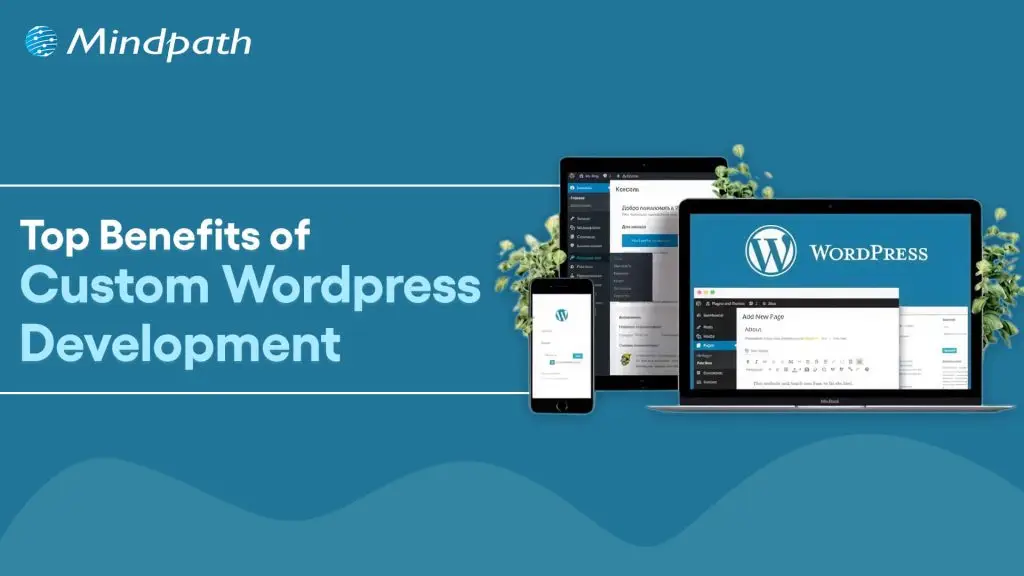
A website truly reflects your business motive and what it offers to its targeted audiences. Without a proper website, your organization can’t stand in this massive digital world. However, if you think your website is just to highlight your business, then you are misguided. As per a statistic of Stanford University, around 75% users judge the credibility of a business through their website design. So, for your long-term success, you must adopt a well-optimized website.
This is where custom WordPress development serves uniqueness. Being the most popular software for creating websites, it powers over 43% of the internet. (Source: Click) Instead of limiting your vision to a similar theme, custom development accesses your site to be curated from the core.
Ready to turn your website into a powerful business asset? Mindpath offers expert WordPress development services to create scalable and high-performance solutions built for your business growth.
What is Custom WordPress Development?
Custom WordPress development is the practice of building tailor-made websites, bespoke themes, and custom plugins from scratch, using WordPress as the foundation. Unlike relying on pre-existing themes that hundreds of other sites use, a custom website is architected specifically to align with your unique business workflows, design needs, and system integrations. This means every element, from backend frameworks to front-end features, is precisely crafted around your preferences, requirements, and values.
- Pre-existing themes might be convenient for many users as they are a bit affordable. However, they come with certain risks of flexibility and generic layout.
- On the other hand, a custom WordPress website leverages creative freedom. You can develop your own layouts and include features that suit your interests.
Must Read: WordPress and PHP Compatibility
How Adopting Custom WordPress Development Services Can Be Beneficial for Your Business?
Let us go through some major benefits that you can discover by choosing the custom WordPress development services.
1. Seamless and Faster Development
You don’t require a backend in WordPress website development. Unlike traditional website creation, where every element is generated individually, WordPress sites allow you to choose a framework as per your business requirements and preferences. This enables you to quickly develop your site. With rapid development, you can also save your time and resources.
2. Custom Theme Creation
In custom WordPress development, you can’t only transform the tagline but also change the overall appearance and functionality of your site. You can decide the changes as per the growing demand of your business. You can transform all such things by shifting the color palette, layout design, and widgets. Moreover, WordPress delivers a wide range of layouts that support multiple levels of business objectives.
3. User-Friendly Web Designs
Ease of use is another significant factor that makes businesses prefer custom WordPress development services. It offers intuitive and straightforward operations. So, you don’t require any coding expertise to operate your business site effectively. The availability of multiple customizable plugins and themes can help you create a business site that meets your business expectations widely.
4. Adopt Scalability
Getting a WordPress website developer can assist you in scaling your website as your company scales. You can also discover flexibility with custom WordPress development as per the dynamic nature of your company. So, be it an e-commerce or an advanced site, WordPress can help you effortlessly scale without compromising on quality. This offers you the benefit of staying relevant in such a digital era.
5. Wonderful Designs
A pleasing, satisfying design can help your site attract prominent prospects while making your website look more professional. So, with the help of WordPress custom website design, you can easily enhance its reach while making its user interface valuable. Moreover, it puts a valuable first impression while converting your visitors into loyal customers.
6. Social Media Handle Integrations
This is one such major value of a custom WordPress development, where your site can adopt social media implementation into your feed. This feature allows you to highlight your social accounts on your site. The valuable addition of the accounts can help you attract a larger number of visitors to your page without utilizing several media handles for your organization.
7. Long-Term Support and Maintenance
One such overlooked advantage of a WordPress custom website is the seamless partnership and assistance you leverage. With the evolving nature of your business, your team can integrate new features and redesign without initiating it from scratch. This ensures quick integration and minimal downtime.
Looking to make your custom WordPress site usable for everyone? Explore our guide on web accessibility guidelines to learn practical ways to enhance your WordPress site and improve user experience.
What are Some Common Misconceptions People Have Regarding Custom WordPress Development?
WordPress comes with a series of features that remain unmatched. Further, a WordPress website developer can help you design a site that truly reflects your authenticity. However, there are some misconceptions that people have regarding this platform, as follows.
1. Security Lapses
Many people consider that plugin incorporation can give rise to security threats in WordPress. However, the platform is extremely secure. Further, the platform has started investing in security releases.
2. The Platform Is Solely for Blogs
WordPress generally powers around half of all the sites available on the internet. So, it has much more to offer beyond serving only as a blogging platform.
3. Limited Support
This is another piece of misinformation that is spreading over the market. For your information, WordPress has a dedicated and active community of contributors who introduce new features and themes. Moreover, this community offers significant help to user challenges and fixes bugs rigorously.
Concerned about security risks in custom WordPress development? Check out our blog on safeguarding common WordPress vulnerabilities to understand how to prevent attacks and data loss.
Who Should Opt for Custom WordPress Development Services?
A WordPress custom website is not only for tech influencers and huge corporations. It can be a smart strategy for many businesses that want to strengthen their online presence. Custom development delivers flexibility while keeping you aware of long-term values.
1. Small Businesses
It is essential for a small business to stand out in a competitive market. So, a template website might make you go live quickly, but it doesn’t reflect any professionalism or significance. So, you should stay true to the business goals that can help you build trust while maximizing the conversion rate.
With custom WordPress development, you can get a real and purpose-efficient site that matches your customers’ expectations. Accordingly, local SEO efforts can be included directly into your site structure. Most importantly, you can avoid the risks of basic themes along with other features.
2. E-commerce Businesses
E-commerce websites always come with complex requirements, starting from product page handling to up-to-date inventory management. So, a pre-existing layout can’t offer your customers a seamless shopping experience. But custom WordPress development can eliminate such issues with the right solutions.
You can customize your checkout strategies and customer experience for better conversion. Further, you can integrate your site with other necessary tools.
3. Startups
Startups always require scalability and agility. So, with your audience growth and offering shift, your website should be ready to evolve. Here, it is essential to get a flexible backend that gives you access for easy scaling and feature additions. In order to do that, you can build a site that highlights credibility and innovations.
4. Content-oriented Platforms
Media brands, agencies, and bloggers mostly prefer publishing bulk content while handling their consistency and site performance. This is where a WordPress website developer can be your ultimate help. You can design a secure workflow that excels your editorial practices.
Looking to get the most out of custom WordPress development for your website? Explore our guide to hire a WordPress developer and ensure your site is built for performance, security, and scalability.
Conclusion
Your site is generally the foremost impression users have of your brand. So, it shouldn’t be ordinary at all. In today’s quick digital world, where user experience, speed, and site design decide the conversions, custom WordPress development is a necessity. So, by hiring a WordPress developer and prioritizing a custom WordPress site, you can discover a platform that understands your business terms and goals.
If you are ready to proceed towards the next step of building a site that fuels results, it’s time for you to partner with experts who breathe WordPress. Mindpath specializes in excellent custom WordPress site development services and ultimate support. Starting from custom functionality to precise optimization, it ensures your website is up to the mark.
Are you looking out for the perfect developer who can assist you in turning great healthcare app ideas into reality? With the changing scenery of health technology, finding the right kind of expertise can be quite a difficult process. In this blog, we will come across the steps to hire the perfect healthcare app developer for your project.
Healthcare applications are mobile apps designed to make healthcare easier and more accessible. They perform duties like checking records, making appointments, and receiving medical advice from the comfort of one’s own home. These apps can be linked to wearable devices to monitor vital health parameters like steps taken or heart rate and help users monitor their health on a minute scale. Their main purpose is betterment in health and improving healthcare services. Some of these include healthcare apps used in billing, telehealth, or video consultation with doctors, practice management by arranging medical practices, and coding medical information. They will help the patients and doctors work together in the management of health and the diagnosis of conditions. According to a report, the global digital health market is projected to grow from USD 240.9 billion in 2023 to USD 946 billion by 2030.
It is very important to hire healthcare app developers because they bring specialized experience and knowledge updated to help in developing complex healthcare apps. They ensure that your app complies with regulations such as HIPAA and GDPR and build it faster and more affordably compared to doing it yourself. These professionals also have continuous support to keep them updated. They also customize solutions for meeting any needs and seamlessly integrate with existing healthcare systems, making the app much more effective and efficient.
So, let us dive deep into the steps to hire the perfect healthcare app developers which will be beneficial for you.
Steps To Hire The Best Healthcare App Developers
1. Define Your Requirements
While looking to hire healthcare app developers, you must define your project objectives and requirements. Write down all the features that you want the app to have, like telemedicine capabilities for remote consultations, EHR integration to connect over electronic health records, and health monitoring tools that track different metrics. Identify your target audience and how the app will integrate with other already running systems, such as hospital management software. Giving an overview of the detail of needs helps identify the exact skill sets and expertise needed from the developers to ensure that they can adapt a solution catering to all your requirements and optimize the experience for the end-user.
2. Shortlist Developers
Deeply search for developers or companies having a successful history of health app development. Look for those who have effectively worked on similar apps and have experience with healthcare-specific features and regulations. Study their case studies, portfolios, and customer reviews to assess their expertise, past performance, and client satisfaction. Check the scale and complexity of previous projects to make sure that they fit your needs. Shortlist candidates who prove consistent in delivering healthcare apps with positive reviews from clients. Proper consideration will help you settle on developers who can carry out a project of your magnitude and finally come up with a high quality and effective solution.
3. Evaluate Expertise and Technical Skills
After you have shortlisted developers, you should assess their technical ability and experience. You should conduct technical interviews with them, discussing their experience and knowledge. You could even ask them to go for coding tests that would present them with real problems and then see how they solve them. Request samples of previous work done to determine the quality and relevance of projects completed before. They must know the programming languages and frameworks your app needs. One also needs to spot if they can solve any problem that might be caused by them during development. Such a rigorous process confirms whether the developers are well-endowed with the kind of skills relevant for the successful construction of a healthcare app.
4. Review Past Experience
Gather references from their past clients to know if they are work-oriented, reliable, and can meet deadlines. Evaluate the past projects in which the developer was involved to understand the correctness of the delivered work. Determine whether they came up with top-of-the-line applications that could be said to be user-friendly yet solve their client’s needs if possible. This step is very important to substantiate their claims and ensure their work meets the standards that you have set for your work. A look at the track record will help you settle better on the right one through feedback from other customers.
5. Check Communication and Cultural Fit
This step is all about good communication and a proper cultural fit. While interviewing, review whether the developer can communicate his ideas clearly, is ready to listen, etc. Describe his attitude to working in a team, how he works, and evaluate whether it will align with the culture in your organization. This ensures high working relationships and effective results from the projects.
Is your healthcare app ready to meet the demands of the future?
With Mindpath’s expertise in advanced technology solutions, we can help you stay ahead in the evolving healthcare landscape.
How Can Mindpath Help In Healthcare Application Development Services
Mindpath is dedicated to transforming the world of health care by providing state-of-the-art technology solutions. This is where we provide full-fledged health care software development services with a sole purpose: to enable health care providers to provide better patient care and smoothen operations while adhering to regulations and industry standards. It starts with strategic consulting for visibility and the exact requirement of your health care software project.
We apply safe and scalable software into the development services under our care, such as Electronic Health Records, practice management systems, and patient portals, to make improvements in health care delivery on a larger scale and with greater efficiency within the organization. The design team is primed to create user-friendly, intuitive, self-explanatory screens with visuals that make the software functional and engaging. Further, we provide AI chatbots for managing their tasks to answer the queries of patients, manage appointments, and provide medical information to improve patient interaction and take some workload off the healthcare staff.
Conclusion
The future of healthcare has been very dynamic, especially due to technological innovation, making complex patient care more efficient, more accessible, and increasingly personalized. Trends such as telemedicine, AI-driven diagnostics, and wearable health technology are altering the nature of healthcare service delivery. Now is the time to get investments pumping into state-of-the-art healthcare applications catering to the modern patient and healthcare provider, with the global digital health market expected to grow soon.
Mindpath leads from the frontline in this revolution with state-of-the-art healthcare application development services according to the newest industry trends. Our commitment to quality, compliance, and user-centered design assures effectiveness and engagement of the solutions we provide. Whether you want to enhance patient engagement through AI chatbots for healthcare, enhance operational processing through EHR integrations, or simply update legacy systems, Mindpath has rich experience in bringing any idea into life.
Looking to take your healthcare services up a notch with state-of-the-art technology?
At Mindpath, we specialize in healthcare application development that can change the way patient care is operated.
Looking for that one legal software developer who will turn your idea into a real project? Choosing a partner may seem truly overwhelming, but it doesn’t have to be. In this blog we will know about the factors to consider while hiring legal software developers.
The legal tech market is growing beyond walled gardens, with newly built tools fueled by demand from law firms, corporate legal departments, and individual practitioners. Legal software is specialized to be applied in managing specific legal tasks such as secure electronic signatures and contract reviews; it’s not quite like the general genre of technological tools illustrated by email systems or file-sharing services. This can take the form of tools for in-house legal departments that streamline internal processes, such as document management and compliance; law firm management software for keeping cases, billing, and client communications in check; and consumer applications to help them with personal legal problems, whether concerning bankruptcy or parking tickets.
Hiring legal software developers becomes essential to ensure that your legal software development services runs effectively and does everything that you would want it to do. The developers working on this legal software specialize in creating and customizing solutions regarding case file management, deadline tracking, document management, and more. They help build tools that better law firms by handling tasks such as searching case files, running calendars, following tasks, even access to information on-the-go through their mobile features. By hiring skilled legal software developers, you get the assurance that your software will be well-designed and secure, coupled with features tailored to meet your specific requirements, making the task of managing legal cases and firm operations much smoother and efficient.
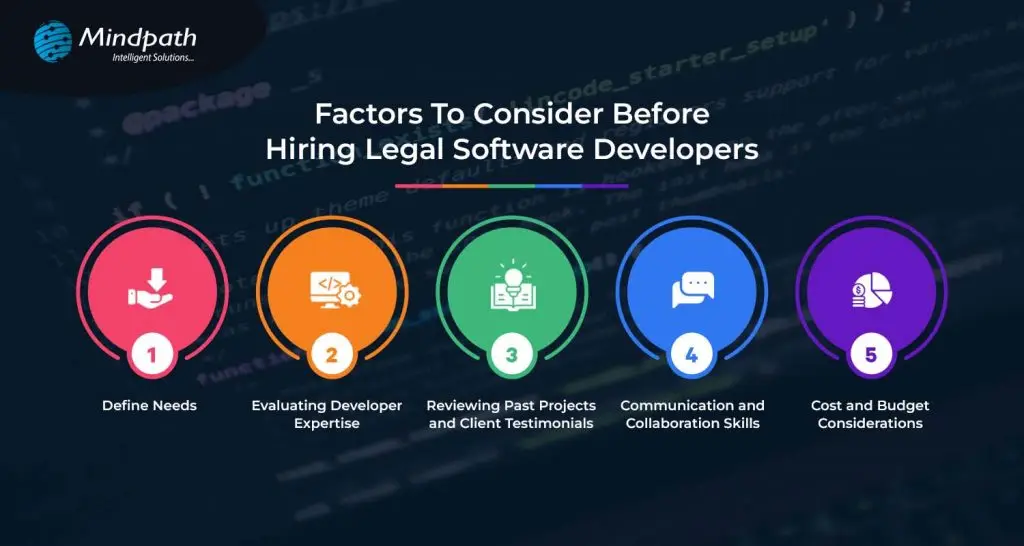
Factors To Consider Before Hiring Legal Software Developers
1. Define Needs
Before you hire legal software developers, the needs must be clearly defined. It means determining what one wants the developers to be able to do. Consider the integration of the software with other systems in use like email and file storage for perfect workflow. This includes setting a budget, which will serve as a guideline regarding priorities and finding a developer or developers to deliver what you will need within your financial limits. Defining your needs will allow you to communicate your needs to the developers, hence bridging to a more successful, tailor-made software solution.
2. Evaluating Developer Expertise
Before hiring, critically evaluate the expertise of legal software developers. Are they technically competent? Do they have the skill sets and experience using their tools? Engage developers who have experience in working with legal software. After all, their better understanding of the unique needs of law firms and legal departments is good enough for saying so. Just look at all the client testimonials that app developers have gotten to understand that they do quality work. Make sure they are good at communication and that they are responsive, friendly developers. That way, by appraising their expertise, you can find developers who would be well equipped to build the software for you.
3. Reviewing Past Projects and Client Testimonials
Before you start hiring legal software developers, view their past projects; what kind of work they have done, how many projects they have handled. See if they have done any similar projects as you want. They can deliver qualitative software related to the legal field. Moreover, you can look over the client testimonials and reviews to know how the previous clients feel about their experience. It will provide you with positive feedback, thereby giving you confidence in their ability and reliability. This step helps in choosing a developer who has the potential to prove his results and satisfy your needs accordingly.
4. Communication and Collaboration Skills
When looking to hire legal software developers, try and pay attention to their communication and collaboration skills. Pick the ones you can talk with easily and hear you out. They should be responsive, updating you on the progress of their work. Good collaboration means they can work well with your team, share ideas, and solve problems together. Effective communication means everyone is on the same page, thus leading to a smoother development process toward a successful software solution.
5. Cost and Budget Considerations
The cost or budget for hiring a legal software developer should be considered. It will be important for you to decide just how much you are prepared to pay for your project and then compare legal software developers who can work within your budget. Different pricing models—like fixed price or hourly rate—might suit your needs better. Be sure to discuss extra costs that may arise. This will help you to understand better the financial aspects of the matter and find out the developers who offer maximum value for your money.
Legal software development services at Mindpath
We have a variety of legal software development services designed to make your life simple and give you more time. Our solutions improve client service, streamline operations, and help remain compliant with regulations.
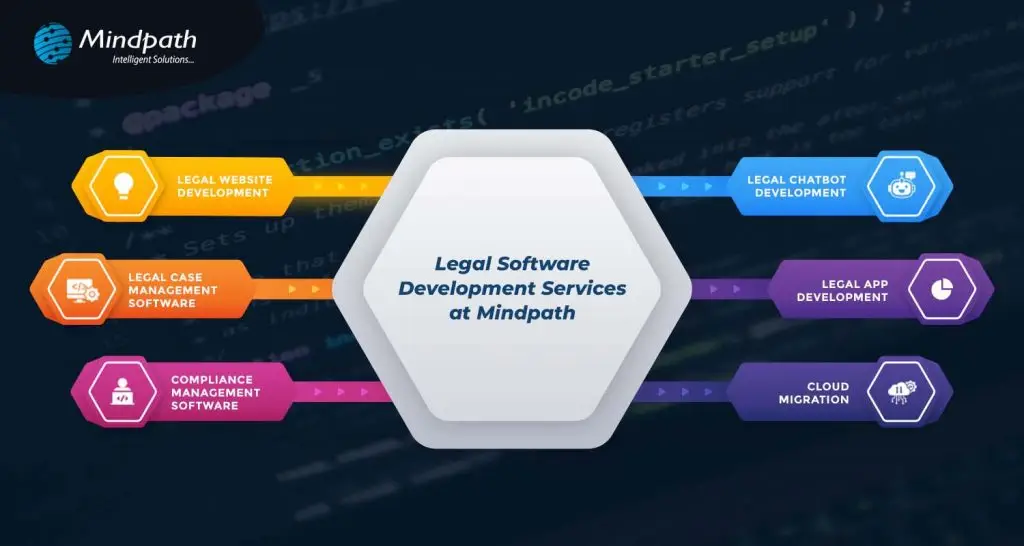
1. Legal Website Development
We provide law firms with professional websites that are attractive, user-friendly, and search engine friendly, so you will have an excellent online presence that really attracts potential clients.
2. Legal Chatbot Development
Our chatbots automate client interactions through answering questions, setting up appointments, and providing updates. They offer support 24/7 to help reduce the admin workload and increase client satisfaction.
3. Legal Case Management Software
Our software simplifies case management by providing real-time data and automated tasks so you will be able to have full control over your cases and gain valuable insights into their progress.
4. Legal App Development
We create user-friendly apps on iOS and Android to handle client interactions and case information from anywhere, creating a better experience for the client.
5. Compliance Management Software
This software takes extra care to keep you compliant with the legal framework and provides automated tracking of risk management to keep your practice updated.
6. Cloud Migration
We ensure the safe transfer of your data to the cloud so that flexibility and security are enhanced with easy access anywhere, along with system performance during cloud optimization.
Conclusion
The fast-changing legal technology landscape dictates that law firms and legal departments should catch up. In the modern world, technology is the way to achieve efficiency, better customer service, and compliance. While hiring a legal software developer, due consideration of things such as defining your needs, evaluating experience, and good communication can result in successful partnering and effective software solutions.
At Mindpath, we look to simply your process and introduce you to innovation that will automate your legal practice. By choosing Mindpath, you’re putting your money into innovation and expertise to drive your success against competition in the legal arena. Stay ahead with Mindpath and focus on what you do best by providing exceptional legal services.
Get In Touch!
Looking to Revolutionize Your Legal Practice?
At Mindpath, we build custom legal software websites, chatbots, and case management systems just for you.
Ever Wondered how technology is really influencing the healthcare sector? From electronic health records and telemedicine to mobile health apps, today healthcare software development plays a great role in changing the way patients receive and providers provide treatment.
But what exactly are healthcare software development services, and why are they crucial for modern medicine? In this blog we will explore healthcare software development services and how these cutting-edge solutions are going to shape the future of healthcare, improve patient outcomes, and smooth operations.
What is Healthcare Software?
Healthcare software development is the process of developing individualistic computer programs designed for hospitals, clinics, and all other types of healthcare organizations. These programs assist in enhancing how healthcare providers render care by making processes more effective, accurate, and oriented towards patients. Healthcare software creates a complete digital system within a healthcare organization.
This allows medical professionals to offer better and more accurate clinical services. To doctors, this represents an easy way to do follow-ups and monitor the health of their patients, schedule appointments, and get access to medical reports, all from the comfort of managing staff. To patients, it offers online appointment booking, live chat with doctors, sharing of medical reports, and receiving health advice.
These software solutions come with various benefits associated with the improvement in patient care, efficiency, and reduction in medical errors. They can digitize the traditional paper-based systems and take care that patient care is performed quicker and much more safely. Healthcare software is further creating new sectors, such as patient engagement, clinical robotics, and telehealth, driving a lot of startups to bring ideas into life.
Types of Healthcare Software Development Services
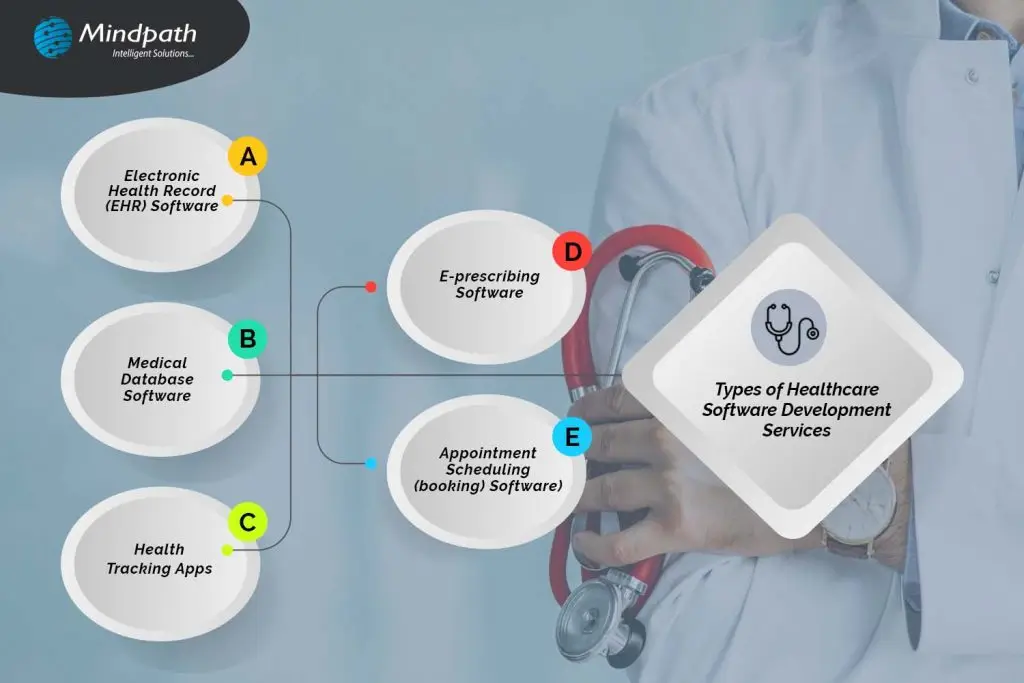
1. Electronic Health Record (EHR) Software
EHR software is being used by hospitals and clinics like any CRM, but with a healthcare tune. It contains all the relevant information concerning every patient, among them what medicines they use, the various doctors’ advice, and the medical processes that they have gone through. Many EHRs incorporate mechanisms for billing, collection, and even a patient portal that allows patients to view consultation history, medical records, and prescriptions. There are two types of EHR software: the electronic patient record, which is used in hospitals for management purposes concerning a patient internally, and the electronic medical record, which keeps track of information like medications, past and future procedures, and how well the patient is recovering.
2. Medical Database Software
Medical database software can be called a huge library of information about medicine, not according to the profiles of patients but according to diseases. This tool aids doctors in looking through cases like one that is being treated and thus making informed decisions about its cure. It is also used for learning by allowing doctors to know more about certain diseases. For example, a dermatologist using medical database software can view all the patients diagnosed with Atopic Dermatitis, compare their symptoms, treatments, and recovery plans, and find the best approach for their current patients.
3. Health Tracking Apps
Health-tracking apps are part of the fast-growing industry called mHealth, which stands for “mobile health.” This industry, valued at $37 billion globally for 2019 alone, allows users to trace and manage their health from their smartphones. Some of the popular health monitoring apps include fitness apps such as 8fit, diet apps such as Fitatu Calorie. For instance, sleeping patterns are monitored by the FitBit wristband, while the Oura Ring is responsible for monitoring several health metrics. Others include glucometers for testing blood sugar levels and, of course, thermometers in general—for instance, tracking menstrual cycles like the Kindara app. All these tools work together to give users a better understanding of their health and wellness.
4. E-prescribing Software
The e-prescribing software is becoming a tool that every doctor must have, with countries all over the world rapidly adopting electronic prescriptions. Such software allows doctors to easily manage all prescriptions for all patients by tracking, renewing, and canceling them as need be. It is also connected to national drug reference databases that help in picking up the right medications and making sure there is no error. Examples include MediTab and ScriptSure, two software programs designed to ease e-prescribing and improve the capabilities of health professionals to deliver accurate and effective care.
5. Appointment Scheduling (booking) Software
Appointment scheduling software is designed to assist hospitals, clinics, and medical practices in managing their appointments online. This normally allows the provision of a user-friendly platform through which patients can easily book appointments via an app or website without calling up the office. This type of software normally features email notifications and automatically sends reminders to doctors and patients about upcoming appointments. It accommodates multiple doctors’ schedules, cancellations, or rescheduling of appointments, and does much more to provide appointment trend data that helps in bringing efficiency to the practice. Additionally, AI chatbots are integrated into these systems to enhance the booking experience. These chatbots can handle appointment scheduling, provide immediate responses to patient inquiries, and assist with rescheduling or cancellations.
Looking to boost your healthcare operations with top-tier software solutions?
At Mindpath, we deliver cutting-edge, customized healthcare software to empower efficiency and elevate patient care.
Why Are Healthcare Practitioners Going Digital?
Health practitioners use digital technologies greatly because of the great advantages they present in improving patient care and practice management. Digital healthcare solutions help doctors in the management of patient information. Therefore, record-keeping becomes more accurate and efficient while diminishing the burdens of paperwork.
Healthcare IT has been one of the fast-growing markets and is expected to grow further. From $303.4 billion in 2022, this is projected to rise as high as $974.5 billion by 2027 with a good annual growth rate. The market is expected to grow to $728.63 billion by 2029 and even further to $1,069.13 billion by 2032. Healthcare provider solutions take up about 38% of the market, such as those in Electronic Health Records. On the other hand, IT services form 52% of the market, including online payments and cybersecurity. Growth is fueled by new technologies, increased spending by consumers, and government initiatives; however, challenges persist, with the most important ones being related to cybersecurity risks. It has the maximum market share in North America due to its better and advanced infrastructure. The European region is predicted to grow fast with government help and support, adoption of AI soon. Some major players in this field are GE Healthcare and Philips, which are carrying the industry forward.
Leading Healthcare Software Development Services at Mindpath
Mindpath offers a full cycle of healthcare software development services that meet all the needs of healthcare providers, patients, and all those concerned. Our offered solutions work toward better patient care while easing operations. Here are the services we provide:
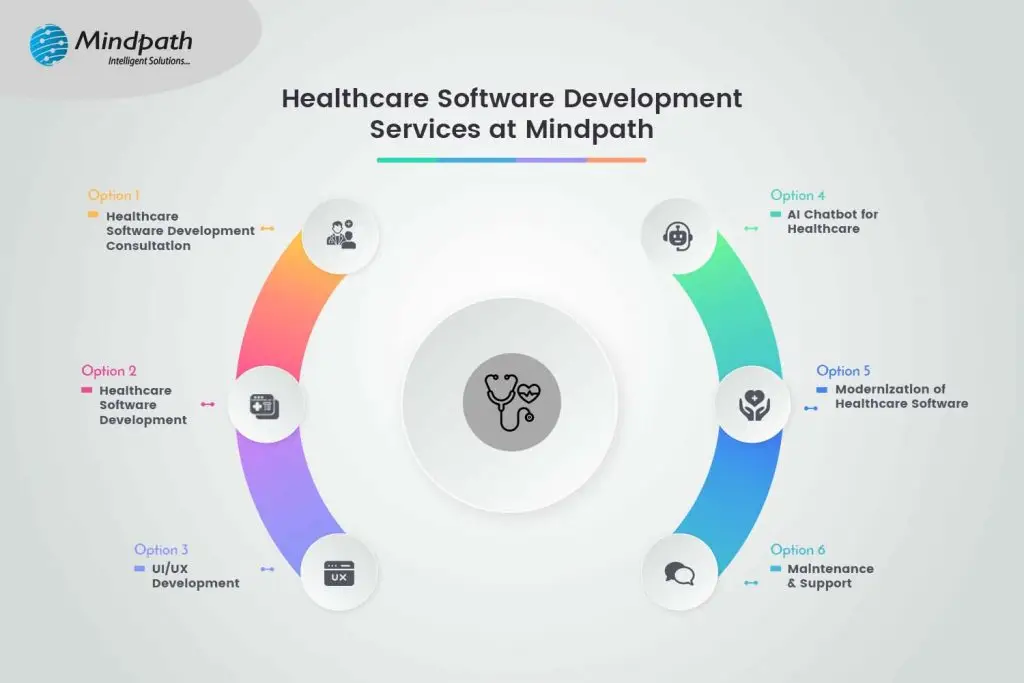
1. Healthcare Software Development Consultation:
We assist in planning and designing your healthcare software project from an idea to detailed planning. Our advice ensures you will have a clear roadmap for developing effective healthcare solutions.
2. Healthcare Software Development:
We develop various healthcare IT software solutions, including Electronic Health Record (EHR) software, practice management systems, patient portals, among others. The solutions are secure, scalable, and well-built according to the industry regulations to ensure better patient care and efficiency.
3. UI/UX Development:
We design easy-to-use interfaces that will be convenient and pleasant for the eye. We focus on bringing your healthcare software both functionality and user experience.
4. AI Chatbot for Healthcare:
Our AI chatbots for healthcare answer questions, provide appointment scheduling, and disseminate medical information. They help improve interaction with patients and relieve some workload from the health staff.
5. Modernization of Healthcare Software:
Legacy system upgrade and migration to state-of-the-art platforms, enrichment of new functionalities, and updating of old technologies to manage your software and keep it relevant.
6. Maintenance & Support:
Ongoing support and maintenance are available to make sure that your healthcare software keeps running smoothly and aligns with your changing needs.
Conclusion
The huge effects of rapid growth in technology reshaping healthcare to become more effective, accessible, and patient-centered are undeniable. It is evident from the adoption of electronic health records and e-prescribing software at the end of the spectrum to health-tracking apps and AI-driven tools that are revolutionizing how healthcare providers care for patients and their practices.
Such innovations not only improve the quality of care provided to patients but also the administrative flow, hence making healthcare very responsive and effective. Adopting the newest technology is crucial for healthcare organizations to keep ahead of these trends as the sector continues to change. This is where a holistic approach to healthcare software development is necessary. Healthcare providers may enhance patient outcomes, streamline operations, and more adeptly navigate the digital terrain by incorporating cutting-edge software solutions.
At Mindpath, we are dedicated to supporting healthcare providers through every step of this transformation. From development and consultation to UI/UX design and modernization—our services cover a large area of needs, all meant to make sure you can drive positive change in healthcare through digital technology. Be it building new systems, updating existing ones, or ensuring ongoing support, Mindpath makes sure that your healthcare software is of the highest quality and effectiveness.
Are you curious about how cutting-edge medical software might transform your business?
At Mindpath, we develop solutions that improve patient care and expedite operations.
Steps to Hire Education Software Developers
1. Define Clear Needs and Objectives
Be clear about the needs and goals that your organization wants to fulfill before any hiring. Determine whether you’re looking for web application-oriented developers or a UI designer. Since personalization features in an online learning environment are very important, the requirements should be focused on the position and objectives of your company in the EdTech industry. Define your project scope by determining whether you will create a new web application or improve the user interface of an existing platform to identify necessary skills.2. Conduct Rigorous Vetting Process
Finding the right kind of talent is hard in this busy online world, but Aloa, Google, and LinkedIn will help in this regard. One of the most important decisions for any startup entering the field of EdTech would be whether to build in-house or to outsource. In-house development brings more control directly to the fingertips, thereby providing customization and quicker changes. On the other hand, outsourcing brings outside expertise and can be more cost-effective.3. Create A Job Description
A detailed description of the job is one of the most important aspects in the acquisition of the right candidates. Clearly indicate what kind of responsibilities, skills, and experience will be required, with major emphasis on web application development, UI design, and knowledge of online learning. In such a well-written description of a job, there is an articulate roadmap for potential candidates to evaluate their fit for roles in education software development.4. Perform Virtual Interviews
Virtual interviews provide an efficient way to connect with a global talent pool for education software development. They allow you to evaluate candidates’ understanding of online learning environments, self-education mindset, and potential contributions. This step is crucial for assessing both practical skills and cultural fit.5. Reviewing Portfolios and Skills
In the case of a candidate who has worked on education software creation, this should be evident through their portfolio. The relationship with the candidate’s previous projects shows skills in the development of web applications, UI design, and personalization. Previous work should reflect clearly an understanding of the online learning environment and meet modern learners’ needs.6. Ensure Legal Compliance
Ensuring compliance with legal regulations is essential when hiring educational software developers. This includes clear contracts outlining work scope, intellectual property rights, and confidentiality, to prevent disputes. Protecting user data by adhering to privacy laws like GDPR is crucial, and following employment laws ensures fair treatment of employees. Proper legal compliance safeguards both parties and avoids future legal issues.Considerations While hiring Education Software Developers
1. Expertise in the Development
While considering recruiting professionals to education software development, people with a deep understanding of education and technology must be the most prospective candidates. You should seek professionals who have deep expertise in software development and an understanding of fine details of education. This will enable them to create pedagogically relevant solutions that leverage the best of technology.2. Strong Collaboration and Communication Skills
Seamless collaboration in the creation of education software solutions, involving developers, educators, designers, and other professionals, calls for cross-functional teams. Effective communication skills play a huge role in translating complex technical terms into easily understandable language for non-technical stakeholders. Assess people based on their technical prowess and how well they can function in a team that values communication.3. Innovations and Adaptability
Developers in the fast-moving education software field should be abreast of new technologies and trends. Seek those with experience in change and the ability to innovate in fulfilling educational needs. It is precisely this ability to evolve with technology and create new solutions that sets people apart in education software development.4. User-Centric Focus
Education software is aimed at enhancing learning. Hire education software developers for whom this would be the top priority, delivering user experience and learner outcomes with a strong sense of empathy toward educators and learners. This would ensure intuitive and effective software solutions.Mindpath has the expertise to help you succeed.
Searching for the best education software developers to transform your e-learning vision into reality?
How can Mindpath Help You Hire the Best Education Development Software?
Mindpath is here to help in hiring the best developers for creating educational software that will meet your needs. We understand the fact that education is constantly evolving and is changing with the wind; it needs the best technologies to survive the race. That is the reason we offer the facility to hire top developers for creating such software to fulfill your educational goals. Our team connects you to experienced developers who have expertise in developing educational platforms, Learning Management Systems (LMS), and school management software. Such professionals help in designing software that allows both student and educator engagement through the latest technology.
At Mindpath, we take pride in our educational technology experience. We’re quite sure user-centered software development makes our developed solution intuitive and easy to use. We provide scalable solutions, which will grow with your institution according to your needs. We keep providing technical support and maintenance to the developed software to make it keep upgrading and secure. Choosing Mindpath means you get a partner who is dedicated to making you succeed.
Conclusion
It is a fast-changing environment for education software technology, developers become very instrumental in shaping the future of learning. With emerging trends in artificial intelligence, virtual reality, and personalized learning platforms, among others, now more than ever is the need for skilled developers who can bring these innovations to life. Developers are not just writing software; they are building tools that will define a new way of teaching and learning.
By choosing Mindpath, you tap into a talent network of peer developers who understand the challenges and opportunities that exist in education technology. Our vetting process assures that the developers you intend to hire would be with the right skill set, experience, and mindset moving your projects forward. With our support, you can build a team capable of developing cutting-edge solutions that will enhance learning outcomes, help in positioning your institution as a leader in the education software.
Ready to Transform Your Educational Software?
Mindpath specializes in connecting you with top education software developers who can bring your vision to life.
Managing legal cases, preparing documents, tracking deadlines, and communicating with clients can consume significant time for law firms. When these activities depend on spreadsheets, emails, and disconnected applications, teams may struggle to maintain accurate records and coordinate their work efficiently.
Key Takeaways
- 01
Legal software solutions help law firms manage cases, documents, deadlines, billing, and client communication from a centralized platform. - 02
Custom legal software development allows firms to build features around their specific workflows and operational needs. - 03
AI-powered tools can assist with document review, contract analysis, legal research, and repetitive administrative tasks. - 04
Data security, access control, and regulatory requirements should be considered when selecting legal technology. - 05
The right legal software development partner can help law firms improve efficiency, client experience, and long-term scalability.
Legal software solutions help address these challenges by bringing essential legal operations into a connected digital environment. From case management and document automation to client portals and AI-assisted research, modern legal technology helps attorneys organize their work and reduce repetitive administrative tasks.
For law firms, corporate legal departments, and legal technology businesses, investing in the right software can support more efficient workflows and better client service. This guide explores the main types of legal software, their benefits, essential features, and how to choose the right solution.
Looking to transform your ideas into intelligent software? Mindpath provides expert AI Development Services to help businesses build scalable, efficient, and innovative AI-powered solutions.
What are Legal Software Solutions?
Legal software solutions are digital tools designed to support legal professionals in managing everyday legal and administrative activities. These applications can help organize case information, prepare documents, manage contracts, track billable hours, and maintain communication with clients.
For example, a law firm handling multiple corporate cases can use legal case management software to organize client records, assign tasks, and monitor deadlines. It can also store relevant documents in one place, making information easier to access.
Depending on business requirements, firms can choose ready-made applications or invest in custom legal software development. Custom solutions are particularly useful when existing tools cannot support specialized workflows, integrations, or reporting requirements.
Types of Legal Software Solutions
1. Legal Case Management Software
Legal case management software helps attorneys organize cases from initial client intake to final resolution. It centralizes important information, including case status, client details, assigned team members, upcoming deadlines, and related documents.
Automated reminders and task assignments help legal teams stay organized. As a result, they can reduce the risk of overlooking important activities and manage their caseloads more effectively.
2. Legal Document Management Software
Legal professionals handle contracts, agreements, evidence, research files, and confidential client records. To manage these documents efficiently, legal document management software provides a structured way to store, search, access, and share information.
Additionally, useful features include version control, permission-based access, document search, secure sharing, and automated document generation. As a result, legal teams can find the correct information more easily while maintaining better control over sensitive files.
3. Contract Management Software
Contract management software supports the creation, review, approval, signing, and renewal of contracts. It can help businesses monitor contractual obligations, identify important dates, and standardize document workflows.
AI-assisted contract analysis can also help flag specific clauses or inconsistencies for human review. However, attorneys should verify the findings before making legal decisions.
4. Legal Billing and Practice Management Software
Billing and practice management tools help firms track billable hours, prepare invoices, manage expenses, and monitor payments. Some platforms also provide reports on workload, outstanding invoices, and matter profitability.
By connecting billing with case management, law firms can reduce duplicate data entry and improve financial visibility. This makes it easier to monitor financial performance alongside daily legal operations.
5. AI-Powered Legal Software
AI in legal technology can support document summarization, contract review, legal research, and information retrieval. These tools can help professionals process large volumes of information more efficiently.
However, AI-generated results may contain errors or unsupported statements. Confidentiality controls, reliable source verification, and attorney oversight are essential when using AI for legal work.
Benefits of Custom Legal Software Development
1. Improved Operational Efficiency
Custom legal software can automate repetitive activities such as document generation, task assignments, appointment scheduling, and routine notifications. This allows legal professionals to spend more time on research, strategy, and client relationships.
By reducing manual work, firms can organize their processes more consistently. They can also minimize repetitive data entry and improve the flow of information across teams.
2. Better Collaboration
A centralized platform helps attorneys, paralegals, administrators, and clients access relevant information according to their permissions. Shared case records and task updates can improve coordination across departments and office locations.
Teams can also track progress without relying entirely on separate emails or spreadsheets. This creates a clearer view of responsibilities and upcoming tasks.
3. Enhanced Client Experience
Client portals can provide secure document sharing, appointment requests, billing information, and case updates. Better access to information can reduce unnecessary follow-ups and help clients understand the progress of their matters.
In addition, consistent communication helps clients stay informed throughout the legal process. Firms can use these tools to provide a more organized and accessible service experience.
4. Stronger Data Security
Legal organizations manage confidential information that requires careful protection. Custom applications can incorporate encryption, role-based access controls, multifactor authentication, audit logs, and secure backups.
Security requirements should be based on the firm’s risk profile, applicable privacy laws, and contractual obligations. Regular reviews can also help identify vulnerabilities and maintain appropriate access controls.
5. Greater Flexibility and Scalability
As a legal practice grows, its technology requirements may change. Custom software can be designed to support additional users, new practice areas, specialized workflows, and integrations with existing business systems.
This flexibility helps organizations adapt without relying entirely on manual workarounds. It also provides room to introduce new features as business needs evolve.
Essential Features to Look for in Legal Software
Before choosing a solution, consider whether it includes the following capabilities. The right combination will depend on your firm’s workflows, team size, and security requirements.
- Centralized case management: Organize case records, tasks, contacts, and deadlines.
- Document automation: Generate standardized documents using approved templates.
- Deadline tracking: Schedule hearings, filing dates, contract renewals, and reminders.
- Secure client portals: Share updates and documents with authorized clients.
- Billing and reporting: Track time, invoices, expenses, and operational performance.
- System integrations: Connect with email, calendars, accounting tools, and document platforms.
- AI-assisted workflows: Support document analysis and information retrieval with appropriate human review.
- Security and auditability: Apply access restrictions and maintain records of important actions.
The best feature set depends on the size of the organization, the type of legal work it performs, and its existing technology infrastructure. Evaluating these requirements early can help prevent unnecessary costs and functionality gaps.
How to Choose the Right Legal Software Development Company
Selecting a reliable legal software development company requires more than comparing prices or feature lists. You need a partner who understands your operational challenges and can translate them into a practical software solution.
Start by identifying the problems your team wants to solve. Next, evaluate the developer’s experience in custom software development, data security, system integration, and user-friendly application design.
Ask potential partners about their development process, testing standards, maintenance services, and ability to support future upgrades. Request a prototype or demonstration when possible, and confirm how confidential information will be handled.
It is also important to establish measurable goals. For example, a firm might track document processing time, missed deadlines, administrative workload, client response times, or billing accuracy before and after implementation.
Finally, consider using a phased rollout rather than introducing every feature at once. This allows teams to test essential functionality, gather feedback, and address usability issues before expanding the solution across the organization.
Why Choose Mindpath for Legal Software Development Services?
Mindpath helps businesses explore tailored software solutions aligned with their operational requirements. For legal organizations, the right development approach can bring case management, document workflows, client communication, and business processes into a more connected environment.
By focusing on usability, integration, scalability, and appropriate security controls, a development partner can help transform complex manual processes into efficient digital workflows. This can also create a stronger foundation for future improvements.
Whether you are planning a legal management platform, a client-facing application, or an AI-enabled legal tool, defining your requirements clearly is the first step toward a successful implementation. A well-planned solution should address current challenges while allowing room for future growth.
Looking to modernize your legal operations? Connect with Mindpath to discuss software development solutions tailored to your business needs.
Conclusion
Legal software solutions help modern law firms organize cases, manage documents, improve collaboration, and deliver a more consistent client experience. The right platform can also reduce repetitive work and provide better visibility into daily operations.
Before investing in new technology, evaluate your workflows, security requirements, integration needs, and long-term goals. While ready-made tools may suit standard requirements, custom legal software development can provide greater flexibility when specialized processes demand a tailored approach.
With a clear implementation strategy and the right technology partner, legal organizations can build a more secure, efficient, and scalable digital practice.
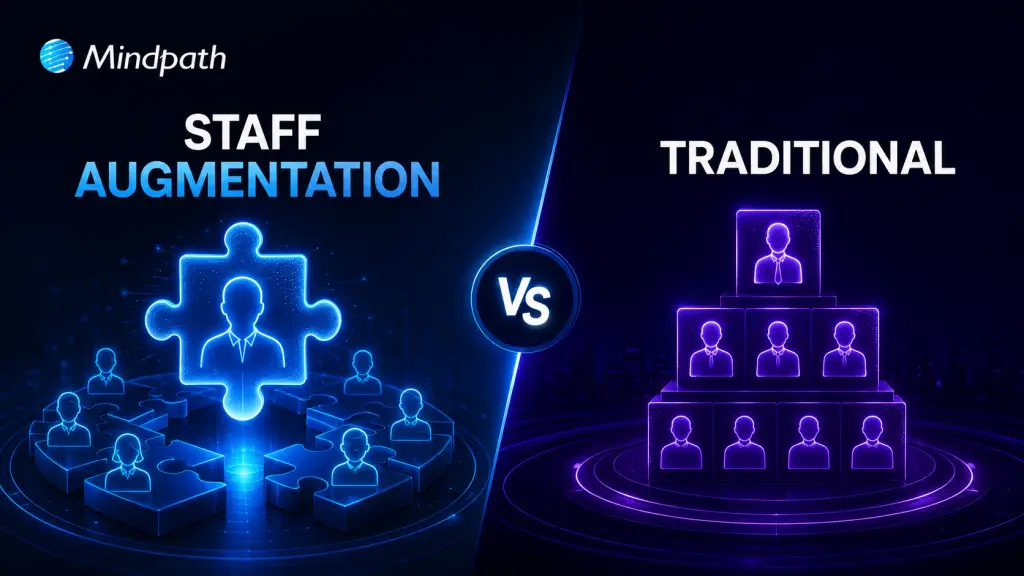
IT staff augmentation offers a flexible, scalable, and cost-effective alternative to traditional hiring models. It enables businesses to quickly access specialized talent, adapt to changing project needs, and optimize resource allocation without long-term commitments. This approach enhances operational efficiency, speeds up hiring processes, and supports strategic growth in dynamic markets.
Are you struggling to find the right talent for your IT projects or facing challenges with traditional hiring processes? Traditional hiring could take months, but what if there was a faster, more flexible solution? Now, with IT staff augmentation, you may satisfy your project goals fast and effectively without the long-term commitment and expense associated with traditional employment.
In today’s fast-changing business environment, companies need to scale quickly and adapt to project demands. IT staff augmentation allows businesses to add skilled professionals to their existing teams without long-term hiring commitments, making it easier to adjust resources as project needs change.
What are the traditional hiring models?
Traditional hiring models cover a range of techniques used by businesses to onboard new staff members. Here’s a short breakdown:
1. Direct Hiring
This is the most popular approach used by businesses to hire people directly for full- or part-time jobs. It includes posting job positions, evaluating applications, setting up interviews, and choosing job applicants.
2. Temporary Hiring
Businesses employ people to do certain tasks or for a set amount of time. Temporary hires are made by the company itself or through employment agencies to cover short-term positions like project-based labour or seasonal labour.
3. Contractual Hiring
Contractual hiring is employing individuals or businesses under a formal contract to do certain activities or projects. Contractors may labour for a certain amount of time until the project is finished, and they are normally compensated for their services in accordance with the conditions specified in the contract.
4. Freelancers or Independent Contractors
Businesses employ independent contractors or freelancers on a project-by-project basis. They work for themselves and supply specialized knowledge or services on demand, frequently from a distance. They are not employees.
Drawbacks of traditional hiring models
Despite being frequently employed, traditional employment strategies include several drawbacks that businesses need to consider:
1. Time and Resource Inefficiency
It might take a while and a lot of resources to advertise job positions, evaluate applications, hold interviews, and decide who gets hired. This inefficiency frequently leads to protracted spells of unemployment, which affects output and pushes back project deadlines.
2. Cost Implications
Conventional hiring includes indirect costs like pay, benefits, and overhead related to permanent workers in addition to direct expenditures like advertising, onboarding charges, and recruiting agency fees (if applicable). Budgetary constraints may be strained by these costs, especially if turnover rates are significant or if highly skilled personnel require premium pay.
3. Rigidity in Staffing
In traditional models, once employed, workers usually commit to long-term jobs that might not match project-specific requirements or changing corporate demands. This lack of adaptability may cause resources to be overextended during peak hours or underutilized during off-peak hours, which would reduce overall operating efficiency.
4. Skills and Expertise Gaps
Access to the knowledge or abilities required for specialized projects or cutting-edge technology could not always be ensured by traditional recruiting practices. Talent with specialized skills may be difficult for organizations to find and keep, which might impede innovation and competitiveness in quickly changing sectors.
Overview of IT Staff Augmentation
IT staff augmentation is a flexible outsourcing model that helps businesses quickly add skilled IT professionals to their existing teams. Instead of hiring full-time employees, companies bring in experts on a temporary or project basis to fill skill gaps and meet project goals. These professionals are typically hired through staffing agencies, freelancers, or direct contracts based on the specific expertise needed.
Key Benefits of IT Staff Augmentation
1. Flexibility and Scalability
Two key benefits of hiring more IT professionals are flexibility and scalability. IT staff augmentation lets companies quickly bring in skilled experts when needed without making long-term hiring commitments. This helps businesses adapt to changing project demands while keeping work on track. It also allows companies to scale their teams up or down as projects change, reducing costs and making it easier to expand into new markets when needed.
2. Cost-Effectiveness
Staff augmentation is a cost-effective way to access specialized talent without the high costs of traditional hiring. It reduces recruitment, onboarding, and long-term employee expenses like benefits and office space. Companies can also scale their workforce based on project needs, helping them manage budgets more efficiently.
3. Access to Specialized Talent
Access to specialized talent helps companies quickly bring in expertise they don’t have in-house. By hiring skilled professionals through agencies or direct contracts, businesses can handle technical or short-term projects without making long-term hires. This approach improves project outcomes, drives innovation, and helps companies stay competitive in fast-changing industries.
4. Faster Hiring Process
IT staff augmentation helps companies hire skilled professionals much faster than traditional recruitment. With access to pre-screened talent, businesses can quickly fill roles, start projects sooner, meet deadlines, and stay flexible while reducing hiring delays and maintaining quality.
Choosing Between IT Staff Augmentation and Traditional Hiring
| Criteria | IT Staff Augmentation | Traditional Hiring |
| Flexibility | High – Can scale up/down as needed | Low – Fixed, long-term commitments |
| Cost | Cost-effective, reduced overhead | Higher costs, including benefits and office space |
| Time to Hire | Fast – Quick onboarding with pre-vetted candidates | Slow – Lengthy recruitment and onboarding process |
| Access to Talent | Access to specialized, global talent quickly | Limited to available local talent |
| Project Adaptability | Easily adapt to changing project needs | Rigid, less adaptable to project changes |
| Commitment | Short-term or project-based | Long-term employment contracts |
Conclusion
In conclusion, IT staff augmentation helps businesses stay flexible, scale teams quickly, and access specialized talent without the commitment of traditional hiring. It improves efficiency, optimizes resources, and keeps companies competitive in a fast-changing market.
Whether you need to scale for a new project or hire specialized IT talent, Mindpath offers flexible staffing solutions tailored to your needs. Contact us today to learn how we can support your business.
Node.js stands at the forefront of web development, seamlessly integrating frontend and backend tasks with its JavaScript foundation. Its event-driven architecture and expansive npm ecosystem enable rapid development of scalable applications. Backed by a thriving community, Node.js continues to redefine digital landscapes, making it the premier choice for innovative, high-performance web solutions.
Are you curious about the tools that power some of the most efficient and dynamic web applications today? If you’re in the web development space, you have probably heard of Node.js. But what makes Node.js stand out among the myriads of options available? Let’s explore why Node.js might just be the game-changer you’ve been searching for.
In this blog, let’s dive deep into the advantages of Node.js to uncover how it enhances application performance, scales seamlessly to meet growing demands, and streamlines development processes.
An Overview of Node.js
Node.js is a web development platform that is revolutionizing the way applications are developed and distributed on the internet. It is a standout force in the dynamic field of online development. Node.js, which leverages the widely used JavaScript language, enables developers to easily integrate the frontend and backend development processes. Node.js development services benefit from its lightweight, event-driven design, which is very useful in the modern digital environment.
It makes it possible to develop scalable, highly responsive apps that can manage several connections at once. Because of its effectiveness, Node.js is the best option for real-time applications where responsiveness is crucial, such chat platforms, online games, and collaboration tools. Additionally, Node.js encourages creativity by streamlining the development process. Its robust package and library ecosystem, made possible by npm (Node Package Manager), speeds up development and enables programmers to take advantage of pre-existing tools for a range of features. This feature improves web applications’ scalability and maintainability while also saving time and resources.
Key Benefits of using Node.js
1. High Performance
Node.js development services achieves great performance because of its non-blocking, event-driven architecture, which enables it to handle several requests concurrently without waiting for prior actions to finish. In real-time applications where responsiveness is essential, this efficiency is crucial. Node.js translates JavaScript straight into machine code by using the V8 JavaScript engine, which is well-known for its speed and optimization. This leads to quicker execution times.
The core of Node.js’s ability to provide great performance across a range of applications is this Google-developed engine. For example, Node.js is used by PayPal and LinkedIn because it can easily handle large amounts of traffic and provides real-time updates.
2. Scalability
Node.js excels in scalability because of its unique architecture and features designed for large-scale applications. Because of its event-driven, non-blocking architecture, Node.js servers can process several requests at once without experiencing I/O operation blocking. Applications that need to manage massive data streams in real-time or serve a high number of concurrent users must have this capacity.
Node.js is lightweight and efficient, allowing it to scale horizontally across multiple cores or servers, enhancing its scalability. Because Node.js is an asynchronous programming language, developers may leverage its ease of deployment across distributed systems to maximize resource consumption and maintain excellent performance even under severe loads.
3. Efficient Development Process
By using JavaScript for both frontend and backend development, Node.js streamlines the development workflow and lowers the learning curve for developers who are already familiar with JavaScript, enabling an efficient development process.
By writing code for the complete stack using a single language, developers can increase code reuse and reduce the amount of time they spend moving between multiple programming languages.
The strong npm (Node Package Manager) module ecosystem of Node.js is another element that makes development easier. A sizable collection of reusable tools and libraries that make typical development tasks easier are provided by npm. Third-party modules are simple for developers to incorporate into their projects, which shortens development timeframes and eliminates the need to create essential features from scratch.
4. Rich Ecosystem
Node.js has a rich ecosystem, which increases its attractiveness and usability in modern web development. The largest open-source library ecosystem in the world, npm (Node Package Manager) is at the center of this ecosystem. With more than a million packages, modules, and tools covering almost every facet of application development, npm provides developers with an extensive repository.
With the help of this large library of npm packages, developers may speed up development processes by using pre-made solutions for typical tasks like database integration, testing frameworks, UI components, and authentication.
5. Strong Community Support
Strong community support is one of Node.js’s greatest assets and is essential to its expansion, uptake, and continuous improvement. This dynamic group of contributors, enthusiasts, and developers works together to enhance Node.js, exchange information, and offer helpful resources to other developers.
The accessibility and inclusion of the Node.js community is one of its main advantages. Developers of all skill levels, from beginners to seasoned professionals, are welcomed and encouraged to participate. A large number of people contribute to the ecosystem by making npm packages, frameworks, tools, and instructional materials. This collaborative effort ensures that Node.js remains innovative, responsive to industry trends, and capable of addressing evolving development challenges.
Case Study and Success Stories
Node.js development service has shown its mettle in a number of well-known applications, showcasing its adaptability and reliable performance in a variety of sectors.
Walmart, a massive retailer, is the subject of an interesting case study. The company used Node.js to improve its online shopping experience. By choosing to hire Node.js developers for their backend services, Walmart improved page load speeds and overall site performance, which raised consumer happiness and increased sales conversions
Similarly, Netflix has streamlined its content delivery systems with Node.js, guaranteeing millions of consumers globally a flawless streaming experience. These triumphs demonstrate the tactical benefit of working with a professional Node.js development services firm. Through these collaborations, companies may efficiently utilize Node.js’s capabilities, utilizing its event-driven, non-blocking design to create scalable, high-performance apps that satisfy the demands of the contemporary digital landscapes.
How to Hire Node.js Developer
1. Define Project Requirements
Clearly outline the skills and experience needed, such as JavaScript proficiency, knowledge of asynchronous programming, and experience with frameworks like Express.js. Understanding why hire NodeJS developers can help ensure you bring in the right talent to leverage these skills for your project’s success.
2. Draft a Detailed Job Description
Highlight the required technical skills and any additional qualifications, including database management or API development experience.
3. Conduct Thorough Technical Interviews
Assess problem-solving abilities, Node.js knowledge, and hands-on skills through technical interviews and coding challenges.
4. Evaluate Cultural Fit and Communication Skills
Ensure candidates can collaborate effectively and fit well with your team dynamics, especially if working in a remote environment.
5. Check References and Past Work
Validate reliability and performance by checking references and reviewing past work experiences.
Conclusion
Conclusively, Node.js emerges as a key component of contemporary web development, presenting unmatched advantages including high performance, scalability, a productive development process, an extensive ecosystem, robust community support, and proven performance in the real world. Node.js stays ahead of the curve as web development patterns change over time, adding new features and developing its ecosystem. Adopting Node.js enables companies to develop and prosper in a cutthroat online marketplace while also ensuring reliable and scalable systems.
At Mindpath, we specialize in leveraging Node.js to drive transformative solutions for businesses of all sizes. Whether you’re looking to optimize performance, scale your applications, or innovate with new features, our expertise in Node.js development services can empower your digital journey. What are you waiting for? Contact us today to explore how we can help you harness the full potential of Node.js.
Do you ever wonder what’s the secret sauce of creating a perfect website or web application? It is the right framework! The success of your project depends on the framework you choose in the ever-changing world of web development. ReactJS is a framework that has been more popular among developers because of its comprehensive features, adaptability, and efficiency.
ReactJS is a part of the wide JavaScript library and is quite popular amongst the developer community for its versatility. With large numbers of frameworks available and new ones coming every single year, it could be a tricky decision to choose the right one for your web project.
In this blog, we will take a deep dive into the origins of ReactJS, its key features, and ten compelling reasons to consider ReactJS for your web development needs.
Origin of ReactJS Framework
Facebook invented ReactJS, also referred to as React, in 2011 and made it available to the public in 2013. The framework was created to help developers overcome the difficulties they encountered when creating intricate, high-performing user interfaces.
The component-based design that React introduces makes development easier by enabling developers to create modular and reusable components. ReactJS is one of the most widely used web development frameworks nowadays, maintained by Facebook in collaboration with a sizable developer community.
Features of ReactJS
ReactJS is a great option for web development because of its many capabilities. Important characteristics consist of:
- Component-Based Architecture: React makes it possible to create independent components that are capable of independently managing their state, which makes it easier to create intricate user interfaces.
- Virtual DOM: React reduces rendering overhead by simply updating the UI elements that have changed, as opposed to re-rendering the entire page, thanks to the use of a virtual DOM.
- JSX Syntax: This JavaScript syntax extension makes it possible for programmers to write HTML-like code inside JavaScript, improving the debugging and readability of the code.
- Unidirectional Data Flow: Applications are simpler to debug and maintain because to React’s one-way data binding, which guarantees a consistent data flow.
- Rich Ecosystem: React boasts a vast ecosystem of libraries and tools that extend its functionality and streamline the development process.
10 Benefits of Using ReactJS
1. Enhanced Performance
The virtual DOM in ReactJS ensures fast and efficient updates, enabling your web application to handle high-user interactions smoothly.
2. Reusable Components
Because of React’s component-based architecture, developers may quickly and consistently create new areas of an application by reusing components across them.
3. Ease of Learning
Learning ReactJS is not too difficult, especially for people who have experience with JavaScript. It is accessible to novice and seasoned developers because of its straightforward syntax and wealth of internet resources.
4. SEO Friendly
React’s server-side rendering features make it possible to greatly improve your web applications’ SEO, which will raise their visibility and search engine ranks.
5. Strong Community Support
With a large and active community, ReactJS developers can easily find solutions, share knowledge, and stay updated with the latest developments, providing valuable support for troubleshooting and skill enhancement.
6. Rich Ecosystem
The extensive ecosystem of tools, libraries, and extensions available for React makes it highly versatile, with solutions available for state management, routing, and testing.
7. Mobile App Development
React Native, derived from ReactJS, allows developers to build mobile applications using the same principles and components, facilitating seamless extension of web projects to mobile platforms.
8. Scalability
React’s modular structure makes it highly scalable, enabling the addition of new features and components without rewriting existing code, ensuring long-term maintainability.
9. Developer Tools
React offers powerful developer tools, such as React Developer Tools for Chrome and Firefox, which help developers inspect component hierarchies, debug applications, and enhance productivity.
10. Backed by Industry Leaders
Supported by Facebook and used by major companies like Instagram and Airbnb, ReactJS is a reliable and future-proof choice, continuously evolving with strong backing from industry leaders.
Hire ReactJS Developers with Mindpath
Now that we have established that ReactJS can benefit your web project in numerous ways, the next question is where you can hire qualified ReactJS developers. Well, look no further as Mindpath can help you hire the best ReactJS developers!
At Mindpath, we understand the importance of skilled developers for the success of your web project. Our team of experienced ReactJS developers is adept at leveraging the full potential of the React framework to create dynamic, responsive, and user-friendly web applications.
Whether you’re starting a new project or enhancing an existing one, our developers can help you achieve your goals efficiently and effectively.
We are committed to delivering high-quality solutions tailored to your unique needs. Contact us today to learn more about how our ReactJS developers can contribute to the success of your web project.
So you can end your search for React developers today with Mindpath. To know more.
Looking for a ReactJS Developer for your next project?
The world is changing rapidly and so is the technology spectrum across the globe. We are stepping into a digitally advanced world with new technologies like Generative AI, Web3, Blockchain, etc. Today’s businesses constantly seek innovative technologies to gain a competitive edge and drive strategic decision-making.
With the flood of technologies coming every year, some of them remain truly essential for modern-day businesses to thrive. Therefore, in this blog, we’ll explore ten upcoming technologies poised to transform business decision-making in the near future.
So let’s get started!
8 Upcoming Technologies To Drive Business Decision
1. GenAI
GenAI or generative AI is already making strides with popular tools like ChatGPT, Dall-E, Midjourney, etc. Generative AI, as the name suggests, is able to generate content like text, images, codes, designs, etc., based on “prompts” given by the users.
ChatGPT, a hot example of GenAI took the world by storm as soon as it was introduced. Many software have been launched since. In the coming years, GenAI is expected to play a crucial role in helping business leaders with decision making. GenAI empowers businesses to automate creative processes and deliver hyper-personalized experiences at scale, from creating personalized marketing content to designing custom products.
2. GenAI-Powered Chatbots
The next notable technology is Gen-AI-powered virtual assistants or chatbots which are becoming increasingly popular amongst users. GenAI-powered virtual assistants leverage natural language processing and machine learning algorithms to understand and respond to user queries and requests intelligently.
Virtual assistants include chatbots, voice assistants like Alexa & Siri, language-based assistants like ChatGPT & Bard, etc. GenAI and conversational AI are taking the customer experience to the next level. By harnessing the power of conversational AI, businesses can provide personalized customer support, streamline internal processes, and enhance productivity.
3. Digital Twins
Another trailblazing technology that’s going to assist businesses in making the best of their resources in the coming time is Digital Twins. Digital Twins are digital copies or replicas of real-world physical assets, systems, machines, tools, processes, etc.
To put simply, imagine you have a toy car that you want to understand better. You create an exact digital copy of this toy car on your computer, including all its parts and how they work together. This digital copy is called a digital twin. Now, whenever you want to experiment with or understand how the toy car behaves in different conditions, you can use the digital twin instead of the actual toy. For example, you could test how it moves on different surfaces, how it performs with various modifications, or how it reacts to changes in speed.
By creating a digital twin of products, equipment, or infrastructure, businesses can gain valuable insights into performance, predict maintenance needs, and enhance operational efficiency.
4. Multimodal User Interfaces (UIs)
User Interfaces (UIs) play a key role in delivering optimal customer experience. But most UIs till now have confined users to interact with machines in a monotonous way like typing on keyboard. That’s not the case with Multimodal User Interfaces (UIs). Multimodal UIs combine various interaction modalities such as voice, gesture, touch, and gaze to provide more intuitive and immersive user experiences.
To put it simply, multimodal user interfaces are like having multiple ways to talk to your computer or device. It’s not just typing on a keyboard anymore. You can use your voice, touch the screen, wave your hand, or even look at something to interact with it. By accommodating diverse user preferences and accessibility needs, multimodal UIs enhance engagement and usability across different devices and platforms.
5. Intelligent Applications
Intelligent applications support advanced analytics, machine learning, and automation capabilities to deliver context-aware insights and recommendations in real time. Think of intelligent applications as smart helpers. These apps use AI/ML along with advanced analytics to understand what you need and help you out.
These intelligent apps can serve as a golden opportunity for businesses to better predict customer behavior, optimize supply chain operations, as well as automate decision making process.
6. Tokenization
Have you heard of digital tokens? Tokenization allows the conversion of physical assets and contracts into digital tokens. Wondering how? Here’s an example! When you make a purchase online, you might use your credit card. Instead of giving the website your actual credit card number, which could be risky if the site gets hacked, tokenization replaces your card number with a unique token. This token acts as a placeholder, representing your card securely without exposing your real information.
Tokenization is all set to enable secure and transparent payments without any third-party intermediaries.
7. Quantum Processors
Quantum processors, as complex as they sound, are actually going to simplify the complex procedures and provide fast results. These are superfast computer processors aimed at delivering faster results for any problem. For example, quantum processors can handle the complex calculations needed to understand how molecules behave and interact with each other, which is crucial for developing new medicines.
While still in the early stages of development, quantum processors have the potential to revolutionize fields such as cryptography, optimization, and drug discovery, enabling businesses to tackle previously intractable problems with unprecedented speed and efficiency.
8. Web3
Lastly, let’s talk about Web3. It represents the next generation of the internet. Web3 is all about creating an immersive user experience and creating a decentralized platform. Technologies like blockchain, decentralized finance (DeFi), and decentralized apps (DApps), are at the core of Web3.
It will give more control to users over their data and provide transparency in transactions. With Web3, instead of going through a centralized payment processor like PayPal, you can use a decentralized cryptocurrency like Bitcoin or Ethereum to make the purchase directly, without any intermediaries.
Business leaders need to adapt themselves to provide a customer experience that is democratize and free from intermediaries.
These were the 8 new technologies 2024 that will become crucial for business owners for making business decisions.
Wrapping Up
In today’s digital world, businesses need to use new technologies to stay competitive and grow. These technologies, like GenAI, digital twins, smart virtual assistants, Web3, etc., can help them make better decisions and be more innovative. By keeping up with these changes and being open to trying new things, businesses can succeed in the digital age.
As a leader in upcoming technologies, Mindpath Tech is well-positioned to guide businesses through this journey of adaptation and innovation. With our expertise and commitment to staying ahead of the curve, we can help businesses harness the power of transformative technologies and thrive in the digital landscape.
So are you ready to become future-ready? Get in touch!
Join our Newsletter!
categories
Join the world's largest training library and unlock new opportunities!
Featured Posts
Turn Insights Into
Real Business Solutions
Exploring trends is only the beginning. Whether you’re planning AI adoption, modernizing legacy systems, or building scalable software, our experts help transform ideas into practical business outcomes.