Benefits of Custom WordPress Development for Your Website

Home

Benefits of Custom WordPress Development for Your Website

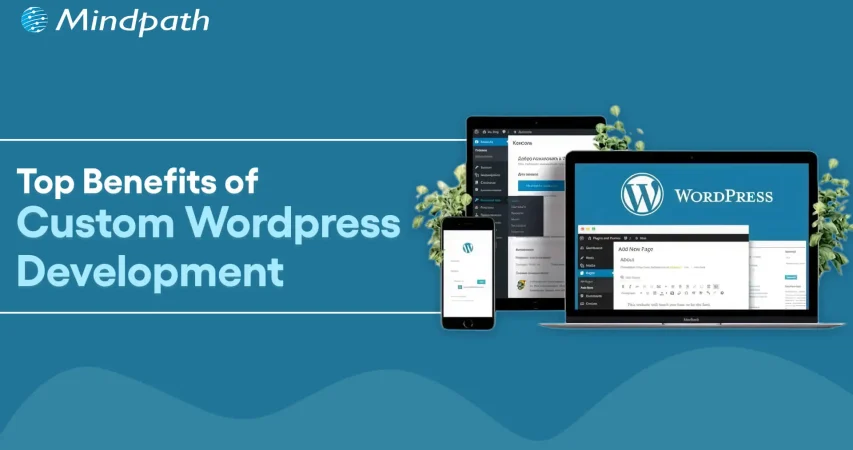
Benefits of Custom WordPress Development for Your Website

Discover the top benefits of custom WordPress development, easy maintenance, SEO-friendly, quick launch, and more. Transform your website today with Mindpath!

Join our Newsletter!

Custom Wordpress development

A website truly reflects your business motive and what it offers to its targeted audiences. Without a proper website, your organization can’t stand in this massive digital world. However, if you think your website is just to highlight your business, then you are misguided. As per a statistic of Stanford University, around 75% users judge the credibility of a business through their website design. So, for your long-term success, you must adopt a well-optimized website. 

This is where custom WordPress development serves uniqueness. Being the most popular software for creating websites, it powers over 43% of the internet. (Source: Click) Instead of limiting your vision to a similar theme, custom development accesses your site to be curated from the core. 

Ready to turn your website into a powerful business asset? Mindpath offers expert WordPress development services to create scalable and high-performance solutions built for your business growth.

What is Custom WordPress Development?

Custom WordPress development is the practice of building tailor-made websites, bespoke themes, and custom plugins from scratch, using WordPress as the foundation. Unlike relying on pre-existing themes that hundreds of other sites use, a custom website is architected specifically to align with your unique business workflows, design needs, and system integrations. This means every element, from backend frameworks to front-end features, is precisely crafted around your preferences, requirements, and values.

  • Pre-existing themes might be convenient for many users as they are a bit affordable. However, they come with certain risks of flexibility and generic layout. 
  • On the other hand, a custom WordPress website leverages creative freedom. You can develop your own layouts and include features that suit your interests.

How Adopting Custom WordPress Development Services Can Be Beneficial for Your Business?

Let us go through some major benefits that you can discover by choosing the custom WordPress development services

1. Seamless and Faster Development

You don’t require a backend in WordPress website development. Unlike traditional website creation, where every element is generated individually, WordPress sites allow you to choose a framework as per your business requirements and preferences. This enables you to quickly develop your site. With rapid development, you can also save your time and resources. 

2. Custom Theme Creation

In custom WordPress development, you can’t only transform the tagline but also change the overall appearance and functionality of your site. You can decide the changes as per the growing demand of your business. You can transform all such things by shifting the color palette, layout design, and widgets. Moreover, WordPress delivers a wide range of layouts that support multiple levels of business objectives. 

3. User-Friendly Web Designs

Ease of use is another significant factor that makes businesses prefer custom WordPress development services. It offers intuitive and straightforward operations. So, you don’t require any coding expertise to operate your business site effectively. The availability of multiple customizable plugins and themes can help you create a business site that meets your business expectations widely. 

4. Adopt Scalability

Getting a WordPress website developer can assist you in scaling your website as your company scales. You can also discover flexibility with custom WordPress development as per the dynamic nature of your company. So, be it an e-commerce or an advanced site, WordPress can help you effortlessly scale without compromising on quality. This offers you the benefit of staying relevant in such a digital era. 

5. Wonderful Designs

A pleasing, satisfying design can help your site attract prominent prospects while making your website look more professional. So, with the help of WordPress custom website design, you can easily enhance its reach while making its user interface valuable. Moreover, it puts a valuable first impression while converting your visitors into loyal customers. 

6. Social Media Handle Integrations

This is one such major value of a custom WordPress development, where your site can adopt social media implementation into your feed. This feature allows you to highlight your social accounts on your site. The valuable addition of the accounts can help you attract a larger number of visitors to your page without utilizing several media handles for your organization. 

7. Long-Term Support and Maintenance

One such overlooked advantage of a WordPress custom website is the seamless partnership and assistance you leverage. With the evolving nature of your business, your team can integrate new features and redesign without initiating it from scratch. This ensures quick integration and minimal downtime.

Looking to make your custom WordPress site usable for everyone? Explore our guide on web accessibility guidelines to learn practical ways to enhance your WordPress site and improve user experience.

What are Some Common Misconceptions People Have Regarding Custom WordPress Development?

WordPress comes with a series of features that remain unmatched. Further, a WordPress website developer can help you design a site that truly reflects your authenticity. However, there are some misconceptions that people have regarding this platform, as follows. 

1. Security Lapses

Many people consider that plugin incorporation can give rise to security threats in WordPress. However, the platform is extremely secure. Further, the platform has started investing in security releases. 

2. The Platform Is Solely for Blogs

WordPress generally powers around half of all the sites available on the internet. So, it has much more to offer beyond serving only as a blogging platform. 

3. Limited Support

This is another piece of misinformation that is spreading over the market. For your information, WordPress has a dedicated and active community of contributors who introduce new features and themes. Moreover, this community offers significant help to user challenges and fixes bugs rigorously. 

Concerned about security risks in custom WordPress development? Check out our blog on safeguarding common WordPress vulnerabilities to understand how to prevent attacks and data loss.

Who Should Opt for Custom WordPress Development Services?

A WordPress custom website is not only for tech influencers and huge corporations. It can be a smart strategy for many businesses that want to strengthen their online presence. Custom development delivers flexibility while keeping you aware of long-term values. 

1. Small Businesses

It is essential for a small business to stand out in a competitive market. So, a template website might make you go live quickly, but it doesn’t reflect any professionalism or significance. So, you should stay true to the business goals that can help you build trust while maximizing the conversion rate. 

With custom WordPress development, you can get a real and purpose-efficient site that matches your customers’ expectations. Accordingly, local SEO efforts can be included directly into your site structure. Most importantly, you can avoid the risks of basic themes along with other features.

2. E-commerce Businesses

E-commerce websites always come with complex requirements, starting from product page handling to up-to-date inventory management. So, a pre-existing layout can’t offer your customers a seamless shopping experience. But custom WordPress development can eliminate such issues with the right solutions. 

You can customize your checkout strategies and customer experience for better conversion. Further, you can integrate your site with other necessary tools. 

3. Startups

Startups always require scalability and agility. So, with your audience growth and offering shift, your website should be ready to evolve. Here, it is essential to get a flexible backend that gives you access for easy scaling and feature additions. In order to do that, you can build a site that highlights credibility and innovations. 

4. Content-oriented Platforms

Media brands, agencies, and bloggers mostly prefer publishing bulk content while handling their consistency and site performance. This is where a WordPress website developer can be your ultimate help. You can design a secure workflow that excels your editorial practices. 

Looking to get the most out of custom WordPress development for your website? Explore our guide to hire a WordPress developer and ensure your site is built for performance, security, and scalability.

Conclusion

Your site is generally the foremost impression users have of your brand. So, it shouldn’t be ordinary at all. In today’s quick digital world, where user experience, speed, and site design decide the conversions, custom WordPress development is a necessity. So, by hiring a WordPress developer and  prioritizing a custom WordPress site, you can discover a platform that understands your business terms and goals. 

If you are ready to proceed towards the next step of building a site that fuels results, it’s time for you to partner with experts who breathe WordPress. Mindpath specializes in excellent custom WordPress site development services and ultimate support. Starting from custom functionality to precise optimization, it ensures your website is up to the mark.

Related Post

chatbots vs AI agents vs LLMs  

AI is transforming business communication, behavior, and decision making. However, the process of selecting the appropriate intelligence layer is still bewildering, right? When teams compare chatbots vs AI agents vs LLMs, the choice impacts speed, cost, and growth. So, how do you align technology and actual business objectives? We must overcome the indecisiveness and begin to think clearly, practically and strategically.

Expectations are growing at a rapid rate as the debate on automation commences. Customers desire fast responses, smarter behaviors, and repeat experiences. In the meantime, leaders desire control, magnitude, and value that is measurable. This tension renders this decision to be critical. But what are some of the ways these technologies would fit various business requirements nowadays? In this blog, we will guide you to make the correct choice for your business with confidence. So, continue reading further!

Ready to use the right AI technology to streamline and scale your business? Mindpath offers customised AI development services to build chatbots, AI agents, and LLM-powered solutions.

Choosing the Best: Chatbots vs AI Agents vs LLMs

In today’s industry, chatbots, AI agents, and LLMs play key roles in improving business operations. Each brings unique capabilities, but the right choice depends on your specific business needs. Let’s dive deeper into each technology to understand how it can best serve your goals.

What is a Chatbot?

A chatbot is a computer application that converses with the user via text or voice. It solves queries, provides information and directs the users in real time. Companies implement chatbots on websites and applications to assist customers, save time, and enhance the speed of the responses.

Chatbots cope with direct and simple conversations that are easy to explain in the context of chatbots vs AI agents vs LLMs debate. They respond according to set patterns or trained responses. This renders them dependable when it comes to FAQs, bookings, and simple support matters.

How Does a Chatbot Work?

Chatbots operate through reading the input of users and comparing it with the trained data or rules. They apply AI, machine learning and NLP to comprehend intent. Then, they choose the most appropriate response, according to some patterns, logic, or previous interactions.

There are two main chatbot types for chatbot for business use. Declarative chatbots act according to the established rules and respond to the frequently asked questions. Predictive chatbots are based on advanced AI and learning. They are dynamic, personalized, and predictive in terms of user needs.

What are the Key Benefits of a Chatbot?

Chatbots are more effective in addressing specific tasks. This is why they are highlighted in comparisons such as Chatbots vs AI agents vs LLMs. Some of its notable advantages include the following.

1. Offer 24/7 services immediately that enhance customer satisfaction.

2. Provide quick and reliable customer experiences channelwide.

3. Drive growth and sales with personal and timely contacts.

4. Gather customer information to enhance knowledge and business practices.

5. Minimize the expense of dealing with the large volume of queries via chatbots and AI agents.

Curious which chatbot capabilities deliver real value compared to AI agents and LLMs? Discover AI chatbot examples to check out practical use cases that support smarter decisions.

What is an AI Agent?

An AI agent refers to a system that performs work without human intervention through the use of tools and workflow. It is able to make decisions and resolve problems. AI agents respond to environments and take actions, which means that there is no need to have human guidance on daily operations.

As we always compare Chatbots vs AI agents vs LLMs, AI agents are more effective in complex and multi-step tasks than simple chatbots. They apply NLP in LLMs, automate processes, and offer intelligent support to all enterprise software and IT systems.

How Does an AI Agent Work?

The AI agents operate based on a defined role, type of communication and personality. They obey orders and apply tools to accomplish tasks that are effective. The agents evolve with time, learn to be more accurate, make better decisions and cope with complex situations.

A clear persona makes sure that there is a consistent behavior as the agent develops. Memories store short term, long term, episodic, and shared information to aid in learning. Tools enable access to data, manipulation or control of systems. LLMs play the role of the brain where they can make intelligent use of understanding, reasoning and language production.

What are the Key Benefits of an AI Agent?

The AI agents provide more intelligent automation and work on more advanced tasks than simple interactions. They have advanced business capabilities in comparison with Chatbots vs AI agents vs LLMs. Some of the most outstanding advantages are as follows.

1. Increase productivity through an AI agent for business to automate your tasks.

2. Better accuracy through identification of mistakes and production of quality output.

3. Work 24/7, accomplish tasks and help teams at any time.

4. Cut the expenses through automation of workflows and manual inefficiencies when we comparison chatbots vs AI agents.

5. Use data to offer information and make superior decisions.

Looking to decide whether AI agents are the right fit for your business operations? Check out the role of AI agents to learn how they handle complex tasks autonomously.

What is an LLM?

Large language model (LLM) is a computer program that is capable of comprehending and producing text based on deep learning algorithms. It learns on large amounts of data to identify patterns in language and comprehend human language.

LLM forms the backbone of chatbots and AI agents in the debate of Chatbots vs AI agents vs LLMs discussion. They interpret speech, invent answers and facilitate thinking. Fine-tuning LLM provides an accurate performance of tasks. These include answering questions or summarizing content or translating the text effectively.

How Do LLMs Work?

LLMs learn language by training on massive text datasets. They apply Transformer neural networks, which apply self-attention to learn context, patterns and relationships. This enables them to produce human text, respond to questions, summarize, and do other language tasks.

In LLMs for business, these models automate the process of creating content, customer support and data analysis. They forecast words in a text one by one, identify more complex patterns and give correct answers. They also enable companies to save time, enhance communication, and make smarter decisions effectively.

What are the Key Benefits of LLMs?

LLMs have advanced language interpretation and generation that redefine the way businesses interact with data and clients. They are more flexible and intelligent than any other model in comparisons such as Chatbots vs AI agents vs LLMs. Some of the notable advantages include the following.

1. Automation of language and data processes to enhance productivity and minimize the effort.

2. Scale operations in a graceful way to handle the large and increasing quantities of data.

3. Provide low-latency and fast responses to improve Chatbots and LLMs based interactions.

4. Multiple languages should be supported to allow worldwide communication and expanded presence.

5. Create insights that can make informed choices in the comparison of AI agents vs LLMs.

Want to see how LLM capabilities will expand beyond text generation? Learn about the future of LLMs to discover trends redefining intelligent systems.

Chatbots vs AI Agent vs LLMs: Key Differences

Before settling on the appropriate intelligence model to use, businesses should have clarity. This section describes the difference between the chatbots and the AI agent and the LLMs:

1. Functional Scope

Chatbots are based on guided responses and structured conversations. They are able to deal with direct user queries in their day-to-day operations.

AI Agents accomplish objectives based on actions and decisions. They work outside of a discussion and control workflows on their own.

LLMs are language understanding and language generating machines. They justify contents, analysis and arguments between systems.

2. Intelligence Depth

In Chatbots vs. AI Agent vs. LLMs, chatbots are based on predetermined logic. They are competent in foreseeable and monotonous situations.

AI agents are based on reasoning and awareness. They modify behaviors depending on the objectives and results.

The LLLs have high language intelligence. They decode intent, tone as well as context.

3. Level of Autonomy

Chatbots are responsive and wait until the users prompt them. They are unable to start and take charge of things individually.

AI agents are very independent and only act on the goals that have been specified. Their planning and implementation are not guided constantly.

The operation of LLMs needs prompts or integrations. They never take action independently.

Also Read: LLaMA LLM

4. System Complexity

Chatbots have minimal architecture and processes. This makes deployment and maintenance simple.

AI agents entail multi-step systems containing memory and equipment. They control cross-platform complex processes.

LLMs are based on the use of advanced neural networks. They are complex enough to do in-depth processing of language.

5. Cost and Growth Readiness

Chatbots provide cost-effective scaling when it comes to simple support requirements. A lot of teams implement them rapidly.

AI agents are more expensive to invest in but are easily scalable to automation. They are appropriate to be used in the enterprise settings.

The LLMs are ecologically friendly as they are scaled using cloud APIs. The overall cost depends on the volume of usage.

6. Architectural Dependency

Chatbots tend to incorporate LLMs to have conversations. The connection is evident in Chatbots vs LLMs discourses.

AI agents use LLMs as their reasoning engine. They incorporate action and planning layers.

LLMs provide the foundation across systems. This role helps explain the differences in Chatbots vs AI agents vs LLMs clearly.

Planning to deploy AI solutions that focus on instant communication and support? Discover conversational AI chatbot to check out how they fit modern business needs.

Let us understand more clearly through the difference table:

Feature  Chatbots  AI Agents  LLMs 
Interaction Communicates with users through text or voice Interacts with users and systems to complete tasks Understands and generates language for multiple applications
Task Scope Handles simple and repetitive tasks Manages complex multi-step workflows independently Performs advanced content, analysis, and language tasks
Decision-Making Follows predefined rules and scripts Makes autonomous decisions based on goals and context Supports reasoning when integrated into systems or prompts
Learning Learns slowly through updates and rules Improves from past interactions and feedback Learns from large datasets and adapts to patterns automatically
Integration Works alone or with basic systems Integrates with tools, software, and workflows Powers other systems and integrates into chatbots or AI agents
Efficiency Provides quick responses for simple queries Saves time through task automation Processes large amounts of language data rapidly
Suitability Ideal for basic customer support and FAQs Best for enterprise automation and multi-step tasks Suitable for advanced language intelligence and analysis
Scalability Scales easily for repeated interactions Handles growing workflows and processes Scales via cloud APIs for large data and tasks

Ready to Choose the Right AI for Your Business?

The decision on Chatbots vs AI agents vs LLMs influences the manner in which your business operates and develops. All the options address various problems and suit various objectives. Chatbots are good at one-dimensional conversations. AI agents are independent in handling complex tasks. LLMs drive language comprehension on a system-wide basis. Understanding needs will result in more intelligent decisions. The comparison assists teams in making clear and confident decisions.

At Mindpath, our AI development services assists companies to convert AI concepts into practical solutions. Our professionals create chatbots, AI agents, and LLM based systems that will suit your objectives. We are concerned with speed, precision and a value that is measurable. Mindpath Teams develop scalable AI solutions using the framework that enable growth, better decisions, and customer experiences in industries.

 FAQS

1. What are the major differences between Chatbots, AI Agents and LLMs?

When we make a comparison of chatbots vs AI agents vs LLMs, each has a different business purpose. Chatbots are directed towards basic conversations and user guidance. The AI agents are involved in their tasks and decision-making, whereas the LLMs comprehend and create language within systems.

2. Can chatbots work without LLMS?

Yes, chatbots and LLMs do not always work together. Business chatbot can be executed with the help of predefined rules or scripts. LLMs do not make simple tasks mandatory, and they enhance the quality of conversation.

3. Between chatbots and AI agents, which is more advanced?

The AI agents prove better in the chatbots vs AI agents debate. They are future-oriented and execute multifaceted and multi-process work. Chatbots are primarily the ones that answer questions and are programmed to act according to certain patterns.

4. Do AI agents need LLMs to function?

LLMs for business improve an AI agent and LLMs combination. Even in the absence of LLM, AI agents can operate with the help of tools and rules. LLMs enhance the agents by making them smarter, improving their reasoning, understanding and natural language output.

5. When should a business choose AI agent, chatbot, and LLMs?

Chatbots and AI agents can be used to support or automate the work. Chatbots and LLMs perform better when the natural language understanding is serious. The appropriate decision is based on the complexity of the task and business objectives.

Monolith to microservices

Enterprise systems tend to have one unified architecture that facilitates early expansion. Gradually, construction gets heavy and hard to ascend. Releases slow down. Minor modifications require huge test cycles. Teams become under pressure to be more innovative. This is where monolith to microservices will be a strategic move towards enterprise legacy modernization. It is not a trend. It is a realistic reaction to actual operation constraints that influence operation, agility, and long-term development.

As businesses grow, they require systems that are flexible and capable of constant delivery and autonomous growth. Nevertheless, a monolithic building goes down only with solid architectural design and business focus. The technology leaders need to reconsider their deployment models, data management, and ownership of teams. Each step requires thorough consideration. In this blog, we will discuss how businesses may proceed in a practical manner to modernize architecture with clarity. So, keep reading!

Looking to simplify complex legacy systems for better agility? Mindpath’s legacy modernization services make it easier to break monoliths into microservices while keeping operations smooth.

What is Monolithic Architecture?

A monolithic architecture integrates all the application elements into a single piece of code. The database layer, business logic and user interface are a single system. Teams develop, test and deploy the application as a whole. It is a structure that promotes centralized control and easy management.

This model has been used by many enterprises to embark on their digital journey. Growth, however, makes the process more complex and causes the changes to slow down. Such a challenge tends to motivate the migration of monolith to microservices to enhance scalability and agility. Nevertheless, it is important to comprehend the monolithic basis before strategizing in terms of modernization.

Some of the advantages of monolithic architecture are listed here:

1. Quick initial development

2. Simple deployment process

3. Managing codes centrally

4. Reduced initial infrastructure price

5. Suitable for small teams

What is Microservice Architecture?

Microservice architecture forms an application of tiny, concentrated services. Every service deals with a certain business operation. They have teams that construct and operate. Services interact via APIs or messaging, which are lightweight. It is a structure that enables quicker releases and better ownership over teams.

Companies that switch from monolith to microservices have the goal of enhancing agility and scalability. Complex systems are broken down into services by teams. They enhance update control and performance control. This model facilitates constant delivery and the alignment of technology to evolving business needs.

Some of the advantages of microservice architecture are listed here:

1. An independent deployment of service.

2. Faster feature releases

3. Better fault isolation

4. Loosely planned technology options.

5. Targeted scalability

Want to ensure your move from monolith to microservices follows a clear direction? Explore legacy modernization strategy to build a structured and effective transformation plan.

Why do Organizations Switch from Monolith to Microservices?

As organizations become more and more application-driven, they become more complex. Monolith to microservices migration becomes a strategic decision when traditional architectures start limiting growth and flexibility.

benefits of switching from monolith to microservices

1. Independent Team Ownership

Microservices provide teams with a definite service scope. The teams are in charge of their updates and releases. This construction minimizes wasting of time and enhances concentration. Organizations that follow monolith-to-microservices patterns build stronger ownership models.

2. Flexible Technology Stack

The appropriate tools depend on the service selected by the teams. They do not rely on a common technology. This innovation and future development is supported by this flexibility. It makes architecture flexible to alterations.

3. Targeted Scalability

Monolithic systems need to scale the whole application. Microservices permit the scaling of particular services. This method enhances management of resources. This accuracy is why many enterprises are abandoning monolithic to microservices.

Must Read: Legacy Modernization Roadmap

4. Better System Stability

Even a single problem within a monolith is capable of affecting all. Microservice provides isolation of failures in a single service. The teams address the issues without impacting the entire system. This improves reliability.

5. Faster Release Cycles

Teams create and implement services on their own. They make releases without necessarily having to recreate the system. This enhances the speed of delivery. Business enterprises migrate from monolithic to microservice to enhance momentum.

6. Easier Maintenance

The huge codebases become hard to handle. Microservices separate applications into smaller parts. Developers are able to maintain and update services with ease. This facilitates long-term clarity.

Planning to reduce system limitations while adopting modern architectures? Learn from the benefits of modernizing legacy systems to improve overall performance.

Key Steps for Migrating from Monolith to Microservices

Organizations need to strategize before they shred a monolithic system into smaller services. Successful migration to microservices is based on clear strategy and disciplined execution.

key steps for migrating from monolith to microservices

1. Assess the Current System

Begin by doing a line-by-line audit of your monolithic system. Check review services, dependencies, data flow, and performance gaps. This analysis forms the basis of successful monolithic to microservices migration.

2. Define a Clear Migration Strategy

Establish simple service boundaries on the capability of the business. Make decisions on the size of the service and the style of communication at the early stage. A strong monolithic to microservices migration strategy reduces confusion and prevents rework.

3. Build the Right Infrastructure

Finalize API gateway, service discovery and CI/CD pipelines. Insert containers and orchestration tools to introduce consistency. The powerful infrastructure promotes consistent monolithic to microservices conversion.

4. Extract a Low Risk Service First

Select a valuable module that is loosely coupled. Build it as a stand-alone service having its database. It is a risk-controlled step that is proving yourself.

Must Read: Benefits of Cloud Migration

5. Refactor and Validate Carefully

Refactor the chosen ones into a single service. Implement it and observe behavior closely. Logging and tracing helps to identify problems at an early stage.

6. Gradually Expand the Migration

Move other modules depending on the business priorities. Break-even monolith tasks gradually. This phased approach supports smooth monolithic application to microservices’ evolution.

7. Separate the Data Layer

Discontinue reliance on a corporate database. Allocate domain-owned datastores to each service. Synchronize the plan data keenly to ensure that it is consistent.

8. Align Teams with Services

Establish cross-functional teams for each microservice. Provide them with complete development and operations ownership. This is a structure that reinforces autonomy and long-term scalability.

Looking to enhance your modernization process with intelligent automation? Learn from AI-driven legacy system modernization to boost efficiency and performance.

Ready to Modernize Your Enterprise Architecture?

Contemporary business requires the ability to expand its systems as it grows and facilitate ongoing innovations. A clear shift from monolith to microservices improves agility, resilience, and operational control. The key to success lies in effective planning and implementation in phases and aligning a team. Through proper strategy, companies become simpler and create future ready digital platforms that underpin long-term business objectives.

At Mindpath, we provide legacy modernization services which help companies plan and implement legacy modernization with confidence and clarity. Our specialists evaluate architecture, establish migration roadmaps and deploy scalable microservices. We are performance-based, stability-centered and result-orientated. Collaborate with Mindpath to modify old systems into nimble, growth-motivated digital systems.

FAQs

1. Why should enterprises consider monolith to microservices today?

Enterprises face rapid market shifts and rising customer expectations. Monolith to microservices helps organizations build adaptable systems that support faster innovation. It also aligns technology with business domains, enabling better ownership, governance, and long-term digital growth without increasing structural complexity.

2. How do we know if our organization is ready for migration?

You should assess technical maturity, DevOps readiness, and team structure. Clear service boundaries and business alignment indicate strong readiness. Leadership commitment also plays a key role in successful transformation and sustainable architectural evolution.

3. Is monolith to microservices suitable for every business?

Not every system requires immediate migration. Smaller or stable applications may perform well as monoliths. However, enterprises planning aggressive scaling, multi-team collaboration, or global expansion often benefit from monolith to microservices as a long-term strategy.

4. What technical challenges arise during data separation?

Data decoupling often introduces consistency and transaction complexity. Teams must design domain owned databases and manage synchronization carefully. Event-driven patterns and API governance help maintain reliability during service level transitions.

5. How can Mindpath support our legacy transformation journey?

Mindpath’s legacy modernization services guide enterprises through assessment, planning, and execution. Our experts design scalable architectures and structured migration roadmaps. We help organizations transition confidently using proven monolith-to-microservices approaches aligned with measurable business outcomes.

Support Is One Click Away

Featured Posts

Related Post

Discover how emerging technologies like AI, social media, and data analytics are transforming small businesses, helping them grow, innovate, and stay competitive.