An Overview of Healthcare Development Services and Guide to Hire Right Service Providers.

Join our Newsletter!

Featured Posts

Support Is One Click Away

Home

An Overview of Healthcare Development Services and Guide to Hire Right Service Providers.

healthcare software development services

An Overview of Healthcare Development Services and Guide to Hire Right Service Providers.

Ever Wondered how technology is really influencing the healthcare sector? From electronic health records and telemedicine to mobile health apps, today healthcare software development plays a great role in changing the way patients receive and providers provide treatment.  

But what exactly are healthcare software development services, and why are they crucial for modern medicine? In this blog we will explore healthcare software development services and how these cutting-edge solutions are going to shape the future of healthcare, improve patient outcomes, and smooth operations. 

What is Healthcare Software?    

Healthcare software development is the process of developing individualistic computer programs designed for hospitals, clinics, and all other types of healthcare organizations. These programs assist in enhancing how healthcare providers render care by making processes more effective, accurate, and oriented towards patients. Healthcare software creates a complete digital system within a healthcare organization.  

This allows medical professionals to offer better and more accurate clinical services. To doctors, this represents an easy way to do follow-ups and monitor the health of their patients, schedule appointments, and get access to medical reports, all from the comfort of managing staff. To patients, it offers online appointment booking, live chat with doctors, sharing of medical reports, and receiving health advice.   

These software solutions come with various benefits associated with the improvement in patient care, efficiency, and reduction in medical errors. They can digitize the traditional paper-based systems and take care that patient care is performed quicker and much more safely. Healthcare software is further creating new sectors, such as patient engagement, clinical robotics, and telehealth, driving a lot of startups to bring ideas into life. 

 Types of Healthcare Software Development Services  
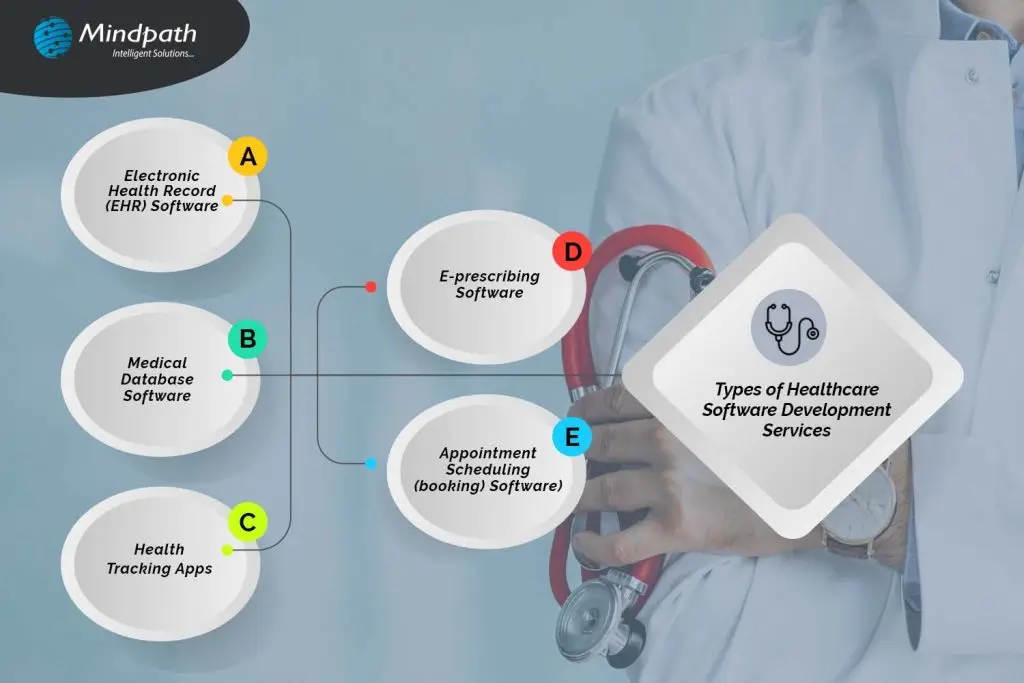
Types of Healthcare Software Development Services - infographic

1. Electronic Health Record (EHR) Software   

EHR software is being used by hospitals and clinics like any CRM, but with a healthcare tune. It contains all the relevant information concerning every patient, among them what medicines they use, the various doctors’ advice, and the medical processes that they have gone through. Many EHRs incorporate mechanisms for billing, collection, and even a patient portal that allows patients to view consultation history, medical records, and prescriptions. There are two types of EHR software: the electronic patient record, which is used in hospitals for management purposes concerning a patient internally, and the electronic medical record, which keeps track of information like medications, past and future procedures, and how well the patient is recovering. 

2. Medical Database Software   

Medical database software can be called a huge library of information about medicine, not according to the profiles of patients but according to diseases. This tool aids doctors in looking through cases like one that is being treated and thus making informed decisions about its cure. It is also used for learning by allowing doctors to know more about certain diseases. For example, a dermatologist using medical database software can view all the patients diagnosed with Atopic Dermatitis, compare their symptoms, treatments, and recovery plans, and find the best approach for their current patients. 

3. Health Tracking Apps 

Health-tracking apps are part of the fast-growing industry called mHealth, which stands for “mobile health.” This industry, valued at $37 billion globally for 2019 alone, allows users to trace and manage their health from their smartphones. Some of the popular health monitoring apps include fitness apps such as 8fit, diet apps such as Fitatu Calorie. For instance, sleeping patterns are monitored by the FitBit wristband, while the Oura Ring is responsible for monitoring several health metrics. Others include glucometers for testing blood sugar levels and, of course, thermometers in general—for instance, tracking menstrual cycles like the Kindara app. All these tools work together to give users a better understanding of their health and wellness. 

4. E-prescribing Software 

The e-prescribing software is becoming a tool that every doctor must have, with countries all over the world rapidly adopting electronic prescriptions. Such software allows doctors to easily manage all prescriptions for all patients by tracking, renewing, and canceling them as need be. It is also connected to national drug reference databases that help in picking up the right medications and making sure there is no error. Examples include MediTab and ScriptSure, two software programs designed to ease e-prescribing and improve the capabilities of health professionals to deliver accurate and effective care. 

5. Appointment Scheduling (booking) Software 

Appointment scheduling software is designed to assist hospitals, clinics, and medical practices in managing their appointments online. This normally allows the provision of a user-friendly platform through which patients can easily book appointments via an app or website without calling up the office. This type of software normally features email notifications and automatically sends reminders to doctors and patients about upcoming appointments. It accommodates multiple doctors’ schedules, cancellations, or rescheduling of appointments, and does much more to provide appointment trend data that helps in bringing efficiency to the practice. Additionally, AI chatbots are integrated into these systems to enhance the booking experience. These chatbots can handle appointment scheduling, provide immediate responses to patient inquiries, and assist with rescheduling or cancellations. 

Looking to boost your healthcare operations with top-tier software solutions?

At Mindpath, we deliver cutting-edge, customized healthcare software to empower efficiency and elevate patient care.

Why Are Healthcare Practitioners Going Digital? 

Health practitioners use digital technologies greatly because of the great advantages they present in improving patient care and practice management. Digital healthcare solutions help doctors in the management of patient information. Therefore, record-keeping becomes more accurate and efficient while diminishing the burdens of paperwork.  

Healthcare IT has been one of the fast-growing markets and is expected to grow further. From $303.4 billion in 2022, this is projected to rise as high as $974.5 billion by 2027 with a good annual growth rate. The market is expected to grow to $728.63 billion by 2029 and even further to $1,069.13 billion by 2032. Healthcare provider solutions take up about 38% of the market, such as those in Electronic Health Records. On the other hand, IT services form 52% of the market, including online payments and cybersecurity. Growth is fueled by new technologies, increased spending by consumers, and government initiatives; however, challenges persist, with the most important ones being related to cybersecurity risks. It has the maximum market share in North America due to its better and advanced infrastructure. The European region is predicted to grow fast with government help and support, adoption of AI soon. Some major players in this field are GE Healthcare and Philips, which are carrying the industry forward. 

Leading Healthcare Software Development Services at Mindpath 

Mindpath offers a full cycle of healthcare software development services that meet all the needs of healthcare providers, patients, and all those concerned. Our offered solutions work toward better patient care while easing operations. Here are the services we provide: 
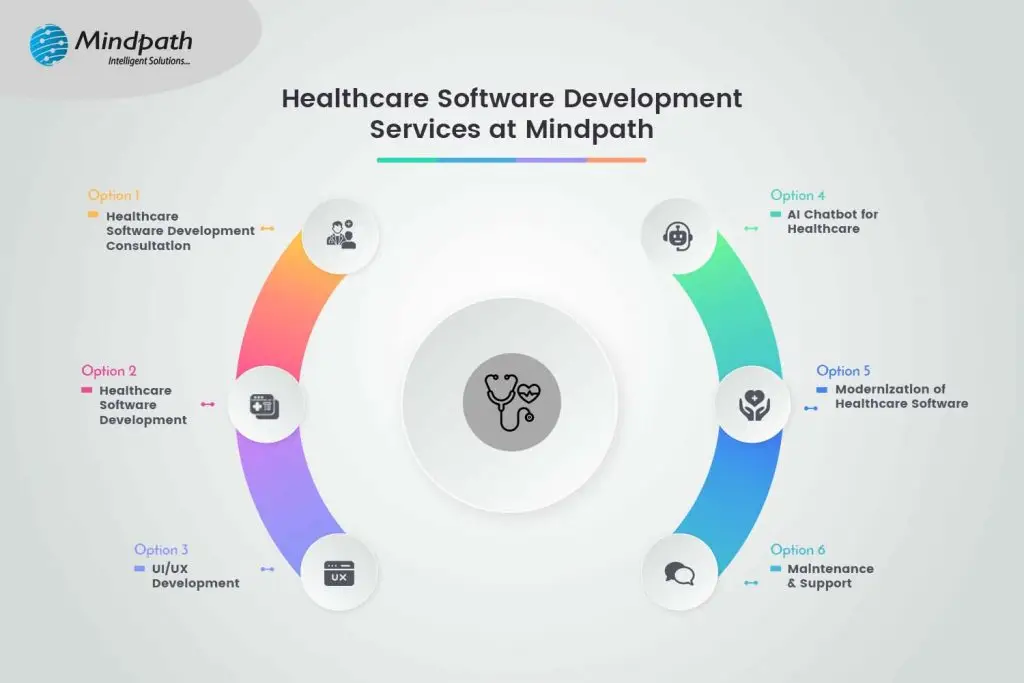
Leading Healthcare Software Development Services at Mindpath - infographic format

1. Healthcare Software Development Consultation: 

We assist in planning and designing your healthcare software project from an idea to detailed planning. Our advice ensures you will have a clear roadmap for developing effective healthcare solutions.  

2. Healthcare Software Development: 

We develop various healthcare IT software solutions, including Electronic Health Record (EHR) software, practice management systems, patient portals, among others. The solutions are secure, scalable, and well-built according to the industry regulations to ensure better patient care and efficiency. 

3. UI/UX Development: 

We design easy-to-use interfaces that will be convenient and pleasant for the eye. We focus on bringing your healthcare software both functionality and user experience. 

4. AI Chatbot for Healthcare: 

Our AI chatbots for healthcare answer questions, provide appointment scheduling, and disseminate medical information. They help improve interaction with patients and relieve some workload from the health staff. 

5. Modernization of Healthcare Software: 

Legacy system upgrade and migration to state-of-the-art platforms, enrichment of new functionalities, and updating of old technologies to manage your software and keep it relevant. 

6. Maintenance & Support: 

Ongoing support and maintenance are available to make sure that your healthcare software keeps running smoothly and aligns with your changing needs. 

Conclusion  

The huge effects of rapid growth in technology reshaping healthcare to become more effective, accessible, and patient-centered are undeniable. It is evident from the adoption of electronic health records and e-prescribing software at the end of the spectrum to health-tracking apps and AI-driven tools that are revolutionizing how healthcare providers care for patients and their practices.  

Such innovations not only improve the quality of care provided to patients but also the administrative flow, hence making healthcare very responsive and effective. Adopting the newest technology is crucial for healthcare organizations to keep ahead of these trends as the sector continues to change. This is where a holistic approach to healthcare software development is necessary. Healthcare providers may enhance patient outcomes, streamline operations, and more adeptly navigate the digital terrain by incorporating cutting-edge software solutions.  

At Mindpath, we are dedicated to supporting healthcare providers through every step of this transformation. From development and consultation to UI/UX design and modernization—our services cover a large area of needs, all meant to make sure you can drive positive change in healthcare through digital technology. Be it building new systems, updating existing ones, or ensuring ongoing support, Mindpath makes sure that your healthcare software is of the highest quality and effectiveness. 

Are you curious about how cutting-edge medical software might transform your business?

At Mindpath, we develop solutions that improve patient care and expedite operations.

Related Post

Discover how IT staff augmentation can optimize costs, enhance flexibility, and access specialized talent to boost your organization’s success.

Related Post

Web Development Costs

Understanding the web development costs is a significant question many businesses struggle with before initiating a project. Web development is the easiest way to make your products and services connect with global audiences. In fact, entrepreneurs are well aware of the profitable aspects and booming growth they can adopt through the online market. Talking about the trends, progressive web applications are growing fastest at a CAGR of 14.00%. Moreover, around 71% of businesses already have a website. 

So, it becomes necessary for you to understand how much a web development costs. For your information, there are numerous factors that influence the cost of web development. This guide can help you with a complete breakdown, no matter if you are starting from scratch or have a small budget. 

Planning to build a website and need a clear cost roadmap? Mindpath delivers scalable web development services designed to fit your business goals.

What Does the Web Development Cost Include?

Before you get into the web development costs, it is necessary to research your competitors and how uniquely you need to develop your site. Moreover, developing a good and reliable website is not just about writing code or initiating good designs. The total website development cost breakdown is dependent on your website’s structure. 

Further, you need to be considerate about the functionality, technology stack, and the requirements for post-launch support. Here are some quick factors that influence the web development prices

1. Type of website

A static website might cost you less than an interactive SaaS project.

2. Technology Stack

Use of leading frameworks like Laravel, React, or Next.js can increase the development timeline along with their charges. 

3. Customization Values

If your website is developed with a pre-built template, the cost will be much lower. On the other hand, custom approaches can heighten the price range. 

4. Development Approach

If you are valuing the expertise of a professional web development company, the development charges will be higher than those for a freelancer. However, the projects from a certified company always win in the competitive edge. 

Curious why some web projects cost more than others? Discover web development tools and see how technology choices influence productivity and expenses.

What are the Average Web Development Costs for Multiple Industries?

The average web development cost majorly depends on the type of website you are relying on. Further, it also depends on the way you are creating and launching it. 

1. Small Business

A small website development cost generally falls between USD 1000 and USD 10,000. Basically, it will include 5 to 10 pages, including content management systems such as WordPress. Moreover, there will be some useful features like service pages, contact forms for reaching the business, along with mobile responsiveness. 

So, if you are serving locally or a startup business, this web development pricing can be useful. 

2. Corporate Operations

A corporate website will include some good features like ERP integrations and scalable architecture.  So, for such a business, the web development costs will be around USD 10,000 to USD 50,000. 

Such a price range offers proper performance optimization and user engagement. Further, it also enhances a business’s reach on global platforms while including many advanced options in it. 

3. E-commerce Sites

When it comes to e-commerce sites, the cost of web page development automatically heightens. Further, the cost breakdown depends on your catalog size, custom product pages, payment gateway integration, and shipping management systems. 

Many users also consider building their entry-level store through platforms like WooCommerce and Shopify. However, a completely customized e-commerce website can range up to USD 50,000. This will cover all types of essentials, such as automating the inventory management and multi-vendor benefits. To enhance your customer experience, you should be careful about the project’s security. 

4. Custom Web Applications

The overall cost of custom web development will fall in the range of USD 25,000 to USD 160,000. Your web application will include several important platforms like booking engines, SaaS products, real-time dashboards, and internal management systems. 

These are some custom solutions that need to be built from scratch and require advanced backend architecture, API integration, scalable database, etc. The web application development is comparatively challenging and requires the involvement of experts. 

This is the general idea about the average web development costs for multiple business types. So, the costs might vary depending on the various requirements of your projects. 

Looking to understand how emerging trends affect web development costs? Check out the latest web development trends to see how new technologies and practices influence project scope.

Website Development Cost Breakdown as Per the Types

You must be aware of the fact that every website has its unique development scope. So, the web development prices generally depend on your site’s functionality, complexity, and the intended need of the project. Here, you can go through the expected cost of web page development

Web Development Type Key Functions Development Phase Estimated Cost 

Basic Clean and understandable UI, contact forms, page navigation, search tools, etc., 6 to 12 weeks, USD 10,000 to USD 20,000. 

Standard User interaction, seamless content management, API usage, database support, etc., 3 to 6 months USD 20,000 to USD 45,000. 

Advanced High-level data flow, custom modules, real-time functionality, etc., 12 months plus. Starts at USD 50,000 and increases with custom inclusions. 

Planning your web development budget more effectively? Explore web development technologies to see how choosing the right stack affects cost and performance.

Website Development Cost As Per the Chosen Experts

There are multiple options available in the market to personalize your web development. Let us explore some valuable vendor types that have been offering the best web development costs while enhancing the facilities through viable inclusions. 

1. Team of Expert Web Developers

Hiring a professional web development team can be the best option available in the market. However, you might think it is an expensive investment. But remember that this option offers the highest level of security. 

Apart from this, these agencies consist of experienced people who can easily customize your projects as per your business goals. Such companies can help you with an accelerated web development process. Apart from leveraging design and developmental solutions, they also ensure website maintenance while developing a marketing strategy. The web development pricing of the full-fledged agencies will be around USD 15000 to USD 150,000 and more. 

2. In-house Development Team

Creating your own web development team offers you the advantage of having dedicated professionals at your fingertips. However, the process can be resource-intensive and time-consuming. You need to be assured of effective management and create a positive work environment. Other than this, it can be challenging for you to find candidates who match your required skills and budget. 

Remember that an in-house web development team is necessary if the website is essential to your business. The average web development cost of these experts can be between USD 80,000 and USD 200,000 per year. 

3. Freelance Developers

Freelancers will charge you around USD 15 to USD 80 per hour. They are the only viable options that come within a small budget. They are best suited for your small websites, MVPs, or any budget-centric projects. Further, they offer flexibility with the contracts and easily scale the tasks. 

4. DIY Efforts

Many businesses just take the challenge to create their website on their own. However, it takes high skills and commitment. The process remains slower, and you might commit mistakes that your business can’t bear at all. 

Curious how web development costs compare to full-scale software projects? Discover software development cost insights to understand long-term budgeting and investment planning.

How to Pick the Best Web Development Partner?

If you require your development process to be effective enough, only prioritizing the website development cost breakdown is not enough. You need to prefer the right development team or company that can make your project a success. Moreover, they should satiate your budget without being a burden on your pockets. 

A right development partner should meet your budget, business requirements, and technical needs. So, you should look for experts who have good experience with your project type and industry. The experts should follow clear communication while being transparent regarding their process and charges. They should offer a detailed proposal regarding their web development pricing. So, no matter if you are choosing a professional agency or a freelancer, just be assured of their support and clarity. 

What are Some Ongoing Costs that you might experience after a Website Launch?

Launching a site is just half of your journey. There are other elements related to it that can proceed with ongoing costs. Some of the major ones have been listed below. 

1. Hosting Charges

Hosting charges usually come on an annual or a monthly basis. Shared hosting can be a bit approachable, while cloud hosting might hamper your budget. 

2. Maintenance Efforts

To let your website offer desirable results, you need to continuously test its performance and fix bugs when required. 

3. Support Packages

Your company might require support packages from web developers to keep the website performance-oriented. 

Want to avoid unexpected web development costs? Check out the web development roadmap to understand project milestones and cost drivers.

Conclusion

It is a great thing to understand the website development cost breakdown before you think about any project. This can help you set clear goals while maintaining your budget. On the other hand, costs differ as per your goals, industry, requirements, and complexity of your projects. Breakdowns available in this guide can help you plan your projects with clarity. A well-defined budget with a solid plan can help you prevent your company from costly surprises and help your website to fulfil your business goals precisely. 

So, if you are ready to experience the next step with a personalized cost estimation and strategy customized specifically for your business needs, consider the excellence of Mindpath’s web development services. Here, the team can help you build a website that can match your vision while pushing you ahead in the market. 

travel technology

Technology has helped in transforming various industries, including finance, retail, and tourism. The advent of travel technology has created new opportunities to enhance the value propositions in tourism, alongside enhancing productivity. Which technology has had the biggest influence on the travel and tourism industry? You can find the answers to this question in an overview of the top technological trends in tourism.

The transformative impact of different technologies has created endless possibilities for enhancing guest experience and customer service. With the adoption of technology in travel and tourism, businesses can find an effective solution to add value to the lives of customers. Let us learn about the top technology trends that have the potential to revolutionize tourism. 

Technology is redefining the travel experience, and businesses must adopt these technologies to stay ahead in the competitive market. Mindpath’s services in AI development, custom chatbots, and web development will support your business journey towards digital transformation.

Understanding Travel Technology

The travel and tourism industry came to a halt for almost a year in response to the global pandemic in 2020. However, change was inevitable, and the tourism industry recognized the importance of embracing technology and digital transformation like other sectors. The introduction of tech in tourism brought a new wave of opportunities to address existing flaws and pursue innovation in delivering better customer experiences. 

According to the World Travel and Tourism Council, the total global economic contribution of the tourism sector is expected to be almost $11.7 trillion in 2025 (Source). For an industry with such potential, technology is no longer a luxury as organizations compete with each other to achieve an advantage. 

The basic premise of travel technology involves the use of IT, e-commerce, and other technologies in the domain of travel and tourism. It primarily aims at enhancing the customer experience while assisting businesses and employees in the tourism and hospitality sector.

One of the best examples of the use of technology in the domain of travel and tourism points at mobile apps for booking trips online. The apps not only provide an easy solution to book tickets and hotels but also represent a shift towards technology-driven experiences in tourism.

Struggling to keep up with changing traveler expectations and digital innovation? Explore our blog digital transformation for businesses to learn how technology drives efficiency, personalization, and growth.

Is Technology Really Necessary for Travel and Tourism?

The example of online booking apps in the travel and tourism sector is not the only instance of the use of technology in the industry. As companies embrace technology in the tourism industry in various forms, it is reasonable to wonder about its relevance. How will technology help in the travel, tourism, and hospitality sector? Technology can help in streamlining and automating processes that require consistent human involvement. As a result, businesses can reduce costs and staffing requirements while achieving better financial results.

The impact of technology in the domain of travel and tourism is also evident in easier access to advanced data insights. With the help of technology, businesses can collect huge amounts of data to improve informed decision-making. In-depth understanding of customer behavior and market trends can help a business create better strategies. The use of technology in the tourism industry will also create the ideal grounds for continuous innovation. Businesses in travel and tourism can leverage technology to stay relevant and attract new customers with improved experiences.   

Curious which technologies help travel apps scale and perform globally? Discover our blog mobile app development technologies to learn how modern development stacks support innovation in the travel industry.

Unraveling the Biggest Tech Trends in Travel and Tourism

The utility of technology in the travel and tourism sector is not limited to booking apps. You can find different technologies in the tourism industry making waves with their ability to revolutionize travel experiences. What are the notable tech trends that will have a significant impact on tourism? The following technology trends will stand out as the biggest contenders for transforming the travel and tourism sector.

1. Sustainable Technology

The growing awareness of the environmental impact of tourism has led many people to think of sustainable solutions. Therefore, travel and tourism companies have to think of innovative technological solutions that have minimal impact on the environment. 

Sustainability will be one of the keywords for tourism technology of the future, as evident in the existing customer behavior trends. For instance, more travelers prefer eco-friendly destinations and use technology for all travel-related needs that reduce the wastage of natural resources.

2. Artificial Intelligence

If you take a look around in the modern technological landscape, AI might be the brightest trend you will notice among other technologies. Artificial intelligence has redefined the benchmarks of efficiency in the approaches to embracing technology in the travel industry with its diverse capabilities. AI and machine learning can bring a lot of benefits to travel and tourism businesses in customer service, demand forecasts, and service recommendations. 

Many companies in the travel and tourism sector leverage AI and ML to predict customer demand and offer personalized recommendations. How would you feel if a travel operator recommends hotels and restaurants that serve your favorite food? AI can also help travel and tourism companies in the form of chatbots and smart virtual assistants. The AI-powered solutions can not only answer customer queries but also offer personalized itineraries and travel plans.

3. Augmented and Virtual Reality

The evolution of virtual reality and augmented reality has offered new ways to experience the world around us, along with virtual worlds. AR/VR technologies provide one of the most promising examples of the potential of travel industry technology to offer better customer experiences. Augmented reality helps in changing how travellers think about their experiences before booking their vacations or business trips. 

The best example of using AR/VR technologies is evident in the case of some airline companies that help passengers experience the in-flight facilities before boarding the flight. Travellers can also get 360-degree virtual tours of hotels or travel destinations while sitting in their homes with AR/VR technologies. Augmented and virtual reality will emerge as the most powerful marketing tools for travel and tourism companies.     

Also Read: Top AI Trends

4. Hyper-Personalization

Another big trend that redefines the utility of technology in tourism is hyper-personalization. The emphasis on hyper-personalization has increased significantly as travel and tourism companies want to deliver exactly what their customers want. Artificial intelligence has made this easier as innovative AI solutions can help in personalizing travel experiences to varying degrees of customer satisfaction.

Travel and tourism companies can leverage AI to generate personalized recommendations and plans for their customers. Custom AI tools can help travel operators find insights from analysis of past behavior, weather conditions, and preferences of travelers. The extensive use of information technology for tourism has enabled easier access to huge collections of user data. Subsequently, those insights can help the companies recommend personalized travel plans that improve customer satisfaction while achieving business efficiency.

5. Voice Search and Voice Control

Voice assistants are one of the prominent highlights in the existing tech landscape. The growing dependence on voice assistants for search is one of the travel tech trends that is hard to ignore. Almost half of all travelers search for travel accommodations and book tickets through voice commands. It is just a matter of time before voice search and voice control become the norm in tourism and hospitality.

Voice search has already become an attractive feature in hotels that allow guests to control room temperature and adjust lighting. You can expect this technology to grow in the future and promote innovations in the travel industry while attracting new customers. Voice assistants in hotel rooms can also help customers request hotel services without interacting with the front desk, thereby improving their experience.

6. Generative AI

The utility of generative AI in travel and tourism also deserves special mention among notable tech trends in the industry. Generative AI can blend tourism and technology in an intuitive manner with the help of language models like ChatGPT. Travel and tourism companies can use ChatGPT or similar tools to create new content for their marketing efforts. On top of it, the language models can help companies provide prompt replies to customer queries and enhance customer satisfaction.

The significance of generative AI in strengthening the technology tourism connection is visible in its different use cases. One of the foremost outcomes of adopting generative AI tools in tourism is the assurance of better productivity. For instance, generative AI tools can help companies with booking and reservations, alongside providing personalized solutions to customer queries.

Wondering how travel businesses can leverage AI beyond basic automation? Learn from our blog about generative AI use cases in diverse industries to see how intelligent content and virtual assistants drive engagement.

Final Thoughts

The top tech trends in travel and tourism showcase that customer experience is the biggest goal of the industry’s transformation. Artificial intelligence, AR/VR, sustainable technology, and voice control are a few of the notable trends that will shape the future of travel technology and the industry itself. Without effective solutions to tap into these technologies, your business is not going anywhere. What do you think is the biggest tech trend that your travel and tourism business should be capitalizing on?

We, at Mindpath, specialize in services for AI development, custom chatbot development, and custom web development. Our end-to-end IT solutions cater to the needs of various sectors, including the travel and hospitality industry. Over the years, our experts have looked at the evolution of technology and the tourism industry from close quarters. We have created many customer success stories with our strategic approach to every project. Contact us to discover the next big tech trend for your travel and tourism company now.

Discover top tech trends transforming the travel industry, from AI to IoT, and learn how Mindpath can help your business stay ahead.
Tech Trends

Curious about what’s going to be big in tech this year? Want to know the trends that will shape our world in 2024? In this blog we will explore the latest technology trends that are set to shape the future. 

The world today is fast-moving and changing constantly; hence, businesses and professionals need to keep up with the latest technologies.  Be it learning new skills to get ahead in your career or just knowing what’s happening around you to effectively communicate in your workplace, knowing the changes in technology makes all the difference.  It would make the workflow easier, save much time, and increase productivity.  Much of today’s job search is conducted through digital tools and platforms, so keeping ahead of the game to ensure you present yourself in the best light possible is highly important. In addition, updated technology has made it possible for businesses to better reach their potential customers with very relevant content across social media, apps, and blogs. Staying ahead of the technology curve better engages and understands your audience, establishes stronger relationships, and helps to differentiate you in the marketplace. 

So, let’s dive into the latest technology trends that can help you stay updated as well as transform the future! 

Top 10 Technology Trends 2024  

1.  AI-Generated Content   

One of the major tech trends of 2024 should be AI-created content. Artificial intelligence is capable of creating high-quality content in textual, visual, video, and even musical formats. For example, tools like GPT can write articles or help with education-related materials, such as generating summaries for textbooks or creating engaging blog posts. DALL-E will produce unique and different images based on simple descriptions, like custom illustration designs for a website or to use for adding visuals to a social media campaign. It eases and speeds content creation, especially for small businesses or individuals with meager budgets. For example, a small online shop could use AI to create promotional graphics for a sale or quickly generate product descriptions. AI-generated content saves time and money, giving more opportunities to let their ideas be heard on a greater scale. 

2. Quantum Computing   

Quantum computing is one of the most exciting technology trends that will make a difference in 2024. A quantum computer avails itself of the law of quantum mechanics to deal with information much more quickly compared to traditional computers, especially for specific tasks. This could be applied to cryptography: quantum computers would resolve cryptographic codes and change the idea of securing data. The quantum computer can accelerate the process of drug discovery by emulating a complex structure of molecules precisely, and thus aid in the development of new medicines. Though still in its infant stage, quantum computing is sure to be a game-changer in different industries; it gives solutions to problems that ordinary computers cannot solve. It stands on the verge of reshaping everything about how complications are handled and can be of vital importance in domains such as cybersecurity or pharmaceuticals. 

3. 5G Expansion   

Compared to previous generations, 5G offers much greater data speed, far superior coverage, and connections more reliable. This huge growth in 5G has spurred the development of technologies that are considered transforming—for example, the Internet of Things, augmented reality, and autonomous vehicles. 5G underpins the very fast and efficient communication among many IoT devices leading to smart homes and cities. Augmented reality experiences, like interactive games or virtual training, require ultra-low-latency connections of 5G. In the same way, the quick data interchange feature and high-speed data processing ability of 5G technology are applied in autonomous vehicles for safe and very accurate self-driving capability. 

4. Virtual Reality (VR) 2.0   

Virtual Reality 2.0 provides even more realistic and engaging experiences. Improved VR technologies enhance display resolution, motion tracking, and interaction features, giving a world that is brimming with activity and character. For instance, in gaming, next-generation VR provides highly detailed graphics and motion tracking to give users the impression of complete immersion into their video game environments. In training, it is used in simulating scenarios of the real world for effective learning. Moreover, VR also brings benefits in therapeutic settings where controlled virtual environments can treat a wide range of anxiety or PTSD cases. Recent improvements are also geared toward making VR more user-friendly, with lighter headsets and longer battery life that may see more people using VR in daily life.  

5. Augmented Reality (AR) in Retail   

Augmented Reality (AR), in the retail sector, created something different this 2024 by providing consumers with new ways of shopping. In other words, AR technology really makes it possible for shoppers to see products in their real-world environment right on their smartphones or tablets. For instance, AR applications that will let you have a virtual trial of specific attire, showing you how you are likely to look in it. Likewise, AR can show furniture fitting and appearance in a room prior to one making a purchase. Such kinds of interactions provide more than better customer satisfaction since people can make better decisions. Rather, they increase sales and reduce return rates. By providing customers with a better feel for how products are going to work in their lives, AR is revolutionizing the retail experience to make it not only more fun, but more convenient. 

6. Internet of Things (IoT) in Smart Cities   

Smart cities are being implemented in 2024 through the power of the Internet of Things. IoT technology interlinks a variety of sensors and devices involved in running the resources and services of cities for easy gathering and analysis of data. For example, it can monitor traffic patterns and public transport systems to bring about ease in congestion and reduce travel time. On the other hand, smart grids make use of IoT to optimize energy consumption and, hence, make cities more energy-efficient and cost-effective. IoT facilitates public safety by interconnecting various emergency services and monitoring public places against incidents to enable quicker responses. As cities continue to grow in population, IoT helps deal with the increasingly complex management of urban areas to ensure an improved quality of life through responsive and sustainable cities. 

7. Blockchain Beyond Crypto   

This blockchain technology, first developed for Bitcoin, is making waves way beyond just cryptocurrency in 2024. It’s very unique features are harnessed across a plethora of industries: transparency, security, and reduction of fraud. For example, blockchain will track where something came from and its journey in supply chains to ensure authenticity and prevent counterfeiting. In voting systems, blockchain provides a tamper-proof way of recording votes, hence making elections safer and more trustworthy. Moreover, blockchain is useful in managing secure medical records and thus in safeguarding sensitive health information against unwarranted access. These new applications underline blockchain’s potential for improving transparency and security within different fields, stretching its benefits far from the world of digital currency. 

8. Neuromorphic Computing   

Neuromorphic computing is one of the most exciting tech trends looking forward to 2024, which is basically a kind of computing intended to develop computer chips like the neural structure of the human brain. In contrast to traditional computers, chips process information like our brains. This approach improves efficiency, especially in tasks like pattern recognition and sensory data processing. It can make Technologies that require real-time learning and adaptation—in terms of advanced robotics or AI systems that work in interaction with their environment—much better. Such chips offer enormous gains in energy efficiency and computational power, hence making them ideal for uses where quick, adaptive responses are needed. When completely developed, this technology has the potential to cause revolutions in how we look at complex computing tasks. 

9. Autonomous Vehicles   

Autonomous vehicles are among the top tech trends for 2024. These are cars that use AI, sensors, and machine learning to drive on roads and navigate without human intervention. Even though a completely self-driving car has not yet been developed, remarkable development has happened in having different degrees of autonomy within public transport and freight logistics. For example, cities are testing autonomous buses to make public transport more efficient and safer. In freight logistics, self-driving trucks are already applied to facilitate deliveries, reducing traffic accidents by ensuring that the right routes are followed while lowering emissions. The further development of these technologies will provide higher road safety, reduce congestion, and contribute to cleaner air. 

10. Edge Computing 

Edge computing is another leading technology trend. It deals with processing data closer to its source and thus does not have any central data center. This is quite critical for applications requiring real-time processing and quick decision-making, which was hitherto faced with latency in the case of cloud computing. For example, edge computing in autonomous vehicles performs instantaneous processing of sensor data to support quick driving decisions. In industrial IoT, it helps real-time monitoring and control of machinery for increased efficiency and safety. Moreover, edge computing supports local data processing in remote areas where internet connectivity may be poor, hence ensuring that crucial data is well processed and acted on. This technology enhances performance and lowers latency across a wide variety of applications. 

Ready to Transform Your Future?

At Mindpath, our expert team is here to guide you through modernization, digitization, and innovation, ensuring you stay ahead of the curve.

Lead the Way in Technology with Mindpath 

In the fast-changing technological world today, one needs innovation, expertise, and strategic planning to be ahead. Mindpath empowers your business to lead in this by offering cutting-edge IT services that are tailor-made for you. Our team works hard to ensure you leverage new technologies, optimize your processes, and drive growth to be competitive and successful in a changing digital world. Here are the services we offer: 

1. Modernization 

Bring your business up to speed with legacy system upgrades, process optimization, and state-of-the-art technologies. We provide modernization services to help you keep up with the ever-changing world of business. 

2. Digitization 

Get proper visibility online through our all-rounded Web Development and App solutions. We give you the tools and strategies to help your business remain relevant and competitive across the digital space. 

3. Innovation Hub 

Our Innovation Hub is where creativity meets implementation. We are an innovative, collaborative space for ideas, project development, and making things happen. From an initial concept to the final execution, we will guide you through your innovation journey. 

4. Custom Chatbot Development 

Take user experience to another level by our bespoke chatbot solutions. Our intelligent, conversational chatbots will smooth interactions and great insights that improve customer engagement and support. 

5. Artificial Intelligence Development 

Leverage AI to unlock new insights to do what really matters, automate processes, and predict trends. Tailored AI solutions will let you drive efficiency and foster innovation while lining them up with your business goals. 

6. Staff Augmentation 

Make use of our skilled professionals in aiding you to achieve your project objectives—short- or long-term. Experts integrate into your team to raise your business to the next level with exceptional results. 

Conclusion 

2024 is the handiwork of innovation that will change our world in immense ways. From AI-generated content to quantum computing, the very pervasiveness of 5G, and the transformative power of augmented and virtual reality, keeping ourselves conversant and adaptable becomes imperative. These trends call for more innovation than ever but equally demand readiness to tap their full potential. The reason for embracing these technologies is threefold: efficiency, growth, and new opportunities within many industries.   In this age of rapidly changing technology, Mindpath stands ready to guide and lead you in the digital age. Our suite of expertise in IT services is crafted for you and your specific needs to move your business forward. From modernizing systems to digitizing an online presence or innovation in our collaborative hub, Mindpath is equipping businesses like yours for success. Our services are developed in the belief in the easy integration of bespoke chatbot development, advanced AI solutions, and skilled staff augmentation, giving wings to your goals and elevating your projects. 

Ready to Embrace the Future?

Dive into the latest tech trends with Mindpath and explore how our tailored IT solutions can transform your business!

Discover the top tech trends for 2024 and how Mindpath’s cutting-edge IT services, from modernization to AI, can help you stay ahead and drive innovation.