An Overview of Healthcare Development Services and Guide to Hire Right Service Providers.

Join our Newsletter!

Featured Posts

Support Is One Click Away

Home

An Overview of Healthcare Development Services and Guide to Hire Right Service Providers.

healthcare software development services

An Overview of Healthcare Development Services and Guide to Hire Right Service Providers.

Ever Wondered how technology is really influencing the healthcare sector? From electronic health records and telemedicine to mobile health apps, today healthcare software development plays a great role in changing the way patients receive and providers provide treatment.  

But what exactly are healthcare software development services, and why are they crucial for modern medicine? In this blog we will explore healthcare software development services and how these cutting-edge solutions are going to shape the future of healthcare, improve patient outcomes, and smooth operations. 

What is Healthcare Software?    

Healthcare software development is the process of developing individualistic computer programs designed for hospitals, clinics, and all other types of healthcare organizations. These programs assist in enhancing how healthcare providers render care by making processes more effective, accurate, and oriented towards patients. Healthcare software creates a complete digital system within a healthcare organization.  

This allows medical professionals to offer better and more accurate clinical services. To doctors, this represents an easy way to do follow-ups and monitor the health of their patients, schedule appointments, and get access to medical reports, all from the comfort of managing staff. To patients, it offers online appointment booking, live chat with doctors, sharing of medical reports, and receiving health advice.   

These software solutions come with various benefits associated with the improvement in patient care, efficiency, and reduction in medical errors. They can digitize the traditional paper-based systems and take care that patient care is performed quicker and much more safely. Healthcare software is further creating new sectors, such as patient engagement, clinical robotics, and telehealth, driving a lot of startups to bring ideas into life. 

 Types of Healthcare Software Development Services  
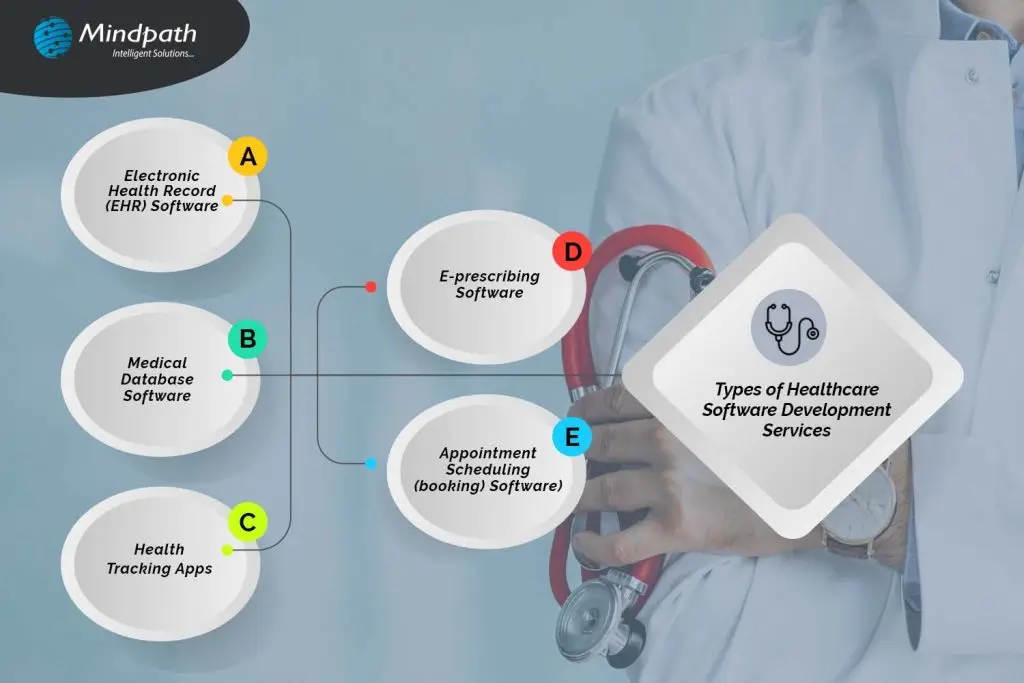
Types of Healthcare Software Development Services - infographic

1. Electronic Health Record (EHR) Software   

EHR software is being used by hospitals and clinics like any CRM, but with a healthcare tune. It contains all the relevant information concerning every patient, among them what medicines they use, the various doctors’ advice, and the medical processes that they have gone through. Many EHRs incorporate mechanisms for billing, collection, and even a patient portal that allows patients to view consultation history, medical records, and prescriptions. There are two types of EHR software: the electronic patient record, which is used in hospitals for management purposes concerning a patient internally, and the electronic medical record, which keeps track of information like medications, past and future procedures, and how well the patient is recovering. 

2. Medical Database Software   

Medical database software can be called a huge library of information about medicine, not according to the profiles of patients but according to diseases. This tool aids doctors in looking through cases like one that is being treated and thus making informed decisions about its cure. It is also used for learning by allowing doctors to know more about certain diseases. For example, a dermatologist using medical database software can view all the patients diagnosed with Atopic Dermatitis, compare their symptoms, treatments, and recovery plans, and find the best approach for their current patients. 

3. Health Tracking Apps 

Health-tracking apps are part of the fast-growing industry called mHealth, which stands for “mobile health.” This industry, valued at $37 billion globally for 2019 alone, allows users to trace and manage their health from their smartphones. Some of the popular health monitoring apps include fitness apps such as 8fit, diet apps such as Fitatu Calorie. For instance, sleeping patterns are monitored by the FitBit wristband, while the Oura Ring is responsible for monitoring several health metrics. Others include glucometers for testing blood sugar levels and, of course, thermometers in general—for instance, tracking menstrual cycles like the Kindara app. All these tools work together to give users a better understanding of their health and wellness. 

4. E-prescribing Software 

The e-prescribing software is becoming a tool that every doctor must have, with countries all over the world rapidly adopting electronic prescriptions. Such software allows doctors to easily manage all prescriptions for all patients by tracking, renewing, and canceling them as need be. It is also connected to national drug reference databases that help in picking up the right medications and making sure there is no error. Examples include MediTab and ScriptSure, two software programs designed to ease e-prescribing and improve the capabilities of health professionals to deliver accurate and effective care. 

5. Appointment Scheduling (booking) Software 

Appointment scheduling software is designed to assist hospitals, clinics, and medical practices in managing their appointments online. This normally allows the provision of a user-friendly platform through which patients can easily book appointments via an app or website without calling up the office. This type of software normally features email notifications and automatically sends reminders to doctors and patients about upcoming appointments. It accommodates multiple doctors’ schedules, cancellations, or rescheduling of appointments, and does much more to provide appointment trend data that helps in bringing efficiency to the practice. Additionally, AI chatbots are integrated into these systems to enhance the booking experience. These chatbots can handle appointment scheduling, provide immediate responses to patient inquiries, and assist with rescheduling or cancellations. 

Looking to boost your healthcare operations with top-tier software solutions?

At Mindpath, we deliver cutting-edge, customized healthcare software to empower efficiency and elevate patient care.

Why Are Healthcare Practitioners Going Digital? 

Health practitioners use digital technologies greatly because of the great advantages they present in improving patient care and practice management. Digital healthcare solutions help doctors in the management of patient information. Therefore, record-keeping becomes more accurate and efficient while diminishing the burdens of paperwork.  

Healthcare IT has been one of the fast-growing markets and is expected to grow further. From $303.4 billion in 2022, this is projected to rise as high as $974.5 billion by 2027 with a good annual growth rate. The market is expected to grow to $728.63 billion by 2029 and even further to $1,069.13 billion by 2032. Healthcare provider solutions take up about 38% of the market, such as those in Electronic Health Records. On the other hand, IT services form 52% of the market, including online payments and cybersecurity. Growth is fueled by new technologies, increased spending by consumers, and government initiatives; however, challenges persist, with the most important ones being related to cybersecurity risks. It has the maximum market share in North America due to its better and advanced infrastructure. The European region is predicted to grow fast with government help and support, adoption of AI soon. Some major players in this field are GE Healthcare and Philips, which are carrying the industry forward. 

Leading Healthcare Software Development Services at Mindpath 

Mindpath offers a full cycle of healthcare software development services that meet all the needs of healthcare providers, patients, and all those concerned. Our offered solutions work toward better patient care while easing operations. Here are the services we provide: 
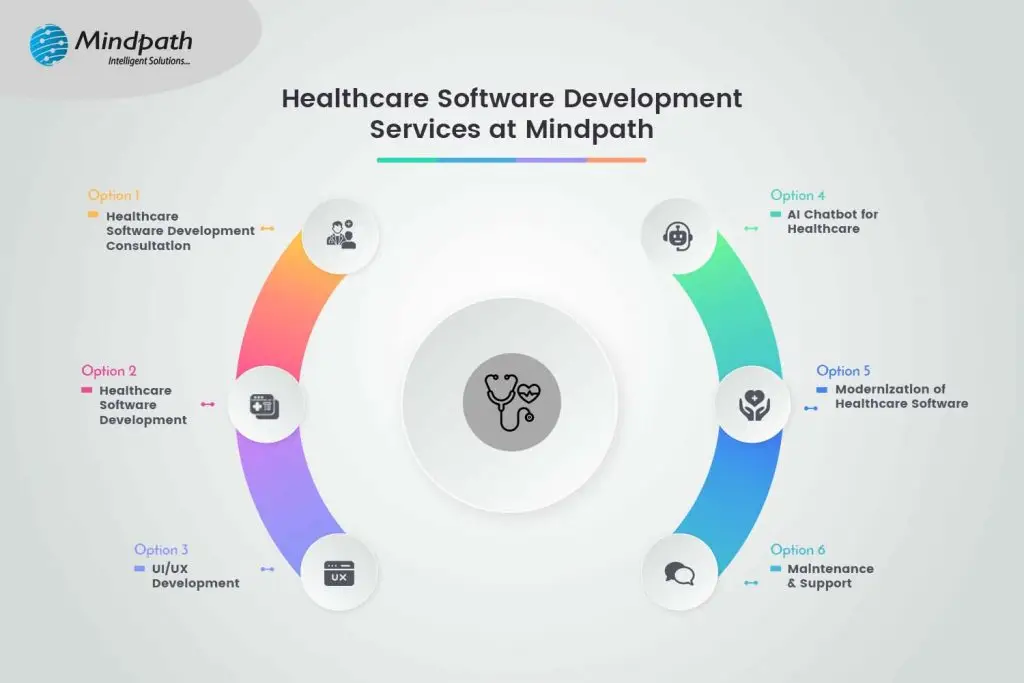
Leading Healthcare Software Development Services at Mindpath - infographic format

1. Healthcare Software Development Consultation: 

We assist in planning and designing your healthcare software project from an idea to detailed planning. Our advice ensures you will have a clear roadmap for developing effective healthcare solutions.  

2. Healthcare Software Development: 

We develop various healthcare IT software solutions, including Electronic Health Record (EHR) software, practice management systems, patient portals, among others. The solutions are secure, scalable, and well-built according to the industry regulations to ensure better patient care and efficiency. 

3. UI/UX Development: 

We design easy-to-use interfaces that will be convenient and pleasant for the eye. We focus on bringing your healthcare software both functionality and user experience. 

4. AI Chatbot for Healthcare: 

Our AI chatbots for healthcare answer questions, provide appointment scheduling, and disseminate medical information. They help improve interaction with patients and relieve some workload from the health staff. 

5. Modernization of Healthcare Software: 

Legacy system upgrade and migration to state-of-the-art platforms, enrichment of new functionalities, and updating of old technologies to manage your software and keep it relevant. 

6. Maintenance & Support: 

Ongoing support and maintenance are available to make sure that your healthcare software keeps running smoothly and aligns with your changing needs. 

Conclusion  

The huge effects of rapid growth in technology reshaping healthcare to become more effective, accessible, and patient-centered are undeniable. It is evident from the adoption of electronic health records and e-prescribing software at the end of the spectrum to health-tracking apps and AI-driven tools that are revolutionizing how healthcare providers care for patients and their practices.  

Such innovations not only improve the quality of care provided to patients but also the administrative flow, hence making healthcare very responsive and effective. Adopting the newest technology is crucial for healthcare organizations to keep ahead of these trends as the sector continues to change. This is where a holistic approach to healthcare software development is necessary. Healthcare providers may enhance patient outcomes, streamline operations, and more adeptly navigate the digital terrain by incorporating cutting-edge software solutions.  

At Mindpath, we are dedicated to supporting healthcare providers through every step of this transformation. From development and consultation to UI/UX design and modernization—our services cover a large area of needs, all meant to make sure you can drive positive change in healthcare through digital technology. Be it building new systems, updating existing ones, or ensuring ongoing support, Mindpath makes sure that your healthcare software is of the highest quality and effectiveness. 

Are you curious about how cutting-edge medical software might transform your business?

At Mindpath, we develop solutions that improve patient care and expedite operations.
Related Post

Hiring ReactJS developers? Explore essential factors like experience, skills, and project requirements to ensure a successful collaboration.
Discover the top Node.js trends shaping digital technology in 2024, from AI and TypeScript to IoT and cloud computing. Explore how Node.js drives innovation!

Related Post

AI Redefining Job Roles in Tech

Artificial intelligence is rapidly transforming how the tech world operates, bringing a wave of changes that are reshaping the ways in which professionals work and innovate. The influence of AI redefining job roles in tech can be seen across every corner of the tech industry, where automation and human creativity are coming together to drive smarter, faster, and more efficient ways of building the future. This isn’t about replacing talent; it’s about enabling talent to reach new heights of access and productivity.

Organizations are changing rapidly, and traditional job roles are being redefined. Developers have become strategists, data analysts have become decision-makers, and engineers are collaborating more closely with advanced intelligent systems, leveraging AI in decision-making to drive smarter business outcomes. The pace of change will accelerate, and those who can adapt will lead the next generation of digital expansion. Let’s dive in and examine the impact of AI on the future of work and how it is changing the technology landscape like never before.

As AI transforms the tech workforce, businesses have more ways than ever to scale and innovate. Want to know how? Explore our AI development services to elevate productivity and stay competitive.

The Growing Influence of AI in Today’s Tech Industry

Artificial Intelligence is evolving into a transformational force in the contemporary technology sector. It will alter the ways businesses design products, optimize resource allocation for applications, and provide digital experiences. Companies are utilizing AI to not only automate tasks but also to make informed decisions and create new innovation opportunities. With the rise of AI in business strategy, organizations are now integrating intelligent systems to strengthen planning, improve efficiency, and gain a competitive edge. AI’s influence is extending into every dimension of technology.

A report published by McKinsey stated that the adoption of AI in IT functions increased from 27% to 36% in six months. The report also showed that 71% of organizations that use AI employ generative AI for at least one business function. Additionally, 38% of companies that use AI anticipate their overall workforce to remain the same over the next three years, while IT and product development teams are expected to see growth. This demonstrates the benefits of AI not just in operational efficiency but also in creating new skill-based jobs and redefining job roles in the tech sector, helping humans work more intelligently and strategically.

Must Read: Is Your Business Ready for AI?

How is AI Changing Job Roles?

The impact of artificial intelligence on employment is changing how people do their jobs and how organizations staff their teams. It’s creating new types of opportunities, and it is changing the types of skills that matter the most in today’s tech world. Here are the differences AI is making in job roles across the industry.

1. New Opportunities in AI-Driven Careers

As artificial intelligence expands, the emergence of new specialized careers in technology is beginning to take shape. People are now working as AI trainers, data scientists, and ethics officers, among other roles. These new job roles will be open for a workforce to be smarter and more resourceful going forward.

2. Smarter Work with Automation

AI is taking over repetitive work like data entry, research, and customer support. That frees up professionals to spend more time in the day on creativity, innovation, and decision-making. The trend of AI redefining job roles in tech captures the reshaping of work toward strategic and value-added work.

3. Shifting Skills and Smarter Roles

As AI tools are getting integrated into daily operations, workers are now the ones who supervise, analyze, and enhance the results provided by AI. They are acquiring skills in data interpretation, problem-solving, and collaboration. Their changing duties, thus, emphasize the impact of technology on the restructuring of the old job models.

4. Boosting Productivity Across Teams

AI tools increase both accuracy and speed with tasks like analysis of data and performance management of systems. Teams are now able to work more successfully and with higher levels of accuracy and speed. AI redefining job roles in tech is making the workplace more task efficient and performance focused, a sign of AI transforming the future of work.

5. Growing Value of Human Skills

With AI, handling most of the technical and monotonous tasks, the qualities of creativeness and emotional intelligence have become very important. Essentially, traits such as empathy, communication, and leadership have become the main factors in one’s professional development. These proficiencies are what make it possible for people to be leaders of innovation; thus, they are‌ indispensable.

6. A Changing Job Market Landscape

Artificial ‍intelligence is changing the way companies hire employees and how the workforce is managed. With the help of AI, recruiters can find the right candidates in less time and then focus on valuable interaction with the candidates. The AI redefining job roles in tech trend is an indication that the two, people and technology, are evolving hand in hand to build up the future workforce that will be more ‌‍ ‍‌powerful.

Wondering how your business can actually implement these AI capabilities without overwhelming your team? Explore our detailed guide on AI consulting services explains how expert support can simplify adoption and accelerate results.

AI Job Roles in Tech

The increase of AI job opportunities in technology is changing how workers build careers and how innovation will occur. AI continues to expand and is also creating jobs that integrate technology, creativity, and human thinking.

1. Building Smarter Systems

Artificial intelligence (AI) engineers develop smart systems that enable businesses to become more efficient and intelligent in their processes. They build responsive solutions using machine learning and automation that will evolve and get better with time.

2. Turning Data into Decisions

Researchers and analysts work on research and analyze information gathered through AI tools. They provide companies with better decisions by leading them from complex data to business insights. Their work is essential across sectors, from finance to AI for customer services, where data-driven insights improve customer interactions.

3. Training the Machines

AI teachers and trainers help create guidelines for learning for AI systems. Their work guarantees that every algorithm works perfectly and aids actual applications.

4. Designing Better Algorithms

Algorithm engineers develop and improve algorithms that power features such as recommendations and predictions. They partner with software engineers and data scientists to implement efficient and precise models.

5. Leading AI Product Development

AI product managers handle the end-to-end development of AI solutions. They ensure those solutions support user needs, can scale across an organization’s technology stack, and support business objectives, demonstrating how AI is redefining job roles in tech and advancing growth across fields. Their contributions help drive advancements in multiple industries, including AI in e-commerce, where product managers shape smarter and more personalized shopping experiences.

Want to see how AI is reshaping not just tech jobs but also the way websites are built? Our blog on AI in Web Development breaks down how intelligent automation is transforming the entire development workflow.

Ready to Embrace the Future of AI in Tech?

Artificial intelligence has a vital role in changing the way we work, learn, and develop in the technology space. The trend of AI redefining job roles in technology shows how human creativity and machine intelligence can work together to build a smarter future. The individuals who adapt and retrain today will confidently participate in tomorrow’s digital transformation.

At Mindpath, we develop cutting-edge AI development solutions that help businesses grow faster and work smarter. Our skilled team focuses on developing intelligent systems that automate processes, apply data analysis, and improve decision-making. We help our clients leverage AI technology, allowing them to remain competitive in an ever-evolving technology-based world while achieving digital success that will last for a long time.

role of AI agents

In the fast-changing business world, AI agents are making a big impact by helping businesses work faster and smarter. As a business owner, you can certainly consider using AI agents for the purpose of automating repetitive tasks and gaining data-driven insights that can help in making strategic decisions. In fact, the strategic integration of AI agents by retail businesses has shown a 30% decline in operational costs, reports Experro in AI Agent Statistics 2025. It shows that when used well, AI agents can boost business efficiency and give a strong competitive edge. 

AI agents have definitely cemented their place in the business realm of the 21st century within a short span of time. Although the novel technology is in its nascent stage, it has shown immense promise. Let us explore the role of AI agents in the modern business landscape.

Want to stay ahead in this fast-paced world by implementing AI agents in your operations? Mindpath offers AI development services that provide advanced AI solutions and enhance business growth.

What are AI Agents?

An AI agent refers to a novel system that is capable of autonomously performing tasks by designing workflows. They can encompass an array of functions beyond natural language processing. Some of their core functions include problem-solving and decision-making. AI agents can even perform actions and interact with their environment. 

What makes AI agents unique is that they are capable of solving complex tasks across enterprise applications. They can solve tasks relating to software design and code generation. Additionally, they are capable of solving tasks relating to conversational assistance as well as IT automation. AI agents basically utilize advanced natural language processing techniques for the purpose of comprehending and responding to the inputs of users. 

Curious how AI agents can improve your organisation’s choices? Discover AI in Decision Making to learn how intelligent systems enhance efficiency, reduce risks, and support strategic planning.

Benefits of Using AI Agents In Business Operations

The use of AI in business operations has gained momentum in recent years. Business entities of different natures and sizes have been integrating the capabilities of artificial intelligence in order to simplify and streamline their operations. Furthermore, the emergence of AI agents has been nothing less than a boon for businesses. Some of the popular AI agent examples that you may come across today include Siri as well as Google Assistant.

Some of the top benefits that businesses enjoy by adopting AI agents in their processes and operations include: 

1. Increased level of productivity

AI agents undoubtedly increase the overall productivity of business entities. This is possible since AI agent software is able to automate repetitive and time-consuming tasks. Businesses can leverage AI agents and ensure that their human employees can be free to focus on more complex and high-value tasks and processes. This automatically increases the output of businesses. 

2. Cost savings

AI agents deliver considerable cost savings for business entities by automating routine operations and minimizing the requirement for labour. With the help of AI agents, you can also decrease operational expenses in a number of areas, such as customer service. Furthermore, by relying on AI agents, the possibility of errors is reduced significantly.  

3. Better customer experience

The incorporation of AI agents by businesses creates an opportunity to enhance customer experience. With the help of AI agents, such as chatbots, businesses can offer personalized responses to their customers. Moreover, these AI agents can ensure to respond to the queries and complaints of customers instantly. Therefore, the overall satisfaction level of customers can be enhanced if businesses use AI agents. In fact, the introduction of AI agents in the customer service landscape is nothing new today.

4. Improved operational efficiency

Businesses are able to accelerate their workflows and streamline their processes by leveraging AI agents. AI agents create an opportunity for businesses to coordinate diverse processes and decrease delays. So, businesses are able to focus on their priority areas and optimize their operations. Furthermore, the 24/7 availability of AI agents ensures that there is productivity in an ongoing manner without any downtime. 

Wondering how AI agents can directly impact customer engagement? Explore AI Chatbot Examples to discover how intelligent automation improves conversions and customer support.

Revolutionary Impact of AI Agents on Business Operations

In the digital era, numerous digital tools and technologies have come into existence that have been adopted by businesses. However, a technology that is full of promise is none other than the AI Agent. Several business entities have witnessed the power of AI agents. In order to understand the revolutionary nature of AI agents, you need to take a look at their key impacts:

1. Automation

AI agents are optimizing the workflows of businesses through automation. They serve as valuable tools that can automate complicated or complex tasks that would otherwise need human resources. AI agent automation is undoubtedly one of the main areas that has undergone change in the modern business landscape. This shift certainly represents a major change in how businesses operate and handle tasks while ensuring resource optimization. Automation has definitely been acting as a key driver when it comes to modernizing business operations. 

2. Data-Driven Insights

The data-driven insights that are powered by AI agents have the potential to help businesses make strategic decisions. As a business owner, you can definitely consider integrating AI agents into your decision-making process. Since AI agents are capable of analyzing a large volume of data, your business can strategically utilize them to uncover patterns and trends. Using AI agents in decision-making is of high strategic value since it can empower businesses to optimize their processes and forecast demands. Moreover, through the data-driven insights, you will be capable of detecting risks that may not be noticed by human beings. 

3. Improved Customer Service and Support

The impact of AI business transformation can be felt in the area of customer service and support. The activities that are undertaken in the customer service domain are typically repetitive, and they are high in volume. In recent times, businesses have been integrating AI agents in their customer service function in order to promptly respond to the needs of the customers. This shift has been creating value not only for businesses but also for customers. Business entities are able to promptly respond to their customers thanks to AI agents. Similarly, customers do not have to wait for long hours to get their queries resolved.  

4. Increased Scalability

Heightened scalability through AI agents has certainly been transforming business operations today. This is because organizations are able to handle a high workload without having to increase their human resources. While adopting conventional models, businesses had to hire more staff to meet demand. However, that is not the case when it comes to AI agents. AI agents are capable of managing high volumes of tasks in an autonomous manner. Hence, there is efficient as well as rapid scaling that creates value for businesses.   

Want to tailor AI agents for your specific business needs? Explore OpenAI Fine-Tuning to discover how you can customize models for smarter, task-specific intelligence.

Best Practices While Incorporating AI Agents

In order to derive optimum value from AI agents, it is fundamental for businesses to adopt best practices. Such practices can play a catalytic role and enable your business to transform its operations in the intended manner. Some of the best practices that business entities need to bear in mind are:

1. Maintaining expert oversight

It is true that AI agents are capable of making decisions in an independent manner. However, human experts need to have the final authority over the decisions made by AI agents. As AI agent development is still a new concept, the role of human beings cannot be negated. Furthermore, it is crucial to set clear guidelines relating to the level of autonomy of the agents. 

2. Provision of internal data for training

Business entities need to bear in mind that the effectiveness of AI agents depends on the data used for training. As a business owner, you need to make sure that the AI agents remain connected with the appropriate data sources. This step is crucial to increasing the overall effectiveness of AI agents in the business context. 

3. Fostering a collaborative mindset

The staff should understand how AI agents work so that they can be optimally put to use. Members from the technical and non-technical teams must work together to gain a detailed insight into the key features and functionalities of AI agents. They need to locate areas where AI-based automation can alleviate or remove challenges. 

4. Emphasis on regular training

Business firms must arrange training workshops and other educational sessions so that their team members can cultivate essential skills to leverage AI agents. The team members need to be updated about the latest developments in the AI landscape.

Looking to see how AI agents can boost your business growth? Explore AI in Business Strategy to discover how autonomous systems align with long-term goals and competitive advantage.

Final Words

AI agents have certainly emerged as a revolutionary force in the contemporary business realm. Business firms can leverage these novel tools to streamline their work processes. Moreover, you can make use of AI agents to simplify how you handle your work and operations. In the prevailing business era, AI agents can certainly act as a lifesaver for your business and help you accomplish your business goals and objectives in an efficient and effective manner. 

Mindpath offers world-class AI development services that perfectly meet the needs of modern businesses. You must leverage these services so that your business can be equipped to capitalize on AI agents in an optimal manner. Our top-notch solutions can certainly transform your business processes and practices while giving you a competitive edge against your rivals and competitors. 

Web development roadmap

Producing impactful online experiences begins with a clearly defined web development roadmap. The ultimate goal is to create an application where every click, scroll, and animation feels natural and engaging. You are not simply building webpages; you are creating experiences that resonate with people and enable ideas to be expressed, although it is an endless process that presents incredible skills to learn, tools to manipulate, and decisions that will define how your web applications will perform, appear, and feel.

Every step of this journey adds a new dimension to your skills and perspectives. From planning your layouts, designing usable interactions, creating activities, and optimizing the performance, all are built to produce something fantastic. The web development roadmap acts like a compass, guiding you towards building valuable applications for users that “stand out” in a digital moving landscape.

If you are planning to build an ultimate web app development? Mindpath’s web app development services will bring expertise and deliver digital solutions that enhance your business performance.

Understanding the Basics of Web Development

Web development is the act of developing and maintaining websites and web applications. It involves tasks like coding, design, testing, and maintaining that ensure everything is performing as it should for the user. All of these different platforms allow businesses, educational entities, governments, and other organizations to distribute information, market and sell products, provide services, and communicate with others online. Well-developed websites and web applications improve user experience, improve accessibility to information, and support business objectives, which is why they play a major role in achieving success in presently shared digital and real-world spaces.

Collectively, Business Insight Research has valued the global web development market at USD 70.6 billion in 2024, which is expected to grow to USD 141.49 billion by 2033, with a CAGR of 8.03% between 2025 and 2033. The growth is attributed to the proliferation of the internet, smartphones, and e-commerce. The globalization of business has led organizations to invest in professionals to create websites that are visually appealing, fast, and have a highly navigable experience to stay profitable.

Also Read: Web Development Trends

Here are the three types of Web Development

Types of Web Development

1. Front-end Development

Front-end development refers to all the content and elements that appear on the screen in a web browser. Developers using HTML, CSS, and JavaScript create page layouts, decorative elements, and interactive front-end functionality. The purpose of each front-end web page is to be visually appealing, responsive, and usable. Understanding this part is essential in any web development roadmap.

2. Back-end Development

Back-end development refers to everything that happens server-side in order for a website to run properly. Developers will work with data, databases, and user authentication and will largely be responsible for connecting the front-end to the server through application programming interfaces (API). Essentially, back-end development means processing data, executing business logic, and making sure everything is secure.

3. Full-stack Development

Full-stack development encompasses both front-end and back-end development as a way to build fully operating web apps. Developers take on user interface design, server-side, database operation, and everything in between. In this, developers are able to drive every aspect of a project and maximize consistency in integrating the interface visited by a user and the underlying system.

Curious how a web application actually works behind the scenes? Explore the role of frontend and Backend to understand how both layers drive performance and user experience.

What are the 7 Stages of Web Development?

Web development is a precise discipline as it transforms ideas into interactive digital experiences. In web development, everything is sequenced and implemented purposefully, which culminates in a well-polished, functional product that leaves an impression. Each stage is dependent on the prior stage, which allows web developers to build a website or web application for a target audience. Grasping these stages is an essential step in building a successful web development roadmap.

Stages of Web Development

1. Setting Clear Project Goals

Identifying the purpose of your site is the first step, as well as how it will serve your audience. You need to identify your business goals, unique value proposition, audience preferences, and competitive space. A clear vision is the basis of the whole web development plan.

2. Structuring Your Website Plan

Developing a full model for your website will include solid materials such as sitemaps and wireframes. The sitemap will tell you how pages are linked, while the wireframes provide a visual representation of how you want the major elements of your site structured and what areas they will fill. Getting this correct will help ensure that your website navigation, layout, and the way users will travel around the site are thought out in a solid manner from the start.

3. Designing the Visual Experience

At this stage, we start to think about site aesthetic and brand elements, color, typeface, imagery, and iconography. The design must remain uniform across channels to build brand awareness. User user-friendly and aesthetically pleasing design can draw people in and build trust!

4. Creating Engaging Content

At this stage, you’ll develop content for landing pages, product descriptions, blogs, images, videos, etc., in more detail. Content not only needs to align with the needs and questions of your audience, but content also provides engagement opportunities. Keywords will be employed, and if we do this strategically, we can improve reach and connect with specific traffic that can bring targeted traffic to your site.

5. Developing the Website

Once everything about your design and content has been established, developers will start building the front end (client side) and back end (server side) of your website. Their job is to code your site, code in your required functionalities, and build a technical foundation on which the site can grow as needed. It is essential that you have the technical foundation in place, as having the right technical foundation allows your site to function seamlessly while hopefully supporting businesses in their growth.

6. Testing for Quality and Performance

Everything on your website needs to work correctly before the site launches. Prior to launch, the site must be tested on different devices and different browsers. This testing will include broken link checking, speed optimization, and mobile responsiveness. Testing is considered a crucial step in the process to ensure that the user experience is flawless when the user first experiences the website.

7. Ongoing Maintenance & Updates

Once a website is launched, it must be updated on a regular basis to remain useful, secure, and on trend. Updating a website can mean a lot of things and can include adding content, fixing bugs, adding features or functionality, and backing up. Frequent maintenance will keep you more competitive and help with longer-term success. Mastering these stages plays a vital role in shaping a clear and effective web development roadmap.

Is your web application prepared to handle modern security threats? Explore application security best practices for Web and Mobile Apps to learn how to protect your data, users, and business operations.

Web Development Roadmap 2026: A Step-by-Step Guide

A website development roadmap is a structured plan that outlines the stages, tasks, and goals involved in building and launching a website. This web development roadmap for beginners explains what a website roadmap is by showing how each step connects, helping you create a professional, user-friendly site that meets your goals and performs well in 2026.

Web Development Roadmap 2025

1. Mastering Core Web Technologies

The important first part of the web development roadmap is getting familiar with the core technologies that underpin the internet. HTML provides the structure, CSS provides the layout, and JavaScript provides interactivity to web pages. Developers should be familiar with some protocols like HTTP/HTTPS, FTP, and TCP/IP that define how data is transferred between the server and the browser. The basics of accessibility, usability, and web semantics are important to know to create accessible, well-structured websites. The fundamentals are the starting point for anyone on the roadmap.

2. Understanding Web Application Types

Before you start building, it’s a good idea to understand the different kinds of web applications and their use cases. Static HTML pages indicate fixed content. Dynamic pages have content that changes based on user interaction. Server-side applications deliver content through languages like PHP, Python, and Java.

Single-page applications provide fast and fluid experiences, with only slight page reloads. Progressive web apps provide offline capabilities and app-like experiences. Hybrid apps combine web and native features. Understanding these types of web applications familiarizes web developers with the appropriate way to develop for each available project.

3. Building the Right Tool Stack

A complete full-stack web development roadmap involves selecting the proper tool set to orchestrate front- and back-end work simultaneously. For the front end, tools like React, Angular, and Vue.js facilitate responsive and interactive interfaces supported by a variety of CSS pre-processors like Sass for long-term maintainability. For the back end, languages like Java, Python, and PHP power the application logic supported by frameworks like Express.js and Django.

Databases like MySQL and MongoDB facilitate data storage. APIs link the client and server, which helps decouple the presentation of data and business logic. There are many elements that the client and server need against the tool stack for productivity, scaling, and performance.

4. Preparing for Deployment

Deployment refers to the process of making your application available to users on the internet. While the use of Git version control helps keep track of application code changes, Docker guarantees the environment in which we run applications will be consistent. Orchestration tools such as Kubernetes are used to serve developer needs when we are doing large deployments.

Most CI/CD pipelines, like Jenkins and GitLab CI, work together to automate the build and release process for applications. Many providers in the cloud space, such as AWS, Azure, and Google Cloud, give us secure environments where our products can be built and serve to scale with ease. Finally, monitoring tools will allow a web developer to track the service performance and ensure their application is performing as expected post-launch.

5. Implementing Testing and Quality Checks

Testing is vital in web development because it ensures that the website is functioning across devices, browsers, and user conditions. Testing types include unit tests, which test individual items (API, elements, etc at the component level) integration testing, which tests that the pieces of the application work together correctly, and end-to-end testing, such as Cypress or Selenium, which will simulate user behaviors to verify a complete workflow. Accessibility testing is a type that checks that the website can be accessed by individuals with disabilities, and performance testing looks to see how quickly the site responds and how it responds under heavy load conditions.

Periodic testing is an essential factor of this process that leads to quality and reliability in the web. The integration testing tests the pieces of the application work together correctly; and end-to-end testing, such as Cypress or Selenium, which will simulate user behaviors to verify a complete workflow.

Not sure which technologies are right for your web app? Explore the tech stack for your web app success to make informed decisions that drive growth and reliability.

Want to Turn Your Web Development Roadmap into a Success Story?

Following a clear web development roadmap ensures you move through each stage with purpose and precision. It helps align design, functionality, and performance to create websites that truly serve their audience. By mastering core technologies, understanding application types, and implementing strong testing, you build projects that are scalable, secure, and ready for long-term success.

At Mindpath, we create websites that are fast, secure, and built to grow with your business. Our web development services cover everything from front-end design to back-end functionality, ensuring a seamless user experience. We specialize in custom web applications, e-commerce platforms, CMS solutions, API integrations, and performance optimization. With a focus on scalability, usability, and innovative design, we turn your ideas into high-performing digital solutions that engage users and deliver results.