Home

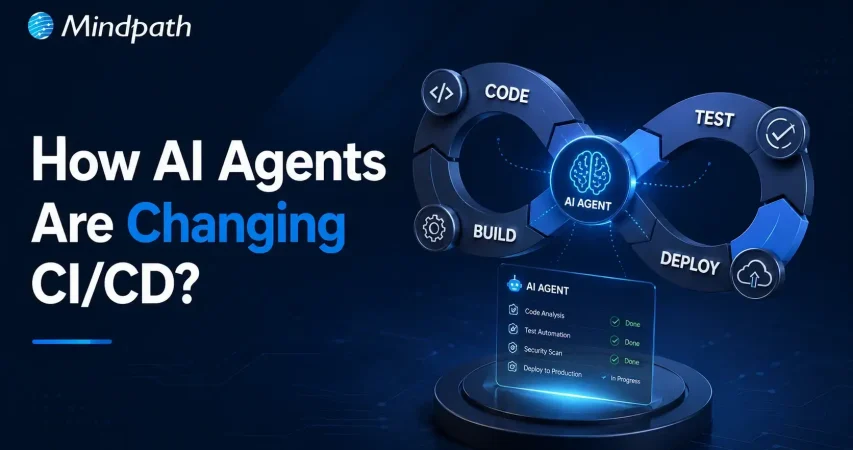
How AI Agents are Changing CI/CD: Automated Code Review, Testing & Deploys 

How AI Agents are Changing CI/CD: Automated Code Review, Testing & Deploys 

Join our Newsletter!

AI Agents in CI/CD Pipelines

Modern software teams push updates faster than ever, yet speed alone no longer defines success. AI Agents in CI/CD Pipelines are changing how teams build, validate, and release software with greater accuracy and consistency. As delivery cycles grow more demanding, many organizations now look beyond traditional automation. They want systems that can analyze, decide, and act intelligently throughout development workflows.

Key Takeaways

  • 01
    AI agents improve CI/CD workflows through faster analysis, smarter decisions, and automated actions.
  • 02
    Automated code reviews help developers identify quality issues and security risks earlier.
  • 03
    Intelligent testing reduces maintenance work while improving test coverage and pipeline speed.
  • 04
    Predictive insights help teams detect deployment risks before they affect production environments.
  • 05
    AI-driven monitoring and rollbacks support reliable releases and faster incident recovery.

As a result, AI-driven development practices continue to gain momentum across modern engineering teams. Developers now expect faster feedback, stronger code quality, and smoother releases without increasing operational pressure. At the same time, businesses seek reliable ways to improve delivery performance and reduce costly errors. In this blog, we will explore how AI agents are reshaping CI/CD workflows and driving smarter software delivery.

Planning to integrate AI agents into your CI/CD pipeline? Mindpath provides AI Agents development services that improve development efficiency, reduce errors, and accelerate release cycles.

What are AI Agents in CI/CD Pipelines?

AI agents in CI/CD pipelines are intelligent systems that help automate and improve software delivery processes. Powered by large language models and machine learning, they analyze pipeline activities, identify issues, and support faster decisions throughout the AI agents’ software development lifecycle.

Unlike traditional automation tools that follow fixed rules, AI agents can learn from data and adapt to changing conditions. They monitor workflows, recommend improvements, and respond to problems in real time, helping teams maintain efficient, reliable, and scalable CI/CD operations.

What are the Key Functionalities of AI Agents in CI/CD Pipelines?

AI agents bring intelligence and adaptability to every stage of the CI/CD process. They go beyond traditional automation by analyzing data, making decisions, and continuously improving workflow efficiency.

The following functionalities highlight how AI agents help development teams deliver software faster, improve quality, and reduce operational challenges across modern CI/CD pipelines.

1. Autonomous Failure Analysis

AI agents quickly analyze logs, test results, and system activity when failures occur. They identify the root cause faster, helping teams resolve issues without lengthy investigations.

2. Self-Healing Test Execution

AI agents adjust tests automatically when minor UI or code changes appear. This reduces unnecessary test failures and keeps pipelines running smoothly.

3. Intent-Driven Test Generation

Developers can describe testing requirements using simple language. AI agents convert those requirements into executable test cases with minimal manual effort.

4. Proactive Risk and Anomaly Detection

AI agents monitor build history, code changes, and error patterns continuously. They detect potential risks early and alert teams before problems escalate.

5. Intelligent Test Selection and Parallelization

AI agents identify which tests relate to specific code changes. They run only the necessary tests and optimize execution time across the pipeline.

6. Automated Security and Compliance

AI agents scan applications for vulnerabilities and policy violations automatically. They help teams maintain security standards and support compliance requirements.

7. Auto-Remediation and Rollbacks

AI agents respond quickly when deployment issues or production incidents occur. They can initiate corrective actions, perform rollbacks, and support faster recovery.

Why are Traditional CI/CD Pipelines No Longer Enough?

1. Limited Infrastructure Awareness

Complex cloud environments require deeper context than scripts provide.

2. Struggles with AI-Generated Changes

High-volume code updates overwhelm traditional review workflows.

3. Security Risks Increase

Broad credentials create larger attack surfaces across pipelines.

4. Tight System Coupling

Connected processes reduce flexibility and slow scaling efforts.

5. Lack of Intelligent Decision-Making

Static rules cannot adapt to changing development conditions.

How Do AI Agents Improve Modern CI/CD Workflows?

AI Agents for DevOps bring intelligence to software delivery by continuously analyzing data, automating decisions, and responding to issues in real time. Instead of relying only on predefined rules, they help teams optimize workflows, improve code quality, reduce deployment risks, and accelerate release cycles across modern CI/CD environments.

1. Automated Code Review

AI Agents in CI/CD Pipelines analyze code changes and identify bugs, security gaps, and coding issues automatically. They provide instant feedback, helping developers improve code quality before merging changes.

2. Intelligent Test Case Generation

AI agents create test cases based on application logic, requirements, and code changes. This reduces manual effort and strengthens DevOps and test automation practices.

3. Smarter Software Testing

Modern AI software testing tools use AI agents to execute, optimize, and maintain tests continuously. They improve test coverage while reducing repetitive testing tasks.

4. Self-Healing Test Automation

AI agents detect minor application changes and automatically update affected test scripts. This keeps automated testing reliable and reduces maintenance workloads.

5. Predictive Failure Detection

AI agents analyze historical pipeline data, build logs, and deployment patterns. They identify risks early and help teams prevent failures before production releases.

6. Intelligent Deployment Management

AI agents evaluate deployment readiness using performance metrics, test results, and risk indicators. They support safer releases by recommending the best deployment actions.

7. Continuous Monitoring and Incident Response

AI agents monitor applications and infrastructure after deployment in real time. They quickly detect anomalies, investigate issues, and support faster resolution.

8. Automated Rollbacks and Pipeline Optimization

When deployments cause problems, AI agents can trigger rollback actions automatically. They also analyze pipeline performance and recommend improvements for faster software delivery.

Ready to Build Smarter CI/CD Pipelines with AI?

AI agents in CI/CD pipelines help teams improve code quality, strengthen testing, and manage deployments with greater confidence. They bring faster insights to complex delivery workflows while reducing repetitive work. As software releases become more frequent, intelligent automation can help organizations maintain speed, reliability, and control.

At Mindpath, we provide AI Agent development services that help businesses build practical, scalable, and secure solutions. Our team can support your journey with AI agents in CI/CD that align with your development workflows, testing needs, and deployment goals.
Frequently Asked Questions

Test

Hire Talent

Click Here
Yes. AI agents can integrate with common repositories, testing platforms, cloud services, and deployment tools. Teams can introduce them gradually, starting with code reviews or test analysis, without replacing the complete CI/CD environment or disrupting established development processes.
Teams should treat AI feedback as an additional review layer, not an automatic approval system. Clear review rules, human validation, secure access controls, and regular feedback checks help ensure suggestions remain accurate, relevant, and aligned with coding standards.
Start with repetitive, low-risk tasks that consume significant time. Code quality checks, test failure analysis, test case suggestions, and pipeline log summaries often provide early value while allowing teams to evaluate results before automating more sensitive deployment activities.
No. AI agents support DevOps engineers by handling repetitive analysis, testing tasks, and pipeline monitoring. Engineers still make important decisions, define standards, review critical changes, and manage complex situations that require business context, technical expertise, and accountability.
Yes. AI agents can assess test results, code changes, infrastructure signals, and past deployment patterns before release. This helps teams identify risky changes early, prioritize important checks, and make informed release decisions without adding unnecessary manual review delays.

Support Is One Click Away

Featured Posts

Related Post

ReactJS Developers in London

Are you looking for skilled ReactJS developers in London to build fast and reliable web applications? Do you need experts who can turn your ideas into seamless user experience? Finding the right developers can be challenging, but the good news is that London has a strong pool of ReactJS talent. In this guide, we’ll help you understand how to hire the best ReactJS developers in London and what to look for in a top-tier developer. 

Hiring ReactJS developers in London offers several benefits for firms trying to create modern, high-performance web applications. London has a highly skilled tech talent pool, so you’ll have access to seasoned engineers who are up to speed on the newest ReactJS developments. These specialists can develop apps that are quick, scalable, and easy to use, hence increasing client engagement. Furthermore, collaborating with local developers improves communication, cooperation, and alignment with UK corporate norms.

London’s thriving digital sector also connects firms to a network of innovation, ranging from startups to established organizations, encouraging cooperation and information exchange. ReactJS developers in London have expertise working with a variety of sectors, allowing them to create solutions that are suited to unique company requirements. Furthermore, they use the best coding techniques to create secure, high-performance apps that stand out in a competitive digital market. Whether you’re a startup or an established business, hiring ReactJS developers in London guarantees that your project will benefit from innovation, efficiency, and high-quality development techniques.

Let’s explore the steps to hire ReactJS Developers in London!

Steps to Hire ReactJS Developers in London

ReactJS is an open-source JavaScript library that was developed by Facebook to create complex and interactive user interfaces for web applications. Since its inception, React has gained massive popularity due to its flexibility, efficiency, and ease of use. By breaking down applications into smaller, manageable components, React enables faster and more streamlined development. 

ReactJS is favored by developers because of its modularity, speed, and ability to build scalable, maintainable applications. Whether you’re building a simple landing page or a complex web application, ReactJS offers the tools and functionality to create high-quality, responsive applications. So, why should you hire ReactJS developers? Let’s explore. 

1. Define Your Project Needs

Before hiring a ReactJS developer in London, you need to describe your project’s requirements. Begin by determining if you require a developer for a basic website, a large web application, or a comprehensive platform. This aids in the establishment of defined objectives as well as the identification of suitable talent. Once you’ve determined the scope of the project, make a list of the necessary talents. If your project solely requires front-end development, search for people with experience in React, JavaScript, and UI/UX design. If you need full-stack knowledge, make sure they are also familiar with back-end technologies such as Node.js and databases. You can hire the top ReactJS developers in London by clearly describing your project’s requirements. This step guarantees that you recruit someone with the right skills, experience, and understanding to build a high-quality application for your business.

2. Craft a Clear Job Description

When recruiting a ReactJS developer in London, it is essential to provide a clear job description. It helps to attract the ideal candidates by giving crucial facts about the position. Begin by defining the job title and the developer’s tasks, such as creating user interfaces, maintaining state, and integrating APIs. Next, provide the necessary qualifications, such as familiarity with ReactJS, JavaScript, and other similar technologies. If your project requires extra abilities, such as Redux, TypeScript, or Next.js, make them explicit. Also, describe the type of project—whether it’s a web application, mobile app, or enterprise solution—so candidates understand what they will be working on. A well-structured job description not only attracts skilled developers but also ensures they align with your project’s needs, making the hiring process smoother and more efficient.

3. Find Talent Through Multiple Channels

You can look into numerous employment platforms and networks. Begin by using professional networks such as LinkedIn, where you can interact with developers directly, post job vacancies, and participate in relevant tech communities. Networking events and local gatherings can also help you connect with experienced professionals. Use prominent employment portals such as Indeed, Monster, and Hubstaff Talent to reach a larger pool of applicants. These platforms allow you to post thorough job descriptions and screen applicants based on their abilities and expertise. If you require flexible or short-term developers, consider using freelancing markets such as Upwork or Toptal. By utilizing numerous hiring channels, you boost your chances of finding a ReactJS specialist that fulfills your project’s requirements and can deliver high-quality results.

4. Evaluate Technical and Soft Skills

Finding the appropriate ReactJS developer in London involves a thorough screening procedure. Begin by checking resumes and portfolios to determine their experience with React applications. Look for projects that showcase excellent coding abilities, fast UI creation, and a thorough grasp of contemporary frameworks. Next, do technical interviews to determine their understanding of React topics like as components, state management, and hooks. You can also offer real-world coding tasks to watch how they solve difficulties and improve performance. Aside from technical competence, soft skills are also vital. A skilled developer should be able to properly convey ideas, work in teams, and adapt to project needs. Strong cooperation and problem-solving skills guarantee that they can operate effectively in a professional situation. By considering both technical and soft qualities, you can locate a ReactJS developer that not only codes well but also fit well with your team.

5. Offer Competitive Compensation

To recruit the top ReactJS developers in London, you must provide competitive compensation based on market trends and experience levels. Skilled developers are in great demand, therefore offering a reasonable wage can help you stand out from competition. In addition to compensation, consider adding advantages such as remote work choices, incentives, and opportunity for professional advancement. Developers like employment that promote professional development, thus offering training or mentoring can make your offer more enticing. Also, consider the complexity of your project—senior developers may anticipate higher remuneration for complicated applications. A well-balanced pay plan can help you acquire and retain top individuals capable of producing high-quality results.

Looking for skilled ReactJS developers in London? Mindpath connects you with top-tier professionals who can build high-performance web applications tailored to your needs. With expertise in modern React development, our developers ensure fast, scalable, and user-friendly solutions. Let’s bring your project to life—Get in touch with us today!

Want to make the right hiring decision? Check out our next blog on Factors to Consider While Hiring Expert ReactJS Developers in London to ensure you find the perfect fit for your project!
How much does hiring a ReactJS developer cost? Learn about factors affecting rates, and how to find the best talent within your budget.
CI/CD Pipelines

Continuous Integration and Continuous Deployment (CI/CD) pipelines have revolutionized modern DevOps best practices. In fact, they are the backbone of DevOps in recent years. CI/CD pipelines allow teams to release high-quality software faster and more reliably. This is possible because a CI/CD pipeline can automate the key stages of the software development lifecycle.

CI/CD Pipelines have empowered software teams and developers like never before. You need to have an in-depth understanding of what is CI/CD in DevOps, as it has been acting as a game-changer. In the business context, a CI/CD Pipeline allows faster product releases and creates value by reducing costs and streamlining the overall development process. It is time to explore what is CI/CD pipeline at a deeper level.

Want to reduce deployment delays and boost business efficiency? Mindpath’s DevOps Consultation and Implementation services streamline DevOps processes to deliver smooth and scalable software delivery.

An Insight into CI/CD Pipeline

CI,CD pipeline full form is continuous integration and continuous deployment. A CI/CD pipeline refers to a series of steps that software developers need to follow so that they can deliver a new version of a software solution. CI/CD pipelines can also be defined as the practice that focuses on improving software delivery throughout the software development lifecycle. It has been transforming the software development process through automation.

CI/CD pipeline introduces automation throughout diverse stages such as development, testing, production, and monitoring.  Teams are in a position to develop top-quality software in a fast and secure manner. The automated testing process allows the identification of dependencies and other issues at an early stage, thereby saving valuable time later. 

Ready to maximize the impact of your CI/CD workflows? Explore the benefits of DevOps to understand how it boosts performance, reduces errors, and accelerates releases.

Mechanism of CI/CD Pipeline

Now that you know CI,CD pipeline full form, and its meaning, it is time to explore its underlying mechanism. The insight can definitely help you understand how a CI/CD pipeline works. To understand how it works, you need to bear in mind that there exist three interrelated methods, including Continuous Integration, Continuous Delivery, and Continuous Deployment.

1. Continuous Integration

Continuous Integration refers to the process of fusing changes to code into a shared repository several times a day. An automated system is responsible for building the app and running tests every time the developer works on the code. CI fundamentally encompasses automated unit tests and static code analysis.

The fundamental goal at this stage is to discover issues relating to integration. In the absence of continuous integration, bugs may surface after multiple changes have been made at the time of a major release. This makes it challenging to find as well as fix them. Continuous Integration minimizes the specific threat by performing tests of every minute change in an isolated manner. 

2. Continuous Delivery

Continuous delivery lays emphasis on the automation of the process that takes place after the code passes the CI stage. CD prepares each change for release so that the deployment can be done smoothly to production at a given time. In the case of a CD pipeline, after the verification of the build, it is moved through the staging environment as well as the pre-production environment in an automatic manner.

It is essential to bear in mind that continuous delivery does not involve the deployment of code to production in an automatic way. The codebase is kept in a deployment-ready state so that software development teams will be able to release as per their need or convenience. CD enables organizations to release software more regularly. 

3. Continuous Deployment

Continuous deployment is responsible for automatically releasing code changes to end-users after passing a series of predefined tests. These predefined tests could be integration tests that test code in a copycat environment and help to ensure code integrity.

This automated process of releasing software code changes directly to the production environment after they have passed all the necessary automated tests eliminates the need for manual intervention. It enables teams to deliver updates and new features to users quickly. It also helps to fix bugs fast. Basically, it accelerates the feedback loop with customers and minimizes the risk relating to large and infrequent releases.   

Looking to understand how CI/CD pipelines are becoming smarter and more efficient? Check out the role of AI in DevOps to learn how automation and intelligence are transforming pipeline performance and reliability.

Key Benefits of CI/CD Pipeline

Now that you know what is CI/CD pipeline it is time to look at some of its key benefits. CI/CD pipeline benefits allow software teams to develop software in an agile manner while ensuring quality. Some of the top benefits include:

1. Faster Time to Market

One of the main benefits of CI/CD pipelines is that teams are able to deliver new features and fix bugs for users faster as well as more often. In fact, this is how major tech giants have been making incremental improvements in their products and creating value for their target market audience. 

With the help of CI/CD tools in DevOps businesses are able to quickly respond to user feedback and develop quality software apps. A typical CI/CD pipeline example automates the build, test, and deployment of a web application, thereby ensuring that the software is introduced in the market in a timely manner. 

2. High-Quality Codes

While releasing software, the role of proper testing is of paramount importance. Now that you know what is CI/CD in DevOps, you can say that high priority is given to testing. A central part of any CI/CD pipeline involves a series of automated tests that are run on every build. 

Automated tests ensure that teams can perform tests in a continuous manner, and the quality of software solutions can be maintained. The automated nature of tests plays a key role in enhancing the quality of code that is generated. 

3. Shorter Feedback Loops

While talking about the CI/CD pipeline example, a thing that is non-negotiable is rapid feedback. Getting feedback early ensures that teams can save sufficient time as well as effort while developing software applications. Teams are able to give frequent updates, which helps in receiving immediate feedback from the users. It thus helps to bring about appropriate changes and increase user satisfaction. 

4. Less Downtime

Even with automated testing, there is a possibility that bugs may sometimes sneak their way through production. A key benefit of using CI/CD tools in DevOps and making regular updates is that it makes it easier to locate the cause of an issue. As the commits are smaller, teams and developers can roll back the change without having to remove necessary elements. This certainly simplifies how issues are fixed and reduces the overall downtime. 

5. Better Communication and Collaboration

One of the main benefits of CI/CD pipelines revolves around improved communication and collaboration among team members. This practice enables members to function in a cohesive manner and make changes to the code. They can also respond to the queries and comments of one another in a transparent manner. The ongoing feedback loop makes sure that there is no communication gap among the team members. The rise in effectiveness in team collaboration is reflected in the ultimate software solution. 

Wondering how CI/CD pipelines are evolving in modern DevOps practices? Discover the latest DevOps trends to learn which tools, methodologies, and innovations are driving smarter and more reliable pipelines.

Final Words

In the prevailing software development arena, the concept of CI/CD pipeline has emerged as a breath of fresh air. It has shown the power that automation can bring while developing software solutions. Some of the key benefits of CI/CD pipelines that you should be aware of include high-quality code, faster time to market, and many more. The explanation of the underlying mechanism of the CI/CD pipeline is there so that you can understand how the process works. 

Mindpath’s top-grade DevOps solutions can certainly assist modern business organizations to leverage CI/CD pipelines to the fullest. Our experts will ensure that, through continuous integration and continuous delivery, your business can develop excellent software applications that can improve user satisfaction. 

Discover how CI/CD pipelines streamline software development, boost quality, and reduce costs with automated processes.
AI integration services

Every business will approach a stage where its web app demands more. Users desire more intelligent features and competitors continue to move forward. This is where the AI integration services will be a crucial business decision. So, you begin to ask the real questions. How much time will this require? What will be the actual cost?

Key Takeaways

  • 01
    AI integration timelines range from 2 weeks to over 12 months depending on complexity.
  • 02
    Basic AI features start at $5,000 while enterprise builds exceed $100,000 easily.
  • 03
    Clean, structured data is essential before any AI integration project truly begins.
  • 04
    Choosing a partner with domain experience and compliance knowledge protects your entire investment.
  • 05
    AI integration is an ongoing commitment requiring regular maintenance, monitoring, and model retraining.  

Well, most teams don’t consider these questions. The process of integration can range significantly across different tech stacks. App cost can vary significantly based on where your app is today. There’s also a tendency to have results that don’t quite match the original set-up. It isn’t a warning. It’s just how effective AI implementation is in real-world scenarios. Here in this blog, we delve into everything and make it very clear; leaving you to plan smarter and move forward with real confidence. So, let us read further and know more!

Planning to add AI to your existing application? Explore our AI Development Services for seamless AI integration tailored to your business goals.

What Are AI Integration Services and Why Do Businesses Need Them?

AI integration involves integrating intelligent features within your current web application. It brings AI to your actual data, workflows, and user interactions. This makes AI app integration more effective than standalone applications. Your app begins to generate more intelligent results according to the actual business context.

Using an AI tool is not the same as integrating an AI tool. True integration is when AI is integrated within your systems on an ongoing basis. It reads real-time data, aids decision-making, and automates repetitive tasks naturally. Companies that use AI effectively grow in leaps and bounds and run with much greater efficiency.

Let us look at some of the real reasons why businesses need AI integration services:

1. Process Automation

AI automates repetitive actions such as data entry. Teams save hours and concentrate on strategic work. Accuracies of human errors have tremendously decreased during daily operations.

2. Smarter Decision-Making

AI can quickly and accurately analyze large amounts of data. Leaders get real-time insights for better business decisions. Intuition and speculation are replaced with certainty and facts.

3. Elevated Customer Experience

Customers can interact with AI chatbots at any time of day. Customized suggestions lead to higher user satisfaction and engagement. All interactions are more relevant and timely.

4. Predictive Analytics and Growth

Businesses predict the future trends before they actually occur. Teams make early adaptations and maintain a competitive edge. Planning and inventory management are much more accurate.

5. Cost Reduction and Efficiency

Efficient workflows save a lot of unnecessary operational costs. Errors reduce and overall productivity significantly increases. The greater the efficiency, the more powerful the ROI.

Core Features of AI Integration at a Glance

1. AI-Powered Virtual Assistants

Routine queries are taken care of by intelligent chatbots and provide support 24/7.

2. In-App Copilots

Contextual AI helps users, creates content, and condenses reports in a flash.

3. Semantic Search

AI knows what users want and brings up relevant information each time.

4. Intelligent Document Processing

OCR and AI automatically read data from any invoice, PDF, or forms.

5. Recommendation Engines

AI provides product and content recommendations tailored to the user’s activity.

6. Fraud Detection

AI identifies unusual transactions and intrusions as they occur.

How Long Does AI Integration Into an Existing Web App Take?

The timeline for AI integration services varies from one organization to another. Everything is based on your project scope, tech stack, and approach. Let us have a look at it in detail:

1. Basic AI Integration (2 to 8 Weeks)

Teams integrate existing APIs such as GPT seamlessly and efficiently. Testing of UI changes and responses takes one to four weeks.

2. Moderate AI Implementation (3 to 6 Months)

Custom AI solutions delve into your business logic. It takes several months for data cleaning, model embedding and accuracy testing.

3. Enterprise AI Transformation (6 to 12+ Months)

Specialized models are constructed and trained from scratch. Compliance validation and secure deployment add significantly to the deployment timelines for enterprises.

What Is the Real Cost of AI Integration Services for Web Apps?

Most businesses underestimate the real AI implementation cost from the start. Your stack, complexity, and chosen approach shape every dollar spent.

1. Chatbots and Customer Support ($5,000 – $30,000)

Teams wire pre-trained APIs into existing interfaces relatively quickly. Costs cover conversation design, testing, and API connection work.

2. Recommendation Engines and Smart Search ($15,000 – $50,000)

Lightweight models track behavior and deliver personalized suggestions efficiently. Data volume and complexity define the final AI integration cost.

3. Advanced Automation and Predictive Analytics ($30,000 – $100,000+)

Fine-tuned models process proprietary data with much higher accuracy. NLP and predictive logic require significantly more development investment overall.

4. Data Preparation and System Integration

Dirty data breaks AI-powered web applications before they even launch. Connecting AI to legacy systems adds $10,000 to $50,000 easily.

5. Testing, Validation and Maintenance

AI outputs need far more manual testing than standard development. Plan to spend 15% to 25% annually on model upkeep.

AI Technologies Work Best for Web App Integration

1. Large Language Models (LLMs)

Tools like OpenAI and Gemini power smart, context-aware web interactions.

2. Intelligent Chatbots and Assistants

Conversational agents automate support workflows and execute in-app actions efficiently.

3. Semantic Search Engines

NLP-driven search understands actual user intent beyond basic keyword matching.

4. Vector Databases

Tools like Weaviate deliver ultra-fast content recommendations using mathematical data representations.

5. Computer Vision and Cognitive APIs

Pre-built APIs automate image tagging, visual search, and media moderation instantly.

6. Predictive Analytics Platforms

Google Vertex AI and SageMaker forecast demand and identify key behavioral trends.

How Do You Choose the Right AI Integration Partner?

Choosing the right AI integration services partner shapes your entire project outcome. The wrong choice costs you time, money, and serious technical debt.

1. Domain and Industry Experience

Choose AI consulting services partners with proven experience in your specific industry.

2. Technical Stack Proficiency

Confirm expertise in Python, TensorFlow, React, AWS, and Azure development.

3. Custom AI Software Development

Strong partners build tailored models using your data, not generic tools.

4. Data Privacy and Compliance

Verify SOC 2 audits, OAuth 2.0 protocols, and strict ethical AI standards.

5. Transparent Communication

Your partner should explain timelines, risks, and progress in plain language.

6. Ongoing Support and Roadmapping

AI software development needs continuous monitoring, retraining, and long-term scalability planning.

Is Your Web App Ready to Integrate AI?

AI integration is no longer optional for growing businesses. Your competitors are already moving faster with smarter apps. The right strategy, timeline, and budget make all the difference. Now is the right time to act with full clarity and confidence.

At Mindpath, we provide AI development services that fit your exact business needs. Our team handles everything from planning to deployment and beyond. We help you move faster, spend smarter, and build better. Contact us to turn your web app into a truly intelligent product today.

Frequently Asked Questions

1. What exactly do AI integration services include for a web app?

AI integration services cover everything from connecting pre-built APIs to building custom models. This includes data preparation, workflow automation, testing, and ongoing maintenance. The scope depends entirely on your app’s current state and what business outcomes you want to achieve.

2. Can a small business afford AI integration?

Absolutely. Not every integration requires a six-figure budget. Basic chatbot setups and smart search features start around $5,000. The key is starting with high-impact, low-complexity features first. Scaling up gradually keeps costs manageable while delivering real business value early.

3. Will AI integration disrupt our existing app users?

A well-planned integration causes minimal disruption. Experienced teams phase the rollout carefully, test thoroughly in staging environments, and monitor performance post-launch. Users typically notice improvements, not interruptions. The goal is always to enhance the existing experience, not rebuild it from scratch.

4. How do we know if our data is ready for AI integration services?

Most apps need some level of data cleaning before integration begins. Fragmented, duplicate, or unstructured data slows everything down. A good technical partner will audit your data early and build proper pipelines before any model connects to your live systems.

5. What happens if the AI model gives wrong or inaccurate outputs?

This is more common than most vendors admit. Models can drift over time or respond poorly to edge cases. That is why validation, human oversight, and regular retraining are essential parts of any responsible AI integration plan, not optional extras.