Latest Insights On
GenAI, Tech, and Digital Transformation
Stay updated with expert insights, success stories, and real-world applications of cutting-edge technology.
Whenever you are creating a tailored solution for your business, it is very important to clearly understand how the development process will be structured. The custom software development process clearly guides you in turning your ideas into a usable working solution. Every step matters – from understanding the requirements, conceptualizing the software, determining the specifications, and creating software that supports your goals. You will get to know what is to come, how teams will work together, and what to expect at every step as your project moves forward in purpose and clarity.
A thorough comprehension of how this process works gives you a better sense of clarity and confidence as you engage with the project. You will be able to understand each phase clearly and watch your vision come together step by step. Upon having this understanding, it is very easy and clear to collaborate with your development team. In this blog, you’ll go through the whole process and will understand how the custom software will come to life, step by step.
At Mindpath, we offer custom software development services to turn your vision into reality by guiding you through every step. Contact us today for a solution that turns your ideas into real-world project.
Importance of Custom Software Development for Businesses
Custom software development is valuable because it provides businesses with tools made solely for them. Unlike off-the-shelf software, custom software solutions fit unique business requirements and methods. This leads to improved performance, increased efficiencies, and better results. It also minimizes unnecessary rework, saving time and money, and allowing companies to be more efficient overall.
Custom software is scalable with your business. You will be able to add features or alter functionality based on your requirements. This adjustable system uniquely supports a company’s long-term goals and puts you ahead of your competitors. Custom software solutions offer a better experience for both the user and employees, which supports increased productivity and satisfaction.
Also Read: Custom Software Development Benefits
Understanding the Custom Software Development Process
It is essential to know about the process to be followed prior to starting a software project. By getting familiar with the software development process steps, you can be an active participant and an advantageous decision-maker throughout the project. By understanding the process, you will also ensure value delivery by building software with clear goals, planning, and execution.
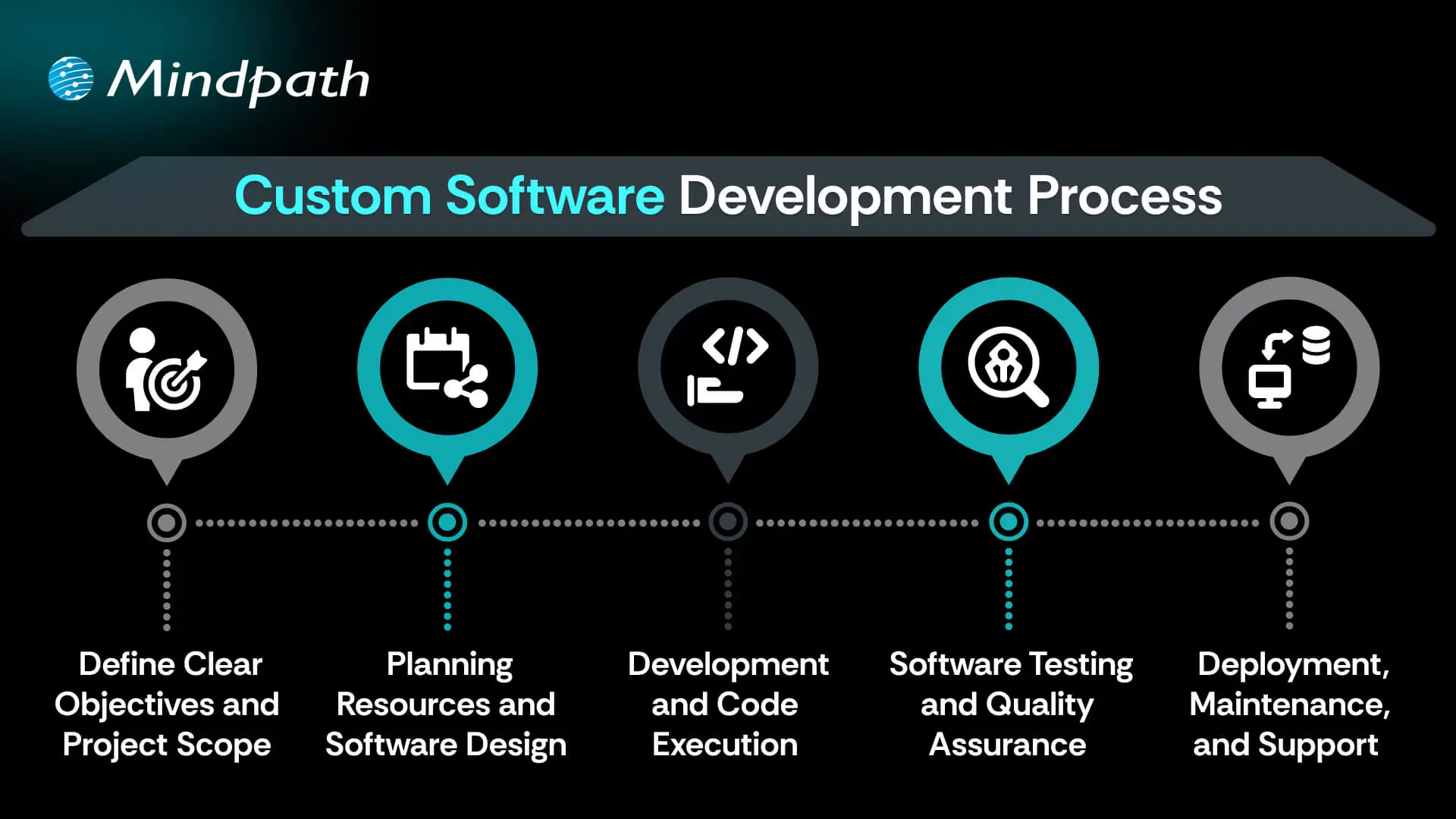
1. Define Clear Objectives and Project Scope
The custom software development process begins by defining your goals and understanding what the software must achieve. This includes identifying the target users, the problem it solves, and how it should perform differently from existing tools. A detailed list of features and expected outcomes is prepared. Both functional and non-functional requirements are clearly documented. This step sets the direction and purpose for everything that follows.
2. Planning Resources and Software Design
Planning involves creating a detailed timeline, setting milestones, and organizing resources for development. Budgets, risks, and deliverables are clearly outlined to avoid delays or extra costs. During software development design, wireframes and prototypes are created to visualize the interface and user flow. The architecture is also planned, including system components and how they will interact. Technologies such as programming languages, frameworks, and databases are chosen here.
3. Development and Code Execution
At this point in the custom software development process, the programmers will begin the actual coding based on the approved designs. The developers will prepare technical infrastructure with tools, servers, and version control. The front-end, back-end, and database modules are built and integrated together. Each piece of software functionality is developed based on the description created in the design documents. The functionality is translated into active, live software with working features to start testing.
Curious how software functions seamlessly from the user interface to the server? Explore the role of frontend and backend to understand how both sides work together to deliver smooth, secure, and engaging digital experiences.
4. Software Testing and Quality Assurance
After the software is developed, it will go through a series of testing strategies to check for quality and reliability. The first step, or unit testing, will cover each feature and try to eliminate some early problems. Then the following step, called integration testing, will check the work of modules and ensure they work as a system. Once that’s complete, the next phase is system testing, which ensures all performance, security, usability, and reliability aspects are achieved and validated prior to the release of the product.
5. Deployment, Maintenance, and Support
In the final step of the custom software development process, the solution moves to a live environment for end users. The deployment may include installing the software on servers, setting up databases, and giving users access. After launch, the software is continuously monitored for issues. Maintenance includes fixing bugs, adding new features, and updating it for better performance. Ongoing support keeps the software running smoothly over time.
Concerned about risks that could slow down your custom software build? Explore the major custom software development mistakes that can disrupt progress and find out how to avoid them.
Real-World Examples of Customized Software
Below are six real-world customized software examples that demonstrate how businesses are navigating unique challenges by investing in custom software to create a digital solution. These tools have been developed to improve usability, performance, and long-term sustainability.
1. Uber
Uber constructed a custom ride-booking system complete with GPS tracking, so you know where your ride is located, secure payment options, and updates on the driver’s progression. The app shifted transportation in cities globally.
2. Netflix
Netflix utilizes AI-based recommendation engines and adaptive streaming systems to provide an overall personalized viewing experience through a fully custom platform.
3. Amazon
Amazon uses custom software to manage inventory, predict customer preferences, and allow one-click ordering for a fast and reliable purchasing experience.
4. Airbnb
Airbnb built a custom platform for travelers to pay securely, check real-time availability, and search by location for hosted accommodations around the globe.
5. Tesla
Tesla uses customized software for its smart vehicles to drive the autopilot capabilities, over-the-air updates, and real-time diagnostics to enable sophisticated performance.
6. Starbucks
Starbucks utilizes a custom application to allow customers to mobile order, encrypt reward tracking, and offer options for contactless payments, making the product experience more convenient and helping to cultivate loyalty.
Curious how different kinds of software are built to serve unique business and user needs? Discover the various types of software development to understand how each one contributes to creating powerful digital solutions.
Ready to Create Software That Aligns with Your Business?
Custom software development is the process of creating digital solutions that fulfill your specific business goals. From clarifying your vision to deploying the software and providing ongoing support, every step of the official custom software development process undergoes proper plan and execution. The final outcome of custom software typically entails better efficiency, enhanced experiences for users, and long-term growth through technology that suits your needs.
As a premier custom software development company, we at Mindpath specialize in providing full-spectrum custom software development services that suit your specific business. Our team expertly develops scalable, secure, and simple solutions that integrate well into your workflows and future goals. Partner with us to turn your ideas into powerful, high-performance software built for results.

Without a robust and engaging web presence, your business is going nowhere, and this might be a perfect reason to hire ReactJS developers. Once you know the cost of hiring ReactJS developers, you can measure the value they will bring to your web projects. Let us discover why you must know the costs of hiring React developers and the factors that influence hiring costs.
Want to adopt ReactJS in your next project? Mindpath’s ReactJS development services will provide expertise that will help you in building interactive web applications according to your business requirements.
Reasons to Focus on ReactJS
ReactJS is a component-based, open-source JavaScript library that has been the favorite pick for frontend development since 2013. It is still one of the most powerful tools for creating visually appealing UIs. Any business that thinks of hiring frontend developers should focus on ReactJS for its distinctive features. Some of the notable features of React include component-based architecture, cross-platform development with React Native, virtual DOM, and a strong community. ReactJS not only facilitates faster development but also ensures that you get web applications that offer better performance and scalability.
While hiring guides can help you pick the right talent for your teams, it is important to learn about the costs of hiring React developers. Why? Many hiring managers will believe that the cost of hiring a ReactJS developer is all about their salary. Interestingly, employers must also consider other factors, such as location and experience, along with additional costs, to determine hiring costs.
Must Read: ReactJS Developer Skills
Cost of Hiring a ReactJS Developer
Professional ReactJS developers can help you craft the best user experiences in web applications. However, the expertise of ReactJS developers comes at a cost. The search for answers to “How much does it cost to hire a ReactJS developer?” might lead you directly to salary forecasts for React developers. On the other hand, the salary is not the only thing that you must consider in the cost of hiring a ReactJS developer. The following factors will help you understand how to determine the ideal compensation for React developers in your web projects.
1. Experience of the Developer
The foremost factor that influences the salary of ReactJS developers is their experience. Junior or entry-level developers have limited professional experience and can build basic components, work on simpler tasks, and support senior developers. Mid-level developers have a better understanding of React concepts and can work on complex features alongside contributing to architecture design.
Senior developers are the top-tier talent with more than five years of professional experience and can design the whole application architecture. Senior ReactJS developers can also guide junior developers, optimize performance, and scale up web applications with ease. The estimates for ReactJS developer cost in 2025 suggest that senior developers can earn more than $150,000 per year. Similarly, junior developers can earn almost $70,000 annually, while mid-level developers can ask for $100,000 to $120,000 per year.
2. Geographical Location
Hiring managers must also take the geographical location into account while calculating the costs of recruiting React developers. Location is an important factor in determining the hiring cost as it implies variations in market competitiveness, demand for talent, and cost of living. For instance, the cost of hiring a ReactJS developer in North America will be higher than the global average. Why? You can find tech hubs like Silicon Valley and New York, along with major Canadian cities that have a higher cost of living.
The average annual salary of a ReactJS developer in North America can vary from $90,000 to $120,000. The only other competitive market for ReactJS development is Western Europe, where countries like the UK, Germany, and France seek high-quality talent. One of the best choices for a cost-effective React development solution is the Asia-Pacific region, which includes India, China, and the Philippines. The annual salary for React developers in the Asia-Pacific region is considerably lower than in Western countries.
Want to scale your application seamlessly as your customer base grows? Learn how the benefits of ReactJS development services make large-scale, high-traffic apps easier to maintain and expand.
3. Scope and Complexity of the Project
Employers must also pay attention to the scope and complexity level of their web project while calculating the hiring costs for a ReactJS developer. You may want to build simple web apps, mid-sized applications, or large-scale enterprise applications with ReactJS. Each type of project will demand a specific level of expertise, which indirectly influences the cost of ReactJS developers. For instance, junior developers can create simple applications with basic UIs or static websites with minor features.
The estimates for ReactJS project development cost might be a little higher for medium-sized applications, which will require mid-level to senior developers. Such types of applications may need custom designs, dynamic features, or integrations with third-party APIs, which call for experts and more costs. Large enterprise applications that need complex architectures and intricate state management will require senior and lead developers, thereby increasing costs.
4. Hiring Model
One of the key factors that determines the cost of hiring a ReactJS developer is the hiring model. Do you want a full-time in-house developer or a freelancer? If you hire an in-house developer to work on a full-time basis, it will cost you the most. The recruitment costs for in-house developers in the USA can vary between $5000 and $20,000 for each hire. The primary reason to hire an in-house React developer is the assurance of maximum control.
Hiring managers can opt for freelance developers or hire developers on a contractual basis to reduce costs and ensure flexibility. You should hire freelancers only when you need access to specialized skills and faster onboarding. Some employers also choose cost-effective ReactJS development services through outsourcing or dedicated remote teams. Outsourcing offers access to a vast talent pool and better options for scalability with fewer administrative setbacks.
5. Other Additional Costs
The direct salary or hourly compensation for ReactJS developers is only the tip of the iceberg. Employers and hiring managers must also pay attention to the additional costs of hiring React developers. The notable additional costs include recruitment costs, training costs, infrastructure costs, and benefits for full-time developers.
Recruitment costs include the costs of job board posting, agency fee, and the time invested in screening and interviews. Infrastructure costs point to the cost of laptops, cloud services, testing tools, and software licenses for IDEs, developer tools, and communication. Training and onboarding costs, along with benefits and perks like health insurance, stock options, and bonuses, also determine the hiring costs of React developers.
Want to ensure your next digital product is built by a partner who truly understands your business goals? Discover what matters most when choosing the right React development company for your business.
Final Thoughts
The list of answers to “What factors affect ReactJS developer rates?” reveals that the salary is not the only cost. Hiring managers can determine the salary by considering different factors such as experience, geographical location, and hiring model. The additional costs of hiring a React developer include training and onboarding costs, recruitment costs, and infrastructure costs.
The cost of ReactJS projects at Mindpath also encompasses support and maintenance without imposing additional costs. On top of it, with reliable platforms like Mindpath, you will get transparent cost estimates for ReactJS development services. Explore the most cost-effective ReactJS development solutions for your projects with Mindpath.
The advantages of ReactJS have made every business owner think about its utility in developing web projects. It is the most powerful and commonly used JavaScript library for creating intuitive interfaces. If you want React developers in your team, then you must know the ReactJS developer skills that you should look for in candidates. The declarative approach and component-based architecture of ReactJS have revolutionized the process of front-end development. Let us find out the skills that you need in ReactJS developers to create successful web projects.
Want to hire ReactJS developers for your next web project? Explore more on Mindpath’s React JS development services to get expertise in developing a web application aligned with your business goals.
Discovering the Skillset of Expert ReactJS Developers
The general assumption about the skillset of ReactJS developers is that they know how to work with React. However, fluency in React itself is not the only addition in the React skill set for any developer. React developers must have a broader skillset beyond the library to craft impactful web projects. The following skills can help business owners identify the best React developers for their next web project.
1. HTML and CSS
The foremost addition in a list of ReactJS skills is the combination of HTML and CSS, which play a crucial role in organizing the styling of the web experience. React developers must know the concepts of semantic HTML and how to use the right HTML tags for better SEO and accessibility. ReactJS developers should have an in-depth understanding of the fundamentals of CSS, such as selectors, CSS Grid, responsive design principles, and the box model.
Apart from CSS fundamentals, the essential React skills for developers also include knowledge of CSS preprocessors and frameworks. Developers can use the pre-processors to streamline styling workflows and improve ease of maintenance in larger projects.
2. JavaScript ES6
JavaScript ES6 or ECMAScript 2015 brought many interesting features to the domain of modern web development. When you hire React developer for the next web project, you should check their level of fluency in JavaScript ES6. The distinctive features of JavaScript ES6, such as arrow functions, template literals, and ES6 classes, make React web development more efficient. For instance, arrow functions can ensure simpler syntax for functions and intuitive management of the context.
ReactJS developers must know how to leverage ES6 classes for a more structured use of JavaScript along the lines of component-based architecture. Developers can also use features like template literals to embed expressions in strings, thereby creating cleaner code.
3. Event Handling and DOM Manipulation
The virtual DOM in React is one of its distinctive features. All the listings for React JS developer jobs showcase the necessity of learning about DOM manipulation. At the same time, you must know that direct DOM manipulation is not required in React. On the other hand, developers must know the process through which the browser renders and interacts with the Document Object Model. DOM manipulation is required in scenarios where you want to build interactive and dynamic user interfaces.
Another crucial addition among skills required for ReactJS developer is event handling. It focuses on responding to different user events through event listeners and callback functions. Therefore, React developers must know the fundamentals of event delegation, capturing, and bubbling.
4. Git
You cannot think about hiring React developers who don’t know how to work with Git, the most popular version control system. Git helps in promoting team collaboration and source code revision management to ensure efficiency in the development lifecycle. ReactJS developers must know the fundamental concepts, such as commits, repositories, branches and merges. On top of it, developers must also know how to work with branching strategies, hosting platforms of Git and conflict management.
Git is a promising tool for frontend development with React as it provides the ideal foundation for collaborative development. Developers who know how to work with platforms like GitLab and GitHub can ensure better efficiency in team collaboration, project management and code reviews.
Must Read: Cost of Hiring ReactJS Developer
5. Redux
The list of technical skills you should search in the profiles of ReactJS developers also includes Redux. It is a specialized library used for state management in larger and more complex React applications. The cost of hiring ReactJS developers is justified when you notice how fluency in Redux can offer credible benefits to your web projects. The most promising features of Redux include centralized state management, application scalability and predictable state updates.
Redux works with a single storage for all states of an application, thereby ensuring consistency in management of state transition. Efficient state management also serves as a catalyst for easier scalability and managing increasing complexity without vulnerability to bugs. Centralized state management with Redux also ensures predictability in the behavior of your web applications, thereby facilitating easier maintenance and debugging.
6. JavaScript XML or JSX
Every ReactJS developer must know how to work with JavaScript XML or JSX. It is also one of the notable additions among react developer must-have skills as it serves a critical role in ensuring simpler development and management of UI components. JSX helps developers write HTML-like structures in JavaScript, offering a seamless blend of markup and JavaScript logic. JSX also provides an easier solution for creating and managing the user interface components of their web applications.
The other notable applications of JSX include data and logic integration. JSX can help in injecting data and logic directly into the UI, thereby ensuring dynamic content rendering, required for modern web applications. On top of it, the declarative nature of JSX ensures that the code is easily readable and accessible for debugging.
7. React Hooks
Professional ReactJS developers must also have strong command on React Hooks, a revolutionary feature for state management. Hooks have introduced new perspectives on managing React features in functional components. It is one of the essential ReactJS developer job skills and aspiring developers must know about the important hooks they must learn to create web applications.
The notable React Hooks that a developer must know include ‘useState’, ‘useEffect’, ‘useRef’ and ‘useContext’. Each hook serves a distinct function such as providing direct access to DOM elements or managing component-specific state. On top of it, ReactJS developers must know how to create reusable logic through custom hooks.
8. Testing, Debugging and Performance Optimization
The most important skill that you can find in expert React developers is testing and debugging skills. You can find answers to “why hire React developers?” in their skillsets that focus on comprehensive testing to create robust apps. The notable testing methods include unit testing, that involves testing the individual components independently or integration testing. React developers must also know how to work with debugging tools and browser developer tools to inspect the code.
Apart from testing and debugging, React developers must also know the best practices for performance optimization. Skilled ReactJS developers can use different techniques such as virtualization, code splitting and bundle size optimization to craft responsive applications.
Want to improve your application’s speed without increasing development time or infrastructure costs? Discover how optimizing React performance benefits business owners looking for efficiency and ROI.
Mandatory Soft Skills
Most of the discussions about skills of ReactJS developers focus only on the technical skills. Choosing a React JS development service for capitalizing on the expertise of skilled developers also requires attention to soft skills. You need developers who have the capabilities for critical thinking and problem-solving with efficient solutions. React developers must have skills for clear and concise communication that empowers them to work in collaboration with other teams.
React developers should also have attention to detail for crafting intuitive user experiences and writing code without bugs. Most important of all, ReactJS developers should strive to learn continuously and improve their skills to stay updated with emerging technologies and recent ReactJS trends.
Final Thoughts
The thought of hiring a developer from a reputed ReactJS development company might seem like a challenge. Interestingly, you can find the best ReactJS developers at Mindpath for your next web project; they help you build modern web solutions. The notable technical skills of React developers include knowledge of HTML and CSS, JSX, JavaScript ES6, React Hooks and direct DOM manipulation. On top of it, ReactJS developers must also have soft skills such as communication, adaptability, critical thinking and problem-solving. Learn how to pick the best ReactJS developers for your web projects now.
Software development has evolved beyond the traditional approaches that required separate frontend and backend development teams. The need for full-stack development is evident in the new digital landscape, where user requirements and business goals change in an instant. Full-stack software development offers a strategic option to develop user-friendly and robust applications without paying a fortune.
With the growing competition to establish a strong digital presence, business owners must pick a reliable development approach, like full-stack. However, it is also important to learn what full-stack software development entails before embracing it. Let us discover more about the full-stack approach and how businesses can use it to develop their software applications.
Thinking of adopting full-stack development for your next project? Mindpath’s full stack development services will help you with the integration of front-end and back-end expertise that your business needs.
Understanding Full Stack Fundamentals
Full-stack has emerged as the most valuable strategy for software development that allows businesses to meet the emerging user requirements and business goals. It follows an end-to-end approach for developing software applications, involving both the frontend and backend. The answers to “What is full-stack development?” also emphasize how it can enhance cost-effectiveness, agility, and efficiency. You can understand full-stack in a better way by breaking it down into the two primary components.
1. Frontend Development
The frontend development deals with the client-side aspect of the application, or the part of the application that users see. It includes everything a user sees of an application on their smartphones or web browsers. The important elements of the frontend of an application include the design, images, layout, navigation menus, buttons, text, and anything that users can interact with.
The most important technologies for frontend development in the full-stack approach include HTML, CSS, and JavaScript. In addition, full-stack developers must also have a strong command of frontend frameworks and libraries. HTML serves as the foundation for arranging web content, while CSS helps in styling the interface by controlling fonts, layout, responsiveness, and colors.
The search for answers to “what is full-stack web development” will also help you understand the significance of JavaScript. It is a popular programming language that helps developers add dynamic and interactive elements to web pages. Most important of all, frameworks and libraries like Angular, Vue, and React simplify frontend development while empowering developers to create complex user interfaces without sacrificing responsiveness.
Planning to use full-stack development for your next web project? Before that, read about the future of full-stack development for web projects!
2. Backend Development
The backend of a software application focuses on the server-side aspects of the application, which drive its functionalities. Backend development deals with logic, communication, and data storage, which work in the background and are never visible to users. The full-stack development definition describes the backend as the “brains” behind the working of an application. The backend processes requests from the frontend, interacts with databases, and sends data back to the frontend.
Backend development for a software application requires fluency in programming, backend frameworks, server management, APIs, and database management. The notable programming languages used to create backend logic include Python, Java, Ruby, Node.js, and PHP. Developers should also know how to leverage the relevant backend frameworks for each programming language. For instance, Ruby on Rails is ideal for Ruby, while Express.js is for Node.js, and Django is the best backend framework for Python.
Also Read: Full-stack development with Node.js
Database management and server management are also integral requirements for full-stack developers. Backend development is incomplete without databases, as they help with the storage and management of application data. Database management may involve the use of relational databases like MySQL and SQL Server or NoSQL databases such as MongoDB. Backend development also requires an in-depth understanding of best practices for configuring and managing web servers. Another important requirement for backend development focuses on APIs that establish rules and protocols for communication between different software components.
The answer to such a question is quite obvious and points to any developer who knows frontend and backend development. One of the significant highlights in any full-stack developer definition is the proficiency in frontend and backend development technologies. On top of it, full-stack developers must be fluent in security practices and DevOps to offer productive end-to-end software development solutions. Full-stack developers know how every layer of an application works, thereby empowering them with a holistic view of the development process.
The versatility of full-stack developers makes them one of the most valuable resources for businesses in the new technological landscape. Full-stack developers can create responsive web layouts, implement database integration, manage testing and debugging, and write server-side logic. On top of it, they also work in collaboration with UI/UX designers and other teams to develop efficient applications.
Understanding the differences between front-end, back-end, and full-stack developers is key to building an effective development team. Learn more about the distinct responsibilities of each developer in our blog: Front-end vs Back-end vs Full-stack developer
Workflow of Full Stack Development
The definition of full-stack indicates that combining frontend and backend development can serve promising advantages for businesses. At the same time, it is also important to wonder about the workflow in full-stack projects. Where does full-stack begin, and how does it integrate frontend and backend development in a single workflow? You can find the answer by reflecting on the full stack definition once again, by focusing on the end-to-end aspect of the process.
Full-stack developers begin with the planning stage and end with the deployment and maintenance stage. The following steps in the full-stack workflow can help you understand how the holistic approach blends the traditionally different sides of software development.
1. Planning
The first step in the full-stack workflow involves planning and identifying essential features and technical specifications for the application. Full-stack developers collect information about essential requirements and understand the scope of the project. The developers also collaborate with different stakeholders to come up with an outline of the features desired in the application and its technical specifications.
2. Frontend Development
After finalizing the design, the next step in full-stack development focuses on the frontend of the application. The frontend development starts with a definition of the project structure and selecting the relevant technologies like HTML and CSS. The full-stack developer will implement the user interface in this step while ensuring accessibility and responsiveness.
At the same time, developers must ensure that the frontend complies with important design guidelines. The other crucial tasks in the frontend development stage include the creation of reusable components and the integration of backend APIs to fetch and display data.
Must Read: Full-stack Development Trends
3. Backend Development
The next step in the full-stack software development workflow focuses on backend development and integration of the backend logic with the frontend. Developers can create the backend of a full-stack application with server-side scripting languages like Python, Node.js, or Ruby. In addition, developers also employ the relevant database management system for the application according to its requirements.
Apart from creating and implementing the server-side logic, full-stack developers also create RESTful APIs and address data management needs. The backend development stage also calls for attention to the security and scalability of applications. Therefore, developers have to implement comprehensive authentication and authorization mechanisms and follow the best practices for data validation.
4. Testing
Before launching the application, full-stack developers will implement comprehensive testing plans to find errors and bugs. Developers have to define unit tests, end-to-end tests, functional tests, and integration tests to measure the utility of the application in different scenarios. Writing the tests in the early stages of development helps in creating applications that align with the desired goals and requirements of features. It also ensures that the application is easy to maintain, reliable, and adheres to the desired specifications.
Following the testing process, developers work to achieve seamless integration of frontend and backend components. The process involves establishing communication between the frontend and backend with uninterrupted data flow and error management. Full-stack developers rely on testing on a wide range of devices, scenarios, and browsers to identify and resolve performance issues. As a result, they can ensure easier integration of frontend and backend components without conflicts.
5. Deployment and Maintenance
The final stage in the full-stack workflow or deployment focuses on preparing the application for the production stage. The deployment stage involves the configuration of essential server environments and setting up continuous integration and continuous deployment pipelines with DevOps. Full-stack developers must also ensure that the application has been optimized for production in the deployment stage.
Some of the important requirements for deploying a full-stack web application include database migration, scaling to adapt to the user traffic, and server provisioning. Once the deployment is complete, developers monitor the application performance to identify any anomalies. If they find any issues, then developers will address them, followed by providing continuous maintenance and updates.
Hiring the right talent can make or break your MVP. Learn why hiring a Full-Stack Developer for MVP Success can make your product development faster and more efficient
Popular Technology Stacks for the Full Stack Developer
The doubts of a business owner before adopting the full-stack approach also focus on the choice of technology stack. Technology stacks refer to the combinations of technologies used by full-stack developers to create software applications. You must also know that the full-stack developer’s salary depends a lot on the candidate’s fluency in different stacks.
The most popular technology stack alternatives include MERN, MEAN, LAMP, LEMP, and Python-based stacks. Each stack features distinct technologies serving different roles in the development cycle.
1. MERN
The MERN stack represents the combination of MongoDB, Express.js, React.js, and Node.js. MongoDB serves as the NoSQL database while React.js offers the frontend development library. Node.js works as the JavaScript runtime for the backend, and Express.js is the relevant backend framework for it. Developers can work with a single programming language as all components in the MERN stack are JavaScript-based.
2. MEAN
The MEAN stack includes similar components to the MERN stack, albeit with the exception of the Angular framework for frontend development. It is a popular choice for full-stack web solutions due to Angular, which offers a more structured framework for frontend development. At the same time, developers can capitalize on the advantages of working with a complete JavaScript ecosystem in the MEAN stack.
3. LAMP and LEMP
The LAMP tech stack includes Linux as the operating system, Apache as the web server, PHP as the server-side programming language, and MySQL as the relational database. It is a traditional tech stack, implemented in content management systems such as WordPress. The LEMP stack is similar to LAMP, albeit with a different web server, Nginx, which offers high performance and efficient management of concurrent connections.
4. Python-based Stacks
Python is also one of the most popular server-side programming languages for its readability. The effectiveness of full-stack development with Python also depends on its comprehensive collection of libraries and strong community. Python-based stacks can use different Python web frameworks, frontend frameworks, and relational databases, depending on the project requirements. The common choices for Python web frameworks include Django and Flask, while frontend framework choices include React and Angular.
Looking to reduce time and costs, and take full advantage of full-stack expertise. Discover how Mastering Full-Stack Development with Node.js can help businesses in streamlining workflows as well as boost project ROI.
How Does Full Stack Help Your Business?
As a business owner, you might wonder if full-stack is an effective approach to software development. Businesses can capitalize on the full-stack development benefits to get best outcomes for their businesses.
1. Faster and Efficient Development
The most promising advantage of full-stack software development is the speed of development. It reduces the dependencies between isolated frontend and backend development teams as a single developer takes responsibility for multiple aspects of the project. Full-stack developers can achieve faster iterations, release features quickly, and ensure faster time to market for new products, services, and updates.
2. Cost Savings
The next notable highlight in full-stack developer skills is the ability to offer the services of frontend and backend developers, along with database specialists, in one package. Businesses don’t have to hire different professionals for these roles, which reduces the costs of recruitment, onboarding, and other operational costs.
3. Flexibility and Consistency
Another promising advantage of working with full-stack developers is the assurance of flexibility in agile environments that demand rapid changes. Full-stack developers will quickly adapt to address the requirement of urgent attention to specific areas of an application. On top of it, the unified and consistent architecture ensures easier integration between the frontend and backend components without compatibility issues.
Want to accelerate your development process? Explore how a freelance full-stack developer can create interactive user interfaces and oversee deployment and maintenance.
Final Thoughts
The value of full-stack development for any business is about following a holistic approach to software development. The unique approach not only reduces costs but also provides a solution to avoid delays and deliver the best user experiences in applications. With the support of a full-stack developer, your business can navigate through the complexities of the digital landscape with ease.
We at Mindpath specialize in end-to-end software development and have helped clients create intuitive applications in different industries. Our commitment to deliver the best results stems from our ability to understand the client’s requirements and identify the best resources for their projects. Contact us to figure out the ideal course for your next software development project.
If you have any interest in web development, you have likely seen how everything is evolving. Developers are examining better ways of implementing new interfaces that deliver a better experience to their users. As the demand for fast, reliable interfaces is continually increasing, it’s increasingly vital to keep up with the evolving ReactJS trends. By establishing these foundations within yourself, you will be able to develop and apply smarter development choices soon.
With each successive year, ReactJS continues to develop and create outcomes in how modern applications are designed. The updates, tools, and ideas that make up the ReactJS universe are forcing developers to think differently and advance the way they work. These changes aren’t just technical; they also reflect what users expect from digital experiences. Knowing what’s gaining attention and where the focus is shifting can give you an edge, right? So, in this blog, we will look at the best ReactJS trends to watch in 2026. Let’s dig in!
Want to stay ahead with the latest ReactJS trends? Our ReactJS development services can help you create modern, scalable, and future-ready applications, designed as per your business requirements.
Evolution of ReactJS
Since it was first implemented in 2013, React has changed the frontend development space through its component structure and virtual DOM. In earlier versions of React, we had JSX and rendering efficiency, which all led to building scalable user interfaces. Newer versions (React 15 and 16) further refined the usability of the library through performance improvements, error boundaries, and server rendering, and in the process, significantly improved development stability and experience. Meanwhile, React 17 through 19 introduced further original ideas and modern development workflows.
With React 17, we saw improvements to the upgrade paths of React and compliance with the browsers, while React 18 gave us concurrent rendering, new powerful hooks, and React 19 built on React 18 with server components, action-based state management, and support for Web Components. React continues to evolve to meet the needs of web development.
Must Read: ReactJS Web Development
Upcoming Features in ReactJS
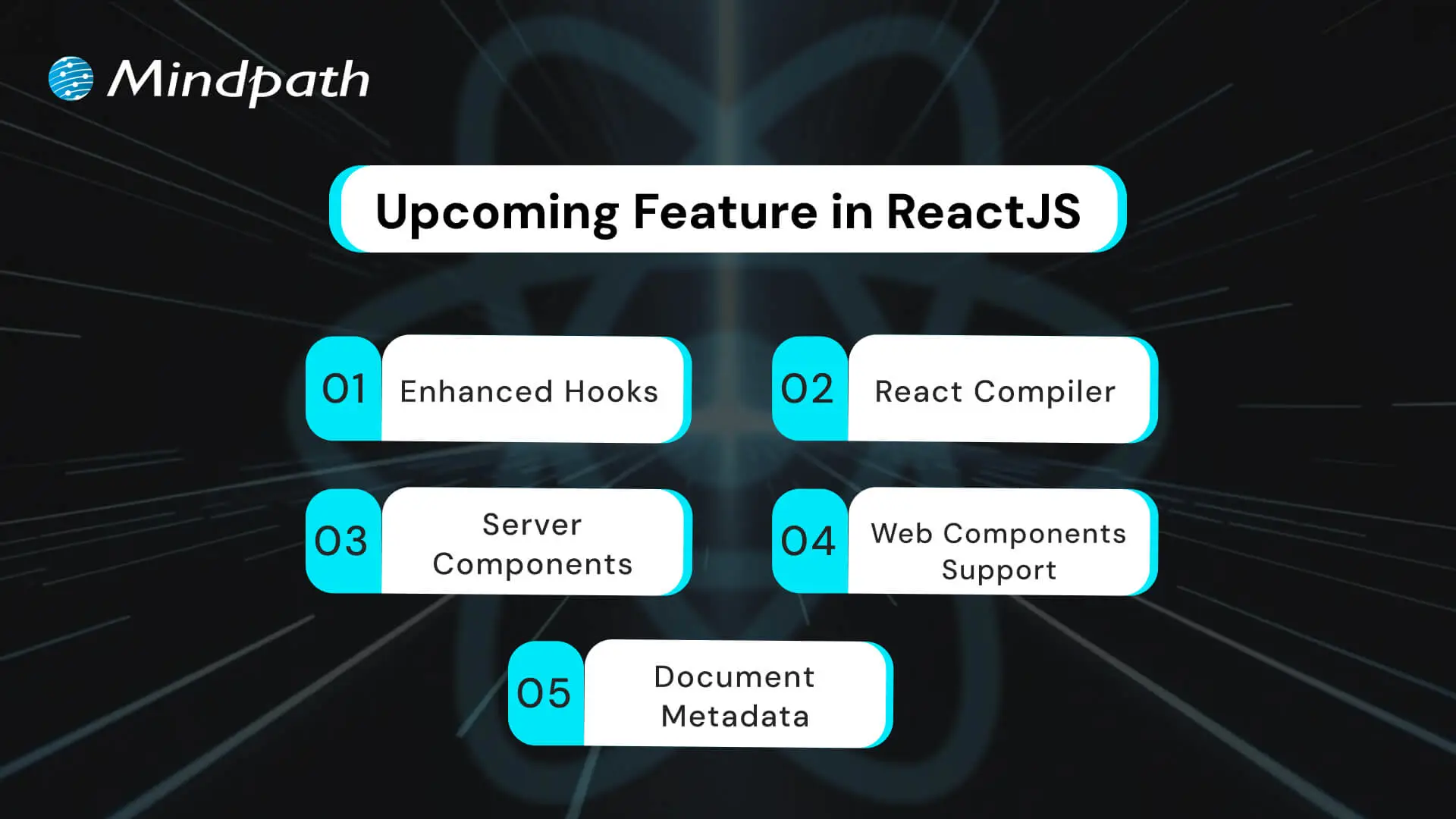
ReactJS 19 is the latest version, bringing fresh improvements to the way developers build user interfaces. With ReactJS’ upcoming features, version 19 focuses on better performance, cleaner code, and easier state handling. These updates mark a big step forward in the future of ReactJS and give a clear view of what’s new in ReactJS in 2026.
1. Enhanced Hooks
One of the React 2026 updates includes powerful new hooks that will make state and effect management even smoother. These enhanced hooks aim to simplify logic and reduce repetitive code in components. They’re designed to give developers more flexibility and control in modern web development.
2. React Compiler
React is introducing a new compiler that optimizes code during build time. It helps reduce manual work by automatically improving performance behind the scenes. Instagram is already using this tool, making it one of the most promising ReactJS features.
3. Server Components
React now supports server components, allowing parts of the UI to render on the server. This feature works well with frameworks like Next.js and helps improve app performance. It reduces the JavaScript sent to the browser, making pages load faster.
4. Web Components Support
React will soon support the direct use of web components inside your code. This opens the door to combining different front-end technologies in one project. It’s a big step forward in creating flexible and reusable UI elements for modern web development.
5. Document Metadata
React 2026 updates will include better control over document metadata like titles and meta tags. This allows developers to manage SEO-related data more efficiently within their components. It saves time and keeps everything organized in one place.
Want to ensure your digital products stay competitive as new react trends shape the future of web development? Discover how the latest React roadmap helps business owners plan smarter, more future-ready tech investments.
What are the Top ReactJS Trends for 2026?
The React ecosystem is going through major improvements that are changing the way developers approach front-end development. ReactJS trends 2026 highlight a shift toward more efficient workflows, faster rendering, and cleaner architecture. With smarter tools and updated features, we can see how ReactJS is evolving in 2026 to meet the growing demands of modern web development.
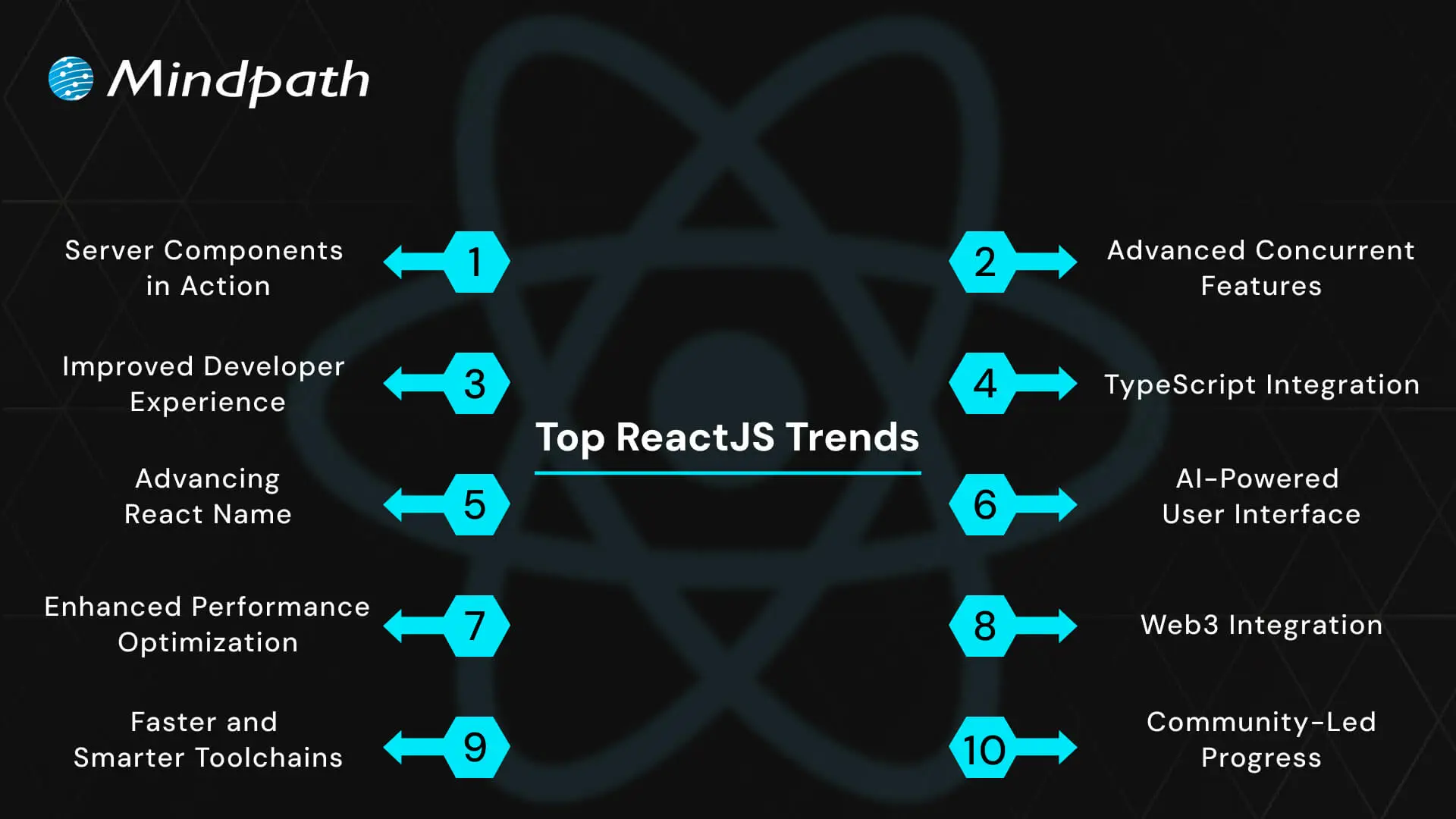
1. Server Components in Action
React’s new server components allow parts of the UI to be rendered on the server, reducing the workload on the browser. This makes applications faster and easier to manage, aligning with the latest ReactJS trends. They also allow developers to send less JavaScript to the client, improving performance. This results in faster initial page loads and a smoother user experience.
2. Advanced Concurrent Features
React’s concurrent features, like Suspense and automatic batching, make multitasking smoother and interfaces more responsive. This update improves how React handles rendering without blocking the user experience. It helps manage large-scale applications more efficiently. Developers can build interfaces that stay fast even during heavy updates.
3. Improved Developer Experience
Tools like React DevTools are being enhanced to support more efficient debugging and testing. These improvements help streamline development workflows and reduce troubleshooting time. Developers get better visibility into component behavior and performance bottlenecks. This leads to quicker bug fixes and smoother iterations.
4. TypeScript Integration
The adoption of TypeScript continues to grow as teams seek more scalable and maintainable codebases. This is now a major trend in front-end trends 2026, supporting safer and more reliable coding. TypeScript’s static typing reduces runtime errors and improves code clarity. It also makes collaboration easier across large development teams.
5. Advancing React Native
React Native updates are making it easier to develop high-quality cross-platform apps. It remains a strong choice for teams working across both web and mobile interfaces. New libraries and tools are being introduced to improve development speed. These updates also enhance native-like performance and UI consistency.
Want to be sure that your web application delivers a fast and smooth user experience that keeps customers engaged? Discover how improving React performance can directly enhance satisfaction and boost overall business results.
6. AI-Powered User Interfaces
React is being used to build smarter, AI-driven interfaces that adapt to user behavior in real time. These features support more personalized and predictive user experiences. AI integration helps applications anticipate user actions and deliver relevant content. This enhances engagement and boosts user satisfaction.
7. Enhanced Performance Optimization
Performance remains a top focus, with React adding better support for edge computing and efficient memory handling. These updates are critical to meeting modern speed and scalability demands. They ensure faster content delivery across global networks. Optimizations also help reduce power and data usage on devices.
8. Web3 Integration
React is being adapted to work smoothly with decentralized technologies like blockchain wallets and smart contracts. This is part of the broader movement in JavaScript frameworks 2026 towards Web3-ready solutions. It simplifies the process of building secure and decentralized apps. React’s flexibility supports fast adoption in emerging blockchain-based platforms.
9. Faster and Smarter Toolchains
Modern tools like Vite and frameworks such as Next.js and Gatsby are becoming more powerful. These enhancements reflect improvements seen across React front-end development practices. They reduce build times and make testing and deployment more efficient. Developers benefit from improved hot reloading and modular workflows.
10. Community-Led Progress
The React ecosystem continues to expand thanks to open-source contributors who build tools, libraries, and new practices. These efforts keep ReactJS trends moving forward with fresh ideas and evolving standards. Active community support ensures regular updates and fast issue resolution. It also helps spread knowledge and best practices across the industry.
Want to scale your application seamlessly as your customer base grows? Learn how the benefits of ReactJS development services make large-scale, high-traffic apps easier to maintain and expand.
Are You Looking Forward to Embracing the Future of ReactJS?
ReactJS trends are reshaping the landscape of modern web development. With fresh tools, smarter architecture, and growing support for cutting-edge features, staying current is no longer optional. Developers who stay informed can build faster, smarter, and more scalable applications. Understanding these shifts puts you in control of how you approach digital solutions in 2026 and beyond.
At Mindpath, we offer expert ReactJS development services designed for growth and scalability. Our team stays aligned with the latest ReactJS trends, ensuring your product is future-ready. From concept to deployment, we develop efficient and high-performing applications tailored to your goals. Partner with us to unlock seamless, modern interfaces built with precision and care.

At present, the UI and UX aspects of web app development are undergoing a paradigm shift. It is an understatement to say that the year 2026 has been a groundbreaking year when it comes to web app development. This is because an array of new UI/UX design trends has emerged. In fact, as per recent UX statistics, if you invest USD 1 in UX, you are likely to get a return of USD 100. It highlights the rising popularity of top-notch UI UX designs.
If you wish your business to stand out in the crowded digital space, it is essential to familiarize yourself with the latest UI UX best practices. By incorporating the top UI UX trends into your website, you can have a lasting impression on your target audience. Let us take a look at some of the most unique UX UI design trends that are set to rule in the year 2026 and beyond.
If you want to modernize your next project with UI/UX trends, our web development services can help you design and develop applications that would deliver engaging digital experience.
Top UI/UX Trends of Today
Gone are the days when websites used to be boring. Thanks to rising emphasis on UI UX, learning businesses have started realizing the strategic relevance of user experience and user interface. In the fast-paced business world, it is a must for businesses across diverse industries to incorporate captivating UX UI elements that can captivate online users.
If you wish to use your business website as a strategic tool, it is essential to review UI UX design elements that are ruling the web app development arena at present. It will certainly create an opportunity for you to develop a world-class website that can boost the overall experience of your users. Some of the major UX UI trends that are likely to rule the current as well as future web app development arena are:
1. AI-Driven Personalization
Today, businesses are relying on artificial intelligence technology to redefine their UI UX efforts. By leveraging AI, it has become possible to take personalization to the next level. Many businesses across diverse sectors and industries are incorporating AI to tailor the digital experiences of their users. By capitalizing on AI capabilities, it has become possible to create highly engaging as well as relevant interactions for the target audience.
Such a development in the web app development arena has undoubtedly revolutionized the experiences of users. Moreover, by focusing on AI-driven personalization, businesses are able to understand the behavior and preferences of their users in a better way. The insights are equipping businesses to promptly respond to the needs of their users and strengthen their association with them. Today, businesses have even started taking AI-driven personalization to the next level by creating dynamic layouts for their websites and developing adaptive designs.
Curious to learn how AI can transform web development? Take a deep dive into our Comprehensive Guide to AI in Web Development to get more insights!
2. Integration of Immersive Elements
One of the most popular UX UI trends that is dominating the web app development space revolves around the use of immersive elements. It has become common to add 3D elements to websites so that users can have a highly engaging experience. Some of the other common UX UI design examples that are gradually gaining popularity include virtual reality (VR) and augmented reality (AR) elements.
By incorporating such components into web app development, new possibilities have opened up for businesses. In fact, businesses have become capable of blurring the lines between the virtual world and the physical world. It has also been reshaping how online users interact with businesses in the modern era. In the future, this specific UX UI design trend is likely to gain further momentum due to its rising popularity among businesses and users alike.
3. Focus on Interactive Design
At present, businesses have shifted their attention towards interactive design in the context of web app development. By incorporating such elements, businesses can improve engagement and interaction with online users. It has become quite common to incorporate elements in the form of subtle animations and feedback to guide the users. Similarly, businesses have started incorporating dynamic animations that are capable of responding to the inputs of users.
Interactive design is considered to be an indispensable part of UX UI. Such design components can serve as catalysts and influence how online users interact within a website. This trend is here to stay since it can impact the experience of online users at diverse levels. If you wish your web application to have a lasting impact on your target audience, you must certainly start incorporating impactful interactive design features and components.
4. Introduction of Dark Mode
The dark mode is not exactly a new trend in the web app development space, but it has undoubtedly gained immense popularity in recent times. This mode has become immensely popular among online users owing to its sleek and captivating look. Moreover, the dark mode ensures the comfort of users, especially when they navigate websites and applications in low-light settings.
By including the dark mode element, it is possible for you to keep up with the amazing UX UI trend. This visual setting can create value for your web app by improving its overall aesthetics. Moreover, it can certainly enhance the overall experience of online users by improving their readability and reducing their eye strain. It is undoubtedly one of the top trends that businesses cannot afford to ignore today.
Curious about what’s shaping the future of web experiences? Discover top web development trends to discover the technologies and practices driving next-generation applications.
5. Sustainability in Designing
Today, immense focus is being laid on sustainability aspects. This trend has also been observed in the context of web application development. Currently, businesses are fusing sustainable and environmentally friendly design elements into their websites and applications. You must also start including elements that enhance the digital experiences of your users while minimizing their environmental impact. One of the top trends that is gaining momentum focuses on minimalism and efficiency. Similarly, another popular trend involves the use of recyclable resources.
It has become fairly common to prioritize efficiency in coding practices. By focusing on this aspect, it is possible for businesses to curb their footprint on the environment. This UX/UI trend is surely catching up in recent years, and it is expected to stay for a long time. It is the perfect time for modern businesses to incorporate this specific UX UI trend by locating unique ways to reduce waste and optimize the use of resources in web app design.
The top UX UI trends that have been identified are redefining the future of web app development today. Furthermore, these top trends are most likely to gain further momentum and influence how businesses create their websites as well as applications to shape user experience.
Want your UI/UX designs to truly stand out in real-world applications? Explore our Custom Web Development Services blog to see how tailored solutions turn great designs into seamless user experiences.
Final Words
The future of UI/UX design is full of new possibilities today. You can give your business an edge by choosing the best UX/UI design elements. Some of the major trends that you must look out for today include AI-driven personalization, integration of immersive elements, interactive design, dark mode, and many more.
You must undoubtedly consider joining hands with Mindpath since we offer comprehensive UI UX designs to modern businesses today. We aim to help you to keep up with the latest UI/UX design trends in 2026 and enjoy a competitive advantage. By choosing Mindpath’s top-notch app development services, businesses can create amazing applications that boost their performance and contribute to business growth.
Have you ever considered how AI and business actually fit together? You may have heard a lot about AI being faster and smarter, but is your business actually prepared for it? Many people are excited about new technology, but they often overlook whether they have a solid foundation. Take a second to think about it- is your business possibly ignoring some signs that say you are not prepared for AI yet?
AI can help any business develop, but starting without preparation can create issues. There are companies that jump into AI without having the right tools or people, or even ideas. This could waste valuable time and resources and lead to frustration. Integrating AI in business strategy from the start ensures you’re prepared and can identify potential challenges early. In this blog post, you’ll learn five easy indicators that show your business may not be ready for AI yet.
Want to future-proof your business with AI? We at Mindpath offers exceptional AI development services that help your business get AI-ready and unlock next level of growth!
What Being ‘AI Ready’ Really Looks Like?
Being ready for AI means your business has the right people, tools, and plan to make it work well. When you think about AI and business together, it’s more than just buying new software. You need good data that’s easy to use, a team that knows how to work with AI, and clear goals that AI can help you reach. A business ready for AI knows how to bring people and smart technology together.
Look at Amazon. They show how AI in e-commerce can work side by side with business to help customers and save money at the same time. This happens because they plan ahead and know exactly how AI will help. If you want your business to be ready to use AI, start by checking your data, training your team, and making a simple plan that fits your real needs. When you get this right, AI in business can really help you grow.
Must Read: Benefits of AI
What is an AI Readiness Checklist?
An AI Readiness Checklist is a simple tool that helps you see if your business is really ready to use AI in the right way. It covers important things like your data, your technical tools, and how well your team understands AI. When you think about AI helping your business grow, this checklist shows you what’s strong and what needs more work.
A good AI checklist looks at your technical setup, the quality of your data, your team’s skills, and whether your company is open to new ways of working. This way, you can fix any gaps before you bring AI into your business. By using an AI checklist, you can make sure you’re set up for success and get real value from AI in business.
How is AI reshaping the way websites are built and optimized? Explore our detailed article on AI in Web Development to see how it’s driving smarter design, faster deployment, and better user experiences.
AI Readiness Checklist for Businesses
Before you bring AI into your daily operations, it’s important to know where you stand. A good AI readiness checklist will help you see if your business is truly prepared for this step. Here are the key areas to focus on as you plan your AI and business journey.

1. Robust Data Foundations
Good data is the backbone of any artificial intelligence business idea. Check that your data is clean, organized, and ready for AI tools to use well. Strong data governance keeps your insights trusted and prepares your business for AI integration.
2. Leadership and Team Alignment
A strong AI and business plan starts with people who believe in it. Make sure leaders fully support your strategy and teams understand the goals. A clear roadmap and open communication help everyone move toward strategic AI adoption together.
3. Technology and Process Readiness
Your tools and workflows must support AI smoothly. Research the best AI solutions for your existing systems and test them with pilot projects. Use simple frameworks to track results and find the best areas for automation.
4. Governance, Ethics, and Security
Responsible AI needs strong rules and security in place. Create clear ethical guidelines and monitor how AI works in your company. A good AI checklist helps protect your artificial intelligence business ideas and builds trust for the long term.
5. Financial Planning and ROI
Every digital transformation roadmap needs clear budget planning. Create realistic budgets, show expected returns, and track savings as you go. This makes it easier to get leadership buy-in and keeps AI and business costs under control.
Looking to streamline your business operations and enhance customer experiences? Discover how conversational AI chatbots can help your business transform its workflows and boost efficiency in our blog.
5 Signs Your Business is Not Ready for AI
Many companies jump into AI without checking if they’re really prepared. Missing a few basics can lead to wasted time and money. Here are five signs that show your business is not ready for AI yet.

1. Stuck in Paper-Heavy Processes
Paper forms, files, and manual approvals slow down daily work and limit growth. AI needs clean, digital data that is easy to find and process. If you’re still tied to paper, you’ll struggle to get real results from AI. Going digital is the first step to connect AI and business ideas that really work.
2. Running on Outdated Technology
Old systems can hold you back from adding smart AI tools. If your technology can’t talk to modern platforms, your AI plans won’t go far. Keeping rigid, legacy software in place only adds roadblocks. Updating your systems is essential for future-proofing your business with AI.
3. Poor Data Quality and Structure
Messy or incomplete data will confuse even the best AI tools. AI needs clear, well-organized data to find patterns and deliver insights. If your data is spread everywhere and filled with errors, you’re not ready yet. A strong data foundation helps your AI and business strategy succeed.
4. No Clear Data Strategy in Place
Without a clear plan, your data might be scattered, outdated, or not useful at all. AI can’t do much if it doesn’t have good data to work with every day. A strong data strategy shows what to collect, how to store it, and who can use it. This is key for turning business ideas AI into real results and leveraging AI in decision-making.
5. Lack of Real-Time Data Insights
AI works best when it has fresh, up-to-date information at its fingertips. If you only rely on old monthly reports, you will miss the full power of AI. Real-time data helps AI spot changes and take action fast. It’s a big step for future-proofing businesses with AI in any industry.
Want to future-proof your AI strategy? Don’t miss our insights on the Top AI Trends in 2025 every business should be ready for.
Ready to Make AI and Business Work Together?
Preparing your business for AI means more than just buying new tools. It’s about building strong data foundations, modern systems, and a clear strategy that connects people and technology. Knowing the signs that you’re not ready yet can save time, money, and stress. With the right plan, AI can help your business grow stronger together and bring real results.
Mindpath’s expert AI development services help you create practical, future-ready solutions. Our team works closely with you to plan, build, and integrate AI into your daily operations. We focus on clean data, secure systems, and smart strategies that fit your business needs. Let us help you connect AI and business in ways that truly work.
Have you ever asked yourself what makes a web application run perfectly while another one continues to crash, raise issues, or slow down? The answer often relates to tech stack alternatives. Think of technology stack choices as the foundation and building blocks of your project. They can make your web application more robust or scalable, and easier or harder to maintain. So, how do you know which technologies should run your next big idea? It’s a decision that impacts the success of your project.
The options can seem endless, but if you understand your desired outcomes and the function of every piece of the technology stack, then this decision doesn’t need to feel too overwhelming. When you pick the right combination of tools, you could save yourself a lot of time and money. In this blog, we are going to explain the basics/fundamentals for web application tech stacks, highlight important considerations, and hopefully help you feel confident in regard to choosing the right technology stack for your web application project. So, let’s explore!
Planning to build a new web application? Mindpath’s web development services will help you in choosing the right tech stack and developing applications as per your business needs.
What is a Technology Stack?
A technology stack, or tech stack, is a combination of tools, frameworks, and programming languages that work together to build and run a web application. It serves as the base for your project. Each part of the stack reflects a specific function. Whether handling user actions or managing data behind the scenes, and effectively, they all need to work together if your application is going to function well.
Finding the right combination will have a significant effect on how your application performs and compounds. A prudent choice will allow you to build an organized, flexible, and scalable web application that you can easily maintain and grow as your needs change.
To understand how technology choices fit into the complete development journey, explore our detailed guide on the web application development process.
Key Factors to Consider While Choosing the Right Tech Stack
Choosing the right tech stack for web development is one of the most important things you’ll do to ensure the success of your project. The tools and technologies you decide to use will dictate how your application performs, scales, and is kept secure. Here are some key factors to keep in mind while selecting the best tech stack for web development.
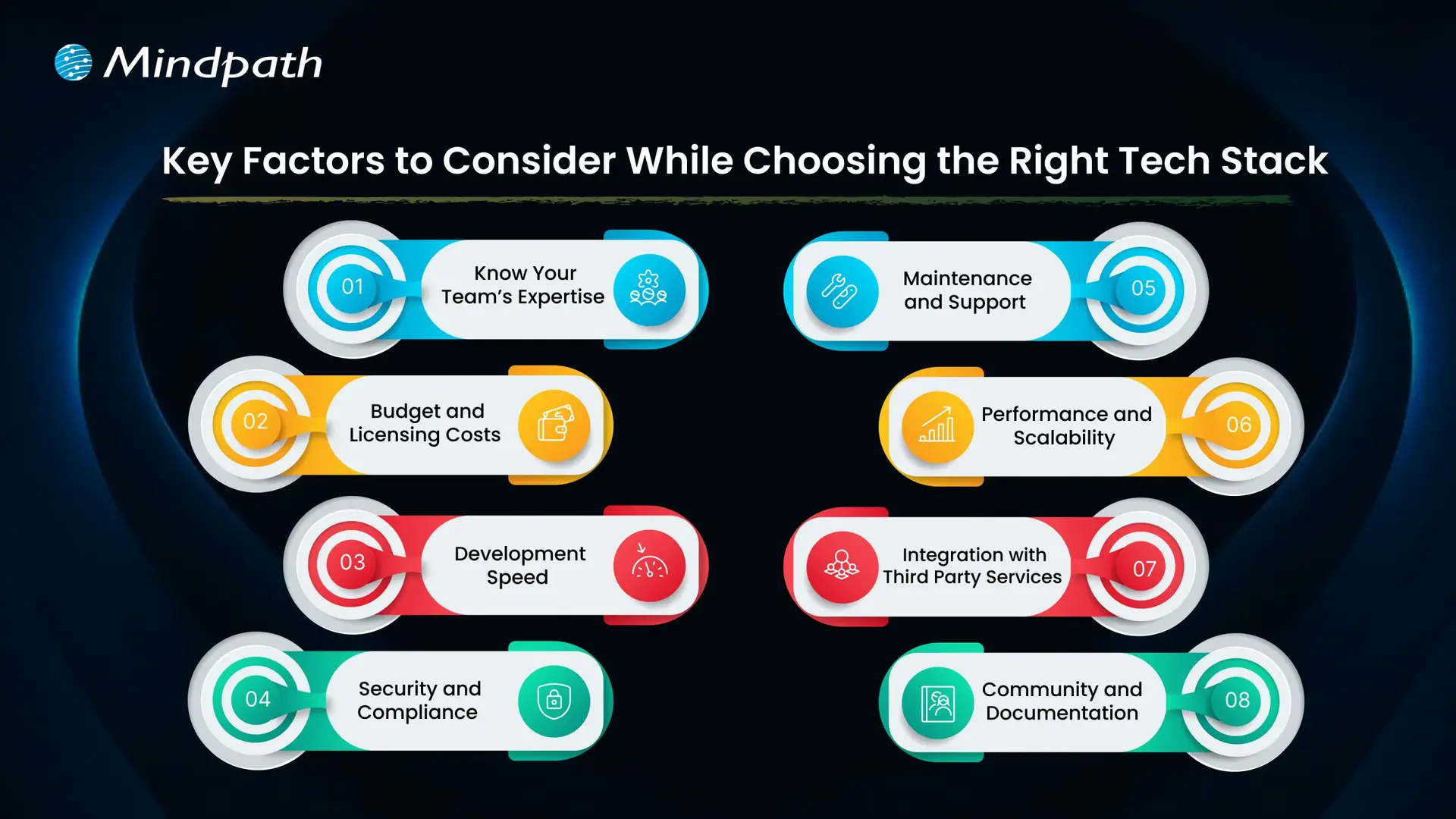
1. Know Your Team’s Expertise
Look at what technologies your team already knows well. Using familiar tools can help you develop faster and avoid extra training costs. Make sure the tech stack matches your team’s size and experience to keep the project on track.
2. Budget and Licensing Costs
Think about any licensing fees for paid tools and compare them with free, open-source options. Remember to plan for costs related to maintenance, updates, and security. Also, include cloud service expenses that may grow as your project expands.
3. Development Speed
Getting your product ready fast can be a big advantage, especially for new businesses. Choosing proven frameworks and useful libraries can help your team build features quickly. This saves time and lets you focus on improving your web app for users.
4. Security and Compliance
Prioritizing security is essential, especially if your application handles sensitive data. Choose a tech stack that supports robust security features and aligns with industry regulations. This will help protect user information and maintain compliance as your project grows.
Must Read: Application Security Best Practices
5. Maintenance and Support
Choose technologies that have strong community or vendor support so you can get help when needed. A reliable tech stack with regular updates will make it easier to fix issues and improve your application over time. This helps you avoid unexpected costs and keeps your project stable in the long run.
6. Performance and Scalability
Make sure your tech stack can handle the speed and load your application needs. If you expect real-time processing or heavy traffic, choose tools that keep response times fast. This helps your web app run smoothly as more users come on board.
7. Integration with Third-Party Services
Check that your tech stack works well with the third-party services your app needs. Good API compatibility makes it easier to connect features like payments, analytics, or social media. This saves time and helps your app deliver a smooth user experience.
8. Community and Documentation
Choose technologies with an active developer community and plenty of shared resources. Strong documentation makes it easier for your team to build, test, and maintain your web application. This support can save time and help solve issues more quickly.
Wondering how your tech stack fits into the bigger picture of web app development? Explore our comprehensive Web App Development Roadmap for 2026 to see how each decision impacts your project’s success.
Top 8 Tech Stack Examples
Exploring technology stack examples can help you see what works best for different types of projects. Here are some of the most popular examples to consider in 2026.
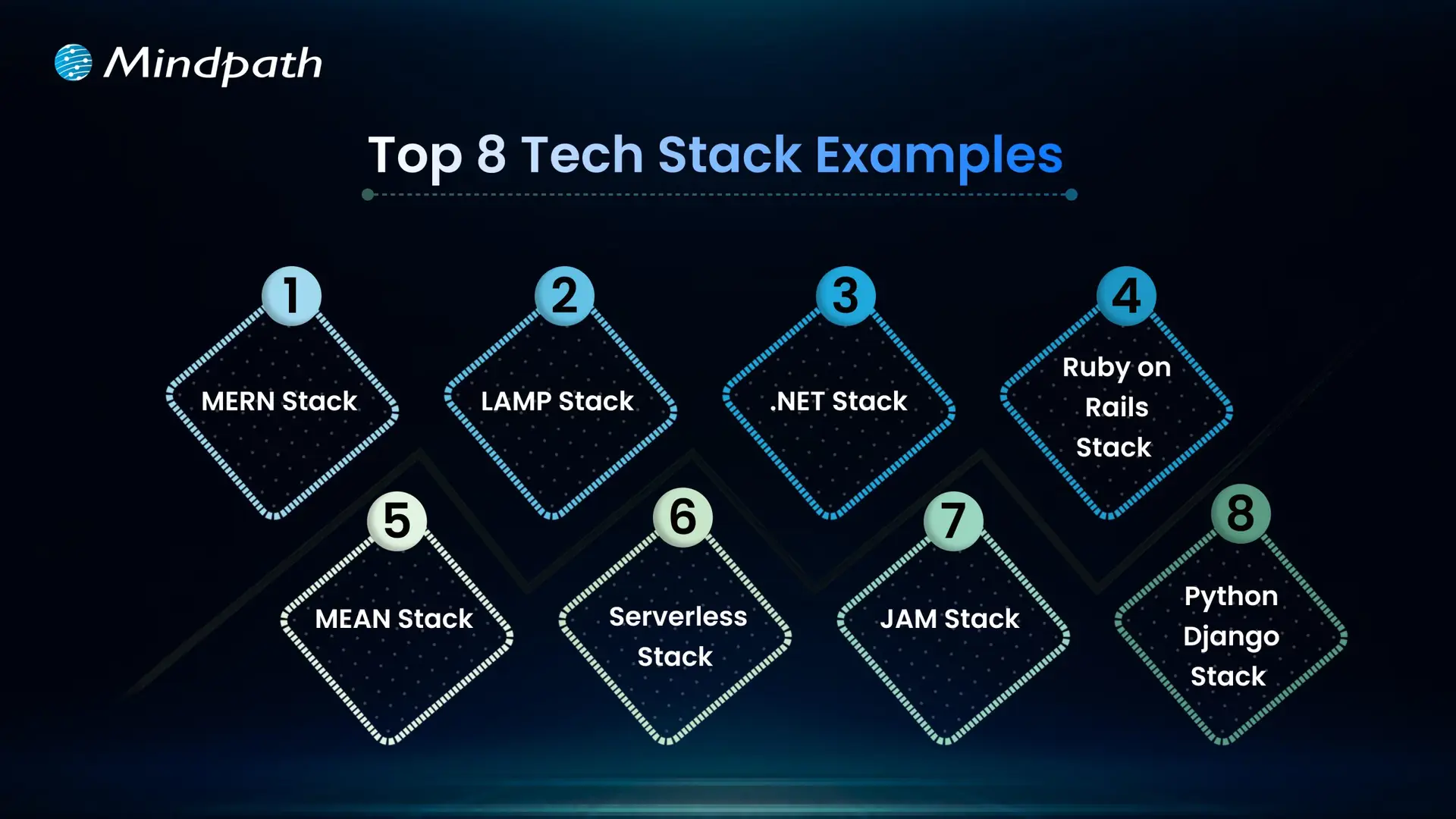
1. MERN Stack
MERN includes MongoDB, Express.js, React, and Node.js for flexible, dynamic sites. It’s widely chosen as a modern web application stack for responsive interfaces.
2. LAMP Stack
The LAMP stack combines Linux, Apache, MySQL, and PHP to build reliable, cost-effective websites. It is one of the oldest and most trusted web stacks in use today.
3. .NET Stack
The .NET stack is known for secure, large-scale enterprise applications. Many companies choose this web dev stack for its strong integration with Microsoft tools.
4. MEAN Stack
The MEAN stack uses JavaScript across MongoDB, Express.js, Angular, and Node.js. This tech stack for web development is popular for real-time and single-page apps.
5. Ruby on Rails Stack
Ruby on Rails offers a simple, clean approach for rapid web projects. This technology stack example is still a favorite for startups and MVPs.
6. Python-Django Stack
The Python-Django stack helps developers build powerful sites quickly. Many prefer this as a flexible web development stack with great community support.
7. JAM stack
JAM stack uses JavaScript, APIs, and Markup to deliver fast static sites. It is considered one of the best tech stacks for web development for content-heavy projects.
8. Serverless Stack
Serverless architecture removes the need to manage servers directly. It’s a growing example of a tech stack that cuts costs and improves scalability.
Not sure if your business really needs a custom web application? Discover the key signs that your business needs a custom web application that indicate it’s time to invest in a tailored solution for your needs.
Need Help Choosing the Right Tech Stack for Your Web Project?
Selecting the right tech stack for web development shapes how well your application performs, scales, and adapts over time. By knowing your goals, team strengths, and key factors like security, costs, and integrations, you can make informed choices that save you time and money. A thoughtful approach will help you build a reliable, future-ready web application that supports your business growth.
At Mindpath, we help you build secure, high-performing web applications with the best-fit tech stack for your needs. Our experts offer end-to-end web application development services, covering design, development, testing, and support. We make sure your solution stays flexible, scalable, and easy to maintain as your business grows. Let’s create a web app that works for you.
The fast-paced growth of the digital landscape has not only empowered businesses but also made them think about their online presence. Companies have been hiring ReactJS developers to capitalize on the diverse capabilities of ReactJS for creating robust user interfaces. The notable features of ReactJS include the virtual DOM, a thriving ecosystem, and modular architecture. Let us find out the important factors you must keep in mind while hiring React developers.
Want to hire ReactJS expert for your next project? Discover how Mindpath’s ReactJS development services will help you achieve your specific business goals.
What Should You Keep in Mind While Hiring ReactJS Developers?
The search for expert ReactJS developers has gained momentum as a response to more businesses turning towards online platforms. However, business owners might experience some trouble in hiring React developer as they will find it difficult to understand coding nuances and technical jargon. At the same time, finding the best React developer who can also be a cultural fit is a huge challenge.
Hiring managers must also go through a massive talent pool of React developers to find the top expert for their next web project. On top of it, employers have to look for more than just technical skills in React developers to create successful web projects. The following checklist can help you hire the best ReactJS developers for your web projects.
Must Read: ReactJS Trends
1. Specify the Project Requirements
One of the foremost factors to consider when hiring ReactJS developers is the outline of project requirements. You should know your project scope and complexity level to identify the ideal React developer who would align with your project vision. The project requirements should not be limited to defining the type of project, but also the timeline, desired features, budget, and complexity.
With a clear impression of these aspects of your project, you can determine the skills and experience required from candidates. For instance, you will need a junior developer for smaller tasks and a senior developer for leading initiatives to scale up web projects.
2. Never Compromise with Technical Fluency
The easiest solution to challenges in hiring expert ReactJS developers involves focusing on the technical skills of applicants. You need developers who know more than the fundamental concepts of React and have various crucial technical skills. Candidates must have strong understanding of JavaScript features such as arrow functions, closures and destructuring.
Applicants for React developer jobs should also have in-depth understanding of the important concepts in ReactJS. Some of the important React concepts include React Hooks, component lifecycle methods, virtual DOM and reconciliation. People applying for ReactJS developer jobs must also know how to work with state management libraries such as Redux.
The other crucial technical skills in a checklist for hiring ReactJS developer include fluency in HTML and CSS, version control with Git and API integration. Aspiring React developer must also know how to work with testing frameworks, build tools and package managers like NPM. Another prominent technical skill that React developers must have is performance optimization.
Want to keep your large React app fast and responsive as it scales? Discover the best practices for optimizing React performance for large applications.
3. Optimizing the Interview Process
The effectiveness of your hiring process depends a lot on the quality of the interview. If the resume serves as an advertisement, then the interview helps you test the product. Employers should divide the interview process into different stages to evaluate the distinct competencies of applicants. The best practices for hiring ReactJS developers suggest that the interview must include technical assessment, portfolio review, live coding session and behavioral interview. Each stage in the interview process will help you measure the overall proficiency of candidates rather than focusing on specific areas of expertise.
The technical assessment should have coding challenges to test the problem-solving skills and coding style of applicants. You can find out whether they use efficient algorithms, data structures and React concepts in their code. Hiring managers should choose live coding sessions in interviews for senior React developer roles. The portfolio review involves checking for active contributions of candidates on GitHub and their past projects. Employers can use the portfolio review to find out whether the applicant has problem-solving skills.
The technical assessment and portfolio review must be accompanied with behavioral interview questions. The best react developer hiring tips point out that behavioral interview questions can help you learn more about the developer. For example, you can find out how they approach complex issues, their preferred development workflow and their preferences for collaboration. The behavioral interview will help you understand the capabilities of a React developer applicant on a more personal level.
4. Don’t Forget the Soft Skills
Among the many factors that you should keep in mind while hiring React developers, the list of soft skills will never lose its significance. As a matter of fact, soft skills like communication, adaptability, problem-solving and collaboration are essential requirements for almost every job. Why are soft skills important for ReactJS developers? Soft skills serve as the catalyst for transforming a group of individuals into a powerful team.
Most of the guides on how to hire ReactJS developers also focus on other soft skills such as attention to detail, proactivity and accountability. React developers need attention to every detail of the UI development process as it can help in crafting robust and engaging user experiences. On top of it, proactivity implies that the candidate will be always ready to take initiative. At the same time, accountability can ensure that the developers take responsibility for all their actions.
5. Determine Realistic Compensation
The most crucial highlight in the hiring process is the cost of hiring ReactJS developers. Hiring managers must offer a compensation package that fits perfectly with the role and responsibilities of the developer. For example, junior developers can earn between $70,000 and $90,000 while senior developers can earn more than $150,000.
The ideal way to make sure that the candidates feel that the compensation is right involves a clear job description and smooth onboarding process. Tell the developers what they have to do on the job to make them understand why they are being paid a specific amount. In addition, try to include programs for continuous learning and growth of developers.
Looking for specialists who can handle complex front-end challenges in your business? Learn why partnering with an expert React Development Company is a smart move.
Final Thoughts
The answers to “What are the key things to consider before hiring a ReactJS developer?” focus specifically on project requirements, technical skills, soft skills and the interview process. On top of it, determining the ideal compensation for ReactJS developers is also an important concern in the hiring process.
Do you need professional ReactJS development services for your next web application? At Mindpath Tech, we have the best developers who can handle all your frontend development needs. Our team of proficient ReactJS developers has the experience of working on multiple projects. We not only offer the assurance of efficient web development but also resourceful solutions to optimize your digital presence. Join us and work with top-tier ReactJS talent on your revolutionary web app right now.
ReactJS has been one of the most popular JavaScript libraries for user interface development. You might want to hire ReactJS developer for your next project to capitalize on the interesting features of ReactJS. Since its arrival in 2013, ReactJS has been a leading tool for frontend development with capabilities to develop high-performance user interfaces. Let us discover how you can find the best React developers in 2025 for your team.
Are you planning your next project and you need a ReactJS developer? Explore how Mindpath’s ReactJS development services can help bring your concept to life and help you achieve your business objectives.
Why is ReactJS Popular in 2025?
With so many libraries and frameworks emerging every year, it is reasonable to wonder about the reasons for which ReactJS is still popular. You should know that the demand for skilled ReactJS developers is still strong in 2025 as React is the cornerstone of modern web development. Businesses want to hire ReactJS developers for their web projects to capitalize on the various features of ReactJS.
One of the foremost reasons to choose React for frontend development is the backing of Meta, a tech giant. ReactJS was created by Meta, and even after becoming open-source, the library gets maintenance and support at par with the highest standards.
The other promising reasons to pick ReactJS for interface development include the component-based architecture, declarative syntax, cross-platform capabilities, and the virtual DOM. Each feature of ReactJS gives a strong reason to pick the best ReactJS developers for your next project.
The component-based architecture ensures that developers can create reusable UI components, thereby reducing the development time and ensuring easier maintenance. The declarative syntax of ReactJS enhances the predictability of code, which makes it easier to debug. On top of it, the virtual DOM helps in improving performance by avoiding direct modifications to the browser DOM.
Many companies also want to hire react native developers as ReactJS offers cross-platform development support with React Native. ReactJS is a versatile choice for businesses that want to leverage mobile apps for expanding their digital presence. Most important of all, ReactJS is still popular because it has a strong community that is growing continuously with new tools, libraries, continuous updates, and extensive resources.
Must Read: ReactJS Trends
Know Your Requirements to Hire React Developers
The search for skilled React developers might be a challenging task for hiring managers in 2025. Why? The competition among businesses to hire react developer also means that you can find a crowd of applicants for the job of React developers. Therefore, hiring managers must start their search for talented React developers with a clear understanding of their specific requirements. You have to keep the following points in mind while creating the job listing or description of the role.
1. Definition of Project Scope and Complexity
The first thing that you need to know before hiring React developers is the scope of your project. Are you building a single-page application or a complex web portal? Do you need interactive visualizations or have plans to scale up in the future? The answers to these questions can guide you through the React developer hiring process without obstacles. For instance, simpler projects will require a junior developer while complex web applications need senior developers who know API integration, state management and performance optimization.
2. Experience of the Developers
The next aspect of determining your hiring requirements from ReactJS developers is their seniority and experience. It is important to remember that the complexity of a project provides a clear direction when you have to determine the experience level you need in React developers. Junior developers might have less than two years of experience while mid-level React developers have two to five years of experience. Senior developers are the ideal picks for leading projects and making critical decisions, owing to their experience of more than five years.
3. Technical Skills of ReactJS Developers
Another prominent highlight in the process of creating a job description for ReactJS developers is the list of technical skills. You must specify the exact ReactJS developer skills that you need from a React developer in your team. The most important technical skills required from React developers include strong command over JavaScript and core ReactJS concepts, JSX, API integration and state management. You should also know that ReactJS developers must be fluent in HTML and CSS, testing frameworks, debugging and version control.
4. Soft Skills of ReactJS Developers
If you want ReactJS developers who can solve your problems, then you must focus on soft skills. Developers with problem-solving ability, communication skills, adaptability and attention to detail can serve as valuable assets for any organization. For instance, problem-solving skills can empower developers to break down complex problems and come up with efficient solutions. Similarly, adaptability enables ReactJS developers to understand new technologies and embrace change. Furthermore, communication skills and teamwork can help developers work effectively in different environments while tapping into the benefits of collaboration.
Are you missing out on the potential efficiency ReactJS offers for modern web apps? Discover the essential benefits of ReactJS development services to maximize your investment.
Searching for ReactJS Developers in the Right Places
The competition between ReactJS developers is high and with a vast talent pool, hiring managers often worry about the places to recruit React developers. If you know the right place to post listings for React developer jobs, then you can have an easier hiring process. Here are some of the top places to search for the best ReactJS developers.
1. Online Job Search Platforms
The best place to start listing ReactJS developer jobs is LinkedIn, the most popular professional networking platform. It is a great choice for posting job vacancies and searching directly for candidates with advanced filters, based on skills and experience. Some of the other notable job search platforms to hire dedicated developers for ReactJS projects include Indeed, Glassdoor and Monster. Hiring managers can use these job portals to post detailed job descriptions and attract a larger base of applicants for ReactJS development roles. Special job boards such as Stack Overflow Jobs and Discord communities can also help you find talented ReactJS developers.
2. Freelance Platforms
Another notable approach to hire resources for any business is freelancing. Some businesses want to hire remote ReactJS developers according to their budget or strategic plans. For example, remote work can empower developers to improve their productivity with better work-life balance. You can come across multiple freelance platforms such as Upwork and Fiverr to find ReactJS developers for small tasks or short-term projects. Freelance platforms also help you discover developers with specialized skills required for certain projects. One of the reasons to choose freelance platforms is the safety net of their rigorous scrutiny process, which ensures that you work with top-tier ReactJS developers.
3. Professional Networks, Communities and References
If you don’t find a React developer for your next project on different online platforms, job boards and freelance platforms, then you must choose the next best option. Businesses can hire expert ReactJS developers from professional networks and communities. For instance, GitHub is one of the best places to find a lot of ReactJS developers and measure their skills on the basis of their open-source contributions, coding style and portfolio. Developer conferences or React forums can help in obtaining references and identifying skilled developers. Always remember that references from industry contacts can help in identifying talented candidates who can also be the perfect cultural fit in your organization.
Is your current team struggling to handle large-scale React applications? Learn why hiring a React Development Company might be the smarter choice.
Steps for Hiring the Best ReactJS Developers in 2025
After identifying the important requirements from ReactJS developers and the sources to hire top-tier talent, you need a strategic plan. The plan can not only streamline the hiring process but also offer the ideal template to make informed hiring decisions. You must keep the following points in mind to ensure the most productive hiring process to add talented ReactJS developers in your team.
Step 1: Design an Appealing Job Description
If you want the best ReactJS developers for your next project, then you must create an appealing advertisement. The job description serves as the ad to hire React developer on different platforms and makes the first impression on potential candidates. Experts recommend that the job description must be clear and concise to attract top talent among ReactJS developers. How can you design an attractive job description for React developer roles? You can start by mentioning a clear title that reflects the duties desired from the candidate. The job description must also provide a detailed company overview which shows why your company is a great place to work.
The job description must also include a list of the responsibilities for ReactJS developers in your organization. At the same time, you should also add the list of required skills for the job. While listing the responsibilities and skill requirements, you must be specific about them. On top of it, you must mention some additional skills that you need from ReactJS developers. The most important element that will complete your ReactJS developer job description is the outline of compensation and benefits.
Step 2: Use the Best Screening Techniques
Once you put the job description as a listing on different platforms, you will receive a lot of applications. The initial screening process is mandatory in all cases, whether you want to hire JavaScript developers or ReactJS developers. You can begin the initial screening process with a review of the resume and portfolio of candidates. It is important to check the experience of applicants in ReactJS projects and their work history. Hiring managers must also find out if candidates have contributed to open-source projects with ReactJS.
The effectiveness of the initial screening procedure for ReactJS developers also depends on how effectively you review their code. You should check the quality, structure and ease of maintenance of the code in different projects in a candidate’s portfolio. Automated coding assessment platforms can prove useful in measuring the proficiency of candidates in ReactJS development. The initial screening process may also involve a phone call for reviewing the communication skills, interests in role and salary expectations of applicants.
Must Read: React vs Vue
Step 3: Follow a Structured Approach to Interviews
Interviews for ReactJS developer roles might not be as simple as you have imagined. You should hire React programmers only after a multi-stage interview process for comprehensive evaluation of all candidates. The essential stages that you should include in an interview for ReactJS developer jobs include technical interview, system design interview and behavioral interview. Technical interviews must involve live coding exercises focused on core ReactJS concepts, algorithms and data structures. Hiring managers can provide real-world scenarios with coding challenges to evaluate the hands-on coding proficiency of candidates.
The system design interview is a type of advanced technical interview tailored for senior roles. The primary focus in the system design interview is on scalability, design patterns, complex systems and architecture. Candidates for senior React developer roles must be asked to design scalable React applications or recommend the structure for a large-scale project. Finally, the behavioral interview can serve as a useful tool to measure the soft skills of candidates. Behavioral interviews help in evaluating whether the candidate will be a perfect fit in an organization.
Step 4: Salary of ReactJS Developers in 2025
Another important step in the process for hiring ReactJS developers in 2025 focuses on determining the ideal salary. Awareness of the salary expectations can help a business identify the best compensation for React developers working on their projects. The cost of hiring ReactJS developer depends on various factors including location, experience, employment type, company size and specialized skills. The average annual salary of ReactJS developers in the USA varies between $70,000 and $180,000.
Seeking a development approach that reduces complexity while enhancing functionality? Read why React Web Development is ideal for modern projects.
Mistakes You Should Avoid While Hiring ReactJS Developers
The most crucial step in the process of hiring ReactJS developers is to acquire awareness of common mistakes. For instance, some employers focus a lot on the cost of hiring and go for cheaper options that lead them to problems in the long run. It is important to choose talent that will pushes your project forward on the path to long-term success. Ambiguity in the job description might also be one of the notable mistakes while hiring React developers.
If you want to hire dedicated ReactJS developers, then you must also pay attention to common pitfalls in technical and behavioral assessment of candidates. On top of it, recruiters must also pay attention to the references of a candidate and use updated interview questions.
Final Thoughts
You can hire the best talent for ReactJS development in 2025 by focusing on a systematic plan for the hiring process. Hiring managers can rely on professional ReactJS development services to find a way around the intricacies of the hiring process. Professional service providers can help you work with top-tier talent that you can choose according to your project requirements.
Mindpath Tech is your one-stop destination for hiring the best ReactJS developers with years of professional experience. We have been crafting visually appealing web apps and strengthened our reputation as one of the top end-to-end IT solutions provider. Consult with our experts and find ReactJS developers with the most relevant skills for your next project now.
Have you recognized how AI for customer service is changing the way you receive services from your favorite brands? Perhaps you’ve engaged with a virtual assistant at midnight or received an immediate answer without waiting on hold. It feels good, right? That’s the benefit of smart technology working behind the scenes for you. Companies all around the world are now depending on AI to deliver fast, friendly, and 24/7 customer support. It’s amazing that using AI is transforming the future of customer service; every interaction you have will ultimately be quicker and more personal.
The adoption of smart tools is indeed one of the most important ways businesses gain an edge and keep you satisfied in 2026. From chatbots that understand your problem much better than any human agent to virtual agents that don’t get tired of responding, it makes you feel like somebody is listening and making sure you are being helped every time you reach out. The benefits of chatbots help brands get better at solving problems faster and even predict what you might want next, resulting in an environment that you would love to come back to. In this blog, you’ll learn about the top benefits of using AI for customer service in 2026.
Planning to gain a competitive edge by providing exceptional customer support? Mindpath’s AI development services can help you deliver exceptional customer experience and unlock growth!
What is AI in Customer Service?
AI in customer service is all about using intelligent technology to support customers in accessing customer support efficiently and conveniently. It includes services like chatbots and virtual assistants that can understand questions, respond to questions, and fix basic issues 24/7. This means consumers can access customer support for basic requests and not wait in long queues or hold to speak with a person.
With AI taking care of regular tasks such as order tracking, password resets, or account changes, human agents can dedicate their time and energy to more personalized or complex issues that need a human touch. AI can also provide insight into the customer’s previous interactions to make the service seem more tailored to the customer and more supportive in general. AI in business strategy helps businesses to better understand the needs of customers. Overall, AI makes the service process faster, more efficient, and more comfortable for both businesses and customers.
Must Read: Gen AI for Customer Service
Benefits of AI for Customer Service
There are numerous advantages of AI for customer service that are changing the way customer relations are formed. Companies today use intelligent tools to improve the performance of their service and the way they follow through on solving problems. Let’s look closely at what makes this initiative worthwhile.
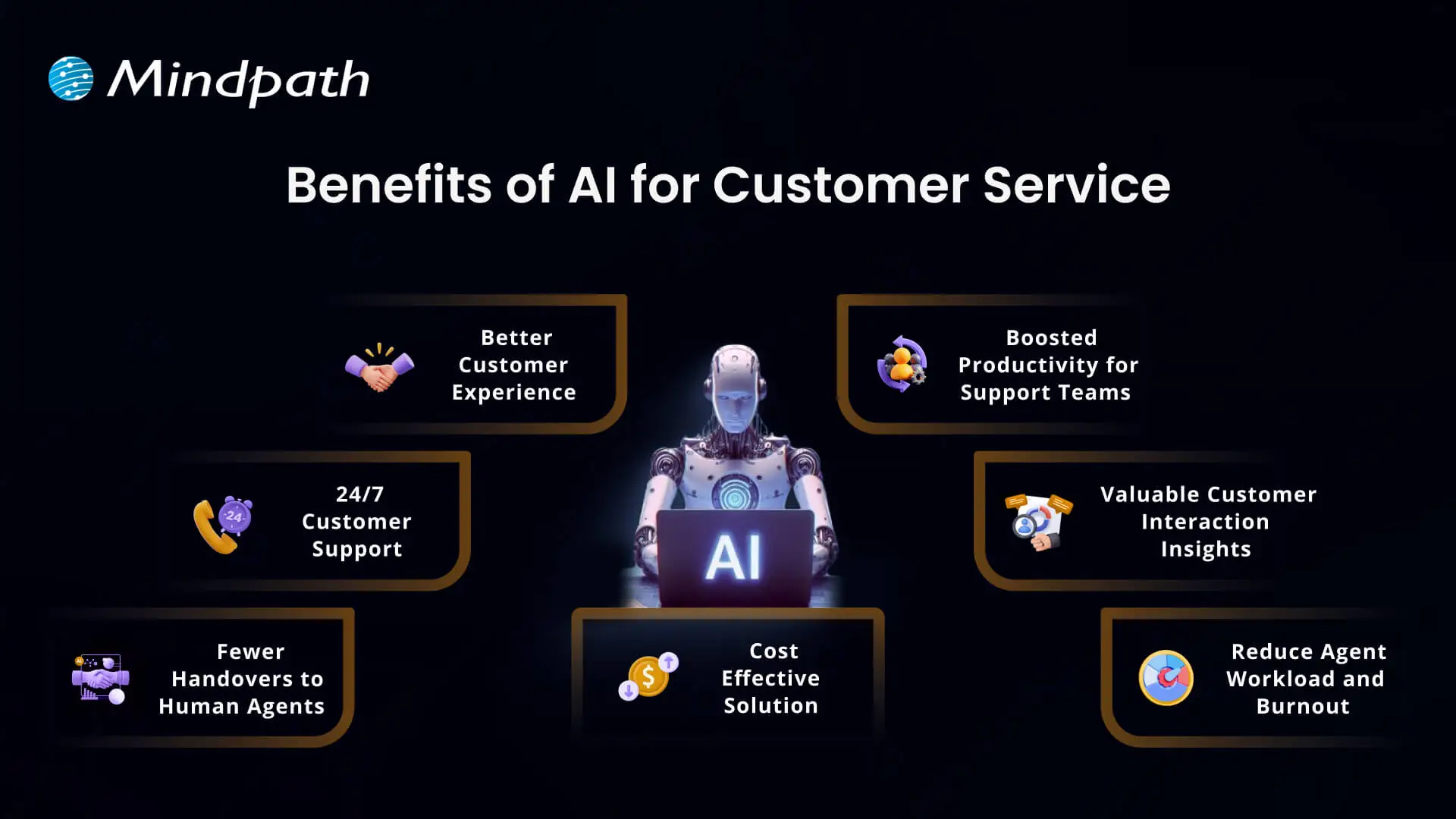
1. Better Customer Experience
AI can help create a better experience in customer service by making every interaction easier and more efficient for the customer. People are more comfortable engaging in conversations with chatbots and virtual assistants to get instant answers to their questions than they ever were before. AI tools such as agent assist and sentiment analysis can break down what customers want and prioritize how to respond, which allows support teams to drive a faster and more personal experience to satisfy customers.
2. 24/7 Customer Support
One of the main benefits of AI is that it offers businesses the opportunity to provide customer support 24/7 and every day of the year. With customer service AI tools such as virtual agents and voice bots, customers can get help immediately, even outside normal business hours. This has the impact of conveniences customers and keeping them happy. It also demonstrates how the benefits of AI chatbots improve customer service, making it quicker, easier, and always available.
3. Fewer Handovers to Human Agents
With smarter chatbots today, AI tools for customer service are becoming more human-like in their conversations and helping customers with simple questions. As a result, customers receive a quick answer, without having to wait for a human agent. Support teams now spend more time aiding customers with complex issues which require a more human touch. This solution was designed to balance the workload and ultimately improve the overall support experience.
4. Cost Effective Solution
Using AI customer services helps companies spend less on handling customer questions and problems. Chatbots and voice bots can answer many requests on their own, which means fewer calls and messages for human agents. These AI tools work all day and night without extra pay or breaks. This saves money on hiring, training, and keeping large support teams.
5. Boosted Productivity for Support Teams
AI makes customer service agents more productive by handling simple tasks automatically. It can sort and route requests and even suggest answers, so agents work faster and more accurately. This means they have more time to focus on complex problems that need a human touch. So, AI helps support teams get more done and provide better service.
6. Valuable Customer Interaction Insights
Using AI to track how customers feel during calls gives businesses a clearer picture of every interaction. It helps measure customer satisfaction and see where service can improve. Managers can also spot training needs for their team based on these insights. Looking at past data, AI can even help predict what customers might expect in the future.
7. Reduce Agent Workload and Burnout
Working in customer service can be stressful and lead to burnout when agents handle too many repetitive tasks. AI helps by taking care of simple questions and routine work, so agents have more time for important tasks. This reduces daily pressure and keeps the workload more balanced. Over time, it can help teams feel more supported and less burned out.
Want to know if your business is ready to implement AI in the right way? Explore our blog – AI Readiness Checklist.
Examples of Utilizing AI for Customer Service
Companies across industries are finding new ways to use AI to improve how they help their customers. This smart technology is making customer service more effective and reliable than ever. Let’s explore some real-world examples of how this is happening.
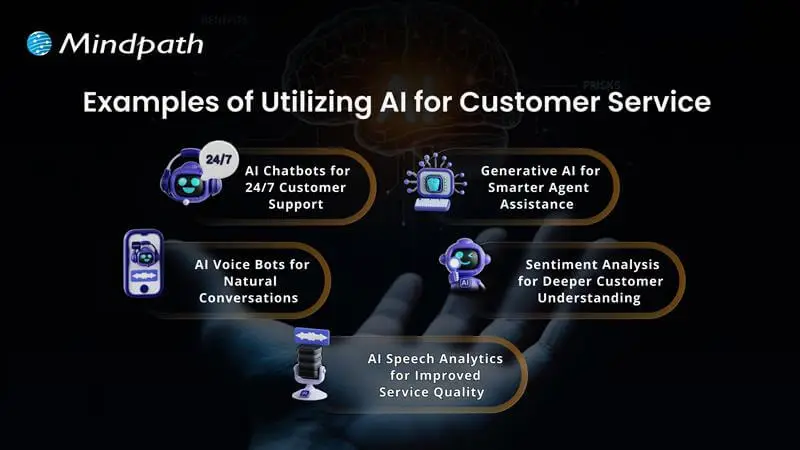
1. AI Chatbots for 24/7 Customer Support
Conversational AI chatbots help businesses assist customers in getting answers any time, day or night. They can handle common questions, check orders, and even help with returns. This keeps support teams free for more complex problems.
2. AI Voice Bots for Natural Conversations
AI voice bots answer calls and talk to customers naturally, just like a human agent. They can share product details, update accounts, or book appointments. This reduces routine calls for human teams and keeps service smooth.
3. AI Speech Analytics for Improved Service Quality
AI speech analytics tools listen to customer calls to find useful patterns. They help managers see what customers care about and how agents are doing. This helps improve service and spot issues early.
4. Sentiment Analysis for Deeper Customer Understanding
Sentiment analysis uses AI to understand how a customer feels during a call. It looks at tone and pitch to score conversations as positive, neutral, or negative. This helps companies see where they can do better and train their teams.
5. Generative AI for Smarter Agent Assistance
Generative AI helps support agents work faster by giving them ready-made answers. It pulls information from your knowledge base and CRM, so agents don’t waste time searching. This means customers get quicker, more accurate help.
Ready to adopt the recent trends of Gen AI into your business? Read our detailed blog on Gen AI trends, which provides a deeper understanding of how to implement Gen AI into your business for future growth.
Ready to Unlock the Full Potential of AI for Customer Service?
Using AI for customer service is one of the smartest ways to keep your customers happy and your support teams working smoothly. From 24/7 chatbots to tools that understand customer feelings, AI makes service faster and more personal. By adding these smart solutions now, businesses can handle more requests, save time, and build stronger customer trust for the future.
At Mindpath, we provide custom AI development services that help companies improve customer service and stay ahead of the curve. Our team can build AI chatbots, voice bots, analytics, and more, all tailored to your business goals. We focus on making your service more efficient and personal. Connect with our experts to see how our AI development services can transform your customer experience.

The whole world has welcomed artificial intelligence into almost every aspect of everyday life. At the same time, the concerns for careful and responsible use of AI have also been coming under the limelight. One of the notable highlights associated with responsible AI usage points at GenAI hallucinations, which can affect the credibility of generative AI. The use cases of generative AI have opened the doors to numerous opportunities for businesses worldwide across different sectors.
The arrival of generative AI improved efficiency across different areas, including the development of marketing materials and streamlining customer service. Generative AI also promises massive shifts in the conventional approaches to work. However, the insidious threat of generative AI hallucinations places huge roadblocks in the path to large-scale adoption of AI. Let us learn more about GenAI hallucinations and how to avoid them.
Deploying GenAI successfully requires more than just technology, it needs expertise and precision. Our AI development services help businesses design, train, and implement models that deliver reliable and consistent results
Understanding GenAI Hallucinations
Artificial intelligence has been modeled to think, act and work like humans. Just like humans come up with false or misleading answers when they don’t know how to respond to some questions, AI may also do the same. The basic explanation for generative AI hallucination is almost the same as generative AI models can offer nonsensical answers as factual responses. Businesses must know that AI hallucinations can invite legal challenges, affect critical decisions and lead to loss of trust.
You can get a better idea about GenAI hallucinations when you know why AI models hallucinate. AI hallucinations are the result of the approaches through which AI models learn and generate new content. Assume that a student has read multiple books in the library but has not learned how to use his knowledge in the real world. The student can connect different ideas and present convincing ideas, although some of them might not have any plausible impact.
Curious how Generative AI is transforming industries? Explore our blog on Generative AI Revolution to understand the innovations shaping the future of AI and its business applications.
Common Reasons Underlying GenAI Hallucinations
The definition of AI hallucination suggests that it represents any situation where generative AI models present false and nonsensical answers as factual output. At this point of time, you might want to dive deeper into the gen AI hallucination meaning to identify the factors that lead to AI hallucinations. The most common culprits for AI hallucinations include insufficient or biased training data, complex prompts, model architecture and overfitting.
Generative AI models learn from the training data and their effectiveness depends on the quality of data. If the data contains biases or is incomplete, then the AI models will reflect the same flaws in output of the models. Similarly, unclear prompts can also lead AI models to generate made-up information just to serve responses. The internal working and learning approach of gen AI models are also some of the notable factors responsible for hallucinations.
The consequences of these factors can be far-reaching, especially in terms of legal conflicts. On top of it, businesses should worry about AI hallucinations as they can have a negative impact on customer trust, operational efficiency and brand reputation. You can find gen AI hallucination examples in which lawyers were fined for wrong citations and businesses had to incur massive losses due to fabricated financial forecasts.
For instance, an attorney in New York used ChatGPT to conduct legal research for an injury claim. The federal judge noted that the lawyer had provided quotes and citations that never existed. The generative AI tool had not only made them up but also suggested that they were available in all major legal databases.
Wondering how businesses are putting Generative AI into action today? Explore our blog on Generative AI Use Cases in diverse industries to see real-world applications driving innovation across sectors.
How Can You Avoid GenAI Hallucinations?
Businesses must understand the consequences of AI hallucinations and follow a multi-layered approach to address the limitations. The best way to avoid them involves a combination of human oversight and technical safeguards. On top of it, businesses must follow a culture of critical evaluation with generative AI to prevent hallucinations. The following points can play a major role in strengthening a business with protection from hallucinations.
1. Pay Attention to Data Quality and Governance
The foremost solution to GenAI hallucinations is data quality as high-quality data is essential for creating reliable generative AI systems. What can a business do to ensure high-quality training data for their generative AI systems? The easiest way to remove hallucination in generative AI models is through cleaning your training data. It is important to clean the training data by removing duplicates, irrelevant entries and outdated information. On top of it, businesses must also use robust data cleaning methods to ensure accuracy, timeliness, validity and consistency.
The next crucial recommendation for improving data quality involves building a knowledge base for each business. The knowledge base will serve as a reliable source of truth, which offers company-specific and accurate information. In addition, businesses should also use diverse and representative data to reduce bias.
2. Choosing and Enhancing Gen AI Models
The choice of a generative AI model can have a significant influence on the possibilities of AI hallucinations. You should know how to identify the language model for specific tasks. For example, you may need advanced models like GPT-4 for complex applications while lighter models will be useful for simpler tasks. However, choosing the right AI models may be difficult in certain cases.
The list of ways to solve the problem of hallucinations in AI also points at techniques like Retrieval-Augmented Generation or RAG. The primary advantage of RAG is the ability to connect generative AI models to external data sources in real-time. With the help of RAG, AI models retrieve relevant information for responding to different queries. As a result, the models are less likely to hallucinate and will provide factual responses.
Also Read: Gen AI Tools
3. Prompt Engineering
The way you interact with generative AI models also affects the quality of their output. You must learn about the importance of prompt engineering in eliciting desired responses from AI models. Businesses can avoid GenAI hallucinations by following the best practices of prompt engineering. The first recommendation anyone would give for prompt engineering is to maintain accuracy in prompts. When you give clear and detailed instructions with the relevant context to an AI model, you can expect credible responses.
Businesses can also use advanced prompting techniques to improve accuracy alongside understanding the decision-making process of AI models. Effective prompt engineering can also help you fight against AI hallucinations by repeating key instructions at the beginning and end of the prompts to obtain desired responses.
4. The Human Element
The overview of some ChatGPT hallucination examples, like the one involving a New York attorney, suggests that human intervention could have solved the problem. Rather than trusting the output of AI models blindly, businesses should choose the human-in-the-loop validation approach. Continuous feedback loops for checking AI outputs against actual data can play a vital role in reducing AI hallucination.
Businesses should also implement critical evaluation training to help employees evaluate generative AI outputs. On top of it, every business must offer transparency into the working of their AI models to reduce confusion in the event of AI hallucinations.
What’s next for intelligent technologies? Read our blog on Generative AI Predictions to learn about the emerging trends defining the future of AI.
Final Thoughts
The answer to ‘what is an AI hallucination’ establishes a direct link between quality of data, prompting techniques and human-in-the-loop validation. AI hallucination is the result of the ways in which AI models learn and respond to user queries. With the growing adoption of generative AI, businesses must avoid GenAI hallucinations to protect their brand and avoid financial losses. Learn more about the effective solutions to AI hallucination now.
Join our Newsletter!
categories
Join the world's largest training library and unlock new opportunities!
Ready to Leverage GenAI for
Software Development?
Form automation to innovation, let’s turn your ideas into intelligent, AI-driven solution.