
Latest Insights On

GenAI, Tech, and Digital Transformation 

Stay updated with expert insights, success stories, and real-world applications of cutting-edge technology.

MVP development

In the software development context, you must have come across the term MVP or minimum viable product. It is the simplest version of a product or application. MVP just has enough features so that initial users can test and provide their feedback. It is ideal for investors to look at the MVP of a product that is being pitched to them.

The importance of MVP development is vital in the prevailing business environment. Many startups fail today because they create products on the basis of assumptions. However, the best way to test those assumptions is by developing an MVP that the real users can see and use. It is the perfect time to learn about MVP and its relevance.

If you are looking to adopt MVP into your business, but don’t know where to start? Mindpath offers end-to-end MVP development services that help you validate ideas quickly while minimizing financial and technical risks.

What is a Minimum Viable Product (MVP)?

A Minimum Viable Product refers to the beta version of a new product that a business plans to create. It encompasses just enough features to capture the attention of early customers and collect feedback from them. The companies that adopt the MVP approach to collect as well as respond to user feedback are able to grow faster in the competitive market setting.

Businesses can use MVP in software development to test if customers are happy with their app before spending too much time and effort. As the needs and preferences of modern customers keep changing, it is fundamental for businesses to prioritize MVP development.

Benefits of Implementing MVP

You need to bear in mind that the concept of MVP product development comes from the lean startup methodology. It focuses on learning as well as building with scalability. When a business builds MVP, it is basically taking the first small step towards a new idea or product. This small step can enable businesses to understand the interest of the market in the product.

1. Gathering User Insights

Businesses can gain valuable insight from MVP development. It can teach them where to make improvements in their offering and scale back. Businesses can also add extra features in order to make their product or application more attractive and useful for the users.

2. Testing Business Idea

The key benefit of MVP is that it serves as a low-risk testing ground before businesses invest millions of dollars into a product. Startup businesses can validate their product through MVP development. It creates an opportunity to interact with customers and understand their needs.

3. Cost Efficiency

You need to remember that an MVP development company can help you in terms of cost-saving. Mature software products need years of development along with considerable investment. MVPs ensure that products are simple for coding as well as functionality, thereby reducing development cost. Once you start gaining customer feedback, you can start spending your money more wisely on the new product.

4. Assessing Market Demand

The MVP encompasses testing as well as analyzing the functionality of a product. Moreover, it helps in evaluating the market demand and helps in the acquisition of new customers in the market. It is vital for business organizations to understand the needs of their customers along with the existing solutions. The MVP approach empowers businesses to refine their offering and know whether their offering has a future in the market or not.

5. Securing Funding

Startups require funding in order to survive in the competitive market environment. MVP development for startups serves as a strategic method that can enable them to test the idea before reaching out to investors and other stakeholders. Such a systematic approach can help businesses to secure funds from investors who trust in their idea and Minimum Viable Product.

How Much Does MVP Development Cost?

The role of MVP development is indispensable for businesses. So it is time to focus on the MVP development cost. Businesses may wonder – How much does MVP development cost? The answer to the question is not straightforward. The average cost relating to MVP development depends on a number of factors, such as the scope of the project and team composition. Similarly, contractual dynamics may also play an important role in impacting the cost of MVP development.

When it comes to MVP, the cost can be categorized into specific features as well as development phases. The common categories that you may come across include market research, prototyping, and MVP development. It is crucial to bear in mind that the research phase is conducted in parallel with prototyping.

Difference Between MVP, Prototype, and Proof of Concept

In order to get a holistic insight into MVP, you must understand how it is different from Prototype and Proof of Concept. A layman may think that these terms are interchangeable. However, that is not true. Each of the terms has a different meaning that businesses should be familiar with.

1. MVP

MVP refers to a launchable product version. It includes core features. The purpose of MVP development is to validate the market potential of a product and gain valuable feedback from users.

2. Prototype

Prototype refers to a preliminary model of a product. It can also be described as a mock-up that is designed to test the design concepts and technical feasibility. It also helps to assess the functionality of a product before its complete development.

3. Proof of Concept

Proof of Concept is a small experimental project. It is undertaken to demonstrate the feasibility or viability of a concept. It is mostly tested internally before further investment is made.

The main difference between these three terms has been presented in the table below:

Aspect MVP Prototype Proof of Concept
Purpose Market validation Technical exploration Feasibility testing
Complexity Functional product Non-functional model Basic technical demonstration
Audience Potential customers Internal stakeholders Technical team

Misconceptions Relating to MVP

There are a number of misconceptions that startups may have about MVP. It is essential to have proper clarity about MVP so that businesses can take advantage of the approach while developing their offering.

1. A common misconception is that MVP is an inferior quality product. However, in reality, an MVP is crafted in a strategic manner. It focuses on the product or software that can deliver core value while maintaining user experience.

2. Another common myth is related to the investment aspect. You may believe that MVP in web development requires no major investment. However, that is not true. Although MVPs are more cost-effective than the final product, they require resource allocation and technical implementation.

3. Businesses may have the idea that one MVP may be sufficient while developing a product. But the truth is that MVP development is an iterative process. Businesses must continuously incorporate the feedback of users so that the best version of the product can be made.

4. You may think that an MVP is a universal solution for all startups. However, this is a common misconception. Not all startups might be able to validate their product or idea through an MVP.

Ready to launch your MVP without delays? Visit our blog on hiring full-stack developers for MVP to learn how to find developers who can handle both front-end and back-end tasks with ease.

Turn Your Product Idea into a Market-Ready MVP

In the current business landscape, the importance of MVP development cannot be negated. In order to sustain and survive in the complex business space, it is key for startups to develop a minimum viable product before investing completely in the actual product. It can empower businesses to refine their product or offering and create value for the end-users.

Businesses can take advantage of Mindpath’s minimum viable product development services. Our experts can help you develop your MVP in an efficient manner, and you can obtain relevant feedback to improve your offering. The MVP development process can play a strategic role, and it can give your business an edge.

mobile app maintenance

Mobile app maintenance plays a key role in keeping the application stable, secure, and ready for real-world use. A new app can be created with great design and functionality, but its functionality is often determined by how well it is updated since it is released. The expectation of the users is flawless navigation, quick reaction, and no interruptions. Then how does an app keep these expectations going as technology, devices and user behaviour keep evolving?

This is where regular maintenance is necessary to achieve success in the long term. Regular updates assist in enhancing performance, repairing latent problems, and maintaining security as threats change. Simultaneously, it keeps the app running at the expectations of the user. In its absence, even a well-developed application may soon lose its worth in a competitive market. In this blog, we will be exploring the importance of mobile app maintenance.

Ready to reduce risks and keep your mobile app performing at its best? Mindpath offers maintenance and support services to support continuous performance and stability.

What is Mobile App Maintenance?

Mobile app maintenance is the continuous process that maintains an application after its release. It consists of performance enhancements, bug fixes and feature additions. Developers also tune UI and UX to user requirements. Moreover, applications can be updated regularly and checked to ensure that they remain compatible with new operating systems and versions of devices.

Mobile application maintenance helps reduce technical issues, security risks, and performance slowdowns. It makes the experience of users smooth and non-interrupted as well as crash-free. This leads to improved customer satisfaction and low uninstall rates. Ongoing maintenance makes the app stable, predictable, and up-to-date with the evolving technology and user needs.

Must Read: Proactive vs. Reactive

Types of Mobile App Maintenance

Maintenance of mobile applications involves various strategies that make an application stable, current and user friendly even after its launch. These are the categories of application maintenance services that will provide seamless operation and sustainability.

1. Corrective Maintenance

Corrective maintenance fixes post-release bugs, crashes and errors. It maintains a smooth running of the app in the hands of the users.

2. Preventive Maintenance

The preventive maintenance mitigates future problems by updating the codes and improving performance. It assists in preventing the issues before they arise.

3. Perfective Maintenance

Perfective maintenance enhances features, depending on user feedback. It also keeps the app in compliance with the evolving business requirements.

4. Adaptive Maintenance

Adaptive maintenance upgrades the app to new operating systems and devices. It maintains the compatibility of the app with evolving technology.

5. Emergency Maintenance

The emergency maintenance addresses urgent problems that influence the stability of the app. It promptly recovers normal functioning following critical failures.

Importance of Mobile App Maintenance

Mobile app maintenance keeps an application stable, secure, and high performing once it is launched. The following are the major significance of having mobile application:

1. App Security Updates

Mobile application maintenance enhances security by addressing vulnerabilities and preventing cyber threats. It protects the data of users and generates trust in the long term.

2. Performance Monitoring

Constant monitoring will assist in the monitoring of the performance of the apps and in the identification of problems in time. It guarantees the rapid repairs and maintains the smooth operation of the app.

3. Regular Feature Updates

The frequent updates are the features that make the app relevant and interesting. They also enhance usability and general user satisfaction.

4. App Store Compliance

It is necessary that apps adhere to the new app store policies to be available to users. Maintenance guarantees adherence and avoid removal or suspension.

5. Bug Fixing

Bug fixing is used to correct the errors that compromise the stability and performance of the apps. It enhances trustworthiness and delivers an easier user experience.

6. UI/UX Improvements

The UI/UX enhancements increase the design and usability of the app. They simplify navigation and enhance user interaction.

7. Downtime Reduction

Maintenance will assist in minimizing crashes and downtime surprises. This is to guarantee that users are not interrupted when availing services.

8. Technology Updates

Applications need to adapt to new technologies and operating system modifications. Maintenance will guarantee compatibility and maintain the app up to date.

9. Business Growth Support

A properly maintained app will attract and retain more users in the long run. This promotes business development and sustainability.

10. User Experience Enhancement

Frequent upgrades enhance user engagement with the application. They make the performance smoother and user satisfaction higher.

Best Practices for Mobile App Maintenance

Mobile application maintenance services is most effective when they are a well-planned and regularly followed process. The following are some of the most effective ways to maintain mobile applications.

1. Code Structure and Modularity

If the code is divided into distinct units, it becomes easier to resolve problems and make modifications. Also, when updating the main functions, the level of risk is minimized.

2. Continuous App Monitoring

If you use monitoring devices, they will assist you in following the application functioning in the real-time environment. They are capable of promptly identifying faults and failures.

3. User Feedback Analysis

Users’ comments and criticisms throw light on the genuine problems people experience using the app. So they allow developers to come up with the enhancement of the functions that respond to users’ specific requirements.

4. Issue Prioritization

The first thing to do is to classify the defects according to the extent to which they affect users. This will make sure that the most severe problems are resolved first.

5. Testing Before Release

It is important to do thorough testing to each and every updated version before making it available to the users. In doing so, you can be sure that users will not be subjected to any newly-introduced bugs.

6. Post Update Review

Checking ‍ performance and collecting user feedback after an update is a great way to make sure things are really working according to your ‍expectations.

Ready to Keep Your App Strong and Future Ready?

App maintenance is extremely important if you want to keep your app running smoothly, securely and in a way that users would enjoy even after it has been launched. It leads to improved performance, lesser bugs, and a seamless user experience. Besides that, regular updates are a way of standing out in a digitally-advanced world that is changing fast and also, apps that are well-maintained tend to be on the path of success.

At Mindpath, we offer maintenance and support services, aiming at keeping your app up-to-date, secure, and running efficiently. Our team works on increasing the overall stability of the app, resolving the bugs, as well as improving the user experience. We assist businesses in minimizing the periods of downtime and ensuring that the app runs smoothly, which in turn promotes growth and customer satisfaction.

Frequently Asked Questions

1. Why does mobile app maintenance matter after launching an app?

Mobile app maintenance ensures the app stays stable, secure, and smooth after launch. It helps fix hidden issues, improve performance, and keep users satisfied. Without regular updates, even a good app can become outdated and lose users over time in a competitive market.

2. How often should an app be maintained for best performance?

Maintenance should happen regularly, not only when problems appear. Monthly checks and timely updates help prevent bugs and performance issues. Continuous monitoring also ensures the app stays compatible with new devices, operating systems, and changing user expectations for a smooth experience.

3. What are the common issues solved through app maintenance?

App maintenance mainly fixes crashes, slow performance, and security gaps. It also addresses UI issues and improves overall usability. These updates ensure users face fewer interruptions and enjoy a smooth, reliable experience every time they use the app.

4. How is mobile app maintenance cost usually decided for businesses?

The mobile app maintenance cost depends on app complexity, features, and update frequency. Apps with advanced features or high user traffic may need more frequent updates, which increases cost. Regular maintenance, however, helps avoid bigger issues and expensive fixes later.

5. Can poor maintenance affect user experience and app success?

Poor maintenance directly impacts user satisfaction and trust. Users may face bugs, crashes, or slow performance, leading to uninstalls. Over time, this reduces engagement and affects business growth, making consistent updates essential for long-term app success.

maintenance support

Failure can be indicated well before it is seen. Reliable delivery teams begin to become aware of minor disruptions at an early stage. When systems exhibit minor yet consistent problems, maintenance support is needed. Are there minor errors that are occurring more frequently than anticipated? Do the response times seem a little bit out of tune during normal operations? These signals do not tend to be loud; however, they reflect more technical gaps that require consideration.

Besides, regular delays, unplanned downtime, and user complaints are hard to come by on their own. They accumulate pressure against business continuity and trust, over time, by users. Consequently, a prompt response maintains systems as dependable and effective. By neglecting the early warning signs, risks and cost are likely to rise. In this blog, key indicators will highlight when immediate maintenance action becomes necessary.

Ready to fix recurring issues before they start affecting your customers and revenue? Mindpath offers maintenance and support services to quickly resolve problems and keep your product running smoothly.

Why are Maintenance and Support Services Essential for a Business Product?

Business products need consistent performance to meet user expectations and market demands. Even small issues can affect reliability and growth. Maintenance support keeps systems stable, secure, and aligned with changing needs, ensuring smooth operations over time.

As businesses grow, products face higher traffic, security risks, and shifting user behavior. Regular updates and monitoring improve efficiency. Strong support services help businesses adapt quickly, protect performance, and maintain long term value without unexpected setbacks.

Here are the key points why support and maintenance are important:

1. Stronger Security and Risk Control

Frequent updates are used to address vulnerabilities before they are a major problem. This safeguards data, compliance, and minimizes exposure to cyber risks.

2. Better User Experience

Ongoing improvements make interfaces smoother and faster to use. As a result, users stay satisfied and engage more with the product.

3. Reduced Costs Over Time

Regular upkeep averts serious problems that require costly repairs. This will reduce the long term costs and eliminate the surprises of costs of repairs.

4. Improved Performance and Scalability

Regular optimisation and monitoring of systems is more effective. They are also capable of managing more workloads as the business needs increase.

5. Less Downtime and Smooth Operations

Active surveillance detects problems earlier than they can impact performance. This will maintain uniform operation and minimize unplanned disruptions.

6. Continued Relevance and Flexibility

The updates maintain products in line with new technologies and market demands. This assists companies remain competitive and prepared to change.

Key Signs Your Product Needs Immediate Maintenance Support

Products are capable of alerting to a decrease in their performance through early signs, and fixing them with the help of maintenance and support at once is the best way to do that. Not reacting quickly to these signs can lead to instability, whereas, by taking timely actions, we can keep the systems dependable.

1. System Struggles to Handle Growth

When ‍ the user base increases, the application either runs very slow or stops working altogether. Software maintenance support can help not only in improving the scalability of the application but also in ensuring smooth performance during system ‍ ‌‍ ‍‌growth.

2. Frequent Crashes and Downtime

During ordinary operation, the system crashes, sticking or having to be continually restarted. This is not only a reflection of its instability but also a signal for the need of quick measures that would strive to bring back the regular functioning.

3. Slow Speed and Response Issues

One of the main reasons why users get frustrated with an application is when pages take too long to load. Not only does it affect user experience, but it can also lead to low user engagement. In this regard, application maintenance support is a great solution to optimize performance and minimize latency.

4. Rising User Complaints

Another sign of a troubled product is when users start reporting problems more frequently such as errors, missing features, or poor usability. In fact, this could be a clear indication that the product is no longer satisfying the users and hence, requires immediate improvement.

5. Security Gaps and Risks

If updates are not implemented, the system becomes vulnerable to exposure and unauthorized access. Therefore, regular patches are not only vital for data security but are also the best way to keep the application safe from security loopholes.

6. Outdated Technology Stack

With technology advancing rapidly, the use of outdated frameworks and systems often becomes a major hindrance to performance and compatibility. This is why only technology updates lead to better efficiency and at the same time meet the needs of modern users.

7. Hard-to-Manage Code Structure

Simple changes take too long due to complex and unstructured code. This slows development and signals the need for code optimization.

8. Failed Backup and Data Risks

Backup processes fail or recovery tests do not work properly. This increases the risk of data loss and demands immediate attention.

9. Overloaded Support Team

The team spends most time fixing urgent issues instead of improving the product. This shows deeper system problems that need structured maintenance.

10. Broken Integrations and Features

Third-party tools or APIs stop working as expected. This not only affects the product operation but the entire functioning also gets disrupted.

Is Your Product Ready for Reliable Performance?

Ignoring early warning signs can impact performance, security, and user trust. Timely maintenance support helps businesses stay ahead of issues and ensure smooth operations. A proactive approach keeps systems stable, efficient, and aligned with changing business needs.

At Mindpath, we provide maintenance and support services to keep your product running without disruptions. Our team ensures consistent performance, quick issue resolution, and long-term stability, helping businesses focus on growth with confidence and reliability.

Frequently Asked Questions

1. How often should a product receive maintenance support to stay stable?

Regular maintenance depends on product complexity and usage levels. High traffic systems need more frequent monitoring and updates. Consistent checks help prevent unexpected issues, improve performance, and ensure the product continues to meet user expectations without interruptions.

2. What happens if early signs of product issues are ignored?

Ignoring small issues can lead to serious performance failures, security risks, and poor user experience. Over time, this increases downtime and repair costs. Addressing problems early helps maintain stability and avoids major disruptions that can affect business operations.

3. How does maintenance support help in improving user satisfaction?

Maintenance support ensures smooth performance, faster load times, and fewer errors. Users expect reliable and quick experiences. Continuous improvements and timely fixes help meet these expectations, leading to better engagement, trust, and long-term user retention.

4. Is maintenance support necessary even when the product is performing well?

Even well-performing products require regular updates and monitoring. Hidden issues can grow over time without visible signs. Proactive maintenance support helps prevent future problems, keeps systems secure, and ensures consistent performance as business needs evolve.

5. Can regular support reduce long-term product costs?

Yes, regular maintenance helps identify and fix small issues before they become expensive problems. It reduces the need for emergency repairs and system overhauls. This approach ensures better resource management and keeps overall operational costs under control.

what is data-decision making

Every prosperous company in today’s modern world relies on insights, not on instincts. The importance of data-driven decision-making is that it turns the daily choices made by human beings into strategic moves guided by genuine facts. Businesses that rely on data are better positioned to identify new opportunities, make decisions faster to adapt to change, and make decisions accordingly to grow. Data-driven decisions are the difference between guessing your next step and knowing your next step. 

As companies embrace data as a trustworthy guide, they promote a culture of clarity and accountability. Decisions are sharper, and strategies are more in sync with customer and market needs. This pragmatic use of data helps organizations to keep their focus on the future and to remain competitive in today’s digital-first environment. In this blog, we are going to outline why data-driven decision-making is a crucial component of contemporary business success.

Looking to turn your business data into actionable insights? Explore Mindpath’s AI Data Analytics Services to uncover trends, improve decision-making, and drive measurable business growth.

What is Data-Driven Decision Making?

Data-driven decision making (DDDM) refers to making business decisions on the basis of facts, figures, and analysis rather than personal opinions or gut feelings.  It reduces uncertainty by collecting data from various sources that examine the relationship between actions taken, such as customer behavior, sales tracking, or market data on trends, to identify what is really working for the business.

When organizations use this approach, they make data-based decisions with direct evidence that reduces risks and reveals new opportunities. Analyzing data patterns enables businesses to plan more effectively and achieve success easily.

Core Principles of Data-Driven Decision Making

1. Focus on Business Goals

Every data initiative must have a direct link to business goals. When teams better define their objectives, they can evaluate data with intention and make decisions that result in observable growth for the business.

2. Keep Data Clean and Reliable

All insights must be accurate, and therefore, the data must be from a trusted source. Ongoing checks for data quality and best practices in data cleaning should be conducted to guarantee decisions are based on sound data and not on missing or stale data.

3. Use Data as Proof, Not Assumptions

Effective decisions are built on true evidence. The importance of data-driven decision-making is that it eliminates the guessing and offers visibility that leads the decision-maker to act faster and more reflectively.

4. Make It a Continuous Effort

Data-based decision-making is an integral process. Companies should be consistently collecting, monitoring, and analyzing data so they can keep pace with shifts in market trends and customer needs.

5. Encourage Team Collaboration

Strong insights often develop in collaboration. When departments share their insights and discuss results, they create a collective plan that produces better and more consistent outcomes.

Want to know how modern businesses manage and analyze large volumes of data efficiently? Explore cloud‑native development to understand how cloud-native systems optimize data-driven operations.

Top Benefits of Data-Driven Decision Making

Understanding the importance of data-based decision-making supports businesses in formulating better rationales and better results. It instills a culture of fact-based, accountable decision-making to foster growth and transparency in increasingly dynamic markets.

1. Smarter Communication Across Teams

Effective communication is one of the main benefits of data-driven decision-making. When all departments are working with the same reliable insights, updates are easier to share and alignment of goals is simpler. With transparency, collaboration is fostered, and coordination is improved. This enables leaders to make quicker, smarter choices for improved business performance overall.

2. Continuous Growth and Progress

The importance of data-driven decision-making is tied to its support for constant growth in the business. By looking at across practice areas to identify patterns that drive success, teams can recognize what affects success and improve decisions. Each decision that relies on evidence is a barometer for the future and ensures steady improvement. With time, this will fortify the organization and provide continued success.

3. Unlocking New Business Opportunities

Making decisions based on data allows organizations to discover new areas of growth and opportunities. When teams analyze customer behavior and market trends, they may identify opportunities that they never considered. This approach can result in more confidence in expansions, partnerships, and innovations. When focused by data, it allows the organization to have a distinct competitive advantage.

4. Building Knowledge and Innovation

Organizations that leverage data-based decisions regularly outperform firms that don’t. Studies have shown that data-driven firms have higher productivity and higher profitability. When we start considering information to be a valuable asset, teams begin to actually have a learning culture, where information flows both ways. This kind of culture leads to smarter thinking and out-of-the-box problem-solving.

5. Reducing Costs and Avoiding Mistakes

Choosing to make decisions based on gut feelings can lead to poor and costly outcomes in a business scenario. When leaders choose to make decisions based on data, they are making decisions based on certainty that is based on fact, instead of hunches. Relying on evidence instead of instincts leads to companies using their resources more efficiently. More clarity leads to reduced time and waste and naturally occurs in the flow of achieving sustainable cost efficiency.

6. Adapting to Market Changes Easily

Another importance of data-driven decision-making is its ability to assist organizations in being adaptable. Market conditions change and customer expectations fluctuate, and data keeps companies prepared. When companies can monitor trends and performance as they are happening, they can react quickly and with confidence. This ability to be adaptive will help to keep organizations competitive, relevant, and profitable.

Wondering how different AI systems impact decision-making in organizations? Discover types of Artificial Intelligence – ANI, AGI, and ASI and see which technologies can optimize your business insights.

Ready to Strengthen Your Business with Smarter Data Decisions?

The importance of data-driven decision-making is that it enables an entity to convert unprocessed data into efficient and effective measures. Businesses using data as their main resource are in a position to make decisions without hesitation, spot trends quickly, and hence, execute plans deftly to reach a steady level of growth. It becomes their corporate culture that they have fact-based support for every decision made, which eventually results in enhanced operational efficiency, greater flexibility, and durability in a very dynamic business environment.

At Mindpath, we empower businesses to harness the power of data through our advanced AI development services. Our experts design AI-driven tools that simplify complex processes, enhance decision accuracy, and drive smarter outcomes. By combining innovation with intelligent data use, Mindpath helps organizations improve productivity, streamline operations, and achieve measurable results that strengthen their competitive edge in the digital-first business world.

woocommerce vs shopify

In the e-commerce landscape, businesses need to make a number of critical decisions. In case you are planning to venture into the e-commerce space, it is imperative to choose the right platform. This decision can certainly influence the success of your business in the dynamic e-commerce arena. 

The platform that you choose for your e-commerce store can undoubtedly influence the overall performance and success of your business. The top names that are ruling the e-commerce platform setting are Shopify WooCommerce. You need to dive into the world of WooCommerce Shopify so that you can make a proper comparison between these platforms. You need to know how these e-commerce platforms differ from one another so that you can make the ideal selection.

Planning to grow your online business and make a real difference in sales and customer experience? At Mindpath, we provide expert web development services that create user-friendly online stores designed to boost conversions and engage your customers.

An Insight into Shopify

Shopify is a subscription-based, cloud-hosted e-commerce platform that enables entrepreneurs, small businesses, and large brands to sell products online and in person. It provides an all-in-one suite of tools, including inventory management, payment processing, and order fulfillment, without requiring any coding or web development experience. As one of the most widely used e-commerce platforms globally, Shopify equips businesses with the features they need to build, manage, and grow their online store in a competitive digital marketplace.

You must get a holistic insight into Shopify and its features to understand its true capabilities as an e-commerce platform. One of its distinguishing features is related to the creation of a store. Businesses can also use their selling tools and payment processing features to streamline their practices and operations. 

An Insight into WooCommerce

WooCommerce is a free, open-source e-commerce plugin built for WordPress. It enables users to transform any standard WordPress website into a fully functional online store. Beyond just adding products and payment options, WooCommerce supports selling physical goods, digital products, subscriptions, and services, making it one of the most versatile e-commerce solutions for WordPress users.

A unique thing about WooCommerce is that it is ideal for experienced sellers in the e-commerce domain. You can extend its functionality with the help of a number of add-ons and themes. Businesses need to familiarize themselves with the core features of WooCommerce so that they can make use of the platform in an optimal manner. Its key features that you need to know about include the availability of a large library of themes and high extensibility.  

Must Read: AI in E-commerce

Difference Between WooCommerce and Shopify

Now that you have a basic understanding of Shopify and WooCommerce, it is time to look at them at a closer level. Businesses that plan to establish themselves on the online platform need to know the key differences between these platforms so that they can have clarity on WooCommerce vs Shopify. The insight into this area is crucial to choosing the suitable platform and thriving in the market. 

1. Cost

While talking about WooCommerce vs Shopify, one of the key differences between the two options revolves around their cost. WooCommerce and Shopify have entirely different pricing structures. WooCommerce is entirely free for users, so you do not have to pay anything to use it for your online business. Thus, it offers ample flexibility with variable costs for users. 

On the other hand, when it comes to Shopify, it has a subscription model for its users. WooCommerce vs Shopify pricing is a major point of difference that you need to take into consideration for your e-commerce business. The ultimate budget of businesses can play a catalytic role in choosing their ideal e-commerce option.  

2. User-Friendliness

The ease of use or user-friendliness is a key dimension that you need to bear in mind while selecting between WooCommerce and Shopify. You must keep in mind that both these e-commerce solutions offer a diverse user experience. As WooCommerce is an open-source plugin for WordPress, which is self-hosted, it requires manual setup. 

Every aspect has to be handled separately by businesses while using the plugin. Moreover, businesses should know that it requires ongoing management as well. When it comes to Shopify, it has an all-in-one dashboard that users can use for their needs.  Thus, users can have a hassle-free experience if they choose Shopify. 

Not sure which technologies will give your e-commerce business the best performance and scalability? Explore our blog tech stack for your web app success to learn how to choose the right tools for long-term growth.

3. Themes as well as Templates

While talking about shoplift vs WooCommerce, it is key to understand how they differ in terms of available themes and templates. WooCommerce offers a humongous library of premium as well as free WordPress themes. You can choose the specific theme that is ideal for your business. The good news for users is that there is an opportunity to customize the themes on WooCommerce. 

When it comes to Shopify, businesses can use professionally designed themes. Such themes can certainly give an edge to your business. But you have to bear in mind that there are limited options to customize the themes. You need to take into account WooCommerce vs Shopify themes while choosing the ideal option out of the two options.

4. Scalability

Scalability is an important dimension that every e-commerce business needs to prioritize. You need to make sure that your online store grows in a seamless manner as your business expands. Your store must be able to handle additional product offerings and additional users. WooCommerce serves as a highly flexible option for e-commerce businesses. 

However, in order to leverage the flexibility that it offers, businesses must be aware of how to use the available tools. Shopify undoubtedly simplifies the degree of flexibility by offering built-in tools for businesses. You can leverage these tools as they will handle most of the work for your business. 

5. Security

Security is undoubtedly a non-negotiable element you need to look at while understanding the difference between WooCommerce and Shopify. If you plan to use WooCommerce, you need to know that, since it is a self-hosted solution, the onus of security lies with you. Although it offers certain security features, most of the security depends on elements such as the hosting environment and plugins. 

Similarly, the manner in which businesses maintain their websites also influences the quality of security. On the other hand, Shopify offers robust security to e-commerce businesses. This specific platform has in place holistic security measures that can safeguard both customer and store-related data. 

Concerned about keeping your online store and customer data secure? Read our blog application security best practices for web and mobile apps to learn proven methods to protect your business.

6. Payment Gateway 

As a majority of online customers are making online payments, it is essential for e-commerce businesses to have in place a robust payment gateway mechanism. Both Shopify and WooCommerce offer a diverse range of payment gateway options that you need to be aware of. As WooCommerce is integrated with WordPress, it offers a high degree of flexibility when it comes to payment gateways. 

It is possible to integrate almost any gateway. But the particular process may require additional setup for businesses. When it comes to Shopify, it comes with built-in options. The built-in payment option offered by Shopify makes it simpler for businesses to accept payments from customers without requiring additional setup. Moreover, it supports international payments, thereby creating value for modern businesses. 

7. Customization

The difference between WooCommerce and Shopify arises when looking at the customization dimension. You can look at WooCommerce as a blank canvas. It offers high power to businesses to customize their online store based on their needs and requirements. On the other hand, Shopify keeps things simple for businesses. 

It offers limited customization ability as a business. Without having to do much customization, businesses can have a professional-looking online store. You can take advantage of the drag-and-drop editor to build your store. However, this feature limits the ability to customize for users. 

Looking for innovative ways to stand out in the crowded e-commerce space? Learn from our blog, augmented reality in e-commerce, and see how AR technology can transform your online store.

The table presented below gives an overview of the main differences between Shopify and WooCommerce. Businesses can certainly refer to it while making the selection between WooCommerce or Shopify.

Basis WooCommerce Shopify
Cost Free  Monthly subscription model 
User-friendliness Not beginner-friendly and requires manual setup Beginner-friendly and intuitive
Themes and Templates Offers a large library of WordPress themes and high customization ability Offers professionally developed themes and low customization ability
Scalability Flexible but requires good hosting and optimization Effortless scaling with business
Security Security level depends on hosting and manual updates Security is fully managed and comprehensive 
Payment Gateway Multiple payment gateways with no additional charge Shopify payments and external payments with applicable fees
Customization High customization Limited customization

Selecting Between WooCommerce and Shopify

It is crucial for businesses to remember that the ultimate choice between WooCommerce and Shopify depends on the goals as well as the needs of businesses. You need to keep in mind your budget and WooCommerce vs Shopify payments while choosing the ideal platform for your e-commerce business. You must remember that both platforms offer a unique set of advantages for businesses. 

As the pros and cons of each of these options vary, you need to carefully consider them while making your choice. WooCommerce empowers businesses to customize their online stores. On the other hand, Shopify offers a professional-looking store thanks to its drag-and-drop option. 

Struggling to make informed platform decisions for your e-commerce business? Explore our blog on the  importance of data-driven decision-making for businesses to learn how data insights can guide your choices.

Final Words

In the cut-throat competitive business space, it is mandatory to choose the ideal platform for e-commerce success. In order to make the right choice, you need to have clarity on your basic requirements. This insight can guide you to choose the best platform that perfectly meets your needs and expectations. 

Mindpath provides web development services that understand the need to choose the right platform for e-commerce businesses. Businesses can undoubtedly rely on our experts to make use of high-quality WooCommerce and Shopify solutions. These high-quality solutions can make sure that your business can thrive in the unpredictable e-commerce realm and gain an edge over its competitors. 

Frequently Asked Questions

Web development trends

The landscape of web development is evolving faster than ever. What was an innovation just a few years ago is now obsolete. Developers and businesses should stay ahead of the curve to remain relevant and competitive. From decentralized technology to AI-powered automation, the latest web development trends are redefining how web apps and websites are developed and optimized. 

These trends do not just revolve around making technical upgrades. They involve strategic shifts that influence digital growth and user experience. By embracing these advancements early, you can enjoy a decisive edge in this competitive digital world. Following a well-structured web development roadmap can help you prioritize the right technologies, tools, and methodologies for maximum impact.

In this blog, we will talk about some major trends in web development processes, methodologies, and tools that are constantly transforming this landscape. 

Using these trends in your business requires expert guidance. At Mindpath, we offer web development services where our guidance will provide you with the direction you need to stay ahead of the competition.

Why Web Development Trends Matter?

Web development is now entering a transformative era, significantly driven by user-centric designs and technological innovations. In the future, we can expect to see faster, personalized, and smarter websites.

Besides, the demand for Progressive Web Apps will increase as these apps provide users with an app-like experience without downloading an app. What’s more? With machine learning and IoT widely integrated into websites, the web will evolve into a more responsive, intelligent, and interactive ecosystem. 

Let’s further explore the top web development trends that are shaping the next generation of digital experience.  

Top Web Development Trends to Watch in 2026

As we move deeper into 2026, here are some trends that are reshaping how web applications and websites are built and deployed. These innovations enhance scalability, performance and align with increasing demand for transparency, security and personalization.

1. Code Will Become Optional: AI-Assisted Development

In 2026, AI-powered web development tools will streamline multiple tasks, from code creation to UX enhancement. Platforms such as OpenAI Codex, GitHub Copilot, Tabnine, and more help developers by suggesting improvements, writing boilerplate code, debugging, and more. 

Besides, web application development trends in 2026 include predictive analytics, AI-assisted personalization, intelligent chatbots, etc. Such intelligent capabilities have become integral to modern web development projects with source code, reducing development time and enhancing user engagement. 

2. The Rise of Jamstack Architecture

Jamstack (which combines JavaScript, APIs, and Markup) has become one of the most popular web development technologies. This modern architecture decouples the front-end from the back-end. It leads to improved security, better scalability, as well as faster load times. For marketing pages, e-commerce sites, and content-heavy platforms, Jamstack would be an excellent choice 

3. Blockchain Technology

Blockchain is here to facilitate continuous flows of records and transactions, called blocks. This technology is cryptographically secure and records every transaction in a tamper-proof and transparent manner.  

Web developers can use this to create high-performance, decentralized applications that eliminate centralized control and intermediaries. 

4. Progressive Web Apps

By combining the features and functionalities of native mobile apps and websites, PWAs are changing the web development process. These apps offer an app-like experience while being cost-effective and accessible. 

A report indicates that the global PWA market is projected to grow from USD 1.9 billion in 2014 to USD 9.7 billion by the end of 2034 (Source: Emergen Research). This clearly shows the rising adoption of PWAs by businesses.

5. Machine Learning in Browsers

Thanks to the latest web development technologies like TensorFlow.js and WebAssembly, web developers can easily run various machine learning models in browsers. This facilitates voice recognition, real-time personalization, predictive UX, and more. It is now possible to create privacy-conscious and faster applications that can adapt to user behaviour. 

Are your web apps providing the best possible experience for users? Discover UI/UX design trends in web application development to learn how modern design trends can enhance usability and engagement.

6. Micro-Frontends

It breaks down the complete UI into manageable, smaller components. This modular approach significantly enhances scalability and facilitates parallel development. This can be an excellent solution for large-scale development projects. 

7. No-Code and Low-Code Platforms

Low-code development is getting popular among developers. Platforms such as Bubble, OutSystems, and Webflow let non-technical users create functional websites with minimal coding. It reduces costs and accelerates prototyping. Low-code or no-code development is one of the impactful dev trends in 2026 for small businesses and startups.  

8. Single Page Applications

These web apps are created as a single page, and they can dynamically update content in real-time. SPAs help reduce costs, and businesses can use cloud technology to attain scalability. Some examples of popular SPAs are Google Maps, Facebook, Airbnb, Twitter, and Netflix. 

9. WebRTC Advancements

WebRTC is a major technical advancement in the field of web app development. It is an open-source technology and uses HTML and JavaScript APIs to add communication features to browsers. There is no need to use any external software or plugins.

With the help of RTCPeerConnection, RTCDataChannel, and MediaStream, it enables peer-to-peer data, video, and audio sharing. 

10. Edge Computing

It refers to the processing of data closer to the source instead of depending on centralized data centers. It reduces latency, improves privacy and performance while helping businesses to keep costs low. 

Edge computing is becoming significantly crucial for business, and it is estimated that by 2028, it will reach USD 378 billion

Choosing the right technologies is crucial for building a high-performing web app. Explore the tech stack for your web app success to discover the best tools and frameworks for your project.

11. Motion UI Frameworks

These frameworks help bring a static interface to life by integrating optimized transitions and animations. For example, Animate.css offers ready-to-use animations that are compatible with multiple browsers. It is a great option for sliders and home pages. 

You can implement animations that are not just visually appealing but also serve functional purposes, such as highlighting vital information, guiding visitors through a certain process, etc. 

12. Adaptive and Responsive Design

Web development trends in 2026 also include the wide use of adaptive designs. With wearables and foldable devices entering the mainstream, adaptive design is now evolving. Developers are prioritizing gesture optimization, context-centric layouts, and device-specific breakpoints. 

This shift is central to modern web development trends, ensuring a consistent user interface across screens and devices. 

13. Server-Driven UI

It enables servers to identify the behaviour and structure of the front-end for dynamic content rendering and quick updates. It transmits JSON-based instructions to the frontend and controls the UI layouts.

This development approach allows faster deployment, seamless CMS integration, personalization, and cross-platform consistency. It is a strategic shift in today’s web development trends.

14. Data-Driven UX and Real-Time Analytics

Developers are now integrating session recording, heatmaps, real-time user behaviour tracking, and more for design decisions. This approach reduces guesswork and assumptions while enhancing user satisfaction. 

Product metrics, email analytics, Google Analytics, and social media analytics are some commonly used analytics tools to get important quantitative data. This approach aligns with new web development trends and can also boost conversion rates. 

15. AI-Assisted SEO Optimization

With search engines, SEO is also evolving. AI tools are now helping with content scoring, meta tag generation, keyword clustering, and improving internal linking. 

For developers and content strategists, it means better alignment with user needs and faster optimization cycles. 

Looking to build a website that drives engagement and conversions? Explore web design and development services to discover how professional design and development make an impact.

Best Programming Languages for Modern Web Development

Staying updated with the Latest Web Development Languages is also important to create future-proof and scalable web applications. Here are some key languages that cater to frontend as well as backend needs.

1. JavaScript

The backbone of front-end development, and it helps create interactive and dynamic user interfaces. 

2. TypeScript

An ideal option for large-scale projects due to its error reduction and maintainability. 

3. Go

Also called Golang, it is popular for its concurrency and speed. It is widely used for websites requiring high performance. 

4. PHP

A dominating language for server-side scripting. Frameworks such as Laravel are modernizing PHP development.

5. Rust

Well-known for performance and memory safety, Rust works well for secure backend systems and web assembly projects. 

Want a web application built to match your workflow perfectly? Discover our custom web development services to learn how we create bespoke digital experiences.

Emerging Software Development Trends in 2026

In 2026, the application development trends cover CI/CD automation, AI coding, and more. Here are some major dev trends you should consider. 

1. Micro Frontends

Dividing user interfaces into independently-deployed, smaller parts with an aim to achieve flexibility, collaboration, and scalability. 

2. AI-Assisted Coding

Smart testing tools and code generation tools powered by AI are simplifying workflows. 

3. CI/CD Pipelines

Automated testing ensures that web applications and websites are updated on time and faster. 

4. Sustainable Development

Coding architectures and practices that meet global accessibility standards and reduce energy consumption are getting popular in dev trends. 

5. 5G Integration

Developers can leverage 5G technology to optimize CDNs or Content Delivery Networks and create high-performing websites. 

It can be said that the future of web development holds more such exciting innovations. 

Integrating CI/CD into your development cycle can boost productivity. Explore CI/CD Pipelines to discover tools and techniques for seamless automation.

It’s Time to Embrace the Trends

The 2026 web development trends clearly signal a shift toward adaptability, speed, and intelligence. Businesses optimizing their landing pages or creating new websites from scratch, these new technologies in web development can offer strategic opportunities to enhance the digital experience.  

If you are searching for an expert who can guide you through this evolving landscape, Mindpath would be the best option for you. We offer comprehensive web development solutions designed to take your digital experience to a whole new level. Our experts keep themselves updated with the current web development trends so that you can enjoy the desired results. Let us develop a perfect website integrated with advanced features and capabilities, and stand out in this competitive market.  

Frequently Asked Questions

low code vs. no code

The rapidly growing demand for digital transformation has had many businesses thinking about effective ways to align with new trends. You must have heard about the low-code vs. no-code debate in discussions about software development in 2026. As a matter of fact, Gartner has pointed out that 70% of new applications will use low-code or no-code technologies by 2026.

Do you feel that the modern technology landscape is evolving at a speed that you find difficult to match? Your business must also be struggling to find the ideal developer talent for your new IT projects. No-code and low-code solutions can address these concerns by offering convenient alternatives to the conventional software development process. 

The right development choice makes a huge difference. Contact us, and we will guide you on whether low-code or no-code development best suits your business.

What Is Low Code vs. No Code?

Low code and no code are modern software development approaches designed to accelerate application development. Low-code platforms provide visual development tools with the flexibility to add custom code when needed.

No-code platforms eliminate coding altogether, enabling business users and non-technical teams to build applications through intuitive visual interfaces. Choosing between low code vs. no code depends on your project’s complexity, customization needs, and available technical resources.

What Is Low Code?

You can know a lot about low-code from the name itself, which implies the use of less code. Low-code is a new approach to software development that involves automated code generation with visual building blocks. The functionality of low-code platforms revolves around automation that offers a middle ground between manual coding and no-code development. It allows developers to add code in auto-generated code, thereby retaining the human element.    

Common applications of low-code development in business process management platforms and cross-department tools have been gaining traction. Low code serves as the most useful solution for web and mobile app development and achieving integration with external plugins. Many businesses have successfully leveraged the low-code approach for the modernization of legacy apps. 

What Is No Code?

The curiosity about no-code development is also gaining momentum in 2026 as businesses seek new avenues for innovation. You can describe the answers to “what is no-code development” as a prominent subset of the low-code development approach. The no-code development approach is completely free of human intervention and depends completely on visual tools.

You can find the most applications of no-code development in self-service apps for business users and dashboards. Businesses can rely on the no-code development approach to build standalone apps with simple UIs and automation. One of the notable examples of no-code development is evident in tools for online order management and automated customer service in e-commerce. 

Are your low-code and no-code apps delivering the best possible user experience for your audience? Explore the latest UX/UI design trends to discover how modern interfaces and interactions can make your apps more engaging and effective.

Low Code vs. No Code: Key Differences

Many people generally assume that low-code and no-code approaches are essentially the same thing, with different terminology. However, the answers to ‘what is low code development’ and the definition of no-code development showcase a completely different picture. You must know the differences between low-code and no-code development to pick the ideal development approach for your next project.

1. Coding Skill Requirement

The first thing you must check while choosing between low-code and no-code development is the requirement of professionals with coding skills. In the case of low-code development, you will need professionals who have a basic understanding of coding. You must know at least one programming language fluently to use the low-code development approach. Therefore, low code is a difficult approach in cases where non-technical employees don’t know about coding or any programming language.

On the other hand, answers to ‘what is no-code development’ clearly reveal that anyone can use the no-code approach without coding skills. It helps you build applications by replacing the coding portion with blocks of code. You can just drag and drop the blocks of code to build the application you want.

2. Best Use Cases

The next point of comparison between low-code and no-code draws the limelight towards scenarios where they serve the right fit. You can rely on low-code application development platforms to develop applications with many complex features. Low-code development approach involves the use of an exhaustive component library that can be used for applications with heavy logic. In addition, the low-code approach also supports scalability and integration with other apps and external APIs. 

You can leverage no-code platforms for creating apps that deal with analytics, workflow management, project tracking, and progress reporting. It is also important to know that no-code application development platforms also have features that can help you build complex apps without writing code. No-code is a trusted development approach for front-end apps that pull data from different sources. It can serve as a useful solution to repetitive administrative tasks like reporting in business teams.  

3. Development Speed

Another notable aspect in the comparison between low-code and no-code development approaches is the speed of development. The low-code development approach is a rapid application development methodology tailored to develop applications at a faster pace. However, the low-code approach requires coding for certain parts of an application, which leads to longer development time. 

On the other hand, the no-code development approach does not require any coding. You can refer to the difference between low code and no code to understand that the no-code approach does not rely on coding skills. Business owners and entrepreneurs can build applications or create working prototypes in no time. As a matter of fact, some businesses have reported that they created apps with no-code development within a year.

Looking to deliver apps quickly but unsure if your business needs custom solutions? Discover the signs that indicate it’s time for a custom web application to accelerate growth and efficiency.

4. Target Users

The discussions around differences between the low-code and no-code development approaches will also focus on who should use them. Low-code development approach is the ideal pick for professional developers who want to avoid the burden of replicating basic code. It offers more space for developers to focus on complex aspects of development and encourages innovation. The low-code approach ensures automation of the standard parts of coding without depending on the syntax. You should know that low code benefits professional developers by offering opportunities for reskilling.      

The no-code development approach is more suitable for business users who have extensive domain knowledge. It complements their lack of ability to write code and allows them to use their domain expertise efficiently. Hybrid teams with software developers and business owners are also the most prominent target users of no-code development. Small business owners as well as HR, legal and finance teams in an organization, can also choose no-code over low-code development approach.  

5. Expansion of Architecture

The search for differences between low-code and no-code development approaches will also lead you to think about their architectural range. How will the two approaches support your applications as they grow in future? The no code vs. low code comparison suggests that the low-code development approach offers more support for scalability. In addition, it also offers space for cross-platform compatibility, thereby making it an ideal choice for modern business apps. The low-code approach also offers flexibility for using custom code and custom plugins to achieve a broad range of implementations.

On the other side of the debate, no-code approach has limited potential when it comes to flexibility. You cannot extend no-code apps and they showcase limitations in achieving integration with other platforms or legacy systems. It is important to remember that no-code development is useful only for a narrow collection of use cases. Furthermore, the no-code approach also implies limited scope for scalability.

6. Open or Closed System

The low-code development approach follows an open system as it allows users to extend the functionality of apps through code. It offers the advantages of enhanced flexibility and reusability. Users can develop custom plugins or data oracles according to their use cases and add them later in the apps. However, you will have to test the new upgrades and patches with manually introduced code.

The review of no-code benefits in software development reveals that it works best as a closed system. You have to rely on templates of feature sets to extend the functionalities of no-code apps. As a result, you will find limited use cases with no-code apps and restrictions on access to boilerplate integrations and plugins. However, the no-code approach offers support for backward compatibility as it does not involve manually written code.

PTrying to build mobile applications quickly without compromising quality? Check out the top mobile app development tools to learn which frameworks and technologies help teams deliver robust, scalable apps faster.

The following table provides an overview of the differences between low-code and no-code development approaches.

Criteria Low-Code No-Code
Coding Skill Requirement Low-code development requires prior coding knowledge and fluency in one programming language. No-code development does not need coding expertise or awareness of coding languages.
Best Use Cases Low-code development is suitable for complex apps that require heavy business logic. No-code development is ideal for front-end apps, UI apps and internal apps that don’t require extensive functionalities.
Development Speed Low-code is faster than traditional development albeit with need for manual coding. No-code is faster than the low-code approach as it follows a plug-and-play approach.
Target Users Low-code is more suitable for professional developers. No-code is the ideal choice for business users, non-IT teams and hybrid development teams.
Expansion of Architecture Low-code supports scalability and cross-platform compatibility. No-code has limitations in integration with legacy systems and reduced scalability.
Open or Closed System Low-code approach works as open system that supports extension of functionalities through code. No-code approach is similar to a closed system as you can add features only through pre-defined template sets.


Final Thoughts

The decision to choose between low-code and no-code development in 2026 may be a difficult one. Each development approach is meant to help you build and deploy applications quickly without compromising functionality. However, you can pick one from low-code or no-code development according to your project requirements and technical expertise.

Mindpath is one of the leading software development agencies with specialization in low-code and no-code development methodologies. We have achieved fluency in the modern software development approaches with experience in different types of projects. Our experts have delivered high-performance solutions tailored to the needs of clients with unparalleled perfection. Reach out to us and find the ideal development solutions for your business right now.

Mobile app development 

In this fast-paced digital world, mobile app development has become a key channel for businesses to help grow and support their customers. Every tap, click and swipe is part of the user’s experience and lasting commitment to the brand. As customers rely more on their smartphones for shopping, entertainment, and other services, those companies that develop an intuitive e-commerce mobile app will have a better competitive advantage and will have their customers engaged with them.

As technology progresses every day, businesses can no longer rely solely on traditional platforms. Mobile apps now offer convenience, personalization, and live interaction that websites often cannot provide. Mobile apps help brands deliver seamless experiences and help build awareness and growth. This blog post will provide key advantages of mobile app development and help take your business to new heights.

Want to fully experience the benefits of mobile app development in your business? Mindpath offers mobile app development services, which help your business unlock new opportunities through innovative design and seamless functionality.

What is Mobile App Development?

Mobile app development refers to building software applications that are operated on mobile devices such as smartphones and tablets. Mobile app development is simply the process of designing the app’s interface and coding the app itself. These apps are designed to serve particular functions, which means they will facilitate the ability for a user to use services, shop online, or stay connected to others.

Mobile applications are capable of making use of the integrated functionality offered by a device, such as GPS, camera, bluetooth, and microphone, which sets them apart from traditional software. Developers today create the majority of applications for the Android or iOS platforms because these two dominate the worldwide market. Developers may use various frameworks & tools to construct applications that function smoothly, are visually attractive, and work seamlessly across devices.

What is the Process of Mobile App Development?

Developing a mobile application involves several necessary steps to take your idea to a working app. Each step plays a role in enabling usability, reliability, and scalability of the mobile app that is aligned with the business goals.
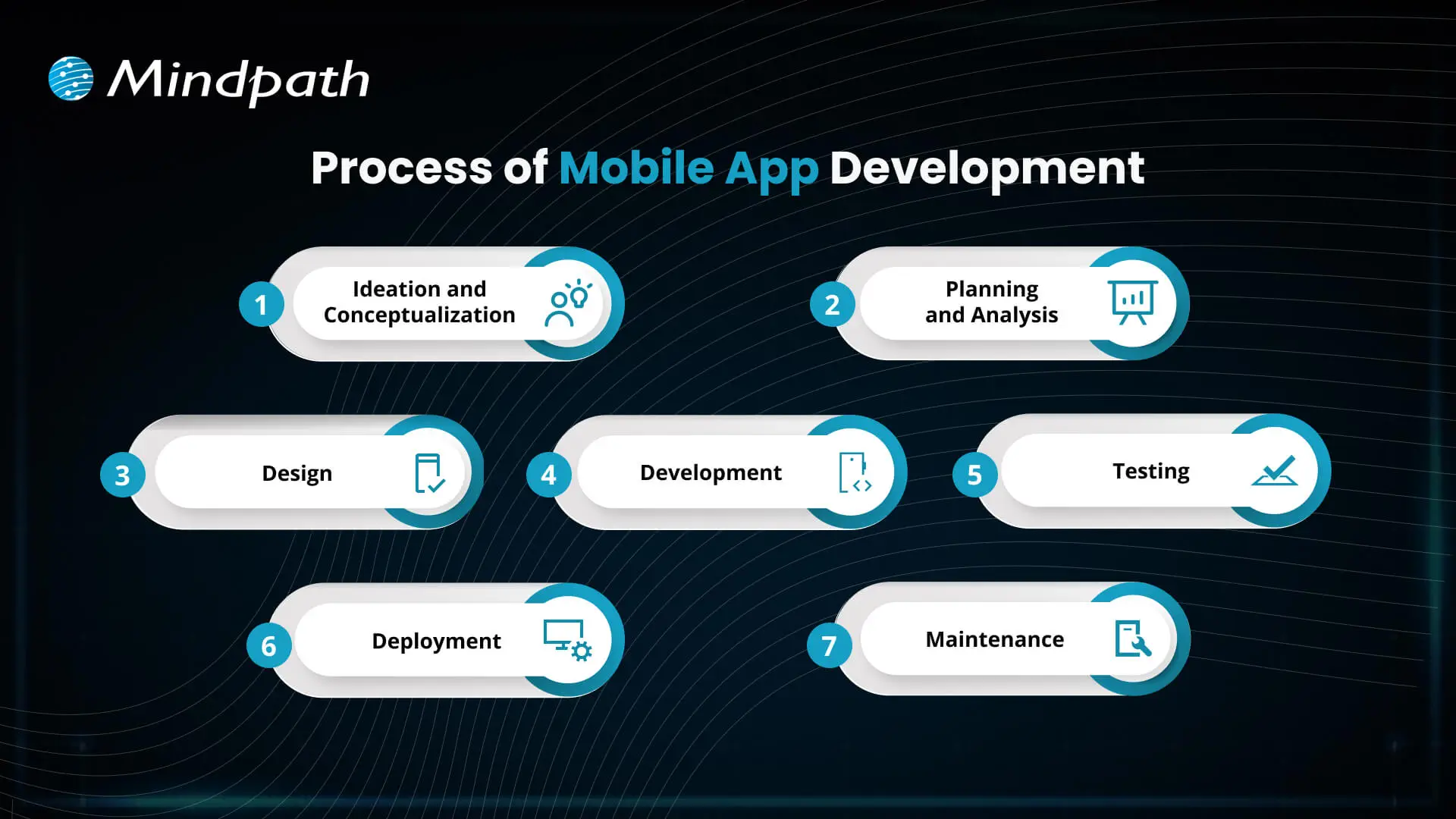
Process of Mobile App Development

1. Ideation and Conceptualization

The first step in the mobile app development process is coming up with a concept for your app. The teams think of an exciting mobile app development idea, find a way to solve problems for users, depict their target audiences, and identify key features.

2. Planning and Analysis

During this step, the teams conduct market research, determine app features, and establish goals. A proper framework documents timelines, budgets, and resources that will enable mobile app development startups and teams to stay on track.

3. Design

Designers create the aesthetic design and layout of the app to ensure it looks pleasing and is easy to use. Designing with simplicity and enjoyment in mind will allow users to navigate the app easily and have a positive experience while working.

4. Development

This is where developers start coding and building both the front and back ends of the app. The mobile app development process at this stage focuses on creating functional features that bring the design to life.

5. Testing

Before an app is launched, several tests are conducted to identify any malfunctions, like bugs or performance problems. This is a necessary step in order to ensure that the app is performing normally and responding correctly for the users.

6. Deployment

After the application has successfully gone through the testing stage, the app is published on the app stores, i.e., Google Play or Apple App Store. Companies that provide mobile app development will also develop a listing and promotional materials to be prepared for the launch.

7. Maintenance

Once the app has launched, it should be updated on a regular basis to fix bugs and continue to work with new devices or software versions. Maintaining the app will give users satisfaction, and enjoying the app for an extended period of time will keep users active.

Is your business app prepared to handle today’s security challenges? Discover how application security best practices for web and mobile apps keep user data safe while supporting sustainable growth.

Benefits of Mobile App Development

The advantages of mobile app development support businesses in more easily reaching customers and accelerating growth. By utilizing a mobile app development service, businesses can build simple and effective mobile apps that enhance user experience and increase engagement.

1. Enhance Customer Engagement

Mobile apps enable users to engage with your brand more often, keeping your business top of mind and relevant. Mobile app development allows businesses to develop features such as favorites, shopping lists, and review capabilities, all of which act as tools to enhance engagement.

2. Build Strong Brand Identity

An app that is well-designed becomes a permanent ambassador for your brand. Mobile app developers can collect relevant user data through the app, which can help improve your brand and continue to deliver value to your audience.

3. Increase Customer Loyalty

Mobile applications can host loyalty programs that encourage customers to revisit and repeat purchases. By giving discounts or rewards instantly, the app creates a sense of engagement with the app and helps build longer-term positive relationships.

4. Improve Customer Interaction

Mobile applications provide a convenient way for customers to purchase products because the app saves payment details and even previously favorite products. This all allows for an easier customer experience, which leads to convenience, improves customer satisfaction, and increases future conversions.

5. Personalize Marketing Efforts

Businesses can provide targeted offers and recommendations based on how users interact with their app. Personalized communication helps make users feel appreciated and encourages engagement.

Looking to build apps faster and smarter? Explore how mobile app development tools streamline development and boost productivity.

6. Boost Profits

Mobile apps typically drive sales and reduce marketing expenses by improving engagement, loyalty, and the overall user experience. Investing in the app is worthwhile because it is an efficient means of maximizing return.

7. Leverage Social Media Integration

Mobile applications can seamlessly connect to their social media channels, allowing individuals to easily share products or submit reviews. This advertising practice provides brands with exposure and social proof.

8. Provide Unique Value to Customers

Apps can offer features that are not available anywhere else, such as augmented reality try-ons, AI in mobile app development for intelligent chat support, and app-exclusive discounts. This adds convenience and encourages individuals to visit again.

9. Target Your Niche Market

Mobile apps provide a competitive advantage over other markets with specialized features and experiences. Businesses can effectively target and engage a broader segment of their target market.

10. Strengthen Communication

Push notifications ability and geotargeting gives businesses the ability to communicate with users in real time. Apps allow businesses to send relevant and time-sensitive messages without interruption from other communication channels.

Want to stay ahead in app innovation? Discover how mobile app development technologies power scalable, future-ready applications

Ready to Elevate Your Business with Mobile Apps?

Mobile app development offers businesses a powerful way to engage customers, build loyalty, and boost growth. By leveraging AI in mobile apps, companies can deliver smarter personalization, real-time support, and data-driven user experiences that stand out in competitive markets.. Leveraging the benefits of mobile apps helps businesses strengthen their brand, improve customer experience, and maximize sales in today’s digital world.

Mindpath provides professional mobile app development services to help businesses turn ideas into functional, user-friendly apps. Our team of experts focuses on designing apps that engage users, integrate key features, and deliver measurable results. With Mindpath, companies can launch high-quality apps that drive growth, enhance customer experience, and ensure long-term success.
What is serverless architecture 

Currently, companies are striving to create applications capable of scaling at a moment’s notice while requiring very little overhead. In this major transition, digital leaders need to grasp the concept of what is serverless architecture. It suggests a move towards fast development, less concern with the technical infrastructure, and a focus on generating real business ‍value.

While seeking agility and innovation, organizations will probably come across serverless computing since it is often praised for its great benefits. However, any architectural decision brings along some critical considerations that impact control and performance. So, in this blog, we will explore the fundamentals of serverless architecture to help you consider how it fits into the bigger picture. So, keep reading further!

Ready to build a scalable and efficient serverless ecosystem for your business? Explore Mindpath cloud infrastructure services to design, deploy, and manage high-performance cloud environments tailored to your needs.

What is Serverless Architecture?

Serverless architecture is a cloud computing model in which the cloud provider automatically manages the infrastructure. It eliminates server management, scaling, and maintenance. This means developers can concentrate on code to fulfil business needs. This enhances the speed, agility, and efficiency of application development.

Cloud providers automatically run application code in stateless, event-driven environments. They manage deployment, scaling, and availability automatically. So, developers avoid operational complexity and focus on innovation. This approach enables rapid deployment, optimal resource allocation, and performance under variable load.

Also Read: Serverless Architecture in Cloud Computing

Why are Businesses Choosing Serverless Architecture in 2026?

The serverless architecture market was worth USD 9.42 billion in 2023 and continues to grow at a robust pace, according to Grand View Research reports. It’s projected to grow at a CAGR 28.2% from 2024 to 2030. This is why serverless is gaining traction in various sectors. In 2026, companies will use serverless to address application development challenges more effectively.

Serverless helps deliver responsive and scalable applications in growing demand. It is easier to build and has a faster development cycle. Organizations are now embracing it to keep up with the digital shift. Let’s take a look at the components of serverless architecture that make it so powerful.

1. Event Sources

Invoke serverless functions via APIs, database operations, or storage events.

2. Data Services

Offer scalable data storage for access and management.

3. Compute Layer (FaaS)

Runs code based on events without server management.

4. Observability Layer

Monitors logs, metrics and performance for visibility.

5. API Gateway Layer

Controls access and routes traffic to serverless functions.

6. Orchestration

Manages the execution of multiple functions for complex tasks.

What are the Key Advantages of Serverless Architecture?

Knowing what is serverless architecture helps to explain its increasing popularity with businesses. Companies are looking for ways to ease development and increase efficiency. The benefits below demonstrate how it addresses the needs of applications.

1. Faster Application Delivery

Without the need to build infrastructure, teams are able to roll out features at a faster pace. Hence, it mitigates the occurrence of delays and enhances release cycles.

2. No Server Management Required

Developers are not responsible for the management of servers and operating systems. That makes development quite straightforward and that greatly contributes to the reduction of technical burden.

3. Flexible Event-Based Execution

Applications that recognize and react to events such as a change in data or a new file being uploaded. This feature unleashes the power of modern and customized workflows.

4. Better Cost Efficiency

Companies only get billed for the times they actually run their code, so there is no cost for unused resources. This approach leads to more effective financial management and better use of money.

5. High Availability by Design

Applications are deployed across multiple zones to improve their reliability. With this, they can maintain their performance even in cases of failures or when there is high demand.

6. Easy and Automatic Scaling

Applications automatically increase their capacity based on the traffic demand. There is no need for manual intervention during traffic spikes.

7. Improved Developer Focus

Development teams fully dedicate their efforts to enhance application logic and including new features. This is a direct indication of the major serverless benefits for contemporary software development.

8. Reduced Operational Effort

It significantly reduces the requirement for near-constant supervision and the upkeep of infrastructure. Consequently, it diminishes the level of operational work and dependence on resources.

Key Challenges of Serverless Architecture

While we are discussing the benefits of serverless computing, we should also consider its challenges. It may enhance development, but there are some constraints that impact control and performance. Here are some of the challenges that businesses need to consider.

1. Limited Control Over Performance

Serverless systems can have different response times depending on whether there are sudden changes in traffic or periods of inactivity.

2. Dependency on Cloud Providers

Functional applications are highly dependent on specific provider services, making migration difficult.

3. Complex Debugging Process

It is hard to debug errors across multiple distributed functions, as there is no central point of control. 

4. Stateless Architecture Limitations

Functions do not maintain internal state and rely on external systems for state management. 

5. Security Management Challenges

A web of interconnected services expands the attack surface and needs security attention.

6. Constraints in Application Design

Serverless may not be suitable for long-running applications or memory-intensive tasks.

7. Difficult Local Testing

Local testing of applications becomes complex because of service integration. 

8. Cold Start Delays

Time is required to start inactive functions so this is a problem for applications with a rapid response requirement. 

Trends Shaping the Future of Serverless Architecture

Just knowing the concept of what is serverless architecture is not sufficient in the ever-changing technology landscape. Companies must also know how it is evolving. These trends are just a glimpse of how serverless architecture is going to transform the way apps are built and used in future.

1. AI and Machine Learning Growth

Serverless frameworks enable quicker AI model deployment and scaling. This facilitates real-time intelligent applications.

2. Edge Computing Expansion

Applications are executed near end-users. This enhances performance and lowers latency.

3. Support for Complex Applications

Serverless can run complex and high-performance applications. This extends its application in modern apps.

4. Multi Cloud Adoption

Companies adopt serverless on multiple cloud providers. This lowers risk of vendor lock-in.

5. Stateful Serverless Evolution

Enhancements enable improved function state management. This simplifies workflow and eliminates external state.

Ready to Embrace the Future with Serverless Architecture?

Knowing what is serverless architecture enables better tech choices. It enables rapid development, scalable resource management, and easy maintenance. In the digital age, keeping up with the times is crucial. The rise of serverless architecture is transforming the development and deployment of applications in the competitive landscape.

At Mindpath, we provide cloud computing services tailored to modern business needs. We assist in creating scalable and efficient serverless solutions. Our goal is to deliver speed, agility and value for your digital transformation.

Frontend trends

Frontend technologies are enabling digital experiences and shaping today’s user experiences. Programmers are constantly experimenting with new techniques and technologies to create faster, responsive, and interactive websites. But have you ever wondered how do these technologies affect performance, scalability and user experience?

Developers experiment with technologies to improve performance, look and feel, and cross-device user experience. In a more competitive environment, there is greater focus on best programming practices and technology selection in front-end design. Want to know how the best solutions are building the future of UX and developer choices? In this blog, we will explore evolving frontend landscape in detail. So, keep reading further!

Planning to upgrade your frontend with a modern framework that delivers speed and flexibility? Our ReactJS development services at Mindpath help you craft seamless user experiences that scale with your growth.

Understanding the Importance of Frontend Technologies in 2026

Frontend development technologies are frameworks, tools and languages like HTML, CSS, JavaScript, React, and Tailwind. They build the user interface of web applications. They define structure, design, responsiveness, and interactivity. These technologies play a key role in digital product experiences.

They matter more in 2026 because expectations of digital products are increasing for all businesses. They’re essential for businesses to deliver responsive and performant websites. Here’s why frontend technologies matter for websites.

1. Fast Performance Expectations

Instant loading and seamless interactions are expected always. New tools eliminate lag and improve performance.

2. AI in the Development Process

AI assists with development, testing and UI design. Coding becomes quicker and less tedious.

3. PWAs and Voice Interfaces

Progressive web apps provide app-like capabilities in the browser. Voice interfaces make it easier and accessible.

4. Evolving Frameworks and TypeScript

Frameworks like React and Tailwind keep improving. TypeScript makes code safer and cleaner.

5. Frontend Meets Backend

New frameworks combine the UI and server. This moves frontends closer towards full-stack programming.

6. Security and Specialization

Security ensures data and input safety online. Developers specialize in areas such as animation and performance.

Top 20 Frontend Web Technologies List in 2026

A frontend technologies list in the year 2026 undoubtedly represents the tools that are shaping modern web experiences across the industries. These technologies enable developers to create fast, responsive, and very interactive user interfaces that cater to the digital needs of today.

1. JavaScript

JavaScript enables interactive and dynamic features on web pages. It is used to create forms, animations, and shopping carts. It is still one of the most important Front end development technologies today.

2. React

React is a JavaScript library for creating interactive user interfaces. It uses reusable components to simplify development. It was developed by Facebook and is now popular for building large-scale web apps.

3. Angular

Angular is a robust framework for JavaScript development supported by Google. It adopts a modular, component-based approach for developing applications. It is popularly used for developing single-page applications.

4. Vue

Vue is a progressive JavaScript framework for developing user interfaces. It has a straightforward, component-based structure like React and Angular. It is popular for creating responsive single-page apps.

Must Read: Angular vs React vs Vue 

5. CSS (Cascading Style Sheets)

CSS is responsible for rendering the HTML structure and giving websites a particular design. Mainly, it decorates websites with colors, spacing and responsiveness. Besides, it is possible to use CSS for animating and enhancing user experience.

6. HTML (HyperText Markup Language)

HTML is the main code behind web pages. It produces elements such as titles, buttons, forms, and sections. It is the foundation of web content.

7. React Native

React Native is a framework to build mobile apps for iOS and Android with a single code base. It is a framework based on React and provides almost native performance. It makes mobile development across platforms easier and faster.

8. Tailwind CSS

Tailwind CSS is a utility-first CSS framework. The styling of elements is therefore remain restricted to the class attribute in HTML. It is especially helpful for quick development of user interfaces with reusable themes and styles.

9. Flutter

Flutter is a framework developed by Google to create mobile and web applications using Dart. It offers a wide range of pre-built widgets for building responsive user interfaces. Furthermore, it enables a single codebase for multiple platforms.

10. Headless CMS

Headless CMS separates content from the presentation layer. It shares data through APIs making it suitable for any platform. It also resolves issues related to team collaboration.

11. GraphQL

GraphQL is a language for querying APIs. It only loads necessary data, which makes it quicker in getting the data you really need. Due to this feature, it has become quite popular in web applications for handling data.

12. Progressive Web Apps (PWA)

PWA generates app-like functionalities through a combination of web technologies. They are fast, capable of working offline, and can be installed. Since adaptability is one of the characteristics, many companies are opting for PWAs.

13. Web3 Apps

Web3 apps connect users with decentralized platforms through modern web interfaces. Developers use tools like Web3.js and ethers.js to build secure blockchain-based experiences. These solutions are shaping the future of web frontend technologies.

14. Next.js

Next.js is a powerful React framework for building fast and SEO-friendly websites. It supports static generation and server-side rendering. It helps businesses create scalable and high-performance web experiences.

15. TypeScript

TypeScript is a typed programming language that is a superset of JavaScript. It enables developers to find and fix bugs earlier. For this reason, it’s one of the most popular frontend developer technologies for large-scale applications.

16. Gatsby

Gatsby is a framework for building fast websites. It offers performance optimizations such as code-splitting and optimization of images. It’s suitable for content-driven and responsive websites.

17. Astro

Astro is a fresh framework for developing quick and adaptable websites. It generates very simple pages but still supports interactive components whenever needed. This leads to better speed and performance.

18. Micro Frontends

Micro frontends break large applications into smaller independent parts. Different teams can manage separate features more efficiently. This structure improves scalability and development flexibility.

19. Monorepo

Monorepo means one repository covering multiple projects. It is a very efficient way of sharing code, teamwork and managing projects. It’s especially suitable for projects that consist of multiple related apps.

20. Three.js

Three.js is a JavaScript library for rendering 3D graphics and animations for the web. It enables the development of immersive experiences within web browsers. It is one of the new frontend development technologies, used to create new digital design, game and visualization projects.

How to Choose the Right Frontend Technology for Your Project in 2026?

Selecting the right frontend development technologies can directly influence how smoothly your project grows and performs over time. The following are the essential factors that can guide better decisions for building efficient and future-ready digital products in 2026.

  • Match the technology with your project size, features, and long-term business goals.
  • Focus on speed, SEO, and user experience to support better performance and visibility.
  • Choose tools that fit your team’s skills to reduce learning time and improve productivity.
  • Review rendering methods and performance capabilities for smoother digital experiences.
  • Consider community support, hiring availability, and ecosystem strength for future growth.
  • Select technologies that align with modern trends like AI, TypeScript, and scalable architecture.

Ready to Build Smarter Digital Experiences in 2026?

Frontend development technologies continue to redefine how modern businesses create meaningful digital products. The right choices improve performance, support growth, and help brands deliver smoother user experiences while staying prepared for future industry shifts.

At Mindpath, we provide ReactJS development services that help businesses create responsive, scalable, and user-focused digital platforms. Our team builds practical technology strategies that support long-term success through modern development expertise.

custom website development services

Companies consistently wrestle with the challenge of maintaining a smooth operation and competing in an ever-changing world. Custom website development services provide the missing link to develop a platform that matches your exact needs and workflows. When a website is built around a real process that matches a real workflow, the company will improve efficiency, and simplify tasks. This simplifies how teams work faster and will improve the extent customers interact on your website. A good website becomes a tool for growth to enable outcomes without adding more work.

Many businesses have adopted custom website development because of the time-saving nature of routine work automation, greater collaboration, and more rapid responses to shifting needs. When technology is a partner with a skilled web design company to streamline operations to connect people across different teams and functions, its powers can enhance overall productivity. A business’s online presence can become a powerful accelerator of success when a company can tie it to real business goals. In this blog, we will detail how these services can modernize and streamline your business.

Must Read

Want to build a website that not just exists but also gives your brand a great online presence? Mindpath offers web development services to ensure responsive designs and smooth performance, which makes every click an opportunity for the business.

Understanding Custom Website Development Services

Custom web development means creating a website from the ground up to fit the needs of a business. Rather than just using templates or a cloned website, a custom website development company will build your platforms to express the brand’s identity, work with existing systems, and provide a uniquely personalized experience for users. Every aspect of the site is built to serve the company’s needs and enables the site to be fully functional and engaging.

By taking this approach, businesses will also have the flexibility to add features that are appropriate for their business and will help make the website easier to manage as the business grows. Additionally, there is the ability to know their site will be secure and have capacity for more users or more content over time. For companies, custom web development offers a website that looks professional, works well, and can grow with their businesses.

How are Custom Web Development Services Streamlining Business Operations?

Custom web development services are primarily concerned with designing a website that reflects a business’s unique goals and key strategies. These services ensure an online presence that is at once professional and trustworthy, and sufficiently adaptable for use as a tool for the business’s development and other operational needs, both now and in the future.
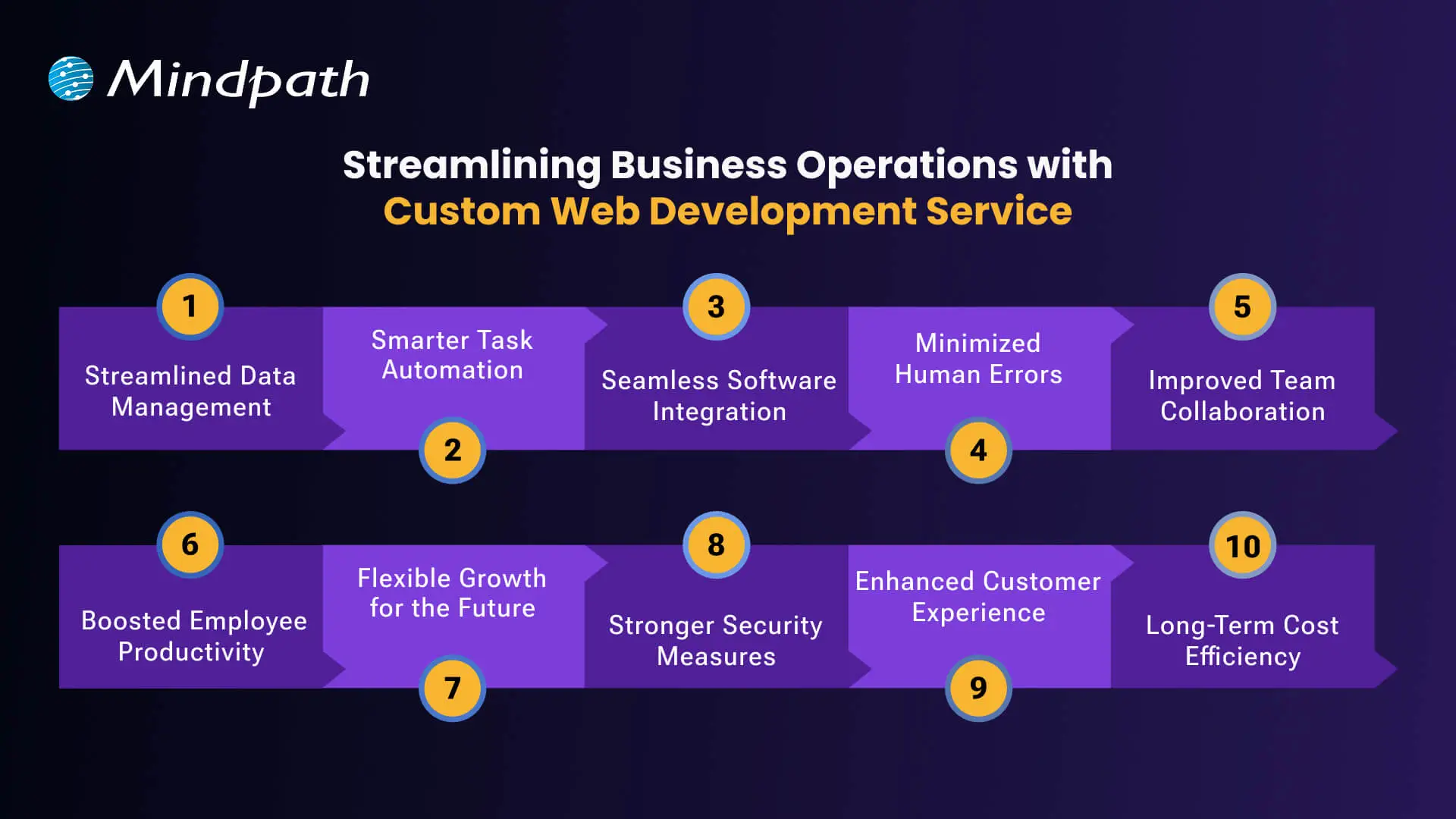
Streamlining Business Operations with Custom Web Development Service

1. Streamlined Data Management

A custom web application enables the collection of information from multiple locations, thus ensuring that each department has the same up-to-the-minute information. Dashboards and reporting functions pull together the information to enable visual, timely, better decision making, and it increase overall efficiency.

2. Smarter Task Automation

Custom web development services enable automation of repetitive tasks such as order processing, invoicing, and inventory management. Minimally, this frees up the time of employees to focus on more strategic objectives and accelerate the pace of operations and thus total productivity.

3. Seamless Software Integration

A custom web development company can design applications that integrate smoothly with your existing systems like CRM or ERP tools. It is a way that frees people from the heavy work of manual data transfer in different applications and at the same time, enables the seamless integration of workflows and processes. The result is a more efficient and cohesive operational environment.

4. Minimized Human Errors

Custom-built applications incorporate highly developed validation and error-checking mechanisms. Businesses save time and avoid mistakes, improve accuracy, and reduce costs by removing the risk of human error in data entry or repetitive processes. Employees can focus on actual work and add value instead of fixing an error.

5. Improved Team Collaboration

A custom web application provides a centralized platform for sharing documents, tracking progress, and communicating in real-time. Teams can coordinate tasks more effectively, reducing misunderstandings. This enhances inter-departmental collaboration and streamlines daily workflows.

Curious how artificial intelligence can transform the way websites are built and managed? Explore our article on AI in web development to discover how AI can enhance your site’s efficiency, usability, and performance.

6. Boosted Employee Productivity

With a custom web application, teams can share documents, track progress, and communicate in real-time all in one location. This increased coordination among team members leads to a better understanding of tasks, which improves departmental collaborations and caters to their day-to-day duties better.

7. Flexible Growth for the Future

Custom web development provides businesses with solutions that expand with them. This means that the platform can accommodate more users, storage of larger datasets, and use cases when the business expands, and all without a complete redesign. This level of flexibility is important for maintaining a valuable website as a tool over time.

8. Stronger Security Measures

Custom solutions enable developers to incorporate tailored security protocols to safeguard sensitive data. Unlike generic software, custom applications can include encryption, authentication, and enhanced security measures tailored to your firm. Organizations at least know that their customer and operational data are of the highest security.

9. Enhanced Customer Experience

Custom web development services play an important role in elevating customer engagement and communication. Just to illustrate, an automated follow-up or a tracking system for orders can be a way of informing your customers at each step, thus attracting them. Consequently, it becomes a cycle of strengthening your relationships and building trust with your clients over time.

10. Long-Term Cost Efficiency

Custom website developers may have a higher upfront cost, but the ROI can be huge over time. Eliminating continuing software fees and inefficient processes can ultimately save the business money. Custom software solutions create well-performing, reliable systems that promote growth and success.

Want to build a complete website without coordinating with multiple developers? Explore our post on full-stack development for web projects to discover how a full-stack approach simplifies your workflow and accelerates delivery.

Ready to Streamline Your Business with Custom Web Development Services?

Custom web development services help businesses improve efficiency, strengthen teamwork, and enhance customer interactions. By creating websites that match real business goals, companies can save time, reduce errors, and manage operations with ease. A well-designed website acts as a strong foundation for growth and lasting success.

At Mindpath, our expert team delivers professional website development services that align with your business goals. Each custom web development service is designed to create fast, secure, and scalable websites that enhance performance and user engagement. We focus on crafting digital solutions that simplify operations and help your business grow with confidence.
custom mobile application development services

In an ever-quickening pace of digital development, businesses strive for differentiators that can engage their audiences in new ways. Custom mobile application development services provide the means to actually deliver, providing a way for businesses to develop apps that serve their needs perfectly. Using unique features connected to smooth user experiences, organizations build engagement, access to efficiencies, and value delivery. Have you noticed how apps designed with intention often make a bigger impact than off-the-shelf solutions?

Keeping up with mobile app development trends ensures that these custom solutions remain relevant, innovative, and aligned with evolving user expectations. These services create opportunities for organizations to reconsider customer engagement and organizational workflows in a fundamentally different way. Through dedicated solutions, organizations can have a competitive advantage and respond quickly to the changes in market demands. The custom mobile application’s ability to do so goes beyond its convenience. It helps to shape strategies, improve growth potential, and establish connections. In this blog, we are exploring the top seven industries that have benefited from custom mobile application development services and how. So, let’s dig in!

Looking to stay ahead in today’s fast-paced technology world, businesses are looking to customize apps that are tailored to meet their specific demands. Mindpath’s mobile app development services will deliver high-performing solutions that give real results.

What are Custom Mobile Application Development Services?

Custom mobile app development services involve building bespoke mobile applications tailored to specific business requirements, user workflows, and long-term goals, rather than relying on generic, off-the-shelf solutions. The process covers planning, UX/UI design, native (iOS/Android) or cross-platform (React Native/Flutter) development, quality assurance, and post-launch maintenance. The result is an application that delivers personalized user experiences, seamless integration with existing systems, and the flexibility to scale as your business evolves.

These services are developed to deliver applications that are agile, scalable, and secure. Custom solutions can effortlessly merge with an existing system and adapt to changing needs in the business. When companies invest in their respective user experience, they can enhance their engagement while properly managing sensitive information. Custom mobile app development services will provide sustainability for the long term, and a strategic and effective digital presence that supports competitiveness and adaptability.

Industries Benefiting from Custom Mobile Application Development Services

Many sectors are changing how they operate and engage customers with custom app development services. These services help businesses create mobile apps that cater to their specific goals, workflows, and the needs of their customers. Through customization, companies from many sectors can enhance efficiency, increase engagement, and achieve measurable growth.

1. E-Commerce and Retail

Custom app development services plays a significant role. It provides seamless and engaging shopping experiences to brands in the e-commerce and retail industry. Personalized recommendations, customer-friendly navigation, and secure payments are some of the app features that businesses can create to keep customers happy. Retailers not only increase customer loyalty by incorporating features such as loyalty programs and real-time updates but also can gain steady sales growth.

2. Healthcare

The healthcare industry is changing rapidly, as you would expect from a sophisticated mobile application development platform. Making use of customized healthcare apps will allow patients to have much simpler access to booking their visits and managing online consultations.

Hospitals also enjoy a more efficient patient care process. The implementation of electronic prescriptions and the employment of telemedicine innovations. All of which results in the saving of time and resources and the maintenance of high-quality care.

3. Education

One of the innovations that the education sector is adopting is the use of tailor-made mobile applications. The implementation of these applications has brought ease in the management of virtual classes, assignments, and attendance for schools, universities, and e-learning platforms.

Through the use of custom apps, education can be more stimulating, adaptable, and available to students from any location as these apps provide interactive learning experiences and instant communication.

4. Finance

One of the major trends in the finance and banking industry is the use of custom mobile application development services to revolutionize customer experience. These applications not only allow the users to carry out banking, investing, and loan activities effortlessly but also ensure that the data security is at a very high level.

Some of the latest security and convenience features, such as biometric authentication, instant payments, and personalized insights, have empowered customers to become more loyal. This makes them feel more comfortable with their financial institutions.

Looking to prioritize security in your application lifecycle? Discover useful strategies in our blog on application security best practices and explore how to make security a core part of your development roadmap.

5. Logistics and Transportation

One of the main factors for better efficiency in the logistics and transportation industry is custom application development services which develop various applications for business use. This kind of apps will allow companies to manage their routes, shipments tracking, and fleet operations. Not only in person but also in real time.

Advanced analytics and the usage of GPS as standard technology in many different fields have definitely helped in optimizing fuel consumption as well as in savings and in making sure deliveries are on time and are reliable.

6. Real Estate

Custom mobile application development services have a major impact on the real estate sector, which changes the way the market has been operating for a long time. With these new applications, end-users can go through listings, practically visit properties, and get in touch with agents at once. Thus, it speeds up and clarifies the entire process.

Apart from that, real estate companies are also benefiting from these applications. They can manage their leads more efficiently and correspond with clients comfortably. Thus making the property experience more productive and enjoyable.

7. Travel and Hospitality

Innovative custom mobile application development services have become an effective way for the travel and hospitality industry to improve customer experience. By using these apps, individuals can quickly reserve trips, keep track of their schedules and have seamless access to different departments at any time.

As a result of incorporating functionalities such as up-to-the-minute updates, location maps, and tailored gifts & services, travel companies. They have the opportunity to create customer loyalty and provide their travellers with a more exciting and integrated outing.

Curious about the tools and frameworks driving the future of mobile apps? Explore and discover key innovations in our blog on mobile app development technologies that can empower your business to build smarter, more efficient apps.

Ready to Transform Your Business with a Custom Mobile App?

Custom mobile application development services are helping industries innovate, improve customer engagement, and achieve lasting growth. Businesses across sectors now rely on tailored apps to enhance user experience, streamline operations, and stay competitive. With the right strategy and expert support, these apps can become a long-term asset for business success.

As a trusted custom mobile app development company, Mindpath delivers powerful website and mobile app development solutions designed for your unique goals. Our expert team builds secure, scalable, and user-friendly apps that help your business connect better with customers and perform efficiently. Partner with Mindpath to bring your app idea to life and move your business ahead with confidence.

Frequently Asked Questions

Join our Newsletter!

categories

Join the world's largest training library and unlock new opportunities!

Featured Posts

Turn Insights Into
Real Business Solutions

Exploring trends is only the beginning. Whether you’re planning AI adoption, modernizing legacy systems, or building scalable software, our experts help transform ideas into practical business outcomes.