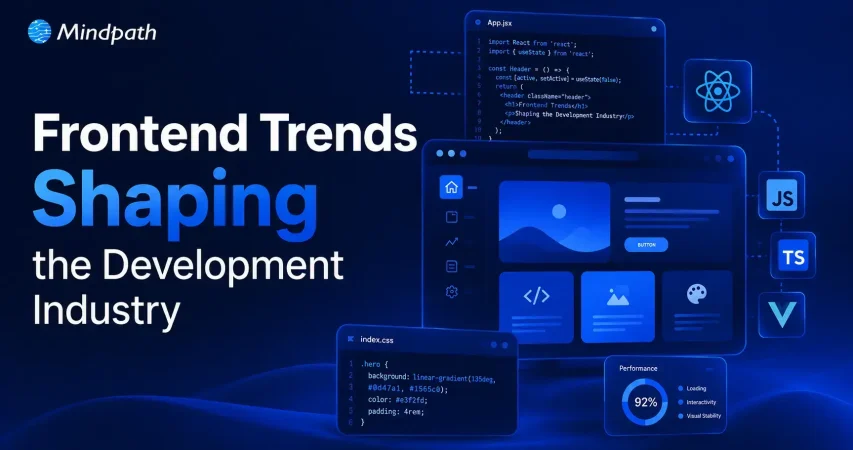
Frontend technologies are enabling digital experiences and shaping today’s user experiences. Programmers are constantly experimenting with new techniques and technologies to create faster, responsive, and interactive websites. But have you ever wondered how do these technologies affect performance, scalability and user experience?
Developers experiment with technologies to improve performance, look and feel, and cross-device user experience. In a more competitive environment, there is greater focus on best programming practices and technology selection in front-end design. Want to know how the best solutions are building the future of UX and developer choices? In this blog, we will explore evolving frontend landscape in detail. So, keep reading further!
Planning to upgrade your frontend with a modern framework that delivers speed and flexibility? Our ReactJS development services at Mindpath help you craft seamless user experiences that scale with your growth.
Understanding the Importance of Frontend Technologies in 2026
Frontend development technologies are frameworks, tools and languages like HTML, CSS, JavaScript, React, and Tailwind. They build the user interface of web applications. They define structure, design, responsiveness, and interactivity. These technologies play a key role in digital product experiences.
They matter more in 2026 because expectations of digital products are increasing for all businesses. They’re essential for businesses to deliver responsive and performant websites. Here’s why frontend technologies matter for websites.
1. Fast Performance Expectations
Instant loading and seamless interactions are expected always. New tools eliminate lag and improve performance.
2. AI in the Development Process
AI assists with development, testing and UI design. Coding becomes quicker and less tedious.
3. PWAs and Voice Interfaces
Progressive web apps provide app-like capabilities in the browser. Voice interfaces make it easier and accessible.
4. Evolving Frameworks and TypeScript
Frameworks like React and Tailwind keep improving. TypeScript makes code safer and cleaner.
5. Frontend Meets Backend
New frameworks combine the UI and server. This moves frontends closer towards full-stack programming.
6. Security and Specialization
Security ensures data and input safety online. Developers specialize in areas such as animation and performance.
Top 20 Frontend Web Technologies List in 2026
A frontend technologies list in the year 2026 undoubtedly represents the tools that are shaping modern web experiences across the industries. These technologies enable developers to create fast, responsive, and very interactive user interfaces that cater to the digital needs of today.
1. JavaScript
JavaScript enables interactive and dynamic features on web pages. It is used to create forms, animations, and shopping carts. It is still one of the most important Front end development technologies today.
2. React
React is a JavaScript library for creating interactive user interfaces. It uses reusable components to simplify development. It was developed by Facebook and is now popular for building large-scale web apps.
3. Angular
Angular is a robust framework for JavaScript development supported by Google. It adopts a modular, component-based approach for developing applications. It is popularly used for developing single-page applications.
4. Vue
Vue is a progressive JavaScript framework for developing user interfaces. It has a straightforward, component-based structure like React and Angular. It is popular for creating responsive single-page apps.
Must Read: Angular vs React vs Vue
5. CSS (Cascading Style Sheets)
CSS is responsible for rendering the HTML structure and giving websites a particular design. Mainly, it decorates websites with colors, spacing and responsiveness. Besides, it is possible to use CSS for animating and enhancing user experience.
6. HTML (HyperText Markup Language)
HTML is the main code behind web pages. It produces elements such as titles, buttons, forms, and sections. It is the foundation of web content.
7. React Native
React Native is a framework to build mobile apps for iOS and Android with a single code base. It is a framework based on React and provides almost native performance. It makes mobile development across platforms easier and faster.
8. Tailwind CSS
Tailwind CSS is a utility-first CSS framework. The styling of elements is therefore remain restricted to the class attribute in HTML. It is especially helpful for quick development of user interfaces with reusable themes and styles.
9. Flutter
Flutter is a framework developed by Google to create mobile and web applications using Dart. It offers a wide range of pre-built widgets for building responsive user interfaces. Furthermore, it enables a single codebase for multiple platforms.
10. Headless CMS
Headless CMS separates content from the presentation layer. It shares data through APIs making it suitable for any platform. It also resolves issues related to team collaboration.
11. GraphQL
GraphQL is a language for querying APIs. It only loads necessary data, which makes it quicker in getting the data you really need. Due to this feature, it has become quite popular in web applications for handling data.
12. Progressive Web Apps (PWA)
PWA generates app-like functionalities through a combination of web technologies. They are fast, capable of working offline, and can be installed. Since adaptability is one of the characteristics, many companies are opting for PWAs.
13. Web3 Apps
Web3 apps connect users with decentralized platforms through modern web interfaces. Developers use tools like Web3.js and ethers.js to build secure blockchain-based experiences. These solutions are shaping the future of web frontend technologies.
14. Next.js
Next.js is a powerful React framework for building fast and SEO-friendly websites. It supports static generation and server-side rendering. It helps businesses create scalable and high-performance web experiences.
15. TypeScript
TypeScript is a typed programming language that is a superset of JavaScript. It enables developers to find and fix bugs earlier. For this reason, it’s one of the most popular frontend developer technologies for large-scale applications.
16. Gatsby
Gatsby is a framework for building fast websites. It offers performance optimizations such as code-splitting and optimization of images. It’s suitable for content-driven and responsive websites.
17. Astro
Astro is a fresh framework for developing quick and adaptable websites. It generates very simple pages but still supports interactive components whenever needed. This leads to better speed and performance.
18. Micro Frontends
Micro frontends break large applications into smaller independent parts. Different teams can manage separate features more efficiently. This structure improves scalability and development flexibility.
19. Monorepo
Monorepo means one repository covering multiple projects. It is a very efficient way of sharing code, teamwork and managing projects. It’s especially suitable for projects that consist of multiple related apps.
20. Three.js
Three.js is a JavaScript library for rendering 3D graphics and animations for the web. It enables the development of immersive experiences within web browsers. It is one of the new frontend development technologies, used to create new digital design, game and visualization projects.
How to Choose the Right Frontend Technology for Your Project in 2026?
Selecting the right frontend development technologies can directly influence how smoothly your project grows and performs over time. The following are the essential factors that can guide better decisions for building efficient and future-ready digital products in 2026.
- Match the technology with your project size, features, and long-term business goals.
- Focus on speed, SEO, and user experience to support better performance and visibility.
- Choose tools that fit your team’s skills to reduce learning time and improve productivity.
- Review rendering methods and performance capabilities for smoother digital experiences.
- Consider community support, hiring availability, and ecosystem strength for future growth.
- Select technologies that align with modern trends like AI, TypeScript, and scalable architecture.
Ready to Build Smarter Digital Experiences in 2026?
Frontend development technologies continue to redefine how modern businesses create meaningful digital products. The right choices improve performance, support growth, and help brands deliver smoother user experiences while staying prepared for future industry shifts.
At Mindpath, we provide ReactJS development services that help businesses create responsive, scalable, and user-focused digital platforms. Our team builds practical technology strategies that support long-term success through modern development expertise.