



Latest Insights On
GenAI, Tech, and Digital Transformation
Stay updated with expert insights, success stories, and real-world applications of cutting-edge technology.
In 2026, web design trends are redefining what modern websites look and feel like. Designers are moving beyond conventional layouts, blending user-centric principles with bold aesthetics — from kinetic typography and immersive 3D elements to AI-driven personalization and accessibility-first standards. The goal is to craft websites that are not just beautiful, but also interactive, human-centric, and memorable.
As technology advances and expectations of users evolve, staying ahead of new trends in web design is crucial for businesses to stand out. Whether you are optimizing your local business site or creating a new one, these top web design trends in 2026 will surely trigger ideas and enhance your digital experience. Keep reading to explore some leading web design trends that are set to define modern websites with Mindpath.
If you are looking to implement these latest modern web design trends in your business, you require expertise. Mindpath offers web development service that helps you stay ahead of your competitors and deliver a website tailored to your business needs by turning your ideas into reality.
Focus On Smart Design For A Smarter Web
In 2026, web design is no longer a choice between personality and performance: it is a combination of both. Modern web design balances high-speed performance with immersive, human-centric storytelling. Designers are leveraging design systems and frameworks that deliver super-fast load times without sacrificing brand storytelling, visual impact, or interactive depth.
This shift has created a new era where creative expression and technical precision go hand in hand. Websites are getting smarter, emotionally resonant and leaner, resulting in a digital experience where design creates a lasting impression and functionality drives engagement.
Wondering who can bring these design trends to life? Discover our website design company blog to see how the right team can turn trends into impactful websites.
Let’s talk about the trends that businesses need to focus on to achieve designs that deliver.
21 Web Design Trends to Consider in 2026
Trends in web design are driven by advanced technologies and a desire to develop sites that are highly functional, interactive, memorable, and have elements to showcase a brand’s identity authentically. From sustainable designs to hyper-personalized interfaces, here are 21 web design trends to consider.
1. Expressive Fonts and Maximalist Typography
Typography is a major visual element in every website. Businesses can expect to see layered, bold, and oversized text that will be the centerpiece of a web page. Besides, web designers are now creating playful, custom typefaces along with high-contrast pairings for a powerful statement.
2. Micro Animations/ Interactions
Small details can make a huge impact. Micro interactions can help reinforce actions and guide users. For example, button ripples, hover effects, form feedback, or loading indicators. These are subtle yet powerful and can enhance the overall user experience.
3. Experimental Navigation
Are you still using dropdown and hamburger menu designs? Well, it’s time to take a break. 2026’s trending web designs focus on scroll-as-navigation, gesture-based, and radial navigation styles, increasing engagement.
4. Brutalist Designs with Some Modern Twists
A reaction template-driven, overly polished designs, brutalism is back, but with a modern twist. This modern style features unpolished, raw elements, bold typography, subtle animations, and pops of color. This design can be an ideal way to add a unique attitude and authenticity to websites.
5. Illustration-led Web Design
This is gaining popularity among web designers in 2026 for conceptual clarity, quick load times, as well as brand originality. Utilizing illustrations offers a visually engaging alternative to heavy images, making them an excellent choice for service-based websites.
Also Read: Web Development Technologies
6. Immersive Scrolling
Most websites are now becoming cinematic due to the integration of scroll-triggered animations. As users move down pages, elements zoom or fade in, crafting a narrative-like or dynamic user journey. With this, you can make a simple scrolling into an immersive experience.
7. Dark Mode and Custom Palettes
Dark mode has become a standard design, but designers are tweaking it to add more effects. You can now see custom dark mode and palettes that utilize rich grays along with muted tones, offering a more branded and sophisticated experience while reducing strain on the eyes.
8. Monochromatic Design
It is a simple yet powerful visual approach that utilizes a single base color and its different tones, tints, and shades throughout websites. Such designs emphasize cohesion, elegance, and simplicity. The distraction factors will be less as it creates a unified aesthetic.
9. Hyper-Personalized Interfaces
Inclusion of machine learning and AI in web design has enabled a new level of customization. Websites will adapt their layout and content to every user, providing them with dynamic content and tailored recommendations based on their browsing history.
10. Sustainable Web Design Trends
In 2026, the focus will be more on developing environmentally-friendly websites. While designing and developing websites, developers would prioritize eco-friendly hosting providers, accessibility, and streamlined code. These things help lower carbon emissions related to the internet.
Curious how AI is transforming modern web experiences? Explore our AI in Web Development blog to learn how smart features enhance usability and performance.
11. Sci-Fi Gaming and Futuristic UI Aesthetics
Website interfaces inspired by sci-fi films and games are getting popular. How about HUD-style overlays, neon glows, glitchy transitions, etc.? These designs can create high-tech and bold digital experiences.
12. Bento Grid Layouts
Influenced by the elegance of the Japanese bento box, this design utilizes a modular grid of boxes. These layouts offer an efficient and clean way to organize information in a structured way. These website layout ideas are an ideal option for complex content websites and portfolios.
13. Neumorphism Web Design Trends
It combines flat and skeuomorphism design using minimal contrast and soft shadows for a monochromatic and clean look. It suits web apps but requires proper handling of UX to avoid usability problems.
14. Power of White Space in Web Design
Emphasizing negative space in a web design can enhance focus and clarity by balancing content with open, clean areas. Strategic use of typography and spacing boosts readability, creates an intuitive experience, and guides user attention. You can consider Apple.com as an example.
15. Custom Mouse and Cursors Interactions
Custom cursors can play a major role in branding. Designers use them to instill interactive flair and personality, with responsive shapes, sparkly trails, brand logos, and more. It may look simple, but it works well in making a website look unique.
Must Read: Web Development vs Software Development
16. 3D Elements
Another popular modern web design that can make your site look stunning is the use of 3D elements. From interactive product demonstrations to full-screen 3D backgrounds, these elements add realism and depth, making your site more immersive and captivating.
17. Smart and Dynamic Videos
Videos on websites are becoming ambient design elements. They are generally looped seamlessly, silent, and optimized for faster performance. By using videos on homepages, you can make the website engaging without reducing the site’s speed.
18. Gamified Designs
When talking about 2026’s web design trends, we can’t ignore these designs. These designs add game-like elements to websites, like challenges, rewards, or points, enticing visitors to spend more time on websites.
19. Combining Photos with Graphical Elements
Web designers are getting creative by combining photography with beautiful graphical overlays. For instance, elements like arrows, doodles, or collage elements can add a unique layer of creativity.
20. Detailed Footers in Web Design Trends
Enhanced footers are now redefining web design and development trends. A footer has evolved from a basic contact section into a content-rich, dynamic section, playing a crucial role in brand storytelling. Check out the website of 360gardalife for inspiration.
21. Collage-Like Scrapbook Layouts
These layouts create an asymmetrical, layered, and handcrafted feel. These designs mimic a scrapbook with text and images scattered in a compelling way. With it, you can add an artistic, human touch while avoiding those rigid grid systems.
Planning a new web application for your business? Discover our Web App Development Roadmap blog to understand each stage and avoid common pitfalls.
Top Modern Website Design Examples
Are you searching for the best web design inspiration? Well, here are some modern website design examples you should check out.
1. Stripe
Utilizes minimal UI, geometric shapes, and interactive visuals to craft a conversion-focused and sleek website.
2. Apple
The design combines 3D product previews, cinematic storytelling, seamless transitions, etc., for better user engagement.
3. Spotify
Combines animated CTAs, dark mode, and bold colors to provide users with an immersive and personalized music discovery platform.
4. Mantis Pro
A perfect combination of high-contrast visuals, bold fonts and amazing layouts while emphasizing speed and performance.
5. Datel
Includes layers, visuals, scroll animations, and modern typography that clearly highlight the brand’s product innovation and tech-forward approach.
6. Velux
The design has interactive sliders, soft gradients, and natural imagery that help the brand support its vision, i.e., promoting sustainability.
These cool website designs clearly showcase how their functionality and design can be combined to craft memorable user experiences.
Looking to make your website more engaging and user-friendly? Read about UI/UX Design Trends to learn what design elements boost interaction and retention.
Website Design Trend: More Innovations in the Future
Whether you are creating a new website or planning to revamp the existing one, here are some future-forward website design trends that you should consider.
1. Voice User Interface
Voice search and commands integration streamline navigation and offer users hands-free browsing, enhancing accessibility.
2. AI-Powered Design
Various AI tools personalize content, optimize UX, and automate layouts, making a website faster, and smarter.
3. IoT
Websites connected with smart devices can offer real-time data, personalized automation and remote-control features.
4. Accessibility-First Design
Focus on inclusive designs to ensure easy access for every user, including people with disabilities, through keyboard navigation, alt text, and readable fonts.
5. Minimalistic Design
The best web design utilizes strategic whitespace, focused content, and a clean layout to enhance readability, mobile performance while reducing load time
6. Integration of Blockchain
This will ensure enhanced security and transparency for identity verification and transactions on modern websites.
7. 3D Visuals
3D elements add visual depth, interactivity, and realism, especially for immersive storytelling and product showcases.
Apart from these web design trends, collaboration between developers and designers is vital. This will help you ensure that your new website is not just visually great, but also secure, high-performing and stable.
Looking for the right team to bring your web ideas to life? Read our Website Development Company blog to see what to look for before hiring.
Create Web Designs that Move your Business Forward
The future of web design is an exciting combination of purpose, interactivity, sustainability, and authenticity. By incorporating these 21 web design trends 2026, businesses can craft a website that will not just look incredible, but also create an effective and engaging experience.
For businesses looking to translate trending website designs into a visually appealing and high-performing website, partnering with an expert is crucial. This is where they can count on Mindpath. We offer web development services that integrate advanced technologies, a customer-centric approach, bespoke web design solutions, and follows the latest web development trends to create websites that every business needs. Let us craft digital experiences for businesses that engage, inspire, as well as convert.
Frequently Asked Questions
Artificial intelligence has become one of the trending topics of discussion in the domain of technology, largely due to LLMs. Large language models or LLMs have made it possible to talk with AI and complete different types of actions, such as generating content or writing code. The impact of LLMs has not only redefined the conventional norms for interacting with technology but also provided new perspectives on information processing. Therefore, more people want to learn about LLMs and how they work. Let us discover how LLMs have become a powerful force in the AI landscape with an overview of their fundamentals.
Want to turn the power of LLMs into real business value? Discover Mindpath’s LLM Development Services to develop intelligent applications that automate workflows, enhance customer experiences, and improve productivity.
What are Large Language Models?
The obvious questions on the mind of any beginner are “What are Large Language Models?” and how they work. You can think of them as AI models which use deep learning, a sophisticated form of machine learning that leverages neural networks. Neural networks are a type of computational system designed along the lines of the human brain, with the interconnected layers represented neurons. LLMs rely on deep learning as it helps in finding intricate patterns in massive training datasets.
The definition in any Large Language Models beginner guide also focuses on the size of LLMs. You must know that the “Large” in LLMs is not an exaggeration as LLMs are built by training on large amounts of data. The data used to train LLMs is obtained from various sources, including the internet, books and many other sources of information. The large amount of training data ensures that LLMs have capabilities for recognizing, translating, predicting and generating human-like text.
Want to customize a large language model for your specific use case? Explore our OpenAI Fine-Tuning API tutorial to learn how to fine-tune LLMs for better accuracy and performance.
How Do Large Language Models Work?
The features of LLMs create questions about the special component that makes them so powerful. Most of the answers to “what is LLM?” focus on the transformer architecture and the attention mechanism. Transformer architecture refers to a neural network design created to process sequential data like text. Conventional models experienced troubles in learning the long-range dependencies in sentences. However, transformers changed the game by introducing the self-attention mechanism.
Almost every LLM definition sheds light on the impact of the self-attention mechanism on the working of LLMs. Self-attention mechanism of transformer architecture measures the significance of different words in a sentence with respect to each other, irrespective of their position. It helps in improving contextual understanding, which serves useful in generating coherent and relevant text.
The design of the transformer architecture involves an encoder and decoder. The encoder transforms the input text into numerical representations, which capture the syntax and semantic meaning of the input text. Subsequently, the decoder uses the numerical representation to craft the output sequence, on the basis of the context offered by the encoder.
Curious how large language models understand context and relationships between words? Discover our attention mechanism explained blog to learn the core concept that powers modern LLMs.
How Do LLMs Learn to Respond to Instructions?
Do LLMs work only with the data used for their training? The basic explanation for LLM means that it uses massive amounts of data in its training. However, it is only the initial stage of training, where the LLM gains general understanding of language from different datasets. The process is known as pre-training and involves subjecting an AI model to unsupervised learning. Pre-training empowers AI models to predict the next word in a sentence based on the preceding words. The pre-training process helps the LLM in understanding grammar, factual knowledge, statistical patterns and syntax of language.
Another crucial process that you may come across in a large language model tutorial is fine-tuning. Once the pre-training process is complete, you can use fine-tuning to prepare the model for domain-specific tasks. Fine-tuning involves the use of smaller datasets focused on the corresponding domain to optimize language models for certain tasks. For instance, you can fine-tune an LLM to serve support for medical diagnosis or creation of legal document summaries.
Prompt engineering is also another notable element in the world of LLMs as it focuses on creating effective instructions. You can take any introduction to LLMs and find insights on the significance of prompt engineering. The best thing about prompt engineering is that you can craft effective instructions to draw desired outputs from LLMs. With prompt engineering, you can teach language models how to work on new tasks without an extensive overhaul.
Concerned about how AI will impact careers and job roles in technology? Explore how AI is redefining job roles in tech to learn how professionals can adapt and stay competitive.
Key Concepts of Large Language Models
As a beginner, you must know some of the most crucial concepts required to work with LLMs. The essential concepts related to LLMs that you should learn before using the models include tokens, embeddings, context window, temperature and model parameters. Let us discover more about the significance of these concepts for LLMs.
1. Tokens
A review of different examples of LLMs will help you know that language models break down text into smaller units. The small units or tokens can be words or characters in the sentence, represented as numbers. Tokens help language models understand natural language and respond to user queries.
2. Embeddings
Embeddings are the numerical representation of tokens, which capture their semantic meaning. Words with similar meaning will have embeddings close to each other in a multi-dimensional space. The embeddings help the model understand the context and relationship between different words in text.
3. Model Parameters
Another important addition among concepts of LLM for beginners points at model parameters. The model parameters are the weights and biases in a neural network, capable of encoding the complete knowledge of the model. New LLMs come with billions and some with trillions of parameters. Adding more parameters improves the performance of LLMs albeit with the burden of increasing demand for computational resources.
4. Context Window
The context window represents the maximum amount of text that the model can evaluate at once. You can think of the context window of a LLM as its short-term memory as the model does not take information outside the context window for the current processing step.
5. Temperature
The description of different large language models examples also showcases the importance of temperature for language models. Temperature is responsible for determining the level of creativity and randomness in the output of language models. Lower temperatures lead to creation of deterministic models while higher temperature introduces more randomness, leading to creative responses. However, higher temperature also means that the responses may be less predictable.
Looking for efficient ways to adapt large language models without high computational costs? Explore our Low-Rank Adaptation (LoRA) blog to learn how lightweight fine-tuning improves LLM performance.
Real-World Applications of LLMs
The popularity of LLMs can be attributed to the growing number of their use cases in the real world. As the capabilities of LLMs continue to expand and evolve, they can serve as key ingredients for innovation in any industry. The following real-world applications of LLMs can help you measure their significance in the domain of technology.
1. Customer Support Chatbots
One of the notable examples which serve the ideal answer to ‘why are large language models’ is the broad range of advanced chatbots and virtual assistants. LLMs can power chatbots to provide automated and personalized customer support anytime. The capabilities of language models help chatbots in answering complex queries and streamlining customer service operations through contextual understanding and sentiment analysis.
2. Content Generation
LLMs are also popular in the field of content generation, ranging from essays to marketing materials. You can find examples of language models like ChatGPT serving millions of users with content creation benefits. Language models can accelerate the content creation process by providing ideas, initial drafts or even creating new content from scratch.
3. Coding
The use cases of LLMs in the real world also draw attention towards their applications in generating code. One of the notable examples of language models used in code generation is GitHub Copilot. It uses language models to provide real-time coding suggestions and generate complex programs, thereby improving developer efficiency.
4. Education and Professional Training
LLMs are becoming more important in the domain of education and training as they can offer personalized learning experiences. AI chatbots in the field of education can not only generate educational content but also provide personalized explanations. Language models can offer the benefit of adaptive learning systems that teach according to the expertise of learners.
5. Business Operations
With the consistently increasing levels of sophistication in deep learning models, LLMs will offer stronger foundation for improving productivity in business operations. LLM-based tools can help businesses address different issues, such as improving employee efficiency, summarizing meetings and automating routine, repetitive tasks. Language models will define the future of competitive advantage by facilitating workflow streamlining in different departments.
Curious about the real impact of AI chatbots on customer engagement and sales? Discover AI chatbot examples that increased conversions to learn how intelligent chatbots drive measurable results.
Do LLMs Have Limitations?
Yes, language models also have limitations such as lack of access to knowledge, computational resources, AI hallucination and biases. LLMs cannot deliver relevant responses when they don’t have the data required for pre-training or fine-tuning. At the same time, you cannot trust the responses of pre-trained LLMs which do not update their knowledge base.
Language models, especially the ones relying on deep learning, require high-end computational resources. As a result, implementing LLMs comes at a significant cost. On top of it, you cannot undermine the threat of AI bias and hallucinations that might lead to discriminatory or completely irrelevant output.
Transform Business Innovation with Large Language Models
The fundamentals of LLMs reveal that they are an integral component of the modern AI landscape. During the process of understanding large language models, you can learn how they work with the transformer architecture. On top of it, the introductory guide on LLMs revealed the essential concepts, such as context window, tokens and embeddings. Mindpath’s AI development services support businesses in applying LLM technology effectively to create intelligent solutions.
Frequently Asked Questions
The significance of a robust online presence for any business extends beyond just adapting to new trends. Businesses that offer intuitive and dynamic user interfaces in their web and mobile apps stand out of the crowd. You can hire React JS developers and capitalize on the power of the most popular open-source JavaScript library in the world. The extensive ecosystem and innovative features of React JS have made it one of the top favorites of developers for creating high-performance web applications. Let us learn why React JS developers are the best picks for your next web project.
If you are looking for ReactJS experts for your next project, Mindpath ReactJS development services will assist you in achieving business goals.
Why is ReactJS the Preferred Choice for Modern Web Development?
The first thing that you might want to know before you hire React developers is the reason to choose React. You can find multiple libraries and frameworks for web projects with various features to craft responsive and dynamic applications. What makes React JS a special choice? React JS offers a wide range of benefits for creating robust web applications, whether it is a single-page website or a comprehensive enterprise-level solution.
The popularity of ReactJS web development has increased due to its features, such as virtual DOM, declarative nature and component-based architecture. Developers can work on individual components without continuity issues and reusable code ensures cost-effectiveness. Furthermore, the ease of use in ReactJS makes it easier to learn for developers as compared to other frameworks.
Another reason to trust ReactJS for your next web project is the flexibility for mobile development. You can hire React Native developer and create mobile apps to attract more users for your web project. React developers can use their expertise to work with React Native easily and offer the advantage of cross-platform development.
Want to understand how much your business should invest in skilled ReactJS talent? Learn the real cost of hiring ReactJS developers to make informed financial decisions.
Top Reasons to Hire ReactJS Developers
The rapidly evolving domain of web development calls for special attention to selecting the right technology stack. ReactJS is one of the most powerful tools in web development with a diverse array of features. On top of it, you should hire react developer because you need the right talent to help you make the most of the advantages of ReactJS. The following advantages of working with ReactJS developers can help you understand why you need to hire one now.
1. Faster and Efficient Development
The best thing about hiring React developers is the assurance of faster development with precision. ReactJS developers can use their knowledge of the component-based architecture of the JavaScript library to create reusable component for web applications. The ReactJS developer job description does not focus on reinventing the wheel for every new feature or update. On the contrary, ReactJS developers can utilize a library of carefully designed components to reduce development time.
The focus on speed in ReactJS does not imply that you might have to compromise with efficiency. On the contrary, you can find more efficient development lifecycles with the consistency in different areas of web applications. ReactJS developers can harness these features of React to help you transform promising ideas into tangible applications at faster pace.
2. High-Performance Applications
Businesses should actively seek React developer hiring platforms to seek the best talent for creating high-performance web projects. Users need lightning-fast applications which load within seconds and offer a seamless user experience. React developers can use the virtual DOM feature of ReactJS to create high-performance applications. The virtual DOM is a virtual representation of the UI of an application that helps in identifying the minimum changes required before updates to the actual browser DOM.
React developers can use the virtual DOM feature to ensure that only the relevant parts of a web application are updated rather than the entire application. As a result, the web app can offer higher responsiveness and performance. Users can experience fluid interactions and seamless transition even in complex and data-intensive applications. With applications that offer higher performance, any business could rely on ReactJS developers to achieve higher user retention and lower bounce rates.
Also Read: ReactJS Trends
3. New Prospects for Scalability
Scalability has been one of the biggest challenges for any business that works on web projects. It is important to remember that every business is a constantly evolving and growing entity. As your business grows, your web applications must also reflect the changes. The biggest reason to trust a React JS developer in 2025 is their ability to build scalable web applications. React developers can leverage features like the modular structure and efficient state management to enhance scalability of your apps.
Developers can use ReactJS to create applications that can manage increased traffic and accommodate new features without affecting their performance. As a result, your web application powered by ReactJS can cater to an expanding user base without a complete makeover. React developers have the talent to build applications with a long-term vision to ensure that the apps deliver desired returns as the business grows.
4. Code Quality and Maintenance
Some business owners might assume that they can use the services of React developers to create web applications and be done with them. However, the best platforms for React JS development services not only focus on creating high-performance apps but also pay attention to their maintenance. Professional React developers follow an organized approach to development of your web application. The developers comply with best practices for writing clean and modular code with clear documentation.
Apart from ensuring high code quality, React developers also take care of maintenance for your web applications. Interestingly, the commitment to code quality plays a vital role in enhancing maintenance and long-term health of your application. Cleaner code is easier to debug and offers new developers an advantage by helping tem catch up with the project easily. The emphasis on maintenance reduces future technical debt and enhances the agility of web applications.
Want to ensure your React apps run smoothly even under heavy traffic and complex operations? Learn the best techniques to optimize ReactJS performance for scalable and efficient development.
5. Capitalize on New Technologies
Another crucial reason to choose experienced React developers is their ability to capitalize on new technologies. You must know that the domain of web development is expanding and evolving with the rise of new methodologies and technologies. The advantage of choosing developers from platforms that offer ReactJS services is the ability of the developers to navigate through emerging advancements.
As you come across new updates in the React ecosystem, experienced developers can help you make the most of them for your web project. For example, the React ecosystem has recently introduced the Context API and Hooks. On top of it, ReactJS has also introduced the Next.js framework for server-side rendering and generating static sites. Developers from trusted React development companies can work with these new technologies due to their continuous efforts in upskilling.
6. Art of Creating Unique User Experiences
You cannot miss the capabilities of React developers to create unique and appealing user experiences while creating web applications. Businesses know that a good web application does not boast of a lot of features. On the contrary, an expert ReactJS developer will aim to offer the best feeling and experience to users. React developers can leverage their skills to create visually stunning and intuitive user interfaces that capture the attention of users.
The ability of developers to understand subtle nuances of user interaction helps them translate design ideas into dynamic components for web applications. As a result, the web apps created by React developers can respond seamlessly to different user actions. The intuitive user experiences feel natural and establish the foundation for stronger connection between users and a business.
Also Read: Benefits of ReactJS Development Sevices
7. Knowledge of a Large and Growing Community
The general assumption while hiring React developers is that you will hire only one developer. Interestingly, you bring a lot more to the table when you hire React developers as they have the power of collective intelligence. ReactJS has one of the biggest and most active developer communities with an extensive network of developers constantly involved in sharing knowledge, solutions and best practices.
The strength of the community empowers React developers to tackle complex challenges or special requirements in web projects. With the assurance of faster problem-solving and continuous innovation, React developers can offer cutting-edge solutions and the wealth of collective intelligence and experience.
8. Focus on Core Activities
While the web application project is one of the priorities for a business, it is not the only activity business owners should be worried about. Hiring the best React JS development services ensures that business owners get more time for core business activities. If you manage an in-house team of developers, then you will have to take out some time to supervise their work. On the other hand, a professional development company can take the burden off your shoulders.
ReactJS developers can help you have the peace of mind you need while creating a new web application. With experts on the job, you can worry about other things such as marketing and sales strategies for web applications. The expertise of a React developer can help you capitalize on emerging innovations and architectural patterns to create modern and secure apps. That’s something every business owner will want while beginning a new web project.
Looking to future-proof your web applications with a technology that scales as your business grows? Discover the strategic top reasons to choose ReactJS for Progressive Web App development for business owners.
Build Better Applications When You Hire ReactJS Developers
The decision to choose a professional developer from a ReactJS development company might be the best one for business owners. Experienced developers working with professional development companies can bring a treasure trove of knowledge and skills to your web project. Learn more about the best practices to pick a React developer to translate your ideas into high-performance web applications.
Technology has helped in transforming various industries, including finance, retail, and tourism. The advent of travel technology has created new opportunities to enhance the value propositions in tourism, alongside enhancing productivity. Which technology has had the biggest influence on the travel and tourism industry? You can find the answers to this question in an overview of the top technological trends in tourism.
The transformative impact of different technologies has created endless possibilities for enhancing guest experience and customer service. With the adoption of technology in travel and tourism, businesses can find an effective solution to add value to the lives of customers. Let us learn about the top technology trends that have the potential to revolutionize tourism.
Technology is redefining the travel experience, and businesses must adopt these technologies to stay ahead in the competitive market. Mindpath’s services in AI development, custom chatbots, and web development will support your business journey towards digital transformation.
What is Travel Technology?
Travel technology refers to the use of digital tools, software, artificial intelligence, automation, and connected platforms that improve travel planning, booking, customer service, and operational efficiency. It enables travel agencies, hotels, airlines, and tourism businesses to deliver personalized experiences while reducing manual processes and improving business performance.
The travel and tourism industry came to a halt for almost a year in response to the global pandemic in 2020. However, change was inevitable, and the tourism industry recognized the importance of embracing technology and digital transformation like other sectors. The introduction of tech in tourism brought a new wave of opportunities to address existing flaws and pursue innovation in delivering better customer experiences.
According to the World Travel and Tourism Council, the total global economic contribution of the tourism sector is expected to be almost $11.7 trillion in 2025 (Source). For an industry with such potential, technology is no longer a luxury as organizations compete with each other to achieve an advantage.
The basic premise of travel technology involves the use of IT, e-commerce, and other technologies in the domain of travel and tourism. It primarily aims at enhancing the customer experience while assisting businesses and employees in the tourism and hospitality sector.
One of the best examples of the use of technology in the domain of travel and tourism points at mobile apps for booking trips online. The apps not only provide an easy solution to book tickets and hotels but also represent a shift towards technology-driven experiences in tourism.
Struggling to keep up with changing traveler expectations and digital innovation? Explore our blog digital transformation for businesses to learn how technology drives efficiency, personalization, and growth.
Why Travel Technology is Essential for Modern Tourism?
The example of online booking apps in the travel and tourism sector is not the only instance of the use of technology in the industry. As companies embrace technology in the tourism industry in various forms, it is reasonable to wonder about its relevance. How will technology help in the travel, tourism, and hospitality sector? Technology can help in streamlining and automating processes that require consistent human involvement. As a result, businesses can reduce costs and staffing requirements while achieving better financial results.
The impact of technology in the domain of travel and tourism is also evident in easier access to advanced data insights. With the help of technology, businesses can collect huge amounts of data to improve informed decision-making. In-depth understanding of customer behavior and market trends can help a business create better strategies. The use of technology in the tourism industry will also create the ideal grounds for continuous innovation. Businesses in travel and tourism can leverage technology to stay relevant and attract new customers with improved experiences.
Curious which technologies help travel apps scale and perform globally? Discover our blog mobile app development technologies to learn how modern development stacks support innovation in the travel industry.
Top Travel Technology Trends to Watch
The utility of technology in the travel and tourism sector is not limited to booking apps. You can find different technologies in the tourism industry making waves with their ability to revolutionize travel experiences. What are the notable tech trends that will have a significant impact on tourism? The following technology trends will stand out as the biggest contenders for transforming the travel and tourism sector.
1. Sustainable Technology
The growing awareness of the environmental impact of tourism has led many people to think of sustainable solutions. Therefore, travel and tourism companies have to think of innovative technological solutions that have minimal impact on the environment.
Sustainability will be one of the keywords for tourism technology of the future, as evident in the existing customer behavior trends. For instance, more travelers prefer eco-friendly destinations and use technology for all travel-related needs that reduce the wastage of natural resources.
2. Artificial Intelligence
If you take a look around in the modern technological landscape, AI might be the brightest trend you will notice among other technologies. Artificial intelligence has redefined the benchmarks of efficiency in the approaches to embracing technology in the travel industry with its diverse capabilities. AI and machine learning can bring a lot of benefits to travel and tourism businesses in customer service, demand forecasts, and service recommendations.
Many companies in the travel and tourism sector leverage AI and ML to predict customer demand and offer personalized recommendations. How would you feel if a travel operator recommends hotels and restaurants that serve your favorite food? AI can also help travel and tourism companies in the form of chatbots and smart virtual assistants. The AI-powered solutions can not only answer customer queries but also offer personalized itineraries and travel plans.
3. Augmented and Virtual Reality
The evolution of virtual reality and augmented reality has offered new ways to experience the world around us, along with virtual worlds. AR/VR technologies provide one of the most promising examples of the potential of travel industry technology to offer better customer experiences. Augmented reality helps in changing how travellers think about their experiences before booking their vacations or business trips.
The best example of using AR/VR technologies is evident in the case of some airline companies that help passengers experience the in-flight facilities before boarding the flight. Travellers can also get 360-degree virtual tours of hotels or travel destinations while sitting in their homes with AR/VR technologies. Augmented and virtual reality will emerge as the most powerful marketing tools for travel and tourism companies.
Also Read: Top AI Trends
4. Hyper-Personalization
Another big trend that redefines the utility of technology in tourism is hyper-personalization. The emphasis on hyper-personalization has increased significantly as travel and tourism companies want to deliver exactly what their customers want. Artificial intelligence has made this easier as innovative AI solutions can help in personalizing travel experiences to varying degrees of customer satisfaction.
Travel and tourism companies can leverage AI to generate personalized recommendations and plans for their customers. Custom AI tools can help travel operators find insights from analysis of past behavior, weather conditions, and preferences of travelers. The extensive use of information technology for tourism has enabled easier access to huge collections of user data. Subsequently, those insights can help the companies recommend personalized travel plans that improve customer satisfaction while achieving business efficiency.
5. Voice Search and Voice Control
Voice assistants are one of the prominent highlights in the existing tech landscape. The growing dependence on voice assistants for search is one of the travel tech trends that is hard to ignore. Almost half of all travelers search for travel accommodations and book tickets through voice commands. It is just a matter of time before voice search and voice control become the norm in tourism and hospitality.
Voice search has already become an attractive feature in hotels that allow guests to control room temperature and adjust lighting. You can expect this technology to grow in the future and promote innovations in the travel industry while attracting new customers. Voice assistants in hotel rooms can also help customers request hotel services without interacting with the front desk, thereby improving their experience.
6. Generative AI
The utility of generative AI in travel and tourism also deserves special mention among notable tech trends in the industry. Generative AI can blend tourism and technology in an intuitive manner with the help of language models like ChatGPT. Travel and tourism companies can use ChatGPT or similar tools to create new content for their marketing efforts. On top of it, the language models can help companies provide prompt replies to customer queries and enhance customer satisfaction.
The significance of generative AI in strengthening the technology tourism connection is visible in its different use cases. One of the foremost outcomes of adopting generative AI tools in tourism is the assurance of better productivity. For instance, generative AI tools can help companies with booking and reservations, alongside providing personalized solutions to customer queries.
Wondering how travel businesses can leverage AI beyond basic automation? Learn from our blog about generative AI use cases in diverse industries to see how intelligent content and virtual assistants drive engagement.
Build Better Customer Experiences with Travel Technology
The top tech trends in travel and tourism showcase that customer experience is the biggest goal of the industry’s transformation. Artificial intelligence, AR/VR, sustainable technology, and voice control are a few of the notable trends that will shape the future of travel technology and the industry itself. Without effective solutions to tap into these technologies, your business is not going anywhere. What do you think is the biggest tech trend that your travel and tourism business should be capitalizing on?
We, at Mindpath, specialize in services for AI development, custom chatbot development, and custom web development. Our end-to-end IT solutions cater to the needs of various sectors, including the travel and hospitality industry. Over the years, our experts have looked at the evolution of technology and the tourism industry from close quarters. We have created many customer success stories with our strategic approach to every project. Contact us to discover the next big tech trend for your travel and tourism company now.
Frequently Asked Questions
You depend on computer systems to manage business, data storage, and customer services on a daily basis, isn’t it? Cyber security for business now plays a critical role in keeping everything stable and secure. Nevertheless, not every organization realizes how rapidly risks develop and to what extent they could influence development. In that case, is your business ready to face the threats that continuously evolve in size and complexity?
Simultaneously, companies seek to develop, innovate, and remain competitive continuously. Thus, security can no longer remain in the background as a fundamental role. It requires a more agile, responsive strategy that complies with the business objectives. In this blog, you will discover how the contemporary strategies are defining the tougher protection and smarter decision-making. So, let’s dive in!
Planning to build a security infrastructure that’s monitored, maintained, and always ready for emerging threats? Mindpath offers end-to-end managed IT services that cover security protocols and 360-degree infrastructure monitoring for businesses of every size.
What is Cyber Security?
Cyber security for business focuses on protecting systems, networks, and critical data from digital threats. It assists organizations to avoid unauthorized entry, loss of data and disruption of operations. Businesses today are dependent on effective security measures to protect sensitive data, uphold trust, and guarantee a smooth business process in an increasingly interconnected and risk-based world.
Concurrently, business cyber security requires a multi-layered structure that incorporates people, procedures, and high-tech systems. Companies enhance greater security defenses in instances where they integrate security measures with business operations. With the increasing complexity of threats, businesses should remain vigilant, operate fast and provide a higher level of protection to ensure long-term stability and ensure growth that is safe.
What is the Importance of Cyber Security for Businesses?
There is an increasing trend in cyber risks as companies increase the reliance on digital systems and data. Everyorganization requires high levels of protection to prevent disruption and retain confidence. The following are the main reasons why cyber security is one of the most important aspects of growth and stability protection.
1. Securing Critical Business Data
Companies need to secure confidential data including personal information and financial data of customers. Strong Business data security helps prevent breaches that lead to losses and damage. A focused approach to data protection in cyber security keeps valuable assets safe and reliable.
2. Ensuring Smooth Business Continuity
Cyber threats have the potential to disrupt day-to-day activities and reduce productivity. A strong cyber security for business strategy helps avoid downtime and keeps systems running. This enables teams to operate without interruption and be able to remain on a steady performance.
3. Meeting Compliance Requirements
Companies have to take stringent measures on keeping their customer and company data secure. Security practices can be used to address these standards and mitigate legal risks. This will guarantee easier operations without fines and legal regulations.
4. Strengthening Customer Confidence
Customers want businesses to ensure that their personal information is always safeguarded. Good security administration develops trust and is responsible. This results in long-term relationships and an improved customer loyalty.
5. Gaining a Competitive Edge
Organizations having high levels of security are distinguished in the competitive market. They minimize risks and emphasize more on growth and innovation. This brings a stable situation where long-term business success can occur.
Modern Cyber Security Approaches for Businesses
Cyber threats keep changing and pushing the conventional security measures. Organizations can no longer afford to rely on passive methods of protection. Here are the modern approaches that strengthen cyber security for business.
1. Building Employee Awareness
The employees are important to recognize the risks and avoid threats. Frequent training enhances the quality of decision-making and minimizes errors. This directly strengthens Cyber Security for business by minimizing human-related risks.
2. Applying Strong Access Controls
Companies need to restrict the access to sensitive data in accordance with the roles. Implementation of controlled access minimizes the possibilities of misuse both internal and external. This approach builds a stronger foundation for IT Security across systems.
3. Using Strong Passwords and Authentication
Secure passwords are used to secure systems against intrusion. Multi-factor authentication involves an additional authentication process. These steps follow essential cybersecurity best practices and improve overall protection.
4. Keeping Systems Updated and Backed Up
Periodic fixes address the security lapses and enhance performance of the system. Important data is safeguarded through backups in case of unforeseen circumstances. They assist one another to ensure uniform and stable operations.
5. Creating Adaptive Security Policies
The security policies should be modified with the varying technologies and threats. Exceptional guidelines make the employees stick to the proper practices. This guarantees greater organization and discipline in the organization.
6. Working Closely with IT Teams
Business executives have to collaborate with IT departments to control risks. Teamwork enhances the speed of response in case of security situation. This further supports Cyber Security for business in a structured way.
7. Monitoring Third-Party Access
Third-party users may bring risks to business systems. Tracking their activity assists in detection of abnormal behavior at an early stage. This limits possibility of data breach and misuse of the systems.
8. Conducting Regular Security Audits
Audits in security assist in determining the loopholes in the systems. They offer precise lessons in order to enhance protection initiatives. Frequent audits help businesses to remain safe and legal.
9. Promoting Continuous Security Training
Constant learning ensures that employees are kept abreast of the emerging threats. It creates awareness and enhances security practices. This develops a powerful and insecure working culture.
Ready to Strengthen Your Business Security Today?
Cyber threats are constantly increasing and weighing down on all organizations. Organizations need to take decisive and concrete measures to remain secure. An excellent Cyber security solution can minimize the risks and enhance stability. It also helps in improved decision making and long-term development. Companies can secure data, preserve trust, and run their operations without challenges in an evolving rapid digital environment with the right approach.
At Mindpath, we provide quality cybersecurity services to meet the needs of current business. Our specialists aim at developing powerful strategies that safeguard systems and information. We assist companies in enhancing security, minimizing risks, and remaining ready against the changing threats. Having a pragmatic and outcome-driven strategy, Mindpath can help organizations create a secure and confident future.
Strong react architecture is the first step in building powerful digital products. It is also on a daily basis that the modern apps require speed, flexibility, as well as clean structure. So, what makes the complex applications continue to run smoothly as they increase? Intelligent architecture decisions determine performance, maintainability, and future growth. Thus, the need to know this basis becomes critical to serious business success.
Since user demands are increasing, the dispersed development is costly to roadblock and restrict innovation. A scalable approach ensures that the components are organized, data flows are clear, and teams are productive. Then, what is the secret to successful businesses creating React applications that can actually be maintained? In this blog, we will explore the react components architecture strategies behind scalable React applications. So, keep reading further!
Ready to turn your React architecture knowledge into a live, high-performing application built for scale? Explore Mindpath’s React development services and see how our expert team builds clean, modular, and future-ready solutions tailored to your business goals.
What is React Architecture and Why Does It Matter?
The react architecture is the intelligent architecture of a React application. It structures the code into reusable units that perform particular duties. This design ensures that the interface is clean, modular and simpler to construct. Having a clear data flow and logical design, developers build apps that remain organized as the complexity increases.
The significance of react scalable architecture is that it informs scalable and maintainable development. In the absence of adequate structure, large projects usually get confusing and difficult to operate. Proper architectural planning enhances performance, facilitates teamwork, and minimizes errors. It assists companies to create trusted applications that are easily adapted with changes in user requirements and capabilities.
Core Principles of React Architecture for Scalable Development
Developing scalable applications requires very solid structural foundations. Having clear principles enables teams to build faster, still keep quality, and reduce complexity.
Now, let’s look at the main principles that determine effective and future-proof React development.
1. Separation of Concerns
Do not mix UI, business logic, and data layers together. This results in a cleaner code base and also contributes to a more scalable react architecture that is easier to maintain.
2. Unidirectional Data Flow
Data flows from a parent component to a child component in a definite sequence. Hence making it simpler to identify changes and fix bugs.
3. Component-Based Modularity
Simply create reusable components which each have a single, well-defined responsibility. This way, you can keep your application flexible and well-organized.
4. Co-location
Keep related files together with their components. This practice not only makes the codebase clearer but also helps in managing project complexity.
5. Encapsulation via Module Boundaries
Only share the essential information between modules. This not only safeguards the structure but also makes the systems more manageable.
Key Features of a Strong React Architecture
A robust application framework is one of the great enablers of expansions, speed, and long-term stability. In fact, the proper basis goes hand-in-hand with boosting a team’s productivity and the quality of code.
Check below for the major characteristics that render feature-based architecture react a bigger scale and easier to handle.
1. Feature-Based Structure
Organizing code based on business features instead of file types is a good approach. Besides keeping projects nicely structured, it also allows easy scaling. React architecture patterns are more efficient when members of different teams can work on features independently.
2. Smart File Placement
Teams can locate related files very close to their main components to improve clarity and save on development time. With less confusion, programmers can work faster by navigating projects easily.
3. Clear Module Access
Have a single public entry point for each feature. This not only safeguards your internal code but also keeps your modules well-ordered. Besides that, it will make the whole system easier to maintain over time.
4. Layered State Management
Manage state according to its purpose and scope. For better control, keep local, server, and global data very separate. React clean architecture naturally leads to lesser complexity.
5. Separate Logic and UI
Separating business logic from visual components makes testing easier and improves code reusability. It will also result in neat development workflows.
6. Custom Hooks for Logic
Custom hooks are a good idea to implement reusable logic effectively. With components primarily responsible for rendering, hooks can handle the behavior part. This leads to simpler code overall.
7. Container and UI Split
There are two layers: one is responsible for data, and the other is oriented towards the presentation. The former deals with the application logic, and the latter is primarily focused on the look and feel. As a result, applications become cleaner and more flexible.
8. Centralized Service Layer
Separate API calls into one specific service section. This will enhance security, error management, and uniformity. Besides, it will help to keep the components cleaner.
React Architecture Best Practices for Scalable Applications
Developing scalable applications successfully entails doing a lot more than simply writing good code. Well-thought-out and intelligent ways of doing things lead to more robust systems, better performance, as well as easier expansion.
Below are the best practices that assist developers in creating dependable and scalable React applications.
1. Use Feature-Based Folder Structure
Instead of categorizing code based on file types, organize it according to business features. This helps in making the large applications scalable and easier to maintain.
2. Follow Single Responsibility Principle
A component is ideal for handling only one aspect of the task. This leads to cleaner, simpler and more reliable code.
3. Separate Logic and UI
Avoid mixing business logic with UI components. As a result, it will be easier to test, reuse, and have long-term flexibility.
4. Keep State Local
Put state in the nearest place to its actual user. Doing so lowers the complexity and prevents unnecessary global dependencies.
5. Apply Code Splitting
Load only the components required for your task at the moment. It will make the application faster and cut down the initial loading time drastically.
6. Use Type Safety
TypeScript aids in identifying bugs at an early stage of development. Thus enhancing your code quality and making really reliable applications.
Ready to Strengthen Your React Application for Future Growth?
Strong react architecture creates the foundation for scalable, maintainable, and high-performing applications. With the right structure, businesses improve development speed, reduce complexity, and build products that adapt smoothly to changing user needs.
At Mindpath, we provide ReactJS development services focused on scalable solutions, clean code, and long-term success. Our experts build powerful applications using smart react architecture strategies that support business growth.
AI chatbots are molding the future of customer engagement in 2026 by providing accuracy and efficacy. The real-life chatbot examples demonstrate how intelligent systems analyze user interactions, offer relevant and timely recommendations, and aid in decision-making as it unfolds. Organizations that are leveraging these types of solutions notice concrete results in user satisfaction and conversions. This clearly shows that AI chatbot assistants can convert complex customer journeys into simple, actionable experiences.
These examples of chatbots have also shown us the benefits of predictive insights and targeted communication. When brands effectively leverage AI chatbots, they minimize friction in their customer journey, maximize retention, and achieve measurable growth. By looking at these real-life use cases, we can evaluate the strategies we can adopt to improve digital experiences and obtain better data-driven results. So, keep reading this blog as we are going to showcase real-life examples of AI chatbots that have aided businesses in increasing conversion.
Market Demand of AI Chatbots
According to Fortune Business Insights, the global AI chatbot market is growing rapidly, from USD 9.90 billion in 2026 to USD 65.94 billion by 2032, a CAGR of 31.1%. Customer demand for instant service, cost savings through automation, advances in NLP, wider industry adoption, and the rise of generative AI with human-like conversations are driving this growth.
These important figures illustrate the strong market demand: Outgrow says that sales through chatbots are up 67%, Tidio states that 62% of users prefer to chat rather than wait for a human agent, Master of Code says 26% of sales transactions begin with a bot, and 35% of leaders said that they closed sales because of digital assistants. Outgrow also states that 57% of businesses have seen better ROI, and that 45% of businesses have seen reduced response time through chatbots. Looking at these numbers, it shows that AI chatbot examples are demonstrating how businesses can become more efficient, collaborative, and create greater sales.
How AI Chatbots Increase Conversions?
Do chatbots really increase conversions? Businesses worldwide are beginning to embrace AI chatbots to transform customer experiences and make them smoother, faster, and more personalized. Here are the insights that demonstrate that chatbots are very much influencing conversions.
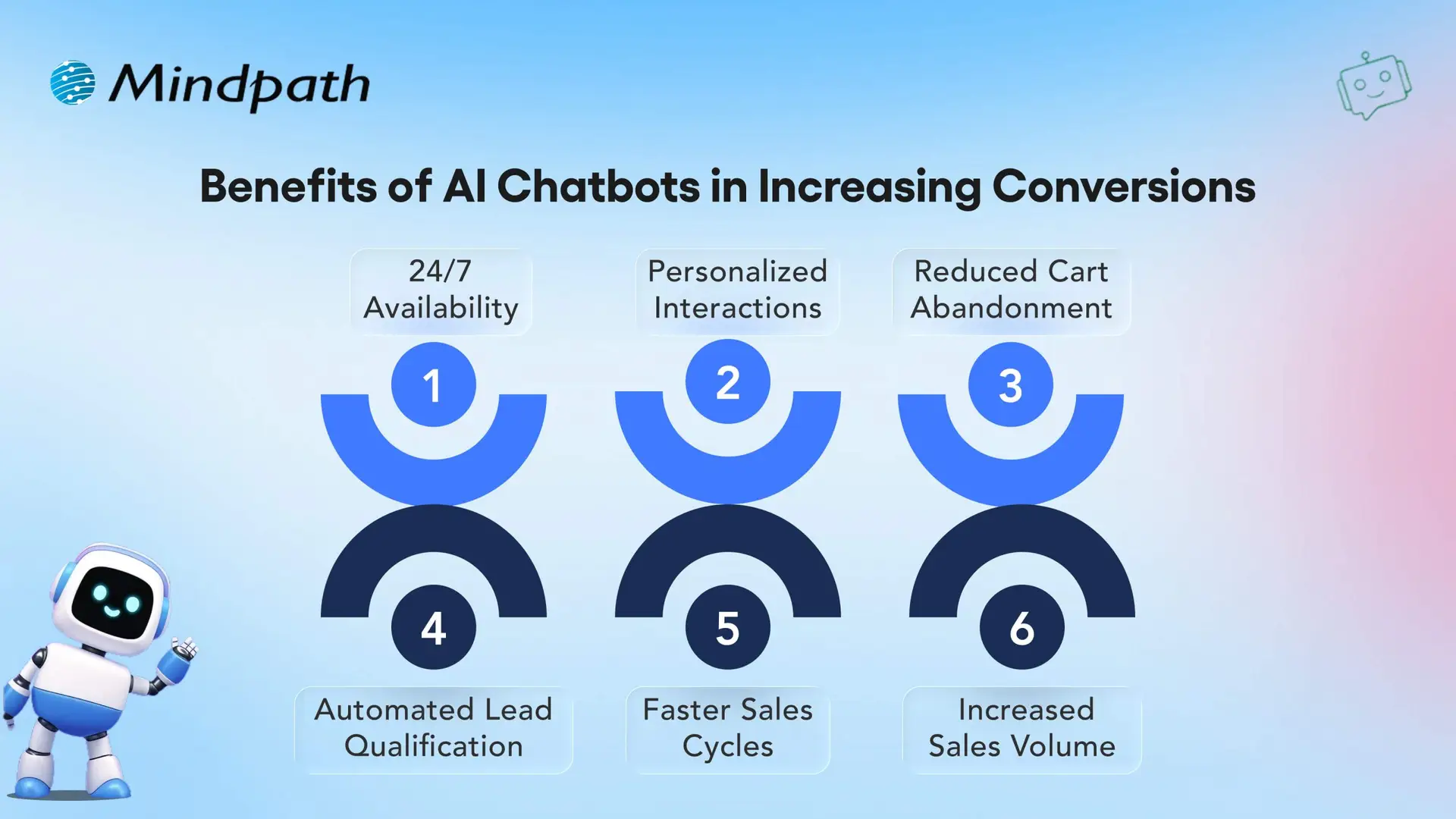
1. 24/7 Availability
AI chatbots are always-on and provide 24/7 access for customers to quickly find answers for whoever, whenever they want assistance. Being constantly available keeps customers engaged and increases the likelihood of execution of a purchase.
2. Personalized Interactions
Real-world Chatbot examples illustrate how AI reads customer engagement data to provide personalized recommendations, product suggestions, etc. This personalization creates more meaningful conversations and promotes higher conversion rates.
3. Reduced Cart Abandonment
AI chatbots minimize cart abandonment by helping consumers through checkout and by answering last-minute questions. This kind of assistance is simple, but improves selling and makes customers feel good about purchasing.
4. Automated Lead Qualification
Chatbot applications can qualify leads with the right questions and key details. The sales team will not have to waste time with any unqualified prospects.
5. Faster Sales Cycles
Utilizing conversational AI for business growth by speeding up the sales process, provides immediate support and follow-ups to customers. The quickness is what allows businesses to turn a lead into a customer quickly and effectively.
6. Increased Sales Volume
Successful chatbot examples illustrate how AI recommends products, engages customers, and inspires repeat purchases. These real-world examples show businesses can also drive revenues while lower acquisition costs.
Want to reduce operational costs while improving customer engagement? Discover how conversational AI chatbots streamline business operations and drive efficiency across teams.
10 Real-life Examples of AI Chatbots
Real-life examples of artificial intelligence chatbots highlight how companies are using artificial intelligence (AI) to innovate the way that organizations interact with potential and current customers. More and more companies are turning to chatbots for lead generation and conversions, thus effectively proving their worth as tools for enhancing sales and ultimately customer experience.
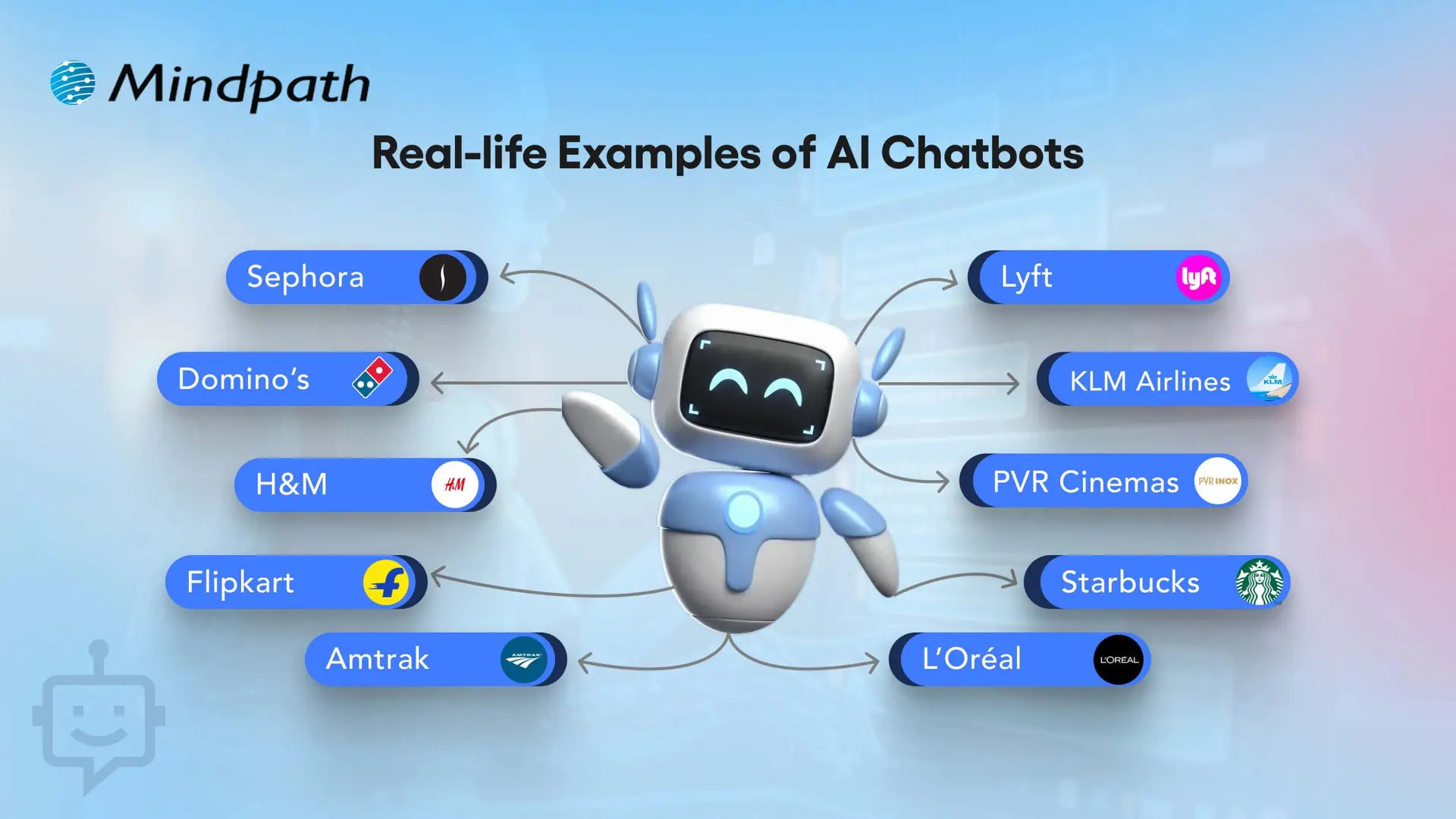
1. Sephora – Personalized Shopping Assistant
Sephora utilizes an AI chatbot to assist customers in selecting makeup and skincare products, to support customers based on their preferences. This chatbot example assists shoppers in finding the right products, much quicker than a human, resulting in higher conversions overall. This video definitely ranks as one of the best chatbot examples in the retail world.
2. Domino’s – Easy Food Ordering
Domino’s has incorporated a chatbot that allows the customers to order pizza directly through a messaging app. This practical application of chatbot makes ordering easy while also cutting down on wait time and increases customer satisfaction. It is one of the most effective AI chatbots that increased sales in the food industry.
3. H&M – Style Recommendations
H&M has a chatbot that suggests clothing based on user style preferences. These website-chatbot examples improve the shopping experience by making it more personal. It shows how real-life examples of AI chatbots in business can drive higher engagement.
4. Flipkart – Seamless E-commerce Recommendations
Flipkart’s chatbot provides personalized product suggestions based on browsing history and preferences. This example of chatbots enhances shopping experiences, boosts conversions, and increases customer satisfaction. It is among the best AI chatbot examples in online retail.
5. Amtrak – Julie Virtual Assistant
Amtrak’s virtual assistant Julie answers millions of passengers queries every year. These examples of chatbots on websites save time for both customers and staff. The company reported significant cost savings and better chatbot ROI examples.
6. Lyft – Ride Booking Made Easy
Lyft allows users to book rides via its chatbot on Messenger or Slack. This real-life example of AI chatbots in business shows how brands can remove friction in customer journeys. It directly improves bookings and conversions.
7. KLM Airlines – Travel Assistant
KLM Airlines uses a chatbot to provide booking confirmations, flight updates, and boarding passes. This website chatbot example streamlines travel support. It is one of the AI chatbots that increased sales through seamless customer care.
8. PVR Cinemas – Movie Booking Assistant
PVR Cinemas uses a chatbot to help customers check movie schedules, book tickets, and view offers instantly. This chatbot example simplifies the booking process, improves customer engagement, and drives higher ticket sales. It is one of the best AI chatbot examples in the entertainment and cinema industry.
9. Starbucks – Coffee Ordering Chatbot
Starbucks has a chatbot that lets customers place their orders ahead via mobile. This application of chatbot reduces wait time and encourages repeat purchases. It’s among the strongest chatbot ROI examples in food service.
10. L’Oréal – Beauty Genius for Personalized Shopping
L’Oréal launched ‘Beauty Genius’, an AI chatbot that gives personalized beauty tips and product recommendations. It uses AI and AR to analyze selfies and suggest the best skincare and makeup from over 750 products. This chatbot improves customer engagement and drives more conversions for the brand.
Looking for AI systems that can plan and act independently for your business? Discover Agentic AI to learn how intelligent agents are transforming decision-making and workflow automation.
Want to Transform Your Business with Chatbot Solutions?
AI chatbots play a vital role in boosting sales, improving efficiency, and creating better customer experiences. These chatbot examples highlight how leading brands use AI to personalize interactions, reduce friction, and drive measurable growth. By learning from real-life cases, your business can adopt similar strategies to maximize ROI and conversions.
At Mindpath, we specialize in developing bespoke chatbot solutions designed to align with your unique business needs. Our tailored approach ensures your chatbot goes beyond generic automation and instead creates real value through seamless user journeys. With expertise in crafting solutions inspired by the best chatbot examples, we help you enhance engagement, streamline processes, and accelerate business growth.
Producing impactful online experiences begins with a clearly defined web development roadmap. The ultimate goal is to create an application where every click, scroll, and animation feels natural and engaging. You are not simply building webpages; you are creating experiences that resonate with people and enable ideas to be expressed, although it is an endless process that presents incredible skills to learn, tools to manipulate, and decisions that will define how your web applications will perform, appear, and feel.
Every step of this journey adds a new dimension to your skills and perspectives. From planning your layouts, designing usable interactions, creating activities, and optimizing the performance, all are built to produce something fantastic. The web development roadmap acts like a compass, guiding you towards building valuable applications for users that “stand out” in a digital moving landscape.
If you are planning to build an ultimate web app development? Mindpath’s web app development services will bring expertise and deliver digital solutions that enhance your business performance.
Understanding the Basics of Web Development
Web development is the act of developing and maintaining websites and web applications. It involves tasks like coding, design, testing, and maintaining that ensure everything is performing as it should for the user. All of these different platforms allow businesses, educational entities, governments, and other organizations to distribute information, market and sell products, provide services, and communicate with others online. Well-developed websites and web applications improve user experience, improve accessibility to information, and support business objectives, which is why they play a major role in achieving success in presently shared digital and real-world spaces.
Collectively, Business Insight Research has valued the global web development market at USD 70.6 billion in 2024, which is expected to grow to USD 141.49 billion by 2033, with a CAGR of 8.03% between 2025 and 2033. The growth is attributed to the proliferation of the internet, smartphones, and e-commerce. The globalization of business has led organizations to invest in professionals to create websites that are visually appealing, fast, and have a highly navigable experience to stay profitable.
Here are the three types of Web Development
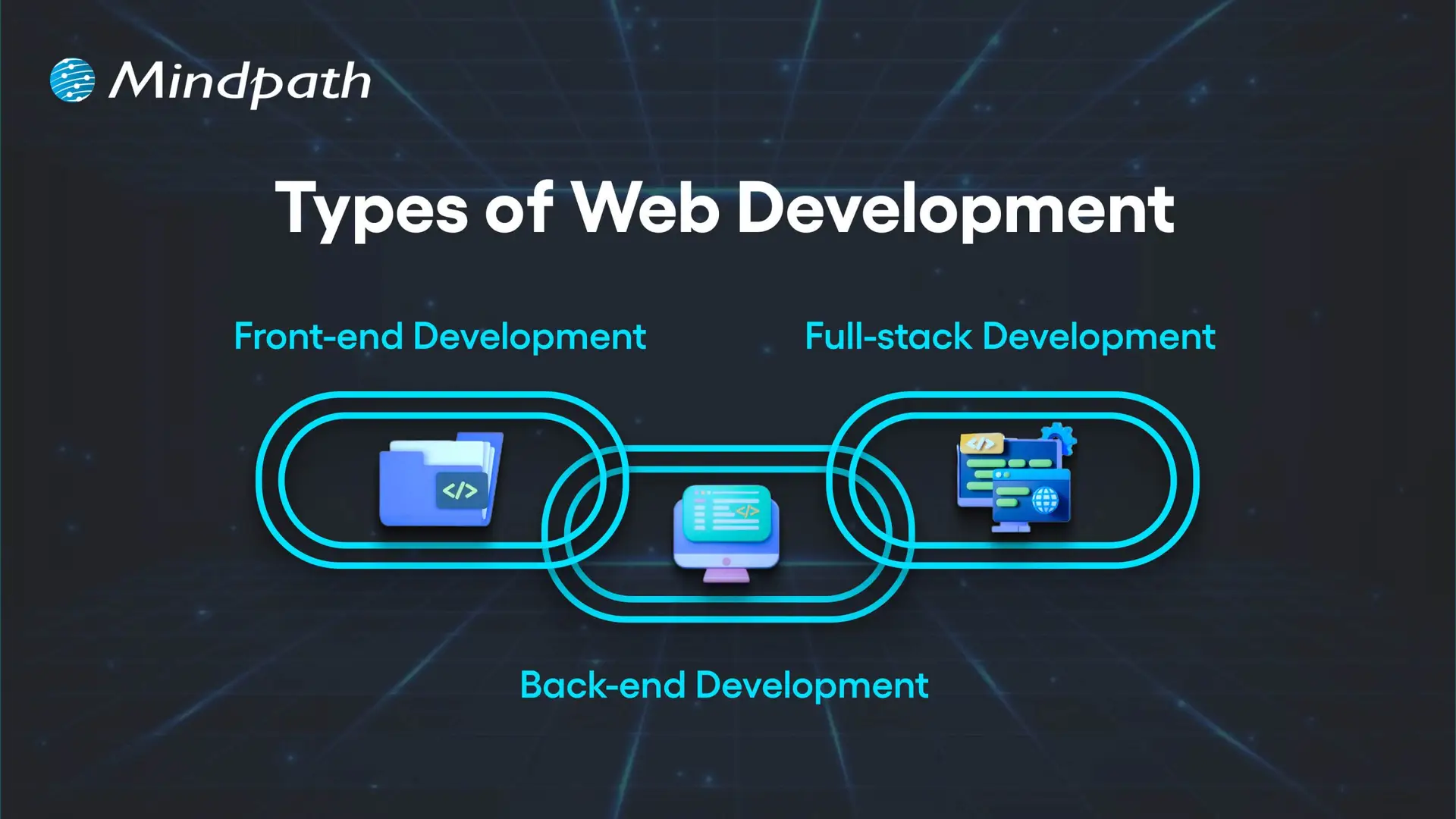
1. Front-end Development
Front-end development refers to all the content and elements that appear on the screen in a web browser. Developers using HTML, CSS, and JavaScript create page layouts, decorative elements, and interactive front-end functionality. The purpose of each front-end web page is to be visually appealing, responsive, and usable. Understanding this part is essential in any web development roadmap.
2. Back-end Development
Back-end development refers to everything that happens server-side in order for a website to run properly. Developers will work with data, databases, and user authentication and will largely be responsible for connecting the front-end to the server through application programming interfaces (API). Essentially, back-end development means processing data, executing business logic, and making sure everything is secure.
3. Full-stack Development
Full-stack development encompasses both front-end and back-end development as a way to build fully operating web apps. Developers take on user interface design, server-side, database operation, and everything in between. In this, developers are able to drive every aspect of a project and maximize consistency in integrating the interface visited by a user and the underlying system.
Curious how a web application actually works behind the scenes? Explore the role of frontend and Backend to understand how both layers drive performance and user experience.
What are the 7 Stages of Web Development?
Web development is a precise discipline as it transforms ideas into interactive digital experiences. In web development, everything is sequenced and implemented purposefully, which culminates in a well-polished, functional product that leaves an impression. Each stage is dependent on the prior stage, which allows web developers to build a website or web application for a target audience. Grasping these stages is an essential step in building a successful web development roadmap.
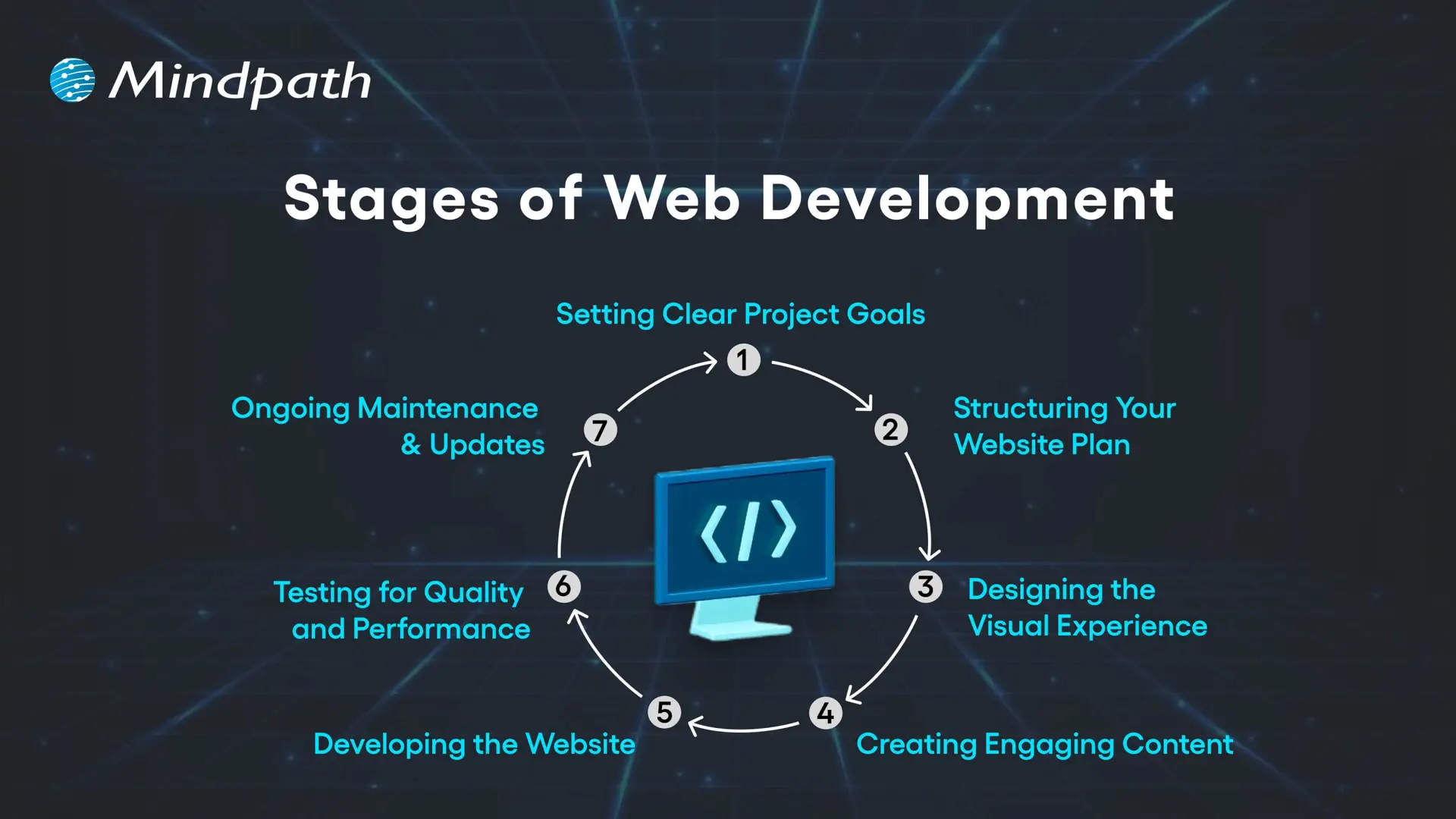
1. Setting Clear Project Goals
Identifying the purpose of your site is the first step, as well as how it will serve your audience. You need to identify your business goals, unique value proposition, audience preferences, and competitive space. A clear vision is the basis of the whole web development plan.
2. Structuring Your Website Plan
Developing a full model for your website will include solid materials such as sitemaps and wireframes. The sitemap will tell you how pages are linked, while the wireframes provide a visual representation of how you want the major elements of your site structured and what areas they will fill. Getting this correct will help ensure that your website navigation, layout, and the way users will travel around the site are thought out in a solid manner from the start.
3. Designing the Visual Experience
At this stage, we start to think about site aesthetic and brand elements, color, typeface, imagery, and iconography. The design must remain uniform across channels to build brand awareness. User user-friendly and aesthetically pleasing design can draw people in and build trust!
4. Creating Engaging Content
At this stage, you’ll develop content for landing pages, product descriptions, blogs, images, videos, etc., in more detail. Content not only needs to align with the needs and questions of your audience, but content also provides engagement opportunities. Keywords will be employed, and if we do this strategically, we can improve reach and connect with specific traffic that can bring targeted traffic to your site.
5. Developing the Website
Once everything about your design and content has been established, developers will start building the front end (client side) and back end (server side) of your website. Their job is to code your site, code in your required functionalities, and build a technical foundation on which the site can grow as needed. It is essential that you have the technical foundation in place, as having the right technical foundation allows your site to function seamlessly while hopefully supporting businesses in their growth.
6. Testing for Quality and Performance
Everything on your website needs to work correctly before the site launches. Prior to launch, the site must be tested on different devices and different browsers. This testing will include broken link checking, speed optimization, and mobile responsiveness. Testing is considered a crucial step in the process to ensure that the user experience is flawless when the user first experiences the website.
7. Ongoing Maintenance & Updates
Once a website is launched, it must be updated on a regular basis to remain useful, secure, and on trend. Updating a website can mean a lot of things and can include adding content, fixing bugs, adding features or functionality, and backing up. Frequent maintenance will keep you more competitive and help with longer-term success. Mastering these stages plays a vital role in shaping a clear and effective web development roadmap.
Is your web application prepared to handle modern security threats? Explore application security best practices for Web and Mobile Apps to learn how to protect your data, users, and business operations.
Web Development Roadmap 2026: A Step-by-Step Guide
A website development roadmap is a structured plan that outlines the stages, tasks, and goals involved in building and launching a website. This web development roadmap for beginners explains what a website roadmap is by showing how each step connects, helping you create a professional, user-friendly site that meets your goals and performs well in 2026.
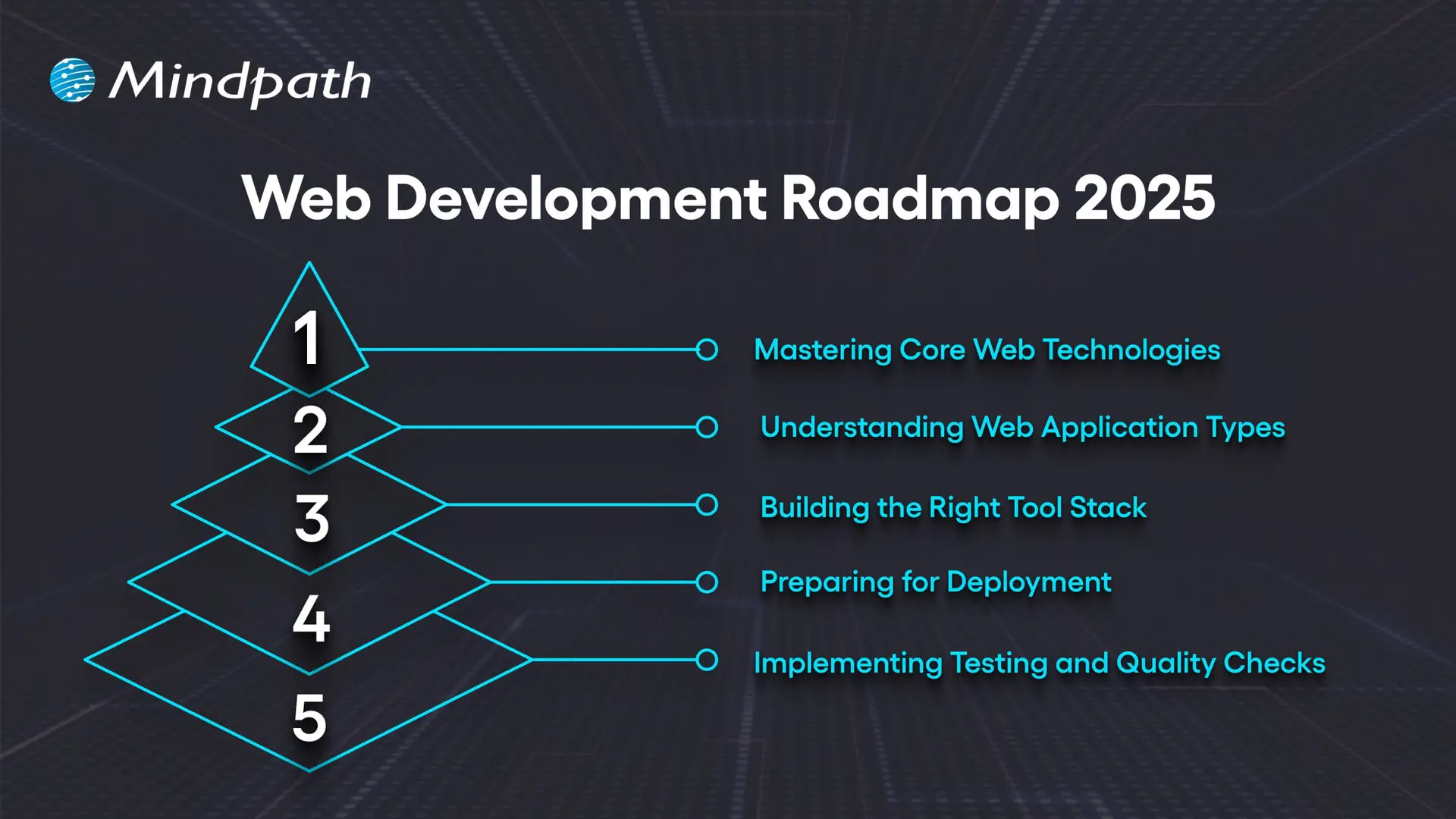
1. Mastering Core Web Technologies
The important first part of the web development roadmap is getting familiar with the core technologies that underpin the internet. HTML provides the structure, CSS provides the layout, and JavaScript provides interactivity to web pages. Developers should be familiar with some protocols like HTTP/HTTPS, FTP, and TCP/IP that define how data is transferred between the server and the browser. The basics of accessibility, usability, and web semantics are important to know to create accessible, well-structured websites. The fundamentals are the starting point for anyone on the roadmap.
2. Understanding Web Application Types
Before you start building, it’s a good idea to understand the different kinds of web applications and their use cases. Static HTML pages indicate fixed content. Dynamic pages have content that changes based on user interaction. Server-side applications deliver content through languages like PHP, Python, and Java.
Single-page applications provide fast and fluid experiences, with only slight page reloads. Progressive web apps provide offline capabilities and app-like experiences. Hybrid apps combine web and native features. Understanding these types of web applications familiarizes web developers with the appropriate way to develop for each available project.
3. Building the Right Tool Stack
A complete full-stack web development roadmap involves selecting the proper tool set to orchestrate front- and back-end work simultaneously. For the front end, tools like React, Angular, and Vue.js facilitate responsive and interactive interfaces supported by a variety of CSS pre-processors like Sass for long-term maintainability. For the back end, languages like Java, Python, and PHP power the application logic supported by frameworks like Express.js and Django.
Databases like MySQL and MongoDB facilitate data storage. APIs link the client and server, which helps decouple the presentation of data and business logic. There are many elements that the client and server need against the tool stack for productivity, scaling, and performance.
4. Preparing for Deployment
Deployment refers to the process of making your application available to users on the internet. While the use of Git version control helps keep track of application code changes, Docker guarantees the environment in which we run applications will be consistent. Orchestration tools such as Kubernetes are used to serve developer needs when we are doing large deployments.
Most CI/CD pipelines, like Jenkins and GitLab CI, work together to automate the build and release process for applications. Many providers in the cloud space, such as AWS, Azure, and Google Cloud, give us secure environments where our products can be built and serve to scale with ease. Finally, monitoring tools will allow a web developer to track the service performance and ensure their application is performing as expected post-launch.
5. Implementing Testing and Quality Checks
Testing is vital in web development because it ensures that the website is functioning across devices, browsers, and user conditions. Testing types include unit tests, which test individual items (API, elements, etc at the component level) integration testing, which tests that the pieces of the application work together correctly, and end-to-end testing, such as Cypress or Selenium, which will simulate user behaviors to verify a complete workflow. Accessibility testing is a type that checks that the website can be accessed by individuals with disabilities, and performance testing looks to see how quickly the site responds and how it responds under heavy load conditions.
Periodic testing is an essential factor of this process that leads to quality and reliability in the web. The integration testing tests the pieces of the application work together correctly; and end-to-end testing, such as Cypress or Selenium, which will simulate user behaviors to verify a complete workflow.
Not sure which technologies are right for your web app? Explore the tech stack for your web app success to make informed decisions that drive growth and reliability.
Want to Turn Your Web Development Roadmap into a Success Story?
Following a clear web development roadmap ensures you move through each stage with purpose and precision. It helps align design, functionality, and performance to create websites that truly serve their audience. By mastering core technologies, understanding application types, and implementing strong testing, you build projects that are scalable, secure, and ready for long-term success.
At Mindpath, we create websites that are fast, secure, and built to grow with your business. Our web development services cover everything from front-end design to back-end functionality, ensuring a seamless user experience. We specialize in custom web applications, e-commerce platforms, CMS solutions, API integrations, and performance optimization. With a focus on scalability, usability, and innovative design, we turn your ideas into high-performing digital solutions that engage users and deliver results.
Artificial intelligence is quickly becoming the backbone technology of our modern day, enabling a wide-ranging variety of advanced technologies, from smart assistants on our phones to an advanced analytics platform. AI enables machines to translate data into useful information by recognizing patterns in the data and eventually making decisions that once required human intelligence. Learning the different types of artificial intelligence is critical to understanding how such human-like systems function and advance from there. As innovation unfolds in real-time, AI is quickly becoming the key enabler of automation, personalization, and intelligent decision-making across industries.
At present, AI development aims toward systems that can reason, adapt, and improve efficiency in the real world. The advancement of these changing and evolving technologies is increasing limitations and changing the way we interact with digital systems. In this blog, we will cover the main types of AI that exist and how each level leads to the next generation of intelligent technology.
Want to step into the future of technology with AI? Mindpath’s AI development services will help you provide smart and intelligent solutions tailored to your business demands.
Understanding the Types of Artificial Intelligence
Artificial intelligence uses data, logic, and algorithms to simulate human thought processing and action in machines, enabling computers to recognize patterns, make decisions, and learn from past experience. AI is typically grouped by capability and functionality into categories such as Narrow AI, General AI, and Super AI, each representing a different stage of machine intelligence. According to SAS, AI systems can manage vast amounts of data and apply logic in real time to intelligently and effectively handle functions like speech processing, visual analysis, image recognition, and natural language understanding.
It is important to understand the types of artificial intelligence, as they indicate how sophisticated a system is and what it can actually do. Knowing about the various AI classifications will provide clarity regarding what AI systems exist today, and what systems are theoretical at this point in time. This knowledge can help businesses select the proper technology, manage risk, and plan strategies more confidently in a world that is becoming increasingly unified through intelligent automation.
Here are the three types of artificial intelligence, based on capability:
- Artificial Narrow Intelligence (ANI): AI built for one specific task, such as web search, voice assistants, or self-driving features. This is the only type of AI that exists today.
- Artificial General Intelligence (AGI): A theoretical stage where machines could match human intelligence across any task, not just a single function.
- Artificial Super Intelligence (ASI): A theoretical future stage where machine intelligence would surpass human intelligence entirely.
Ever wondered how AI systems focus on the most relevant information while processing massive datasets? Discover the attention mechanism to learn why it is foundational to deep learning models and advanced AI intelligence.
What is ANI AI?
Artificial narrow intelligence, or ANI artificial intelligence, operates within a specific functional role, or related functions, within a narrow field of inquiry. ANI does this very effectively, but it cannot go beyond what it has been programmed to do. Businesses use ANI to promote efficiency in work, and individuals employ ANI daily in ways such as digital assistants and recommendation systems to help them work more efficiently, quickly, and accurately.
ANI works by identifying data from prescribed sources and performing assigned tasks with accuracy. It improves business processes from manufacturing to services to customers. ANI also learns over time and employs machine learning and deep learning techniques. Businesses can rely on ANI to increase productivity, reduce risk, and support humans in executing rote or specialized tasks.
Here are the benefits of ANI AI:
1. Higher Efficiency
ANI automates repetitive tasks like data entry and scheduling. Employees can instead work on creative and complex work.
2. Faster Decisions
ANI analyzes large datasets quickly. Companies can confidently make decisions that are based on data.
3. Stronger Security
ANI monitors transactions and user activity in real time. It detects fraud faster than individuals can.
4. Better Customer Support
AI chatbots help customers with whatever they want 24/7. Human agents will manage more complex customer questions.
5. Smarter Marketing
Recommendation engines make intelligent suggestions around helpful products and content. This increases engagement and sales.
Want to see how ANI-powered chatbots deliver real business value? Discover AI chatbot examples to learn how intelligent automation boosts engagement and conversions.
What is AGI AI?
AGI artificial intelligence is a kind of system that can think, learn, and understand like a human being. It does not only refer to a system that is limited to specific tasks like ANI. AGI can reason logically, solve problems, and understand languages in varying contexts. It is significant progress in the domain of artificial intelligence types.
AGI uses information collected previously to create new experiences and applicability of information in a new experience. It can also make decisions relating to healthcare, finance, and technology without the need for detailed programming. AGI artificial intelligence is set apart by its adaptability and flexibility and gives a clear guide to the extent of sophistication apparent between different types of artificial intelligence in ability to cross over between a humanistic understanding of the world and efficiency of a machine.
Here are the benefits of AGI Artificial Intelligence:
1. Faster Research
AGI examines enormous datasets at incredible speeds. It speeds and improves advances in medicine, science, and technology.
2. Solve Big Problems
AGI can help tackle global challenges, including climate change and resource management. It may create sustainable or efficient solutions.
3. Boost Productivity
AGI can automate mundane or advanced activities. This will allow humans to focus their time on creative and strategic input.
4. Personalized Services
AGI can personalize education and healthcare for them. It can suggest educational paths and treatment plans based on specific personalized information.
5. Better Collaboration
AGI reads tone, intention, and context in conversations. It guides humans and gives insights about what is happening in real-time.
Wondering how advanced AI capabilities align with long-term business goals? Discover AI in business strategy to learn how organizations use intelligent systems to gain a competitive advantage.
What is ASI AI?
ASI, artificial intelligence, is a stage of AI that is beyond human intelligence. It is capable of thinking, learning, and solving problems in many areas independently. It handles complex tasks with superhuman speed and accuracy, unlike ANI and AGI, which have limitations. ASI sits at the top of the types of artificial intelligence levels.
ASI or Artificial Super Intelligence could create profound change in areas such as science, medicine, and the arts, by processing greater amounts of data, making choices, and understanding emotions greater than human capacity. Although ASI technology is still hypothetical, investigating the implications and possibilities prepares researchers and organizations for the next generation of artificial intelligence and its social benefits.
Here are the benefits of ASI Artificial Intelligence:
1. Smarter Decisions
ASI examines vast sets of data and simulates complicated systems. It can help solve problems like health, climate change, and poverty.
2. Faster Innovation
ASI automates research and experimentation. It brings breakthroughs in science, technology, and even space exploration.
3. Higher Productivity
ASI efficiently performs any cognitive task. While efficiency increases, humans can spend their time on more creative and strategic work.
4. Personalized Customer Experience
ASI is accurate in anticipating customer needs. ASI provides personalized marketing and services that are well-targeted.
5. Stronger Risk Management
ASI can quickly identify potential threats. It can protect against fraud and strengthen cybersecurity across operations.
Need efficient AI training without excessive computing costs? Discover Low-Rank Adaptation (LoRA) to learn how modern AI models are optimized while maintaining performance and scalability.
ANI vs AGI vs ASI: A Detailed Comparison
Comparing ANI, AGI, and ASI shows how these different forms of intelligence operate. This table explains their capabilities, learning ability, and impact within the types of artificial intelligence.
| Category | ANI (Artificial Narrow Intelligence) | AGI (Artificial General Intelligence) | ASI (Artificial Superintelligence) |
| Intelligence Level | Performs specific tasks well | Performs human-level tasks across all areas | Performs tasks beyond human intelligence |
| Learning Ability | Learns only in its trained tasks | Learns and applies knowledge across multiple areas | Learns independently and creates new knowledge |
| Capabilities | Limited to single tasks | Matches human reasoning and problem-solving | Solves complex problems instantly and invents new methods |
| Development Status | Already in use | Theoretical, may take decades to develop | Hypothetical, comes after AGI |
| Resource Needs | Moderate computing power and data | High computing power and advanced hardware | Extremely high computing power and energy required |
| Applications | Chatbots, recommendations, image recognition | Scientific research, education, creative industries | Global problem-solving, advanced research, innovation |
Ready to Unlock Your Business Growth with the Power of AI?
Understanding types of artificial intelligence like ANI, AGI, and ASI helps businesses and individuals see the potential of AI in everyday life and industry. From improving efficiency and decision-making to driving innovation and solving complex problems, AI is transforming the way we work, create, and interact with technology in ways that were once unimaginable.
Mindpath offers professional AI development services to help companies implement ANI, AGI, and ASI solutions. Our team builds intelligent systems that enhance business productivity, automate processes, and deliver personalized experiences. With expertise in the latest types of artificial intelligence, Mindpath ensures your AI projects are efficient, scalable, and aligned with your strategic goals for measurable results.
A growing business often reaches a point where off-the-shelf solutions no longer match its unique needs. Right? This is where custom web application development comes in. It gives you the web applications that work exactly the way you want them to, based on your specific requirements. Think about how much easier your daily operations would be if every feature were custom-made based solely on how your team works day to day, rather than trying to adapt to a generic application. It happens when technology becomes more than just a tool or a utility and partners with you to scale with your business.
Over time, certain changes in daily operations start to hint that your business might benefit from such a tailored solution. While these changes often seem subtle, they show up as your team performs operations, handles data, or relates to customers. When the shifts appear, it is highly likely that operational efficiency, productivity, or growth will be impacted. Understanding these signals can help you determine the proper time to invest in a strategy that is specifically built to suit the needs of the business.
Every business challenge needs a custom solution. Look how Mindpath’s custom web app development services resolve the issues and support businesses to convert unique needs into powerful digital tools.
What are Custom Web Applications?
Custom web application development for business means you’re building software that is specific to a business’s needs. This means instead of general tools that are often not specific to the goal of the software, you can tailor the application to a business’s workflows and goals, thus providing better efficiency and customer experience. In short, a custom web application for business will be able to manage data, create automation, provide reporting, and centralize operations. This process will result in a secure, scalable solution that supports the overall growth of the business.
Developers choose programming languages, frameworks, and tools relevant to particular project requirements. They communicate with the business to understand the challenges while integrating within the existing systems. During the web application development, the team regularly checks for progress and verifies if everything is aligned, keeping the cost, time, and risk to an acceptable level. The result is a working, well-designed, reliable application that the business finds intuitive, enhances the business, and can adapt as the business grows.
Benefits of Custom Web Application Development
Knowing the custom web application benefits can help you understand how the proper solution can have an impact on how you work. When considering why to build a custom web application, it is usually due to the fact that it can fit your precise requirements, allow you to work more efficiently, and facilitate growth. It is a strategic investment that will provide a return reflecting your investment and your growth aspirations.
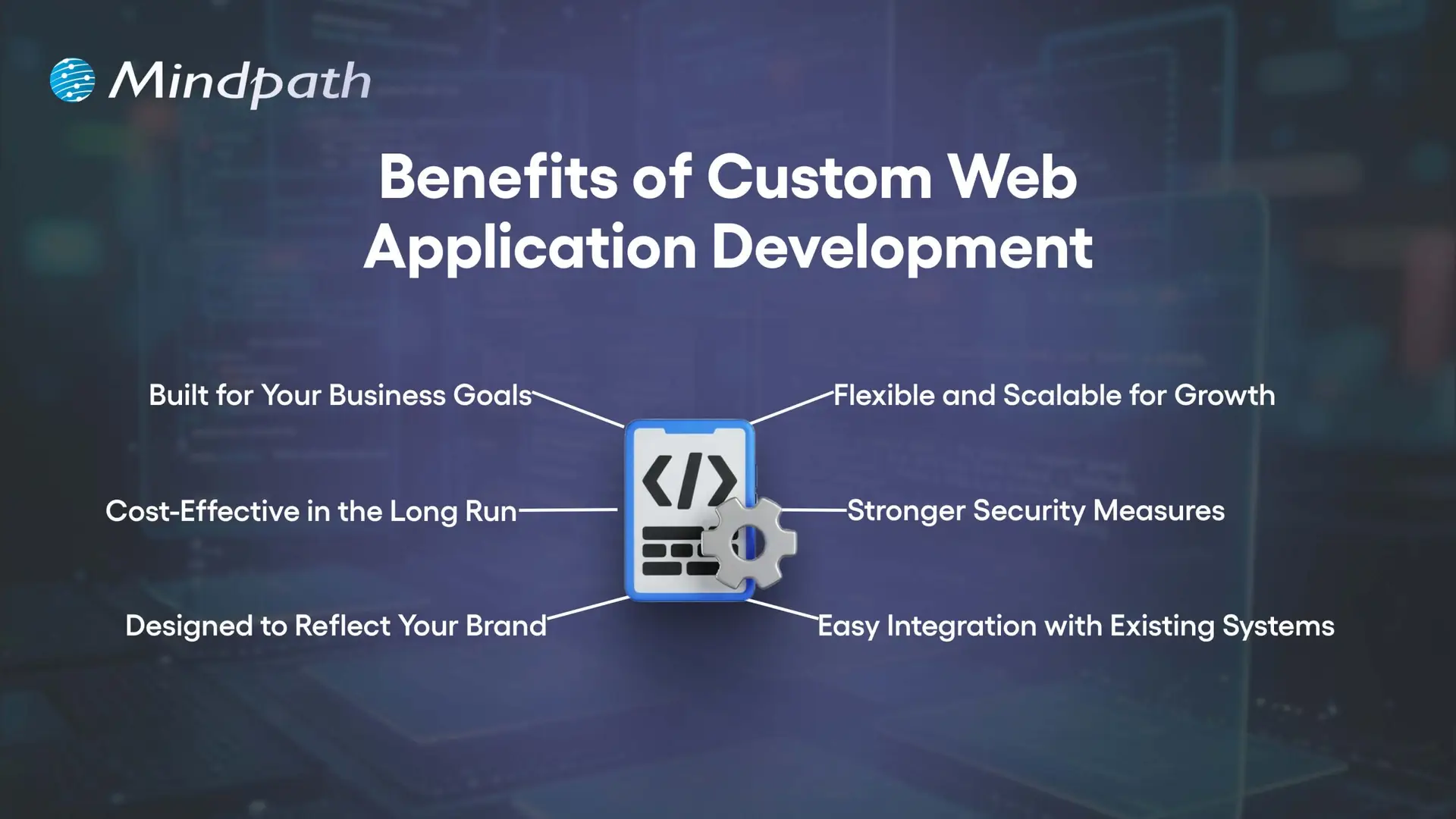
1. Built for Your Business Goals
When you use Custom web application development, you have every feature custom development to suit your needs. This makes integrating workflows easier and an easier experience for your employees.
2. Cost-Effective in the Long Run
A custom solution takes out the licensing fees and unnecessary features, which will save you in the long run. You can also reduce some infrastructure and hardware costs if you are going to outsource the development, too.
3. Designed to Reflect Your Brand
Custom web app development allows you to create every aspect of the application, to your brand’s identity. It can give your application a customized, professional, and unique identity that users will definitely recognize.
4. Flexible and Scalable for Growth
Custom-built applications will grow with your business and meet new demands. You will be able to add new features, accommodate increased traffic and usage, and still have a smooth performance.
5. Stronger Security Measures
Security is a key feature of Custom web application development, ensuring that your business is safe from common cyber threats. Custom apps will be fun to breach and take over than commercial apps found on the market.
6. Easy Integration with Existing Systems
Custom web applications will integrate easily with your current systems and databases. This allows you to keep data synchronized, accurate, and consistent across all platforms.
Choosing a custom web application is a strategic business decision! Discover web development trends to ensure your development strategy aligns with current and future digital demands.
10 Signs Your Business Needs a Custom Web Application
As businesses change, many times their needs exceed what generic software can deliver. Knowing the signs that you need a custom web application will allow you to reduce the damage that can happen before inefficiencies grind your business down.
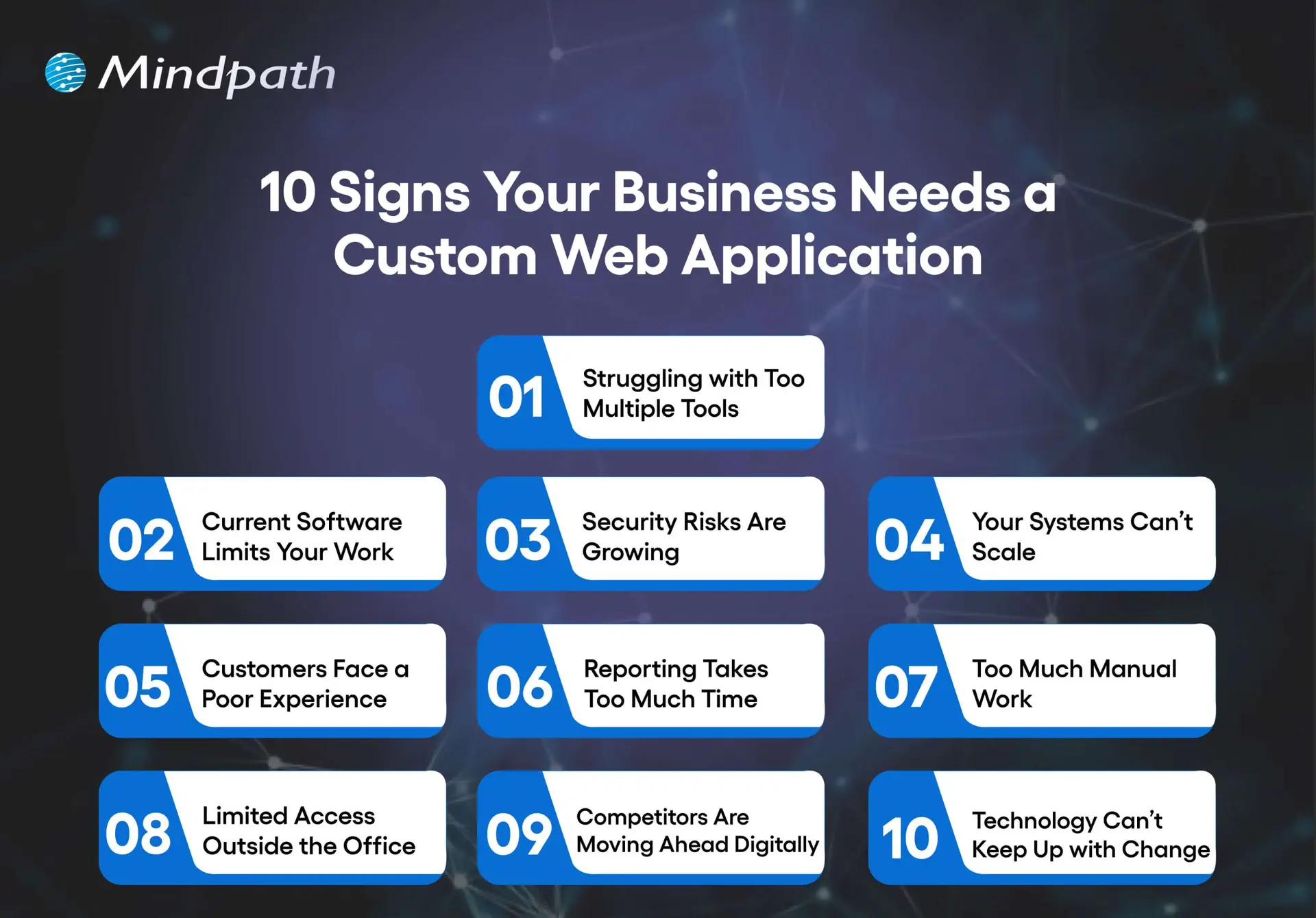
1. Struggling With Too Many Tools
Switching between spreadsheets, emails, and multiple apps slows work and causes mistakes. A custom web app centralizes your operations in one platform for better efficiency.
2. Current Software Limits Your Work
Generic software forces you to adjust your process to fit its features. Custom web application development creates solutions that match your exact workflows.
3. Security Risks are Growing
Using outdated systems leaves sensitive data exposed. A custom web app includes strong security controls, encryption, and adheres to all industry standards.
4. Your Systems Can’t Scale
Organizations evolve. As your business grows, so should your tools increase their users, data, and functionality. Custom software is built to scale without performance issues.
5. Customers Face a Poor Experience
Using slow, outdated, or limited platforms can leave users frustrated. A custom web app will provide users with modern interfaces, fast service, and customized experiences.
6. Reporting Takes Too Much Time
If your reporting is done manually, or it takes too long to collect and analyze, it will limit your decision-making. Custom web apps will provide real-time dashboards and allow for instant self-serve reporting.
7. Too Much Manual Work
When staff are tied up with repetitive data entry or repetitive tasks, it is hard to be productive. A custom application can be built with automation features to allow staff to concentrate on high-value opportunities or higher-skilled work.
8. Limited Access Outside the Office
If your employees can’t easily access your systems while off-site or, even worse, don’t have access to them at all, your flexibility is limited. A custom web application can be secured and hosted in the cloud, allowing staff to work from anywhere.
9. Competitors Are Moving Ahead Digitally
If you’re used to out-of-date tools and systems, keeping up will mostly be impossible. Custom web application development will give you the opportunity to develop useful features that are unique to your organization.
10. Technology Can’t Keep Up with Change
If your business pivots, expands, or introduces new services, the old systems won’t accommodate this change. Custom applications allow you to adapt to these opportunities, adding integrations, and are designed with flexibility.
Wondering what comes next after deciding to build a custom web application? Explore the web app development roadmap to gain clarity on development stages, timelines, and technology choices.
Ready to Build a Solution That Fits Your Business?
A growing business needs tools that adapt to its pace, processes, and vision. Custom web application development delivers tailored solutions that improve efficiency, strengthen security, and enhance customer experience. Recognizing the signs early allows you to invest in a platform that aligns perfectly with your goals and supports sustainable growth.
At Mindpath, our Custom web application development services create secure, scalable, and user-friendly platforms that integrate seamlessly with your operations. We focus on understanding your unique workflows and delivering features designed to simplify tasks, automate processes, and empower your team. The result is technology that becomes a true partner in your business journey.

The landscape of Software as a Service (SaaS) is changing faster than ever. As all businesses are now adopting the cloud-first approach, SaaS tech leaders should stay ahead of SaaS trends to remain innovative and competitive.
Current market trends can help service providers to know about the Saas challenges and come up with feasible solutions to tackle them. Whether you are investing in a SaaS technology, scaling your development strategy, or leading SaaS projects, these 14 SaaS trends will help you understand the market and what approaches you should consider to remain competitive.
Want to stay ahead of your competitors by using the latest Saas technologies in your business? Mindpath offer SaaS devlopment services to receive customized solutions that help you innovate faster and smarter.
The Rising Popularity of SaaS Technologies
SaaS has emerged as a dominant force in today’s digital landscape. It is transforming the way businesses deploy, access, and scale their software programs. With time, the popularity of SaaS platforms continues to rise across all industries. And some major reasons behind this are:
- Businesses don’t have to worry about local installations and get instant access to solutions.
- SaaS is scalable, and businesses can adjust usage without investing in the IT infrastructure.
- Subscription models lower expenditure, making it accessible to all, including startups and SMBs.
- Deployment, upgrades, and maintenance are handled by the service providers.
- SaaS is highly beneficial to support the remote teams and provides access to necessary resources in real time.
- SaaS platforms have the ability to integrate with existing workflows and systems.
SaaS service providers enable businesses to be customer-centric and agile. However, to remain competitive, these service providers have to keep up with innovation and adapt their platforms to the changing market demands.
Planning to build a scalable SaaS product but unsure how to choose the right development partner for your needs? Explore our guide on choosing the right SaaS development services to discover key factors that ensure long-term success.
The optimal way to attain that is by adhering to the trends arising in the SaaS market. Read to explore those trends.
14 SaaS Trends Driving the Future of SaaS
Now that we have unpacked SaaS’s impressive benefits, let’s uncover the SaaS trends that are redefining the landscape of SaaS technologies. Here is what is driving the next big wave of SaaS innovation.
1. API-First Architecture – The New Standard
Most modern SaaS projects now opt for API-first design since it can integrate third-party services and tools without any difficulty. It can assist in increasing flexibility and scalability as well as developer experience. Besides, this approach will simplify the process of creating custom workflows.
2. Edge Computing and SaaS
With the help of edge computing, the SaaS platforms can process data closer to the source. This, in turn, reduces latency while enhancing performance. It is quite helpful in real-time analytics, logistics, and IoT.
Through edge capability integration, SaaS solution providers can enhance security, offline functionality, and responsiveness.
3. AI-Powered SaaS Solutions
Artificial Intelligence has become a necessity. Most SaaS platforms are now embedding AI to personalize user experiences, automate workflows, and offer predictive insights. It has also enabled accurate fraud or risk detection.
SaaS platforms that are lacking intelligence are losing relevance. After all, customers want more than just task automation. They want tools that can anticipate requirements and support their decision-making.
Curious about how AI can transform your SaaS strategy and drive smarter business decisions? Discover our detailed guide on the benefits of AI to explore how it enhances efficiency, innovation, and growth.
4. Changes in Subscription Models
SaaS pricing is now shifting from the monthly packages to hybrid, freemium, and usage-based models. Some are also available with outcome-based pricing models. Such flexible pricing structures have helped service providers to improve retention and customer value.
As these platforms evolve, businesses significantly benefit from personalized pricing. On the other hand, providers get deep insight into product engagement and user behaviour.
5. Enhanced Privacy, Compliance, and Security
Trust is an important asset. The customers believe that service providers are safe and in compliance. But that trust can be hampered with just a single instance of data breach or GDPR conflict. Thus, SaaS providers should focus on the use of zero-trust frameworks and advanced encryption.
Besides, the deployment of automated compliance tools can help a lot here. Furthermore, they should keep themselves updated about evolving regulations such as DORA, HIPAA, GDPR, and PDPL.
6. Vertical SaaS
SaaS development companies are now going niche. Why? Well, generic SaaS tools may not help users with industry-specific needs, workflows, or regulations. They are launching SaaS technologies for specific industries like finance, education, or healthcare.
Vertical SaaS platforms are significantly influencing the future of SaaS by offering tailored compliance, deep domain expertise, and flexibility. The vertical SaaS market is expanding, and it is forecast to reach USD 263420 million by 2031 (Source: Market Monitor Global)
7. Micro-SaaS Solutions
Micro-SaaS businesses typically have a narrow focus on use cases and develop add-ons for big SaaS platforms. They are agile, quick to launch, and lean. Micro-SaaS businesses offer highly targeted solutions, with their flexibility supporting rapid adaptation to changes. They are best suited to deal with overlooked issues in various saturated SaaS markets.
8. Conversational UX Will Be a Game Changer
The interface of SaaS platforms is evolving rapidly, with chat-based navigation, natural language processing, and voice assistants. These features increase accessibility and user engagement.
This is one of the vital SaaS trends that most SaaS providers have adopted, making their software interaction feel more human-centric. This trend has become a core component of SaaS development.
9. RevOps
Speaking of the most significant trends in SaaS, we cannot omit the emergence of Revenue Operations (RevOps). It unifies marketing, customer success, and sales into an AI-powered platform. These tools provide SaaS companies with end-to-end visibility.
This means that the retention, forecasting and profitability can be easily enhanced. For instance, the advanced lead scoring system in the RevOps tool can help sales teams focus on prospects who are more likely to convert.
10. Blockchain Integration in SaaS
It is undeniable that blockchain is quickly changing the SaaS market by introducing decentralized, secure, and transparent data management. Other use cases that we may take as an example are encrypted transactions, smart contracts, and identity verification.
The adoption of blockchain in SaaS applications provides better trust, compliance, and traceability. This is essential for legal, healthcare, and finance SaaS providers who aim to have better data integrity.
Looking to accelerate your SaaS development process without heavy coding efforts? Explore our guide on low-code platforms to discover how they enable faster development and greater flexibility.
11. Low-Code/No-Code Platforms
The low-code and no-code approach is one of the most popular trends in 2026, as it can support easy and fast development. SaaS providers are also supporting this move. In fact, they are also integrating this into their platforms.
Why? In a world where speed matters, allowing non-technical teams to create their own tools can help unlock a new level of productivity. The workflow of finance, operations, and HR teams can be automated with a couple of clicks.
12. Business Intelligence and Predictive Analytics
SaaS platforms are now using predictive analytics to predict market trends, customer behavior, operational risks, and more. This helps businesses to make data-driven decisions faster than before.
Service providers have realized that business intelligence has become a crucial asset. They are optimizing it to enable businesses to enhance performance.
13. Sustainability-Focused Solutions
Sustainability-focused SaaS, or green SaaS, is now gaining traction as organizations are prioritizing eco-friendly options. Carbon tracking, cloud efficiency, and sustainable hosting are leading this transformation.
These trends in the SaaS industry reveal growth in the demand for ethical solutions. And the future of SaaS will be based on how it is aligned with long-term business sustainability and environmental responsibilities.
14. Localization and Globalization of SaaS Tech
It has been seen that SaaS service providers are now expanding globally, and they are also localizing compliance, customer support, and content. By offering region-specific features and multilingual interfaces, they are enjoying continuous international growth.
SaaS companies are evolving and scaling their platforms across multiple geographies while offering all the necessary elements.
Curious how SaaS innovations are evolving to support more efficient and future-ready business operations? Explore our guide on sustainable technology to discover how eco-friendly approaches are shaping the next generation of SaaS solutions.
The Next Chapter in SaaS Innovation and Growth
Well, the current trends are looking really impressive, establishing a solid foundation for SaaS market growth. But what will happen after 2025? Well, predicting the future of SaaS technologies is a little difficult. However, the direction of the journey is clear: SaaS is becoming more intelligent, ambient, and embedded.
New technologies like quantum computing, Zero-UI, blockchain, etc., will bring massive changes in this landscape. For instance, quantum computing will force developers to rethink SaaS security models. On the other hand, Zero UI will lead to enhanced user engagement by offering interfaces powered by context, voice, and predictive behavior.
What’s more? There will be an increasing focus on regulation, privacy, and sustainability. SaaS leaders who thrive will not be the ones who just predict the future, but those who design for resilience and volatility.
Ready to Leverage the Latest SaaS Trends for Your Business Growth?
SaaS is evolving rapidly with trends like AI integration, API-first architecture, and predictive analytics shaping its future. Businesses that adapt to these innovations can improve efficiency, enhance user experiences, and stay competitive in a fast-changing digital landscape.
At Mindpath, we provide expert SaaS development services to help businesses adopt the latest technologies and build scalable, secure solutions. From strategy to deployment, our team ensures innovation and performance. Partner with us to accelerate your SaaS journey.
The emergence of Web 4.0 is revolutionizing how we communicate, share, and engage with the digital world. It is no longer just a platform to find information. The internet is evolving into an intelligent, highly personalized, and interactive medium with which humans can have meaningful conversations. Businesspeople, programmers, and users are at the crossroads. But, what if the web thinks in a more intelligent way, reacts very quickly, and adapts to human needs? We are already witnessing the start of a change that is affecting innovation, and its influence is extending over various sectors.
Along with the changing of technology, people’s desires go beyond only fastness and accessibility. Now, users are looking for connected systems that understand their actions, assist them in decision-making and give them smooth experiences. As a result, Web 4.0 promises a future when digital environments will be more natural and relevant to human life. It provokes organizations to change their strategy and at the same time, it inspires customers to think about bigger opportunities. In this blog, let us discover how the upcoming internet era currently influences technology, business, and people’s experiences online. So, keep reading further!
Looking to stay competitive in the Web 4.0 era with smarter digital solutions? Mindpath offers AI development services to help you build smart applications that grow with your business.
What is Web 4.0?
Web 4.0, commonly known as the symbiotic web, is less about information sharing and more about creating digital experiences that comprehend user needs. This phase of the Internet involves technology that can think and be connected on a deeper level. This web will be a network that connects people, devices, and systems in a smooth way. Through advanced web methods, organizations will be able to make decisions more rapidly. It will offer personalized communication, and collaborate effectively across digital environments.
Web 4.0 differs from the previous web versions in that it emphasizes intelligence, automation, and greater control of the user. It incorporates technologies, such as AI, machine learning, and decentralization to enhance the daily digital encounters of users. The individuals will enjoy improved privacy, robust security, and increased control over their personal data. In a deeply interconnected digital-physical environment, Web 4 is truly a game changer for businesses.
How Does Web 4 Differ from the Earlier Versions?
The internet has changed a lot over time. In this ongoing digital transformation, Web 4.0 is quite different from Web 1.0, 2.0, and 3.0 in that it provides more thorough personalization and a smooth digital interaction.
Let us have a glance at how this Internet 4.0 differs from the earlier versions through this table:
| Category | Web 1.0 | Web 2.0 | Web 3.0 | Web 4.0 |
| Internet Function | Static information browsing | Social content sharing | Decentralized digital ownership | Intelligent connected ecosystem |
| User Interaction | Read-only access | Read-write participation | User-controlled engagement | Predictive personalized interaction |
| Main Technology | Basic web pages | Social media platforms | Blockchain smart systems | AI-powered automation |
| Data Ownership | Company-controlled data | Platform-managed data | User-owned assets | Secure adaptive control |
| Experience Quality | Limited digital presence | Interactive online communities | Transparent secure networks | Seamless human-machine integration |
What are the Key Benefits of the 4.0 Web?
Through the intelligent web, digital experiences are being transformed into smarter, faster, and more responsive. Web 4.0 not only focuses on connectivity but also fosters meaningful interactions that change according to user requirements. Its sophisticated features are allowing new opportunities to be unveiled by both companies and ordinary users.
1. Smart Personalization
Web 4.0 comprehends user behavior and provides the most pertinent digital experience to the users. It facilitates user to get quick recommendations, anticipatory assistance, and tailor-made services. This smart way enhances ease of living as well as business operations.
2. Stronger Data Security
Web 4.0 is built around decentralized systems which allow users to have greater control over their personal data. By minimizing the risks associated with central platforms and enhancing transparency, it leads to much safer and secure online experiences.
3. Better Human-Tech Connection
The future of web is all about more interactive ways for humans to interact with digital systems. With the use of Web 4.0, communication will get better by using technology that is more human-like in responding to our needs. So, the result will be a highly intuitive experience through digital interfaces.
4. Advanced Automation
Artificial Intelligence (AI) has become one of the key components of Web 4.0. It is capable of automating repetitive tasks thus increasing the efficiency level of the work. This also leads to faster workflows, smarter virtual assistants, and less manual work. Businesses, in this way, could enhance their productivity without spending more time.
Must Read: AI vs Automation
5. Seamless Device Connectivity
Web 4.0 facilitates creating seamless experiences through multiple devices and platforms. Users can effortlessly switch from one platform to another without any loss in functionalities. Hence, this leads to highly connected and continuously consistent digital engagements.
6. Smarter Business Insights
Web 4.0 will enable companies to leverage real-time data for making superior decisions. It also enhances the capacity to analyze customer behavior and identify market trends, which subsequently results in quick and better business development strategies.
Key Challenges and Limitations of Web 4.0
Web 4.0 definitely opens a door to a fantastic innovation landscape, but along with it, several complex challenges arise that neither businesses nor users should overlook. Let’s explore the issues and major shortcomings of Web 4.0.
1. Privacy and Data Protection
A lot of personal information will be needed in Web 4.0 to provide smart experiences. This results in heightened worries about improper use of data, cyber risks, and identity theft. Keeping the users’ privacy safe is still a big issue.
2. Ethical AI Concerns
Autonomous systems may raise problems concerning bias, fairness, and accountability. AI’s decision-making might even become non-transparent or unethical at times. Developing responsible systems entails continuous oversight and control.
3. High Infrastructure Demand
Web 4.0 requires powerful computing systems, more advanced networks, and a massive scale of connectivity. Many areas still don’t have this technological basis. Today, it is costly and challenging to implement globally because of this.
4. Complex Development Process
Constructing Web 4.0 systems relies on the integration of AI, IoT, machine learning, and decentralized technologies. Overseeing such sophisticated systems calls for highly skilled professionals and substantial resources. This level of intricacy may hinder the pace of adoption.
5. Growing Digital Divide
High-tech solutions might be equally accessible to everyone for only a limited period. A shortage of gadgets and internet infrastructure may expand the gap of inequality. Such a scenario poses difficulties for achieving a sustainable and inclusive digital development.
6. Technology Dependence Risks
More automation might mean less human engagement in everyday decision-making. Relying too much on digital systems might disable our problem-solving skills. It is really necessary to find a balance in the use of technology and human control.
7. Expanded Cybersecurity Threats
The more connected devices there are, the more potential access points for hackers. One single flaw may give rise to the compromise of several systems. Hence, ensuring the safety of interlinked networks is of utmost importance.
Real-World Applications of Web 4.0
Web 4.0 is more than a mere futuristic idea as it is already radically changing various sectors via technologically advanced and interconnected devices. Its tangible effects are revolutionizing business operations as well as digital human interactions. The following are some significant examples of Web 4.0 being used in practice.
1. Smart Healthcare Solutions
Web 4.0 is an enabler for healthcare in being more proactive and personalized. Devices being worn on the body and AI systems can keep track of one’s health, assess potential risks, and aid in quicker medical interventions. Patient care and daily wellness management could be significantly enhanced by such developments.
2. Connected Smart Cities
Cities are making use of Web 4.0 to enhance traffic flow, reduce energy consumption, and improve the delivery of public services. Real-time sensors and smart systems are the backbone of better urban management. This results in urban areas that are more efficient and responsive to the needs of their inhabitants.
3. Autonomous Transportation
One of the ways Web 4.0 is backing up intelligent transportation is through the interaction of vehicles and infrastructures. Various applications can be used for better route planning, accident reduction, and improving travel time. In fact, this is the technology behind the development of safer commuting options.
4. Personalized Digital Learning
Cutting-edge AI and virtual reality technologies tailor individual learning experiences; with the help of these adaptive learning tools, students can be catered to their pace and needs. As a result, educational methods become markedly enjoyable and effective.
5. Secure Financial Systems
By leveraging decentralized technologies and safe transactions, Web 4.0 further solidifies digital finance. It also increases transparency in logistics and supply chains. Such innovations contribute to building trust and enhancing operational efficiency.
6. Predictive Smart Living
Smart homes and retail platforms, through connected systems, can predict what users need. Personalized actions and recommendations are ways through which devices and services respond faster. This convenience is a portrayal of the future of the internet.
7. Intelligent Task Automation
Web 4.0 opens up the possibility of AI handling almost all kinds of tasks without humans. It can schedule your meetings and do a lot of digital operations on the go. This helps users save time and streamline daily activities.
The Future of Web 4.0 and What Lies Ahead
Web 4.0 continues to evolve as emerging technologies reshape how people, businesses, and systems connect. Its future promises deeper intelligence, stronger automation, and more immersive digital experiences. Here are some key developments expected in the future of Web 4.0.
1. Autonomous AI Partners
Web 4.0 will move beyond basic digital assistants into smarter autonomous systems. These AI agents will manage complex tasks, make decisions, and operate across platforms. This shift will improve productivity and digital convenience.
2. Advanced Human-Machine Interaction
Future Web 4.0 experiences will feel more natural and seamless. Voice commands, gesture controls, and smarter interfaces will reduce dependence on traditional screens. Human and digital interaction will become more intuitive.
3. Predictive Personalization
Web 4.0 will better understand user behavior, habits, and preferences. Systems will anticipate needs and offer proactive solutions before users search. This will create faster and more personalized experiences.
4. Connected Digital Ecosystem
Connected devices will communicate continuously across homes, workplaces, and cities. This deeper IoT integration will support smarter environments and automated living. Daily experiences will become more responsive.
5. Trusted Digital Infrastructure
Blockchain will strengthen trust, security, and transparency behind Web 4.0 systems. It will support secure automated transactions between users, businesses, and AI systems. This foundation will improve reliability.
6. Immersive Digital Experiences
Web 4.0 will expand beyond traditional browsing into interactive 3D environments. AR, VR, and spatial computing will transform work, shopping, and communication. Digital experiences will feel more engaging and realistic.
Ready to Embrace the Next Digital Evolution?
Understanding the web 4.0 definition helps businesses and individuals prepare for a smarter digital future. As technology evolves rapidly, adopting intelligent systems early can unlock innovation, stronger connections, and sustainable growth in an increasingly connected world.
At Mindpath, we provide AI development services that help businesses adapt to Web 4 advancements with confidence. Our innovative solutions support smarter automation, digital transformation, and future-ready growth through advanced technology.
Frequently Asked Questions
1. How will Web 4.0 change everyday online experiences?
Web 4.0 will make digital experiences more personalized, predictive, and seamless. It can improve how people shop, learn, work, and communicate by using smarter systems that understand behavior and respond faster.
2. Is Web 4.0 only useful for large businesses?
No, Web 4.0 can benefit businesses of all sizes. Small companies can also use AI, automation, and connected technologies to improve customer service, increase efficiency, and compete more effectively.
3. What industries will benefit most from Web 4?
Healthcare, education, finance, retail, transportation, and smart city development are expected to benefit greatly. These industries can use intelligent technologies to improve services, decision-making, and user experiences.
4. Will Web 4.0 improve online privacy and security?
Web 4.0 can enhance security through decentralized systems and advanced technologies, but it also creates new risks. Strong cybersecurity strategies and ethical data management will remain essential for safer digital environments.
5. Do businesses need technical expertise to adopt Web 4.0?
While advanced expertise helps, businesses can start gradually by integrating AI tools, automation, and connected platforms. Strategic planning and the right technology partners can simplify the transition successfully.
Join our Newsletter!
categories
Join the world's largest training library and unlock new opportunities!
Featured Posts
Turn Insights Into
Real Business Solutions
Exploring trends is only the beginning. Whether you’re planning AI adoption, modernizing legacy systems, or building scalable software, our experts help transform ideas into practical business outcomes.