Understanding Web 4.0 – A Comprehensive Guide 

Home

Understanding Web 4.0 – A Comprehensive Guide 

Understanding Web 4.0 – A Comprehensive Guide 

Join our Newsletter!

Web 4 

The emergence of Web 4.0 is revolutionizing how we communicate, share, and engage with the digital world. It is no longer just a platform to find information. The internet is evolving into an intelligent, highly personalized, and interactive medium with which humans can have meaningful conversations. Businesspeople, programmers, and users are at the crossroads. But, what if the web thinks in a more intelligent way, reacts very quickly, and adapts to human needs? We are already witnessing the start of a change that is affecting innovation, and its influence is extending over various sectors.

Along with the changing of technology, people’s desires go beyond only fastness and accessibility. Now, users are looking for connected systems that understand their actions, assist them in decision-making and give them smooth experiences. As a result, Web 4.0 promises a future when digital environments will be more natural and relevant to human life. It provokes organizations to change their strategy and at the same time, it inspires customers to think about bigger opportunities. In this blog, let us discover how the upcoming internet era currently influences technology, business, and people’s experiences online. So, keep reading further!

Looking to stay competitive in the Web 4.0 era with smarter digital solutions? Mindpath offers AI development services to help you build smart applications that grow with your business. 

What is Web 4.0?

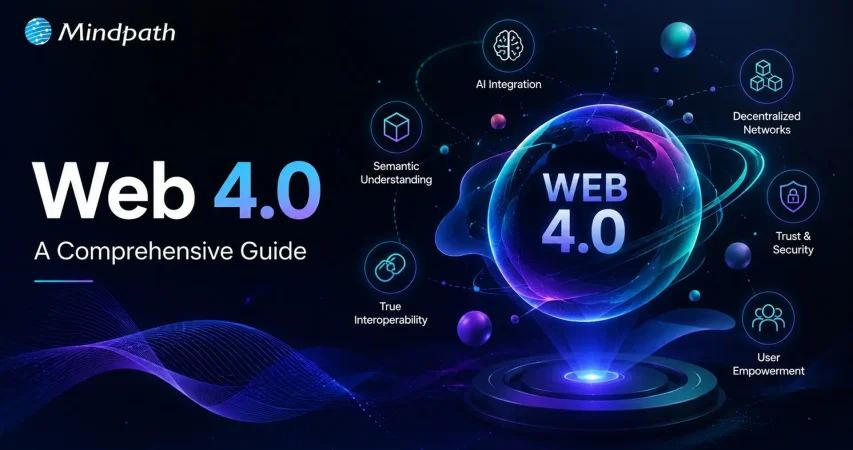
Web 4.0, commonly known as the symbiotic web, is less about information sharing and more about creating digital experiences that comprehend user needs. This phase of the Internet involves technology that can think and be connected on a deeper level. This web will be a network that connects people, devices, and systems in a smooth way. Through advanced web methods, organizations will be able to make decisions more rapidly. It will offer personalized communication, and collaborate effectively across digital environments.

Web 4.0 differs from the previous web versions in that it emphasizes intelligence, automation, and greater control of the user. It incorporates technologies, such as AI, machine learning, and decentralization to enhance the daily digital encounters of users. The individuals will enjoy improved privacy, robust security, and increased control over their personal data. In a deeply interconnected digital-physical environment, Web 4 is truly a game changer for businesses.

How Does Web 4 Differ from the Earlier Versions?

The internet has changed a lot over time. In this ongoing digital transformation, Web 4.0 is quite different from Web 1.0, 2.0, and 3.0 in that it provides more thorough personalization and a smooth digital interaction.

Let us have a glance at how this Internet 4.0 differs from the earlier versions through this table:

Category  Web 1.0  Web 2.0  Web 3.0  Web 4.0 
Internet Function Static information browsing Social content sharing Decentralized digital ownership Intelligent connected ecosystem
User Interaction Read-only access Read-write participation User-controlled engagement Predictive personalized interaction
Main Technology Basic web pages Social media platforms Blockchain smart systems AI-powered automation
Data Ownership Company-controlled data Platform-managed data User-owned assets Secure adaptive control
Experience Quality Limited digital presence Interactive online communities Transparent secure networks Seamless human-machine integration

What are the Key Benefits of the 4.0 Web?

Through the intelligent web, digital experiences are being transformed into smarter, faster, and more responsive. Web 4.0 not only focuses on connectivity but also fosters meaningful interactions that change according to user requirements. Its sophisticated features are allowing new opportunities to be unveiled by both companies and ordinary users.

1. Smart Personalization

Web 4.0 comprehends user behavior and provides the most pertinent digital experience to the users. It facilitates user to get quick recommendations, anticipatory assistance, and tailor-made services. This smart way enhances ease of living as well as business operations.

2. Stronger Data Security

Web 4.0 is built around decentralized systems which allow users to have greater control over their personal data. By minimizing the risks associated with central platforms and enhancing transparency, it leads to much safer and secure online experiences.

3. Better Human-Tech Connection

The future of  web is all about more interactive ways for humans to interact with digital systems. With the use of Web 4.0, communication will get better by using technology that is more human-like in responding to our needs. So, the result will be a highly intuitive experience through digital interfaces.

4. Advanced Automation

Artificial Intelligence (AI) has become one of the key components of Web 4.0. It is capable of automating repetitive tasks thus increasing the efficiency level of the work. This also leads to faster workflows, smarter virtual assistants, and less manual work. Businesses, in this way, could enhance their productivity without spending more time.

Must Read: AI vs Automation

5. Seamless Device Connectivity

Web 4.0 facilitates creating seamless experiences through multiple devices and platforms. Users can effortlessly switch from one platform to another without any loss in functionalities. Hence, this leads to highly connected and continuously consistent digital engagements.

6. Smarter Business Insights

Web 4.0 will enable companies to leverage real-time data for making superior decisions. It also enhances the capacity to analyze customer behavior and identify market trends, which subsequently results in quick and better business development strategies.

Key Challenges and Limitations of Web 4.0

Web 4.0 definitely opens a door to a fantastic innovation landscape, but along with it, several complex challenges arise that neither businesses nor users should overlook. Let’s explore the issues and major shortcomings of Web 4.0.

1. Privacy and Data Protection

A lot of personal information will be needed in Web 4.0 to provide smart experiences. This results in heightened worries about improper use of data, cyber risks, and identity theft. Keeping the users’ privacy safe is still a big issue.

2. Ethical AI Concerns

Autonomous systems may raise problems concerning bias, fairness, and accountability. AI’s decision-making might even become non-transparent or unethical at times. Developing responsible systems entails continuous oversight and control.

3. High Infrastructure Demand

Web 4.0 requires powerful computing systems, more advanced networks, and a massive scale of connectivity. Many areas still don’t have this technological basis. Today, it is costly and challenging to implement globally because of this.

4. Complex Development Process

Constructing Web 4.0 systems relies on the integration of AI, IoT, machine learning, and decentralized technologies. Overseeing such sophisticated systems calls for highly skilled professionals and substantial resources. This level of intricacy may hinder the pace of adoption.

5. Growing Digital Divide

High-tech solutions might be equally accessible to everyone for only a limited period. A shortage of gadgets and internet infrastructure may expand the gap of inequality. Such a scenario poses difficulties for achieving a sustainable and inclusive digital development.

6. Technology Dependence Risks

More automation might mean less human engagement in everyday decision-making. Relying too much on digital systems might disable our problem-solving skills. It is really necessary to find a balance in the use of technology and human control.

7. Expanded Cybersecurity Threats

The more connected devices there are, the more potential access points for hackers. One single flaw may give rise to the compromise of several systems. Hence, ensuring the safety of interlinked networks is of utmost importance.

Real-World Applications of Web 4.0

Web 4.0 is more than a mere futuristic idea as it is already radically changing various sectors via technologically advanced and interconnected devices. Its tangible effects are revolutionizing business operations as well as digital human interactions. The following are some significant examples of Web 4.0 being used in practice.

1. Smart Healthcare Solutions

Web 4.0 is an enabler for healthcare in being more proactive and personalized. Devices being worn on the body and AI systems can keep track of one’s health, assess potential risks, and aid in quicker medical interventions. Patient care and daily wellness management could be significantly enhanced by such developments.

2. Connected Smart Cities

Cities are making use of Web 4.0 to enhance traffic flow, reduce energy consumption, and improve the delivery of public services. Real-time sensors and smart systems are the backbone of better urban management. This results in urban areas that are more efficient and responsive to the needs of their inhabitants.

3. Autonomous Transportation

One of the ways Web 4.0 is backing up intelligent transportation is through the interaction of vehicles and infrastructures. Various applications can be used for better route planning, accident reduction, and improving travel time. In fact, this is the technology behind the development of safer commuting options.

4. Personalized Digital Learning

Cutting-edge AI and virtual reality technologies tailor individual learning experiences; with the help of these adaptive learning tools, students can be catered to their pace and needs. As a result, educational methods become markedly enjoyable and effective.

5. Secure Financial Systems

By leveraging decentralized technologies and safe transactions, Web 4.0 further solidifies digital finance. It also increases transparency in logistics and supply chains. Such innovations contribute to building trust and enhancing operational efficiency.

6. Predictive Smart Living

Smart homes and retail platforms, through connected systems, can predict what users need. Personalized actions and recommendations are ways through which devices and services respond faster. This convenience is a portrayal of the future of the internet.

7. Intelligent Task Automation

Web 4.0 opens up the possibility of AI handling almost all kinds of tasks without humans. It can schedule your meetings and do a lot of digital operations on the go. This helps users save time and streamline daily activities.

The Future of Web 4.0 and What Lies Ahead

Web 4.0 continues to evolve as emerging technologies reshape how people, businesses, and systems connect. Its future promises deeper intelligence, stronger automation, and more immersive digital experiences. Here are some key developments expected in the future of Web 4.0.

1. Autonomous AI Partners

Web 4.0 will move beyond basic digital assistants into smarter autonomous systems. These AI agents will manage complex tasks, make decisions, and operate across platforms. This shift will improve productivity and digital convenience.

2. Advanced Human-Machine Interaction

Future Web 4.0 experiences will feel more natural and seamless. Voice commands, gesture controls, and smarter interfaces will reduce dependence on traditional screens. Human and digital interaction will become more intuitive.

3. Predictive Personalization

Web 4.0 will better understand user behavior, habits, and preferences. Systems will anticipate needs and offer proactive solutions before users search. This will create faster and more personalized experiences.

4. Connected Digital Ecosystem

Connected devices will communicate continuously across homes, workplaces, and cities. This deeper IoT integration will support smarter environments and automated living. Daily experiences will become more responsive.

5. Trusted Digital Infrastructure

Blockchain will strengthen trust, security, and transparency behind Web 4.0 systems. It will support secure automated transactions between users, businesses, and AI systems. This foundation will improve reliability.

6. Immersive Digital Experiences

Web 4.0 will expand beyond traditional browsing into interactive 3D environments. AR, VR, and spatial computing will transform work, shopping, and communication. Digital experiences will feel more engaging and realistic.

Ready to Embrace the Next Digital Evolution?

Understanding the web 4.0 definition helps businesses and individuals prepare for a smarter digital future. As technology evolves rapidly, adopting intelligent systems early can unlock innovation, stronger connections, and sustainable growth in an increasingly connected world.

At Mindpath, we provide AI development services that help businesses adapt to Web 4 advancements with confidence. Our innovative solutions support smarter automation, digital transformation, and future-ready growth through advanced technology.

Frequently Asked Questions

1. How will Web 4.0 change everyday online experiences?

Web 4.0 will make digital experiences more personalized, predictive, and seamless. It can improve how people shop, learn, work, and communicate by using smarter systems that understand behavior and respond faster.

2. Is Web 4.0 only useful for large businesses?

No, Web 4.0 can benefit businesses of all sizes. Small companies can also use AI, automation, and connected technologies to improve customer service, increase efficiency, and compete more effectively.

3. What industries will benefit most from Web 4?

Healthcare, education, finance, retail, transportation, and smart city development are expected to benefit greatly. These industries can use intelligent technologies to improve services, decision-making, and user experiences.

4. Will Web 4.0 improve online privacy and security?

Web 4.0 can enhance security through decentralized systems and advanced technologies, but it also creates new risks. Strong cybersecurity strategies and ethical data management will remain essential for safer digital environments.

5. Do businesses need technical expertise to adopt Web 4.0?

While advanced expertise helps, businesses can start gradually by integrating AI tools, automation, and connected platforms. Strategic planning and the right technology partners can simplify the transition successfully.
Related Post

Large language models

Artificial intelligence has become one of the trending topics of discussion in the domain of technology, largely due to LLMs. Large language models or LLMs have made it possible to talk with AI and complete different types of actions, such as generating content or writing code. The impact of LLMs has not only redefined the conventional norms for interacting with technology but also provided new perspectives on information processing. Therefore, more people want to learn about LLMs and how they work. Let us discover how LLMs have become a powerful force in the AI landscape with an overview of their fundamentals.

Looking to gain a competitive edge using large language models? Mindpath’s AI development services to see how businesses transform LLM capabilities into practical, production-ready solutions.

Understanding Large Language Models

The obvious questions on the mind of any beginner are “What are Large Language Models?” and how they work. You can think of them as AI models which use deep learning, a sophisticated form of machine learning that leverages neural networks. Neural networks are a type of computational system designed along the lines of the human brain, with the interconnected layers represented neurons. LLMs rely on deep learning as it helps in finding intricate patterns in massive training datasets.

The definition in any Large Language Models beginner guide also focuses on the size of LLMs. You must know that the “Large” in LLMs is not an exaggeration as LLMs are built by training on large amounts of data. The data used to train LLMs is obtained from various sources, including the internet, books and many other sources of information. The large amount of training data ensures that LLMs have capabilities for recognizing, translating, predicting and generating human-like text.

Want to customize a large language model for your specific use case? Explore our OpenAI Fine-Tuning API tutorial to learn how to fine-tune LLMs for better accuracy and performance.

Identifying the Driving Force behind LLMs

The features of LLMs create questions about the special component that makes them so powerful. Most of the answers to “what is LLM?” focus on the transformer architecture and the attention mechanism. Transformer architecture refers to a neural network design created to process sequential data like text. Conventional models experienced troubles in learning the long-range dependencies in sentences. However, transformers changed the game by introducing the self-attention mechanism.

Almost every LLM definition sheds light on the impact of the self-attention mechanism on the working of LLMs. Self-attention mechanism of transformer architecture measures the significance of different words in a sentence with respect to each other, irrespective of their position. It helps in improving contextual understanding, which serves useful in generating coherent and relevant text.

The design of the transformer architecture involves an encoder and decoder. The encoder transforms the input text into numerical representations, which capture the syntax and semantic meaning of the input text. Subsequently, the decoder uses the numerical representation to craft the output sequence, on the basis of the context offered by the encoder.

Curious how large language models understand context and relationships between words? Discover our attention mechanism explained blog to learn the core concept that powers modern LLMs.

How Do LLMs Learn to Respond to Instructions?

Do LLMs work only with the data used for their training? The basic explanation for LLM means that it uses massive amounts of data in its training. However, it is only the initial stage of training, where the LLM gains general understanding of language from different datasets. The process is known as pre-training and involves subjecting an AI model to unsupervised learning. Pre-training empowers AI models to predict the next word in a sentence based on the preceding words. The pre-training process helps the LLM in understanding grammar, factual knowledge, statistical patterns and syntax of language.

Another crucial process that you may come across in a large language model tutorial is fine-tuning. Once the pre-training process is complete, you can use fine-tuning to prepare the model for domain-specific tasks. Fine-tuning involves the use of smaller datasets focused on the corresponding domain to optimize language models for certain tasks. For instance, you can fine-tune an LLM to serve support for medical diagnosis or creation of legal document summaries.

Prompt engineering is also another notable element in the world of LLMs as it focuses on creating effective instructions. You can take any introduction to LLMs and find insights on the significance of prompt engineering. The best thing about prompt engineering is that you can craft effective instructions to draw desired outputs from LLMs. With prompt engineering, you can teach language models how to work on new tasks without an extensive overhaul.

Concerned about how AI will impact careers and job roles in technology? Explore how AI is redefining job roles in tech to learn how professionals can adapt and stay competitive.

Discovering the Essential LLM Concepts for Beginners

As a beginner, you must know some of the most crucial concepts required to work with LLMs. The essential concepts related to LLMs that you should learn before using the models include tokens, embeddings, context window, temperature and model parameters. Let us discover more about the significance of these concepts for LLMs.

1. Tokens

A review of different examples of LLMs will help you know that language models break down text into smaller units. The small units or tokens can be words or characters in the sentence, represented as numbers. Tokens help language models understand natural language and respond to user queries.

2. Embeddings

Embeddings are the numerical representation of tokens, which capture their semantic meaning. Words with similar meaning will have embeddings close to each other in a multi-dimensional space. The embeddings help the model understand the context and relationship between different words in text.

3. Model Parameters

Another important addition among concepts of LLM for beginners points at model parameters. The model parameters are the weights and biases in a neural network, capable of encoding the complete knowledge of the model. New LLMs come with billions and some with trillions of parameters. Adding more parameters improves the performance of LLMs albeit with the burden of increasing demand for computational resources.

4. Context Window

The context window represents the maximum amount of text that the model can evaluate at once. You can think of the context window of a LLM as its short-term memory as the model does not take information outside the context window for the current processing step.

5. Temperature

The description of different large language models examples also showcases the importance of temperature for language models. Temperature is responsible for determining the level of creativity and randomness in the output of language models. Lower temperatures lead to creation of deterministic models while higher temperature introduces more randomness, leading to creative responses. However, higher temperature also means that the responses may be less predictable.

Looking for efficient ways to adapt large language models without high computational costs? Explore our Low-Rank Adaptation (LoRA) blog to learn how lightweight fine-tuning improves LLM performance.

Real-World Applications of LLMs

The popularity of LLMs can be attributed to the growing number of their use cases in the real world. As the capabilities of LLMs continue to expand and evolve, they can serve as key ingredients for innovation in any industry. The following real-world applications of LLMs can help you measure their significance in the domain of technology.

1. Customer Support Chatbots

One of the notable examples which serve the ideal answer to ‘why are large language models’ is the broad range of advanced chatbots and virtual assistants. LLMs can power chatbots to provide automated and personalized customer support anytime. The capabilities of language models help chatbots in answering complex queries and streamlining customer service operations through contextual understanding and sentiment analysis.

2. Content Generation

LLMs are also popular in the field of content generation, ranging from essays to marketing materials. You can find examples of language models like ChatGPT serving millions of users with content creation benefits. Language models can accelerate the content creation process by providing ideas, initial drafts or even creating new content from scratch.

3. Coding

The use cases of LLMs in the real world also draw attention towards their applications in generating code. One of the notable examples of language models used in code generation is GitHub Copilot. It uses language models to provide real-time coding suggestions and generate complex programs, thereby improving developer efficiency.

4. Education and Professional Training

LLMs are becoming more important in the domain of education and training as they can offer personalized learning experiences. AI chatbots in the field of education can not only generate educational content but also provide personalized explanations. Language models can offer the benefit of adaptive learning systems that teach according to the expertise of learners.

5. Business Operations

With the consistently increasing levels of sophistication in deep learning models, LLMs will offer stronger foundation for improving productivity in business operations. LLM-based tools can help businesses address different issues, such as improving employee efficiency, summarizing meetings and automating routine, repetitive tasks. Language models will define the future of competitive advantage by facilitating workflow streamlining in different departments.

Curious about the real impact of AI chatbots on customer engagement and sales? Discover AI chatbot examples that increased conversions to learn how intelligent chatbots drive measurable results.

Do LLMs Have Limitations?

Yes, language models also have limitations such as lack of access to knowledge, computational resources, AI hallucination and biases. LLMs cannot deliver relevant responses when they don’t have the data required for pre-training or fine-tuning. At the same time, you cannot trust the responses of pre-trained LLMs which do not update their knowledge base.

Language models, especially the ones relying on deep learning, require high-end computational resources. As a result, implementing LLMs comes at a significant cost. On top of it, you cannot undermine the threat of AI bias and hallucinations that might lead to discriminatory or completely irrelevant output.

Final Thoughts

The fundamentals of LLMs reveal that they are an integral component of the modern AI landscape. During the process of understanding large language models, you can learn how they work with the transformer architecture. On top of it, the introductory guide on LLMs revealed the essential concepts, such as context window, tokens and embeddings. Mindpath’s AI development services support businesses in applying LLM technology effectively to create intelligent solutions.

Discover the basics of Large Language Models (LLMs) and how Mindpath can help you build a customized AI solution to enhance efficiency and drive innovation.
Custom web application development

A growing business often reaches a point where off-the-shelf solutions no longer match its unique needs. Right? This is where custom web application development comes in. It gives you the web applications that work exactly the way you want them to, based on your specific requirements. Think about how much easier your daily operations would be if every feature were custom-made based solely on how your team works day to day, rather than trying to adapt to a generic application. It happens when technology becomes more than just a tool or a utility and partners with you to scale with your business.

Over time, certain changes in daily operations start to hint that your business might benefit from such a tailored solution. While these changes often seem subtle, they show up as your team performs operations, handles data, or relates to customers. When the shifts appear, it is highly likely that operational efficiency, productivity, or growth will be impacted. Understanding these signals can help you determine the proper time to invest in a strategy that is specifically built to suit the needs of the business.

Every business challenge needs a custom solution. Look how Mindpath’s custom web app development services resolve the issues and support businesses to convert unique needs into powerful digital tools.

What are Custom Web Applications?

Custom web application development for business means you’re building software that is specific to a business’s needs. This means instead of general tools that are often not specific to the goal of the software, you can tailor the application to a business’s workflows and goals, thus providing better efficiency and customer experience. In short, a custom web application for business will be able to manage data, create automation, provide reporting, and centralize operations. This process will result in a secure, scalable solution that supports the overall growth of the business.

Developers choose programming languages, frameworks, and tools relevant to particular project requirements. They communicate with the business to understand the challenges while integrating within the existing systems. During the web application development, the team regularly checks for progress and verifies if everything is aligned, keeping the cost, time, and risk to an acceptable level. The result is a working, well-designed, reliable application that the business finds intuitive, enhances the business, and can adapt as the business grows.

Also Read: Web Design Company

Benefits of Custom Web Application Development

Knowing the custom web application benefits can help you understand how the proper solution can have an impact on how you work. When considering why to build a custom web application, it is usually due to the fact that it can fit your precise requirements, allow you to work more efficiently, and facilitate growth. It is a strategic investment that will provide a return reflecting your investment and your growth aspirations.

Benefits of Custom Web Application Development

1. Built for Your Business Goals

When you use Custom web application development, you have every feature custom development to suit your needs. This makes integrating workflows easier and an easier experience for your employees.

2. Cost-Effective in the Long Run

A custom solution takes out the licensing fees and unnecessary features, which will save you in the long run. You can also reduce some infrastructure and hardware costs if you are going to outsource the development, too.

3. Designed to Reflect Your Brand

Custom web app development allows you to create every aspect of the application, to your brand’s identity. It can give your application a customized, professional, and unique identity that users will definitely recognize.

4. Flexible and Scalable for Growth

Custom-built applications will grow with your business and meet new demands. You will be able to add new features, accommodate increased traffic and usage, and still have a smooth performance.

5. Stronger Security Measures

Security is a key feature of Custom web application development, ensuring that your business is safe from common cyber threats. Custom apps will be fun to breach and take over than commercial apps found on the market.

6. Easy Integration with Existing Systems

Custom web applications will integrate easily with your current systems and databases. This allows you to keep data synchronized, accurate, and consistent across all platforms.

Choosing a custom web application is a strategic business decision! Discover web development trends to ensure your development strategy aligns with current and future digital demands.

10 Signs Your Business Needs a Custom Web Application

As businesses change, many times their needs exceed what generic software can deliver. Knowing the signs that you need a custom web application will allow you to reduce the damage that can happen before inefficiencies grind your business down.

10 Signs Your Business Needs a Custom Web Application

1. Struggling With Too Many Tools

Switching between spreadsheets, emails, and multiple apps slows work and causes mistakes. A custom web app centralizes your operations in one platform for better efficiency.

2. Current Software Limits Your Work

Generic software forces you to adjust your process to fit its features. Custom web application development creates solutions that match your exact workflows.

3. Security Risks are Growing

Using outdated systems leaves sensitive data exposed. A custom web app includes strong security controls, encryption, and adheres to all industry standards.

4. Your Systems Can’t Scale

Organizations evolve. As your business grows, so should your tools increase their users, data, and functionality. Custom software is built to scale without performance issues.

5. Customers Face a Poor Experience

Using slow, outdated, or limited platforms can leave users frustrated. A custom web app will provide users with modern interfaces, fast service, and customized experiences.

Also Read: Custom Website Development Services

6. Reporting Takes Too Much Time

If your reporting is done manually, or it takes too long to collect and analyze, it will limit your decision-making. Custom web apps will provide real-time dashboards and allow for instant self-serve reporting.

7. Too Much Manual Work

When staff are tied up with repetitive data entry or repetitive tasks, it is hard to be productive. A custom application can be built with automation features to allow staff to concentrate on high-value opportunities or higher-skilled work.

8. Limited Access Outside the Office

If your employees can’t easily access your systems while off-site or, even worse, don’t have access to them at all, your flexibility is limited. A custom web application can be secured and hosted in the cloud, allowing staff to work from anywhere.

9. Competitors Are Moving Ahead Digitally

If you’re used to out-of-date tools and systems, keeping up will mostly be impossible. Custom web application development will give you the opportunity to develop useful features that are unique to your organization.

10. Technology Can’t Keep Up with Change

If your business pivots, expands, or introduces new services, the old systems won’t accommodate this change. Custom applications allow you to adapt to these opportunities, adding integrations, and are designed with flexibility.

Wondering what comes next after deciding to build a custom web application? Explore the web app development roadmap to gain clarity on development stages, timelines, and technology choices.

Ready to Build a Solution That Fits Your Business?

A growing business needs tools that adapt to its pace, processes, and vision. Custom web application development delivers tailored solutions that improve efficiency, strengthen security, and enhance customer experience. Recognizing the signs early allows you to invest in a platform that aligns perfectly with your goals and supports sustainable growth.

At Mindpath, our Custom web application development services create secure, scalable, and user-friendly platforms that integrate seamlessly with your operations. We focus on understanding your unique workflows and delivering features designed to simplify tasks, automate processes, and empower your team. The result is technology that becomes a true partner in your business journey.

Support Is One Click Away

Featured Posts

Related Post

Learn the key differences between multi-cloud and hybrid cloud strategies and discover how Mindpath’s cloud services can help.
Discover how AI enhances cybersecurity with smarter threat detection, faster responses, and proactive vulnerability management to protect your business in the digital age.