Are you considering developing a quick, responsive application for your next project? With so many technologies options which one are you thinking to prefer? This can be challenging, right? What if we say, ReactJS app development can be the ideal solution you are looking for?
Developers around the world appreciate React for its component-based structure, which allows them to build complex interfaces with reusable code. Whether for startups or enterprises, ReactJS ensures flexibility, smooth maintenance, and rapid development. Report says, React has been used on around 4.8% of all websites across the world, which is over 11 million sites. Many high-traffic websites also trust React, with about 6.2% of the top 10,000 websites utilizing it.
Mindpath offers professional ReactJS development services to help companies to create reliable, effortless applications. ReactJS is a leading framework for modern app development for the following reasons.
What is ReactJS?
Famed for its flexibility and performance, ReactJS is a well-known JavaScript library which is utilized to develop efficient and user-centric web and mobile applications. Created by Facebook and officially released in 2015, it was designed to simplify the process of building dynamic and engaging user interfaces.
React is favorite among developers and organizations with a 5.9% share of the global market, cementing its position as a leading solution for ReactJS app development due to its versatility, speed, and resilience. Curious to know why is React used for application development? Let us learn more about its benefits for app development!
Advantages of Choosing ReactJS for App Development
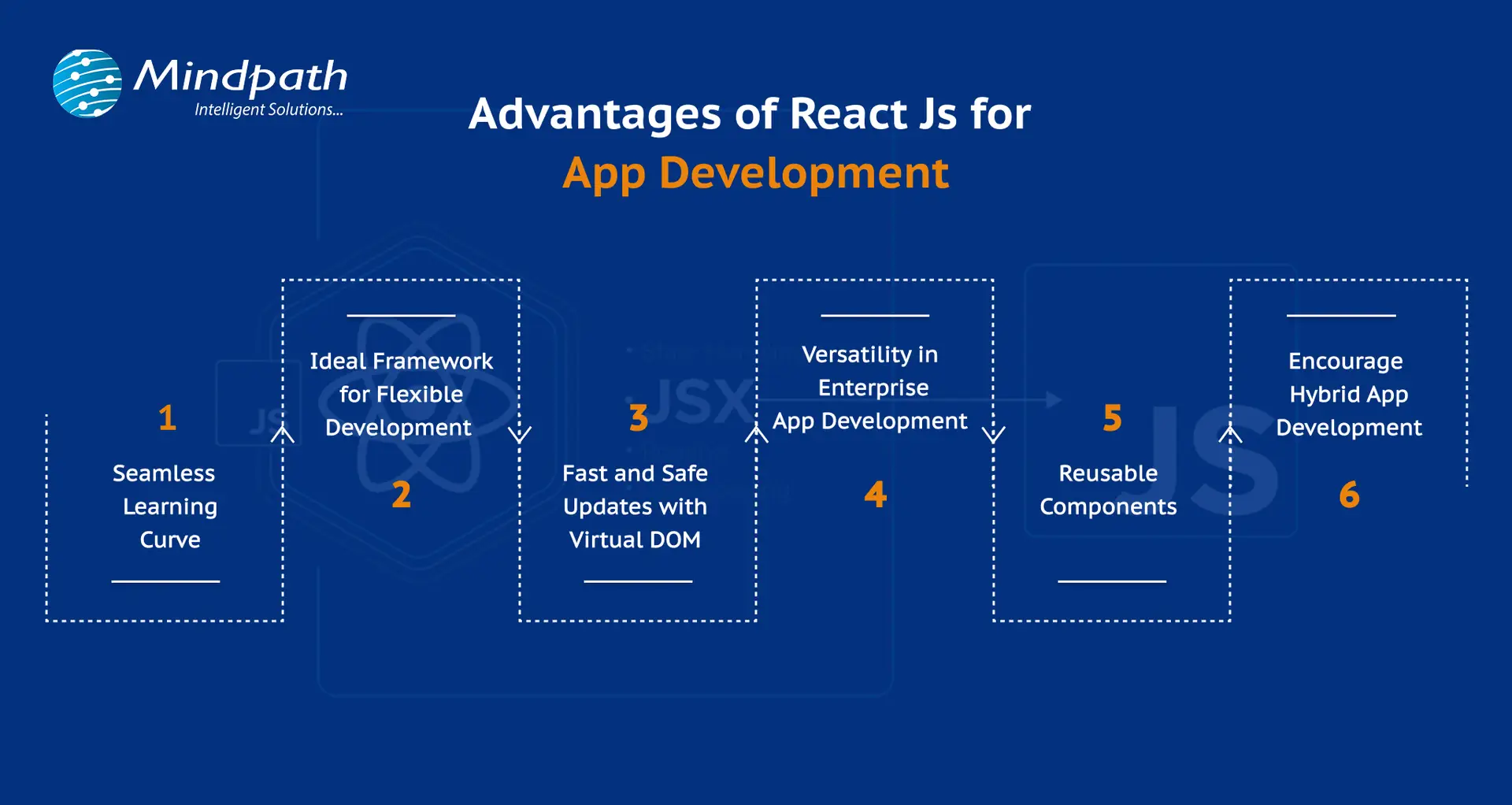
ReactJS continues to be a preferred tool for modern application development and its real value becomes clearer when you look at how it supports better performance and flexibility. Here are some reasons why it works so well for app development:
1. Fast and Safe Updates with Virtual DOM
ReactJS implements a Virtual DOM, which makes updates instantly without impacting the entire app. When any developer makes any updates, the Virtual DOM identifies what is the update and updates only that specific piece, thus making the app smoother and quicker. This is highly impactful in enterprise app development, where apps are enormous and intricate. Developers can safely test the updates within the Virtual DOM prior to updating it to the app if the change is safe. In this way, the app performs smoothly, and risks are minimized prior to release.
2. Reusable Components
One of the greatest advantages of working with React app development is reusability of components. This implies that the developers don’t have to write the same code over and over again. They can create new features by reusing bits of the app which have already been created. These reusable pieces of the app are referred to as components. As every component remains independent, adjustments done to one will not impact others. This saves time and makes the app reliable. It also simplifies the maintenance and future update of the app.
3. Ideal Framework for Flexible Development
ReactJS is widely regarded as a highly flexible framework. It is capable of adapting to what developers or projects require with ease. This ensures that the ReactJS development for applications is easy and less stressful. Its source code is easy and uncomplicated, allowing developers to make adjustments without stress. Thanks to this, companies can save time and money in developing their apps. Also, developers can rapidly inspect, edit, and maintain various segments of the application with the help of React developer tools. It is one of the primary reasons that several organizations prefer using ReactJS to create up-to-date and simple to maintain apps.
Seeking a development approach that reduces complexity while enhancing functionality? Read why React Web Development is ideal for modern projects.
4. Encourage Hybrid App Development
In the current competitive environment, it is important to reach a larger crowd, and ReactJS makes hybrid app development very easy. It enables developers to create React native apps with a single codebase, which means no need for a different code for Android and iOS. Not only does this save time, but also maintenance and updates are made easy because the same code works smoothly on both platforms. By using ReactJS for app development, the developers can provide a seamless and uniform user experience on devices, making it the perfect choice for companies that wish to increase their reach and provide high-quality apps with efficiency.
5. Versatility in Enterprise App Development
For any business, building an app that can grow smoothly is very important. With ReactJS, it’s easier to develop apps that can handle more users, data, and new features without any problems. In enterprise app development, ReactJS helps manage the code and structure in a simple way. Developers can easily update or expand the app without affecting other parts. This means ReactJS apps stay strong and efficient even when the business grows. Because of its flexible and reliable nature, ReactJS is a great choice for creating scalable enterprise applications that are easy to maintain and improve.
6. Seamless Learning Curve
ReactJS is famous for being easy to learn, particularly for developers who are already familiar with JavaScript. Its straightforward architecture and reusable components allow it to be easier to create and maintain applications. That’s why most teams use ReactJS for app development because it allows them to work faster with fewer hassles. Whether you’re just beginning or need to scale, it’s simple to create React apps that are flexible and efficient. This seamless learning curve saves time and is therefore an intelligent decision for companies that are eager to develop robust and easy-to-use applications without wasting any time.
While choosing the right tool for front-end development, React vs Vue is a common debate. Are you confused between React and Vue as well? Read our blog: React vs Vue: Which JavaScript Framework is Best for Frontend Development?
Ready to Build a High-Performance App with ReactJS?
ReactJS has become a preferred choice for building fast, reliable, and scalable web and mobile applications. Its component-based architecture and Virtual DOM make updates seamless and improve app performance. Developers can easily manage large projects with reusable code, reducing time and cost. ReactJS also supports hybrid app development, allowing businesses to reach a wider audience across platforms. With its simple learning curve and strong community support, it remains a go-to solution for modern digital products. Choosing ReactJS means choosing efficiency, innovation, and long-term growth for your app development journey.
Planning to use ReactJS for app development for your business? At Mindpath, we specialize in delivering powerful ReactJS development services tailored to your business goals. Our expert developers know how to build scalable apps that work smoothly across devices. Mindpath also offers expert support if you’re looking to hire ReactJS developers for your next project. Our team consists of skilled professionals who are well-versed in building responsive, scalable, and user-friendly ReactJS applications and can turn your app idea into a powerful digital product.
What does the future hold for generative AI in 2026? Do you think it will become smarter, more creative and give the best human-like responses? As technology continues to evolve at lightning speed, it is natural to wonder where we are headed next, isn’t it? So, if you are interested in generative AI predictions and how this advanced technology could influence industries, work and creativity, you are totally on the right page.
It is anticipated that by 2026, generative AI will be more integrated, accessible, and advanced, embedded in our daily lives. The abilities of AI are now growing rapidly, beginning with automating intricate tasks and transforming customer experiences to helping in creating content and driving personalized learning. Let’s understand what is the future outlook for generative AI and how it will be impacting the tech world. Before we move further, let us first have an idea about the current state of GenAI market.
Looking to stay ahead with generative AI innovations? At Mindpath, we provide Gen AI Development Services that enhance business performance with advanced AI solutions.
Generative AI Market Overview
As per Grand View Research, the global generative AI market size was worth USD 16.87 billion in 2024 and will expand rapidly at a CAGR of 37.6% from 2026 to 2030. The increase is fueled by technologies such as text-to-image conversion, super-resolution and video generation. Companies are employing generative AI to transform processes and enhance creativity, and AI has become an integral aspect of day-to-day activity in sectors.
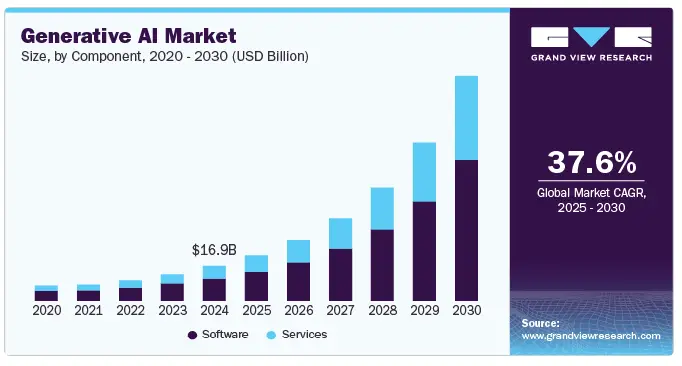
Interestingly, software accounted for 64.2% of the generative AI market in 2024. Businesses are leveraging AI software to address fraud, data privacy concerns, and unpredictable outcomes. Sectors such as fashion and entertainment are embracing it rapidly. H&M and Adidas are some of the brands utilizing generative AI to design garments and create custom sneakers. These companies are expediting and streamlining the creative process for their staff.
This expanding application definitely demonstrates how generative AI trends are influencing the future of work and creation. As additional sectors turn to AI-powered solutions, demand for more intelligent, quicker, and more agile solutions will continue to increase.
Generative AI Predictions for 2026 That Will Reshape the Tech
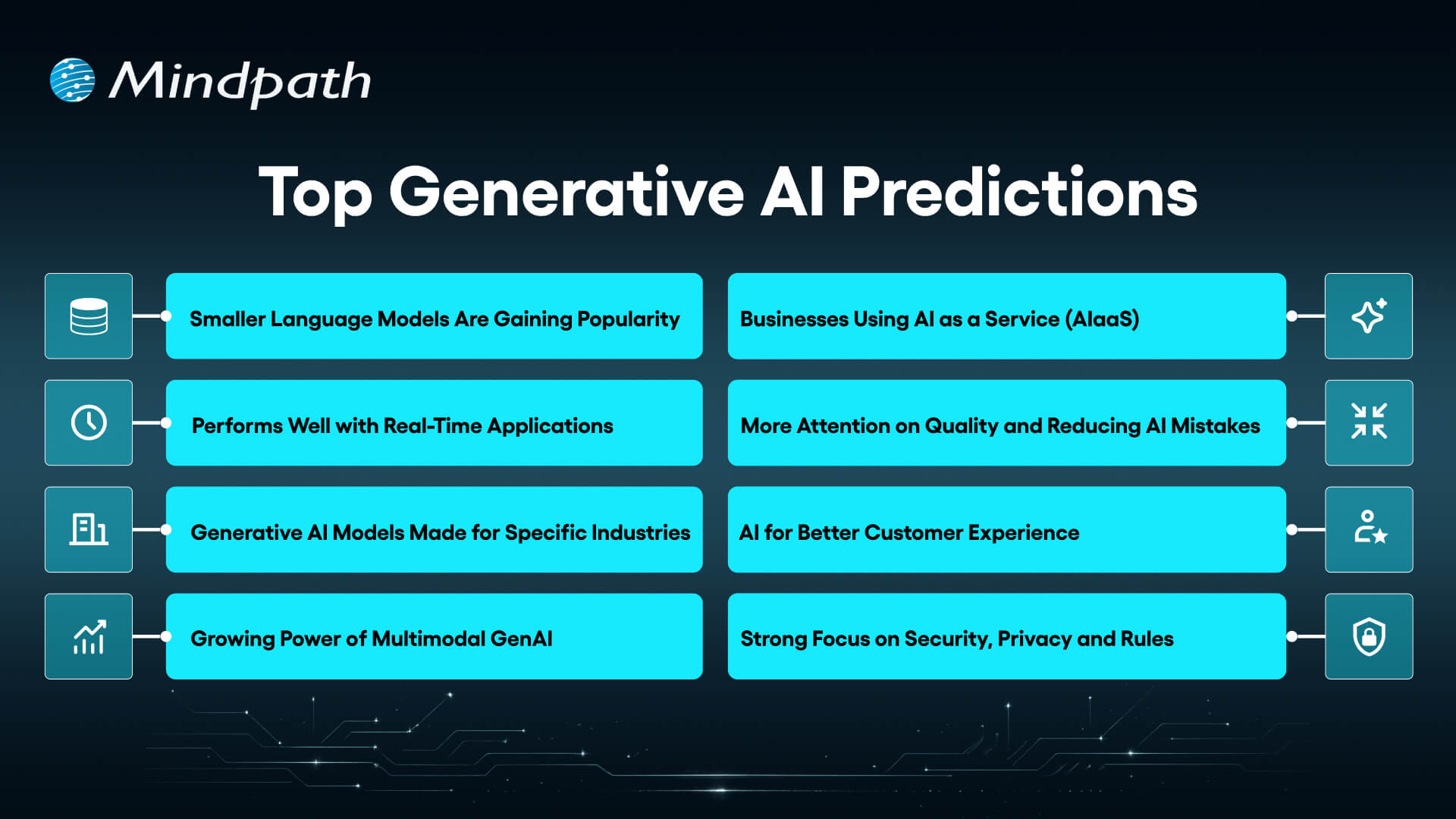
As we enter 2026, generative AI will have an even larger impact on changing how we work, create, and interact with tech. These are some of the best generative AI predictions for 2026 that outline where this revolutionary technology is going next:
1. Smaller Language Models Are Gaining Popularity
The language model market is expanding rapidly, and now there’s a movement towards utilizing smaller models rather than larger ones. These smaller language models (SLMs) are more affordable, easier to implement, and can be used on devices such as phones and tablets. They still provide intelligent AI capabilities but require less power and data. Microsoft, Google, Meta, and Apple are at the forefront of driving this change, making AI more convenient and accessible for use in everyday life.
2. Performs Well with Real-Time Applications
Generative AI is beginning to perform really well with real-time applications. That is, it will be able to generate content, images, or answers instantly while things are unfolding. This development is a major example of generative AI changing the creative industry, as it allows for rapid creation and adaptation of content. During live chat, it will generate custom visuals on the spot, and adjust to changing circumstances in real-time. It will enhance customer support, e-learning, and entertainment by making them more interactive and seamless, allowing users to receive speedier, more customized results in real time.
3. Generative AI Models Made for Specific Industries
A growing trend in generative AI is building models that focus on one specific industry, like healthcare, law, or marketing. These models understand the special terms and needs of that field, so they create more accurate and useful content. Instead of trying to do everything, they do one thing really well. For example, they can write medical reports or legal documents with more detail and clarity. This makes generative AI more helpful and reliable for professional use.
4. Growing Power of Multimodal GenAI
Multimodal generative AI means AI that can understand and create different types of content like text, images, and voice all together. OpenAI’s GPT-4 started this trend, and now Google’s Gemini and Anthropic’s Claude 3 are joining in. Soon, users will expect these features as a standard, especially in paid AI tools. As the technology improves, AI will create better images, videos, and other media, making interactions more natural and helpful for everyday use.
Want to stay ahead in the AI-driven market? Learn how AI programming languages power intelligent solutions, from data processing to smart apps tailored for modern business needs.
5. Businesses Using AI as a Service (AIaaS)
AI as a Service (AIaaS) is becoming popular in generative AI. Instead of building AI systems from scratch, many businesses will use outside experts to help them. These consulting firms guide companies on the best AI solutions without big upfront costs. AI Modeling as a Service (AIMaaS) will grow too, offering flexible models for different needs. These services also focus on security, rules, and easy setup, making it simpler and safer for companies to use AI without having experts on their own team.
6. More Attention on Quality and Reducing AI Mistakes
As people notice wrong or misleading info from AI, companies are working harder to improve quality and reduce errors called hallucinations. OpenAI leads by making its models more accurate and sharing clear research to build trust. Google’s Gemini lets users give feedback and compare answers with real-time internet sources, helping improve results. More AI companies will follow this approach, using user feedback and being open to make AI safer, more reliable, and trustworthy for everyone.
7. AI for Better Customer Experience
More companies are adding generative AI into their everyday work and customer tools to make things smoother and faster. Models like GPT-3.5 and GPT-4 are used in websites, apps, and chatbots to help customers with personalized answers and recommendations. Soon, AI-powered tools will be expected by users during shopping or research. Businesses that don’t use AI this way may fall behind, as customers prefer easier, smarter, and faster experiences powered by AI.
8. Strong Focus on Security, Privacy and Rules
With new AI laws and growing public attention, businesses and AI companies must pay more attention to AI safety, privacy, and rules. Right now, few focus on AI governance, but this will change as concerns about AI risks grow. Soon, companies will use special tools and human checks to make sure AI works responsibly and safely. Clear AI policies will help protect businesses from problems. Keeping AI secure will be very important as it becomes part of everyday work.
If you’re exploring smarter ways to deliver customer support. Read our blog on AI for Customer Service, where we highlight how chatbots and virtual assistants can improve customer satisfaction and drive measurable business growth
Preparing for the Generative AI Shift?
The future of generative AI in 2026 looks incredibly promising. Advancements are making AI smarter, faster, and more tailored to specific industries and real-time needs. As AI becomes more integrated into everyday business and consumer experiences, the focus on quality, security, and ease of use will drive widespread adoption. These generative AI predictions highlight a transformative shift in how industries operate, innovate, and engage with technology, setting the stage for smarter, more creative, and efficient solutions.
At Mindpath, we are committed to helping businesses harness the full potential of generative AI. Our cutting-edge generative AI solutions are designed to deliver customized, secure, and scalable AI-powered tools that boost productivity and enhance user experiences. With expertise in deploying industry-specific models, real-time applications, and AI governance, Mindpath ensures your business stays ahead in this rapidly evolving Gen AI landscape.
In today’s digital world, smart phones are able to recognize voices, answer your queries with virtual assistant and can even sort your photos by location or people. All these features may seem like magic but in reality, it’s the power of artificial intelligence. From chatbots to intelligent assistants, AI is revolutionizing the way we live, work and interact. But behind all these changes lies something as crucial as AI, and they are AI programming languages.
Studying these languages is crucial for technology professionals as well as anyone interested in seeing how the future is being designed. These languages can help developers create smart systems that will be able to understand, learn and react just like humans. In this guide, we will take you through everything that you need to know about programming languages for AI. So, let’s dig in!
Planning to elevate your business and get a personalized AI solution? At Mindpath, we offer AI development services designed to deliver solutions tailored to your business needs.
What are AI Programming Languages?
Artificial intelligence programming languages refers to the tools that are used to create smart computer languages that can think and learn just like humans. These languages help developers to build systems that can understand speech, read data, and even help in autonomous driving. Each language comes with its own tools and libraries to carry out these tasks easily.
In programming with artificial intelligence, it’s helpful to use languages that offer strong support for tasks like data analysis and machine learning. For example, Python is well-known because it has helpful libraries such as TensorFlow and PyTorch, R is also great when you are working with statistics and data. So, these languages make it easier to build AI systems that can work well and can contribute in solving real-world problems.
Must Read: Benefits of AI
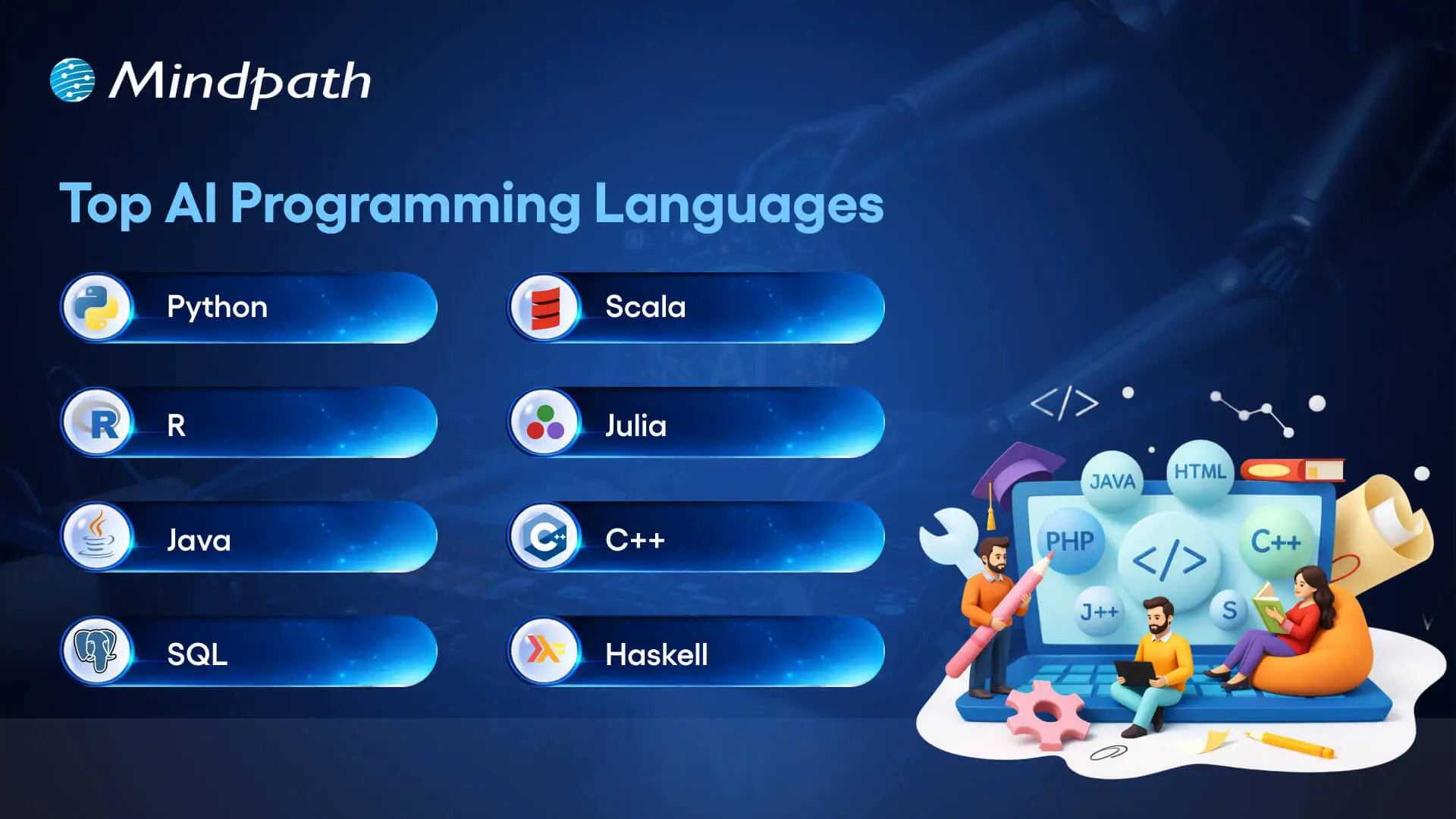
List of Top AI Programming Languages
When you are building smart applications, the choice of programming language plays a major role in it. But with so many options out there, it is important to learn about each and decide which one can provide what benefits. The best AI programming languages can offer the features, libraries, and flexibility needed to handle tasks like machine learning, data processing, and automation. Let’s dive deep!
1. Python
Python is one of the top choices for developing smart systems due to the fact that it’s easy and beginner friendly. It’s widely used for training machine learning models, doing data analysis, and building AI tools like chatbots or image recognition apps. Being an AI coding language, Python has numerous strong libraries such as TensorFlow and PyTorch, which make complicated tasks manageable. It also enables rapid testing and development, which is useful in constructing and refining AI models. It is useful for AI in decision-making, where quick iteration on data models is crucial.
2. R
R is an excellent language to use when dealing with lots of data. It makes it easier for individuals to comprehend patterns, generate charts, and analyze results in an easy manner. It is employed by numerous scientists and developers to explore more into data and make intelligent predictions. R is also useful when creating and testing simple machine learning models. With its strong data-handling capabilities, R is particularly valuable for AI in business strategy, helping organizations analyze trends, optimize operations, and make data-driven decisions. R also has numerous tools that assist in making it simpler to verify and compare results. It gets along great with other programming languages as well, so it can be beneficial for other AI projects that require solid data analysis.
3. Java
Java is a good option for large AI projects, particularly for businesses that require systems to function across different platforms. As an AI language, Java assists programmers in developing intelligent tools that are simple to maintain and expand. It accommodates machine learning, deep learning, and large data tasks through helpful tools and frameworks. Java is also reliable for maintaining things safe and clean, as it has the capability to delete unwanted data automatically.
4. SQL
SQL is a helpful tool when working with a lot of structured data. It makes it easy to find, manage, and prepare data that can be used to train AI models. Since artificial intelligence needs good-quality data, SQL plays an important role in getting that data ready. It works well with other tools used in AI projects and is great for handling large datasets. As one of the trusted artificial intelligence languages, SQL is simple to use and supports many steps in the AI development process.
Curious to know how AI impacts your industry? Discover the top AI trends that drive innovation and shape the future of business.
5. Scala
Scala is a good choice for building strong AI applications, especially when dealing with big data. It can easily manage large sets of data and is made to work fast and smoothly. Scala also works well with popular tools like Apache Hadoop and Spark, which help developers build and run AI projects more easily. Since it supports multi-tasking and can run many processes at once, Scala is useful for complex AI work. It also works nicely with Java, making it even more flexible.
6. Julia
Julia is an AI programming language known for its speed and ability to handle complex calculations. It’s great for deep data analysis and training advanced machine learning models. Julia has a user-friendly syntax which is better, making it easier to learn compared to some other languages. It also works well with languages like Python, C, and R, giving developers more flexibility. With powerful libraries, Julia is perfect for building efficient data models and neural networks.
7. C++
C++ is a powerful language used for AI applications because it offers great performance and uses system resources efficiently. It’s great for running heavy tasks like deep neural networks quickly. Developers often choose C++ for its ability to handle complex jobs, including real-time processing and tasks like computer vision. Its speed and resource management are vital for building sophisticated systems that drive AI transforming the future of technology.
8. Haskell
Haskell is a language that focuses on writing clean and reliable code, making it ideal for AI research and building new algorithms. It is great for prototyping and teaching programming concepts. Many AI developers use Haskell for its strong typing and functional programming style, which ensures precision and reliability. Haskell is also used in roles like AI research, where its features help verify algorithms and improve safety, especially in important fields like healthcare and autonomous vehicles.
Important Note: Some programming languages are not the best choice for AI because they don’t have the right tools or are too slow for complex tasks. Here are a few languages that are generally avoided when building AI applications:
- PHP: It is mainly used for making websites and doesn’t have strong tools or libraries needed for artificial intelligence and machine learning work.
- Ruby: It is easy to read and write, but it runs slowly and doesn’t offer strong support for AI or machine learning tools, which makes it hard to use in real projects.
- C: It can be powerful, but it is too low-level for AI and needs manual memory management, which can lead to errors and unstable programs.
- Fortran: It is an older language that lacks modern features like dynamic memory and safety, which makes it risky and less useful for today’s AI development.
Ready to adopt AI programming languages and transform the way websites are built? Read our blog on AI in web development to explore its impact on creating smarter, more dynamic sites.
Curious How AI Languages Are Powering Smarter Technology?
AI programming language is the key to building smart, efficient, and reliable applications. Whether it’s Python for ease, R for data analysis, or Java for large systems, each language has something unique to offer. While some languages lack the tools or speed for AI tasks, the right one can make AI development smoother and more powerful. Understanding these options helps both beginners and experts create systems that truly think, learn, and improve the way we interact with technology.
At Mindpath, we specialize in Artificial Intelligence development, using the best programming languages like Python, Java, and more to create intelligent solutions that align with your business goals. From automating processes to enhancing user experiences and developing data-driven systems, our expert developers build AI applications tailored to deliver real-world results.

Every year, new technologies reshape the way we use our mobile phones, and 2026 is no exception. If you are willing to create an app or just curious about the future of mobile technology, then staying updated with the latest mobile app development trends will be considered as a smart choice. These trends are not buzzwords but instead play a role in shaping the way individuals utilize apps, how they are developed by developers and how companies can expand through mobile platforms.
The mobile app world is changing at a quick pace, and 2026 will bring to us some of its most game-changing innovations. From smart AI features to faster and safer user experiences, mobile applications are becoming more effective and helpful in our day-to-day lives. This blog will walk you through the top 10 trends in mobile app development in 2026.
Want to turn your mobile app idea into a powerful digital solution, but unsure where to start or whom to trust? Mindpath offers expert mobile app development services, building scalable applications tailored to your business needs.
Before learning about the trends, we must have a quick look at the market value of mobile app development:
Interpreting the Mobile App Development Market Value
According to a study by Allied Market Research, the worldwide mobile app development industry was valued at $195.7 billion in 2023 and is likely to grow to $606.1 billion by 2032. This growth, with a CAGR of 13.1% between 2024 and 2032, is primarily because an increasing number of people are using smartphones and wish to have apps according to their individual requirements.
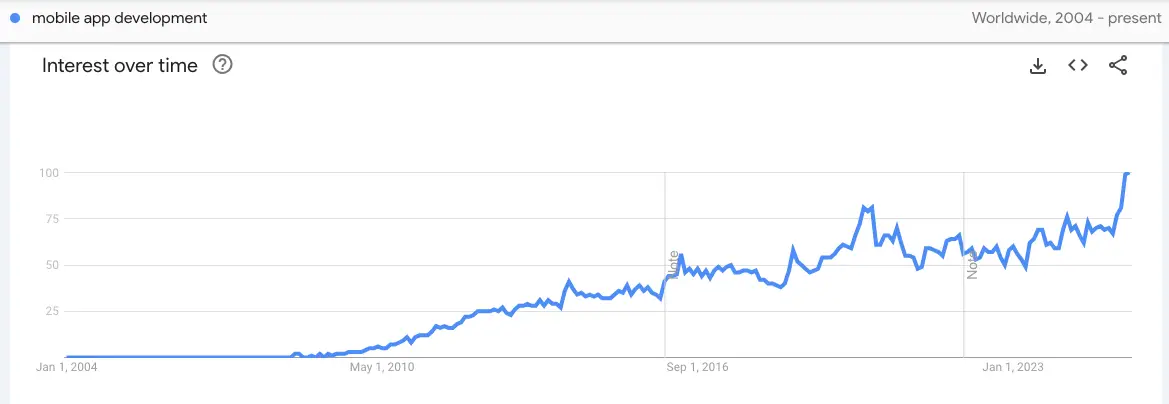
New technologies are helping to make apps smarter and more useful. More people shopping on phones and working remotely after the pandemic has also made mobile apps more popular around the world. Let’s see what are the latest trends for mobile app development in 2026.
Curious about the latest tools shaping modern mobile app development and how they impact performance and scalability? Read our blog on Mobile App Development Tools to explore the frameworks, platforms, and technologies developers rely on to build powerful apps.
Latest Mobile App Development Trends in 2026
The future of mobile app development is looking brighter than ever, with groundbreaking trends that are set to reshape the way we interact with technology. As we move forward, these emerging trends will drive innovation as well as set new standards for app performance and user experience. Let us take a look at it:
1. Artificial Intelligence (AI)
Artificial intelligence (AI) in mobile app development is revolutionizing in 2026. With advancements such as Apple’s Core ML 3, developers are now able to more easily incorporate AI into their apps. AI will make apps smarter, enhancing performance and user experience, and will be a driving force in defining the future of mobile applications.
2. Augmented Reality (AR) and Virtual Reality (VR)
Augmented Reality (AR) and Virtual Reality (VR) will be big trends in mobile app development in 2026. AR is becoming more practical and useful across different industries, while VR is enhancing gaming experiences on mobile devices. Both technologies are helping create more interactive and engaging apps. As these trends grow, we’ll see AR and VR shaping the way users interact with apps in exciting new ways. Based on research by Statista, revenue in the AR & VR market worldwide is projected to reach US$46.6bn in 2026, with an annual growth rate (CAGR 2026-2029) of 7.42%, leading to a projected market volume of US$62.0bn by 2029.
3. Predictive Analytics
Predictive analytics is transforming how mobile apps work. By using AI and data analysis, apps can now predict what users want or need, offering personalized experiences. In 2026, this technology is widely used to improve app interfaces and user interactions. Apps will offer content and suggestions based on each user’s actions, making them feel more intuitive and relevant.
4. Cloud Computing Integration
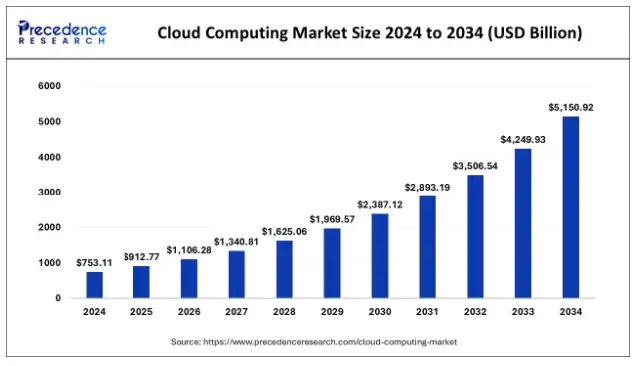
In 2026, cloud computing will become a key trend in mobile app development. It allows apps to store data and perform tasks on the cloud, rather than relying on the user’s device. This will not only improve app performance but also make development more efficient and cost-effective. As cloud technology continues to grow, it will play a major role in shaping mobile app functionality. According to Precedence Research, the global cloud computing market was valued at USD 753.11 billion in 2024 and is projected to grow to approximately USD 5,150.92 billion by 2034, with a CAGR of 21.20% between 2026 and 2034.
5. Chatbots
In 2026, chatbots will see widespread adoption in mobile apps, enhancing customer service and user interactions. Driven by AI, they will provide more natural, human-like responses, improving efficiency and responsiveness. This integration will streamline support processes and elevate the overall app experience, making it faster and more intuitive for users.
6. 5G Technology
The rollout of 5G in 2026 will enhance app performance by providing faster speeds and lower latency. This will enable apps to support more advanced features and deliver smoother user experiences. With improved network efficiency, users can expect faster data processing and better overall functionality. The faster connectivity will also open doors for new, innovative app capabilities.
7. Internet of Things (IoT)
The Internet of Things (IoT) is transforming how we interact with everyday devices, offering more convenience and automation. From controlling home appliances to managing security systems, IoT is becoming integral to modern living. As more devices become interconnected, the potential for smarter homes, workplaces, and healthcare solutions will continue to grow, creating a more seamless and efficient experience for users.
8. Low-code /No-code Development
Low-code/no-code development is revolutionizing how apps are created by simplifying the process and allowing users with little to no coding experience to build apps. This approach speeds up development significantly, making it easier to create and modify apps quickly. By empowering business stakeholders and non-developers to participate in the process, it ensures the final product better meets user needs and business goals. Based on Statista statistics, the global low-code platform market is expected to reach around 65 billion U.S. dollars by 2027, reflecting its rapidly growing demand.
9. Mobile App Security
Mobile app security is crucial as more businesses use apps to handle sensitive customer data. Vulnerabilities in apps can expose users to cyberattacks, leading to financial loss, fines, and a damaged reputation. To protect apps, developers must integrate strong security measures such as encryption, multi-factor authentication, and secure coding practices. Regular updates and testing are also essential to maintaining robust security.
10. Apps for Foldable Devices
Foldable devices are making a strong comeback, with popular models like the Samsung Galaxy Z Fold 5, Huawei Mate X5, and Motorola Razr 40 leading the way. These devices allow users to adjust the screen size, providing both portability and an expanded experience. As their popularity grows, the demand for specialized mobile apps will rise, requiring optimized interfaces that adapt seamlessly as screens fold and unfold.
Ready to discover how modern mobile apps are built? Explore the latest Mobile App Development Technologies that power innovative and user-friendly applications.
Embrace the Future of Mobile Apps with the Latest Technology and Trends
The future of mobile technology is full of exciting changes. The top trends in mobile development for 2026 show us how fast the industry is moving. From smarter AI to apps for foldable devices, each trend brings new ways to build better user experiences. Staying updated with these trends in mobile development is important for creating apps that are fast, secure, and user-friendly.
At Mindpath, we specialize in using the latest technology for mobile app development. Our team follows the latest trends in mobile development to deliver apps that are modern, efficient, and built for the future. If you’re looking for a mobile app development company your search ends here. We at Mindpath have a team of professionals with expertise in creating AI-powered apps, apps built for 5G, or solutions optimized for foldable devices, we’re here to turn your idea into a reliable mobile solution.
Have you been hearing a lot more about the idea of Agentic AI? It is really becoming one of the most talked about ideas in tech, right? Well, it is a new way of thinking about AI, and it takes action on its own, not just reactively waiting for a command. It can make decisions, plan, and act independently as if it possesses its own autonomous cognition. This is what makes it feel less like a tool and more like a genuinely smart collaborator who is helpfully performing the task at hand.
Even more exciting is how easily it’s intertwining with real-world activities, showcasing how AI is transforming future innovations is becoming a reality. But what does agentic AI mean, and why is it being so widely talked about right now? If you’re in tech, in business, or simply curious about the future of AI, spanning these definitions will be vital. So, in this blog, we’re going to guide you through what Agentic AI is, why it’s gaining traction, and how it may soon bring intelligence into our everyday lives. To begin with, let us know what is the concept of agentic AI.
Looking to integrate smarter, goal-driven AI into your business? At Mindpath, we offer end-to-end Agentic AI Development Services to design, train, and deploy advanced agentic solutions.
What is Agentic AI?
Agentic AI is a more sophisticated and advanced kind of artificial intelligence agent that can make its own decisions and perform actions once it is initially instructed. It is not limited to just following commands; it can understand what to do, outline a plan, execute it, and optimize the process during execution. Agentic AI is well suited for numerous, complex tasks in business and other fields, where fast thinking and independent action are often required.
Agentic AI’s potential extends far beyond automation, as it is already on track to considerably change many industries. A report from MarketsandMarkets estimates that the global market size of Agentic AI will increase from USD 13.81 billion in 2025 to USD 140.80 billion by 2032, growing at a CAGR of 39.3%. Rapid AI growth can be traced to its ability to perform tasks and activities associated with marketing, sales, and operations. In customer service, Gartner predicts that by 2029, Agentic AI will resolve 80% of support issues independently, which would lead to an estimated 30% reduction in operational costs. These numbers reflect just how transformative Agentic AI is becoming, especially in areas that demand fast, intelligent decision-making.
Benefits of Agentic AI
As businesses look for smarter ways to work, Agentic AI offers powerful advantages that go beyond traditional automation. Its ability to think, act, and improve independently is unlocking new levels of efficiency and innovation across industries.
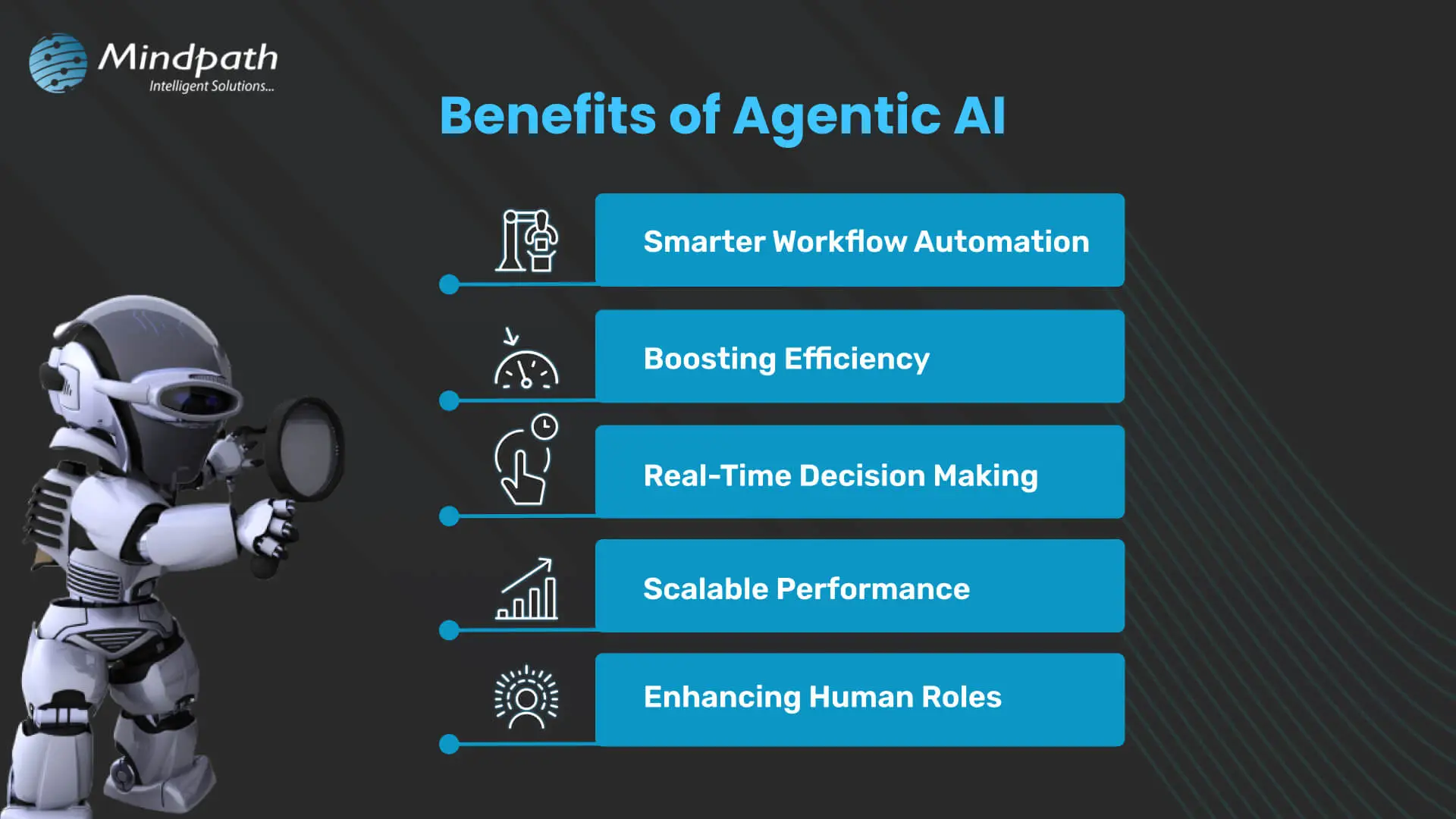
1. Smarter Workflow Automation
Agentic AI makes it easier to manage complex workflows without needing constant human input. In supply chain operations, it can analyze data, spot issues early, and suggest the best solutions. It also tracks inventory levels and connects with suppliers to restock items on time, keeping everything efficient and well-organized.
2. Boosting Efficiency
Agentic AI helps businesses run faster and smoother by managing and improving processes on its own. It learns from results, adjusts its actions, and keeps getting better without needing to be reprogrammed. This leads to fewer delays, higher efficiency, and makes it easier to scale operations as the business grows.
3. Real-Time Decision Making
One of the key strengths of agentic AI is its ability to quickly make decisions and adapt to changing situations. Agent AI tools can process real-time data, respond to unexpected events like shipping delays, and adjust plans without human help. This makes AI in decision-making faster, more flexible, and better suited for today’s fast-moving business needs.
4. Scalable Performance
Agentic AI models help businesses grow by handling more tasks without losing speed or efficiency. They use cloud platforms, APIs, and large language models to manage increasing workloads smoothly. In setups with multiple agents working together, such as in healthcare, they share tasks like data analysis and scheduling to reduce manual work.
5. Enhancing Human Roles
Agentic AI helps people work better by taking over repetitive tasks, improving communication, and offering smart assistance. This allows employees to focus on creative thinking, problem-solving, and other work that needs human judgment. While the AI works independently, human guidance is still important to keep everything aligned with company goals and values supported by valuable insights from AI in business strategy.
Wondering how AI-powered chatbots fit into the growing shift toward agentic AI? Read our blog on how conversational AI chatbots help businesses to explore how these systems learn, adapt, and deliver human-like interactions.
Agentic AI Use Cases
Agentic AI is already being used across many industries to improve efficiency, decision-making, and customer experience. Here are some real-world agentic AI examples that show how this technology is making a meaningful impact in different areas.
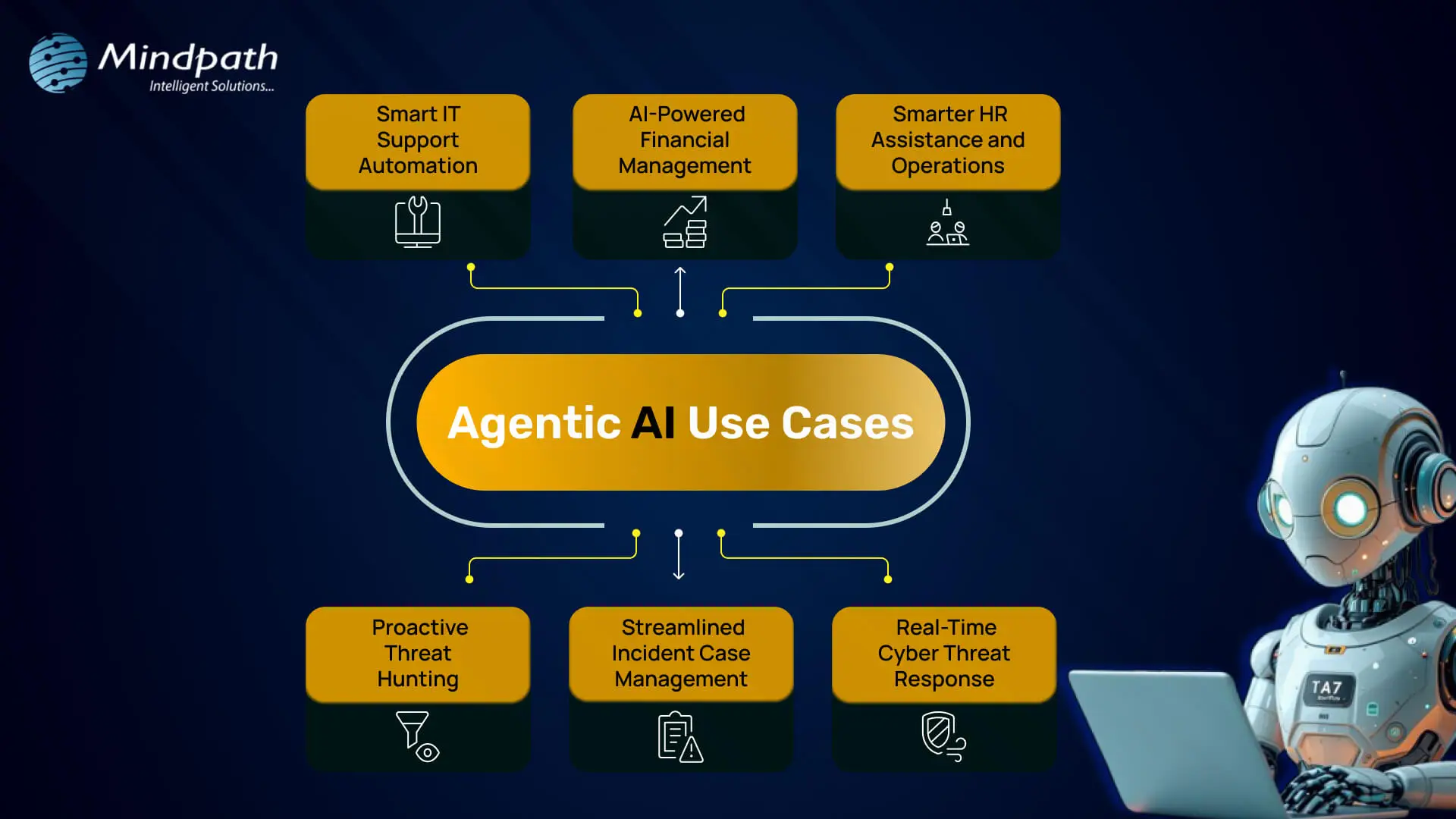
1. Smart IT Support Automation
Agentic AI is changing IT support by spotting and fixing problems on its own before they grow. It handles common tasks like password resets and software updates, while also solving complex issues by learning from past data. This shift aligns with emerging AI trends that focus on self-repairing systems and intelligent automation.
2. AI-Powered Financial Management
Agentic AI in finance can handle tasks like fraud detection, compliance checks, and forecasting by quickly analyzing large amounts of data. It also offers personalized advice by tracking spending and improving money management.
3. Smarter HR Assistance and Operations
In HR, agentic AI helps by answering employee questions, managing onboarding, and screening candidates during hiring. It gives quick, personalized support while allowing HR teams to focus on bigger goals.
4. Proactive Threat Hunting
Agentic AI actively searches for hidden threats by scanning security data for unusual patterns. It keeps learning to catch new types of attacks that older systems might miss.
5. Streamlined Incident Case Management
Agentic AI organizes and tracks cybersecurity incidents by logging details and assigning them to the right teams. It also learns from past cases to suggest better ways to handle future issues and ensures all records stay up to date. Companies often use AI consulting services to optimize these workflows and strengthen overall security operations.
6. Real-Time Cyber Threat Response
In cybersecurity, agentic AI watches for threats around the clock and reacts instantly by blocking risks or alerting teams. It learns from new attacks, so it gets better at spotting danger over time.
Curious how agentic AI is revolutionizing personalized shopping experiences and automation in online retail? Explore our blog AI in ecommerce to see how intelligent systems are reshaping customer journeys and boosting business performance.
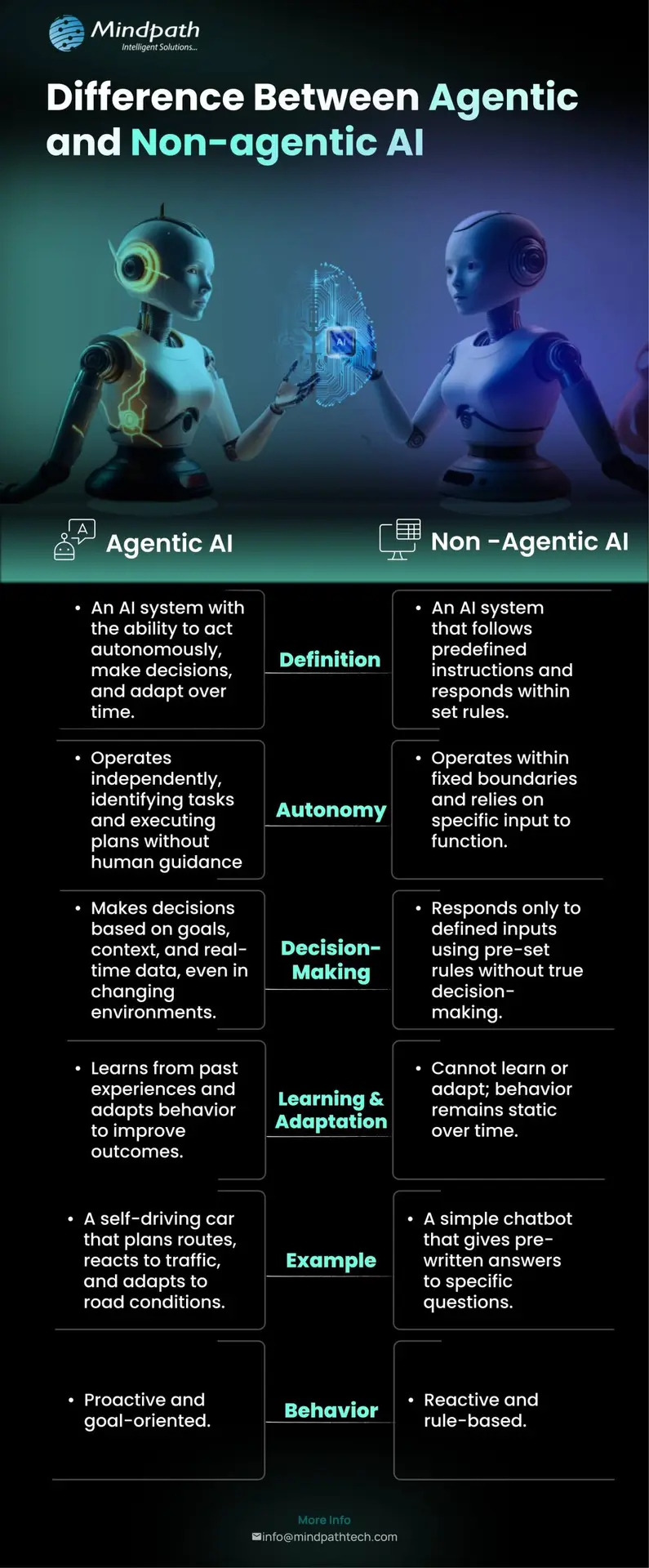
What Is the Difference Between Agentic and Non-agentic AI?
Understanding the difference between agentic and non-agentic AI is key to recognizing how advanced AI systems are evolving. While both types serve important roles, they differ greatly in how they operate, make decisions, and adapt to new situations. The following difference table will help you clear your understanding of agentic and non-agentic AI.
How Far Can Agentic AI Take Your Business?
Agentic AI is creating a major shift in how systems work, making them more independent, responsive, and useful across real-world situations. It’s no longer just about automation but about building intelligent support that acts on its own, learns from outcomes, and keeps improving. As industries adopt this new approach, the ability to understand and apply Agentic AI will be a clear advantage for any forward-thinking team.
At Mindpath, we help businesses bring this future to life with tailored AI development services. Our team builds intelligent, scalable, and adaptive AI solutions that align with your goals and workflows. If you’re ready to explore the power of Agentic AI in your operations, let’s connect and shape your next intelligent move.
Frequently Asked Questions
1. Is Agentic AI suitable for small and mid-sized businesses?
Yes, Agentic AI is not limited to large enterprises. With cloud-based tools and scalable platforms, small and mid-sized businesses can adopt agentic systems for workflow automation, customer support, and analytics. The key is starting with a focused use case that delivers measurable value.
2. How much control do humans have over Agentic AI systems?
Even though Agentic AI can act independently, human oversight remains essential. Businesses set the goals, boundaries, and ethical guidelines the system must follow. Regular monitoring, audits, and performance reviews ensure the AI stays aligned with company objectives and regulatory requirements.
3. What industries can benefit the most from Agentic AI?
Industries that rely on fast decision-making and large data volumes benefit greatly. This includes finance, healthcare, cybersecurity, logistics, retail, and IT operations. Any sector that requires continuous monitoring, predictive insights, or automated responses can gain significant advantages from intelligent agent-based systems.
4. Is Agentic AI difficult to implement in existing systems?
Implementing Agentic AI depends on your current infrastructure. Organizations with modern cloud systems and APIs can integrate it more smoothly. However, legacy systems may require upgrades or restructuring. A clear roadmap, proper data preparation, and technical expertise make the transition easier and more effective.
5. What risks should businesses consider before adopting agent-based AI?
Businesses should consider data privacy, ethical decision-making, system transparency, and security risks. Clear governance policies and human supervision are necessary to prevent unintended outcomes. Proper testing and phased deployment help reduce risks while ensuring the system performs reliably in real-world conditions.
Ever pondered how doctors can diagnose faster now-a-days? Or what helps hospitals and clinics to carry out all the operations smoothly? What’s powering the virtual health check-ups? Well, the answer to all these questions in your mind lies in one powerful solution and that is healthcare software. In this blog, we will walk you through the top 20 types of healthcare software in 2026.
Before learning about the types, let us learn what is the meaning of healthcare software and some of its benefits.
Looking to reduce manual errors and speed up patient care? Mindpath’s Healthcare Software Development Services build intelligent systems that enhance decision-making and patient satisfaction.
What is Healthcare Software?
Healthcare software is a software that is created to help hospitals, clinics, doctors and patients in managing health related tasks smoothly. It assists in various tasks like booking appointments, keeping digital health records of patients, sending reminders, managing billing process and even making sure medicines get delivered on time. This kind of software makes it easier for the medical staff to focus on their work and help patients to get better care, both in person as well as online.
The majority of people often get confused between medical software and healthcare software. Medical software is mainly used with medical devices to check and analyze a patient’s health which helps to decide the right treatment. On the other hand, healthcare software mainly focuses on improving the daily operations in healthcare and making patient experience organized and smoother.
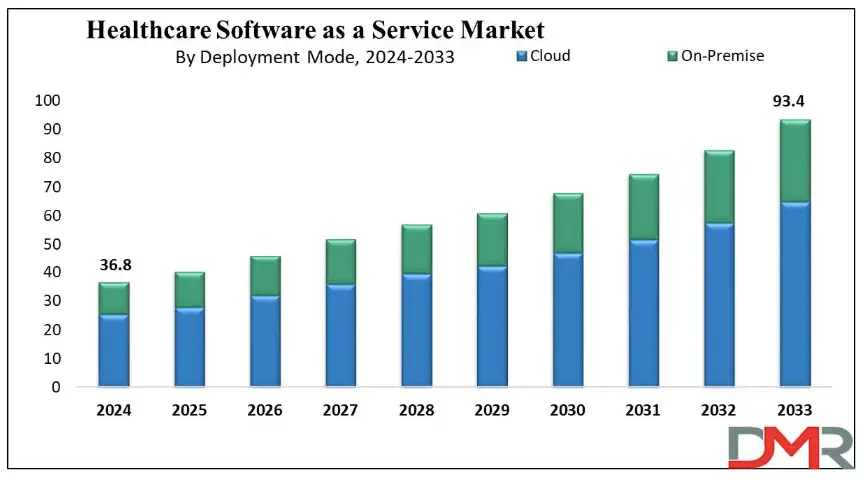
The demand for software in healthcare industry is growing rapidly around the world. According to Dimension Market Research, the global healthcare software as a service market was projected to reach about USD 36.8 billion and experts believe that this number will keep going up every year by around 10.9%, and by 2033, it can reach USD 93.4 billion which indicates that more hospitals and clinics are using this software to make their healthcare better and easier for everyone.
Benefits of Healthcare Software
Now that we have an idea about the definition of healthcare software and what it can do to the industry, let us know about some of its benefits:
1. Boost Hospital Operations
It helps hospitals run more smoothly by making tasks like scheduling, billing, and patient record-keeping much faster and easier for staff.
2. Better Data Handling
Doctors and nurses can quickly access up-to-date patient information, which helps them make better and faster decisions during treatment.
3. Cost-Effective
By reducing paperwork and cutting down on mistakes, hospitals can save a lot of time and money in their daily operations.
4. Easy Bookings for Patients
Patients can easily book their appointments online without the stress of long phone calls or waiting in line.
5. Improve Patient Care from Anywhere
Even if someone lives far from a hospital, they can still talk to their doctor through video calls and get care from the comfort of home.
6. Easy Monitoring and Health Tracking
Health apps and reminders make it easier for patients to take their medicine on time and keep track of how they’re feeling every day.
Curious how AI is transforming industries and healthcare? Explore Generative AI use cases across diverse sectors and see how it’s reshaping healthcare platforms.
Let us come to our main topic now, the types of healthcare software:
Top Healthcare Software in 2026
Having the best healthcare software is very important for making daily tasks easier in clinics, hospitals and labs. Today, many types of software in hospitals help doctors, nurses, and patients to work together and smoothly. Let’s have a look at some of them:
1. Electronic Health Record (EHR) Software
EHR software stores patient data like medications, procedures, and doctor notes which helps doctors make better decisions and often includes billing features and a patient portal for easy access to health records and prescriptions.
2. Medical Diagnosis Software
Medical diagnosis software allows doctors to share anonymized patient records to fill information gaps and improve diagnoses. It often uses AI to analyze data and suggest probable diagnoses. There are apps available for individuals to help users assess if they need medical attention.
3. Medical Imaging Software
Medical imaging software processes MRI/CT/PET scans and creates 3D models. It helps with human anatomy modeling for individual patients, like creating a 3D print of teeth for orthodontics, or designing medical equipment such as artificial limbs.
4. Medical Research Software
Medical research software aids in education and sharing research within the medical community. It trains healthcare professionals and supports diagnoses by referencing external cases, while also streamlining research processes to reduce costs and improve financial outcomes.
5. Appointment Scheduling (Booking) Software
This software helps healthcare facilities manage appointments online. It allows patients to schedule appointments through an app or website, with email notifications and automatic reminders for both doctors and patients about upcoming appointments.
6. Medical Database Software
This medical computer software stores data by disease, not by patient. It helps doctors make better treatment decisions by comparing similar cases and supports learning by offering access to detailed clinical case histories.
7. Telemedicine Software
Telemedicine software lets doctors see patients online through apps or browsers. Some tools also offer e-prescriptions and billing. It’s super convenient for both patients and doctors, which is why it’s growing fast in the healthcare world.
8. E-prescribing Software
E-prescribing software helps doctors manage prescriptions easily. They can track, renew, or cancel them digitally. It also connects with national drug databases, making the whole process quicker, safer, and more accurate for both doctors and patients.
9. Medical Billing Software
Medical billing software helps hospitals manage invoices, payments, and other financial tasks. It’s often built into larger systems like EHRs, making it easier for accounting teams to handle everything in one place, quickly and accurately.
10. Medical Equipment Management Software
Medical equipment management software helps clinics avoid manual tracking by automating maintenance schedules and sending inventory alerts. It keeps everything running smoothly and reduces the risk of missing important upkeep.
11. Hospital Management Software
Hospital management software helps hospitals handle daily tasks like billing, accounting, patient management, inventory, bed management and others. It automates these operations to make hospital workflows smoother and more efficient for staff and administrators.
12. Mobile Health (mHealth) Apps
mHealth apps make healthcare easier by helping patients book appointments, pay bills, and consult doctors online. They connect with EHR systems, so doctors can see medical records during virtual visits, improving care and saving time.
13. Laboratory Information Management Systems (LIMS)
LIMS helps labs track samples, manage test data, and stay compliant with regulations. It reduces errors, speeds up processing, and keeps lab operations smooth, making sure patients get accurate and timely results.
14. Personal Health Record Software (medical diaries)
Personal Health Record software, like the Tulipa app for Parkinson’s disease, allows patients to track symptoms, medication, and treatments. It helps generate health reports for doctor visits and alerts healthcare providers if a patient’s condition worsens.
15. Radiology Information System (RIS)
A Radiology Information System (RIS) manages and stores radiology images and results. It works alongside PACS to streamline radiology department operations, ensuring efficient image storage and integration with EHR/EMR systems for enhanced patient care.
16. ERP System
An ERP system for healthcare focuses on operational management, optimizing financial, supply chain, and human resources processes. It supports strategic planning, including expansions and mergers, without directly managing patient-facing tasks or data.
17. Pharmacy Management Software
Pharmacy management software helps control and monitor inventory by classifying medicines, ensuring adequate stock, and avoiding shortages. It also supports drug price management and integrates with prescription systems for seamless access to medication information.
18. Clinical Trial Management Software
Clinical trial management software records all the information related to the trials, such as patient information, study files, and approval from regulatory bodies. It is utilized mostly in top-class hospitals undertaking large-scale research to maintain compliance and proper trial management.
19. Health Tracking Apps
Health tracking apps assist users in tracking fitness, diet, stress, and sleep. Many syncs with IoT devices like FitBit or Oura Ring to collect data. They’re popular for making healthy habits easier and more trackable every day.
20. Remote Patient Monitoring (RPM)
Remote Patient Monitoring (RPM) enables healthcare professionals to gather patient information beyond the confines of standard settings, i.e., hospitals and clinics. RPM encompasses devices like blood glucose meters and heart rate monitors, which improve post-operative care and chronic disease care.
Looking to speed up hospital operations and reduce errors? See how AI in healthcare is making hospital management smarter and more efficient.
Ready to Revolutionize Your Healthcare Solutions?
Healthcare is changing at a lightning pace, and software is leading the charge. From helping hospitals operate more effectively to making it easier for patients to access care, healthcare software is making a difference. In 2026, these technologies will continue to expand and make care easier, quicker, and more patient centered.
At Mindpath, we recognize the need for state-of-the-art technology in the healthcare industry. Our healthcare software development services are built to improve operations, enhance patient care, and increase overall efficiency. Let Mindpath help you empower your health care business with robust, scalable, and innovative software that keeps up with the evolving healthcare environment. Let’s create a healthier tomorrow together!
Frequently Asked Questions
1. How do I choose the right healthcare software for my organization?
Choosing the right healthcare software depends on your facility size, patient volume, budget, and operational needs. Start by identifying workflow challenges, integration requirements, and compliance standards. Always look for scalable solutions that can grow with your organization and support future technological advancements.
2. Is healthcare software secure for storing patient information?
Yes, most modern platforms are built with strong security measures such as encryption, access controls, and regulatory compliance standards. However, healthcare providers must ensure proper implementation, regular updates, and staff training to maintain data privacy and protect sensitive patient information from cyber threats.
3. Can small clinics afford advanced healthcare software in 2026?
Absolutely. Many healthcare software solutions are now available through cloud-based or SaaS models, making them more affordable for small clinics. These subscription-based systems reduce upfront costs and allow smaller healthcare providers to access advanced features without investing heavily in infrastructure.
4. How does healthcare software improve patient satisfaction?
Healthcare software enhances patient satisfaction by reducing waiting times, simplifying appointment bookings, enabling digital communication, and ensuring accurate records. When systems run smoothly, patients experience faster service, clearer communication, and more personalized care throughout their treatment journey.
5. Will healthcare software replace administrative staff in hospitals?
No, healthcare software is designed to support administrative teams, not replace them. It automates repetitive tasks like billing and scheduling, allowing staff to focus on higher-value responsibilities such as patient coordination, service improvement, and overall operational management.

Have you ever pondered if machines could design, code or even personalize user experiences better than humans? Sounds like a dream, right? Well, this isn’t a dream anymore, it is the power of Artificial Intelligence. You heard it right; artificial intelligence is becoming a powerful tool in web development in today’s digital world. Want to know how AI in web development can be beneficial for you? From accelerating development to building smarter sites, AI is quietly revolutionizing the construction and experience of digital platforms.
But what does this revolution look like? And why are businesses and developers embracing AI more than ever? The answers may surprise you. Stay tuned as we uncover the ways AI is transforming the future of web development!
Are you ready to elevate your website? Contact us for top-notch AI development services and we will bring your AI-driven web vision to life.
Role of AI in Web Development
AI in web development refers to the use of artificial intelligence to build, test, and maintain websites faster, smarter, and easier to manage. It helps with writing code, fixing bugs, automating repetitive tasks, and even assisting with design. AI saves time, reduces errors, and enables developers to create more personalized web experiences. That said, human oversight remains essential for security, architecture decisions, and design consistency. AI works best as a tool that supports developers, not replaces them.
AI plays a major role in making websites better by suggesting designs, writing parts of the code and even testing how well a website works. Once the site goes live, AI can watch how people use it and make things smoother. Now you must have got a good idea about AI in web development. Let us also learn about some of its benefits:
Benefits of AI in Web Development
AI is simplifying website creation for everyone. It assists with coding, designing, and even communicating with users. If you’re creating a website or just beginning, AI can help you save time and get things to work more efficiently. Here are some easy ways it can actually help.
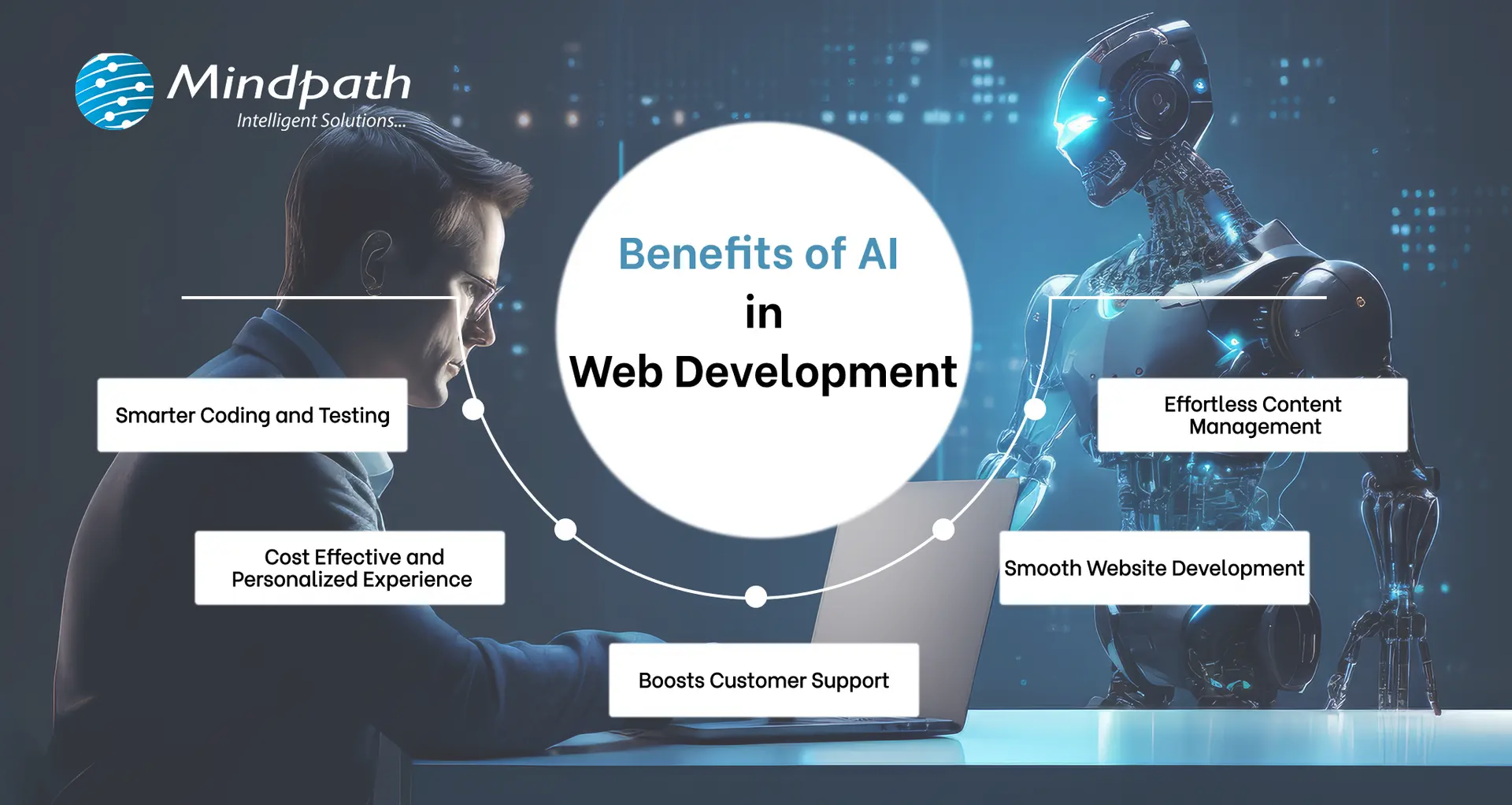
1. Smarter Coding and Testing
The powerful combination of AI and web development can help developers to write cleaner codes by spotting bugs early and improving how the code works. With deep learning, AI-based tools also facilitate automated testing, which assists quality assurance teams in verifying whether the website functions correctly. Although some problematic areas continue to require manual testing, AI streamlines the process and reduces costs. That’s one of the reasons why QA and testing budgets have declined over the past few years, and why more individuals are using AI websites for improved results.
2. Smooth Website Development
AI in web development handles mundane and time-consuming work so developers can concentrate on the larger aspects of a project. With smart tools and data-driven choices, the entire web development process becomes more efficient and faster. This is incredibly useful, particularly if you’re new to it. By using AI to create websites, you save time and effort while building something awesome and making web development feel less stressful and a lot more efficient from the very start.
3. Boosts Customer Support
AI in customer service makes it simple to integrate smart chatbots onto websites that are able to engage with visitors’ day and night. These virtual assistants comprehend questions and respond in natural, friendly terms. They provide instant answers, resolve issues rapidly, and never require breaks. This allows owners of websites to assist users without requiring a support team full-time. It’s an easy method to ensure visitors are satisfied and that they always receive assistance, even when there is no one present.
4. Cost Effective and Personalized Experience
With the help of AI tools, websites are now able to provide customers with a more personalized and seamless experience at reasonable costs. Work that required time can now be processed automatically, saving time for both users and website owners. AI also assists in identifying fraudulent or toxic activities, protecting users. This is why many top AI websites utilize intelligent features to serve customers better. Ultimately, AI assists in providing more value to the customer at a low cost.
5. Effortless Content Management
Website content management becomes a lot simpler with the assistance of AI. Through analyzing user behavior on a website, AI provides clear concepts regarding what type of content users like most. Website owners can develop improved posts, videos, or pages that genuinely interest visitors due to this. With the assistance of AI web templates and smart recommendation tools, you can lead users to whatever they require and retain them for a longer period. It’s an easy way to make content better and make each visit feel more personal.
Is your business making the most of AI to stay ahead of the competition? Explore how integrating AI in your business strategy can optimize processes, drive growth, and improve decision-making.
How to Use AI in Web Development?
Today, web development thrives on the partnership between AI and human expertise. While AI handles repetitive tasks and enhances efficiency, it still relies on human creativity and problem-solving. Here’s how you can use AI in web development to streamline your process and improve results.
1. Artificial Design Intelligence (ADI)
Artificial Design Intelligence (ADI) assists you in creating a complete website by simply responding to a few simple questions. It selects the most suitable layout, design, and content depending on your requirements. It’s like having an intelligent assistant that designs a professional-looking site that reflects your style and objectives. This AI website generator makes the process fast and efficient, ensuring you get the site you want with minimal effort.
2. Search Easier with Voice Assistants
Rather than typing and reading lengthy pages, users can simply speak their question. Voice AI listens, the correct answer quickly, and voices it back. Voice AI assists websites in providing rapid and clear responses, speeding up searches, making it easier, and more accessible to all.
3. Coding Assistants
Developers can use smart coding assistants to speed up their work. These tools suggest code, spot errors, and help build websites faster. Even when working on big ideas, they take care of the small stuff. It’s like having a smart helper while writing your code.
4. Personalize User Help with Chatbots
AI chatbots make it easy for users to get the info they need. They can ask questions in simple language, and the bot instantly provides answers or links. The benefit of chatbot is that it provides fast, accurate responses, making the experience more personal and efficient by using the website’s content.
5. Easy Search Engine Optimization (SEO)
AI can make SEO much easier by providing the best keywords, topics, and headlines for your content. It can even write parts of your text, ensuring the right keyword density for better search engine rankings. This helps your website attract more visitors without the hassle of manual research.
AI is reshaping industries by automating the processes, empowering faster decision-making, and providing data-driven insights. Learn how AI is e-commerce is transforming the future of e-commerce sector.
Ready to Transform Your Website with AI?
AI is changing web development by making tasks faster and more efficient. From designing and coding to improving user experience, AI helps developers focus on what truly matters. By integrating AI, your website can become smarter, more personalized, and easier to manage for everyone involved.
Mindpath offers top-tier AI development services and delivers high-performing artificial intelligence solutions that enhance your website’s design, performance, and functionality. Our expert team utilizes AI tools to streamline processes, boost user experience, and create custom solutions.
Frequently Asked Questions
Can you imagine a scenario of walking into a hospital where doctors are assisted by intelligent machines which can predict diseases, suggest treatments and even monitor your health in real time? Sounds futuristic, doesn’t it? Have you ever pondered how artificial intelligence is transforming the future of healthcare? Well, that’s precisely where AI in healthcare stands out! Interested to know more about this unique combination of AI and healthcare? Let us learn more about it!
Want to deploy AI solutions that drive smarter medical decisions and improve patient experiences? At Mindpath Tech, we provide healthcare software development services designed to make technology work seamlessly for your organization.
Role of AI in Healthcare
AI in healthcare refers to the use of artificial intelligence to assist doctors and nurses in hospitals and clinics. These programs look at a lot of medical data such as test results and scans and find patterns which can help in detecting health problems of patients early. They can even help in suggesting the best treatments based on each patient’s health history. Not only this, but AI is also used to carry out routine tasks like setting appointments or checking records, so that staffs can get more time to care for patients.
The benefits of AI are being used in many parts of healthcare. It is helping doctors to read X-rays and scans so that health problems can be spotted earlier. Intelligent robots will assist doctors to perform surgery with ease. AI assists researchers in discovering new drugs at a quicker rate by analyzing vast amounts of information. Even patients can use AI-based apps to monitor their health and receive reminders about taking medications or adhering to treatment regimens.
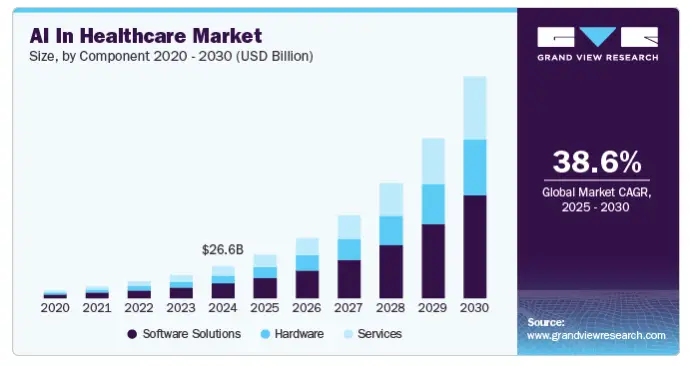
According to a Grandview’s Market Research Survey, the worldwide AI in healthcare market was valued at more than 26 billion dollars in 2024, and it’s expanding very quickly. Experts predict that it can expand by as much as 39% annually until 2030. Why? Because more clinics and hospitals want to work faster, make fewer errors, and help patients feel better sooner.
Benefits of AI in Healthcare
Hospitals nowadays are challenged with providing quicker and improved care with fewer resources. Technologies such as AI are assisting them in doing it more effectively. following are some advantages of AI in Healthcare that is important to know:
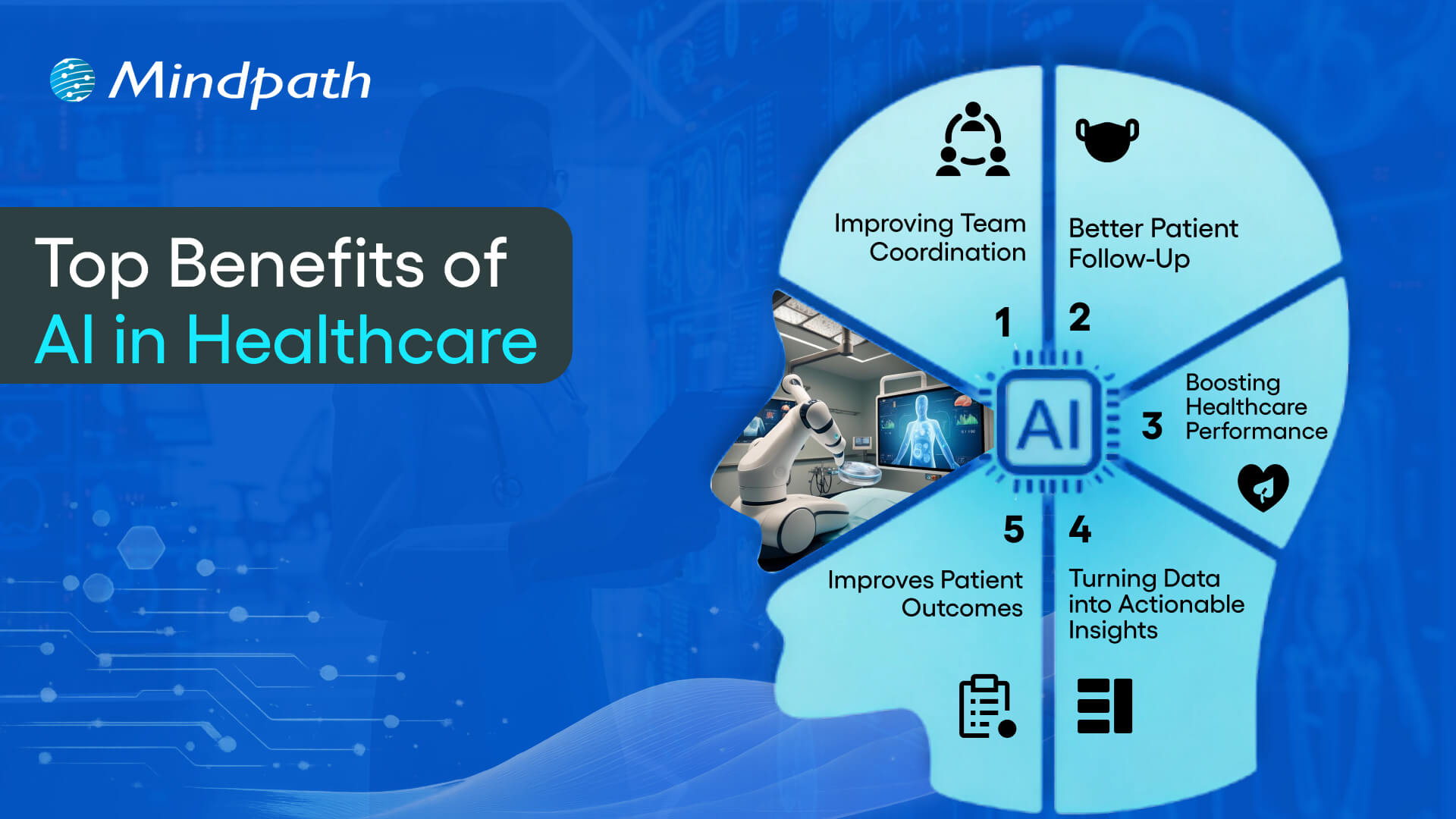
1. Improving Team Coordination
AI for healthcare facilitates easier sharing of critical patient information among doctors and nurses. It consolidates everything into a single place to enable teams to communicate with each other easily and quickly. This translates to quicker decisions, improved treatments, and more efficient teamwork. AI for hospitals enables various departments to communicate with one another, which is crucial during emergencies. When everybody has the proper information at the right moment, patients receive their care on time without confusion or delays.
2. Better Patient Follow-Up
AI assists hospitals in tracking patients and ensuring that they do not miss any important check-ups. By identifying potential health problems early, AI facilitates doctors to act early and administer the appropriate care. This ensures that patients are treated on time and follow-ups are handled more efficiently. Hospitals can track patients more efficiently with AI, resulting in improved long-term care and healthier patients. AI consulting services can guide hospitals in selecting the right tools and workflows for patient monitoring.
4. Boosting Healthcare Performance
AI in medical field enables healthcare systems to achieve significant objectives, referred to as the quadruple aim. The aims prioritize better patient care, low healthcare expenses, facilitation of medical staff, and enhanced overall health. Thanks to AI, hospitals can individualize care, minimize waiting times, and optimize the entire process. This results in improved patient outcomes, reduced expenses, and a healthier, less stressful medical team.
5. Turning Data into Actionable Insights
Hospitals can use AI to gather and organize a lot of data from various sources. This enables doctors and nurses to make quick and easy decisions. By making all that information useful, medical teams are able to provide patients with more accurate and timely care. This streamlines the process, eliminates errors, and ensures that patients receive the proper treatment based on current information available.
6. Improves Patient Outcomes
Patients receive faster and more precise treatment with the use of AI in healthcare. It assists doctors in identifying health issues earlier and making the correct decision on treatment without wasting time. This results in quicker admissions, reduced hospital stays, and improved recovery. Everything goes more smoothly, and patients are more comfortable. By making the care process more efficient, this technology promotes improved health outcomes and allows hospital staff to spend more time in taking care of patients.
Looking to understand which programming languages are best for developing AI solutions? Explore our blog on AI Programming Languages to gain practical insights to get started.
Let us now look at some of the real-world AI in healthcare examples that show how this technology is being used to improve patient care, speed up diagnosis, and support medical teams in everyday hospital tasks:
Real World AI in Healthcare Examples
These artificial intelligence examples in healthcare highlight how hospitals are using AI to improve diagnosis, speed up treatment, and support better decisions. Each example shows the positive impact of AI in daily medical practice:
1. Faster MR Scans
AI accelerates MRI image acquisition, allowing radiology departments to manage more patients more effectively. AI enhances image quality, reduces scanning time, and increases patient comfort, particularly for patients who are anxious or experience pain during the test.
2. Smarter CT scans
AI helps ensure patients are correctly positioned for CT scans, reducing errors and improving image quality. It also enhances image reconstruction, supporting better diagnostics while helping radiology teams work more efficiently with consistent and clear results.
3. Assist in Image Reading for Radiologists
AI assists radiologists by highlighting areas of interest in medical images and supporting segmentation tasks. This allows them to focus on deeper analysis and make quicker, more confident decisions, ultimately improving both workflow and patient care.
4. Better Teamwork in Cancer Care
AI brings together data from radiology, pathology, genomics, and health records to give a clear view of a patient’s condition. This helps care teams make faster, more informed decisions to guide personalized treatment and improve outcomes.
5. Guiding Doctors in Surgery
AI helps doctors during minimally invasive procedures by quickly analyzing CT images and sharing results across teams. It supports accurate planning and guidance, helping physicians work more efficiently and make timely decisions for better patient care.
6. Simplifying Ultrasound Measurements
AI streamlines ultrasound by automating measurements, reducing manual effort and variability. It ensures fast, consistent results, allowing healthcare professionals to focus on clinical judgment while enhancing diagnostic accuracy and improving the experience for both patients and staff.
7. Remote Cardiac Patient Monitoring
AI-powered analysis of remote ECG recordings enables early detection of heart rhythm disturbances like atrial fibrillation. This allows clinicians to provide faster, more efficient care, enhancing patient outcomes by offering timely and proactive cardiac treatment outside the hospital setting.
Wondering how healthcare organizations can implement AI effectively and achieve better patient outcomes? Read our blog on the role of AI consultant explains how expert AI consulting can guide healthcare providers in overcoming challenges, and unlocking the full potential of advanced technologies.
Ready to Embrace the Future of Healthcare with AI?
AI is revolutionizing healthcare by simplifying operations, enhancing diagnosis accuracy, and facilitating quicker, more tailored treatment. By automating mundane tasks, AI enables healthcare workers to spend more time on patient care, leading to better overall outcomes. With its ability to process large volumes of data, AI also facilitates proactive interventions, minimizing errors and enhancing efficiency in hospitals globally.
At Mindpath, we offer healthcare software development services with expertise in using the latest AI technology to develop innovative solutions for medical facilities. Our tailored AI-powered platforms enhance hospital efficiency, provide smooth patient care, and enable medical staff to make informed decisions with ease. Learn how Mindpath can assist in revolutionizing your healthcare practice with innovative solutions designed specifically for you.
Frequently Asked Questions

How do hospitals maintain and keep everything running smoothly? Starting from patient records to important surgery schedules, billing and staff coordination, each and everything is well maintained and smooth, isn’t it? Are you curious to know what’s behind this? Well, it’s Hospital Management System (HMS) which does the magic in handling hospital operations smoothly.
Are you confused about what does it mean and why is it essential for modern hospitals? Don’t worry, we have got you covered! This blog will walk you through everything you need to know about HMS. So, let’s dive in to learn!
Is your Hospital Management System keeping up with today’s healthcare demands? Mindpath provides Healthcare Software Development Services that help healthcare organizations build smarter systems and deliver better patient outcomes.
What is a Hospital Management System?
A hospital management system (HMS) is a type of software that helps hospitals manage everything effortlessly. It allows the doctors, nurses and other staff of a hospital to collect, store and share patient data in a secure and organized way. With the help of this system, the medical teams can easily get access to records such as X-rays, prescriptions and other important documents of patients.
In most of the hospitals, doctors, nurses and the staff spend a lot of their time doing paperwork which can slow down things and also impact the patient’s overall experience. HMS can help in reducing the workload by handling many tasks automatically. It can bring all the necessary information and tools into one place which can help hospitals run their daily operations more proficiently with less delays.
As per Market Research Future (MRFR) analysis, the global Hospital Management Software Market was valued at USD 29.33 billion in 2024. It is projected to reach USD 54.20 billion by 2034, growing at a rate of 6.33% annually between 2025 and 2034. This growth shows the increasing demand for smarter, more connected healthcare systems.
Now that you have a clear idea about what HMS is, there is a major question that arises:
What is the Function of HMS?
When a hospital begins implementing HMS, numerous day-to-day activities are simplified and streamlined. An HMS assists personnel in focusing more on patients and less on documentation. Let us discuss some important functions that make this system so valuable:
1. Scheduling Appointments
HMS facilitates patients to schedule appointments easily and doctors’ schedule efficiently which can eliminate confusion and lengthy waiting times.
2. Patient Data Management
It stores all the patient records including medical history, test results as well treatment details which can help doctors and nurses to quickly access the right information when needed.
3. Handling Billing and Invoice
It makes the billing process faster and more accurate by handling everything, from bill generation to payment tracking as well as insurance processing.
4. Inventory Management
Hospitals can keep track of medicines, equipments and supplies which helps in avoiding shortages and guarantees everything is available on time.
5. Reporting and Analytics
The system provides useful reports on hospital performance and operations, which helps in planning and improving services.
6. Communication
It facilitates easier communication between doctors, nurses and patients to remain connected and exchange crucial updates, resulting in improved coordination and care.
7. Integration with Other Systems
Hospital management software can easily integrate with other systems such as electronic medical records so that everything is integrated into one place with a complete view of every patient’s care experience.
Struggling to improve efficiency and patient outcomes in hospital operations? Discover how AI in healthcare is transforming hospital management with intelligent automation and data-driven insights.
Let us learn about some of the key benefits if you’re looking for more information about hospital management system:
Key Benefits of Hospital Management System
A good hospital management software system can make a huge difference in how smoothly a hospital runs. It assists both staff and the patients by improving the quality of care and simplifying daily tasks. Here are some major benefits of you can expect:
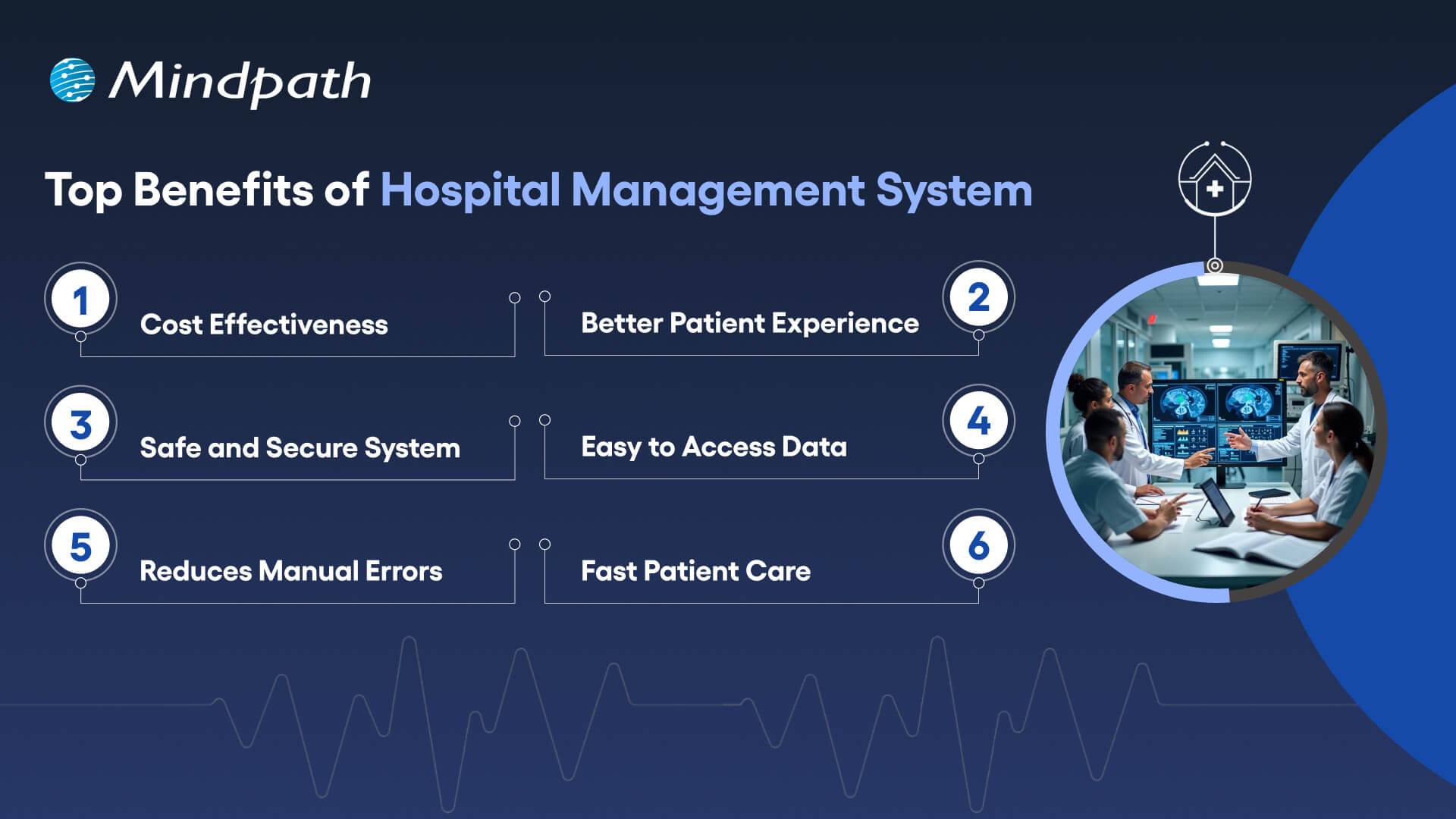
1. Cost Effectiveness
With everything automated and systematized, hospitals are able to cut down on paperwork, labor costs, and wastage of supplies. It also aids in improved planning and utilization of resources such as medicines and equipment. This reduces unnecessary costs and makes the operations more cost-effective, enabling the hospital to utilize its budget where it’s actually needed.
2. Better Patient Experience
Patients are able to schedule appointments with minimal waits, receive follow-up reminders, and view their reports online. It makes them feel more in charge of their treatment and less anxious. It makes everything easier, from arrival to discharge, which results in a more pleasant, efficient hospital stay for each patient.
3. Safe and Secure System
Patient data is stored securely and shared only to permitted staff members. This protects information from abuse or loss. A secure system ensures trust between patients and the hospital, and ensures appropriate processing of sensitive information while keeping the hospital in line with privacy and security regulations.
4. Easy to Access Data
All medical information such as treatment history, test reports, and medications are kept in one place. Doctors, nurses, and medical staff are able to access this info quickly from various departments. This streamlines treatment and prevents the need to repeat tests or inquire about the same information from patients repeatedly.
5. Reduces Manual Errors
The system maintains accurate and up-to-date information, preventing staff from making mistakes such as providing the wrong medication or omitting important steps. Access to information in real time eliminates confusion, enhances coordination, and ensures that doctors adhere to the proper treatment protocols based on the most current and comprehensive patient information.
6. Speed Up Patient Care Process
When doctors and staff have quick access to patient records and reports, they can make faster decisions. Automated tasks like test scheduling and report delivery save time. This helps patients get the care they need without delays, which is especially important in emergency or critical care situations.
Curious how AI is transforming industries and healthcare? Explore Generative AI use cases across diverse sectors and see how it’s reshaping healthcare platforms.
Ready to Upgrade Your Healthcare System?
A hospital management system can really make a difference in how a hospital operates. From enhancing patient care to accelerating operations and minimizing mistakes, HMS makes hospitals more efficient, well-organized, and responsive. Be it scheduling appointments, record management, or cost-cutting, HMS makes everything more efficient and reliable for patients and staff alike.
At Mindpath, we specialize in delivering modern healthcare software development services that make hospital processes faster and smarter. Whether you’re planning a full hospital management system project or need a custom solution for specific tasks, we’re here to help.
As a trusted healthcare app development company, we focus on building secure, user-friendly, and high-performing digital solutions. Our team understands the needs of healthcare and creates tools that support doctors, staff, and patients every step of the way.
Frequently Asked Questions
1. Why is a Hospital Management System important for modern healthcare facilities?
A Hospital Management System helps hospitals handle complex operations in a structured and digital way. As patient volumes grow, manual processes become inefficient. HMS ensures better coordination, faster access to information, improved compliance, and smoother workflows, helping healthcare facilities deliver consistent and quality care.
2. Can a Hospital Management System be customized for different hospital sizes?
Yes, a Hospital Management System can be customized based on the size and needs of the hospital. Small clinics may require basic modules, while large multi-specialty hospitals need advanced integrations, analytics, and multi-department access. Flexible architecture allows the system to scale as the organization grows.
3. How does HMS support regulatory compliance in healthcare?
HMS helps hospitals maintain accurate digital records, secure patient data, and track treatment history systematically. Automated documentation and audit trails make it easier to comply with healthcare regulations and data protection standards. This reduces legal risks and ensures transparency in hospital operations.
4. What technologies are commonly used to build a hospital management system?
Modern systems are built using cloud computing, secure databases, API integrations, and sometimes AI-driven analytics. These technologies enable real-time data access, system interoperability, and remote accessibility. Strong cybersecurity frameworks are also implemented to protect sensitive medical information.
5. How long does it take to implement a Hospital Management System?
Implementation time depends on hospital size, required features, and integration complexity. Basic setups may take a few months, while large-scale systems with multiple modules and integrations can take longer. Proper planning, staff training, and phased deployment ensure smoother adoption and minimal operational disruption.

Have you ever pondered why most of the businesses are in search of React development company? Are you curious to know why choosing the right development partner is important? If yes, you’ve reached the right place!
React, a JavaScript library that was developed by Facebook, is very popular for the development of fast and interactive user interfaces. It has a component-based structure and offers flexibility for developers to put out smooth, scalable and high performing web applications. It focuses on creating interactive elements for web applications, particularly single-page applications (SPAs), where content updates dynamically without reloading the page. Due to these benefits, many businesses are relying on React to enhance their digital experience.
But selecting an appropriate React development company is as crucial as the technology itself. The right team can guarantee that your business objectives are met with precision and efficiency. This blog will guide you through the advantages of choosing the right partner for your React needs as well as the factors to look for in a ReactJS development firm. So, let’s explore!
Looking for a reliable ReactJS development company? Mindpath is leading provider of ReactJS development services aimed at creating impactful and scalable applications that deliver concrete business outcomes.
Advantages of Partnering with a React Development Company
Partnering with an appropriate ReactJS development company can offer many benefits and it is very important to know what they bring to the table and how they work. Here are a few benefits you should know before making your choice:
1. Customized ReactJS Solutions
A dependable ReactJS development company understands that every business has requirements. By offering customized solutions, they guarantee that the final product aligns with your goals. They can adjust features, improve functionality, and design a user-friendly interface to match your business requirements. With customizable ReactJS development services, the company guarantees your web application is not just practical but optimized to support your growth and success. This personalized attention can help in building a product that meets your exact requirements, fostering competence and improving user experience.
2. Faster and Smarter Development
Utilizing ReactJS services can help to speed up the whole development process, so, an expert team follows a clear and organized method that improves how quickly and smoothly the work gets done. With automation and collaboration support tools, they can create your project faster without sacrificing quality. They usually follow agile practices, which include breaking the work into smaller pieces, getting feedback, and adjusting accordingly. This way, your application is delivered in a short time, with fewer bugs, and better results.
3. Ongoing Support after Development
Reliable ReactJS development companies do not consider their work finished once a project goes live; a good company provides continued assistance and support to ensure the website or application runs smoothly. This means troubleshooting and resolving bugs, implementing minor changes, and providing ongoing maintenance. With good ReactJS services, you receive regular maintenance to ensure your application is performing well and updated. If anything goes wrong, the team will be able to fix it with ease. This type of support fosters trust and ensures that your business remains stable in the long term by keeping your digital solution up to date and trouble-free.
4. Strong Emphasis on Quality
Quality remains a top priority for businesses when building web applications. A React development company with expert teams adheres to strong testing methods to make sure everything works as expected. They check the code, design, and features at every stage of the project. This identifies errors early, corrects them prior to the final delivery and makes the final product smooth, dependable, and ready for actual users. By focusing on quality, ReactJS development agencies ensure that applications delivered are of high standards and work effectively.
Are you missing out on the potential efficiency ReactJS offers for modern web apps? Discover the essential benefits of ReactJS development services to maximize your investment.
Key Factors While Choosing a ReactJS Development Company
While choosing a ReactJS development agency, you must pay attention to a few things. Each company has its own way of working and it’s crucial to know what makes one stand out from the rest. The following are some of the important considerations you must look for:
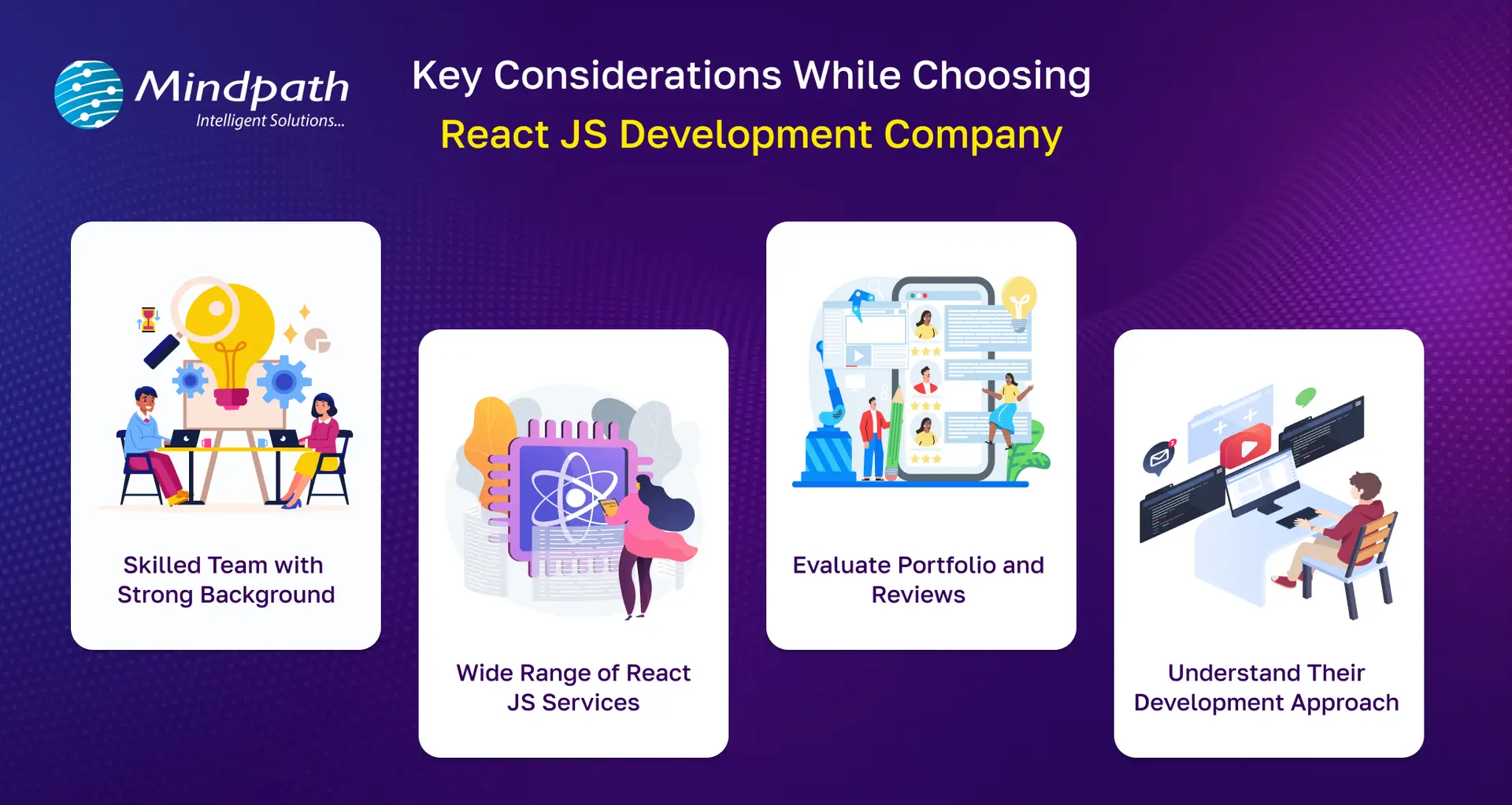
1. Skilled Team with Strong Background
When selecting a team for your ReactJS application development, it is essential to look at their previous records. A team with good experience and expertise will easily be able to deal with complex tasks. They must have developed various types of web or mobile applications for different companies which indicates that they know what fits best in a situation. Experienced teams can identify and fix problems in less time and develop better apps suitable for your needs.
2. Wide Range of ReactJS Services
It is crucial to select a team that provides a complete spectrum of ReactJS development services. This includes custom ReactJS application development, UI/UX design, and React Native mobile app development. The team should also be able to take care of API integration, backend development, and performance optimization. Also look for those who provide migration services to bring your current system up to date and offer ongoing maintenance and support to make sure your app is running smoothly in the long run.
3. Evaluate Portfolio and Reviews
Looking at previous projects and client reviews of a React development company helps you understand their skills and how satisfied their clients are. You can search for reviews on websites like Clutch, GoodFirms, and Trustpilot. These reviews show how well the team communicates, fix issues, and delivers results. A strong portfolio with positive feedback indicates that the team has experience and a good reputation, which gives you confidence in their ability to handle your project successfully.
4. Understand Their Development Approach
One should always know the development process of the team to ensure it suits your business needs. Most developers employ agile practices, which enable them to implement changes easily and remain flexible throughout the project. This implies they can adjust to any issue that comes up. An organized process ensures that the end product is according to your objectives and matches your expectations, especially in the case of ReactJS development, where flexibility and productivity are the key to providing high-quality output on time.
Want to understand how much your business should invest in skilled ReactJS talent? Learn the real cost of hiring ReactJS developers to make informed financial decisions.
Looking for ReactJS Development Services?
Selecting the appropriate React development firm can literally make all the difference in the performance of your application and the success it brings to your business. From customization and speed to quality and maintenance support, every aspect is a crucial consideration for ensuring your success. Investing time to consider experience, services, and working methodologies will guide you to the best team.
At Mindpath, we provide professional ReactJS development services with years of experience and innovation underpinning our work. If you need to hire ReactJS developers who know your needs inside out and can provide you with efficient and scalable solutions, we’re here to assist you in growing.
“Necessity is the mother of invention.” We have all encountered this phrase in our science textbooks or while reading about most scientific innovations. Be it the invention of the cell phone, the internet, or the World Wide Web, each of these has brought a paradigm shift in the world of technology.
While technology is rapidly expanding its horizon, Artificial Intelligence remains the buzzword that every business can’t stop gushing about. Generative AI, a subfield of artificial intelligence, has gained massive momentum post the launch of ChatGPT by OpenAI in 2022. Since then, generative AI use cases have found their way in some of the major industries, including healthcare, banking & finance, gaming, and supply chain, to name a few, marking the beginning of the Gen AI revolution.
But what is Generative AI? Is it only limited to text or image generation, or can it help in other fields as well? In this blog, we will be answering some of the burning questions around Generative AI and generative AI use cases across industries.
Want to implement cutting-edge GenAI solutions in your company? Mindpath offers end-to-end Generative AI Development Services for deploying generative AI applications efficiently.
Introduction to Generative AI
Let’s start with the basics: what is Generative AI? Generative AI is a subset of artificial intelligence that creates novel content, such as text, images, audio, video, and code, in response to user prompts. Rather than merely analyzing existing data, it uses deep learning models to predict and generate entirely new outputs based on patterns learned from vast training datasets.
Think of it as a magic lamp that fulfils many of your creative and analytical needs! With the help of machine learning models and neural networks, large volumes of data are analyzed, patterns are discovered, and new content is generated.
Here are some of the key components of Generative AI:
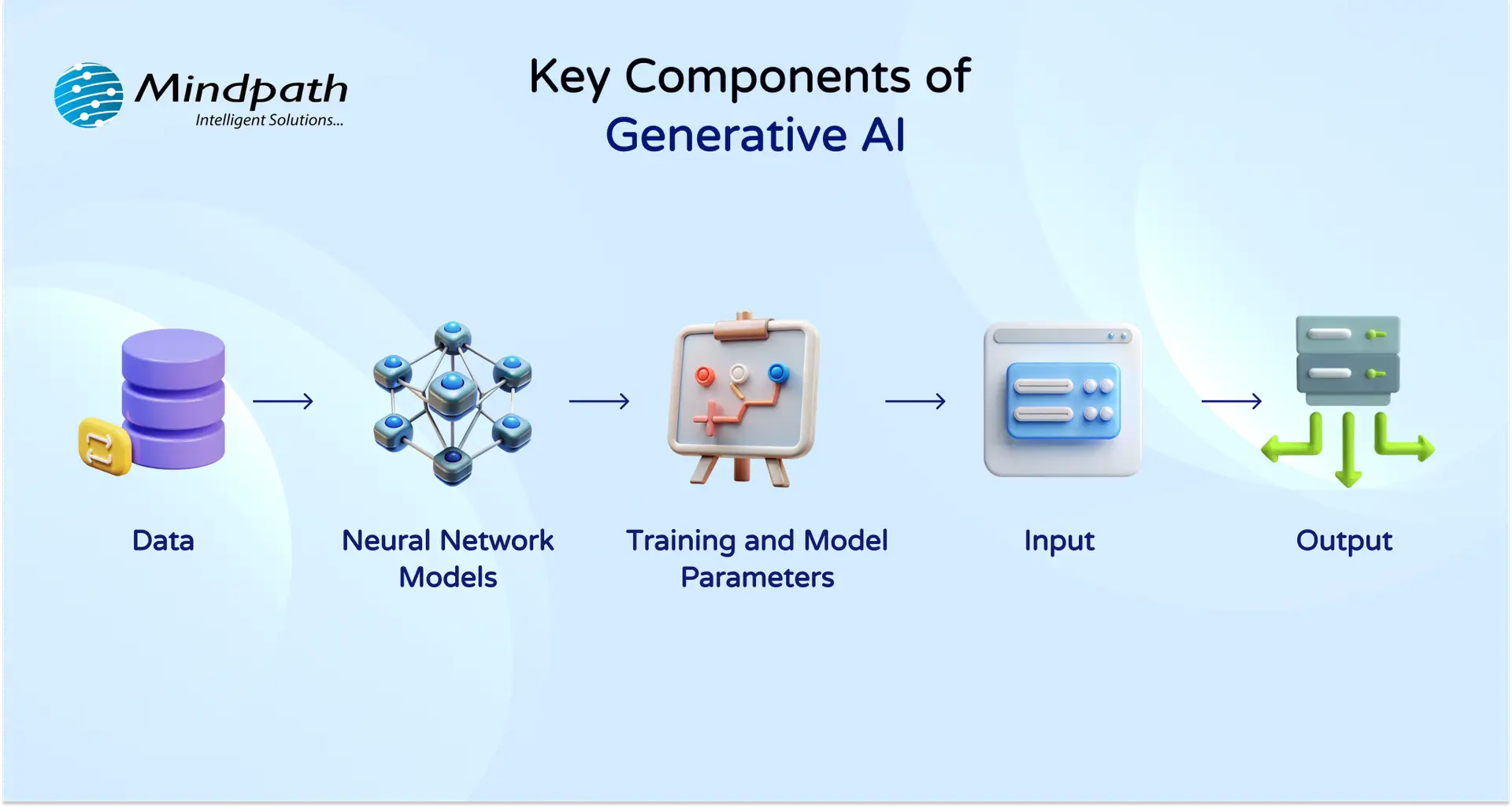
- Data: Raw data such as documents, eBooks, ledgers, images, videos, codes and a lot more that Generative AI uses to learn.
- Neural Network Models: They work just like a human brain; they help AI models to make sense of all the raw data we have put in the model.
- Training and Model Parameters: There are some parameters that help AI models fine-tune the information, cut the noise and generate accurate output.
- Input: When you ask a Gen AI model to create a cover letter for a job, create a report based on Excel data, generate a Ghibli image to roll with the current trends, that’s categorized as an “input”.
- Output: Whatever results a Gen AI model, such as ChatGPT, MidJourney, Bart, delivers for your query is the output.
Generative AI is gaining momentum, with a global market valued at USD 37.89 billion in 2025 which is projected to reach USD 1,005.07 billion by 2034 at a CAGR of 44.20%. (Source: Precedence Research)
Generative AI Use Cases Across Industries
While Gen AI is growing, curating a business-first roadmap for its adoption is important for those seeking to leverage it to its fullest advantage. Now that we have explored what Generative AI is, let’s move on to some prominent generative AI use cases in different industries, proving that it’s more versatile than we know!
1. Healthcare
According to a recent survey by Deloitte Center for Health Solutions, 75% of leading healthcare companies across the globe are either currently experimenting with generative AI or planning to scale Gen AI in the near future.
In what area, you may wonder? Generative AI healthcare is being used to maintain patient records, drug discovery, interpreting and analyzing medical images such as X-rays, CT scans, MRIS, to mention a few.
Scientist are using generative AI for modelling molecular structures that can help not just in creating new drug compounds but also in predicting their effectiveness.
92% of healthcare leaders see a promising future of generative AI in improving efficiency as well as speeding the decision-making in critical scenarios.
2. Banking
Next up is the banking and finance industry. Generative AI in banking is fueling the fintech revolution in more ways than one. Generative AI is currently being leveraged for detecting fraud, assessing the credit score or credit risk based on the creditworthiness of an individual or an entity, customer support, automating routine tasks and compliance checks, creating investment strategies, among others.
A recent report by KPMG revealed that around 76% of banking executives in the United States are planning to implement Gen AI for fraud detection and prevention, while 62% want to leverage it to improve their customer service, followed by 68% of professionals that believe Gen AI can be best used for regulatory compliance.
3. Gaming
One of the most exciting areas for generative AI applications could be gaming. According to Statista, over one-third of game developers across the globe are already using Gen AI tools in their studios. PCG, which stands for Procedural Content Generation, is the largest segment of the gaming industry where almost 30% gen AI is being used currently. PCG helps game developers create larger than life game world, environment and universe that intrigues the players and gives them a more immersive experience.
Other than PCG, some other significant generative AI use cases in gaming include developing characters, detecting bugs, generating real-time content like new levels and challenges, and detecting any kind of irregularities or security breaches or threats.
Wondering how AI can help your business to reach the exceptional level of growth? Read our blog to learn about the importance of generative AI for business.
4. Supply Chain
When it comes to adopting Gen AI, the supply chain industry is no stranger to it. In fact, McKinsey’s survey revealed that a third of global businesses are effectively using generative AI in business areas, including operation processes automation (66%), production planning and scheduling (47%), quality control and inspection (44%), and inventory management (43%).
Gen AI can support the supply chain industry with better demand forecasting, optimizing day-to-day operations, assessing and controlling supplier risks, quality control, fraud detection, and much more!
5. Other Industries
Apart from the above-mentioned industries, use cases of generative AI are prevalent in other industries such as sales and marketing, insurance, legal and compliance, human resources, product development, and many more.
While many still utilize gen AI for content, image and code generation, the applications are certainly above and beyond. However, leveraging gen AI comes with its own set of challenges. Being AI-ready is in demand for every industry and business seeking to adapt and leverage AI to its advantage. There’s no one-size-fits-all guidebook or roadmap for AI adoption; rather, each business and industry needs to understand its niche and create a roadmap that generates true value.
Wondering how generative AI is influencing content creation and design strategies? Check out our blog generative AI changing creative industries to see how AI-driven creativity is shaping the future of industries.
Ready to Embrace Innovation with Generative AI?
Generative AI is expanding its horizon, and businesses have started to realize its true potential. While Gen AI continues to grow, it’s critical to assess all of its aspects that involve data security, lack of information, and overdependence.
Businesses looking to adapt AI must look beyond the hype and create a strategy that works for them. At Mindpath, we help businesses create solutions that are based on their real pain points rather than creating just another software. When you talk to us, we attempt to understand your operations and what may work to make them more efficient.
Our customer-first approach helps us identify gaps and curate a solution that works for you. Thus, if you’ve been wanting to adopt AI, the right time is now! Let’s discuss how our AI development services can help you make the best of up-and-coming technologies and get your business future-ready!