

Latest Insights On

GenAI, Tech, and Digital Transformation 

Stay updated with expert insights, success stories, and real-world applications of cutting-edge technology.

hire node js developers

In this new age of technology, speed and performance are more important than ever. If you are creating an enterprise chat application, an e-commerce site or a custom dashboard, the right technology and right people behind it can be a game-changer. It’s the time to think smart, if you are aiming to stay ahead in the competitive market. Well, choosing to hire Node.js developer can help you build fast, scalable and reliable web applications that can match your business goals perfectly. 

Node.js is relied on by some of the world’s largest brands due to its event-based architecture and non-blocking I/O model. Node.js enables developers to support numerous connections at the same time, leading to extremely efficient backend systems. When you recruit Node.js developers, you’re hiring professionals with experience in optimizing performance while maintaining minimal development expenses. In this blog, we will look at the primary reasons why you should hire Node.js developers to be a great business decision for your growth and success. 

Mindpath offers expert Node.js development services that are intended to transform your ideas into applications. Our developers have the knowledge and skills necessary to ensure the success of your project.

Overview of Node.js

Node.js is an open-source platform that allows developers to execute JavaScript on the server, rather than just in the browser. It’s built upon Google’s V8 engine, which is very fast, so it can execute tasks efficiently. Node.js allows developers to utilize the same language to code the front and back ends of a website, which means that building stuff is easier and quicker.

What is so special about Node.js is how efficiently it can deal with lots of users simultaneously without lagging. This is perfect for real-time applications such as chats platforms or live streaming. It’s also simple to scale up your business, so even if your users increase, Node.js can keep up with it. And there are thousands of pre-built tools available through npm that make it easier for developers to create better apps without having to build them from scratch. 

With the increased demand for Node.js, hiring Node.js developers has also become essential. Let’s find out what benefits Node.js developers can offer:  

Why Hire Node.js Developers?

Node.js is becoming a top choice for businesses that need swift and responsive web solutions and seasoned developers can unlock its full potential to create glitch-free, real-time applications. These are the reasons to hire Node.js programmers for your next project: 

1. Build Apps that Grow With your Business

One big reason to bring in Node.js developers is their skill in building apps that grow with your business. As more people use your app, it needs to handle lots of users at the same time without slowing down. Node.js developers know how to make that happen. They use smart ways to manage traffic and keep everything running smoothly. Whether you’re starting small or expecting fast growth, they build your app ready for the future. If your app needs to respond quickly, handle real-time updates, or manage lots of users, these developers can handle that expertly. 

2. Affordable Development with Great Results

Using tools that don’t cost extra helps keep your project budget friendly. Developers skilled in Node.js know how to make the most of this free technology to build reliable and fast apps. Their experience means they can deliver quality work without unnecessary expenses. This balance of cost and performance makes a big difference for businesses looking to grow without overspending. With their help, you get a well-built application that won’t drain your resources but still meets your needs perfectly. 

3. Creating Interactive and Real-Time Experiences

When you want apps like chat, games, or teamwork tools that work instantly, developers with Node.js skills are the right choice. They understand how to build systems that don’t slow down, even when many users are active at once. Their work makes sure your app can handle lots of requests without waiting around, so everything feels fast and smooth. This means users can enjoy real-time updates and seamless interactions. Having these developers means your app will stay quick and responsive, giving your users a great experience every time they use it. 

4. Expertise in NPM

A good Node.js development company can offer you node.js developers who are experts in using NPM (Node Package Manager), the built-in tool that helps add new features quickly. Instead of building everything from scratch, these developers can easily find and use ready-made packages to speed up the process. This means your app can get new functions faster and updates happen smoothly. Their experience with NPM helps save time and effort, so your project moves ahead without delays. Hiring them means your app gets built efficiently while still being flexible for future changes.  

5. Offer Full Stack Development

With Node.js development, you get developers who can build both the front-end and the back end of your web app. They use the same language, JavaScript, for everything, which makes the process faster and more organized. These developers know how to create what users see and also set up the systems that keep your app working in the background. This means you don’t need two separate teams. It saves time, avoids confusion, and helps your app run smoothly from start to end. It’s a simple and smart way to get full-stack development done right. 

6. Perfect Fit for Microservices Architecture

Node.js developers are great at building apps using microservices Architecture. These are small parts of an app that can work on their own but also connect with other parts when needed. This makes the whole app easier to build, change, and grow. If one part needs an update, they can fix just that part without touching everything else. It keeps things flexible and clean. With Node.js developers, your app becomes easier to manage and ready to scale as your business grows. It’s a smart way to handle complex web apps without making things messy. 

7. Easy Accessibility

Node.js developers are easy to find because Node.js is based on JavaScript, a language most developers already know. This means that they don’t need much training to get started on your project. They can jump in quickly and begin working without long delays. This makes the whole process faster and smoother for you. Whether you’re starting something new or growing an existing app, having developers who already understand the tools saves time and effort. It’s a simple and smart choice when you want things done efficiently and without hassle. 

Ready to Build Powerful Applications with Node.js Developers?

Choosing to hire Node.js developers is one of the smartest choices for creating fast, real-time, and scalable web apps. These developers bring the right mix of front-end and back-end skills to keep your application running smoothly while handling more users as you grow. Their ability to work with modern tools and create user-friendly, high-performing apps makes them the right fit for businesses of all sizes. 

At Mindpath, our Node.js development services are designed to turn complex ideas into smooth, high-performing applications. Our developers are skilled in using the latest tools like NPM, real-time capabilities, and scalable systems to support your business needs. We bring both technical skill and practical experience to deliver solutions that are efficient, reliable, and easy to manage. 

Hire Node.js developers at Mindpath to give your business a strong edge in the digital space. Our team works closely with you to understand your goals, then builds powerful web solutions that meet them. Whether you’re starting small or planning big, we’ve got the skills to grow with you. 

Discover the transformative power of conversational AI chatbots. From cost savings to increased sales, learn how chatbots can drive growth.
Benefits of IT Staff Augmentation vs. Traditional Hiring 

IT staff augmentation offers a flexible, scalable, and cost-effective alternative to traditional hiring models. It enables businesses to quickly access specialized talent, adapt to changing project needs, and optimize resource allocation without long-term commitments. This approach enhances operational efficiency, speeds up hiring processes, and supports strategic growth in dynamic markets.

Are you struggling to find the right talent for your IT projects or facing challenges with traditional hiring processes? Traditional hiring could take months, but what if there was a faster, more flexible solution? Now, with IT staff augmentation, you may satisfy your project goals fast and effectively without the long-term commitment and expense associated with traditional employment. This blog will explore the key benefits of IT staff augmentation compared to traditional hiring models, helping you make an informed decision for your business. 

Staying competitive in today’s changing business world frequently requires the capacity to expand quickly and adapt. Businesses must make crucial choices about how best to find and retain talent to satisfy the needs of IT projects. IT staff augmentation boosts your current workforce with additional workers that have specialized skills or knowledge. In contrast to traditional hiring, which usually entails long-term employment contracts, staff augmentation provides the freedom to scale resources up or down in accordance with project demands. 

Let us dig deep and explore the primary benefits that IT staff augmentation services offer compared to traditional hiring models. Understanding these benefits allows firms to make educated decisions in line with their strategic goals and operational requirements. Additionally, recognizing the power of remote development teams can further enhance flexibility, access to global talent, and cost-efficiency, enabling businesses to scale their projects effectively. 

What are the traditional hiring models?   

Traditional hiring models cover a range of techniques used by businesses to onboard new staff members. Here’s a short breakdown: 

  • Direct Hiring: This is the most popular approach used by businesses to hire people directly for full- or part-time jobs. It includes posting job positions, evaluating applications, setting up interviews, and choosing job applicants.


  • Temporary Hiring: Businesses employ people to do certain tasks or for a set amount of time. Temporary hires are made by the company itself or through employment agencies to cover short-term positions like project-based labour or seasonal labour.


  • Contractual Hiring: Contractual hiring is employing individuals or businesses under a formal contract to do certain activities or projects. Contractors may labour for a certain amount of time until the project is finished, and they are normally compensated for their services in accordance with the conditions specified in the contract.


  • Freelancers or Independent Contractors: Businesses employ independent contractors or freelancers on a project-by-project basis. They work for themselves and supply specialized knowledge or services on demand, frequently from a distance. They are not employees.


Drawbacks of traditional hiring models    

Despite being frequently employed, traditional employment strategies include several drawbacks that businesses need to consider:  

  • Time and Resource Inefficiency: It might take a while and a lot of resources to advertise job positions, evaluate applications, hold interviews, and decide who gets hired. This inefficiency frequently leads to protracted spells of unemployment, which affects output and pushes back project deadlines.


  • Cost Implications: Conventional hiring includes indirect costs like pay, benefits, and overhead related to permanent workers in addition to direct expenditures like advertising, onboarding charges, and recruiting agency fees (if applicable). Budgetary constraints may be strained by these costs, especially if turnover rates are significant or if highly skilled personnel require premium pay.


  • Rigidity in Staffing: In traditional models, once employed, workers usually commit to long-term jobs that might not match project-specific requirements or changing corporate demands. This lack of adaptability may cause resources to be overextended during peak hours or underutilized during off-peak hours, which would reduce overall operating efficiency.


  • Skills and Expertise Gaps: Access to the knowledge or abilities required for specialized projects or cutting-edge technology could not always be ensured by traditional recruiting practices. Talent with specialized skills may be difficult for organizations to find and keep, which might impede innovation and competitiveness in quickly changing sectors. 

Overview of IT Staff Augmentation    

Businesses use IT staff augmentation services, a dynamic outsourcing approach, to improve internal skills and meet project objectives. This strategy entails hiring outside experts, frequently through direct contracts or staffing firms, to assist and enhance current internal teams. Staff augmentation, which provides temporary or project-based solutions, enables flexibility in workforce management in contrast to traditional recruiting, which involves bringing on board individuals for permanent employment. The first step in the process of augmenting IT professionals is to determine exactly what knowledge and abilities are required to carry out a specific project or cover a void in the organization. Then, using a range of channels, such as independent contractors, freelancers, and specialized recruiting agencies, companies look for people or teams with the necessary training and expertise.  

Key Benefits of IT Staff Augmentation  

  •  Flexibility and Scalability   

Two important benefits of hiring more IT professionals are flexibility and scalability, which enable companies to modify their workforce in response to shifting demands and market dynamics. Through the on-demand availability of specialized skills and knowledge, IT staff augmentation provides organizations with flexibility in response to a wide range of project needs. For a new campaign, for example, a marketing agency may add digital advertising professionals to its team to ensure they have the requisite knowledge without having to commit to long-term hiring. This flexibility improves the way projects are carried out by utilizing outside resources just how projects are carried out by utilizing outside resources to when they are specifically needed. Scalability in IT staff augmentation allows companies to efficiently allocate resources. Compared to keeping a set, full-time staff, organizations may control expenses more effectively by expanding to match expanded project scope or by shrinking following project completion. Because it may be expanded geographically or into new markets, its scalability also helps strategic objectives by offering flexible workforce options that are customized to local needs. 

  • Cost-Effectiveness   

Cost-effectiveness gives companies effective ways to manage project budgets and acquire specialized talents. In contrast to traditional recruiting, which entails high upfront expenditures such as onboarding and recruitment fees, staff augmentation lowers these costs. Since agencies find and screen candidates, businesses may save money on hiring expenses. Additionally, firms save money on long-term costs like benefits, office space, and equipment because augmented workers are not full-time employees. Because of this flexibility, businesses may minimize expenses during downtime by allocating staff in accordance with project phases. 

  • Access to Specialized Talent   

access to specialized talent enables companies to swiftly and effectively obtain knowledge that might not be present internally. Through agencies or direct contracts, companies may hire outside experts and access a wide range of specialized talents and industry-specific information. This strategy works especially well for projects needing specialized technical skills or temporary requirements that don’t warrant hiring people on a long-term basis. Businesses may improve project outcomes, innovate successfully, and tackle difficult problems with specialized knowledge by utilizing the experience and skill of augmented workers. IT staff augmentation guarantees operational excellence and competitiveness in quickly changing sectors by giving businesses access to specialized expertise when and when it’s needed. 

  • Faster Hiring Process   

One clear benefit of contracting IT staff augmentation over traditional recruitment techniques is that it allows firms to integrate qualified individuals more quickly. Employing agencies with pre-screened applicants or directly engaging with appropriate contractors can help companies find contractors more rapidly. This expedited procedure shortens the time it takes to fill roles, jumpstarts projects, and improves flexibility in meeting market needs. IT staff augmentation helps companies to achieve project deadlines, deploy workers quickly, and keep up operational momentum without sacrificing quality or knowledge. It does this by reducing administrative delays and expediting onboarding procedures. 

Choosing Between IT Staff Augmentation and Traditional Hiring   

Criteria IT Staff Augmentation Traditional Hiring 
Flexibility High – Can scale up/down as needed Low – Fixed, long-term commitments 
Cost Cost-effective, reduced overhead Higher costs, including benefits and office space 
Time to Hire Fast – Quick onboarding with pre-vetted candidates Slow – Lengthy recruitment and onboarding process 
Access to Talent Access to specialized, global talent quickly Limited to available local talent 
Project Adaptability Easily adapt to changing project needs Rigid, less adaptable to project changes 
Commitment Short-term or project-based Long-term employment contracts 

Conclusion 

Lastly, IT staff augmentation provides a new answer for firms facing the problems of old employment strategies. It gives businesses unmatched scale, flexibility, and access to specialized personnel, enabling them to successfully and economically satisfy project requirements. Businesses may boost agility, optimize resource allocation, and sustain competitiveness in volatile market settings by utilizing on-demand external knowledge.  

Whether you’re expanding for a new project or looking for specialized expertise, Mindpath provides flexible hiring solutions without the long-term obligations of traditional recruitment. With Mindpath, you can streamline your processes and provide better outcomes. Get in touch with us right now to talk about your IT staffing needs and see how our solutions may benefit your company. 

Get in touch! 

Discover the advantages of IT staff augmentation over traditional hiring. Learn how it offers flexibility, cost savings, and quick access to specialized talent for your projects.
Benefits of Using NodeJS Development Services (1)

Node.js stands at the forefront of web development, seamlessly integrating frontend and backend tasks with its JavaScript foundation. Its event-driven architecture and expansive npm ecosystem enable rapid development of scalable applications. Backed by a thriving community, Node.js continues to redefine digital landscapes, making it the premier choice for innovative, high-performance web solutions.

Are you curious about the tools that power some of the most efficient and dynamic web applications today? If you’re in the web development space, you have probably heard of Node.js. But what makes Node.js stand out among the myriads of options available? Let’s explore why Node.js might just be the game-changer you’ve been searching for. 

In this blog, let’s dive deep into the advantages of Node.js to uncover how it enhances application performance, scales seamlessly to meet growing demands, and streamlines development processes.

An Overview of Node.js 

Node.js is a web development platform that is revolutionizing the way applications are developed and distributed on the internet. It is a standout force in the dynamic field of online development. Node.js, which leverages the widely used JavaScript language, enables developers to easily integrate the frontend and backend development processes. Node.js development services benefit from its lightweight, event-driven design, which is very useful in the modern digital environment.  

It makes it possible to develop scalable, highly responsive apps that can manage several connections at once. Because of its effectiveness, Node.js is the best option for real-time applications where responsiveness is crucial, such chat platforms, online games, and collaboration tools. Additionally, Node.js encourages creativity by streamlining the development process. Its robust package and library ecosystem, made possible by npm (Node Package Manager), speeds up development and enables programmers to take advantage of pre-existing tools for a range of features. This feature improves web applications’ scalability and maintainability while also saving time and resources.  

Key Benefits of using Node.js 

  •  High Performance 

Node.js development services achieves great performance because of its non-blocking, event-driven architecture, which enables it to handle several requests concurrently without waiting for prior actions to finish. In real-time applications where responsiveness is essential, this efficiency is crucial. Node.js translates JavaScript straight into machine code by using the V8 JavaScript engine, which is well-known for its speed and optimization. This leads to quicker execution times.  

The core of Node.js’s ability to provide great performance across a range of applications is this Google-developed engine. For example, Node.js is used by PayPal and LinkedIn because it can easily handle large amounts of traffic and provides real-time updates.  

  • Scalability 

Node.js excels in scalability because of its unique architecture and features designed for large-scale applications. Because of its event-driven, non-blocking architecture, Node.js servers can process several requests at once without experiencing I/O operation blocking. Applications that need to manage massive data streams in real-time or serve a high number of concurrent users must have this capacity.  

Node.js is lightweight and efficient, allowing it to scale horizontally across multiple cores or servers, enhancing its scalability. Because Node.js is an asynchronous programming language, developers may leverage its ease of deployment across distributed systems to maximize resource consumption and maintain excellent performance even under severe loads. 

  • Efficient Development Process   

By using JavaScript for both frontend and backend development, Node.js streamlines the development workflow and lowers the learning curve for developers who are already familiar with JavaScript, enabling an efficient development process.  

By writing code for the complete stack using a single language, developers can increase code reuse and reduce the amount of time they spend moving between multiple programming languages.  

The strong npm (Node Package Manager) module ecosystem of Node.js is another element that makes development easier. A sizable collection of reusable tools and libraries that make typical development tasks easier are provided by npm. Third-party modules are simple for developers to incorporate into their projects, which shortens development timeframes and eliminates the need to create essential features from scratch. 

  • Rich Ecosystem 

Node.js has a rich ecosystem, which increases its attractiveness and usability in modern web development. The largest open-source library ecosystem in the world, npm (Node Package Manager) is at the center of this ecosystem. With more than a million packages, modules, and tools covering almost every facet of application development, npm provides developers with an extensive repository.  

With the help of this large library of npm packages, developers may speed up development processes by using pre-made solutions for typical tasks like database integration, testing frameworks, UI components, and authentication.  

  • Strong Community Support 

Strong community support is one of Node.js’s greatest assets and is essential to its expansion, uptake, and continuous improvement. This dynamic group of contributors, enthusiasts, and developers works together to enhance Node.js, exchange information, and offer helpful resources to other developers.  

The accessibility and inclusion of the Node.js community is one of its main advantages.  Developers of all skill levels, from beginners to seasoned professionals, are welcomed and encouraged to participate. A large number of people contribute to the ecosystem by making npm packages, frameworks, tools, and instructional materials. This collaborative effort ensures that Node.js remains innovative, responsive to industry trends, and capable of addressing evolving development challenges. 

Case Study and Success Stories   

Node.js development service has shown its mettle in a number of well-known applications, showcasing its adaptability and reliable performance in a variety of sectors.  

Walmart, a massive retailer, is the subject of an interesting case study. The company used Node.js to improve its online shopping experience. By choosing to hire Node.js developers for their backend services, Walmart improved page load speeds and overall site performance, which raised consumer happiness and increased sales conversions

Similarly, Netflix has streamlined its content delivery systems with Node.js, guaranteeing millions of consumers globally a flawless streaming experience. These triumphs demonstrate the tactical benefit of working with a professional Node.js development services firm. Through these collaborations, companies may efficiently utilize Node.js’s capabilities, utilizing its event-driven, non-blocking design to create scalable, high-performance apps that satisfy the demands of the contemporary digital landscapes. 

How to Hire Node.js Developer 

  • Define Project Requirements: Clearly outline the skills and experience needed, such as JavaScript proficiency, knowledge of asynchronous programming, and experience with frameworks like Express.js. Understanding why hire NodeJS developers can help ensure you bring in the right talent to leverage these skills for your project’s success.
  • Draft a Detailed Job Description: Highlight the required technical skills and any additional qualifications, including database management or API development experience.
  • Conduct Thorough Technical Interviews: Assess problem-solving abilities, Node.js knowledge, and hands-on skills through technical interviews and coding challenges.
  • Evaluate Cultural Fit and Communication Skills: Ensure candidates can collaborate effectively and fit well with your team dynamics, especially if working in a remote environment.
  • Check References and Past Work: Validate reliability and performance by checking references and reviewing past work experiences. 

Conclusion 

Conclusively, Node.js emerges as a key component of contemporary web development, presenting unmatched advantages including high performance, scalability, a productive development process, an extensive ecosystem, robust community support, and proven performance in the real world. Node.js stays ahead of the curve as web development patterns change over time, adding new features and developing its ecosystem. Adopting Node.js enables companies to develop and prosper in a cutthroat online marketplace while also ensuring reliable and scalable systems. 

At Mindpath, we specialize in leveraging Node.js to drive transformative solutions for businesses of all sizes. Whether you’re looking to optimize performance, scale your applications, or innovate with new features, our expertise in Node.js development services can empower your digital journey. What are you waiting for? Contact us today to explore how we can help you harness the full potential of Node.js. 

Looking for a NodeJS Developer for your next project?

Transform your web development with Node.js: integrate frontend & backend effortlessly, leverage event-driven power, and join a thriving developer community.
how much hire react developer

The Ultimate Guide to React JS Developer Cost of Hiring is a complete guide on budgeting and recruiting React developers. With its coverage of important cost considerations including expertise, geography, and hiring practices, it provides you with the necessary knowledge to guide your decision-making for your web development project. 

Are you prepared to use React JS to revolutionize your web development approach but are concerned about the costs of bringing in top talent? Understanding the importance of hiring ReactJS developers can help you make an informed decision, ensuring that your investment leads to high-quality, efficient, and scalable solutions. If so, you are not alone in this. Explore “The Ultimate Guide to React JS Developer Cost of Hiring” to learn all you require to adequately plan your budget to hire React JS Developer

Facebook created the widely regarded JavaScript library React to create dynamic and interactive user interfaces. React’s outstanding efficiency, adaptability, and sustainability have made it an essential technology for several leading companies since its initial release in 2013. The construction of reusable user interface components is made possible by this library, which accelerates development procedures and decreases long-term maintenance expenses.  

One notable aspect of React is its virtual Document Object Model (DOM), which streamlines the rendering and updating operations. The extensive ecosystem that surrounds React provides complete solutions for the building of modern web applications. Examples of these tools are Redux for state management and React Router for routing. It is also used by well-known businesses like Netflix, Instagram, and Airbnb, proving its scalability and dependability for busy applications.  

In this blog, we will take a deep dive into the potential cost for hiring a ReactJS developer in 2024. So, let’s dive right in!  

Rate Dynamics and Considerations 

Hiring a React developer is an important investment; therefore, companies looking to develop or improve their online apps must be aware of the associated costs. A React developer hourly rate often ranges between $50 and $200 or more. Also, React native Developer Hourly Rates in India ranges between $22 to $30 depending upon the experience of the developers.  Senior developers with years of expertise and specialized abilities command higher prices, while junior developers, who are just starting in their careers, usually charge on the lower end of this range. Developers in high-cost regions—like Western Europe and North America—generally charge more than developers in lower-cost regions—like Eastern Europe, Asia, and the Caribbean. In addition to hourly costs, organizations ought to consider the entire cost of ownership when employing a React developer. This covers not just the direct expenditures related to the developer’s hourly rate but also other costs like hiring, onboarding, training, and any tools or software that may be required. Long-term initiatives can accumulate significant costs, therefore it’s important to properly plan and budget for these costs.  


Key Factors Influencing React JS Developers Cost 

Several crucial factors influence React JS developer cost, impacting budgeting and decision-making for businesses: 

  • Experience Level 

React developer hourly rates are heavily influenced by their amount of experience. Junior developers—those with less than two years of experience—usually charge between $50 and $80 per hour. Mid-level developers (two to five years) bill more, often between $80 and $120 per hour. Senior developers (five years or more), who possess advanced skills and leadership qualities, typically charge $120 to $200 per hour or more. 

  • Location  

Developer rates vary significantly by location. In North America and Western Europe, higher living costs and demand result in higher prices. Conversely, countries like India ($22-$30/hour), Ukraine, and Brazil offer competitive rates with a large, skilled talent pool. Eastern Europe, including Ukraine and Poland, provides top-notch developers at more affordable rates, making these regions popular for outsourcing due to their cost-effectiveness and qualified professionals.  

  • Hiring Model 

The cost-benefit ratio should be considered when deciding how to assemble your team. Freelancers may be more expensive for short-term projects, while in-house teams incur additional costs for overhead and perks. With the ability to utilize worldwide talent without the costs associated with standard office settings, remote developers provide an affordable alternative. ReactJS can significantly benefit your web project by offering a flexible, efficient, and scalable solution. This strategy guarantees adaptability and access to specialized expertise catered to the requirements of your project.

  • Complexity level 

The amount of expertise needed from the developer depends on how complex the project is. While complicated apps needing sophisticated state management, API integration, or real-time data processing may just require fundamental frontend development abilities, they may require more experienced developers, which will increase expenses. 

  • Duration of Contract 

Short-term contracts often have higher hourly rates due to the transient nature of employment. Negotiated reduced rates or salaries, which demonstrate consistency and commitment, are frequently the outcome of long-term contracts or full-time employment. 

 Cost Estimation 

Estimating the entire ReactJS developer cost requires numerous factors to guarantee appropriate budgeting and project planning. When recruiting for software development projects, there are additional expenditures to consider in addition to direct developer fees. These consist of overhead expenses related to upkeep of actual office space, furnishings, and utilities.  

Employing in-house developers also means paying more for insurance, perks, and maybe higher wages to compete in regional markets. In addition, there are expenses for hiring, integrating new team members into current workflows, and providing training. It is important to incorporate these additional costs into budgetary planning to guarantee thorough financial transparency and effective resource distribution over the project. 

Tips to Optimize Hiring Budget   

  • Defining Project Scope 

To begin with, make sure the project’s scope is clear. Establish clear expectations for potential developers by outlining precise goals, deliverables, and deadlines. This transparency guarantees that developers can precisely predict costs and durations while minimizing scope creep. 

  • Leverage Hybrid Teams 

Employ a hybrid team strategy by bringing in outside resources like contractors or freelancers to supplement in-house developers. With this tactic, you may keep core team cohesiveness while utilizing specialized abilities for certain project stages or tasks. 

  • Consider Remote Developers 

Adopt remote hiring procedures to get access to a worldwide talent pool and maybe cut expenses related to typical office-based teams. The flexibility that remote developers provide in terms of schedule and location makes it simpler to locate qualified experts who meet the needs of your project. Project management software and video conferencing are two examples of tools that make it easier for distant teams to collaborate and communicate effectively. 

Conclusion 

To sum up, the current employment patterns for React engineers highlight a change in project management towards adaptability, efficacy, and economy. Companies are using remote recruiting and hybrid team strategies more and more to maximize resource allocation and tap into a variety of international talent pools. To reduce costs and expedite development processes, it is still critical to clearly define the project scope and ensure that developer expectations are in accordance with project objectives. These tactics help businesses not only improve project outcomes but also encourage creativity and scalability in contemporary web development endeavors as they negotiate the ever-changing world of tech talent acquisition. 

Whether you’re looking for junior developers to start your project or seasoned experts to lead complex initiatives, mindful budgeting is crucial. At Mindpath, we specialize in connecting businesses with top-tier ReactJS developers skilled to meet your project needs. If you’re searching for skilled developers who can bring your vision to life, contact us today to discuss how we can support your development journey effectively. 

Looking for a ReactJS Developer for your next project?

Get insights on React developer hiring costs, including experience, location, and hiring models. Plan your budget effectively with our comprehensive guide.
ReactJS Can Benefit

Do you ever wonder what’s the secret sauce of creating a perfect website or web application? It is the right framework! The success of your project depends on the framework you choose in the ever-changing world of web development. ReactJS is a framework that has been more popular among developers because of its comprehensive features, adaptability, and efficiency. 

ReactJS is a part of the wide JavaScript library and is quite popular amongst the developer community for its versatility. With large numbers of frameworks available and new ones coming every single year, it could be a tricky decision to choose the right one for your web project.  

In this blog, we will take a deep dive into the origins of ReactJS, its key features, and ten compelling reasons to consider ReactJS for your web development needs 

Origin of ReactJS Framework

Facebook invented ReactJS, also referred to as React, in 2011 and made it available to the public in 2013. The framework was created to help developers overcome the difficulties they encountered when creating intricate, high-performing user interfaces.  

The component-based design that React introduces makes development easier by enabling developers to create modular and reusable components. ReactJS is one of the most widely used web development frameworks nowadays, maintained by Facebook in collaboration with a sizable developer community. 

Features of ReactJS

ReactJS is a great option for web development because of its many capabilities. Important characteristics consist of: 

  1. Component-Based Architecture: React makes it possible to create independent components that are capable of independently managing their state, which makes it easier to create intricate user interfaces.
  2. Virtual DOM: React reduces rendering overhead by simply updating the UI elements that have changed, as opposed to re-rendering the entire page, thanks to the use of a virtual DOM.
  3. JSX Syntax: This JavaScript syntax extension makes it possible for programmers to write HTML-like code inside JavaScript, improving the debugging and readability of the code.
  4. Unidirectional Data Flow: Applications are simpler to debug and maintain because to React’s one-way data binding, which guarantees a consistent data flow.
  5. Rich Ecosystem: React boasts a vast ecosystem of libraries and tools that extend its functionality and streamline the development process.

10 Benefits of Using ReactJS

1. Enhanced Performance

The virtual DOM in ReactJS ensures fast and efficient updates, enabling your web application to handle high-user interactions smoothly.

2. Reusable Components 

Because of React’s component-based architecture, developers may quickly and consistently create new areas of an application by reusing components across them. 

3. Ease of Learning 

Learning ReactJS is not too difficult, especially for people who have experience with JavaScript. It is accessible to novice and seasoned developers because of its straightforward syntax and wealth of internet resources. 

4. SEO Friendly 

React’s server-side rendering features make it possible to greatly improve your web applications’ SEO, which will raise their visibility and search engine ranks. 

5. Strong Community Support

With a large and active community, ReactJS developers can easily find solutions, share knowledge, and stay updated with the latest developments, providing valuable support for troubleshooting and skill enhancement. 

6. Rich Ecosystem 

The extensive ecosystem of tools, libraries, and extensions available for React makes it highly versatile, with solutions available for state management, routing, and testing. 

7. Mobile App Development 

React Native, derived from ReactJS, allows developers to build mobile applications using the same principles and components, facilitating seamless extension of web projects to mobile platforms. 

8. Scalability 

React’s modular structure makes it highly scalable, enabling the addition of new features and components without rewriting existing code, ensuring long-term maintainability. 

9. Developer Tools 

React offers powerful developer tools, such as React Developer Tools for Chrome and Firefox, which help developers inspect component hierarchies, debug applications, and enhance productivity. 

10. Backed by Industry Leaders 

Supported by Facebook and used by major companies like Instagram and Airbnb, ReactJS is a reliable and future-proof choice, continuously evolving with strong backing from industry leaders. 

Hire ReactJS Developers with Mindpath

Now that we have established that ReactJS can benefit your web project in numerous ways, the next question is where you can hire qualified ReactJS developers. Well, look no further as Mindpath can help you hire the best ReactJS developers!  

At Mindpath, we understand the importance of skilled developers for the success of your web project. Our team of experienced ReactJS developers is adept at leveraging the full potential of the React framework to create dynamic, responsive, and user-friendly web applications.  

Whether you’re starting a new project or enhancing an existing one, our developers can help you achieve your goals efficiently and effectively. 

We are committed to delivering high-quality solutions tailored to your unique needs. Contact us today to learn more about how our ReactJS developers can contribute to the success of your web project. 

So you can end your search for React developers today with Mindpath. To know more.

Looking for a ReactJS Developer for your next project?

Discover 10 ways ReactJS can elevate your web project. Learn about its origins, key features, and why developers choose it. Boost your web development today!
Remote development team
Globalization has been a phenomenon that blurred boundaries and helped many businesses expand internationally. While the world is reaching toward realizing the idea of a “Global Village”, reservations and misconceptions about hiring remote employees and teams prevail.   COVID-19 showed business leaders the endless potential of remote working. While the world remained locked up, remote working allowed businesses to keep going, especially the ones dependent heavily on IT services  With rapid digitization, IT services have become more crucial than ever for businesses belonging to all categories and industries. According to Statista, the revenue of the IT services market is projected to reach USD 1,420 billion by 2024. Out of the total revenue, the IT Outsourcing segment is dominating the market with a projected volume of USD 541.10 billion in 2024.   Hiring a remote development team is a sound business decision with multiple benefits. In this blog, we will cover all the information essential if you are considering hiring remote developers or development teams for your business.  

Remote IT Development Teams: An Overview

Remote development teams consist of developers and tech professionals working from different geographical locations. These teams collaborate with businesses virtually, understanding their requirements, creating various wireframes, creating delivery plans, working on development, and delivering, deploying, and testing the final product. When hiring talent via staff augmentation, it’s essential to ensure that these remote teams are well-integrated into your project, enabling seamless collaboration and meeting your business goals efficiently.  Businesses are inclined towards hiring remote developers to access a wide talent pool within budget. Especially mid-sized and small businesses that cannot accommodate a full-fledged IT team to develop and maintain their website, apps, and other digital platforms can hugely benefit from hiring an offshore team.  

Benefits of Hiring a Remote Development Team

1. Access to a Global Talent Pool

One of the primary benefits of hiring a remote development team is the ability to access a diverse range of skills and expertise. Casting a wider net can help businesses recruit the top talents in the technology fields such as development, design, implementation, etc.   Emerging technologies like AI, ML, data science, DevOps, Blockchain, Cloud Computing are taking over the world. By looking beyond geographical boundaries, you can find developers with specific technical capabilities that may not be available locally.

2. Cost Efficiency

Hiring remote developers can be more cost-effective than maintaining an in-house team. A report by Deloitte suggests that 63% of companies outsource their development tasks to reduce costs.   You can reduce expenses related to office space, equipment, and other overhead costs. Moreover, the ability to hire from regions with lower living costs can further reduce payroll expenses without compromising on talent quality. 

3. Flexibility and Scalability

Remote teams offer greater flexibility. You can scale your team up or down based on project requirements without the logistical challenges associated with in-house teams. According to studies, 53% of businesses have dealt with capacity issues, and 38% improved the service quality by hiring a remote development team.   This flexibility allows you to manage resources more efficiently and respond quickly to changing project needs. 

4. Increased Productivity

Remote developers often experience fewer distractions than traditional office environments, increasing productivity. There is also no time for commuting to a physical workplace, saving time for more strategic actions.   With a properly managed remote team, you can leverage different time zones to maintain a near-continuous workflow, ensuring that your project progresses even outside typical working hours. 

5. Environmental Benefits

Hiring a remote development team not only saves your costs and improves productivity but can also contribute to reducing your company’s carbon footprint. With fewer employees commuting to a central office, there are fewer greenhouse gas emissions, aligning your business with environmentally sustainable practices.

Challenges to Consider

1. Communication Barriers

Effective communication is crucial for the success of any development project. When working with a remote team, time zone differences and language barriers can pose significant challenges. It is essential to establish clear communication protocols and utilize collaboration tools to ensure everyone is on the same page.

2. Managing Productivity

Tracking productivity can be more challenging with a remote team. Setting clear expectations, establishing measurable goals, and using project management tools are vital for keeping remote developers on track. Regular check-ins and progress updates can also help in maintaining accountability. 

3. Cultural Differences

Cultural differences can impact team dynamics and workflow. Understanding and respecting these differences is important for fostering a collaborative environment. Encouraging an inclusive culture where all team members feel valued can help mitigate potential conflicts and improve overall productivity. 

Best Practices for Working with Remote Developers

1. Define Clear Objectives

Before hiring a remote development team, define your project goals, timelines, and deliverables. Clear objectives provide a roadmap for the team and help in aligning their efforts with your business objectives. 

2. Invest in the Right Tools

Leverage technology to bridge the gap between remote team members. Tools like Slack/MS Teams for communication, Jira/Azure DevOps for project management, and GitHub for version control can enhance collaboration and streamline workflows. 

3. Build a Strong Onboarding Process

A well-structured onboarding process ensures that remote developers understand your company culture, project expectations, and their specific roles. Providing comprehensive training and resources can help new team members integrate smoothly and start contributing quickly. 

4. Foster Team Engagements

Regular team-building activities, virtual meetups, and open communication channels can help in building a cohesive team. Encouraging social interaction and recognizing individual contributions can boost morale and foster a sense of belonging among remote developers. When comparing IT staff augmentation vs. traditional hiring, these practices are essential in maintaining a strong, engaged team, regardless of the hiring model, while benefiting from the flexibility and scalability that staff augmentation offers.

Wrapping Up

Hiring a remote development team can offer numerous benefits, from access to a global talent pool to cost savings and scalability. However, it also requires careful planning and management to overcome challenges such as communication barriers, productivity tracking, and cultural differences.  If you’re considering hiring a remote development team, Mindpath’s Team Augmentation services can be an invaluable resource. Our experienced professionals can seamlessly integrate with your existing team, bringing specialized skills and expertise to help you achieve your project goals. With Mindpath, you get the flexibility and scalability of remote development without the common pitfalls. Partner with us to unlock the full potential of your development projects.  Feel free to reach out to us with any questions or to discuss your specific requirements. Together, we can build something great! 
Hiring a remote development team is a sound business decision with multiple benefits. Read things to keep in mind while hiring a remote team.
In the Illustrator image, a person is checking new technologies for her business on a laptop.
The world is changing rapidly and so is the technology spectrum across the globe. We are stepping into a digitally advanced world with new technologies like Generative AI, Web3, Blockchain, etc. Today’s businesses constantly seek innovative technologies to gain a competitive edge and drive strategic decision-making.   With the flood of technologies coming every year, some of them remain truly essential for modern-day businesses to thrive. Therefore, in this blog, we’ll explore ten upcoming technologies poised to transform business decision-making in the near future.  So let’s get started!  

8 Upcoming Technologies To Drive Business Decision

1. GenAI

GenAI or generative AI is already making strides with popular tools like ChatGPT, Dall-E, Midjourney, etc. Generative AI, as the name suggests, is able to generate content like text, images, codes, designs, etc., based on “prompts” given by the users.   ChatGPT, a hot example of GenAI took the world by storm as soon as it was introduced. Many software have been launched since. In the coming years, GenAI is expected to play a crucial role in helping business leaders with decision making. GenAI empowers businesses to automate creative processes and deliver hyper-personalized experiences at scale, from creating personalized marketing content to designing custom products. 

2. GenAIPowered Chatbots 

The next notable technology is Gen-AI-powered virtual assistants or chatbots which are becoming increasingly popular amongst users. GenAI-powered virtual assistants leverage natural language processing and machine learning algorithms to understand and respond to user queries and requests intelligently.  Virtual assistants include chatbots, voice assistants like Alexa & Siri, language-based assistants like ChatGPT & Bard, etc. GenAI and conversational AI are taking the customer experience to the next level. By harnessing the power of conversational AI, businesses can provide personalized customer support, streamline internal processes, and enhance productivity. 

3. Digital Twins 

Another trailblazing technology that’s going to assist businesses in making the best of their resources in the coming time is Digital Twins. Digital Twins are digital copies or replicas of real-world physical assets, systems, machines, tools, processes, etc.   To put simply, imagine you have a toy car that you want to understand better. You create an exact digital copy of this toy car on your computer, including all its parts and how they work together. This digital copy is called a digital twin. Now, whenever you want to experiment with or understand how the toy car behaves in different conditions, you can use the digital twin instead of the actual toy. For example, you could test how it moves on different surfaces, how it performs with various modifications, or how it reacts to changes in speed.  By creating a digital twin of products, equipment, or infrastructure, businesses can gain valuable insights into performance, predict maintenance needs, and enhance operational efficiency.

4. Multimodal User Interfaces (UIs)  

User Interfaces (UIs) play a key role in delivering optimal customer experience. But most UIs till now have confined users to interact with machines in a monotonous way like typing on keyboard. That’s not the case with Multimodal User Interfaces (UIs). Multimodal UIs combine various interaction modalities such as voice, gesture, touch, and gaze to provide more intuitive and immersive user experiences.  To put it simply, multimodal user interfaces are like having multiple ways to talk to your computer or device. It’s not just typing on a keyboard anymore. You can use your voice, touch the screen, wave your hand, or even look at something to interact with it. By accommodating diverse user preferences and accessibility needs, multimodal UIs enhance engagement and usability across different devices and platforms. 

5. Intelligent Applications  

Intelligent applications support advanced analytics, machine learning, and automation capabilities to deliver context-aware insights and recommendations in real time. Think of intelligent applications as smart helpers. These apps use AI/ML along with advanced analytics to understand what you need and help you out.  These intelligent apps can serve as a golden opportunity for businesses to better predict customer behavior, optimize supply chain operations, as well as automate decision making process.  

6. Tokenization  

Have you heard of digital tokens? Tokenization allows the conversion of physical assets and contracts into digital tokens. Wondering how? Here’s an example! When you make a purchase online, you might use your credit card. Instead of giving the website your actual credit card number, which could be risky if the site gets hacked, tokenization replaces your card number with a unique token. This token acts as a placeholder, representing your card securely without exposing your real information.   Tokenization is all set to enable secure and transparent payments without any third-party intermediaries.  

7. Quantum Processors  

Quantum processors, as complex as they sound, are actually going to simplify the complex procedures and provide fast results. These are superfast computer processors aimed at delivering faster results for any problem. For example, quantum processors can handle the complex calculations needed to understand how molecules behave and interact with each other, which is crucial for developing new medicines.  While still in the early stages of development, quantum processors have the potential to revolutionize fields such as cryptography, optimization, and drug discovery, enabling businesses to tackle previously intractable problems with unprecedented speed and efficiency. 

8. Web3 

Lastly, let’s talk about Web3. It represents the next generation of the internet. Web3 is all about creating an immersive user experience and creating a decentralized platform. Technologies like blockchain, decentralized finance (DeFi), and decentralized apps (DApps), are at the core of Web3.   It will give more control to users over their data and provide transparency in transactions. With Web3, instead of going through a centralized payment processor like PayPal, you can use a decentralized cryptocurrency like Bitcoin or Ethereum to make the purchase directly, without any intermediaries.  Business leaders need to adapt themselves to provide a customer experience that is democratize and free from intermediaries.   These were the 8 new technologies 2024 that will become crucial for business owners for making business decisions.  

Wrapping Up

In today’s digital world, businesses need to use new technologies to stay competitive and grow. These technologies, like GenAI, digital twins, smart virtual assistants, Web3, etc., can help them make better decisions and be more innovative. By keeping up with these changes and being open to trying new things, businesses can succeed in the digital age.  As a leader in upcoming technologies, Mindpath Tech is well-positioned to guide businesses through this journey of adaptation and innovation. With our expertise and commitment to staying ahead of the curve, we can help businesses harness the power of transformative technologies and thrive in the digital landscape.  So are you ready to become future-ready? Get in touch!  
Discover the top 8 emerging technologies set to revolutionize business decision-making in the near future, including Generative AI, Web3, Blockchain, and more.
Conversational AI Trends 2024
Artificial Intelligence is the term of the decade. While we might not notice, AI is slowly seeping into our everyday life. Conversational AI, a byproduct of AI is already popular in the form of voice assistants like Siri and Alexa, customer assistant chatbots, messenger bots, and more such solutions.   Market research suggests that in 2022, the worldwide conversational AI market was valued at approximately $7.61 billion. It’s expected to expand steadily at a compound annual growth rate (CAGR) of 23.6% from 2023 to 2030. This growth is primarily driven by increased demand, lower chatbot development expenses, AI-driven customer support, and the adoption of omnichannel approaches.  In this blog, we will explore 5 conversational AI trends that will be prominent in the year 2024. So let’s dive right in!  

5 Conversational AI Trends for 2024

1. Chatbots Will Become More Compassionate

One of the biggest trends in the area of conversational AI is that chatbots are going to acquire emotional intelligence. Chatbots will be able to recognize human emotions and respond to them in a manner that’s more humane.   AI chatbots with emotional intelligence will be able to understand complex human emotions such as frustration, dissatisfaction, and anger and thus tweak their response strategy to handle the unpleasant situations that might take place during customer interactions.   Emotional intelligence can also come in handy to enhance chatbot responses and make them much more user-friendly.  

2. More Personalization For Customers

Conversational AI, especially in the domain of chatbots, is becoming more sophisticated by the day where their application is not limited to simply answering the questions. Conversational AI chatbots are all set to offer more personalization to customers in the coming year.   With their ability to understand natural language, chatbots will be able to grasp customer intent. With adequate training on customer data, they will be able to offer customized responses to customer queries, ultimately boosting the customer experience.   Moreover, conversational AI-powered platforms will also be able to curate content such as articles, videos, guides, etc., for users based on their previous activities, providing a rather holistic and personalized experience.  

3. Conversational Search Engines

In 2024, conversational search engines will revolutionize how users interact with search platforms. Traditional keyword-based search is gradually being replaced by more conversational and natural language queries. So instead of typing keywords, we can ask search engines questions as we would to any other human being, and they would respond!   With the advancement of AI and machine learning algorithms, search engines will become adept at understanding the context and intent behind user queries, leading to more relevant search results.  Conversational search engines will enable users to ask complex questions in a more conversational tone, and the search engine will provide answers based on understanding the semantics of the question rather than just matching keywords. This will enhance the search experience, especially on mobile devices and smart speakers, where typing is cumbersome. 

4. Quick Deployment Of Virtual Agents

Advancements in natural language processing (NLP) and machine learning algorithms will enable companies to build and deploy virtual agents rapidly, without extensive customization or development time.   In 2024, the demand for virtual agents will continue to rise, driven by the need for efficient customer service solutions and automation in various industries. Pre-trained models and modular architectures will streamline the deployment process, allowing organizations to implement virtual agents within weeks rather than months.  Training these models is the most time-consuming process. With the availability of large-scale data, it would become much easier and quicker to train the models and deploy them over the coming years.  

5. Multilingual Capabilities Will Expand

Conversational AI technologies will evolve to support a wide range of languages, dialects, and accents, enabling businesses to cater to a global audience seamlessly.  As businesses continue to expand globally, the need for multilingual conversational AI solutions will become more pronounced in 2024. Enterprises operating in diverse markets will require AI-powered platforms that can communicate effectively with customers in their native languages.  Advanced translation models and cross-lingual transfer learning techniques will allow the development of multilingual virtual assistants that can understand and respond to user queries in multiple languages.  To wrap up, the year 2024 promises to be an exciting year for conversational AI, with innovations in emotional intelligence, personalization, search capabilities, virtual agent deployment, and multilingual support reshaping the landscape of customer interactions and user experiences. These conversational AI trends are all set to transform the customer experience for businesses.   If you are also looking to give your business a competitive edge and improve customer experience, it’s the right moment to invest in conversational AI. At Mindpath, we take pride in having innovation as our core value. Our team of professionals combines cutting-edge technology with deep industry knowledge to deliver bespoke solutions tailored to your business needs.   Whether you want a custom AI chatbot or leverage technologies like OpenAI’s ChatGPT, we can help you with all of it.   So if you are looking to unlock the full potential of conversational AI for your business, we can help! Contact us now to explore how our advanced AI solutions can elevate your customer experience and drive business success.  Let’s talk
Conversational AI, a byproduct of AI is already popular in the form of voice assistants like Siri and Alexa, customer assistant chatbots, messenger bots, and more such solutions.  
conversational AI chatbots

Ever thought about how firms can respond to thousands of customer requests every day? Or how can they give customers 24/7 support without interruption? The answer is conversational AI chatbots. These smart virtual assistants change how organizations handle customer inquiries, as well as starting a new trend to assist with sales, without downtime or human effort. The way vendor chatbots can integrate with pre-existing systems is quickly making Chatbots an efficient driver for the future of business. 

These AI chatbots are fast becoming a staple in today’s business toolset. Many organizations are beginning to use them, supplementing their customer interaction and task management processes. Chatbots can fit conveniently into many different areas of an organization. As usage continues to expand, understanding their value is important. This blog will detail how these AI chatbots are increasing the effectiveness of business operations in simple ways. 

Looking to enhance customer engagement with a personalized AI solution? Our custom chatbot development services specialize in building conversational AI chatbots tailored to your business needs and goals.

What is a Conversational AI Chatbot?

A conversational AI chatbot is an intelligent computer program that interacts with individuals using natural language. It understands an accurate interpretation of what its users are saying/writing, processes that input, and responds accordingly in the way a real human would.

Conversational bots are found in websites, applications, and messaging interfaces to assist users who have questions, information, support, or simple tasks and processes. They can exist on a 24/7 basis with no waiting and provide instant and consistent information without the need for the user experience to include human staff.

Conversational chatbots use advanced technologies like natural language processing (NLP), machine learning (ML), and large language models (LLM) to understand and improve conversations. They don’t just follow pre-written scripts but can learn and adapt based on new information.

From helping customers with online shopping to guiding employees through internal systems, these chatbots are becoming a useful part of modern business communication. 

Curious to know how AI can enhance your e-commerce strategy and give your business a competitive edge? Read our detailed blog on how AI in e-commerce is transforming the future.

Types of Conversational AI Chatbots?

Conversational chatbots come in different types, each designed to handle specific kinds of interactions. Understanding these types helps in choosing the right chatbot for your business needs.

1. NLP Chatbots

Natural Language Processing (NLP) chatbots can understand user intent and context, making them capable of handling complex or varied language inputs. Unlike rule-based bots, they interpret full sentences to deliver more relevant and precise answers.

2. Menu-Based Chatbots

Menu-based chatbots use decision tree-type logic and offer users a set of predefined buttons or options to choose from, guiding them through a structured conversation. These bots are ideal for handling simple FAQs like tracking orders or checking pricing but can be limited in handling complex queries.

3. Machine Learning Bots

Machine learning chatbots learn from past user interactions and improve over time, allowing for highly personalized and context-aware conversations. They can remember user preferences and reuse information in future chats, enhancing the customer experience.

4. Hybrid Chatbots

Hybrid chatbots combine rule-based systems with AI capabilities to deliver both structured and intelligent responses. They can escalate complex issues to human agents, allowing seamless integration between automation and live support.

5. Rule-Based Chatbots

Rule-based chatbots operate using if-then logic and keyword recognition, providing answers based on specific triggers set by the developer. They work best when queries are predictable and can be mapped to predefined responses using keywords or phrases.

All these chatbot types can be integrated into a powerful conversational AI platform to provide comprehensive and intelligent customer support solutions.

According to a study by Tidio, the conversation rate of chatbots in some industries has been observed to reach up to 70%.

Also Read: Benefits of AI

Benefits of Conversational AI Chatbots For Business Growth

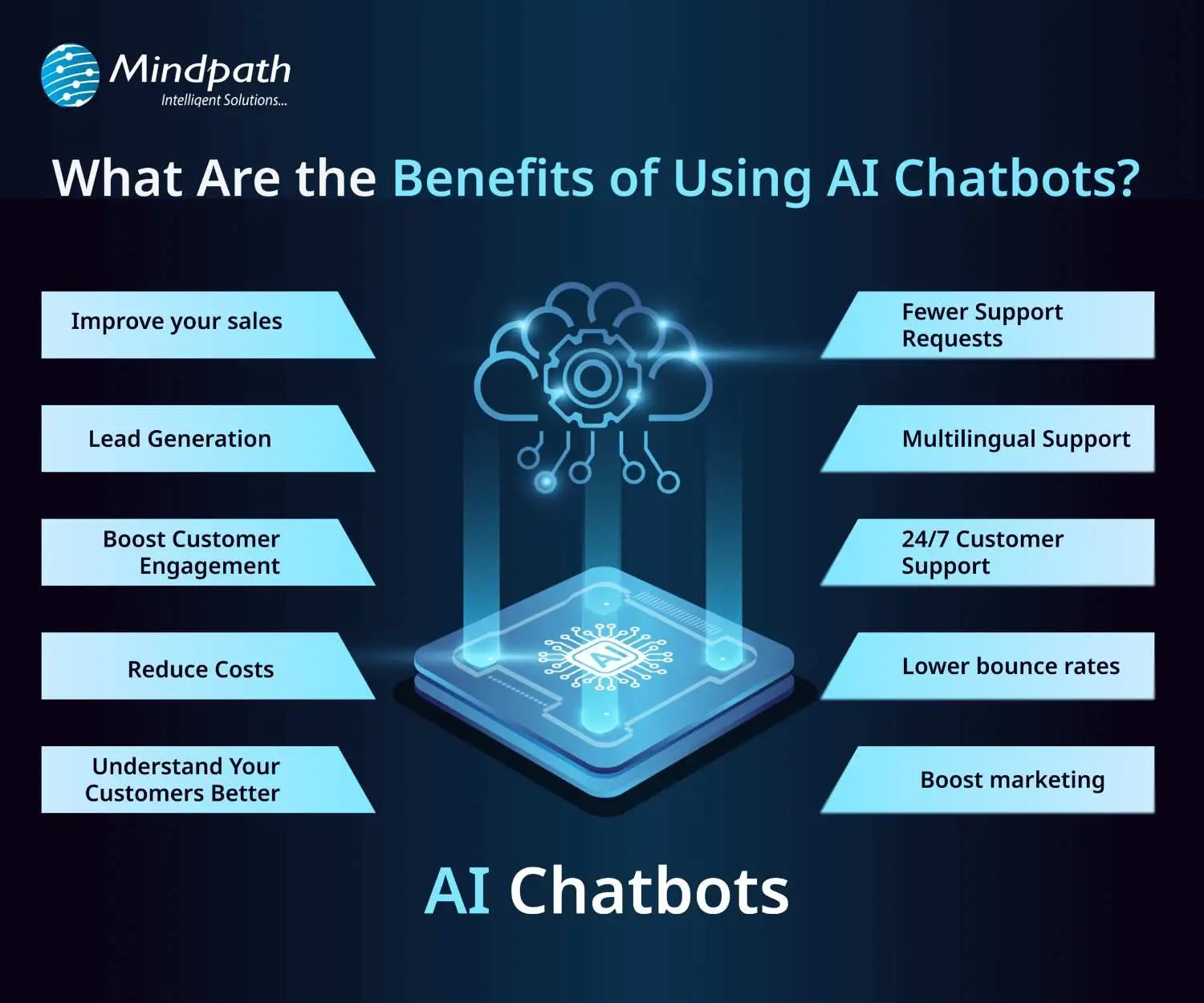
Conversational AI chatbots are becoming a powerful tool for businesses looking to improve how they work and grow faster. Here are some of the key benefits they offer for driving business growth:

1. Get Useful Customer Feedback Easily

Chatbots can ask for feedback right after a chat session by sending a quick question or rating option. To encourage responses, they can offer discounts or small rewards. Businesses can then check feedback and chat logs to discover common issues and improve services. It’s a smart way to collect insights without bothering the customer.

2. Understand Customer Needs

AI chatbots can figure out what the customer wants and how they feel by reading their words and tone. They understand if a message is urgent or if a customer is upset. When needed, they pass this helpful info to an agent. This gives the agent better context to respond more personally and calmly. 

3. Support Your Sales Team with Smart Help

AI chatbots help with sales by chatting with website visitors, gathering lead details, and booking demos. They answer common product questions and encourage customers to stay longer and learn more. This reduces cart abandonment, increases conversion rates, and supports upselling, all with minimal effort. 

4. Handle Repetitive Questions Automatically

One of the best AI chatbot features is the ability to answer common questions instantly. They manage simple tasks like order tracking, returns, and payment issues without needing a support agent. This saves time for both the customer and your team. It also reduces the number of tickets and keeps agents free from more serious problems.

If you’re exploring smarter ways to deliver customer support. Read our blog on AI for Customer Service, where we highlight how chatbots and virtual assistants can improve customer satisfaction and drive measurable business growth.

5. Increase Lead Generation

Instead of filling out forms, customers can chat naturally with AI bots to share their needs. Chatbots collect useful data like preferred products, location, and language. This data is shared with the marketing team, helping them create personalized campaigns and understand customer behavior better.

6. Keep Customers Engaged with Timely Updates

Chatbots can send helpful messages like order updates, appointment reminders, or payment alerts. They also follow up with feedback requests and help continue conversations across different platforms. With custom branding and fun elements like emojis or images, they make every interaction feel friendly and engaging. 

7. Lower Business Costs

Every business wants to reduce costs while improving service quality. Chatbots help by managing simple tasks, answering frequent questions, and routing chats to the right place. This reduces the need to hire additional agents. Some chatbot platforms are easy to set up without coding, saving time and helping businesses see value faster.

8. Scaling Customer Support Efficiently

Chatbots act like additional support agents by handling many customer questions at once. They manage simple requests efficiently, which helps your team focus on more complex issues. This makes it easier to serve a growing number of customers without increasing staff size, saving time, and reducing pressure on your support team. 

Wondering how to turn AI concepts into actionable business solutions? Check out our AI Consulting Services guide for insights on planning, deploying, and scaling AI effectively.

Want to Transform Your Business with Conversational AI Chatbots?

Conversational AI chatbots are changing how businesses talk to customers, manage support, and grow. From smart replies to handling repetitive tasks, these chatbots are now a valuable part of any modern business setup. They simplify operations, improve customer experience, and help teams work more efficiently without adding extra load. 

We at Mindpath are custom chatbot development company, we help businesses build custom conversational chatbots that fit their goals. Whether it’s for customer support, lead generation, or sales, our expert solutions make chatbot integration easy and impactful. Let us help you scale faster and connect better with your customers using the best AI chatbot tools.  

Discover the transformative power of conversational AI chatbots. From cost savings to increased sales, learn how chatbots can drive growth.
Image showing a person using a digital tablet.

Eliza, the first ever publicly demonstrated chatbot, was created using a rule-based approach in the 1960s. With the onset of artificial intelligence and big data, these chatbots have now become advanced with capabilities like providing information and feedback, clear doubts, etcetera, and are transforming the face of education in the best possible way.

Artificial intelligence (AI) provides advanced education solutions and is being leveraged at scale by various institutions to achieve their digital transformation goals. This is evident with the growing demand for AI-driven online learning platforms with AI in education market revenue unanticipated to cross $20billion by 2027.

Illustration of the letters AI

Source: 

AI Chatbots In Education- The Need Of The Hour.

In a 2016 interview, Microsoft founder Bill Gates pointed out the relevance of AI in improving the quality and effectiveness of personalized teaching approaches.

“The idea that you could talk to an [virtual] advisor that would understand different misconceptions and arbitrary linguistics around it, that’ll certainly come in the next decade. And they’ll be a very nice supplement”– Bill Gates.

Truly so, after almost half a decade, AI chatbots are being instrumental in helping institutions provide interactive, streamlined, and personalized learning environments for students.

Conversational AI or AI chatbots are a subset of AI solutions. It is constantly explored to fill the gaps between teaching and learning, and achieve seamless education at all levels.

How do AI Chatbots Help In Teaching And Learning?

AI chatbots use natural language processing(NLP) to decode the intent and keywords according to a specific algorithm, and perform a set of functions.

NLP is among the most promising branches of AI which uses data science to facilitate interaction of humans and computers. The effectiveness of NLP in making computers as smart as people, fueled its growth, with the NLP market anticipated to reach $28.6 billion in 2026.

The AI chat bot processes a set of commands to understand the questions and offer appropriate answers to the same. It can either be in the form of text, or audio-video, pictures, etc.  In the educational realm, this proves to be an interactive way for institutions, both online and offline, to create intuitive and interactive classrooms.

Impact of AI Chatbots on Education

The new-age technology has seemingly replaced the physical library with search engines and created virtual classrooms that have students from different parts of the world.

Apart from these visible technological advancements, conversational AI is also driving the future of eLearning and has already shown signs of transformation in the education realm. As students gain more easy access to high-speed internet and mobile devices, the use-cases of such modern technology also increase.

Let us now look at how AI chatbots are changing the landscape of the traditional education system.

1.    Enhanced Personalized Learning

Personalized learning promotes self-advocacy skills in students. It helps them to focus on their flaws and empower their skills. It involves creating a learning structure that is tailored to each student’s abilities in a way that motivates them. This way, teachers can ensure every student learns together but at their learning rate.

However, in a traditional classroom, providing such assistance can be an excruciating task for the teachers. With AI-enabled chatbots, it is easy to optimize teaching as per the learning abilities of each student. It ensures every student continues to follow the curriculum but at their own pace.

AI chatbots interact with students and understand their specific needs via a set of standard text, audio, and video messages. These chatbots use their inference to create a personalized curriculum that matches their needs.

2.    Smart And Quick Feedback

Feedback whether from a student or a teacher is effective only if it specifically addresses the areas of improvement. Conventionally, feedback would be in the form of written applications or online forums that take time to process and produce relevant results.

With the power of AI, an interactive way to understand the point of view of a student or teacher through surveys is now possible. The AI chatbot automatically cumulates and analyses the responses and publishes the results, making the whole process simple and fast. It provides results on time which the institutions can use to amend their teaching or administrative ways.

For students, detailed feedback from teachers is a comprehensive way to explore their inner strengths and flaws as a learner. For teachers, such feedback is an effective means to understand their student’s expectations and improve their teaching methods accordingly.

3.    Improved Student Engagement

Effective student engagement involves developing the knowledge absorbing skills of students by imbibing a positive thirst to learn new things. AI chatbots break the long lectures into small text or interactive media messages so that it looks like a virtual chat room. This way the tedious lecturers transform into an interactive learning experience.

Many universities have deployed chatbots to streamline student-teacher communication.

For instance, the University of Murcia, Spain rolled out AI chatbots to answer queries from students regarding matters of campus and field of study. The chatbot successfully answered with 91% accuracy to around 38,708 questions.

4.    Better Teaching Assistance

AI chatbots are dedicated virtual teaching assistants that are available 24/7 to help students with clearing the concepts. It also helps teachers to evaluate test papers and detect plagiarism and grammar issues.

With AI chatbots, teachers can optimize their tasks and leverage the time in creating strategies that impart quality education to their students.

5.    Better Student Support

As technology advances, AI chatbots are being trained to provide more personalized counseling sessions to students and guide them to choose the best course.  The AI chatbots mainly focus on three factors responsible for higher student persistence as perceived by Vincent Tinto, University Professor of Sociology (emeritus) at Syracuse University- students’ self-efficacy, sense of belonging and perceived value of the curriculum.

AI chatbots with human monitoring can also be used for improving on-campus mental health counseling, and help students manage their stress efficiently.

Illustration of the letter 'A' and the number

Source:

Bottom Line

The education industry is now witnessing a major paradigm shift from traditional ways of teaching. Even though no AI chatbot can replace a passionate and dedicated teacher, it can surely improve the quality of the overall learning experience.

Choosing the right chatbot is crucial in determining the effectiveness of AI-based tutoring. eBotify has all the elements that make it a perfect choice to deploy as a virtual administrative, teaching, and student assistant.

Contact us with your requirements and our technical team will provide the solutions for you right away!


Explore how AI chatbots are revolutionizing the education sector, providing personalized learning, smart feedback, improved engagement, teaching assistance, and better student support.
Image showing a person working on a laptop.

Want to know about the potential conversational AI use cases? You have reached the right place; let’s dive deep and understand the top use cases of conversational AI.

The advancement of the human race seen in recent times is mindboggling. At the spearhead of the pioneering force of development are the advances in technology made by man. With the rapid pace of development, humans realize the need to create artificial intelligence at par with human intelligence.

Especially after the massive disruption caused by the pandemic, we search for artificial intelligence applications capable enough to take up a significant chunk of manually completed tasks. The pandemic and subsequent social distancing have made us trust machines to complete specific tasks that can be hazardous to our health. Artificial intelligence is an important factor in machines replacing manual labor at most places.

With the rise in artificial intelligence applications, the AI-human relationship is evolving to make it more interactive and fruitful. One core technology that lies at making the use of AI more satisfying for humans is conversational AI. Conversational AI is a set of technologies that help a computer register, process and understand human language. Conversational AI renders a more human touch to AI applications by giving human-AI interactions a more conversational flow.

In this way, conversational AI makes it convenient for people to use complex machines. Conversational AI increases machines’ efficiency by helping them understand the user’s needs in a better way.

Understanding Conversational AI Use Cases

Conversational AI is one of the most promising sectors of Artificial intelligence, with its market share growing from $4.2 billion in 2019 to $15.7 billion by 2024. It is only natural for conversational AI use cases to increase in the next few years. As the accessibility of computers and intelligent devices increases, conversational AI use cases also improve. Conversational AI is used in both the commercial and domestic sectors today. Here are the few conversational AI use cases that highlight the revolution that conversational AI truly is.

IT and Data Security Services

One of the primary conversational AI use cases is found in the IT sector and data security. IT companies are using chatbots as the primary interface of customer support services. The chatbots help customers in accessing support services at any time. These chatbots are programmed to address the fundamental issues faced by a customer and offer troubleshooting solutions. If the customer’s type of concern is of higher complexity, it gets forwarded to the IT support executive. Having a chatbot in the IT services helps filter out the customer requests according to the complexity and priority of the concerns.

–  Using a chatbot in the customer support chain helps resolve issues, increase the staff’s productivity, and better incident management.

–  The chatbots also provide more data security to the customers as they are not exposed to a third party.

–  Chatbots are used in the IT service support sector, troubleshooting, and customer information sector.

Sales Management

Conversational AI platforms like chatbots and virtual assistants are used to handle the different processes involved in sales. In this way, chatbots and virtual assistants help in improving the sales management of an organization. Chatbots can be integrated into warehouse systems, databases, and CRM systems to simplify and streamline. Large-scale manufacturing companies use virtual assistants to schedule despatch of product shipments. Chatbots also help in maintaining sales databases. Chatbots can also assist lead management. Moreover, chatbots help in checking the lead status and fill in the lead details for sales executives.

Marketing and Promotions

Use cases for AI in conversational marketing are in every industry if appropriately observed. Every successful company takes its marketing strategy seriously. Companies are now using technology to support their marketing goals. One of these technologies is conversational AI. Companies are using different online platforms like websites and social media for marketing. The chatbots integrated into these platforms are excellent examples of conversational AI use cases. Chatbots help in gathering customer insights and potential leads from online platforms. Demographics and data insights lay the foundation of the marketing strategy for companies. Conversational AI applications provide crucial data to the marketing teams so that they can create efficient strategies.

Chatbots interact with potential customers to gather good leads. For highly interested potential customers, chatbots help in scheduling demos and meetings. Chatbots observe a visitor’s website activity to recommend products that can be relevant to them. There are many more ways in which conversational AI supports marketing activity and customer acquisition.

Internal Virtual Assistant

Apart from helping a company interact with its customers, a chatbot can also help an organization establish channels of internal communication. This helps in improving the coordination between the different teams of an organization. Internal virtual assistants and intranet chatbots can help set up meetings with the staff, sending out reminders to everyone involved, and improving internal communication in general.

Employees can do small tasks like applying for leaves, approving leaves, and staying informed on internal updates with intranet chatbots’ help. Chatbots can also help in the organization of documents and making them accessible to employees when needed. This decreases the hassle of working and allows an employee to become self-reliant in the workflow.

Furthermore, chatbots can keep the employees in the loop for recent developments, perform simple tasks for them and improve the company’s workflow in general.

Retail Industry Operations

In 2020, the retail industry was in for a revamp to embrace the new normal. As retail became tech-empowered, it also served as a strong example of conversational AI use cases.  The use of chatbots and other conversational AI forms act as virtual shopping assistants for people who want to shop from home. Even inside a store, chatbots help the customers in exploring the inventory for their chosen product. Intelligent chatbots help customers find suitable product recommendations according to their preferences and needs. In e-commerce websites, chatbots help in adding products to the cart and checking out with them. Even in offline stores, conversational AI helps customers make payments and checkout without human interactions.

Bottom Line

Conversational AI plays a vital role in carrying out operations in almost all sectors. The above-mentioned are a few of the use cases of Conversational AI in today’s era. If a user wants to learn more about conversational AI under a conversational AI tutorial, he/she cannot forego the use cases of conversational AI in different fields. With the adoption of conversational AI chatbots for your business, you can take your business to the next level of growth.

Want to know more about conversational AI? Reach our experts at eBotify and they will explain to you the concepts of conversational AI and chatbots.

Want to know about the potential conversational AI use cases? You have reached the right place;

Join our Newsletter!

categories

Join the world's largest training library and unlock new opportunities!

Featured Posts

Ready to Leverage GenAI for
Software Development

Form automation to innovation, let’s turn your ideas into intelligent, AI-driven solution.