Latest Insights On

GenAI, Tech, and Digital Transformation 

Stay updated with expert insights, success stories, and real-world applications of cutting-edge technology.

progressive web apps

Businesses are rethinking how they deliver digital experiences as more customers browse, shop, and interact with services on mobile devices. Progressive web apps (PWAs) offer one way to meet these expectations by combining the accessibility of a website with selected capabilities commonly associated with mobile applications.

A well-designed PWA can load quickly, adapt to different screen sizes, support installation on compatible devices, and provide access to selected content when a network connection is unavailable. These capabilities can help businesses reduce friction for users without automatically requiring separate native applications for every platform. The right approach depends on the product’s requirements, audience, and technical constraints.

Key Takeaways

  • 01
    Progressive web apps combine web accessibility with selected app-like capabilities, including installation on supported devices.
  • 02
    Responsive design, caching, and performance optimization can help PWAs deliver reliable experiences across devices and network conditions.
  • 03
    PWAs can simplify distribution and maintenance, but development costs and platform capabilities depend on the project’s requirements.
  • 04
    Brands such as Starbucks, Flipkart, Pinterest, and Uber are frequently discussed in connection with PWA strategies and mobile web experiences.
  • 05
    Businesses should evaluate offline needs, device support, security, integrations, and user expectations before choosing a PWA.
Planning a mobile-first digital product? Contact Mindpath to discuss your web application requirements and evaluate an approach suited to your business goals.

What Is a Progressive Web App?

A Progressive Web App (PWA) is a web application built with web technologies that can provide selected app-like features on compatible browsers and devices. Users access it through a URL, and depending on the browser and platform, they may be able to install it on their device for convenient access.

Unlike a traditional native application, a PWA can deliver its core experience through the web. Developers can use responsive layouts to support different screen sizes, service workers to manage selected background tasks and caching, and web app manifests to describe how an installable application should appear when launched.

Offline access is possible when developers deliberately cache the necessary resources or data. However, not every PWA works fully offline, and features such as installation, push notifications, and background processing vary across browsers and operating systems.

How Does a PWA Work?

A progressive web app combines several web technologies and development practices to provide a reliable experience. The exact implementation depends on the application, but common components include:

  • Responsive web design: Adapts the interface to different screen sizes, including mobile phones, tablets, and desktops.
  • Service workers: Run separately from the main page and can manage caching, network requests, and certain background capabilities where supported.
  • Web app manifest: Provides information such as the application’s name, icons, display preferences, and launch behavior for supported installation experiences.
  • HTTPS: Provides an encrypted connection and is required for service workers in normal production environments.
  • Caching and performance optimization: Help reduce repeat loading times and can make selected resources available during network interruptions.

Together, these components help developers build web applications that feel more integrated with a device while remaining accessible through a browser. The benefits depend on the quality of the implementation and the capabilities available on the user’s platform.

Related reading: ReactJS for Progressive Web App Development covers ReactJS in the context of PWA development.

Benefits of Progressive Web Apps

Progressive web apps can be a practical option for businesses that want to improve their mobile web experience without maintaining separate native applications for every use case. Their value depends on the target audience, required functionality, and how the application is designed.

Key benefits of progressive web apps, including accessibility, responsive design, and performance

1. Potentially Lower Development and Maintenance Costs

A PWA can allow a business to maintain one primary web application instead of building separate applications for every platform. This can reduce duplicated development and maintenance work when the required features can be delivered effectively through the web.

However, cost savings are not guaranteed. Complex integrations, device-specific functionality, performance requirements, and browser compatibility testing can still require substantial development effort. Businesses should compare the total cost of ownership against the requirements of their proposed solution.

2. Responsive Experiences Across Devices

Responsive design allows a PWA to adapt its layout and interactions to different screen sizes. Users can access the same service through compatible mobile browsers, tablets, laptops, and desktop computers without needing a separate interface for every device category.

For example, an online retailer can provide product listings, filters, account access, and checkout through a responsive web experience. The design should still be tested on real devices to ensure that navigation, forms, and other essential tasks work well on smaller screens.

3. Updates Through the Web

Businesses can update the web application without requiring users to download every release through an app store. When users access the updated application, they can receive the latest content and functionality according to the application’s caching and update strategy.

Developers must still manage cached resources, service worker updates, and release compatibility carefully. A poorly configured cache can cause users to see outdated assets or encounter inconsistent behavior during a deployment.

4. Convenient Access and Installation

Users can visit a PWA through a direct URL, making it easy to share through messages, email, or other digital channels. On supported browsers and devices, users may also be able to install the application or add it to their home screen.

Installation behavior is not identical across all platforms. Businesses should test how their target users access and install the application rather than assuming that every browser offers the same prompt or installation process.

5. Easier Sharing and Distribution

A PWA can be distributed through an ordinary web link. Customers do not necessarily need to search an app store before opening the service, which can simplify access from campaigns, social media posts, search results, and existing websites.

This distribution model can be especially useful for content platforms, retail experiences, booking systems, and other services where a direct link helps users reach a specific page or task.

6. Selected App-Like Capabilities

Depending on browser and operating system support, PWAs can offer features such as home-screen installation, caching for offline access, and push notifications. These capabilities can make a web application more convenient for repeat visitors.

The available features and permission requirements vary across platforms. Businesses should also use notifications responsibly, obtain permission where required, and provide a clear benefit to users instead of treating notifications as a guaranteed way to increase engagement.

Related reading: Application Security Best Practices outlines important considerations for protecting web and mobile applications.

Real-World Examples of Progressive Web Apps

Several well-known brands have been associated with progressive web app strategies or app-like mobile web experiences. These examples illustrate different product goals, from mobile shopping to content discovery and customer ordering. The precise capabilities of each service can change over time, so historical case studies should not automatically be treated as descriptions of its current implementation.

Examples of brands associated with progressive web apps and mobile web experiences

1. Starbucks

Starbucks has been widely cited as an example of PWA-based ordering experiences. A mobile web ordering interface can help customers browse products, customize orders, and access relevant store information without first installing a separate application.

For businesses considering a similar approach, the key lesson is to make the main customer journey straightforward. Product selection, customization, location details, and checkout should work smoothly on mobile devices and under realistic network conditions.

2. Flipkart

Flipkart’s Progressive Web App, commonly discussed as Flipkart Lite, became a notable example of using mobile web technology to reach shoppers. An app-like web experience can help customers browse products and access shopping features through a browser, including in situations where users prefer not to install a full native application.

For e-commerce businesses, this approach highlights the importance of keeping product discovery, category navigation, and shopping flows usable on mobile devices. Performance and low-bandwidth behavior should be measured rather than assumed.

3. Walmart

Walmart operates digital shopping experiences across web and mobile platforms. Retailers such as Walmart illustrate why a consistent shopping journey matters: customers need to search products, review availability, manage their carts, and complete transactions across different devices.

Before describing a specific current Walmart feature as PWA-powered, verify the implementation against a current technical or company source. The broader lesson for retailers is to prioritize performance, accessibility, and a reliable checkout process.

4. Pinterest

Pinterest has been cited as an example of an app-like mobile web experience designed to make visual content accessible through the browser. For a discovery platform, an effective mobile web interface needs to support image loading, scrolling, navigation, and sharing without making the experience unnecessarily heavy.

Businesses building content-heavy websites can apply the same principle by optimizing image sizes, limiting unnecessary scripts, and testing how the page performs on mobile networks.

5. Twitter Lite

Twitter Lite was a widely discussed example of a lightweight, mobile-focused web experience. Its historical use case demonstrated the value of reducing data usage and simplifying access for people using mobile devices or slower network connections.

The service and its branding have changed since that period, so historical performance claims should be verified before being used as current statistics. The practical takeaway remains relevant: lighter pages and efficient resource loading can improve usability on constrained connections.

6. Uber

Uber has also been associated with lightweight web experiences that help users access key ride-booking functions through a browser. This type of interface can be useful when a user needs a service quickly or is using a device where installing an application is inconvenient.

For booking and on-demand services, a PWA project should focus on a clear user journey, reliable form handling, secure account access, and dependable connections to location and payment services where required. Whether a PWA can meet those requirements depends on the specific device capabilities and integrations involved.

Planning your application architecture? Read How to Choose the Right Tech Stack for a Web App to understand the factors that influence technology selection.

Progressive Web Apps vs. Native Mobile Apps

A PWA and a native mobile app can both provide useful digital experiences, but they differ in distribution, implementation, and access to device features. The right choice depends on the functionality the business needs and the expectations of its users.

Factor Progressive Web App Native Mobile App
Access Typically accessed through a web URL and may be installable on supported devices. Usually installed through a platform’s app distribution system or another supported installation method.
Development approach Can share a web codebase across multiple device categories. May require platform-specific development or a cross-platform framework.
Updates Web content and application resources can be updated through a managed web deployment process. Updates generally follow the app’s release and distribution process, although details vary.
Offline support Possible for resources and data deliberately cached or stored by the application. Can be designed for offline use, depending on the application.
Device integration Depends on browser and operating system support for the required web APIs. Can offer broader or more direct access to platform capabilities, subject to permissions and platform rules.
Best fit Experiences where web reach, shareable URLs, and cross-device access are priorities. Products that depend on specific native capabilities or platform-level integration.

A PWA is not automatically cheaper or better than a native app. Teams should compare performance requirements, device integrations, security, accessibility, distribution, and ongoing maintenance before deciding which approach best fits the product.

When Should a Business Consider a PWA?

A progressive web app can be a strong candidate when a business wants to improve its mobile web experience, make services accessible through a URL, or support selected app-like features without building separate native applications for every platform.

  • E-commerce: Product discovery, category browsing, account access, and checkout.
  • Content platforms: Articles, media libraries, and other experiences where direct linking and responsive layouts matter.
  • Booking services: Appointment scheduling, reservations, and other browser-based workflows.
  • Customer portals: Account dashboards and self-service functions that work across device categories.
  • Field and operational tools: Selected workflows that may need access to cached resources during network interruptions.

A native application or hybrid approach may be more appropriate when a product relies heavily on platform-specific functionality, extensive background processing, specialized hardware access, or integrations that are not adequately supported by browsers on the target devices.

Important Considerations Before Building a PWA

1. Browser and Device Compatibility

PWA capabilities differ across browsers and operating systems. Before development, identify the target devices and verify support for installation, notifications, background behavior, and any required web APIs.

2. Offline Data and Caching Strategy

Offline functionality requires deliberate planning. Teams should decide which resources and data can be stored locally, how cached content is refreshed, and what users should see when a request cannot be completed without a network connection.

3. Security and Privacy

PWAs should use secure connections, appropriate authentication, safe storage practices, and carefully controlled permissions. Sensitive information should not be placed in client-side storage without evaluating the risks, and service workers should be managed as part of the application’s security and deployment process.

4. Performance and Accessibility

A PWA should be tested on lower-powered devices and slower networks, not just modern desktop hardware. Optimize images, scripts, and other resources; provide accessible controls; and measure real user performance to identify issues that affect the customer journey.

5. Integrations and Maintenance

Applications may depend on payment services, analytics, customer relationship management systems, APIs, or other business tools. Validate the required integrations early, and plan for browser updates, dependency maintenance, monitoring, and compatibility testing after launch.

Conclusion: Are Progressive Web Apps Right for Your Business?

Progressive web apps offer a practical way to combine the reach of the web with selected app-like capabilities. Responsive layouts, installation on supported devices, carefully implemented caching, and efficient loading can help businesses provide convenient mobile experiences while maintaining a web-based delivery model.

However, a PWA is not the right solution for every product. Businesses should assess device support, offline requirements, security, performance, integrations, and user expectations before choosing between a PWA, native application, or another architecture.

At Mindpath, we help businesses evaluate and build digital solutions around their product requirements. Our web development team can discuss your application goals, technical constraints, and options for delivering a responsive digital experience.

full stack development trends

The full-stack development landscape is changing rapidly, and 2026 is already showing great possibilities for new ideas and better tools. Getting familiar with the newest full-stack development trends can help developers, startups, and businesses create smarter solutions. User needs are increasing, along with the requirement for flexible and efficient development solutions, which means teams are taking a fresh look at how they build, test, and scale applications. Knowing how to navigate these changes can have a significant impact next time whenever you develop a new item or launch a new product.

With speed, scalability, and seamless user experience as the new focus, developers are integrating advanced front-end technologies with back-end solutions to develop modern digital products. With cloud platforms available everywhere and low-code solutions evolving more rapidly, full-stack development is moving to a whole new level.  These solutions are transforming processes that not only save time but also improve quality and naturally foster greater teamwork. In this blog, we will provide further insight into the most important trends shaping full-stack development in 2026.

Want to stay ahead in this competitive market requires the right expertise. Mindpath’s Full Stack Development Services offer comprehensive solutions tailored to modern business needs.

Understanding Full-Stack Development

Full-stack development refers to building both the front-end and back-end of a software application. Let’s dive in to understand! Every application has two main sections. The front-end is what users see and interact with, like buttons, images, and forms. The backend encompasses all the activities that take place in the background – saving data, running logic, interacting with other systems, etc.

Each side requires different skill sets and tool sets. Full-stack development combines both sides into one process. Full-stack development enables developers to create complete applications and allows us to develop the application seamlessly from the user interface through the server and database. This means that the application includes both of those components as one shared system, which makes development more efficient and organized.

Ready to level up your development strategy? Explore this blog highlighting the major benefits of full-stack development in building robust and efficient applications.

Some advantages of full-stack development include:

1. A full-stack developer saves money by doing both front-end and back-end work, minimizing the need for multiple specialists.

2. They speed up the development process by working across the entire tech stack, ensuring faster delivery and smooth collaboration.

3. With strong knowledge of current tools and trends, they support modern full-stack development by integrating advanced features like AI and responsive design.

4. Full-stack developers take full ownership of the codebase, simplifying responsibility and streamlining debugging.

5. They deliver well-rounded, quality solutions by working across the UI, backend logic and business processes, database activities and data expansion, and testing.

6. They even provide ongoing support and maintenance, which ensures long-term stability, security, and enhancement.

Thinking about improving your web application strategy? Explore full stack-development for web projects and learn how integrated development drives efficiency.

Top Full-Stack Development Trends 2026

As technology continues to grow, developers are embracing smarter tools and faster methods to build complete applications. The emerging trends in full-stack development are shaping how teams work, improve performance, and deliver better user experiences in 2026. Here are the top trends to watch:
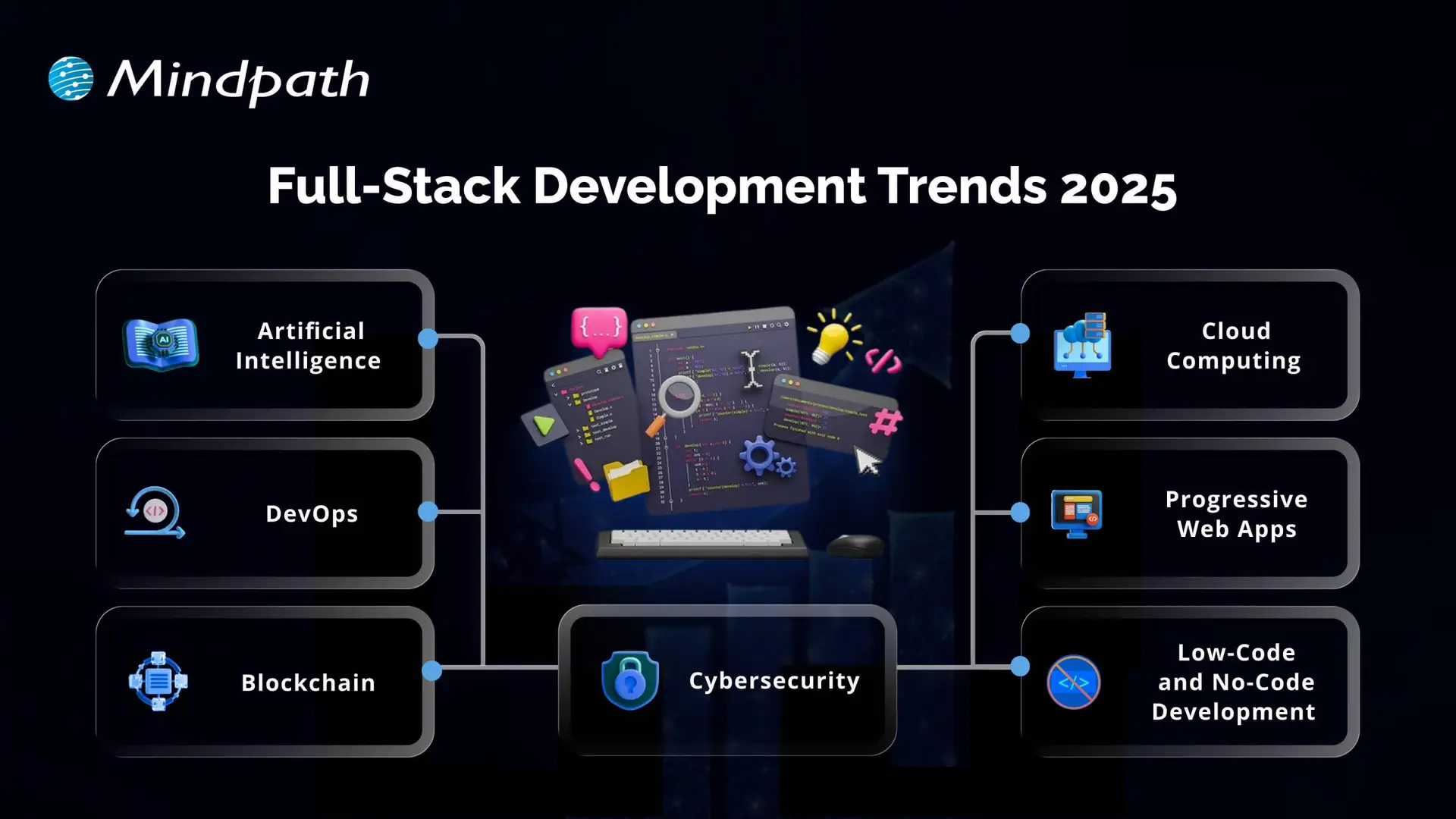
Full-Stack Development Trends 2025

1. Artificial Intelligence

Artificial Intelligence is one of the key full-stack development trends shaping how modern applications are built. It helps solve complex problems faster and allows systems to work without human interruption. Full-stack developers are well-suited for AI roles because they understand both design and logic, making it easier to build intelligent solutions. As the future of full-stack development evolves, AI will play a major role in improving performance and user experience.

2. Cloud Computing

Cloud computing is a fast-growing technology that allows access to data storage, processing power, and other resources over the internet. It supports the future tech stack for developers by offering flexibility, easy scaling, and pay-as-you-go pricing. Full-stack cloud developers are in demand to build and manage cloud-based applications that support collaboration and performance. To grow in this area, developers should understand IaaS, PaaS, SaaS and gain hands-on experience with platforms like AWS, Azure, and Google Cloud.

Also Read: Cloud Computing Trends

3. DevOps

DevOps is a practice that combines development and operations to improve how software is built, tested, and deployed. It helps teams work better together and use tools like continuous integration and delivery to release updates faster. DevOps plays an important role in improving application speed, quality, and reliability. As part of full-stack development trends, it supports the demand for efficient workflows and strong collaboration in building modern applications.

4. Progressive Web Apps

Progressive Web Apps (PWAs) are web applications that offer an app-like experience using modern browser features. They work offline, load quickly, send push notifications, and can be installed on devices without using much storage. As part of web development trends 2026, PWAs help businesses reach more users, especially on mobile, while keeping development simple and cost-effective. Their flexibility and performance make them a smart choice for companies looking to improve user experience.

5. Blockchain

Blockchain is a secure and transparent technology that stores data across a network of computers, making it difficult to change or hack. It is widely used in industries like finance and healthcare to protect transactions and manage decentralized systems. As part of full-stack development trends and the latest trends in web development, blockchain allows developers to build safer and more reliable applications. To work in this area, full-stack developers need skills in decentralized tools, enterprise systems, and Web3 architecture.

Must Read: AI in Cybersecurity

6. Cybersecurity

Cybersecurity is the practice of protecting systems, networks, and applications from online threats like malware, phishing, and DDoS attacks. It has become a key part of full stack development trends as developers need to build secure applications from the ground up. Companies are now including cybersecurity in their future tech stack for developers to keep data and systems safe. Full-stack developers aiming to work in this field should learn network security, web application security, cryptography, and secure coding practices.

7. Low-Code and No-Code Development

Low-code and no-code development platforms allow users to build websites and apps with minimal or no programming skills. These tools are growing as part of full stack development trends because they save time, reduce costs, and make development accessible to more people. While they are great for simple projects, they may not be suitable for complex or large-scale solutions. As part of the trends in software development, LCNC tools offer fast results and full-stack capabilities for quick product launches.

Curious about how development roles differ in modern projects? Explore Front End vs Back End vs Full Stack Developer to see how each contributes to building applications.

Ready to Leverage Full-Stack Development Trends for Your Next Project?

Full-stack development trends are shaping how modern applications are built, improved, and maintained. With advancements like AI, cloud, DevOps, and PWAs, developers and businesses can achieve faster, smarter, and more secure results. Staying updated with these trends will help you build stronger digital products that meet the growing demands of users in 2026 and beyond.

At Mindpath, we offer expert full-stack development services tailored to your business goals. Our skilled developers handle everything from front-end design to back-end logic, delivering complete, scalable solutions. If you’re looking to hire full-stack developers who understand the latest tools and technologies, our team is here to help you build your web and mobile applications with confidence and efficiency.

hiring full stack developer for MVP

The scale of innovation in the modern business landscape is growing consistently, calling for more efficient approaches to create digital solutions. Businesses choose to build MVPs or Minimum Viable Products before investing a huge amount in production. The benefits of hiring full-stack developer for MVP development have been drawing the limelight towards full-stack development services. 

Some business owners think about the possible ways in which full-stack developers can help with MVP development. With full-stack developers, businesses don’t have to hire multiple developers or set up a perfect team to create their MVP. Let us learn about the different ways in which full-stack development services contribute to the success of MVP.

Are you looking to turn your MVP idea into a market-ready product? Mindpath’s Full Stack Development Services will give you access to versatile developers who can handle both front-end and back-end seamlessly.

The Rise of Full Stack Developers

Full-stack development has emerged as one of the prominent alternatives to traditional development approaches. Businesses that have to hire full-stack developer for MVP development must know what a full-stack developer brings to the table. You must notice the term “full-stack” to understand the role of full-stack developers. It represents the complete technology stack or collection of technologies used to create a functional application. Full-stack developers are professionals who have expertise in frontend and backend development.

The versatility of full-stack developers empowers them to bridge the gap between what users see in an application and the underlying infrastructure that powers the application. On top of it, full-stack development also requires knowledge of other aspects such as version control, API integration, and database management. Businesses can find different technology stacks for full-stack development, like MERN, MEAN, LAMP, and Python-based stacks. Every technology stack offers a combination of powerful technologies used to create intuitive applications. 

Advantages of Creating a Minimum Viable Product (MVP)

The Minimum Viable Product or MVP is a trending buzzword in the digital landscape and a strategic solution for efficient product development. Imagine a situation in which a business has invested thousands of dollars in developing an app without a MVP. What will the business do if the target customer base of the organization does not like the app? The business would end up losing the money it invested in the app. 

Let us assume another scenario in which companies hire full-stack developer to create an MVP before rolling an app into production. The MVP is a minimal version of the software or application with limited features for the early adopters. Businesses create MVPs to test their digital products in the early stages of development and learn from the feedback of users to create effective solutions. The following advantages of a MVP will help you understand its significance in the dynamic business landscape.

1. Faster and Cost-Effective Development

One of the prominent advantages of MVPs is the assurance of faster time to market for new digital products and services. MVP focuses on achieving rapid deployment with essential features to gain an early advantage in the target market. 

Businesses can create MVPs without spending a lot on developing a product with full features and gather user feedback. As a result, the MVP can help in testing concepts and identifying the strengths and weaknesses of the application without unwanted expenses.

2. Risk Mitigation from User Feedback

The most distinctive highlight of MVP app development is the opportunity to interact directly with early adopters. Their feedback can help a business find valuable insights into the preferences, pain points, and requirements of users. Developers can use the feedback to ensure that the final product meets user expectations. Interestingly, MVP development involves continuous testing, feedback, and refinement to create more user-friendly and robust applications.

Feedback from users with a minimalistic version of the final product helps in reducing risks for businesses. For instance, business owners don’t have to invest extensively in concepts that their target audience does not like. Early feedback from users helps in identifying potential issues and implementing necessary modifications to reduce risks. 

3. Competitive Edge in the Market

The Minimum Viable Product also helps a business measure market interest and demand for their digital product. It can validate innovative ideas, while negative feedback opens new possibilities for timely modifications before investing a lot in app development. 

The ability to introduce a unique product in the market with limited features allows a business to gain a competitive advantage. Businesses can leverage MVPs to showcase their presence and build brand awareness before competitors jump in. On top of it, the MVP also offers an easy way to generate initial revenue that can be used to support product enhancements and development costs.

Want to stay ahead of the competition and build a truly impactful MVP? Discover the latest Full Stack Development Trends to leverage cutting-edge technologies, streamline development, and maximize your product’s success

Why Should You Hire Full Stack Developers for MVPs?

If the MVP is an important concern for businesses, then they might need specialists for the same. Is MVP development with full-stack developers a feasible choice for your business? The following benefits of working with full-stack developers will help you understand why they are the ideal choices for MVP projects. 

1. Cost Reduction

The cost of a MVP project is significantly less than that of a full-fledged development project. Interestingly, full-stack developers can reduce the cost of MVP development further with their versatility in frontend and backend technologies. Businesses don’t have to hire multiple specialists, thereby reducing the overall development costs. Startups and small enterprises can make the most of this advantage to create impactful MVPs with limited resources.

2. Faster Development

Hiring a full-stack developer is also a proven solution for accelerating the development process. Full-stack developers can contribute to the MVP success strategy with their expertise in frontend and backend domains to ensure seamless integration of all essential components. The streamlined development process supports faster iterations and offers flexibility for refining the product on the basis of users’ feedback. The speed of MVP development helps companies in validating innovative ideas and approving them for production to gain a competitive advantage.

3. Versatile Skillset

Full-stack developers are the ideal picks for MVP development due to their ability to make informed decisions according to the complete development stack and business goals. You can rely on them for end-to-end implementation, starting from creating interactive user interfaces to designing robust server-side architectures. The versatility of full-stack developers also empowers them to switch roles in the MVP development project without conflicts.

4. Lesser Communication Overhead

The next prominent advantage of hiring a full-stack developer for MVP is the assurance of efficient communication. Businesses don’t have to invest a lot of time in communicating with multiple specialists for a MVP project. If a business hires specialists for frontend and backend development, then it will have to monitor their work. On the contrary, full-stack development requires communicating only with a single person. The straightforward communication helps in reducing the possibilities of errors and increases the chances of overall success of the MVP project.

5. Easier Maintenance

With full-stack developers, businesses can avoid all worries about maintenance of the MVP project. Full-stack developers can leverage their expertise in different technologies to address the maintenance requirements, such as bug fixes, updates, and enhancements. On top of it, full-stack developers can implement changes quickly while ensuring compatibility and consistency between different development phases. 

6. Quicker Prototyping

If you have an innovative idea for an app and fail to develop it before your competitor, then you might lose the competitive edge. The value of full-stack development for startups, especially in the case of MVP development, is visible in faster prototyping. Businesses could build working prototypes for their innovative ideas and allow stakeholders to interact with the product. Faster prototyping helps in making necessary changes in the early stages of development and gives opportunities to outsmart the competition.

If you’re not sure what skills to look for in a full-stack developer, start by understanding the key factors that make one successful. Discover Things to Consider Before Hiring a Full Stack Developer to see what expertise can help your MVP stand out.

Challenges of Hiring Full Stack Developers for MVP Projects

The advantages of working with full-stack developers on MVP projects showcase why you need one right now. At the same time, business owners must pay attention to the challenges of hiring full-stack developers. For instance, it is difficult to find full-stack developers with the exact skills required for your MVP development projects. 

Businesses can capitalize on all the benefits of full-stack development only if they hire developers with experience in handling frontend and backend development. It is also important to know that full-stack developers are better picks for small and medium-sized projects. However, hiring only one full-stack developer for large and complex projects may not be the best choice for a business owner.         

Ready to Build Your MVP with the Right Full-Stack Team?

The decision to bring a full-stack developer into your workforce for MVP development is right for many reasons. For starters, you can build the Minimum Viable Product quickly and obtain user feedback to implement relevant modifications in the early stages. On the other hand, choosing a full-stack developer may be one of the toughest challenges for business owners.

At Mindpath, we offer full-stack development services personalized to align with client requirements and vision. We have helped multiple clients bring their vision to reality in the form of intuitive, user-friendly, and robust applications. Our experience and commitment to serving the best results in MVP development make us the best pick for startups and big corporations. Find the ideal resources to create your next MVP project right now.

ReactJS for Progressive Web App development

Creating applications that are fast, dependable, and smooth on all devices is important for every company today, right? So, when you think of building something like that, ReactJS for Progressive Web App development may be a wise option for you. It allows you to create applications that give the experience of a native application without the cost or intricacy. There are many modern companies already using this approach to enhance performance and keep users invested with consistent user experiences.

ReactJS offers speed, flexibility, and user-centric features that are perfectly aligned with progressive web app goals. ReactJS has reusable components and fast rendering, making it easy for developers to build responsive and high-performance apps. PWAs built with ReactJS are responsive and load fast, work offline, and allow a smooth mobile experience that users will enjoy. In this blog, we will examine the top reasons why ReactJS is great for developing PWAs.

Looking to engage users with fast and seamless web applications? At Mindpath, we offer ReactJS development services where our experts help you create user-focused Progressive Web Apps that give users a smooth digital experience.

Understanding the Fundamentals of PWAs

Progressive Web Apps (PWAs) are modern web applications that function like mobile apps. With a PWA, you can open it in a web browser, but it behaves like a real app on your phone or computer. They are designed to function seamlessly across all devices (smartphones, tablets, or desktops), which is nicer than having separate mobile websites, apps, and desktop apps.

Progressive Web Apps are created using HTML, CSS, and JavaScript. They are fast to load; they work when users are offline and can send push notifications. They also allow access to certain phone functionality, such as the camera or location. PWAs can help businesses save time and money since they must build one app that can work everywhere.

Looking for specialists who can handle complex front-end challenges in your business? Learn why partnering with an expert React Development Company is a smart move.

Advantages of Using ReactJS for Progressive Web App development

Using ReactJS for PWA development is a great choice for creating secure and fast web applications. With the growing ReactJS trends, developers hope that they can deliver seamless and user-friendly experiences. Here is how ReactJS is perfect for your PWAs.
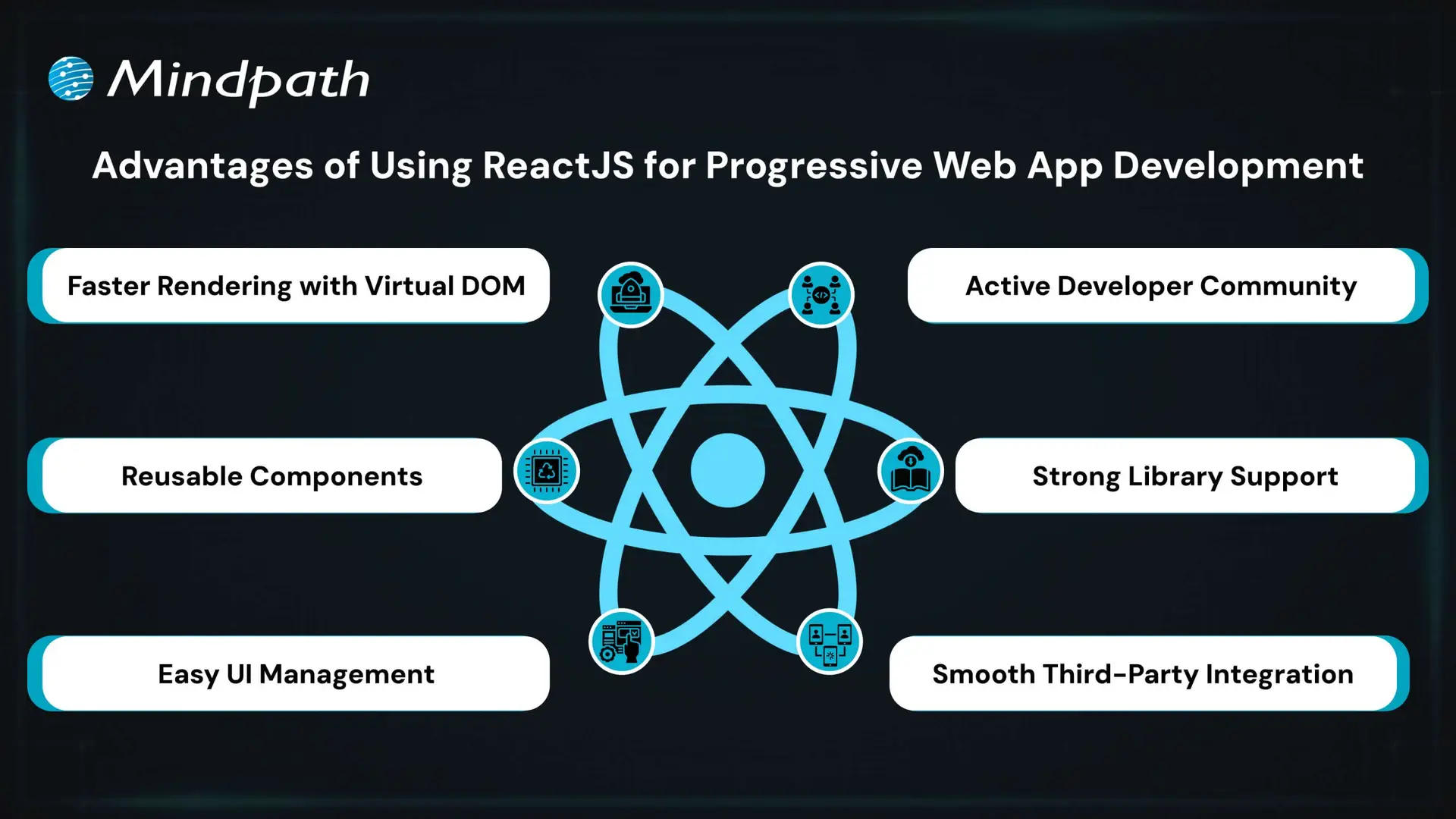
Advantages of Using ReactJS for Progressive Web App development

1. Faster Rendering with Virtual DOM

React uses a Virtual DOM to update only the parts of the page that change. This speeds up performance and ensures a smooth user experience. It’s ideal for building fast and responsive ReactJS PWA solutions.

2. Reusable Components

React’s component-based structure allows developers to reuse code across the app. This makes it easier to manage the app and scale it as it grows. It’s a key reason why teams choose ReactJS for progressive web app development.

3. Easy UI Management

React follows a declarative style for creating user interfaces. This makes it simple to manage and update interactive elements in the app. It helps deliver a smooth and engaging ReactJS progressive web app experience.

4. Active Developer Community

React has a strong global community that shares solutions, tools, and tutorials. This support helps developers solve problems faster and stay updated. It also contributes to the future of ReactJS in modern web development.

5. Strong Library Support

React has many libraries like React Router and Redux that simplify routing, data flow, and offline features. These tools help developers add advanced features to PWAs with less effort. They make building a PWA with React more efficient and reliable.

6. Smooth Third-Party Integration

React works well with tools needed for Progressive Web Apps, such as service workers and web app manifests. These tools help enable offline access, background syncing, and “Add to Home Screen” functionality. This makes it easier to implement full PWA capabilities when building with React.

Want to keep your large React app fast and responsive as it scales? Discover the best practices for optimizing React performance for large applications.

Steps to Set Up a React PWA

Getting started with React is a smart move when building modern web apps that work offline and feel like native apps. If you’re planning to use React for progressive web app development, here are the key steps to set it up properly.
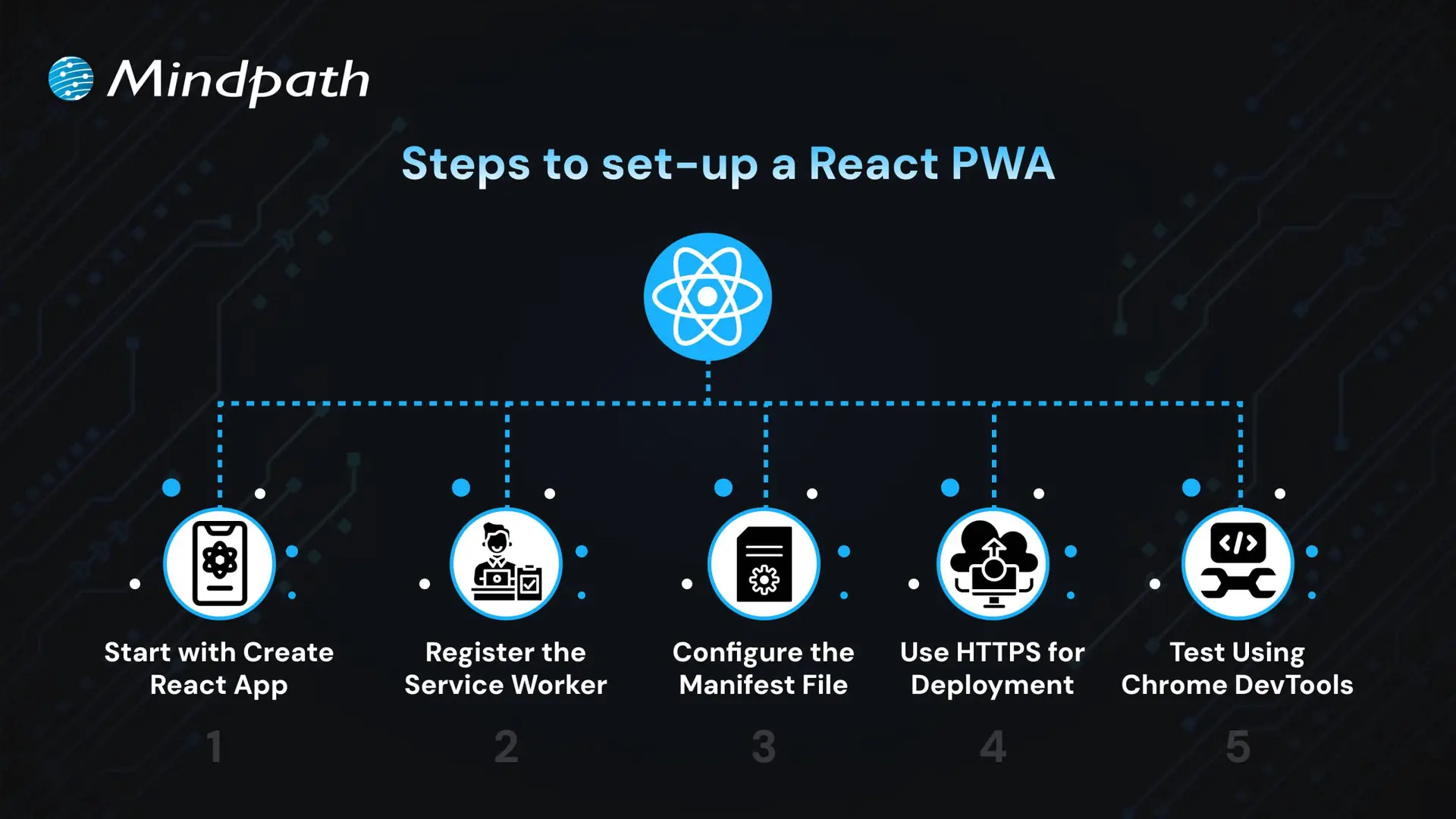
Steps to Set Up a React PWA

1. Start with Create React App

The easiest way to begin is by using Create React App, which includes built-in support for PWAs. It sets up a basic structure with everything needed for ReactJS PWA development, including service workers and a manifest file. CRA also optimizes the build process, making your app production-ready. This setup ensures you have a strong foundation to build a scalable and responsive PWA.

2. Register the Service Worker

To activate offline support, register the service worker by calling ‘serviceWorkerRegistration.register()’. This enables background caching, which is key to building a progressive web app with React that works without an internet connection. A registered service worker allows the app to cache assets and serve them even when the network is unavailable. It also helps improve performance by reducing server requests, ensuring a better user experience in the future of web development.

3. Configure the Manifest File

Update the manifest.json file in the public folder to define your app’s name, icons, theme color, start URL, and display mode. These settings control how your app appears when installed on a device. A properly configured manifest ensures your PWA looks and feels like a native app. This also helps in enabling features like splash screens and full-screen display, supporting the growth of progressive web apps with React development.

4. Use HTTPS for Deployment

For security, PWAs must be served over HTTPS. Local development through CRA handles this, but for live deployment, ensure your server uses a valid HTTPS setup. A secure context is required for service workers and features like push notifications. Using HTTPS also improves user trust and SEO performance.

5. Test Using Chrome DevTools

Use Chrome DevTools to inspect and test your PWA setup. You can verify service worker status, cached files, and manifest settings. Lighthouse audits can also help you improve your app based on best practices for React for progressive web app development. Testing ensures your PWA meets performance, accessibility, and usability standards.

Seeking a development approach that reduces complexity while enhancing functionality? Read why React Web Development is ideal for modern projects.

Ready to Build a Powerful PWA with ReactJS?

ReactJS offers all the essential tools to build fast, reliable, and interactive web apps that feel like native experiences. Its reusable components, strong ecosystem, and smooth performance make it a top choice for modern applications. Choosing ReactJS for progressive web app development is a future-focused decision that brings real value to your business.

At Mindpath, we deliver expert ReactJS development services tailored to your goals. We build responsive, scalable, and feature-rich PWAs with smooth offline access and high performance. Our experienced team uses the latest tools and trends to create apps users love. Partner with Mindpath and bring your next ReactJS PWA to life with speed and quality.
Discover why ReactJS is perfect for Progressive Web App (PWA) development. Learn how Mindpath can help you build high-quality PWAs.
Node js libraries for AI

Businesses increasingly use artificial intelligence to improve customer experiences, automate workflows, and build more capable digital products. For teams working with JavaScript, Node.js libraries for AI provide practical ways to connect applications with machine learning models, language-processing tools, and generative AI services without rebuilding the entire technology stack.

The right approach depends on what you want to build. Some libraries support machine learning directly in JavaScript, others provide natural language processing or computer vision features, and AI service SDKs connect applications to hosted models through APIs. Understanding these differences helps development teams choose tools that fit their technical requirements, budget, and deployment environment.

Key Takeaways

  • 01
    Node.js supports AI integration through JavaScript machine learning libraries, specialized NLP tools, and SDKs for hosted AI services.
  • 02
    TensorFlow.js, Natural, and Compromise serve different needs, from model execution to text processing and language analysis.
  • 03
    AI service SDKs connect Node.js applications to hosted models, while local libraries may support inference or model development in JavaScript.
  • 04
    Library selection should account for maintenance status, compatibility, performance, licensing, privacy, and deployment requirements.
  • 05
    Businesses can combine Node.js with AI APIs or specialized model services to build chatbots, recommendations, document workflows, and other AI-enabled features.
Planning an AI-powered application? Mindpath’s AI integration services can help you evaluate integration options based on your product requirements and existing technology stack.

Why Integrate AI into Node.js Applications?

Node.js is a JavaScript runtime commonly used to build APIs, backend services, real-time applications, and web application infrastructure. Its event-driven, non-blocking I/O model can help applications manage many concurrent network operations, including requests to external AI services.

Node.js can integrate with AI in several ways. Developers can execute compatible models with JavaScript libraries, call hosted AI models through APIs, or connect to a separate inference service written in another language. The best option depends on model requirements, latency expectations, infrastructure, and the amount of control the application needs.

JavaScript’s broad use across web development can also make it convenient for teams that want to share familiar language and tooling across frontend and backend work. However, demanding model training or specialized inference workloads may be better suited to dedicated machine learning frameworks or services.

Here are some potential benefits of integrating AI into Node.js applications:
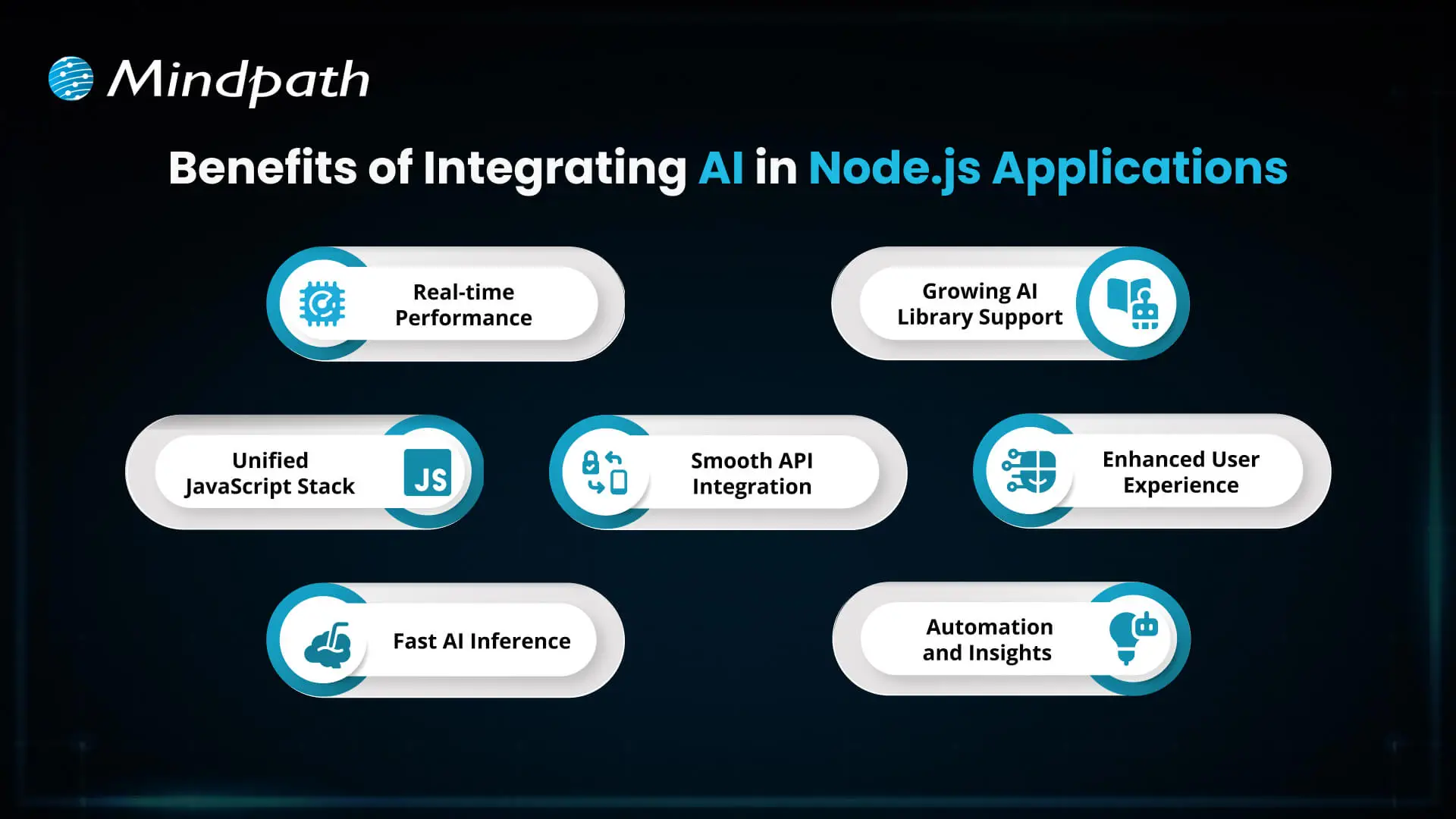
Benefits of integrating AI into Node.js applications

1. Responsive AI Features

Node.js can manage application requests and communicate with AI services asynchronously. This is useful for features such as chat interfaces, recommendation APIs, and automated document processing. Actual response times depend on the model, network, infrastructure, and application design.

2. A Familiar JavaScript Stack

Teams already using JavaScript can integrate AI functionality into their Node.js backend without necessarily introducing a separate application layer for every feature. This can simplify some development workflows, although specialized models may still require Python-based services or other infrastructure.

3. Flexible Model Execution

Depending on the model and runtime, developers can run compatible inference workloads in JavaScript or send requests to an external model endpoint. Performance should be benchmarked against the actual workload instead of assuming that Node.js or any particular library will automatically provide faster inference.

4. Integration with Existing Systems

Node.js applications can connect AI services to databases, customer relationship management platforms, content systems, and internal APIs. This makes it possible to incorporate AI into existing workflows rather than treating it as an isolated feature.

5. A Range of AI Libraries and Services

The JavaScript ecosystem includes machine learning libraries, natural language processing tools, computer vision packages, and SDKs for hosted AI services. Each category serves a different purpose, so developers should select tools based on their intended functionality and ongoing support.

6. More Context-Aware User Experiences

AI features can support conversational assistance, personalized recommendations, classification, and content analysis. Their usefulness depends on data quality, model selection, testing, and appropriate safeguards for the application.

7. Workflow Automation

AI integration can help automate tasks such as categorizing incoming requests, extracting information from documents, and routing customer queries. Teams should keep validation, monitoring, and human review in place where mistakes could have significant consequences.

Related reading: Top Node.js Libraries covers additional tools for building Node.js applications.

Top Node.js Libraries for AI Integration

There is no single best AI library for every Node.js project. Some tools provide machine learning capabilities, others focus on text processing or computer vision, and some help applications communicate with external AI platforms. The following options cover different use cases and should be evaluated for current maintenance, compatibility, and licensing before adoption.
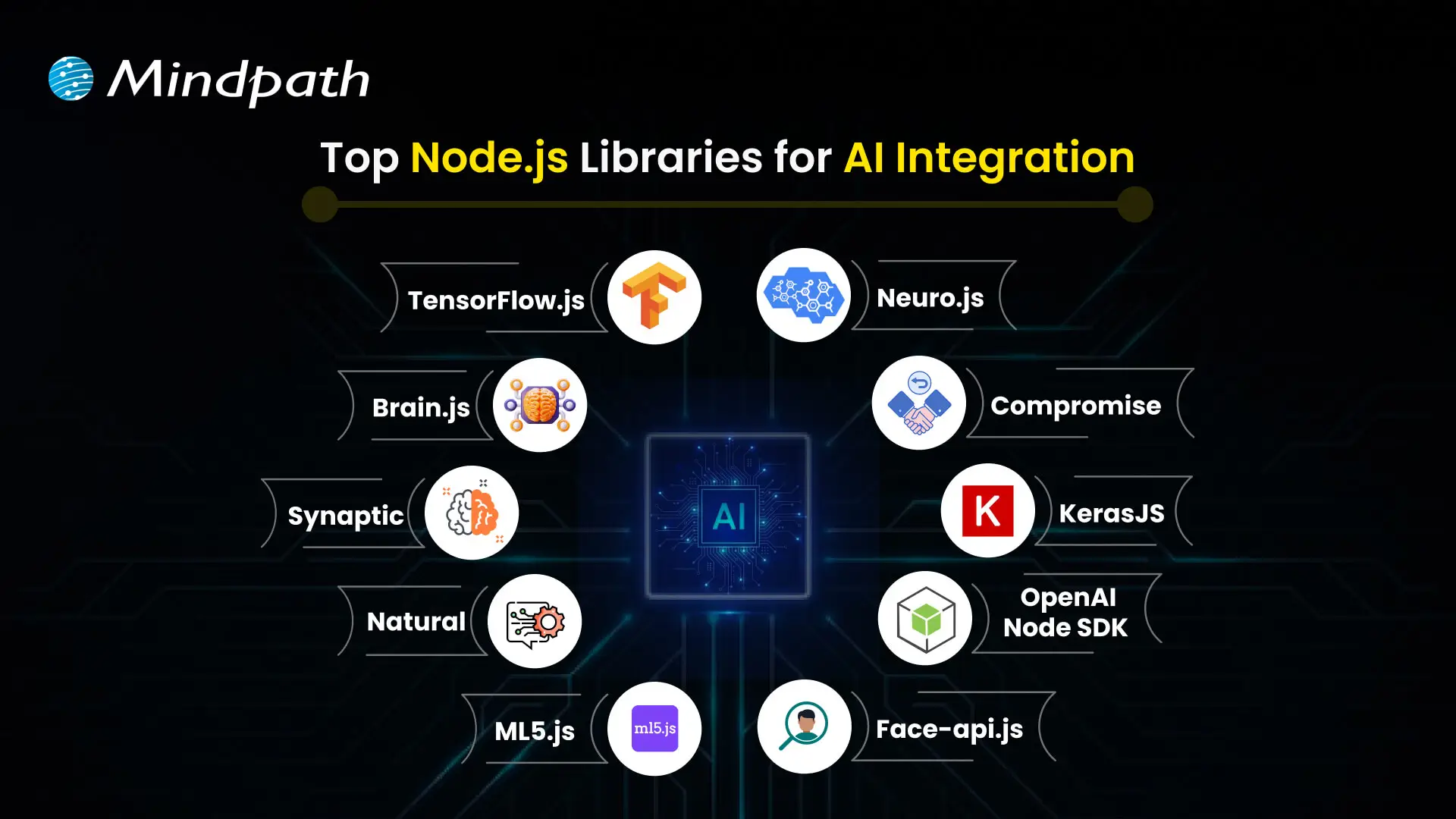
Node.js libraries and tools used for AI integration

1. TensorFlow.js

Best for: JavaScript-based machine learning and model inference.

TensorFlow.js provides tools for developing, training, and running machine learning models in JavaScript. It supports browser-based use and Node.js environments, with capabilities that depend on the selected backend and model.

Developers can use it for suitable classification, prediction, and computer vision workloads. Before using it in production, evaluate model compatibility, runtime performance, hardware support, and whether a JavaScript-based implementation meets the project’s needs.

2. Brain.js

Best for: Smaller neural network experiments and learning projects.

Brain.js is a JavaScript library for working with neural networks. It can be useful for learning the basics of neural network development and experimenting with comparatively straightforward problems.

It is not a replacement for every modern machine learning framework. Review its current maintenance status, supported operations, and performance limitations before selecting it for a business-critical application.

3. Synaptic

Best for: Exploring neural network architectures in JavaScript.

Synaptic is a JavaScript neural network library that has been used for building and experimenting with network architectures. It may be relevant for educational work or existing projects that already depend on it.

Because library maintenance and ecosystem compatibility can change, check the repository, recent releases, documentation, and dependencies before using Synaptic in a new production system. For larger or more specialized workloads, compare it with actively supported alternatives.

4. Natural

Best for: Traditional natural language processing in Node.js.

Natural is a JavaScript natural language processing library that provides utilities for tasks such as tokenization, stemming, classification, and other text-processing operations. It can be useful when an application needs language-processing functionality without relying on a large generative AI model for every task.

Potential use cases include categorizing support messages, processing text, and building rule-based or statistical language workflows. Verify language support and the availability of the required algorithms for your specific application.

5. ml5.js

Best for: Accessible machine learning experiments and creative projects.

ml5.js provides a higher-level interface to selected machine learning capabilities, with a focus on making machine learning more approachable for creative coding and educational projects. It builds on web machine learning technologies and can simplify certain model-based interactions.

Its suitability for a Node.js backend depends on the specific feature and runtime support. Check the current documentation before assuming that a browser-focused example will work unchanged in a server environment.

6. Neuro.js

Best for: Evaluating existing JavaScript machine learning projects.

Neuro.js has been associated with JavaScript machine learning and intelligent application development. Its relevance to a new project depends on the current state of its repository, documentation, dependencies, and supported use cases.

Before choosing it for a production application, verify that it is actively maintained and meets your security, compatibility, and performance requirements. If those requirements are not met, consider a better-supported library or a hosted AI service.

7. Compromise

Best for: Lightweight English-language text analysis.

Compromise is a JavaScript library for processing and analyzing natural language. It can help applications identify and work with elements such as nouns, verbs, dates, and other text structures using lightweight language-processing techniques.

It is useful for selected text-processing tasks, but it is not a general-purpose machine learning framework or a substitute for a large language model. Check its current language coverage and capabilities against your requirements.

8. Keras.js

Best for: Assessing existing projects that use browser-based model execution.

Keras.js was developed to run certain trained neural network models in JavaScript environments, particularly in the browser. It may be relevant when maintaining an older project that already uses it.

For new projects, carefully verify its current maintenance, compatibility with modern model formats, and supported runtime. Teams should compare it with actively supported alternatives before committing to it for a production deployment.

9. OpenAI Node.js SDK

Best for: Connecting Node.js applications to OpenAI APIs.

The OpenAI Node.js SDK is a client library for communicating with OpenAI services from JavaScript and TypeScript applications. It can be used to integrate supported API capabilities into applications, depending on the models and endpoints available to the account.

Typical use cases include conversational interfaces, text generation, structured outputs, and other supported model capabilities. The SDK itself is not a local machine learning framework; model processing takes place through the relevant OpenAI service.

Keep API credentials on the server, handle errors and rate limits, and review usage costs, data-handling requirements, and the current API documentation before deployment.

10. face-api.js

Best for: Evaluating face-detection and facial-analysis functionality in existing JavaScript projects.

face-api.js provides JavaScript implementations for selected face-detection and facial-analysis tasks built on TensorFlow.js. It has been used in browser and Node.js projects, although setup requirements and compatibility depend on the runtime and model configuration.

Before using it in a new application, check maintenance activity, supported dependencies, model compatibility, and performance. Facial data is sensitive, so any deployment should also address consent, privacy, security, and applicable legal requirements.

Need help selecting a production-ready AI stack? Read about web performance with Node.js development services and consider how application architecture affects your AI workloads.

How to Choose the Right Node.js AI Library

Choosing a library should begin with the business problem, not the popularity of a package. A chatbot, a document classification workflow, and a custom image model can require very different tools and infrastructure.

1. Define the AI Use Case

Determine whether your application needs text analysis, generative AI, image processing, recommendations, prediction, or another capability. A clearly defined use case makes it easier to shortlist appropriate libraries and test their results.

2. Decide Between Local Models and Hosted AI APIs

Local inference may offer greater control over execution and data flow, but it also requires suitable model support, compute resources, deployment planning, and maintenance. Hosted APIs can simplify access to capable models, but introduce external dependencies, usage costs, latency considerations, and provider-specific data policies.

3. Check Maintenance and Compatibility

Review release activity, issue handling, documentation, supported Node.js versions, dependency health, licensing, and security advisories. A library that works for a prototype may not be the right choice for a system that needs long-term support.

4. Test Performance with Realistic Workloads

Benchmark latency, throughput, memory usage, and operating costs with representative data. For API-based AI, measure network and provider response times as well as the time spent in your own application. For local inference, test the model and runtime on the hardware intended for deployment.

5. Plan Security, Privacy, and Monitoring

Assess whether the application processes personal, confidential, or regulated information. Apply appropriate access controls, protect credentials, validate model outputs, and log operational metrics without unnecessarily exposing sensitive data. Add human review where an incorrect AI result could create material risk.

Common Business Use Cases for Node.js AI Integration

Node.js can act as the application layer that connects AI capabilities with business data, user interfaces, and operational systems. Examples include:

  • Customer support assistants: Connect chat interfaces to an AI API and approved knowledge sources, with escalation paths for complex requests.
  • Document processing: Extract, classify, or summarize information from business documents using suitable models and validation steps.
  • Recommendation features: Combine product or user data with a suitable recommendation model or external service.
  • Text classification: Categorize messages, feedback, or support tickets using traditional NLP tools or machine learning models.
  • Workflow automation: Route requests, extract fields, and prepare suggested actions while retaining appropriate approval and audit controls.
  • Computer vision applications: Connect compatible image-processing models or services to a Node.js API for supported visual tasks.

These are implementation patterns, not guarantees of business results. The appropriate model, data source, evaluation process, and system design depend on the application’s goals and constraints.

Why Work with a Node.js and AI Integration Partner?

Choosing a library is only one part of building a dependable AI-enabled application. Production systems also require architecture planning, API integration, authentication, data handling, error management, performance testing, deployment, and ongoing monitoring.

A development partner can help assess whether a hosted model, JavaScript library, or separate inference service is appropriate for the project. This evaluation can reduce avoidable integration work and ensure that the technical approach matches the business requirements.

When evaluating a development partner, ask how they handle model evaluation, API security, cost controls, data privacy, observability, and maintenance. Request a clear implementation scope and measurable acceptance criteria rather than relying on broad claims about AI capabilities.

Looking for support with your project? Explore Mindpath’s Node.js development services to discuss your application architecture, integrations, and development requirements.

Conclusion

Node.js libraries for AI give development teams several ways to add intelligent capabilities to JavaScript applications. Tools such as TensorFlow.js, Natural, and Compromise support different types of local processing, while the OpenAI Node.js SDK connects applications to hosted AI services. Other libraries may be useful for existing projects, but their current maintenance and compatibility should be checked before adoption.

The right choice depends on your business use case, model requirements, data policies, performance targets, and long-term maintenance needs. A well-planned integration should include testing, security controls, monitoring, and a clear way to measure whether the feature meets its intended purpose.

At Mindpath, we support businesses building and integrating digital solutions. Visit our Node.js development services page to discuss your project requirements and explore an implementation approach aligned with your business goals.

Discover top Node.js libraries for AI integrations and learn to enhance your applications with machine learning, NLP, and more.
Artificial intelligence is changing how people interact with technology, access information, and complete everyday tasks. From AI-powered assistants to systems that analyze complex datasets, AI is becoming part of business operations, education, healthcare, and digital services. These developments offer new ways to improve efficiency, support creativity, and make informed decisions.

Key Takeaways

  • 01
    The future of AI will influence how businesses operate, people learn, and teams make decisions.
  • 02
    Generative AI, AI agents, machine learning, and multimodal systems are expanding the ways people use AI.
  • 03
    AI can support creativity, accessibility, cybersecurity, sustainability, and personalized services.
  • 04
    Businesses should connect AI initiatives to measurable goals, reliable data, and clear operational needs.
  • 05
    Responsible AI adoption requires human oversight, data protection, transparency, and ongoing evaluation.

The future of AI will depend not only on advances in technology but also on how people and organizations choose to use it. Businesses must evaluate where AI can create value, while addressing challenges such as data privacy, bias, security, and the need for human oversight. Understanding these opportunities and limitations can help organizations prepare for an increasingly AI-driven world.

Planning to integrate AI into your business? Mindpath provides artificial intelligence development services to help organizations evaluate, develop, and implement AI-powered solutions.

The Evolution of Artificial Intelligence

Artificial intelligence refers to computer systems designed to perform tasks that typically require human cognitive abilities, such as recognizing patterns, understanding language, generating content, and supporting decisions. Modern AI includes several approaches, including machine learning, deep learning, natural language processing, and generative AI.

AI has developed through decades of research and technological progress. Alan Turing’s work in the 1950s helped shape early discussions about machine intelligence. Researchers subsequently developed symbolic reasoning methods and expert systems, which used rules and structured knowledge to solve specific problems.

As computing power, data availability, and machine learning techniques improved, AI systems became capable of handling more complex tasks. Deep learning advanced applications such as image recognition, speech processing, and language understanding. More recently, large language models and generative AI have made it possible to produce text, images, code, and other content from user instructions.

Today’s AI systems vary considerably in capability. Some perform narrowly defined tasks, while others can assist with multiple related activities. Their usefulness depends on the quality of the model, the data and tools available, the task being performed, and the level of human supervision.

Related reading: AI for customer service explains how AI can support customer interactions and service workflows.

How AI Will Shape the Future

The future of AI will involve more than automating repetitive tasks. AI systems can support human creativity, help organizations analyze information, personalize digital experiences, and identify patterns that may be difficult to recognize manually. The following areas illustrate where these capabilities can make a difference.

1. Supporting Human Creativity and Productivity

AI tools can help writers develop outlines, designers generate concepts, and developers draft or review code. By assisting with repetitive or time-consuming activities, these tools can give people more time to focus on judgment, creative direction, and complex problem-solving.

However, AI-generated work still requires review. Human expertise remains important for verifying accuracy, maintaining originality, understanding context, and ensuring that the final output meets business or customer requirements.

2. Improving Decision-Making

AI can process large datasets, identify patterns, and generate forecasts that support business planning. Organizations can use these capabilities to analyze customer behavior, evaluate operational performance, identify potential risks, and compare possible courses of action.

AI in decision-making can help teams assess information more efficiently, but recommendations should be evaluated against reliable data and relevant business context. Human decision-makers remain accountable for consequential choices.

3. Personalizing Education and Learning

AI-powered educational tools can adjust practice activities, provide feedback, and recommend learning materials based on a student’s progress. Conversational interfaces can also help learners ask questions and receive explanations at their own pace.

These capabilities may make learning more flexible, but they do not replace teachers or educational judgment. Learning platforms should protect student data, check generated information for accuracy, and account for differences in accessibility and learning needs.

4. Making Digital Experiences More Accessible

AI can support accessibility through speech recognition, text-to-speech tools, automated captions, image descriptions, and language translation. These features can help people interact with digital products in ways that better suit their needs.

Accessibility tools should be tested with people who use them. AI-generated captions, descriptions, and translations may contain errors, so critical information should have appropriate review and alternative access options.

5. Supporting Sustainability and Resource Efficiency

AI can help organizations analyze energy consumption, forecast equipment maintenance needs, optimize logistics, and identify opportunities to reduce material waste. Predictive models and digital twins can also support simulations of operational changes before they are implemented in real environments.

The environmental value of an AI system depends on its implementation and actual outcomes. Organizations should assess energy use, infrastructure requirements, data quality, and measurable resource savings rather than assuming that AI automatically produces sustainable results.

6. Strengthening Cybersecurity and Risk Detection

AI systems can analyze network activity, flag unusual behavior, prioritize security alerts, and help security teams investigate potential threats. These capabilities can improve how organizations identify and respond to suspicious activity.

AI is also used by attackers to develop more convincing phishing messages and automate certain malicious activities. Businesses should combine AI-assisted security with access controls, monitoring, incident response procedures, and regular security reviews.

7. Improving Access to Information and Services

AI assistants and chatbots can answer common questions, guide users through processes, and help customers find relevant information. When connected to approved knowledge sources and business systems, they can also support tasks such as service requests and information retrieval.

Organizations should define which tasks an AI assistant can handle, when it must escalate a request, and how users can reach a human representative. These safeguards are particularly important when requests involve sensitive information or complex decisions.

8. Accelerating Collaboration and Innovation

AI can support collaboration by summarizing documents, organizing research, generating product concepts, and helping teams compare design or development options. AI agents may also coordinate multiple steps in a workflow when provided with suitable tools, permissions, and instructions.

Effective collaboration requires clear responsibilities and review processes. Teams should verify outputs, restrict access to sensitive systems, and monitor automated actions before allowing AI to perform higher-impact tasks independently.

Related reading: Generative AI use cases covers practical ways organizations can apply generative AI across different workflows.

Emerging AI Technologies Shaping the Future

Several areas of AI development are expanding what software can do. Their business value depends on the problem being solved, the maturity of the technology, and the safeguards used during implementation.

AI technology What it does Potential applications
Generative AI Creates content such as text, images, code, and summaries from prompts or other inputs. Content assistance, prototyping, software development, and knowledge work.
AI agents Use models and tools to carry out sequences of tasks toward a defined goal, subject to their permissions and controls. Workflow coordination, research assistance, and selected customer service tasks.
Multimodal AI Processes or combines different data types, such as text, images, audio, and video. Document analysis, accessibility, media understanding, and interactive assistants.
Retrieval-augmented generation (RAG) Uses retrieved information from selected sources to provide context for generated responses. Internal knowledge assistants, document search, and support systems.
Predictive machine learning Uses historical data and learned patterns to estimate outcomes or classify information. Demand forecasting, anomaly detection, maintenance planning, and risk analysis.

These technologies can be combined, but they are not interchangeable. For example, a predictive model may be better suited to forecasting demand, while a retrieval-augmented system may be more appropriate for answering questions using company documentation. Choosing the right approach starts with defining the task and evaluating the available data.

Strategic Approaches to an AI-Driven Future

Organizations need a practical strategy to turn AI capabilities into useful business outcomes. A successful approach begins with a defined problem, a manageable scope, and clear expectations about performance, cost, risk, and human involvement.

1. Define Clear Business Objectives

Identify a specific problem that AI could help solve, such as reducing manual data entry, improving search across internal documents, or assisting customer support teams. Define the existing process and establish baseline measurements before introducing a new solution.

2. Start With a Focused Pilot

Test the proposed solution on a limited workflow before expanding it across the organization. Use a representative dataset, define success criteria, and collect feedback from the people who will use the system. A pilot can reveal limitations before the business commits to a larger rollout.

3. Prepare Data and Integrations

AI systems need suitable data, secure access, and reliable connections to the systems they use. Review data quality, ownership, permissions, and retention requirements. For systems that retrieve internal information, make sure access controls also apply to the information returned by the AI.

4. Develop AI Skills Across Teams

Help employees understand what AI systems can and cannot do. Training should cover effective use, output verification, privacy, security, and escalation procedures. Teams responsible for building and maintaining AI solutions may also need specialized technical and governance skills.

5. Make Responsible AI Part of the Process

Establish policies for data protection, transparency, bias assessment, human review, and accountability. The level of oversight should reflect the potential consequences of an incorrect or inappropriate output. Sensitive or high-impact decisions may require stronger controls and additional expert review.

6. Measure Results and Improve Continuously

Evaluate AI using measures that relate directly to the original business objective. Depending on the application, these may include task completion time, error rates, customer satisfaction, operating cost, adoption, or the accuracy of generated responses.

Monitor performance after launch because data, user needs, and underlying models can change. Establish a process for investigating failures, collecting feedback, updating systems, and deciding when human intervention is necessary.

Building an AI roadmap? Review top AI trends and AI programming languages to understand relevant developments and technical options.

Challenges That Could Shape the Future of AI

AI creates opportunities, but its adoption also introduces technical, operational, and ethical challenges. Addressing these issues early helps organizations make more informed decisions about where and how to deploy AI.

Challenge Why it matters Practical response
Inaccurate outputs AI can generate plausible but incorrect information or recommendations. Validate important outputs, use trusted sources, and define review requirements.
Privacy and data security Improper handling of personal, confidential, or regulated information can create risk. Apply access controls, data minimization, approved tools, and retention policies.
Bias and fairness Data and model behavior can produce uneven outcomes for different groups. Evaluate representative cases, test for disparate outcomes, and review decisions.
Integration and cost AI systems can require infrastructure, maintenance, monitoring, and process changes. Estimate total operating costs and test integrations before scaling.
Overreliance on automation Users may accept outputs without checking context or accuracy. Set clear responsibility, escalation paths, and human oversight for important tasks.

Responsible AI is an ongoing process rather than a one-time technical check. Organizations should revisit their controls as applications evolve, usage expands, and new risks emerge.

Ready to Prepare Your Business for the Future of AI?

Artificial intelligence is influencing how organizations develop products, support customers, analyze information, and improve everyday workflows. Its long-term value will depend on selecting appropriate use cases, combining technology with human expertise, and addressing risks through responsible implementation.

Mindpath helps businesses assess and implement AI solutions aligned with their operational needs. Our AI development services can support organizations looking to build practical, scalable applications with appropriate attention to data, security, and business objectives.

Explore how is AI transforming future, impacting data privacy, job markets, and business automation. Learn about Mindpath’s AI Services.
AI in Decision Making

75% of leaders believe AI gives them a major edge in making smart decisions. This highlights the growing trust leaders place in AI to improve clarity and confidence in business decisions.

AI is helping businesses plan effectively, reduce uncertainty, forecast demand, understand customers, and improve efficiency. In this blog, we’ll explore practical applications and key benefits of using AI in decision-making.

Ready to elevate your decision-making with AI? Discover how Mindpath’s advanced AI solutions can transform your business strategies and drive success. 

What is AI Decision Making?

AI decision-making uses data-driven systems to analyze large volumes of information and recommend or determine actions using rules, models, and machine learning.

Unlike traditional methods, AI can process complex data quickly, identify patterns, and learn from previous decisions. This helps businesses make faster, more accurate decisions when handling large amounts of data.

Curious about bringing AI into your business but unsure how to begin? Read our blog: Is Your Business Ready for AI?

Benefits of AI in Decision Making

Using AI for decision-making is becoming a key part of how modern businesses operate. With AI adoption on the rise, it’s important to understand what makes this technology so valuable in today’s decision-making process.  

1. Boost Productivity

AI works like a nonstop helper that gives decision makers quick answers and useful insights. It saves time by handling data and helps people focus on bigger tasks. With decision maker AI, you can get more done without working extra hours.

2. Lower Risks

AI benefits help in spotting problems early by studying past data and finding patterns. It can warn decision makers about things like fraud or sudden changes in the market. This helps businesses act early and avoid big mistakes.

3. Make Faster Decisions

AI looks at data quickly and gives answers in real time, helping businesses respond fast. It saves time by doing the hard work of sorting and studying information. This helps decision makers act faster and stay ahead in a fast-moving market.

4. Improve Efficiency

AI helps speed up tasks by collecting and studying data without delays. It shows decision makers the right information fast and helps fix weak spots in the process. This means teams can work better and get more done every day.

5. Ensure Consistency

AI follows the same rules every time, which helps make decisions fairer and steadier. It removes personal bias and uses data to guide choices in the same way for everyone. This helps businesses build trust and keep their work smooth and reliable.  

Curious to know how AI can enhance your e-commerce strategy and give your business a competitive edge? Read our detailed blog on how AI in e-commerce is transforming the future.

Real World Use Cases of AI in Decision Making

Real-world use cases of AI in decision-making highlight how this technology supports smarter choices in everyday business. Many industries are using AI to handle complex tasks, spot patterns, and guide important decisions with greater confidence.

1. Sales

In sales, AI in business strategy studies customer data to help teams focus on the best leads and plan better strategies. It suggests the right prices, products, and ways to talk to customers based on what works best. AI also checks team performance and gives ideas to improve sales results.

2. Manufacturing

The role of AI in decision-making is helping manufacturers keep machines running smoothly by spotting problems before they happen. It also helps manage materials, workers, and production by studying live data and showing the best way to use resources. AI gives useful ideas to improve processes and keep product quality high at every step. 

3. Marketing

In marketing, AI for customer service helps teams understand different customer groups and choose the best ones to focus on. It studies what people like and helps create content and ads that feel more personal and effective. By checking results from ads and social media, AI supports better decisions that improve marketing success.

4. Finance

AI helps financial experts find market trends by studying large amounts of data and giving clear insights. It also checks for possible risks and suggests safer ways to manage money and plan investments. With this support, decision makers can adjust portfolios and make smarter financial choices.

5. Customer Relationship Management

AI helps businesses understand what customers need by studying their behavior and feedback. It supports better decisions in improving service, keeping customers happy, and reducing the chance of losing them. AI also shows the best ways and times to talk to customers for stronger relationships. 

6. HR Operations

AI helps HR teams find the right candidates faster by quickly checking resumes and matching skills. It also looks at how employees are doing at work and gives useful ideas to support their growth. AI suggests fair pay and benefits by studying company budgets and market trends, helping keep employees happy and motivated.

Ready to leverage the transformative power of AI? Explore our blog AI transforming the future, to learn how to create a clear strategy and successfully adopt AI technologies in your organization

Ready to Make Smarter Business Decisions with AI?

AI in decision-making is helping businesses move faster, reduce risk, and improve results. It supports better planning, smarter insights, and more consistent actions. Many industries are now using AI as a trusted tool for everyday decisions. With the right approach, AI becomes a reliable partner that helps businesses grow with confidence.

At Mindpath, we deliver AI development services tailored to your unique business goals. Our expert team builds intelligent solutions that help you work smarter and stay ahead. With a focus on innovation, performance, and simplicity, we are here to support your digital journey. Let’s build intelligent systems that shape your future. 

top AI trends

AI is evolving rapidly, creating new opportunities for businesses through intelligent automation, advanced data analysis, and smarter decision-making. From improving workflows to enhancing business performance, AI is transforming how companies operate and compete in 2026.

Staying updated with the latest AI trends helps business leaders make informed technology investments, improve team productivity, and identify new growth opportunities. Ignoring these developments may mean missing valuable tools and strategies that can provide a competitive advantage.

In this blog, we’ll explore the top AI trends for 2026 and how businesses can leverage them to drive innovation, improve efficiency, and achieve long-term growth.

Wondering how to get started with AI development the right way? Our AI Development Services can help you build impactful solutions from concept to deployment.

What is Artificial Intelligence (AI)?

Artificial Intelligence (AI) is a type of technology that helps computers in thinking, learning, and making choices like people. It allows machines to use language, read information, and analyze data to give helpful responses. In business, AI is primarily being utilized to make workflow quicker and smarter.

For example, AI allows an organization to better appreciate the needs of its customers, and provide its products or services to them, when they need them, in a timelier manner. AI functions for businesses efficiently by helping cut down the time taken for a task that people typically take a lot longer to do. AI can minimize errors, take care of repeated and tedious work, and it can operate indefinitely without breaks.

It means that an organization can receive a product quicker, save time to increase productivity, and use their time to pursue other important goals. AI can also help organizations improve the quality of their products and services by being able to produce and share insights derived from their data, helping ensure smarter, and more informed decisions.

Let us know about some AI statistics that highlight how organizations are adopting and managing AI technologies in 2026:

  • According to Statista, the AI market is expected to reach US$244.22 billion in 2026 and grow to US$1.01 trillion by 2031, with a CAGR of 26.60%.
  • As per McKinsey AI report, more than three-quarters of organizations now use AI in at least one business function.
  • An artificial intelligence survey from Forbes reveals that 25% of enterprises will deploy AI agents in 2026 to handle complex, multi-step tasks.
  • Analytics Insight states that 80% of retail executives plan to accelerate AI adoption through automation by the end of 2026.

Is your business missing out on the advantages AI can offer? Explore the benefits of AI from increasing efficiency and cutting costs to making smarter, data-driven decisions that drive growth.

Top AI Trends for 2026

Trends in artificial intelligence are shaping how businesses operate, innovate, and grow in 2026. As more companies start using AI to improve workflows and decision-making, these key developments are driving real impact across industries.

1. AI Reasoning Gets Smarter

Among the latest developments in AI, one major shift is its growing ability to reason and make sense of complex situations. In 2026, large language models can think more like humans, helping businesses go beyond basic insights. They now support smarter planning and stronger decision-making. This means companies are using AI not just to understand data, but to act on it more confidently.

2. Generative AI Reshaping Content Strategy

The best artificial intelligence trend in 2026 is the rise of generative AI in content creation. It allows businesses to create text, visuals, and videos instantly from basic prompts. This helps teams produce more personalized content at scale without extra effort. It’s making content strategies faster, smarter, and more effective across industries.

3. AI Agents Redefining Business Efficiency

One exciting use of AI in business is the rise of intelligent AI agents that act like real team members. These smart tools handle tasks like finding new leads, managing admin work, and analyzing data in real time. By doing this, they help teams work faster and focus on bigger goals. Companies are now seeing lower costs and fewer errors due to these advanced AI systems.

4. Multi-Agent Systems Streamlining Workflows

A new shift in AI is the use of multiple agents working as a team to handle complex business tasks. Each AI agent focuses on a specific job, like customer service or finance, and they all work together smoothly. This makes it easier to automate detailed processes that once needed people to manage them. The result is faster work, better accuracy, and stronger connections between business systems.

5. Industry-Driven AI in Action

Different industries are now using AI in ways that fit their unique needs. Sectors like finance, healthcare, insurance, and manufacturing are leading the way because they already follow strong rules around data and systems. These fields need custom AI tools for tasks like managing claims, tracking supply chains, or handling appointments. Tailored AI solutions are helping these industries work faster, meet rules, and serve people better.

How is AI reshaping the way websites are built and optimized? Explore our detailed article on AI in Web Development to see how it’s driving smarter design, faster deployment, and better user experiences.

6. GPUs Powering the Future of AI

A key new technology in AI is the growing use of GPUs to run advanced models. These powerful chips help process large amounts of data quickly, which is essential for AI tasks. As AI adoption grows, the demand for GPUs is rising across both cloud and on-premise systems. They now play a central role in building fast, efficient, and scalable AI infrastructure.

7. A Shift Towards Small Language Models (SLMs)

One trend catching the eye of artificial intelligence companies to invest in is the move from large to small language models. These smaller models, called SLMs, can do many of the same tasks as LLMs but use fewer resources. They are faster, cheaper to run, and easier to manage, making them a smart choice for everyday use. With techniques like pruning and knowledge sharing, SLMs are becoming more efficient without losing quality.

8. Businesses Turn to Open-Source AI

Open-source AI is becoming a strong choice for businesses that want more freedom and flexibility. Unlike closed systems, open-source models let companies build and manage AI tools on their own, keeping data private and costs lower. They can also fine-tune models using their own data to get better results. This shift is helping more businesses create powerful AI solutions without relying on big tech providers.

9. RAG Brings More Accuracy

One growing method to reduce wrong answers from AI is called Retrieval-Augmented Generation, or RAG. It helps AI pull information from reliable and current sources, making responses more accurate. While it improves relevance, it doesn’t always provide personalized answers without added context. Still, RAG is becoming a valuable tool for businesses looking to make AI more useful and trustworthy.

10. Swarm Learning Driving AI Progress

Swarm learning is a new way for AI systems to grow by sharing what they learn with each other. Instead of learning alone, connected AIs exchange knowledge in real time. This helps them improve faster and solve problems more efficiently. It’s a smart way to build stronger AI by working as a team.

Looking for smarter ways to handle customer queries and optimize workflows? Explore our blog to see how conversational AI chatbots can transform your business.

Is Your Business Aligned with the Top AI Trends?

AI trends are reshaping how businesses grow, compete, and deliver value across every industry. From reasoning models to open-source tools and AI agents, these trends are helping companies simplify operations, improve decision-making, and stay ahead. By understanding what’s emerging in 2026, leaders can better prepare for new opportunities and future success.

At Mindpath, we offer AI development services that align with the latest AI trends and business goals. We create intelligent tools, automation systems, and custom AI models that improve decision-making and increase efficiency. Our solutions are built to fit your operations, boost productivity, and support long-term growth. With us, businesses gain reliable and future-focused AI support.

offshore software development for business growth

Would you like to grow your business quickly without spending a lot of money? If so, offshore software development may be an appealing option for you. Many companies today are choosing this model due to the cost-saving element, access to global talent, and keeping pace with digital technology. So, for companies that want to grow fast and provide more resources to their primary company without the pressure on their in-house or workforce, offshore development is a viable choice.

Now with this increased interest, offshore development services in 2026 are perceived as a way to stay agile and innovate faster while providing the continued influx of technology in the marketplace. Businesses of all sizes, including small startups and large enterprise clients, are increasingly leveraging offshore teams to produce robust and dependable software solutions. In this blog, we will explore why this trend is growing and how your organization can benefit from it.

Ready to take your business to the next level? Partner with Mindpath for expert offshore development services that drive innovation, efficiency, and growth. Contact Us!

What is Offshore Development?

Offshore development refers to hiring a software development team from abroad to either build or manage your software projects. It’s a form of software development outsourcing and allows companies to choose to work with teams located in different countries. It is beneficial for companies to consider going offshore for lower costs, accessing greater developer skill sets, and spending their time on their core business processes.

For instance, if a company in the UK hires a software development team from India to develop its web application, the rates in India will be cheaper than in the UK, while still maintaining high-skilled developers. Thus, using offshore development can help a company scale quickly and effectively with good quality work.

According to a Business Research Insights Survey, the software offshore market was worth roughly USD 160.9 billion in 2024, and is on track to reach USD 413 billion by 2033, with a CAGR of 11.04%.

Offshore Development Benefits for Businesses

There is a growing number of businesses opting for offshore teams to deliver their software needs. The benefits of offshore development have made it a popular option for organizations seeking smart and adaptable options for growth. Let’s have a look:
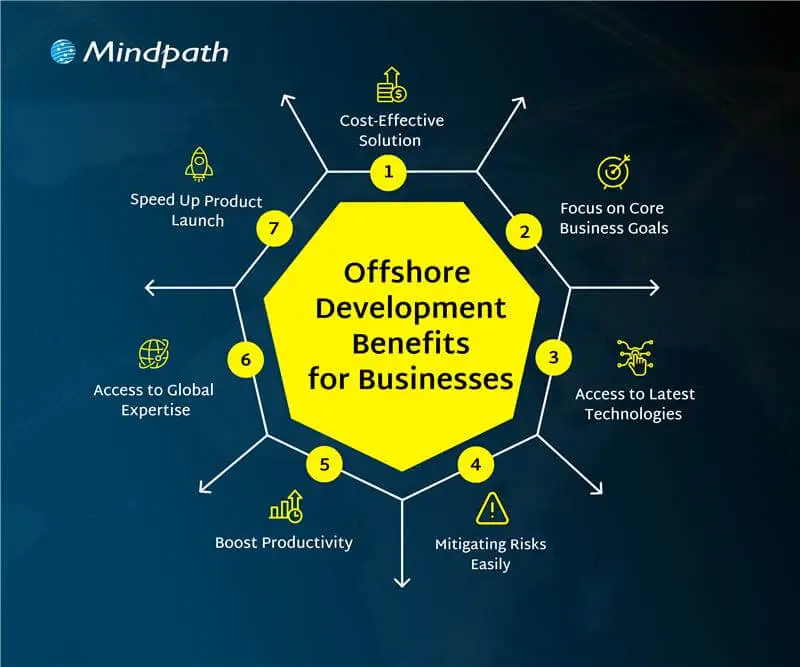
offshore development benefits for businesses

1. Cost-Effective Solution

Offshore development services help businesses lower their software development costs without losing quality. Companies can hire skilled developers from countries where salaries are more affordable compared to local markets. This approach offers a smart way to achieve cost-effective software development without compromising on results. The money saved can then be used in other important areas like marketing, research, or improving infrastructure.

2. Focus on Core Business Goals

Offshore development lets companies’ hand over routine tech tasks to external teams. This helps free up internal staff to work on more important goals and long-term plans. With fewer day-to-day responsibilities, businesses can focus better on innovation and growth. It also gives them more time to strengthen their position in the market.

3. Access to Global Expertise

Working with global software development teams allows companies to tap into a wide range of skills and knowledge. They can bring in experts who specialize in tools or technologies that are hard to find or too expensive locally. This helps businesses build better solutions and stay updated with the latest trends. It also brings fresh ideas and faster problem-solving from experienced professionals around the world.

4. Mitigating Risks Easily

Working with offshore teams helps reduce risks that may affect your local operations. This includes not just natural disasters or political changes, but also technical issues like system failures or delays in development. Offshore partners can quickly step in to handle problems and share responsibility when challenges arise. This setup keeps your projects moving and makes your business more stable and prepared.

5. Boost Productivity

Offshore teams usually have clear roles and focus on getting results. This helps manage projects better and use resources more effectively. Many offshore developers work in well-organized environments that support smooth and efficient work. As a result, they often deliver high-quality work on time and sometimes even ahead of expectations.

6. Access to Latest Technologies

Offshore teams give businesses access to modern tools like AI, cloud computing, blockchain, and IoT. Many offshore developers already have experience with these technologies and know how to use them well. This helps companies stay up to date and try new ideas without spending extra on training or new systems. It also supports faster innovation and better tech solutions.

7. Speed Up Product Launch

Tech talent outsourcing helps businesses work faster by using teams in different time zones. When one team finishes their day, the offshore team can continue the work, keeping the project going around the clock. This constant progress helps fix issues quickly and speeds up development. As a result, companies can launch their products sooner and meet deadlines with ease.

Want to know how this round-the-clock development approach works best ? Understanding the stages of the software development life cycle helps ensure offshore teams collaborate efficiently while maintaining quality and timelines.

Are you facing any confusion between offshore software development and onshore software development? Let us learn about the difference between them.

Offshore vs Onshore Development: A Comparison Table

When planning a software project, businesses often choose between offshore and onshore development based on their goals, budget, and timeline. Both options have their own advantages and challenges. The table below gives a clear comparison to help you decide which model suits your business needs best.

Factor 

Onshore Development 

Offshore Development 

Definition  Development done by a local team Development handled by a team in another country
Location Within the same country Access to cost-effective global locations
Proximity Easy access to the team Remote but manageable with clear planning
Cultural Fit  Shared work culture Diverse perspectives and global work culture
Communication Face-to-face communication possible Efficient digital communication tools
Talent Base Limited to local skills Broader access to global tech talent
Language Barrier Minimal language issues Clear strategies help overcome language gaps
Time Zone Same time zone, easy scheduling 24/7 progress through time zone advantage
Work Cycle Fixed to local business hours Continuous work with round-the-clock development

Looking to Scale Smartly with Offshore Software Development?

Offshore software development continues to be a smart and flexible solution for businesses in 2026. It helps reduce costs, improves access to global talent, and supports faster innovation. By using offshore teams, companies can stay competitive, scale quickly, and focus on their main business goals. No matter if you’re a startup or an established company, offshore development can support your long-term growth.

At Mindpath, we offer reliable offshore development services tailored to your business needs. Our expert teams are equipped with the latest tools and technologies to deliver high-quality solutions on time. With a focus on communication, transparency, and results, Mindpath helps you build the right IT outsourcing strategy for long-term success.

Frequently Asked Questions

1. How do offshore development services ensure quality work when teams are remote?

Offshore teams follow structured processes, regular updates, and clear communication to maintain quality. Many companies also use agile methods, testing practices, and performance tracking tools. With the right planning and collaboration, remote teams can deliver reliable and high-quality results consistently.

2. Is offshore software development suitable for small businesses or only large enterprises?

Offshore software development is suitable for both small businesses and large enterprises. Startups can benefit from lower costs and faster development, while larger companies use it to scale operations. It offers flexibility for any business aiming to grow efficiently without heavy investment in local hiring.

3. What challenges can businesses face with offshore development, and how can they manage them?

Common challenges include time zone differences, communication gaps, and cultural differences. These can be managed by setting clear expectations, using collaboration tools, and scheduling regular meetings. A well-defined workflow and strong project management help ensure smooth coordination and project success.

4. How do offshore development services help businesses stay competitive in a fast-changing market?

Offshore development services give access to global talent, faster delivery cycles, and modern technologies. This allows businesses to innovate quickly and adapt to market changes. With continuous development and cost savings, companies can focus more on strategy and stay ahead of competitors.

5. What factors should be considered before choosing an offshore development partner?

It is important to check the partner’s experience, technical expertise, communication approach, and past projects. Understanding their work process and support system is also key. Choosing the right partner ensures better collaboration, smoother execution, and long-term project success.
Discover the benefits of offshore development, including cost savings, access to skilled talent, and enhanced flexibility.
how generative ai work in creative industry

In a digital environment where GenAI is emerging as a new place to start innovating, we are often faced with questions like, can AI be creative? Have you ever thought about how generative AI work in creative industry today? Well, generative AI is no longer just technology; it is a creative partner. It can assist with day-to-day entries to concepts, to producing full designs or content. GenAI solutions are beginning to change how professionals will manage their work moving forward. It is creating new opportunities to bring imagination together with intelligent automation. How exciting is that, right?

As more professionals utilize AI to support their creative processes, the impact is becoming apparent across multiple industries. According to a study by The Business Research Company, the generative AI market in creative industries grew from $3.08 billion in 2024 to an expected $4.09 billion in 2025, and it’s projected to reach $12.61 billion by 2029. With open-source tools, rising interest, and cross-industry use, the landscape is evolving fast. Want to know about this in depth? In this blog, we’ll be taking a closer look at how generative AI is changing creative work and the impact it will have on the future of the industry.

Looking for ideas to reshape your business with generative AI? Unlock smarter growth, faster innovation, and personalized customer experiences with our AI-powered solutions.

What is Generative AI?

Generative AI is a type of technology that enables computers to produce new content such as text, images, music, or even computer code. Instead of just producing answers or analyzing data, generative AI will generate new content on its own by analyzing a data set or learning from examples. For companies, this opens the door for them to use generative AI to save time, produce content faster, and create even more personalized experiences for their customers. It allows teams to be more productive collaboratively and be more creatively enabled.

How does Generative AI Work?

Generative AI works by learning from large amounts of data like text, images, or audio, and then creating something new based on that learning. It uses neural networks, which are computer systems designed to understand patterns, such as how sentences are written or how pictures are formed.

These systems are trained using different types of learning methods, often with very little labeled data. This helps build foundation models that can do many tasks. Generative AI examples include tools like ChatGPT, which can write stories or articles from short prompts, and DALL·E, which creates simple images from written descriptions.

How Generative AI Work in Creative Industry?

Creative work is changing in many exciting ways with the help of GenAI. It’s helping people come up with new ideas, save time, and try things that were not possible before. If you’re curious about how does generative AI affect creativity, here are the ways it’s making the creative process easier, faster, and more inspiring.
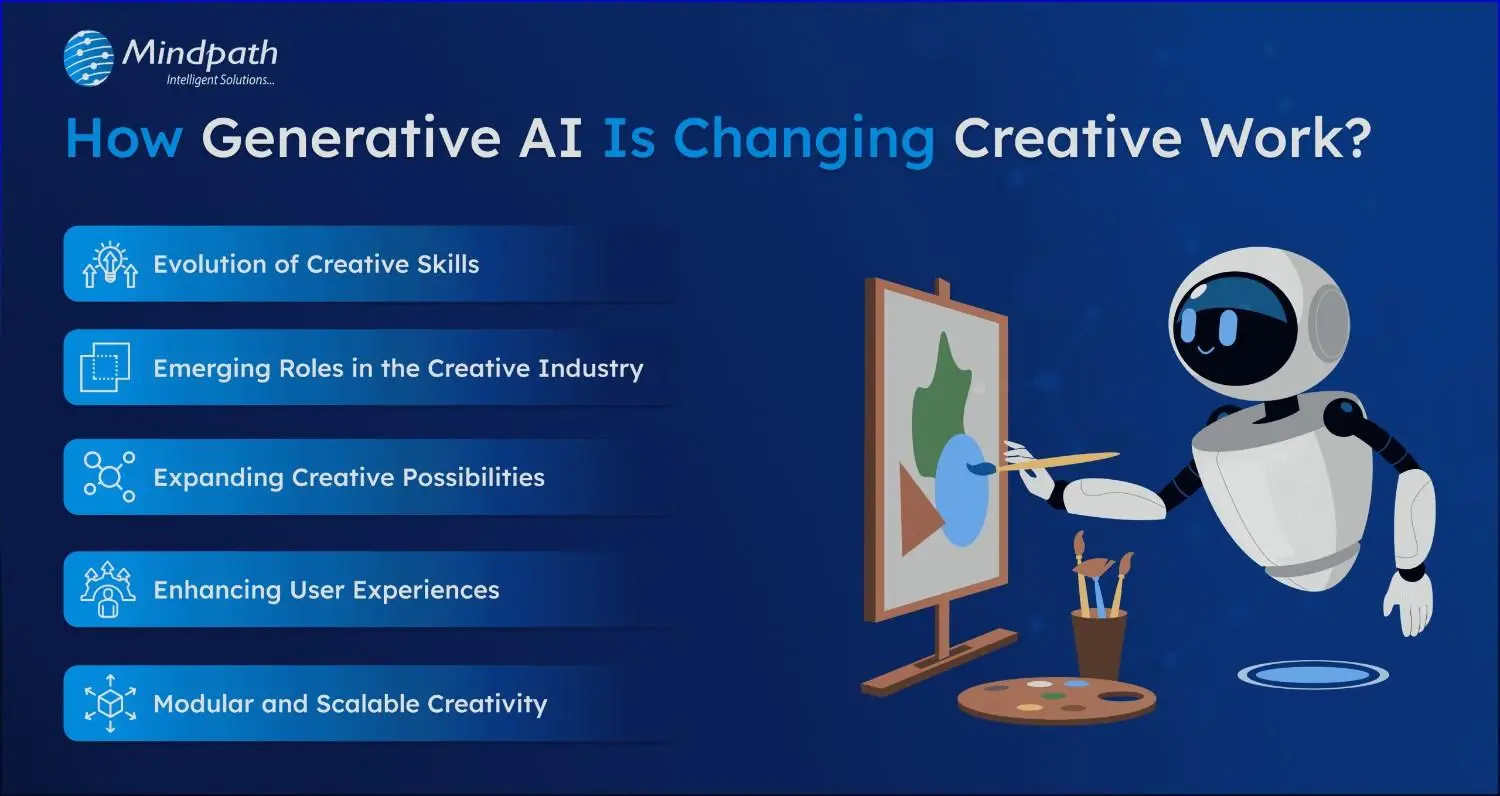
how-genAI-is-changing-creative-work-scale

1. Evolution of Creative Skills

Today’s creative professionals need more than just talent. They also need to understand how to use generative AI tools wisely and make thoughtful, responsible choices. Skills like curation help them pick and improve AI-generated ideas, while AI fluency means knowing how to use tools like ChatGPT or DALL·E. Most importantly, they must think ethically to ensure their work respects people and values.

2. Emerging Roles in the Creative Industry

As AI becomes a regular part of creative work, new types of roles are starting to appear. These jobs mix creative thinking with technical skills, showing how generative AI work in creative industry. For example, Prompt Engineers write clear instructions to help AI create content, while AI Art Directors use AI tools to design visuals quickly. There are also roles like Synthetic Media Producers and AI UX Designers who focus on virtual content and improving user experiences.

How are different industries leveraging Generative AI today? Find out in our blog on Generative AI Use Cases across Industries—from content creation to customer service and beyond.

3. Expanding Creative Possibilities

Generative AI is removing many of the limits that once held creative ideas back. Now, artists, marketers, and musicians can quickly try out new concepts without worrying about time or cost. They can test visuals, messages, sounds, and styles almost instantly. This freedom encourages bold thinking and opens the door to more creative experiments than ever before.

4. Enhancing User Experiences

Creative work is becoming more interactive and personalized, thanks to the use of generative AI. Brands and creators are now building experiences that adapt in real time, giving users a chance to take part in the creative process. From custom storylines to co-designed fashion and dynamic game worlds, AI is adding a new layer of engagement. Rather than replacing creativity, it’s helping people bring their ideas to life in exciting new ways.

5. Modular and Scalable Creativity

Generative AI is making it easier to create content in parts, or modules, that can be reused and adapted for different needs. This helps teams customize content for various platforms and audiences without starting from scratch each time. Marketing teams can turn one idea into ads, videos, or social posts quickly. Designers and writers are now building flexible templates that save time and boost creativity.

Real-World Examples of GenAI Transforming Creative Industries

Generative AI is making a real difference in how creative work happens across different industries. Many companies and creators are already using it in ways that are smart, fast, and effective. Here are a few real-world examples showing its growing impact.

1. Entertainment Industry

GenAI is helping creators in entertainment and gaming bring stories and virtual worlds to life more quickly and creatively. Game developers are using AI to design characters, build game levels, and create realistic dialogue. It also supports features like deepfake voices and more dynamic non-player characters. In filmmaking, tools like Runway ML make it easier to edit videos and add visual effects in real time.

2. Writing and Publishing Industry

Writers are now using generative AI to boost both creativity and productivity. From coming up with ideas to drafting and editing, AI tools help simplify the writing process. Platforms like ChatGPT offer support when writers face blocks or need quick content suggestions. Publishers are also using AI to create short stories, newsletters, and SEO content at a larger scale.

3. Advertising and Sales Industry

Generative AI supports sales teams by helping them write personalized emails, prepare reports, and test different sales pitches more efficiently. It also assists in understanding products, markets, and risks by analyzing use cases and offering clear insights. Tools like ChatGPT and Gemini can explain complex visuals and data, making it easier to make informed decisions. Platforms like Jasper even help sales teams expand globally by translating content into multiple languages.

4. Marketing Industry

Marketing is one of the industries seeing the biggest impact from generative AI. It allows companies to personalize content at scale, create high-quality visuals and videos quickly, and manage large volumes of work in less time. Tools like ChatGPT, Jasper, and Einstein Copilot help with ad optimization, brand design, and social media content. These tools also support strategy by building customer profiles, analyzing competitors, and predicting market trends.

5. Media Industry

GenAI is helping media industries create content faster by assisting with writing, editing, and transcribing. News outlets use it for generating headlines, interview questions, and social media posts. Some broadcasters also use AI anchors and tools to automate simple news stories. While a few bold moves faced setbacks, many media groups now rely on AI to improve efficiency and scale content production.

Ready to Transform Your Creative Process with Generative AI?

Generative AI is transforming how creative professionals work by making tasks faster, smarter, and more flexible. It supports everything from writing and design to marketing and media. By understanding how generative AI work in creative industry, teams can unlock new levels of innovation, improve productivity, and explore fresh ideas without limits.

At Mindpath, we offer advanced Generative AI development services that help businesses simplify creative work and scale innovation with unexpected solutions. Whether you’re looking to generate content, design visuals, or build engaging user experiences, our expert team and tools are ready to support your goals. We work closely with you to deliver practical, AI-powered solutions that drive results. With Mindpath, your ideas turn into impact – faster, smarter, and with creative confidence.

Discover how is generative AI changing creative work by boosting efficiency and making tools more accessible for all creators.
energy efficient computing

Every application, server, database, and cloud workload uses computing resources. As businesses continue to move more of their operations online, the amount of processing power and infrastructure they rely on also grows. That makes energy use an important part of modern IT planning.

Energy-efficient computing is about getting the work done without using more computing power than necessary. That can mean optimizing an application, reducing unnecessary database processing, choosing the right cloud resources, improving server utilization, or replacing inefficient infrastructure. The goal is not simply to use less power. It is to make technology work more efficiently without compromising the performance a business depends on.

For enterprises, this matters for both operational and sustainability reasons. Better resource utilization can help control technology costs, while more efficient systems can support broader environmental goals. As cloud computing, AI, and data-intensive applications become part of everyday business operations, energy efficiency is becoming a more practical consideration in technology decisions.

Looking to make your technology environment more efficient? Talk to Mindpath about software, cloud, and technology solutions built around performance, scalability, and smarter resource usage.

What is Energy-Efficient Computing?

Energy-efficient computing means designing and running computing systems in a way that uses fewer energy and infrastructure resources while still delivering the required results. It applies to more than the physical devices in an IT environment. Software, databases, cloud infrastructure, servers, storage, networks, and workloads can all affect how efficiently a system operates.

Consider a cloud application that runs several servers around the clock even though most of them are only lightly used. The infrastructure is doing its job, but some of that capacity may not be necessary. The same applies to an application that repeatedly processes information that could have been cached or a database that performs expensive queries unnecessarily.

Energy-efficient computing looks at these situations and asks a simple question: can the same work be completed with fewer resources?

What Makes Computing Energy Efficient?

There is no single technology that makes a computing environment energy efficient. It usually comes from a combination of better software, appropriate infrastructure, efficient hardware, sensible workload management, and regular monitoring.

For one organization, the biggest opportunity may be cloud resource optimization. For another, it could be application modernization or database optimization. The right approach depends on how the technology environment is built and how it is being used.

How Does Energy-Efficient Computing Work?

Improving computing efficiency usually starts with understanding where resources are being consumed. A business needs to know which applications, servers, databases, and workloads are using significant processing, storage, or network capacity before it can decide what needs to change.

For example, a company may discover that some cloud resources are running continuously despite having very little activity. Another company may find that an application is making repeated API requests or processing the same information multiple times. A database may also be spending unnecessary resources on queries that could be improved through better indexing or data handling.

Once these areas are identified, teams can optimize the application, adjust infrastructure, consolidate suitable workloads, or introduce automation. The results should then be monitored to make sure the changes actually improve efficiency without affecting performance or reliability.

A Practical Approach

  1. Understand the current environment: Review applications, infrastructure, cloud resources, databases, storage, and workloads.
  2. Find areas of waste: Look for idle resources, unnecessary processing, inefficient queries, repeated operations, and over-provisioned infrastructure.
  3. Optimize the technology: Improve application code, databases, APIs, cloud resources, and infrastructure where appropriate.
  4. Match capacity to demand: Use scaling, scheduling, consolidation, or automation when workloads do not require constant capacity.
  5. Measure the outcome: Monitor resource usage, performance, infrastructure costs, and other relevant metrics after making changes.

Principles of Energy-Efficient Computing

Energy efficiency can be improved at several levels of an IT environment. The following areas are particularly relevant for businesses that want to reduce unnecessary computing resources without sacrificing the performance of their systems.

1. Algorithm and Code Optimization

The way software is written can affect how much computing power an application requires. Inefficient algorithms, repeated calculations, unnecessary background processes, and excessive data processing can all increase resource usage.

Developers can improve efficiency by selecting appropriate algorithms, reducing redundant operations, optimizing data processing, improving API usage, and using caching where it makes sense. These changes can also improve application performance, which means energy efficiency does not necessarily have to come at the expense of speed.

2. Efficient Hardware

Hardware remains an important part of the equation. Processors, memory, storage, networking equipment, and other components all have different performance and resource requirements.

Businesses should choose hardware based on actual workload requirements rather than simply selecting the most powerful option available. Hardware that is significantly over-sized for its workload may provide capacity that is rarely used.

3. Power and Workload Management

Not every workload needs to run at maximum capacity all the time. Systems can often be configured to respond to actual demand instead.

Autoscaling, workload scheduling, resource consolidation, and automated management can help match infrastructure capacity with usage. This is particularly useful for applications where demand changes significantly throughout the day or week.

4. Cloud Resource Optimization

Moving to the cloud does not automatically make an IT environment energy efficient. Poorly managed cloud resources can still result in unnecessary computing capacity and operating costs.

Businesses can review instance sizes, storage, databases, containers, and other cloud resources to determine whether they are being used effectively. Removing unused resources and adjusting capacity according to actual demand can make a meaningful difference to overall resource utilization.

5. Sustainable Software Development

Software architecture influences how much infrastructure an application needs. An application that performs unnecessary processing or handles data inefficiently may require more resources as usage grows.

Efficient data handling, appropriate caching, well-designed APIs, sensible architecture, and careful resource management can help applications remain efficient as they scale.

Want to explore technology strategies that can improve business efficiency? Check out emerging technologies for small businesses to see how modern technology can support more efficient IT operations.

Energy-Efficient Computing vs. Green Computing

Energy-efficient computing and green computing are closely related, but they are not exactly the same thing. Energy efficiency focuses mainly on reducing the resources required to perform computing tasks. Green computing takes a broader view of the environmental impact associated with technology.

Energy-Efficient Computing Green Computing
Focuses on using computing resources more efficiently. Looks at the broader environmental impact of technology.
Includes software, hardware, infrastructure, and workload optimization. Can include energy use, hardware lifecycle, materials, recycling, and electronic waste.
Focuses on completing required work with fewer resources. Focuses on reducing the overall environmental impact of technology.
Often considers resource utilization and computing efficiency. Can include broader sustainability and lifecycle considerations.

Benefits of Energy-Efficient Computing

For businesses, energy efficiency is not only about environmental responsibility. It can also affect infrastructure costs, application performance, resource utilization, and the way technology is managed as the organization grows.

1. Lower Energy Consumption

When applications and infrastructure perform unnecessary work, they consume resources that may not contribute any real business value. Optimizing those workloads can reduce unnecessary processing and make better use of available computing capacity.

2. Lower IT Operating Costs

More efficient use of infrastructure can help reduce some of the ongoing costs associated with computing resources. In cloud environments, for example, removing unused resources and choosing capacity according to actual demand can help avoid unnecessary spending.

3. Better Infrastructure Utilization

Energy-efficient computing encourages businesses to understand how their infrastructure is actually being used. This can reveal systems that are underutilized, over-provisioned, or performing unnecessary work.

4. Reduced Environmental Impact

Using fewer computing resources can reduce the energy requirements associated with digital operations. When combined with responsible hardware and infrastructure practices, efficiency can become part of a wider technology sustainability strategy.

5. Easier Scaling

Efficient systems are often easier to scale because they make better use of available resources. Applications designed with sensible architecture and resource management can adapt to changing demand without automatically requiring a large increase in infrastructure.

6. Better Resource Planning

Tracking resource usage gives technology teams better information when planning infrastructure investments. Instead of relying entirely on assumptions, teams can use actual usage patterns to make decisions about capacity and modernization.

Real-World Examples of Energy-Efficient Computing

Energy-efficient computing can be applied in many different ways. The right approach depends on the technology environment, workload, and business requirements.

1. Cloud Workload Optimization

Imagine a business running several cloud servers continuously even though application demand changes throughout the day. Some of those resources may spend a significant amount of time underutilized.

Reviewing resource usage, adjusting instance sizes, using appropriate scaling, and removing resources that are no longer required can help bring infrastructure closer to actual demand.

2. Software Optimization

An application may perform the same calculation repeatedly, make unnecessary API requests, or process more information than it actually needs. Developers can review these workflows and reduce unnecessary operations.

Caching, better algorithms, more efficient data processing, and improved API design are some of the approaches that can help.

3. Database Optimization

Databases can become resource intensive when queries are poorly designed or when applications repeatedly request information that could be handled more efficiently.

Query optimization, appropriate indexing, caching, data lifecycle management, and database architecture can all contribute to more efficient data processing.

4. AI Workload Optimization

AI workloads can require substantial computing resources, depending on the model, task, and volume of requests. Businesses can look at whether every task requires the same type of model or amount of computing capacity.

Using an appropriate model for the task, reducing unnecessary model calls, improving inference workflows, and managing workloads carefully can help avoid using more computing resources than the application requires.

5. Infrastructure Consolidation

Some organizations operate separate infrastructure for workloads that could potentially share resources. Where the architecture and business requirements allow it, consolidation can improve utilization and reduce unnecessary infrastructure capacity.

How Enterprises Can Implement Energy-Efficient Computing

For an enterprise, improving energy efficiency is usually an ongoing process. It is not necessary to replace the entire technology environment at once. A more practical approach is to identify the areas where inefficient resource usage is having the greatest impact and address them gradually.

1. Start With an Infrastructure Audit

Begin by understanding what is currently running. This includes servers, cloud resources, databases, applications, storage, networking, and other infrastructure.

The goal is to create a clear picture of what resources are available, how they are being used, and where potential inefficiencies exist.

2. Identify High-Consumption Workloads

Not every application deserves the same level of attention. Look for workloads that consume significant processing, memory, storage, or network resources.

Idle infrastructure, over-provisioned resources, repeated data processing, and inefficient applications can all be candidates for optimization.

3. Optimize Applications and Databases

Review application code, database queries, APIs, data processing, and background tasks. Small changes in these areas can sometimes remove a significant amount of unnecessary work, particularly in applications with high traffic or large datasets.

4. Review Cloud Resources

Cloud environments should be reviewed regularly rather than treated as set-and-forget infrastructure. Check whether resources are appropriately sized and whether unused storage, instances, databases, or other services can be removed or adjusted.

5. Consider Legacy Modernization

Older systems can sometimes require more resources to perform tasks that newer architectures can handle more efficiently. Modernization does not always mean rebuilding everything from scratch. Depending on the application, businesses can evaluate approaches such as refactoring, replatforming, restructuring, or selective replacement.

6. Match Resources to Demand

Applications with variable demand may not need the same infrastructure capacity at all times. Scaling and workload scheduling can help align resources with actual usage when the architecture supports it.

7. Monitor the Results

Optimization should be measured after implementation. Teams should compare resource utilization, application performance, infrastructure costs, and other relevant metrics to understand whether a change actually delivered the expected result.

Want to improve IT infrastructure efficiency while preparing for changing technology requirements? Explore cloud computing trends to learn more about how modern cloud approaches can support efficient enterprise computing.

How to Measure Computing Efficiency?

It is difficult to improve efficiency if there is no way to measure it. The right metrics will depend on the organization’s infrastructure and workloads, but several measurements can provide useful insight into how efficiently computing resources are being used.

Metric What It Tells You
Energy Consumption Shows how much energy is being used by computing infrastructure or a specific workload.
CPU Utilization Provides insight into how much available processing capacity is actually being used.
Server Utilization Helps identify infrastructure that may be underused or over-provisioned.
Cloud Resource Utilization Shows whether cloud capacity is aligned with actual application demand.
Energy per Workload Helps compare the resources required to complete a particular computing task.
Infrastructure Cost Shows the operational cost associated with the computing resources being used.

Energy-Efficient Computing and Modern Technology

The conversation around computing efficiency is becoming more relevant as businesses adopt cloud platforms, AI applications, distributed systems, and data-intensive software. These technologies can provide significant business value, but they also make resource planning more important.

1. AI and Computing Efficiency

AI applications can involve repeated model inference, large datasets, and specialized computing resources. Businesses should consider the actual requirements of each AI use case rather than automatically choosing the most resource-intensive option.

Model selection, inference optimization, efficient data processing, and workload management can all be considered when building AI-powered systems.

2. Cloud Computing and Resource Efficiency

Cloud platforms give businesses flexibility, but that flexibility needs to be managed carefully. Resources that are provisioned but rarely used can still contribute to unnecessary operating costs and resource consumption.

Regular reviews of cloud infrastructure, resource sizing, storage, databases, and scaling policies can help businesses keep their environments aligned with actual requirements.

3. Software Architecture and Efficiency

Architecture decisions can have a long-term effect on how much infrastructure an application requires. Efficient APIs, appropriate caching, sensible data flows, and well-designed services can reduce unnecessary processing as an application grows.

4. Legacy Technology and Modernization

Legacy applications are another area worth reviewing. Some older systems are difficult to scale or maintain efficiently because of outdated architecture and tightly connected components.

When modernization is appropriate, businesses can evaluate different approaches based on application complexity, business requirements, performance, security, scalability, and long-term maintenance needs.

Challenges of Energy-Efficient Computing

Improving computing efficiency sounds straightforward, but enterprise environments are rarely simple. Technology teams have to balance efficiency with performance, availability, security, scalability, and business requirements.

1. Legacy Infrastructure

Older systems may depend on technologies that are difficult to modify or integrate with newer infrastructure. In these cases, optimization may require careful planning rather than a quick technical change.

2. Limited Visibility

It is difficult to optimize infrastructure when teams do not have enough information about how resources are being consumed. Monitoring and observability therefore play an important role in identifying inefficient workloads.

3. Performance Trade-Offs

An efficiency improvement is only useful if the application continues to meet its business requirements. Reducing resources should not result in slower applications, poor user experiences, reduced availability, or security problems.

4. Complex Technology Environments

Enterprise environments often combine cloud services, on-premises infrastructure, SaaS applications, APIs, databases, and distributed applications. Improving efficiency requires looking at how these components work together rather than optimizing each one in isolation.

How Mindpath Helps Businesses Build Sustainable IT Solutions

Making technology more efficient is not always about replacing existing infrastructure. In many cases, the biggest improvements come from understanding how a system is being used and then making targeted changes to its software, architecture, infrastructure, or workload management.

At Mindpath, we help businesses build and modernize technology solutions with a focus on performance, scalability, and efficient resource usage. This can include software development, application modernization, cloud-focused improvements, architecture planning, and other technology initiatives based on the organization’s specific requirements.

Whether you are improving an existing application or planning a new digital product, an efficiency-focused approach can help create systems that are easier to manage, scale, and optimize over time.

Discover how energy-efficient computing can reduce costs, helping businesses create a sustainable, future-ready infrastructure.
top genAI tools

If you’ve been paying attention to the tech world lately, you must have seen how the best GenAI tools are revolutionizing the way we can accomplish our jobs. Whether it is writing content in seconds or smartly developing sophisticated apps without heavy layers of coding, innumerable examples exist of how these tools are helping people do more with less effort. These AI tools are quickly becoming the new solution for developers, creators, and organizations who want to increase their speed and get better results.

The evolution of GenAI is transforming how industries approach work and innovation. Work that could take hours, and manual efforts are now being dramatically reduced to minutes through intelligent tools. Developers and organizations are employing GenAI tools in many everyday tasks. They provide efficiency, less effort, and improved outcomes. In this blog, we will showcase the most powerful GenAI tools carving the future of AI development. You’ll get a quick look at what they do and why they matter.

Looking to transform your ideas into intelligent, future-ready solutions with Generative AI? Our expert Gen AI development services help you build scalable, smart systems that drive real business impact.

What is Generative AI?

Generative AI is an intelligent technology that creates new things using AI, like text, images, video, and even code. Generative AI can move beyond simply answering questions or completing simple tasks; it is able to generate something new. This allows businesses to operate more quickly and continually come up with new ideas.

Countless organizations are now taking advantage of generative AI to save time and operational efficiencies. Businesses apply it to write emails, design graphics, make advertisements as well as create chatbots. By leveraging generative AI, businesses can reduce manual labor, have fewer errors, and provide customers with their services in a more personalized and timely manner.

Here are some advantages of generative AI for businesses:

  • Creativity and Innovation – Generative AI allows businesses to develop more ideas and make new content.
  • Productivity – It saves time by taking responsibility for boring, menial tasks.
  • Efficiency – It allows work to be completed more quickly and with fewer errors.
  • Personalized Customer Experience – Business can create more personalized and relevant content for the customer.
  • Product Development – It can develop new products faster through automated coding, idea generation, and design enhancements.
  • Support Service/AI chatbots – It supports customer service chatbots that are capable of answering customer questions.
  • Better Decision-making – It provides some basic recommendations to businesses using data so they can make better decisions.
  • Reduction in Costs – It results in cost savings through automation of tasks and improved operations.

Curious about where Generative AI is headed next? Explore the top Generative AI Trends for 2025 and stay ahead of the innovation curve.

Best Generative AI Tools Driving the Future

Generative AI tools are making a big impact by helping businesses create content, improve services, and speed up their workflows. These tools are easy to use and offer smart solutions for many daily tasks. Below is a generative AI tools list that showcases the top tools shaping the future of work and technology.

1. Gemini 

Gemini is one of the best AI tools for students who need help with research, writing, and learning new topics. It works like a smart assistant that gives clear answers, supports multiple languages, and connects well with Google’s tools. It’s great for organizing ideas and understanding complex information more easily.

2. ChatGPT

ChatGPT is a helpful AI tool for writing, support, and idea generation. It can answer questions, create content, and help you think through new ideas. Whether you’re stuck on a project or need help with writing, it’s like having a smart assistant that’s ready to guide you anytime.

3. Cohere

Cohere is one of the useful generative AI tools for developers who want to build smart apps with language features. It helps create text for chatbots, search tools, and marketing content. Developers can use its API to train custom models and add natural language understanding to different types of projects.

4. GitHub Copilot

This tool is a great example of generative AI for coding, helping developers write code faster with real-time suggestions. It works smoothly with popular editors like Visual Studio Code and supports many languages. It also learns your coding style to give more personalized tips, making your development process easier and quicker.

5. AlphaCode

AlphaCode is a helpful generative AI coding tool that supports developers with tasks like writing code, fixing bugs, and learning new programming languages. It can save time by handling repetitive work and giving smart suggestions. It also helps improve code quality and makes team coding easier with shared ideas and solutions.

6. Microsoft Copilot

Microsoft Copilot is a smart assistant that helps with both coding and office work. It gives helpful code suggestions, writes documentation, and works well with tools like Visual Studio and Microsoft 365. It’s a great support tool for developers and teams who want to work faster and more efficiently.

7. Canva AI

Canva AI makes graphic design simple and fast, even if you’re not a designer. With its easy drag-and-drop setup and ready-made templates, you can create eye-catching visuals in minutes. It also gives smart design suggestions and helps keep your brand style consistent across all your projects.

8. DALL-E 2

This is one of the most creative generative AI applications, turning simple text into detailed images. You just describe what you want, and it creates visuals in different styles. It’s great for bringing ideas to life, whether you’re designing something new or showing a concept in a fun, visual way.

9. Microsoft Power Apps

This tool makes building apps easier by letting you use simple chat-like prompts instead of writing a lot of code. It helps create database layouts and app designs quickly. It’s great for teams working together and speeds up the whole process, though it works best within the Microsoft environment.

10. Turing’s CodeGen Copilot

This tool is one of the useful generative AI tools for programmers who want to save time and avoid repeating the same coding tasks. It fits well with tools like GitHub and Jira, making the workflow smoother. It helps boost productivity and lets developers focus more on creative and important work.

To explore how Generative AI is reshaping mobile and web experiences, check out our in-depth article on the Role of Generative AI in App Development. It dives into real-world applications and how this technology accelerates innovation in app design and functionality.

Want to Boost Your Workflows with the Best GenAI Tools?

GenAI tools are changing how we work, learn, and innovate. From faster coding to better customer service and content creation, these tools help users do more in less time. They are now essential for staying efficient, creative, and competitive in today’s fast-moving digital world.

Mindpath offers GenAI powered solutions to help businesses automate tasks, build smarter apps, and improve customer experience. Our expert team delivers AI tools that fit your goals, helping you reduce time, cut costs, and grow faster. Let us help you transform your business with our world-class, customised AI development services.

Discover top GenAI tools revolutionizing AI development. Enhance creativity, automate tasks, and streamline processes for your business success!

Join our Newsletter!

categories

Join the world's largest training library and unlock new opportunities!

Featured Posts

Turn Insights Into
Real Business Solutions

Exploring trends is only the beginning. Whether you’re planning AI adoption, modernizing legacy systems, or building scalable software, our experts help transform ideas into practical business outcomes.