Home

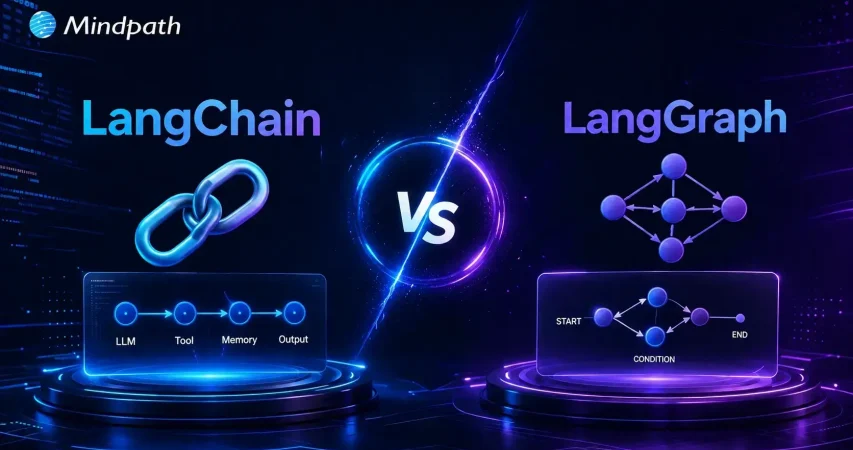
LangChain vs LangGraph: Which Framework Is Better for Enterprise AI?

LangChain vs LangGraph: Which Framework Is Better for Enterprise AI?

Join our Newsletter!

Langchain vs Langgraph

Enterprise AI is rapidly evolving from simple chatbots to intelligent systems that automate workflows, coordinate AI agents, and support business decisions. As organizations build more advanced AI applications, choosing the right framework becomes essential. The discussion around LangChain vs LangGraph is growing because each framework is designed to solve different enterprise AI challenges and development requirements.

Key Takeaways

  • 01
    Choose frameworks based on business needs, not popularity.
  • 02
    LangChain simplifies building AI applications with reusable components.
  • 03
    LangGraph supports complex, stateful, multi-agent AI workflows.
  • 04
    Both frameworks serve different enterprise AI development requirements.
  • 05
    Combining both frameworks delivers greater flexibility for enterprise AI.

While LangChain focuses on building AI applications with structured workflows, LangGraph is designed for stateful, multi-agent orchestration and complex decision-making. Understanding their differences helps enterprises select the right framework for long-term scalability and performance. In this blog, we will compare LangChain vs LangGraph and help you choose the best fit for enterprise AI.

Looking to build enterprise AI applications that align with your business goals? At Mindpath, we offer AI development services that help businesses design, develop, and deploy scalable AI solutions using frameworks like LangChain and LangGraph for intelligent automation and enterprise workflows.

What is LangChain? An Overview

LangChain is an open-source framework that helps developers connect large language models with external tools, business data, APIs, and memory. The LangChain framework for AI agents simplifies building intelligent, task-driven applications.

It provides reusable components for prompt management, retrieval, tool integration, and workflow creation. This modular approach enables developers to build scalable AI applications that can perform complex business tasks with greater efficiency.

Core Components of LangChain

  • Models: Connects applications with different large language models seamlessly.
  • Prompt Templates: Creates consistent, reusable prompts using dynamic input variables.
  • Chains: Combines multiple AI tasks into structured sequential workflows.
  • Memory: Maintains conversation context across multiple user interactions effectively.
  • Indexes and Retrievers: Retrieves relevant business data for accurate AI responses.
  • Agents: Enables AI to choose tools and execute tasks.

Advantages of LangChain

  • Faster Development: Accelerates AI application development using reusable framework components.
  • Easy Model Switching: Switches between AI models with minimal code changes.
  • Private Data Integration: Connects securely with enterprise data using RAG techniques.
  • Context and Memory: Preserves conversation history for better contextual AI responses.
  • Autonomous Workflows: Automates complex tasks through intelligent AI agent workflows.

Drawbacks at a Glance

  • Over-Abstraction: Hides application logic behind multiple framework layers.
  • Limited Control: Reduces flexibility for implementing custom AI workflows.
  • Frequent Updates: Breaking changes increase maintenance and upgrade complexity.
  • Difficult Debugging: Complex stack traces make troubleshooting production issues harder.

What is LangGraph? An Overview

LangGraph is an open-source framework for building stateful AI applications using graph-based workflows. It enables LangGraph multi agent orchestration, allowing multiple AI agents to collaborate, share context, and complete complex tasks.

Instead of linear workflows, LangGraph uses interconnected nodes and persistent state to manage decisions and long running processes. This architecture makes it well suited for enterprise AI applications requiring reliability, scalability, and workflow control.

Core Components of LangGraph

  • State: Stores shared application data across workflow execution steps.
  • Nodes: Execute individual tasks, logic, or external tool operations.
  • Edges: Connect nodes to define workflow execution sequence clearly.
  • Conditional Edges: Route execution dynamically based on current application state.
  • Checkpointing: Saves workflow state for recovery and debugging purposes.
  • START and END: Define workflow entry and completion points clearly.

Advantages of LangGraph

  • Cyclical Workflows: Supports loops, retries, and dynamic workflow execution paths.
  • Persistent State Management: Maintains shared state throughout entire workflow execution.
  • Human-in-the-Loop: Enables user reviews before critical workflow decisions.
  • Multi-Agent Coordination: Orchestrates multiple AI agents working toward shared goals.
  • Built-in Checkpointing: Automatically saves workflow progress for seamless recovery.

Drawbacks at a Glance

  • Overkill for Simple Tasks: Adds unnecessary complexity for straightforward AI applications.
  • Steep Learning Curve: Requires understanding graphs, states, and workflow architecture.
  • Maintenance Burden: Complex state management increases long term maintenance efforts.
  • Ecosystem Friction: Frequent updates may introduce compatibility and integration challenges.
LangChain Vs LangGraph: A Comparison Table

Understanding the difference between LangChain vs LangGraph helps enterprises select the right framework for their AI requirements. While both support AI application development, they differ in architecture, workflow design, scalability, and enterprise capabilities. The comparison below highlights their key differences.

Feature LangChain LangGraph
Primary Purpose Build LLM applications using reusable AI components. Orchestrate complex, stateful AI agent workflows.
Architecture Linear chains and pipelines. Graph based architecture with nodes and conditional edges.
Workflow Type Sequential execution. Non linear execution with loops and branching.
State Management Limited by default, requires additional handling. Persistent state maintained throughout execution.
AI Agent Support Supports single and simple tool using agents. Designed for advanced multi agent orchestration.
Decision Making Best for straightforward task execution. Supports dynamic decision-making during workflows.
Control Flow Fixed execution sequence. Flexible routing based on workflow state.
Human in the Loop Requires custom implementation. Native support for approvals and interruptions.
Checkpointing Not available by default. Built in checkpointing and workflow recovery.
Memory Handling Conversation memory through integrated components. Shared workflow state across every execution step.
Complex Workflow Support Moderate. Excellent for enterprise grade AI automation.
Scalability Suitable for small to medium AI applications. Built for long running, scalable enterprise systems.
Development Speed Faster for prototypes and MVPs. Slower initial setup but stronger production control.
Learning Curve Easier for beginners and AI developers. Steeper due to graph concepts and state management.
Debugging Can become difficult in larger applications. Easier with checkpoints, traces, and workflow visibility.
Integration Extensive integrations with models, vector databases, APIs, and tools. Uses the same ecosystem while adding orchestration capabilities.
Enterprise Use Cases Chatbots, RAG applications, document search, AI assistants. Multi-agent systems, autonomous workflows, compliance processes, enterprise automation.
Best For Rapid AI application development with minimal complexity. Mission critical AI systems requiring reliability and orchestration.
Typical Business Choice Organizations launching AI products quickly. Enterprises deploying production ready AI agents at scale.

Which Is Better: LangChain or LangGraph?

There is no universal winner in the LangChain vs LangGraph comparison because each framework is built for different enterprise AI requirements. The right choice depends on your application complexity, workflow design, scalability needs, and long term business goals.

When to Use LangChain?

Choose LangChain if your organization needs:

  • AI chatbots and virtual assistants
  • RAG based knowledge retrieval applications
  • Rapid prototyping and faster development
  • Sequential AI workflows with minimal orchestration
  • Flexible integration with LLMs, APIs, and vector databases

When to Use LangGraph?

Choose LangGraph if your organization needs:

  • Multi agent AI systems with shared responsibilities
  • Long running, stateful AI workflows
  • Human approval and compliance checkpoints
  • Dynamic routing, loops, and conditional execution
  • Enterprise grade automation requiring reliability and scalability

For organizations building advanced autonomous AI systems, LangGraph is often the best framework for AI agents. However, many enterprises achieve the best results by combining LangChain for application development with LangGraph for orchestration and workflow management.

Which Framework Should Enterprises Choose for AI?

Choosing the right framework depends on your enterprise AI goals, workflow complexity, and scalability requirements. Instead of asking is LangGraph better than LangChain, organizations should evaluate which framework aligns with their application architecture, operational needs, and long-term AI strategy for maximum business value.

At Mindpath, we build enterprise AI solutions tailored to your business requirements, from intelligent assistants to advanced multi agent systems. Our AI development experts help organizations design, develop, integrate, and scale secure AI applications using the right frameworks for long term success.

Frequently Asked Questions

The right choice depends on project complexity, workflow requirements, scalability goals, and AI architecture. Many enterprise solutions successfully combine both frameworks to achieve better performance and flexibility.
Yes. LangChain can manage AI components and integrations, while LangGraph handles workflow orchestration, state management, and multi agent coordination for more advanced enterprise applications.
No. LangGraph also works well for long running workflows, approval based processes, and applications that require persistent state, conditional execution, and reliable workflow management.
LangChain is generally easier for beginners because of its simpler workflow model. LangGraph requires understanding graph based execution and state management, making it better suited for advanced projects.
Evaluate workflow complexity, scalability needs, integration requirements, maintenance effort, and future AI goals before selecting the framework that best fits business objectives.

Support Is One Click Away

Featured Posts

Related Post

Angular vs React

Developing modern web applications requires making definite technological choices. The Angular vs React controversy still influences those decisions. Lots of software development teams look beyond the most popular option. They focus on aspects that drive long-term value, scalability, and developer experience. Now, what truly sets the right one for a project? A deeper look shows how both fit different business goals, technical needs, and team capabilities. So, the decision becomes more thoughtful than it first appears.

With development demands changing, businesses now expect fast delivery. They also want flexible architecture and a near-perfect user experience. Therefore, choosing the right framework becomes a strategic move. It is not just a simple preference. Some focus on structure and consistency, while others prefer flexibility and speed. This gap raises a few important questions. Your discussions must address them before moving forward. In this article, you will learn through deep research which platform suits your development needs best.

What is React? A Quick Overview

React is a JavaScript library that was created by Meta, and it is mainly used to create user interfaces that are dynamic and single-page applications. It breaks frontend content into smaller, reusable, and independent components, which makes the code more manageable, scalable, and efficient for the development of modern web.

Besides, developers adore React for its virtual DOM feature that drastically reduces the time of the rendering process and allows for the smooth update of the UI. As opposed to heavier frameworks, React’s adaptability and component-based structure render it a leading choice when one compares Angular vs React. In fact, it is always found ranking very high for its simple and high performance.

Benefits of React Framework:

1. Component-Based Architecture

React builds UIs from small, reusable components. This makes code easier to manage, test, and scale.

2. Virtual DOM for Faster Rendering

React updates only the necessary parts of the DOM. This ensures faster performance and a smoother user experience.

3. Declarative UI

React lets developers describe what the UI should look like in any state. This makes code more readable and easier to debug.

4. Unidirectional Data Flow

Data flows strictly from parent to child components in React. This ensures better control and a more stable codebase.

5. Strong Community and Ecosystem

React has a massive global community backed by Meta. Tools like Redux and Next.js make development faster and well-supported.

6. Cross-Platform Mobile Development

React Native allows building iOS and Android apps using the same principles. This reduces development time, cost, and effort significantly.

What is Angular? A Quick Overview

Angular is a comprehensive solution developed with the TypeScript language, and it is open source. Google is the one that maintains it. Angular is mainly used to create dynamic single-page applications. It presents a well-structured and component-based working style alongside a full set of internal tools. This makes the development of large-scale applications much more manageable, consistent, and efficient.

If we talk about the comparison of Angular vs React, Angular as a framework is complete and delivers out-of-the-box facilities for routing, forms, and HTTP services. This reduces the developers’ reliance on third-party libraries and gives the teams working with the same technology a unified and standardized way of building robust and enterprise-grade web applications.

Benefits of Angular framework:

1. Component-Based Architecture

Angular builds UIs from self-contained, reusable components. This promotes modularity and maintainability across the application.

2. TypeScript Integration

Angular is built on TypeScript, enabling static typing and early error detection. This ensures cleaner, more reliable code for large projects.

3. Two-Way Data Binding

Angular automatically synchronizes data between the model and UI in real time. This eliminates manual DOM manipulation and simplifies development.

4. Comprehensive Tooling and Ecosystem

Angular offers built-in routing, forms, HTTP client, and testing utilities. This reduces reliance on third-party libraries significantly.

5. Performance Optimizations

Angular includes AOT compilation, lazy loading, and the Ivy rendering engine. These ensure faster load times and improved application performance.

6. Google Support and Community

Backed by Google, Angular receives consistent updates and long-term support. A large developer community provides extensive resources and solutions.

React vs Angular: Which is the Best Framework for Frontend Development?

Deciding on the best frontend framework for your project is certainly a heated topic in web development today. By deciding Angular vs. React, which is better, allows us to understand how tech choices can be more aligned with the needs of specific projects.

1. Architecture

Angular is built around a rigid MVC architecture with clearly demarcated components, modules, and services, which is highly conducive to large teams and enterprise projects. With its well-defined, opinionated style that enforces uniformity and standardization across the entire codebase, Angular doesn’t leave much to the imagination of the developers.

Unlike Angular, React is a totally unopinionated framework that lets developers have full control over the way they structure their projects. This flexibility could match the creative teams well, but the fact of the matter is that without discipline making consistency could be nothing but a challenge, especially when applications are scaling.

2. Data Binding and DOM Handling

Angular’s two-way data binding syncs the UI and model automatically. This makes the development easier, however, it might cause overhead in very big applications. It operates on the real DOM which could slow down the app especially in scenarios where there are a lot of changes to the data.

React uses one-way data binding combined with a Virtual DOM that only the affected parts of a component will be re-rendered. This is the main reason why in discussion of Angular vs React performance React wins. It’s the most efficient when it comes to dynamic and data heavy applications.

3. Language and Syntax Differences

Angular leverages TypeScript, which has the benefits of type safety, automatic code completion, and more elegant handling of the code+

React mainly runs on JavaScript, with the option of TypeScript being an addition, and it introduces JSX as a means

4. Learning Curve and Developer Experience

Angular is a complex framework, and developers have to learn TypeScript, DI, modules, and the Angular way of doing things. It is a good choice for mature developers who want to build structured software that lasts a long time.

React is simpler and more approachable, particularly for developers already familiar with JavaScript frameworks. It is a popular choice among new developers, startups, and fast-growing teams because of its very easy learning curve.

5. Ecosystem and Community Support

Exploring Angular vs React features, Angular delivers a full, Google-supported ecosystem along with the official tools for routing, forms, HTTP services, and testing that are part of the package. Such an integrated environment is why Angular is a dependable option with steady long–term ‌‍ ‍‌support.

React, ‍‌ for its part, enjoys a large open-source ecosystem with h a huge number of third-party libraries Redux, React Router, Recoil, etc. Besides, its big community across the world not only helps in keeping the library updated, encouraging innovations but also makes learning resources very ‍ ‌‍ ‍‌accessible.

React vs Angular: A Comparison Table

The following table compares React and Angular across key parameters. This makes it easier to evaluate which framework best suits your development needs.

Criteria  Angular  React 
Type Complete structured frontend framework Flexible lightweight UI library approach
Architecture Strict MVC based architecture pattern Component based reusable UI structure
Language TypeScript used by default always JavaScript with optional TypeScript support
Data Binding Two-way automatic data binding One-way predictable data flow
Performance Heavier framework moderate performance speed Fast rendering using virtual DOM
Learning Curve Steep learning curve for beginners Easy learning curve for developers
Development Speed Slower due to strict structure Faster development with flexibility
Ecosystem Built in tools limited flexibility Large ecosystem high flexibility

Ready to Choose the Right Framework for Your Next Project?

The Angular vs React future depends on how well each option fits your project goals. Angular offers strong structure and built-in tools for complex systems. React brings flexibility, speed, and a modern approach to UI development. Teams now focus on performance, scalability, and user experience before making a choice. A clear understanding of project needs helps select the right technology and ensures long-term success.

At Mindpath, we deliver high-quality React development services with a strong focus on performance and scalability. The team builds modern, user-friendly applications that support business growth. With deep expertise and a flexible approach, Mindpath helps companies create fast and reliable digital products that stand out in today’s competitive market.

Frequently Asked Questions

1. How does Angular vs React impact long-term project maintenance and updates?

Long-term maintenance depends on how easily code can adapt to changes. Angular offers a structured setup that helps large teams stay consistent over time. React provides flexibility, which allows faster updates and easier feature additions. The choice often depends on team size, project complexity, and future expansion plans.

2. In Angular vs React, which option supports better team collaboration in real projects?

Team collaboration improves when developers follow clear coding patterns and workflows. Angular supports consistency with built-in standards, making coordination easier in large teams. React encourages flexibility, which works well for smaller or agile teams. The right choice depends on how structured or adaptable the team prefers to work.

3. How do these technologies handle frequent UI changes in growing applications?

Modern applications often need regular UI updates to stay relevant. React handles frequent UI changes efficiently due to its component-based structure. Angular also supports updates but may require more effort due to its strict architecture. The decision depends on how often the interface needs quick and dynamic changes.

4. Which option works better for startups aiming for quick product launches?

Startups often focus on speed, flexibility, and quick iterations. React helps teams build and test features faster due to its lightweight nature. Angular provides a complete setup but may take more time initially. Choosing the right option depends on how quickly the product needs to reach the market.

5. How do Angular and React support future technology integration like AI or advanced analytics?

Future-ready applications require smooth integration with modern technologies. React offers flexibility, making it easier to integrate AI tools and analytics platforms. Angular also supports integration but may need more structured implementation. The decision depends on how dynamic and scalable the future technology roadmap is.

Discover the top Node.js trends shaping digital technology in 2024, from AI and TypeScript to IoT and cloud computing. Explore how Node.js drives innovation!
Generative AI for Businesses

Are you struggling to keep your business ahead in an increasingly competitive market? Wondering how leading companies are innovating faster, reducing costs, and delivering personalized experiences? What if there was cutting-edge technology that could unlock new levels of creativity and efficiency for your business? Could Generative AI be the missing piece in your strategy for success? In this blog, we will explore how generative AI is impacting your business. So, let’s dive in! 

What is Generative AI?

Generative AI is a type of technology that employs complex algorithms to generate new and realistic material based on previously learnt data, such as writing, photos, or even noises. These algorithms function by training on massive volumes of data, allowing them to recognize patterns and produce material that appears to be unique. The most powerful types of generative AI are based on what are known as foundation models, which are trained on massive datasets without the requirement for specific labels. This enables the AI to learn in a more flexible manner and tackle a wider range of tasks. 

Why is Generative AI Important?

Generative AI is essential because it boosts creativity by creating new content based on patterns learnt from data. It also personalizes user experiences, enabling firms to adjust information to specific customer requirements and interests. Furthermore, generative AI promotes cooperation by working alongside individuals, using their talents to create greater results. This technology also speeds up procedures, increasing operational efficiency. Furthermore, its broad effect spans sectors, providing greater insights into artificial and human intelligence, propelling innovation and understanding forward. 

How Does Generative AI Impact Businesses?

1. Improved Customer Experience

Improving customer experience is a prominent application of generative AI, giving organisations a valuable tool for improving interactions. Businesses can create more engaging and rewarding consumer experiences by implementing dynamic AI agents that provide human-like replies, hence strengthening connections. 

These AI-powered chatbots, based on advanced language models, provide more nuanced and intelligent replies, enhancing interactions and making customers feel heard and understood. Beyond direct connection, generative AI is an invaluable support mechanism for customer care personnel. These AI agents use natural language processing (NLP) to listen to discussions between agents and clients, instantly collecting relevant information to help in real time. This increases service quality and cuts response time and the workload of human agents.  

2. Personalized Learning

Generative AI systems excel in adaptive learning, which enables them to constantly improve by incorporating feedback and analyzing new data. This constant modification improves their effectiveness, allowing them to offer outcomes that better match user preferences and company objectives. For example, in a corporate environment, generative AI can be used to improve marketing strategy by analyzing consumer interactions and feedback. As the system better understands client preferences and behaviors, it will create more focused and successful marketing efforts. Furthermore, it may tailor recommendations and information to particular client demands, resulting in more personalized and effective interactions. This skill not only improves the efficiency of marketing activities, but also allows organizations to remain flexible and responsive to changing market trends. 

3. Data Generation

Generative AI provides considerable data synthesis benefits. These AI algorithms can mix and interpret massive volumes of data to generate significant insights by analyzing many datasets. For example, in the financial business, generative AI can build predictive models by analyzing market patterns, customer behavior, and economic statistics. These models assist organizations in making sound investment decisions by offering a clearer view of future market movements. Generative AI, which harnesses the power of data synthesis, helps organizations in many industries to access actionable insight, offering them a competitive advantage in today’s data-rich environment. 

4. Increased Efficiency and Productivity

Generative AI improves efficiency and productivity by automating difficult and time-consuming operations, allowing firms to optimize workflows and better allocate resources. For example, in the manufacturing industry, AI can deliver optimized production plans that decrease waste and increase overall efficiency. In customer service, generative AI can assist support agents by summarizing tickets, proposing relevant replies, and selecting the best tone for conversations. This allows agents to resolve enquiries faster and more correctly, increasing productivity and enhancing customer service quality. Businesses that use generative AI can boost productivity, save operating costs, and improve performance across several departments. 

5. Reduced Time and Costs

Generative AI saves time and money by automating processes that previously needed significant human effort. For example, in architecture and design, AI can quickly generate architectural plans based on certain factors, considerably speeding up the design process and minimizing manual labor. AI can also analyze stakeholder comments and market trends to produce new product ideas and improve designs more effectively. This capacity to analyze massive amounts of data quickly not only reduces operating costs, but also shortens project timeframes and improves resource al__cpLocation, resulting in increased overall efficiency for enterprises. 

6. Boosted Creativity

Generative AI greatly increases creativity by allowing organizations to efficiently create a diverse range of interesting and unique content. In the advertising sector, for example, AI-powered solutions can create intriguing ad copy, eye-catching images, and even dynamic video material. This feature not only speeds up the creative process, but also allows firms to experiment with new thoughts and ideas without the constraints of physical labor. 

Beyond advertising, generative AI may help with a variety of creative tasks, from designing distinctive product packaging to creating interactive customer experiences.  It’s an effective tool for brainstorming and refining ideas, allowing teams to push creative limits and remain ahead of trends. By automating repetitive operations and providing new viewpoints, generative AI enables firms to sustain a steady flow of creative content while remaining competitive in a constantly evolving market. 

Generative AI Services at Mindpath

Mindpath provides a variety of services that leverage generative AI to help your business succeed.

Our artificial intelligence (AI) can generate interesting material, such as ad copy, graphics, and even motion pictures, all personalized to your specifications. This means less time spent on manual labor and more time for creativity. 

We also utilize AI to analyze data and produce valuable insights, allowing you to make better decisions. Whether you need new marketing ideas or better methods to understand your consumers, our generative AI services will help you stay competitive in today’s fast-paced environment. 

Wrapping Up!

Generative AI is a game changer for organizations, providing creative solutions for increasing creativity, streamlining processes, and improving consumer experiences. By automating complicated activities and delivering important insights, it allows businesses to cut expenses while staying competitive. As more firms use this technology, those that use generative AI will be better positioned to promote development, respond to market changes, and achieve long-term success. Embracing generative AI is more than simply a technological advancement; it is a strategic step towards a more dynamic and efficient future. At Mindpath, we offer tailored generative AI solutions that streamline processes, cut costs, and elevate customer experiences. Embrace the future with Mindpath and unlock new opportunities for growth and innovation in today’s fast-paced market. 

Ready to elevate your business with cutting-edge technology?

Discover how Mindpath’s generative AI solutions can transform your operations and drive success.

Discover how generative AI for businesses can drive innovation, efficiency, and creativity. Explore its impact in our latest blog.
top digital transformation trends

In the digital world, new digital technologies are emerging at a rapid pace. It is imperative for business entities operating in diverse industries and sectors to familiarize themselves with the top digital transformation trends in 2026. The global spending on digital transformation is likely to touch USD 3.9 trillion by the year 2027. It highlights the bright future of digital transformation.

In order to stay ahead in the competitive business space, you need to keep a tab on the key trends that contribute to digital transformation for businesses. The insight into these trends can surely guide your business towards a path of innovation and creativity. Let us explore some of the chief trends that can influence the trajectory of your business in 2026.

Looking to use the digital transformation trends practically in your business operations to enhance performance? Contact us to get personalized advice on how to implement these trends successfully.

Major Digital Transformation Trends in 2026

Businesses need to familiarize themselves with major digital transformation trends that are dominating in 2026. Such trends can create new opportunities for businesses to stay ahead in their industries. The top digital transformation trends include:

1. Rapid Adoption of Generative AI

The emergence of generative AI has certainly broadened the boundaries of Artificial Intelligence. In fact, you cannot ignore AI and automation in digital transformation today. By leveraging generative AI for business, they have the amazing opportunity to redefine personalization. Moreover, by making use of generative AI capabilities, it has become possible for businesses to automate the content creation process.

It is undoubtedly among the top trends that are catching up among businesses. You can strategically integrate generative AI elements to showcase your commitment to innovation. In the future, as generative AI further matures, businesses can transform their existing workflows as well as processes.

2. Boosting Efficiency through Cloud Computing

Cloud computing is certainly among the top enablers of digital transformation for businesses at present. Businesses need to keep track of the latest cloud computing trends in 2026 so that they can improve their productivity. Moreover, it can also create an opportunity for businesses to minimize their overall costs.

Businesses can consider adopting a hybrid cloud infrastructure. It will enable them to ensure high portability, IT agility, and vendor-related flexibility. Businesses cannot ignore the strategic relevance of cloud computing technology in their digital transformation journey. It can play a catalytic role by fostering innovation for businesses.

3. Rising Adoption of Mobile Technologies

While discussing the topic of digital transformation, one cannot omit mobile technologies. Instead, it is among the top digital transformations in IT that one can come across. Today, the reliance on mobile is expanding among customers. This trend has automatically been driving digital transformation initiatives among businesses today.

Regardless of the industry in which businesses operate, it is essential for businesses to develop mobile apps. By doing so, the communication between businesses and their potential and existing customers can be simplified. It can certainly redefine the overall experiences of customers. It can even give rise to new opportunities for businesses to transform the customer journey.

4. Increased Focus on Cybersecurity

In the highly dynamic and volatile cyberspace, businesses have started refocusing on cybersecurity aspects. The rapid adoption of new types of technologies has automatically escalated cybersecurity concerns for businesses as well as customers. This is because malicious actors such as cybercriminals and online hackers have been using sophisticated techniques to compromise the security of legitimate users online.

To prepare themselves in the evolving cybersecurity space, businesses have started prioritizing their cybersecurity preparedness. Modern businesses are adopting new cybersecurity measures and interventions to strengthen their cybersecurity posture. This specific trend is likely to gain further prominence in the evolving digital landscape.

Wondering how artificial intelligence is reshaping security in the digital era? Check out AI in cybersecurity to learn how intelligent threat detection and automation are transforming protection strategies in 2026.

5. Shift Towards Data-Driven Business

In the contemporary business world, the role of emerging technologies in digital transformation is surely instrumental. It has also created an opportunity for businesses to shift towards a data-driven approach. Today, businesses are relying on concrete data and facts to make decisions. Such a shift has undoubtedly shown the high value of rich and insightful data for businesses.

By relying on real-time and accurate data, it has become possible to respond to the evolving needs of customers promptly. Furthermore, it has also empowered businesses to adapt to the dynamic business climate and make cautious and well-informed decisions. It is definitely a major source of competitive advantage for businesses in the current times. This particular trend certainly holds the promise to redefine the journey of businesses as well as their customers.

6. Growing Popularity of Agentic AI

Although the concept of Agentic AI is in its nascent stage, it has captured the attention of one and all. In fact, this novel technology holds the promise to become a cornerstone of digital transformation for modern businesses. By integrating agentic AI, businesses can automate repetitive tasks. Furthermore, this technology can enable businesses to optimize their overall decision-making process.

Even though Agentic AI is still evolving, it has started to impact several industries and businesses. As such systems have a high degree of autonomy, they can make important decisions with little human intervention. It is certainly among the top emerging technologies in digital transformation that businesses must focus on.

7. High Expansion of Edge Computing

Edge computing is a novel concept where data processing and data storage are brought closer to the source of data. This approach has been gaining considerable momentum in the business world today. This is because it can give rise to a host of benefits for businesses in the form of reduced latency, better real-time responsiveness, and reduced use of bandwidth.

In the competitive business landscape, edge computing certainly acts as a vital source of advantage for businesses today. By leveraging the novel technology, businesses can carry out their operations in a more reliable manner. Moreover, it also creates the opportunity for businesses to save costs by reducing the amount of data that is transmitted to the cloud.

Strategic Importance of Digital Transformation

In the prevailing business environment, it is imperative for businesses to familiarize themselves with the latest digital transformation trends for 2026. By being aware of the emerging technologies, you can strategically deploy appropriate digital technologies to advance towards your digital transformation journey.

Digital transformation is of high strategic importance for entities since it can boost efficiency, promote automation, and improve the experience of customers. Moreover, it can foster innovation, which is a must for contemporary businesses today. By leveraging digital transformation for business growth, you can ensure that your business can effectively adapt to the evolving business climate. It can serve as the ultimate pathway that can help businesses achieve sustainable growth in the digital age.

Wondering how digital trends drive real business impact? Discover digital transformation for businesses to see how companies are evolving in 2026.

Final Words

In the 21st century, digital technologies have been influencing how business entities operate. In order to adapt to the rapidly evolving business setting, it is a must for businesses to keep a tab on the top digital transformation trends. A broad range of trends has been identified, including the rapid adoption of Generative AI, leveraging cloud computing, rising use of mobile technologies, increased focus on cybersecurity, and a shift towards data-driven business. Similarly, businesses are also focusing on novel technologies like Agentic AI as well as edge computing to boost their capabilities.

As the strategic relevance of digital technologies is immense, businesses must choose a top service provider that can help them advance in their digital transformation journey. Businesses must consider the innovative solutions of Mindpath to stay ahead in the digital transformation race. The modernization and digitalization of solutions can surely help businesses thrive in the technology-driven business world.