Home

LLMOps vs MLOps: Key Differences in Managing AI Models in Production

LLMOps vs MLOps: Key Differences in Managing AI Models in Production

Join our Newsletter!

llmops vs mlops

Moving AI models from experimentation to production requires careful planning, consistent monitoring, and ongoing maintenance. Traditional machine learning operations have established processes for training, testing, deploying, and maintaining models. However, large language models introduce additional challenges, including prompt management, response quality, hallucination detection, and inference cost control. This has made LLMOps vs MLOps an important consideration for businesses building production-ready AI applications.

Key Takeaways

  • 01MLOps manages traditional machine learning workflows, while LLMOps addresses generative AI applications.
  • 02LLMOps introduces additional requirements for prompt management, response evaluation and hallucination monitoring.
  • 03Data preparation, model development, and evaluation differ across both operational approaches.
  • 04Choosing suitable LLMOps tools improves monitoring, deployment and production management.
  • 05Businesses can combine MLOps and LLMOps to manage diverse AI applications effectively.

While both practices aim to maintain reliable AI systems, their operational requirements differ in several areas. Understanding these differences helps businesses choose the right approach for their AI initiatives. In this blog, we will examine their key differences, workflows, essential tools, and practical applications.

Struggling to manage AI models and maintain their performance in production? Mindpath offers AI development services to help businesses build, deploy, and manage scalable AI solutions with reliable production workflows.

Understanding the Foundations of MLOps and LLMOps

Understanding how these two operational approaches work is essential before comparing their capabilities. Although MLOps and LLMOps share several engineering principles, they address different requirements in the development and management of AI applications.

1. What Is MLOps?

MLOps, or Machine Learning Operations, combines machine learning development with DevOps practices to manage the complete ML lifecycle. It establishes consistent processes for preparing data, training models, validating results, deploying models, and monitoring their performance in production.

Its primary goal is to make machine learning workflows reliable, repeatable, and easier to maintain. MLOps uses automation, model versioning, and continuous integration to help engineering teams manage changes and maintain consistent model performance.

Key responsibilities of MLOps include:

  • Data Preparation: Cleaning, processing, and organizing training datasets.
  • Model Training: Developing models using selected algorithms and datasets.
  • Model Validation: Testing performance through accuracy, precision, and recall.
  • Automated Deployment: Releasing validated models into production environments.
  • Performance Monitoring: Tracking model behaviour, data drift, and prediction quality.

For instance: A subscription business can use an ML model to identify customers likely to discontinue their subscriptions. MLOps help manage the training data, model updates, deployment, and ongoing prediction monitoring.

2. What Is LLMOps?

LLMOps, or Large Language Model Operations, focuses on managing the development, deployment and maintenance of applications powered by Large Language Models (LLMs). It covers foundation model selection, prompt engineering, retrieval pipelines, fine-tuning, evaluation and production monitoring.

Its primary goal is to maintain reliable and cost-effective generative AI applications. LLMOps introduces additional practices for evaluating responses, identifying hallucinations, managing token consumption and maintaining consistent output quality across different user interactions.

Key responsibilities of LLMOps include:

  • Model Selection: Choosing suitable foundation models for specific applications.
  • Prompt Management: Creating, testing and versioning prompts.
  • Retrieval Management: Connecting LLMs with relevant external knowledge sources.
  • Response Evaluation: Assessing relevance, factual accuracy, and contextual grounding.
  • Production Monitoring: Tracking hallucinations, latency, token usage and response quality.

For instance: A customer support assistant can use an LLM connected to a company’s knowledge base to answer customer queries. LLMOps helps manage its prompts, retrieval pipeline, response quality and production performance.

LLMOps vs MLOps: 8 Key Differences Explained

MLOps and LLMOps share operational foundations such as automation, deployment, version control, and continuous monitoring. However, their requirements differ based on model architecture, output characteristics, and production challenges. Understanding LLMOps vs MLOps helps businesses choose suitable practices for managing their AI applications.

Comparison factor MLOps LLMOps
Primary focus Traditional ML models LLM-powered applications
Data management Training datasets and feature pipelines Contextual data, prompts and retrieval sources
Model development Training and tuning ML models Foundation model selection, prompting and fine-tuning
Evaluation Accuracy, precision, recall and F1-score Relevance, factual accuracy, groundedness and safety
Version control Models, datasets and feature pipelines Models, prompts, configurations and retrieval components
Deployment Model serving and inference pipelines LLM serving, API integrations and application pipelines
Monitoring Data drift, model drift and prediction quality Hallucinations, latency, token usage and response quality
Cost management Training, infrastructure and inference costs Inference, API consumption and infrastructure costs

These differences become clearer when examining the operational processes involved in developing and maintaining both types of AI systems.

1. Data Management and Preparation

MLOps manages training datasets through data cleaning, feature engineering and automated processing pipelines. LLMOps also manage contextual information, embeddings, vector databases, and retrieval sources to provide relevant information during model interactions.

2. Model Development and Experimentation

MLOps involves algorithm selection, feature engineering, hyperparameter tuning, and repeated training experiments. LLMOps focuses on foundation model selection, prompt engineering, Retrieval-Augmented Generation (RAG) and fine-tuning to meet specific application requirements.

3. Model Evaluation and Performance Metrics

Traditional ML models are evaluated using metrics such as accuracy, precision, recall, and F1-score. LLMOps requires additional evaluation of response relevance, factual correctness, contextual grounding, toxicity and consistency, often supported by automated testing and human feedback.

4. Deployment and Version Management

MLOps deployment involves packaging trained models, configuring inference endpoints, and integrating them into applications. LLMOps must also manage foundation model versions, prompt templates, API configurations, and retrieval pipelines to maintain consistent application behaviour.

5. Monitoring, Observability and Cost Control

MLOps monitoring tracks data drift, prediction errors, model performance, and infrastructure health. LLMOps additionally monitors hallucinations, prompt failures, response latency, API reliability and token consumption to maintain response quality and control inference expenses.

These operational requirements also influence the selection of LLMOps tools, particularly for evaluation, tracing, deployment, and production monitoring.

MLOps vs LLMOps: Which Approach Should Businesses Choose?

The right approach depends on the type of AI applications a business plans to develop and maintain.

MLOps is suitable for:

  • Predictive analytics and forecasting.
  • Fraud detection and classification.
  • Recommendation systems.
  • Demand prediction and customer segmentation.

LLMOps is suitable for:

  • Generative AI applications.
  • AI-powered customer support assistants.
  • RAG-based knowledge systems.
  • Document processing and AI agents.

Businesses planning LLM deployment should consider the operational requirements of their applications, including response quality, scalability, and monitoring. Organizations using both traditional ML and generative AI can combine MLOps and LLMOps practices within an integrated operational framework.

Best Practices for Managing MLOps and LLMOps in Production

Although MLOps and LLMOps have different operational requirements, both need consistent management practices to maintain reliable AI systems.

  • Maintain Version Control: Track models, datasets, prompts, and application configurations.
  • Build Evaluation Datasets: Test models against realistic business scenarios and expected outcomes.
  • Monitor Production Performance: Track model quality, latency, security, and operational expenses.
  • Strengthen AI Governance: Implement access controls, data protection and responsible AI safeguards.
  • Automate Operations: Automate testing, deployment, and continuous performance evaluation.

Human review also remains important for high-impact or sensitive AI applications. While traditional ML workflows require oversight of predictions, LLM-powered applications need additional checks for inaccurate, biased, or unsafe responses.

How Can You Build Production-Ready AI Systems with the Right Framework?

MLOps and LLMOps share the goal of maintaining reliable AI systems in production. While LLMOps extends traditional operational practices to address generative AI challenges, the right framework depends on model requirements, application complexity, infrastructure and business objectives.

At Mindpath, we help businesses build production-ready AI applications through AI consulting, model development, fine-tuning, and AI agent development. Our AI engineering expertise supports businesses in designing, deploying and managing AI systems aligned with their goals. Explore Mindpath’s MLOps development services to build scalable and reliable AI applications.
Build and Manage AI Models with Confidence

Improve AI operations with scalable model development and deployment solutions from Mindpath.

Frequently Asked Questions

Yes, existing MLOps practices provide a foundation, but additional capabilities are needed to manage prompts, response quality, hallucinations, and LLM-specific costs.
Yes, even pre-trained models require evaluation, monitoring, prompt management, and performance optimization when integrated into production applications.
Businesses can use continuous evaluation, prompt versioning, response monitoring, and regular testing to identify performance issues and maintain reliable outputs.
Businesses should assess data privacy, response accuracy, infrastructure requirements, inference costs, scalability, and potential security risks before production deployment.
Yes, managed LLM APIs and cloud-based monitoring tools allow smaller teams to build and maintain LLM applications without managing extensive infrastructure.

Support Is One Click Away

Featured Posts

Related Post

Mobile app development 

In this fast-paced digital world, mobile app development has become a key channel for businesses to help grow and support their customers. Every tap, click and swipe is part of the user’s experience and lasting commitment to the brand. As customers rely more on their smartphones for shopping, entertainment, and other services, those companies that develop an intuitive e-commerce mobile app will have a better competitive advantage and will have their customers engaged with them.

As technology progresses every day, businesses can no longer rely solely on traditional platforms. Mobile apps now offer convenience, personalization, and live interaction that websites often cannot provide. Mobile apps help brands deliver seamless experiences and help build awareness and growth. This blog post will provide key advantages of mobile app development and help take your business to new heights.

Want to fully experience the benefits of mobile app development in your business? Mindpath offers mobile app development services, which help your business unlock new opportunities through innovative design and seamless functionality.

What is Mobile App Development?

Mobile app development refers to building software applications that are operated on mobile devices such as smartphones and tablets. Mobile app development is simply the process of designing the app’s interface and coding the app itself. These apps are designed to serve particular functions, which means they will facilitate the ability for a user to use services, shop online, or stay connected to others.

Mobile applications are capable of making use of the integrated functionality offered by a device, such as GPS, camera, bluetooth, and microphone, which sets them apart from traditional software. Developers today create the majority of applications for the Android or iOS platforms because these two dominate the worldwide market. Developers may use various frameworks & tools to construct applications that function smoothly, are visually attractive, and work seamlessly across devices.

What is the Process of Mobile App Development?

Developing a mobile application involves several necessary steps to take your idea to a working app. Each step plays a role in enabling usability, reliability, and scalability of the mobile app that is aligned with the business goals.

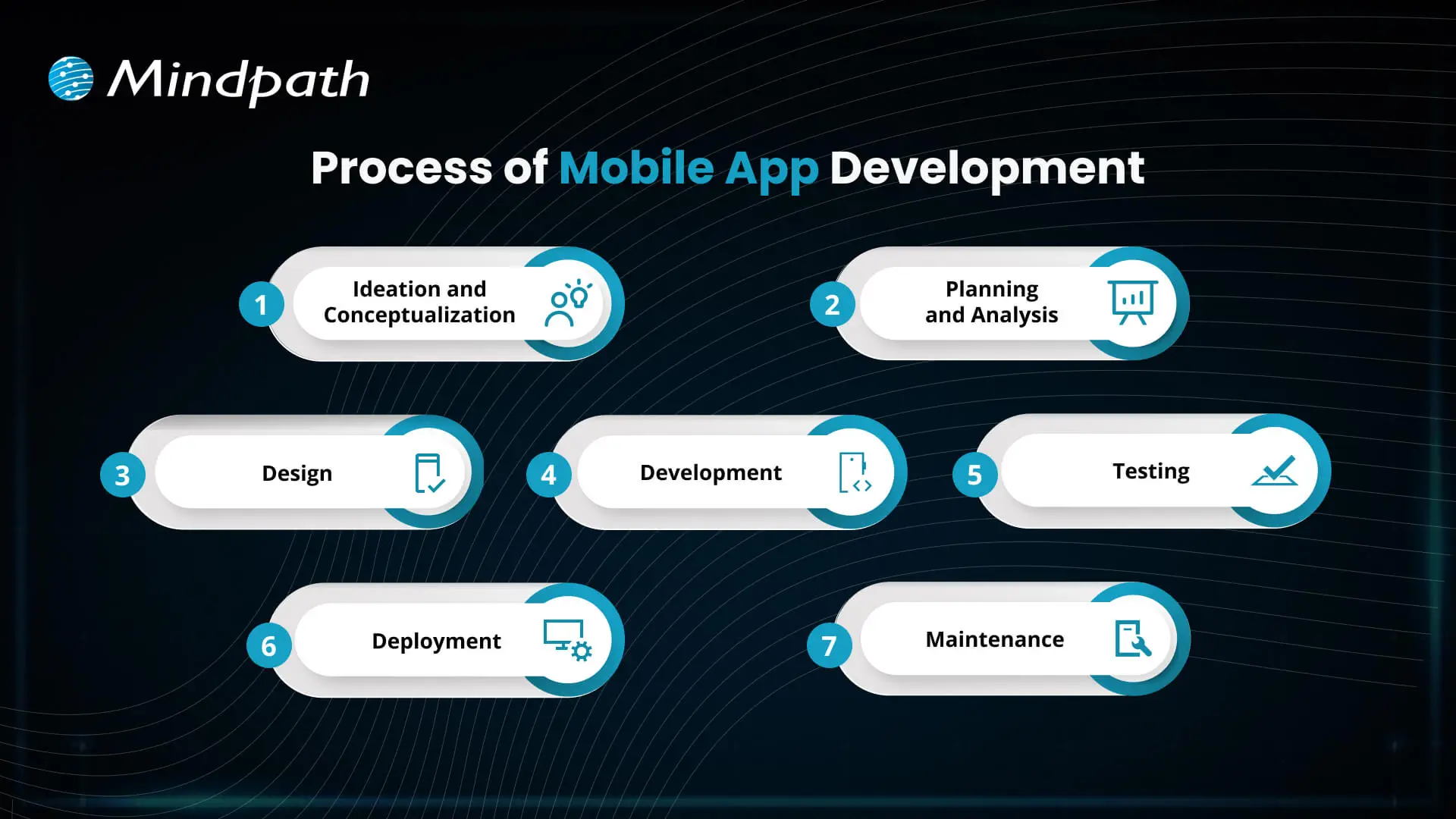
Process of Mobile App Development

1. Ideation and Conceptualization

The first step in the mobile app development process is coming up with a concept for your app. The teams think of an exciting mobile app development idea, find a way to solve problems for users, depict their target audiences, and identify key features.

2. Planning and Analysis

During this step, the teams conduct market research, determine app features, and establish goals. A proper framework documents timelines, budgets, and resources that will enable mobile app development startups and teams to stay on track.

3. Design

Designers create the aesthetic design and layout of the app to ensure it looks pleasing and is easy to use. Designing with simplicity and enjoyment in mind will allow users to navigate the app easily and have a positive experience while working.

4. Development

This is where developers start coding and building both the front and back ends of the app. The mobile app development process at this stage focuses on creating functional features that bring the design to life.

5. Testing

Before an app is launched, several tests are conducted to identify any malfunctions, like bugs or performance problems. This is a necessary step in order to ensure that the app is performing normally and responding correctly for the users.

6. Deployment

After the application has successfully gone through the testing stage, the app is published on the app stores, i.e., Google Play or Apple App Store. Companies that provide mobile app development will also develop a listing and promotional materials to be prepared for the launch.

7. Maintenance

Once the app has launched, it should be updated on a regular basis to fix bugs and continue to work with new devices or software versions. Maintaining the app will give users satisfaction, and enjoying the app for an extended period of time will keep users active.

Is your business app prepared to handle today’s security challenges? Discover how application security best practices for web and mobile apps keep user data safe while supporting sustainable growth.

Benefits of Mobile App Development

The advantages of mobile app development support businesses in more easily reaching customers and accelerating growth. By utilizing a mobile app development service, businesses can build simple and effective mobile apps that enhance user experience and increase engagement.

1. Enhance Customer Engagement

Mobile apps enable users to engage with your brand more often, keeping your business top of mind and relevant. Mobile app development allows businesses to develop features such as favorites, shopping lists, and review capabilities, all of which act as tools to enhance engagement.

2. Build Strong Brand Identity

An app that is well-designed becomes a permanent ambassador for your brand. Mobile app developers can collect relevant user data through the app, which can help improve your brand and continue to deliver value to your audience.

3. Increase Customer Loyalty

Mobile applications can host loyalty programs that encourage customers to revisit and repeat purchases. By giving discounts or rewards instantly, the app creates a sense of engagement with the app and helps build longer-term positive relationships.

4. Improve Customer Interaction

Mobile applications provide a convenient way for customers to purchase products because the app saves payment details and even previously favorite products. This all allows for an easier customer experience, which leads to convenience, improves customer satisfaction, and increases future conversions.

5. Personalize Marketing Efforts

Businesses can provide targeted offers and recommendations based on how users interact with their app. Personalized communication helps make users feel appreciated and encourages engagement.

Looking to build apps faster and smarter? Explore how mobile app development tools streamline development and boost productivity.

6. Boost Profits

Mobile apps typically drive sales and reduce marketing expenses by improving engagement, loyalty, and the overall user experience. Investing in the app is worthwhile because it is an efficient means of maximizing return.

7. Leverage Social Media Integration

Mobile applications can seamlessly connect to their social media channels, allowing individuals to easily share products or submit reviews. This advertising practice provides brands with exposure and social proof.

8. Provide Unique Value to Customers

Apps can offer features that are not available anywhere else, such as augmented reality try-ons, AI in mobile app development for intelligent chat support, and app-exclusive discounts. This adds convenience and encourages individuals to visit again.

9. Target Your Niche Market

Mobile apps provide a competitive advantage over other markets with specialized features and experiences. Businesses can effectively target and engage a broader segment of their target market.

10. Strengthen Communication

Push notifications ability and geotargeting gives businesses the ability to communicate with users in real time. Apps allow businesses to send relevant and time-sensitive messages without interruption from other communication channels.

Want to stay ahead in app innovation? Discover how mobile app development technologies power scalable, future-ready applications

Ready to Elevate Your Business with Mobile Apps?

Mobile app development offers businesses a powerful way to engage customers, build loyalty, and boost growth. By leveraging AI in mobile apps, companies can deliver smarter personalization, real-time support, and data-driven user experiences that stand out in competitive markets.. Leveraging the benefits of mobile apps helps businesses strengthen their brand, improve customer experience, and maximize sales in today’s digital world.

Mindpath provides professional mobile app development services to help businesses turn ideas into functional, user-friendly apps. Our team of experts focuses on designing apps that engage users, integrate key features, and deliver measurable results. With Mindpath, companies can launch high-quality apps that drive growth, enhance customer experience, and ensure long-term success.

ai and business

Have you ever considered how AI and business actually fit together? You may have heard a lot about AI being faster and smarter, but is your business actually prepared for it? Many people are excited about new technology, but they often overlook whether they have a solid foundation. Take a second to think about it- is your business possibly ignoring some signs that say you are not prepared for AI yet?

AI can help any business develop, but starting without preparation can create issues. There are companies that jump into AI without having the right tools or people, or even ideas. This could waste valuable time and resources and lead to frustration. Integrating AI in business strategy from the start ensures you’re prepared and can identify potential challenges early. In this blog post, you’ll learn five easy indicators that show your business may not be ready for AI yet.

Want to future-proof your business with AI? We at Mindpath offers exceptional AI development services that help your business get AI-ready and unlock next level of growth! 

What Being ‘AI Ready’ Really Looks Like?

Being ready for AI means your business has the right people, tools, and plan to make it work well. When you think about AI and business together, it’s more than just buying new software. You need good data that’s easy to use, a team that knows how to work with AI, and clear goals that AI can help you reach. A business ready for AI knows how to bring people and smart technology together.

Look at Amazon. They show how AI in e-commerce can work side by side with business to help customers and save money at the same time. This happens because they plan ahead and know exactly how AI will help. If you want your business to be ready to use AI, start by checking your data, training your team, and making a simple plan that fits your real needs. When you get this right, AI in business can really help you grow.

What is an AI Readiness Checklist?

An AI Readiness Checklist is a simple tool that helps you see if your business is really ready to use AI in the right way. It covers important things like your data, your technical tools, and how well your team understands AI. When you think about AI helping your business grow, this checklist shows you what’s strong and what needs more work.

A good AI checklist looks at your technical setup, the quality of your data, your team’s skills, and whether your company is open to new ways of working. This way, you can fix any gaps before you bring AI into your business. By using an AI checklist, you can make sure you’re set up for success and get real value from AI in business.

How is AI reshaping the way websites are built and optimized? Explore our detailed article on AI in Web Development to see how it’s driving smarter design, faster deployment, and better user experiences.

AI Readiness Checklist for Businesses

Before you bring AI into your daily operations, it’s important to know where you stand. A good AI readiness checklist will help you see if your business is truly prepared for this step. Here are the key areas to focus on as you plan your AI and business journey.

AI Readiness checklist for businesses

1. Robust Data Foundations

Good data is the backbone of any artificial intelligence business idea. Check that your data is clean, organized, and ready for AI tools to use well. Strong data governance keeps your insights trusted and prepares your business for AI integration.

2. Leadership and Team Alignment

A strong AI and business plan starts with people who believe in it. Make sure leaders fully support your strategy and teams understand the goals. A clear roadmap and open communication help everyone move toward strategic AI adoption together.

3. Technology and Process Readiness

Your tools and workflows must support AI smoothly. Research the best AI solutions for your existing systems and test them with pilot projects. Use simple frameworks to track results and find the best areas for automation.

4. Governance, Ethics, and Security

Responsible AI needs strong rules and security in place. Create clear ethical guidelines and monitor how AI works in your company. A good AI checklist helps protect your artificial intelligence business ideas and builds trust for the long term.

5. Financial Planning and ROI

Every digital transformation roadmap needs clear budget planning. Create realistic budgets, show expected returns, and track savings as you go. This makes it easier to get leadership buy-in and keeps AI and business costs under control.

Looking to streamline your business operations and enhance customer experiences? Discover how conversational AI chatbots can help your business transform its workflows and boost efficiency in our blog.

5 Signs Your Business is Not Ready for AI

Many companies jump into AI without checking if they’re really prepared. Missing a few basics can lead to wasted time and money. Here are five signs that show your business is not ready for AI yet.

5 Signs Your Business is Not Ready for AI

1. Stuck in Paper-Heavy Processes

Paper forms, files, and manual approvals slow down daily work and limit growth. AI needs clean, digital data that is easy to find and process. If you’re still tied to paper, you’ll struggle to get real results from AI. Going digital is the first step to connect AI and business ideas that really work.

2. Running on Outdated Technology

Old systems can hold you back from adding smart AI tools. If your technology can’t talk to modern platforms, your AI plans won’t go far. Keeping rigid, legacy software in place only adds roadblocks. Updating your systems is essential for future-proofing your business with AI.

3. Poor Data Quality and Structure

Messy or incomplete data will confuse even the best AI tools. AI needs clear, well-organized data to find patterns and deliver insights. If your data is spread everywhere and filled with errors, you’re not ready yet. A strong data foundation helps your AI and business strategy succeed.

4. No Clear Data Strategy in Place

Without a clear plan, your data might be scattered, outdated, or not useful at all. AI can’t do much if it doesn’t have good data to work with every day. A strong data strategy shows what to collect, how to store it, and who can use it. This is key for turning business ideas AI into real results and leveraging AI in decision-making.

5. Lack of Real-Time Data Insights

AI works best when it has fresh, up-to-date information at its fingertips. If you only rely on old monthly reports, you will miss the full power of AI. Real-time data helps AI spot changes and take action fast. It’s a big step for future-proofing businesses with AI in any industry.

Want to future-proof your AI strategy? Don’t miss our insights on the Top AI Trends in 2025 every business should be ready for.

Ready to Make AI and Business Work Together?

Preparing your business for AI means more than just buying new tools. It’s about building strong data foundations, modern systems, and a clear strategy that connects people and technology. Knowing the signs that you’re not ready yet can save time, money, and stress. With the right plan, AI can help your business grow stronger together and bring real results.

Mindpath’s expert AI development services help you create practical, future-ready solutions. Our team works closely with you to plan, build, and integrate AI into your daily operations. We focus on clean data, secure systems, and smart strategies that fit your business needs. Let us help you connect AI and business in ways that truly work.

Angular vs React vs Vue

Do you want to create web applications for your business, but are unsure about which framework to choose? Choosing the correct framework for your next project can be challenging because it must be perfect in terms of speed, performance and creating attractive UIs. When we discuss ideal frameworks; React, Angular and Vue are the most popular ones that come to our minds. But the main question is – which one should you choose from these three, i.e., Angular vs React vs Vue?

Confused, right? Well, we got you covered! This blog will walk you through the difference between Angular vs React vs Vue which will give you a clear idea about which one to choose for your next project. So, let us find out! 

Confused about whether Angular, React, or Vue is the right framework for your next project? Mindpath offers expert ReactJS development services to help you choose and build scalable, high-performing web applications.e

Overview of Angular, React, and Vue

When you’re setting out to develop a website or web application, one of the initial choices is selecting an appropriate front-end framework. Angular, React, and Vue are three of the leading choices today. All three work differently, and the choice of the best one is based on your project requirements, your team’s expertise, and your long-term objectives. Let us try to understand their fundamentals: 

What is Angular?

Angular is a popular, open-source front-end framework maintained by Google, designed to build dynamic, single-page web applications (SPAs). Built with TypeScript, a type-safe variant of JavaScript, it gives developers a complete toolkit to handle UI rendering, routing, forms, and client-server communication without relying on third-party libraries. This makes it particularly well-suited for large and complex applications.

One of the greatest things about Angular is that it only gets better with periodic updates, every six months. Such updates tend to introduce new features, enhancements, and bug fixes, which make your app up-to-date and secure. 

Here are the important features of Angular:

1. Dependency Injection

Angular makes it easy to share data and logic between parts of your app using services. These services are “injected” where needed, helping keep your code clean and testable.

2. Angular CLI

Angular comes with a command-line tool that helps you quickly create, test, and build apps. It saves time by automating common tasks like generating files or setting up projects.

3. Cross-Platform Development

With Angular, you can use the same code to build web, mobile, or even desktop apps. This means faster development and less work for different platforms.

4. MVC Architecture

Angular organizes your code into three parts: data (model), display (view), and logic (controller). This structure keeps things neat and easy to manage.

5. Reactive Programming

Angular handles real-time updates smoothly using reactive programming. It helps your app respond to user actions instantly without waiting on the server.

Want to know how React skills can help you build portfolio-ready applications? Explore our detailed ReactJS web development guide to understand its real-world potential.

What is React?

React is a free, open-source JavaScript library used for building interactive user interfaces (UIs). Maintained by Meta (formerly Facebook) and a large open-source community, it is designed primarily for creating web and mobile applications.

One of the reasons developers adore React is that it’s so flexible. You can use the tools and features you require, without being locked into a rigid structure. This allows you to have greater control over how your app is constructed. React also makes development quicker by enabling you to reuse snippets of code in various portions of your application.  

Here are the important features of React:

1. Virtual DOM

React uses a virtual copy of the real DOM to check for changes before updating the screen. This avoids reloading everything and makes the app faster.

2. One-Way Data Binding

In React, data flows in just one direction, data transferred from top to bottom. This makes it easier to control how data moves in the app.

3. JSX (JavaScript + HTML)

JSX lets you write HTML inside JavaScript, which makes the code cleaner and easier to understand. It helps developers work faster without switching between languages.

4. High Performance

Due to virtual DOM and reusable components, React apps run very smoothly. Only the parts that change are updated, which saves time.

5. Component-Based Structure

React breaks the app into small pieces called components. Each one handles its own look and logic, and you can reuse them anywhere. 

Wondering how to keep your React app fast as it becomes more complex? Explore our detailed guide on optimizing React performance for large applications to learn easy ways to keep your app fast and smooth.

What is Vue?

Vue (pronounced “view”) is an open-source, progressive JavaScript framework for building interactive user interfaces and web applications. It focuses on front-end development and is flexible enough to scale from a simple script on a single page to a full-scale single-page application (SPA), all while staying fast and lightweight.

What distinguishes Vue is that it brings together useful aspects of React and Angular. It’s easy to learn and suits well for developing apps that must be fast to market without compromising on performance or quality. Due to its clean structure and simple syntax, developers can start using Vue easily and develop apps that are easy to maintain. 

Here are the important features of Vue:

1. Lightweight and Fast

Vue is a small framework (just 21KB), allowing for quick load times and faster development. It enables developers to write clean, concise code and speed up the process.

2. Excellent Performance

With its virtual DOM lighter than React, Vue updates only what’s needed, making apps faster and more efficient. It delivers impressive performance, even with large data sets or complex tasks.

3. Easy Debugging

Vue provides live feedback on how the UI looks as you write code, making debugging quick and straightforward. This helps developers catch errors early, even if they’re new to coding.

4. Built-in Tools

Vue includes Vue Router for easy navigation and Vuex for efficient state management. These built-in features save time by providing everything needed to build a full application.

5. Flexibility and Reactivity

Vue can be used for both small and large apps, giving developers flexibility. Its reactive system ensures real-time updates when data changes, keeping the app fast and responsive.

Now that we have understood the fundamentals of Angular, React and Vue, let us learn about the difference between Angular vs Vue vs React.

Planning to build your next project with React but not sure what expertise to prioritize? Discover the key ReactJS developer skills you should look for by reading this comprehensive breakdown.

Angular vs React vs Vue – A Quick Comparison

Here’s a quick comparison of React, Angular, and Vue to help you understand their strengths in terms of popularity, ecosystem, learning curve, performance, and architecture. This will give you a clear view of what each offers:  

1. Popularity

React is extremely popular in web development with most big players using it to support their front-end requirements. Angular is robust in features, commonly used by big applications and top companies like Google and Upwork. Vue is becoming more popular as a light, adaptive framework, a favorite among both businesses and developers. 

2. Ecosystem

In the debate of React vs Vue vs Angular, React has a robust ecosystem with state management in React using tools like Redux, and the ability to create mobile apps with React Native. Angular also supports state management and mobile development with NativeScript while providing a structured framework for building apps. Vue offers useful libraries, state management with Vuex, and smooth integration with Laravel for full-stack development.

3. Learning Curve

In Angular vs React vs Vue comparison, Angular comes with a steeper learning curve due to its complex project structure and TypeScript requirement while React is easier to start with, due to its simpler, component-based approach and Vue, though a bit more complex than React, is still beginner-friendly and has a syntax similar to HTML, making it accessible for most developers.

4. Performance and Memory

For performance in Vue vs React vs Angular, Angular uses real DOM, which can slow down larger applications, while React and Vue leverage virtual DOM for faster rendering and better memory management. This makes React and Vue more efficient in handling dynamic web apps and scaling performance effectively.

5. Architecture

React, when compared with Vue vs Angular architecture, is flexible without having a set design pattern and emphasizes components as building blocks. Angular has the MVC pattern but is component-based and gives a clean structure. Vue uses the MVVM pattern but is flexible enough to use different patterns and can integrate smoothly with third-party tools.

Need a clear path to build React expertise across your team? Discover a strategic React roadmap that helps teams build scalable, high-quality applications faster.

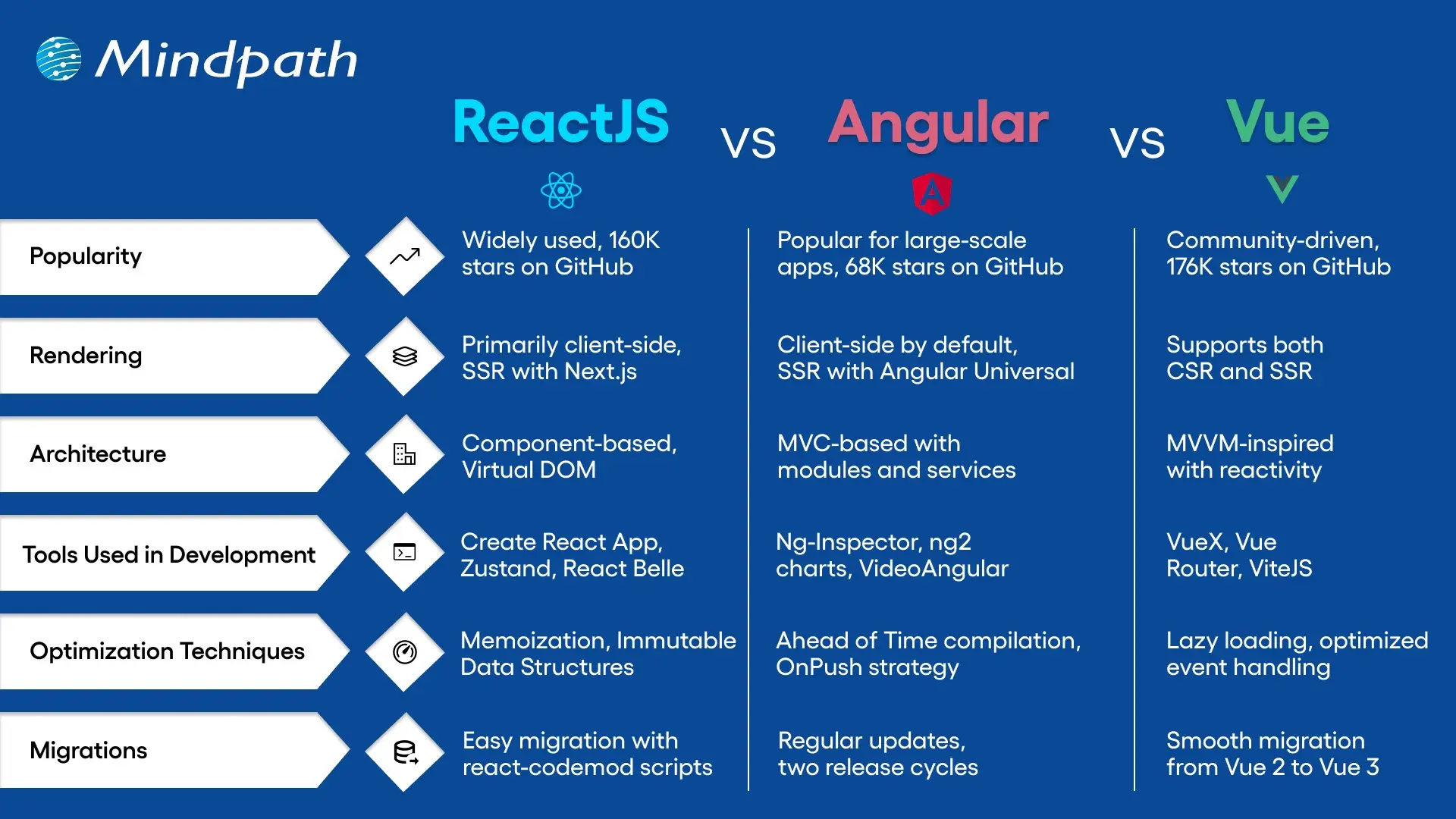
ReactJS vs Angular vs Vue Comparison Table

Here’s a quick comparison of Angular, React, and Vue across key factors. This table highlights their unique strengths to help you choose the right framework for your project: 

reactjs vs angular vs vue

Choose the Right Framework for your Web Applications

Selecting between Angular vs React vs Vue is based on your project and team expertise. Each offers distinct advantages for web applications today. Angular is best for big-scale, enterprise-oriented applications with a full toolkit. React provides flexibility, reusability, and an enormous ecosystem and is best for dynamic and quick-loading UI. Vue is small in size, simple to learn, and ideal for small to medium-sized applications with a nice balance of simplicity and performance. 

At Mindpath, we specialize in delivering high-performance web solutions with our ReactJS development services. Our experienced developers build scalable, responsive, and feature-rich applications tailored to your business needs. No matter if you’re upgrading an existing product or starting from scratch, our team ensures seamless development and fast delivery, backed by modern tools and proven practices.