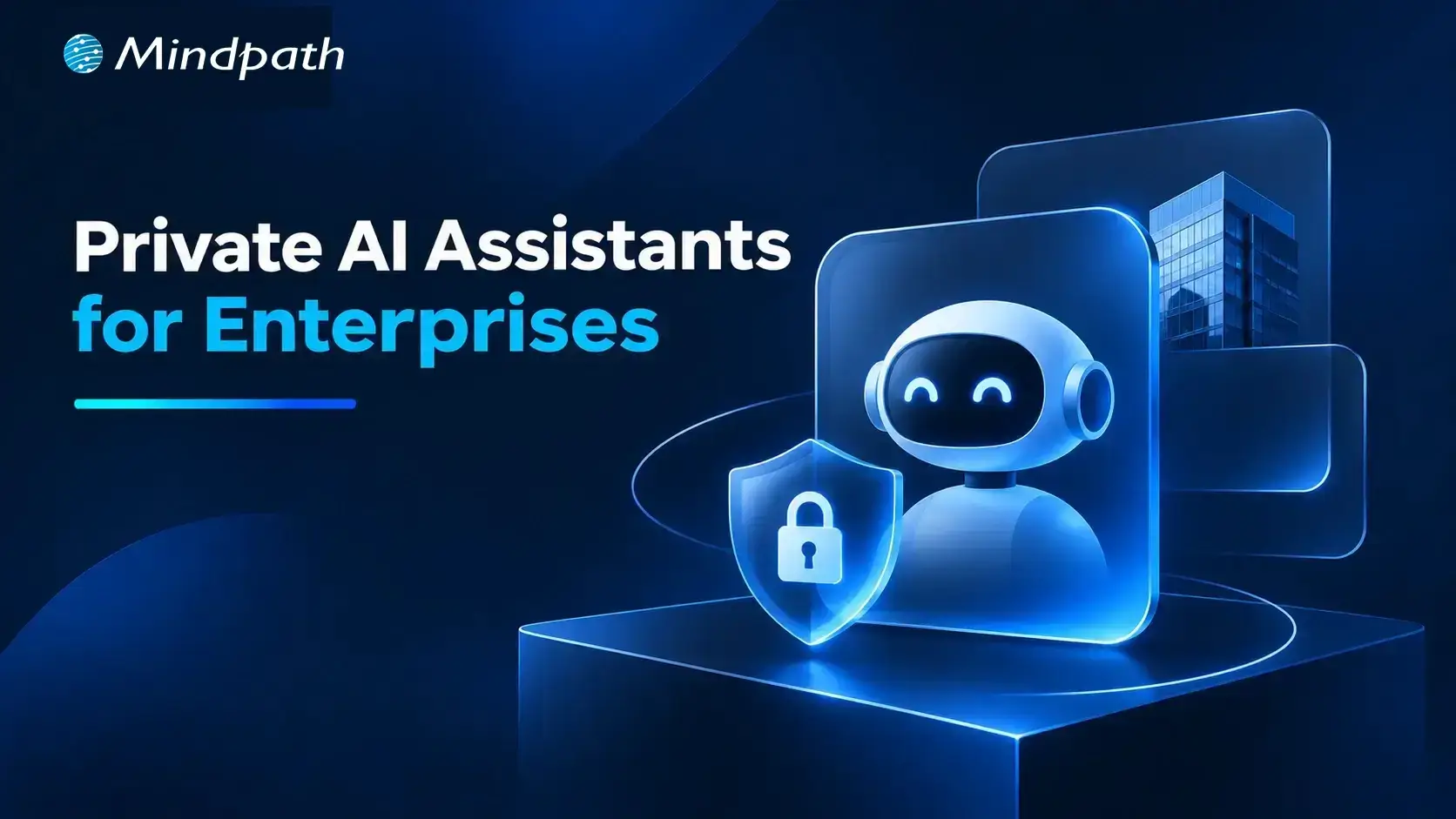
Employees are increasingly using AI to find information, review documents, and handle routine business tasks. However, bringing AI into everyday operations raises important questions about data privacy, access permissions, and the handling of confidential company information. A private AI assistant gives businesses a way to use AI with their internal knowledge while maintaining control over sensitive data and access.
Key Takeaways
- 01
Private AI assistants help businesses access internal knowledge while maintaining control over sensitive information. - 02
RAG connects AI assistants with approved company documents and business data. - 03
Role-based permissions, encryption, and monitoring strengthen enterprise AI security. - 04
Cloud, VPC, and on-premises deployments offer different levels of control and maintenance. - 05
Careful data preparation, testing, and monitoring improve assistant reliability and performance.
For enterprises, successful AI adoption requires more than choosing a capable language model. It involves secure data integration, reliable responses, clear governance policies, and the right deployment environment. Understanding these requirements helps businesses make informed decisions about implementation. In this blog, we explore the key use cases, security considerations, and deployment options for private AI assistants.
Mindpath offers custom AI development services to help businesses build secure AI assistants that connect internal knowledge and support everyday workflows.
What Is a Private AI Assistant and How Does It Work?
A private AI assistant is an AI-powered application that works with an organization’s internal data, documents, and business systems under defined security and access policies. It uses Large Language Models (LLMs) to understand employee queries and generate relevant responses. With Retrieval-Augmented Generation (RAG), it retrieves information from approved company sources before answering. Integrations with platforms such as SharePoint, CRM, ERP, and internal databases help employees access relevant business information through a single interface.
An internal AI assistant also relies on identity management and governance controls to ensure users access information according to their permissions. Administrators can monitor interactions, evaluate response quality, and manage data access. Businesses planning a custom AI development project can use these requirements to define the assistant’s functionality and architecture.
General-Purpose AI vs. Private Enterprise AI Assistant
| General-purpose AI assistant | Private enterprise AI assistant |
|---|---|
| Primarily handles general knowledge and connected services | Uses approved organizational knowledge |
| Data handling follows provider and account terms | Configured around organizational data policies |
| Offers a general user experience | Supports role-based access and business workflows |
| Customization depends on the platform | Allows tailored integrations, retrieval, and governance |
Enterprise offerings such as Microsoft Copilot also provide organizational security and access controls. The actual differences depend on deployment architecture, configuration, and the level of control an organization requires.
Why Businesses are Investing in Private AI Assistants?
As AI becomes part of everyday business operations, organizations face growing concerns about protecting confidential information. IBM’s 2025 Cost of a Data Breach Report found that shadow AI increased the average cost of a data breach by $670,000 globally. This highlights the financial risks of using AI without proper oversight.
Businesses are investing in private AI assistants for four key reasons:
- Intellectual property protection: Keep sensitive financial records, customer information, and proprietary documents under controlled access.
- Regulatory compliance: Manage data residency, retention, privacy, and audit requirements.
- Controlled information access: Give employees relevant information without exposing restricted company records.
- Operational efficiency: Reduce repetitive searches, manual document reviews, and routine internal queries.
Organizations should also understand the risks of AI in cybersecurity when introducing AI into business operations.
Top Enterprise Use Cases of Private AI Assistants
Private AI assistants can support several business functions by connecting employees with relevant company information and everyday workflows. Some practical applications include:
1. Internal Knowledge Management
Employees often spend time searching through policies, SOPs, project files, and shared documents. An internal AI assistant retrieves relevant information from approved sources and provides contextual answers with document references. This helps employees find accurate information without repeatedly contacting different departments.
2. IT Helpdesk and Employee Support
IT teams handle recurring requests involving password resets, software access, troubleshooting, and system configurations. An assistant can retrieve approved troubleshooting guides, explain resolution steps, and direct complex issues to the appropriate support team.
3. Customer Support and Sales Assistance
Support representatives can use an enterprise AI assistant to retrieve product specifications, customer history, and approved response guidelines. Sales teams can also access relevant account information, product details, and previous interactions to prepare for customer conversations.
4. Data Analysis and Business Intelligence
Employees can ask questions about business performance using natural language. The assistant can translate authorized requests into governed database queries, helping teams examine sales figures, identify operational trends, and understand business reports without manually navigating multiple dashboards.
5. HR, Finance, and Compliance Operations
HR teams can use assistants to answer questions about employee policies, leave procedures, and benefits. Finance teams can retrieve financial documents and prepare reports, while compliance professionals can locate relevant contracts, regulatory records, and internal policies.
Security Architecture: How to Build a Secure Private AI Assistant
Building a secure private AI assistant requires multiple layers of protection across data, applications, and infrastructure. Each layer addresses specific risks associated with handling sensitive business information. Following established cybersecurity practices for businesses helps organizations establish a stronger security foundation.
1. Data Protection and Encryption
- Encrypt data at rest and in transit.
- Define data retention and deletion policies.
- Establish clear provider agreements for data processing and model training.
- Apply sensitive information detection and masking.
2. Identity and Access Management
- Implement Single Sign-On (SSO) and multi-factor authentication.
- Use Role-Based Access Control (RBAC).
- Apply department- and user-level permissions.
- Restrict document retrieval based on individual access rights.
3. Model and Application Security
- Secure model hosting and API connections.
- Validate user inputs and filter generated outputs.
- Protect against prompt injection and unauthorized tool execution.
- Require approval for sensitive AI-driven actions.
Organizations should also establish secure LLM hosting and API integration practices based on their data protection requirements.
4. RAG and Knowledge Base Security
- Restrict access during document ingestion.
- Validate sources and maintain document versions.
- Detect malicious instructions in indexed documents.
- Apply permission-aware retrieval and source citations.
Effective context engineering also helps manage the information supplied to AI models and maintain relevant context during interactions.
5. Monitoring, Auditing, and Governance
- Maintain logs of prompts, responses, and system actions.
- Monitor unusual access patterns.
- Establish audit and retention policies.
- Conduct regular security assessments.
Common Security Risks and Recommended Controls
| Security risk | Recommended control |
|---|---|
| Unauthorized data access | Permission-aware retrieval |
| Prompt injection | Input and context validation |
| Sensitive information exposure | PII detection and redaction |
| Incorrect AI responses | Grounding and response evaluation |
| Unauthorized AI actions | Tool restrictions and human approval |
Private AI Assistant Deployment Options: Cloud, VPC, and On-Premises
Choosing the right deployment model depends on an organization’s data sensitivity, infrastructure, security requirements, and maintenance capabilities. An enterprise AI assistant can be deployed through three primary approaches.
| Factor | Managed cloud | Private cloud / VPC | On-premises |
|---|---|---|---|
| Infrastructure | Provider-managed | Dedicated cloud environment | Organization-managed |
| Control | Provider-dependent | Greater configuration control | High infrastructure control |
| Scalability | Generally easier | Flexible | Hardware-dependent |
| Maintenance | Lower internal burden | Shared responsibility | Higher internal burden |
| Best suited for | Faster adoption | Sensitive workloads | Strict infrastructure requirements |
1. Managed Cloud
Suitable for businesses seeking faster implementation without managing underlying infrastructure, provided the provider’s security and data policies meet their requirements.
2. Private Cloud or VPC
Offers greater control over network access, infrastructure configuration, and data flows, making it suitable for sensitive business workloads.
3. On-Premises
Keeps infrastructure within organizational facilities but requires hardware investment, model management, security updates, and ongoing maintenance.
Hybrid deployment combines these approaches. Organizations can process sensitive information within their controlled environment while connecting to an approved external model endpoint under defined data protection agreements. The right choice depends on actual security needs, operational resources, and long-term costs. Businesses evaluating infrastructure changes can also review the benefits of cloud migration.
Common Challenges When Implementing a Private AI Assistant
Implementing a private AI assistant involves several practical challenges that businesses should address early.
- Poor data quality: Outdated, duplicated, and unstructured documents reduce retrieval accuracy.
- Complex integrations: Connecting enterprise applications requires careful API and permission management.
- Hallucinations: AI models may generate incorrect answers despite accessing internal information.
- Infrastructure and maintenance costs: Hosting, monitoring, security, and model updates require ongoing investment.
Proper data preparation, retrieval optimization, regular testing, and continuous monitoring help address these challenges and maintain reliable performance. Businesses can also use AI agent testing practices to evaluate response quality and system behavior.
How to Implement a Private AI Assistant: A Practical Roadmap
A structured implementation approach helps businesses avoid unnecessary complexity and achieve reliable results.
1. Identify Business Requirements
Select a specific workflow and define measurable objectives.
2. Assess Enterprise Data
Review data sources, document quality, and access permissions.
3. Choose the Architecture
Select the LLM, RAG approach, integrations, and deployment model.
4. Implement Security Controls
Configure authentication, encryption, access controls, and monitoring.
5. Test and Optimize
Evaluate accuracy, retrieval quality, response time, and operating costs.
Start with a focused pilot, validate its performance against business requirements, and gradually expand to other departments and workflows.
Ready to Build a Private AI Assistant for Your Business?
Private AI assistants help businesses make better use of internal knowledge while maintaining control over sensitive information. The right approach requires careful planning, secure data integration, suitable deployment architecture, and continuous evaluation. With these elements in place, organizations can introduce AI into everyday workflows while keeping security, reliability, and business requirements in focus.
At Mindpath, we help businesses develop a private AI assistant aligned with their data, systems, and operational needs. Our expertise in custom LLM development, RAG, AI consulting, and enterprise data engineering supports secure AI implementation. We help businesses plan, build, and optimize AI capabilities that deliver practical value as their requirements evolve.