Home

Agentic Workflow Design Patterns: A Practical Guide for AI Systems

Agentic Workflow Design Patterns: A Practical Guide for AI Systems

Join our Newsletter!

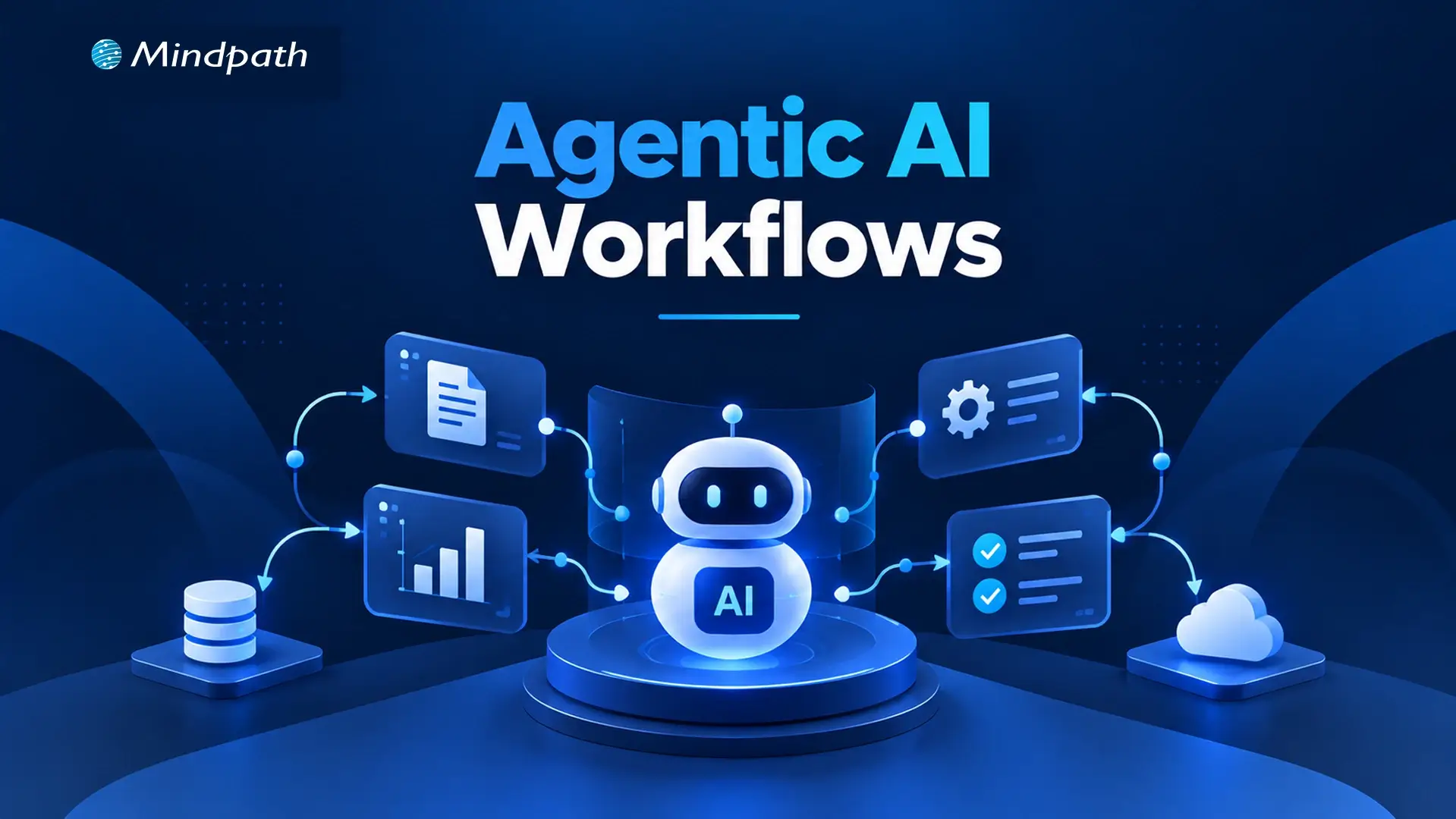
Agentic AI Workflows

Traditional automation works well when processes follow predictable rules. However, business operations often involve changing conditions, incomplete information, and decisions that cannot be handled through fixed instructions alone. Agentic workflows help address these challenges by enabling AI agents to interpret context, select actions, and coordinate multi-step tasks within defined boundaries.

Key Takeaways

  • 01
    Agentic workflows help AI agents manage multi-step tasks and adapt to changing conditions.
  • 02
    Sequential, routing, planning, and parallel patterns address different business workflow requirements.
  • 03
    Human approval and clear permissions help control risks during sensitive business operations.
  • 04
    Reliable data, defined boundaries, and thorough testing support consistent workflow execution.
  • 05
    Monitoring performance and business outcomes helps improve workflows and guide responsible autonomy.

Building these workflows requires more than connecting AI tools. Businesses need clear objectives, reliable data, decision-making logic, and appropriate human oversight to ensure consistent execution. In this blog, we examine the design patterns, business applications, and implementation principles behind agentic workflows.

Looking to implement agentic workflows in your business?

Mindpath offers AI consulting services to help businesses identify suitable AI opportunities and design workflows aligned with their operational goals.

What Makes an Agentic Workflow Different from Traditional Automation?

Traditional automation executes predefined rules to complete repetitive tasks. AI-assisted workflows add capabilities such as interpreting documents, summarizing information, and recommending decisions. However, agentic workflows allow AI agents to choose appropriate tools, determine the next steps, and adjust their approach based on intermediate results, within established boundaries.

The key difference lies in how each approach handles decisions and changing conditions. Businesses must also determine which actions can run independently and which require human approval. Greater flexibility brings additional responsibilities for validating outputs, monitoring execution, and managing exceptions.

Capability Rule-Based Automation AI-Assisted Workflows Agentic Workflows
Decision-making Predefined rules AI-supported recommendations Context-based, bounded decisions
Adaptability Limited to configured rules Interprets variable inputs Adjusts actions based on results
Tool usage Fixed integrations AI features and connected tools Selects tools according to task needs
Human oversight Rule configuration and exception handling Often reviews AI outputs Sets autonomy limits and approval checkpoints

The right approach depends on task complexity, business risk, and the level of decision-making required.

Six Design Patterns for Building Reliable Agentic Workflows

An effective agentic AI workflow needs a structure that matches its business objective. Design patterns determine how agents process tasks, make decisions, coordinate actions, and manage exceptions. Choosing the right pattern helps businesses maintain control while improving execution.

1. Sequential Workflow Pattern

How it works: Tasks follow a defined sequence. Each stage uses the previous stage’s output.

Business example: An agent gathers customer requirements, analyzes needs, drafts proposals, and requests approval.

Design consideration: Validate outputs between stages. This prevents errors from affecting subsequent tasks.

2. Routing and Conditional Decision Pattern

How it works: An agent classifies requests and directs them to appropriate workflows or specialists.

Business example: Support requests are routed according to urgency, product, and customer impact.

Design consideration: Define clear routing criteria. Provide fallback paths for ambiguous requests.

3. Planning and Iterative Execution Pattern

How it works: An agent plans tasks, evaluates results, and adjusts subsequent actions.

Business example: An agent investigates supply delays, compares alternatives, and recommends recovery plans.

Design consideration: Limit execution steps, tool calls, and retries. Set time limits to prevent endless execution loops.

4. Parallel Execution and Aggregation Pattern

How it works: Independent tasks run simultaneously. Their results are combined into one validated output.

Business example: Agents assess vendor pricing, delivery reliability, and contract requirements concurrently.

Design consideration: Check every subtask for completion. Resolve conflicting findings before producing recommendations.

5. Supervisor and Specialized Agents Pattern

How it works: A coordinating agent delegates tasks to specialized agents and reviews their outputs.

Business example: Research, financial analysis, and compliance agents support vendor evaluations.

Design consideration: Assign distinct responsibilities to each agent. Control handoffs and validate combined results.

6. Human-in-the-Loop Approval Pattern

How it works: Work pauses when decisions require human authorization. Execution resumes after approval.

Business example: An agent recommends purchases but awaits approval before placing orders.

Design consideration: Define approval thresholds and escalation paths. Maintain audit records for consequential actions.

These patterns can operate independently or combine within larger agentic workflows, depending on task complexity and business risk. The priority is to balance autonomy with reliable execution, clear responsibilities, and appropriate oversight.

Five Business Examples of Agentic Workflows

Practical agentic workflow examples show how AI agents can coordinate business tasks, support decisions, and reduce repetitive work. Their value depends on reliable data, clear permissions, and appropriate human oversight.

1. Customer Support and Issue Resolution

AI agents classify tickets and retrieve relevant customer information. They draft responses or execute approved actions, escalating sensitive requests for review.

2. Sales Qualification and CRM Management

Agents research prospects and assess leads against predefined criteria. They update CRM records and recommend relevant follow-up actions.

3. Supply Chain and Procurement

AI agents monitor inventory, supplier updates, and pricing changes. They identify potential disruptions and recommend suitable procurement decisions.

4. Software Development and IT Operations

Agents investigate alerts, analyze logs, and run approved diagnostics. They recommend fixes while escalating risky changes for authorization.

5. Finance and Business Operations

AI agents extract invoice details and verify purchase order information. They flag discrepancies and route exceptions to authorized finance teams.

How to Design an Agentic Workflow for Your Business

Effective AI workflow automation starts with a suitable business process. A structured implementation helps businesses manage risks, maintain control, and measure results.

1. Identify a Suitable Business Process

Choose repetitive tasks involving multiple steps and decisions. Avoid processes where simpler automation already performs well.

2. Define the Agent’s Scope and Boundaries

Specify permitted actions, tools, and data access. Establish approval requirements and clear success criteria.

3. Connect Reliable Data and Business Systems

Integrate approved APIs, CRM platforms, ERP systems, and knowledge bases. Apply access controls and validate incoming data.

4. Test Before Expanding Autonomy

Evaluate accuracy, execution time, and failure recovery. Test edge cases before enabling real-world actions. A structured AI agent testing process helps identify weaknesses before workflows are deployed at scale.

5. Monitor Business Outcomes

Track completion rates, errors, costs, and processing time. Review results regularly and refine workflow logic.

Common Design Mistakes That Undermine Agentic Workflows

Poor implementation decisions can make AI workflows unreliable, expensive, and difficult to manage.

  • Excessive Autonomy: Allowing consequential actions without sufficient safeguards.
  • Unclear Responsibilities: Overlapping agents can duplicate tasks or conflict.
  • Poor Data Quality: Incomplete information can lead to incorrect decisions.
  • Missing Recovery Mechanisms: Unhandled errors can interrupt workflow execution.
  • Insufficient Monitoring: Missing logs make failures harder to investigate.
  • Unnecessary Complexity: Multiple agents can increase coordination overhead without adding value.

Reliable agentic workflows require autonomy levels and system complexity that match business needs. Clear responsibilities, validated data, recovery mechanisms, and appropriate oversight help maintain consistent execution.

How Can Your Business Put Agentic Workflows into Practice?

Successful agentic workflows depend on choosing suitable design patterns, connecting reliable data sources, and defining clear operational boundaries. Businesses should measure accuracy, efficiency, and task completion before expanding autonomy. A gradual approach helps teams identify limitations, strengthen safeguards, and establish confidence in AI-driven execution.

Mindpath helps businesses turn AI opportunities into practical implementations through AI consulting, AI agent development, data engineering, and business system integration. Our team can help design workflows aligned with your operational goals, existing infrastructure, and governance requirements.

Automate Smarter with AI

Build AI-powered workflows that streamline your business operations.

Frequently Asked Questions

Consider agentic workflows when processes require contextual decisions, changing inputs, multiple tools, and adaptive actions that fixed rules cannot handle efficiently.
Set permission limits, validate outputs, require approval for high-risk actions, and maintain execution logs to identify and resolve errors.
Yes. Agents can connect with approved APIs, CRM platforms, ERP systems, and internal databases, provided integrations support required access and security controls.
Track task completion, error rates, processing time, operating costs, and human intervention to evaluate performance against defined business objectives.
Maintaining reliability across more tasks, tools, and agents requires stronger monitoring, consistent permissions, effective exception handling, and clear accountability.

Support Is One Click Away

Featured Posts

Related Post

ReactJS Trends 

React continues to shape modern front-end development, with changes in rendering, performance optimization, developer tooling, and application architecture influencing how teams build web applications. Understanding the latest ReactJS trends can help developers and businesses make informed decisions about technology choices, maintainability, and user experience.

In 2027, React development involves more than building reusable UI components. Server Components, the React Compiler, TypeScript, modern frameworks, and AI-powered interfaces are influencing how applications are designed and maintained. This guide covers ten important ReactJS trends, their practical applications, and the considerations businesses should evaluate before adopting them.

Key Takeaways

  • 01
    React Server Components and modern rendering strategies give developers more options for organizing application logic and delivering content.
  • 02
    The React Compiler can automate certain performance optimizations, reducing the need for some manual memoization when properly configured.
  • 03
    TypeScript, testing tools, and improved debugging workflows help teams maintain larger React applications with greater confidence.
  • 04
    AI-powered interfaces, reusable design systems, and React Native create opportunities for richer digital experiences across web and mobile products.
  • 05
    Businesses should evaluate ReactJS trends based on measurable performance, security, accessibility, development needs, and long-term maintenance costs.
Planning a modern web application? Explore Mindpath’s ReactJS development services to discuss a development approach aligned with your product requirements and business goals.

How ReactJS Has Evolved

Since its introduction in 2013, React has developed from a library focused on building interactive user interfaces into a broader ecosystem supported by frameworks, development tools, and rendering capabilities. Its component-based approach remains central to how developers organize interfaces, while newer features address application performance, asynchronous updates, and server-side rendering patterns.

React 18 introduced concurrent rendering capabilities, including automatic batching and improvements to Suspense. React 19 added features such as Actions, the use API, support for document metadata, and stable React Server Components for compatible environments. Subsequent releases continue to evolve the library and its development workflows.

The React team’s official release notes are the best reference for version-specific changes. Developers should check compatibility and migration guidance before upgrading an existing application.

For a broader view of React’s development direction, read the React roadmap.

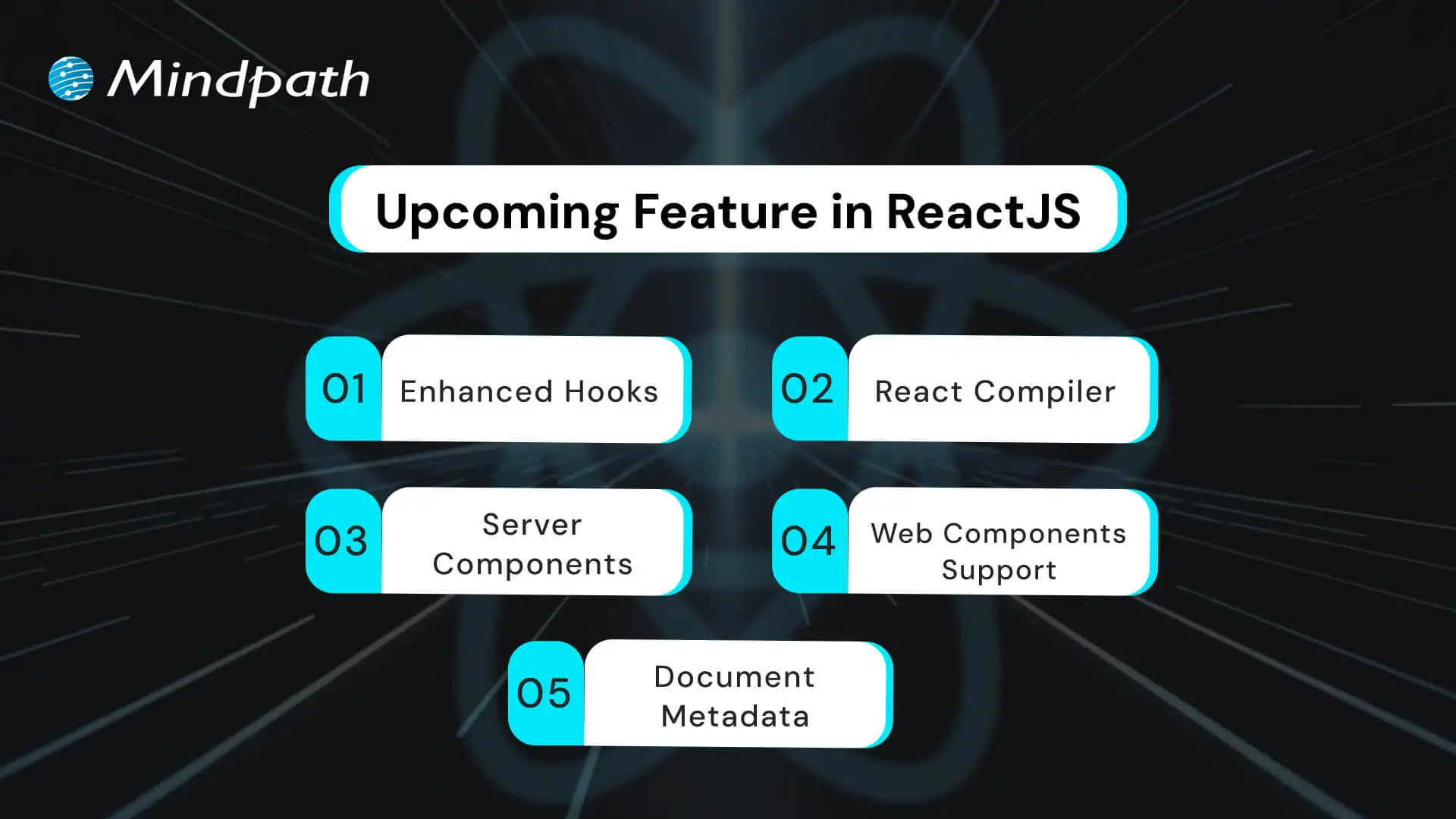
ReactJS Features and Updates to Understand in 2027

React’s recent development has focused on improving application architecture, rendering, data handling, and developer workflows. The following capabilities are particularly relevant when planning or modernizing a React project.

ReactJS features and updates for modern web development

1. React Actions and Modern Hooks

React 19 introduced Actions and APIs such as useActionState and useOptimistic to help manage common asynchronous workflows. These capabilities can simplify form submissions, pending states, error handling, and optimistic interface updates.

For example, a customer portal can display a pending state while a user updates account information. An interface may also show an expected change immediately while the application waits for the server to confirm the operation.

These APIs do not eliminate the need for backend validation, error handling, or secure data processing. They provide building blocks for managing the user experience around asynchronous operations.

2. React Compiler and Automatic Optimization

The React Compiler reached its first stable release in October 2025. It can automatically optimize React components and Hooks through memoization, reducing the need for some manual performance optimizations.

Traditionally, developers may use techniques such as memo, useMemo, and useCallback to avoid unnecessary calculations or rendering work in appropriate situations. The compiler can handle certain optimizations automatically when the code meets its requirements.

Teams should still measure performance, review compiler compatibility, and follow the recommended setup process. The compiler is not a substitute for efficient data fetching, sensible component design, or profiling real application behavior.

3. React Server Components

React Server Components allow components to render in a server-side or build-time environment separate from the client application. In compatible frameworks, they can help developers keep selected data access and rendering work on the server instead of sending all of that logic to the browser.

This approach can be useful for content-heavy pages, product catalogs, and applications that retrieve information from server-side data sources. Server Components and Client Components serve different purposes, so teams need to understand which features require browser-side interactivity.

Server Components do not automatically guarantee faster applications or better security. Performance depends on the architecture and delivery strategy, while sensitive operations still require correct authorization and data handling. Teams should also use compatible framework and bundler implementations.

4. Document Metadata and Custom Element Support

React 19 introduced native support for rendering document metadata elements, including title and meta tags, from components. It also improved support for custom elements, making it easier for React applications to interact with standards-based web components.

Metadata support can simplify some implementations by allowing page-specific titles and descriptions to be declared closer to the relevant content. However, larger applications may still benefit from framework-level metadata management for route handling, canonical URLs, and other SEO requirements.

Custom element support can also help teams integrate existing web components into a React interface. These capabilities are established features rather than merely upcoming React updates; the important consideration is how well they fit the application’s architecture.

Want to plan a React application around current capabilities and future requirements? Review the React roadmap and assess which updates are relevant to your product.

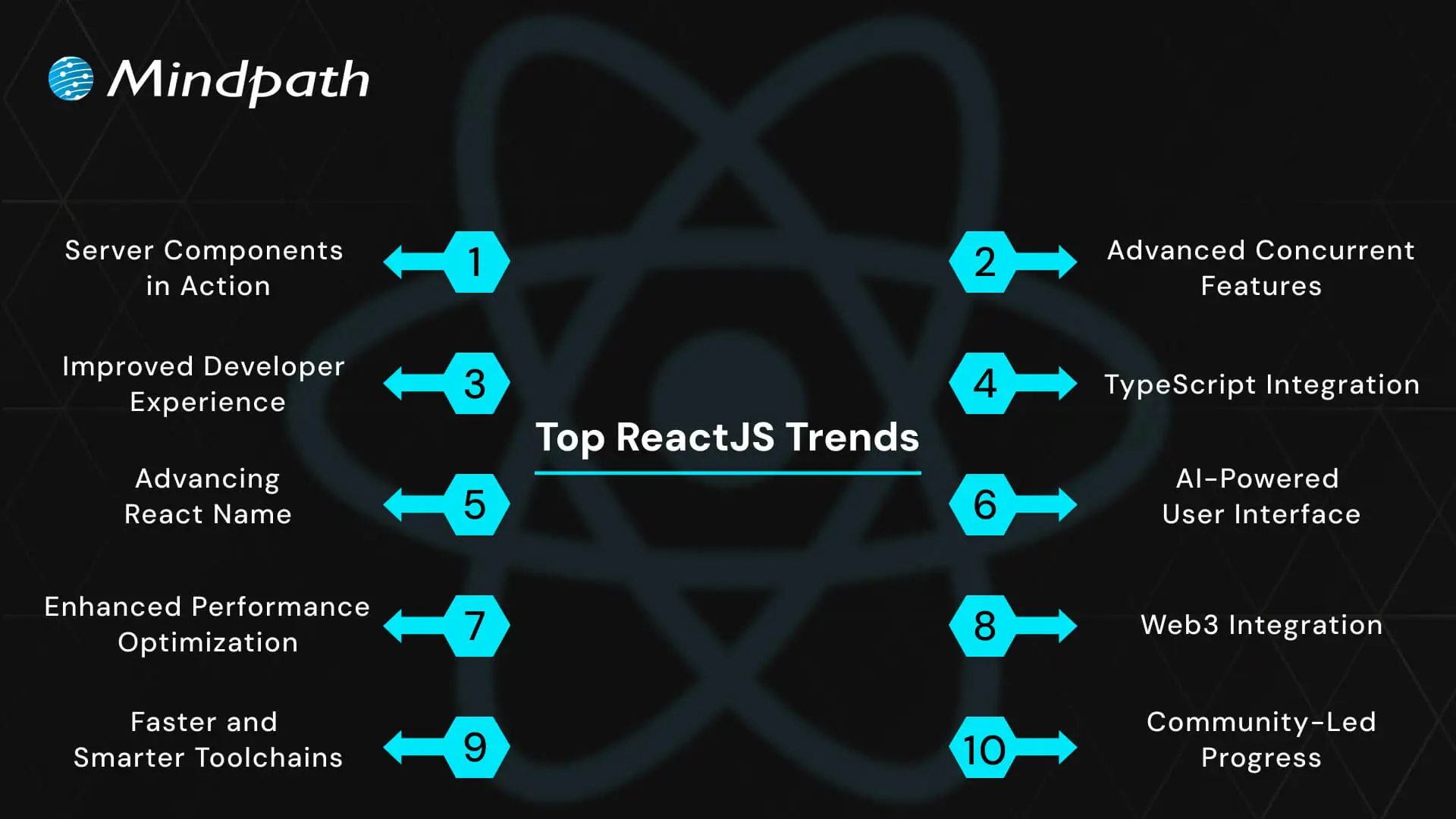
Top ReactJS Trends to Watch in 2027

The following trends reflect how teams are using React and its surrounding ecosystem to develop modern digital products. Some are based on established React capabilities, while others are broader development practices that continue to influence React projects.

Top ReactJS trends influencing web application development in 2026

1. Server-First Application Architecture

One of the important ReactJS trends is the growing use of server-oriented rendering and data access patterns. Server Components, server-side rendering, and static generation provide different ways to deliver content and manage work across server and client environments.

For example, a product listing page may render much of its content on the server while using Client Components for interactive filters, cart controls, or other browser-side actions.

The right approach depends on how frequently the content changes, whether a page requires user-specific data, the infrastructure available, and the application’s performance goals. Server-first architecture is not mandatory for every React application, especially when a simple client-rendered interface is sufficient.

2. Automated Performance Optimization with React Compiler

The React Compiler is changing how developers approach certain rendering optimizations. Instead of relying exclusively on manually added memoization, teams can use compiler-supported optimization to reduce some unnecessary recalculations and re-renders.

This can make performance-oriented code easier to maintain, particularly in interfaces with many reusable components. However, results vary with the application, its dependencies, and the code being compiled.

Developers should still use profiling tools, monitor Core Web Vitals for public-facing websites, and investigate expensive rendering, network requests, or large JavaScript bundles. Automated optimization works best as part of a broader performance strategy.

3. Concurrent UI and Responsive Interactions

React’s concurrent rendering capabilities allow rendering work to be prioritized so that urgent interactions can remain responsive while less urgent updates are prepared. Features such as transitions and Suspense help developers manage updates and loading states in suitable application designs.

For example, a search interface may keep text entry responsive while results update in the background. A complex dashboard can use loading boundaries to display useful interface elements while selected content is being prepared.

These capabilities require thoughtful implementation. Suspense boundaries, transitions, data loading, and error states should be designed around actual user journeys rather than added without a clear purpose.

4. TypeScript for More Maintainable React Applications

TypeScript continues to be a useful choice for React teams that need clearer contracts between components, reliable data models, and maintainable codebases. It adds static type checking to JavaScript and can identify certain mistakes during development before the application runs.

For example, a reusable component can define the properties it accepts, while an API response can be represented using an explicit data type. These practices help teams understand how different parts of an application fit together.

TypeScript does not prevent every runtime error, validate untrusted API data automatically, or replace testing. Teams still need appropriate runtime validation, automated tests, code reviews, and consistent development practices.

5. Better Developer Tooling and Testing Workflows

React development increasingly relies on tools that help teams inspect component behavior, diagnose rendering issues, test user interactions, and automate code-quality checks. React Developer Tools, browser profiling tools, testing libraries, and static analysis can help identify problems earlier in the development process.

A reliable workflow may combine component tests, integration tests, end-to-end testing, accessibility checks, and continuous integration. These practices are especially important for applications with complex workflows or frequent releases.

Tools should be selected based on the project’s requirements, team familiarity, and maintenance needs. Adding more tools is not inherently better if they create duplicated checks or unnecessary complexity.

Building an application that needs to remain responsive as it grows? Read our guide to optimizing React performance for large applications for additional implementation considerations.

6. AI-Powered User Interfaces

React is frequently used to build interfaces for applications that include AI-powered features. These may include conversational assistants, content generation tools, semantic search, document summarization, recommendation interfaces, and AI-supported workflow automation.

React can manage the interactive interface while backend services handle model requests, data retrieval, permissions, and business logic. Streaming responses and clear loading states can help users understand that a request is in progress.

AI-powered interfaces need more than an attractive front end. Developers should plan for latency, errors, usage limits, privacy, access controls, and the possibility of inaccurate model responses. AI output should be presented with appropriate context and verification options when accuracy matters.

7. Performance, Accessibility, and User Experience

Performance remains an important consideration for React applications, but user experience depends on more than rendering speed. Developers must also consider navigation, keyboard access, readable layouts, error recovery, responsive design, and how quickly users can complete important tasks.

Useful practices include code splitting, efficient data fetching, optimized assets, accessible components, and testing with real devices. Public-facing websites should also monitor Core Web Vitals and investigate issues identified through performance measurements.

The best optimization priorities come from evidence. Teams should identify the pages and interactions that create friction, measure the impact of changes, and avoid adding complexity for improvements that do not meaningfully benefit users.

8. React Native and Shared Product Experiences

React Native remains relevant for businesses that want to build mobile applications using React concepts and JavaScript or TypeScript. It provides a separate development approach from React for the web, while allowing teams to share selected business logic and development knowledge where appropriate.

A company may offer a React web portal alongside React Native mobile apps. Shared validation rules, API clients, and domain logic can sometimes be reused, while navigation, UI components, and device integrations may require platform-specific implementations.

Cross-platform development should be evaluated against the required native capabilities, accessibility, performance, release process, and available skills. Code reuse can be valuable, but it does not remove the need for platform-specific testing and maintenance.

9. Modern Frameworks and Faster Development Toolchains

Frameworks and build tools influence how React applications handle routing, rendering, data loading, bundling, testing, and deployment. Tools such as Vite and frameworks such as Next.js offer different workflows and capabilities depending on the project.

A lightweight client-rendered application may need a different setup from a content-heavy website that benefits from server rendering or static generation. Developers should choose a toolchain based on deployment requirements, integrations, team experience, and long-term maintenance.

Faster local builds and convenient development feedback can improve day-to-day productivity. However, build speed alone should not determine the architecture. Production performance, security, reliability, and upgrade paths also matter.

10. Design Systems and Reusable UI Components

As applications grow, design systems and shared component libraries help teams maintain consistent visual patterns and interactions. A design system may include typography, spacing, colors, accessible form controls, navigation patterns, buttons, tables, and documented component behavior.

In a React project, reusable components can reduce duplicated implementation and make updates more consistent across pages. A shared component library can also help multiple teams work from common interface standards.

To be effective, a design system needs clear documentation, accessibility testing, versioning, and a process for handling changes. Teams should avoid creating abstractions for every small variation when a simpler component would meet the requirement.

Want to build a scalable React application around your business needs? Talk to Mindpath about ReactJS development services and plan the right approach for your product.

How Businesses Can Evaluate ReactJS Trends

Not every new capability needs to be adopted immediately. Businesses should evaluate ReactJS trends based on the problems they are trying to solve, the constraints of their existing applications, and the value a change is expected to deliver.

1. Start with a Specific Business or User Need

Identify whether the priority is page performance, maintainability, a new interactive feature, a better mobile experience, or a more efficient development workflow. A clear goal helps teams choose relevant technologies instead of adopting tools simply because they are new.

2. Review Compatibility and Migration Requirements

Check React version requirements, framework support, dependencies, deployment constraints, and migration risks before introducing a new feature. For established applications, a phased rollout may be safer than changing multiple architectural elements at once.

3. Test Performance and Usability

Use profiling, automated tests, accessibility checks, and real-user feedback to evaluate whether a change improves the application. Record a baseline before implementation so that results can be compared objectively.

4. Account for Security and Maintenance

Review dependency health, access controls, data handling, update policies, and operational responsibilities. AI features and server-side capabilities may introduce additional data and security considerations that need to be addressed before deployment.

5. Measure Results Before Scaling

Start with a limited pilot when possible. Measure outcomes such as task completion time, error rates, page performance, development effort, and user feedback. Expand the implementation when the results support the original objective.

Challenges to Consider When Adopting New ReactJS Practices

New features and tools can improve development workflows, but adoption also introduces trade-offs. Businesses and development teams should consider these common challenges.

1. Compatibility and Migration Complexity

Older applications may depend on libraries, build tools, or patterns that are not immediately compatible with newer React capabilities. Teams should review upgrade guides, test critical workflows, and schedule migrations according to risk and business priorities.

2. Performance Is Not Automatic

Server Components, compilers, and modern toolchains provide useful options, but no single feature guarantees an optimal user experience. Applications still need careful data fetching, asset management, error handling, and performance testing.

3. Learning Curve and Team Readiness

New rendering patterns and tools may require changes to how developers structure components, load data, and test interfaces. Documentation, code reviews, training, and incremental adoption can help teams build confidence without disrupting delivery.

4. Security and Data Governance

Server-side rendering and AI integrations introduce important questions about access permissions, sensitive information, API usage, and data retention. Teams must ensure that server-only logic and credentials remain protected and that user-specific data is handled correctly.

What Is Next for ReactJS Development?

React’s continued development points toward more flexible rendering strategies, automated optimization, improved asynchronous workflows, and closer integration with modern application frameworks. At the same time, broader engineering practices such as TypeScript, accessibility testing, reusable design systems, and AI integration are shaping how React applications are built.

The most useful direction for a business is not necessarily the newest feature. It is the combination of technologies and development practices that addresses real user needs, supports the product roadmap, and remains maintainable over time.

Teams should follow official release notes, test upgrades in controlled environments, and regularly review their performance, security, and accessibility requirements. This approach helps businesses adopt relevant changes while avoiding unnecessary technical complexity.

Final Thoughts

The key ReactJS trends in 2027 include server-oriented application architecture, React Compiler, concurrent UI patterns, TypeScript, improved developer tooling, AI-powered interfaces, performance and accessibility, React Native, modern frameworks, and reusable design systems.

Each trend offers opportunities, but the right choice depends on the application’s goals, technical requirements, team capabilities, and long-term maintenance plan. By evaluating changes carefully and measuring their impact, businesses can keep their React applications aligned with evolving user expectations and development practices.

At Mindpath, we help businesses build and modernize digital products around their technical and operational requirements. Our ReactJS development services support organizations planning interactive, maintainable, and scalable web applications.

Planning your next React project or modernizing an existing application? Contact Mindpath to discuss your requirements and identify a practical development approach.
nodejs development companies

Almost all the businesses that exist today have a single objective in mind. The objective is to grow and stay ahead of the competitors in the market. In order to stay ahead of the curve, businesses are choosing Node.js as their ultimate development platform. Node.js has earned a solid reputation in the business world for all the right reasons. It is not only fast but also scalable. Moreover, Node.js serves as a perfect tool that businesses can use in order to build everything, from real-time chat applications to enterprise-grade systems. 

The emergence of Node.js has been a boon not only for large businesses but also for start-up businesses. The high popularity of Node.js among developers and businesses has increased the reliance on top Node.js development companies. It is high time for you to know why businesses are preferring NodeJS development companies in 2026 like never before. 

Want to deliver scalable web applications that keep your business ahead in 2026? Mindpath’s NodeJS development services provide expert solutions to turn your ideas into high-performance applications.

An Overview of Node.js

Node.js refers to an open-source and cross-platform JavaScript runtime environment. The key features of Node.js are:

1. Node.js involves the application of JavaScript for overall web development purposes. As a result, developers can build complete apps by leveraging a single language. 

2. Node.js has a non-blocking I/O model and an event-driven architecture. Such an arrangement allows Node.js to handle a large number of concurrent connections in an efficient and effective manner without creating a new thread for each request. 

3. It acts as a well-suited tool for scalable network applications as well as real-time systems. You can run Node.js on the V8 engine as it can benefit from its speed and optimizations. It can thus lead to efficient execution of code.

4. Since Node.js comes with a vast ecosystem of open-source libraries as well as modules called Node Package Manager, the development process gets simplified. NPM ensures that pre-built solutions are available for diverse tasks.

5. Node.js can be used for developing a broad range of applications and websites, such as web servers and real-time chat applications. You can also create command-line tools with the help of Node.js. 

Want to understand why Node.js continues to dominate modern backend development in 2026? Discover our advantages of NodeJS blog to learn what makes this technology a top choice for businesses.

Benefits of Choosing NodeJS Development Companies

The businesses that seek fast and efficient web or app solutions can derive immense benefits by choosing a Node.js development company. Businesses need to bear in mind that Node.js uses a non-blocking and event-driven architecture. This architecture enables high performance and real-time data processing, which is ideal for chat apps as well as dynamic websites. Some of the top benefits that your business can enjoy by choosing the best NodeJS development services provider include:

1. Developing Fast and Scalable Apps

NodeJS development solutions are the go-to option for a majority of modern businesses. This is because these solutions help to create applications that are fast as well as scalable in nature.  The non-blocking I/O model of Node.js is capable of handling a number of requests simultaneously. Thus, your business can rest assured of high performance even when the traffic is high. This is why several businesses have been choosing NodeJS development companies so that they can create robust and well-functioning business websites. 

2. Use of One Language for Diverse Needs 

Node.js uses JavaScript for both backend and frontend aspects. Thus, if you hire NodeJS developers, you only have to use a single language for everything. This can certainly create opportunities for teams to collaborate in a seamless manner. The collaboration ability can certainly simplify how your business can develop a website or app and offer an experience to the target market audience. This can be possible thanks to the unification of the user interface code and the server-side logic. 

Want to ensure you choose the right expert for your next Node.js project? Discover our factors to consider while hiring NodeJS developer blog to learn what skills and experience truly matter.

3. Ideal for Real-time Apps

You need to hire a Node.js developer if you wish to develop real-time apps for your business entity. The event-driven architecture of Node.js is capable of handling continuous data streams in an efficient manner. As a result, nodes services are ideal for gaming as well as live chats. They even support collaboration tools. You may be surprised to know that Slack uses Node.js in order to power real-time messaging for millions of users across the globe while ensuring reliability as well as speed. 

4. Building Flexible Microservices

Node.js is capable of integrating quite well with microservices. Thus, it enables applications to maintain as well as scale in an independent manner. A real-world example involves PayPal, which transitioned to microservices with the help of Node.js. This decision has led to a reduction in development time and has also improved its overall performance. 

5. Cost-efficient Option 

Businesses have been preferring NodeJS development companies so that they can save money while building apps and websites.  Node.js undoubtedly saves costs by speeding up the development process as well as optimizing resources. Its ability to leverage JavaScript for both frontend and backend reduces the need for additional developers. Companies have the option to save money and time by using Node.js for creating their applications and websites. 

6. Existence of a Vibrant Community 

Node.js has an extremely vibrant community of developers. These developers contribute to the development of Node.js. They play a cardinal role in making the tool more innovative as well as accessible in nature. Developers get the chance to effectively collaborate with each other and track issues. It even helps with version control. 

Curious how Node.js handles high traffic and improves load times? Check out our web performance with NodeJS blog to explore strategies for building faster web applications.

7. Ideal for Mobile Devices

One of the top benefits of using Node.js for businesses is related to its use for mobile devices. Companies can easily move their application towards mobile mainstream as Node.js supports fast development time as well as ease of use. In the prevailing environment, this decision can certainly expand your reach in the market setting. Business entities that wish their mobile application to connect with their desktop application can leverage the Node.js development services offered by reliable Node.js development companies. 

8. Cross-Platform Compatibility

The cross-platform compatibility of Node.js enhances its versatility in the web development arena. It enables the creation of applications that can run in a seamless manner on diverse operating systems. It thus supports a broad reach and smooth experience for users across diverse types of operating systems. You need to bear in mind that Node.js unifies the development efforts and eliminates the need for platform-specific code. It even reduces the complexity of managing multiple codebases. Node.js thus supports a more resilient and efficient development process for business entities.  

The Node.js framework has emerged as a remarkable tool for both businesses and individual developers. Both business owners and individuals need to familiarize themselves with the key characteristics of Node.js so that they can capitalize on the framework in an effective manner. Businesses have been choosing Node.js so that they can be empowered to create scalable and exceptional apps and websites. 

Looking to accelerate AI adoption within your Node.js ecosystem? Explore our Node JS libraries for AI guide to learn which libraries drive smarter, data-powered applications.

Final Words

Modern businesses are heavily relying on Node.js development service providers. These providers can ensure that you can capitalize on the core features of Node.js to develop a well-functional and high-performance website or application. Due to various reasons, businesses have been choosing NodeJS development companies, such as developing fast and scalable apps, leveraging JavaScript, and many more. 

Mindpath’s Node.js application development is the perfect solution that can help you leverage Node.js in an optimal manner. Our experts ensure that your application is not only scalable in nature but also delivers excellent performance for your business as well as your customers. The services will certainly play a catalytic role and help your business have an edge over your competitors. 

ReactJS and AI

The demand for interactive user interfaces has gone beyond expectations. The requirement for an app that will learn from users’ behavior and adapt according to the user preferences is an essential part of modern web development. So, this effective resolution has pushed developers to rethink how modern frontends are built. This is where ReactJS and AI come together.

Key Takeaways

  • 01
    ReactJS provides a flexible frontend foundation while AI enables smarter and more adaptive user experiences.
  • 02
    AI can analyze user behavior and personalize content, interfaces, and recommendations in React applications.
  • 03
    ReactJS and AI can work together to improve UI testing, accessibility, decision-making, and continuous learning.
  • 04
    Smart search, personalized interfaces, and predictive assessment are key use cases of AI and React applications.
  • 05
    AI-driven React frontends also require responsible data use, bias evaluation, privacy, and security considerations.

The market size of AI is most likely to reach USD 826.73 billion by 2030. So, every reputed ReactJS development company has been fueling its strategies through AI tools. By combining React’s component-driven architecture with AI, your team can build frontends that continuously improve experiences. This blog explores how AI and React are shaping smarter frontend development and why this combination is necessary for your future-rich applications.

Planning to combine ReactJS with AI for smarter web applications? Mindpath offers AI development services to build intelligent and scalable solutions for your business.

Why ReactJS Remains the Top Pick for Modern Frontend Development?

ReactJS is tagged as an open-source JavaScript library developed by Facebook to create user interfaces specifically for single-page apps. It allows you to generate large web apps that can render and upgrade effectively in response to your data changes. This is why the library has become a top preference of the developers.

1. Reusable Components

Components are more likely to be building blocks. So, once they are created, your developers can reuse them across multiple parts of the application.

2. Easy to Learn

The learning curve of React is comparatively much lower than Angular or Vue.js. So, if you are well aware of JavaScript, you can easily get started with ReactJS.

3. Effective Rendering

The virtual DOM of ReactJS encourages rendering performance. Additionally, it enables you to leverage seamless user experiences.

4. Precise Adaptability

The developer tools browser extension of React can help you inspect your component hierarchies. This approach can help your team debug more easily.

5. SEO-Effectiveness

It is easy for you to render React on the server with the use of Next.js or similar frameworks. This can increase your search engine optimization.

Ready to select a front-end framework that supports AI-enhanced features? Discover React vs Vue to check out their pros, cons, and ideal use cases.

How AI Impacts Frontend Development?

Artificial intelligence has become much more than just being used in backend analytics and experimentation. Moreover, it has become an essential force that shapes modern frontend experiences. In the recent scenario, AI is influencing the user interactions with apps and how interfaces respond to user behavior. Additionally, AI in React ensures frontend development is shifting from static design to futuristic interactions.

1. Captures User Behavior

AI-driven React applications can assist you in analyzing the user behavior, patterns, and preferences. This is how your audience can expect a seamless user experience from your application that also builds trust.

2. Real-time Content Personalization

React frontends can make you acquainted with custom content through the behavior of your audience and AI models. Starting from product recommendation to custom dashboards, AI ensures your users see data that aligns with their preferences and intent.

3. Prompt UI Testing

AI-integrated testing features can easily assess the inconsistencies present in your UI, along with usability gaps and performance risks. This concept fastens the development cycles in AI and React environments. Further, it can reduce manual testing efforts while continuously optimizing your user experience.

4. Better Accessibility and Interactive Design

AI plays a vital role in enhancing accessibility by adopting interfaces for users with multiple abilities. Moreover, React applications have the power to adjust your text size and assistive features along with the navigation flow. This ensures your customers are gaining credible digital experiences.

Ready to get the most value from AI in your front-end projects? Discover the benefits of AI consulting to check out how guidance from specialists can improve outcomes and efficiency.

How ReactJS and AI Can Enhance Your Frontend Development?

Developers can elevate their front-end development efforts with the combined approaches of ReactJS and AI. React can make sure your UI is functioning properly while maintaining your customer interactions. Similarly, AI prioritizes futuristic predictions & pattern learning. So, when you make sure to leverage the work of ReactJS and AI together, it gives rise to a continuous feedback loop that directly enhances the interface.

1. Assesses Behavior

AI models use the data captured from the interaction to assess trends and search patterns of the audience. Further, such models can detect frequently used features or engagement signals. This helps in forming a foundation for smarter UI decisions within AI/React applications.

2. Catches User Interactions

React can seamlessly trace user interactions by assessing your customers’ clicks and scrolling behavior. Such interactions are extremely important as they make you aware of customers’ preferences and intent. So, by managing state changes in real time, React offers a structure and potential way to gather frontend behavioral data.

3. UI Upgrades

React strongly sticks to the data and updates leveraged by AI, and accordingly refines the interface. This encourages customized content while streamlining your UI elements to be much more goal-oriented.

4. Access Intelligent Decision Making

Implementation of AI insights into the React components can help your application to abide by real-time decision-making. Moreover, this leverages faster responses and reduces friction for a more effective digital experience. So, the AI+React stack changes frontends from static presentation layers into adaptive systems.

5. Ensures Continuous Learning

As users interact with your updated UI, new data is processed in the AI models. This gives rise to a continuous improvement cycle where your frontend becomes smarter with every interaction it makes. Moreover, it also enhances long-term user experience.

Ready to achieve peak performance in your ReactJS applications? Discover the best techniques to optimize ReactJS performance to check out expert approaches for enhancing efficiency.

What are Some Real Use Cases of AI and React Applications?

Here, you can go through some real use cases of ReactJS and AI that have helped a series of companies establish their relevance in the digital space.

1. Smart Search

Search experience through AI and React has gone beyond keyword assessment. AI can easily assess the search intent and relevance. Similarly, React values instant UI feedback. This component can offer faster searches while satisfying your customers with better results.

2. Personalized User Interfaces

AI models have the power to understand what your customers demand. Further, React renders recommendations, customized layouts, and content in real time. This approach is widely valued in platforms like e-commerce and streaming services.

3. Predictive Assessment

With React development with AI, applications can easily detect the behavior of your customers and what they are most likely to do. Whether they click, scroll, or convert, the UI flow will be adjusted proactively. This feature can increase user retention, conversion rates, and overall efficiency of your user experience.

Planning to integrate AI into your next web or mobile app? Learn about AI app development to discover strategies for building intelligent and responsive applications.

What are Some Ethical Considerations You Need to Adopt In AI-Driven Frontends?

No doubt AI development with React can energize your frontend abilities. However, it also gives rise to critical security and ethical responsibilities. As per the trends, around 97% share of organizations reported an AI-related security incident. AI-driven interfaces generally process sensitive user data. So, it becomes necessary to be transparent in decision-making efforts. Further, users should understand how predictions and recommendations are generated to ensure trustworthiness.

1. It is also important for you to avoid bias in data inputs. AI models processed with inefficient datasets can leverage misleading UI behavior. This can negatively hamper your user experience and brand credibility.

2. You must consider regular audits and bias evaluation to keep the outcomes ethically positive. Further, securing data is an essential requirement in AI and React apps. Further, this reduces data exposure.

3. Compliance with privacy regulations is extremely important. So, a well-curated AI+React stack balances your innovation with responsibility. Further, this ensures your intelligent experiences are ethical and secure.

Want to stay ahead in front-end development with AI-powered solutions? Discover AI trends to learn how the latest advancements are shaping smarter, more interactive interfaces.

Conclusion

Combining AI and React is no longer a future concept in 2026. It has turned out to be a competitive necessity. Starting from personalization to accessibility and automation, this combination can assure you of smarter and user-centric frontend experiences. Moreover, you can predict what your customers demand and how their search patterns have been evolving with time.

However, proper success with AI in React is far beyond just adopting the trending tools. Your architectural vision should be very clear. Further, your performance optimization knowledge should strive to leverage goal-oriented results. So, if you are someone who is looking forward to adopting AI in React, you require a development partner that has plenty of experience in understanding the frontend architecture.

This is where Mindpath can become your ultimate partner. Our expertise in AI development services and ReactJS development services have already helped a series of clients with scalable frontend development. Further, we ensure the solution matches your vision while putting you ahead in the competition.

Learn how combining React and AI enhances front-end development, offering smarter, personalized user experiences and dynamic features.