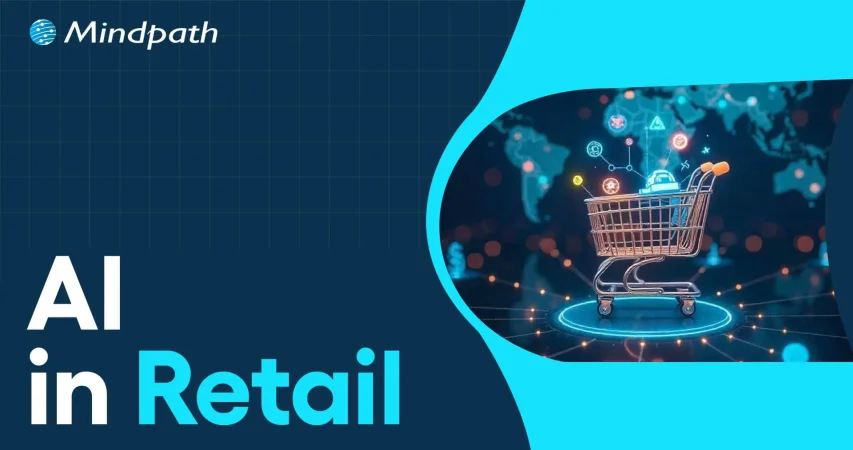
Undoubtedly, the global retail landscape is going through a massive transformation. A major architect of this transformation is Artificial Intelligence, or AI. Today’s customers demand convenience, immediacy, as well as personalization. They expect companies to anticipate their needs. Well, AI in retail industry helps brands to achieve that.
If you want to create a seamless shopping experience and boost customer engagement, retail AI would be an excellent option. Today, we are moving beyond simple automation to a new phase of creative and predictive intelligence. So, this blog explores how generative AI in retail and other AI tools are enhancing customer engagement. Besides, we will discuss some AI in retail examples to get a better idea about this.
Looking to go beyond generic AI tools to create truly personalized retail experiences? Our AI development services help retailers build custom solutions that boost customer engagement and drive smarter growth.
AI in Retail Industry- A Short Brief
Artificial intelligence in retail store means the use of natural language processing, machine learning, generative AI, and computer vision to enhance or automate decision-making. These technologies also play a crucial role in streamlining operations and personalizing customer journeys.
Offering predictive recommendations and data-driven insights, AI in retail industry boosts customer satisfaction and revenue. As per a recent survey, the use of AI in the retail sector can increase customer experience by 59 percent (Source: World Tea News).
Besides, generative AI creates massive economic potential for retailers. It is projected to offer between USD 240 billion to USD 390 billion in economic value (Source: McKinsey).
Whether it is a recommendation engine suggesting useful products or a retail AI chatbot helping shoppers, AI can be embedded in all aspects of the customer journey.
Must Read: AI in E-commerce
Generative AI in Retail- A Game-Changer for Customer Engagement
Generative AI for retail is now pushing boundaries by offering personalized and dynamic content at scale. Well, here is how it plays a crucial role in creating customer engagement strategies.
1. Hyper-Personalized Product Recommendation
AI in retail industry effectively analyzes customers’ purchase history, preferences, and behaviour. It can provide customized product recommendations based on the gathered data. In addition, such recommendations can appear in applications, emails, or websites, which enhances the conversion rates.
Customer satisfaction, shopping experience, and loyalty can be improved by offering the customers relevant products at the right time.
2. Smart Virtual Assistants and Chatbots
Retailers are able to provide 24/7 customer support using generative AI chatbots. Bots can easily handle multiple queries without any issues. Furthermore, they can guide purchases.
Over time, these intelligent bots can learn from customer interactions, improving personalization and accuracy. Besides, you will be able to reduce the cost of customer support when using a chatbot.
Want to offer instant and personalized support to your online shoppers? Explore conversational AI chatbots to learn how they improve customer engagement and boost conversions.
3. Demand Forecasting
AI-driven demand forecasting involves using ML and data and analytics trends for predicting the demand of products in the future. Retailers can optimize inventory, improve logistics and reduce waste by analyzing market data, sales, and customers.
These models may be trained to respond to changes in the market, assisting retailers in better planning than the rest. So, they can react swiftly to the changes.
4. Dynamic SMS and Email Campaigns
Advanced AI tools for retail industry can create personalized SMS and email campaigns. For this, they consider various elements like behavioral data, seasonal trends, and customer segments. Speaking about some useful AI-powered tools you can use are OptiGenie, HubSpot, Canva, and AdCreative.ai.
These messages or emails are relevant and engaging, leading to higher click-throughs, open rates, and conversions. Furthermore, retailers can also automate outreach using these tools.
5. Visual Search and Styling
Thanks to generative AI, customers can now find their desired products quickly. They just need to upload an image of the product, and the search engine will then display similar products instantly.
Besides, these tools also offer styling suggestions based on the customer’s input. It is this visual search that can enhance product discovery and interaction while minimizing friction. It is used by retailers to offer a shopping experience that is immersive and intuitive.
Planning to personalize every customer interaction at scale? Discover generative AI for customer service to learn how it delivers tailored responses and smarter assistance.
6. Custom Rewards and Loyalty Programs
AI assists retailers to design custom loyalty and reward programs by analyzing the frequency and preferences of purchases. Special offers, targeted incentives, and personalized rewards generate increased brand loyalty and purchase repetitions.
The use of AI in retail industry ensures that all customers feel appreciated, establishing stronger customer relationships.
7. Sentiment Analysis
The use of AI in retail industry promotes sentiment analysis to monitor the emotions of the customers. These tools analyze social media, reviews, feedback, etc, to understand customers. With the right data, retailers will be able to respond to all negative sentiments positively.
In addition, the insights are also used in the development of marketing plans and brand communication, which is in line with customer expectations.
Artificial Intelligence is no longer a futuristic concept. It is changing customer interaction by hyper-personalizing automated customer support, visual search, etc.
Wondering how to connect customer data with long term planning? Check out AI in business strategy and discover how it improves forecasting, personalization, and operational efficiency.
Key AI Use Cases in Retail
Now, we shall find out the key AI use cases in retail industry that have contributed to the smooth transformation of the retail sector.
| Use Cases | Description |
| Inventory Optimization | AI helps retailers stock the right products using predictive analytics. This helps avoid stockouts and overstock issues. |
| Customer Segmentation | AI can categorize customers based on their demographics, preferences, and behaviour for targeted marketing. |
| Fraud Prevention | AI tools regularly monitor transactions for suspicious activities, protecting customers and retailers. |
| Price Optimization | Retail AI tools adjust pricing based on competition, demand, and customer behaviour. |
| Virtual Try-Ons | AI allows shoppers to try products digitally, lowering return rates and enhancing customer engagement. |
| Route Planning | AI-assisted route planning helps retailers eliminate service disruption and manage changing conditions. |
A Few Real-World Examples of Generative AI in Retail
The influence of AI in retail industry revolves around the behavior of the customers. Some of the established retailers are using AI to offer superior experiences. The following are some real-world AI in retail examples that can be considered to have a clear picture.
1. Amazon Go Stores
These stores use computer vision, deep learning, and sensors and help customers purchase their preferred products. The AI tools monitor purchases and automatically charge the customer’s account.
2. Shopify
Shopify Magic is a new product offered by Shopify that understands your retail store and creates content automatically.
3. Sephora
It supports AI-based virtual try-ons for beauty products, increasing sales and improving customer confidence in the product.
4. Walmart
They have implemented AI for predictive analytics as well as inventory management.
5. Zara
It applies predictive modeling systems that are supported by AI to analyze fashion trends. These models track social media platforms, sales data, etc to know what the customers truly desire. The company is also able to streamline supply chains with the help of AI.
6. The North Face
They use IBM’s Watson to offer customers a conversational shopping assistant.
Looking to anticipate market shifts before your competitors do? Discover Generative AI trends to learn how predictive insights shape smarter retail strategies.
Technologies and Tools Powering AI in Retail
AI in retail industry is driven by a robust ecosystem of tools and technologies. Both facilitate operational efficiency, and smarter decision-making. Read on to know a few major innovations that are supporting the retail sector.
1. Big Data & Predictive Analytics
Evaluate large datasets to predict customer behavior, trends, as well as inventory requirements.
2. Data Management Tools
Help in organizing and retrieving both unstructured and structured data to support decision-making and personalization.
3. Salesforce Einstein
Offers features such as automated workflows, predictive analytics, and powerful generative AI tools.
4. NLP
Natural Language Processing helps understand as well as respond to customer queries, feedback, and reviews. It powers chatbots as well as allows personalized communication.
5. Computer Vision
This technology helps with shelf monitoring, smart mirrors, and visual search by processing video data and images in the retail stores.
6. IoT or Internet of Things
IoT involves devices that are connected and used to detect foot traffic and monitor inventory.
These technologies assist retailers in ensuring that customers remain the focal point in the interaction process, enabling them to stay competitive in this changing market.
Want to make faster and more accurate business choices in retail? Discover AI in decision making to learn how data driven insights improve customer engagement and operational efficiency.
AI and Retail- What Comes Next?
Due to the ongoing development of AI technology, the future of AI in retail industry promises a more personalized shopping experience. Retailers worldwide will implement AI more often for operational efficiency, customer service, and personalization, thus eliminating the lines between digital and physical commerce.
In the future, we can expect:
1. Application of Emotion AI
AI will be in a position to understand customer emotions and assist retailers in enhancing customer satisfaction.
2. Hyper-Personalization
Generative AI in retail will offer context-aware and real-time experiences across multiple channels.
3. Sustainability Insights
AI will assist retailers in tracking and lowering their environmental impact.
4. Virtual Shopping Assistants
AI-powered virtual shopping assistants will offer real-time and personalized shopping support.
5. Blockchain Integration
Retail and e-commerce sectors will become more transparent and secure with the help of blockchain and AI.
Retailers who leverage AI will successfully meet customer expectations. Result? Increased customer engagement, loyalty, and growth.
Curious why businesses are rapidly adopting intelligent technologies? Check out the benefits of AI and discover how it improves decision making and competitive advantage in retail and e commerce.
Ready to Transform Your Retail Business with AI?
Artificial intelligence is revolutionizing retail by enhancing customer engagement, personalizing shopping experiences, and improving operational efficiency. Retailers leveraging AI gain a competitive edge, optimize processes, and deliver smarter, data-driven experiences that delight customers and drive growth.
At Mindpath, we provide tailored AI development services for the retail sector. Our experts design custom AI solutions that streamline operations, enable predictive analytics, and boost customer engagement. Partner with us to harness AI strategically and create innovative, scalable retail experiences that drive measurable results.