Software Development Trends Businesses Can’t Ignore in 2026

Join our Newsletter!

Featured Posts

Support Is One Click Away

Home

Software Development Trends Businesses Can’t Ignore in 2026

Software development trends

Software Development Trends Businesses Can’t Ignore in 2026

Software development trends are changing businesses and their innovation and competitiveness. The rapid changes in technology present businesses with risks and opportunities where using the correct tools and methodologies can be the difference between success and failure. New frameworks, better automation, and cloud-based solutions are driving change to every aspect of software development and creation. Teams are adjusting strategies rapidly, exploring AI-driven development, and integrating collaborative platforms.

As new trends continue to gather momentum, leaders must start considering how current processes might be adjusted to create opportunities today. Agile practices, low-code platforms, and modern cybersecurity are rapidly reaching a baseline requirement for organizations. Knowing these trends and making the necessary adjustments allows businesses to work smarter, drive out cost, and improve user experience moving forward into 2026. So, keep reading to know more about the trends in software development in this blog.

Ready to achieve your unique business goals with custom software solutions? Mindpath offers custom software development services, which will provide you with more knowledge on how we turn your ideas into real-world solutions.

A Quick Dive into the Software Development

Software development is the process of designing, developing, testing, and maintaining software applications. It can deliver service improvements, increased efficiency and scalability, and a better user experience. Companies utilize software development to automate, optimize, and support business goals. Companies developed four main types of software development: web development, mobile development, enterprise solutions, and application software. Each of these helps companies achieve their business goals.

Grand View Research reported that the global software market stood at USD 730.70 billion in 2024 and will likely reach USD 1,397.31 billion by 2030, growing with a CAGR of 11.3% in the forecast period of 2026 – 2030. The emergence of ongoing research, new technologies, and government initiatives that promote software is helping drive this growth, further fueling software development trends across industries.

Also Read: Benefits of Custom Software development

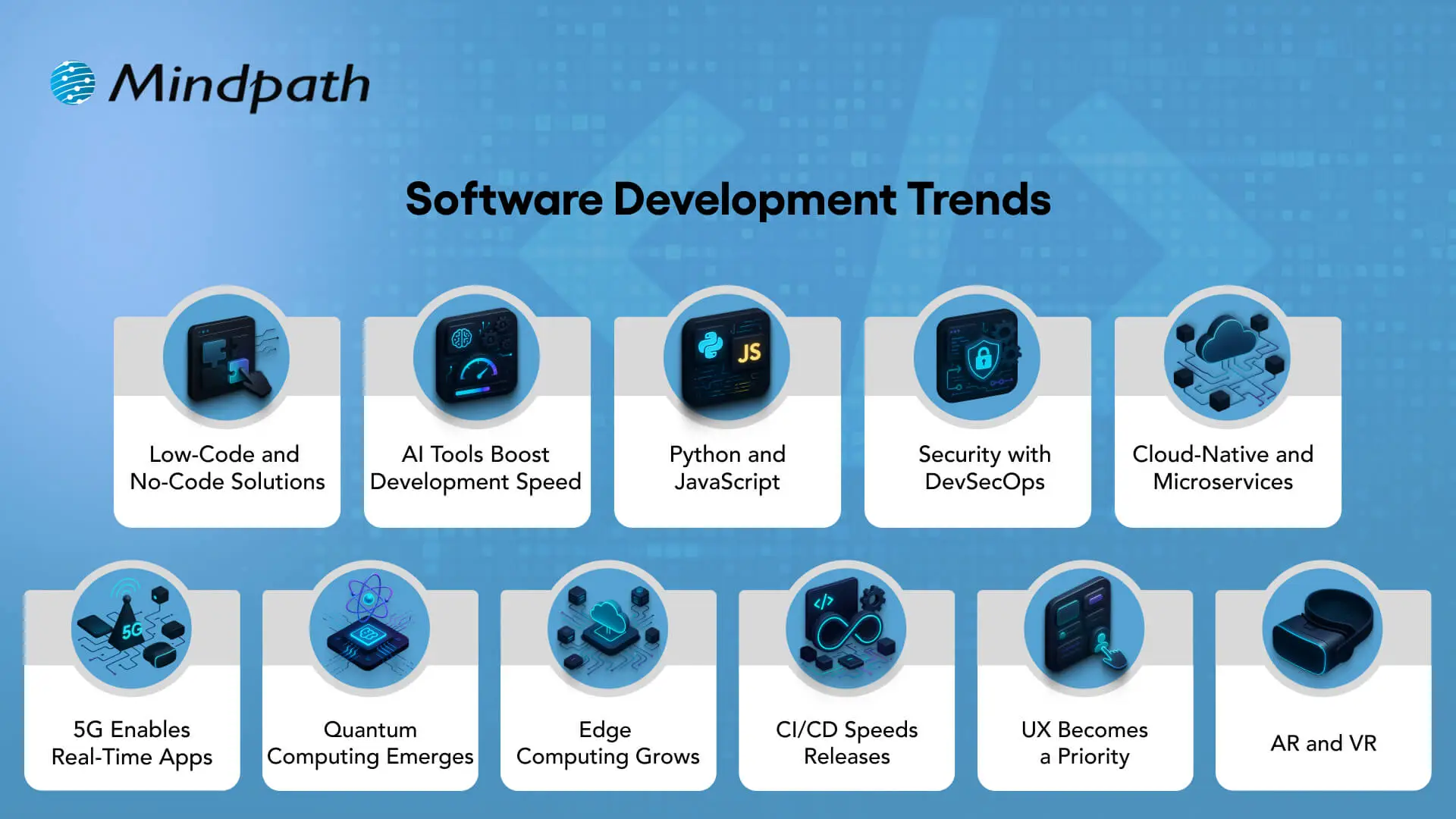
Software Development Trends 2026

New trends in software development are changing the way businesses are building smarter, faster, and more secure solutions. When companies understand these advances, they can effectively prepare for the future of software development to keep ahead of the competition.
Software Development Trends


1. Low-Code and No-Code Solutions

Low-code/no-code tools enable a business to build apps with simple visual designs. The low-code and no-code platforms change the scope of full-code requirements and benefit non-developers with workarounds to build their own solutions.

This distance from the original requirement allows for enterprises and startups to accelerate their launch products. This balance between the two reflects a software development trend that benefits everyone, especially startup and enterprise applications.

2. AI Tools Boost Development Speed

AI-enabled tools are reshaping software writing and release processes for developers. GitHub Copilot instantly suggests code and removes repetitive tasks. Testing tools such as Test.ai extrapolate early bugs and generate stable releases.

This software development trend demonstrates how AI makes the overall software writing process more accurate, more rapid, and prepared for the future with cloud, along with more automation.

3. Python and JavaScript

Python and JavaScript remain at the forefront of software industry trends because of their extensive usage and flexibility. It drives AI, automation, and heavy data tasks, while JavaScript powers responsive web apps and cloud apps.

They both facilitate development cycles that enable more rapid innovation. These languages show how software development trends connect directly to real-world needs and digital transformation.

4. Security with DevSecOps

DevSecOps incorporates security into every process of the software development lifecycle. Automated scans, code checks, and in-flight monitoring can identify risks before they become threats. These tools allow teams to ensure software safety with tools like SonarQube and Checkmarx, without slowing down releases. In addition to the multitude of software engineering trends, DevSecOps is a notable software development trend that enables speed without sacrificing safety.

5. Cloud-Native and Microservices

Microservices are foundational for cloud-native development. With microservices-based applications, teams can deploy and update smaller components of an application without impacting the entire application. Docker and Kubernetes enable microservices-based development for organizations of every size. Cloud-native development is one of the many trends taking root in software development, allowing freedom of flexibility while supporting speed to growth.

Curious how cloud-native approaches boost software development agility? Discover the latest cloud computing trends that are driving innovation and growth in the industry.

6. 5G Enables Real-Time Apps

5G networks provide improved connectivity with almost no latency. This enables acceleration of applications that support smart cities, healthcare, and autonomous vehicles. For consumers, 5G improves mobile applications through richer and more interactive experiences. This advance is correlated with trending technologies in the software industry and also advances a software development trend focused on instant, connected solutions.

7. Quantum Computing Emerges

Quantum computing helps solve problems that classical systems simply cannot solve. Industries expect quantum computing to revolutionize processes like financial modeling, supply chains, and drug discovery. Quantum encryption will help keep sensitive data safe in the future.

Experts already list it as a technology trend in the Gartner Technology Trends 2026 report. This means it is a dominant trend in software development and will have a long-term impact.

8. Edge Computing Grows

Edge computing processes data close to where it is collected for faster results. This is helpful for smart factories, vehicles, and IoT devices. It allows organizations to use predictive maintenance and monitor in real time. Edge computing, as the newest form of software development technologies, allows further performance advantages and reduces the dependence on cloud computing.

9. CI/CD Speeds Releases

CI/CD pipelines enable teams to deploy faster while having fewer bugs. Developers integrate code multiple times a day, and automated deployments uphold stability and quality. This supports agility and reduces downtime. It highlights software industry trends where automation drives faster product improvement.

10. UX Becomes a Priority

User experience determines the success of modern software. Companies design apps to be intuitive, analyze behaviors, and test interface engagement. Both AR and VR make experiences immersive and interactive. One of the new technologies for software development is UX innovation, a software development trend that creates customer trust and loyalty.

11. AR and VR

Augmented reality and virtual reality are providing opportunities beyond entertainment in sectors like healthcare, training, and retail. Medicine professionals use VR to more accurately and affordably simulate surgeries; retailers use AR to display previews of products.

Both technologies provide value in learning and interaction and help to improve the customer experience. These represent the latest software development technologies to redefine industries through immersive digital experiences.

Want to know how much building software really costs? Check out our blog on software development cost to plan efficiently and maximize value.

Want to Stay Ahead with the Current Trends in Software Development?

Software development trends are reshaping the way businesses build, innovate, and compete. By adopting new technologies such as AI, DevSecOps, edge computing, and low-code solutions, companies can transform challenges into opportunities. Staying agile and forward-focused allows leaders to unlock growth, deliver better user experiences, and position themselves for success in 2026 and beyond.

At Mindpath, we align our software development services with the latest software development trends to help businesses stay competitive. Our team delivers solutions built on innovation, scalability, and security. By combining deep expertise with modern practices, we create applications that support growth and efficiency. Partnering with us helps your business achieve its digital transformation goals.
Related Post

Discover the key factors influencing software development costs and how to optimize your budget. Learn how Mindpath can help.
Discover staff augmentation for IT projects, its benefits, and top providers in the USA. Learn how it can bridge gaps and save costs.

Related Post

ai in mobile apps

Every day, AI in mobile apps revolutionizes user interaction with technology. Just think of a single application that understands your behavior, foresees your requirements, and adjusts its capabilities for a smooth and unique experience. Enterprises are equipped with smart features such as conversational agents, personalized algorithms, and speech assistants to attract user interaction in a better way. This transformation is making regular applications become intelligent friends that facilitate actions and offer answers that are convenient and timely.

Beyond convenience, AI in application development brings innovation and returns efficiency. In a nutshell, developers can analyze real-time data, discover patterns, and tailor personalized experiences for users, keeping them more engaged for longer periods. Companies can gain insight into users through actionable data, and users enjoy quicker, seamless, and more meaningful interactions. As the future of AI continues to unfold, this new progress opens the doors to new opportunities in retailing, healthcare, education, and entertainment. This article shall delve into the positive impacts, utilization, and practical scenarios of AI in mobile apps. So, keep reading further!

Ready to bring AI into your mobile app development, but confused about where to start? Mindpath provides full guidance on mobile app development services to help you gain user attraction and create powerful digital experiences.

Evolution of AI in Mobile App Development

AI in mobile app evolution has changed the design of the same user simple tools into smart, user-engagement-focused experiences. The earliest examples of AI in mobile applications were predictive text and basic speech recognition, while mid-level AI brought in personalized recommendations, more intelligent search functions, and AI-enabled chatbots. All these technological innovations enabled the most efficient user-behavior apps to comprehend and reply to users without wasting time.

Currently, artificial intelligence in mobile applications powers advanced features such as real-time analytics, augmented reality, and the ability for apps to operate autonomously. Besides, AI dramatically simplifies the development process by automatic testing, code generation, and cross-platform integration. These innovations reflect the consistent trend of AI eventually transforming mobile into more intelligent, rapid, and personalized user experiences, hence driving app usage to be a natural daily occurrence.

Looking to understand how mobile apps can enhance the impact of AI and unlock greater value for your business? Discover more insights in our blog on the Mobile App Development, which benefits your business by improving customer engagement and driving measurable growth.

Benefits of Artificial Intelligence in Mobile Apps

AI-enabled mobile app development is a game-changer as it opens opportunities for intuitive, personalized and efficient apps. Developers can thus use smart features to build apps that not only attract users but also make their routine tasks effortless.

1. Tailored Experiences for Users

Mobile applications powered by Artificial Intelligence will eventually have the capability to study user behavior and preferences so as to offer customized content and recommendations. This means that the applications will be more engaging, and the users will have a custom-made experience which gives them the impression that the entire thing is just for them.

2. Stronger Security Measures

AI is one of the factors that revolutionize the environment of mobile applications to uncover unconventional user behaviour patterns with the aid of artificial intelligence technology, to prevent unauthorized access, and ensure the safety of the data. If you associate with a firm that is proficient in AI app development, then you will definitely have security protocols being implemented in a proper way.

3. Instant Customer Support

AI-driven virtual assistants solve problems right away, thus increasing user delight. Consequently, the need for human support is made smaller although the speed and correctness of the answers are maintained.

Also Read: AI for Customer Services 

4. Smarter Search and Navigation

The power of AI allows applications to interpret voice inputs, pictures and even the users’ thoughts in order to deliver more accurate search results. Thus, users are able to locate their desired items in less time, which means the experience is more fluid and user-friendly.

5. Predicting Trends and Behavior

The AI in mobile apps is capable of studying user actions which were done in the past to predict their future inclinations and the general trend of the market. Thus, enterprises will be able to have a clearer vision of the suitable decisions to take, which will further promote the involvement of clients.

6. Streamlined Tasks and Efficiency

Artificial intelligence can automate the execution of monotonous operations that include scheduling, setting of reminders, data handling, and so on, thereby saving valuable time and eliminating errors. A company can utilize AI app ideas to create apps that are both quality-excellence and user-friendly.

Curious how mobile apps can leverage AI to transform your business and stay ahead in 2025? Explore our blog on Mobile App Development Trends to discover how these innovations can enhance user experiences.

Use Cases of AI in Mobile App Development

Artificial Intelligence is transforming how mobile applications function and enabling them to become smarter, faster, and more adaptable. The use of artificial intelligence in mobile application development is progressing and promotes opportunities for interesting new applications across industries.

1. Personalized Content and Recommendations

AI in mobile apps can use advanced data analytics of users’ intent and behaviors to formulate personalized content and product recommendations and offerings. By suggesting items or services they might like, apps proactively enhance user engagement and satisfaction, and they also help businesses utilize data to make informed decisions.

2. Intelligent Virtual Assistants

Applications incorporate artificial intelligence technology for mobile app development, and voice assistants now exist that can take user directions. These voice assistants can help navigate tasks quickly, without even using your hands, allowing access to information obtained faster and can speed up your daily tasks.

3. Automated Task Management

AI takes over basic responsibilities, such as scheduling and reminders, or the organization of emails from mobile applications. This increases efficiency and minimizes the time a user will spend on monotonous tasks.

4. Enhanced Security and Fraud Detection

AI in mobile apps identifies unusual patterns of user behaviour and prevents fraud from happening right away. Businesses can leverage advanced monitoring and threat detection functionality to safeguard sensitive information and ensure user safety.

5. Industry-Specific Smart Solutions

Artificial intelligence powers the development of applications in the healthcare, finance, and e-commerce arenas which can provide personalized services, forecasts, and automation. Working with an AI application development company can help ensure applications comply with industry standards, while also improving the user experience.

Want to make sure that your applications are not only functional but also secure, compliant, and trustworthy for your users? Discover our blog on application security best practices to explore essential techniques for protecting your software and building trust.

Real-World AI in Mobile Application Examples

AI in mobile apps is transforming everyday interactions by making them smarter, faster, and more intuitive. Real-world examples show how AI improves user experiences, streamlines tasks, and delivers personalized solutions across different industries.

Real-World AI in Mobile Application Examples

1. Voice Control with Siri, Google Assistant, and Alexa

These virtual assistants use artificial intelligence in mobile applications to understand voice commands and perform tasks like setting reminders or controlling smart home devices.

2. Personalized Streaming on Netflix and Spotify

Streaming apps use AI in mobile apps to analyze user behavior and recommend movies, shows, or music that match individual preferences.

3. Smart Social Feeds on Facebook and Instagram

Social media platforms use AI mobile app development to personalize news feeds and suggest relevant content, friends, and groups for each user.

4. Tailored Shopping on Amazon

Amazon uses AI in mobile apps to recommend products based on browsing history and past purchases, creating a personalized shopping experience.

5. Visual Search with Google Lens

Google Lens uses AI technology for mobile app development to recognize images and provide instant results through photo-based searches.

Want to build a mobile app but don’t know which technology to use for better execution? Learn from the mobile app development technologies blog to understand what suits best for your business.

Ready to Build Smarter Mobile Apps with AI?

The use of AI in mobile apps introduces new opportunities for businesses and users. This advancement creates great user experiences, strengthens security, and provides more effective daily interaction. As industries pursue innovation, apps will work smarter, adapt more quickly, and become infinitely personal, helping brands engage with users, in meaningful and authentic ways.

Working with Mindpath gives organizations access to superior AI mobile application development services built for measurement. We build intelligent, fast, and user-friendly applications to support your organizational priorities. We provide a blend of strategy, innovation, and technology to design digital solutions that drive growth and maintain user engagement.

staff augmentation trends

The digital revolution has been empowering itself rapidly, and this is leading to a need for complex tech in business management. This is why organisations are dealing with hiring issues while keeping the prices minimal. Staff augmentation has turned out to be a strategic approach to deal with such risks.

The IT staff augmentation service is growing drastically and is ready to touch USD 857.2 billion by the year 2032. Further, it is growing at a rate of 13.2%. So, instead of being a niche workforce strategy, staff augmentation has become a mainstream model. In this blog, we will go through some reliable IT staff augmentation trends and why your business should acknowledge them.

Looking for a reliable partner to power your IT initiatives? Mindpath delivers premium IT staff augmentation services tailored to help you scale with confidence and drive project success.

What is the Meaning of Staff Augmentation?

Staff augmentation meaning is simple and viable for everyone. It is a flexible outsourcing strategy that allows your company to elevate their in-house with external professionals on a temporary or specific-period project basis. Traditional hiring can be time-consuming and rigid for many professionals. On the other hand, staff augmentation enables your business to quickly bring on experts with specific skills as per your requirements.

This is just like empowering your existing workforce with in-time talent. This approach can help you fill in the expertise gaps while managing seasonal demands. Most importantly, it can accelerate your strategic initiative.

  • Staff augmentation allows you to add or reduce team members as per the needs of your projects.
  • It can reduce the overhead charges of full-time hiring like taxes, benefits and long onboarding cycles.
  • You can be assured of skill-specific resourcing like cloud computing, AI and cybersecurity.

What are Some Top IT Staff Augmentation Trends to Leverage in 2026?

Let us go through some leading and meaningful IT staff augmentation trends that can make your hiring process viable in the current competitive landscape.

1. Hybrid Workforce Models

As per the recent research of ISACA, around 75% percent of employees prefer hybrid work practices. This has made many organisations leverage hybrid models. This is not only a smart recruitment approach, but a cost-efficient deal. Such Staff augmentation models can improve your team’s collaborative mediums.

Further, hybrid setups are essentially beneficial for companies that handle complicated development cycles. Around 25% of employers in the US are delivering a hybrid work culture to their workers.

2. AI and Modern Tech Implementation

AI-rich recruitment is no longer an option. It has become a mainstream necessity for employers. With the integration of AI-led tools, you can give rise to a faster and better screening assessment. Further, you can recruit skill sets that match your project requirements.

Such tools can also predict your future workforce needs. Additionally, automation and chatbots can enrich your team’s communication.

3. Adoption of Offshore and Nearshore Professionals

One of the incredible IT staff augmentation trends in the recent scenario is the hiring of offshore and nearshore experts. Nowadays, organisations are prioritising balancing factors like time zone compatibility, risks and cultural efficiency. Many organisations have claimed a reduction in operational charges due to such a viable option.

4. Cybersecurity Staff Augmentation

The trends and patterns of cyber threats have been increasing drastically. So, staff augmentation should be your foremost priority. Companies are willing to hire specialised compliance experts or security engineers through staff augmentation models to protect their infrastructure. This is becoming possible without even creating large in-house teams. Further, this approach can help you work within a regulated environment.

Must Read: AI in Cybersecurity

5. Communication-Oriented Hiring

No doubt, technical skills are important. But along with this, it is important for you to prioritise skills like collaboration and better communication. Staying in sync can help your team work towards a better goal without any mishaps.

With the rise in remote work, soft collaboration skills can facilitate better operations across multiple nations.

6. Changing Skill Advancement

As per the recent IT staff augmentation trends, organisations are valuing systems to facilitate continuous upliftment. So, IT teams are generally going through multiple training programs. Manpower is getting updated with the development of modern technologies. So, your preparation of future-rich teams can diminish your dependency on outside hiring.

7. Cloud Infrastructure Staffing

With the growth of cloud adoption, cloud infrastructure staffing is becoming prominent. Businesses are majorly augmenting teams with DevOps engineers, cloud architects and platform specialists. Such a trend can align seamlessly with DevOps staffing and cloud-centric strategies.

Wondering how companies stay flexible while scaling their teams quickly? Learn more about what is staff augmentation and why it’s a game-changer for modern businesses.

What are the Major Types of Staff Augmentation Models?

Understanding the different types of staff augmentation models can help you choose the right approach while keeping your decisions intact. Here, you can go through some main models that work potentially.

1. Short-term Augmentation

This type of process is appealing for quick turnarounds and urgent technical fixes. It generally lasts from a few weeks to several months.

2. Long-term Augmentation

When your company requires ongoing support for extensive projects, long-term augmentation can offer you continuity. Such types of staff augmentation can help you with deeper integration with your internal teams.

3. On-demand Augmentation

This model values hiring talent when your business requires it. The process remains flexible and mainly adopted in agile development criteria.

4. Team Augmentation

Instead of hiring individual talent, you can hire an entire team that can match your internal workflows.

Every types of staff augmentation vary in commitment and integration approaches. The choice completely depends on your project needs and workforce maturity.

Not sure which AI advancements are shaping staff augmentation trends? Explore the top AI models helping businesses stay competitive.

What are the Potential Benefits of IT Staff Augmentation?

The benefits of IT staff augmentation generally remain unmatched. Starting from saving your costs to hiring top talent, it can help your workflow remain streamlined. Let us discover some of the most essential benefits of staff augmentation in this section.

1. Minimal Hiring Uncertainty

With the help of staff augmentation, your company can approach top talent when you require it instead of being worried about long-term commitments. Moreover, there will be fewer chances of hiring inefficient profiles, as you are going for specialised individuals for specific tasks or projects.

2. Manageable Administrative Workloads

If your organisation is considering the help of staff augmentation providers, you can remain unburdened about the extra administrative work. Further, the providers can handle your payroll and other HR centric works. This approach can prevent you from extreme charges while saving your resources.

3. Adoption of New Technologies

With the usage of staff augmentation models, businesses can explore and experiment with advanced technologies without being tense about investing in large-scale solutions. As a result, you can hire experts to try out technologies when you require them.

Want to know how AI can enhance recruitment efficiency and strengthen your extended workforce strategy? Read our insights on Generative AI in HR to see how HR teams are leveraging intelligent automation.

What are Some Challenges of Adopting Staff Augmentation?

While staff augmentation can make you aware of many benefits, it also highlights certain challenges, as given below.

  • Your augmented teams might struggle to understand your internal work culture.
  • Misalignment can occur when the external workers are not completely informed. So, use structured communication channels.
  • External access to systems can give rise to compliance risks.
  • Your team might prioritise their skill development.

Conclusion

As IT staff augmentation trends have been shifting rapidly, your business needs a strategic augmentation partner to fulfill the hiring requirements. Starting from your remote workforces to data scientists, your augmented teams can help your companies navigate complicated digital transformations.

Partnering with professional providers ensures your organisation can pick the right expertise at the right time without compromising quality or alignment. Here, Midpath can be your ultimate preference. Experts in this company can understand your changing needs while helping you leverage the right talent solutions.

FAQs

1. What is technology staffing?

Technology staffing generally refers to the hiring of skilled IT professionals with the help of flexible models to meet project-specific requirements.

2. How is staff augmentation different from outsourcing?

Staff augmentation mainly supplements the internal team with external talent as per your company’s directions. On the other hand, outsourcing transfers responsibility for entire functions.

3. What are some eminent models of staff augmentation?

Some of the common staff augmentation models include long-term, short-term, and on-demand team augmentation.

4. How can IT staff augmentation be beneficial for you?

Through IT staff augmentation, you can have faster access to expertise while reducing the hiring team. Further, it can support your strategic initiatives without any long-term commitments.

5. Which roles are majorly augmented in businesses?

Frequently augmented roles include software developers and cloud engineers. Business also augments data scientists and cybersecurity experts for better alignment.

Explore how IT staff augmentation trends are reshaping the tech industry, from cybersecurity to AI, and discover Mindpath’s expert solutions.
generative ai applications for enterprises 

Generative AI is changing how modern firms operate, innovate and grow. By harnessing generative AI applications for enterprises and adopting generative AI for business, they are finding better ways to create, plan, and deliver value. It helps teams speed up the flow of work, foster creativity, and make data-driven decisions with greater accuracy. Each industry has begun to see how this technology is turning challenges into opportunities to succeed.

With growing adoption, generative AI is becoming a central component of business strategy. One ‍of the main areas where it is applied is the customer experience improvement and gen AI in market research, helping organizations better understand trends, customer behavior, and insights. The simplification of the company’s processes and the building of more adaptable systems that can react to the changes in the market. As a result, it is reshaping the entire way companies handle their innovations and efficiencies. In this article, we will uncover the different applications of generative AI for everyday scenarios, and the ways in which companies employ it to bring positive changes. Therefore, let’s tread further into‍‌ it!

Ready to translate the GenAI opportunities into real operational impact for your organisation? Mindpath offers AI development services that guide you on how to turn your ideas into product-ready systems.

Understanding Generative AI: A Quick Dive In

Generative AI is changing the ways in which businesses innovate by generating real and useful outputs in a manner that incorporates data-driven insights through machines, marking the ongoing gen AI revolution. It assists organizations to increase creativity, decision-making, and accelerate the processes within departments. This technology is going viral due to its capability to transform ideas into workable solutions. This results in business growth that can be measured.

Based on a report by Grand View Research, generative AI is estimated to have a market value of 16.87 billion USD in 2024 and will grow to 109.37 billion USD by 2030, at a CAGR of 37.6%. The rising adoption of generative AI applications in enterprises is a clear signal that companies are using the technology to update their processes, create new products and maintain their competitive advantage in the digital ‍‌era.

Looking to stay ahead of enterprise innovation in generative AI? Check out Gen AI trends to learn what’s shaping real-world business adoption.

Benefits of Generative AI for Enterprises

Here are some key benefits of generative AI for enterprises:

1. Generative AI opens the door for anyone to use sophisticated creative tools. Thus enabling non-technical and non-design people to make high-quality content of a professional nature. Such a transformation has the potential to ignite creative and innovative ideas in the whole industry ‍sector.

2. It enhances the overall productivity by overcoming the monotonous activities involved in text summary, code generation, and drafting of content. Subsequently, the employees will be capable of focusing on the tasks that are of a strategic nature and of high value, thereby yielding real results.

3. With the help of generative AI applications for enterprises which automate content creation, product design, and data analysis, companies can save both time and money. Such efficiencies are instrumental in speeding up projects and reducing operational costs by a large margin.

Must Read: Generative AI Tools for Content & Code Creation

4. In addition, research and development benefits from this as well, as it allows specialists to validate their hypotheses at a quicker pace and process a vast amount of data. Consequently, the time to first discovery, quality of materials, and rate of innovation across sectors are all‌‍ ‍‌increasing.

5. Generative ‍AI is a creative tool that can be used in conjunction with human beings to come up with fresh ideas and new design paths. It energizes innovation and enables the creative teams to extend their creative limits in any discipline.

6. GENAI technology is also a big factor behind personalization as it helps in creating content and recommending products or services that are suitable for the tastes of each user. Hence, customer experiences become more delightful, and the level of engagement gets higher.

Wondering how creative teams leverage generative AI beyond simple content generation? Discover how generative AI works in the creative industry to check out real-world enterprise use cases.

What are the Applications of Generative AI in Businesses?

Businesses‌ of various industries are implementing real-life examples of generative AI, showcasing practical generative AI use cases to raise their creativity levels, accelerate their workflows and make their decisions more efficient. Our focus will be on how companies are leveraging this technology for the transformation of their operations, the increase of their innovation, and the provision of an intelligent customer ‍‍‌experience.

1. Software Development

  • Automating Software Testing

One of the ways generative AI tools enhance software testing is by the automatic creation of test cases and running them for checking software quality. They analyze the code, locate the errors at the earliest stage, and complete the developers’ fixing process by giving them the solution promptly before the release.

  • Improving Code Quality

Artificial Intelligence (AI) code writing assistants analyze the already written code and propose better alternatives for writing. They locate defects, enhance the readability, and generally, the codebase becomes more efficient.

  • Writing and Completing Code Faster

Developers employ generative AI-powered coding examples from real-world applications to create code snippets or even finish a whole function just by giving a text prompt. As a result, they are able to cut down on their time spent on tedious tasks and increase the pace of software‌‍ ‍‌development.

2. Marketing and Sales

  • Creating Social Media Content

One of the major generative AI applications that businesses may leverage is the automatic production of social media content which may include captions, visuals, and hashtags. Thus, enterprises are able to go on with their online presence and, concurrently, communicate with their target audience in a most efficient way.

  • Personalizing Email Campaigns

Another major business use of generative AI is the development of one-to-one emails that represent the customer’s preferences and behavior. With such a method, firms become capable of providing authentic and influential messaging, which, as a result, gives rise to the intensification of the customer relationships and the growth of ‍‌‍‌engagement.

  • Writing Engaging Ad Copy

One of the major business examples that generative AI can be used for is the creation of brief ad texts and a few words describing different ad campaigns. It allows the marketing department to be agile in the execution of their creativity by rapid testing various options and identifying the best response from the targeted ‍customers.

Planning to modernize financial workflows with intelligent automation? Discover Gen AI in finance to check out real-world enterprise use cases.

3. Finance Department

  • Detecting Fraudulent Activities

One of the key generative AI applications for enterprises is the case of figuring out fraudulent financial transactions. By keeping an eye on the trends in real-time, it notifies the responsible units when evoking abnormal conduct is detected that can be used to commit a fraud.

  • Automating Regulatory Compliance

By means of generative AI, the bank can keep up with the ever-changing compliance regulations since the system itself keeps track of the regulatory changes and also drafts reports automatically. This tool has the advantage of letting the organization cut down on the manual labor and abiding by the updated ‍ ‍‌regulations.

  • Personalizing Financial Advice

Generative‍‌ AI enables financial advisors to come up with tailored investment plans that depend on the client’s objectives and the level of risk they’re comfortable with. The technology equips the professionals to make wiser suggestions and to give more understandable portfolio insights.

4. Manufacturing Department

  • Designing Products and Parts

Generative AI is a tool for engineers to find several design alternatives by using specified materials, measurements, and performance requirements, making AI in manufacturing a practical support for faster and smarter design decisions. The turnaround for new product development is greatly enhanced with the help of creative and efficient design variations being readily available for ‍‌selection.

  • Optimizing the Supply Chain

Supply chain optimization is one of the most effective generative AI applications for enterprises. Such a system scans massive data files to forecast consuming patterns, to streamline transportation, and to give advance warnings of delays in the production line.

  • Enhancing Manufacturing Efficiency

Generative AI helps Manufacturers detect the variation in the production process that results in lower resource consumption. The latter is creating more productive and efficient workflows that not only increase output levels but also reduce the‍‌ waste.

Ready to understand why enterprises are shifting beyond prompt-based AI systems? Check out Agentic AI vs Generative AI to learn how intelligent agents reshape workflows.

Ready to Unlock the Power of Generative AI for Your Business?

Generative AI changes the whole business landscape by redefining the ways companies innovate, create, and operate. The usage examples of the different industries show that it is a potent instrument. This enhances the creativity, productivity, and decision-making abilities of the employees. Companies implementing such technology are able to maintain a competitive position amid the turbulent market conditions and increase their velocity of growth. This brings more intelligent solutions with a positive ‍ ‌environmental impact to the market.

At Mindpath, we offer expert AI development services designed to help enterprises integrate and scale generative AI solutions with confidence. Our team builds intelligent systems that automate tasks, optimize workflows, and enhance customer experiences. Partner with Mindpath to transform your business with custom AI-driven innovations that accelerate growth and redefine digital success.