Latest Insights On
GenAI, Tech, and Digital Transformation
Stay updated with expert insights, success stories, and real-world applications of cutting-edge technology.
Creating a strong business application depends on an important understanding of how you connect the frontend and backend to develop a consistent experience for the user. Picture a user on a platform that is fast, responsive, and intuitive. At every click, scroll, and keyboard input, there are systems running in the background to simulate that experience, all while interacting with a framework and keeping the user interface interesting. Technology, in turn, must be aligned with user experience and growth expectations to ensure a platform operates without flaws while keeping users satisfied.
As businesses grow, the proportion of back-end and front-end becomes more important than ever. The front-end dictates the manner in which users experience your platform, while the back-end powers the processes that allow everything to run smoothly. Ensuring that the two work closely together enhances performance, increases efficiencies, and guarantees a consistent user experience. This blog outlines the ways that both frontend and backend can be used to build a scalable business application.
Ready to build an application that provides your business with a unique and secure digital presence from front end to back end? Mindpath offers expert full-stack development services to help you design and develop scalable web application.
What are Backend and Frontend?
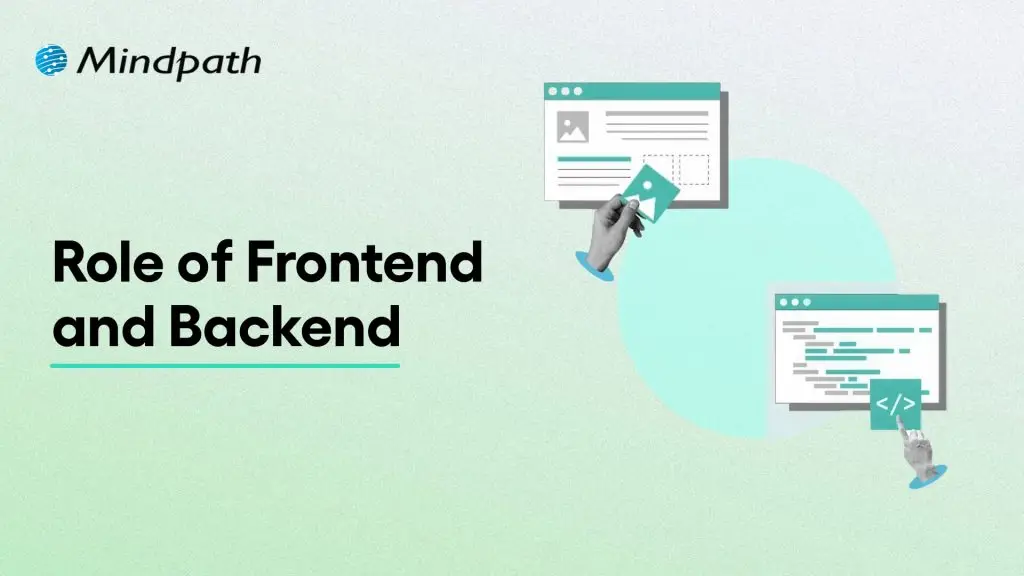
The frontend is the client-side layer of an application, everything a user sees and directly interacts with, including page layouts, buttons, text, and graphics. It runs in the user’s browser or app and is responsible for visual presentation, navigation, and responsiveness across screen sizes. Frontend developers use technologies such as HTML, CSS, or JavaScript, and frameworks such as React, Angular, or Vue.js to create interactive designs and usability of the platform.
The backend is the server-side infrastructure that powers the frontend. It processes user requests, runs business logic, manages server security, and stores or retrieves data from databases. Whenever a user submits a form, logs in, or makes a purchase, the frontend sends a request to the backend, which handles it and returns the appropriate response. Backend developers use programming languages such as Python, Java, PHP, Node.js, and Ruby, along with databases such as PostgreSQL, MySQL, or MongoDB, which store user accounts, posts, product catalogs, and other persistent data. The backend layer ensures that the application functions reliably and efficiently, delivering the information the frontend needs.
How Frontend and Backend Work Together for Building Scalable Applications?
The front-end and back-end collaborate appropriately to manage both user actions and the appropriate background processes that will occur. This collaboration will promote the applications’ responsiveness and scalable properties for more users and maintain the performance expected by the user.
1. API Communication
One of the main methods by which the frontend and backend cooperate is through APIs such as REST or GraphQL. The backend thus offers the frontend certain endpoints from which it can get data or to which it can send data.
The frontend on its part, performs HTTP requests like GET, POST, and PUT to communicate with these endpoints. Such a division provides a possibility for different teams to develop the UI and business logic separately and thus more efficiently.
2. Microservices Structure
In order to handle the complexity of huge applications, an option is to split the backend into several small units referred to as microservices. Each microservice is responsible for one specific area of the application, for example, payments, user accounts, or products.
The front-end and back-end interact with each other through APIs for every service, thus being able to work on different parts at the same time. This organizational pattern allows applications to become scalable and the process of development to be more efficient.
3. Asynchronous Communication
The frontend and backend have the ability to interact asynchronously, which contributes to a better performance. In a situation where a user makes a request that takes a long time, the front end is able to give an immediate response to the user.
The backend is handling the request silently and when it is done, it sends a message to the frontend. This method is free from the problem of users having to wait for a long time and their experience is thus made better.
4. Efficient Data Handling
The data that is being transferred from the frontend to the backend and vice versa must be of the highest standard in terms of speed and efficiency. The backend is to send only the necessary data to the frontend, thus lessening the network or bandwidth usage.
One of the ways through which it is possible to load large datasets of records into small pieces is pagination. The use of JSON or some other lightweight formats is the way to shorten the response times.
5. Independent Scaling
Apps work better when the frontend and backend are allowed to scale separately as per their requirements. In such a case, the front-end servers will be able to deal with the increased traffic without inhibiting the backend services.
On the other hand, the backend can scale its database or processing power as per its needs without any intervention from the frontend. It is, therefore, a great way to ensure that performance remains steady, even at times of user activity spikes.
Ready to leverage frontend and backend roles to build scalable applications? Discover how full-stack development works together to unlock growth potential.
6. Secure Interaction
Front-end and back-end security are the basis of their cooperation. The frontend securely sends user credentials and handles authentication requests. The backend, on the other hand, is the one that verifies credentials, keeps sessions safe, and stops attacks such as SQL injection and XSS. Therefore, both sides must be in sync to keep data and users safe.
7. Centralized Data Management
Centralized state management keeps data consistent between frontend and backend. The frontend keeps API responses in a state that is shared by all components and thus accessible to them. This makes redundant API calls impossible, and all application parts having the same information and show it. Centralized data refresh the application faster and make it easier to update.
8. Performance Optimization
On the performance side, the frontend and backend teams are exerting a joint effort. Frontend developers minimize the sizes of assets, introduce lazy loading, and apply client-side caching. Backend developers optimize database queries and set up server-side caching for quicker API responses. Frequent coordination keeps the application fast and responsive.
9. Load Balancing
Load balancers are instrumental in making the frontend and backend capable of handling increased traffic efficiently. To users, the frontend with the help of the load balancer offers a single-entry point, thus giving the impression of an application that is seamless.
The backend, through the load balancer, is able to spread the incoming requests to different servers, thus sending the traffic to those servers which are the healthiest. This step not only avoids the overload of the servers but also keeps the performance at a good level and, hence, the application is able to handle sudden spikes in the number of users without crashing.
10. Centralized Logging and Monitoring
Frontends and backends through a centralized logging system can immensely improve their performance. Frontend logs are able to capture the situations of pages that take a long time to load, API calls that fail, or UI errors.
Backend logs monitor server health, API response time, and database queries. By uniting these logs, developers get the opportunity to quickly locate the problems, understand their source, and have a chance to optimize the application in terms of both reliability and speed.
Want to make sure that your applications are not only functional but also secure, compliant, and trustworthy for your users? Discover our blog on application security best practices to explore essential techniques for protecting your software and building trust.
Looking to Build Scalable Business Applications?
Understanding the role of frontend and backend is essential for building scalable, efficient, and user-friendly business applications. When the front-end and back-end work together seamlessly, applications run smoothly, respond quickly, and deliver a consistent experience. Focusing on clear communication, performance optimization, and security, ensure that your platform meets both user expectations and business growth needs effectively.
At Mindpath, we offer professional full-stack development services that ensure your application performs reliably and scales efficiently. Our team focuses on the role of frontend and backend, creating intuitive user interfaces supported by powerful backend processes. By combining technical expertise and best practices, we help businesses deliver high-quality applications that are fast, secure, and easy to manage.
Frequently Asked Questions
Artificial intelligence is rapidly transforming how the tech world operates, bringing a wave of changes that are reshaping the ways in which professionals work and innovate. The influence of AI redefining job roles in tech can be seen across every corner of the tech industry, where automation and human creativity are coming together to drive smarter, faster, and more efficient ways of building the future. This isn’t about replacing talent; it’s about enabling talent to reach new heights of access and productivity.
Organizations are changing rapidly, and traditional job roles are being redefined. Developers have become strategists, data analysts have become decision-makers, and engineers are collaborating more closely with advanced intelligent systems, leveraging AI in decision-making to drive smarter business outcomes. The pace of change will accelerate, and those who can adapt will lead the next generation of digital expansion. Let’s dive in and examine the impact of AI on the future of work and how it is changing the technology landscape like never before.
As AI transforms the tech workforce, businesses have more ways than ever to scale and innovate. Want to know how? Explore our AI development services to elevate productivity and stay competitive.
The Growing Influence of AI in Today’s Tech Industry
Artificial Intelligence is evolving into a transformational force in the contemporary technology sector. It will alter the ways businesses design products, optimize resource allocation for applications, and provide digital experiences. Companies are utilizing AI to not only automate tasks but also to make informed decisions and create new innovation opportunities. With the rise of AI in business strategy, organizations are now integrating intelligent systems to strengthen planning, improve efficiency, and gain a competitive edge. AI’s influence is extending into every dimension of technology.
A report published by McKinsey stated that the adoption of AI in IT functions increased from 27% to 36% in six months. The report also showed that 71% of organizations that use AI employ generative AI for at least one business function. Additionally, 38% of companies that use AI anticipate their overall workforce to remain the same over the next three years, while IT and product development teams are expected to see growth. This demonstrates the benefits of AI not just in operational efficiency but also in creating new skill-based jobs and redefining job roles in the tech sector, helping humans work more intelligently and strategically.
Must Read: Is Your Business Ready for AI?
How is AI Changing Job Roles?
The impact of artificial intelligence on employment is changing how people do their jobs and how organizations staff their teams. It’s creating new types of opportunities, and it is changing the types of skills that matter the most in today’s tech world. Here are the differences AI is making in job roles across the industry.
1. New Opportunities in AI-Driven Careers
As artificial intelligence expands, the emergence of new specialized careers in technology is beginning to take shape. People are now working as AI trainers, data scientists, and ethics officers, among other roles. These new job roles will be open for a workforce to be smarter and more resourceful going forward.
2. Smarter Work with Automation
AI is taking over repetitive work like data entry, research, and customer support. That frees up professionals to spend more time in the day on creativity, innovation, and decision-making. The trend of AI redefining job roles in tech captures the reshaping of work toward strategic and value-added work.
3. Shifting Skills and Smarter Roles
As AI tools are getting integrated into daily operations, workers are now the ones who supervise, analyze, and enhance the results provided by AI. They are acquiring skills in data interpretation, problem-solving, and collaboration. Their changing duties, thus, emphasize the impact of technology on the restructuring of the old job models.
4. Boosting Productivity Across Teams
AI tools increase both accuracy and speed with tasks like analysis of data and performance management of systems. Teams are now able to work more successfully and with higher levels of accuracy and speed. AI redefining job roles in tech is making the workplace more task efficient and performance focused, a sign of AI transforming the future of work.
5. Growing Value of Human Skills
With AI, handling most of the technical and monotonous tasks, the qualities of creativeness and emotional intelligence have become very important. Essentially, traits such as empathy, communication, and leadership have become the main factors in one’s professional development. These proficiencies are what make it possible for people to be leaders of innovation; thus, they are indispensable.
6. A Changing Job Market Landscape
Artificial intelligence is changing the way companies hire employees and how the workforce is managed. With the help of AI, recruiters can find the right candidates in less time and then focus on valuable interaction with the candidates. The AI redefining job roles in tech trend is an indication that the two, people and technology, are evolving hand in hand to build up the future workforce that will be more powerful.
Wondering how your business can actually implement these AI capabilities without overwhelming your team? Explore our detailed guide on AI consulting services explains how expert support can simplify adoption and accelerate results.
AI Job Roles in Tech
The increase of AI job opportunities in technology is changing how workers build careers and how innovation will occur. AI continues to expand and is also creating jobs that integrate technology, creativity, and human thinking.
1. Building Smarter Systems
Artificial intelligence (AI) engineers develop smart systems that enable businesses to become more efficient and intelligent in their processes. They build responsive solutions using machine learning and automation that will evolve and get better with time.
2. Turning Data into Decisions
Researchers and analysts work on research and analyze information gathered through AI tools. They provide companies with better decisions by leading them from complex data to business insights. Their work is essential across sectors, from finance to AI for customer services, where data-driven insights improve customer interactions.
3. Training the Machines
AI teachers and trainers help create guidelines for learning for AI systems. Their work guarantees that every algorithm works perfectly and aids actual applications.
4. Designing Better Algorithms
Algorithm engineers develop and improve algorithms that power features such as recommendations and predictions. They partner with software engineers and data scientists to implement efficient and precise models.
5. Leading AI Product Development
AI product managers handle the end-to-end development of AI solutions. They ensure those solutions support user needs, can scale across an organization’s technology stack, and support business objectives, demonstrating how AI is redefining job roles in tech and advancing growth across fields. Their contributions help drive advancements in multiple industries, including AI in e-commerce, where product managers shape smarter and more personalized shopping experiences.
Want to see how AI is reshaping not just tech jobs but also the way websites are built? Our blog on AI in Web Development breaks down how intelligent automation is transforming the entire development workflow.
Ready to Embrace the Future of AI in Tech?
Artificial intelligence has a vital role in changing the way we work, learn, and develop in the technology space. The trend of AI redefining job roles in technology shows how human creativity and machine intelligence can work together to build a smarter future. The individuals who adapt and retrain today will confidently participate in tomorrow’s digital transformation.
At Mindpath, we develop cutting-edge AI development solutions that help businesses grow faster and work smarter. Our skilled team focuses on developing intelligent systems that automate processes, apply data analysis, and improve decision-making. We help our clients leverage AI technology, allowing them to remain competitive in an ever-evolving technology-based world while achieving digital success that will last for a long time.
Frequently Asked Questions
Every day, AI in mobile apps revolutionizes user interaction with technology. Just think of a single application that understands your behavior, foresees your requirements, and adjusts its capabilities for a smooth and unique experience. Enterprises are equipped with smart features such as conversational agents, personalized algorithms, and speech assistants to attract user interaction in a better way. This transformation is making regular applications become intelligent friends that facilitate actions and offer answers that are convenient and timely.
Beyond convenience, AI in application development brings innovation and returns efficiency. In a nutshell, developers can analyze real-time data, discover patterns, and tailor personalized experiences for users, keeping them more engaged for longer periods. Companies can gain insight into users through actionable data, and users enjoy quicker, seamless, and more meaningful interactions. As the future of AI continues to unfold, this new progress opens the doors to new opportunities in retailing, healthcare, education, and entertainment. This article shall delve into the positive impacts, utilization, and practical scenarios of AI in mobile apps. So, keep reading further!
Ready to bring AI into your mobile app development, but confused about where to start? Mindpath provides full guidance on mobile app development services to help you gain user attraction and create powerful digital experiences.
Evolution of AI in Mobile App Development
AI in mobile app evolution has changed the design of the same user simple tools into smart, user-engagement-focused experiences. The earliest examples of AI in mobile applications were predictive text and basic speech recognition, while mid-level AI brought in personalized recommendations, more intelligent search functions, and AI-enabled chatbots. All these technological innovations enabled the most efficient user-behavior apps to comprehend and reply to users without wasting time.
Currently, artificial intelligence in mobile applications powers advanced features such as real-time analytics, augmented reality, and the ability for apps to operate autonomously. Besides, AI dramatically simplifies the development process by automatic testing, code generation, and cross-platform integration. These innovations reflect the consistent trend of AI eventually transforming mobile into more intelligent, rapid, and personalized user experiences, hence driving app usage to be a natural daily occurrence.
Looking to understand how mobile apps can enhance the impact of AI and unlock greater value for your business? Discover more insights in our blog on the Mobile App Development, which benefits your business by improving customer engagement and driving measurable growth.
Benefits of Artificial Intelligence in Mobile Apps
AI-enabled mobile app development is a game-changer as it opens opportunities for intuitive, personalized and efficient apps. Developers can thus use smart features to build apps that not only attract users but also make their routine tasks effortless.
1. Tailored Experiences for Users
Mobile applications powered by Artificial Intelligence will eventually have the capability to study user behavior and preferences so as to offer customized content and recommendations. This means that the applications will be more engaging, and the users will have a custom-made experience which gives them the impression that the entire thing is just for them.
2. Stronger Security Measures
AI is one of the factors that revolutionize the environment of mobile applications to uncover unconventional user behaviour patterns with the aid of artificial intelligence technology, to prevent unauthorized access, and ensure the safety of the data. If you associate with a firm that is proficient in AI app development, then you will definitely have security protocols being implemented in a proper way.
3. Instant Customer Support
AI-driven virtual assistants solve problems right away, thus increasing user delight. Consequently, the need for human support is made smaller although the speed and correctness of the answers are maintained.
4. Smarter Search and Navigation
The power of AI allows applications to interpret voice inputs, pictures and even the users’ thoughts in order to deliver more accurate search results. Thus, users are able to locate their desired items in less time, which means the experience is more fluid and user-friendly.
5. Predicting Trends and Behavior
The AI in mobile apps is capable of studying user actions which were done in the past to predict their future inclinations and the general trend of the market. Thus, enterprises will be able to have a clearer vision of the suitable decisions to take, which will further promote the involvement of clients.
6. Streamlined Tasks and Efficiency
Artificial intelligence can automate the execution of monotonous operations that include scheduling, setting of reminders, data handling, and so on, thereby saving valuable time and eliminating errors. A company can utilize AI app ideas to create apps that are both quality-excellence and user-friendly.
Curious how mobile apps can leverage AI to transform your business and stay ahead in 2025? Explore our blog on Mobile App Development Trends to discover how these innovations can enhance user experiences.
Use Cases of AI in Mobile App Development
Artificial Intelligence is transforming how mobile applications function and enabling them to become smarter, faster, and more adaptable. The use of artificial intelligence in mobile application development is progressing and promotes opportunities for interesting new applications across industries.
1. Personalized Content and Recommendations
AI in mobile apps can use advanced data analytics of users’ intent and behaviors to formulate personalized content and product recommendations and offerings. By suggesting items or services they might like, apps proactively enhance user engagement and satisfaction, and they also help businesses utilize data to make informed decisions.
2. Intelligent Virtual Assistants
Applications incorporate artificial intelligence technology for mobile app development, and voice assistants now exist that can take user directions. These voice assistants can help navigate tasks quickly, without even using your hands, allowing access to information obtained faster and can speed up your daily tasks.
3. Automated Task Management
AI takes over basic responsibilities, such as scheduling and reminders, or the organization of emails from mobile applications. This increases efficiency and minimizes the time a user will spend on monotonous tasks.
4. Enhanced Security and Fraud Detection
AI in mobile apps identifies unusual patterns of user behaviour and prevents fraud from happening right away. Businesses can leverage advanced monitoring and threat detection functionality to safeguard sensitive information and ensure user safety.
5. Industry-Specific Smart Solutions
Artificial intelligence powers the development of applications in the healthcare, finance, and e-commerce arenas which can provide personalized services, forecasts, and automation. Working with an AI application development company can help ensure applications comply with industry standards, while also improving the user experience.
Want to make sure that your applications are not only functional but also secure, compliant, and trustworthy for your users? Discover our blog on application security best practices to explore essential techniques for protecting your software and building trust.
Real-World AI in Mobile Application Examples
AI in mobile apps is transforming everyday interactions by making them smarter, faster, and more intuitive. Real-world examples show how AI improves user experiences, streamlines tasks, and delivers personalized solutions across different industries.
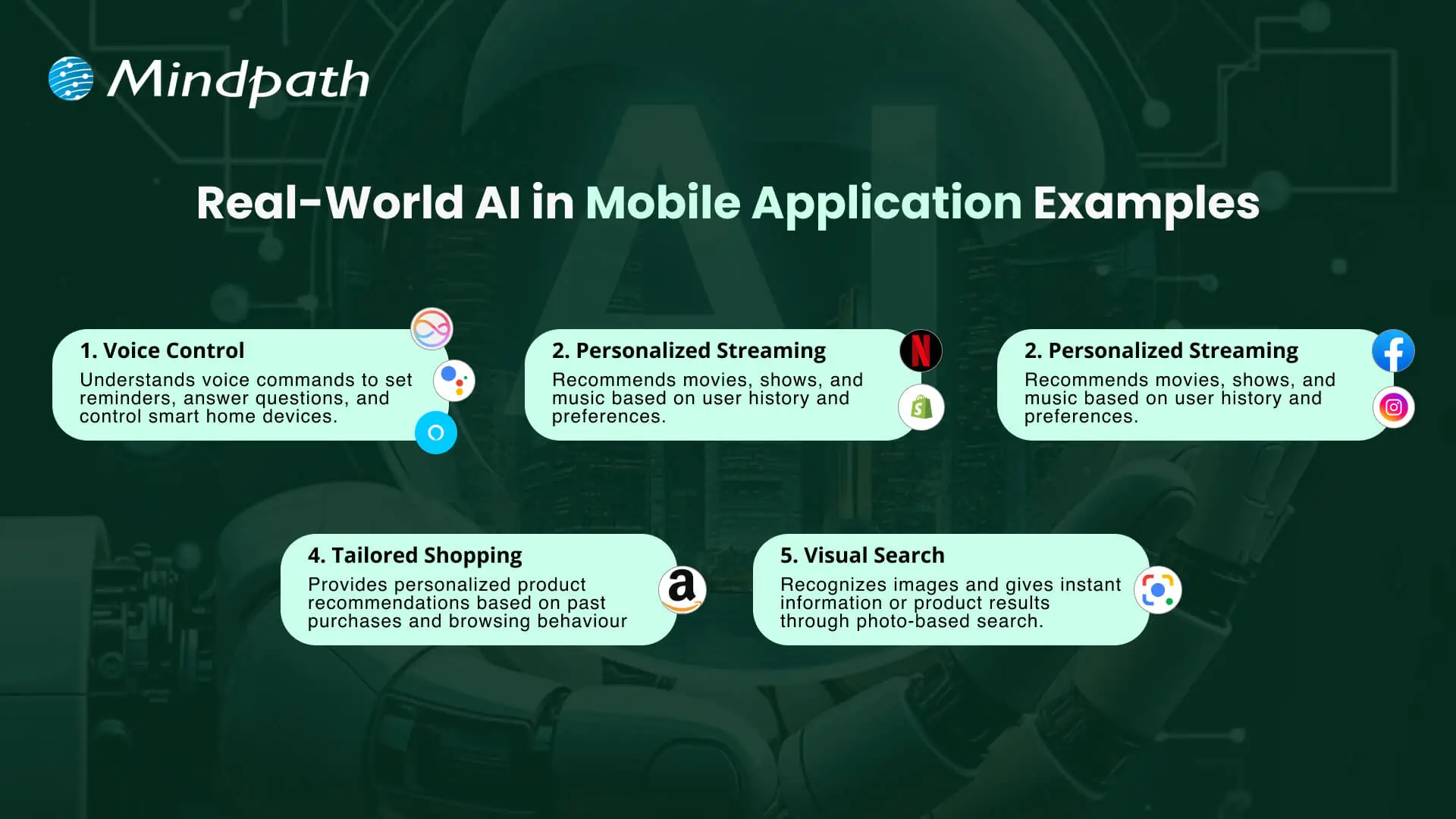
1. Voice Control with Siri, Google Assistant, and Alexa
These virtual assistants use artificial intelligence in mobile applications to understand voice commands and perform tasks like setting reminders or controlling smart home devices.
2. Personalized Streaming on Netflix and Spotify
Streaming apps use AI in mobile apps to analyze user behavior and recommend movies, shows, or music that match individual preferences.
3. Smart Social Feeds on Facebook and Instagram
Social media platforms use AI mobile app development to personalize news feeds and suggest relevant content, friends, and groups for each user.
4. Tailored Shopping on Amazon
Amazon uses AI in mobile apps to recommend products based on browsing history and past purchases, creating a personalized shopping experience.
5. Visual Search with Google Lens
Google Lens uses AI technology for mobile app development to recognize images and provide instant results through photo-based searches.
Want to build a mobile app but don’t know which technology to use for better execution? Learn from the mobile app development technologies blog to understand what suits best for your business.
Ready to Build Smarter Mobile Apps with AI?
The use of AI in mobile apps introduces new opportunities for businesses and users. This advancement creates great user experiences, strengthens security, and provides more effective daily interaction. As industries pursue innovation, apps will work smarter, adapt more quickly, and become infinitely personal, helping brands engage with users, in meaningful and authentic ways.
Working with Mindpath gives organizations access to superior AI mobile application development services built for measurement. We build intelligent, fast, and user-friendly applications to support your organizational priorities. We provide a blend of strategy, innovation, and technology to design digital solutions that drive growth and maintain user engagement.
Mobile app development technologies are important in the fast-paced environment of technology because they define how companies engage with users and keep them engaged. Each swipe, tap, and click is based on technology that is getting faster, smarter, and more interactive. If you’ve ever noticed, some apps feel effortlessly smooth, and others do not. The difference is usually related to the frameworks and platforms chosen for the business objectives and user expectations, and understanding these technologies provides a big advantage over others.
Delving into the newest trends in mobile application development often presents a plethora of choices that can seem confusing. However, choosing the appropriate technology can improve app performance, security, and the overall user experience. Developers routinely test technologies, frameworks, languages, and software solutions to create apps that can more easily rise above the fray. In this blog, we will explore the latest trends and the specific technologies that power the successful mobile app today.
Want to use top mobile app development technologies into a functional app? Mindpath offers mobile app development services, which will turn your imagination into a fully working, high-quality app.
What are Mobile App Development Technologies?
Mobile app development technologies are the programming languages, frameworks, and tools used to design, build, and deploy software applications for smartphones and tablets. These technologies enable developers to create compatible applications that run across platforms such as Android and iOS, while determining core factors like performance, development speed, and overall project budget.
The landscape of mobile development technologies broadly falls into two primary categories: native (platform-specific) tools and cross-platform frameworks, along with supporting backend services. The combination of these tools enables the development of applications that provide rich user experiences, work with cloud services, and utilize the native features provided by the device. Choosing the appropriate technology allows developers to build all of these easily, efficiently, and in a scalable way.
Also Read: AI in Mobile Apps
Top Mobile App Development Technologies in 2026
In order to remain competitive as an app developer, it is important to stay informed about the best technology for mobile app development in 2026. The choice of development tools can positively affect the performance, usability, and scalability of modern applications.
1. Flutter 3.22
Flutter 3.22 is a highly favored mobile app development platform to help developers develop applications for mobile devices, the web, desktop, and embedded devices. It provides high-performance and smooth animations that allow applications to run quickly and feel responsive. Developers also appreciate its professionally designed UI components, making it easy for developers to create stunning and consistent user interfaces.
2. Kotlin Multiplatform Mobile (KMM)
Kotlin Multiplatform Mobile (KMM) is a mobile app development framework that allows developers to share code for Android and iOS apps. It utilizes the modern, efficient programming language Kotlin to simplify the process of creating a mobile app for two platforms at once. This translates into a significant time saving, might help to reduce errors, and assure consistent behavior across your Android and iOS devices.
3. C++
C++ is among the most robust mobile app development technologies currently available for building high-performance applications. It enables developers to take direct control of system resources, which is often favored for complex applications or graphics-intensive applications. Also, by using C++, you can rest assured your apps are running as efficiently as possible, even as they traverse between different platforms.
4. Swift
Swift, a mobile application technology developed by Apple, is for building native iOS applications. It is fast, safe, and reliable, while also allowing seamless integration into AI and machine learning. With Swift, developers can build iPhone and iPad apps that are fast, safe, and modern.
5. AR/VR Integration Tools
AR/VR integration tools are tools for mobile app development that help developers add augmented reality and virtual reality features to an app. Integrating augmented and virtual reality features into apps is a valuable way to engage users while making an experience much more entertaining or immersive. These integrations are extremely popular in gaming and even found in some education and retail apps to enhance user experiences.
Ready to build smart mobile apps, but still wondering how AI can transform your development approach? Discover our blog on the benefits of AI in mobile app development to understand how AI can reshape modern app development.
6. AI-Assisted Development Tools
AI-Assisted Development Tools refer to tools such as GitHub Copilot and Amazon CodeWhisperer that support the automation of coding tasks. They streamline developers’ efforts in application development through code suggestions, error detection, and execution of tests. The upshot is that developers can create apps faster and also more efficiently.
7. React Native
React Native is another top mobile app development technology that enables developers to create apps for both iOS and Android using JavaScript. It provides a native look and feels with one complete codebase, reducing development time and duplication of effort. Companies are drawn to React Native because of its quick development period and strong support from the community.
8. Ionic
Ionic is a hybrid app framework and is a popular option among mobile app development technologies, allowing developers to write cross-platform apps using HTML, CSS, and JavaScript. It allows developers to write one codebase to operate on multiple devices. Ionic is very much favored by developers to create efficient and visually striking apps.
9. NativeScript
NativeScript is a flexible framework that matches the up-to-date trends in mobile application development with the ability to create fully native apps using JavaScript, TypeScript, Angular, or Vue.js. With NativeScript, you have full access to the native APIs offered by the OS, meaning that your application will work and perform like a truly native solution. NativeScript enables developers to build highly efficient and rich-featured mobile applications.
10. Xamarin (.NET MAUI)
Xamarin (.NET MAUI) is a framework aligned with mobile app development trends through the creation of native apps for Android, iOS, Windows, and macOS. While using C# and the .NET ecosystem, developers can share code and have a consistent experience across all platforms. Overall, this reduces development time, and provides high-quality apps.
Want to understand where custom mobile applications are creating real competitive advantages across the market? Discover our blog on the Custom Mobile Application Development Services to uncover high-impact opportunities and emerging trends.
Ready to Build the Next Successful Mobile App?
Mobile app development technologies continue to evolve, offering smarter tools and faster frameworks to help developers create better apps. Choosing the appropriate technology guarantees improved performance, security, and scalability. With the growth of innovation, staying up to date with current tools is critical for a company to provide seamless and engaging mobile experiences.
At Mindpath, we provide expert mobile app development services intended to turn your ideas into strong digital solutions. Our experienced developers create secure, high-performing, and easy-to-use applications by applying modern tools and proven approaches. Partner with us to build an app that empowers your brand and creates long-lasting value for your users.
Frequently Asked Questions
In an increasingly competitive digital landscape, businesses cannot settle for mediocre or average online presences. This is where the need for web design and development services matters. A well-designed, well-conceived website not only invites new visitors and clients; it also establishes the credibility required to enhance brand and organizational value and to create real engagement. Each click and scroll is a reflection of how users view your business, so design and functionality are equally significant to ensure continuity.
As online behavior evolves, organizations must remain in alignment with user expectations and technology trends. Choosing an experienced web design company will allow your organization to create websites that are aesthetically pleasing, quick, and easy to use. Every aspect of the website, from visual to responsiveness, influences customer experience and brand trust. In this blog, let’s discuss and reveal the top benefits of choosing a professional web design and development service for your organization.
If you are looking to take full advantage of modern web designs, it’s important to work with professionals who understand both aesthetics and functionality. Mindpath offers web development services that will provide your brand with a distinctive digital presence.
What is Website Design and Development?
Website design and development is the end-to-end process of building, programming, and maintaining websites and web applications. Web design covers the visual aesthetics, layout, color, graphics, and user experience (UX), ensuring every page feels intuitive and engaging across all devices. Web development is the technical side of things, where coding and programming bring those designs to life. Developers handle everything from site structure and loading speed to interactive features.
Developers can create and maintain the structure and function of the site. The developers can help to keep everything running smoothly, from loading speed to interactive aspects. Together, website design and website development services create a strong online presence that enhances business and user satisfaction.
Also Read: Web Design Company
Key Fundamentals of Web Design and Development Services
It’s important for businesses to understand the principles of web development and website design in order to develop digital experiences that resonate with users. Companies that are leading in web design and development tend to focus on the fusion of technology and creative thinking to develop beautiful, fast, and intuitive experiences for their users.
1. Interactive User Experience
Interactivity elements such as micro-interactions, gamification, and social sharing can make engagement increase, and users continue to discover your site. These characteristics bring user experience to the level of fun and unforgettable, which is a clear indication of the use of custom website design services for proper implementation.
2. Intuitive Layout and Navigation
An effective layout that is properly organized directs the users in an effortless manner to the different pages of your site, thus enabling them to locate the needed data in a short time span. Besides, the use of grids, wireframes, and adaptable menus guarantees the good and easy accessibility of your website, which is the main factor in the provision of successful custom website development services.
3. Engaging Content Design
Your brand story, which is interesting and informative, should be the main focus of the content. Incorporating visitor-specific settings, easy navigability, and the ability to interact with the site through the intuitive CTA of each page not only ensures customer engagement but also contributes to the achievement of professional web development services.
4. Visual Appeal and Consistency
The use of high-quality images, readable typography, and a clear visual hierarchy are what will make your website visually attractive and easy to navigate. Besides that, the consistent design systems and 3D elements not only evoke your brand on each page but also go with your professional web development services.
5. Seamless Functionality
Users expect a website to be fast, compatible with all devices, and meet their accessibility requirements. Embracing fast loading times, mobile-friendly websites, and standards-compliant accessibility are three ways to make easy navigation the major user experience, and here is where professional custom web design development services offerings become crucial.
Curious how artificial intelligence can transform the way websites are built and managed? Explore our article on AI in web development to discover how AI-driven tools and techniques can enhance your site’s efficiency, usability, and performance.
Benefits of Professional Web Design and Development Services
A seasoned web design and development company specializes in helping organizations design a website that will leave an indelible impression on visitors. Thoughtful design meets optimal performance, with your site looking good and performing even better on behalf of your business goals.
1. Personalized User Experience
Customized websites allow users to have useful and significant interactions. The memorable experiences that users return to are created by the adaptive interfaces, custom content delivery, and easy navigation.
2. Scalable Digital Solutions
Custom web design and development services enable you to grow your business and have a website that supports this growth. The use of flexible architectures and adaptable features is one way to make sure that your investment continues to deliver value as your business evolves.
3. Optimized Performance
Fast and efficient websites are the ones which not only keep users interested but also make them take the desired action. These web design and development services guarantee that every user will have smooth working, quick loading, and effortless navigation.
Must Read: Web Development Trends
4. Enhanced Security
Professional and creative web design and development services are equipped with security features that are tailored to the specific needs of your business. Through encryption, surveillance, and anticipatory security, there is no threat to your site and user data.
5. Seamless Integration
Custom solutions can enable your site to operate smoothly with other internal programs as well as with any external applications. Linking your enterprise with CRMs, APIs, payment gateways, etc., not only makes your activities more efficient but also saves your valuable time.
6. Improved Revenue Potential
Expertly designed and developed websites will positively influence the user experience and, as a result, business expansion. The easy-to-navigate designs, well-defined Calls-to-Action, and quick interactions lead to increased conversions and customer loyalty.
7. Unique Brand Identity
Implementing custom solutions will enable your company to stand out with a one-of-a-kind web presence that is not shared with anyone else. Every element, from visuals to interactions, can be tailored to reflect the personality and the values of your brand.
Looking to build an end-to-end website without managing multiple specialists? Explore our blog on full‑stack development for web projects to see how a full‑stack approach streamlines your development process and boosts efficiency.
Looking to Boost Your Business with Custom Web Development Services?
Web design and development services of high-end quality will not only make your website look good but will also ensure that it is fast, secure, and easy to use. The use of tailored solutions for a website will increase interaction, promote your brand, and become the source for your business’s expansion. A properly designed website enables customer interaction, makes the transaction simple, and efficiently contributes to your business objectives.
Mindpath is where you can get website development services tailored to your business needs. We create stylish, functional, high-performance websites that can be scaled up or down as per the client’s needs. We aim to produce customer-centric digital experiences that not only draw, interact with and maintain users but also improve your virtual presence by blending art and technology.
Frequently Asked Questions
The transition from purely text-based web experiences to interactive websites has been possible due to WordPress. It is the most powerful content management system that has made it easier for anyone to create and manage websites. Therefore, businesses want to convert HTML to WordPress websites and capitalize on its benefits. Does that mean an end to the dominance of HTML in website development?
HTML is still here, with HTML5 offering a promising tool to build high-quality websites without a content management system. However, the rising adoption of WordPress indicates that more people are switching to the CMS platform for its diverse advantages. You have arrived at the right place if you want to switch your HTML website to WordPress.
Want to convert your HTML site to WordPress but don’t know where to start? Hire expert WordPress developers from Mindpath who assist every step of the way to ensure a smooth HTML to WordPress conversion.
Is it Right to Convert Your Website to WordPress?
The thought of converting your HTML website into WordPress might have given you sleepless nights. You can overcome all doubts regarding the utility of WordPress for your website by learning about its benefits. With a HTML to WordPress converter service, you can transition to a dynamic web presence. WordPress offers more flexibility for modifying the content and design of your website without coding skills. You have the final say in deciding the appearance and functionalities of your website with complete control over design and features.
The biggest strength of WordPress is dynamic content management which removes the burden of writing markups for each page. On top of it, you will find an extensive library of themes and plugins that allow you to change designs and introduce new features in your website. Another prominent reason to embrace WordPress over HTML is the support for search engine optimization with different SEO plugins. As a result, you can not only create and manage websites with WordPress but also ensure that they rank well on search engines.
Still wondering why businesses prefer converting static HTML websites into WordPress?
Explore the key benefits of converting HTML to WordPress and discover how it improves scalability, performance, and content management.
How Can You Switch to WordPress from HTML?
Once you have decided to convert your HTML website to WordPress, you have three options. The primary objective in each process revolves around changing your HTML design to WordPress theme, which will give it the look and experience of a WordPress website. You can choose any process depending on the time you have, personal preferences, coding skills and amount of money you want to invest.
1. Manually convert HTML websites to WordPress themes.
2. Use the WordPress Child Theme to convert HTML to WordPress.
3. Import content to WordPress from HTML sites with plugins.
Before finding the best HTML website to WordPress converter tool, you must keep some prerequisites in mind. The foremost things you need to take into account are the time and budget you have for the conversion process. If you want quick results, then hiring professional developers will help albeit with a burden on your budget.
The other important requirements for the transition from HTML to WordPress include a code editor and hosting service. You must choose a suitable code editor that can help in modifying HTML code of your website according to WordPress guidelines. Similarly, you should pick a hosting service that fits your requirements and delivers credible services.
Converting Your HTML Website to WordPress Manually
You are a traditionalist if you want to create a WordPress site for your HTML website from scratch. The traditional approach to converting HTML to WordPress may seem intimidating to many people. However, it is not that difficult once you know each step of the process, and you can get things done without advanced technical knowledge.
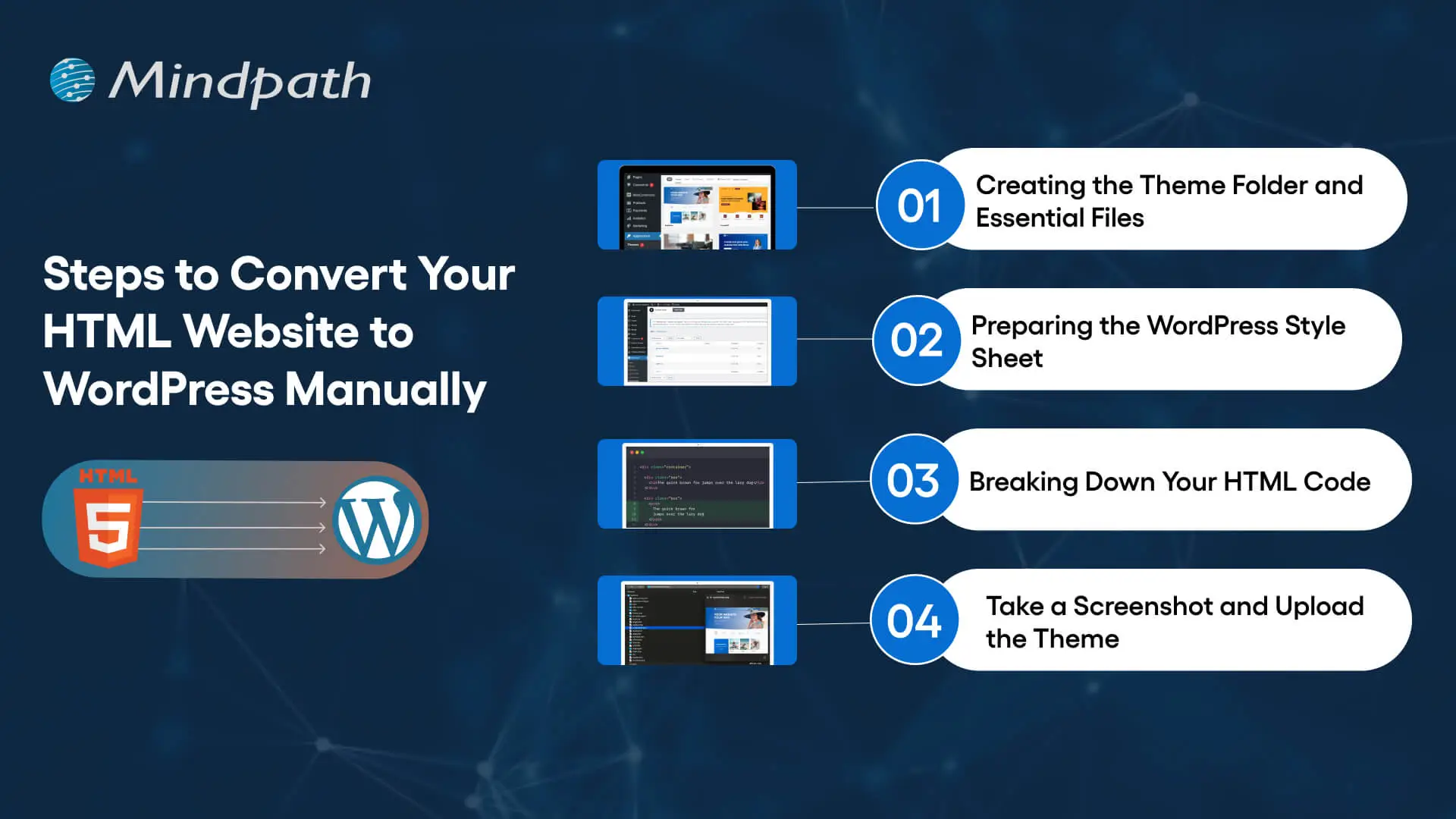
Step 1: Creating the Theme Folder and Essential Files
You can begin the conversion process by creating a new theme folder on your desktop. You can follow the same process as you would for creating another directory on your system. Once you have created the theme folder, you can give it a specific name as per your requirements.
After creating the theme folder, you must open the code editor and create different text files. You can name them as ‘style.css’, ‘index.php’, ‘sidebar.php’, ‘footer.php’, and ‘header.php’.
The number of files you have to create in this step will depend on the features and design you want in the WordPress theme. You don’t have to do anything else with the files in the code editor now and keep the code editor open as we will need the files in the next step.
Step 2: Preparing the WordPress Style Sheet
You can start the actual preparations for converting your HTML website to WordPress with the WordPress style sheet. Do you remember the ‘style.css’ file you left open in the code editor in the first step? Open it and paste the important details in the style sheet header enclosed within “/*” and “*/”.
Any guide on HTML to WordPress converter online will focus on the details provided in the style sheet header. The important information included in the style sheet header includes the theme name, theme URI, author name, author URI, description and version. In addition, the style sheet header must also specify license details and tags, which are crucial requirements to add your theme to the WordPress theme directory.
After providing the essential details in the header, you have to copy and paste the CSS of your HTML website. Make sure that you save the ‘style.css’ file in the theme folder you have created and then close it.
Is a basic WordPress setup enough to support your growing business needs?
Read more about custom WordPress development and discover how tailored solutions can enhance functionality and user experience.
Step 3: Breaking Down Your HTML Code
One of the most important things you must know about WordPress is that it leverages PHP to extract information from its database. Therefore, you have to break down the existing HTML of your website into different pieces. It will help WordPress put them together in the right way.
This part of the process of converting HTML to WordPress may seem challenging to beginners. However, it is extremely simple as you have to copy different parts of the HTML document and paste them into different PHP files. Do you remember the PHP files created in the code editor in the first step? They will play a crucial role in this step of the HTML to WordPress conversion process.
You have to open the main file of your HTML website, or ‘index.html’, and copy its content into different PHP files. After copying, you must save the ‘index.php’ file and close it to add the theme to your WordPress website.
Step 4: Take a Screenshot and Upload the Theme
The theme screenshot is a valuable resource that offers a preview of the backend of your WordPress website. It is also important to note that the theme screenshot will also include information from the style sheet header. You cannot convert HTML site to WordPress without knowing how your website works in the WordPress backend.
Contrary to your assumptions, you don’t have to follow a complex process to take the theme screenshot. You can open the existing HTML site in a browser and take a screenshot with any method you want. After taking the screenshot, you can use an image editing software to crop the screenshot image to 880×660 pixels. Once you save the screenshot as a ‘screenshot.png’ file in the theme folder, you can upload the theme.
The process to upload your WordPress theme starts with the WordPress Admin Dashboard. You should access the “Appearances” section, where you will find the “Themes” option. Now, you must click on “Add New” and then choose the “Upload Themes” option. Find the theme folder and click on “Install Now,” followed by activating the theme.
Are you unsure if your website development project is on the right track? Discover our WordPress developer checklist to ensure every critical step is covered for a smooth and successful website launch.
How Will Your WordPress Theme Become More Responsive?
Switching your HTML website to a WordPress theme alone is not enough to get the best results. Anyone who knows how to download WordPress can follow the manual process and get their website on the CMS platform. However, you must also ensure that your website will look good and function seamlessly across all devices. The solution to such problems lies in creating a responsive design, and you can make it happen with a few crucial steps.
First of all, you should choose a responsive framework like CSS or Bootstrap. These frameworks not only save your time but also ensure an effective design that aligns with tested principles. You should also use flexible images to ensure that they don’t pop out of the boxes on mobile devices. In addition, CSS media queries can help you detect small screen sizes, and you should use a mobile menu that offers clean navigation on mobile screens.
Past the content here
Want to make sure your WordPress website runs seamlessly with the latest technology? Discover how WordPress PHP compatibility can protect your site and enhance its performance.
Final Thoughts
You have decided to convert an HTML website to WordPress to capitalize on the benefits of the most popular CMS platform. With big brands choosing WordPress for their websites, it is reasonable to pick the platform for revamping your website. The manual process of converting HTML-based websites to the WordPress theme is extremely simple and easy to follow. At the same time, you must also ensure that your new WordPress website features a responsive design and works effectively on all devices.
Mindpath has been a pioneer in helping businesses transition to WordPress from outdated formats. We are the trusted specialists in WordPress development with a successful record in empowering websites for the modern business landscape. Our expert WordPress developers conduct comprehensive site analysis and develop custom themes that align with your design needs. With Mindpath at your service, you don’t have to worry about content integration or CMS integration. Consult with our experts and switch to WordPress right now.

Companies are now seeking scalable and robust applications, which can meet both years of functional performance and user expectations. That’s when full-stack Node.js development comes into play, uniting the power of frontend and backend within a single environment. It allows developers to build faster and smarter while creating applications to remain adaptable as the business continues to grow.
In this way, constructing end-to-end solutions is more fluid and intelligent. With cohesive databases, APIs, and user interfaces integrating and interfacing, developers can automate some of the hassle proactively. Understanding full-stack Node.js ultimately gives developers an advantage to think forward as technology grows and gives organizations tangible opportunities to grow with applications that perform and scale easily. So, let’s dive in to know how this expertise truly makes a difference.
Want to build an advanced application without compromising performance? At Mindpath, our full-stack development services will help you provide the best solutions, handling both front-end and back-end with efficiency.
Understanding the Fundamentals of Full-Stack Development
Full-stack development means developing on the front end and back end of a web application. The front end refers to all the things that the user responds to and interacts with, such as buttons, layouts, designs, etc. The back end refers to all of the things that run in the background, like databases, servers, etc., and all the logic that makes it run smoothly, working together.
A full-stack developer has the capability to deal with both sides. They are capable of building UX and the technology that serves the app. This gives them agile skills that allow them to build comprehensive applications entirely from front to back.
Understanding the Basics of Node.js
Node.js is a platform that allows you to run JavaScript code in a JavaScript runtime outside of the browser. It is built on Google’s V8 engine, which is extremely fast and built to be efficient. Node.js allows developers to write server-side applications using the same exact language as for the front end, making development and management easier and smoother.
An advantage of Node.js is that it operates asynchronously, which allows tasks to not have to wait for one another to complete, meaning that applications can handle multiple requests at once. Because of this, the use of full-stack Node.js is quickly becoming a good choice when building scalable, real-time, and modern applications.
The success of using Node.js in full-stack development depends on hiring the best developer. Discover the key Factors to Consider while Hiring Node.js Developers.
Why is Node.js Important for Full-Stack Development?
Utilizing Node.js full-stack technology is an impressive approach to developing a complete web application. Here are reasons that Node.js is a valuable technology option in the full-stack.
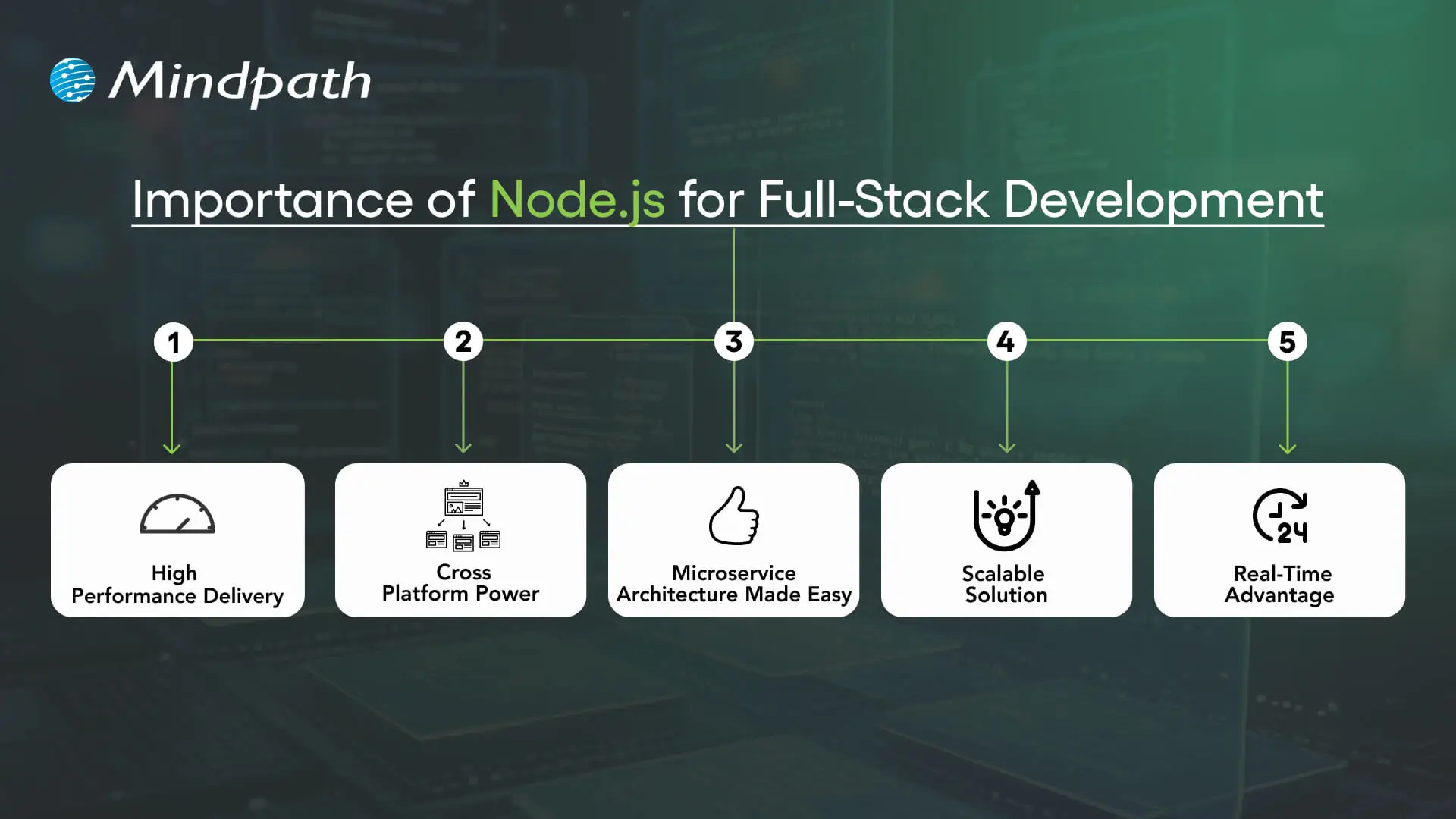
1. High Performance Delivery
Node.js utilizes a non-blocking I/O hardware model that can handle hundreds or even thousands of requests simultaneously, providing faster response times and greater user-specific.
2. Cross-Platform Power
With the Node.js full stack, developers can write mobile and desktop apps to run on Windows, macOS, Linux, and more. By relying on a single JavaScript code base, developers can save time and effort writing for multiple platforms.
3. Microservice Architecture Made Easy
Full-stack Node allows users to break one larger application down to multiple smaller independent services using infrastructure that is easier to work with. This approach lets developers build faster, stay flexible, and rely on proven solutions.
4. Scalable Solution
Full-stack Node.js is used by major players like Walmart, Uber, and Trello to handle millions of users. It helps to lower load time significantly, and it ensures your applications will scale seamlessly, as your demands increase.
5. Real-Time Advantage
When it comes to applications that leverage chat, live streaming, food delivery, or payments, Node.js full-stack is the way to go. It seamlessly provides real-time updates to keep the user engaged and connected.
Key Steps to Use Node.js in Full-Stack Development
A full-stack Node.js developer is involved in both the front end and the back end of web application development and will work to build complete web applications. Below is a synopsis of the primary steps to utilize Node.js in full-stack development that is easy and productive.
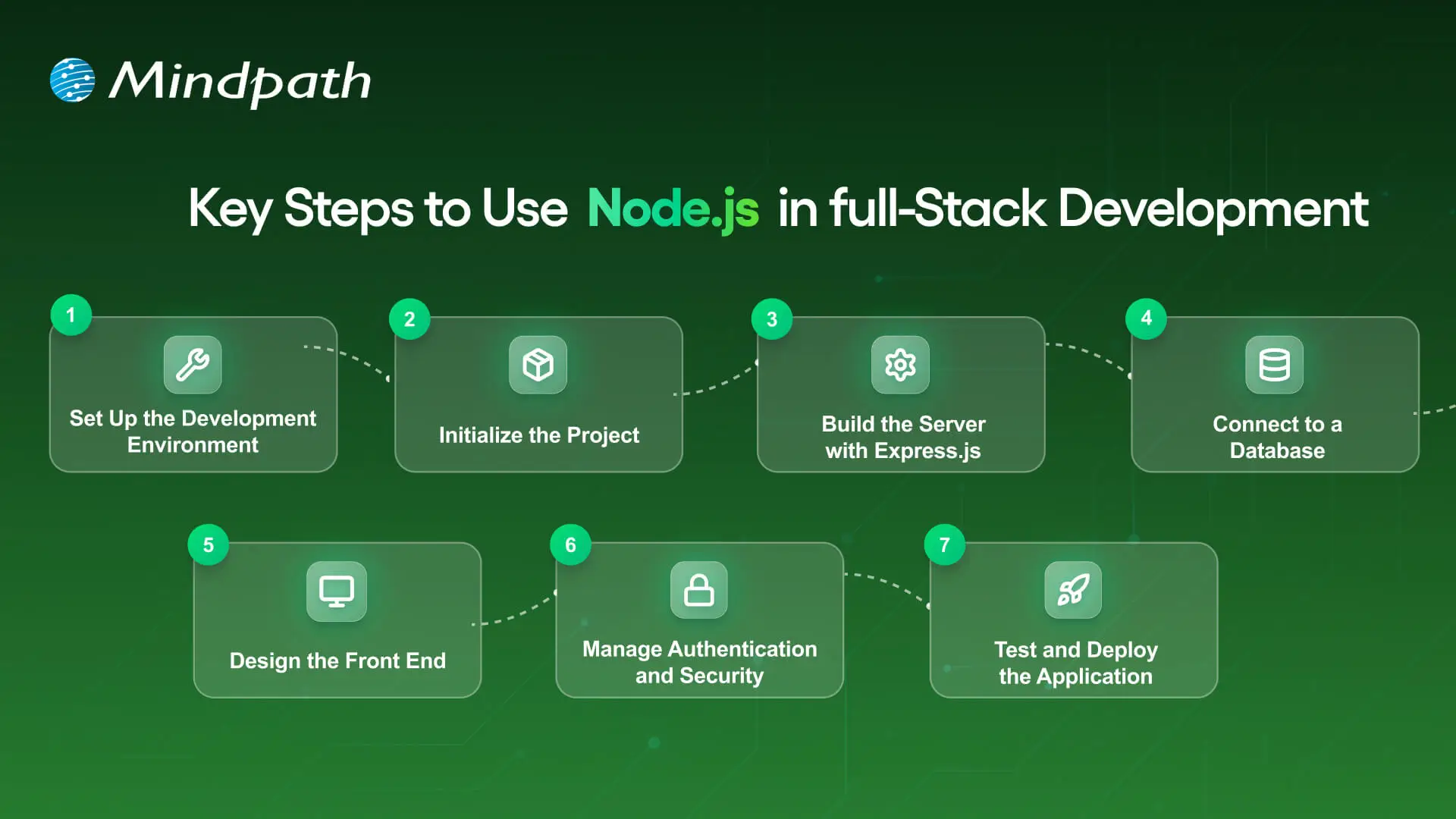
1. Set Up the Development Environment
To begin your application-building experience, you will need to install Node.js and npm (Node Package Manager). These tools will allow you to execute JavaScript beyond the browser, and they will also help manage libraries with ease. Verify the setup by checking versions with simple commands in your terminal.
2. Initialize the Project
Make a new folder for your app, and use ‘npm init’ to create a ‘package.json’ file. A package.json file holds important information, such as your project name, dependencies, and scripts. It will serve as the basis for managing everything in your project.
3. Build the Server with Express.js
Install Express.js so you’ll be able to set up the backend server and handle all of the different routes. Express.js makes handling requests, responses and APIs supposedly easy. This step will ensure the backend runs appropriately with the frontend.
4. Connect to a Database
Based on your needs for this project, select a database like MongoDB or PostgreSQL. This should be paired with a Node.js library like Mongoose or Sequelize, which will allow you to connect to and perform both read and write operations on your data. At this point, you will have the ability for your application to persist and retrieve your data.
5. Design the Front-End
Build the front-end using a library such as React, Angular, or Vue. You can link the front-end through RESTful APIs or GraphQL to your Node.js back end. At this point, players will finish the bridge for a Full-stack Node.js application.
6. Manage Authentication and Security
Use libraries like Passport.js or JWT to add secure login and registration. Secure necessary paths so that any authorized user can get to those routes. You should always consider security in any Full-stack Node.js application.
7. Test and Deploy the Application
Create unit and integration tests to ensure that your application does what you intended. Deploy the application to cloud hosting solutions like Google Cloud, AWS, or Heroku. To utilize your Full-stack Node.js application’s performance tool on different scales, you should monitor its performance!
Looking to integrate AI in your Node.js projects? Explore our Ultimate Guide to Node.js Libraries for AI Integration to discover the most effective libraries for building smart, scalable, and future-ready applications.
Ready to Unlock the Power of Full-Stack Node.js?
Full-stack Node.js has proved to be a smart choice for building scalable, high-performing, and real-time applications. It unites front-end and back-end seamlessly, helping developers create complete solutions with speed and flexibility. With its ability to handle microservices, cross-platform apps, and real-time updates, it has become an essential technology for modern web development.
At Mindpath, we provide expert full-stack development services designed to match your business goals. Our skilled Node.js developers bring deep technical knowledge and practical experience to build secure, scalable, and user-friendly applications. If you are looking to transform your digital ideas into reality, hiring a Node.js expert from our team ensures growth and lasting impact.
Artificial intelligence is rapidly transforming from a buzzword to a necessity for businesses in all industries. You must have noticed the impact of AI in mobile app development with examples of voice assistants like Google Assistant and Siri. Why is artificial intelligence useful for mobile app development? Mobile app developers can use AI to capitalize on a broad range of capabilities, including smart automation and better efficiency.
AI is no longer just about science fiction as businesses leverage it for different operations. The adoption of AI for developing mobile apps creates a new perspective on how companies pursue growth. Artificial intelligence not only simplifies the work of developers but also ensures seamless experiences for users. An overview of the benefits of AI in developing mobile apps can help you understand its significance.
Using AI in mobile applications can be beneficial, but many businesses struggle to implement it. Mindpath’s mobile app development services will deliver full-proof planning and execution, ensuring innovation and efficiency in every project.
Understanding the Fundamentals of AI in Mobile App Development
AI in mobile app development refers to integrating artificial intelligence into the process of building mobile applications and embedding smart features within them. By combining machine learning (ML), natural language processing (NLP), and computer vision, developers can create intuitive, self-improving apps, while also streamlining the development process itself.
AI-powered mobile apps analyze user data in real time to make intelligent, context-aware decisions — delivering personalized experiences without manual input. This allows apps to adapt dynamically to what each user actually needs. The best thing is that mobile apps can achieve all this without human intervention. The utility of different technologies in mobile apps can help you understand how AI revolutionizes mobile app development.
How AI Technologies Power Smarter Mobile Apps?
AI mobile apps use machine learning algorithms to continuously learn from user behavior and refine their performance over time, automatically aligning with evolving user expectations.
Developers can capitalize on the benefits of AI in mobile apps to deliver a broad range of functionalities to users. For instance, natural language processing (NLP) enables in-app chatbots to interpret user queries contextually and respond in natural, human-like language. AI mobile applications deliver more than just automation as you can rely on artificial intelligence to create next-gen apps that can adapt to the future.
Also Read: Benefits of Mobile App Development
How Have Developers Used AI for Mobile Apps?
The distinct functionalities of AI technologies for mobile app development reveal crucial insights about growing popularity of AI-powered mobile apps. You can come across many new AI features in mobile applications used by millions worldwide. The functionalities of artificial intelligence in modern mobile apps can help you understand why AI-powered mobile apps are a necessity now.
1. Chatbots and Virtual Assistants
You must have seen or used chatbots on many mobile apps that make intelligent conversations with users. Chatbots and virtual assistants use AI for customer service without the involvement of humans. For instance, healthcare apps can rely on AI chatbots to provide accurate medical diagnosis on the basis of symptoms. Voice assistants like Siri and Alexa can interact with users and help them with different tasks, like searching information and setting reminders.
2. Personalization of User Experiences
Developers have discovered that AI can play a major role in personalizing user experiences according to each user’s preferences. The use of AI tools for mobile app development ensures that artificial intelligence can analyze user behavior, past interactions and preferences to find personalized content and recommendations. As a result, your mobile app can be more engaging for users by delivering the relevant services. Netflix is one of the biggest examples of using AI for personalizing user experiences as it recommends content on the basis of your watch history.
3. Facial Recognition
Computer vision is one of the formidable AI technologies that have gained recognition in mobile app development workflows. An overview of new mobile app development trends reveals how facial recognition has become a necessity in modern apps. Developers can use computer vision in their mobile apps to recognize faces and patterns. AI-powered mobile apps can leverage facial recognition to offer better security. The best example of using AI for facial recognition in mobile apps is Instagram, which offers AR filters with computer vision.
4. Power of AI Automation
Developers cannot think about using artificial intelligence for developing mobile apps without incorporating automation. As a matter of fact, automation is the biggest strength of AI that helps in streamlining repetitive tasks. With AI taking care of manually intensive tasks, mobile apps can offer better efficiency and productive user experiences. You can notice the best example of AI automation in mobile apps in Gmail, which automatically classifies emails into different categories.
Want to streamline your operations and build smarter workflows using the latest tools? Explore our blog on mobile app development tools for a better understanding.
Why Should Developers Trust AI for Mobile App Development?
Artificial intelligence contributes to diverse aspects of mobile app development and offers numerous benefits. Businesses can rely on AI mobile app development experts to capitalize on these advantages and create cutting-edge apps. An overview of the advantages of AI in developing mobile apps can help you understand why AI-powered mobile apps are gaining traction.
1. Seamless Automation in Mobile Apps
Automation is one of the biggest advantages you can get from using artificial intelligence to create mobile apps. Your mobile app works on many background tasks, including data entry and content moderation, while delivering what the users want. Artificial intelligence can do the heavy lifting for your mobile apps by automating these tasks, thereby achieving better efficiency. At the same time, users can also get faster access to the app’s functionalities and services.
2. Creating Custom Experiences for Each User
Custom user experiences are the next big thing in mobile app development as user behavior trends favor personalization. Every mobile app user needs services and content personalized according to their behavior and preferences. The utility of AI in application development primarily revolves around creating apps that can adapt to each user and their needs. Artificial intelligence can empower your mobile app to provide personalized content and product recommendations to users.
3. Smarter Decision Making
Mobile apps are not autonomous agents who can take decisions independently on behalf of customers. AI in decision-making can empower mobile apps with the capability to analyze patterns and detect trends or anomalies. The growing popularity of AI app ideas depends significantly on how artificial intelligence provides actionable insights. Mobile apps can use the insights to optimize strategies for customer engagement and pricing with the ability to make better decisions.
4. Breaking the Language Barriers
Artificial intelligence also contributes significantly to expanding the global reach of mobile apps. Language is one of the biggest obstacles for the expansion of mobile apps in international markets. However, a reliable AI app development company can help you overcome these barriers as AI technology offers real-time language translation features in mobile apps. Artificial intelligence in mobile apps will emerge as a prominent trend to make mobile apps usable across all countries.
5. Enhanced Accessibility and Inclusivity
AI breaks the language barrier and also makes your mobile apps more accessible to different users. Users with disabilities can capitalize on voice recognition features to access all the functionalities in a mobile app. For instance, visually challenged users can access different features on your mobile app with speech-to-text typing and voice-controlled navigation. Artificial intelligence ensures that literally everyone can become a user of your mobile apps.
6. Improvements in Operational Efficiency
Artificial intelligence also helps in enhancing the operational efficiency of your mobile apps. You can rely on AI for boosting app performance with efficient resource allocation, performance monitoring and predictive maintenance tasks. It plays a crucial role in reducing downtime, optimizing backend processes and ensuring smooth functionality of your app.
Most of the guides on how to develop an AI mobile app also emphasize how AI can optimize app performance. Artificial intelligence can help in optimizing battery consumption, reducing unnecessary background processes and managing memory usage. The enhanced operational efficiency translates directly into a more responsive and faster user experience.
Want to build high-performance digital products and stay updated on the latest mobile app development technologies shaping modern businesses? Check out our guide on mobile app development technologies to explore the best tools and frameworks for creating scalable, future-ready applications.
What are the Challenges of Adopting AI for Mobile App Development?
The benefits of AI for developing mobile apps create a strong case for developers to embrace artificial intelligence. However, developing efficient and powerful mobile apps with AI brings some formidable challenges. First of all, the development costs will be higher as developers will need expensive AI tools. Developers will also have to think about issues with data quality and privacy. On top of it, mobile processing power is limited and using AI can lead to problems with performance and battery life.
Unlock the Full Potential of AI in Mobile Apps
The uses of AI in mobile app development will introduce a new perspective on mobile app user experiences. Artificial intelligence not only contributes to automation but also enhances scalability and performance of mobile apps in different scenarios. You can notice how AI makes mobile apps more accessible to users by removing language barriers and introducing facial recognition and speech-to-text typing features.
Mindpath is your trusted destination for mobile app development services with the AI advantage. We have been creating mobile apps for clients from different industry verticals with the assurance of efficiency and enhanced productivity. You can rely on our experts to develop mobile apps that reflect your brand identity and achieve excellence on all benchmarks. Consult with our experts and find the best services for AI-powered mobile app development now.
Frequently Asked Questions
In the digital world of the 21st century, DevSecOps has undoubtedly become the backbone of secure software delivery. It has perfectly blended DevOps and security practices in order to protect applications from cyber threats without hampering innovation. With the surge in cloud DevSecOps organizations across diverse sectors are embedding automated testing and compliance, along with continuous monitoring, directly into CI/CD pipelines.
It is the right time for you to know how DevSecOps works and why it matters for DevOps cybersecurity. DevSecOps is now essential for resilience, whether you are developing cloud-native apps or securing your software supply chain. It is time to look at how businesses can implement DevSecOps in the real world.
Curious about how DevSecOps implementation helps businesses in achieving secure and scalable pipelines? Contact us and let our experts provide you with full guidance.
An Insight into DevSecOps
In recent times, DevSecOps has certainly surfaced as an innovative approach for Development, Security, and Operations. It combines security into every single phase of the software development lifecycle to create software efficiently while curbing vulnerabilities.
DevSecOps solutions make sure that security is shared across the development and security teams, in addition to the operations team. It is achieved through the automation of security processes and practices within CI/CD pipelines. This approach has gained massive popularity in the past few years since it fosters collaboration while empowering business entities to deliver secure and high-quality software solutions.
Also Read: Benefits of DevOps
Key Benefits of DevSecOps
The DevSecOps concept gives rise to a host of benefits for users, including professionals as well as businesses. Now that you know what is DevSecOps, it is time to get familiar with its key benefits.
1. Faster Delivery of Software
DevSecOps creates the opportunity for you to integrate security into the development pipeline. Thus, it allows businesses to rapidly deliver highly secure code. It is capable of addressing issues early on and while streamlining the release process.
2. Better Agility
Automation serves as a catalyst and reduces bottlenecks relating to manual security. It allows security teams to lay emphasis on high-value tasks. Moreover, they feel empowered to respond in a prompt manner to threats and risks.
3. Diminished Time to Market
The concept of cybersecurity DevOps is capable of catching as well as fixing vulnerabilities at an early stage. It therefore minimizes the requirement for expensive as well as time-consuming remedial actions at a later stage. It is good news for software developers since it accelerates software project timelines.
4. Top-Notch Security
You need to leverage DevSecOps so that you can strengthen the security posture when it comes to custom software development. Security gaps can be reduced exponentially as DevSecOps embeds security into each stage of the DevOps lifecycle.
6. Better Compliance with Laws and Regulations
You need to use DevSecOps tools since they ensure compliance at all stages of software development. With security checks that are automated and compliance tools, modern businesses can rest assured about their compliance requirements.
Curious about the latest shifts reshaping how software and websites are built and deployed? Check out our blog on DevOps trends to stay ahead of the curve and make sure your projects leverage modern best practices.
Steps to Implement DevSecOps
The implementation of DevSecOps means weaving security into each and every phase of the DevOps pipeline without compromising the delivery. At present, organizations face rising cyber risks along with stricter compliance standards, which makes a structured approach essential. You need to follow the steps below in order to effectively implement DevSecOps while developing a software solution.
Step 1 – Evaluate your Current Security Practices
While implementing DevSecOps, the very first step that you need to take involves the assessment of your current security practices. You need to do a careful and comprehensive evaluation of the security tools and processes that are in place. You also need to identify gaps along with appropriate areas of improvement while taking into account the organizational goals and context.
Step 2 – Establishment of Security Goals and Objectives
Now it is time to establish security objectives. You must keep in mind to define clear and well-defined security goals and objectives that are perfectly aligned with the vision of your organization. At this stage, you can even consider involving stakeholders from the development, security, and operations teams. It is vital to prioritize shared understanding along with unified commitment.
Step 3 – Implementation of Security Training and Awareness Programs
You need to conduct training programs at this stage of the implementation process. These training programs can play a strategic role and help the staff members to cultivate essential skills and capabilities. It is also essential to promote security awareness while fostering an accountable security culture within the organization.
Step 4 – Integration of Security into the Software Development Lifecycle
At this stage, you need to combine security practices and controls at every phase of the software development lifecycle. You must focus on implementing tools along with automation that are capable of facilitating secure code reviews as well as vulnerability scanning. The tools must also support threat modelling.
Step 5 – Emphasizing Continuous Security and Automation
It is vital to prioritize automation when it comes to cybersecurity DevOps. So you need to automate security testing, such as dynamic analysis and static analysis. You must also consider automating software composition analysis so that you can get feedback on an ongoing basis. It is a wise decision to integrate security into the continuous integration and deployment pipelines, as it can help ensure security checks at every stage.
Must Read: DevOps vs DevSecOps
Step 6 – Implementation of Infrastructure as a Code Security
You must also apply the security principles to Infrastructure as a Code (IaC) scripts and templates. It is undoubtedly a critical step when it comes to DevSecOps implementation. Businesses must ensure that they leverage version control for the Infrastructure as a Code template for maintaining traceability. You can even consider applying policy as code frameworks in order to enforce security baselines for cloud resources.
Step 7 – Fostering Communication and Collaboration
You need to encourage cross-team collaboration along with transparent communication. You can ensure this through regular meetings and by using shared tools. It is essential to prioritize joint decision-making. It is equally important to set up and maintain a DevSecOps culture so that it can promote trust along with accountability within the organization.
Step 8 – Implementation of Continuous Monitoring and Incident Response
It is critical at this stage to adopt continuous monitoring of applications and infrastructure. This is because such a practice can help in detecting as well as responding to security incidents in a prompt manner. You must also establish an incident response plan that can facilitate effective and efficient mitigation in case of a security breach.
Step 9 – Focus on Regular Assessment
One cannot overemphasize the importance of regular assessment and improvement while implementing DevSecOps. You must conduct assessments to evaluate the effectiveness of the implemented DevSecOps practices periodically. It is equally essential to improve the security processes and adjust to emerging threats on an ongoing basis. Businesses must also make sure to incorporate the feedback from the key stakeholders.
Step 10 – Remaining Abreast with the Latest Security Practices
It is imperative for modern businesses to stay updated with the latest security trends and industry standards. You need to bear in mind that your business needs to engage in continuous learning. So in your organization, you need to encourage security professionals to take an active part in training programs as well as online communities.
Facing hurdles in your deployment process? Read our guide on DevOps challenges and solutions to learn actionable strategies for smoother, more efficient workflows.
Best Practices While Implementing DevSecOps
There are a number of best practices that you need to keep in mind while implementing DevSecOps within your business. You need to adopt these practices so that you can derive optimum value from DevSecOps implementation.
1. Emphasis on Security
You need to shift security to the left. It means that the security component has to be integrated at an early stage in the software development lifecycle. Several practices, such as threat modelling and secure coding practices, need to take place during the development stage in order to reduce the risk before the production stage.
2. Automation
The role of automation is indispensable when it comes to DevSecOps implementation. You need to embed appropriate security controls into CI/CD pipelines and ensure static as well as dynamic code analysis.
3. Importance of Continuous Testing
Continuous testing is an essential component of DevSecOps as it allows teams to identify security gaps and vulnerabilities. You need to test code on a continuous basis so that the number of security issues can be reduced before that may reach the production stage.
Ready to modernize your tech operations and accelerate product delivery? Explore our blog on DevOps for Businesses to learn how DevOps helps businesses build, deploy, and scale with confidence.
Final Words
DevSecOps is no longer an optional thing for businesses when it comes to developing software solutions. It serves as the ultimate foundation for building secure and resilient software applications that are compliant in today’s world. Businesses need to integrate DevOps and security practices across the entire pipeline in order to reduce security risks and uncertainties. If DevSecOps implementation is done in the right manner, it can foster innovation and business resilience.
The top-notch DevOps services of Mindpath can ensure that your business can successfully adopt DevSecOps. With the help of expert guidance and support, your business can achieve innovation, which can give it an edge in its operational domain.
Frequently Asked Questions
You have a great business idea and you just discovered that WordPress can help you build high-quality websites from scratch. Would you go for the DIY approach or choose an expert for the job? Many would choose to hire WordPress developer with the skills required to take up your project. With a large pool of WordPress developers in the world, it is difficult to navigate the hiring process.
The right WordPress developer can change the course of your web project with their skills to utilize available resources in the most efficient way. You may be launching a new site or switching your existing site to WordPress and in every case, you will need skilled developers to do the job. This guide will help you understand the hiring process for bringing a skilled WordPress developer to your team.
Ready to transform your online presence with a website designed to grow your business? At Mindpath, we offer expert WordPress development services to customize high-performing websites that drive your growth.
Unraveling the Reasons to Hire a WordPress Developer
The first thought that might come to your mind when conceptualizing a web project is the availability of website builders. You can use the ‘drag-and-drop’ features of website builders to create a website from scratch with preset themes. Why should you hire dedicated WordPress developers when you can do it on your own? When your website grows, you will need more features, specific design elements or better performance. Therefore, you cannot ignore the importance of a WordPress developer in the modern digital landscape.
You can rely on a professional developer to tailor the design of your website in a way that reflects your brand identity. Developers can add new features without relying solely on plugins and scale up your website as your business grows. Experienced developers also ensure that your website design is optimize for mobile devices and search engines. With the intervention of custom WordPress development experts, you can create websites that work seamlessly on all types of devices and are more visible on search engines.
The next prominent advantage of WordPress experts for hire in any region is the assurance of security. Developers can take care of the security best practices, such as cleaning the code, using secure plugins and creating custom login URLs. In addition, you can rely on WordPress development professionals for ongoing maintenance and support services to keep your website running according to your expectations.
How Many Types of WordPress Developers are there?
Hiring professionals for WordPress development is quite difficult as you have to identify the right person for the role. Depending on the requirements of your project, you will have to hire the type of developer who will be the right fit for the project. While looking for expert WordPress developers, you must know that there are five distinct types of WordPress development experts.
The frontend developers work on user interface and design of websites with the help of JavaScript, HTML and CSS. Backend developers are responsible for creating the server-side logic, functionalities and managing database of the website with PHP and MySQL. If you need someone who can do both, then you should hire a full-stack developer.
The other notable types of WordPress development experts you will come across are WordPress theme developers and plugin developers. WordPress theme developers specialize in creating and customizing WordPress themes that you can use for your website. Similarly, WordPress plugin developers help in creating custom plugins that can help you add new features in a website.
What Does a WordPress Developer Do?
Anyone with general knowledge about WordPress would know that creating websites with WordPress doesn’t require coding. However, businesses want to hire WordPress programmers with design skills who can take care of their web projects. As a WordPress developer, you will have to fulfill various responsibilities that require programming skills. For instance, WordPress developer writes the code required to customize core WordPress files.
The WordPress developer is also responsible for testing and debugging the core WordPress software. In addition, developers have to update WordPress websites on a regular basis while working with different stakeholders. Another crucial responsibility of a WordPress developer revolves around creating WordPress themes and plugins according to client requirements.
Curious if your WordPress site is using the right PHP version for best performance and security? Our WordPress PHP Compatibility Guide will help you stay aligned with best practices and avoid technical issues.
Which Skills Should You Look for In a WordPress Developer?
The common thing about every business looking for a WordPress developer is that everyone wants the best professionals. How can you identify a WordPress expert from the crowd of applicants? Recruiters should have a candidate profile that helps them identify the essential skills required from a WordPress developer for their web projects.
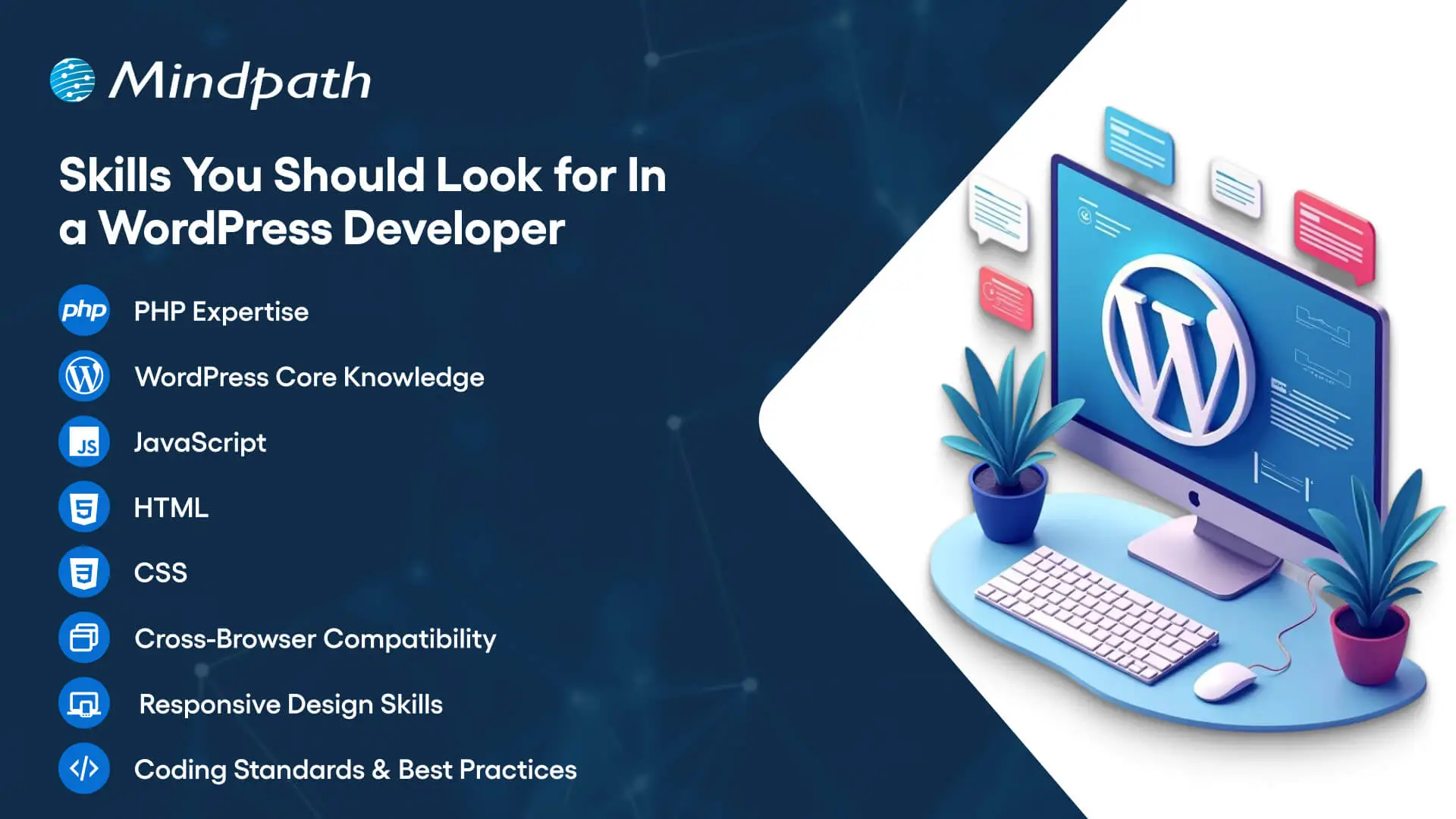
You should focus on the core competencies first to identify professionals who are capable of leveraging the capabilities of WordPress.
1. A skilled WordPress developer must be fluent in PHP, WordPress core, JavaScript, HTML and CSS.
2. The wordpress developer should have in-depth understanding and practical experience in building WordPress themes and plugins.
3. The core competencies of WordPress development experts also revolve around skills for ensuring cross-browser compatibility and responsive design.
4. A WordPress developer is expected to know the coding standards and best practices for WordPress development.
Ready to make your hiring process smooth and avoid picking the wrong developer? Our WordPress Developer Checklist gives you a clear, step-by-step framework to evaluate every candidate.
Are Core Competencies Enough for a WordPress Developer?
The core skills required from a WordPress developer showcase only one half of the picture. Recruiters must also look for candidates with additional skills that can bring more value to web projects. Business can hire remote WordPress developers or dedicated in-house experts after checking their capability to go beyond the norm. Candidates who know more than the core skills of a WordPress developer can take care of different aspects of web projects with minimal assistance.
You should look for candidates with experience in version control and performance optimization. On top of it, a WordPress developer who has in-depth understanding of SEO principles can be a valuable asset. The other additional skills that you can look for in a WordPress developer include familiarity with SQL and database management. Candidates with knowledge of working with WordPress REST API and RESTful APIs will definitely elevate the chances of creating better web projects.
While technical skills are a must-have for WordPress developers, it is impossible to ignore the importance of business acumen and soft skills. Any WordPress developer with business acumen can understand the vision and goals of a web project. In addition, they also need soft skills like communication and time management to work in a team and deliver their best performance.
Unsure if your WordPress site meets accessibility standards for all users? Explore our article on how to improve WordPress web accessibility and ensure your site is usable by everyone.
Which Hiring Model Should You Choose?
Diving straight into the hiring process without choosing a hiring option can lead recruiters into many roadblocks in future. Business owners and hiring managers must know the strengths and setbacks of each hiring model to figure out the ideal option for their web project. You can hire freelance developers or opt for an in-house developer and capitalize on different advantages. For instance, freelance developers are the best picks for web projects of small companies or startups. Freelance developers can work on tight budgets and serve as the most efficient assets for one-time web development projects.
The freelance hiring model may seem appealing due to the lower costs than hiring a dedicated in-house developer. However, many people don’t pay attention to the limitations that come with freelance developers. It is difficult to manage freelancers as they may be working with multiple clients and could not deliver your project on time. The alternative to a WordPress freelancer is an in-house developer who will work in your office. In-house developers understand your business goals and customer expectations more closely, which helps them create effective products.
You may have assumed that an in-house WordPress developer will be the ideal choice for your next web project. The problem with in-house developers is the cost and time required to welcome them into your team. Apart from the costs of salary and infrastructure, you will have to bear the burden of time required for onboarding an in-house developer.
Interestingly, you can find a solution to this setback in professional WordPress development agencies. Professional agencies offer access to a team of developers with full-stack development expertise and the assurance of project management. With a professional agency, you don’t have to worry about overheads or continuous maintenance and support.
Looking to scale your web project without long-term commitments? Check out our guide to hire a freelance full-stack developer and discover how to find skilled freelancers who meet your needs.
What are the Costs of Hiring WordPress Developers?
The type of hiring model you choose to hire expert WordPress developers for your web project will have a significant impact on the hiring costs. On top of it, you must also consider the location and experience of the developer to determine the hiring costs. It is also important to note that businesses can choose between hourly pricing and fixed pricing for different hiring models. For instance, a freelancer will charge around $20 to $100 per hour for their services or take a salary of $65,000 to $70,000 per year for different projects.
The location where a WordPress developer will work also has a significant influence on the hiring costs. The average WordPress developer salary in the United States varies between $42,000 and $103,000. On the other hand, the salary of a WordPress developer in Australia can be somewhere between $91,000 and $179,000. It is also important to note that the salary of WordPress developers may vary with changes in demand for talent and complexity of projects. Awareness of salary ranges can help you ensure that you make the right offers to skilled candidates.
Roadmap for Hiring an Expert WordPress Developer
Once you know what you are looking for, the search for a skilled WordPress developer becomes a lot easier. You can follow a few simple steps to establish a solid hiring process for WordPress development projects.
1. Know Your Business Goals
The first step in the hiring process involves understanding that you are not listing WordPress jobs to follow a trend. You must identify the problems you want to solve with the help of a WordPress developer. Understanding your problems and business goals will help you identify developers with the skills required to solve them.
2. Establish a Clear Budget
Another area where you should be very clear while hiring WordPress development experts is the budget. As a matter of fact, your budget will determine the type of hiring model that will suit your project. The important factors that help you define a budget for web projects include the scope of the project and its complexity. On top of it, the experience of developers will also come into play as you will have to pay more to senior developers.
3. Rigorous Testing and Interview Process
The most common mistake recruiters make while hiring a WordPress developer is the lack of attention to the testing and interview process. You should use different types of tests to evaluate the proficiency of candidates in PHP, HTML, JavaScript and SQL. The best way to test the technical proficiency of candidates involves providing hands-on assignments. Furthermore, the interview process should be more sophisticated with questions to evaluate the business knowledge and soft skills of candidates.
4. Finalize the Hiring Process
After identifying the right candidate for your WordPress project, you can complete the hiring process. It is important to create verified contracts that include comprehensive details about the project scope, terms of payment and timeline of the project. The hiring contract must also specify the clauses of confidentiality, ownership rights and terms of contract termination. With both parties agreeing to the contract, you can finalize the hiring process and welcome the developer into your team.
Ready to upgrade your HTML site to something more powerful and manageable? Explore why converting HTML to WordPress can streamline updates and improve your online presence.
Ready to Hire the Right WordPress Developer for Your Project?
The benefits of working with a professional WordPress developer can elevate your web project. You can hire offshore WordPress developers or choose an in-house developer for your team, depending on your requirements. However, the process to choose the ideal candidate for WordPress development projects remains the same in almost every case.
Mindpath is a trusted WordPress development company that has been helping businesses discover new solutions to a better digital presence. Our experience in working on different types of WordPress development projects has empowered us with the skills and confidence to deliver the best results. We offer WordPress development services tailored to the needs and vision of each business, thereby ensuring that you get desired outcomes from your web projects. Consult with us and make the most of WordPress for web development projects now.

As a result of the rapid evolution of the digital landscape, businesses nowadays want faster, efficient, and more scalable options. This is why many companies choose to hire NodeJS developers who are able to develop high-performing applications without limitations of real-time responsiveness. As businesses compete for efficiency and seamless digital offerings, the demand for NodeJS expertise is increasing. But when hiring a NodeJS Developer, it isn’t just about technical knowledge; it’s about a deeper understanding of your business aims and objectives.
So, how do you make the right choice when the market is filled with so many options? This is the point where many decision-makers stop and consider. With numerous talented developers available, knowing what differentiates the right developer can be a challenge. Filling a role quickly is easy, but finding a developer who contributes positively to your long-term growth is different. Before proceeding to the next step, you should slow down and investigate the key factors to consider in making the right decision.
Looking for a Node.js developer who ensures your app performs at scale without compromising speed and security. Hire Node JS developers from Mindpath who strive to provide you the best, world-class solutions.
Who is a NodeJS Developer?
A NodeJS developer is a technical professional who uses Node.js to create fast, scalable applications server-side. They’re responsible for everything from building prototypes to writing clean code that supports applications that power our world. Their responsibilities also include connecting back-end services with front-end systems to provide users with maximum efficiency and reliability.
Node.js developers are crucial for contemporary software projects because Node.js enables developers to utilize one programming language, JavaScript, for both the client side and server side. They develop great solutions thanks to the ability to do it quickly. They also have strong problem-solving skills and know how to utilize this technology to further enhance an application and prepare it for scale.
What are the Responsibilities of a NodeJS Developer?
Companies wanting to grow often look to hire dedicated Node.js developers as part of their technology teams. Node.js developers do more than code; they are an integral part of delivering solutions that will amplify your digital products.
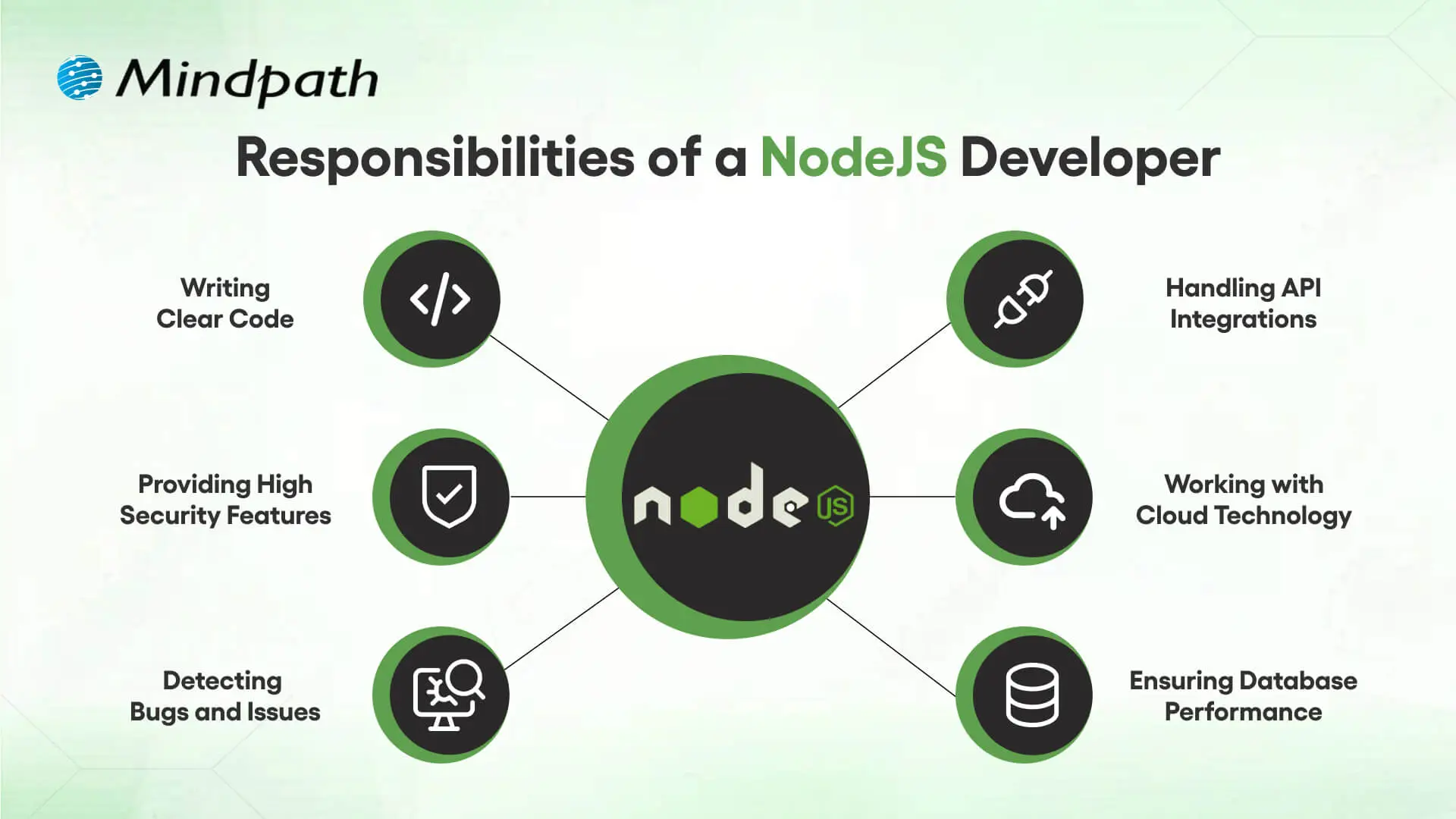
1. Writing Clear Code
When you hire Node.js developers, their job is to write clean and readable code. This will make it easier for other developers to maintain and grow the application.
2. Providing High-Security Features
Security is also a core part of a Node.js developer’s job. Developers need to identify their risks and add features that protect data and users.
3. Detecting Bugs and Issues
Bugs can give rise to slowed-down applications and degradation of performance. NodeJS developers are then also able to quickly identify and fix bugs to maintain stability on the systems.
4. Handling API Integrations
Most modern applications require API integration to add some functionality. Proficient NodeJS developers know how to use API integrations such as HTTP, buffers, and simple file handling.
6. Working with Cloud Technology
When you hire Node.js developers, it is common for these developers to work on the backend and, therefore, will work with cloud deployment. They will configure a cloud platform (such as AWS or Azure) to run the application to ensure it runs properly.
7. Ensuring Database Performance
A Node.js developer will oversee your databases so that the responses are quick. They ensure the back-end interacts with your front-end requests appropriately.
Unlock the new opportunities by Full-Stack Development with Node.js, the key to building a reliable application. Explore now and elevate your business to the next level.
Key Factors to Consider While Hiring Node.js Developers
Choosing the right talent can dictate whether or not your digital projects achieve ultimate success. If you are going to hire a Node.js developer, here are the important things to keep in mind before you do.
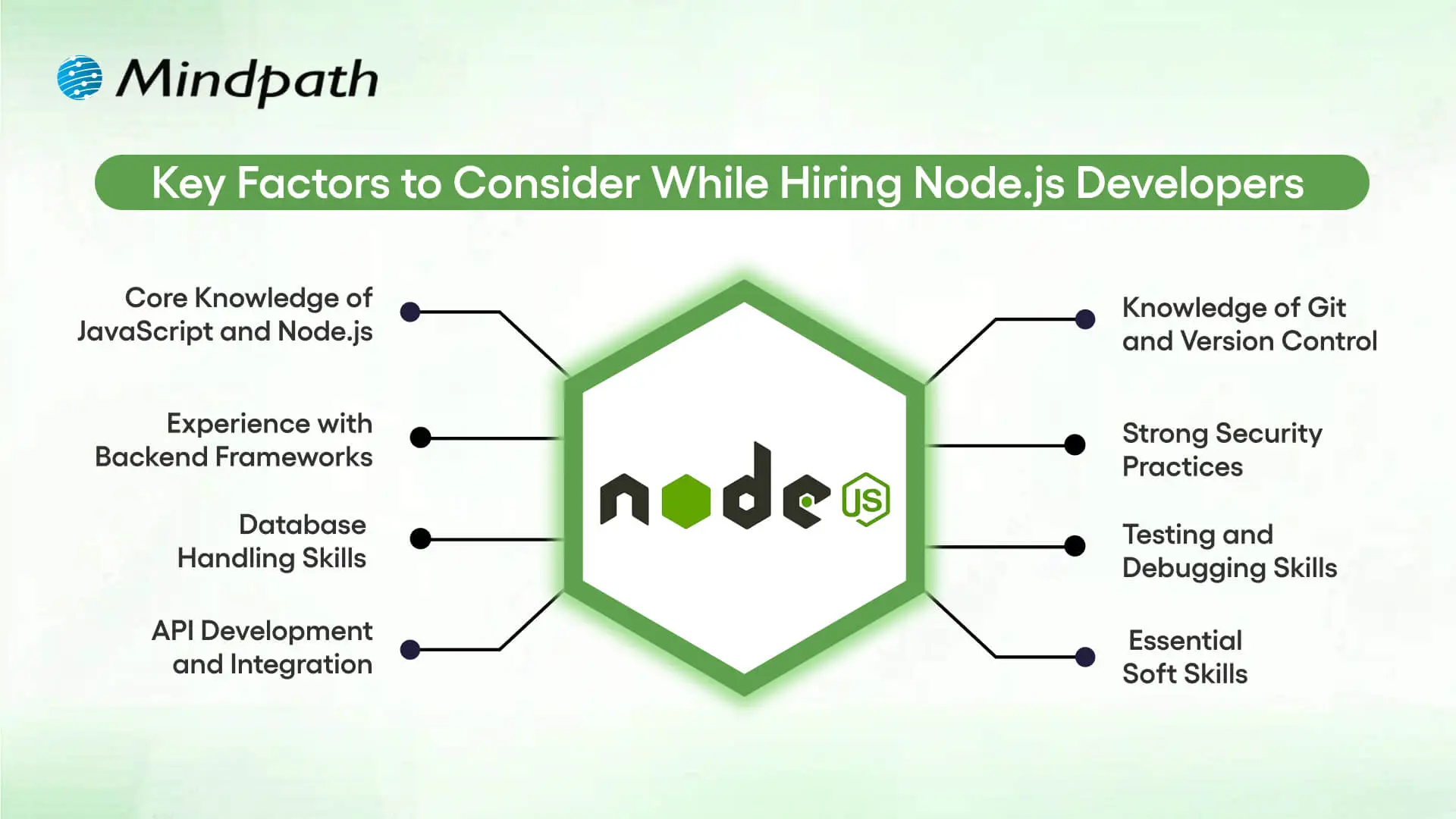
1. Core Knowledge of JavaScript and Node.js
When hiring Node.js developers, the first thing is to check their understanding of the basics of JavaScript and Node.js foundations. They should understand asynchronous programming, Node event loop, and code management through NPM, as well as managing dependencies, which is a large part of the Node.js developer roadmap related to developing scalable applications.
2. Experience with Backend Frameworks
A top-notch developer should really have practical experience with frameworks like Express.js, Koa.js, or Nest.js. The key benefit of these frameworks is that they make projects faster, and framework-less projects have no organization. If you’re hiring Node.js developers, you can easily test their framework knowledge with some simple tasks or some Node.js developer interview questions.
3. Database Handling Skills
All applications require databases, so any competent developer must know their databases MySQL, PostgreSQL, and they must know some NoSQL databases such as MongoDB. They need to understand caching as well as real-time data processing by having basic knowledge of tools like Redis. If you hire a Node.js developer with good database skills, your application will respond faster and stay robust.
4. API Development and Integration
APIs connect applications to additional services, and Node.js is often a popular choice to build those APIs as well. Developers must be familiar with RESTful APIs, GraphQL, and secure protocols like OAuth. Before you hire Node.js developers, be sure to ask them how they create APIs and manage API integration.
5. Knowledge of Git and Version Control
Git is an everyday tool for every developer, and they should be able to manage branches, pull requests, and conflicts without hindering the development. The knowledge of Git is a prerequisite for hiring Node.js developers for teamwork purposes.
6. Strong Security Practices
Security is always a primary concern. Developers need to understand encryption, input validation, and token-based authentication. When employing Node.js developers, look at how they implement these practices to protect applications and sensitive information.
7. Testing and Debugging Skills
Reliable applications need effective debugging and testing. Developers can leverage tools (such as Mocha, Jest, or Cypress) to find bugs early in application development. Knowledge of testing is a vital skill if you are planning to hire Node.js developers to help with long-term applications.
8. Essential Soft Skills
Technical skills are not enough to qualify for Node.js Developer jobs. Communication, collaboration, and problem-solving all make progress much easier on a project. These skills are equally important each time employers hire Node.js developers, as many projects will have challenging aspects.
As user experiences is evolving day by day, businesses need to adopt technologies that ensure speed, scalability, and reliability. Discover how Hiring Expert NodeJS Developers can help you deliver high-performance digital solutions.
Steps to Hire a Node.js Developer
While the search for the perfect talent can seem daunting, breaking the process down into clear steps makes it much easier. Below are the key steps to take when hiring a Node.js developer for your project.
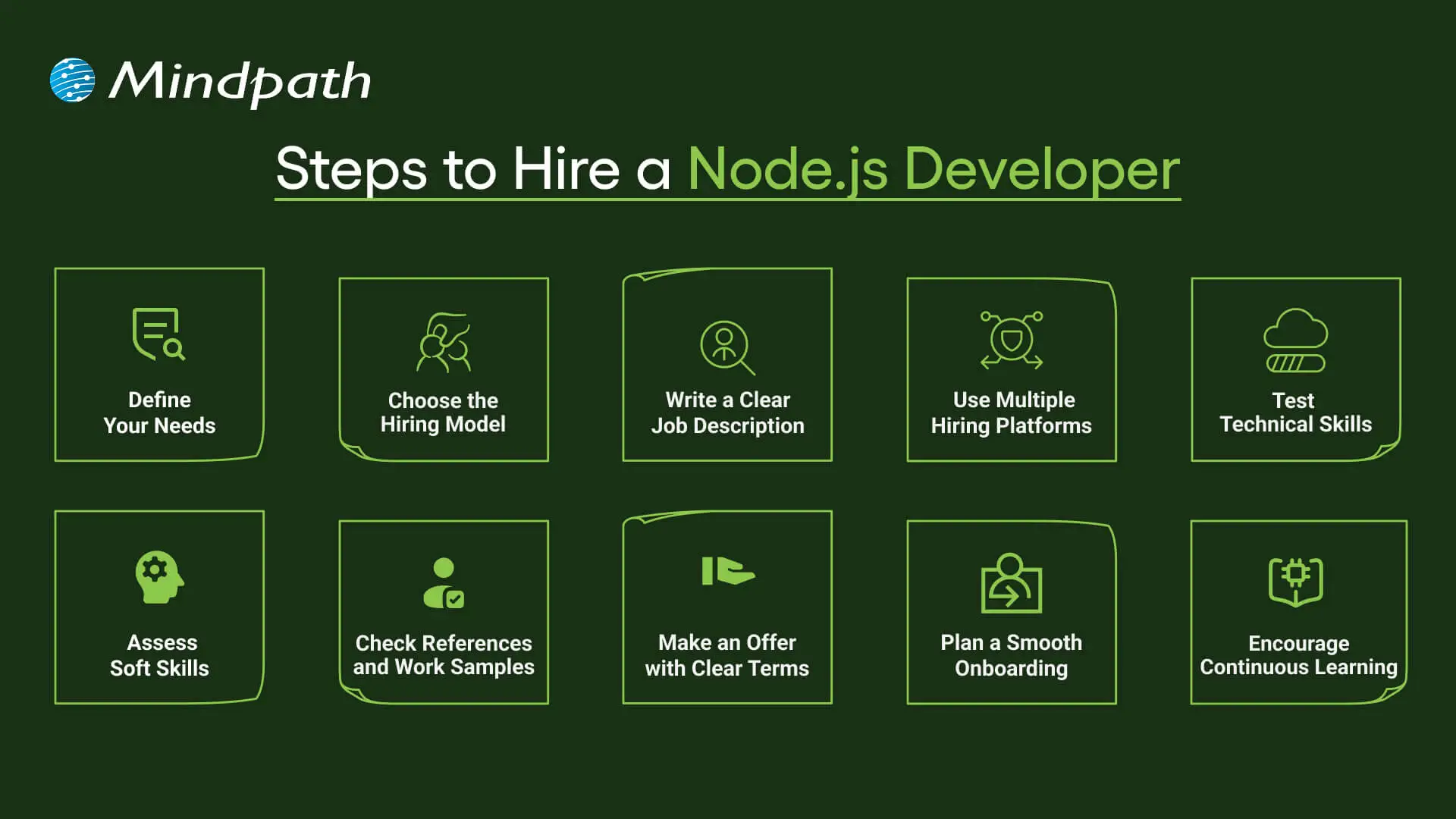
1. Define Your Needs
Start by defining your project scope, features, and tech stack. When you hire NodeJS developers, identifying clear requirements can save time and attract the right candidates.
2. Choose the Hiring Model
Determine whether you need in-house, remote, or offshore developers. Many companies hire NodeJS developers offshore for more flexibility and lower costs.
3. Write a Clear Job Description
A well-written job description allows candidates to know what they are applying for. Include as much as possible in the description, who you want, including the skills, the experience you expect, and if you are looking for a full-stack Node.js developer.
4. Use Multiple Hiring Platforms
Search for talent on LinkedIn, GitHub, and job boards that identify talented developers. These platforms enable developers to connect because of their special skill set.
5. Test Technical Skills
Evaluate coding expertise with tasks, interviews, or online coding challenges. This evaluates whether the developer can work with Node.js concepts properly.
6. Assess Soft Skills
Good communication and teamwork are as essential as coding, because they also allow the project to flow without delay.
7. Check References and Work Samples
It’s important to understand what the developer has done in the past, so it is good to check references and speak to previous clients or employers. This develops an understanding of the developer’s reliability and quality of effects.
8. Make an Offer with Clear Terms
Discuss salary, benefits, and expectations openly. Transparency builds trust and helps retain the developer.
9. Plan a Smooth Onboarding
Provide tools, resources, and guidance to new hires. A structured onboarding makes developers productive faster.
10. Encourage Continuous Learning
Support your team in learning new Node.js updates and practices. This keeps skills sharp and projects future-ready.
Want to enhance your website presence in today’s fast-paced digital world? Explore our detailed blog on how you can Increase Web Performance with Node.js Development Services.
Looking to Hire Expert Node.js Developers for Your Next Project?
Hiring the right Node.js talent can define the success of your digital projects. Skilled developers bring more than technical expertise; they align with business goals and deliver scalable, secure, and high-performing applications. By following clear steps and evaluating both technical and soft skills, you ensure your projects are built for long-term growth and innovation.
Mindpath stands out as a trusted Node.js development company offering top-tier Node.js development services. With a team of skilled developers, we help businesses build scalable applications tailored to their unique needs. By choosing Mindpath, you gain a partner focused on delivering secure, efficient, and future-ready solutions that accelerate your digital success.
In today’s digital-first world, creating applications that are fast, responsive, and scalable is vital for business success. And for this, they need to choose the right technology stack as it can make or break their custom application. Among the many options available to choose from, the advantages of Node.js make it a standout option for modern businesses aiming for speed, agility as well and development efficiency.
Since its launch in 2009 by Ryan Dahl, this backend technology has transformed how developers create scalable, fast, and real-time web applications, supporting continuous innovation across different industries. But what makes Node.js a standout choice among businesses?
In this blog, we will explore Node’s advantages and understand what it is used for. Besides, we will discuss the pros and cons of Node.js so that you can make an informed decision.
Want to implement these advantages of Node.js into your business? Mindpath Node.js development services will guide you every step of the way on how to create a high-performing web application tailored to your business needs.
What is Node.js?
Evolution of Node.js
Before diving deep into its advantages, let’s understand how Node.js has evolved. This will help businesses appreciate their current abilities and future potential.
The evolution of this backend tech has been a rapid journey from a simple experimental project to a mainstream web development technology.
1. 2009
Ryan Dahl introduced Node.js. The initial aim was to offer high-performance servers through JavaScript’s V8 engine.
2. Early 2010s
The NPM or Node Package Manager was created. It became the largest software registry ecosystem, accelerating web development projects.
3. Mid 2010s
Socket.io and Express were launched, and in 2011, NPM 1.0 was introduced. In 2014, the project went through some major governance changes.
4. 2015 to 2020
In 2017, when security became a top priority, HTTP/2 and Node.js 8 were launched. During that time, NPM witnessed more than 3 billion downloads. ES modules and Node 10 were introduced in 2018. NPM was acquired by GitHub in 2020.
5. 2020 – Present
Node 16 was launched in 2021. LTS version 18 was introduced in 2022. The launch of ES Modules and other stable module systems, along with TypeScript integration, strengthened its status as a powerful enterprise platform. Node.js 24 was released in 2025.
This continuous evolution highlights this backend tech’s growth, business adoption, and strong community, making Node.js a backbone of today’s backend development.
Must Read: Top Node.js Libraries
Why Global Enterprises and Businesses Choose Node.js?
Keeping pace with rapid innovation in this competitive tech landscape is not an easy task. New applications, after a few months, struggle to stay relevant as digital standards and user expectations constantly evolve. That’s why businesses need a solid backend technology that can offer better performance and grow with them. Enter Node.js for backend- a future-ready and dynamic solution that is trusted by some of the biggest and popular brands in the world.
Fortune 500 enterprises like LinkedIn, PayPal, eBay, Walmart, and Trello are using this tech as a core part of their tech stack. Node.js development allows businesses to leverage its flexibility, scalability, and speed to power modern applications and experience the amazing advantages of node.js. The rising demand for Node.js shows its ease of use and reliability, making it an excellent choice for businesses and developers. Whether you are creating a full-scale business platform, microservice, or API, Node.js can offer the innovation and consistency you need to enjoy a competitive edge.
Now, let’s talk about some major benefits of Node.js and explore how it is helping businesses in this competitive digital landscape.
Looking to build fast and scalable NodeJS applications? Explore our blog on hiring expert NodeJS Developers for High-Performance Apps to see how experienced developers can deliver robust, high-performing solutions for your business.
Advantages of Node.js- A Perfect Option for Your Web App
Node.js has become a game-changing backend tech for modern businesses, providing them with a perfect combination of cost-efficiency, scalability, and performance. Here are some impressive advantages of Node.js that organizations of all sizes can witness when deployed correctly.
1. Cross-Platform Application Development
With powerful frameworks such as NW.js and Electron, Node.js supports the creation of high-performance cross-platform desktop apps. Developers can utilize Chrome Developer Tools to code, build, debug, and streamline the development process.
Furthermore, they can leverage frontend frameworks such as React, Vue.js, and Angular to create versatile applications. This is a major Node.js advantage for every business.
2. Reduced Loading Time
It comes with a caching module to store frequently used data in memory. This, in turn, reduces loading time while enhancing user experience. It enables efficient request handling and quick page rendering.
3. Superior Performance
Node.js uses the V8 engine to compile JavaScript into machine code and offers excellent performance. Furthermore, the single-thread event loop and non-blocking I/O model enable asynchronous tasks to function efficiently.
4. Scalable Web Applications
One of the most significant advantages of Node.js is that the tech is scalable. It is designed to support multi-threaded execution. Besides, the cluster module helps it to balance CPU-bound tasks. As a result, multiple Node instances can run smoothly simultaneously.
Moreover, it enables horizontal partitioning, enabling apps for personalized user experience considering the user’s location, age, interests, and languages.
5. Efficient Handling of Concurrent Requests
It works great at managing multiple concurrent users. That’s why most e-commerce platforms and complex web apps are developed using Node.js. By handling simultaneous requests, it ensures smooth performance of your web app during high traffic.
6. Active and Massive Community Support
Node.js has a growing global community aligned with strong corporate support from Netflix, Facebook, Amazon, and Google. The NPM provides developers with access to thousands of libraries and tools without any cost. On the other hand, GitHub offers a lot of open-source resources.
All these benefits of Node.js are enough to prove why it is a top choice among developers and organizations for backend development.
Not sure how to choose the right NodeJS developers for your project? Read our blog on Hiring NodeJS Developers to learn key tips for selecting skilled professionals who can deliver high-performance, scalable applications.
Disadvantages of Node.js
While the advantages of Node.js are quite impressive, it’s vital to acknowledge that this technology has some challenges. Here are some key disadvantages of node js to consider.
1. Challenge of Mastering Asynchronous Logic
For scalability, Node.js utilizes asynchronous programming. However, managing promises and callbacks can be very challenging for developers who have used linear blocking I/O programming.
2. Dependency on Third-Party Libraries
JavaScript doesn’t have strong native libraries. That’s why developers depend on third-party packages for various tasks. This may lead to dependency management problems and security risks.
3. Frequent API Updates
Frequent updates often break changes and force developers to refactor code after every update. Well, while updates are critical but they can disrupt workflows, demanding constant attention to version compatibility and maintenance effort.
4. Lack of Standardized Structures
Node.js is a runtime and offers maximum flexibility. However, it lacks an opinionated, rigid structure. This may lead to inconsistencies among large teams.
Most of these disadvantages can be eliminated with the right tooling, strategic planning, and team training. Node.js remains an excellent choice, but it’s vital to compare nodejs pros and cons, considering your project’s unique needs, to come up with the right solution.
Want to build complete, high-performing applications from front-end to back-end? Learn mastering Full-Stack Development with Node.js to understand how Node.js empowers developers to create seamless, full-stack solutions.
Applications of Node.js
As discussed above, Node.js is a robust runtime environment that allows developers to create efficient, fast, and scalable server-side applications. Node.js benefits and versatility make it suitable for different real-world applications across various industries.
A common application of Node.js is real-time web apps. For instance, live dashboards, chat platforms, and collaborative tools. Its support for WebSockets and event-driven architecture enables seamless bi-directional communication between server and client. Apart from this, Node.js is also a crucial tech in API development, deploying GraphQL and RESTful services that smoothly handle thousands of requests while maintaining low latency.
Another useful application of Node.js is product catalogs for e-commerce websites. Besides, it is also used to enable real-time inventory updates and to offer personalized user experiences. Additionally, Node.js is a great choice for creating microservice architectures and desktop app development.
In summary, its rich ecosystem and cross-platform support make Node.js a top choice across industries for modern backend development.
Also Read: Increase Web Performance with Node.js
Future of Node.js for Backend Development
The advantages of Node.js clearly show that it is a cornerstone of today’s backend development. However, it is still evolving, and in the future, we can expect to see more innovations. The OpenJS Foundation and Node.js community will invest heavily in:
1. Advanced Security and Diagnostic
Optimizing tooling for monitoring, performance, vulnerability management, and debugging.
2. Worker Threads
Increasing support for CPU-intensive tasks, enabling developers to offload heavy tasks without affecting the main event loop.
3. Expanded Serverless Compatibility
Strengthening Node.js for various serverless platforms such as Azure, AWS, etc., making it more powerful for event-driven and scalable architectures.
4. Edge Computing and IoT
Node.js’s event-driven architecture and lightweight footprint will continue to play an important role in building IoT applications and apps for edge computing.
5. Enhanced Support for ES Modules
Node.js is expanding support for ECMAScript or ES Modules. As ES Modules are a crucial element in web development, the trend will continue, allowing developers to enjoy better compatibility with modern libraries and JavaScript code.
With industries increasingly adopting real-time applications, cloud-native systems, IoT solutions, and micro services, Node.js will remain a dominant player in this field. Besides, we can’t ignore the Node.js advantages that support its growth.
Looking for the right partner to build robust NodeJS applications? Read our blog on Choosing NodeJS Development Company to discover the essential checklist for selecting expert developers who deliver high-quality, scalable solutions.
Creating a Digital Future on a Robust Node.js Foundation
After going through the pros and cons of Node.js, it can be said that Node.js has a lot of benefits rather than disadvantages. And the primary reason behind this is its amazing features, active community support, and evolving architecture. If you want to experience these Node.js benefits, then it is advisable to partner with an expert who understands this technology and uses it to offer a tailored solution.
When it comes to choosing the best Node.js expert to enjoy the maximum advantages of Node.js, you may not find a better option than Mindpath. From optimizing asynchronous performance to creating modular microservices, our Node.js development services make sure that Node.js is correctly deployed, offering you inclusive, responsive, and fast applications. Besides, we can guide you through the best practices in this tech’s architecture and security. Choose us and get ready to build faster and smarter digital solutions based on Node.js.
Frequently Asked Questions
Join our Newsletter!
categories
Join the world's largest training library and unlock new opportunities!
Turn Insights Into
Real Business Solutions
Exploring trends is only the beginning. Whether you’re planning AI adoption, modernizing legacy systems, or building scalable software, our experts help transform ideas into practical business outcomes.