Home

Agentic AI vs. Traditional Automation: What’s Actually Different?

Agentic AI vs. Traditional Automation: What’s Actually Different?

Join our Newsletter!

Agentic AI vs Traditional Automation

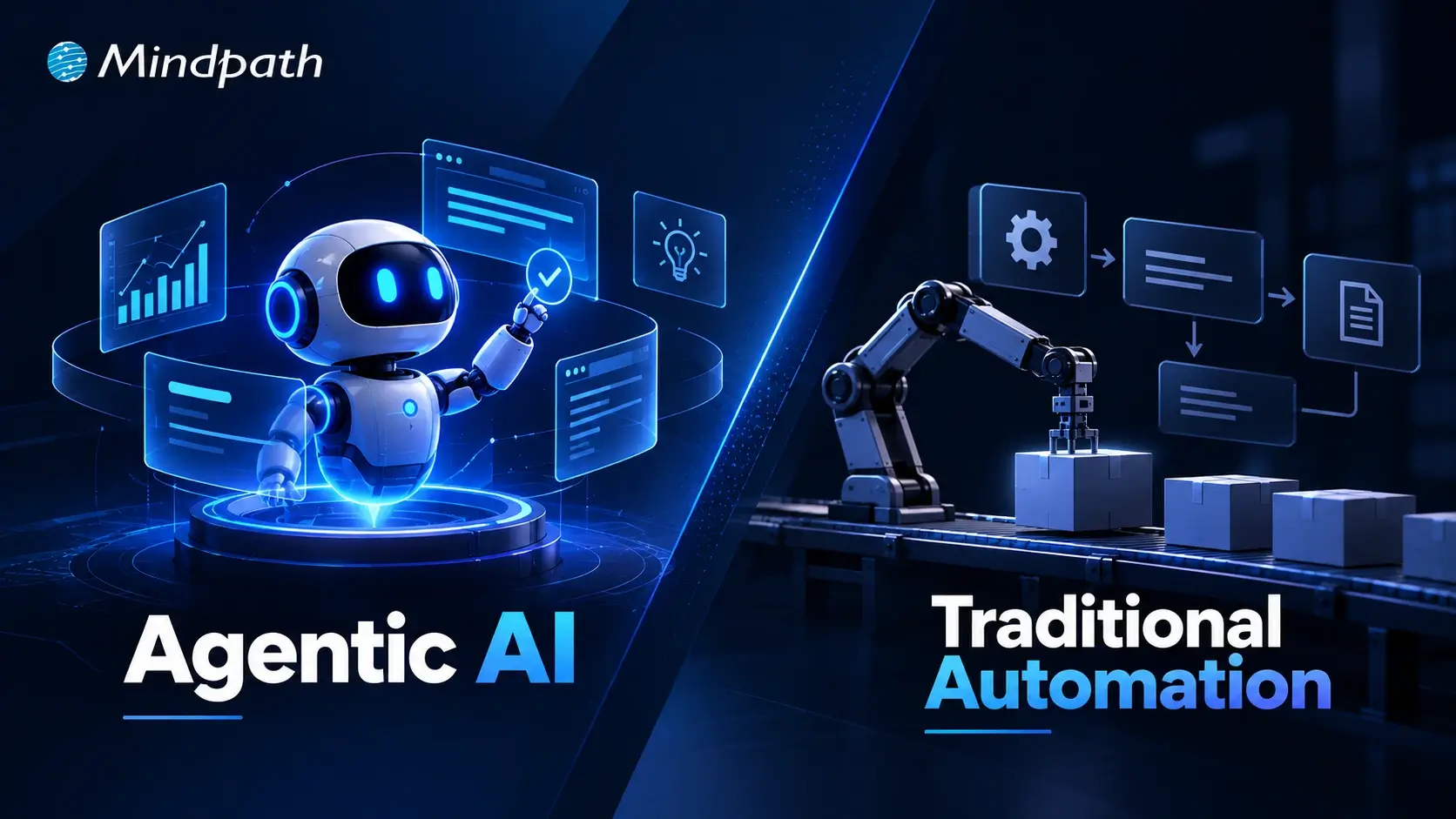
A workflow can run perfectly for years until one unexpected exception exposes its limits. That is where the difference between agentic AI vs traditional automation becomes important. Automation follows defined rules and paths, while agentic AI can interpret context, make decisions, and adapt its actions as conditions change.

Key Takeaways

  • 01
    Traditional automation works best for predictable, repetitive, and rule-based business processes.
  • 02
    Agentic AI handles workflows requiring reasoning, adaptability, and context-based decisions.
  • 03
    AI agents can manage unstructured information, exceptions, multiple systems, and complex objectives.
  • 04
    Businesses should choose technology based on workflow requirements rather than replacing automation unnecessarily.
  • 05
    A hybrid approach can combine automation for routine tasks with AI agents for complex decisions.

The real question is not which technology is better, but which one fits the work. Businesses need to understand where predictable automation delivers greater efficiency and where autonomous decision-making creates measurable value. In this blog, we compare both approaches to help you choose the right one for your business workflows.

Need the right AI approach for your workflow?

Explore Mindpath’s AI development services to design, build, and deploy intelligent solutions aligned with your business goals.

What is Agentic AI?

Agentic AI refers to AI systems that can pursue a defined goal by interpreting information, making decisions, using tools, and adjusting their actions based on what happens next. Instead of relying entirely on a fixed sequence, an AI agent can determine the next appropriate step within a given set of boundaries.

In a business environment, an agent might review customer information, search internal knowledge, interact with business applications, analyze the results, and decide whether to complete a task or escalate it to a person.

Key advantages of agentic AI include:

1. Adaptive Execution

Adjusts actions when conditions or requirements change.

2. Contextual Decisions

Uses available information to determine the next step.

3. Exception Handling

Can assess situations that fall outside standard workflows.

4. Multi-step Execution

Coordinates several actions toward a single business goal.

5. Tool Interaction

Can work with APIs, databases, software platforms, and other business systems.

What is Traditional Automation?

Traditional automation uses predefined rules, triggers, and workflows to complete specific tasks without requiring manual intervention at every stage. The process is designed in advance, and the system executes those instructions consistently whenever the required conditions are met.

For example, an automated workflow can receive an invoice, check predefined criteria, send it to the appropriate approver, update a database, and trigger a notification. The workflow performs each action according to the logic established by the business.

Key advantages of traditional automation include:

1. Predictable Execution

Follows established workflows consistently.

2. Fast Processing

Handles repetitive tasks efficiently at scale.

3. Cost Efficiency

Reduces manual effort for routine processes.

4. Process Consistency

Applies the same rules across every transaction.

5. Easy Control

Gives businesses clear visibility into predefined actions and outcomes.

Agentic AI vs Traditional Automation: The Core Difference

The agentic AI vs traditional automation comparison becomes clearer when you look at how each system handles work after the initial instruction. Traditional automation is designed around known rules and predictable paths. Agentic AI is designed to work toward an outcome, making context-based decisions when the path changes.

The biggest difference is how much flexibility the system has during execution. An automated workflow generally does what it was programmed to do. An AI agent can assess the current situation, choose an action, observe the result, and determine what should happen next.

Capability Traditional Automation Agentic AI
Primary approach Executes predefined instructions Works toward a defined goal
Decision logic If/then rules and fixed conditions Context-based reasoning and planning
Workflow path Predetermined sequence Can change based on circumstances
Input handling Best with structured inputs Can interpret structured and unstructured inputs
Exception handling Follows predefined exception rules Can assess unfamiliar situations
Adaptability Changes require workflow updates Can adjust actions within defined boundaries
Task planning Business defines the sequence Agent can determine the next step
Tool usage Specific integrations trigger specific actions Can select and use available tools based on the task
Retries Usually follow programmed retry logic Can reassess why an action failed and try another path
Escalation Triggered by predefined conditions Can escalate when it cannot confidently proceed
Human involvement Often required for predefined exceptions Can operate independently while keeping humans in the loop
Best suited for Repetitive, predictable processes Variable, multi-step, decision-heavy work

When Traditional Automation Is Still the Better Choice?

Agentic AI can handle complex workflows, but that does not mean every business process needs an AI agent. When to use agentic AI instead of traditional automation depends largely on how predictable the work is. If a process follows clear rules, receives structured inputs, and produces consistent outcomes; traditional automation is often simpler, faster, and easier to control.

Traditional automation is usually the better fit when:

1. Rules Are Clearly Defined

The process can be mapped using fixed conditions and actions.

2. Tasks Are Repetitive

High-volume activities follow the same sequence every time.

3. Inputs Are Structured

Data comes in predictable formats that require little interpretation.

4. Consistency Is Critical

Every transaction needs to follow the same approved process.

5. Exceptions Are Limited

Unusual cases can be handled through predefined rules or human escalation.

When Agentic AI Creates More Value?

Agentic AI becomes valuable when a workflow cannot be mapped into a fixed sequence of rules. Businesses may know the outcome they want, but the steps required to reach it can change with each situation. That is where AI agents can interpret context, evaluate options, and determine what action should come next.

Businesses can build AI agents for business when their workflows involve:

1. Unstructured Information

Emails, documents, conversations, and other inputs need interpretation.

2. Dynamic Decisions

The next action depends on what the system discovers during execution.

3. Multiple Systems

A task requires information or actions across CRM, databases, APIs, or business applications.

4. Complex Objectives

The desired outcome is clear, but the exact execution path is not.

5. Frequent Exceptions

Unusual cases require contextual decisions rather than another fixed rule.

Choosing the Right Approach for Your Workflow

The right choice between agentic AI vs traditional automation depends on the kind of work you want to automate. If the steps are clear and repeatable, traditional automation is usually enough. If the workflow changes often and needs decisions, agentic AI can be a better fit. Some workflows can also use both.

If your workflow is Best approach Why
Repetitive and predictable Traditional automation Follows fixed rules quickly and consistently
Based on clear business rules Traditional automation Easy to control, monitor, and audit
High-volume and structured Traditional automation Handles routine work efficiently
Unstructured or variable Agentic AI Can interpret changing information
Dependent on decisions Agentic AI Can assess context before acting
Spread across multiple systems Agentic AI Can coordinate different tools and actions
Partly predictable, partly complex Hybrid approach Uses automation for routine steps and AI for decisions

For agentic AI vs automation for business processes, the goal should be to choose the simplest approach that can reliably achieve the desired outcome. You do not need an AI agent where a straightforward automated workflow already works well.

What to Consider Before Deploying AI Agents?

Understanding how agentic AI works is an important first step before introducing agents into a business workflow. The system needs clear goals, access to relevant information, defined boundaries, and a reliable way to handle situations it cannot resolve.

Before deployment, businesses should consider:

1. Business Goal

Define the specific outcome the agent needs to deliver.

2. Data Quality

Make sure the agent can access accurate and relevant information.

3. Permissions

Control which systems, data, and actions the agent can access.

4. Human Oversight

Set clear points for review and escalation.

5. Integration

Connect the agent with the tools already used by the business.

6. Performance

Measure accuracy, task completion, failures, and business impact.

An experienced AI agent development company can help assess these requirements and design an architecture around the workflow. Businesses that plan to hire AI agent developers should also look for experience in integrations, security, agent evaluation, and production deployment.

Which Approach Is Right for Your Business?

The choice between agentic AI vs traditional automation depends on the workflow, not the technology trend. Traditional automation remains ideal for predictable tasks, while agentic AI fits work requiring reasoning, adaptability, and dynamic decisions. The strongest strategy often combines both to create efficient, practical, and scalable business workflows.

Mindpath helps businesses identify where AI can create meaningful operational value and build solutions around those opportunities. Our agentic AI development services cover strategy, agent development, integrations, and deployment, helping businesses introduce AI agents with the right architecture, controls, and business objectives.
Ready to Move Beyond Traditional Automation?

Build AI agents that adapt, decide, and automate complex workflows.

Frequently Asked Questions

Traditional automation can be more cost-efficient for repetitive tasks, while agentic AI can justify higher costs when complex decisions reduce manual effort.
Yes. Businesses can introduce agents into specific workflow stages where decisions, exceptions, or unstructured information create limitations.
Businesses should assess workflow complexity, data quality, system access, security requirements, human oversight, integration needs, and measurable business outcomes.
Yes. Routine steps can remain automated while AI agents handle decisions, exceptions, and tasks requiring greater flexibility.
Agentic AI may be unnecessary when a workflow already follows simple, predictable rules that traditional automation can execute reliably and efficiently.

Support Is One Click Away

Featured Posts

Related Post

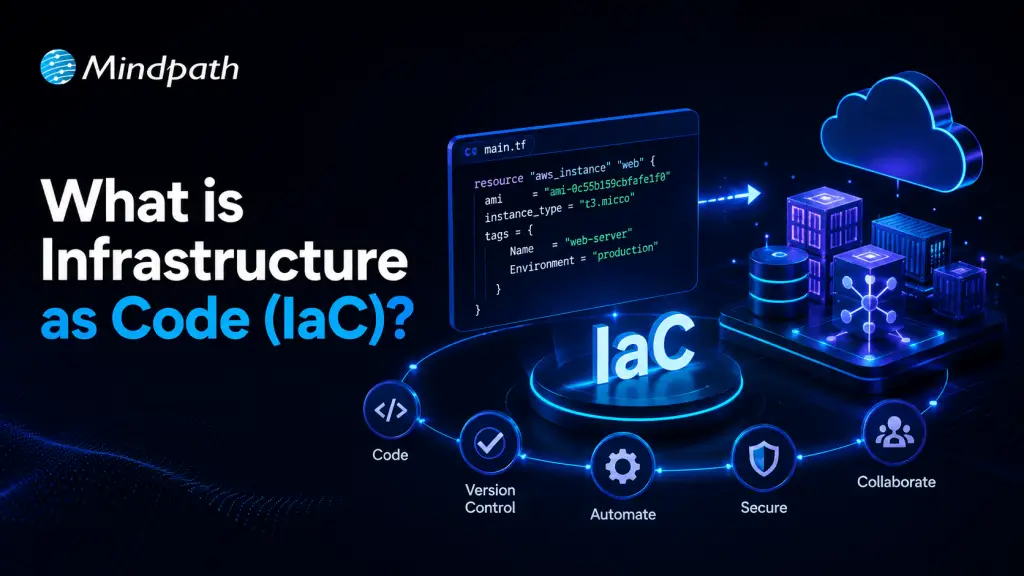
What is Infrastructure as Code (IaC)

What if you could manage your IT infrastructure with the same ease and precision as writing code? Imagine deploying servers, configuring networks, and managing resources through a few lines of code instead of manual processes. Sounds revolutionary, right? This is exactly what Infrastructure as Code (IaC) brings to the table. But how does it work? Why is it transforming the way we handle IT operations? In this blog, let’s explore the fundamentals of IaC, its benefits, and why it’s becoming a cornerstone of modern DevOps practices. So, let’s dive in!

Looking to simplify infrastructure management and scale your IT operations with speed and consistency? At Mindpath, we offer expert DevOps services, including Infrastructure as Code (IaC), to automate provisioning and accelerate delivery.

What is Infrastructure as Code (IaC)?

Infrastructure as Code (IaC) is a method of configuring and managing your IT infrastructure, such as servers, databases, and storage, using code rather than doing everything manually. It’s similar to sending directions to a computer so it can complete the setup for you. When creating and running applications, developers use a variety of tools and mechanisms to collaborate. This encompasses operating systems, databases, and storage. Normally, putting things up manually takes a long time and can lead to errors, especially when working on large projects. With IaC, you just create a code file that explains how your system should appear and function. The tools will then create and manage everything for you. This saves time, reduces mistakes, and facilitates rapid updates or fixes. Businesses utilize IaC to save money, prevent risks, and respond quickly to new possibilities.

Advantages of Infrastructure as Code (IaC)

1. Speedy Deployments

Infrastructure as Code (IaC) makes deployment quicker and easier. Instead of manually configuring systems, you can use a single command to create the full environment in a few minutes. This is especially useful for startups and small enterprises that need to move quickly while staying under budget.

Fast deployment is also vital for testing and development. Developers can rapidly construct test environments that seem identical to the real system. This allows them to devote more time to essential responsibilities such as detecting and fixing problems, evaluating how the system manages high traffic, and enhancing security. By reducing time and effort, IaC allows teams to focus on developing better apps and delivering them faster. It keeps projects on track, increases productivity, and allows firms to adapt swiftly to changes or new possibilities. Whether you’re creating a small app or managing a massive system, IaC makes it easier and faster to complete tasks.

2. Reduced Risks

Manually configuring and administering systems can give rise to errors since it depends primarily on human labor. Repeating the same procedure increases the likelihood of mistakes and adds additional workload to engineering teams. It can also make addressing or debugging problems more difficult and time-consuming.

Infrastructure as Code (IaC) reduces these risks by automating the process and ensuring consistency. Instead of depending on a single person’s knowledge to handle crucial systems, IaC keeps all of the relevant facts in code that is accessible to the whole team. This makes infrastructure easier to understand, share, and administer, even if team members leave the organization. Companies can use IaC to reduce mistakes, boost cooperation, and guarantee their systems are always dependable and secure. This not only saves time and effort, but also instills trust in the infrastructure, making it easier to adapt and develop as needed.

3. Enhanced Security and Quick Recovery

Infrastructure as Code (IaC) improves system security and recoverability. Security measures can be included directly into the system setup process when utilizing code. This guarantees that every deployment is protected without requiring additional evaluations or permissions. If a company’s security standards are updated, the changes can be immediately deployed across all systems via code, ensuring that everything remains consistent and secure. IaC also helps with recovery planning by making it easier to reconstruct systems in the event of a failure. While this strategy may take somewhat longer than other ways, it assures that systems are rebuilt safely and correctly. Businesses can apply IaC to build a solid security foundation and prepare for situations of crisis, all while lowering risks and saving time.

4. Boosted Operational Efficiency

Infrastructure as Code (IaC) increases the efficiency and productivity of developers, architects, and administrators. Complex cloud systems can be deployed significantly faster using pre-configured IaC components, reducing total development time. One of the primary advantages of IaC is that it provides uniform conditions across several teams. Multiple teams, including development, security, QA, and user testing, can collaborate in synchronized environments using a simple script. This allows everyone to make progress simultaneously, rather than waiting for one phase to finish before going on to the next.

IaC also promotes continuous integration and continuous delivery (CI/CD) processes, which enable teams to deploy new features or upgrades more rapidly and efficiently. Additionally, IaC makes it simple to automatically shut down environments that are no longer in use, lowering wasteful expenditures and keeping the cloud infrastructure lean. This enables firms to expand and manage their systems more efficiently, while preserving efficiency and lowering operating costs. Ultimately, IaC simplifies procedures, lowers human mistakes, and allows teams to operate more quickly, intelligently, and cooperatively.

5. Greater Accountability

In the past, engineering teams had to manually record their work for a long period in order to guarantee seamless communication, prevent delays, and handle issues like errors and staff turnover. With Infrastructure as Code (IaC), this is no longer required. Instead of depending on elaborate documentation, all changes are recorded immediately in the source code repository.

Every modification is explicitly tracked using version control, which shows who made the change and when. This makes it simple to track changes, identify issues, and comprehend the context around them. If an issue emerges, it is straightforward to identify the cause of the problem and who should be approached for clarification. IaC enhances accountability by making all activities public and traceable, ensuring that everyone on the team is on the same page, and enabling teams to collaborate more effectively.

How Can Mindpath Help in Infrastructure as Code (IaC)?

We can assist you with leveraging Infrastructure as Code (IaC) to streamline and protect your IT processes. We use IaC to automate system setup and administration, resulting in a more consistent, dependable, and manageable infrastructure. Our staff can create and manage the code that specifies your infrastructure, eliminating the need for time-consuming manual configurations. With IaC, we ensure that your systems are swiftly installed, updated, and fully protected, while minimizing risks and human error. We help you design environments that are simple to reproduce and scale, allowing your development, security, and testing teams to collaborate effortlessly.

Wrapping Note!

Infrastructure as Code (IaC) is revolutionizing the way IT infrastructure is managed by automating processes, reducing human errors, and enabling faster, more secure deployments. By adopting IaC, organizations can achieve greater operational efficiency, boost security, and ensure better collaboration among teams, all while minimizing risks. As businesses continue to scale and adapt to new challenges, IaC is becoming an essential practice in modern DevOps strategies. At Mindpath, we are dedicated to helping you implement IaC effectively, making your infrastructure more streamlined, reliable, and scalable.

Discover how Infrastructure as Code (IaC) improves IT operations with faster deployments, enhanced security, and increased efficiency.
MVP in software development

MVP in Software Development, also known as Minimum Viable Product, is an initial, functional version of a software application built with only the core features necessary to solve a primary problem and be released to early users. The fundamental goal of MVP development is to validate market demand, gather real-world user feedback, and reach the market quickly with minimal investment.

As innovation in the current market setting is growing at a rapid pace, it is essential for businesses to realize the importance of software development MVPs. You need to develop an MVP before investing a significant amount of money in the full-scale product. This strategic development methodology can be implemented by the development team without having to build a complete software product. It is the right time to explore the relevance of MVP in software development.

Wondering how to validate your software idea before committing full resources? Mindpath’s MVP development services help businesses build functional prototypes and gather real user feedback quickly.

What is MVP Development?

In the era of digitalization, startup businesses may wonder – what is MVP in software development? In simple words, MVP or Minimum Viable Product, is a development strategy where a new product or software is launched with only the core features necessary to satisfy early adopters. Unlike a beta version, an MVP is purpose-built to validate market demand and gather actionable user feedback with minimal time and financial investment.

This basic version consists of the essential features and functions. These elements are included by taking into consideration the pain points of clients. The core idea behind the MVP development process is to build customer-oriented software applications. It helps businesses to ascertain whether their product is up to the mark or if it requires improvement. MVP development focuses on minimizing costs and business operations. It even helps to build the software in a smarter and efficient manner.

Stages for Building an MVP

In order to build an MVP in the context of software development, a systematic approach has to be adopted. The MVP development process involves a series of stages that you need to be aware of. You need to follow the steps in a methodical manner so that you can succeed while developing an MVP. 

1. Defining the Problem 

The fundamental step is to know the problem or pain points of your users. If businesses do not have insight into this area, they may end up creating an app that no one will use. So you need to clearly define the specific problem that your software application is going to solve. At this stage, startup businesses can consider using MVP development services. Otherwise, they can sit and discuss with their development team the problem that the application is going to solve. It is also important to understand how important the application will be for people who will be using it. 

2. Knowing the Target Audience

At this stage of the MVP development process, it is essential for you to decide who will be your target audience. A common mistake that some developers make is that they decide to create an app for everyone. It is advisable to target a niche group when startups develop an application. It can help narrow the focus of the project and develop well-functioning software. Businesses need to build the target audience persona and make it as detailed as possible.  Some of the details that should be included in the persona include profession, age, and income group. 

3. Ascertaining Key Features

Startups need to determine the key features that the first version of the product must have. It is an important thing you need to look at after defining the problem and identifying your target audience. At this stage, businesses need to list down all the possible features of the product. Then you must decide the essential features that need to be incorporated to make the software application usable. From the list of features, you can choose the most essential features that need to be included in the MVP. 

Must Read: MVP for Startups

4. Building the MVP

Once you have clarity about the features of your MVP, it is time to start creating the product. At this stage, you have to determine the programming language, framework, and other tools that you plan to use. You can even consider taking the help of an MVP development company if you wish to build your MVP. At this particular stage, you do not have to think about making a perfect product. Instead, startup businesses must focus on building a product that is usable for the intended audience. The ultimate goal must be to develop a functional product within the shortest period of time. 

5. Testing the Product

After you have created your MVP, it is time to test it. You must reach out to early adopters who are going to be the actual users of your software application. It is vital to search for the people who match the created buyer persona. You must request them to try out your MVP. If it is possible, you can reach out to them via social media or email. At this stage, your ultimate goal should be to get a good number of people and gather feedback from them. Collecting honest feedback is crucial to making improvements in the software application MVP. 

6. Using Feedback for Product Improvement

Once users start giving feedback about your MVP, you need to start collecting it. Moreover, you need to see what the best way is to implement them so that your software can meet the needs of the target audience. Initially, you need to focus on how your software solves the problem for users. If you receive positive feedback, you need to look at additional features that you can incorporate into your actual product. The feedback loop can guide you to develop the ideal product that can effectively meet the needs of the intended users. 

Ready to push your MVP from idea to functional product? Explore our blog on hiring full stack developers for MVP to learn what abilities truly drive strong outcomes.

Advantages of Developing a Successful MVP

The creation of an effective MVP can give rise to a host of advantages for startup businesses. You need to be aware of the chief benefits.

1. An MVP can help a business quickly decide whether the solution genuinely resonates with the target audience or not. It can save valuable time as well as resources of your business while helping you to test the core assumptions with the actual users. 

2. An MVP can enable businesses to test their business concept with limited investment, as it can minimize the financial exposure that is associated with full-scale software development. So businesses can avoid making costly mistakes. 

3. The invaluable feedback that businesses can gather can help in iterating and refining the product. So you can take into account the actual needs and preferences of your customers and create value for them through the software solution.

4. An MVP can help you launch your software application sooner in the market. This will be possible since you can focus on the essential features and key functionalities. The MVP can help you gain a competitive edge in the market setting. 

In the current times, when the needs and preferences of customers are rapidly changing, businesses need to understand the importance of an MVP. A successful MVP can enable businesses to create something that can create value at a comprehensive level.  

Curious about the different ways software can be built? Check out our guide on the types of software development to learn which approach fits your project best.

Final Words

In the context of software development, the relevance of a minimum viable product cannot be ignored. If businesses plan to develop a new software solution in the market, they need to adopt the MVP approach. The systematic development approach can enable businesses to create software that can create value for the ultimate users in the market. Businesses need to understand the strategic value of a minimum viable product. The knowledge can empower them to build software applications that perfectly match the needs of their target audience.

Mindpath’s MVP development services can help businesses develop their minimum viable product in an effective and efficient manner. Our experts will guide you to make refinements in your software by taking into account the needs of your target audience. 

AI use cases for business

The adoption of artificial intelligence in business functions would have sounded like a myth almost a decade ago. You will come across many organizations leading the charge by adopting AI in business functions in 2026. The curiosity to learn about AI use cases for business will also lead to thoughts about the ways in which AI brings value to business operations. According to a 2025 survey by McKinsey, almost 88% of participating organizations claimed that they used AI in one business function (Source).

The McKinsey Global Tech Agenda 2026 report also showcases that 54% of companies treat AI as their top investment (Source). The statistics for AI adoption clearly suggest that businesses see huge potential for ROI in AI use cases. According to Deloitte’s 2026 AI report, almost 42% of companies believe that they are strategically prepared for AI adoption (Source). Every business owner should know the business use cases of AI that deliver tangible improvements in their ROI.

Looking for smarter ways to enhance productivity and deliver better customer outcomes? Mindpath offers end-to-end artificial intelligence development services tailored to optimize performance and drive success.

Unravelling the Top AI Use Cases for Business with Measurable ROI

The growing use of AI in business creates big questions about the value that artificial intelligence brings to the table. Many enterprise AI examples have showcased measurable ROI albeit with modest outcomes, such as growth in capacity, productivity and efficiency. Do you want to adopt AI in business use cases that deliver measurable ROI? It is more important than ever for every business owner to identify AI use cases that improve ROI by enhancing productivity and expanding revenue opportunities.

1. Using AI for Content Generation

One of the most common use cases of AI that you will come across, even in public use, is content generation. Businesses can leverage Generative AI tools for content generation in various ways that empower content and marketing teams with significant time savings. Marketing teams can use AI tools to reduce the time required to generate marketing materials by streamlining the content creation process. On top of it, AI writing assistants serve valuable support in localizing content and creating nuanced translations.

The best example of AI success stories in streamlining marketing content creation workflows is Currys. The UK-based electronics retailer incorporated Adobe Firefly in its creative workflow for faster idea generation, iteration on campaign visuals and producing on-brand asset variants. With the help of AI, the creative team of Currys reduced content production time by almost 50%. AI also helped the marketing team of the organization reduce dependency on third-party agency costs.

2. Predictive Maintenance and Quality Control

For many years, businesses had to rely on vendor recommendations for predictive maintenance. However, vendors with years of industry experience failed to achieve precision and accuracy in predicting malfunctions. Artificial intelligence plays a major role in enhancing predictive analytics to achieve better accuracy in monitoring equipment health. AI-powered predictive maintenance systems can use sensor data, field reports, ERP logs and production records to draw precise estimates of equipment lifetime and probability of failure.

The best example of using AI to enhance predictive maintenance and quality control is Rolls-Royce. It uses a combination of AI-powered predictive analytics and digital twin technology to monitor the performance of aircraft engines and critical systems. Sensors embedded in aircraft engines send real-time data to machine learning models, which can identify subtle patterns that indicate possibility of failure. Rolls-Royce has used AI-driven predictive analytics to extend the time required between maintenance schedules by around 48%. AI has helped in reducing unplanned service events and longer engine runtimes between scheduled maintenance.

Curious how automated machine learning can simplify model building and accelerate your AI initiatives? Discover our guide on automated machine learning to explore how it helps deliver faster insights with minimal manual effort.

3. Personalizing the Customer Experience

Businesses can use AI-powered customer experiences to achieve significant improvement in sales and reducing cost to serve each customer. Personalization is no longer a luxury that brands offer to few selected customers and every customer expects it by default. One of the best examples of applied AI solutions is visible in the applications of highly personalized recommendation engines. You can utilize large language models and AI agents to facilitate real-time interactions with customers while capturing their preferences and understanding the context.

Many successful case studies of AI-powered personalization showcase positive ROI and Starbucks is one of the leading examples. Starbucks introduced Deep Brew, a machine learning platform to integrate AI in the customer experience journey. Deep Brew analyzes transaction and loyalty data to come up with personalized recommendation and offers for customers. The system takes data from the Starbucks mobile app, purchase history of customers and contextual signals to create personalized promotions and digital interactions. Starbucks has achieved a 30% ROI for AI-powered personalization and offers with Deep Brew.

4. Fraud Detection

Almost every industry that you will come across has to experience problems with fraud detection. As a matter of fact, fraud detection is not limited only to the domains of finance and banking. The list of AI use cases for business also emphasizes how artificial intelligence has become a powerful tool for fraud detection. Businesses can use generative AI platforms to detect fraud patterns in user activity and call logs with more accuracy. On top of it, AI agents can facilitate end-to-end management of fraud detection workflows and complement the work of human reviewers.

HSBC is the biggest example of companies leverage AI and machine learning systems to improve fraud detection. The leading global bank has integrated AI and machine learning in its financial crime and fraud detection operations with significant improvement over the traditional rules-based monitoring. The AI platforms of HSBC detect two to four times more suspicious activity as compared to traditional methods. At the same time, the AI systems also helped HSBC in reducing false positives by almost 60%, thereby improving focus on genuine threats.

5. Enhancing Knowledge Management

Knowledge management is probably one of the biggest concerns in everyday operations of a business in 2026. The ability to leverage AI in operations that require knowledge sharing will empower businesses to improve their ROI by significant margins. The combination of conversational AI and autonomous agents can help teams in supporting new employees with personalized assistance. New hires don’t have to rely on managers and team leaders for basic questions, thereby empowering senior employees to focus on high-priority tasks.

Morgan Stanley has implemented Morgan Stanley Assistant, an internal knowledge copilot to help financial advisors gain access to institutional knowledge. The assistant helps advisors in searching, retrieving and understanding content from the large internal database of the organization. The interesting part is that advisors can do all of these tasks directly in their workflow without manually searching through policy materials and research. Morgan Stanley has successfully expanded the scale of its assistant to help more than 16,000 financial advisors.

Looking to enhance your customer service experience with faster responses and smarter support solutions? Explore the benefits of AI for customer service to discover how it improves efficiency, personalization, and customer satisfaction.

Final Thoughts

The ability to leverage AI for transformation can be one of the biggest strengths for any business in 2026. If you are a business owner, then it is high time to think about AI as a strategic investment and not as a fancy experiment. The AI use cases for business clearly showcase the power of artificial intelligence to deliver measurable ROI. You should choose a reliable technology partner to help you embrace the power of AI for your business.

Mindpath is one of the leading platforms for AI development services with years of experience in the industry. Our team of experts specializes in creating custom AI solutions for businesses in every industry with unwavering focus on client requirements. We are committed to bring your vision to life with our distinct capabilities and industry expertise in AI. Consult with our experts to find the ideal roadmap for AI adoption now.