Home

When Should You Build a Custom LLM Instead of Using an Off-the-Shelf API?

When Should You Build a Custom LLM Instead of Using an Off-the-Shelf API?

Join our Newsletter!

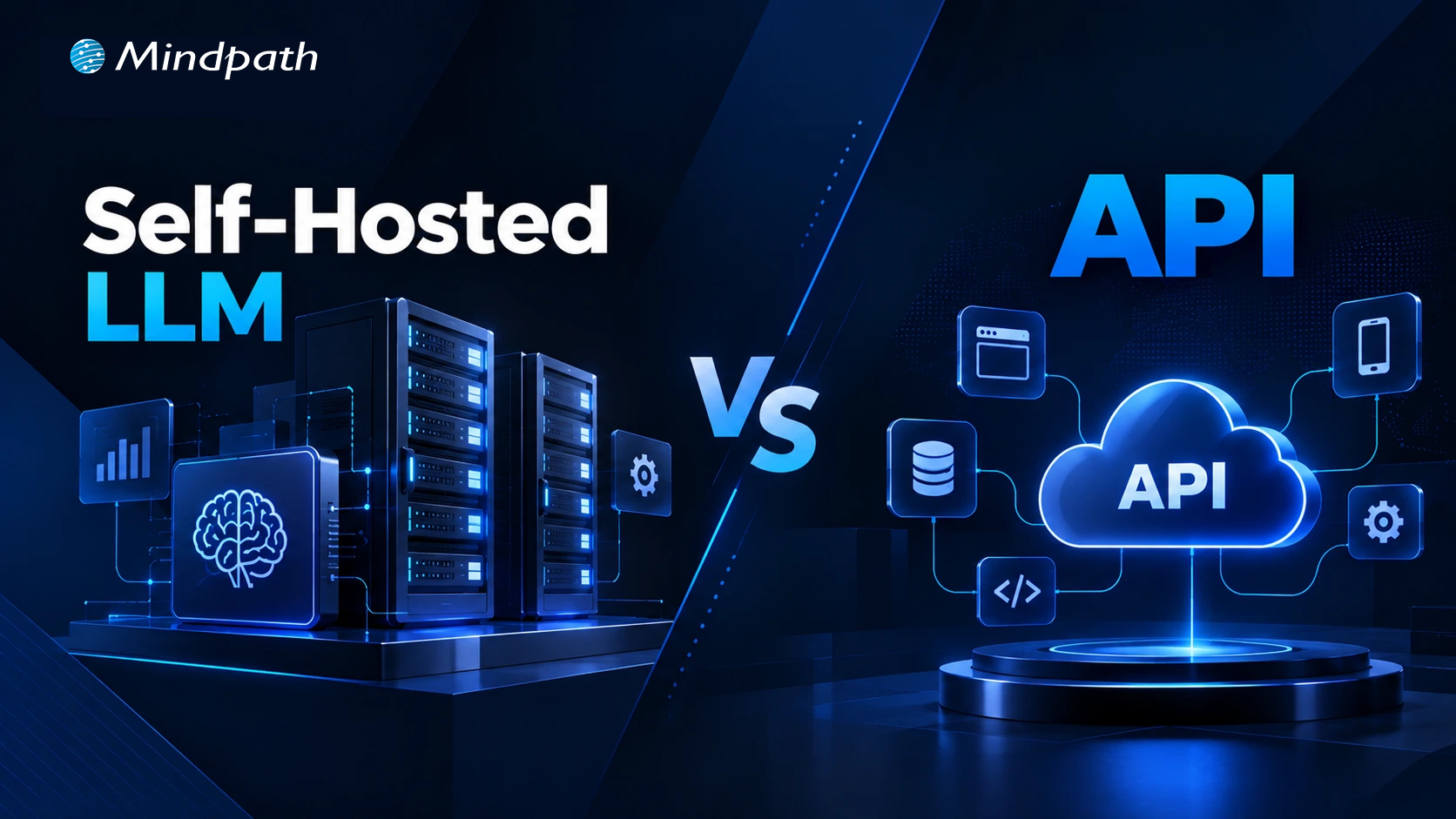
Self hosted LLM Vs API

At some point, every growing AI initiative runs into the same question: should we keep using an API or build something of our own? The LLM vs API decision is rarely as simple as comparing model capabilities. Cost, data control, latency, customization, and the demands of the application can all change the answer.

Key Takeaways

  • 01
    Choose between an LLM and API based on business requirements, cost, control, and performance.
  • 02
    Custom LLMs make sense when standard APIs cannot meet critical business requirements.
  • 03
    Self-hosted models offer greater control over data, infrastructure, latency, and model behavior.
  • 04
    Custom LLM development requires investment in data, compute, engineering, deployment, and ongoing maintenance.
  • 05
    Evaluate total ownership costs before replacing an API with a custom or self-hosted LLM.

Building a custom LLM can sound like the logical next step when an API starts falling short, but it can also introduce significant engineering and operational overhead. In many cases, RAG, fine-tuning, or a self-hosted model can address the real limitation without training a model from scratch. In this blog, we’ll look at when each approach makes sense, what it really costs, and how to choose based on business value.

Need a Custom LLM Built Around Your Business Needs?
Mindpath’s custom LLM development services help businesses design, customize, deploy, and optimize models around their specific data, workflows, performance goals, and infrastructure requirements.

What is a Custom LLM?

A custom LLM is a language model adapted or developed for a specific business requirement instead of relying entirely on a general-purpose model. Customization can involve fine-tuning an existing open-weight model, training it on specialized datasets, or building a model architecture for highly specific workloads. The goal is to make the model more effective for particular tasks, terminology, workflows, or operational constraints.

The key point is that custom LLM development does not always mean training a foundation model from scratch. A company may customize an existing model when that delivers the required performance with less investment.

Common benefits of custom LLM and considerations include:

1. Domain specialization

Handles industry-specific language, terminology, and workflows more consistently.

2. Greater control

Organizations can have greater control over model behavior, deployment, and infrastructure.

3. Data governance

Self-hosted deployments can provide stronger control over sensitive data and processing environments.

4. Predictable performance

A specialized model can be optimized for defined business tasks and response patterns.

5. Infrastructure demands

Self-hosting requires suitable compute, deployment architecture, monitoring, and MLOps capabilities.

6. Ongoing maintenance

Model evaluation, updates, security, and performance monitoring remain the organization’s responsibility.

What is an Off-the-Shelf API?

An off-the-shelf API provides businesses with access to a pre-trained LLM through a provider-managed interface. Instead of developing, training, and operating the underlying model, the application sends prompts or structured requests to the provider and receives generated responses. This makes it possible to add language capabilities to an application without taking responsibility for the model’s underlying infrastructure, training pipeline, or serving environment.

Key benefits and considerations include:

1. Faster deployment

Teams can integrate established models without building model infrastructure.

2. Lower initial investment

Training and infrastructure requirements are largely handled by the provider.

3. Managed scalability

Providers manage the computing resources needed to serve changing demand.

4. Model access

Businesses can use increasingly capable models without developing them internally.

5. Usage-based costs

Expenses generally increase with model usage, context size, and request volume.

6. Limited control

Businesses have less control over the underlying model, infrastructure, updates, and provider policies.

Need a Custom LLM Built Around Your Business Needs?
Mindpath’s custom LLM development services help businesses design, customize, deploy, and optimize models around their specific data, workflows, performance goals, and infrastructure requirements.
Explore Custom AI Development →

LLM vs API: How Do the Tradeoffs Compare?

The custom LLM vs API decision becomes clearer when you look beyond model quality. An API gives a team quick access to a capable model without requiring it to manage GPUs, deployment, scaling, or model operations. A self-hosted approach offers greater control, but that control comes with infrastructure, engineering, security, and maintenance responsibilities.

The right choice therefore depends on what the business is trying to optimize. A hosted API may be the practical option when speed and simplicity matter, while a self-hosted model can become attractive when data control, predictable workloads, latency, or specialized performance are more important.

Decision Factor Off-the-Shelf LLM API Self-Hosted / Custom LLM
Time to Market Fast integration using existing models Longer setup, testing, and deployment
Upfront Investment Lower initial investment Higher engineering and infrastructure costs
Model Control Limited control over underlying model Greater control over model and deployment
Customization Prompting, RAG, tools, and provider options Fine-tuning, model selection, and deeper customization
Data Control Governed by provider architecture and policies Greater control over data location and processing
Infrastructure Provider manages compute and serving Organization manages compute and serving
Scalability Provider handles infrastructure scaling Team must plan and manage capacity
Latency Depends on provider, network, and model Greater ability to optimize serving and placement
Cost at Scale Usage costs can rise with volume Higher fixed costs, with potential advantages at predictable scale
Maintenance Lower operational responsibility Requires ongoing MLOps, monitoring, updates, and security
Vendor Dependency Higher dependency on provider pricing and availability Greater architectural independence
Best Fit Fast-moving, general-purpose AI applications Specialized, sensitive, high-volume, or highly controlled workloads

For organizations comparing self-hosted LLM vs API options, the biggest consideration is often not which model produces better response in isolation. It is which architecture delivers the required performance while keeping the total cost and operational complexity under control.

When Should a Company Build a Custom LLM?

The right time to consider custom LLM development is when an API creates a measurable limitation that simpler approaches cannot solve. The local LLM vs API decision should be driven by business requirements, data control, performance, and long-term economics.

1. Specialized Domain Performance

General models consistently struggle with highly specialized terminology, workflows, or task-specific requirements.

2. Strict Data Control

Sensitive information must remain within a controlled infrastructure rather than being processed through an external provider.

3. Predictable High Volume

Large, consistent workloads make API usage costs difficult to justify over the long term.

4. Latency Requirements

Applications require faster and more predictable inference than a third-party API can reliably provide.

5. Deep Customization

Prompting, RAG, or standard fine-tuning cannot deliver the required level of model behavior or task performance.

6. Infrastructure Ownership

The business needs greater control over deployment, model versions, inference infrastructure, and operational policies.

7. Provider Dependency

Long-term reliance on external pricing, model changes, rate limits, or availability creates unacceptable business risk.

8. Strategic Model Ownership

AI is becoming a core product capability where controlling the underlying model can create meaningful technical or commercial advantage.

How Much Does Custom LLM Development Cost?

The cost of custom LLM development depends heavily on the model approach, data requirements, infrastructure, and level of customization involved. In LLM vs API comparison, businesses should evaluate total cost of ownership rather than comparing API fees with development costs alone.

Key cost factors include:

1. Model Development

Fine-tuning or deeper model customization requires specialized ML engineering and evaluation.

2. Data Preparation

Cleaning, structuring, labeling, and validating domain-specific datasets can become a significant part of the investment.

3. Compute Infrastructure

Training and inference require GPUs, storage, networking, and supporting infrastructure.

4. Engineering Expertise

ML engineers, data engineers, MLOps specialists, and application developers may all contribute to the project.

5. Deployment Model

Self-hosted environments require ongoing infrastructure, monitoring, security, and optimization.

Development Approach Typical Cost Range What Drives the Cost Best Fit
API Integration $15K–$80K Integration, prompts, testing, application development Fast AI launches and general-purpose applications
RAG Development $50K–$150K Data pipelines, retrieval, evaluation, security Business knowledge and document-heavy applications
Fine-Tuned LLM $100K–$300K+ Data preparation, training, evaluation, engineering Specialized tasks and domain-specific behavior
Self-Hosted Open Model $150K–$750K+ Model customization, GPUs, deployment, MLOps High-volume or data-sensitive workloads
Custom-Trained LLM $500K–$1.5M+ Training data, compute, ML engineering, infrastructure Strategic use cases requiring deep model ownership

When Should You Hire Custom LLM Developers?

Building a custom LLM requires expertise across model engineering, data pipelines, infrastructure, evaluation, and deployment. Businesses should consider it when the technical complexity and operational responsibility go beyond what their existing AI team can efficiently manage.

1. Specialized Model Expertise

Bring in experienced developers when model selection, fine-tuning, evaluation, or optimization requires deeper ML expertise.

2. Complex Data Pipelines

External expertise can help when large, fragmented, or sensitive datasets need to be prepared for training or fine-tuning.

3. Production Deployment

Custom models need reliable serving, monitoring, scaling, security, and MLOps practices beyond initial development.

4. Performance Optimization

Experienced teams can optimize inference speed, memory usage, model quality, and infrastructure costs for production workloads.

5. Limited Internal Expertise

Hiring specialists can accelerate development when building an in-house AI team would take significantly longer or require substantial recruitment costs.

Is a Custom LLM the Right Investment for Your Business?

The LLM vs API decision should come down to business value, not the appeal of owning a model. APIs, RAG, fine-tuning, self-hosting, and custom models each have a place. The right approach is the one that solves your performance, cost, security, and scalability requirements without adding unnecessary complexity.

At Mindpath, we provide custom LLM development services covering model customization, data engineering, deployment, evaluation, and optimization. As a custom LLM development company, we help businesses build practical AI systems aligned with their technical requirements, workflows, and long-term goals.
Do You Need a Custom LLM?

Build AI models tailored to your business needs.

Frequently Asked Questions

When model control, specialized performance, data governance, or predictable long-term economics justify the additional development and operational investment.
High usage volumes, specialized requirements, infrastructure control, and reduced dependence on external providers can make the investment more viable.
Yes, when the model directly supports a critical product capability and its long-term value outweighs development, infrastructure, and maintenance costs.
High infrastructure costs limited internal expertise, ongoing maintenance, model performance issues, and underestimating the resources required for production deployment.
Compare expected performance, total ownership costs, data requirements, scalability, deployment control, and operational responsibility against the business value each approach provides.

Support Is One Click Away

Featured Posts

Related Post

AGI vs ASI 

AI is advancing quickly, and the installation of the debate around AGI vs. ASI is picking up steam in tech circles. These phrases might seem similar but have very different meanings for the technology and the future. While we discuss this landscape, it is good to think about how this evolution will affect industries, decision-making, and everyday life. The difference between intelligent systems and possibly superintelligent systems is interesting, as there are many factors and questions that will stimulate conversation among the expert community.

To comprehend the differences between AGI and ASI, it is necessary to examine their features and possible influence. AGI will try and mimic human-like building understanding across tasks, and ASI expands into areas beyond ourselves, with conjectures that we may not be able to comprehend. By tracking the advancement of these systems, we may be able to better prepare ourselves for potential opportunities and challenges. In this blog, we will explore AGI vs. ASI in greater detail and what separates them.

Want to implement this rise of AGI and ASI into your business operations? At Mindpath, our AI Development Services empower you to integrate this next-generation intelligence into real-world applications today.

What is AGI AI?

AGI stands for artificial general intelligence. The goal of AGI artificial intelligence is to develop systems that are able to think and learn like a human being. As it stands, current artificial intelligence only operates within a defined boundary, while AGI will have the ability to undertake new tasks or challenges that have not been specifically programmed. AGI research needs to increase intelligence beyond narrow application and focus on understanding, reasoning, and problem solving over a wide variety of situations.

Regarding AGI vs. ASI, AGI describes the point in time at which a machine has human-like cognitive properties. It can learn on its own, improve its own skills, and perform tasks that were never taught to perform specifically. This level of advanced intelligence is the step researchers see as important toward more advanced systems. AGI also helps understand what the future of intelligence will look like within the technical framework.

Want to know which AI breakthroughs are driving the gap between AGI and ASI? Explore the most recent developments in generative AI trends and their impact on advanced intelligence.

Key Benefits of AGI Artificial Intelligence in Business

Artificial general intelligence is changing the way enterprises deal with problems and prospect the future. Its ability to learn and adjust like a human being is paving the way for the options that change the companies’ concept of getting bigger and ‍‌innovating.

1. Better Decisions

AGI studies large amounts of data to identify patterns and trends that generate wiser decisions. It also offers predictive analytics, which enables businesses to plan in terms of strategy, demonstrating one of the differences between AGI vs. ASI capabilities.

2. Boosted Innovation

AGI also allows for new products, services, and business models that never existed before. It can also spark the creative process for businesses to remain competitive.

3. Enhanced Customer Care

AGI tailors their interaction based on anticipated customers’ behavior and preferences. AGI is also able to offer customer care in real time, which leads to improved retention and satisfaction.

4. Increased Efficiency

AGI is capable of taking over monotonous tasks, granting employees more time for strategic activities. It facilitates workflows and improves productivity overall.

5. Reduced Costs

AGI streamlines processes and lowers required labor, minimizing operational costs. It performs tasks correctly, thus decreasing errors that lead to wasteful expenditures.

Struggling to implement AI effectively despite understanding the differences between AGI and ASI? Discover practical insights on overcoming these challenges of AI adoption.

What is ASI AI?

ASI stands for artificial superintelligence. ASI artificial intelligence signifies a phase in which machines excel human intellect in all areas. ASI doesn’t simply copy human-like thinking, as is the case with AGI, but ASI can process complex abstractions and resolve problems beyond a human level of operations. The ability to reason, learn, and adapt will happen much faster than any human could.

In the conversation of AGI vs. ASI, ASI is unique and purely hypothetical in that people are generally not aware of it yet, but it could very well usher in a mega-change. It proposes an ideal of self-aware systems that understand and interpret behavior in ways that humans cannot. Researchers are working on ASI to prepare for what technology, society, and decision-making look like in the future when intelligence is not limited to humans.

Key Benefits of ASI Artificial Intelligence in Business

ASI AI stands for a new tier of intelligence, one that reveals the outer limits of what machines might be able to accomplish. Its capability is changing how enterprises reflect on technology, strategy, and the future.

1. Advanced Problem-Solving

ASI has the ability to analyze a massive quantity of data at extraordinary levels of speed to solve problems that are impossible for humans. Companies interested in AGI vs. ASI can leverage this ability to develop new opportunities and discover new markets.

2. Hyper-Personalized Service

ASI can analyze customer data in order to gain insights into their individual preferences and behaviors and offer highly personalized experiences. ASI can offer personalized marketing, recommendations, and customer service that predict customer needs before they express them.

3. Predictive Insights

ASI is capable of making market predictions, predictions about consumer behavior, and disruptions with a high degree of accuracy. By having this ability, organizations can make better decisions and reduce risk.

4. Operational Efficiency

ASI can oversee complex processes and streamline industries with almost no human supervision. It can improve workflows, minimize inefficiencies, and reduce operating costs significantly.

5. Enhanced Cybersecurity

ASI can identify and mitigate cyber threats in real-time, keeping ahead of possible attacks. It enhances security for critical infrastructures and proprietary business information.

Wondering how AGI and ASI compare to other stages in the AI evolution journey? Discover the various types of Artificial Intelligence and how they shape modern innovation.

ASI vs. AGI: A Comparison Table

The table below highlights the key differences between ASI and AGI, showing how their capabilities and potential impacts vary.

Feature AGI ASI
Intelligence Level Human-level cognitive abilities across tasks. Surpasses human intelligence in all domains.
Learning Ability Learns and adapts like humans across multiple areas. Learns exponentially and self-improves beyond human understanding.
Problem-Solving Can handle complex tasks humans can manage. Solves problems beyond human capacity, including abstract and novel challenges.
Existence Currently under research, possible in the future. Hypothetical, not yet achieved.
Decision-Making Makes informed, human-like decisions. Makes near-perfect predictions and strategic choices using vast data.
Impact Supports humans, automates tasks, and improves productivity. Can transform industries, create technologies, and potentially surpass human control.
Examples Personal assistants, research AI. Hypothetical global optimization or fully autonomous research systems.

Are You Ready to Unlock the Future of AI?

Artificial intelligence is evolving rapidly, and understanding AGI vs ASI helps businesses prepare for future opportunities and challenges. Both systems offer unique capabilities, from human-like decision-making to superintelligent problem-solving. Staying informed allows organizations to leverage these technologies responsibly and strategically, ensuring they remain competitive and innovative as AI continues to reshape industries and daily operations.

At Mindpath, we offer expert AI development services to help businesses implement advanced AGI and ASI solutions. Our team builds scalable, intelligent systems tailored to your goals, from automating workflows to creating predictive and personalized experiences. Partnering with Mindpath ensures your organization can stay ahead in innovation, efficiency, and growth while navigating the evolving AI landscape with confidence.

role of vector database in ai application

Have you ever thought to yourself about how AI can interpret images, voices, or texts so accurately? Well, it is due to the rapid growth of the role of vector databases in AI applications. Standard databases do a good job of storing structured data, while much of AI work involves dealing with complex and unstructured information. Vector databases provide methods for storing and comparing information which allow machines to recognize patterns, context, and meaning much faster and with higher accuracy.

As AI systems become more intelligent, the demand for methods to support thinking beyond the simple data is also increasing. Vector databases provide that opportunity for AI to correlate information, learn from it, and generate more impactful results. They are quickly becoming the framework of modern AI innovation. In this blog, we will take a look at the power of vector databases in AI applications and why they are a necessary future element of intelligent systems.

Key Takeaways

  • 01
    Vector databases help AI applications search and compare information based on meaning and context.
  • 02
    They support AI use cases such as semantic search, RAG, recommendations, and computer vision.
  • 03
    Vector embeddings convert text, images, audio, and other data into numerical representations that AI can compare.
  • 04
    Fast similarity search allows AI systems to retrieve relevant information from large and complex datasets.
  • 05
    Vector databases can act as a memory layer for AI systems and agents that need to store and retrieve contextual information.

Looking for a way to enhance personalization with the help of AI in your apps using a vector database? Explore Mindpath’s AI development services, which provide expert guidance and knowledge on how to maximize the value of the vector database to elevate your AI capabilities.

What is a Vector Database for AI?

A vector database is a specific type of database that enables storing and searching for data represented as vectors. Vectors are sets of numbers that represent the meaning or features of data such as text, images, and audio. Instead of searching for exact matches of data, a vector database searches for similar items, based on the context, illuminating AI’s capacity to perform at a more intelligent level based on context.

In basic terms, it works like the brain of AI systems that require memory and comparison. A vector database in AI enables quick and accurate data searches among very large and complex datasets. They are often used in applications such as chatbots, recommendation engines, and image searches where the response time and clearly related results mean everything.

In simple terms, a vector database helps AI applications store, search, and retrieve information based on meaning rather than exact keyword matches.

Curious how AI chatbots can boost engagement and revenue? Discover AI Chatbot examples to learn how vector database-driven intelligence improves customer interactions.

How Does a Vector Database Work?

Vector databases assist artificial intelligence to comprehend and look through data in terms of meaning rather than precise words. Data is stored as numbers that illustrate what the data depicts. This helps AI connect ideas, find similarities, and give more accurate and useful results.

1. Creating vector embeddings

AI models process raw data to create vectors, which are sets of numbers that represent the meaning of the data. Vectors are mechanisms for AI to understand the connections among different data points.

2. Storing and indexing vectors

The vectors are kept within a vector database, which can be indexed with smart indexing methods, such as HNSW (Hierarchical Navigable Small World) or IVF (Inverted File Index). The role of vector databases in AI applications here is to store, group, and quickly find similar data when needed.

3. Performing similarity search

When the search begins, it will convert the query into a vector, which it begins to compare to other stored vectors. The database returns the closest elements based on meaning, so the AI can accurately and relevantly respond to the user.

Looking to optimize AI models without heavy computational costs? Explore Low-Rank Adaptation (LoRA) to discover techniques that improve vector database-powered AI efficiently.

Role of Vector Databases in AI Applications

The importance of the vector database for the AI application is becoming more necessary and prevalent as AI works with larger and more complicated data. Below are the main ways in which it helps and enhances the AI systems.

1. Smarter Search with Meaning

An AI application that utilizes a vector database can perform searches on meaning, rather than just a specific word. It finds things that are contextually similar in vector space; this is a lot more precise and much more human-like. This is incredibly useful, because the AI system can determine what users mean, not simply what they type.

2. Supporting Retrieval-Augmented Generation (RAG)

Vector databases provide large language models with access to current facts, knowledge, and data points from the public domain. The user’s inquiry is converted to a vector, which retrieves information from data similar to that represented in the user’s question. The information and materials retrieved help the AI provide responses that are elevated in relevance and made to be factually accurate.

3. Managing Complex Data Types

The role of vector database in AI application is to be able to manage unstructured data including images, text, and audio. A vector database does this by representing the unstructured data as numerical vectors that convey meaning. This allows AI to be able to compare unstructured data types more easily.

4. Enabling Fast Similarity Search

Vector databases leverage novel algorithms to identify similar items quickly, even among massive datasets. This capability is crucial for a number of artificial intelligence (AI) applications that depend on real-time results. The vector database in the AI application in this case is to return results quickly and still maintain precision.

5. Improving Recommendations

Recommendation systems utilized vector databases to recommend similar attributes to items or products that users had liked before. AI uses patterns in the vectors and can customize content for each individual. This leads to a more meaningful and engaging experience for the user.

6. Powering Computer Vision

In computer vision, a vector database in AI helps identify and compare images or videos efficiently. It supports tasks like face recognition, image search, and visual content filtering. By finding visually similar vectors in AI systems it improves speed and accuracy.

7. Building AI Memory

The role of the vector database in AI applications is that it is a dependable memory mechanism for the AI agents. It strengthens the AI agent’s ability to store and retrieve information in support of reasoning and decision-making. Thus, vector capacity increases the multi-step capabilities of AI agents when solving complex tasks.

8. Hybrid and Refined Search

Vector databases have the ability to merge traditional filters like date or category with similarity search. This hybrid effort increases the precision and relevance of a search result. Users can quickly and clearly find exactly what they are looking for.

Wondering how AI systems focus on the most important information in complex datasets? Discover the Attention Mechanism to learn how it enhances AI performance in combination with vector databases.

Ready to Build Smarter AI Solutions with Vector Databases?

Vector databases are transforming how AI systems process and understand information. They enable faster searches, handle complex data, and make AI responses more meaningful and accurate. As technology continues to advance, the role of vector databases in AI applications will remain central to building intelligent and scalable solutions across industries.

At Mindpath, our AI development services combine the power of vector databases with advanced machine learning models to build smarter and more efficient systems. We help businesses create intelligent applications that learn, adapt, and deliver real results. Partner with us to design AI solutions that drive innovation and long-term success.

progressive web apps

Many companies are now looking into progressive web apps to improve their ways of communicating with people using mobile devices. This solution has the capability of being responsive and reliable, while providing users with an experience that reflects expectations in today’s world. Companies are wishing to provide users with something that has simplicity and speed. This change is not only about changing ideal trends, but rather the relationships that effectively span through the utilization of mobile devices and help establish long-term commitment to retention.

This shift to a modern approach is allowing organizations to rethink how they plan differently today for mobile-first users. It enables organizations to offer something new with a sense of reality and cost-effectiveness. Users benefit without even realizing what goes on behind the scenes, while businesses reap the benefits by providing an experience that works. This blog will ultimately help you understand why so many people are considering this path forward. Let’s dive in!

Want to develop a Progressive Web Application and increase your business growth four times? Contact us and talk to our experts, they will help you achieve your business objective with an unexceptional progressive web app. 

What is a Progressive Web App?

A Progressive Web App (PWA) is a modern type of web application that works like a regular app but runs through a web browser on any device. It combines the best parts of websites and mobile apps, allowing users to access it easily without needing to download anything. PWAs can work offline and continue running in the background, giving people a smooth and reliable experience wherever they are.

Businesses are turning to PWAs to offer better performance and engagement for their customers.  According to Gartner, more than 50% of consumer-facing apps will be PWAs by 2027, showing just how important this technology is becoming for the future of digital experiences. A survey by Grand View Research reveals that the global PWA (progressive web app) market is expected to reach $9,425.9 million by 2030, growing at a rate of 30.5% from 2024 to 2030.

Benefits of PWAs (Progressive Web Apps)

Adopting PWA is genuinely beneficial for companies trying to remain competitive in a mobile-first environment. These solutions offer the advantages of both web and native apps features to provide users with a seamless experience. The following are some key benefits to consider:

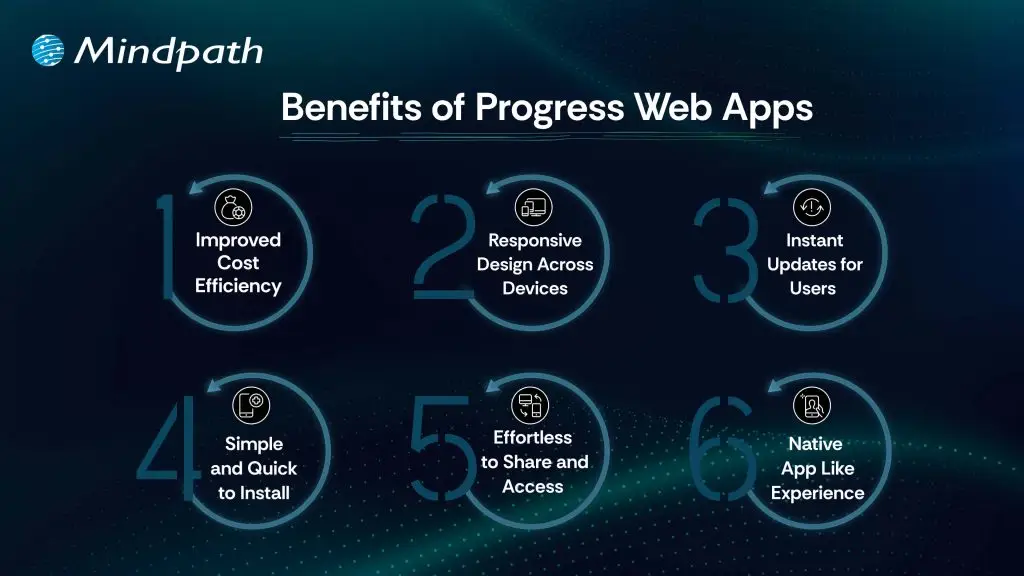
Benefits of PWAs (Progress Web Apps (1)

1. Cost Efficiency

Developing a web app is often much more affordable than building a native app. Instead of creating separate versions for web, iOS, and Android, one project works across all major platforms. A progressive web app iOS solution uses a single codebase, which keeps development simple and costs less. Ongoing updates and maintenance are also easier and more budget-friendly than managing multiple native apps.

2. Responsive Design Across Devices

The responsive design makes PWA development valuable for reaching users on any device. A single PWA can adapt to mobile phones, desktops, laptops, or tablets without needing separate builds. For example, it works just as well on a Google Pixel phone as it does on a Windows computer. This approach helps businesses offer a consistent experience everywhere while keeping development simple.

3. Instant Updates for Users

A PWA stays current whenever it’s online, so users always see the latest version. There’s no need to download or install updates manually. New features and content appear automatically without extra steps. This makes the experience smooth and hassle-free for everyone.

4. Simple and Quick to Install

A progressive web app makes installation easy for users. There’s no need to visit an app store or follow long steps to get started. Everything happens right in the browser with just a few clicks. This gives users faster access to content without any extra hassle.

5. Effortless to Share and Access

PWA can be shared easily through a direct URL, just like any standard website. This means users can pass it along to others without any special steps or downloads. It works smoothly across devices, making access simple and convenient. This flexibility helps businesses reach a wider audience with minimal effort.

6. Native App-Like Experience

A progressive web app offers many of the same features people love about native apps. It works even when there’s little or no internet connection, keeping access smooth and reliable. Push notifications help keep users engaged and informed on most devices. With home screen installation and familiar mobile navigation, it gives users a true app-like experience.

Worried about keeping your apps secure? Explore Application Security Best Practices to learn essential strategies for protecting your web and mobile applications.

Real-World Examples of PWAs

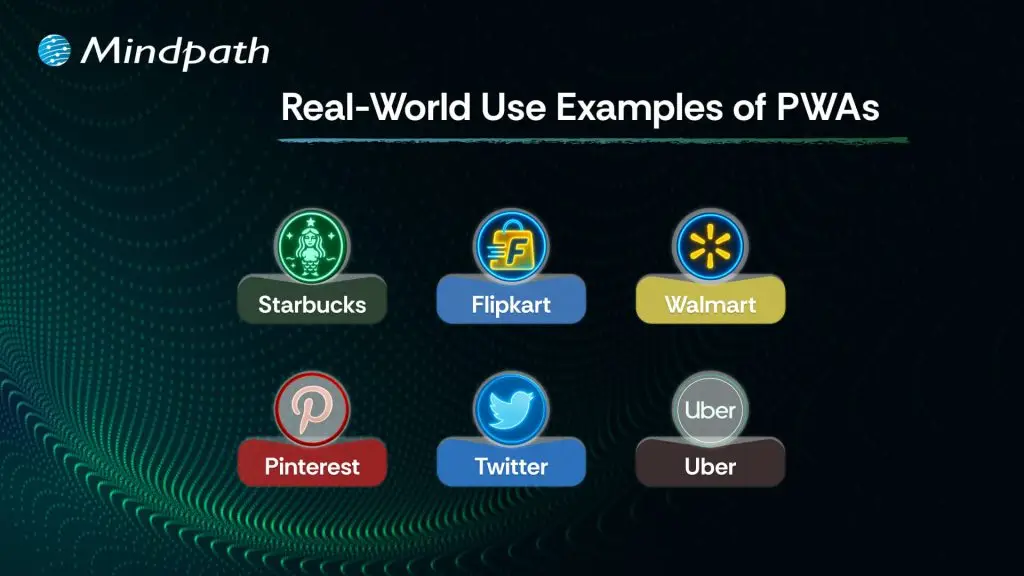
Many leading brands are proving the value of this technology through real progressive web app examples. These practical cases show how businesses can offer faster, more reliable experiences that keep users engaged.

Real world use examples of pwas

1. Starbucks

Starbucks created a PWA to boost customer engagement with a smoother ordering process and rewards program. This solution replaced its old mobile site to offer a consistent experience on any device. Customers can easily customize drinks, check store details, and view nutrition information.

2. Flipkart

Flipkart’s PWA helps shoppers enjoy a smooth browsing experience, even with poor connections. Users can explore product categories, special deals, and bestsellers with ease. This approach keeps customers engaged longer and makes online shopping more accessible across India.

3. Walmart

Walmart uses a PWA to handle thousands of products while making ordering and delivery seamless. Geo-tracking shows top-selling items nearby to personalize recommendations. Push notifications to keep users updated on deals and new arrivals.

4. Pinterest

Pinterest launched a PWA to expand its global reach with a faster, lighter site. Compared to its old version, the new app loads quicker and uses less data. This led to more time spent, higher ad engagement, and improved click-through rates.

5. Twitter

Twitter Lite was one of the first big brands to adopt a PWA to boost daily user activity. It consumes less data, loads quickly on slower networks, and still feels like a native app. As a result, page views, tweets sent, and overall engagement increased significantly.

6. Uber

Uber is a strong example of progressive web app design focused on speed and convenience with minimal storage use. It loads quickly, even when the network is weak, so users can book rides without delays. Depending on the location, people can also order food or rent bikes and scooters.

Looking to build a robust web application? Discover choosing the right tech stack for your web application and make informed decisions on frameworks, languages, and databases.

Are You Looking to Elevate Your Digital Presence?

Progressive web apps prove that businesses can deliver fast, reliable, and engaging user experiences without the high costs of traditional apps. With examples like Starbucks, Flipkart, and Uber leading the way, it’s clear that investing in this approach helps brands stay competitive in a mobile-first world. Adopting the right strategy ensures you get the most out of modern application development services.

At Mindpath, we develop future-ready AI solutions that unlock the true value of progressive web apps. Our expert web application development services help you create mobile-first experiences that are cost-effective, secure, and easy to maintain. From planning to launch, we ensure your app stands out and keeps your customers engaged. Let’s shape your next success story together.