What is Legacy Modernization – A Comprehensive Guide 

Join our Newsletter!

Featured Posts

Support Is One Click Away

Home

What is Legacy Modernization – A Comprehensive Guide 

legacy modernization

What is Legacy Modernization – A Comprehensive Guide 

Technology is a high-paced thing, and companies are under pressure to keep up with it. Legacy Modernization has come to be a serious agenda among companies that currently use the old systems to conduct their daily operations. You may find that the performance is slowing down, maintenance costs are increasing, and security threats are increasing yearly. All these problems cause tension amongst teams and restrict innovation. Then, what actually happens when the old systems are retarding progress? And how do companies get back in control without derailing the fundamental processes?

Meanwhile, leaders desire systems that can enable development, flexibility, and more intelligent decision-making. Their goals are to enhance performance besides safeguarding the vital data and business logic. Such an equilibrium needs a good technical direction and strategy. Thus, it is critical to comprehend the acceptable strategy to achieve success in the long term. This blog will discuss all the major points of legacy modernization step by step.

Ready to move beyond outdated systems that slow down your business? Mindpath offers legacy modernization services to help you upgrade and transform legacy applications into scalable and future-ready solutions.

What is Legacy Modernization?

Legacy modernization involves updating old software and infrastructure to new modern technologies and architectures. It enhances the performance, security and scalability without altering the underlying business logic. Businesses rely on it in order to remain competitive and promote growth. This strategy enhances the current systems and makes them ready to meet the current digital requirements without necessarily interfering with day to day activities.

However, legacy system modernization goes beyond technical upgrades. Companies need to reconsider procedures, user experience and long term objectives. They enhance efficiency, mitigate risk and facilitate innovativeness with strategic change. An effective modernization strategy puts technology into business performance and establishes a platform to achieve the long-term digital development.

Must Read: Benefits of Modernizing Legacy Systems

Why is Legacy Modernization Important?

Outdated systems slow progress and increase risk. The modernization of legacy applications helps businesses improve performance, security, and flexibility. Here are some of its key benefits:

1. Legacy modernization reduces high maintenance and infrastructure costs. It also reduces the reliance on the old systems and costly specialists support.

2. It enhances the rate of speed and general dependability of the system. Teams are also able to update at a higher pace and handle changes with ease.

3. It enhances security because it eliminates the risks associated with outdated software. Organizations remain updated on new compliance standards and regulations as well.

4. It improves agility and promotes inter-team innovation. Companies are able to introduce new functionality in a shorter time and react to the needs of the market.

5. Contemporary systems can easily manage increasing traffic and information. They are also compatible with cloud computing and other sophisticated analytics solutions.

6. It improves user experience by making the user interfaces and performance cleaner. There is a greater work efficiency and confidence among the employees when using the system.

Curious about the best way to transition from legacy systems to modern platforms? Check out our legacy modernization roadmap blog to uncover proven steps and strategies.

How to Modernize Legacy Applications?

Organizations must take a clear and strategic approach to legacy modernization to avoid disruption and control risk. A structured plan helps teams upgrade systems efficiently while supporting business goals and future growth.
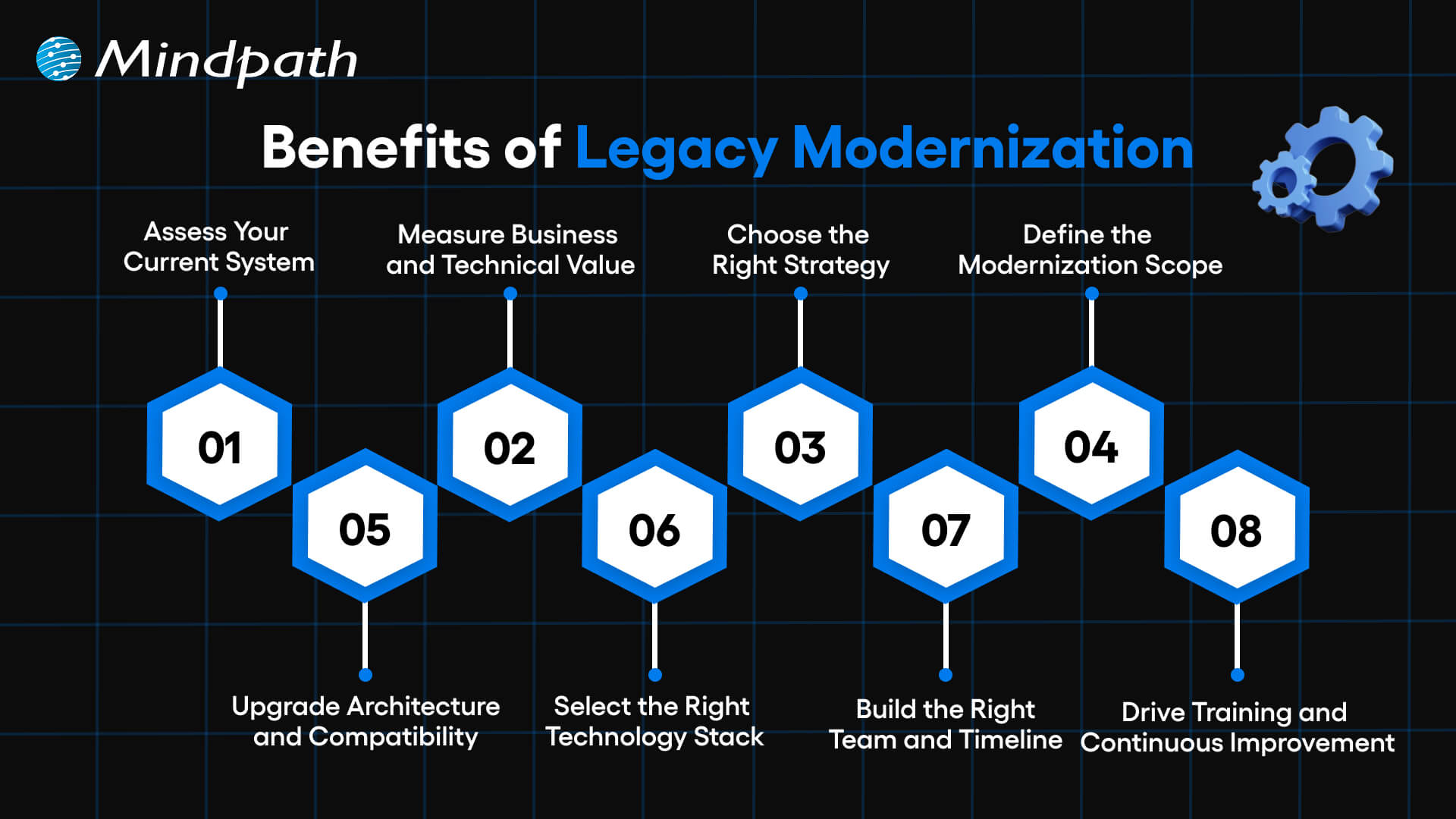
benefits of legacy modernization

1. Assess Your Current System

Evaluate your applications both business and IT. Determine deficiencies in performance, security and scalability. This step builds a strong base for legacy modernization decisions.

2. Measure Business and Technical Value

Assess business fit, agility, cost, complexity and risk. Know the amount of value each system brings in the present day. Clear insights strengthen your legacy app modernization strategy.

3. Choose the Right Strategy

Select a legacy modernization approach that aligns with business goals. Compare such options as rehost, refactor, rebuild or replace. Take the course of action that brings more quickly and reduces the risk.

4. Define the Modernization Scope

Target key points that lead to business performance. Eliminate the old and unwanted functions that complicate things. A clear scope helps teams modernize legacy applications with confidence.

5. Upgrade Architecture and Compatibility

Use scalable architecture when needed e.g. microservices. Enhance dynamism and streamline administration of the system. Enhance seamless integration with other tools/ platforms.

6. Select the Right Technology Stack

Select technologies that will be able to accommodate existing needs and expand in the future. Never act on your judgment without consulting experts. Good testing will guarantee effectiveness, protection and dependability.

7. Build the Right Team and Timeline

Create a cross functional team with established responsibilities and ownership. Develop and maintain documentation. Set realistic milestones to guide legacy modernization progress.

8. Drive Training and Continuous Improvement

Train the staff on effective use of the new system. Onboarding is encouraged by means of structured support. Continuous updates keep legacy modernization relevant and sustainable.

Want to align your legacy systems with your long-term business goals? Explore the legacy modernization strategy for business growth to build a result-driven transformation plan.

Key Challenges in Legacy Modernization

There are some valid advantages of legacy modernization, but it also possesses actual challenges. During the transition, organizations have to be ready to overcome technical, financial, and operational challenges.

1. Complex Legacy Code

Systems are difficult to comprehend and expand due to old-fashioned code and lack of documentation. Such complexity slows the development and raises its maintenance costs.

2. Integration Barriers

The old systems also fail to make connections with cloud providers and new APIs. Architecture reengineering will require teams to be mindful of downtime and the gaps in security.

3. Security and Compliance Gaps

The existing security and regulations are not met in aging systems. It is necessary that Legacy Modernization involves proactive protocols, encryption, and compliance control updates.

4. High Costs and Limited Resources

Modernization demands investment in equipment, education, and infrastructures. Lack of a proper roadmap will increase costs and strain internal resources.

5. User Resistance to Change

Employees tend to be at ease with the well-known systems. Good communication, training will enable teams to adjust to Legacy Modernization programs.

6. Performance and Scalability Limits

Old applications are unsuitable to meet the increasing data and user requirements. Legacy Modernization enhances speed, stability, as well as long term scalability.

7. Knowledge and Skill Gaps

It may be challenging to locate professionals with knowledge of old technologies. Lack of experience will put risks and time delays at a higher level and make the project more complex.

8. Data Migration Risks

Migration of mass volumes of old data can result in loss, corruption or compatibility problems. There has to be audits, backups and testing of data to ensure data integrity in Legacy Modernization.

Planning to integrate AI into your legacy infrastructure for better decision-making? Learn about AI-driven legacy system modernization to transform your systems intelligently.

8 Legacy Modernization Strategies for Modern Businesses

Companies must have a strategy in place when modernizing old systems. The right legacy modernization strategies assist in decreasing risk and faster business worth.
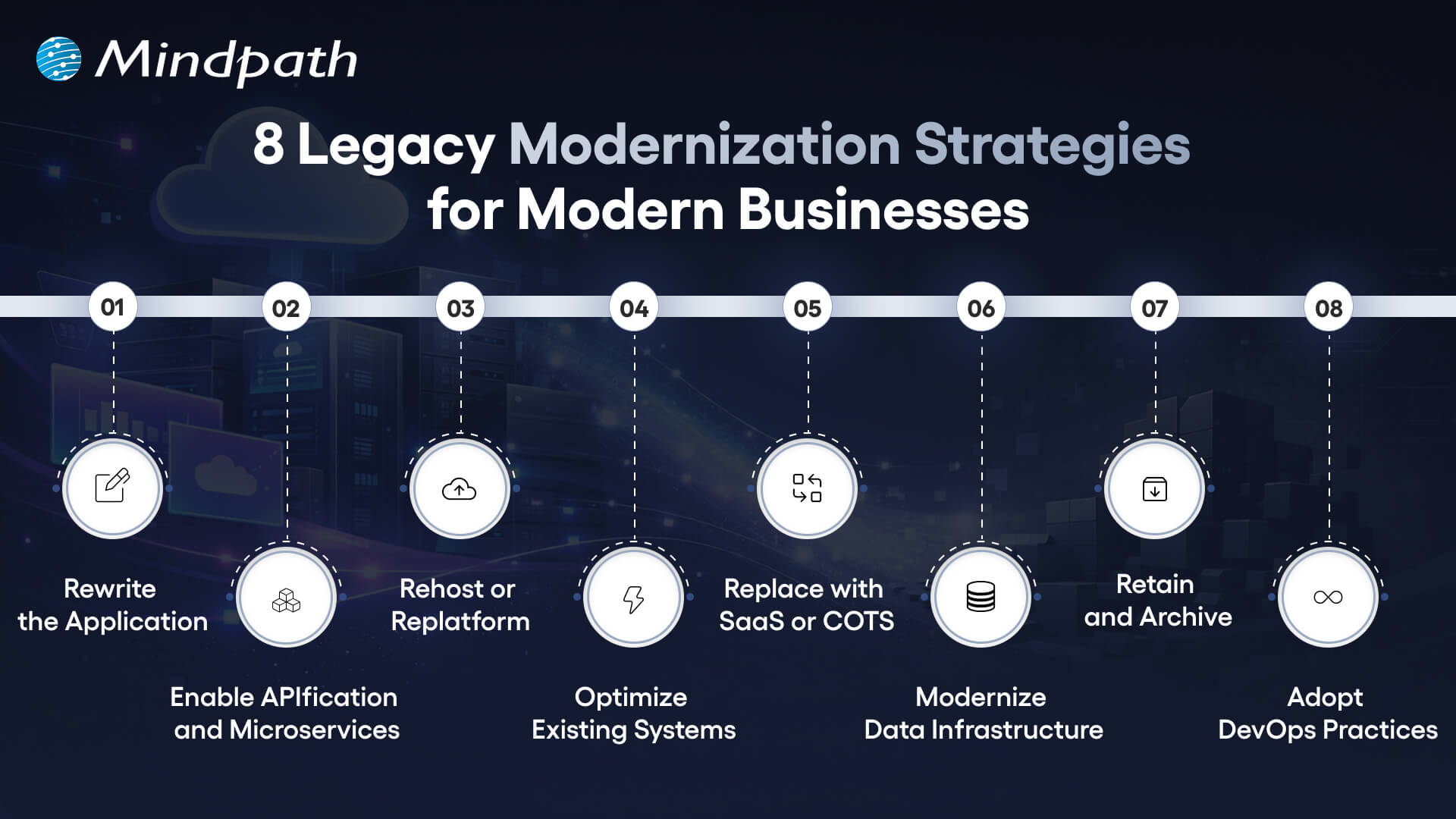
8 legacy modernization strategies for modern businesses

1. Rewrite the Application

Rewrite the old systems using new languages. This strategy will modernize the application and enhance quicker updates. It also reduces the long term maintenance.

2. Enable APIfication and Microservices

Divide monolithic systems into small services. APIs can be used to better integrate them. Innovation is accelerated through this model.

3. Rehost or Replat form

Migration to the cloud with minimal code modification. It is a move that minimizes infrastructure expenses within a very short time. The teams enhance scalability without causing much disturbance.

4. Optimize Existing Systems

Check the workloads as well as code performance gaps. Minimize the usage of infrastructure and operations expenditures. Utilize savings to finance additional upgrades.

Must Read: Monolith to Microservices

5. Replace with SaaS or COTS

Use pre-made platforms that will satisfy business requirements. Accomplish security and compliance. Implement solutions in a shorter time and with reduced risk.

6. Modernize Data Infrastructure

Move the old databases to scaled systems. Enhance the speed, analytics, and flexibility. This step should be aligned to Legacy Modernization.

7. Retain and Archive

Retain those systems that retain the necessary value. Audits of applications that are rarely used in the archive. Unnecessary changes and risks should be avoided.

8. Adopt DevOps Practices

Implement continuous integration and testing. Publishing is faster and teamwork becomes better. Enhance the performance and stability of the systems.

Planning to enhance your modernization efforts with better automation and continuous delivery? Discover DevOps best practices to build a more agile and scalable transformation process.

Key Trends for Legacy Modernization System

Organizations are still redefining their technology environment to remain competitive. The modernization trends point to the new directions that lead to faster, smarter and more scalable transformation.
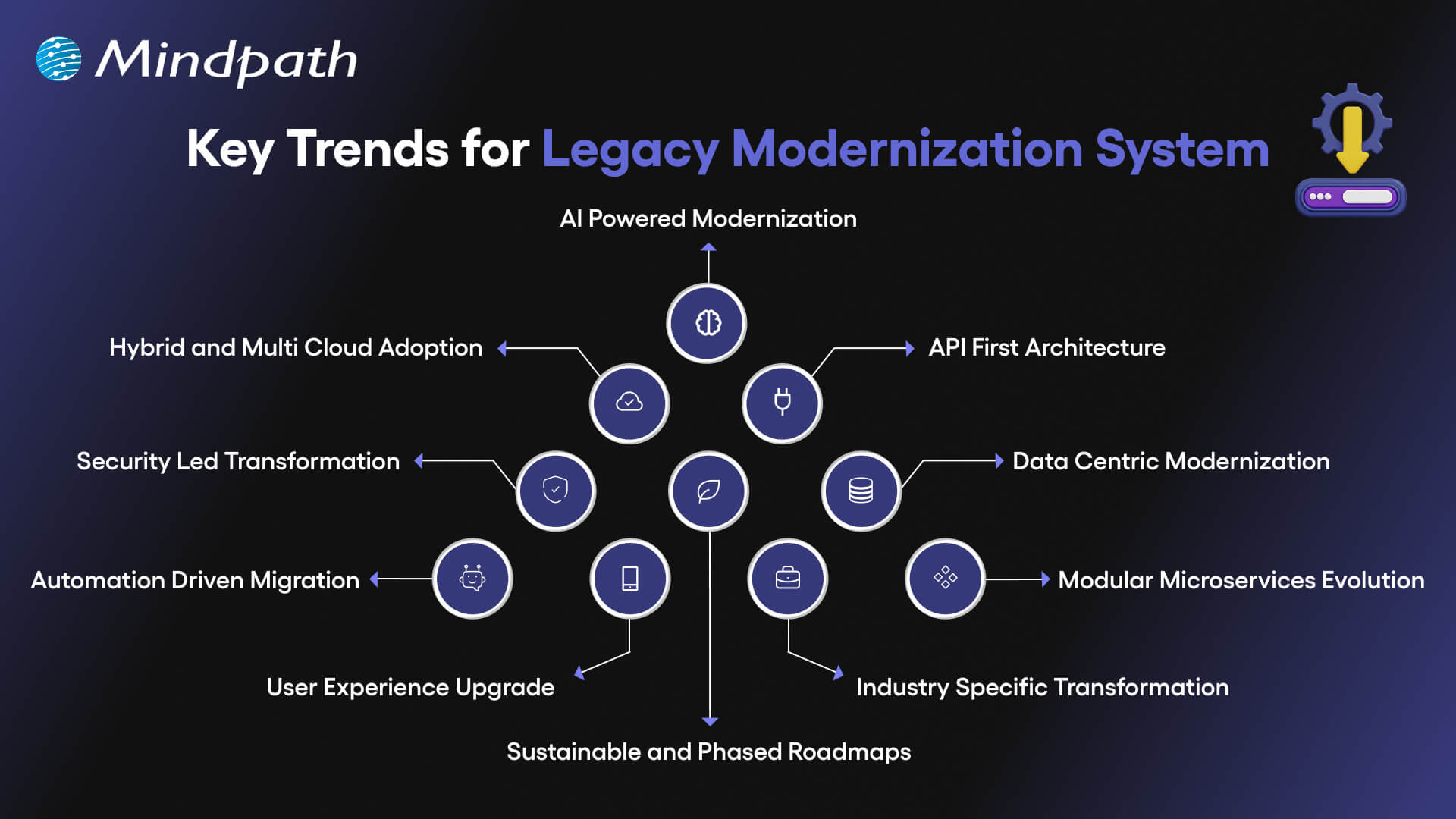
key trends for legacy modernization system

1. AI Powered Modernization

Code refactoring, re-architecture and system analysis are now assisted by AI. According to legacy modernization trends, many enterprises spend lots of money in AI. It enhances preciseness, less threat, and accelerates change.

2. Hybrid and Multi Cloud Adoption

Organizations have stopped relying on one cloud provider. They operate hybrid and multi cloud environments to be flexible and resilient. Container platforms assist systems to operate efficiently in environments.

3. API First Architecture

Enterprises substitute monolithic models with modular API based models. The APIs enhance integrations, scalability, and expedited feature upgrade. The change holds its ground in the contemporary legacy modernization patterns.

4. Security Led Transformation

The presence of stringent rules encourages companies to advance the old security checks. Zero trust models, encryption, and enhanced access management are implemented in teams. Every modernization roadmap is currently being influenced by security.

5. Data Centric Modernization

Isolated data warehouses are sent to unified lake house platforms by businesses. This measure enhances real-time understanding and information controls. Powerful data strategy is a key to successful legacy software modernization.

Curious about how AI can reduce costs and improve system capabilities? Check out the benefits of AI to transform your business operations.

6. Automation Driven Migration

Code scanning, risk detection, and recommendation are processes performed by AI-based tools. Jurisdictional testing and documentation lowers the manual work involved. These applications reduce migration time.

7. Modular Microservices Evolution

Businesses upgrade microservices using containers and orchestration technology. AI assists in tracking and optimization of working loads. This will enhance system stability and scalability.

8. User Experience Upgrade

The future UX concentrates on customization, usability, and functionality. Component based design models substitute strict legacy interfaces. These enhancements are in line with wider patterns of legacy modernization.

9. Industry Specific Transformation

Banks, healthcare providers, and manufacturers need individual solutions. Modern systems are now able to comply with strict industry rules. A strong legacy modernization framework supports niche requirements effectively.

10. Sustainable and Phased Roadmaps

Companies are ready to upgrade slowly than to rewrite everything. Planned phase will guarantee the sustainability of long term and reduce disruption. This approach makes modernization anticipative and expandable.

Want to make your legacy modernization efforts more environmentally responsible? Explore sustainable technology to build eco-friendly and future-ready systems.

Examples of Legacy Systems

Several organizations are still using the old systems to execute important activities. These are the legacy systems that are still in use and support day-to-day processes in spite of low adaptability and scalability.

1. Cloud Enablement in Financial Services

To enhance scaling and reporting, a fintech company has transferred the core systems to the cloud. This legacy modernization decreased manual labor and increased reliability.

2. Clinical Platform Enhancement

A microservices-based upgrade of an oncology system to speed up its performance. The transformations enhanced integration and helped to make medical decisions faster.

3. High-Performance Trading Systems

Microservices and automated deployments were embraced in a trading platform. This legacy modernization enabled speed and increased volume of transactions.

4. Digital Leasing Transformation

One leasing system upgraded its infrastructure to initiate operations more quickly. The upgrade made the operations less complex and efficient.

5. Smart Assessment Innovation

One of the education platforms presented AI-based grading tools. The educators used to save some time and received more rapid performance feedback.

6. Scalable K-12 Learning Infrastructure

One school system optimized its cloud environment to its maximum. The upgrade also enhanced the uptime and made the learning process stable.

Wondering how to connect legacy modernization with broader business goals? Explore about digital transformation for business to align technology with strategic growth.

Ready to Future Proof Your Business?

Legacy systems limit growth, increase risk, and slow innovation. Organizations that invest in legacy modernization improve performance, security, and scalability while reducing long term costs. A clear strategy helps teams modernize in phases and avoid disruption. With the right approach, businesses build flexible systems that support innovation, improve user experience, and create lasting competitive advantage in a fast changing digital market.

Mindpath stands as a trusted legacy modernization service provider delivering practical and scalable solutions. Our team assesses existing systems, defines a clear roadmap, and executes modernization with minimal disruption. We focus on performance, security, and cloud readiness to create measurable business value. With proven expertise and strong technology partnerships, Mindpath helps enterprises modernize confidently and achieve sustainable digital growth.

FAQs

1. What is Legacy Modernization and why should my business consider it now?

Legacy modernization helps businesses upgrade aging systems to improve speed, security, and scalability. Companies adopt it to reduce operational risks and support innovation. When technology limits growth, modernization creates a strong digital foundation. It also prepares organizations to integrate cloud, data analytics, and automation effectively.

2. How do I know if my organization needs legacy modernization?

Frequent system failures, high maintenance costs, and slow feature releases signal deeper issues. If your teams struggle to scale or integrate modern tools, your systems likely restrict progress. Legacy modernization helps you overcome these limits and align technology with current business goals and customer expectations.

3. How can Mindpath support our modernization journey?

Mindpath’s legacy modernization services focus on strategy, assessment, and execution with minimal disruption. Our experts analyze your systems, design a practical roadmap, and implement scalable solutions. As a trusted legacy modernization company, Mindpath ensures measurable performance gains and long-term technology stability.

4. What technical approaches work best for modernizing complex legacy systems?

The right approach depends on architecture, dependencies, and business priorities. Teams may rehost applications in the cloud, refactor code into microservices, or rebuild critical components. A structured legacy modernization plan ensures integration stability, secure data migration, and improved system performance.

5. How do we manage risk during legacy application transformation?

Teams reduce risk through phased execution, automated testing, and strong DevOps practices. Clear documentation and system audits help identify hidden dependencies early. Mindpath’s legacy modernization services follow controlled deployment models that protect data integrity and maintain operational continuity throughout the transition.

Related Post

Related Post

hiring a wordpress developer

WordPress remains a top choice for website development due to its scalability, ease of use, and flexibility. However, to unlock WordPress’s true potential, it is crucial to hire the right developer- an expert who can understand your goals, the technical nuances of WordPress, and your customers. Yet, hiring a WordPress developer is a major investment.

It is not just about finding a professional who can write code; it is a strategic partnership between your business and an expert who can offer you the required solutions. Besides, it involves more than just checking technical skills. This detailed hiring WordPress developer guide will guide you through the hiring process, helping you make an ultimate hiring a WordPress developer checklist.

Are you looking for expert help to build your WordPress site? At Mindpath, you can hire WordPress developers who are highly skilled and dedicated to building high-performing websites that drive measurable results.

Top Reasons for Hiring a WordPress Developer

Before diving into the WordPress developer checklist to ensure a successful hiring, let’s understand why you should hire expert WordPress developer.

Top Reasons for Hiring a WordPress Developer

1. Customized Solutions

A professional WordPress developer can provide custom WordPress development for the site to match your unique brand identity, functional requirements, and user experience goals. Pre-built themes or plugins won’t offer you such flexibility.

2. Efficient and Clean Code

Skilled developers always prioritize writing scalable, secure, and optimized code. This ensures better SEO scores, fewer compatibility issues, and faster load times.

3. SEO Optimization

Developers know how to develop a website for search engines. For example, they use schema markup, semantic HTML, image optimization tools, and caching techniques that boost visibility and improve rankings.

4. Compliance and Security

From database protection to SSL configuration and plugin installation, professional WordPress developers deploy best security practices to protect your site from data breaches and malware. Besides, they ensure that all the plugins and elements are updated to the latest versions.

5. Advanced Functionality

Do you need a custom API integration or booking system? Well, a skilled WordPress developer knows how to integrate complex features that align with your user needs and business goals. They can also create custom plugins to expand the features of your site.

6. Strategic Insight

Apart from coding, WordPress developers help businesses to get detailed insight into conversion optimization, user behavior, latest trends, and more. All these things will help businesses in making smarter decisions.

Want to make sure your WordPress site is accessible to everyone? Check out our post on improve WordPress web accessibility to learn practical steps for making your site more inclusive and user-friendly.

Types of WordPress Experts- Which One Should You Hire

Understanding the benefits and value a developer can bring is just the beginning. To make the right decision on hiring a WordPress Developer, it is crucial to learn about the different types of WordPress developers you can hire. Remember that each brings a unique focus area and skill set.

1. Front-End WordPress Developers

These experts specialize in interactive and visual aspects of websites. They manage styling, layouts, and user experience and responsiveness using JavaScript, CSS, page builders, and HTML.

2. Back-End WordPress Developers

They focus on database management, server-side functionality, custom theme development, and plugin development. They work with WordPress core functions, MySQL, PHP, and more to create scalable websites.

3. Full-Stack WordPress Developers

Such experts handle back-end and front-end development tasks. They can create a website from scratch while ensuring seamless integration.

While hiring dedicated WordPress developer, you should choose the right type of developer to ensure your project aligns with the design goals, technical needs, and vision.

Curious about which developer’s role best suits your project? Dive into our article on Front-End vs Back-End vs Full-Stack to understand each role and decide which path aligns with your website’s needs.

WordPress Developer Checklist- Skills to Consider

Your hiring WordPress developer checklist should cover the key skills of WordPress developers. HTML, CSS, PHP, MySQL, and JavaScript rank among the key languages for WordPress development. Most developers are familiar with these languages, but knowledge of these technologies is not enough. Here are some skills that matter the most.

Hard Skills or Technical Capabilities

  • Knowledge of using core languages such as jQuery, JS, HTML5, CSS3, PHP, MySQL, React.js, and other languages.
  • Clear understanding of plugin architecture and WordPress core.
  • Building and customizing themes from scratch, and experience with various page builders like Beaver Builder, Gutenberg, Thrive Architect, Elementor, and Themify Builder.
  • Familiarity with REST API.
  • Knowledge of various optimization methods like scheme markup, image compression, caching, Core Web Vitals, minifying CSS, use of CDN, and more.
  • Understating security issues and applying fixes

Soft Skills

  • Ability to explain technical concepts in practical and simple terms.
  • Habit of making clear documentation.
  • Clarity and responsiveness in replies.
  • Ability to collaborate with backend teams and designers.
  • Familiarity with various management tools such as Jira, Trello, and Slack.
  • Willingness to accept feedback and incorporate it quickly.

Some Bonus Skills that Add Value

These skills are not that important for every project, but they can make a developer more valuable. These skills can include:

  • Experience in handling WooCommerce.
  • Knowledge about Headless WordPress configurations.
  • Use of Git or similar tools to manage collaborative workflows and code.
  • Experience in creating responsive and accessible designs to help websites meet the legal requirements of ADA.gov, etc.
  • A better understanding of the business’s goals, like lead generation, conversions, etc.

Want a more flexible and user-friendly website than a static HTML page can offer? Explore our blog on converting HTML to WordPress to see how shifting to WordPress can simplify maintenance and boost performance.

Hiring A WordPress Developer: Best Practices

Hiring a skilled WordPress developer can be a challenging process. That’s why utilizing a structured hiring a WordPress developer checklist is vital. A well-defined hiring checklist can help you save time, and you can hire the best talent for your projects. Here is how to begin your process to hire expert WordPress developer using a proven checklist.

1. Understand your Project Requirements and Goals

Before starting to search for a WordPress developer, it would be better for you to understand your project requirements. Do you want to create a new WordPress site from scratch or optimize an existing site? Are you creating a blog site, business website, or eCommerce platform?

Understanding these things will help narrow down the skills required. For instance, if you want to integrate APIs or advanced features into your site, then hiring a developer with skills in JavaScript or PHP would be a great choice.

Avoiding this step can lead to mismatched expectations. The more precise your needs, the easier your hiring a WordPress developer would be.

2. Selecting the Right Hiring Model

While hiring a WordPress developer, selecting the right engagement model is vital to aligning your development project budget, timeline, and scope. In general, WordPress developers come under three key categories these are:

  • Freelancers: Ideal for short-term and small projects due to their cost-effectiveness and flexibility.
  • Agencies: Offer complete solutions, including website design, development, SEO optimization, and maintenance. Agencies are ideal for large-scale and complex projects.
  • In-House Web Developers: They are best for organizations with ongoing development requirements. Businesses will enjoy faster turnaround and full control. However, this model requires businesses to invest in salaries, management overhead, and benefits.

Consider your budget, long-term objectives, and project size to choose the right model.

3. Developer’s Industry Experience

When using a hiring WordPress developer checklist, an important factor to consider is the developer’s industry-specific experience.

Working with a WordPress developer familiar with your business niche can significantly improve the outcomes while reducing costly trial and error. For instance, for creating an eCommerce website, hiring a developer with WooCommerce expertise will be the best option.

On the other hand, for a blog site, you should prefer to hire an expert with deep SEO and performance optimization knowledge.

This approach will accelerate development and boost functionality. And always ask developers whether they have built websites like yours.

4. Check References and Review Portfolios

Start by examining developers’ portfolios for design consistency, quality, and diversity of development projects that match your business niche. Also, check the custom developer tasks completed by developers to get an idea about their technical skills as well as problem-solving skills.

If possible, assess site performance, usability, and responsiveness to understand the developer’s attention to detail. Also, go through client references to confirm the developer’s support quality, professionalism, and reliability.

5. Conduct Technical Tests and Interviews

Don’t just rely on resumes. Conduct thorough practical tests and interviews. Start by creating targeted interview questions. For instance, you can ask, “How do you solve plugin conflicts”? Or “How do you check a site’s responsiveness?”

Practical tests can include fixing a site speed problem or creating a custom feature or post type. Such tests show developers’ technical skills, efficiency, and creativity. Besides, it helps you to know whether they can work under pressure. This step is pivotal for confident hiring decisions.

Stuck deciding whether WordPress or Drupal is a better match for your business? Our WordPress vs Drupal guide breaks down key differences to help you pick the perfect solution.

Common Mistakes to Avoid

Even with a solid WordPress checklist, mistakes can happen. Here are some common mistakes that you should avoid during the hiring process.

1. Don’t hire an expert based on just low rates. Focusing on the cost factor over quality can lead to poor site performance, missed deadlines, and you may end up with a site that may not meet your business goals.

2. Avoid developers who don’t want to sign confidential agreements. After all, keeping your business data, personal information, and intellectual property safe is important, especially when sharing sensitive details and backend access.

3. Don’t overlook maintenance service and ongoing support offered by the developer. Without this, your site may become vulnerable to bugs and security issues, affecting user experience, speed, and scalability.

4. Don’t ignore red flags such as lack of references, unclear communication, or vague answers.

5. Don’t make your hiring process long and complicated. Excessive interview rounds and lengthy assessments can frustrate candidates, and you may lose top talent.

6. Developers can only create and customize your site. They are not content strategist or designers. So, expecting them to handle everything would be a big mistake, leading to missed opportunities and misaligned results.

Want to ensure your WordPress site is running on the right PHP version for top performance and security? Check out our guide on WordPress PHP compatibility to keep your site efficient, stable, and future-ready.

Hire Smart and Built Better with Mindpath

Hiring a WordPress developer is a major investment that you make in your business. This can greatly influence your business’s digital future. By following this detailed WordPress developer checklist, you can avoid common mistakes and find a WordPress developer who can create a website that will boost your online presence.

If you are searching for a trusted platform to hire an experienced WordPress developer, you may not find a better option than Mindpath. We specialize in providing the industry’s best WordPress developers, who combine creative design skills, deep technical knowledge, and commitment to quality to develop a perfect solution. Your website needs creative vision, thoughtful design, and expert attention that can bring your brand to life. And for this, you can always count on Mindpath.

Discover the essential factors for hiring a top WordPress developer. Learn about expertise, communication, experience, cost, and finding the right platform.
freelance full stack developer

In the current business landscape, business entities are engaging in a wide range of projects. Due to the high diversity coupled with the complexity of projects, many companies are hiring the best freelance full-stack developers for their projects. According to the reports, full-stack developer jobs are one of the most in-demand jobs since their year-over-year postings are rising by more than 35 %.

As the reliance of companies across industries on digital technologies rises, the demand for full-stack development freelance services is likely to surge. Businesses that prioritise their digital transformation journey have been considering freelance full-stack developers. If you wish to excel in your tech projects, you must definitely consider the best freelance full-stack developer for hire.

If you’re looking to hire full-stack developers who see beyond code and focus on your future transformation, Full Stack Development Services will provide you with forward-thinking professionals who deliver innovative solutions that drive business growth.

Who is a Freelance Full-Stack Developer?

Before deciding whether a freelance full-stack developer is an ideal choice for your project or not, you must familiarise yourself with the particular role. A Freelance Full-Stack Developer is a professional who is proficient in the front-end and backend components of a web application. These developers have solid expertise in a broad range of technologies such as CSS, HTML, React, JavaScript, and many more. As in recent years, a greater number of businesses are integrating digital technologies into their processes, and the reliance on capable freelance full-stack developers has skyrocketed. 

The high versatility of these professionals while building entire web apps from scratch gives rise to benefits for businesses. Apart from their prowess to create apps, these professionals are capable of managing databases and deploying and maintaining software in a cloud environment. Thus, businesses that decide to hire a freelance full-stack developer can succeed in their technology-driven projects. 

Looking for the best way to scale? Explore how full-stack development for web projects improves flexibility and long-term growth. 

Skills of a Freelance Full-Stack Developer

Businesses need to familiarise themselves with the top skills and expertise of a Freelance and remote full-stack developer. The insight in this specific area can certainly help you understand the true potential of these professionals. The top skills that these professionals leverage in order to help business firms excel in their web development projects are:

1. High proficiency in front-end technologies

A capable Freelance Full-Stack Developer is proficient in popular front-end languages such as Angular, React, and CSS. 

2. Expertise in backend aspects

A highly skilled Freelance Full-Stack Developer has immense knowledge relating to database management, along with popular languages Python and Node.js. The professional also has expertise in API development, which equips them to handle backend operations flawlessly.

Also Read: Full-stack Development with Node.js

3. Solid foundation in cloud technologies

Talented Freelance Full-Stack Developers possess solid insight into cloud technologies. The rich insight empowers them to design highly scalable and secure applications for businesses. 

4. Testing and debugging skills

The skills relating to testing and debugging processes enable these professionals to develop robust and well-functioning applications. By conducting rigorous testing, they are able to locate flaws or vulnerabilities in web apps and adopt appropriate remedial measures in a prompt manner. 

5. Robust version control

Freelance Full-Stack Developers are capable of tracking changes to code. The skill pertaining to version control ensures that the quality of code can be maintained throughout the app development process. Furthermore, these developers focus on collaborating with others to ensure the success of projects. 

Want to gain deeper insight into which development role best suits your business needs? Explore our blog – Front-End vs Back-End vs Full-Stack Developer.

How Can a Freelance Full-Stack Developer Add Value to Your Project?

In the digitalised business realm, it is a necessity for businesses to consider partnering with the best freelance full-stack developers. Businesses can derive immense value if they decide to partner with a top Freelance Full-Stack Developer or hire a remote full-stack developer.

1. Expertise to handle end-to-end projects

By hiring the best Freelance Full-Stack Developers, you can rest assured about the entire web development lifecycle. These professionals will capitalise on their skills and expertise to handle a diverse range of projects efficiently. As they can work on the entire project lifecycle in an independent manner, you do not have to rely on other teams or professionals. 

2. Cost-effective solutions

Hiring the best Freelance Full-Stack Developers is undoubtedly a highly cost-effective solution for businesses. By choosing freelance full-stack developers, you can eliminate unnecessary costs relating to employee benefits or long-term contracts. Additionally, you do not have to hire entire project management teams to work on your web development projects. Moreover, by leveraging the expertise of these professionals, you can surely excel in your project in an efficient manner. 

3. High agility

Generally, Freelance Full-Stack Developers are highly agile as well as adaptable when it comes to handling web app development projects. As a result, they can deliver results for businesses with shorter delivery timelines. Furthermore, their ability to work in an independent manner can decrease the overall time taken to work on projects for businesses. Businesses can certainly derive immense value from their ability to launch their web apps in the market successfully. 

4. Flexible way of handling projects

By joining hands with Freelance Full-Stack Developers, businesses can handle their projects in a flexible manner. As these professionals work as freelancers, they offer flexible options for their business clients. Based on your exact project needs, these web developers can deliver tailored solutions to meet your specific project objectives. 

5. Capitalising on transferable abilities

Freelance Full-Stack Developers have highly transferable abilities thanks to their comprehensive knowledge of web development. As a result, business entities can take advantage of full-stack developers to take care of their varying needs relating to web design and web app development. The transferable abilities of these professionals undoubtedly empower businesses to reduce the overall complexity of their projects. 

Planning to validate your product idea quickly? Discover how hiring a full-stack developer for MVP accelerates product validation.

Promising Future of Freelance Full-Stack Developers

The future of Freelance Full-Stack Developers is full of possibilities in the current times. This is mainly because of the rising demand for these professionals in the contemporary business world. The skills that Freelance Full-Stack Developers possess make them highly dependable professionals. Furthermore, their proficiency makes them capable of tech agility and working on complete projects independently. 

The future-proof skills and prowess of full-stack developers increase their worth for companies. In the future, as more businesses engage in web development projects, the dependence on these developers may further increase. Such a trend is likely to increase the full-stack developer’s salary significantly in the long run.

Some of the chief reasons for the bright and prosperous future of freelance full-stack developers include:

  1. The growing demand for flexible web app development solutions in the business world.
  2. The ability of these professionals to offer end-to-end web app development solutions to businesses. 
  3. The flexible nature of solutions that are offered by full-stack developers in the evolving business climate.
  4. The updated knowledge of these developers about the latest industry trends, as well as the latest technology tools. 
  5. The ability to solve diverse web app projects with varying levels of complexity.     

Also Read: Full-stack Development Trends

Final Words

The emergence of the role of freelance full-stack developers has been a boon for modern business entities. In order to thrive in the tech-driven business landscape, a majority of businesses are hiring full-stack developers who can handle their web development projects efficiently. These professionals are undoubtedly playing a catalytic role in helping firms excel in their development projects. 

If you wish to capitalise on the skills of the best freelance full-stack developers, you must consider partnering with Mindpath. By leveraging its staff augmentation services, you can hire full-stack developers who can drive your projects towards success. Therefore, by integrating highly skilled professionals, your business can boost its project management capabilities.  

Discover why hiring a freelance full-stack developer in 2024 can boost your project’s efficiency, quality, and cost-effectiveness. Learn more with Mindpath!
react development company

Have you ever pondered why most of the businesses are in search of React development company? Are you curious to know why choosing the right development partner is important? If yes, you’ve reached the right place!

React, a JavaScript library that was developed by Facebook, is very popular for the development of fast and interactive user interfaces. It has a component-based structure and offers flexibility for developers to put out smooth, scalable and high performing web applications. It focuses on creating interactive elements for web applications, particularly single-page applications (SPAs), where content updates dynamically without reloading the page. Due to these benefits, many businesses are relying on React to enhance their digital experience.

But selecting an appropriate React development company is as crucial as the technology itself. The right team can guarantee that your business objectives are met with precision and efficiency. This blog will guide you through the advantages of choosing the right partner for your React needs as well as the factors to look for in a ReactJS development firm. So, let’s explore!

Looking for a reliable ReactJS development company? Mindpath is leading provider of ReactJS development services aimed at creating impactful and scalable applications that deliver concrete business outcomes.

Advantages of Partnering with a React Development Company

Partnering with an appropriate ReactJS development company can offer many benefits and it is very important to know what they bring to the table and how they work. Here are a few benefits you should know before making your choice: 

1. Customized ReactJS Solutions

A dependable ReactJS development company understands that every business has requirements. By offering customized solutions, they guarantee that the final product aligns with your goals. They can adjust features, improve functionality, and design a user-friendly interface to match your business requirements. With customizable ReactJS development services, the company guarantees your web application is not just practical but optimized to support your growth and success. This personalized attention can help in building a product that meets your exact requirements, fostering competence and improving user experience.

2. Faster and Smarter Development

Utilizing ReactJS services can help to speed up the whole development process, so, an expert team follows a clear and organized method that improves how quickly and smoothly the work gets done. With automation and collaboration support tools, they can create your project faster without sacrificing quality. They usually follow agile practices, which include breaking the work into smaller pieces, getting feedback, and adjusting accordingly. This way, your application is delivered in a short time, with fewer bugs, and better results.

Also Read: React Roadmap for 2025

3. Ongoing Support after Development

Reliable ReactJS development companies do not consider their work finished once a project goes live; a good company provides continued assistance and support to ensure the website or application runs smoothly. This means troubleshooting and resolving bugs, implementing minor changes, and providing ongoing maintenance. With good ReactJS services, you receive regular maintenance to ensure your application is performing well and updated. If anything goes wrong, the team will be able to fix it with ease. This type of support fosters trust and ensures that your business remains stable in the long term by keeping your digital solution up to date and trouble-free.

4. Strong Emphasis on Quality

Quality remains a top priority for businesses when building web applications. A React development company with expert teams adheres to strong testing methods to make sure everything works as expected. They check the code, design, and features at every stage of the project. This identifies errors early, corrects them prior to the final delivery and makes the final product smooth, dependable, and ready for actual users. By focusing on quality, ReactJS development agencies ensure that applications delivered are of high standards and work effectively.

Are you missing out on the potential efficiency ReactJS offers for modern web apps? Discover the essential benefits of ReactJS development services to maximize your investment.

Key Factors While Choosing a ReactJS Development Company

While choosing a ReactJS development agency, you must pay attention to a few things. Each company has its own way of working and it’s crucial to know what makes one stand out from the rest. The following are some of the important considerations you must look for: 

Key Factors While Choosing ReactJS Development Company

1. Skilled Team with Strong Background

When selecting a team for your ReactJS application development, it is essential to look at their previous records. A team with good experience and expertise will easily be able to deal with complex tasks. They must have developed various types of web or mobile applications for different companies which indicates that they know what fits best in a situation. Experienced teams can identify and fix problems in less time and develop better apps suitable for your needs.

2. Wide Range of ReactJS Services

It is crucial to select a team that provides a complete spectrum of ReactJS development services. This includes custom ReactJS application development, UI/UX design, and React Native mobile app development. The team should also be able to take care of API integration, backend development, and performance optimization. Also look for those who provide migration services to bring your current system up to date and offer ongoing maintenance and support to make sure your app is running smoothly in the long run.

Must Read: Top ReactJS Trends 

3. Evaluate Portfolio and Reviews

Looking at previous projects and client reviews of a React development company helps you understand their skills and how satisfied their clients are. You can search for reviews on websites like Clutch, GoodFirms, and Trustpilot. These reviews show how well the team communicates, fix issues, and delivers results. A strong portfolio with positive feedback indicates that the team has experience and a good reputation, which gives you confidence in their ability to handle your project successfully.

4. Understand Their Development Approach

One should always know the development process of the team to ensure it suits your business needs. Most developers employ agile practices, which enable them to implement changes easily and remain flexible throughout the project. This implies they can adjust to any issue that comes up. An organized process ensures that the end product is according to your objectives and matches your expectations, especially in the case of ReactJS development, where flexibility and productivity are the key to providing high-quality output on time.

Want to understand how much your business should invest in skilled ReactJS talent? Learn the real cost of hiring ReactJS developers to make informed financial decisions.

Looking for ReactJS Development Services?

Selecting the appropriate React development firm can literally make all the difference in the performance of your application and the success it brings to your business. From customization and speed to quality and maintenance support, every aspect is a crucial consideration for ensuring your success. Investing time to consider experience, services, and working methodologies will guide you to the best team.

At Mindpath, we provide professional ReactJS development services with years of experience and innovation underpinning our work. If you need to hire ReactJS developers who know your needs inside out and can provide you with efficient and scalable solutions, we’re here to assist you in growing. 

Frequently Asked Questions

1. Why should one hire a React development company instead of freelancers?

Hiring a React development company ensures access to a full team of designers, developers, and testers working together. This structured approach improves quality, scalability, and timely delivery. Unlike freelancers, agencies usually offer long-term support, better accountability, and organized project management for complex business applications. 

2. How to measure the expertise of a ReactJS development partner?

You can assess expertise by reviewing technical certifications, case studies, GitHub contributions, and industry experience. Conducting technical interviews and discussing architecture strategies also helps. A strong React development company will confidently explain their approach, performance optimization methods, and scalability planning. 

3. What industries benefit most from ReactJS development services?

Industries such as e-commerce, fintech, healthcare, education, and SaaS benefit greatly from ReactJS development services. React’s flexibility and component-based structure make it ideal for building dynamic dashboards, interactive portals, and scalable single-page applications tailored to diverse business needs. 

4. How important is scalability when choosing a React development company?

Scalability is critical for long-term growth. Your application should handle increasing users, new features, and higher traffic without performance issues. An experienced team designs clean architecture, reusable components, and efficient state management to ensure smooth scaling as your business expands. 

5. What questions should I ask before finalizing a React development company?

Ask about their development methodology, communication process, security practices, post-launch support, and experience with similar projects. Clarify timelines, pricing structure, and technology stack. Clear discussions at the start reduce risks and help build a transparent, productive partnership. 

Discover how to choose the right ReactJS development company with our step-by-step guide and learn about Mindpath’s expert services.