Generative AI Use Cases in Diverse Industries

Join our Newsletter!

Featured Posts

Support Is One Click Away

Home

Generative AI Use Cases in Diverse Industries

Generative AI Use Cases in Diverse Industries

Generative AI Use Cases in Diverse Industries

“Necessity is the mother of invention.” We have all encountered this phrase in our science textbooks or while reading about most scientific innovations. Be it the invention of the cell phone, the internet, or the World Wide Web, each of these has brought a paradigm shift in the world of technology.  

While technology is rapidly expanding its horizon, Artificial Intelligence remains the buzzword that every business can’t stop gushing about. Generative AI, a subfield of artificial intelligence, has gained massive momentum post the launch of ChatGPT by OpenAI in 2022. Since then, generative AI use cases have found their way in some of the major industries, including healthcare, banking & finance, gaming, and supply chain, to name a few, marking the beginning of the Gen AI revolution.

But what is Generative AI? Is it only limited to text or image generation, or can it help in other fields as well? In this blog, we will be answering some of the burning questions around Generative AI and generative AI use cases across industries.  

Want to implement cutting-edge GenAI solutions in your company? Mindpath offers end-to-end AI Development Services for deploying generative AI applications efficiently.

Introduction to Generative AI 

Let’s start with the basics: what is Generative AI? A magic lamp that fulfils all your wishes; well, almost! Generative AI uses a pool of data that includes text, images, code, etc., amongst other data types.  

With the help of machine learning models and neural networks, this large sum of data gets analyzed, patterns are discovered, and output is delivered. Generative AI, as it says, is not limited to analyzing the data, but creates new information such as content, images, videos, and even code.  

Also Read: Top GenAI Trends 

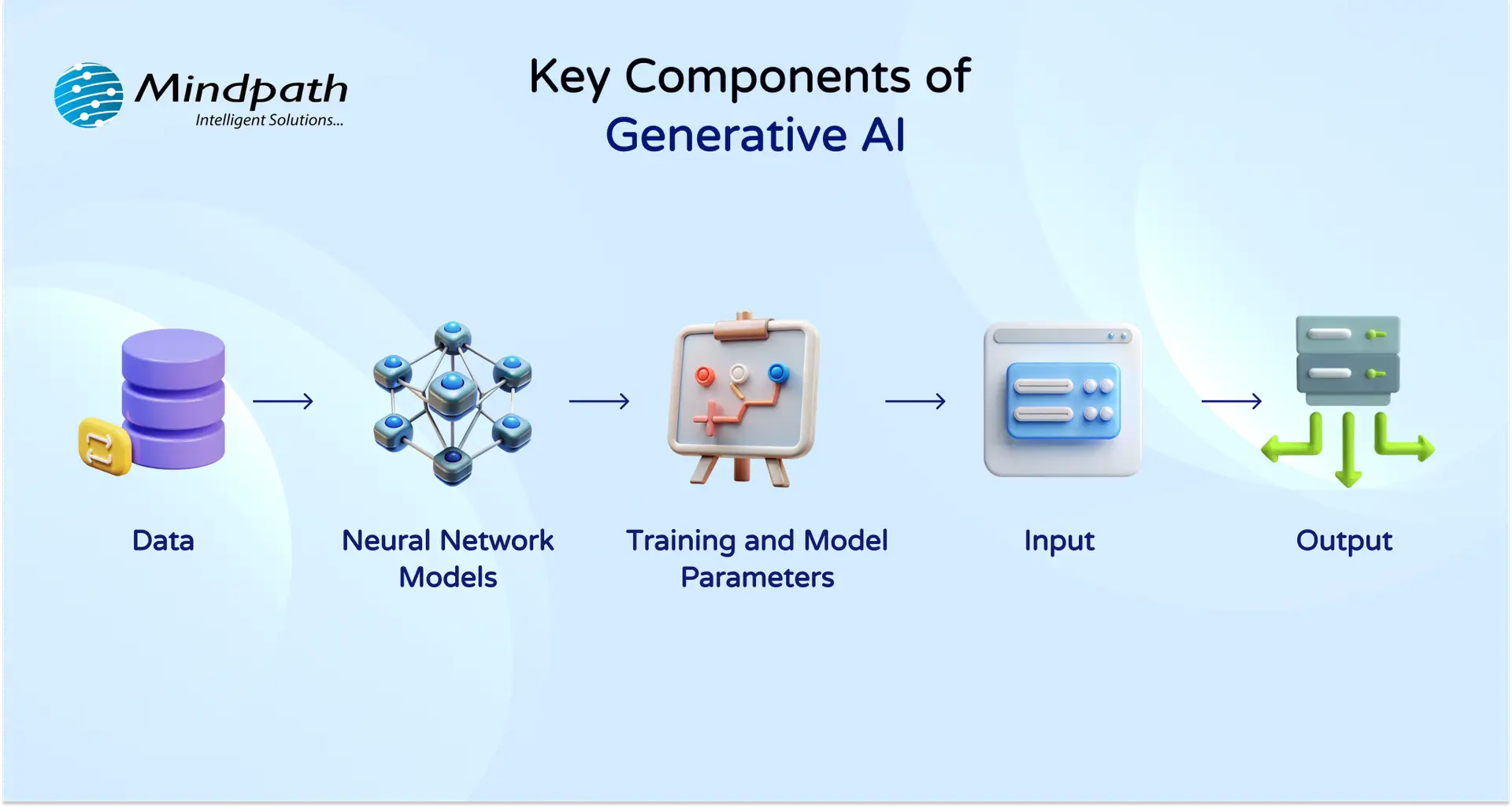
Here are some of the key components of Generative AI:  
key components of Generative AI

  1. Data: Raw data such as documents, eBooks, ledgers, images, videos, codes and a lot more that Generative AI uses to learn.  
  2. Neural Network Models: They work just like a human brain; they help AI models to make sense of all the raw data we have put in the model.  
  3. Training and Model Parameters: There are some parameters that help AI models fine-tune the information, cut the noise and generate accurate output.  
  4. Input: When you ask a Gen AI model to create a cover letter for a job, create a report based on Excel data, generate a Ghibli image to roll with the current trends, that’s categorized as an “input”.  
  5. Output: Whatever results a Gen AI model, such as ChatGPT, MidJourney, Bart, delivers for your query is the output.  

Generative AI is gaining momentum, with a global market valued at USD 37.89 billion in 2025 which is projected to reach USD 1,005.07 billion by 2034 at a CAGR of 44.20%. (Source: Precedence Research)

Generative AI Use Cases Across Industries 

While Gen AI is growing, curating a business-first roadmap for its adoption is important for those seeking to leverage it to its fullest advantage.  Now that we have explored what Generative AI is, let’s move on to some prominent generative AI use cases in different industries, proving that it’s more versatile than we know!  

1. Healthcare 

According to a recent survey by Deloitte Center for Health Solutions, 75% of leading healthcare companies across the globe are either currently experimenting with generative AI or planning to scale Gen AI in the near future.  

In what area, you may wonder? Generative AI healthcare is being used to maintain patient records, drug discovery, interpreting and analyzing medical images such as X-rays, CT scans, MRIS, to mention a few.  

Scientist are using generative AI for modelling molecular structures that can help not just in creating new drug compounds but also in predicting their effectiveness.  

92% of healthcare leaders see a promising future of generative AI in improving efficiency as well as speeding the decision-making in critical scenarios.  

2. Banking  

Next up is the banking and finance industry. Generative AI in banking is fueling the fintech revolution in more ways than one. Generative AI is currently being leveraged for detecting fraud, assessing the credit score or credit risk based on the creditworthiness of an individual or an entity, customer support, automating routine tasks and compliance checks, creating investment strategies, among others.  

A recent report by KPMG revealed that around 76% of banking executives in the United States are planning to implement Gen AI for fraud detection and prevention, while 62% want to leverage it to improve their customer service, followed by 68% of professionals that believe Gen AI can be best used for regulatory compliance.  

3. Gaming  

One of the most exciting areas for generative AI applications could be gaming. According to Statista, over one-third of game developers across the globe are already using Gen AI tools in their studios. PCG, which stands for Procedural Content Generation, is the largest segment of the gaming industry where almost 30% gen AI is being used currently. PCG helps game developers create larger than life game world, environment and universe that intrigues the players and gives them a more immersive experience.  

Other than PCG, some other significant generative AI use cases in gaming include developing characters, detecting bugs, generating real-time content like new levels and challenges, and detecting any kind of irregularities or security breaches or threats.  

Wondering how AI can help your business to reach the exceptional level of growth? Read our blog to learn about the importance of generative AI for business.

4. Supply Chain 

When it comes to adopting Gen AI, the supply chain industry is no stranger to it. In fact, McKinsey’s survey revealed that a third of global businesses are effectively using generative AI in business areas, including operation processes automation (66%), production planning and scheduling (47%), quality control and inspection (44%), and inventory management (43%).  

Gen AI can support the supply chain industry with better demand forecasting, optimizing day-to-day operations, assessing and controlling supplier risks,  quality control, fraud detection, and much more!  

 5. Other Industries 

Apart from the above-mentioned industries, use cases of generative AI are prevalent in other industries such as sales and marketing, insurance, legal and compliance, human resources, product development, and many more.  

While many still utilize gen AI for content, image and code generation, the applications are certainly above and beyond. However, leveraging gen AI comes with its own set of challenges. Being AI-ready is in demand for every industry and business seeking to adapt and leverage AI to its advantage. There’s no one-size-fits-all guidebook or roadmap for AI adoption; rather, each business and industry needs to understand its niche and create a roadmap that generates true value.  

Wondering how generative AI is influencing content creation and design strategies? Check out our blog generative AI changing creative industries  to see how AI-driven creativity is shaping the future of industries.

Ready to Embrace Innovation with Generative AI?

Generative AI is expanding its horizon, and businesses have started to realize its true potential. While Gen AI continues to grow, it’s critical to assess all of its aspects that involve data security, lack of information, and overdependence.  

Businesses looking to adapt AI must look beyond the hype and create a strategy that works for them. At Mindpath, we help businesses create solutions that are based on their real pain points rather than creating just another software. When you talk to us, we attempt to understand your operations and what may work to make them more efficient.  

Our customer-first approach helps us identify gaps and curate a solution that works for you. Thus, if you’ve been wanting to adopt AI, the right time is now! Let’s discuss how our AI development services can help you make the best of up-and-coming technologies and get your business future-ready!  
Frequently Asked Questions

1. Why are generative AI use cases expanding so quickly across industries?

Generative AI use cases are expanding because businesses need faster innovation, better decision-making, and automation at scale. The technology can process vast datasets and generate meaningful outputs, helping industries respond quickly to market changes while improving efficiency, accuracy, and customer experience.

2. How can companies identify the right generative AI use cases for their industry?

Businesses should start by analyzing operational challenges, repetitive workflows, and data-heavy processes. The most effective generative AI use cases solve real business problems rather than following trends. A clear roadmap, measurable goals, and strong data infrastructure help ensure successful adoption.

3. Is generative AI suitable for regulated industries?

Yes, but with caution. Regulated industries like healthcare and finance must ensure data privacy, compliance, and transparency. Proper governance frameworks, human oversight, and secure infrastructure are essential to safely implement AI solutions without violating regulatory standards.

4. What skills are required to implement generative AI in an organization?

Organizations need a mix of AI engineers, data scientists, domain experts, and cybersecurity professionals. Beyond technical roles, leadership must understand strategy and change management. Training employees to collaborate with AI tools is equally important for long-term success.

5. What risks should businesses consider before scaling generative AI solutions?

Key risks include data bias, security vulnerabilities, inaccurate outputs, and overdependence on automation. Businesses should validate AI-generated results, maintain human supervision, and establish ethical guidelines. A balanced approach ensures innovation without compromising reliability or trust.

Related Post

Hiring a remote development team is a sound business decision with multiple benefits. Read things to keep in mind while hiring a remote team.

Related Post

AI and Cloud Computing

The modern-day digital development depends on the intelligence, scalability, and flexibility advancing concurrently. This transformation is driven by AI and cloud computing, which help companies to make more efficient decisions by analyzing data faster. Executives see visible improvements in operations, products and customer experience. Consequently, the subject of conversation is not just trends but actually implementation. Teams want to have systems that learn, adapt and spur growth with minimum friction or delays.

With the increased adoption, there are heightened expectations in every industry. Decision makers want to have clarity, control and enduring value. They have to strike a balance between innovation and stability and cost consciousness. Additionally, it depends on choosing the correct strategy at the initial stage to succeed. Strategy is crucial and so is the technology. So, in this blog, we shall analyze the major advantages and the best practices of AI and cloud computing.

Keep reading further to learn more about this strategic synergy!

Want to optimize your business operations and scale effortlessly with the cloud? Mindpath offers cloud-managed services to provide secure, efficient, and fully managed cloud solutions.

Understanding the Core Fundamentals of AI and Cloud Computing

Artificial Intelligence (AI) facilitates machines to carry out tasks that would otherwise be carried out by human intelligence. It studies based on data, reasoning, identifies patterns, and comprehends language. Some of these major fields are machine learning, deep learning and natural language processing. AI helps companies to increase their efficiency, create smarter tools, and discover insights. Artificial intelligence and cloud computing tend to collaborate in order to improve outcomes.

Cloud computing involves computing resources, which include servers, storage as well as software offered via the Internet. It allows businesses to scale fast, pay as per their usage and access services anytime. The basic models include IaaS, PaaS and SaaS. This adaptability reduces the cost, accelerates the development, and supports the contemporary applications.

AI applications run effectively and successfully on cloud computing. AI and cloud computing go hand in hand to develop smarter and quicker systems. Cloud provides scalable storage and high-performance computing of AI models. AI will introduce intelligent cloud services via analytics, automation and optimization of resources. They all facilitate chatbots, predictive insights, and data analysis. The companies can operate cloud-based AI to take advantage of more advanced AI tools without substantial initial expenses and data analysis. Companies can access advanced AI tools on cloud platforms without huge upfront costs.

Looking to streamline cloud operations with intelligent solutions? Explore AI tools for DevOpss to see how automation and analytics optimize development and deployment workflows.

Key Benefits of AI Cloud Computing

AI and cloud computing are transforming the world of business and technologies. They open up fresh opportunities of development, productivity, and better decision making. Organizations look into how to make use of this combination. These are the best advantages that companies can embrace to remain competitive.

key benefits of AI Cloud Computing

1. Faster Data Insights

AI and cloud computing have excellent assistance in analyzing large data sets within a short period of time. Businesses bridge the data sources at ease and identify patterns that can make better decisions. This pace facilitates planning and minimizes guesswork in the operations.

2. Smarter Cost Control

AI and cloud computing minimize excessive expenditure on computers and their support. Businesses purchase resources as they consume and spend as demand increases. This strategy maintains flexible and predictable budgets.

3. Intelligent Automation

AI and cloud is used to automate repetitive workflow processes. Systems acquire knowledge and enhance processes through time. Teams are more strategic oriented as operations proceed normally.

4. Flexible Scaling Power

With AI and cloud computing, scaling up and down of resources is done on demand. Businesses either expand or contract without hesitation. This scalability helps in the development and unexpected increase in workload.

Must Read: Cloud Computing Trends

5. Easy Access to AI Tools

Cloud services provide ready-to-use AI services to business needs. Teams combine analytics, language processing, and vision tools within a short period of time. In combination, cloud computing and artificial intelligence eliminate technical restrictions.

6. Stronger Security Oversight

Cloud systems that operate based on AI keep a constant watch on activity. They identify threats at an early stage and react quicker to threats. This enhances security without retarding processes.

7. Better Data Management

Cloud services are an easy way of organizing, storing and retrieving data. AI assists in the automation of information classification and management. Companies have smarter data to analyze and report.

8. High Performance Computing

Artificial intelligence workloads require resources with high computing capabilities to operate. The cloud platforms offer on-demand GPUs and fast processors. Businesses deal with complicated activities that are not heavily capitalized.

Planning to deploy AI solutions at scale in the cloud? Explore cloud security tools to see how modern technologies secure AI pipelines and cloud infrastructure.

Best Practices for Implementing AI in Cloud Computing

AI and cloud computing need a more explicit and deliberate way of developing real value. Before adopting systems, teams need to plan, set goals and prepare systems. Technology is as important as strategy. These best practices demonstrate the way to apply AI in cloud computing in an effective and responsible manner.

Best Practices for Implementing AI in Cloud Computing

1. Select a Trusted Cloud Provider

Select a provider with the track record of working with AI and cloud services. Assess its standards of reliability, scalability, and compliance. Powerful partner will facilitate safe expansion and stable long-term operations.

2. Prioritize Data Privacy and Security

Encrypt and implement control access to sensitive information. Review security policies on a regular basis in order to minimize risks. High level of security instills trust in cloud systems and AI.

3. Define Clear AI Capabilities and Limits

Know what AI is capable of providing under the circumstances of the quality of the data. Track models regularly in order to identify bias or performance problems. Good expectations can make teams use AI in a responsible and effective way.

Also Read: Cloud Computing Attacks

4. Establish Ethical AI Practices

Instruct employees on how to use AI fairly, transparently, and accountably. Ethical consciousness results in an improved decision-making process within teams. Conscientious operations enhance the confidence of cloud-based AI.

5. Monitor Performance and Business Impact

Monitor behavior and business performance of the track systems. Assess value through measurement of efficiency, accuracy and cost. Consistent reviews help to maintain AI and cloud investments in accordance with the objectives.

6. Prepare for Future Innovation

Anticipate changing regulations and elements of technology. Architecture Software Build scalable systems, which welcome upgrades and additional features. A visionary roadmap would guarantee success in the long term with AI and cloud computing.

Wondering how AI applications can scale efficiently in the cloud? Check out serverless architecture in cloud computing to learn how server-free designs enable faster, cost-effective, and scalable deployments.

Ready to Turn AI and Cloud Computing into Real Business Value?

Artificial intelligence and cloud computing are transforming the nature of modern business development, competition, and innovation. They allow making smarter decisions, executing them faster, and operating flexibly together. It takes proper planning, excellent data, and responsible usage in order to be successful. By linking technology to the objectives of the firms, companies mitigate risk and create value in the long term. The approach will assist teams to develop systems which are adaptable, scalable and perform well.

Mindpath AI cloud services assist companies to embrace AI clearly and confidently. Our professionals develop safe and scalable solutions which are practical to the business requirements. We put an emphasis on performance, ethics, and quantifiable results. Mindpath provides organizations with a dependable service in terms of planning, deployment, and optimization. Our strategy will make AI and cloud computing produce useful outcomes and not complications.

WordPress Security Plugins

Operating a website means managing constant threats that are trying to invade your data and ultimately ruin all of your hard work. This brings us to selecting the perfect WordPress security plugins, which is a necessary action for anyone who owns a website. Instead of taking risks, it’s always better to be one step ahead and protect your site with the best tools available to you that won’t compromise site performance. Ultimately, your site should have strong protection that does not detract from performance.

There is no doubt that, with intelligent attacks being developed and stronger defences put in place in 2026, there is an urgent need for updated solutions. You cannot just depend on old methods and expect them to still work. So again, the smarter choice is to explore plugins and services that professionals worldwide test, prove, and depend on. By using the best plugins and services, you will protect your site and continue its growth without interruption. In this blog, we are going to discuss some of the best security plugins for WordPress, which can protect your website in the best way.

Want to strengthen your WordPress site’s security and performance? Mindpath offers WordPress development services, providing expert assistance in building a safe and high-performing website. 

What are WordPress Security Plugins?

WordPress security plugins are tools that you install on your website to protect it from common internet threats. These tools perform functions such as scanning for malware, preventing harmful traffic, and blocking brute-force attempts. These plugins add a layer of protection to your site from malicious behavior and can help prevent serious security issues for WordPress.

These plugins enhance security by providing login protection, firewall capabilities, and monitoring for suspicious activity. The plugins protect websites in real time to interrupt hackers before they cause damage to your website. Using the right plugin can mitigate WordPress security problems early to ensure the site is running smoothly.

Worried about exploits that bypass basic WordPress security plugins? Discover safeguarding common WordPress vulnerabilities to check out best practices for stronger site defense.

Best WordPress Security Plugins in 2026

When it comes to ensuring the safety of your site, the proper security tools can make a huge difference. Here are the best WordPress security plugins in 2026 that effectively combine advanced defense with consistent performance for meeting today’s increasing online threats.

1. Wordfence Security

Wordfence Security provides protection for your site against the most common WordPress security issues by offering powerful features like a firewall, malware scanner, and brute force protection. It allows you to monitor your site by having live traffic information, login logs, and detecting suspicious activity, so you can identify and stop a threat before it can become an issue. Developers will also like Wordfence for its multi-site licenses, and other helpful features like comment spam filters and login security, which make it easy to keep all of your sites secure.

2. MalCare Security

MalCare Security is among the top WordPress security plugins that secures your site with cloud-based malware scanning, bot protection, and login security. It enables you to remove malware with a single click and blocks suspicious traffic to protect your WordPress security. The plugin monitors uptime, sends alerts when you have a problem, and does this while staying light so your website remains fast and fully secured.

Want to ensure your WordPress site is accessible to every user while staying secure? Explore our blog on web accessibility guidelines to learn how inclusive design strengthens user trust.

3. All In One WP Security & Firewall

The All-In-One WP Security & Firewall protects your website against many common WordPress security problems by enhancing the security of user accounts, login pages, and database files. The plugin has transparent graphs, which show the strength of your site’s security, and makes recommendations for improvement, so it’s useful for both novice and advanced users. As a free WP security plugin, it also blocks intruders, hides sensitive information from your site, and allows an emergency lockdown by making your site unavailable.

4. SecuPress

SecuPress is one of the best security plugins for WordPress that protects your site against malware, viruses, and suspicious activity. It offers protection against brute-force logins, blocking IP addresses, and bot protection to add layers to your website’s security. It is user-friendly, gives you security alerts when something is wrong, and scans your website in detail. In short, this plugin gives you the best control over your website’s protection.

5. BulletProof Security

BulletProof Security is a feature-rich WordPress security solution that adds a layer of security to your site with login security, database backups, malware scanners, and anti-spam features. Additionally, unique features such as folder hiding, intrusion detection, and maintenance mode expand the protection of your website. There are free and premium features that allow developers and site owners to effectively handle security.

Concerned about plugin conflicts caused by WordPress and PHP version mismatches? Check out WordPress and PHP compatibility to learn how proper alignment keeps your site secure and stable.

6. Sucuri Security

Sucuri Security is among the most reliable plugins for WordPress security, shielding your website with malware scanning and integrity checks, as well as security hardening. It observes activity and alerts you in real-time about issues that could affect your website or business. The plugin includes premium features in conjunction with your free download such as advanced firewalls, DDoS protection, and post-cleanup reports as all-encompassing tools for the management and protection of your website, regardless of the attack scenario.

7. Shield Security

Shield Security is a trustworthy WordPress security solution that protects your web from hacks, bots, and intrusions. It activates immediately to protect your site and provides features such as brute-force protection, firewalls, and two-factor authentication. Shield actively repairs any threats it detects, monitors traffic, and gives professionals advanced scans for deeper security.

8. WP Activity Log

WP Activity Log is a WordPress security plugin that monitors and records all actions on your website in real time. It keeps a record of all changes made to posts, pages, user profiles, and plugins allowing you to identify irregular activity and solve problems fast. The plugin tells you who made each change, notifies you when an issue arises, and allows you to keep your site secure by managing your users easily.

Ready to move beyond plugins for stronger and more flexible WordPress security? Discover custom WordPress development to check out how custom builds enhance site protection.

9. WP Fail2ban

WP fail2ban is a WordPress security plug-in that protects your site against brute force attacks by monitoring and logging all login attempts and blocking suspicious users from logging in to your site. It can ban users either hard or soft. The plug-in also integrates with Cloudflare (the only plugin on this list to do so), provides more surface area on WordPress multisite sites, and enhances security accordingly. WP fail2ban tracks spam, comments, and other user activity on your site, and helps to prevent attacks from reaching your login page.

10. VaultPress

VaultPress is a security plugin for WordPress that provides real-time and daily backups to keep your site secure. It allows you to quickly restore files with just one click. It keeps track of suspicious activity and provides detailed stats, logging every backup and restore action for better tracking. VaultPress will also make incremental backups, allow you to create multiple versions of your site’s data, and give you complete control of your site’s security and data.

Planning to move beyond basic plugins for long-term WordPress protection? Check out why it makes sense to hire a WordPress developer for stronger security.

Are You Ready to Secure Your WordPress Site?

Keeping your website safe is critical in 2026. Using the best WordPress security plugins ensures protection from malware, hackers, and suspicious activity while keeping your site fast and reliable. Choosing the right plugins helps you monitor, block, and repair threats. Also it gives you confidence that your website remains secure and operates smoothly for visitors and users.

At Mindpath, we offer expert WordPress development services to help you build secure, high-performing websites. Our team integrates reliable security solutions, custom features, and regular monitoring to prevent WordPress security issues. We focus on creating sites that are fast, scalable, and safe, allowing your business to grow confidently while keeping your data and visitors protected from online threats.</p>

agentic ai examples

Generative AI represented a major milestone in the evolution of artificial intelligence. It played a crucial role in enhancing employee capabilities and brought AI closer to the average user. However, you should also look at agentic AI examples to discover how artificial intelligence has moved one step ahead. Agentic AI revolves around the use of agents that not only generate content but also have capabilities for autonomous decision-making.

You should know that big names, including NASA, NVIDIA and Microsoft, have been leading the race for adoption of AI agents. The growing use of AI agents in business is a testament to the fact that they are better than chatbots, which take thousands of prompts to generate remotely useful outputs. An overview of the business use cases of agentic AI can help you understand its true potential.

Ready to use the future-leading  AI solution in your operations? Mindpath offers AI development services that empower your businesses, help you automate processes, and drive innovation.

Understanding the Fundamentals of Agentic AI

LLMs empowered businesses with many capabilities, albeit with a reactive nature and the inability to retain context or memory. Therefore, the utility of LLMs and generative AI was restricted to improving individual productivity in different tasks. Agentic AI marked a shift towards autonomous decision-making and established the foundation of proactive artificial intelligence. 

The most popular agentic AI use cases showcase how agents have introduced a revolutionary transformation in the working of AI. Agentic AI encompasses autonomous AI systems that have capabilities like memory and reasoning and can solve complex problems. 

AI agents can understand the goals for multi-step problems and break them down into subtasks alongside interacting with humans and systems. The agents can also execute the subtasks and adapt to new changes with minimal human intervention. 

Also Read: Generative AI for Business

Why Should Your Business Choose AI Agents?

Many business owners will wonder why they should adopt AI agents. Is it just because big companies are using agentic AI? The examples of agents in AI have proved how agentic AI brings a new set of capabilities to the use cases of AI across different industries. 

Businesses can now have AI systems that not only learn from data but also process information in real-time and execute tasks with different levels of human oversight. Agentic AI delivers promising benefits for businesses such as

  • Enhanced productivity
  • Personalized workflows
  • Operational efficiency at scale
  • Better accuracy and faster decision-making
  • Cost optimization
  • Easier cross-team collaboration

Are you missing opportunities to make faster, smarter decisions because your business isn’t leveraging AI to its full potential? Learn from our blog AI decision-making use cases guide to discover practical ways AI can accelerate insights and give your business a competitive edge.

How Have Businesses Used AI Agents?

Agentic AI is capable of managing everyday tasks and can also enhance agility across enterprise operations. It has been reshaping the way businesses in different industries work with a proactive approach. The curiosity about agentic applications of artificial intelligence is gaining momentum among businesses as AI agents revolutionize workflows. Awareness of the use cases of AI agents in business can provide the ideal foundation to embrace them. 

1. Customer Support Automation

Chatbots and voice assistants have been the most prominent contributions of artificial intelligence in the domain of customer support. Businesses must recognize the limitations of chatbots and voice assistants as they require the right prompts to deliver useful responses. However, AI agents can achieve automation of customer service beyond answering few commonly asked questions.

AI-powered customer service agents don’t need human guidance to function and solve complex multi-step problems. AI agents can offer customer support in different industries for diverse functions without being limited to a specific number of questions. Their capabilities for autonomous decision-making help them in understanding the customer’s need and providing relevant answers.       

2. Proactive Threat Mitigation

Cybersecurity is one of the biggest concerns for businesses as most organizations have security systems that cannot keep up with emerging threats. The adaptability of agentic AI tools ensures that they can learn and respond to security risks in real time. Agents have smart capabilities for round-the-clock network monitoring to identify anomalies and respond to threats before they cause any damage. 

Agentic AI can add an intelligent and dynamic threat detection system that not only offers safeguards but also creates a more resilient security system. You can rely on AI agents for running simulations of attacks to identify vulnerabilities before malicious attackers. On top of it, agentic AI can also facilitate real-time scoring of user activity which helps your team focus on critical threats. 

3. Automation of Enterprise Workflows

Organizations have been experiencing different issues in managing their enterprise workflows with little to no improvement from using various tools. The search for answers to ‘what is agentic AI’ reveals how agents excel at automation without human intervention. Agents can help businesses in streamlining processes through automation of repetitive tasks. For example, AI agents can use meeting notes to issue project tickets without human inputs. 

Agentic AI can help businesses in pooling all their data to avoid information silos. Their ability to retain context helps them develop in-depth understanding of how your business works. As a result, AI agents can enhance productivity and efficiency in enterprise workflows without incurring additional overheads.

4. Faster and Streamlined Software Development

Businesses need smarter software development tools that enhance productivity and transform the traditional notions of customer experience. The rising adoption of AI development services is clearly visible in the use of AI coding assistants, also known as copilots. Agentic AI can help in creating a new generation of AI coding assistants that can write large segments of code. 

Even with mixed reviews, agentic AI has gained appreciation from experts who believe that smart agents will write most of the code in future. Coding assistants will not only help in writing code but also leverage special agents to review code and identify errors. Agents also have the capability to leverage reverse engineering for extracting specifications from code, which makes them a powerful catalyst for coding automation.

Curious how tailored solutions can accelerate growth? Check out the custom software development benefits to see how personalization drives efficiency and innovation.

5. Accelerated Lead Conversion

How many times have your sales teams struggled to convert leads into potential customers? You can find answers to ‘what is agentic AI example’ in the use of agents for lead conversion. Sales representatives can use AI agents to get the accurate insights for zeroing in on the right prospects. For example, agentic AI can help businesses by highlighting the prospects that are most likely to convert. As a result, your sales teams will focus specifically on leads that have real potential.

Another promising contribution of agentic AI to the sales department of your organization is the assurance of offering personalized content. Smart AI agents offer customized follow-up responses, thereby informing your sales representatives about how they can communicate with leads. Furthermore, agentic AI also helps in identifying high-risk deals that may lose momentum.

6. Creating Smarter Product Roadmaps

Business owners must also recognize the scope for improving the methods for developing product roadmaps with agentic AI. With every stakeholder demanding priority for their feature, it becomes difficult to know which aspect deserves your attention. The value of an agentic AI development company becomes clearly visible in such cases where your product team needs agentic AI. 

Professional development companies can help you avoid redundancies in product roadmap development with different functionalities. You can use agents for gathering qualitative data from user research, surveys and feedback to gain holistic understanding of customer requirements. The comprehensive user behavior analysis with agentic AI can create the path for developing smoother customer experiences.                    

7. Enhancing the Agility of Operations Teams

The real-world use cases of agentic AI in business also draw attention towards issues in operations teams. Manual processes not only lead to inefficiencies and delayed decisions but also the inability to dig deeper into data for identifying bottlenecks. The benefits evident in agentic AI examples across different business operations can be applied for operations teams of your organization.

AI agents can help businesses with demand forecasting by drawing accurate prediction of supply requirements. At the same time, the proactive nature of AI agents empowers them to adjust shipping and delivery routes in real time. Agentic AI also offers the advantage of tracking supplier performance and identifying risks which can slow down production. 

8. Establishing Intelligent HR Operations

HR is one of the prominent entries among the many business functions you can transform with AI agents. As a matter of fact, agentic AI use cases in HR operations are low-risk and high-value use cases. It is for this reason that most of the companies using agentic AI leverage it for human resource operations. 

AI agents can make many things easier for HR, including providing responses to simple questions of employees. In addition, smart AI agents can also help HR with internal knowledge retrieval, documentation and tagging alongside other business processes. Every agent in your HR system will be tailored for one specific task and will have the ability to interact with each other. 

Looking to stay ahead in the rapidly evolving world of artificial intelligence and understand how emerging technologies can impact your business? Check out our blog on the top AI trends to see how AI is transforming the industry and driving innovation.

Final Thoughts

The real use cases of agentic AI in businesses reveal many interesting insights on their actual potential. You can capitalize on AI agents to bring a certain degree of autonomy in various business operations while incorporating human oversight. Agentic AI marks another phase in the evolution of artificial intelligence by facilitating the creation of systems that are proactive and can take decisions on their own.

Mindpath is a pioneering agentic AI development company with a credible record in creating AI agents for different business functions. We have developed AI agents capable of integrating seamlessly into your enterprise workflows. Our team has the ability to ensure that your agentic AI systems align with your business needs and vision. Consult with our experts and discover the most efficient ways to embrace agentic AI now.