


Latest Insights On
GenAI, Tech, and Digital Transformation
Stay updated with expert insights, success stories, and real-world applications of cutting-edge technology.
Ever thought, what if your device could not only display an enhanced reality but also predict your next move? How would industries change if machines could learn from real-world environments and respond intelligently in real-time? Could the combination of Artificial Intelligence (AI) and Augmented Reality (AR) completely reshape the way we interact with technology and each other?
In this blog, we’ll explore how AI and AR are working together to unlock groundbreaking possibilities, transform industries, and shape the future of our digital world. So, let’s dig in!
Overview of AI and AR
The term artificial intelligence (AI) refers to the ability of machines to think and learn like humans. AI recognizes patterns in data rather than being given step-by-step instructions, which allows it to improve over time. It drives advancements in technology such as facial recognition, voice assistants, and intelligent robots that learn from their mistakes and carry out tasks more effectively.
Augmented Reality (AR) is a technology that combines digital data with the real world in real time. Unlike virtual reality, which provides a wholly simulated experience, augmented reality (AR) overlays digital images, sounds, or information on top of what you see in the world around you. It is frequently utilized with devices such as smartphones or special glasses, allowing users to engage with a combination of real and virtual components, making ordinary situations more dynamic and informative.
Benefits of Combining AI and AR Technologies
1. Enhance User Experience
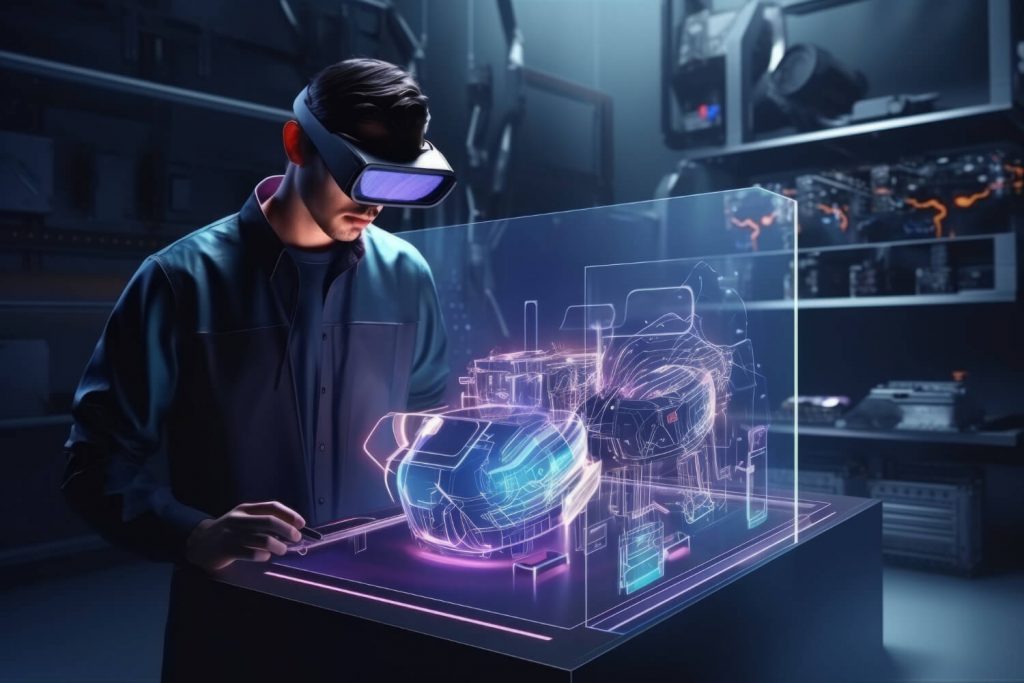
When working with advanced equipment, traditional paper manuals and 2D instructions can lead to confusion among personnel. However, by merging AI with augmented reality, customers may see crisp 3D graphics, receive real-time instruction, and receive quick alerts to possible concerns. This not only makes jobs easier to grasp, but it also enables workers to accomplish them faster and with fewer errors. The immersive experience also keeps people engaged, which boosts their confidence and overall productivity on the job.
2. Strengthen Safety Measures
AI-powered AR provides users with real-time warnings and notifications to assist them avoid unexpected events and risks. It also offers immersive, interactive training and work instructions that are more comprehensive than standard paper manuals. AR increases workers’ awareness of possible hazards and ensures them adhere to safety measures more rigorously. This not only lowers the likelihood of mishaps, but also promotes a safer and more secure workplace.
3. Minimize Mistakes
Using large, printed instructions can be exhausting and increase the possibility of errors. AI-enhanced augmented reality aids by offering clear, real-time visual instruction and automated adjustments. It functions as an “extra set of eyes,” ensuring that workers remain precise even when exhausted at the end of a shift. This assistance reduces mistakes, enhances job accuracy, and assures consistent performance, resulting in superior overall outcomes.
4. Maximize Productivity
AI-enhanced augmented reality solutions increase productivity by making work processes more interesting and efficient. Immersive AR experiences, paired with real-time AI insights, enable users to understand complicated tasks faster and more accurately. This eliminates the need for subject matter experts to give ongoing assistance to new staff, therefore speeding up training and onboarding. Additionally, AR can streamline ordinary processes such as reporting and data collecting, saving workers time and allowing them to focus on more important duties. As a result, productivity increases, and overall workplace efficiency improves.
5. Promote Sustainability
AI-enhanced AR work instructions give frontline workers exact instructions, guaranteeing tasks are executed precisely the first time. This lowers the possibility of mistakes, eliminates the need for rework, and avoids costly scrap, which assists to preserve resources and reduce waste. AR promotes more sustainable practices within your organization by reducing wasteful material consumption and increasing overall efficiency. Furthermore, the reduction in errors and rework means that fewer resources are spent rectifying mistakes, which strengthens your company’s commitment to environmental responsibility and sustainability.
Curious how AI and AR can revolutionize your business?
Mindpath delivers cutting-edge solutions tailored to your needs.
Use Cases of AI in AR
1. Virtual Shopping Assistants
AI-powered AR applications add a new layer of involvement to online shopping by allowing users to try on simulated clothes and other accessories. This tool allows shoppers to see how goods will appear in real-time, making their shopping experience more personalized and enjoyable. Customers may make better-informed choices and have a more engaging and convenient shopping experience from home by seeing how different goods fit and appear without physically trying them on.
2. Language Translation
AR applications powered by AI provide real-time translation of signs, menus, and text, making communication easier for travelers. These apps allow users to easily navigate new areas by overlaying translated text right onto their screen. This quick translation function improves travel experiences by reducing language barriers, allowing users to connect more confidently, grasp local information, and enjoy their vacation without worrying about misconceptions.
3. AR Navigation
AI enhances AR navigation apps by merging real-time data, such as traffic conditions and nearby points of interest, with the user’s surroundings. This connection delivers up-to-date, clear instructions and notifications, allowing users to avoid delays, select the best routes, and easily explore nearby facilities. AI-powered AR simplifies and enhances the experience of navigating both familiar and unfamiliar regions by combining crucial navigation information with the actual environment.
4. Industrial Maintenance
Combining AR and AI provides considerable benefits for industrial maintenance by sending real-time instructions and visual data directly to professionals. This system delivers interactive, step-by-step instructions and precise data overlays, allowing personnel to complete difficult maintenance chores accurately. AR improves decision-making and troubleshooting by using AI to analyze equipment status and identify possible difficulties. This decreases the chance of mistakes, shortens downtime, and increases overall efficiency, ensuring that machinery runs smoothly, and maintenance activities are handled quickly and effectively.
5. Medical Imaging
AI-powered AR improves medical imaging by superimposing diagnostic data directly on a patient’s body during operation. This real-time integration allows medical practitioners to observe crucial data, such as anatomical structures and pathology, with higher accuracy. AR helps to enhance surgical results by offering visual context and direction, enabling for improved planning and execution of difficult medical techniques.
How can Mindpath Help?
End Note
As AI and AR technologies advance, their ability to disrupt industries and improve everyday lives is limitless. By seamlessly merging these advancements, we may explore new levels of interactivity, efficiency, and insights. From transforming how we purchase and navigate to enhancing safety and precision in industrial and medical domains, the collaboration of AI and AR is paving the way for a smarter, more connected future. Mindpath is pleased to be at the forefront of this technological transformation, providing bespoke solutions that leverage the power of AI and augmented reality to drive your success and creativity. Explore these options with us to see how we might help you design the future.
Ready to Transform Your Business?
Discover how Mindpath’s AI and AR solutions can elevate your operations.
Manufacturers all over the world have been under pressure to meet emerging challenges in an environment with limited resources. The prominent setbacks for the manufacturing industry include supply chain shortages and talent gaps. However, the advent of digital twin technology serves as the best example of how technological innovation can shape the future of manufacturing. Digital twins can not only enhance capacity but also ensure more efficiency and resiliency in manufacturing operations.
The growing demand for fast-paced and continuous operations in manufacturing creates various limitations. Digital twins offer virtual representations of production lines, equipment or the whole factory to help manufacturers with more effective decision-making. Manufacturers must know about the utility of digital twins and how they can unlock untapped value to prepare factories of the future.
Looking to harness digital twin technology to gain deeper insights and future-proof your business? Contact us for expert guidance and tailored solutions that help turn digital twin innovation into real-world impact.
Understanding the Digital Twin Technology
The foremost highlight in any introduction to digital twins will focus on their definition. The most common answers to ‘what is digital twin technology’ paint them as virtual representations of physical objects or systems. Digital twins use real-time data to imitate the behavior, conditions and performance of their physical counterparts. Digital twins help with continuous monitoring and analysis of objects, systems or products throughout their complete lifecycle. In addition, digital twins can also feature external processes and crucial variables that can influence the performance of real-world assets.
One of the significant highlights of digital twins is that they work with data flowing between the object and its virtual representation in real-time. The two-way flow of data ensures the most accurate simulations of the physical world. Businesses can also use multiple digital twins together to create models for more complex systems, aimed at a larger digital transformation strategy.
Digital twins provide a clear impression of how something works and predicts its behavior in future scenarios. As a result, they can help in accelerating innovation and improving efficiency along with making well informed decisions. You can come across use cases of digital twins in predictive maintenance, product development, supply chain optimization and process optimization.
Breaking Down the Architecture of Digital Twins
If you want to capitalize on the power of digital twins in diverse use cases, then it is important to know their architecture. You can find digital twin providers like IBM, Microsoft, General Electric and Siemens with solutions that provide a comprehensive suite of services. The digital twin examples may feature hardware layers, synchronization services, data processors and other tools to draw the most accurate simulations of real objects and processes. However, awareness of the architecture of digital twins can help you figure out exactly what you need to make the most of the innovative technology.
1. Physical Asset
The physical asset in digital twins can be any real-world object, process or system that you want to study or monitor within virtual environments.
2. Virtual Model
The virtual model in digital twins is the digital representation of the physical asset that you want to know more about.
3. Data Sources
One of the notable highlights in the answers to ‘what is a digital twin’ points at the two-way flow of data between the physical asset and the virtual model. Data sources are an integral component in digital twin architecture as they ensure accuracy in virtual representations. Internet of Things or IoT devices serve as data sources by recording relevant metrics for creating digital twins.
4. Data Pipelines
Data pipelines are used for transmitting sensor data to the virtual model in real time. They play a vital role in ensuring that the digital twin is synchronized with the physical asset.
5. Feedback Loop
The feedback loop helps in sending control signals or insights from the virtual model to the physical asset. It serves as a promising component for optimizing performance and efficiency alongside enhancing decision-making.
6. Analytics Engine
Digital twins needs an analytics engine running on AI or machine learning to detect patterns and facilitate predictive analytics. The functionalities of the analytics engine helps in drawing accurate simulations alongside offering support for effective asset tracking.
7. Visualization Dashboard
The visualization dashboard is another crucial component that completes the digital twin definition by providing access to the virtual representation. You can use the visualization dashboard to interact with the two-dimensional or 3D representation of the physical asset.
Breaking Down the Working Mechanism of Digital Twins
The uses of digital twins can vary by huge margins across different industries and applications. You must also know that digital twins follow some common steps that you will find in every example.
1. Data Collection
Organizations can start their digital twin projects by embedding sensors on a physical object to capture its performance, operating environment and condition. The digital twin meaning in case of IoT applications revolves around using smart objects that feature in-built sensors to collect and share data continuously. In the case of IT environments, teams can create digital representations of computers, applications and software with virtualization technologies. Subsequently, the teams can use software agents to collect data from the digital asset for supporting the digital twin.
2. Creation of the Virtual Model
The primary focus of digital twins aligns with the creation of digital replicas of certain objects or systems. Virtual modeling involves using the data collected from the physical asset to create a digital model. It is important to define digital twins with key attributes that help them offer realistic reactions to variables. The variables can refer to interactions with the physical asset or its environmental conditions. The attention to virtual modeling ensures that digital twins can offer reliable and accurate simulation of the responses of the physical assets in different conditions.
3. Real-Time Data Integration
You cannot think of a digital twin without live data integration as it ensures continuous communication between the digital twin and physical asset in real time. Live data integration offers a dynamic feedback loop that can help organizations with performance optimization and enhancements in system reliability. The two-way data exchange also helps in efficient predictive maintenance by anticipating issues ahead of time. Most of the organizations automate the real-time data exchange process to focus on more critical and strategic tasks.
4. Analysis and Decision-Making
Digital twins offer the most promising solutions to experiment safely within virtual environments. You find better answers to ‘how do digital twins work’ in manufacturing plants where digital twins can help in finding out how an upgrade may affect efficiency and performance. The best thing here is that manufacturers don’t have to implement the upgrade directly to measure its impact. On top of it, analytics engines used in digital twins can recommend operational changes to make the changes more cost-effective.
Variants of Digital Twins
Most of the discussions about digital twins don’t emphasize the fact that you can find different types of digital twins. Organizations can deploy different variants of digital twins in one production environment with the advantage of learning from different levels of physical assets.
1. Product Twins
Product twins refer to the virtual representations of products after the ideation stage or throughout the complete lifecycle. You can use product digital twins for design improvements, enhancing service satisfaction and manufacturing efficiency.
2. Process Twins
The variety of digital twin applications also draws attention towards the use of process twins that help in understanding how different systems work with each other. Process twins offer visualization of the interactions between systems and suggest actionable feedback to improve quality standard or process speed.
3. Part Twins
Part twins or component twins focus on the most granular level of larger systems. The primary goal of part twins revolves around measuring the insights from basic components of larger systems. Component twins serve a promising role in understanding the performance of certain components and identifying larger problems before they happen.
4. Place Twins
The largest deployment of digital twins can happen in the form of place twins. You can find examples of place twins in factory twins, which simulate a complete physical location or place. In some cases, you may assume similarities between process twins and place twins. However, place twins also include spatial data, such as climate, context and temperature of the physical location.
Unraveling the Use Cases of Digital Twins
Organizations in different industries leverage digital models to understand complex systems and promote innovation. Digital models have also proved as the most useful tools for efficient optimization and predictive equipment maintenance. You can find a digital twin use case in almost every major industry with widespread applications.
1. Construction of Physical Structures
Digital twins can prove to be the most useful tools for engineers to design durable and safe physical structures, such as buildings, bridges and dams. For example, digital twins can help engineers determine whether a specific design for a bridge can enhance its durability. As a result, engineers can identify any setbacks and make changes in the design before starting construction.
2. Healthcare
Another promising area where digital twins can offer significant advantages is in the domain of healthcare. Digital twins can come up with crucial insights from forecasts of disease progression to identify how patients will respond to different treatment options. Furthermore, healthcare professionals can use digital twins to enhance diagnosis through detailed modeling that helps in understanding how interactions between organs can affect health.
3. Urban Planning
You can also notice the benefits of digital twins in urban planning applications, especially for traffic supervision. City models use spatial data, IoT object data and AI analytics to determine how new transportation systems or infrastructure upgrades will affect the city’s environment and traffic. Digital twins serve a pivotal role in planning for smart cities and urban planning experts aim to tap into their power to enhance sustainability and quality of life.
Identifying the Advantages of Digital Twin Technology
The use cases of digital twins across different industries reveal their potential to revolutionize digital transformation. You can notice how digital twins offer more visibility into complex systems while opening doors for experimentation without real-world changes. An overview of their advantages can help you understand how they can unlock the future.
1. Faster Research and Development
How do you think a business can step into the future ahead of time? Without research and development, companies cannot experiment with new product designs, manufacturing processes or workflows. The advantages of digital twins make it easier to experiment within a virtual environment, thereby opening the doors for accelerated innovation. Digital twins offer a more cost-effective and safer approach to research and development without the need for real tests.
2. Scalability
Companies can stay competitive in the modern business landscape only by adapting to changes in product demand, customer priorities and economic conditions. Digital twins offer virtual environments where you can adjust parameters and test configurations safely before full-scale deployment. You can also connect digital twins to live systems and ensure that they can continuously transmit their scaling adjustments in real time to the physical asset.
3. Operational Efficiency
The next crucial outcome of digital twin technology is the assurance of enhanced operational efficiency. Digital twins can provide the insights required to achieve operational efficiencies throughout the value chain. Organizations can use different datasets to collect real-time data on physical asset and production performance. With more visibility into the asset or process bottlenecks, digital twins can help in crafting potential solutions.
Final Thoughts
The progressive use of digital twins is a perfect example of how the world is welcoming innovation and preparing for the future. Digital twins provide the easiest solution to multiple problems that affect efficiency, cost-effectiveness and productivity in different industries. With the help of virtual models that mimic real-world assets, companies can reinvent their manufacturing, services and internal management.
Mindpath is one of the leading destinations for digital twin app development with years of expertise in end-to-end IT solution development. We are proud to have team members who are eager to learn and specialize in new technologies, including digital twins. Our experts are familiar with the use of popular tech stacks for digital twin development in alignment with your business goals. Consult with our team and build your first digital twin right now.
Are you curious about how cloud computing will evolve in 2024? What new technologies will shape the way we store, process, and access data? As the cloud landscape continues to grow and evolve, staying updated on these trends is more crucial than ever. In this blog, we will explore the latest cloud computing trends set to redefine the digital landscape this year.
Cloud computing is the practice of employing internet-based services rather than maintaining everything on your personal computer. Imagine you need to save data, run programs, or use tools, but instead of doing it on your device, you access them over the internet. The real data, such as your files and applications, is stored on large, powerful computers known as servers, which belong to businesses such as Google, Amazon, and Microsoft. They handle everything, so you don’t need to worry about monitoring or maintaining anything. As long as you have internet connectivity, you may utilize everything you need, such as storage or software, at any time and from any location.
Understanding cloud computing trends is essential for both your career and business. Businesses can pick the finest services and solutions, save money, and increase efficiency by having a thorough awareness of these trends. Staying up to date on what’s new and popular allows you to make better decisions, stay ahead of the competition, and maximize the benefits of the cloud.
So, let’s dig in to explore the cloud computing trends 2024!
Cloud Computing Trends 2024
1. Kubernetes and Docker
In 2024, Kubernetes and Docker will be key players in cloud computing. These technologies make cloud application management and deployment easier and more efficient. Docker enables you to organize your program and its dependencies within a lightweight, portable container. This implies that your program can work properly on any platform, including your PC and the cloud. Kubernetes goes a step further, managing and coordinating these containers. It automates processes such as scaling up or down and balancing workloads, ensuring that everything functions smoothly without requiring continual manual changes. As more businesses use cloud computing, Kubernetes and Docker are becoming increasingly important for improving and flexibly delivering cloud services.
2. DevSecOps
In 2024, DevSecOps will be an essential approach to cloud computing security. It stands for Development, Security, and Operations, and it focusses on implementing security measures from the beginning of the development process. Rather than waiting until an application is complete to check for security flaws, DevSecOps ensures that security is built in throughout. This helps to defend against issues such as hacking, service outages, and unauthorized access to data. Cloud service providers offer tools and services that enable DevSecOps easy to utilize. Businesses may use these technologies to ensure their cloud environments are secure and free of possible dangers.
3. Disaster recovery and backup
Disaster recovery and backup will be essential in 2024 for ensuring the security of your cloud data. If anything goes wrong—like a server breakdown, a power outage, a natural disaster, a cyberattack, or a hardware failure—having a robust backup strategy allows you to recover your data fast. Cloud computing simplifies this process by keeping copies of your vital data online. This manner, if something occurs to your primary PC, you can swiftly recover everything from the cloud. Many companies automatically store important data and information to cloud servers. This means companies don’t have to worry about losing important information and can keep their operations functioning smoothly even during catastrophes.
4. Edge computing
Edge computing is changing the way we handle information by bringing it closer to where it originated. This reduces delays and speeds up operations. With the emergence of 5G networks, edge computing is becoming increasingly significant since it enables real-time data processing and enhanced security. Edge computing is becoming increasingly important as more devices connect to the Internet of Things (IoT), allowing for faster data analysis and smoother communications. Edge computing improves speed by bringing data processing closer to the source, ensuring that data is handled safely and effectively.
5. Internet of Things (IoT)
The Internet of Things (IoT) is a rapidly emerging technological trend. IoT collects massive volumes of data via a network of sensors and devices, which is subsequently stored on cloud servers. This data is analyzed to offer relevant information for making business decisions. IoT connects various devices, computers, and networks, enabling them to communicate and share information. It can collect data remotely and control things from a distance. This smart connection is crucial for IoT’s appeal in cloud computing since it allows for more effective data management and utilization across several platforms.
6. Low Code and No Code
Low-code and No-code Cloud solutions are transforming the way we develop applications by making it easy for anybody, not just experts, to create software. These platforms enable people to create apps and employ AI technologies with minimum technical knowledge. Instead of writing large amounts of code, you can quickly develop and launch projects using simple, user-friendly tools. This speeds up the development process, reduces errors, and makes technology more accessible to a larger audience. Users can easily construct apps using popular tools like Figma and Zoho, without having to maintain complex coding systems.
7. AI and ML
Artificial intelligence (AI) and machine learning (ML) are leading cloud computing trends. These technologies demand a significant amount of computing power and storage to manage data and train models, but they also provide strong and cost-effective solutions. In 2024, we can expect AI and machine learning to drive trends such as self-automation, which allows systems to handle themselves, and personalized cloud services that adapt experiences to individual demands. These technologies will also enhance data security and privacy. Major technology businesses, such as Amazon, Google, and IBM, are aggressively investing in AI and machine learning. Amazon’s AWS DeepLens and Google Lens, for example, make use of machine learning to provide enhanced capabilities and improve user experiences.
Cloud Computing at Mindpath
Mindpath’s cloud computing platform enables businesses to leverage advanced technologies without having to handle it all themselves. Mindpath provides a variety of cloud services that allow you to conveniently and securely store data, execute programs, and access resources online.
Our cloud solutions are intended to be adaptable and scalable, allowing them to expand alongside your organization. Whether you need to back up important information, operate complex apps, or optimize your IT infrastructure, we have you covered. We guarantee that everything goes smoothly and securely, enabling you to focus on what is most important to your organization.
Final Thought
As we look ahead to 2024, the cloud computing world is full of intriguing possibilities. Keeping up with these trends is essential from the rising relevance of Kubernetes and Docker in application management to the creative breakthroughs in AI and ML that are creating smarter, more secure solutions. Edge computing and IoT technologies are changing the way we manage and process data, while low-code and no-code platforms make app creation easier than ever.
At Mindpath, we are dedicated to assisting organizations in navigating these changes and realizing the full potential of cloud computing. Our cloud solutions are adaptable and scalable to match your demands, whether you want to strengthen your IT infrastructure, secure your data, or innovate with cutting-edge technology.
Ready to Transform Your Cloud Experience?
Dive into cutting-edge technologies with Mindpath’s tailored solutions and keep your business ahead in 2024.
Ever wondered how secure your business really is in today’s digital age? What if we tell you that there are better ways to protect your digital assets from emerging threats? As cyber-attacks become more sophisticated, it’s essential to stay ahead of the curve. In this blog, we’ll explore effective strategies to enhance your business’s cyber security.
Cybersecurity refers to protecting your computer systems and data against cyber-attacks. These risks include hackers attempting to steal or destroy your data, malware that locks your files until you pay a fee, and attacks that interrupt your business. With so many gadgets and more skilled hackers, it is essential to employ numerous levels of security. This includes employing tools to detect and resolve issues, as well as ensuring that your people and procedures are prepared to respond. Cybersecurity is all about integrating smart technology and behaviors to keep your digital world safe. Cybersecurity is essential because it protects us from online threats that might lead to catastrophic consequences, such as identity theft or data loss. Our everyday lives rely on secure systems like power plants, hospitals, and banking. If these systems are not secured, they can harm everyone.
So, let’s dive in to explore the ways in which we can increase cyber security!
Ways to Increase Cyber Security
1. Regular Updates
To keep your computers safe, update them on a regular basis. This includes desktop computers, laptops, and mobile devices. Keep your operating systems and web browsers up to date to guard against emerging threats. Check for updates to any software on your computer, including security programs. Cloud-based software often updates automatically, so you don’t have to worry about it. If the employees use mobile devices for work, make sure they maintain their software up to date, particularly security programs. This helps keep all your gadgets safe.
2. Training Employees
Make sure your staff are aware of your company’s security plan. Begin by developing a cybersecurity policy that specifies best practices and processes for keeping information secure. This policy ought to specify what procedures to take if there is a security breach. Encourage staff to adopt strong, unique passwords for all accounts and devices. They should use different passwords for their PC, mobile devices, and corporate accounts. Whenever possible, enable two-factor authentication. This provides an additional security layer by needing a second device or code to complete the sign-in procedure. This helps to safeguard your accounts even when passwords are stolen. Additionally, provide regular training for your employees on cybersecurity. This helps them stay informed about the latest threats and best practices.
3. Limiting Access
Make sure that only authorized individuals have access to company computers and accounts. Even trustworthy people should not access information or equipment that they are not authorized to use. For example, do not allow a customer to use a work laptop to search something up. Different workers may require varying degrees of access depending on their positions. Ensure that staff do not reveal their account details. For example, an accountant should never share their accounting software password with a salesman. When feasible, build unique logins for each employee. This enables you to restrict and limit what each individual may access depending on their function, therefore improving overall security.
4. Securing Wi-Fi
If your business’s Wi-Fi is not sufficiently safeguarded, it might pose a security concern. Make sure your Wi-Fi is password-protected so that only employees have access to it. Ideally, keep the WiFi password secret from employees. If you need to provide Wi-Fi connectivity to customers, create a separate network exclusively for them. This guest network should be separate from the network of your company to avoid unauthorized access to important files and data. Keeping these networks distinct helps secure your company’s information from potential security attacks.
5. Create Backups
To avoid data loss, back up your computer’s information on a regular basis. If files are stolen or go missing, maintaining a backup allows you to restore them. Make sure that all vital data is backed up. For example, if you have vendor information on your desktop, keep a copy on the cloud. Both copies should be encrypted and password-protected to prevent unauthorized access. This way, if something goes wrong, you’ll still have access to vital data.
6. Create Mobile Action Plan
Mobile devices may be a security issue, especially if they hold sensitive information or provide access to your business network. To reduce these dangers, ask users to password lock their devices and encrypt their data. Encourage them to use security programs to protect their information, particularly while accessing public networks. In addition, create explicit protocols for reporting missing or stolen devices. This allows you to respond swiftly to security breaches and guarantees that your data and network are protected.
7. Passwords and Authentications
Ensure that staff use unique passwords for each account and update them every three months. To improve security, use multi-factor authentication (MFA), which needs more than just a password to access accounts and typically includes a second form of verification, such as a code texted to a mobile device. Additionally, check with providers who handle sensitive data, such as banking services, to determine if they provide MFA for your accounts. This extra step helps to secure your information from unauthorized access.
Increase Your Cyber Security at Mindpath
At Mindpath, we make it easier to safeguard your company from cyber-attacks. We assist you in increasing your security by using strong passwords, keeping software up to date, and implementing additional levels of protection such as multi-factor authentication. Our staff guarantees that your data is safe and secure, providing you peace of mind while enabling you to concentrate on your company. Let us assist you in keeping your digital world safe!
Wrapping Up!
Cybersecurity is more essential than ever in today’s digital environment. You can significantly boost your company’s cyber security by applying the measures we’ve covered, which include frequent updates, complete staff training, restricted access, secure Wi-Fi, dependable backups, a mobile action plan, and strong password restrictions. Our web development services are devoted to assisting you in navigating these challenges with ease. Our team is committed to providing you with the resources and assistance you require to safeguard your digital assets and keep your peace of mind.
Ready to fortify your business against cyber threats?
Connect with Mindpath for top-notch security solutions tailored to your needs.
Curious about how artificial intelligence is reshaping the world of website development? How is AI automating routine tasks, enhancing user experiences, and streamlining design processes? What new possibilities does AI open up for creating dynamic and interactive websites? You are in the right place! In this blog, we will explore the impact of AI in website development and how it can be beneficial for your business.
Artificial intelligence (AI) is a technology that enables computers to do intelligent things. AI allows computers to “see” and interpret images and words, such as reading a paper or recognizing a voice. They can also analyze data, provide helpful recommendations, and do a variety of other jobs. For example, AI can interpret a text from images or documents and convert it into meaningful data that organizations can use.
Artificial intelligence (AI) is increasingly becoming the best option for website development. AI helps construct smarter, more effective websites by automating activities, personalizing user experiences, and analyzing data. From chatbots that help visitors to tools that adapt to user preferences, AI provides creative solutions that improve both functioning and consumer happiness.
So, now let’s dig in to explore more about the impact of AI in website development!
Benefits of AI in Website Development
1. Improved Communication
AI improves website development by increasing communication and trust. AI-powered chatbots and virtual assistants offer 24/7 customer service, answering questions and assisting consumers. This ongoing assistance boosts users’ trust and overall satisfaction with the website. Furthermore, AI handles many interactions with clients, reducing the effort of assistance employees and allowing them to focus on more complicated issues.
2. SEO Strategies
AI substantially enhances SEO by analyzing search engine algorithms to determine which aspects influence rankings. It finds relevant keywords and recommends ways to improve your site’s exposure. AI systems can additionally track your website’s performance in real time, evaluate competitor’s strategies, and make targeted SEO improvements. By automating these operations, AI enables you to remain ahead of the competition, adjust swiftly to algorithm changes, and successfully increase natural traffic to your site.
3. Reduce Human Errors
Artificial intelligence significantly decreases human error by automating many operations, making the development process more precise and efficient. For example, AI can automate testing methods to quickly uncover defects and performance issues that human testers may miss. This not only accelerates the development cycle but also guarantees that issues are identified and resolved sooner. Furthermore, AI can constantly monitor and analyze program performance, discovering abnormalities and recommending remedies before they become serious issues. By managing repetitive and error-prone operations, AI contributes to higher quality standards, improves software reliability, and minimizes the chance of expensive errors.
4. Improved User Experience
AI improves the user experience and engagement by personalizing interactions to individual preferences. By analyzing visitor behavior and preferences, AI can customize content, suggestions, and user interfaces to each individual’s interests. This implies that consumers see the most appropriate material and offers, increasing their engagement and satisfaction. AI is also useful in developing dynamic and adaptable experiences. For example, it may change website layouts in real time based on user interactions or provide personalized product suggestions. This customization not only improves the site’s usability, but it also encourages users to stay longer and return more frequently.
5. Enhancing Responsive Design
AI can improve responsive design by ensuring that websites perform seamlessly on a variety of devices and screen sizes. It enables developers to construct layouts that adapt to multiple screen sizes and dynamically modify information to match user preferences and device capabilities. This ensures that consumers have a reliable and engaging experience regardless of whether they are using a smartphone, tablet, or desktop. AI makes it easier to maintain high-quality design across all devices, hence increasing usability and accessibility.
Want a website that stands out?
Let Mindpath’s AI solutions transform your site into a dynamic, engaging experience.
Use Cases of AI in Website Development
1. Artificial Design Intelligence (ADI)
Artificial Design Intelligence (ADI) automates the process of creating e-commerce websites. It creates comprehensive websites, including everything from their appearance to their structure and content. ADI can design a website that exactly meets your needs and preferences by asking users a few basic questions and utilizing the vast quantity of data it has gathered. Whether you want a smooth, modern design or something more conventional, ADI can easily adapt to your needs and provide a website that matches your vision.
2. Site Performance and Security Testing
Testing website code requires a lot of hands-on labor. Programmers must monitor test results, alter test settings, find appropriate test cases, and log changes with each test run. AI can speed up this process by automating basic testing and monitoring, reducing manual labor. This enables programmers to concentrate on solving more complicated challenges and enhancing site security. AI’s effectiveness in managing these duties ensures that websites are extensively evaluated for vulnerabilities and performance concerns, resulting in a more dependable and secure online presence.
3. Real-Time Content Customization
To keep consumers interested, firms need to go beyond basic interaction and emails. Today’s customers desire information that is personal and relevant, indicating that a company understands their requirements. AI-powered dynamic content personalization enables this, even for a big number of clients. By analyzing data from many sources, AI can determine where each client is on their journey, learn their preferences, and customize marketing messages to their individual interests. This method promotes meaningful connections while increasing the chances of client retention and satisfaction.
4. Code Optimization Assistants
Coding assistants are tools that allow programmers to create code more effectively by minimising the amount of typing required. Coding assistants do easier, repetitive duties, while professional software engineers handle innovative and complex ones. These tools can quickly produce common code snippets and functions, allowing programmers to focus on the more complex elements of their projects. Coding assistants help both experienced and inexperienced developers produce creative solutions by managing regular parts and streamlining the coding process.
Website Development Services at Mindpath Powered by AI!
Mindpath uses the power of artificial intelligence to transform website development. Our advanced AI services are intended to improve every element of the process, from creating visually appealing and useful designs to assuring optimal performance and security. To accelerate development and create excellent user experiences, we provide AI-driven solutions like automated testing, dynamic content personalization, and intelligent coding assistance. Here are some of our services:
1. Artificial intelligence
Our AI services improve website development by combining predictive analytics and machine learning to improve user experiences and expedite procedures. We automate complicated activities, give data-driven insights, and assist you in making strategic decisions, converting raw data into usable information to propel your website’s success.
2. Business Intelligence
Our website development services transform data into meaningful insights that guide design and functionality decisions. We provide advanced data visualization, interactive dashboards, and performance analysis to help you plan your website strategy and increase its efficacy.
3. Conversational AI
We utilize intelligent chatbots and virtual assistants to increase user engagement on your website. These solutions offer immediate assistance, manage regular chores, and employ natural language processing to create seamless, engaging experiences that increase user happiness.
End Note
Artificial intelligence is more than just a trend; it is a game changer in website development. AI enables the creation of dynamic and engaging websites by automating regular operations, personalizing user interactions, and improving design processes. AI is transforming the way we develop and operate websites, from boosting communication with smart chatbots to optimizing SEO techniques and reducing human error. At Mindpath, we use AI to create smarter, more successful websites that match your specific goals and propel your organization ahead.
Curious about AI’s impact on website development?
Partner with Mindpath to see how our advanced AI tools can boost your site’s performance and user engagement.
Web scraping with Node.js allows developers to collect and use website data quickly and efficiently. It is useful to make smarter decisions, automate tasks, and enhance digital projects. The process is easy and feasible as Node.js is speedy and is compatible with JavaScript. Mastering this skill will create new prospects of dealing with real-time information and putting it into practical use in the contemporary web development projects.
This blog describes the concept of web scraping and how web scraping works in a step-by-step manner. You will get to know what web scraping is, why you should use Node.js, and how to begin using it in your projects. All ideas are simple to comprehend and straightforward. At the end, you will have a clear background on how to effectively gather, store and utilize web data for real-life applications.
Planning to gather web data efficiently for your business? Mindpath offers expert Node.js development services to create fast, scalable scraping solutions.
What is Node.js Web Scraping?
Web scraping with Node.js lets developers collect website data automatically and use it for real projects. Node web scraping refers to the creation of scripts that will retrieve web documents. These scripts read their contents and retrieve information such as prices, contacts, or news. It is easy to process static sites with such tools as Axios or Cheerio. The interactive websites can be managed with the aid of Puppeteer. The speed and efficiency of Node.js ensure a more scalable and faster scraping.
The Node web scraping operates by making requests, retrieving HTML, and extracting data on the page. JavaScript is used to handle both the static and dynamic sites. Using Node.js, developers have the ability to automate the process of logging in to a website. They can click buttons and gather information on numerous websites simultaneously. This strategy makes the process effective, valid, and prepared to apply it in the real world.
Curious why developers choose Node.js for large-scale web scraping? Explore the advantages of Node.js to see how its performance and event-driven model simplify data extraction.
Key Benefits of Web Scraping with Node.js
High-speed and efficient web scraping with Node.js provides developers with a quick and efficient tool to deal with web data. It assists teams to process vast information without any additional effort. These are the best advantages that make Node.js a robust option in the collection and use of data in real projects.
1. Fast and Efficient Processing
A Node.js scraper does not have to wait to make a number of web requests. Node.js web scraping will allow you to gather massive data within a short time.
2. Handles Modern Websites
It is common to use dynamic JavaScript loading content on websites today. Such tools as Puppeteer or Playwright allow developers to see a complete page and obtain data correctly.
3. Single Language Development
JavaScript can be utilized by developers to perform front-end and backend scraping. This makes coding easier and allows the workflow to be similar.
4. Wide Range of Tools
Node.js scraper may utilize such libraries as Axios to make requests, Cheerio to process them, and Puppeteer to automate. These are the tools that can make web scraping using Node.js flexible to any project.
Must Read: NodeJS Libraries for AI
5. Scalable for Growth
The ability to work with large number of data streams simultaneously makes Node.js relevant to the large-scale web scraping project. It is capable of expanding along with your data requirements.
6. Easy Integration
Scraped information is often included in the form of JSON, which is automatically processed by the Node.js. This information may be inputted directly into web applications, databases, or analytics pipelines.
7. Automates Repetitive Tasks
Web scraping with Node.js provides an ability to log in, click on buttons, and scroll the pages automatically. A scraper made with Node.js saves time and makes the data collection regular.
8. Real-Time Data Monitoring
Using a Node.js scraper, it is possible to make continuous updates on the sites. This assists in the collection of new information within a short time to analyze or report.
Looking to ensure your Node.js scraping applications run fast and efficiently? Check out web performance with Node.js to learn how optimization techniques improve speed, scalability, and reliability.
Steps to Build a Node.js Web Scraper
Web scraping with Node.js lets developers collect data efficiently and apply it to real projects. A scraper to build needs the right planning and procedures. The key actions to develop a Node.js web scraper and begin the data extraction process successfully include the following.
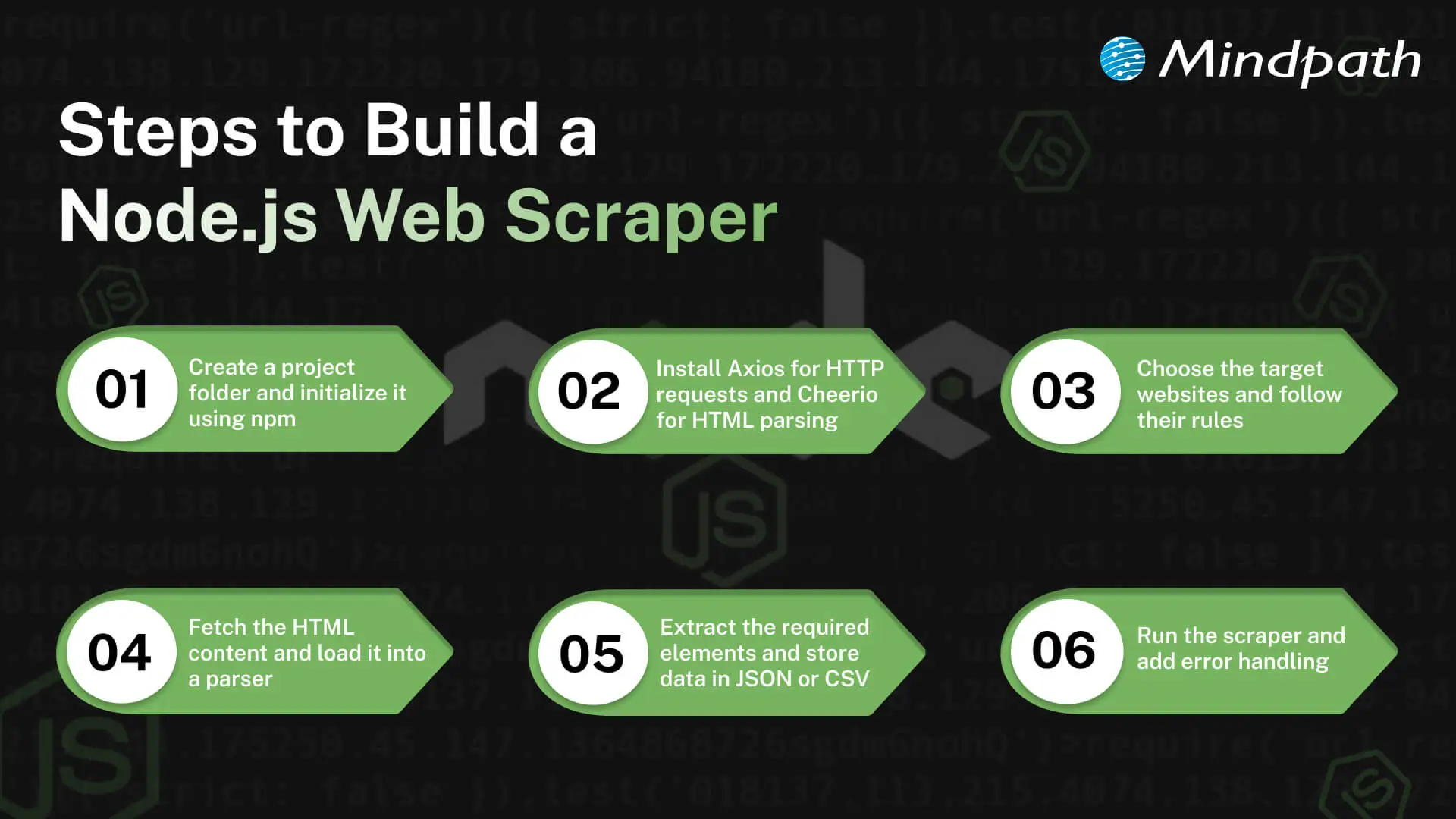
1. Set Up Your Project
Make a new project folder and get it started using npm. This prepares your Node.js environment for web scraping with Node.js. The project will manage all dependencies through a package.json file.
2. Install Necessary Libraries
Install such tools as Axios to make the HTTP requests and Cheerio as the HTML parsing tool. The libraries simplify the creation of a Node.js scraper. They give you the core tools for web scraping with Node.js.
3. Choose Target Websites
Choose the sites that you would like to scrape. Ensure that you are obeying their rules and law. Target selection helps to make sure your web scraping of Node.js is safe and effective.
Must Read: Full-Stack Development with Node.js
4. Fetch and Parse Pages
Get the HTML of the page using Axios or any other HTTP library. Load it into Cheerio or other similar to navigate and choose elements. The next thing that needs to be done is to prepare your data that your Node.js scraper will extract.
5. Extract and Organize Data
Even define the information you require, such as prices, titles, or links. It should be collected using CSS selectors. Export the data that has been extracted in a simple, easy-to-use format: JSON, CSV, or database.
6. Execute and Improve
Install and run your Node.js scraper and verify the output. Include error management and rate limiting to prevent problems. Refining your process ensures web scraping with Node.js runs smoothly and efficiently.
Looking to simplify web scraping with Node.js? Explore essential Node.js libraries to make data extraction faster and more reliable.
Ready to Unlock the Power of Web Scraping with Node.js?
Web scraping with Node.js allows developers to collect and use data efficiently, making it easier to support smarter decisions, automation, and digital innovation. By understanding the right tools, techniques, and workflows, businesses that hire Node.js developer can work seamlessly with both static and dynamic websites, manage large datasets, integrate data into applications, and gain real-time insights to enhance project prosperity
Mindpath is a trusted Node.js development company offering expert web and Node.js development services to build fast, scalable, and secure applications. Their team creates custom solutions for web scraping, data integration, and automation. With experience in modern technologies, they deliver efficient and reliable results. Choosing Mindpath ensures your Node.js projects run smoothly, save time, and meet your business goals with high-quality support.

The employees of a company are no doubt the most essential assets. In the recent scenario, businesses have plenty of choices to keep their team more robust and result-oriented. With the rise of remote work and technology, you don’t need to limit your team to a certain geographic location. Further, you can leverage the excellence of the worldwide talent pool.
A number of companies are choosing to outsource their tasks and project development. In fact, the global outsourcing market size is USD 1.02 trillion, and it is going to double by 2031 (Source). In this blog, let us compare two of the most essential outsourcing approaches: staff augmentation vs managed services. This can help you pick the right service that goes well with your company’s structure.
Want a team that can help you to stay competitive with evolving project demands? At Mindpath, we offer staff augmentation services that enable you to scale your workforce efficiently and cost-effectively.
What is Staff Augmentation?
Staff augmentation is considered to be an outsourcing business model in which your company will hire outside professionals temporarily. Further, the process remains quick, and you can augment the capacity as per your current team’s needs. You can leverage near-shore, onshore, and offshore talent and can scale the team as per the demands.
- When it comes to the IT industry, businesses can use staff augmentation for multiple stages of the development process. Additionally, this includes workflow optimisation, programming, quality assurance, etc.
- This can help you overcome specific challenges while hiring key skills that your internal team may be missing.
- Talking about staff augmentation vs managed services, staff augmentation is cost-effective and offers flexibility.
- It is a temporary solution that accesses your existing team and resources, and gets the benefits of outside talent while reducing the operational charges.
What are Managed Services?
Managed services are an integral approach to software development that allows you to outsource your IT functions to a provider from another region. Moreover, your business can outsource the work virtually to managed IT services. This can include anything from data migration to cybersecurity, and much more.
- Managed service providers don’t integrate with your internal team but operate on their own.
- They can offer you a reliable quote and project timelines. After you approve them, they will start working on the designated task while maintaining continuous communication.
- The managed services model is cost-efficient as it lessens the requirement for overhead and resource management.
- Your company can prioritize other business tasks and can check on the progress instead of assessing the work on a daily basis.
Looking to stay ahead in your hiring strategy with evolving workforce models? Check out the latest staff augmentation trends to learn what’s shaping the future of talent.
What are Some Key Differences between Managed Services vs Staff Augmentation?
To get a detailed knowledge of managed services vs staff augmentation, let us go through some of its key aspects. Here is a table that highlights all the essential features that these models consist of.
| Important Features | Staff Augmentation | Managed Services |
| Benefits | Cost efficiency is one major staff augmentation benefits. | This model leverages a fixed rate and can be your long-term partner. |
| You can have access to a wide range of talented professionals. | Prevents you from the risk of managing in-house teams. | |
| It enables you to scale the team as per project demands. | Provides access to a team with expertise across multiple elements. | |
| Bridges temporary skills gaps. | Allows the internal team to prioritize core operations. | |
| Disadvantages | It is a bit risky to integrate a new team to your existing operations. | Integrating external resources might require extreme knowledge. |
| Risk of dependency on external providers for critical works. | You need to depend on the provider to drive process success. | |
| It needs a strong internal management capacity to handle the external professionals. | No control over your project, team, or the development process. | |
| Flexibility | Your teams can be scaled quickly as per the existing skills gaps. | Flexibility remains limited, and changes might give rise to additional payments. |
| Expertise | It offers access to specific skills or expertise for a required timeframe. | Offers a wide range of expertise and a supportive environment. |
| Responsibility | The client is responsible for your project’s success and workflows. | This model provider owns the project and offers a product as per the agreed requirements. |
| Focus Area | It is task-specific and viable for short-term projects. | It leveraged end-to-end solutions. |
| Customization | This model is fully customizable as per your team dynamics. | Follows the terms that is written on the agreement. |
| Best For | Quick scaling where your workload is heavy. | Suitable for long-term project commitments. |
When Should You Prefer Staff Augmentation Services?
After assessing the staff augmentation benefits and other critical factors, let us understand when you should leverage this outsourcing model.
1. Your Need is Project-Specific
If your requirement is temporary, staff augmentation can help you bring in the specialized talent for a specific time period. Further, you can easily access the services as per your project demands without seeking any long-term commitments.
2. You Need Direct Assessment
When your company has a strong team, staff augmentation allows the external team to work under your supervision. So, this ensures your priorities are fulfilled with quality. Additionally, your existing team’s capabilities will also increase with better insights.
3. You are Handling a Strict Deadline
If your project’s timeline is critical and hiring full-time employees would take too long, staff augmentation provides rapid onboarding of skilled professionals. Further, this can help you maintain your project speed.
Want to avoid common onboarding challenges with external talent? Learn through our augmented staff onboarding guide for a smoother transition.
When Should You Prefer Hiring Managed Services?
Here are the instances where managed IT services can be your utmost preference.
1. You Desire Strategic IT Management
If your organization doesn’t have the leadership to manage all its internal IT operations, managed services can access the experts to take complete responsibility. Moreover, this ensures professional oversight for better performance management. Your team gets the freedom to focus on core functionalities.
2. You Need Predictable Solutions
When your company depends on consistent system performance and reliability, managed services can deliver structured processes. So, it keeps your team balanced while lessening the operational charges. Moreover, your plans will have that strategic influence on your audience.
3. Your Company Needs Long-Term Commitments
Managed services can offer continuous expertise when it comes to fulfilling your ongoing requirements. Instead of hiring an internal team, you can get dedicated support that can encourage your overall functions.
Curious about hiring the right talent for short-term and long-term projects? Check out our staff augmentation hiring guide to learn practical hiring insights.
Cost Considerations of Both IT Outsourcing Models
It is important for you to understand that saving money is not always the primary goal. You also need to value precise creation. Here, go through the cost approaches of both the IT outsourcing models.
1. Staff Augmentation Costs
In this model, you need to pay only for the expertise you need. You can control the resource allocation, and there is no overhead of benefits, training, and recruitment. However, the charges might increase if you demand some change in the middle of your project.
2. Managed Services Costs
This model can assure you of predictable or fixed charges. It sometimes includes service level agreements for performance. The essential providers can handle multiple clients effectively. But managed services sometimes come with longer contractual commitments.
Looking to improve project delivery with the right technical expertise? Check out our IT staff augmentation guide to learn how to bring in skilled professionals.
Final Words
Staff augmentation and managed services can assist your business in completing the development projects more efficiently. However, when it comes to staff augmentation vs managed services, you need to assess their elements prior. Staff augmentation can be a great solution for businesses that need flexibility and short-term goals. On the other hand, managed services are best suited for long-term assistance.
Our experts at Mindpath can help you with both aspects. Partnering with us can offer you the support that you desire while filling the gap needed for your IT foundation.
Key Trends in Front-End Development 2024
1. Motion UI
Motion UI is expected to revolutionize front-end development by 2024. Companies need to discover innovative methods to keep users interested as their attention spans decrease. Motion UI is a new approach, employing transitions and animations to make webpages and applications more vibrant and intriguing. This trend enables developers to create seamless animations to buttons, menus, and page transitions. Animated elements make interactions more interesting and enjoyable, encouraging visitors to stay on a website longer and explore farther. As Motion UI becomes popular, it is projected to play an important role in improving and captivating web experiences.
2. JAMStack
JAMStack, which stands for JavaScript, APIs, and Mark-up (HTML and CSS), offers a new approach to website development. Traditionally, developers had to configure a server to produce HTML pages every time a visitor visited a website, which might be sluggish and inefficient. JAMStack makes this procedure considerably easier and faster. Rather than managing a sophisticated backend, developers build static HTML pages that are hosted on a Content Delivery Network (CDN). When people visit the website, the CDN immediately distributes the pre-built HTML pages to them. JavaScript and APIs are then used to manage any dynamic content, resulting in an interactive and responsive website. This strategy accelerates website performance, increases scalability, and simplifies management. As a result, JAMStack is expected to offer big advantages in developer experience, performance, scalability, and cost savings, making it a key front-end trend in 2024.
3. VR and AR
Virtual Reality (VR) and Augmented Reality (AR) are already enhancing the immersive and interactive nature of online apps by 2024. While AR adds digital features to what you see in real life, VR replaces the real world with a virtual environment. They work together to produce more engaging and dynamic experiences on websites and applications, potentially increasing conversions and company growth. Big corporations like Amazon and Sephora are already embracing VR and AR to improve the shopping experience by allowing customers to see things in entirely new ways. As technology advances, VR and AR are expected to become progressively more popular, altering how consumers interact with online apps and setting new expectations for engagement.
4. Micro Front Ends
Micro front ends will emerge as a major trend in front-end development, providing a new method to construct sophisticated apps. Unlike traditional monolithic designs, which bundle everything together, micro front ends divide huge programs into smaller and more manageable components. Each of these components, or micro front ends, has its own codebase, development team, and deployment procedure, and they work independently yet together to form a bigger system. This technique reflects the ideas of microservices architecture, giving developers more adaptability and mobility. One of the primary benefits of micro front ends is their reusability. Developers can create standardized user interface components that can be reused across several apps, maintaining design consistency and avoiding the need for unnecessary coding.
5. Voice User Interface (VUI)
Voice User Interfaces (VUIs) are expected to become an influential trend in front-end development, altering how people engage with technology. As people get more comfortable using their voices to control devices and applications, VUIs gain popularity, making it essential for developers to embrace this technology and provide novel solutions. One of the primary advantages of VUIs is their capacity to improve accessibility. VUIs let users communicate with technology via voice commands, opening new possibilities for a wider audience, including people with impairments. When integrated with the Internet of Things (IoT), VUIs allow users to easily operate linked devices, making daily chores simpler and more natural.
6. Single-Page Applications (SPAs)
Single-page applications (SPAs) are expected to have an enormous impact in 2024, becoming a prominent trend in front-end development. Unlike traditional multi-page applications (MPAs), that load a new page with each user interaction, SPAs start with a single page and dynamically modify the content as users interact with it. This method provides a smoother, quicker, and more responsive user experience. One of the fundamental aspects of SPAs is their dependence on JavaScript for asynchronous updates, which allows content to be presented without requiring a full page reload. This improves speed and helps the program appear more fluid and intuitive to users. As search engines improve their ability to handle dynamic material, the potential for SPAs grows. Companies who adopt SPAs currently will be ahead of the curve, acquiring a competitive advantage in the front-end development market. With its capacity to deliver a better user experience while requiring less development time and effort, SPAs are set to become a dominating force in web development, altering how businesses approach their online presence.
Ready to stay ahead in front-end development?
Mindpath offers cutting-edge solutions to elevate your website’s design, performance, and user engagement.
Front End Development Services at Mindpath
Final Thought!
Front-end development will be significantly transformed by new innovations like VR, AR, and micro front ends. These advances aim to make online interactions more immersive and efficient, while Voice User Interfaces and Single-page Applications provide more seamless and intuitive user experiences. Staying ahead of these trends will be essential for developers and organizations seeking to distinguish out and thrive in the rapidly changing digital market. The future of front-end development seems promising, and now is the moment to embrace these improvements and advance your projects ahead. Mindpath is devoted to provide excellent digital experiences by using the latest and most recent front-end development services. Our services are meant to keep your web presence ahead of the curve by integrating cutting-edge technologies. By focusing on seamless, engaging, and high-performance solutions, we ensure that your website not only meets but exceeds current standards of excellence. Partner with us to change your digital strategy and create exceptional outcomes in 2024 and beyond.
Curious about enhancing your web presence?
Mindpath’s front-end development expertise can transform your digital experience into something exceptional.
Understanding the web development costs is a significant question many businesses struggle with before initiating a project. Web development is the easiest way to make your products and services connect with global audiences. In fact, entrepreneurs are well aware of the profitable aspects and booming growth they can adopt through the online market. Talking about the trends, progressive web applications are growing fastest at a CAGR of 14.00%. Moreover, around 71% of businesses already have a website.
So, it becomes necessary for you to understand how much a web development costs. For your information, there are numerous factors that influence the cost of web development. This guide can help you with a complete breakdown, no matter if you are starting from scratch or have a small budget.
Planning to build a website and need a clear cost roadmap? Mindpath delivers scalable web development services designed to fit your business goals.
What Does the Web Development Cost Include?
Before you get into the web development costs, it is necessary to research your competitors and how uniquely you need to develop your site. Moreover, developing a good and reliable website is not just about writing code or initiating good designs. The total website development cost breakdown is dependent on your website’s structure.
Further, you need to be considerate about the functionality, technology stack, and the requirements for post-launch support. Here are some quick factors that influence the web development prices.
1. Type of website
A static website might cost you less than an interactive SaaS project.
2. Technology Stack
Use of leading frameworks like Laravel, React, or Next.js can increase the development timeline along with their charges.
3. Customization Values
If your website is developed with a pre-built template, the cost will be much lower. On the other hand, custom approaches can heighten the price range.
4. Development Approach
If you are valuing the expertise of a professional web development company, the development charges will be higher than those for a freelancer. However, the projects from a certified company always win in the competitive edge.
Curious why some web projects cost more than others? Discover web development tools and see how technology choices influence productivity and expenses.
What are the Average Web Development Costs for Multiple Industries?
The average web development cost majorly depends on the type of website you are relying on. Further, it also depends on the way you are creating and launching it.
1. Small Business
A small website development cost generally falls between USD 1000 and USD 10,000. Basically, it will include 5 to 10 pages, including content management systems such as WordPress. Moreover, there will be some useful features like service pages, contact forms for reaching the business, along with mobile responsiveness.
So, if you are serving locally or a startup business, this web development pricing can be useful.
2. Corporate Operations
A corporate website will include some good features like ERP integrations and scalable architecture. So, for such a business, the web development costs will be around USD 10,000 to USD 50,000.
Such a price range offers proper performance optimization and user engagement. Further, it also enhances a business’s reach on global platforms while including many advanced options in it.
3. E-commerce Sites
When it comes to e-commerce sites, the cost of web page development automatically heightens. Further, the cost breakdown depends on your catalog size, custom product pages, payment gateway integration, and shipping management systems.
Many users also consider building their entry-level store through platforms like WooCommerce and Shopify. However, a completely customized e-commerce website can range up to USD 50,000. This will cover all types of essentials, such as automating the inventory management and multi-vendor benefits. To enhance your customer experience, you should be careful about the project’s security.
4. Custom Web Applications
The overall cost of custom web development will fall in the range of USD 25,000 to USD 160,000. Your web application will include several important platforms like booking engines, SaaS products, real-time dashboards, and internal management systems.
These are some custom solutions that need to be built from scratch and require advanced backend architecture, API integration, scalable database, etc. The web application development is comparatively challenging and requires the involvement of experts.
This is the general idea about the average web development costs for multiple business types. So, the costs might vary depending on the various requirements of your projects.
Looking to understand how emerging trends affect web development costs? Check out the latest web development trends to see how new technologies and practices influence project scope.
Website Development Cost Breakdown as Per the Types
You must be aware of the fact that every website has its unique development scope. So, the web development prices generally depend on your site’s functionality, complexity, and the intended need of the project. Here, you can go through the expected cost of web page development.
Web Development Type Key Functions Development Phase Estimated Cost
Basic Clean and understandable UI, contact forms, page navigation, search tools, etc., 6 to 12 weeks, USD 10,000 to USD 20,000.
Standard User interaction, seamless content management, API usage, database support, etc., 3 to 6 months USD 20,000 to USD 45,000.
Advanced High-level data flow, custom modules, real-time functionality, etc., 12 months plus. Starts at USD 50,000 and increases with custom inclusions.
Planning your web development budget more effectively? Explore web development technologies to see how choosing the right stack affects cost and performance.
Website Development Cost As Per the Chosen Experts
There are multiple options available in the market to personalize your web development. Let us explore some valuable vendor types that have been offering the best web development costs while enhancing the facilities through viable inclusions.
1. Team of Expert Web Developers
Hiring a professional web development team can be the best option available in the market. However, you might think it is an expensive investment. But remember that this option offers the highest level of security.
Apart from this, these agencies consist of experienced people who can easily customize your projects as per your business goals. Such companies can help you with an accelerated web development process. Apart from leveraging design and developmental solutions, they also ensure website maintenance while developing a marketing strategy. The web development pricing of the full-fledged agencies will be around USD 15000 to USD 150,000 and more.
2. In-house Development Team
Creating your own web development team offers you the advantage of having dedicated professionals at your fingertips. However, the process can be resource-intensive and time-consuming. You need to be assured of effective management and create a positive work environment. Other than this, it can be challenging for you to find candidates who match your required skills and budget.
Remember that an in-house web development team is necessary if the website is essential to your business. The average web development cost of these experts can be between USD 80,000 and USD 200,000 per year.
3. Freelance Developers
Freelancers will charge you around USD 15 to USD 80 per hour. They are the only viable options that come within a small budget. They are best suited for your small websites, MVPs, or any budget-centric projects. Further, they offer flexibility with the contracts and easily scale the tasks.
4. DIY Efforts
Many businesses just take the challenge to create their website on their own. However, it takes high skills and commitment. The process remains slower, and you might commit mistakes that your business can’t bear at all.
Curious how web development costs compare to full-scale software projects? Discover software development cost insights to understand long-term budgeting and investment planning.
How to Pick the Best Web Development Partner?
If you require your development process to be effective enough, only prioritizing the website development cost breakdown is not enough. You need to prefer the right development team or company that can make your project a success. Moreover, they should satiate your budget without being a burden on your pockets.
A right development partner should meet your budget, business requirements, and technical needs. So, you should look for experts who have good experience with your project type and industry. The experts should follow clear communication while being transparent regarding their process and charges. They should offer a detailed proposal regarding their web development pricing. So, no matter if you are choosing a professional agency or a freelancer, just be assured of their support and clarity.
What are Some Ongoing Costs that you might experience after a Website Launch?
Launching a site is just half of your journey. There are other elements related to it that can proceed with ongoing costs. Some of the major ones have been listed below.
1. Hosting Charges
Hosting charges usually come on an annual or a monthly basis. Shared hosting can be a bit approachable, while cloud hosting might hamper your budget.
2. Maintenance Efforts
To let your website offer desirable results, you need to continuously test its performance and fix bugs when required.
3. Support Packages
Your company might require support packages from web developers to keep the website performance-oriented.
Want to avoid unexpected web development costs? Check out the web development roadmap to understand project milestones and cost drivers.
Conclusion
It is a great thing to understand the website development cost breakdown before you think about any project. This can help you set clear goals while maintaining your budget. On the other hand, costs differ as per your goals, industry, requirements, and complexity of your projects. Breakdowns available in this guide can help you plan your projects with clarity. A well-defined budget with a solid plan can help you prevent your company from costly surprises and help your website to fulfil your business goals precisely.
So, if you are ready to experience the next step with a personalized cost estimation and strategy customized specifically for your business needs, consider the excellence of Mindpath’s web development services. Here, the team can help you build a website that can match your vision while pushing you ahead in the market.
The modern-day digital development depends on the intelligence, scalability, and flexibility advancing concurrently. This transformation is driven by AI and cloud computing, which help companies to make more efficient decisions by analyzing data faster. Executives see visible improvements in operations, products and customer experience. Consequently, the subject of conversation is not just trends but actually implementation. Teams want to have systems that learn, adapt and spur growth with minimum friction or delays.
With the increased adoption, there are heightened expectations in every industry. Decision makers want to have clarity, control and enduring value. They have to strike a balance between innovation and stability and cost consciousness. Additionally, it depends on choosing the correct strategy at the initial stage to succeed. Strategy is crucial and so is the technology. So, in this blog, we shall analyze the major advantages and the best practices of AI and cloud computing.
Keep reading further to learn more about this strategic synergy!
Want to optimize your business operations and scale effortlessly with the cloud? Mindpath offers cloud-managed services to provide secure, efficient, and fully managed cloud solutions.
Understanding the Core Fundamentals of AI and Cloud Computing
Artificial Intelligence (AI) facilitates machines to carry out tasks that would otherwise be carried out by human intelligence. It studies based on data, reasoning, identifies patterns, and comprehends language. Some of these major fields are machine learning, deep learning and natural language processing. AI helps companies to increase their efficiency, create smarter tools, and discover insights. Artificial intelligence and cloud computing tend to collaborate in order to improve outcomes.
Cloud computing involves computing resources, which include servers, storage as well as software offered via the Internet. It allows businesses to scale fast, pay as per their usage and access services anytime. The basic models include IaaS, PaaS and SaaS. This adaptability reduces the cost, accelerates the development, and supports the contemporary applications.
AI applications run effectively and successfully on cloud computing. AI and cloud computing go hand in hand to develop smarter and quicker systems. Cloud provides scalable storage and high-performance computing of AI models. AI will introduce intelligent cloud services via analytics, automation and optimization of resources. They all facilitate chatbots, predictive insights, and data analysis. The companies can operate cloud-based AI to take advantage of more advanced AI tools without substantial initial expenses and data analysis. Companies can access advanced AI tools on cloud platforms without huge upfront costs.
Looking to streamline cloud operations with intelligent solutions? Explore AI tools for DevOpss to see how automation and analytics optimize development and deployment workflows.
Key Benefits of AI Cloud Computing
AI and cloud computing are transforming the world of business and technologies. They open up fresh opportunities of development, productivity, and better decision making. Organizations look into how to make use of this combination. These are the best advantages that companies can embrace to remain competitive.
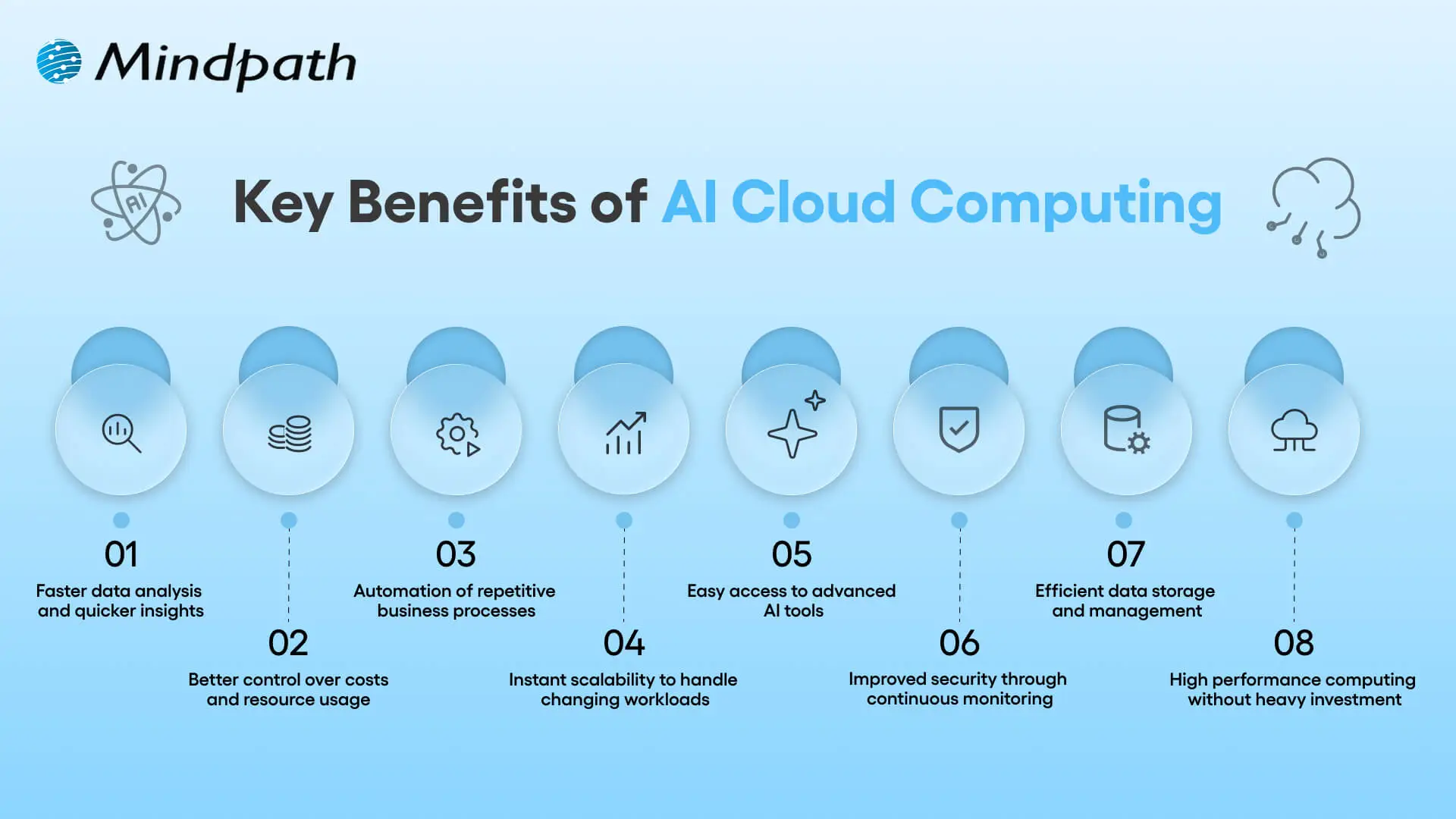
1. Faster Data Insights
AI and cloud computing have excellent assistance in analyzing large data sets within a short period of time. Businesses bridge the data sources at ease and identify patterns that can make better decisions. This pace facilitates planning and minimizes guesswork in the operations.
2. Smarter Cost Control
AI and cloud computing minimize excessive expenditure on computers and their support. Businesses purchase resources as they consume and spend as demand increases. This strategy maintains flexible and predictable budgets.
3. Intelligent Automation
AI and cloud is used to automate repetitive workflow processes. Systems acquire knowledge and enhance processes through time. Teams are more strategic oriented as operations proceed normally.
4. Flexible Scaling Power
With AI and cloud computing, scaling up and down of resources is done on demand. Businesses either expand or contract without hesitation. This scalability helps in the development and unexpected increase in workload.
Must Read: Cloud Computing Trends
5. Easy Access to AI Tools
Cloud services provide ready-to-use AI services to business needs. Teams combine analytics, language processing, and vision tools within a short period of time. In combination, cloud computing and artificial intelligence eliminate technical restrictions.
6. Stronger Security Oversight
Cloud systems that operate based on AI keep a constant watch on activity. They identify threats at an early stage and react quicker to threats. This enhances security without retarding processes.
7. Better Data Management
Cloud services are an easy way of organizing, storing and retrieving data. AI assists in the automation of information classification and management. Companies have smarter data to analyze and report.
8. High Performance Computing
Artificial intelligence workloads require resources with high computing capabilities to operate. The cloud platforms offer on-demand GPUs and fast processors. Businesses deal with complicated activities that are not heavily capitalized.
Planning to deploy AI solutions at scale in the cloud? Explore cloud security tools to see how modern technologies secure AI pipelines and cloud infrastructure.
Best Practices for Implementing AI in Cloud Computing
AI and cloud computing need a more explicit and deliberate way of developing real value. Before adopting systems, teams need to plan, set goals and prepare systems. Technology is as important as strategy. These best practices demonstrate the way to apply AI in cloud computing in an effective and responsible manner.
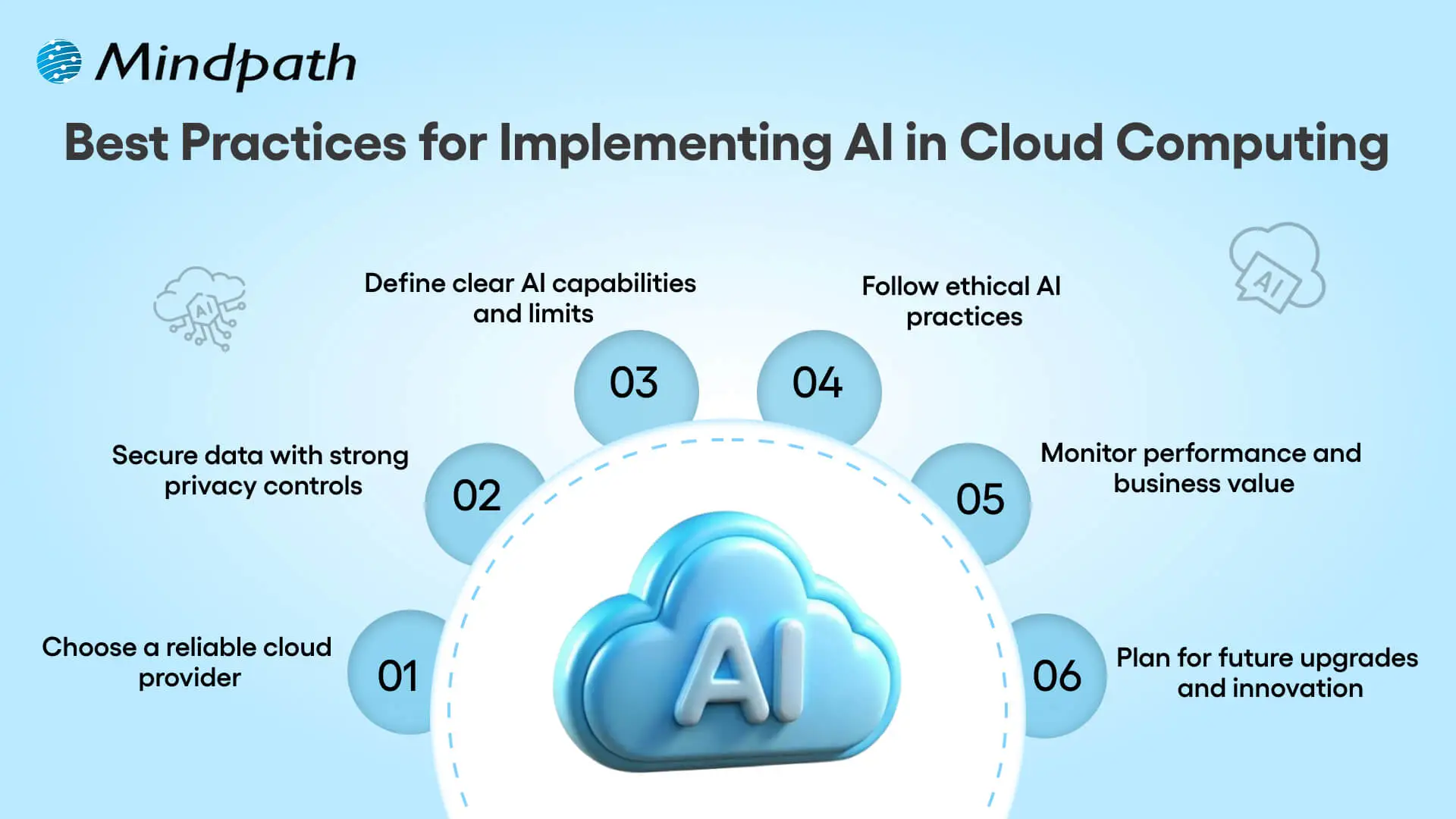
1. Select a Trusted Cloud Provider
Select a provider with the track record of working with AI and cloud services. Assess its standards of reliability, scalability, and compliance. Powerful partner will facilitate safe expansion and stable long-term operations.
2. Prioritize Data Privacy and Security
Encrypt and implement control access to sensitive information. Review security policies on a regular basis in order to minimize risks. High level of security instills trust in cloud systems and AI.
3. Define Clear AI Capabilities and Limits
Know what AI is capable of providing under the circumstances of the quality of the data. Track models regularly in order to identify bias or performance problems. Good expectations can make teams use AI in a responsible and effective way.
Also Read: Cloud Computing Attacks
4. Establish Ethical AI Practices
Instruct employees on how to use AI fairly, transparently, and accountably. Ethical consciousness results in an improved decision-making process within teams. Conscientious operations enhance the confidence of cloud-based AI.
5. Monitor Performance and Business Impact
Monitor behavior and business performance of the track systems. Assess value through measurement of efficiency, accuracy and cost. Consistent reviews help to maintain AI and cloud investments in accordance with the objectives.
6. Prepare for Future Innovation
Anticipate changing regulations and elements of technology. Architecture Software Build scalable systems, which welcome upgrades and additional features. A visionary roadmap would guarantee success in the long term with AI and cloud computing.
Wondering how AI applications can scale efficiently in the cloud? Check out serverless architecture in cloud computing to learn how server-free designs enable faster, cost-effective, and scalable deployments.
Ready to Turn AI and Cloud Computing into Real Business Value?
Artificial intelligence and cloud computing are transforming the nature of modern business development, competition, and innovation. They allow making smarter decisions, executing them faster, and operating flexibly together. It takes proper planning, excellent data, and responsible usage in order to be successful. By linking technology to the objectives of the firms, companies mitigate risk and create value in the long term. The approach will assist teams to develop systems which are adaptable, scalable and perform well.
Mindpath AI cloud services assist companies to embrace AI clearly and confidently. Our professionals develop safe and scalable solutions which are practical to the business requirements. We put an emphasis on performance, ethics, and quantifiable results. Mindpath provides organizations with a dependable service in terms of planning, deployment, and optimization. Our strategy will make AI and cloud computing produce useful outcomes and not complications.

Benefits of AI in Education
1. Customized Learning
The greatest advantage of AI in education is that it offers personalized learning. With AI, learning becomes much more likely to be tailored to each student’s needs. If one student is weak in reading, AI can provide extra support by way of practice and activities. At the same time, another student who excels in reading can be given more challenging materials to engage their interest. This way, each student is presented with material that suits their levels best, making their work more effective and enjoyable.
2. Expanded Accessibility and Inclusion
AI is overcoming distance and physical limitations in education. Students in remote places or with physical constraints may now access high-quality educational resources using AI-powered solutions such as virtual instructors, interactive course materials, and language translation services. This technology contributes to a more inclusive educational environment in which all students, regardless of location, have equal opportunities to learn and develop.
3. Adaptive Assessments and Feedback
AI improves evaluations by employing exams, assignments, and even analyzing pupils’ facial expressions or posture to measure their development. This enables rapid feedback, indicating exactly where a learner requires further assistance and giving resources that will help them understand. This strategy not only improves academic achievement, but it also promotes students’ general well-being and trust regarding their learning journey.
4. Streamlined Administrative Tasks
AI is excellent at both creating personalized teaching and performing administrative work. It can handle student information, organize lessons, and grade multiple-choice tests. This automation allows teachers to devote more time to what is most important: crafting interesting classes, developing strong connections with students, and providing useful feedback.
5. Enhanced Student Engagement
AI is altering student engagement by offering fascinating new ways to study. Gamification, interactive simulations, and personalized learning plans provide students with dynamic educational experiences. Tools such as interactive classrooms and immersive platforms make learning more fun, allowing students to engage with one another and enthusiastically explore new topics.
Use-cases of AI in Education
1. Advanced Tutoring Systems
Tutoring programs driven by AI provide pupils individualized support. As students work in classes, AI examines their responses, identifies areas where they may be suffering, and provides personalized explanations to make things simpler. This manner, the learning tempo is tailored to each student’s needs. These systems improve students’ understanding of difficult topics by providing rapid support and a learning style that is tailored to each learner. The continual contact with AI improves learning outcomes and raises students’ confidence and performance.
2. Automated Grading and Evaluation
Grading is made easier by artificial intelligence, which evaluates student work rapidly and uniformly. This minimizes instructors’ burden, allowing them to focus on providing personalized help. By detecting patterns in pupil performance, AI can identify individuals who require further support and direct focused assistance. Additionally, AI delivers quick feedback, which improves the learning process. Automated grading and assessment improve teaching quality, assure fair assessments, and foster interaction among students and teachers.
3. AI-Powered Chatbots and Assistants
AI-powered chatbots and virtual assistants play an important role in improving students’ educational experiences. They offer immediate assistance by walking students through assignments, answering problems, and providing comments. These resources are available 24 hours a day, seven days a week, and satisfy the demands of students at any time. Their personalized guidance promotes autonomous learning and helps students actively participate in their studies, hence enhancing academic progress and achievement.
4. Educational Entertainment and Gamification
Edutainment and gamification make learning more enjoyable and engaging by incorporating artificial intelligence. By developing instructional games and simulations, AI transforms standard teachings into interactive experiences. Including game aspects such as prizes and competitiveness keeps students interested and engaged in their study. These gamified technologies not only capture students’ interest, but they also help them grasp and recall complicated concepts better. AI-driven edutainment and gamification mix education and entertainment to create a dynamic learning environment with thrilling gaming and interactive challenges.
5. Interactive and Educational Games
Artificial intelligence improves interactive and educational games by providing interesting learning experiences. These games integrate AI algorithms, natural language processing, and machine learning to create interesting tales, react to player activities, and provide personalized insights. This technique encourages students to become more interested, creative, and deliberate in their learning. AI-powered learning systems use challenges, simulations, and virtual worlds to encourage active learning, improve problem-solving abilities, and foster collaboration among students.
6. Smart Curriculum Planning
AI helps with creating curriculum by analyzing educational data to identify patterns or weaknesses in student learning. It can propose curriculum modifications and revisions based on current research and new standards of learning. AI may also assist in matching curricula with specific goals for learning, keeping the information relevant and up to date. This enhances curriculum design efficiency, allowing educators to make informed decisions and make better use of resources, ultimately improving educational quality and relevance.
Mindpath’s AI Development Services for Education
Wrapping-Up
AI is revolutionizing the learning process with in-depth, personalized, and truly innovative experiences. From personalized lesson plans and adaptive feedback—reducing administrative burden—to interactive educational games, AI finds ways to make the learning process more efficient and accessible. These developments do not clearly indicate how students will learn better but arm educators with more focused support and lively classrooms.
Mindpath is on the cutting edge of this revolution in education. Our AI development services enable powerful new levels of personalization in learning, the automation of administrative tasks, and insight-driven solutions. We empower institutions of education to make use of AI for better learning outcomes, teaching strategies, and, in fact, the educational environment.
Curious how AI can revolutionize your classroom?
Explore Mindpath’s cutting-edge AI solutions and transform your educational experience today.
Ever been puzzled between Angular and React for your next web development project? Both are very powerful tools with unique advantages, but how do you know which to use for the best fit? In this blog, we’ll uncover the key differences between Angular and React, highlight their strengths, and help you make an informed decision. Are you curious about which framework stands out? Let’s dive in and find out!
Overview of React
React is a front-end JavaScript library developed by Facebook that enables building user interfaces based on the reusable component model. Along with flexibility and efficiency, it also hosts server-side rendering for improved performance and scalability. React aids in developing complex UIs with a seamless user experience. It was developed under the “Learn Once, Write Anywhere” philosophy, ending up as one of the most favored choices while developing fast and scalable applications. It also integrates with JSX, which is an extension of syntax, making it quite easier to write and manage HTML-like code within JavaScript. If you’re considering how to leverage these features effectively, you may want to hire ReactJS developers who can expertly utilize these capabilities to meet your project’s needs.
Overview of Angular
Angular is an open-source front-end JavaScript framework developed by Google. It is vastly used in the creation of high-performance and scalable mobile and web apps using only HTML, CSS, and TypeScript. It gives robust solutions at the enterprise level in the development of web apps with its latest version, Angular 13. Angular is a complete overhaul of AngularJS (Angular 1.0) and utilizes the MVC (Model View Controller) architecture. This means that it structures code into logical components, enhancing development efficiency and improving the time it takes to load the initial page.
Top Features of React
1. Reusability
The biggest advantage of React is in creating user interface components that turn out to be reusable across different parts of a given app. It means building a button or form once and reusing it as many times as you want in your application. This way, development time is saved with React, and the application remains organized and scalable. These benefits are a key reason why many businesses seek ReactJS development services to enhance their application’s efficiency and maintainability.
2. Interactivity
React makes it easy to build active, engaging user interfaces. This allows one to update and render data in real time, not having to refresh the whole page. This will therefore mean a smoother user experience as users interact with the App.
3. Performance
React enhances performance through its Virtual DOM, which optimizes the update process by efficiently managing changes to the Document Object Model. Instead of updating the whole page it changes only what is required, which makes updates faster and more efficient for the user.
4. Community
React has an enormous, active, and highly vibrant community of developers. This vibrant community provides a lot of resources, libraries, and tools extending and enhancing the functionality of React, which helps in finding support and solution for the projects easily.
5. Reliability
React is trusted by big companies and websites: from Facebook and Instagram to Airbnb. This wide adoption highlights its reliability and scalability for building large-scale applications.
Wondering how ReactJS can boost your project’s success?
Mindpath’s seasoned developers craft cutting-edge solutions tailored to your needs.
Top Features of Angular
1. Modularity
Angular is designed modularly, which provides a possibility to break complex applications down into smaller, reusable pieces in the process of development. This makes the code easier to manage, test, and scale, hence being better organized for maintenance.
2. TypeScript
Angular is written in TypeScript, an enhanced version of JavaScript supporting additional features, classes, and type checking. That allows early detection of errors and makes the code easier to read and maintain.
3. Performance
Angular boosts performance with lazy loading, ahead-of-time compilation, and tree shaking. These tools decrease load time and make an application run faster; thus, enhancing the user experience.
4. Cross-platform
Angular is a cross-platform framework that allows the developer to build web, mobile, and desktop applications from one codebase. This simplifies the procedure for development and maintenance across different platforms.
5. Community
Angular has a large, ever-active community of developers and contributors who have contributed a great deal to the updating, fixing, and implementation of new features. In that regard, this big support community makes Angular reliable and future-proof for the construction of modern web applications.
React vs. Angular – Comparison Table
Feature | React | Angular |
Learning Curve | Easier to learn and use | Steeper learning curve |
Data Binding | One-way data binding | Two-way data binding |
Performance | Virtual DOM for efficient updates | Real DOM with optimization techniques |
Flexibility | Highly flexible, integrates well with other libraries | More opinionated and less flexible |
Modularity | Component-based structure | Modular but more rigid |
Development Speed | Fast development with reusable components | Slower due to larger framework overhead |
React Development Services at Mindpath
At Mindpath, we put ReactJS into practice to come up with powerful and scalable web solutions. With over ten years of experience, our team is well-equipped to handle a wide array of ReactJS development needs. Here’s a review of the services we offer:
- ReactJS Front-End Development: We are involved in creating responsive and dynamic user interfaces to improve user experience and interaction with your website.
- React Native App Development: Our team develops cross-platform mobile apps with React Native and gives them the native look and feel across iOS and Android devices.
- ReactJS Consulting: We expertly guide you on the usage of ReactJS in your projects so that the development strategy and architecture may be better optimized for the projects.
- ReactJS API Integration: We will integrate your ReactJS applications easily with external APIs and connect them seamlessly for smooth data and functionality exchange.
- ReactJS Enterprise App Development: We develop scalable and reliable applications that large organizations can use to take up complex requirements with high performance and efficiency.
- ReactJS Maintenance & Support: Continuous maintenance and support services that keep your ReactJS applications in motion, fixing any issues fast.
- React Web Design: We design engaging and user-friendly web interfaces that provide an impressive user experience through a focus on aesthetics and functionality using ReactJS.
- Custom React JS App Development: Build customized ReactJS applications that meet your business requirements, providing personalized solutions to all your needs.
- ReactJS Upgradation: Upgrade your existing ReactJS applications to their latest versions, offering you brand new features and improved performance.
- ReactJS Product Development: We develop innovative products with ReactJS; high quality and performance-driven applications that fulfill your business needs.
- ReactJS Ecommerce Development: We will build robust, interactive e-commerce platforms using ReactJS to ensure a great online shopping experience.
- ReactJS Migration: We help migrate your existing applications to ReactJS while ensuring smooth transitioning and improved performance.
- ReactJS Plugin Development: Developing custom plugins for ReactJS that extend functionality and fit in perfectly with other tools and systems.
- 1 ReactJS Social Media & Interactive Apps: Let us help you create engaging social media and interactive applications using ReactJS that improve user interaction and their experiences.
- ReactJS Customization Services: We will customize ReactJS components and applications according to your needs and wishes.
Conclusion
The choice between Angular and React greatly depends on the needs, goals, and long-term vision for your project. While React offers flexibility and reusability, which fits best in dynamic and user-centric applications, Angular has a robust framework and modularity for large-scale enterprise-level projects. Both are unique in their own advantages, but understanding your specific requirements will lead you to the best choice.
At Mindpath, we specialize in harnessing the power of ReactJS in the development of new-generation, scalable, and high-performance applications that meet your business requirements. Besides that, our ReactJS development services ensure that from an interactive web app to powerful mobile solutions down to robust enterprise platforms, your project will be in good hands. Let us help you navigate the world of modern web development and achieve your goals with confidence.
Ready to elevate your web development?
Mindpath’s ReactJS expertise delivers dynamic, user-focused applications that drive results.
Join our Newsletter!
categories
Join the world's largest training library and unlock new opportunities!
Ready to Leverage GenAI for
Software Development?
Form automation to innovation, let’s turn your ideas into intelligent, AI-driven solution.