AI in Web Development – Everything You Need to Know

Join our Newsletter!

Featured Posts

Support Is One Click Away

Home

AI in Web Development – Everything You Need to Know

ai in web development

AI in Web Development – Everything You Need to Know

Have you ever pondered if machines could design, code or even personalize user experiences better than humans? Sounds like a dream, right? Well, this isn’t a dream anymore, it is the power of Artificial Intelligence. You heard it right; artificial intelligence is becoming a powerful tool in web development in today’s digital world. Want to know how AI in web development can be beneficial for you? From accelerating development to building smarter sites, AI is quietly revolutionizing the construction and experience of digital platforms. 

But what does this revolution look like? And why are businesses and developers embracing AI more than ever? The answers may surprise you. Stay tuned as we uncover the ways AI is transforming the future of web development! 

Are you ready to elevate your website? Contact us for top-notch AI development services and we will bring your AI-driven web vision to life. 

Role of AI in Web Development

AI in web development refers to the use of artificial intelligence for building websites, faster, smarter and easier to manage. It can help with a lot of things such as writing code, fixing bugs and even assisting with the design. AI can be used in web development to save time, reduce errors and create personalized websites. By leveraging AI, developers can avoid doing repeated tasks and focus on more important things. It can find errors, accelerate things and also help users get their requirements faster.

AI plays a major role in making websites better by suggesting designs, writing parts of the code and even testing how well a website works. Once the site goes live, AI can watch how people use it and make things smoother. Now you must have got a good idea about AI in web development. Let us also learn about some of its benefits: 

Also Read: Benefits of AI

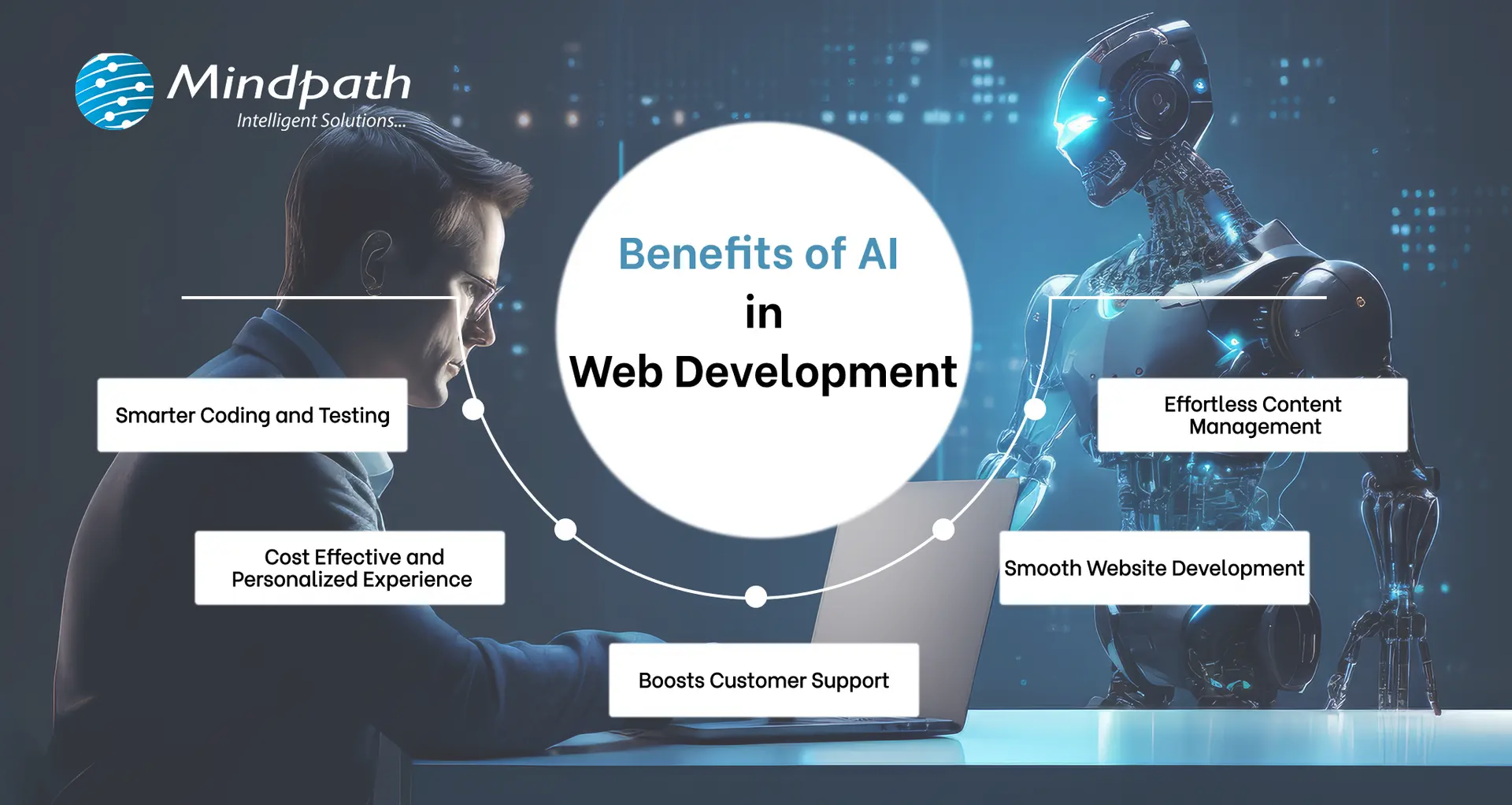
Benefits of AI in Web Development

AI is simplifying website creation for everyone. It assists with coding, designing, and even communicating with users. If you’re creating a website or just beginning, AI can help you save time and get things to work more efficiently. Here are some easy ways it can actually help.
Benefits of AI in Web Development

1. Smarter Coding and Testing

The powerful combination of AI and web development can help developers to write cleaner codes by spotting bugs early and improving how the code works. With deep learning, AI-based tools also facilitate automated testing, which assists quality assurance teams in verifying whether the website functions correctly. Although some problematic areas continue to require manual testing, AI streamlines the process and reduces costs. That’s one of the reasons why QA and testing budgets have declined over the past few years, and why more individuals are using AI websites for improved results. 

2. Smooth Website Development

AI in web development handles mundane and time-consuming work so developers can concentrate on the larger aspects of a project. With smart tools and data-driven choices, the entire web development process becomes more efficient and faster. This is incredibly useful, particularly if you’re new to it. By using AI to create websites, you save time and effort while building something awesome and making web development feel less stressful and a lot more efficient from the very start. 

3. Boosts Customer Support

AI in customer service makes it simple to integrate smart chatbots onto websites that are able to engage with visitors’ day and night. These virtual assistants comprehend questions and respond in natural, friendly terms. They provide instant answers, resolve issues rapidly, and never require breaks. This allows owners of websites to assist users without requiring a support team full-time. It’s an easy method to ensure visitors are satisfied and that they always receive assistance, even when there is no one present. 

4. Cost Effective and Personalized Experience

With the help of AI tools, websites are now able to provide customers with a more personalized and seamless experience at reasonable costs. Work that required time can now be processed automatically, saving time for both users and website owners. AI also assists in identifying fraudulent or toxic activities, protecting users. This is why many top AI websites utilize intelligent features to serve customers better. Ultimately, AI assists in providing more value to the customer at a low cost. 

5. Effortless Content Management

Website content management becomes a lot simpler with the assistance of AI. Through analyzing user behavior on a website, AI provides clear concepts regarding what type of content users like most. Website owners can develop improved posts, videos, or pages that genuinely interest visitors due to this. With the assistance of AI web templates and smart recommendation tools, you can lead users to whatever they require and retain them for a longer period. It’s an easy way to make content better and make each visit feel more personal.

Is your business making the most of AI to stay ahead of the competition? Explore how integrating AI in your business strategy can optimize processes, drive growth, and improve decision-making.

How to Use AI in Web Development?

Today, web development thrives on the partnership between AI and human expertise. While AI handles repetitive tasks and enhances efficiency, it still relies on human creativity and problem-solving. Here’s how you can use AI in web development to streamline your process and improve results. 

1. Artificial Design Intelligence (ADI)

Artificial Design Intelligence (ADI) assists you in creating a complete website by simply responding to a few simple questions. It selects the most suitable layout, design, and content depending on your requirements. It’s like having an intelligent assistant that designs a professional-looking site that reflects your style and objectives. This AI website generator makes the process fast and efficient, ensuring you get the site you want with minimal effort.  

2. Search Easier with Voice Assistants

Rather than typing and reading lengthy pages, users can simply speak their question. Voice AI listens, the correct answer quickly, and voices it back. Voice AI assists websites in providing rapid and clear responses, speeding up searches, making it easier, and more accessible to all. 

3. Coding Assistants

Developers can use smart coding assistants to speed up their work. These tools suggest code, spot errors, and help build websites faster. Even when working on big ideas, they take care of the small stuff. It’s like having a smart helper while writing your code. 

4. Personalize User Help with Chatbots

AI chatbots make it easy for users to get the info they need. They can ask questions in simple language, and the bot instantly provides answers or links. The benefit of chatbot is that it provides fast, accurate responses, making the experience more personal and efficient by using the website’s content.

5. Easy Search Engine Optimization (SEO)

AI can make SEO much easier by providing the best keywords, topics, and headlines for your content. It can even write parts of your text, ensuring the right keyword density for better search engine rankings. This helps your website attract more visitors without the hassle of manual research. 

AI is reshaping industries by automating the processes, empowering faster decision-making, and providing data-driven insights. Learn how AI is e-commerce is transforming the future of e-commerce sector.

Ready to Transform Your Website with AI?

AI is changing web development by making tasks faster and more efficient. From designing and coding to improving user experience, AI helps developers focus on what truly matters. By integrating AI, your website can become smarter, more personalized, and easier to manage for everyone involved. 

Mindpath offers top-tier AI development services and delivers high-performing artificial intelligence solutions that enhance your website’s design, performance, and functionality. Our expert team utilizes AI tools to streamline processes, boost user experience, and create custom solutions.  
Frequently Asked Questions

1. Is AI in web development suitable for small businesses and startups?

Yes, AI in web development is highly suitable for small businesses and startups. It helps reduce development costs, automate repetitive tasks, and speed up website launches. Even with limited resources, businesses can build professional, scalable, and user-friendly websites without needing a large technical team. 

2. Will AI replace human web developers in the future?

No, AI is designed to assist, not replace, web developers. While it can automate coding suggestions, testing, and design support, human creativity, strategy, and problem-solving remain essential. Developers use AI as a productivity tool to work faster and more efficiently, not as a substitute for expertise. 

 3. How secure are AI-powered websites?

AI-powered websites can be highly secure when properly configured. AI tools can detect unusual behavior, prevent fraud, and monitor vulnerabilities in real time. However, security also depends on proper development practices, regular updates, and human oversight to ensure strong protection against evolving cyber threats. 

 4. How does AI in web development improve user engagement?

AI in web development enhances user engagement by analyzing visitor behavior and delivering personalized content, recommendations, and experiences. It can adjust layouts, suggest relevant products or articles, and provide instant support through chatbots, making interactions more meaningful and increasing the chances of conversions. 

 5. What skills are needed to start using AI in web development?

To start using AI in web development, basic knowledge of programming, APIs, and web frameworks is helpful. Familiarity with AI tools, automation platforms, and data analysis can be beneficial. However, many modern AI platforms are beginner-friendly and require minimal technical expertise to get started. 

Related Post

Discover the key factors influencing software development costs and how to optimize your budget. Learn how Mindpath can help.
Discover the key differences between DevOps and traditional IT. Explore which approach suits your business needs.
Discover how ReactJS development enables scalable, high-performance applications with benefits like optimized routing, state management, etc.

Related Post

ReactJS Developer Hiring Costs in New York
Hiring a ReactJS developers in New York involves several pricing considerations, including expertise level, project complexity, and engagement approach. The cost of employing a freelancer, in-house developer, or outsourcing to an agency varies greatly. Understanding these aspects allows you to efficiently manage your budget and select the best staff for your project. Here’s an overview of the major factors that determine the cost of hiring ReactJS developers in New York.

1. Experience Level

The cost of hiring a ReactJS developer in New York varies according to their expertise level. Entry-level developers often charge between $60 and $80 per hour, making them an excellent alternative for modest tasks. Mid-level developers, with greater hands-on expertise, charge between $80 and $120 per hour. Senior developers, who have substantial experience with React and complicated application development, may charge between $120 and $180 an hour. While senior developers are paid more, they deliver high-quality, scalable, and optimized solutions that save time and money in the long term. Choosing the appropriate expertise level is determined by your project’s objectives and budget.

2. Engagement Model

The engagement model you choose affects the price of hiring a ReactJS developer in New York. Freelancers charge between $50 to $120 per hour, providing flexibility but less consistency for long-term work. In-house developers make $90,000 to $150,000 per year, offering specialized assistance but incurring additional expenses like perks and office space. Agencies charge $100 to $200 per hour and provide a team of professionals for end-to-end development. Each model has advantages and disadvantages, so firms should evaluate project duration, complexity, and money before making a selection.

3. Project Complexity

The complexity of your ReactJS project has a direct influence on development expenses. Simple applications, such as basic web pages, cost between $5,000 and $15,000. Medium-complexity projects, such as bespoke dashboards or eCommerce websites, cost between $20,000 and $50,000. Highly complicated programs, such as business software or AI-powered platforms, might cost more than $100,000 owing to additional functionality, API interfaces, and security needs. More sophisticated projects necessitate developers with greater skill, raising expenses. Identifying your project’s complexity allows you to budget more wisely while also hiring the proper ReactJS talent for a scalable and efficient solution.

4. Location and Market Demand

The location and market demand in New York have a substantial impact on recruiting expenses. As a tech hub, New York has a strong demand for ReactJS engineers, resulting in higher wage expectations. Local developers often make $90,000 to $150,000 per year in-house, or $100 to $200 per hour as top freelancers and agencies. To cut expenses, several organizations are exploring recruiting remote workers from Eastern Europe or Latin America, where competent engineers are more affordable. While local developers make cooperation simpler, employing experienced remote workers can be a cost-effective choice without sacrificing quality.

Looking for expert ReactJS developers in New York? Mindpath, offers top-tier talent for your project, whether you need freelancers, in-house experts, or a full development team. We deliver cost-effective, high-quality solutions tailored to your needs. Let’s build something great together!

Contact us today

Discover the ultimate guide to hiring Node.js developers in London. Learn about the skills, benefits, and cost factors involved in finding the right talent for your project.
Hiring the proper ReactJS developer in California is essential to developing a high-quality, scalable application. In today’s competitive technology industry, it is important to properly examine prospects. Several aspects impact the success of your project, including technical knowledge and communication abilities. Taking these important factors into account will assist you in finding a developer who fulfils your company requirements and assures seamless development.

1. Competitive Salary

California is home to some of the most prominent technology organizations, making it a very competitive employment market for ReactJS developers. To recruit and retain top people, competitive compensation is required. Developers with extensive experience in ReactJS, state management libraries like Redux, and current frameworks sometimes command higher wages owing to demand. Salaries vary according to experience, location in California, and the intricacy of the work. Junior developers may have lower wage expectations, but mid-level and senior developers with demonstrated skill expect higher pay. Keeping up with industry wage trends ensures that your offer remains competitive. In addition to competitive base pay, performance-based incentives, bonuses, and stock options can help make your employment offer stand out. Providing a well-structured remuneration package will enhance your chances of securing skilled ReactJS developers who can contribute effectively to your project’s success.

2. Benefits Package

A solid benefits package is essential for recruiting and retaining ReactJS employees in California, in addition to a competitive wage. With the growing cost of living, developers prioritize advantages such as complete health insurance, dental and vision care, and mental health services. These bonuses improve work satisfaction and general well-being. Retirement programs, such as employer-matched 401(k) contributions, enhance the long-term value of your offer. Paid time off, parental leave, and wellness initiatives all help to promote a healthy work-life balance, making your organization more desirable to developers looking for stability. Other incentives, such as learning and development opportunities, conference sponsorships, and home office stipends, might help your employment offer stand out. Offering remote work permits, commuting advantages, or gym memberships boosts employee happiness. A well-rounded benefits package doesn’t just attract top ReactJS developers but also helps with long-term retention, ensuring your project has the stability and expertise needed for success.

3. Remote Work Flexibility

The need for flexibility has increased, and many experienced ReactJS developers in California choose remote work arrangements. Being open to employing remote developers inside the state helps you to tap into a larger talent pool without being constrained to a single area, such as San Francisco or Los Angeles. Employers and developers benefit from the flexibility that remote work provides. It helps businesses save money on office space while allowing developers to work in a pleasant, distraction-free environment. Offering hybrid or entirely remote positions might attract highly skilled individuals who might be unwilling to relocate. Invest in communication technologies like Slack and Zoom, as well as project management systems like Jira and Trello, to guarantee remote collaboration is efficient. Setting clear expectations for deliverables, meetings, and deadlines can assist in sustaining productivity. By embracing remote work flexibility, you can hire top ReactJS talent across California, improving the chances of securing developers with the right skills and expertise for your project.

Finding the right ReactJS developer requires competitive salaries, strong benefits, and flexible work options. At Mindpath, we connect you with top ReactJS talent in California, ensuring the perfect fit for your project.

Get expert developers who deliver high-performance, scalable applications. contact Mindpath today! to build your ReactJS team with confidence!

Discover the ultimate guide to hiring Node.js developers in London. Learn about the skills, benefits, and cost factors involved in finding the right talent for your project.
Headless CMS

The digital landscape always adopts unique approaches that engage audiences widely. So, accordingly, businesses are striving to offer exceptional online experiences to be prominent in the digital world. To achieve this, a systematic content-management system can play a critical role. However, traditional CMS systems might limit your performance while restricting your content delivery over multiple channels. 

This is where a headless CMS can be a desirable option to rely upon. As per the statistics, the estimated market of headless CMS software is going to touch USD 7,113.6 million by 2035. This is efficiently transforming the way businesses manage and distribute their content. 

Looking for a website that attracts more customers and grows your business? At Mindpath, we offer professional web development services to build fast, secure, and high-converting websites for your business.

What is a Headless CMS, and How Does It Work?

A headless CMS is known to be a content management system that generally decouples the backend from the front-end. Talking about the traditional CMS platforms, they were able to analyze how content is displayed. But a headless CMS allows developers to prefer their desired front-end technology, making the process more adaptable and versatile. 

A headless CMS uses APIs to deliver content and ace its way for making your customers’ experience more user-centric. Now, you are well aware of what is a headless CMS. Further, let us learn about its working capabilities. 

  • Through a headless CMS architecture, content developers can work within the backend, where they can seamlessly add, modify, or organize content as per their requirements. 
  • The backend is considered to be a repository or a database. So, instead of creating HTML pages, the headless CMS offers content through APIs. This allows your developers to fetch it and display it over multiple platforms. 
  • Accordingly, front-end developers can use JavaScript frameworks like Angular, React, or Vue.js to present the content in a more appealing way. This ensures your brand values have been implemented properly into the content.

Want to understand how digital transformation is changing the way businesses manage content and technology? Explore our blog on digital transformation trends to discover the key innovations driving modern digital experiences.

How a Headless Content Management System Can Be Beneficial for Your Business?

A headless content management system comes with a series of benefits that can escalate the versatility of your business in the digital landscape. 

1. Efficient Omnichannel Service

A headless content management system allows your team to channelize content seamlessly through different channels. No matter if you prefer IoT devices, a website, or a mobile app, your content will remain consistent. This is how your users will love the interactive experience while fueling your brand values. 

2. Enhanced Flexibility

Your business doesn’t have to work with pre-defined layouts, as a headless CMS will always help you perform uniquely. You can easily understand the power of your front-end technologies while allowing you to leverage your creativity and custom efforts. 

No matter if you want a personalized website or a mobile app with a unique interface, a headless CMS platform can offer you flexibility while bringing life to your vision. 

Must Read: Top Mobile App Development Technologies

3. Offers Scalability and Keeps Your Business Future-Proof

Headless CMS offers scalability to your designs. With your business growth, you might discover new channels and technologies. So, a headless CMS makes it easier for integration. The decoupled architecture ensures your content can be efficiently distributed without disturbing your active work structure. 

So, no matter if you want to diversify your product line or want to reach new markets, headless CMS can completely support your growth. 

4. Better Market Delivery

With the backend and front-end separated in a headless CMS platform, it ensures your workflow is not disturbed. This allows your business to initiate rapid content updates, respond swiftly, and launch detailed campaigns faster as per the market demands. 

This valuable approach offers you a great significance in the competitive edge. With better turnaround times, your business can gather better opportunities while reacting to changing trends. 

5. Easy Customization

Businesses can easily personalize their content with the help of headless CMS options. This can be done to satisfy your users’ preferences and behavior. By delivering data-rich insights, you can easily target your audience segments for better reach. Further, this step can enhance your customer engagement while escalating their satisfaction rate. 

For your information, personalization always breeds loyalty, and a headless CMS always equips you with tools that tailor content as per individual user requirements. Moreover, it creates memorable experiences that give rise to long-term customer relationships. 

Wondering how modern technologies and strategies are reshaping the way businesses operate? Read our detailed blog on digital transformation for business to understand how it drives growth and innovation.

Where You Should Utilize a Headless CMS?

A headless CMS can be your ultimate solution for a series of scenarios, as given below. Discover where the headless CMS options can be your viable preference. 

1. Custom Front-end Development

If you require a unique and custom front-end experience, a headless CMS can allow your front-end developers to effectively discover their creativity. So, your user experience and designs are not limited to any pre-built templates. It allows you to generate a unique digital experience that can make your customers happy. 

2. Multi-platform Requirements

If you want your content delivery to be seamless through multiple platforms, a headless CMS architecture can be your suitable pick. It simplifies content distribution while keeping your user experience valuable over different channels. 

3. Content-first Integrations

There are many organizations that desire content marketing. So, a headless CMS can easily align your content creation with its delivery. Apart from this, it accesses your markets to acknowledge engagement while your development team can handle the technical aspects. 

Thinking about how emerging AI technologies can enhance your digital ecosystem alongside Headless CMS? Read about the most impactful AI trends shaping the future of technology.

4. E-commerce Applications

Headless CMS can be a suitable choice for your e-commerce platforms, where you need to endlessly update your content and products. Moreover, it allows you to initiate swift updates in your pricing, product listing, and promotional content. 

5. IoT Applications

Headless CMS can easily manage and offer content to a variety of connected devices in IoT applications. It includes healthcare devices, smart applications, and even manufacturing equipment. Further, headless CMS architecture ensures real-time updates and proper content distribution to these devices. 

6. Personal Web Application

Organizations that create custom web apps or websites with unique approaches and functionality requirements can adopt the values of Headless CMS. You can use APIs to access and display content as per your requirements, offering you greater flexibility in layout and designs. 

Struggling to understand how modern businesses build scalable digital systems to support flexible content architectures? Read our guide on custom software development to see how businesses build future-ready platforms.

How to Implement Headless CMS with Best Practices?

Integrating a headless CMS is not random, as you need to adopt a better plan. 

1. Assess Your Requirements

In the initial phase, start by identifying your content delivery needs. This might include the type of content and the number of platforms you want to target.

2. Opt for the Right CMS

Prefer a headless CMS that fulfills your business motive. You can consider elements like ease of use, scalability, content modeling ease, etc. 

3. Data Migration

In the next step, you need to think about migrating your existing content to the headless CMS platform. This includes transferring all the content from your existing CMS platform to the new one. 

4. Content Modeling

Next, you need to think about content modeling that can match your business’s unique requirements. 

5. API Integration

There are many headless CMS platforms that offer APIs to access and further retrieve the content. So, you can develop APIs for your front-end apps. 

Curious about how AI models can be trained to generate more relevant and contextual content for modern CMS platforms? Learn how OpenAI fine-tuning API works and how it can enhance your content strategy.

Conclusion

The digital landscape is changing in a blink. So, brands that can offer consistent and engaging content through multiple channels are more likely to survive in the market. So, a headless CMS platform can make your modern development teams unique by offering them the flexibility they desire. 

No matter if you want to extend your digital presence or just want to elevate your engagement rate, a headless CMS can provide you with a good foundation to be successful. Here, Mindpath can be your ultimate partner. This company can help you with the best CMS implementation while keeping you ahead with your unique innovations and dedicated content. 

Discover the benefits of headless CMS for faster content delivery, personalized experiences, and seamless integration.