Home

Turning Business Data Into AI-Ready Insights: A Practical Guide

Turning Business Data Into AI-Ready Insights: A Practical Guide

Join our Newsletter!

Data Preparation for AI

Business data holds valuable insights, but poor quality, scattered records, and inconsistent formats can make those insights difficult to unlock. When businesses introduce AI without addressing these issues, even capable models can produce unreliable results. The real challenge is making existing data accurate, relevant, and usable for meaningful business decisions.

Key Takeaways

  • 01
    Assess existing data sources to identify gaps, inconsistencies, and information needed for specific AI applications.
  • 02
    Clean and validate records to improve data reliability and reduce misleading AI outputs.
  • 03
    Transform business data using suitable encoding, feature engineering, and formatting techniques.
  • 04
    Prepare documents for AI retrieval using text extraction, chunking, embeddings, and metadata.
  • 05
    Maintain reliable data pipelines with automated quality checks, governance, and continuous performance monitoring.

Data preparation for AI helps bridge this gap by turning raw information into reliable inputs for AI applications. From correcting data inconsistencies to organizing documents for generative AI applications, each step influences the quality of the outcome. In this blog, we will cover the practical steps to prepare business data for AI and build a reliable foundation for long-term success.

Need support with your AI data strategy?

Our AI data consulting services can help organizations prepare their data foundations and move forward with greater confidence.

Understanding Your Business Data Before AI Implementation

Before preparing data for AI, businesses need a clear picture of the information they already have. Customer records, sales reports, transaction histories, and support conversations often sit across different platforms. Understanding where this data lives and how it is maintained helps identify what is useful, what needs improvement, and what is missing.

Start by reviewing your data sources, formats, volume, and frequency of updates. Exploratory data analysis (EDA) can reveal missing values, unusual patterns, inconsistent entries, and relationships between variables. These findings help teams assess whether the available information can support the intended AI application.

Business goals should guide this assessment. For example, a retailer planning to forecast product demand needs reliable sales history, inventory records, and information about seasonal promotions. Missing or inconsistent records could affect the quality of its predictions.

This initial review also helps teams identify access restrictions, data ownership issues, and gaps in historical records. These factors matter when planning AI-driven data analytics and deciding which datasets are suitable for a specific use case. A focused assessment gives businesses a practical starting point and prevents time and resources from being spent preparing irrelevant information.

How to Prepare Business Data for AI Applications?

Once businesses understand their existing data, the next step is to improve its quality and consistency. Data collected across different systems often contains missing values, duplicate entries, outdated records, or conflicting formats. Addressing these issues early helps AI models work with dependable information and reduces the risk of misleading results.

The following practices make data preparation for AI more effective:

1. Handle Missing Values

Identify incomplete records and decide whether to fill gaps, retain them with appropriate indicators, or remove affected entries. The right choice depends on the data and its intended use.

2. Correct Inconsistent Formats

Standardize dates, currencies, measurement units, naming conventions, and data types so information from different sources can work together.

3. Remove Duplicate Records

Find repeated entries without accidentally deleting legitimate transactions or multiple interactions associated with the same customer.

4. Identify Errors and Outliers

Investigate unusual values before removing them. An unexpected transaction or sudden change in demand may reflect a genuine business event rather than a data error.

5. Apply Validation Rules

Check required fields, acceptable value ranges, and relationships between connected records. Repeat these checks whenever new data enters the system.

6. Maintain Data Traceability

Document where information comes from and how it has been changed. This helps teams investigate unexpected AI outputs and maintain confidence in the underlying data.

Steps to Make Business Data AI-Ready Through Transformation

With data cleaned and validated, the next step is to transform it into a format that suits the intended AI application. Raw information often needs restructuring before a model can identify patterns, make predictions, or generate useful responses. The right transformations depend on the data type, the model, and the business objective.

The key steps to make business data AI-ready include:

1. Standardize Numerical Data

Adjust the scale of numerical values when needed. For example, a machine learning model analyzing customer age and annual income may benefit from scaling because these variables have very different ranges.

2. Encode Categorical Information

Convert fields such as product categories, customer segments, and payment methods into representations that the selected model can process.

3. Create Meaningful Features

Derive useful variables from existing records. A retailer, for instance, can calculate average monthly sales or purchase frequency to help a forecasting or customer behaviour model identify relevant patterns.

4. Structure Data for Training

Organize records into suitable training, validation, and test datasets. Keep information that would not have been available at prediction time out of the training process to prevent data leakage.

5. Preserve Relevant Context

Retain important relationships between fields and records instead of flattening the dataset in ways that remove useful business information.

Preparing Unstructured Data for AI Applications

Structured data, such as sales figures and customer records, is only one part of a business’s information. Emails, PDFs, contracts, product manuals, and support conversations often contain valuable context that AI systems can use. However, this information needs additional processing before it can support reliable search, analysis, or generative AI applications.

Key considerations when preparing data for AI include:

1. Extract Text from Documents

Use parsing tools to retrieve content from PDFs, Word files, and emails. Apply optical character recognition (OCR) to scanned documents and images containing text.

2. Remove Irrelevant Content

Eliminate repeated headers, broken characters, and redundant material while preserving important details and the original meaning.

3. Divide Content into Meaningful Chunks

Split lengthy documents into smaller, related sections. Appropriate chunk sizes help retrieval systems find relevant information without losing essential context.

4. Generate Embeddings for Semantic Search

Convert text into numerical representations that help systems identify content with similar meanings. This is particularly useful for embeddings and retrieval-augmented generation (RAG).

5. Preserve Metadata and Permissions

Retain details such as document source, date, category, and access restrictions so AI systems can retrieve relevant information without exposing unauthorized content.

Building a Reliable Data Pipeline for AI

Once structured and unstructured data are prepared, businesses need a reliable way to keep that information updated and consistent. A one-time cleanup cannot account for new records, changing business requirements, or unexpected changes in data formats. A well-designed data pipeline automates recurring tasks and maintains data quality as AI applications evolve.

Key elements of a reliable pipeline include:

1. Automate Data Ingestion

Collect information from business applications, databases, APIs, and document repositories through scheduled or event-driven workflows.

2. Run Continuous Quality Checks

Validate incoming records for missing fields, duplicates, format changes, and inconsistent values before they reach AI systems.

3. Establish Data Governance

Define data ownership, access permissions, retention rules, and privacy requirements to protect sensitive business information.

4. Monitor Data Freshness and Drift

Track how frequently datasets are updated and identify changes that could affect model performance.

5. Maintain Data Lineage

Record where information originates and how it moves through the pipeline, making errors easier to investigate.

6. Design for Future Growth

Build infrastructure that can accommodate additional data sources, increasing volumes, and new AI use cases without requiring a complete redesign.

Businesses can use AI data engineering services to build and maintain these pipelines, integrate disconnected systems, and establish dependable data workflows that support their growing AI requirements.

Measuring Data Quality and AI Readiness

A reliable data pipeline helps maintain consistency, but businesses also need to measure whether their data is ready to support the intended AI application. Regular evaluation helps teams identify weaknesses early, prioritize improvements, and understand how data quality affects model performance.

Businesses can assess their progress through a few practical measures:

1. Data Completeness

Track the percentage of records containing all required fields for the intended use case.

2. Data Accuracy

Compare selected records against trusted sources to identify incorrect values and inconsistencies.

3. Data Freshness

Measure how recently information was updated, particularly for applications that depend on current business data.

4. Model Performance

Evaluate relevant metrics, such as forecast error, precision, recall, or retrieval relevance, based on the AI application.

5. Business Impact

Monitor changes in decision-making time, manual effort, prediction reliability, or customer support efficiency.

Ready to Make Your Business Data AI-Ready?

Successful AI adoption begins with reliable data. From assessing existing records and correcting inconsistencies to transforming information and maintaining quality, data preparation for AI helps businesses build dependable applications. A structured approach allows teams to reduce data-related risks, improve model performance, and make informed decisions as their AI needs grow.

Mindpath offers AI development services to help businesses build practical, scalable AI applications backed by reliable data infrastructure. Our AI data consulting services and data engineering expertise help organizations prepare their data foundations and move forward with greater confidence. Connect with Mindpath to discuss your AI goals.


Ready to Make Your Data AI-Ready?

Turn business data into reliable insights with the right AI strategy.

Frequently Asked Questions

Start with one high-value AI use case, identify its essential data requirements, and address the most critical quality issues before expanding.
Yes. Businesses can begin with available systems, improve selected datasets, and gradually build pipelines as their AI requirements grow.
Review data quality continuously where possible, with regular assessments based on update frequency, business risks, and changes in model performance.
Outdated information can lead to inaccurate predictions, irrelevant recommendations, and unreliable responses, particularly in applications that depend on current records.
External expertise can help when data is spread across disconnected systems, quality issues persist, or internal teams lack the skills to build reliable AI pipelines.

Support Is One Click Away

Featured Posts

Related Post

Reactjs performance

React.js revolutionized frontend development, primarily in terms of performance optimization, with its unique architecture. As a matter of fact, big names such as LinkedIn trust React.js for creating their web applications to achieve seamless performance. You would be surprised to know that you can elevate React.js performance further with the help of some tested techniques. Do you want to know why performance optimization is required in React.js apps?

Many people would argue that React.js does not need performance optimization, as it helps in creating faster interfaces without optimization. The most interesting thing about React.js is that you can optimize it for better performance in specific use cases. You can leverage performance optimization techniques to make your React-based web apps faster and more responsive. 

Elevate your business by using ReactJS, a technology that transforms digital presence and provides you with exceptional user experiences. Explore Mindpath’s ReactJS development services as they are designed to deliver speed and scalability.

Unraveling Top Techniques for React.js Performance Optimization

Would you visit a website again if it takes almost a minute to load a page? The growing competition in the digital landscape demands that businesses have their web apps optimized for high performance. You can rely on React optimisation to achieve better user experiences and reduce bounce rates, which will enhance your competitive advantage. An overview of notable optimization techniques for React.js apps can help you understand why you should implement them right now.

1. Incorporate Lazy Loading Images in Your App

Using multiple images in your React.js application is a bad thing for performance as the DOM will render all images before displaying the requested information. In such cases, React.js optimization with lazy loading images can help you avoid performance issues. Lazy loading images ensure that the image will wait for its turn to appear on the user interface and prevent the creation of unwarranted DOM nodes. You can use popular libraries like react-lazyload and the react-lazy-load-image-component to boost the performance of your React.js apps.

2. Proper Use of Server-Side Rendering

Server-side rendering or SSR is one of the most appealing features of React.js for web development projects. You should identify the need for SEO in your web app and if you don’t feel that it is necessary, then you should skip SSR. The problem with SSR for React optimization is that it takes up a massive load. You can find a solution to this problem with NextJS integrations in React admin templates that can streamline development process.

3. Split the Chunk Files

The development of every web application begins with few components. As you continue adding new dependencies and features in the app, you will get a large production file. In such cases, you can have two different files by isolating the third-party library code from the application code. You can leverage the CommonsChunkPlugin to create the vendor.bundle.js and app.bundle.js files. The splitting ensures less frequent browser caching and parallel resource downloads, thereby reducing the loading time.

4. Optimizing the Dependencies

Performance optimization in React.js apps revolves primarily around the application bundle size. However, the optimization of React app must also focus on the amount of code used from dependencies. Let us assume that you use Moment.js that features localized files to offer support for multiple languages. If you don’t want multi-language support, then you can remove the unused localized files for the final bundle. Similarly, you should look for dependencies that you can optimize in your React app for better performance.

5. Immutable Data Structures

You can also think of data immutability as a solution to enhance performance of React.js apps with a different approach to writing code. Data immutability helps you think about the approach for structuring the application data flow in React to optimize the app performance. Experts have also pointed out that data immutability focuses largely on maintaining a unidirectional data flow in all circumstances. Data immutability can be implemented in designing front-end apps with various benefits, such as zero side-effects and ease of tracking changes.

Looking to accelerate your team’s adoption of best practices and modern patterns? Learn the actionable steps in the React roadmap to stay ahead of current trends.

6. Leveraging the Production Mode Flag

Developers relying on webpack 4 as module bundler for their app should try specifying production as the mode option. It is a useful trick to instruct the webpack for using its in-built optimization for better performance. Developers can also pass it as a CLI argument for performance optimization in React apps. The production model flag helps in limiting optimizations to libraries, thereby avoiding exposure of file paths or the source code.

7. Throttling and Debouncing

The event trigger rate is one of the crucial factors that determine the performance of web apps created with React.js. It defines the number of times the app invokes the event handler in a specific amount of time. You can improve performance of React.js apps by identifying the event handler doing the most significant work and implementing debouncing or throttling. Debouncing involves preventing the frequent activation of event trigger while throttling focuses on delaying the execution of functions. 

8. Ignore Props in the Initial States

One of the common highlights in any React development workflow is the necessity of passing initial data with props to the React component. However, the use of props for initializing a state in constructor function will lead to duplication of ‘source of truth’. You can avoid redundancy without initializing the state with props that you can change later and must ensure direct use of props in the component. The ‘componentWillReceiveProps’ can help in updating the state in alignment with changes in props.

9. Using Reselect in Redux

Developers can build memorized selectors with the help of Reselect, which serves as a simple selector library. It helps you improve performance of React app by defining selectors as a function and retrieving the snippets of Redux state for React components. Reselect helps in avoiding re-rendering by returning the result of the last function till it passes new inputs. 

10. Memoization to the Rescue

Memorization is another option for improving React app performance. The optimization technique returns the cached results for similar inputs and aids in storing the results of costly function calls. Memoization improves the speed of functions by fetching results from the cache for similar values as the previous function call. The method compares the props and context of components with strict guidelines, thereby ensuring better accuracy along with speed.

Looking to select the best framework for your next app while maximizing ROI? Discover the top reasons to choose ReactJS for app development and how it benefits business owners.

11. Implementing a Faster CDN

Content delivery networks offer credible options to distribute static content from your web apps to the target audience. With the help of a trusted CDN provider, you can achieve faster and more effective content delivery in React web apps. You will notice that the online experiences provided by the CDN server that is closest to users are the best ones. To get better performance from React apps, developers should use reliable CDN providers like CloudFlare, CloudFront or Google Cloud CDN.

12. Virtualization of Long Lists

React.js developers can also enhance the performance of web apps by using list virtualization or windowing. It is an effective optimization technique in scenarios where web apps have to render long lists of data. List virtualization involves rendering a limited subset of rows, thereby reducing the time required to re-render components. The virtualization of long lists also helps in reducing the number of DOM nodes required for re-rendering. You can trust React libraries, like react-window and react-virtualized to capitalize on reusable components to display tabular data, lists and grids.

13. Using Gzip Compression for Web Server

The easiest approach to increase performance of React app involves reducing the size of files, thereby reducing the loading time for your website. You can leverage Gzip compression for CSS, HTML and JavaScript files which have a lot of repeated text and large amount of whitespace. Gzip can help with compression of common strings, thereby reducing the size of style sheets and pages by almost 70%. As a result, your website will take lesser time to render and will deliver desired performance in online experiences.

14. Trimming Your JavaScript Bundles

Every React.js app includes a lot of JavaScript bundles, which contribute to the overall load on the app during loading. You should aim to eliminate code redundancy by trimming the JavaScript packages in your app’s code. By removing duplicates and unwanted code in your app, you can enhance its performance by a huge margin. Therefore, it is important to analyze bundled code and determine the potential areas for trimming.

15. Capitalizing on the Value of Functional Components

Developers should also try using functional components, which offer a subtle approach to optimize the performance of functional components. As a matter of fact, you can achieve React.js performance optimization effectively through functional components. You can use smaller components as they don’t pose difficulties in reading, testing, maintenance and reusability. The prominent advantages of functional components include the requirement of less code, more flexibility and flexibility for extracting smaller components.

Looking to future-proof your web applications with a technology that scales as your business grows? Discover the strategic top reasons to choose ReactJS for Progressive Web App development for business owners.

16. Key Coordination to Render Lists

You will also have to incorporate lists in React apps, which offer an opportunity for performance optimization. It is important to allocate specific attributes to the element that helps in rendering upcoming items in the list. You will notice that in dynamic lists a new list entry automatically offers suggestion for the previous list entry. Developers can avoid this redundancy by assigning a specific key value to the list component and boost the performance of their React apps.

17. Special Attention to ‘this’ Binding

If you are using functional components, then they will not need the ‘this’ binding. In the case of ES6 binding, React will not facilitate auto-binding for functions you have used in components. On the other hand, you can implement React optimisation by binding your functions and components with manual methods. Some of the notable methods including binding in render or construction and allowing the arrow function in render.    

18. Make Web Workers Do Your Work

During the rendering process of a web page, JavaScript will execute multiple tasks, such as managing UI interactions, CSS animations and configuring DOM elements. As a single-threaded application, JavaScript handles all these tasks in one thread, which creates bottlenecks for performance. Web workers help in reducing the burden on the main thread by executing scripts on a different thread in the background. The separation of threads is useful for managing tasks that require a lot of computational resources or long-running operations. 

19. Utilize React Fragments to Your Advantage

Another popular solution to optimize the performance of your React.js apps involves React Fragments. You can find the feature in React 16.2 and use it for grouping multiple elements without an additional DOM node. It can help you with React.js optimization when your app has to return multiple elements from the render method of the component. In addition, you must know that React Fragments work the best when you don’t want DOM elements that interfere with the app style or layout.

20. Implementing the UseTransition Hook

Developers should also pay attention to the ‘useTransition’ hook in React as a promising method for performance optimization. It can help in improving application performance with support for classifying state updates as non-blocking transactions. The hook helps React in deferring the render process for state updates, thereby preventing UI blocking that improves overall responsiveness. The non-blocking transition helps in preventing UI blocking, especially during large-scale updates and data fetching operations.

Want to scale your application seamlessly as your customer base grows? Learn how the benefits of ReactJS development services make large-scale, high-traffic apps easier to maintain and expand.

Final Thoughts

The rising competition for an attractive web presence has pushed almost every business to use React.js for frontend development. You can improve performance of React app with the help of credible performance optimization techniques approved by experts. However, you cannot rely on a single optimization method for every application. You will need a strategic approach and in-depth understand of React.js framework to implement effective performance optimization techniques.

Mindpath is your trusted companion for React.js development services and performance optimization for your web apps. We can help you identify the exact areas where your web applications need improvement. Our experts use their years of experience to identify relevant performance optimization techniques for your React apps. Reach out to us and find the ideal solution to boost the performance of your next big web project now.

Optimize your React app for better speed and scalability. Explore advanced performance techniques, including virtualization and useMemo.
Cloud Disaster Recovery

Today’s digital-first world has made businesses heavily dependent on data, applications, and uninterrupted operations. However, what happens when a cyberattack occurs or a system fails unexpectedly? This is where cloud disaster recovery becomes essential. According to recent reports, the cloud disaster recovery market size is growing at a CAGR of 24.94% and is expected to reach USD 71.8 billion by 2032.

A well-planned recovery approach can help your business resume operations quickly while minimizing data loss. Therefore, having a cloud computing disaster recovery plan has become an important part of modern business continuity.

Looking for a reliable way to manage your cloud infrastructure while improving performance and reducing operational costs? At Mindpath, we offer managed cloud services that help businesses optimize, secure, and scale their cloud environments with ease.

What Does Cloud Disaster Recovery Mean?

When a business loses critical data, its operations can be affected, leading to financial losses and service disruptions. Therefore, it is important to understand why your company needs cloud disaster recovery solutions and how they can support business continuity.

  • Cloud disaster recovery involves backing up data, applications, and IT infrastructure in a cloud environment so they can be restored quickly after a disruption.
  • Instead of relying only on physical backup systems, businesses can use cloud-based disaster recovery services to replicate and store their systems on secure, off-site cloud servers.
  • When a system failure occurs, these systems can be restored quickly, depending on the recovery strategy and infrastructure in place.
  • Cloud disaster recovery helps businesses protect critical data and reduce the risk of permanent data loss.
  • It works as a secondary recovery environment that can be activated when the primary systems become unavailable.

Why are Cloud Disaster Recovery Solutions Important for Your Business?

Around 72% of organizations are concerned about future cybersecurity risks related to hybrid or remote working environments. In addition, businesses of every size can face hardware failures, human errors, cyberattacks, and other disruptions. This is why a cloud computing disaster recovery plan can be valuable for business continuity.

1. Ensure Business Continuity

Downtime can directly affect revenue and customer trust. Therefore, cloud disaster recovery can help maintain business operations by restoring critical systems quickly and reducing the impact of interruptions.

2. Safeguard Critical Data

Data is essential to almost every business. For this reason, cloud computing disaster recovery helps secure backups and reduce the risk of data loss during unexpected events.

3. Strengthen Cloud Security

Modern cloud environments can include encryption, access controls, and compliance features. Together, these capabilities can strengthen your overall cloud security strategy.

Ready to strengthen your business against unexpected cloud disruptions? Check out our blog on cloud security risks to understand potential threats and how to mitigate them effectively.

4. Faster Recovery

Cloud environments can support faster recovery through automated backup and recovery processes. As a result, businesses can restore critical systems sooner and resume operations with fewer delays.

5. Improved Compliance

Many industries must follow strict data protection and security standards. Therefore, cloud disaster recovery solutions can support compliance requirements by providing appropriate security and backup capabilities.

6. Reduce Operational Disruptions

Automating backup and recovery processes can reduce manual work. In turn, this can lower the risk of human errors and help businesses respond more effectively to unexpected disruptions.

Together, these are some of the essential benefits of a disaster recovery plan that businesses should consider.

Looking to strengthen your cloud disaster recovery strategy? Learn which top cloud security tools can protect your business from data loss and cyber threats.

What are the Main Types of Disaster Recovery in Cloud Computing?

Understanding the different types of disaster recovery in cloud computing can help your business choose an approach that matches its recovery requirements, budget, and infrastructure.

1. Pilot Light

A pilot light approach maintains a minimal version of your environment in the cloud. During a major disaster, additional resources can be activated and scaled to support recovery.

2. Backup and Restore

In this approach, data is backed up periodically and restored when required. It can be cost-effective; however, the amount of potential data loss depends on the backup frequency.

3. Warm Standby

A warm standby environment is a scaled-down but functional system that runs continuously. Consequently, it can support faster recovery when the primary environment becomes unavailable.

4. Multi-Site

With a multi-site approach, fully replicated systems operate across multiple locations. This setup can support very low downtime when properly implemented.

Each approach offers a different balance of recovery speed, cost, complexity, and infrastructure requirements. Therefore, businesses should select a strategy based on their specific recovery objectives.

Want to future-proof your disaster recovery strategy with modern cloud solutions? Explore the cloud computing trends to deepen your understanding and stay ahead.

Major Disaster Recovery Strategies for Your Business

To build an effective disaster recovery strategy, businesses should identify potential risks and establish clear recovery processes. The following steps can help create a more reliable approach.

  • Identify potential threats such as power failures, cyberattacks, and natural disasters. Then, determine which risks can be addressed through cloud-based disaster recovery services.
  • Set clear Recovery Time Objectives (RTOs) and Recovery Point Objectives (RPOs) to define acceptable downtime and potential data loss.
  • Maintain continuous and reliable data replication across multiple cloud regions where required.
  • Automate recovery processes where possible to reduce manual errors and support faster execution. Regular testing is also essential.
  • Choose reliable cloud-based disaster recovery solutions that meet your performance, security, and recovery requirements.

Do you know which cyber threats pose the biggest risk to your cloud infrastructure? Discover the most common cloud computing attacks and how to protect your business from them.

Cloud-Based Disaster Recovery Services vs. Traditional Techniques

Cloud-based disaster recovery services differ from traditional disaster recovery techniques in areas such as cost, recovery speed, scalability, and maintenance. The comparison below highlights the key differences.

Elements Cloud DR Traditional DR
Cost Pay as you use High upfront charges
Recovery Speed Faster Slower
Scalability High Limited
Maintenance Minimal High

Common Challenges You Might Face in Cloud Disaster Recovery

Although cloud disaster recovery offers several benefits, businesses should also consider its potential challenges. Understanding these limitations can help organizations plan their recovery strategy more effectively.

  • Data privacy concerns may arise when business information is managed by third-party providers.
  • Recovery operations can depend heavily on reliable internet connectivity.
  • Subscription and service costs can increase based on the required infrastructure and recovery resources.
  • Businesses may face additional complexity when managing multi-cloud or multi-level environments.

However, careful planning, regular testing, and the right technology partner can help businesses manage these challenges effectively.

Wondering how cloud solutions can improve your business resilience and efficiency? Check out our blog on the benefits of cloud migration to explore its advantages and real-world impact.

Best Practices for Implementing Your Cloud Disaster Recovery

To maximize the benefits of a disaster recovery plan, businesses should follow a few essential practices. First, test the recovery plan regularly and encrypt sensitive data to reduce security risks. In addition, maintain multiple backup locations and train employees on recovery procedures. Most importantly, monitor your systems continuously so that potential issues can be identified early. Together, these practices help your business stay prepared for unexpected disruptions.

Bottom Line

Cloud disaster recovery should be an important part of your business continuity strategy. From protecting critical data to supporting faster recovery, it can help modern organizations prepare for unexpected disruptions. By implementing the right IT solutions, businesses can reduce the impact of system failures and improve their ability to respond to changing risks.

Mindpath can help your business build robust and secure cloud environments. Through our cloud managed services, we provide consultation, deployment, and ongoing management to help businesses avoid unnecessary trial and error. Moreover, we help organizations remain competitive, resilient, and responsive even when unexpected disruptions occur.

Hire node js developers

Recruiting the right talent is the backbone of every successful digital project. That is why many businesses hire Node.js developers to build fast, scalable, and modern applications. Node.js is so popular right now that it’s powering websites and apps around the world, which is a great sign of how trusted and reliable it has become in the tech marketplace. According to recent report by W3Techs, Node.js powers 4.9% of all known websites that are identifiable as running on a web server. Isn’t it exciting to see how the runtime continues to evolve while we get more adoption and verified efficiencies in performance-centric applications?

The gradual rise in Node.js usage clearly indicates just how much impact it makes in the current web development landscape. The capacity to provide reliable and fast applications while being able to handle high volumes of traffic is a strong source of support for businesses looking to grow sustainably. With the right Node.js developers, organizations can convert ideas into reality and create valuable experiences for users. In this blog, we will explore why this is a meaningful choice.

Want to leverage the power of a fast and scalable web application in your next project? Mindpath’s Node.js development services focus on developing reliable and future-ready applications to acheive considerable business growth.

Why Choose Node.js for Your Dream Project?

Node.js is an open-source, cross-platform JavaScript runtime environment that enables developers to run JavaScript on the server-side. It is extremely fast and efficient, and it is a popular way to build modern applications that require high performance. When companies look to hire Node.js developers, they probably need a scalable, reliable, future-ready solution; one that could meet a growing user base with a fast and seamless digital experience.

Node.js delivers strong benefits through its powerful features. Based on Google’s V8 engine, it can deliver real-time, high-performance applications, such as chats, live updates, and streaming. It offers scalability to allow you to handle large amounts of traffic as well as ease of use so that cross-team members can collaborate using the same language, JavaScript. With npm’s large ecosystem, ease of development, and support for microservices, Node.js services provide plenty of flexibility for companies to enable faster innovation and faster time to market with reliable applications.

Want to take your Node.js application to the next level, but don’t know how? Learn how AI can help you transform your app with our ultimate guide to Node.js Libraries for AI Integration.

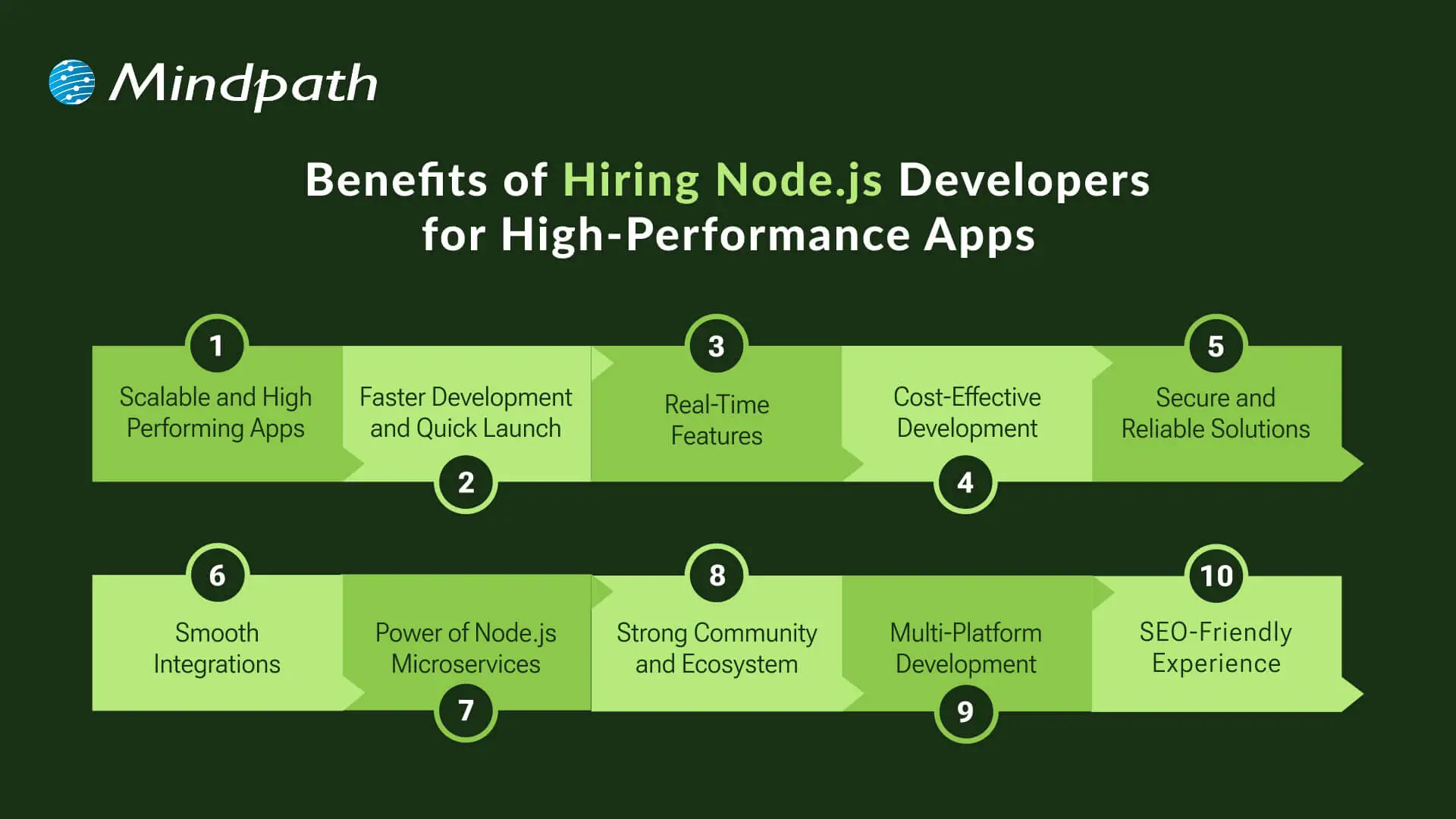
Benefits of Hiring Node.js Developers for High-Performance Apps

To build high-performance applications, developers need expertise, and Node.js has emerged as a top choice for today’s development projects for many reasons. Here are some principal reasons why businesses choose to hire dedicated Node.js developers for their projects.

Benefits of Hiring Node.js Developers for High-Performance Apps

1. Scalable and High-Performing Apps

Node.js is able to process multiple requests at once using an event-driven and non-blocking model. This makes applications fast and reliable, while also ensuring that they can support high traffic without losing speed. Businesses that hire Node.js developers will be able to make sure that their apps can scale with user demand.

2. Faster Development and Quick Launch

The lightweight structure of Node.js gives the programmer the option of using reusable modules, which allows them to code faster. With npm, programmers have access to thousands of open-source libraries ready to use for database, authentication, and security. Companies that hire expert Node.js developers save time and get products to market faster.

3. Real-Time Features

Node.js makes building real-time applications easy, including chat, notifications, and live updates. With WebSockets, developers can create real-time movement of data between users and servers. When businesses bring in Node.js Developers with some real-time experience, they can provide users with more interactive and engaging experiences.

4. Cost-Effective Development

Because Node.js employs JavaScript on both the front end and back end, one developer can support the entire application with relative ease. Since Node.js applications run easily on a single server, there is less reliance on costly infrastructure. Startups and small businesses benefit the most when they hire Node.js developers to build their applications and grow within a budget.

5. Secure and Reliable Solutions

Node.js can provide a strong security practice, encryption, and authentication for applications and safe API functionality. Skilled coders also work to update applications constantly to protect against breaches and unauthorized development. By getting the right group together, a company will be able to sustain and protect applications over time.

6. Smooth Integrations

Node.js integrates seamlessly with databases like MongoDB, MySQL, and PostgreSQL. It can also easily integrate with front-end frameworks such as MongoDB, MySQL, and Postgres. Cloud makes it easy for Node.js to integrate into AWS or Azure. Node.js removes the technical barriers, allowing developers to develop powerful solutions.

7. Power of Node.js Microservices

Node.js is ideal for modular architectures, where a service operates independently from others. Therefore, developers can scale or upgrade a part of their application independently. With a Node.js microservices approach, businesses benefit from speed, flexibility, and easier maintenance. 8

8. Strong Community and Ecosystem

Node.js is a development community that is increasingly active and improving its ecosystem with more updates and tools. Developers can find quick solutions through community-shared libraries, tutorials, and forums. This means that companies that hire Node.js developers are always relevant and evolving according to modern trends and practices.

9. Multi-Platform Development

Node.js is used by developers to build web, desktop, and mobile application projects (from the same codebase). For instance, Electron is a simple and easy-to-use Node.js-based framework that can run the same code in the same runtime performance consistently across web, desktop, and mobile applications.

10. SEO-Friendly Experience

Node.js, through server-side rendering, allows applications to load faster and be searchable. Improvements in load speed improve user experience and increase visibility on the web. Server-side rendering makes it easier for developers to enjoy the performance and increases search visibility for their applications.

Not sure which development partner is right for your project? Explore our expert insights on choosing NodeJS Development Company to make the right decision with confidence.

Ready to Build High-Performance Apps with Node.js?

Node.js is still emerging as a dependable technology for building fast, scalable, and modern applications. Given its strong features, flexibility, and vast ecosystem, Node.js is undoubtedly one of the top choices in the market for companies that want to provide high-performing digital solutions. By hiring professional Node.js developers, companies get the expertise required to enable developers to bring ideas to life while considering user experience and developing sustainable applications.

Partnering with Mindpath gives you access to trusted Node.js development services tailored to your business goals. You can easily hire remote Node.js developer teams who bring proven expertise and adaptability to every project. With the right talent by your side, you gain the power to innovate faster, scale smarter, and deliver applications that perform at every level.

How much does hiring a ReactJS developer cost? Learn about factors affecting rates, and how to find the best talent within your budget.