Home

Staff Augmentation vs Traditional Hiring: Which One is Better?

Staff Augmentation vs Traditional Hiring: Which One is Better?

Join our Newsletter!

Staff augmentation meaning 

The hiring process for finding the right employees is more complex than ever before. In today’s world, businesses are under constant pressure to grow quickly, remain lean and produce results. Leaders can make better workforce decisions when they grasp the staff augmentation meaning. It’s not all about filling seats. It’s all about the right team at the right time. Many companies continue to hire traditionally because that’s the way they’ve always done it. But the world of business has undergone significant changes. So, the question is, is traditional hiring still the most effective approach?

This answer will depend upon your objectives. Projects require permanent staff members for long periods of time. Others require skills that are specialized for several months. Both models have their own merits and demerits. You could lose time, money, and momentum if you select the wrong one. Talent markets will become more competitive, and flexibility will be a game-changer. We will explain these two models in this blog in a clear way, so that you can make a confident selection. So, let us keep reading further!

Looking for a reliable partner who handles the entire talent search so you can stay focused on delivery? Mindpath offers end-to-end IT staff augmentation services that connect you with experienced professionals who are ready to contribute from day one.

What is Staff Augmentation?

Staff augmentation meaning is easy to understand. Essentially, you bring in outside experts on a temporary basis to enhance your current team. These experts are not separate from your staff but rather work with them. They help in areas where skills are lacking without the need for permanent hires. Companies in various industries like IT, finance, healthcare, etc. adopt this model. It allows them to get the right people at the right time.

Think of it as a hiring strategy that offers a lot of flexibility. Rather than spending lots of time hiring, you simply get highly-skilled professionals who are ready to work almost immediately. Typically, a third-party staffing agency takes care of uncovering candidates for you. Not only will your workforce be strengthened but also your work will be expedited by this method. It’s as simple as that.

Must Read: Staff Augmentation Trends

Key Benefits of Staff Augmentation

Staff augmentation offers more than just the number of workers. It provides the enterprise a wise, speedy, and adaptable route to expansion. Here are the main advantages of why most companies decide to switch.

1. Access to Specialized Skills

Skill deficiencies may hinder progress of ambitious projects. With staff augmentation, you can get niche experts right away, be it AI developers or specialized engineers, without spending months on training.

2. Faster Hiring

Traditional recruitment methods only offer the quality of well vetted, experienced professionals but it takes the advantage of time. Staff augmentation meaning is that it can give you professionals who are ready to work at a short notice.

3. Control Over Projects

In ‍‌‌‌‍staff augmentation work, you are given full control over the management team which is completely different from traditional outsourcing. You are the one leading the team, deciding the priorities and having full control over every project ‍ ‌‍ ‍‌decision.

4. Enhanced Productivity

Overworking your permanent team is a sure way to cause burnout and reduce productivity. Hiring augmented personnel is an effective way to balance the workload efficiently, enabling each team member to deliver their highest level of performance.

5. Flexibility and Scalability

Project needs are always changing, and your team size has to change accordingly. Staff augmentation gives you the opportunity to increase or decrease your team size with great simplicity. It makes your business able to respond to changes at all times.

Drawbacks of Staff Augmentation

Each of the hiring models presents its own set of challenges. Here are some of the disadvantages to consider.

  • Contract rates are higher on extended projects than on full-time salaries.
  • It takes time for external personnel to get to know the internal processes.
  • Transient employees have a difficult time with company culture.
  • Important project information is lost when the contract is terminated.
  • Access to the system for others poses significant threats to data security.
  • Taking on external professionals puts additional strain on the internal managers.

What is Traditional Hiring?

Traditional hiring meaning is a simple concept. First, a business posts the available position, then goes through the submitted resumes, eventually interviewing the potential candidates, and ultimately deciding on the one that is the best fit. Companies assess individuals mainly on their qualifications, work history, and alignment with company culture. For many years, it has been the default method of recruitment.

This model emphasizes on long-term commitment of both sides. The employer spends time and other resources to recruit a permanent employee who will fit the company well. The process is quite extensive but the progress is usually slow. It is the most appropriate model when a company needs devoted, full-time employees for their continuous positions.

Key Benefits of Traditional Hiring

Let’s examine the main advantages that continue to make traditional hiring a relevant and widely trusted method.

1. Stronger Team Cohesion

Working in permanent teams helps establish closer relationships and make collaboration smoother as time passes. Regular teamwork tends to establish trust and boost productivity.

2. Better Cultural Alignment

Traditional recruitment enables you to hire candidates that fit your values perfectly. Employees who are a good cultural match adjust more quickly and make a significantly higher contribution.

3. Greater Long-Term Commitment

When a person works full-time, they usually immerse themselves fully in the growth and success of your business. Their dedication leads to stability and a greater feeling of personal responsibility.

4. Continuous Skill Development

Businesses have the option of upskilling their employees and preparing them for bigger responsibilities down the line. This not only results in a skilled and dedicated team but also reduces the need for frequent external hiring.

Staff Augmentation vs Traditional Hiring: A Comparison Table

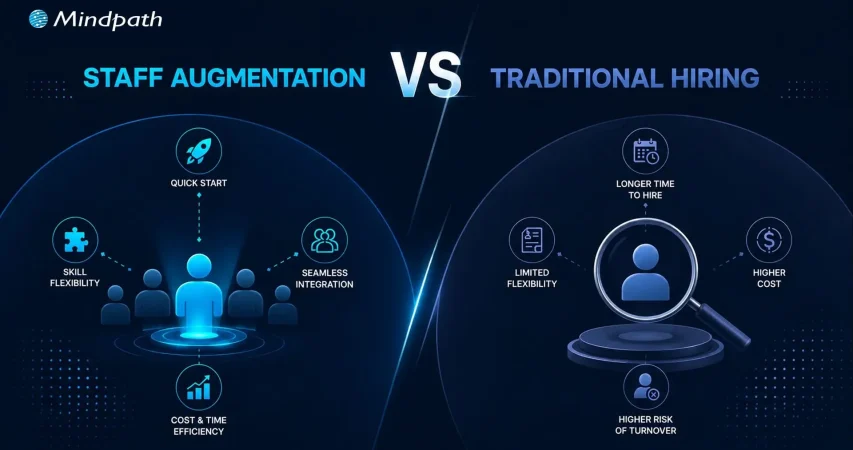
Figuring out which model suits your business better is way easier when you put them next to each other visually. Here’s an overview that explains what is staff augmentation meaning and how do the traditional hiring compare to staff augmentation on the aspects that matter the most to your company.

Criteria   IT Staff Augmentation   Traditional Hiring  
Flexibility High – Can scale up/down as needed Low – Fixed, long-term commitments
Cost Cost-effective, reduced overhead Higher costs, including benefits and office space
Time to Hire Quick onboarding with pre-vetted candidates  Lengthy recruitment and onboarding process
Access to Talent Access to specialized, global talent quickly Limited to available local talent
Project Adaptability Easily adapt to changing project needs Rigid, less adaptable to project changes
Commitment Short-term or project-based Long-term employment contracts

Which Hiring Model is Right for Your Business?

Traditional hiring has its place, but today’s fast-moving business world demands more flexibility. Staff augmentation meaning becomes clear when speed, skills, and cost-efficiency matter most. When comparing staff augmentation or traditional hiring, augmentation consistently proves smarter for businesses that need to scale without long-term burdens or heavy recruitment cycles.

At Mindpath, we provide staff augmentation services that connect you with top-tier talent instantly. Our vetted professionals plug into your team seamlessly and deliver results from day one. Let us help you build smarter, move faster, and grow confidently.
Frequently Asked Questions

1. Is staff augmentation only suitable for large enterprises?

Not at all. Businesses of every size use staff augmentation today. Startups benefit greatly from accessing senior talent without full-time costs. It is equally powerful for mid-sized companies managing rapid growth or unexpected project demands.

2. What is the typical duration of a staff augmentation contract?

Contracts vary based on project needs. Some last a few weeks, others run for several months. The flexibility is actually one of its strongest advantages, letting businesses extend or conclude engagements based on real-time project progress.

3. How is staff augmentation meaning different from a freelancer arrangement?

Freelancers work independently on their own terms. Staff augmentation professionals, however, work directly under your management and follow your processes. They function as true team extensions, not outside contractors operating on a separate agenda.

4. Can augmented staff work remotely or only on-site?

Both options are completely viable. Many businesses today prefer remote augmented teams for cost savings and wider talent access. On-site arrangements work better for projects requiring close collaboration or access to physical infrastructure.

5. What industries benefit the most from staff augmentation?

Technology, healthcare, finance, and e-commerce lead the way. However, any industry facing skill shortages or fluctuating project demands can benefit. The model adapts well across sectors wherever speed and specialized expertise are business priorities.

Support Is One Click Away

Featured Posts

Related Post

Monolith to microservices

Enterprise systems tend to have one unified architecture that facilitates early expansion. Gradually, construction gets heavy and hard to ascend. Releases slow down. Minor modifications require huge test cycles. Teams become under pressure to be more innovative. This is where monolith to microservices will be a strategic move towards enterprise legacy modernization. It is not a trend. It is a realistic reaction to actual operation constraints that influence operation, agility, and long-term development.

As businesses grow, they require systems that are flexible and capable of constant delivery and autonomous growth. Nevertheless, a monolithic building goes down only with solid architectural design and business focus. The technology leaders need to reconsider their deployment models, data management, and ownership of teams. Each step requires thorough consideration. In this blog, we will discuss how businesses may proceed in a practical manner to modernize architecture with clarity. So, keep reading!

Looking to simplify complex legacy systems for better agility? Mindpath’s legacy modernization services make it easier to break monoliths into microservices while keeping operations smooth.

What is Monolithic Architecture?

A monolithic architecture integrates all the application elements into a single piece of code. The database layer, business logic and user interface are a single system. Teams develop, test and deploy the application as a whole. It is a structure that promotes centralized control and easy management.

This model has been used by many enterprises to embark on their digital journey. Growth, however, makes the process more complex and causes the changes to slow down. Such a challenge tends to motivate the migration of monolith to microservices to enhance scalability and agility. Nevertheless, it is important to comprehend the monolithic basis before strategizing in terms of modernization.

Some of the advantages of monolithic architecture are listed here:

1. Quick initial development

2. Simple deployment process

3. Managing codes centrally

4. Reduced initial infrastructure price

5. Suitable for small teams

What is Microservice Architecture?

Microservice architecture forms an application of tiny, concentrated services. Every service deals with a certain business operation. They have teams that construct and operate. Services interact via APIs or messaging, which are lightweight. It is a structure that enables quicker releases and better ownership over teams.

Companies that switch from monolith to microservices have the goal of enhancing agility and scalability. Complex systems are broken down into services by teams. They enhance update control and performance control. This model facilitates constant delivery and the alignment of technology to evolving business needs.

Some of the advantages of microservice architecture are listed here:

1. An independent deployment of service.

2. Faster feature releases

3. Better fault isolation

4. Loosely planned technology options.

5. Targeted scalability

Want to ensure your move from monolith to microservices follows a clear direction? Explore legacy modernization strategy to build a structured and effective transformation plan.

Why do Organizations Switch from Monolith to Microservices?

As organizations become more and more application-driven, they become more complex. Monolith to microservices migration becomes a strategic decision when traditional architectures start limiting growth and flexibility.

benefits of switching from monolith to microservices

1. Independent Team Ownership

Microservices provide teams with a definite service scope. The teams are in charge of their updates and releases. This construction minimizes wasting of time and enhances concentration. Organizations that follow monolith-to-microservices patterns build stronger ownership models.

2. Flexible Technology Stack

The appropriate tools depend on the service selected by the teams. They do not rely on a common technology. This innovation and future development is supported by this flexibility. It makes architecture flexible to alterations.

3. Targeted Scalability

Monolithic systems need to scale the whole application. Microservices permit the scaling of particular services. This method enhances management of resources. This accuracy is why many enterprises are abandoning monolithic to microservices.

4. Better System Stability

Even a single problem within a monolith is capable of affecting all. Microservice provides isolation of failures in a single service. The teams address the issues without impacting the entire system. This improves reliability.

5. Faster Release Cycles

Teams create and implement services on their own. They make releases without necessarily having to recreate the system. This enhances the speed of delivery. Business enterprises migrate from monolithic to microservice to enhance momentum.

6. Easier Maintenance

The huge codebases become hard to handle. Microservices separate applications into smaller parts. Developers are able to maintain and update services with ease. This facilitates long-term clarity.

Planning to reduce system limitations while adopting modern architectures? Learn from the benefits of modernizing legacy systems to improve overall performance.

Key Steps for Migrating from Monolith to Microservices

Organizations need to strategize before they shred a monolithic system into smaller services. Successful migration to microservices is based on clear strategy and disciplined execution.

key steps for migrating from monolith to microservices

1. Assess the Current System

Begin by doing a line-by-line audit of your monolithic system. Check review services, dependencies, data flow, and performance gaps. This analysis forms the basis of successful monolithic to microservices migration.

2. Define a Clear Migration Strategy

Establish simple service boundaries on the capability of the business. Make decisions on the size of the service and the style of communication at the early stage. A strong monolithic to microservices migration strategy reduces confusion and prevents rework.

3. Build the Right Infrastructure

Finalize API gateway, service discovery and CI/CD pipelines. Insert containers and orchestration tools to introduce consistency. The powerful infrastructure promotes consistent monolithic to microservices conversion.

4. Extract a Low Risk Service First

Select a valuable module that is loosely coupled. Build it as a stand-alone service having its database. It is a risk-controlled step that is proving yourself.

5. Refactor and Validate Carefully

Refactor the chosen ones into a single service. Implement it and observe behavior closely. Logging and tracing helps to identify problems at an early stage.

6. Gradually Expand the Migration

Move other modules depending on the business priorities. Break-even monolith tasks gradually. This phased approach supports smooth monolithic application to microservices’ evolution.

7. Separate the Data Layer

Discontinue reliance on a corporate database. Allocate domain-owned datastores to each service. Synchronize the plan data keenly to ensure that it is consistent.

8. Align Teams with Services

Establish cross-functional teams for each microservice. Provide them with complete development and operations ownership. This is a structure that reinforces autonomy and long-term scalability.

Looking to enhance your modernization process with intelligent automation? Learn from AI-driven legacy system modernization to boost efficiency and performance.

Ready to Modernize Your Enterprise Architecture?

Contemporary business requires the ability to expand its systems as it grows and facilitate ongoing innovations. A clear shift from monolith to microservices improves agility, resilience, and operational control. The key to success lies in effective planning and implementation in phases and aligning a team. Through proper strategy, companies become simpler and create future ready digital platforms that underpin long-term business objectives.

At Mindpath, we provide legacy modernization services which help companies plan and implement legacy modernization with confidence and clarity. Our specialists evaluate architecture, establish migration roadmaps and deploy scalable microservices. We are performance-based, stability-centered and result-orientated. Collaborate with Mindpath to modify old systems into nimble, growth-motivated digital systems.

FAQs

1. Why should enterprises consider monolith to microservices today?

Enterprises face rapid market shifts and rising customer expectations. Monolith to microservices helps organizations build adaptable systems that support faster innovation. It also aligns technology with business domains, enabling better ownership, governance, and long-term digital growth without increasing structural complexity.

2. How do we know if our organization is ready for migration?

You should assess technical maturity, DevOps readiness, and team structure. Clear service boundaries and business alignment indicate strong readiness. Leadership commitment also plays a key role in successful transformation and sustainable architectural evolution.

3. Is monolith to microservices suitable for every business?

Not every system requires immediate migration. Smaller or stable applications may perform well as monoliths. However, enterprises planning aggressive scaling, multi-team collaboration, or global expansion often benefit from monolith to microservices as a long-term strategy.

4. What technical challenges arise during data separation?

Data decoupling often introduces consistency and transaction complexity. Teams must design domain owned databases and manage synchronization carefully. Event-driven patterns and API governance help maintain reliability during service level transitions.

5. How can Mindpath support our legacy transformation journey?

Mindpath’s legacy modernization services guide enterprises through assessment, planning, and execution. Our experts design scalable architectures and structured migration roadmaps. We help organizations transition confidently using proven monolith-to-microservices approaches aligned with measurable business outcomes.

conversational AI chatbots

Ever thought about how firms can respond to thousands of customer requests every day? Or how can they give customers 24/7 support without interruption? The answer is conversational AI chatbots. These smart virtual assistants change how organizations handle customer inquiries, as well as starting a new trend to assist with sales, without downtime or human effort. The way vendor chatbots can integrate with pre-existing systems is quickly making Chatbots an efficient driver for the future of business. 

These AI chatbots are fast becoming a staple in today’s business toolset. Many organizations are beginning to use them, supplementing their customer interaction and task management processes. Chatbots can fit conveniently into many different areas of an organization. As usage continues to expand, understanding their value is important. This blog will detail how these AI chatbots are increasing the effectiveness of business operations in simple ways. 

Looking to enhance customer engagement with a personalized AI solution? Our custom chatbot development services specialize in building conversational AI chatbots tailored to your business needs and goals.

What is a Conversational AI Chatbot?

A conversational AI chatbot is an intelligent computer program that interacts with individuals using natural language. It understands an accurate interpretation of what its users are saying/writing, processes that input, and responds accordingly in the way a real human would.

Conversational bots are found in websites, applications, and messaging interfaces to assist users who have questions, information, support, or simple tasks and processes. They can exist on a 24/7 basis with no waiting and provide instant and consistent information without the need for the user experience to include human staff.

Conversational chatbots use advanced technologies like natural language processing (NLP), machine learning (ML), and large language models (LLM) to understand and improve conversations. They don’t just follow pre-written scripts but can learn and adapt based on new information.

From helping customers with online shopping to guiding employees through internal systems, these chatbots are becoming a useful part of modern business communication. 

Curious to know how AI can enhance your e-commerce strategy and give your business a competitive edge? Read our detailed blog on how AI in e-commerce is transforming the future.

Types of Conversational AI Chatbots

Conversational chatbots come in different types, each designed to handle specific kinds of interactions. Understanding these types helps in choosing the right chatbot for your business needs.

1. NLP Chatbots

Natural Language Processing (NLP) chatbots can understand user intent and context, making them capable of handling complex or varied language inputs. Unlike rule-based bots, they interpret full sentences to deliver more relevant and precise answers.

2. Menu-Based Chatbots

Menu-based chatbots use decision tree-type logic and offer users a set of predefined buttons or options to choose from, guiding them through a structured conversation. These bots are ideal for handling simple FAQs like tracking orders or checking pricing but can be limited in handling complex queries.

3. Machine Learning Bots

Machine learning chatbots learn from past user interactions and improve over time, allowing for highly personalized and context-aware conversations. They can remember user preferences and reuse information in future chats, enhancing the customer experience.

4. Hybrid Chatbots

Hybrid chatbots combine rule-based systems with AI capabilities to deliver both structured and intelligent responses. They can escalate complex issues to human agents, allowing seamless integration between automation and live support.

5. Rule-Based Chatbots

Rule-based chatbots operate using if-then logic and keyword recognition, providing answers based on specific triggers set by the developer. They work best when queries are predictable and can be mapped to predefined responses using keywords or phrases.

All these chatbot types can be integrated into a powerful conversational AI platform to provide comprehensive and intelligent customer support solutions.

According to a study by Tidio, the conversation rate of chatbots in some industries has been observed to reach up to 70%.

Benefits of Conversational AI Chatbots For Business Growth

Conversational AI chatbots are becoming a powerful tool for businesses looking to improve how they work and grow faster. Here are some of the key benefits they offer for driving business growth:

1. Get Useful Customer Feedback Easily

Chatbots can ask for feedback right after a chat session by sending a quick question or rating option. To encourage responses, they can offer discounts or small rewards. Businesses can then check feedback and chat logs to discover common issues and improve services. It’s a smart way to collect insights without bothering the customer.

2. Understand Customer Needs

AI chatbots can figure out what the customer wants and how they feel by reading their words and tone. They understand if a message is urgent or if a customer is upset. When needed, they pass this helpful info to an agent. This gives the agent better context to respond more personally and calmly. 

3. Support Your Sales Team with Smart Help

AI chatbots help with sales by chatting with website visitors, gathering lead details, and booking demos. They answer common product questions and encourage customers to stay longer and learn more. This reduces cart abandonment, increases conversion rates, and supports upselling, all with minimal effort. 

4. Handle Repetitive Questions Automatically

One of the best AI chatbot features is the ability to answer common questions instantly. They manage simple tasks like order tracking, returns, and payment issues without needing a support agent. This saves time for both the customer and your team. It also reduces the number of tickets and keeps agents free from more serious problems.

If you’re exploring smarter ways to deliver customer support. Read our blog on AI for Customer Service, where we highlight how chatbots and virtual assistants can improve customer satisfaction and drive measurable business growth.

5. Increase Lead Generation

Instead of filling out forms, customers can chat naturally with AI bots to share their needs. Chatbots collect useful data like preferred products, location, and language. This data is shared with the marketing team, helping them create personalized campaigns and understand customer behavior better.

6. Keep Customers Engaged with Timely Updates

Chatbots can send helpful messages like order updates, appointment reminders, or payment alerts. They also follow up with feedback requests and help continue conversations across different platforms. With custom branding and fun elements like emojis or images, they make every interaction feel friendly and engaging. 

7. Lower Business Costs

Every business wants to reduce costs while improving service quality. Chatbots help by managing simple tasks, answering frequent questions, and routing chats to the right place. This reduces the need to hire additional agents. Some chatbot platforms are easy to set up without coding, saving time and helping businesses see value faster.

8. Scaling Customer Support Efficiently

Chatbots act like additional support agents by handling many customer questions at once. They manage simple requests efficiently, which helps your team focus on more complex issues. This makes it easier to serve a growing number of customers without increasing staff size, saving time, and reducing pressure on your support team. 

Wondering how to turn AI concepts into actionable business solutions? Check out our AI Consulting Services guide for insights on planning, deploying, and scaling AI effectively.

Want to Transform Your Business with Conversational AI Chatbots?

Conversational AI chatbots are changing how businesses talk to customers, manage support, and grow. From smart replies to handling repetitive tasks, these chatbots are now a valuable part of any modern business setup. They simplify operations, improve customer experience, and help teams work more efficiently without adding extra load. 

We at Mindpath are custom chatbot development company, we help businesses build custom conversational chatbots that fit their goals. Whether it’s for customer support, lead generation, or sales, our expert solutions make chatbot integration easy and impactful. Let us help you scale faster and connect better with your customers using the best AI chatbot tools.  

Frequently Asked Questions

1. How do conversational AI chatbots improve customer response time?

Conversational AI chatbots respond instantly to customer queries without any waiting time. They can handle multiple conversations at once, ensuring users get quick answers. This helps reduce delays, improves satisfaction, and keeps customers engaged without depending on human availability.

2. Are conversational AI chatbots difficult to integrate with existing systems?

Conversational AI chatbots are designed to work smoothly with existing business tools like CRM systems, websites, and mobile apps. With proper setup and planning, integration is usually simple, allowing businesses to automate workflows and improve operations without major technical disruptions.

3. Can chatbots handle complex customer queries effectively?

Modern chatbots powered by AI can understand context and intent, making them capable of handling more than just basic questions. For complex issues, they can gather details and pass the conversation to a human agent, ensuring customers still receive accurate and helpful support.

4. Can AI chatbots support both customer service and sales activities at the same time?

Yes, AI chatbots can handle both support and sales tasks together. They can answer questions, guide users through products or services, collect lead information, and even suggest relevant options, helping businesses improve engagement while supporting conversions in a seamless and efficient way.

5. How do chatbots help businesses maintain consistent customer communication?

Chatbots provide consistent responses by following defined logic and learning from interactions. They ensure that every customer receives accurate information regardless of time or volume. This consistency builds trust, improves brand experience, and helps businesses maintain clear and reliable communication.

Discover the transformative power of conversational AI chatbots. From cost savings to increased sales, learn how chatbots can drive growth.
AI Agent development time

Building a custom AI solution starts with understanding the expected AI agent development time for your business goals. Every project follows a different schedule because business requirements, system integrations, data quality, testing, and deployment needs directly influence the overall development process. Knowing these factors helps businesses plan realistic implementation timelines and make informed investment decisions.

Key Takeaways

  • 01
    AI agent development time varies based on complexity, integrations, testing, and deployment requirements. 
  • 02
    Clear project planning helps reduce delays and improves overall development efficiency significantly. 
  • 03
    Custom AI agents require multiple development stages before successful production deployment begins. 
  • 04
    Project costs increase with advanced features, enterprise integrations, and autonomous AI capabilities. 
  • 05
    Choosing an experienced development partner accelerates delivery while maintaining quality and security. 

Many businesses also ask how long to build an AI agent before planning budgets and implementation strategies. The answer depends on project scope, customization requirements, existing infrastructure, and deployment readiness rather than a fixed timeline. In this blog, you will learn the typical AI agent development timeline, key factors affecting project duration, and practical ways to accelerate deployment successfully. So, let’s keep reading further!

Want to accelerate your AI agent development without compromising quality? We offer AI Agent Development Services to build reliable, business-ready AI solutions.

What Determines AI Agent Development Time?

The time to deploy AI agent solutions depends on more than writing code or selecting AI models. Every project follows a unique path based on business objectives, technical requirements, and implementation readiness. Understanding these foundations helps businesses set realistic expectations before starting AI agent development.

1. AI Agent Complexity

The type of AI agent has the biggest impact on how long to build an AI agent. Simple agents finish faster, while autonomous and multi-agent systems require additional development, coordination, and testing.

2. System Integrations

AI agents deliver better results when they connect with business tools and applications. Integrating multiple APIs, legacy systems, or custom databases increases development time and technical effort.

3. Security and Approval Controls

Secure AI agents need safeguards before handling business tasks or sensitive information. Teams must build validation checks and approval workflows to ensure reliable and controlled operations.

4. Testing and Performance Validation

Development continues after coding because every AI agent requires thorough testing. Teams evaluate reasoning quality, accuracy, response speed, and reliability before deployment.

5. Development Approach

The chosen development method directly affects project timelines. Pre-built frameworks speed up delivery, while fully custom development takes longer because every feature requires dedicated implementation.

How Long Does It Take to Build an AI Agent?

The AI agent build time depends on project complexity, business goals, and technical requirements. While simple AI agents may take only a few weeks, advanced enterprise solutions require additional development, testing, and deployment. The table below provides a realistic timeline for different types of custom AI agents.

AI Agent Type Typical Use Case Estimated Development Time Estimated Deployment Time Estimated Cost (USD)
Proof of Concept (PoC) AI Agent Validate an idea with limited functionality 2–4 weeks 2–5 days $10,000–$25,000
Simple Task Automation Agent FAQ support, document search, email assistance 4–6 weeks 3–7 days $25,000–$50,000
Business Workflow AI Agent Customer support, HR, sales, internal operations 6–10 weeks 1–2 weeks $50,000–$100,000
Decision Support AI Agent Financial analysis, legal review, business recommendations 8–12 weeks 2–3 weeks $80,000–$150,000
Custom AI Agent with Multiple Integrations CRM, ERP, databases, APIs, enterprise tools 10–16 weeks 2–4 weeks $120,000–$250,000
Autonomous or Multi-Agent Enterprise System End-to-end workflow automation across multiple departments 4–9 months 4–8 weeks $250,000–$1M+

AI Agent Development Timeline: Key Stages Explained

Understanding each development stage helps businesses estimate AI agent development time more accurately. Every phase serves a specific purpose, from planning and development to testing and deployment, ensuring the final AI agent performs reliably and meets business requirements.

1. Define Goals and Project Scope

Every successful AI agent starts with clear business objectives and measurable outcomes. Teams identify the problem, expected results, and project requirements before beginning development.

2. Design the AI Agent Architecture

Developers create the technical foundation by selecting suitable AI models, frameworks, and data structures. This stage ensures the AI agent can handle business tasks efficiently and scale when needed.

3. Build and integrate the AI Agent

Developers create prompts, connect business applications, and integrate external tools and knowledge sources. Secure integrations help the AI agent perform real business tasks with accurate information.

4. Test and Improve Performance

Teams evaluate the AI agent through multiple testing scenarios before production deployment. They refine prompts, fix workflow issues, and improve accuracy to deliver reliable performance.

5. Deploy the AI Agent

After successful testing, the AI agent moves into the production environment with controlled access and security measures. The time to deploy AI agent solutions depends on deployment readiness, governance checks, and rollout strategy.

6. Monitor and Optimize Continuously

Development continues after deployment through regular monitoring and performance improvements. Teams analyze user interactions, update capabilities, and optimize the AI agent for better long-term results.

How to Build an AI Agent Faster Without Compromising Quality?

  • Define clear business goals before starting development.
  • Prioritize high-impact features for the first AI agent release.
  • Prepare clean and organized business data early.
  • Choose the right AI development partner with proven expertise.
  • Use existing systems instead of building everything from scratch.
  • Test continuously throughout development to avoid costly delays.
  • Start with an MVP before expanding advanced capabilities.
  • Review project scope regularly to prevent timeline extensions.

Ready to Build Your Custom AI Agent?

The right AI agent delivers the best results when businesses plan realistic timelines, define clear requirements, and choose the right development approach. Understanding every stage, from planning to deployment, helps reduce delays, control costs, and achieve long-term business value with confidence.

At Mindpath, we deliver custom AI Agent Development Services tailored to your business goals, workflows, and scalability needs. Our experts build secure, high-performing AI agents with faster delivery and reliable implementation. Contact us to discuss your project and find the right AI solution for your business.

Frequently Asked Questions