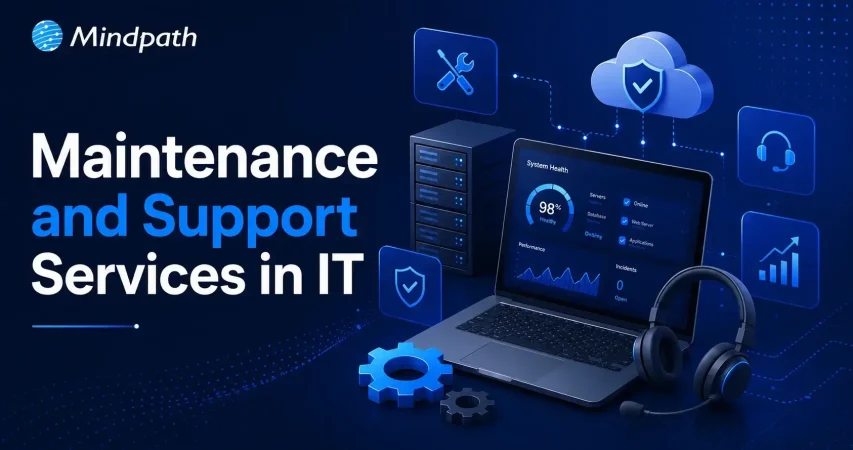
What are Maintenance and Support Services in IT?

Home

What are Maintenance and Support Services in IT?

What are Maintenance and Support Services in IT?

Join our Newsletter!

Maintenance and Support Services

Technology is the source of business development, and any system requires frequent maintenance to remain dependable. Maintenance and support services assist businesses in maintaining, securing, and making software maintainable. A minor problem is likely to slow down the operations and influence the experience of the customers. Sophisticated companies understand that high IT performance requires continuous focus, on-time repairs, and professional management. So, how do companies keep their systems running smoothly while meeting rising digital demands?

Due to the complexity of technology, businesses cannot afford instant fixes to keep up with the competition. Teams need to monitor the health of systems, fix problems quickly, and implement updates in a timely manner. Such a strategy minimizes downtime and ensures that day-to-day activities are not slowed down. It also assists companies in safeguarding data and enhancing user satisfaction. This blog will discuss the ways these services contribute to long-term IT resilience and business performance.

Planning to reduce downtime and keep your business operations consistent? Our maintenance and support services at Mindpath help you manage updates, fixes, and performance with ease.

What are Maintenance and Support Services in IT?

IT support and maintenance services ensure that business technology operates efficiently at all times. Maintenance involves frequent updates, security checks, backups and repair of system problems before they escalate. It assists software to remain stable, secure and effective, thus businesses save time and do not face delays due to unexpected technical issues.

Support services intervene when users have technical problems or require assistance to use systems properly. Support teams resolve problems, answer questions, and direct users through issues within minutes. Maintenance and support together form a stable IT environment, which enhances performance, downtimes, and business needs of the day-to-day business.

Why are Maintenance and Support Services Important for Businesses?

Technology is important in businesses to support daily business activities. The subsequent points demonstrate why maintenance and support services are imperative towards stable IT performance. They assist in minimizing downtime and ensuring systems operate effectively.

1. Stronger Data Security

Companies should have effective security measures to safeguard confidential data against cybercrimes. IT maintenance services mitigate risks by performing frequent security inspections, maintenance, and security measures such as firewalls.

2. Quick Technical Help

Problems in technology require immediate response to prevent delays in work. Proficient support teams are able to resolve issues promptly and provide assistance to users in case they experience system malfunctions or have queries.

3. Better System Performance

Consistent check-ups ensure smooth operation of systems and detecting problems at an early stage. This minimizes delays and ensures that business run smoothly and effectively on a daily basis.

4. Improved Customer Experience

Customers demand rapid and continuous services in all cases. Good system support means less downtime, thus enabling businesses to provide higher quality and more coherent experiences.

5. Timely Bug Resolution

Bugs in the software can impact the performance and cause unpredictable disruptions. Support teams can find out the root cause in a short time and correct errors before they lead to more significant problems.

6. Easy Upgrades and Improvements

The world of technology is rapidly evolving and business software is not left behind. Constant updates and upgrades enhance capabilities, enhance efficiency, and remain competitive.

Types of Maintenance and Support Services

Maintenance and support services cover different areas that keep IT systems reliable and efficient. We can take a look at the primary types that assist businesses in the control of performance, security, and system stability.

1. Software Maintenance Support

Software maintenance services keep software updated, secure, and free from errors. They contain bugs, patches and updates that aid the smooth operation of systems.

2. Hardware Support Services

Hardware support deals with hardware such as servers, computers and network support. Periodic inspections are used to avert failures and maintain devices in proper operation.

3. Network Support Services

Network support ensures that internet connections are maintained in a stable and safe condition to be used in the day-to-day running of business. It also secures systems via firewall configuration and network watchdog.

4. Helpdesk Support and Troubleshooting

Helpdesk staffs offer rapid assistance when customers have technical issues. They find solutions quickly to allow work to proceed without delays.

5. Application Maintenance and Support

Application maintenance services ensure that business applications are maintained and operational. They enhance performance, correct problems, and assist applications to conform to evolving business demands.

6. WordPress Maintenance and Support

WordPress maintenance and support keeps websites secure, updated, and fully functional. It covers the updates of the plugins, security, backups, and error correction.

Factors to Consider While Choosing a Maintenance and Support Service Provider

The following are the factors that you should consider when selecting a Support and Maintenance service provider to your business. The right choice assists in providing quality service, quicker problem resolution, and extended IT stability.

  • Select a provider who has the appropriate technical capabilities and actual industry experience.
  • Ensure response and resolution times are clearly stated in service agreements.
  • Seek positive support that corrects risks before it turns to a problem.
  • Check reviews and client feedback to understand their reliability.
  • Make sure they provide a flexible support that can be expanded with your business.
  • Look at long-term value, rather than making a decision based on low cost.
  • Work with a group that listens effectively and knows what you require.

Best Practices for Implementing Maintenance and Support Services

The right strategy is the best fit with strong maintenance and support. These are the best practices that can assist businesses to run systems smoothly and prevent unnecessary disruptions.

  • Be proactive to find problems and resolve them before they lead to system downtime.
  • Establish an effective ticketing system to monitor, control, and address support orders effectively.
  • Automate common operations and provide self-service in order to handle issues faster.
  • Establish clear objectives of service and regularly measure performance.
  • Develop a robust knowledge base and educate support teams to manage issues.

Challenges of Maintenance and Support Services

Despite its many advantages, maintenance and support services also entail some operational obstacles. The following are some of the problems that businesses can encounter when handling such services.

  • IT systems become more difficult to maintain when the old and the new technologies are managed. It tends to provide unnecessary complexity to support teams.
  • Cybersecurity threats keep increasing and require constant monitoring. Companies should remain ready to safeguard information and comply with safety requirements.
  • The absence of skills may complicate the management of new technologies. Regular training of teams is frequently necessary.
  • Low budgets and resources may influence quality of support. Small teams can be unable to cope with increased workloads.
  • Unforeseen downtime may derail day-to-day business operations at a short notice. Rapid response is required to minimize losses and delays.
  • Ineffective communication may delay the resolution of issues and cause confusion. Proper documentation assists in making teams more effective.

Looking for Reliable IT Support That Keeps Your Business Ahead?

Support and Maintenance services play a vital role in keeping business systems secure, stable, and efficient. Strong maintenance and support services reduce downtime, improve performance, and help businesses adapt to changing technology demands. With the right approach, companies can protect operations and ensure long-term IT reliability.

At Mindpath, we provide maintenance and support services tailored to your business needs. Our expert team helps manage updates, resolve issues quickly, and keep your systems running smoothly. Partner with Mindpath to strengthen your IT environment and support continuous business growth.

Frequently Asked Questions

1. How do maintenance and support services help prevent unexpected system failures?

Maintenance and support services help detect small technical issues before they become major failures. Regular monitoring, timely updates, and preventive checks reduce the risk of sudden breakdowns. This keeps systems stable, avoids costly downtime, and helps businesses maintain smooth daily operations without unexpected disruptions.

2. How often should a business review its IT support and maintenance services?

Businesses should review IT support and maintenance services at least every few months or whenever major system changes happen. Regular reviews help ensure service quality, identify gaps, improve system performance, and keep technology aligned with growing business needs and changing operational demands over time.

3. What signs show that a company needs better maintenance and support services?

Frequent downtime, slow system speed, repeated software errors, and delayed technical responses often show that support needs improvement. If employees face regular disruptions or unresolved IT issues, stronger maintenance and support services become necessary to restore efficiency and protect daily business productivity.

4. Can maintenance and support services improve data security for growing businesses?

Yes, these services strengthen data security through regular patches, system updates, backups, and threat monitoring. Growing businesses face higher cyber risks, so proper maintenance helps protect sensitive information, reduce vulnerabilities, and create a safer IT environment that supports secure and reliable business growth.

5. Why are IT maintenance services important even when systems seem to work fine?

Even when systems appear stable, hidden issues can develop over time without warning. IT maintenance services help catch early risks, apply updates on schedule, and maintain strong performance. This preventive approach keeps technology secure, efficient, and less likely to fail during important business activities.

Related Post

ai agents

Just think if there was a digital assistant that not only obeyed commands, but was able to understand goals, make decisions and learn from experience? Sounds exciting, right? What if we told you this already exists? Yes, you heard correctly. This is where AI Agent comes in, which is a smart system that is intelligent enough to work independently and get the job done without having to check in with a human often, truly showcasing how AI is transforming future possibilities.

These days, companies are turning to automation and intelligence-based tools, which would make artificial intelligence agents important, no matter where you are in business. They can assist organizations in their own endeavors. They can make a company’s operations more efficient, provide real-time personalization for customers, and provide companies with less effort or worry, especially when dealing with complex operations. Do you want to know more? Well, we have you covered. This blog will guide you through everything you need to know about AI agents. 

To start with, let’s understand the meaning of AI agent!

Want to turn AI agent concepts into real, high-performing applications? Mindpath offers AI development services, where we design and deliver intelligent systems tailored for future-ready organizations.

What is an AI Agent?

AI agents are smart computer programs that can think and act on their own. They look at everything around them and understand what is going on and then decide what they should do next in order to accomplish a specific objective. These agents gather input from their environment through sensors or data feeds and respond by carrying out actions through digital systems or physical devices. They are like good digital employees that don’t require someone to keep an eye on them at all times.

What is unique about artificial intelligence agents is that they can learn and make decisions on their own. They act according to rules, operate on data, and in some cases, learn from experience so that they become more efficient in what they do. You will encounter them in numerous fields such as business, science, and technology where they assist in accomplishing things quicker and more efficiently. These agents are increasingly becoming a significant aspect of how we utilize technology today. 

Also Read: Agentic AI

Types of AI Agents 

AI agents come in different types, each designed to handle tasks in unique ways depending on their abilities. Understanding these types helps us see how they solve problems and make decisions in various situations. Below are some common kinds of AI agents and examples of how they work in real life:

1. Model-Based Agents

These use an internal idea, or model, of their environment to make smarter choices. They can remember what happened and plan ahead based on how things are connected. A GPS navigation system is a good example as it uses traffic and map data to suggest the best route in real time, showing how AI agent architecture works with memory and planning.

2. Goal-Based Agents

This type of agents are mainly focused on reaching a goal and making decisions by thinking about what might happen next. They pick actions that move them closer to what they want to achieve. For example, a self-driving car makes choices like stopping or changing lanes based on the goal of getting passengers to their destination safely.

3. Reactive Agents

These are the simplest kind that respond only to what’s happening right now. They don’t remember anything from the past and follow basic “if this happens, then do that” rules. A common AI agent example for this is a thermostat that turns heating or cooling on based on the current room temperature.

4. Utility-Based Agents

These take it a step further by not only pursuing goals but considering what choice provides the best outcome. They opt for actions based on what is most useful or gratifying. For example, a delivery drone can take a longer route to escape adverse weather while ensuring it reaches its destination on time and securely.

5. Learning Agents

These get better over time by learning from what they do and how well it worked. They have different parts that help them act, learn, and explore new options. A Netflix-style recommendation system is one such AI agent platform, improving suggestions as it learns what users like.

Curious about how AI agents deliver faster, smarter real-time responses? Our in-depth blog on Conversational AI explains how these systems understand users, learn from interactions, and continuously improve.

As we now have a basic idea about artificial intelligence agents, here are some benefits it can offer. 

Understanding the Benefits of AI Agents

According to Grand View Research, the global AI agents market size was estimated at USD 5.40 billion in 2024 and is expected to grow at a CAGR of 45.8% from 2026 to 2030. This rapid growth is driven by the increasing adoption of open-source AI agents that offer flexibility and innovation across industries. These intelligent systems bring numerous benefits such as: 

AI Agents Market Size & Trends

1. Ensure Accuracy

These tools can check their own work, find missing details, and fix mistakes. This helps keep results more accurate, even when things move quickly. It’s a smart way to keep quality high without slowing down. 

2. Cut Operational Costs

Automation helps cut down the cost of manual work and mistakes. It also reduces the need for constant back-and-forth between teams. That means more money saved on everyday business tasks. making AI in business strategy a valuable investment for long-term growth.

3. Build Custom Applications

Companies can develop tailored tools trained on their specific data and requirements. These solutions are designed to perform tasks according to the organization’s unique workflows and preferences. This makes AI for developers more effective and aligned with individual business goals. 

4. 24/7 Availability

AI tools can keep working in the background, even after work hours. They help with projects or answer customer questions at any time. This makes support and progress continue non-stop. 

5. Free Up Team Responsibilities

By handling repetitive tasks, these tools give team members more time to focus on creative ideas and big projects. It eases the load of daily tasks. This opens space for planning, strategy, and innovation. 

6. Boost Efficiency

Agentic AI tools help teams save time by handling many small decisions in complex tasks. This means people don’t need to step in every time, which makes work faster. With the right AI agent frameworks, teams can finish more in less time. 

Curious about which technologies are truly driving the next era of AI innovation? Explore our blog on GenAI tools to discover the most powerful solutions shaping the future of AI development.

Let us next learn how to create an AI agent:

Steps to Build an Artificial Intelligence Agent

Building an artificial intelligence agent involves a clear and structured process to ensure it performs effectively. Here’s a simple overview of the essential steps involved in creating a reliable and intelligent AI agent: 

1. Set Clear Goals and Purpose

Begin by clearly defining the specific tasks and functions the artificial intelligence agent will perform. Identify the problems it should solve and the target users it will serve, ensuring its goals match your business needs. Consider real-world use cases to determine the features and capabilities required. 

2. Gather and Prepare the Right Data

Gather data that reflects the type of interactions the artificial intelligence agent will handle, such as chat transcripts, voice recordings, or past user activity logs. Clean the data by removing errors and inconsistencies, then label it to help the agent understand user intent and context. Proper preparation of high-quality data is essential for accurate learning. 

3. Pick the Right Machine – Learning Model

Select a machine learning model suitable for your AI agent’s task, like neural networks for understanding language or reinforcement learning for decision-making. With your data in mind, determine if you can use a pre-trained model, or if you need to train a model from scratch instead. Fine-tuning pre-trained models can help calibrate them to your needs. and this is an area where the role of AI consultant becomes crucial in guiding the right model selection.

4. Train Your AI Agent to Learn

You will now configure your training environment and load the cleaned/labeled data you have. In the same way as traditional essential machine learning, the data has to be separated into training and testing data. The parameters need to be set like learning rate, epochs, and start training. Be aware of the performance metrics, the training metrics to make sure the model is learning as expected and when adjustments are needed. 

5. Test It to Make Sure It Works Well

Evaluate the artificial intelligence agent by running the AI agent through designated tasks, measuring accuracy, response time, and quality interaction with the user. You will use different testing methods like unit testing, user testing, and A/B testing to figure out its relative strengths and weaknesses. Lastly, you will also informally call out any open issues about the experience such as overfitting and refining the training or changing data as required. 

6. Launch and Keep Monitoring

Launch the AI agent on a dedicated platform, website, app, or voice interface and make sure that the integration is seamless. Monitor its usability using real-time analytics and user feedback to have a clear understanding of its performance and any analytics issues as soon as they arrive. To sustain systems and achieve the original intended purpose of engagement, systems should be routinely maintained, updated and improved. 

Wondering if your business is prepared to adopt AI and harness its full potential? Check out is your business ready for AI to assess readiness and start building a smart, future-proof strategy.

Are You Looking to Experience the Power of AI Agents?

AI agents have changed the way we interact with machines by letting systems do things on their own, learn on their own, and achieve more results in a shorter time. They provide freedom from manual effort, support better decisions, and improve efficiency in most industries and business functions. 

At Mindpath, we offer AI development services that fit your business needs. Our AI agents automate the routine tasks, improve the customer engagement experience, and support smarter ways of working, so that you can do things better in an increasingly competitive and tech-driven landscape. 

Frequently Asked Questions

1. How do AI agents fit into existing business systems without disrupting current workflows?

AI agents are designed to integrate with existing tools through APIs and automation layers. They can work alongside current systems without replacing them entirely. This allows businesses to improve efficiency gradually while maintaining stability and avoiding major operational disruptions during implementation.

2. What kind of tasks are best suited for AI agents in a business environment?

AI agents perform best in tasks that involve repetitive decision-making, data analysis, or real-time responses. Examples include customer support, workflow automation, data monitoring, and recommendations. Their ability to process large data quickly makes them valuable for improving speed and accuracy in operations.

3. How secure are AI agents when handling sensitive business or customer data?

AI agents can be highly secure when built with proper safeguards such as encryption, access controls, and compliance with data protection standards. Regular monitoring and updates are essential to maintain security. A well-designed system ensures that sensitive data is handled responsibly and protected from potential risks.

4. Do AI agents require continuous human supervision to perform effectively?

AI agents are built to operate with a level of independence, but they still require periodic monitoring and updates. Human oversight ensures that the system stays aligned with business goals, adapts to changes, and continues delivering accurate and relevant outcomes over time.

5. How can businesses measure the real impact of AI agents after implementation?

The impact of AI agents can be measured through key performance indicators such as reduced operational time, improved accuracy, cost savings, and better customer response rates. Tracking these metrics helps businesses understand how effectively the agents are contributing to overall performance and efficiency.

ReactJS and AI

The demand for interactive user interfaces has gone beyond expectations. The requirement for an app that will learn from users’ behavior and adapt according to the user preferences is an essential part of modern web development. So, this effective resolution has pushed developers to rethink how modern frontends are built. This is where ReactJS and AI come together. 

The market size of AI is most likely to reach USD 826.73 billion by 2030. So, every reputed ReactJS development company has been fueling its strategies through AI tools. By combining React’s component-driven architecture with AI, your team can build frontends that continuously improve experiences. This blog explores how AI and React are shaping smarter frontend development and why this combination is necessary for your future-rich applications. 

Planning to combine ReactJS with AI for smarter web applications? Mindpath offers AI development services to build intelligent and scalable solutions for your business.

Why ReactJS Remains the Top Pick for Modern Frontend Development?

ReactJS is tagged as an open-source JavaScript library developed by Facebook to create user interfaces specifically for single-page apps. It allows you to generate large web apps that can render and upgrade effectively in response to your data changes. This is why the library has become a top preference of the developers. 

1. Reusable Components

Components are more likely to be building blocks. So, once they are created, your developers can reuse them across multiple parts of the application. 

2. Easy to Learn

The learning curve of React is comparatively much lower than Angular or Vue.js. So, if you are well aware of JavaScript, you can easily get started with ReactJS. 

3. Effective Rendering

The virtual DOM of ReactJS encourages rendering performance. Additionally, it enables you to leverage seamless user experiences. 

4. Precise Adaptability

The developer tools browser extension of React can help you inspect your component hierarchies. This approach can help your team debug more easily. 

5. SEO-Effectiveness

It is easy for you to render React on the server with the use of Next.js or similar frameworks. This can increase your search engine optimization. 

Ready to select a front-end framework that supports AI-enhanced features? Discover React vs Vue to check out their pros, cons, and ideal use cases.

How AI Impacts Frontend Development?

Artificial intelligence has become much more than just being used in backend analytics and experimentation. Moreover, it has become an essential force that shapes modern frontend experiences. In the recent scenario, AI is influencing the user interactions with apps and how interfaces respond to user behavior. Additionally, AI in React ensures frontend development is shifting from static design to futuristic interactions. 

1. Captures User Behavior

AI-driven React applications can assist you in analyzing the user behavior, patterns, and preferences. This is how your audience can expect a seamless user experience from your application that also builds trust. 

2. Real-time Content Personalization

React frontends can make you acquainted with custom content through the behavior of your audience and AI models. Starting from product recommendation to custom dashboards, AI ensures your users see data that aligns with their preferences and intent. 

3. Prompt UI Testing

AI-integrated testing features can easily assess the inconsistencies present in your UI, along with usability gaps and performance risks. This concept fastens the development cycles in AI and React environments. Further, it can reduce manual testing efforts while continuously optimizing your user experience. 

4. Better Accessibility and Interactive Design

AI plays a vital role in enhancing accessibility by adopting interfaces for users with multiple abilities. Moreover, React applications have the power to adjust your text size and assistive features along with the navigation flow. This ensures your customers are gaining credible digital experiences. 

Ready to get the most value from AI in your front-end projects? Discover the benefits of AI consulting to check out how guidance from specialists can improve outcomes and efficiency.

How ReactJS and AI Can Enhance Your Frontend Development?

Developers can elevate their front-end development efforts with the combined approaches of ReactJS and AI. React can make sure your UI is functioning properly while maintaining your customer interactions. Similarly, AI prioritizes futuristic predictions & pattern learning. So, when you make sure to leverage the work of ReactJS and AI together, it gives rise to a continuous feedback loop that directly enhances the interface. 

1. Assesses Behavior

AI models use the data captured from the interaction to assess trends and search patterns of the audience. Further, such models can detect frequently used features or engagement signals. This helps in forming a foundation for smarter UI decisions within AI/React applications. 

2. Catches User Interactions

React can seamlessly trace user interactions by assessing your customers’ clicks and scrolling behavior. Such interactions are extremely important as they make you aware of customers’ preferences and intent. So, by managing state changes in real time, React offers a structure and potential way to gather frontend behavioral data. 

3. UI Upgrades

React strongly sticks to the data and updates leveraged by AI, and accordingly refines the interface. This encourages customized content while streamlining your UI elements to be much more goal-oriented.

4. Access Intelligent Decision Making

Implementation of AI insights into the React components can help your application to abide by real-time decision-making. Moreover, this leverages faster responses and reduces friction for a more effective digital experience. So, the AI+React stack changes frontends from static presentation layers into adaptive systems. 

5. Ensures Continuous Learning

As users interact with your updated UI, new data is processed in the AI models. This gives rise to a continuous improvement cycle where your frontend becomes smarter with every interaction it makes. Moreover, it also enhances long-term user experience. 

Ready to achieve peak performance in your ReactJS applications? Discover the best techniques to optimize ReactJS performance to check out expert approaches for enhancing efficiency.

What are Some Real Use Cases of AI and React Applications?

Here, you can go through some real use cases of ReactJS and AI that have helped a series of companies establish their relevance in the digital space. 

1. Smart Search

Search experience through AI and React has gone beyond keyword assessment. AI can easily assess the search intent and relevance. Similarly, React values instant UI feedback. This component can offer faster searches while satisfying your customers with better results. 

2. Personalized User Interfaces

AI models have the power to understand what your customers demand. Further, React renders recommendations, customized layouts, and content in real time. This approach is widely valued in platforms like e-commerce and streaming services. 

3. Predictive Assessment

With React development with AI, applications can easily detect the behavior of your customers and what they are most likely to do. Whether they click, scroll, or convert, the UI flow will be adjusted proactively. This feature can increase user retention, conversion rates, and overall efficiency of your user experience. 

Planning to integrate AI into your next web or mobile app? Learn about AI app development to discover strategies for building intelligent and responsive applications.

What are Some Ethical Considerations You Need to Adopt In AI-Driven Frontends?

No doubt AI development with React can energize your frontend abilities. However, it also gives rise to critical security and ethical responsibilities. As per the trends, around 97% share of organizations reported an AI-related security incident. AI-driven interfaces generally process sensitive user data. So, it becomes necessary to be transparent in decision-making efforts. Further, users should understand how predictions and recommendations are generated to ensure trustworthiness. 

1. It is also important for you to avoid bias in data inputs. AI models processed with inefficient datasets can leverage misleading UI behavior. This can negatively hamper your user experience and brand credibility. 

2. You must consider regular audits and bias evaluation to keep the outcomes ethically positive. Further, securing data is an essential requirement in AI and React apps. Further, this reduces data exposure.

3. Compliance with privacy regulations is extremely important. So, a well-curated AI+React stack balances your innovation with responsibility. Further, this ensures your intelligent experiences are ethical and secure. 

Want to stay ahead in front-end development with AI-powered solutions? Discover AI trends to learn how the latest advancements are shaping smarter, more interactive interfaces.

Conclusion

Combining AI and React is no longer a future concept in 2026. It has turned out to be a competitive necessity. Starting from personalization to accessibility and automation, this combination can assure you of smarter and user-centric frontend experiences. Moreover, you can predict what your customers demand and how their search patterns have been evolving with time. 

However, proper success with AI in React is far beyond just adopting the trending tools. Your architectural vision should be very clear. Further, your performance optimization knowledge should strive to leverage goal-oriented results. So, if you are someone who is looking forward to adopting AI in React, you require a development partner that has plenty of experience in understanding the frontend architecture. 

This is where Mindpath can become your ultimate partner. Our expertise in AI development services and ReactJS development services have already helped a series of clients with scalable frontend development. Further, we ensure the solution matches your vision while putting you ahead in the competition. 

FAQs

1. Can Using AI and React Upgrade My App’s Performance?

If you leverage the help of experts and take care of the structure, AI combined with React can easily update your app. Further, it can optimize rendering while enhancing the resource loading strategies. 

2. Is It Viable to Consider AI React Development for My Small Business?

Your small business can discover a series of benefits through AI React development, including customization, authentic predictions, and smart search. 

3. How Can We Integrate AI with React Applications?

It is possible to integrate AI through API or microservices. Further, React handles UI updates while AI models process data and return predictions. 

4. What Type of Industries Benefits Mostly from AI and React Solutions?

Industries like e-commerce and healthcare can be beneficial through AI and React solutions. 

5. Is It Necessary to Follow Ethical Usage in React-based Frontends?

You must keep your AI logic transparent in the recent scenario and avoid biases in your datasets. 

Learn how combining React and AI enhances front-end development, offering smarter, personalized user experiences and dynamic features.

Support Is One Click Away

Featured Posts

Related Post

Discover the ultimate guide to hiring Node.js developers in London. Learn about the skills, benefits, and cost factors involved in finding the right talent for your project.
Discover how AI enhances cybersecurity with smarter threat detection, faster responses, and proactive vulnerability management to protect your business in the digital age.