
Latest Insights On
GenAI, Tech, and Digital Transformation
Stay updated with expert insights, success stories, and real-world applications of cutting-edge technology.
Artificial intelligence is quickly becoming the backbone technology of our modern day, enabling a wide-ranging variety of advanced technologies, from smart assistants on our phones to an advanced analytics platform. AI enables machines to translate data into useful information by recognizing patterns in the data and eventually making decisions that once required human intelligence. Learning the different types of artificial intelligence is critical to understanding how such human-like systems function and advance from there. As innovation unfolds in real-time, AI is quickly becoming the key enabler of automation, personalization, and intelligent decision-making across industries.
At present, AI development aims toward systems that can reason, adapt, and improve efficiency in the real world. The advancement of these changing and evolving technologies is increasing limitations and changing the way we interact with digital systems. In this blog, we will cover the main types of AI that exist and how each level leads to the next generation of intelligent technology.
Want to step into the future of technology with AI? Mindpath’s AI development services will help you provide smart and intelligent solutions tailored to your business demands.
Understanding the Types of Artificial Intelligence
Artificial intelligence uses data, logic, and algorithms to simulate human thought processing and action in machines, enabling computers to recognize patterns, make decisions, and learn from past experience. AI is typically grouped by capability and functionality into categories such as Narrow AI, General AI, and Super AI, each representing a different stage of machine intelligence. According to SAS, AI systems can manage vast amounts of data and apply logic in real time to intelligently and effectively handle functions like speech processing, visual analysis, image recognition, and natural language understanding.
It is important to understand the types of artificial intelligence, as they indicate how sophisticated a system is and what it can actually do. Knowing about the various AI classifications will provide clarity regarding what AI systems exist today, and what systems are theoretical at this point in time. This knowledge can help businesses select the proper technology, manage risk, and plan strategies more confidently in a world that is becoming increasingly unified through intelligent automation.
Here are the three types of artificial intelligence, based on capability:
- Artificial Narrow Intelligence (ANI): AI built for one specific task, such as web search, voice assistants, or self-driving features. This is the only type of AI that exists today.
- Artificial General Intelligence (AGI): A theoretical stage where machines could match human intelligence across any task, not just a single function.
- Artificial Super Intelligence (ASI): A theoretical future stage where machine intelligence would surpass human intelligence entirely.
Ever wondered how AI systems focus on the most relevant information while processing massive datasets? Discover the attention mechanism to learn why it is foundational to deep learning models and advanced AI intelligence.
What is ANI AI?
Artificial narrow intelligence, or ANI artificial intelligence, operates within a specific functional role, or related functions, within a narrow field of inquiry. ANI does this very effectively, but it cannot go beyond what it has been programmed to do. Businesses use ANI to promote efficiency in work, and individuals employ ANI daily in ways such as digital assistants and recommendation systems to help them work more efficiently, quickly, and accurately.
ANI works by identifying data from prescribed sources and performing assigned tasks with accuracy. It improves business processes from manufacturing to services to customers. ANI also learns over time and employs machine learning and deep learning techniques. Businesses can rely on ANI to increase productivity, reduce risk, and support humans in executing rote or specialized tasks.
Here are the benefits of ANI AI:
1. Higher Efficiency
ANI automates repetitive tasks like data entry and scheduling. Employees can instead work on creative and complex work.
2. Faster Decisions
ANI analyzes large datasets quickly. Companies can confidently make decisions that are based on data.
3. Stronger Security
ANI monitors transactions and user activity in real time. It detects fraud faster than individuals can.
4. Better Customer Support
AI chatbots help customers with whatever they want 24/7. Human agents will manage more complex customer questions.
5. Smarter Marketing
Recommendation engines make intelligent suggestions around helpful products and content. This increases engagement and sales.
Want to see how ANI-powered chatbots deliver real business value? Discover AI chatbot examples to learn how intelligent automation boosts engagement and conversions.
What is AGI AI?
AGI artificial intelligence is a kind of system that can think, learn, and understand like a human being. It does not only refer to a system that is limited to specific tasks like ANI. AGI can reason logically, solve problems, and understand languages in varying contexts. It is significant progress in the domain of artificial intelligence types.
AGI uses information collected previously to create new experiences and applicability of information in a new experience. It can also make decisions relating to healthcare, finance, and technology without the need for detailed programming. AGI artificial intelligence is set apart by its adaptability and flexibility and gives a clear guide to the extent of sophistication apparent between different types of artificial intelligence in ability to cross over between a humanistic understanding of the world and efficiency of a machine.
Here are the benefits of AGI Artificial Intelligence:
1. Faster Research
AGI examines enormous datasets at incredible speeds. It speeds and improves advances in medicine, science, and technology.
2. Solve Big Problems
AGI can help tackle global challenges, including climate change and resource management. It may create sustainable or efficient solutions.
3. Boost Productivity
AGI can automate mundane or advanced activities. This will allow humans to focus their time on creative and strategic input.
4. Personalized Services
AGI can personalize education and healthcare for them. It can suggest educational paths and treatment plans based on specific personalized information.
5. Better Collaboration
AGI reads tone, intention, and context in conversations. It guides humans and gives insights about what is happening in real-time.
Wondering how advanced AI capabilities align with long-term business goals? Discover AI in business strategy to learn how organizations use intelligent systems to gain a competitive advantage.
What is ASI AI?
ASI, artificial intelligence, is a stage of AI that is beyond human intelligence. It is capable of thinking, learning, and solving problems in many areas independently. It handles complex tasks with superhuman speed and accuracy, unlike ANI and AGI, which have limitations. ASI sits at the top of the types of artificial intelligence levels.
ASI or Artificial Super Intelligence could create profound change in areas such as science, medicine, and the arts, by processing greater amounts of data, making choices, and understanding emotions greater than human capacity. Although ASI technology is still hypothetical, investigating the implications and possibilities prepares researchers and organizations for the next generation of artificial intelligence and its social benefits.
Here are the benefits of ASI Artificial Intelligence:
1. Smarter Decisions
ASI examines vast sets of data and simulates complicated systems. It can help solve problems like health, climate change, and poverty.
2. Faster Innovation
ASI automates research and experimentation. It brings breakthroughs in science, technology, and even space exploration.
3. Higher Productivity
ASI efficiently performs any cognitive task. While efficiency increases, humans can spend their time on more creative and strategic work.
4. Personalized Customer Experience
ASI is accurate in anticipating customer needs. ASI provides personalized marketing and services that are well-targeted.
5. Stronger Risk Management
ASI can quickly identify potential threats. It can protect against fraud and strengthen cybersecurity across operations.
Need efficient AI training without excessive computing costs? Discover Low-Rank Adaptation (LoRA) to learn how modern AI models are optimized while maintaining performance and scalability.
ANI vs AGI vs ASI: A Detailed Comparison
Comparing ANI, AGI, and ASI shows how these different forms of intelligence operate. This table explains their capabilities, learning ability, and impact within the types of artificial intelligence.
| Category | ANI (Artificial Narrow Intelligence) | AGI (Artificial General Intelligence) | ASI (Artificial Superintelligence) |
| Intelligence Level | Performs specific tasks well | Performs human-level tasks across all areas | Performs tasks beyond human intelligence |
| Learning Ability | Learns only in its trained tasks | Learns and applies knowledge across multiple areas | Learns independently and creates new knowledge |
| Capabilities | Limited to single tasks | Matches human reasoning and problem-solving | Solves complex problems instantly and invents new methods |
| Development Status | Already in use | Theoretical, may take decades to develop | Hypothetical, comes after AGI |
| Resource Needs | Moderate computing power and data | High computing power and advanced hardware | Extremely high computing power and energy required |
| Applications | Chatbots, recommendations, image recognition | Scientific research, education, creative industries | Global problem-solving, advanced research, innovation |
Ready to Unlock Your Business Growth with the Power of AI?
Understanding types of artificial intelligence like ANI, AGI, and ASI helps businesses and individuals see the potential of AI in everyday life and industry. From improving efficiency and decision-making to driving innovation and solving complex problems, AI is transforming the way we work, create, and interact with technology in ways that were once unimaginable.
Mindpath offers professional AI development services to help companies implement ANI, AGI, and ASI solutions. Our team builds intelligent systems that enhance business productivity, automate processes, and deliver personalized experiences. With expertise in the latest types of artificial intelligence, Mindpath ensures your AI projects are efficient, scalable, and aligned with your strategic goals for measurable results.

A growing business often reaches a point where off-the-shelf solutions no longer match its unique needs. Right? This is where custom web application development comes in. It gives you the web applications that work exactly the way you want them to, based on your specific requirements. Think about how much easier your daily operations would be if every feature were custom-made based solely on how your team works day to day, rather than trying to adapt to a generic application. It happens when technology becomes more than just a tool or a utility and partners with you to scale with your business.
Over time, certain changes in daily operations start to hint that your business might benefit from such a tailored solution. While these changes often seem subtle, they show up as your team performs operations, handles data, or relates to customers. When the shifts appear, it is highly likely that operational efficiency, productivity, or growth will be impacted. Understanding these signals can help you determine the proper time to invest in a strategy that is specifically built to suit the needs of the business.
Every business challenge needs a custom solution. Look how Mindpath’s custom web app development services resolve the issues and support businesses to convert unique needs into powerful digital tools.
What are Custom Web Applications?
Custom web application development for business means you’re building software that is specific to a business’s needs. This means instead of general tools that are often not specific to the goal of the software, you can tailor the application to a business’s workflows and goals, thus providing better efficiency and customer experience. In short, a custom web application for business will be able to manage data, create automation, provide reporting, and centralize operations. This process will result in a secure, scalable solution that supports the overall growth of the business.
Developers choose programming languages, frameworks, and tools relevant to particular project requirements. They communicate with the business to understand the challenges while integrating within the existing systems. During the web application development, the team regularly checks for progress and verifies if everything is aligned, keeping the cost, time, and risk to an acceptable level. The result is a working, well-designed, reliable application that the business finds intuitive, enhances the business, and can adapt as the business grows.
Benefits of Custom Web Application Development
Knowing the custom web application benefits can help you understand how the proper solution can have an impact on how you work. When considering why to build a custom web application, it is usually due to the fact that it can fit your precise requirements, allow you to work more efficiently, and facilitate growth. It is a strategic investment that will provide a return reflecting your investment and your growth aspirations.
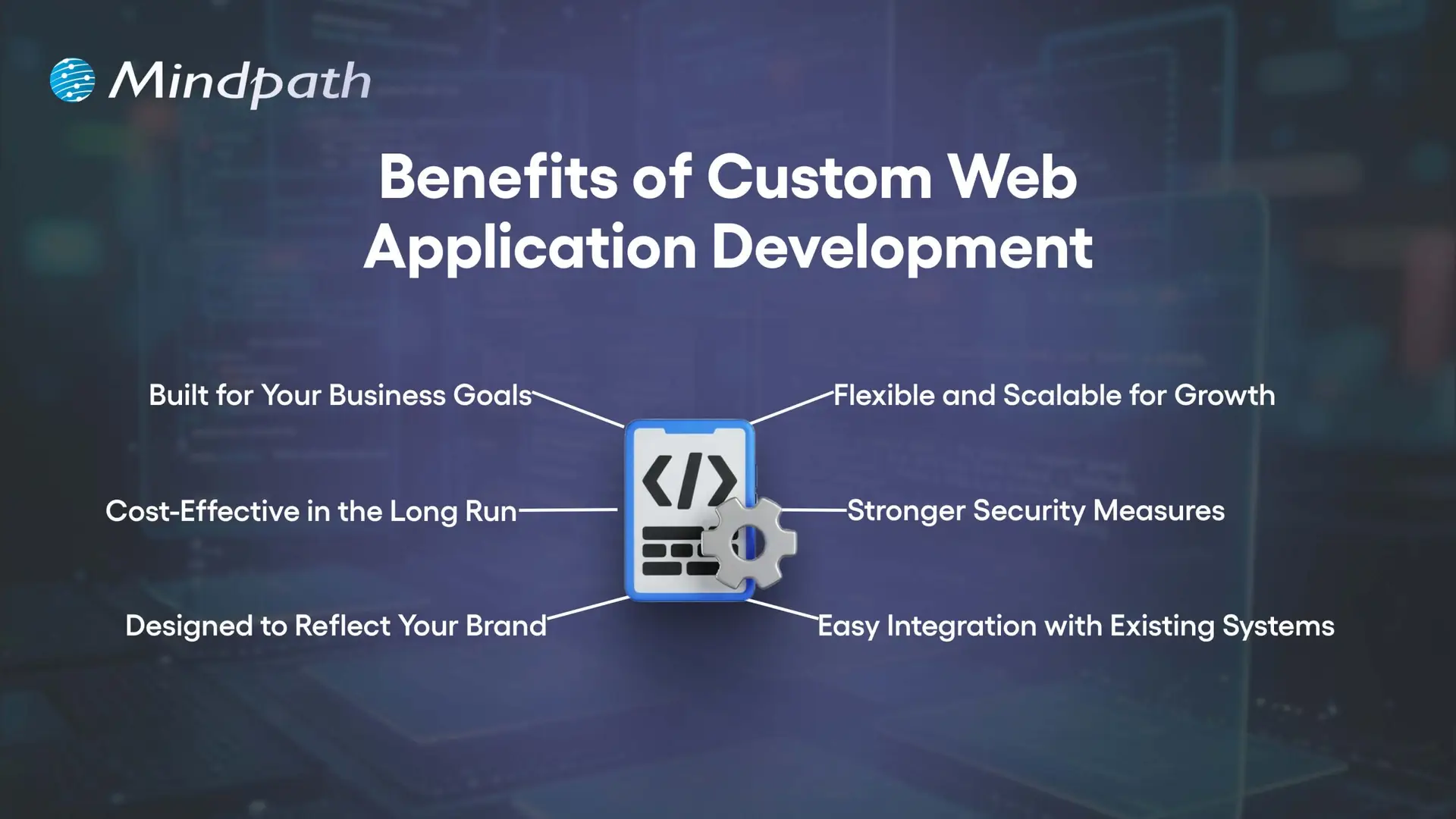
1. Built for Your Business Goals
When you use Custom web application development, you have every feature custom development to suit your needs. This makes integrating workflows easier and an easier experience for your employees.
2. Cost-Effective in the Long Run
A custom solution takes out the licensing fees and unnecessary features, which will save you in the long run. You can also reduce some infrastructure and hardware costs if you are going to outsource the development, too.
3. Designed to Reflect Your Brand
Custom web app development allows you to create every aspect of the application, to your brand’s identity. It can give your application a customized, professional, and unique identity that users will definitely recognize.
4. Flexible and Scalable for Growth
Custom-built applications will grow with your business and meet new demands. You will be able to add new features, accommodate increased traffic and usage, and still have a smooth performance.
5. Stronger Security Measures
Security is a key feature of Custom web application development, ensuring that your business is safe from common cyber threats. Custom apps will be fun to breach and take over than commercial apps found on the market.
6. Easy Integration with Existing Systems
Custom web applications will integrate easily with your current systems and databases. This allows you to keep data synchronized, accurate, and consistent across all platforms.
Choosing a custom web application is a strategic business decision! Discover web development trends to ensure your development strategy aligns with current and future digital demands.
10 Signs Your Business Needs a Custom Web Application
As businesses change, many times their needs exceed what generic software can deliver. Knowing the signs that you need a custom web application will allow you to reduce the damage that can happen before inefficiencies grind your business down.
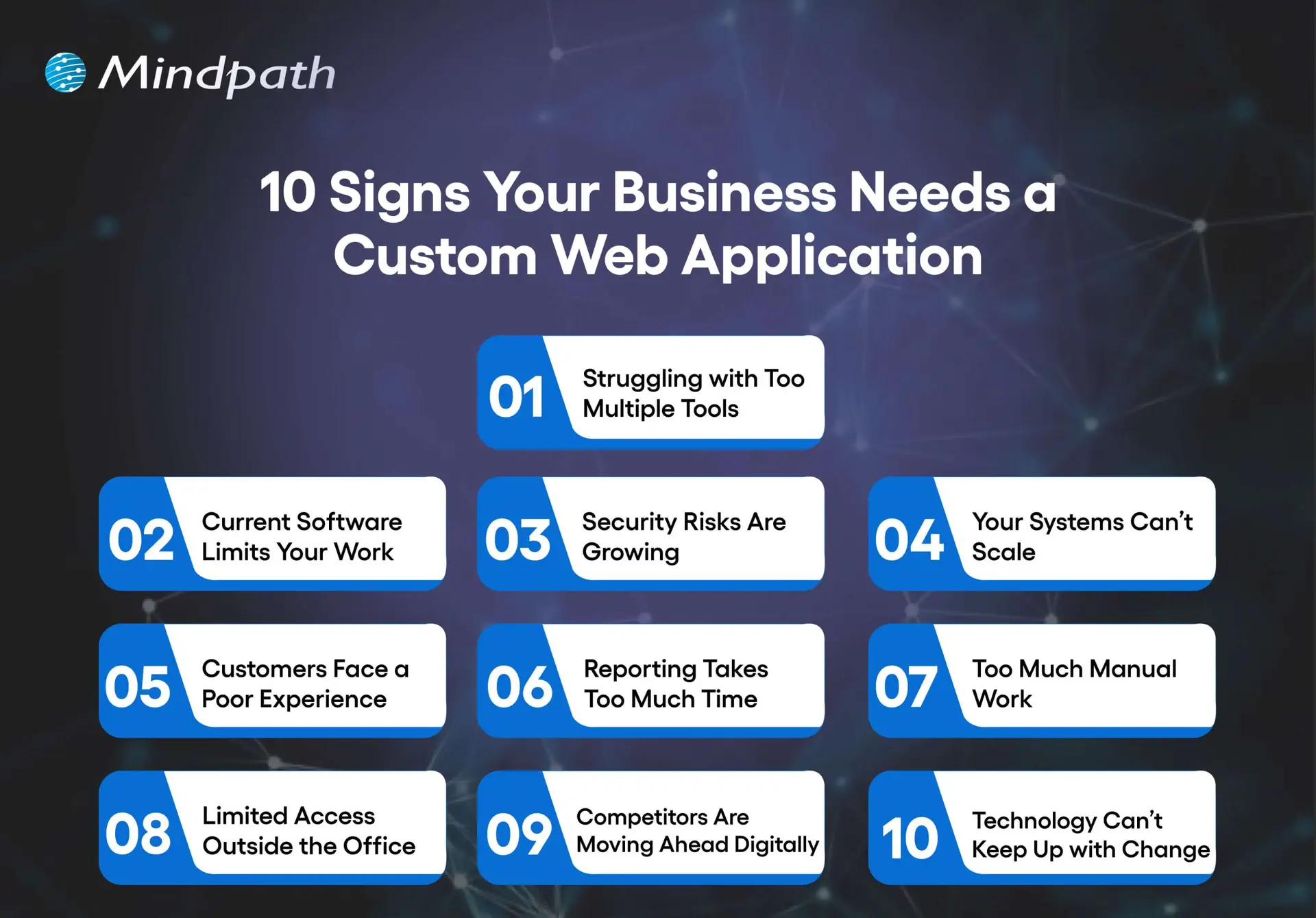
1. Struggling With Too Many Tools
Switching between spreadsheets, emails, and multiple apps slows work and causes mistakes. A custom web app centralizes your operations in one platform for better efficiency.
2. Current Software Limits Your Work
Generic software forces you to adjust your process to fit its features. Custom web application development creates solutions that match your exact workflows.
3. Security Risks are Growing
Using outdated systems leaves sensitive data exposed. A custom web app includes strong security controls, encryption, and adheres to all industry standards.
4. Your Systems Can’t Scale
Organizations evolve. As your business grows, so should your tools increase their users, data, and functionality. Custom software is built to scale without performance issues.
5. Customers Face a Poor Experience
Using slow, outdated, or limited platforms can leave users frustrated. A custom web app will provide users with modern interfaces, fast service, and customized experiences.
6. Reporting Takes Too Much Time
If your reporting is done manually, or it takes too long to collect and analyze, it will limit your decision-making. Custom web apps will provide real-time dashboards and allow for instant self-serve reporting.
7. Too Much Manual Work
When staff are tied up with repetitive data entry or repetitive tasks, it is hard to be productive. A custom application can be built with automation features to allow staff to concentrate on high-value opportunities or higher-skilled work.
8. Limited Access Outside the Office
If your employees can’t easily access your systems while off-site or, even worse, don’t have access to them at all, your flexibility is limited. A custom web application can be secured and hosted in the cloud, allowing staff to work from anywhere.
9. Competitors Are Moving Ahead Digitally
If you’re used to out-of-date tools and systems, keeping up will mostly be impossible. Custom web application development will give you the opportunity to develop useful features that are unique to your organization.
10. Technology Can’t Keep Up with Change
If your business pivots, expands, or introduces new services, the old systems won’t accommodate this change. Custom applications allow you to adapt to these opportunities, adding integrations, and are designed with flexibility.
Wondering what comes next after deciding to build a custom web application? Explore the web app development roadmap to gain clarity on development stages, timelines, and technology choices.
Ready to Build a Solution That Fits Your Business?
A growing business needs tools that adapt to its pace, processes, and vision. Custom web application development delivers tailored solutions that improve efficiency, strengthen security, and enhance customer experience. Recognizing the signs early allows you to invest in a platform that aligns perfectly with your goals and supports sustainable growth.
At Mindpath, our Custom web application development services create secure, scalable, and user-friendly platforms that integrate seamlessly with your operations. We focus on understanding your unique workflows and delivering features designed to simplify tasks, automate processes, and empower your team. The result is technology that becomes a true partner in your business journey.

The landscape of Software as a Service (SaaS) is changing faster than ever. As all businesses are now adopting the cloud-first approach, SaaS tech leaders should stay ahead of SaaS trends to remain innovative and competitive.
Current market trends can help service providers to know about the Saas challenges and come up with feasible solutions to tackle them. Whether you are investing in a SaaS technology, scaling your development strategy, or leading SaaS projects, these 14 SaaS trends will help you understand the market and what approaches you should consider to remain competitive.
Want to stay ahead of your competitors by using the latest Saas technologies in your business? Mindpath offer SaaS devlopment services to receive customized solutions that help you innovate faster and smarter.
The Rising Popularity of SaaS Technologies
SaaS has emerged as a dominant force in today’s digital landscape. It is transforming the way businesses deploy, access, and scale their software programs. With time, the popularity of SaaS platforms continues to rise across all industries. And some major reasons behind this are:
- Businesses don’t have to worry about local installations and get instant access to solutions.
- SaaS is scalable, and businesses can adjust usage without investing in the IT infrastructure.
- Subscription models lower expenditure, making it accessible to all, including startups and SMBs.
- Deployment, upgrades, and maintenance are handled by the service providers.
- SaaS is highly beneficial to support the remote teams and provides access to necessary resources in real time.
- SaaS platforms have the ability to integrate with existing workflows and systems.
SaaS service providers enable businesses to be customer-centric and agile. However, to remain competitive, these service providers have to keep up with innovation and adapt their platforms to the changing market demands.
Planning to build a scalable SaaS product but unsure how to choose the right development partner for your needs? Explore our guide on choosing the right SaaS development services to discover key factors that ensure long-term success.
The optimal way to attain that is by adhering to the trends arising in the SaaS market. Read to explore those trends.
14 SaaS Trends Driving the Future of SaaS
Now that we have unpacked SaaS’s impressive benefits, let’s uncover the SaaS trends that are redefining the landscape of SaaS technologies. Here is what is driving the next big wave of SaaS innovation.
1. API-First Architecture – The New Standard
Most modern SaaS projects now opt for API-first design since it can integrate third-party services and tools without any difficulty. It can assist in increasing flexibility and scalability as well as developer experience. Besides, this approach will simplify the process of creating custom workflows.
2. Edge Computing and SaaS
With the help of edge computing, the SaaS platforms can process data closer to the source. This, in turn, reduces latency while enhancing performance. It is quite helpful in real-time analytics, logistics, and IoT.
Through edge capability integration, SaaS solution providers can enhance security, offline functionality, and responsiveness.
3. AI-Powered SaaS Solutions
Artificial Intelligence has become a necessity. Most SaaS platforms are now embedding AI to personalize user experiences, automate workflows, and offer predictive insights. It has also enabled accurate fraud or risk detection.
SaaS platforms that are lacking intelligence are losing relevance. After all, customers want more than just task automation. They want tools that can anticipate requirements and support their decision-making.
Curious about how AI can transform your SaaS strategy and drive smarter business decisions? Discover our detailed guide on the benefits of AI to explore how it enhances efficiency, innovation, and growth.
4. Changes in Subscription Models
SaaS pricing is now shifting from the monthly packages to hybrid, freemium, and usage-based models. Some are also available with outcome-based pricing models. Such flexible pricing structures have helped service providers to improve retention and customer value.
As these platforms evolve, businesses significantly benefit from personalized pricing. On the other hand, providers get deep insight into product engagement and user behaviour.
5. Enhanced Privacy, Compliance, and Security
Trust is an important asset. The customers believe that service providers are safe and in compliance. But that trust can be hampered with just a single instance of data breach or GDPR conflict. Thus, SaaS providers should focus on the use of zero-trust frameworks and advanced encryption.
Besides, the deployment of automated compliance tools can help a lot here. Furthermore, they should keep themselves updated about evolving regulations such as DORA, HIPAA, GDPR, and PDPL.
6. Vertical SaaS
SaaS development companies are now going niche. Why? Well, generic SaaS tools may not help users with industry-specific needs, workflows, or regulations. They are launching SaaS technologies for specific industries like finance, education, or healthcare.
Vertical SaaS platforms are significantly influencing the future of SaaS by offering tailored compliance, deep domain expertise, and flexibility. The vertical SaaS market is expanding, and it is forecast to reach USD 263420 million by 2031 (Source: Market Monitor Global)
7. Micro-SaaS Solutions
Micro-SaaS businesses typically have a narrow focus on use cases and develop add-ons for big SaaS platforms. They are agile, quick to launch, and lean. Micro-SaaS businesses offer highly targeted solutions, with their flexibility supporting rapid adaptation to changes. They are best suited to deal with overlooked issues in various saturated SaaS markets.
8. Conversational UX Will Be a Game Changer
The interface of SaaS platforms is evolving rapidly, with chat-based navigation, natural language processing, and voice assistants. These features increase accessibility and user engagement.
This is one of the vital SaaS trends that most SaaS providers have adopted, making their software interaction feel more human-centric. This trend has become a core component of SaaS development.
9. RevOps
Speaking of the most significant trends in SaaS, we cannot omit the emergence of Revenue Operations (RevOps). It unifies marketing, customer success, and sales into an AI-powered platform. These tools provide SaaS companies with end-to-end visibility.
This means that the retention, forecasting and profitability can be easily enhanced. For instance, the advanced lead scoring system in the RevOps tool can help sales teams focus on prospects who are more likely to convert.
10. Blockchain Integration in SaaS
It is undeniable that blockchain is quickly changing the SaaS market by introducing decentralized, secure, and transparent data management. Other use cases that we may take as an example are encrypted transactions, smart contracts, and identity verification.
The adoption of blockchain in SaaS applications provides better trust, compliance, and traceability. This is essential for legal, healthcare, and finance SaaS providers who aim to have better data integrity.
Looking to accelerate your SaaS development process without heavy coding efforts? Explore our guide on low-code platforms to discover how they enable faster development and greater flexibility.
11. Low-Code/No-Code Platforms
The low-code and no-code approach is one of the most popular trends in 2026, as it can support easy and fast development. SaaS providers are also supporting this move. In fact, they are also integrating this into their platforms.
Why? In a world where speed matters, allowing non-technical teams to create their own tools can help unlock a new level of productivity. The workflow of finance, operations, and HR teams can be automated with a couple of clicks.
12. Business Intelligence and Predictive Analytics
SaaS platforms are now using predictive analytics to predict market trends, customer behavior, operational risks, and more. This helps businesses to make data-driven decisions faster than before.
Service providers have realized that business intelligence has become a crucial asset. They are optimizing it to enable businesses to enhance performance.
13. Sustainability-Focused Solutions
Sustainability-focused SaaS, or green SaaS, is now gaining traction as organizations are prioritizing eco-friendly options. Carbon tracking, cloud efficiency, and sustainable hosting are leading this transformation.
These trends in the SaaS industry reveal growth in the demand for ethical solutions. And the future of SaaS will be based on how it is aligned with long-term business sustainability and environmental responsibilities.
14. Localization and Globalization of SaaS Tech
It has been seen that SaaS service providers are now expanding globally, and they are also localizing compliance, customer support, and content. By offering region-specific features and multilingual interfaces, they are enjoying continuous international growth.
SaaS companies are evolving and scaling their platforms across multiple geographies while offering all the necessary elements.
Curious how SaaS innovations are evolving to support more efficient and future-ready business operations? Explore our guide on sustainable technology to discover how eco-friendly approaches are shaping the next generation of SaaS solutions.
The Next Chapter in SaaS Innovation and Growth
Well, the current trends are looking really impressive, establishing a solid foundation for SaaS market growth. But what will happen after 2025? Well, predicting the future of SaaS technologies is a little difficult. However, the direction of the journey is clear: SaaS is becoming more intelligent, ambient, and embedded.
New technologies like quantum computing, Zero-UI, blockchain, etc., will bring massive changes in this landscape. For instance, quantum computing will force developers to rethink SaaS security models. On the other hand, Zero UI will lead to enhanced user engagement by offering interfaces powered by context, voice, and predictive behavior.
What’s more? There will be an increasing focus on regulation, privacy, and sustainability. SaaS leaders who thrive will not be the ones who just predict the future, but those who design for resilience and volatility.
Ready to Leverage the Latest SaaS Trends for Your Business Growth?
SaaS is evolving rapidly with trends like AI integration, API-first architecture, and predictive analytics shaping its future. Businesses that adapt to these innovations can improve efficiency, enhance user experiences, and stay competitive in a fast-changing digital landscape.
At Mindpath, we provide expert SaaS development services to help businesses adopt the latest technologies and build scalable, secure solutions. From strategy to deployment, our team ensures innovation and performance. Partner with us to accelerate your SaaS journey.
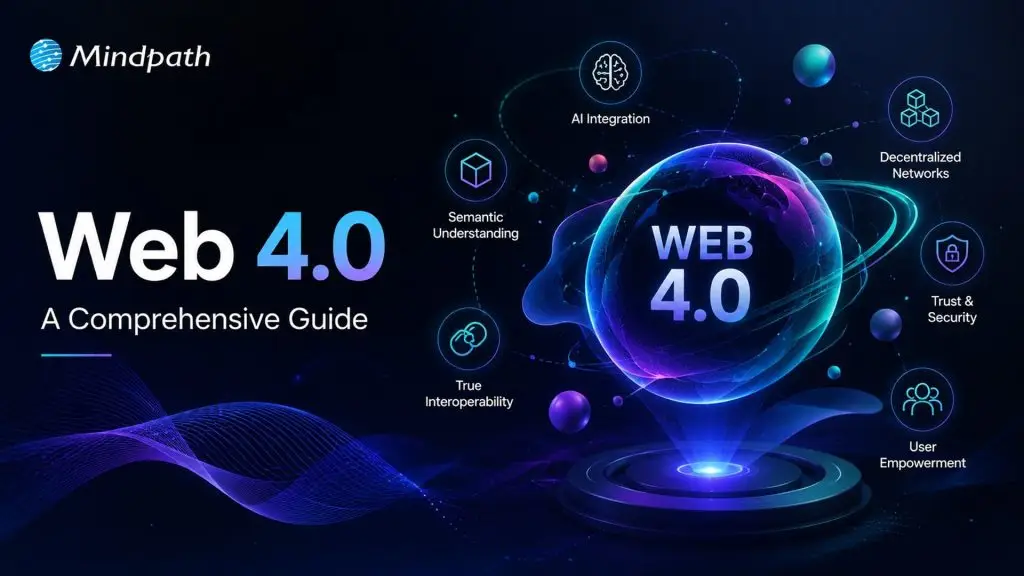
The emergence of Web 4.0 is revolutionizing how we communicate, share, and engage with the digital world. It is no longer just a platform to find information. The internet is evolving into an intelligent, highly personalized, and interactive medium with which humans can have meaningful conversations. Businesspeople, programmers, and users are at the crossroads. But, what if the web thinks in a more intelligent way, reacts very quickly, and adapts to human needs? We are already witnessing the start of a change that is affecting innovation, and its influence is extending over various sectors.
Along with the changing of technology, people’s desires go beyond only fastness and accessibility. Now, users are looking for connected systems that understand their actions, assist them in decision-making and give them smooth experiences. As a result, Web 4.0 promises a future when digital environments will be more natural and relevant to human life. It provokes organizations to change their strategy and at the same time, it inspires customers to think about bigger opportunities. In this blog, let us discover how the upcoming internet era currently influences technology, business, and people’s experiences online. So, keep reading further!
Looking to stay competitive in the Web 4.0 era with smarter digital solutions? Mindpath offers AI development services to help you build smart applications that grow with your business.
What is Web 4.0?
Web 4.0, commonly known as the symbiotic web, is less about information sharing and more about creating digital experiences that comprehend user needs. This phase of the Internet involves technology that can think and be connected on a deeper level. This web will be a network that connects people, devices, and systems in a smooth way. Through advanced web methods, organizations will be able to make decisions more rapidly. It will offer personalized communication, and collaborate effectively across digital environments.
Web 4.0 differs from the previous web versions in that it emphasizes intelligence, automation, and greater control of the user. It incorporates technologies, such as AI, machine learning, and decentralization to enhance the daily digital encounters of users. The individuals will enjoy improved privacy, robust security, and increased control over their personal data. In a deeply interconnected digital-physical environment, Web 4 is truly a game changer for businesses.
How Does Web 4 Differ from the Earlier Versions?
The internet has changed a lot over time. In this ongoing digital transformation, Web 4.0 is quite different from Web 1.0, 2.0, and 3.0 in that it provides more thorough personalization and a smooth digital interaction.
Let us have a glance at how this Internet 4.0 differs from the earlier versions through this table:
| Category | Web 1.0 | Web 2.0 | Web 3.0 | Web 4.0 |
| Internet Function | Static information browsing | Social content sharing | Decentralized digital ownership | Intelligent connected ecosystem |
| User Interaction | Read-only access | Read-write participation | User-controlled engagement | Predictive personalized interaction |
| Main Technology | Basic web pages | Social media platforms | Blockchain smart systems | AI-powered automation |
| Data Ownership | Company-controlled data | Platform-managed data | User-owned assets | Secure adaptive control |
| Experience Quality | Limited digital presence | Interactive online communities | Transparent secure networks | Seamless human-machine integration |
What are the Key Benefits of the 4.0 Web?
Through the intelligent web, digital experiences are being transformed into smarter, faster, and more responsive. Web 4.0 not only focuses on connectivity but also fosters meaningful interactions that change according to user requirements. Its sophisticated features are allowing new opportunities to be unveiled by both companies and ordinary users.
1. Smart Personalization
Web 4.0 comprehends user behavior and provides the most pertinent digital experience to the users. It facilitates user to get quick recommendations, anticipatory assistance, and tailor-made services. This smart way enhances ease of living as well as business operations.
2. Stronger Data Security
Web 4.0 is built around decentralized systems which allow users to have greater control over their personal data. By minimizing the risks associated with central platforms and enhancing transparency, it leads to much safer and secure online experiences.
3. Better Human-Tech Connection
The future of web is all about more interactive ways for humans to interact with digital systems. With the use of Web 4.0, communication will get better by using technology that is more human-like in responding to our needs. So, the result will be a highly intuitive experience through digital interfaces.
4. Advanced Automation
Artificial Intelligence (AI) has become one of the key components of Web 4.0. It is capable of automating repetitive tasks thus increasing the efficiency level of the work. This also leads to faster workflows, smarter virtual assistants, and less manual work. Businesses, in this way, could enhance their productivity without spending more time.
Must Read: AI vs Automation
5. Seamless Device Connectivity
Web 4.0 facilitates creating seamless experiences through multiple devices and platforms. Users can effortlessly switch from one platform to another without any loss in functionalities. Hence, this leads to highly connected and continuously consistent digital engagements.
6. Smarter Business Insights
Web 4.0 will enable companies to leverage real-time data for making superior decisions. It also enhances the capacity to analyze customer behavior and identify market trends, which subsequently results in quick and better business development strategies.
Key Challenges and Limitations of Web 4.0
Web 4.0 definitely opens a door to a fantastic innovation landscape, but along with it, several complex challenges arise that neither businesses nor users should overlook. Let’s explore the issues and major shortcomings of Web 4.0.
1. Privacy and Data Protection
A lot of personal information will be needed in Web 4.0 to provide smart experiences. This results in heightened worries about improper use of data, cyber risks, and identity theft. Keeping the users’ privacy safe is still a big issue.
2. Ethical AI Concerns
Autonomous systems may raise problems concerning bias, fairness, and accountability. AI’s decision-making might even become non-transparent or unethical at times. Developing responsible systems entails continuous oversight and control.
3. High Infrastructure Demand
Web 4.0 requires powerful computing systems, more advanced networks, and a massive scale of connectivity. Many areas still don’t have this technological basis. Today, it is costly and challenging to implement globally because of this.
4. Complex Development Process
Constructing Web 4.0 systems relies on the integration of AI, IoT, machine learning, and decentralized technologies. Overseeing such sophisticated systems calls for highly skilled professionals and substantial resources. This level of intricacy may hinder the pace of adoption.
5. Growing Digital Divide
High-tech solutions might be equally accessible to everyone for only a limited period. A shortage of gadgets and internet infrastructure may expand the gap of inequality. Such a scenario poses difficulties for achieving a sustainable and inclusive digital development.
6. Technology Dependence Risks
More automation might mean less human engagement in everyday decision-making. Relying too much on digital systems might disable our problem-solving skills. It is really necessary to find a balance in the use of technology and human control.
7. Expanded Cybersecurity Threats
The more connected devices there are, the more potential access points for hackers. One single flaw may give rise to the compromise of several systems. Hence, ensuring the safety of interlinked networks is of utmost importance.
Real-World Applications of Web 4.0
Web 4.0 is more than a mere futuristic idea as it is already radically changing various sectors via technologically advanced and interconnected devices. Its tangible effects are revolutionizing business operations as well as digital human interactions. The following are some significant examples of Web 4.0 being used in practice.
1. Smart Healthcare Solutions
Web 4.0 is an enabler for healthcare in being more proactive and personalized. Devices being worn on the body and AI systems can keep track of one’s health, assess potential risks, and aid in quicker medical interventions. Patient care and daily wellness management could be significantly enhanced by such developments.
2. Connected Smart Cities
Cities are making use of Web 4.0 to enhance traffic flow, reduce energy consumption, and improve the delivery of public services. Real-time sensors and smart systems are the backbone of better urban management. This results in urban areas that are more efficient and responsive to the needs of their inhabitants.
3. Autonomous Transportation
One of the ways Web 4.0 is backing up intelligent transportation is through the interaction of vehicles and infrastructures. Various applications can be used for better route planning, accident reduction, and improving travel time. In fact, this is the technology behind the development of safer commuting options.
4. Personalized Digital Learning
Cutting-edge AI and virtual reality technologies tailor individual learning experiences; with the help of these adaptive learning tools, students can be catered to their pace and needs. As a result, educational methods become markedly enjoyable and effective.
5. Secure Financial Systems
By leveraging decentralized technologies and safe transactions, Web 4.0 further solidifies digital finance. It also increases transparency in logistics and supply chains. Such innovations contribute to building trust and enhancing operational efficiency.
6. Predictive Smart Living
Smart homes and retail platforms, through connected systems, can predict what users need. Personalized actions and recommendations are ways through which devices and services respond faster. This convenience is a portrayal of the future of the internet.
7. Intelligent Task Automation
Web 4.0 opens up the possibility of AI handling almost all kinds of tasks without humans. It can schedule your meetings and do a lot of digital operations on the go. This helps users save time and streamline daily activities.
The Future of Web 4.0 and What Lies Ahead
Web 4.0 continues to evolve as emerging technologies reshape how people, businesses, and systems connect. Its future promises deeper intelligence, stronger automation, and more immersive digital experiences. Here are some key developments expected in the future of Web 4.0.
1. Autonomous AI Partners
Web 4.0 will move beyond basic digital assistants into smarter autonomous systems. These AI agents will manage complex tasks, make decisions, and operate across platforms. This shift will improve productivity and digital convenience.
2. Advanced Human-Machine Interaction
Future Web 4.0 experiences will feel more natural and seamless. Voice commands, gesture controls, and smarter interfaces will reduce dependence on traditional screens. Human and digital interaction will become more intuitive.
3. Predictive Personalization
Web 4.0 will better understand user behavior, habits, and preferences. Systems will anticipate needs and offer proactive solutions before users search. This will create faster and more personalized experiences.
4. Connected Digital Ecosystem
Connected devices will communicate continuously across homes, workplaces, and cities. This deeper IoT integration will support smarter environments and automated living. Daily experiences will become more responsive.
5. Trusted Digital Infrastructure
Blockchain will strengthen trust, security, and transparency behind Web 4.0 systems. It will support secure automated transactions between users, businesses, and AI systems. This foundation will improve reliability.
6. Immersive Digital Experiences
Web 4.0 will expand beyond traditional browsing into interactive 3D environments. AR, VR, and spatial computing will transform work, shopping, and communication. Digital experiences will feel more engaging and realistic.
Ready to Embrace the Next Digital Evolution?
Understanding the web 4.0 definition helps businesses and individuals prepare for a smarter digital future. As technology evolves rapidly, adopting intelligent systems early can unlock innovation, stronger connections, and sustainable growth in an increasingly connected world.
At Mindpath, we provide AI development services that help businesses adapt to Web 4 advancements with confidence. Our innovative solutions support smarter automation, digital transformation, and future-ready growth through advanced technology.
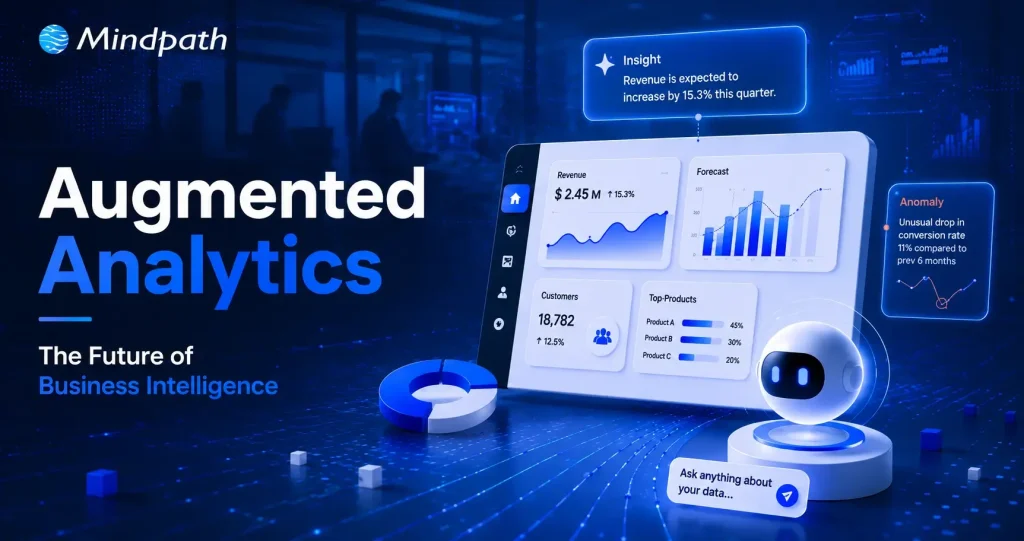
In today’s world, businesses produce more data than ever. However, even the best teams often still find it hard to make decisions based on that data. This is where augmented analytics comes in. It combines artificial intelligence and machine learning with traditional business intelligence. This translates into smarter, faster and more accurate analysis for all.
Then, why is this change important for contemporary businesses? Traditional BI tools were developed with the analyst in mind. Augmented analytics is about to alter all this. It enables every team member to be able to explore the data themselves. No coding, no complex queries, no delay in reporting. The potential for productivity, direction, and development is huge. This blog examines what augmented data analytics really represents, why it’s so relevant today and how it’s changing the future of AI.
Ready to turn your business data into smarter decisions and real growth opportunities? Mindpath offers AI development services to help you build intelligent analytics solutions that deliver meaningful insights.
What is Augmented Analytics?
Augmented analytics is the use of artificial intelligence, machine learning, and natural language processing to automate data preparation and insight generation. It removes technical barriers for everyday business users. Anyone can now explore data, spot trends, and draw conclusions. This is the foundation of modern advanced data analytics.
Simply put, augmented data analytics enhances human intelligence. It does not replace analysts. Instead, it empowers them to work smarter and faster. Non-technical users can ask questions in plain language and get instant answers. Decisions become quicker, more accurate, and rooted in real data. That shift changes everything for businesses today.
How Augmented Analytics Works?
Augmented analytics starts by automatically cleaning and connecting data from multiple sources. From there, users simply ask questions in plain language and get instant answers.The driving force behind this is AI-Powered Analytics, which leverages machine learning to inspect the data and identify patterns, trends, and irregularities without any manual intervention.
Afterwards, the machine converts complicated insights into straightforward, graphical descriptions that are comprehensible to everyone. Also, it keeps on learning from user interaction and enhancing its recommendations. Thus, the final outcome is rapid, intelligent, and highly-tailored insights produced in a matter of minutes instead of days.
Key Benefits of Augmented Analytics for Businesses
Smart data analytics is transforming how businesses understand and act on their data. Here are the major benefits of augmented analytics that are driving this transformation across industries today.
1. Accelerated Time-to-Insight
Preparing data manually often took several days. However, augmented analytics by automating the entire workflow removes delays and delivers on-the-spot insights precisely when companies most rely on them.
2. Democratization of Data
It is unrealistic to expect all the team members to be fluent in the language of data science. Thanks to natural language queries, practically any member of the team can type out their questions in simple English and receive instant factual answers.
3. Enhanced Decision-Making
Making decisions based on old reports leads to a reactive business that will eventually lose the race. What AI in analytics offers is the capability of uncovering hidden patterns and unusual events, which ultimately results in more intelligent and preemptive decisions.
4. Improved Productivity
Preparing data is undeniably the largest part of the time data teams spend. Augmented analytics, by automating these processes, liberates analysts from routine tasks so that they can concentrate on strategic planning and creative work.
5. Reduced Analytical Bias
Because of human nature each interpretation can be different and therefore from some level subjective. Machines, on the other hand, follow strict rules and do not deviate. Therefore, when they are used to analyze the data, it becomes more consistent and trustable.
6. Advanced Forecasting and Modeling
The ability to forecast is at the core of any business planning. Business executives leveraging AI-driven predictions can be highly confident about their supply chain, inventory, and financial decisions.
7. Cost Savings
The role of augmented analytics in business intelligence goes beyond insights. It simplifies the whole analytics process, thus reducing labor and operational costs across different departments.
Real-World Augmented Analytics Examples
Augmented analytics is already making a measurable impact across industries worldwide. Here are some real-world examples of how businesses are putting it to work today.
1. Sales Pipeline Risk Detection
Losing a deal late in the cycle is costly and often avoidable. AI analyzes deal velocity and engagement patterns in real time, giving sales leaders early warnings before opportunities slip away.
2. Employee Attrition Prediction
HR teams in large enterprises can now get ahead of talent loss before it happens. AI analyzes employee behavior and tenure patterns to flag individuals most at risk of leaving the organization.
3. Smarter Demand Forecasting
Supply chain disruptions often stem from poor demand visibility. Using augmented analytics tools, logistics and retail businesses continuously adjust forecasts based on real-time signals and external market data.
4. Intelligent Inventory Management
Overstocking and stockouts both hurt retail profitability. AI analyzes customer buying patterns automatically and adjusts stock levels, helping retailers reduce waste and meet demand more consistently.
5. Predictive Equipment Maintenance
Unplanned downtime is one of the biggest cost drivers in manufacturing. AI monitors equipment data continuously and predicts potential failures before they occur, keeping production schedules on track.
6. Real-Time Fraud Detection
Financial institutions process thousands of transactions every single day. AI scans that data in real time, flagging suspicious patterns instantly and significantly strengthening fraud prevention capabilities.
Is Your Business Ready to Embrace Augmented Analytics?
The use of data by enterprises is rapidly evolving and Augmented Analytics have become a reality. Those organizations that invest in them early will be able to make more informed decisions, get ahead of the competition and be more agile effectively.
Mindpath offers AI development services to assist companies in discovering the real potential of their data. We develop smart and robust solutions customized to your objectives. Contact us now and we will guide you through the new beginnings.Faq updated

The landscape of artificial intelligence is advancing at a higher rate. And it has made it crucial to ensure efficient adoption of LLMs or Large Language Models. Low-rank adaptation (LoRA) has emerged as an effective technique to fine-tune LLMs. Developers are now looking for scalable methods to customize AI models. Well, LoRA offers them a lightweight and cost-effective technique.
Furthermore, it has made the process of low-rank adaptation of LoRA in fine-tuning feasible, accessible, and efficient. In this detailed blog, we will explore more about the LoRA adaptation, understand what it is, and how it works. Besides, we will also discuss why it is an important method for fine-tuning LLMs in 2025. So, read on!
Struggling to figure out how advanced tuning methods like LoRA can give your business a competitive AI advantage? Mindpath’s AI development services help you harness LoRA-driven fine-tuning to build smarter, faster, and more efficient AI solutions.
What Is Low-Rank Adaptation (LoRA)?
Low-rank adaptation (LoRA) is a parameter-efficient fine-tuning technique that enables developers to customize large language models by training only a small set of additional parameters. Instead of updating the entire neural network, LoRA freezes the original model weights and injects lightweight trainable matrices, making AI model customization faster, more affordable, and highly scalable.
Why is Low-Rank Adaptation (LoRA) Important?
Large language models such as ChatGPT are powered by massive neural networks. These networks have trillions of parameters. And during pre-training, these parameters are fine-tuned to make models work properly. While it makes AI models powerful, there is no guarantee that they will work efficiently for certain tasks. Adapting a larger language model to a specific use case, like custom support automation or legal documentation, requires full fine-tuning. For instance, if you want to fine-tune GPT-4, then you will have to work on around 1.8 trillion parameters. Besides, the process demands enormous infrastructure and GPU memory.
However, low rank adoption (LoRA) provides developers with a more efficient and smarter alternative. It allows them to inject small training parameters into specific layers. This, in turn, reduces GPU memory requirements. Furthermore, it leads to minimal disruption, lower costs, and quick training. If you think Low Rank Adoption is the only parameter-efficient method, let us inform you that QLoRA or Quantization LoRA is now gaining popularity in the industry. The reason behind this is that it combines high-precision computation with low-precision storage.
Real-World Example of Low-Rank Adaptation (LoRA)
Now, let’s have a look at a Low rank adaptation LoRA example in order to get a clear idea about the impact of LoRA. Let’s assume you want to fin-tune BERT. You may opt for a full fine-tuning. But for that, you will have to retrain nearly 108,314,886 parameters. Besides, the method is resource-intensive.
On the other hand, using LoRA, you can freeze the model’s original weights. It allows you to train only the necessary adapters related to your tasks. In fact, you can achieve the desired results just by training only 78,342 parameters. As a result, you will witness a significant reduction in training time as well as machine cost.
New to fine-tuning techniques like LoRA and unsure where to start? Explore Large Language Model (LLM) to build a strong foundation before diving deeper.
How Does Low-Rank Adaptation (LoRA) Work?
Now that you have a clear understanding of low rank adaptation (LoRA), let’s talk about the right way to use Low-Rank Adaptation (LoRA) Techniques. To ensure desired outcomes, developers can follow these steps.
1. Selecting a Base Model
Begin by choosing a suitable AI model. You can opt for GPT-4 or GPT-3 as per your need.
2. Create Datasets
After the selection of a model, next, you need to collect quality datasets. Here, you must ensure that those datasets match your fine-tuning objectives.
3. Deploy LoRA Modules
While deploying LoRA adapters, choose the right attention layers. To avoid any issues, ensure a balance between performance and efficiency.
4. Rank Tuning
Select an appropriate rank. While smaller ranks can lower training costs, they can limit the model’s expressiveness. In general, the value can range between 4 and 46, based on the task.
5. Train Adapter Parameters
Here you need to be careful. First of all, freeze all the original parameters. Once done, you can start training low-rank parameters on your dataset. There is no need to train all parameters.
6. Process Validation
Use a separate validation set to monitor the performance of the model. Keep in mind that if the training data is limited and the rank is too high, this can increase the risk of overfitting.
7. PEFT Libraries Integration
To streamline the implementation process, developers can deploy libraries such as Hugging Face’s Parameter-Efficient Fine-Tuning library. It offers plug-and-play support.
Wondering how LoRA compares to traditional fine-tuning approaches? Discover OpenAI’s Fine-Tuning API to understand when efficient fine-tuning matters most.
The Hidden Cost of Full Fine-Tuning
To get a clear understanding of the importance of Low-rank adaptation (LoRA), it is critical to understand the exhaustive technique it replaces, i.e., Full Fine-Tuning.
A pre-trained large language model is essentially a huge network of weight matrices that encode the learned knowledge of the model. When developers go for a full fine-tuning, they feed the model specialized datasets. After that, the model adjusts each parameter to align with the new task.
This process involves calculating errors in the output and sending gradient updates through the entire network using an optimizer such as Adam. However, this technique comes with some critical drawbacks.
1. High Computational Cost
Fine-tuning a model with billions of parameters requires massive GPU memory. To store the AI model, optimizer stats, and necessary gradients, you will need enough VRAM, around hundreds of gigabytes.
2. Storage Inefficiency
Full fine-tuning creates a new model file. A 70B model, at 16-bit precision, can be around 140GB. Storing this size of file for every user who needs a custom AI model is unsuitable. That means maintaining separate models at large is nearly impossible.
3. Risk of Forgetting
Updating all weights to understand the new tasks can overwrite the existing capabilities of the model. For instance, it may not be able to translate language. This can significantly reduce the model’s versatility.
For years, AI model customization was exclusive to the AI labs that created them. However, things have started to change, all thanks to low-rank adaptation (LoRA). It has changed the rules of fine-tuning.
Curious about what LoRA actually optimizes inside modern AI models? Explore attention mechanism explained to understand the architecture behind efficient adaptation.
Why LoRA is an Excellent Option for Fine-Tuning LLMs?
Low rank adaptation (LoRA) is an ideal method for fine-tuning LLMs. After all, it brings efficiency, scalability and versatility to the process.
Here are some benefits of LoRA that prove why it is an excellent option.
1. Parameter Efficiency
As mentioned above, LoRA reduces the number of parameters. It makes fine-tuning possible utilizing low-resource hardware. Apart from this, it opens doors for independent developers to customize AI models.
2. Retain Pre-Trained Knowledge
By preserving base model weight, LoRA eliminates the risk of catastrophic forgetting. Using this, developers can ensure that a model’s general language understanding capability remains intact while expanding to new domains.
3. Scalable Fine-Tuning
With low rank adaptation (LoRA), fine-tuning is faster compared to other techniques. Developers can fine-tune multiple versions of models for various domains. There is no need to duplicate the entire model. As a result, version control will be easier.
4. Full Impact with Zero Latency
The weights of the adapter can be easily merged with the pre-trained models during inference. This helps maintain runtime performance without added latency.
5. Versatility
LoRA seamlessly integrates with popular transformer architectures such as BERT, T5, and GPT. That’s why it is a versatile fine-tuning solution in 2026.
Thinking about where LoRA-fine-tuned models create real business value? Discover generative AI use cases in diverse industries to see how efficient AI adaptation drives impact.
Build Smarter AI Models with Low-Rank Adaptation (LoRA)
Low-rank adaptation (LoRA) is now transforming the process of fine-tuning large language models. By reducing the total number of trainable parameters while maintaining the model’s integrity, LoRA has made fine-tuning more scalable, cost-effective, and accessible. Whether you are developing a multilingual translator or a healthcare chatbot, it offers the precision and flexibility required to train AI for real-world applications.
Developing and fine-tuning AI models can get complicated. This is where Mindpath comes in. Our AI development services can help you in designing and fine-tuning models using low-rank adaptation (LoRA). While doing that, we also ensure that all the things fit perfectly into your workflows. Let us make your AI solution personalized and powerful.
Artificial Intelligence is redefining how individuals will interact with their banks in the future. By leveraging AI in personalized banking experiences, financial institutions can better understand their customers and serve them with both precision and care. Picture receiving financial advice that is based on your lifestyle or alerts that predict your spending needs, even before you notice them. This is no longer a dream, but rather a progressive reality that is evolving our customer relationships with the banking experience.
As technology continues to grow smarter, banks are leveraging AI to enable a more seamless, rapid, and meaningful experience at each and every interaction with customers. Technology provides opportunities to design experiences that feel human, not automated, so clients feel understood at every step. With this growing innovation, personalization is now emerging as a key competitive advantage. In this blog, we’ll explore how AI is revolutionizing the banking experience into one that is less intuitive and more focused on the customer.
Ready to revolutionize the customer experience in their banking journey with the use of AI? Mindpath offers AI development services that help you put together tools that give you personalized financial experiences.
What is AI in Personalized Banking Experiences?
AI in personalized banking experiences is when artificial intelligence is used to create more purposeful banking for all customers, using information to identify spending, saving, and investing patterns to establish services that meet needs. This provides a thoughtful and engaging experience, ultimately increasing customer satisfaction and trust with the bank.
The use of AI in banking enables banks to provide certain services beyond basic transactional exchanges. With AI, banks are able to predict and suggest to the consumer the most likely need, for instance, recommending budgeting plans or how to spend money more wisely. The smart utilization of data and technology is a way to transform and personalize a traditionally impersonal banking experience into something humanized and connected to the customer.
Personalized banking is becoming a strategic advantage for business owners managing finances at scale. Explore AI in business strategy to understand how AI-driven banking solutions support long-term growth.
How Does AI Provide Personalized Banking Experiences?
AI is redefining banking by transforming data to drive understanding and inform the experience customers will have with a bank. Below are the roles of AI in delivering personal and valued banking experiences. This makes every interaction more meaningful, predictive and customer-centric.
1. Smarter Customer Insights
The use of AI in personalized banking experiences enables banks to know their customers more deeply. It analyzes various aspects of the customers’ lives, such as their spending habits, income patterns, and financial goals to be able to provide them with what they may require next. Based on these findings, banks are empowered to give the right advice at the right time and thus enhance customer experience.
2. Personalized Product Recommendations
Artificial Intelligence in finance gives banks the ability to create money management tools that go hand in hand with the everyday life and objectives of each client. After analyzing data like saving habits or risk tolerance, AI comes up with a credit card, a loan, or an investment that is an ideal match. Such customer experience retains customers’ faith and increases their confidence in the company, making them feel recognized and appreciated.
3. Enhanced Fraud Detection and Security
AI in personalized banking experience is a great tool for making customers feel safe when handling their money. It keeps an eye on transactions in real-time, and thus, any strange activities, which are possibly fraudulent, can be easily detected. Besides an increase in safety, this reactive security system also helps to establish trust in each digital interaction made by the customer.
4. Intelligent Virtual Assistance
AI-based virtual assistants and chatbots in banking are revolutionizing the way customer service is delivered. These AI assistants are available 24/7, so customers can always rely on them to get help. These empathetic interactions help to democratize banking.
5. Targeted Marketing with a Personal Touch
One of the conveniences of AI in banking is illustrated in customized marketing strategies as well. Banks are employing insights derived from data-driven decision making to deliver communications and to extend offers that are an authentic fit for the requirements of each customer. This targeted tactic heightens the interaction and facilitates customers in discovering services which really advantage them.
6. Smarter Credit Risk Assessment
AI-powered personalized banking experiences change the way that financial institutions determine a customer’s creditworthiness. Banks using AI check quite a few different aspects of a person’s life, such as income, payment behaviors, and even spending trends, to make a more just decision about who gets the loans. This precision opens the doors to better financial products for customers, while it is a relief to the banks that the risks are minimized.
Want to know how business owners can gain better control over cash flow and financial decisions? Explore AI in decision-making to see how personalized banking insights help businesses make faster choices.
Real-World Examples of AI in Personalized Banking Experience
Throughout the finance sector, AI is developing new methods of communicating with clients and assisting them with everyday banking. Presented below are some examples of AI in banking to illustrate how financial institutions are leveraging intelligent technology to provide clients with more personalized and valuable experiences.
1. Smart Virtual Assistants
AI in personalized banking experiences uses virtual assistants to simplify daily banking tasks. They help customers manage accounts, pay bills, and get instant updates anytime.
2. Personalized Financial Guidance
AI studies customer behavior to offer tailored budgeting tips and spending insights. It helps people make smarter financial decisions that match their goals.
3. Smarter Investment Support
AI analyzes market data and customer preferences to suggest better investment options. It helps both investors and advisors plan strategies more effectively.
4. Stronger Fraud Protection
AI tracks transactions in real time to detect unusual activity quickly. This smart monitoring keeps customers’ accounts secure and builds greater trust.
Wondering what type of AI actually powers personalized banking for businesses? Explore the types of Artificial Intelligence (ANI, AGI, and ASI) to learn how banks apply intelligent systems to serve business owners better.
Ready to Transform Banking with AI Innovation?
The application of AI in customized banking experiences is transforming the way people handle their finances and interact with their bank. Through the intelligent use of data to understand the needs of each customer, AI helps making financial services more accessible, secure, and meaningful to consumers. As technology continues to evolve, AI will continue to offer everyday consumers greater personal, intelligent, and seamless experiences in modern banking.
At Mindpath, we assist financial institutions in developing intelligent and customer-centric AI solutions that redefine banking. Our AI development services allow banks to provide predictive insights, personalized products, and improved security. We leverage our expertise to help you build smart systems that convert customer interactions into trusted and lasting relationships.
In current times of generative AI, prompt engineering is not sufficient to address the requirements of advanced applications. There is a need among content strategists, developers and product teams to have models that can be used to analyze domain-specific language and provide a uniform output. And that is where OpenAI’s fine-tuning tutorial comes in to guide developers through the complicated process of training various models. From healthcare to legal tech, fine-tuning has enabled customization of pre-trained models, opening new opportunities in AI-powered solutions. This blog will allow you to know more via a simple OpenAI fine-tuning API tutorial, as well as some OpenAI fine-tuning examples. We will also talk about why it is crucial for developers.
Ready to use customised AI models that align precisely with your business data, goals, and customer expectations? Mindpath’s AI development services provide end-to-end solutions from design to deployment.
OpenAI’s Fine-Tuning – What is It All About?
Let’s begin this OpenAI fine-tuning API tutorial by understanding the basics, i.e, what OpenAI fine-tuning is.
OpenAI models such as ChatGPT are trained on huge web-scale datasets and designed to perform across different domains. However, for specialised use cases, technical support, expert reasoning, or legal context analysis, these models need more targeted control.
OpenAI fine-tuning is a customization process that lets developers take a pre-trained model (like GPT-4o) and train it on a custom dataset using task-specific prompt-response pairs — teaching the model to consistently follow custom instructions, adopt a specific tone, or stick to a rigid formatting style without needing lengthy, repetitive prompts.
The OpenAI fine-tuning API makes this possible by enabling developers to train base models so they acquire new skills and behaviours based on business needs. Regardless of whether you are building a personalized chatbot, advanced summarisation systems, or scaling content generation, fine-tuning provides you with accuracy, performance, and control.
Must Read: Low-Rank Adaptation (LoRA)
Importance of OpenAI Fine-tuning for Developers
The OpenAI fine-tuning API tutorial focuses on the crucial nature of AI model fine-tuning. Fine-tuning ChatGPT is an essential strategy for developers aiming to create custom AI solutions. By customizing models, they make those models offer more consistent and smarter outputs. The following are a few points that explain why fine-tuning is a necessity for every developer.
1. Better Relevance and Accuracy
For all domain-specific queries, fine-tuned models will perform better compared to generic models. They will offer more contextually relevant and accurate responses.
2. Reduced Cost and Latency
Fine-tuned OpenAI models are more efficient. How? Well, they can attain better results with fewer prompts, lowering token usage. Besides, it leads to a faster response time.
3. Consistent Communication Style and Tone
Wouldn’t it be great if your AI model could speak just like your brand? You can make that a possibility with fine-tuning. You will be able to train the model with specific style, vocabulary and voice such that the outputs match the brand identity.
4. Enhanced Format Handling
If your application demands outputs in a specific reporting format or JSON structure, fine-tuning ensures the model follows those requirements.
5. Robust Safety and Control
By training your AI models on domain-safe and curated data, you can reinforce desired behaviour. This, in turn, will significantly reduce the risk of harmful or off-brand responses.
6. Unlocking New Opportunities
Fine-tuning OpenAI models can be used for multiple applications. Developers can train models to manage tasks, prioritizing expertise and specific interaction styles.
Curious about the concepts that make AI models like OpenAI’s so powerful? Explore the attention mechanism explained, which shows how attention transforms the way models understand and generate data.e
OpenAI Models Developers Can Fine-Tune for Custom Tasks
As described in this OpenAI fine-tuning API tutorial, the fine-tuning API allows developers to fine-tune various advanced models, increasing their capabilities. Now, let’s have a look at the OpenAI models that can be fine-tuned for specialized applications.
1. GPT-3.5
Undoubtedly, GPT 3.5 is a top choice among developers. Some major reasons behind this popularity are cost-effectiveness and low latency. Fine-tuning this model allows developers to reduce the complexity and increase consistency. Product recommendation guides, FAQ bots and customer service automation are some of the common uses of GPT 3.5.
2. GPT-4o
This is OpenAI’s flagship multimodal model. It can process images, audio, videos, and text. This model offers users advanced customization features without losing speed and efficiency. It can be optimized by the developers for domain-specific tasks that demand enhanced textual as well as visual comprehension. Financial document analysis and advanced customer support bots are some common OpenAI fine-tuning examples centered on GPT-4o.
3. GPT- 4.1
This OpenAI model is created to handle multi-step tasks, structured problem-solving and extensive reasoning. It is a perfect option for complicated processes. Fine-tuning this model allows developers to introduce the tools capable of adhering to the domain-specific formats, which makes them a great choice in case of technical planning or automating research.
4. O-Series Models
O-series models are based on GPT-4o and are optimized for efficiency and performance. You can use these models for tasks where GPT-4o’s functionality may be excessive. These models can be fine-tuned to be cost-effective and scaled to a large extent without reducing their accuracy. They come in handy with several industry-specific applications in sectors like SaaS, legal tech, and healthcare.
Wondering how large language models work behind the scenes? Explore the Large Language Model (LLM) detailed guide to discover the foundations of AI that make fine-tuning possible.
Tips to Use Open-AI Fine-Tuning API Effectively
The OpenAI fine-tuning API tutorial can provide useful information on the optimization methods of AI models. These practices can improve mode reliability if utilized in the right manner. Here are some best practices to consider for effective fine-tuning.
1. Data Quality
It’s obvious! The AI models will not be capable of providing precise results without clear, well-constructed, and relevant datasets.
2. Right Model
As mentioned above, only a few OpenAI models can be fine-tuned. For instance, GPT-3.5 or GPT-4o.
3. Tune Hyperparameters
Experiment with batch sizes, training cycles, and learning rates. This will help you find the right configuration.
4. Evaluate Regularly
Properly monitor progress, identify overfitting, and optimize the training approach.
By focusing on all these factors, developers can fine-tune OpenAI models with confidence. This is the foundation for fine-tuning ChatGPT or other models for tailored applications that can offer precise results.
Want to know how fine-tuned AI models can improve business decisions? Explore AI in decision-making to discover how intelligence-driven insights optimize strategy and operations.
When to Fine-Tune vs When to Use Prompt Engineering?
This is a common question that most developers would ask when learning OpenAI fine-tuning API concepts. After all, choosing between prompt engineering and fine-tuning is a vital decision for every developer creating AI-powered tools. Let’s break it down.
Begin With Prompt Engineering
Well, for most use cases, prompt engineering can be an ideal option. A well-developed system prompt, combined with clear instructions and examples, can enable a generic AI model to perform efficiently. In fact, they can attain around 80 to 90 percent task accuracy. Moreover, prompt engineering is cost-effective, fast, and there is no need to maintain a custom model for it. It is also ideal for low-volume tasks and prototyping.
Scenarios Where Fine-Tuning Actually Makes Sense
Based on this OpenAI fine-tuning API tutorial, we can state that in cases where you need to be more consistent and in control, fine-tuning makes a great choice. You can consider it when:
- You want a consistent style and tone format in communications.
- You wish to decrease the cost of the API.
- The existing model offers irrelevant output that can be resolved through curated examples.
- You want to enhance the AI model’s ability to accurately process complex instructions.
Fine-tuning is a major investment. It requires time for accurate data preparation and training costs. However, the long-term results are really impressive. Wondering how? Well, when you learn fine-tuning API methods, you can easily unlock the ability to boost the model’s efficiency, reliability, as well as performance.
Looking to understand where AI is headed next? Discover generative AI trends to explore emerging applications and practical use cases of intelligent systems.
Custom AI: The Future We Will Witness Soon
OpenAI’s fine-tuning API clearly shows a significant leap in making modern AI models bespoke and adaptable. It offers developers who want to go beyond what general AI does the means to add specific domain experience, brand voice, and intelligence to the models. This OpenAI fine-tuning API tutorial proves that it will unlock the next generation of custom AI models.
If you want to join the trend and enhance your business’s functionality with custom AI solutions, you can always count on Mindpath. We provide AI development services that help organizations develop as well as fine-tune their AI foundation models. Our team helps you align AI models with your workflows and domain-specific data. Partner with us today and build a custom AI solution to support your business growth.
The attention mechanism explained in simple terms is a deep learning technique that helps an AI model assign different levels of importance to different parts of its input. Instead of treating every word or data point as equally relevant, the model calculates relationships between elements to build a more context-aware representation. This approach has become a foundation of modern Transformer architectures and plays an important role in large language models (LLMs), machine translation, image analysis, and other AI applications.
To understand why attention changed AI, it helps to look at how the mechanism works, what queries, keys, and values represent, and how different attention techniques support modern AI systems.
Key Takeaways
- 01
Attention allows AI models to weigh the relevance of different input elements when building contextual representations. - 02
Queries, keys, and values work together to calculate attention scores and combine information from relevant tokens. - 03
Self-attention, cross-attention, additive attention, scaled dot-product attention, and multi-head attention serve different purposes. - 04
Transformer architectures use attention to model relationships between tokens and support parallel processing during training. - 05
Attention supports applications such as translation, text generation, question answering, image captioning, and multimodal AI.
What Is the Attention Mechanism?
The attention mechanism is a deep learning method that enables a model to calculate how strongly different parts of an input relate to one another. The resulting weights help the model combine information that is relevant to the current processing task.
Consider the sentence, “John picked up the book because he wanted to read it.” To interpret the sentence, a language model needs to connect words such as “he” with “John” and “it” with “the book.” Attention can help the model represent these relationships by assigning different weights to information from different tokens.
Attention does not work by following a fixed rule that always selects one important word. Instead, it calculates relationships based on learned representations and the model’s current input. The resulting attention patterns can vary depending on the context and the layer or head being evaluated.
Understanding Queries, Keys, and Values
Many attention implementations use three learned representations: queries, keys, and values. These components help the model calculate which information to combine.
- Query: Represents the information a token is using to determine what other information may be relevant to it.
- Key: Represents information used to calculate how relevant another token is to a query.
- Value: Contains the information that is weighted and combined to produce the attention output.
The model compares queries with keys to calculate attention scores. It typically normalizes these scores into weights and uses them to combine the value vectors. The output is a representation informed by the relationships between the input elements.
How Attention Is Calculated
In scaled dot-product attention, the query matrix is multiplied by the transpose of the key matrix. The scores are scaled, passed through a softmax function, and used to weight the value matrix.
The standard formula is:
Attention(Q, K, V) = softmax(QKT / √dk)V
Here, Q represents queries, K represents keys, V represents values, and dk is the dimension of the key vectors. Scaling helps control the size of the dot-product scores before the softmax operation.
An Example of the Attention Mechanism
Consider the sentence, “The dog carried its toy because it was excited.” To interpret the word “it,” a language model may need to evaluate how that word relates to other words in the sentence. Attention provides a way to calculate these relationships instead of relying only on a fixed, local context.
During processing, the model creates query, key, and value representations for the tokens. The query associated with a token is compared with the keys of other tokens. The resulting weights determine how much information is drawn from the corresponding value vectors.
The model does not simply assign the highest score to the sentence’s subject or always focus on a single word. It learns patterns from training data, and the attention weights depend on the input, the model’s parameters, and the layer being used. This flexible weighting helps Transformers build contextual representations that support tasks such as translation and text generation.
What Are the Different Types of Attention Mechanisms?
Different attention mechanisms calculate relationships between input elements in different ways. Some are designed for encoder-decoder architectures, while others are central to Transformer models. Understanding these distinctions helps explain how attention supports different AI tasks.
1. Additive Attention
Additive attention, associated with the work of Bahdanau and colleagues, was developed for neural machine translation. It combines query and key representations through a learned scoring function, typically involving a feed-forward neural network, to calculate attention scores.
The scores are normalized to produce weights that determine how much information the model uses from each available value. Additive attention can be useful when comparing representations of different dimensions, although its computational characteristics differ from dot-product attention.
2. Self-Attention
Self-attention calculates relationships between elements within the same input sequence. For example, when processing a sentence, a token can use information from other tokens to build a representation that reflects the surrounding context.
Self-attention is a central component of Transformer architectures. It helps language models represent relationships between words or tokens, supporting tasks such as text understanding, summarization, and generation.
3. Multiplicative or Dot-Product Attention
Multiplicative attention calculates relevance scores using a product between query and key representations. A common form is dot-product attention, in which the query and key vectors are multiplied to produce a score.
Dot-product attention can be computationally efficient, particularly when implemented with matrix operations on modern hardware. Scaled dot-product attention is a widely used version in Transformers. Additive and multiplicative attention are alternative scoring approaches rather than interchangeable names for every attention variant.
4. Cross-Attention
Cross-attention calculates relationships between two different sets of representations. Queries usually come from one sequence or representation, while keys and values come from another.
In an encoder-decoder Transformer, for example, the decoder can use cross-attention to access information from the encoder’s output while generating a response. Cross-attention is also useful in multimodal models that connect information from sources such as text and images.
5. Scaled Dot-Product Attention
Scaled dot-product attention computes query-key dot products and divides the scores by the square root of the key-vector dimension before applying softmax. The scaling helps prevent scores from becoming excessively large as the vector dimension increases.
This mechanism is a core building block of the original Transformer architecture. When the input sequence is processed in parallel, attention can model relationships between many tokens in a single layer, although the computation and memory requirements can grow substantially with sequence length.
6. Multi-Head Attention
Multi-head attention runs several attention operations using different learned projections of the input. Each head can capture different relationships or patterns, and the outputs are combined to form the layer’s final representation.
For example, different heads may respond to syntactic relationships, nearby tokens, or longer-range dependencies. However, the specific role of each head is not guaranteed to map neatly to one human-readable function. Multi-head attention gives the model multiple ways to represent relationships within the data.
How Attention Changed Transformer Architecture
The 2017 research paper Attention Is All You Need introduced the Transformer architecture, which relies on attention mechanisms and feed-forward neural network layers rather than recurrent or convolutional layers for its core sequence-processing design.
Transformers became influential because they offered an effective way to model relationships across input sequences while enabling substantial parallelization during training. Attention was an important part of this shift, although modern Transformer systems also rely on embeddings, feed-forward networks, normalization, and other architectural components.
1. Modeling Long-Range Relationships
In recurrent neural networks, information from earlier tokens must pass through successive recurrent steps. Self-attention provides a more direct way for tokens to exchange information within a layer, making relationships between distant positions easier to represent.
This does not mean attention eliminates every challenge associated with long sequences. Standard full self-attention has computational and memory costs that grow approximately quadratically with sequence length, which can make processing very long inputs expensive.
2. Parallel Processing During Training
Traditional recurrent networks process tokens sequentially along the sequence dimension because each step depends on the previous hidden state. Transformer self-attention can calculate representations for multiple input positions in parallel during training, subject to the architecture’s masking and implementation requirements.
This parallel processing helped make it practical to train large sequence models on modern accelerator hardware. Autoregressive text generation still generally produces tokens sequentially, even when the model uses Transformer attention.
3. Supporting Pretraining and Transfer Learning
Transformer models can be pretrained on large datasets and then adapted for specific tasks. Depending on the model and task, adaptation may involve fine-tuning, instruction tuning, or other techniques.
Attention helps these models build contextual representations, while the broader training process teaches them patterns and capabilities. Attention alone does not guarantee accurate outputs or eliminate the need for appropriate data, evaluation, and oversight.
Applications of the Attention Mechanism in AI
Attention mechanisms help AI models combine relevant information from sequences and other structured inputs. Their role varies by architecture, but they are widely used in language processing and many multimodal systems.
1. Machine Translation
In neural machine translation, attention helps a model relate elements of a source sentence to the representations used when generating the translated sentence. This supports context-sensitive translation, particularly when word order and sentence structure differ between languages.
2. Text Generation and Summarization
Language models use attention to incorporate information from relevant tokens while generating text. In summarization, these relationships can help a model represent connections across a source document and produce a shorter version that retains important information. Output quality still depends on the model, input, and task.
3. Question Answering Systems
Attention helps question-answering models represent relationships between a question and available context. In systems that process supplied documents, these relationships can help the model use relevant passages when formulating an answer. Attention by itself does not provide live or updated information; access to current data depends on the surrounding system.
4. Speech Recognition
Attention-based architectures are used in speech-processing systems to connect audio representations with other sequence representations. Depending on the design, attention can support speech recognition, transcription, and related audio tasks.
5. Image Analysis and Captioning
Vision models can use attention to represent relationships between image patches, regions, or other visual features. In image captioning systems, attention-based components can help combine visual information with language representations to generate a description of an image.
6. Multimodal AI
Multimodal models process combinations of inputs, such as text, images, audio, or video. Cross-attention and related mechanisms can help connect representations from different modalities, enabling tasks such as visual question answering and text-guided image understanding.
Benefits and Limitations of Attention
Attention offers important advantages for modeling relationships in data, but it also comes with design and implementation trade-offs. Understanding both sides helps teams evaluate whether an attention-based architecture is appropriate for a particular application.
| Aspect | Potential benefit | Important consideration |
|---|---|---|
| Context modeling | Represents relationships between different input elements. | Attention weights do not always provide a complete or reliable explanation of a model’s decision. |
| Parallelization | Supports parallel computation across input positions during training. | Autoregressive generation still generally proceeds token by token. |
| Long sequences | Provides direct paths for information exchange between tokens within a layer. | Standard full attention can require substantial memory and computation for long inputs. |
| Multiple representations | Multi-head attention can model different relationships in parallel. | Additional heads and layers can increase model complexity and resource needs. |
| AI applications | Supports language, vision, audio, and multimodal tasks. | Results depend on the complete model, training data, evaluation, and deployment context. |
Conclusion
The attention mechanism changed the development of modern AI by giving models a flexible way to calculate relationships between different parts of their input. Queries, keys, and values work together to produce attention outputs, while techniques such as self-attention, cross-attention, and multi-head attention serve different roles in model architecture.
Attention is a major building block of Transformer models used in language processing, vision, and multimodal AI. Its benefits must be considered alongside computational costs, data quality, evaluation, and deployment requirements. For businesses planning AI-powered products or workflows, understanding these trade-offs is an important step toward selecting an appropriate solution.
Mindpath supports businesses in evaluating and developing AI solutions aligned with their technical needs and business goals. Visit our AI development services page to learn more about our capabilities.
AI in manufacturing industry has experienced a fundamental transformation which now enables factories to operate differently in the digital age. Modern manufacturing operations benefit from smart systems which process production data to predict equipment breakdowns and enhance manufacturing precision throughout all production stages. The benefits of AI are evident in quicker production cycles, reduced costs, and higher quality outputs, making innovation the core of modern manufacturing.
Manufacturers are moving to the next level of connected intelligence as a result of persistent improvements in automation and data analytics. Basically, every process, choice, and way of working is being upgraded by AI-generated insights that are at the core of both efficiency and expansion. The change is going beyond tech; it’s a total revamp of how industries function. This article will look into the ways in which artificial intelligence is a main driver of Industry 4.0 and is influencing the manufacturing industry’s future.
Looking for a reliable solution to overcome bottlenecks and accelerate your business transformation? Mindpath offers AI development services that help manufacturers unlock new levels of operations excellence.
Understanding the Basics of AI in the Manufacturing Industry
AI in manufacturing is the integration of intelligent technologies, including machine learning, computer vision, and IoT, that work alongside factory operations to enhance efficiency and speed. It broadly means the employment of AI instruments across production, quality checks, supply chain, and machine maintenance. Such tools can reason, learn from data, and identify the most viable solution to a problem promptly, driving the shift toward what industry experts call “smart manufacturing.”
Manufacturers are able to save time, reduce waste, lower errors, and produce top-quality products through the use of AI. This is accomplished by giving the teams the ability to foresee equipment failures before they occur and, hence, maintain the efficiency of the processes. In general, AI is a key enabler of more efficient planning, quicker manufacturing and improved business expansion in the manufacturing sector.
Must Read: Top AI Trends
Role of AI in the Manufacturing Industry
Artificial intelligence significantly influences the manufacturing industry where it is used to make the factories more intelligent, quicker, and also more efficient. The following are the main functions of AI in the manufacturing sector.
1. Smarter Machine Maintenance
By analyzing the real-time data of the machines, AI can foresee the time when they will break down. Thus, producers are facilitated to troubleshoot the problem ahead of time, thereby, they do not experience heavy periods of non-operation, and they are able to keep the equipment in good working condition.
2. Better Quality Checking
With the help of cutting-edge visual analysis, AI technologies are able to detect even the minutest blemishes on products. Consequently, the quality of the products is enhanced, and the amount of discarded products or recalls resulting from the production process is lowered.
3. Efficient Supply Chain
AI enhances supply chain management by keeping an eye on stock, coordinating the transport of goods, and forecasting the requirements for shipments. In this way, factories are enabled to free time, reduce expenses, and maintain the continuity of the supply of materials.
4. Faster Product Innovation
Intelligent simulations and virtual testing are used by an AI-powered system to elevate product design. In this way, a manufacturer is able to produce a quality product in less time and at the same time reduce the defective production output.
5. Improved Demand Planning
Using AI in the manufacturing industry can significantly streamline the demand planning process by effectively analyzing consumer data and market trends. This practice is instrumental in ensuring that products are not only produced but also delivered on time, thereby saving material costs and increasing the earnings.
Want to ensure your manufacturing processes are guided by accurate, data-driven decisions? Explore AI in decision making and learn how AI enhances strategic choices across the factory floor.
How Does AI Improve Efficiency in Manufacturing?
Artificial Intelligence (AI) is the primary reason for the manufacturers working smarter and finishing the tasks in less time. It promotes the best utilization of the time, materials and the resources in each and every process. These are the main impacts of AI on manufacturing industry.
1. Faster Production Cycles
Manufacturers can use AI to increase the pace of their operations as it cuts down on process delays and enhances the interaction between machines. With AI, factories are capable of producing higher volumes in shorter periods of time without fluctuating product quality.
2. Reduced Downtime
Artificial intelligence can foresee when a machine will require service even without a malfunction if it monitors in real-time the data of the apparatus. Passing from this, the machinery will be able to operate for a more extended time, and the production schedules will be more stable.
3. Smarter Resource Management
Artificial intelligence in the manufacturing sector offers the possibility to firms of using their materials, time, and energy in a more efficient manner. As a result, the waste that is generated is minimized, the expenses of production are reduced, and the situation of environment-friendly running is facilitated.
4. Accurate Demand Planning
Through the analysis of customers’ habits and market trends by AI, a production plan can be drawn up reasonably. Hence, the company saves itself from overproduction, inventory is maintained at a proper level, and the efficiency of the whole system is improved.
5. Consistent Product Quality
The use of AI instrumentation in the monitoring of manufacturing lines helps to keep the standardization of each product at the same level. The result is that the reliability gets higher, mistakes become fewer, and customer loyalty is strengthened.
6. Enhanced Workforce Productivity
By taking over the monotonous tasks, AI in the manufacturing industry frees the workforce to concentrate on the creative and technically challenging aspects of their work. The combination of human expertise and advanced technology is a clear indication of how AI is increasingly influencing the manufacturing sector.
Want to see how AI can influence not just production but your entire business strategy? Explore AI in business strategy to learn how intelligent insights drive smarter decisions across manufacturing operations.
AI in Manufacturing Examples
AI in manufacturing is implementing in a variety of practical ways that lead to improvements are production speed, quality, and overall efficiency.
1. Predictive Maintenance
AI in manufacturing industry is instrumental in early detection of malfunction prediction of machines, like the case of GE and Siemens who are employing AI analytics to cut down on downtime.
2. Quality Control
AI-powered systems are employed by giants such as BMW and Foxconn to scrutinize products with great accuracy, thereby enhancing quality and reducing the number of production errors.
3. Supply Chain Forecasting
The use of AI in manufacturing industry facilitates more accurate demand forecasting and inventory management, which in turn enables companies like Coca-Cola to streamline their logistics.
4. Robotics and Automation
One of the key factors that has led to the improvement of both the safety and the efficiency of the production process. It is the AI-enabled robots that Tesla and other automakers use to perform complex tasks.
5. Product Design Innovation
Generative AI tools usage by engineers enables them to create smart and energy-saving products in a shorter period and also the product development cycle becomes faster.
Curious how AI is transforming industries beyond manufacturing? Explore Generative AI use cases in diverse industries to understand how companies are taking advantage of AI for innovation and efficiency.
Ready to Transform Your Manufacturing with AI?
Artificial Intelligence (AI) in the manufacturing industry is the main factor that is causing a transformation to very bright, fast, and more economical production. With the help of AI, companies are able to reduce downtime. Also improve the quality of their products, and also use resources in a more efficient way. AI will still be the prominent power that determines the shape of the worldwide manufacturing industry and the source of continuous improvement for every process.
At Mindpath, we specialize in crafting sophisticated AI development services that enable manufacturers to upgrade their operations and realize substantial efficiency gains. Our team engineers intelligent systems that increase productivity, quality, and business growth. Partner with Mindpath to infuse your manufacturing journey with the power of intelligent automation and innovation.
Digital systems are now a business necessity, and that is why software maintenance is a fundamental aspect of long-term success. All applications require ongoing maintenance to remain stable, secure, and in line with changing user requirements. Even the powerful systems begin to demonstrate sluggishness and unforeseen problems that impact daily operations and customer experience without appropriate maintenance of software.
The concern then is not with the creation of software, but rather its effectiveness after release. Most companies invest in development, but they neglect continuous updates, fixes and improvements that ensure systems remain dependable. Technology is evolving at a fast rate and frequent check up maintains smooth operation and improved management of business performance. In this blog, we will understand why software maintenance matters for sustainable growth.
Looking to extend the life of your software while maintaining top performance? Mindpath offers maintenance and support services to keep everything optimized and running efficiently.
What is Software Maintenance?
Software maintenance is defined as the process of ensuring that a software product is running properly once it has been launched. It comprises updates, system checks, and performance improvement. Maintenance of software ensures that applications remain safe, effective, and in line with the evolving user requirements and business objectives. It also helps maintain stability in the system in the long term.
It is not just about correction of mistakes but also enhancement of features and performance. Consistency of updates minimizes risks and failures. In the software engineering, it entails scheduled modifications and emergency repairs. These initiatives maintain the system steady, dependable and capable of providing uniform value to users.
These are some of the software maintenance types:
1. Adaptive Maintenance
It is concerned with making the system work in the new environment. It is the mechanism by which software remains capable of operating alongside new operating systems, rules, and regulations.
2. Corrective Maintenance
It is the work of identifying and removing bugs, flaws, and errors. It helps to keep the system running without any hick-ups and to prevent disruptions in day-to-day operations.
3. Perfective Maintenance
It is a process by which the system is improved through the users’ feedback. It entails incorporating features that are helpful and getting rid of the ones that have lost their relevance.
4. Preventative Maintenance
It aims to prevent possible problems in the future. Apart from that, it also changes the system to be more manageable, scalable, and maintainable with time.
The Importance of Software Maintenance in Modern Businesses
Today software plays an essential role in the running of the businesses as without it, they would hardly be able to keep track of the management or improve the efficiency and the quality of the user experiences. The following are the few main reasons that demonstrate the necessity of software in the modern business world.
1. Enhanced Security Protection
Periodic upgrades keep a program up to date with the changes in hackers’ tactics and the latest cyber threats. Promptly implemented patches help mitigate vulnerabilities and potential security breach that can lead to exposing sensitive business data.
2. Improved System Performance
Software that is being continuously developed gets faster and more capable of doing the work efficiently. Besides that, code and system processes that have been optimized.
3. Better User Experience
Incorporating user feedback is one of the best ways to build new features that will resonate with users and significantly improve things that people really care about. This is one of the best ways to keep the software relevant, simple to use and satisfying for the users as their needs always evolve.
4. Reduced Long Term Costs
Addressing issues early on will prevent from later encountering bigger and more costly problems. Consistent maintenance also plays a part in reducing downtime, avoiding major breakdowns and helping the business save both time and operational costs.
5. Seamless Compatibility
System updates make it compatible with newly introduced technologies and devices. Users are therefore able to upgrade their systems without worrying about disruptions or compatibility issues.
6. Reliable Issue Handling
Addressing bugs swiftly helps keep the software stable and dependable. Software maintenance support ensures issues are tackled early, thus preserving trust and sustaining system performance consistently.
7. Stronger Compliance Management
Update regularly helps to align with constantly changing legal and industry standards thereby minimizing the risk of non-compliance related penalties and ensuring adherence to laid down guidelines at all time.
8. Extended Software Lifespan
Frequent enhancements make the system stay functional for a longer period. Software updating regularly enables the software to respond to change and keep providing benefits even in a competitive environment.
Ready to Strengthen Your Business with Software Maintenance?
Software is a major factor for business success today. Consistent monitoring and upgrading of the programs result in efficient, dependable machines. Maintaining software is also a way of enhancing security, supporting expansion, and overall bettering the products. Organizations that channel their resources into it are always on their toes and have an efficient mechanism of risk management.
At Mindpath, we provide software maintenance and support services for modern businesses. Our experts constantly perform updates and resolve issues promptly. We collaborate in keeping the systems stable and functional. Hence, your range of products will be always protected, dependable, and suitable for any changes.

Technology is the source of business development, and any system requires frequent maintenance to remain dependable. Maintenance and support services assist businesses in maintaining, securing, and making software maintainable. A minor problem is likely to slow down the operations and influence the experience of the customers. Sophisticated companies understand that high IT performance requires continuous focus, on-time repairs, and professional management. So, how do companies keep their systems running smoothly while meeting rising digital demands?
Due to the complexity of technology, businesses cannot afford instant fixes to keep up with the competition. Teams need to monitor the health of systems, fix problems quickly, and implement updates in a timely manner. Such a strategy minimizes downtime and ensures that day-to-day activities are not slowed down. It also assists companies in safeguarding data and enhancing user satisfaction. This blog will discuss the ways these services contribute to long-term IT resilience and business performance.
Planning to reduce downtime and keep your business operations consistent? Our maintenance and support services at Mindpath help you manage updates, fixes, and performance with ease.
What are Maintenance and Support Services in IT?
IT support and maintenance services ensure that business technology operates efficiently at all times. Maintenance involves frequent updates, security checks, backups and repair of system problems before they escalate. It assists software to remain stable, secure and effective, thus businesses save time and do not face delays due to unexpected technical issues.
Support services intervene when users have technical problems or require assistance to use systems properly. Support teams resolve problems, answer questions, and direct users through issues within minutes. Maintenance and support together form a stable IT environment, which enhances performance, downtimes, and business needs of the day-to-day business.
Why are Maintenance and Support Services Important for Businesses?
Technology is important in businesses to support daily business activities. The subsequent points demonstrate why maintenance and support services are imperative towards stable IT performance. They assist in minimizing downtime and ensuring systems operate effectively.
1. Stronger Data Security
Companies should have effective security measures to safeguard confidential data against cybercrimes. IT maintenance services mitigate risks by performing frequent security inspections, maintenance, and security measures such as firewalls.
2. Quick Technical Help
Problems in technology require immediate response to prevent delays in work. Proficient support teams are able to resolve issues promptly and provide assistance to users in case they experience system malfunctions or have queries.
3. Better System Performance
Consistent check-ups ensure smooth operation of systems and detecting problems at an early stage. This minimizes delays and ensures that business run smoothly and effectively on a daily basis.
4. Improved Customer Experience
Customers demand rapid and continuous services in all cases. Good system support means less downtime, thus enabling businesses to provide higher quality and more coherent experiences.
5. Timely Bug Resolution
Bugs in the software can impact the performance and cause unpredictable disruptions. Support teams can find out the root cause in a short time and correct errors before they lead to more significant problems.
6. Easy Upgrades and Improvements
The world of technology is rapidly evolving and business software is not left behind. Constant updates and upgrades enhance capabilities, enhance efficiency, and remain competitive.
Types of Maintenance and Support Services
Maintenance and support services cover different areas that keep IT systems reliable and efficient. We can take a look at the primary types that assist businesses in the control of performance, security, and system stability.
1. Software Maintenance Support
Software maintenance services keep software updated, secure, and free from errors. They contain bugs, patches and updates that aid the smooth operation of systems.
2. Hardware Support Services
Hardware support deals with hardware such as servers, computers and network support. Periodic inspections are used to avert failures and maintain devices in proper operation.
3. Network Support Services
Network support ensures that internet connections are maintained in a stable and safe condition to be used in the day-to-day running of business. It also secures systems via firewall configuration and network watchdog.
4. Helpdesk Support and Troubleshooting
Helpdesk staffs offer rapid assistance when customers have technical issues. They find solutions quickly to allow work to proceed without delays.
5. Application Maintenance and Support
Application maintenance services ensure that business applications are maintained and operational. They enhance performance, correct problems, and assist applications to conform to evolving business demands.
6. WordPress Maintenance and Support
WordPress maintenance and support keeps websites secure, updated, and fully functional. It covers the updates of the plugins, security, backups, and error correction.
Factors to Consider While Choosing a Maintenance and Support Service Provider
The following are the factors that you should consider when selecting a Support and Maintenance service provider to your business. The right choice assists in providing quality service, quicker problem resolution, and extended IT stability.
- Select a provider who has the appropriate technical capabilities and actual industry experience.
- Ensure response and resolution times are clearly stated in service agreements.
- Seek positive support that corrects risks before it turns to a problem.
- Check reviews and client feedback to understand their reliability.
- Make sure they provide a flexible support that can be expanded with your business.
- Look at long-term value, rather than making a decision based on low cost.
- Work with a group that listens effectively and knows what you require.
Best Practices for Implementing Maintenance and Support Services
The right strategy is the best fit with strong maintenance and support. These are the best practices that can assist businesses to run systems smoothly and prevent unnecessary disruptions.
- Be proactive to find problems and resolve them before they lead to system downtime.
- Establish an effective ticketing system to monitor, control, and address support orders effectively.
- Automate common operations and provide self-service in order to handle issues faster.
- Establish clear objectives of service and regularly measure performance.
- Develop a robust knowledge base and educate support teams to manage issues.
Challenges of Maintenance and Support Services
Despite its many advantages, maintenance and support services also entail some operational obstacles. The following are some of the problems that businesses can encounter when handling such services.
- IT systems become more difficult to maintain when the old and the new technologies are managed. It tends to provide unnecessary complexity to support teams.
- Cybersecurity threats keep increasing and require constant monitoring. Companies should remain ready to safeguard information and comply with safety requirements.
- The absence of skills may complicate the management of new technologies. Regular training of teams is frequently necessary.
- Low budgets and resources may influence quality of support. Small teams can be unable to cope with increased workloads.
- Unforeseen downtime may derail day-to-day business operations at a short notice. Rapid response is required to minimize losses and delays.
- Ineffective communication may delay the resolution of issues and cause confusion. Proper documentation assists in making teams more effective.
Looking for Reliable IT Support That Keeps Your Business Ahead?
Support and Maintenance services play a vital role in keeping business systems secure, stable, and efficient. Strong maintenance and support services reduce downtime, improve performance, and help businesses adapt to changing technology demands. With the right approach, companies can protect operations and ensure long-term IT reliability.
At Mindpath, we provide maintenance and support services tailored to your business needs. Our expert team helps manage updates, resolve issues quickly, and keep your systems running smoothly. Partner with Mindpath to strengthen your IT environment and support continuous business growth.
Join our Newsletter!
categories
Join the world's largest training library and unlock new opportunities!
Featured Posts

Turn Insights Into
Real Business Solutions
Exploring trends is only the beginning. Whether you’re planning AI adoption, modernizing legacy systems, or building scalable software, our experts help transform ideas into practical business outcomes.