Home

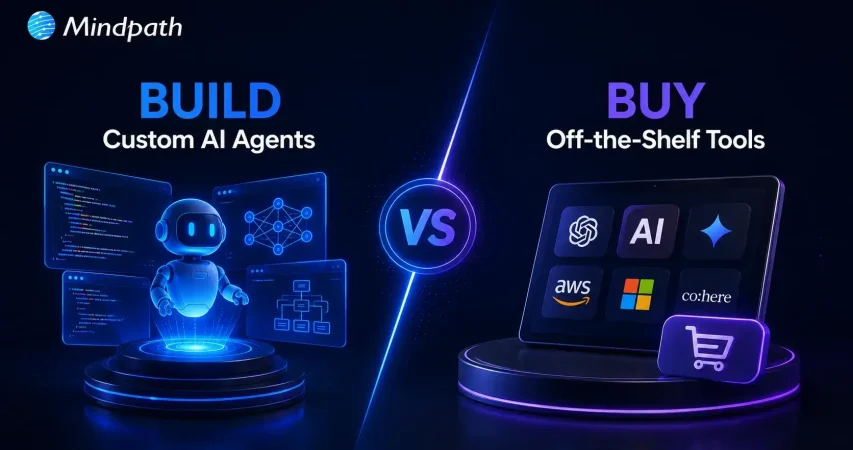
Build vs Buy: Should You Use Off-the-Shelf AI Tools or a Custom AI Agent?  

Build vs Buy: Should You Use Off-the-Shelf AI Tools or a Custom AI Agent?  

Join our Newsletter!

 build vs buy ai

Businesses often begin with AI tools that save time and simplify everyday tasks. But what happens when those tools cannot understand your workflows, access the right data, or support bigger goals? The build vs buy AI decision becomes important when basic AI support no longer drives meaningful business progress.

Key Takeaways

  • 01
    Choose off-the-shelf AI when standard tools meet immediate business needs. 
  • 02
    Build custom AI agents when workflows require deeper automation and control. 
  • 03
    Evaluate data security before sharing sensitive information with external AI platforms. 
  • 04
    Consider integrations when AI must work across core business systems. 
  • 05
    Focus on long-term value, not only initial cost and deployment speed. 

The custom AI agent vs off-the-shelf choice can shape how effectively your business uses AI. One option delivers quick results, while the other can automate complex work across your systems. Seems interesting, doesn’t it? In this blog, we explore which option can unlock greater value for your business. So, let’s keep reading further in detail!

Looking for an AI agent that does more than off-the-shelf tools can offer? At MindPath, we offer AI Agent Development Services to build intelligent solutions tailored to your goals.

What Does Build vs Buy AI Mean? Core Fundamentals

Build vs buy AI describes how a business chooses to access artificial intelligence capabilities.

Building AI means creating a custom AI agent designed around a company’s specific workflows, data, systems, and business goals. The business controls how the solution works, connects it with internal tools, and shapes it to manage unique tasks that ready-made platforms may not support.

Buying AI means choosing ready-to-use AI software or off-the-shelf AI tools from an external provider. These tools offer prebuilt features for common tasks, such as content creation, customer support, transcription, and analysis. Businesses can start using them quickly without building or maintaining the technology themselves.

What Are Off-the-Shelf AI Tools?

Off-the-shelf AI tools are ready-made platforms that businesses can start using without developing AI from scratch. They support common needs through AI chatbots, writing tools, customer support platforms, meeting assistants, and workflow automation tools. While comparing custom AI agent vs off the shelf options, businesses can assess whether standard features meet their operational needs.

Advantages of Businesses Using Off-the-Shelf AI Tools

1. Lower Upfront Costs: Subscription pricing helps businesses adopt AI without major development spending.

2. Faster Deployment: Teams can launch useful AI capabilities quickly and reduce implementation delays.

3. Vendor-Managed Maintenance: Providers handle updates and fixes, reducing pressure on internal IT teams.

4. Easy Team Adoption: Simple interfaces help employees use AI with minimal technical training.

5. Quick Results for Common Tasks: Businesses improve support, content, analytics, and routine workflow efficiency.

Limitations at a Glance

1. Limited Customization: Generic tools may not match unique workflows or business requirements.

2. Data Privacy Risks: External platforms can create security and compliance concerns.

3. Inaccurate Responses: Teams must review outputs for incorrect or fabricated information.

4. IP Concerns: Generated content can raise ownership and copyright issues.

5. Less Differentiation: Common tools can produce similar outputs for competing businesses.

What Is a Custom AI Agent?

A custom AI agent is a goal-focused system built for specific business tasks, workflows, and roles. It can use company data, remember relevant context, connect with business tools, and complete multi-step actions. While comparing build vs buy AI agent options, businesses can assess whether they need basic assistance or tailored automation.

Advantages of Businesses Using Custom AI Agent

1. End-to-End Automation: Agents complete repetitive tasks, reducing manual effort across everyday business workflows.

2. Scalable Operations: Teams handle growing workloads without increasing staff at the same pace.

3. Round-the-Clock Support: Agents respond, monitor, and assist customers beyond standard working hours.

4. Faster Data Insights: Agents analyze information quickly to support smarter, timely business decisions.

5. Personalized Customer Experiences: Context-aware interactions help businesses deliver relevant support and recommendations.

Custom AI Agent vs Off-the-Shelf AI Tools

Choosing between these options depends on how closely AI must support your business operations. The custom AI vs prebuilt AI comparison below highlights the differences in control, cost, integrations, and long-term value.

Comparison Area Custom AI Agent Off-the-Shelf AI Tools
Business Fit Built around your workflows, rules, and industry needs. Designed for common tasks across many businesses.
Deployment Speed Takes longer because teams design and test it. Launches quickly with ready-made features and setup.
Customization Adapts to unique processes, roles, and customer journeys. Offers limited configuration within vendor-defined options.
System Integration Connects deeply with CRMs, databases, and internal platforms. Provides standard connectors for widely used business tools.
Data Control Gives stronger control over data access and governance. Vendor policies determine how data is processed and stored.
Long-Term Value Supports scalable automation and creates business-specific operational advantages. Delivers quick value but may limit growth beyond standard use cases.

When Should You Buy an Off-the-Shelf AI Tool?

  • Your business needs AI for common tasks with clear, standard requirements.
  • Your team needs useful AI capabilities quickly for immediate business priorities.
  • You want to test AI value before making a larger investment.
  • Your workflows do not require deep connections with internal business systems.
  • Standard features can support your processes without extensive customization or development.
  • Your business lacks the technical resources to build and maintain AI internally.

When Should You Build a Custom AI Agent?

  • Your team handles the same complex, time-consuming tasks every day.
  • Your business needs AI to connect multiple systems and data sources.
  • Generic tools cannot understand your specific processes, rules, or terminology.
  • You need stronger control over customer data and internal information.
  • Your workflows involve decisions, approvals, and several connected actions.
  • You want AI to reduce manual effort and improve operational outcomes.

Key Factors to Consider Before Choosing Build vs Buy AI

The question, should I build or buy AI, depends on more than cost or speed. Businesses should assess their goals, workflows, data requirements, and future plans before choosing an approach that delivers practical value today and supports growth over time.

1. Your Business Goals

Explain that companies should first identify whether they need quick productivity support or long-term process automation.

2. Workflow Complexity

Simple tasks may work well with prebuilt AI. Complex workflows may require a custom AI agent.

3. Data Security Needs

Businesses handling customer data, financial data, healthcare records, or confidential internal information may need greater control.

4. Integration Requirements

If AI needs to connect with CRMs, project tools, databases, or support platforms, custom development may be more suitable.

5. Budget and Long-Term Value

Buying may cost less at the beginning, while building can deliver stronger returns when AI supports core operations.

How Do Custom AI Agents Create Long-Term Business Value?

A custom AI agent can deliver greater value when it supports the daily work that drives business growth. Unlike off-the-shelf AI tools, it can connect with internal systems, follow company rules, and automate complex workflows. This makes AI agent development a practical investment for businesses seeking scalable, measurable improvements.

1. Automate repetitive tasks across customer support, sales, operations, and internal teams.

2. Connect CRMs, databases, and platforms to reduce disconnected business processes.

3. Use business data to provide faster insights and support better decisions.

4. Scale automation as customer demand, workloads, and operational complexity grow.

5. Deliver consistent customer experiences using company knowledge and brand guidelines.

6. Reduce manual errors through structured workflows, permissions, and human oversight.

7. Measure value through time savings, faster responses, and improved operational outcomes.

Ready to Choose an AI Solution That Moves Your Business Forward?

Off-the-shelf AI tools can help teams get started quickly, while custom solutions support businesses with complex workflows, connected systems, and growing automation needs. The right choice depends on the value AI can create for your operations today and as your business expands.

At Mindpath, we build intelligent AI solutions that align with your workflows, data, and business goals. Our team helps you move beyond generic tools with scalable AI agent development designed to automate work, connect systems, and deliver measurable business value. Contact us to discuss your requirements and find the right AI approach for your business.
Frequently Asked Questions

When teams repeatedly add manual steps, switch between tools, or cannot connect AI with core systems, a generic tool may no longer meet operational needs.
Yes. Many businesses use prebuilt tools to test use cases, then build custom agents once they identify high-value workflows.
Processes with repeated decisions, multiple steps, large data volumes, or frequent handoffs between systems are strong candidates for custom AI agents.
Track time saved, reduced errors, response speed, task completion rates, operational costs, and improvements in customer or employee experiences.
Businesses should identify the workflow, define expected outcomes, review available data, map required integrations, and set security requirements.

Support Is One Click Away

Featured Posts

Related Post

DevOps
Are you looking for a way to lower your business costs while boosting efficiency? What if you could achieve both by simply improving how your teams collaborate and work together? DevOps offers a powerful approach to streamline operations, automate processes, and eliminate waste—all of which can lead to significant savings. Curious about how DevOps can impact your bottom line? In this blog, we will explore the ways this methodology can transform your business and help you save money in the process.  DevOps is a method that brings together the development (Dev) and IT operations (Ops) teams to collaborate closely and effectively. It entails automating and improving the software development, testing, and deployment processes via the use of methods and tools. The purpose of DevOps is to make the entire process quicker, easier, and more dependable by increasing collaboration and communication among developers and IT workers. DevOps began in 2007 when individuals realized that the conventional style of working, in which developers and IT teams worked independently, was holding down progress. DevOps enables enterprises to produce software faster and with fewer issues by merging the work of both teams. It’s all about working together, automating tasks, and optimizing processes.  So, let’s dive in to explore how DevOps can help save business costs! 

How DevOps Can Help Saving Business Costs

1. Using Cloud Infrastructure

Cloud infrastructure is an effective means to reduce IT expenditures while increasing flexibility and efficiency. Cloud services enable enterprises to scale their resources up or down in real time. Additional resources can be allocated during peak demand periods, while they can be lowered during quieter periods. This guarantees that you only pay for what you use, reducing needless costs and optimizing your budget. Cloud platforms also make processes more efficient by providing automation tools. Tasks like resource management, monitoring, and upgrades can be automated, minimizing the need for human intervention and saving both time and money. Furthermore, the cloud eliminates the need for expensive on-premises infrastructure, resulting in lower maintenance and hardware costs. Businesses that integrate cloud infrastructure into DevOps techniques can save money while also improving efficiency, flexibility, and overall performance. This establishes a solid platform for providing dependable and scalable solutions. 

2. Automating with Infrastructure-as-Code (IaC)

Infrastructure-as-Code (IaC) is a method of managing your IT infrastructure that involves writing it as code, similar to providing precise instructions. Instead of manually configuring servers, databases, or networks, you describe the configurations and dependencies in code, and tools like Terraform or AWS CloudFormation do the rest. This strategy saves time, assures consistency, and allows you to easily replicate or upgrade your infrastructure. With IaC, you can make changes fast, scale resources, and maintain a dependable environment without having to do repeated manual tasks. It also lowers the need for additional documentation, as the code itself is the most accurate and up-to-date reference. To ensure success with IaC, it’s essential to securely configure resources, automate tests to validate the code, and continuously monitor the infrastructure. By adopting IaC as part of your DevOps practices, businesses can simplify infrastructure management, minimize errors, and cut costs through better efficiency and automation. 

3. Optimizing with Containers

Container orchestration makes it easier to manage a large number of containers running on many computers or servers. Containers are self-contained containers that include everything an application needs to function, such as code, libraries, and dependencies. Managing a few containers manually may be possible, but as the number of containers increases, the process gets more complicated. Container orchestration automates this process, ensuring that containers are deployed, scaled, and managed efficiently. It also enables containers to communicate and collaborate easily, eliminating human effort and minimizing mistakes. Kubernetes is a popular container orchestration tool that provides enterprises with a dependable approach to manage large-scale applications. Businesses that use container orchestration may achieve easier operations, improved resource utilization, and cost reductions while preserving application performance. 

4. Streamlining with CI/CD Pipelines

Implementing a Continuous Integration and Continuous Delivery (CI/CD) pipeline is an important DevOps approach that allows firms to save money by automating software development and delivery operations. During the Continuous Integration (CI) phase, developers routinely communicate and integrate code updates into a common repository. Automated systems then test and compile the code to guarantee that everything works properly. This avoids costly complications by identifying problems early in the development phase. CI also saves time on manual integration activities, freeing up resources for other important work. Continuous Delivery (CD) follows CI by automating the deployment of tested code to production or other environments. With solutions like Kubernetes or Docker, the process becomes more frictionless, minimizing delays and the need for manual labor. Automated testing guarantees that only stable and dependable updates are delivered, reducing downtime and mistakes that might result in increased costs. 

DevOps Development Services at Mindpath

At Mindpath, we provide DevOps services that streamline software development and reduce costs. Our team uses cloud infrastructure, automation, and container management to help your business scale efficiently. We automate IT processes with Infrastructure-as-Code (IaC) and manage container orchestration using Kubernetes. Our Continuous Integration and Continuous Delivery (CI/CD) pipelines ensure faster, error-free software delivery. With our DevOps expertise, businesses can improve efficiency, cut costs, and achieve high-quality results with minimal manual effort. 

Final Thought!

Incorporating DevOps into your business processes is a strong method to save costs and increase efficiency. Businesses can reduce operating costs by using cloud infrastructure, automating with Infrastructure-as-Code, optimizing with containers, and simplifying processes with CI/CD pipelines. DevOps not only reduces human work and mistakes, but it also speeds up software delivery and improves team cooperation. Mindpath’s DevOps services are meant to help organizations realise these benefits, allowing them to prosper in a fast-paced, competitive market. By implementing DevOps, you can improve productivity, cut expenses, and provide higher-quality outcomes with less work. 

Ready to optimize your business operations with DevOps?

Partner with Mindpath today to streamline your processes, reduce costs, and achieve high-quality results effortlessly!

Discover how DevOps can save your business costs by improving efficiency, and enhancing collaboration across teams for high-quality delivery.
AI tools for devops

Artificial Intelligence has certainly surfaced as a transformative force in the DevOps realm. In the current times, DevOps teams and professionals have the opportunity to leverage top Artificial Intelligence tools in order to streamline the software development process while promoting resource optimisation. 61% entities have reported that the adoption of AI in DevOps has significantly boosted their delivery ability.

Both novice and experienced DevOps professionals need to familiarise themselves with the strategic role of AI for the DevOps approach. The insight is crucial to capitalise on the capabilities of AI and strengthen how the DevOps approach is adopted while developing software solutions. Let’s identify some of the major AI tools that are revolutionising DevOps at the moment.

Want to adopt AI in DevOps with full potential? Mindpath’s AI Development Services provide full assistance on how you can select and implement the right tool according to your specific requirements.

Best AI Tools for DevOps Teams

Artificial Intelligence has been gaining high prominence in the DevOps arena. Within a short span of time, diverse AI tools have emerged that have simplified the work of DevOps teams. These tools have immense potential to redefine the DevOps approach.

It is imperative to identify the AI tools for DevOps so that you can simplify diverse processes relating to automation, security, code development and many more. Some of the top AI tools for DevOps professionals include:

1. GitHub Copilot

GitHub Copilot is undoubtedly one of the most popular AI tools for DevOps experts that exists today. It can be used as an extremely useful tool that is powered by Artificial Intelligence, which simplifies coding. It is capable of making suggestions to coders. Moreover, it can also assist coders by providing valuable assistance in entire functions. As a result, by leveraging the specific tool in the DevOps landscape, it is possible for developers to write code in an efficient manner. Furthermore, by leveraging the specific tool, the possibility of making errors is substantially reduced. GitHub Copilot represents a significant step toward the future of AI in software development and DevOps workflows.

2. AWS Codeguru

The popularity of Amazon Codeguru has been skyrocketing in recent times. It serves as a perfect tool that DevOps professionals can use for the purpose of automating code analysis. A highlight of this particular artificial intelligence for DevOps is that it is capable of making intelligent recommendations relating to code reviews. Coders and software developers can also rely on the specific tool to gain insightful suggestions relating to the performance of applications. With the help of this top-grade AI tool, DevOps teams can locate issues and improve the quality of their code, and fully leverage the benefits of AI in their development workflows.

3. Datadog

Datadog is a popular AI-driven platform that simplifies the processes for development teams. It is certainly among the top DevOps for business tools that can be used for diverse purposes such as monitoring, security, and performance. This tool offers rich insights to DevOps teams in terms of the behaviour of the software application and the overall health of the infrastructure. It certainly serves as a holistic tool that can offer observability power in an end-to-end manner to DevOps teams. You can definitely capitalise on this tool to achieve goals relating to real-time observability, unified monitoring, and troubleshooting.

4. Splunk

Splunk has gained a solid reputation in the DevOps scene of the current times. It acts as a robust data analytics and monitoring platform that can be used by DevOps teams. By choosing the specific AI-based tool, you can get complete visibility across the full software development lifecycle. In case you have limited familiarity with the particular tool, you can consider partnering with top providers of DevOps services. DevOps teams can leverage Splunk for diverse purposes, including monitoring of performance, event and log monitoring.

5. Sysdig

Sysdig serves as one of the most comprehensive DevOps platforms available for software developers at present. It has been specifically designed for diverse purposes such as monitoring and security in containerised environments. A chief highlight of the tool is that it integrates operations along with top security and offers unified control and visibility to teams. Thus, throughout the software development lifecycle, DevOps professionals can have a solid insight into the process. Moreover, you can rest assured about compliance and monitoring aspects by utilising the tool.

Trying to keep up with the rapidly evolving DevOps landscape as we move into 2026? Explore the latest DevOps trends shaping modern development, automation, and AI-driven workflows.

6. Dynatrace

In the contemporary DevOps landscape, the Dynatrace tool has been playing a cardinal role. It acts as an ideal observability platform that can be leveraged by DevOps teams while developing top-notch software applications. You can take advantage of this app to simplify processes relating to monitoring, collaboration, and automation. Furthermore, Dynatrace offers a broad range of tools that can create value for you relating to resilience engineering, release validation, and automated remediation of problems. The powerful capabilities of the AI tool can empower your DevOps team while developing novel software solutions.

7. Ansible

Ansible is a popular open source automation tool that streamlines DevOps practices for professionals. This tool is primarily used for the purpose of streamlining as well as automating a broad range of IT tasks and processes. It significantly contributes to the DevOps process by focusing on areas such as configuration management, deployment of applications, and the provisioning of infrastructure. Moreover, DevOps teams can leverage the AI-based tool to perform orchestration. This is because Ansible facilitates the orchestration of complex workflows and supports the coordination of multiple tasks.

8. Harness

In the current DevOps realm, Harness has emerged as a holistic software delivery platform., By using the specific tool, your DevOps team can automate the full software development process. Therefore, starting from continuous integration and continuous delivery, you can automate ongoing tracking of errors. Harness has been recognised as one of the most useful tools for DevOps professionals. With the help of the AI tool, your DevOps team can certainly accelerate the software development process and minimize the possibilities of errors and mistakes.

9. Argo CD

In recent times, Argo CD has surfaced as a popular AI tool that can be used by DevOps professionals. It is basically a declarative continuous delivery tool. By using the tool, it is possible for DevOps teams to automate the management as well as the deployment of software apps within Kubernetes clusters. The fact that it is open source in nature enables DevOps teams to use it in a highly versatile and flexible manner. The specific tool offers a broad range of features to users, such as single sign-on integration, multi-cluster management, and many more.

10. Snyk

While adopting the DevOps approach to develop software solutions, one cannot ignore the security aspect. This is when the Snyk tool comes into the picture. Snyk is a developer-first platform that incorporates security elements into the software development process. You can utilize this specific AI tool in your DevOps process for scanning vulnerabilities in code, containers and open-source dependencies. This tool is well-suited for diverse DevOps teams since it perfectly integrates with various elements, such as developer workflow, as well as cloud platforms. You can leverage the tool since it offers actionable insights that can enhance the overall quality of your software solution.

Looking to overcome DevOps hurdles such as security risks, and scalability issues? Discover DevOps challenges and solutions that help organizations overcome these issues and improve operational efficiency.

Benefits of AI Tools in DevOps

The use of AI tools in DevOps processes can give rise to a host of benefits for DevOps teams. Some of the major benefits that you must be aware of include:

1. Better reliability

DevOps teams can leverage AI capabilities to create highly reliable software solutions. This is mainly possible by making use of the predictive analysis function of AI technology.

2. Faster Software creation process

Software development can be quite time-consuming. However, by leveraging AI tools, it is possible to automate diverse processes. It can ultimately speed up the software development process for teams.

3. Proactive resolution of issues

Issues can act as major bottlenecks while developing software applications. With the help of the right AI tools, it is possible for DevOps teams to proactively deal with issues. Therefore, the overall quality of the software solution can also improve.

4. Improved collaboration

By using AI tools or generative AI tools for DevOps, it is possible for professionals to enhance collaboration. Collaboration can certainly open up new and better opportunities that can strengthen the overall process relating to the development of software solutions.

Want to learn how DevOps can transform your business and accelerate your development processes? Discover the benefits of DevOps for a deeper understanding of its impact and value.

Final Words

In the dynamic DevOps arena, the use of artificial intelligence tools is considered to be a necessity. DevOps teams need to be aware of the top tools so that they can strategically use them while creating software solutions. The selection of the right kinds of tools can certainly streamline the software development processes for you. Some of the top tools that you must be aware of include GitHub Copilot, AWS Codeguru, Datadog, Splunk, Sysdig, etc.

We at Mindpath help businesses to make the most of the top AI tools for DevOps with our AI Development Services. Our professionals ensure that the perfect AI tools are chosen that are in line with your DevOps processes. Moreover, you can see how intelligent DevOps can strengthen the quality of your software solutions.

ai product development cost

Funded founders in 2026 face one critical question before everything else. Where exactly does your budget go when building an AI product? Understanding AI product development cost upfront separates smart founders from those who burn runway fast. Getting this right determines whether your product ships or stalls completely.

Key Takeaways

  • 01
    AI product costs are split across build, operations, and long-term ownership phases. 
  • 02
    Hidden costs like model drift and compliance regularly double initial development budgets. 
  • 03
    Data preparation consumes more budget and time than the actual model development. 
  • 04
    Commercial APIs win early stage, while open-source wins at significant scale. 
  • 05
    Talent remains the single largest and most unpredictable line item in AI budgets. 

Every dollar you spend on AI development needs a clear purpose behind it. The real cost to build an AI product depends on decisions made before writing a single line of code. In this blog, we explore real cost breakdowns and provide honest estimates for your budget. So, let’s keep reading further to know more!

Planning to build an AI product within your budget? We offer AI Development Services to develop scalable, cost-effective AI solutions tailored to your business.

Why Are Businesses Investing in AI Products in 2026?

The numbers make it impossible to ignore what is happening right now. Worldwide spending on AI is forecast to reach $2.59 trillion in 2026, a 47% increase year-over-year, according to Gartner. This is not speculative investment in future technology. Businesses are spending real money to solve real problems today.

McKinsey report states that 88% of organizations now report regular AI use in at least one business function, compared to 78% just a year ago. The shift from experimentation to execution is happening faster than most anticipated. Companies sitting on the sidelines are watching their competitors move ahead quickly.

The reason behind this surge is simple. AI products are delivering real outcomes across every major business function. Here is what businesses are actually gaining:

1. Operational efficiency at scale – Repetitive workflows that once consumed entire teams now run on automation.

2. Faster revenue growth – Marketing, sales, and product development are seeing direct revenue impact from AI integration.

3. Reduced operating costs – AI handles high-volume tasks at a fraction of traditional operational costs.

4. Smarter product development – Teams ship faster, iterate quicker, and reach the market ahead of competition.

5. Better customer experiences – Personalization at scale is no longer limited to companies with massive budgets.

AI Product Development Cost: The Real Numbers in 2026

Every AI product is different, and so is every budget behind it. The type of product you build determines everything from your timeline to your total investment. Here is a realistic AI development cost estimate across every major AI product category.

1. Basic AI / API Integration

Cost: $15,000 – $40,000

Timeline: 4 – 8 Weeks

These are proofs of concept or MVPs that connect into pre-trained models like OpenAI or Anthropic APIs with minimal customization. Best suited for smart search, basic AI chat, or simple task automation.

2. AI Chatbots and Virtual Assistants

Cost: $40,000 – $120,000

Timeline: 2 – 4 Months

These products use RAG (Retrieval-Augmented Generation) so the AI references your specific business data. Includes guardrails, observability dashboards, and multi-channel support.

3. Generative AI Applications

Cost: $100,000 – $250,000+

Timeline: 4 – 10 Months

Custom-trained or heavily fine-tuned models built for domain-specific tasks. Think content generation, legal document analysis, or fully autonomous AI agents.

4. Recommendation Systems and Predictive Analytics

Cost: $80,000 – $250,000

Timeline: 3 – 8 Months

Models that analyze large historical datasets to forecast trends or serve real-time recommendations. Common in e-commerce platforms and financial forecasting products.

5. Computer Vision Solutions

Cost: $100,000 – $300,000+

Timeline: 4 – 9 Months

Covers object detection, OCR, and image classification projects. High costs are driven by massive labeled datasets and heavy GPU training infrastructure requirements.

6. Enterprise AI Platforms

Cost: $250,000 – $1M+

Timeline: 6 – 18+ Months

Complex end-to-end AI systems with on-prem or VPC deployment, MLOps data pipelines, multi-tenant security, and compliance requirements like HIPAA or SOC 2.

Hidden Costs of AI Product Development Nobody Talks About

Most teams budget for development and forget everything that comes after. Understanding these blind spots is what separates a sustainable AI app development cost from one that spirals out of control.

1. Compounding Compute and API Fees

AI has no fixed server cost like traditional software does. Every token, user interaction, and agent loop adds to your monthly bill permanently.

2. The Data Engineering Iceberg

A working model in a notebook is never a finished product. Data cleaning, labeling, and legacy system integrations consume far more budget than most teams anticipate.

3. Model Drift and Continuous Retraining

AI models degrade over time as real-world conditions shift around them. Keeping your model accurate requires a recurring annual budget that most initial plans never account for.

4. The AI-Assisted Coding Trap

Tools like Cursor or GitHub Copilot feel faster but introduce invisible technical debt. Developers spend significant time reviewing logic errors and fixing architectural decay caused by AI-generated code.

5. The Expertise Void

AI absorbs entry-level work and quietly removes junior learning opportunities over time. This creates a long-term dependency on expensive senior engineers to correct AI-generated output.

6. Compliance, Security, and Governance

Every AI system you build expands your security attack surface significantly. The real cost to build an AI product always includes security costs that your initial budget never planned for.

The 5 Core Cost Buckets of AI Product Development

Answering how much does it cost to build an AI product starts with knowing where the money actually goes. Most budgets go wrong because teams treat AI development like traditional software development. It is not the same, and these five buckets prove exactly why.

1. AI Model and API Costs

This is where most teams start, but rarely where most money goes. Choosing between open-source models and commercial APIs directly shapes your monthly spending from day one.

2. Data Acquisition and Preparation

Clean, labeled, and structured data is what separates a working product from an expensive experiment. Poor data quality forces costly rework before a single feature reaches production.

3. Infrastructure and Cloud Compute

Every model you run, every inference you serve, and every user request processed adds to this number. Infrastructure costs grow silently and hit hardest when your product starts scaling.

4. Engineering and AI Talent

Specialized AI engineers, data scientists, and MLOps professionals remain expensive and difficult to hire. Talent consistently becomes the single largest line item on most AI development budgets.

5. Deployment, Maintenance, and Compliance

Shipping the product is not the finish line. Ongoing maintenance, security patching, and compliance requirements in regulated industries add significant costs long after launch.

Full-Spectrum AI Product Development Cost at a Glance

One number never tells the full story in AI development. The AI product development cost splits across three distinct phases that most initial quotes completely ignore. Here is every cost layer mapped clearly across build, operations, and long-term ownership.

Cost Layer Cost Category Estimated Cost (USD)
Build Phase Architecture & Solution Design $10,000 – $50,000
AI Engineering & Development $30,000 – $500,000+
Data Preparation & Labeling $10,000 – $100,000+
Third-Party Integrations $5,000 – $30,000 per integration
Operations Phase Cloud Compute & Model Inference $2,000 – $20,000+/month
MLOps & Monitoring $10,000 – $50,000
Security & Compliance Audits $8,000 – $30,000 per assessment
Regulated Industry Premium +20% – 50% of total project cost
Long-Term Ownership Annual Model Retraining 15% – 25% of initial build cost/year
Maintenance & Support 10% – 25% of initial build cost/year
AI Talent Replacement Cost $80,000 – $200,000 per senior AI hire
Change Management & Training $10,000 – $30,000+

Ready to Build Your AI Product Without Blowing Your Budget?

The real AI development cost goes far beyond what any single quote will show you. Every phase, from build to maintenance, carries weight that compounds over time. Planning each layer correctly from day one is what keeps your product on track.

The true cost to build an AI product becomes predictable when you have the right partner driving every decision. At Mindpath, we deliver end-to-end AI development and SaaS development services that turn your vision into a scalable, production-ready product without surprise costs along the way.

Frequently Asked Questions