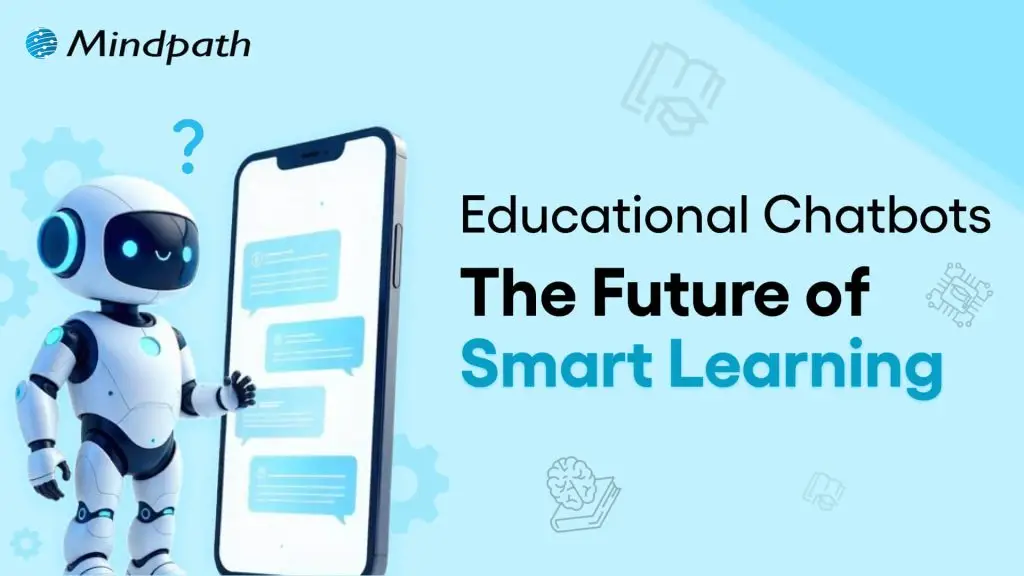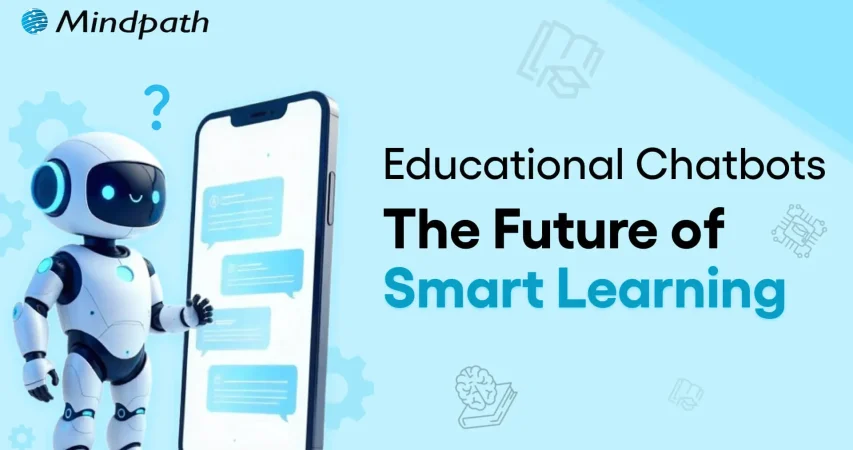
Educational Chatbots: How AI is Transforming the Learning Experience 

Join our Newsletter!

Featured Posts

Support Is One Click Away

Home

Educational Chatbots: How AI is Transforming the Learning Experience 

educational chatbots

Educational Chatbots: How AI is Transforming the Learning Experience 

The radical transformation of the education sector is clearly visible in how classrooms have changed along with the approaches for teaching. With the arrival of solutions like educational chatbots, the education landscape is shifting gradually towards innovative approaches. You can rely on the conversational AI tools to get a completely new perspective on education. Learners can get personalized and engaging experiences, while educators can use AI chatbots to reduce their administrative burden.

In addition, chatbots can assist in providing instant feedback, guiding students through complex concepts, and supporting collaborative learning even outside the classroom. They also help institutions manage routine queries and streamline processes, giving teachers more time to focus on teaching. Let us learn more about the impact of AI chatbots on the learning experience. Let us learn more about the impact of AI chatbots on the learning experience.

Looking to enhance customer engagement with a personalized AI solution? At Mindpath, we offer custom chatbot development services that combine advanced AI with seamless system integration.

Significance of Chatbots in Education

The primary design of chatbots in the domain of education focuses on conversational AI that can interact with students, educators and administrators. The most important highlight of such chatbots is that they learn from interactions with students and understand context better to provide relevant responses. Chatbots work as a learning bot which can answer your simple queries as well as complex questions from subjects in your curriculum. The integration of chatbots in different use cases in education has showcased proof of their transformative potential.

You can understand the importance of chatbots in education from the list of benefits they have to offer. The true capabilities of chatbots focus on personalizing the learning experience by providing personalized content and recommended resources for each student. Educators can also achieve better student engagement with chatbots alongside addressing the challenges in administrative processes. It is important to note that almost 75% of educators acknowledge the potential of AI to transform learning through chatbots and other solutions.

Unraveling the Utility of Chatbots for Education

The education industry faces multiple challenges ranging from overcrowded classrooms to shortages of teaching staff and changes in learning preferences. The combination of artificial intelligence and education can serve the most effective solutions to these challenges. Chatbots powered by artificial intelligence are the best examples of using AI to revolutionize education. You must know that chatbots are no longer the traditional bots that used a predefined set of rules to provide answers.

Chatbots have become sophisticated AI partners who can adapt to diverse learning styles, offer instant feedback, and stoke the curiosity of learners. The following sections can help you understand how chatbots are the next big thing for the education industry.

Wondering how chatbots create measurable value beyond just answering student queries? Discover the powerful advantages outlined in our guide on the benefits of chatbots and see how they drive engagement and efficiency.

1. No More One-Size-Fits-All Learning

The most noticeable advantage of any educational chatbot app or platform is the assurance of personalized learning. Traditional classrooms had to face the biggest problem in catering to the learning needs of each student. Teacher could not create lessons that could align with the learning style, pace and knowledge of all students. AI chatbots can serve as your personalized tutor and offer multiple benefits that build a new perspective on the learning experience of students.

Chatbots can adapt to every learner and make changes in the depth, difficulty and description of concepts in lesson content. If students experience troubles in understanding specific topics, then chatbots can provide additional explanations. Chatbots will ensure that no one in the classroom is left behind in the learning journey. AI chatbots analyze their interactions with learners to discover their strengths and weaknesses.

Another distinctive reason to trust the use of AI in education through chatbots is the ability to cater to diverse learning styles. For instance, some learners may learn better from diagrams and videos while others may benefit from speech synthesis or interactive simulations. Multilingual students can rely on chatbots with NLP capabilities to break down language barriers in education.

2. Learning outside the Classroom

The conventional viewpoint on education paints the classroom as the place where you do all the learning. Interestingly, no one ever bothered to emphasize the fact that most of the learning in the life of a person happens outside the classroom. Teachers have their limits and educational institutions cannot function beyond a specific time. The applications of AI in education make learning outside the classroom a more exciting experience.

Let us assume that a learner comes across an important question at midnight while studying for an exam. Chatbots can help in finding the most relevant answer to the question with detailed explanations. As a result, learners in different time zones or with other responsibilities can learn whenever they want. Learners can also rely on chatbots as smart assistants for help with their homework.

AI chatbot can not only help students with their homework but also streamline administrative processes. It plays a crucial role in empowering the administrative staff to focus on more complex issues. The impact of chatbots outside the classroom can open more prospects to improve the learning experience of every student.

Must Read: Conversational AI Chatbots

3. Fostering Student Engagement

The next prominent aspect that proves the utility of edbot AI solutions is their ability to encourage student engagement. Imagine the level of frustration students have to go through as they sit for endless hours through boring lectures. How far could a student go with the habit of rote memorization? Chatbots in the field of education can solve this problem by ensuring interactive and dynamic learning experiences.

You should know that most of the chatbots use gamification elements such as interactive quizzes, points, leaderboards and badges. It will ensure that learning will become an adventure for every student and encourage them to participate actively in the lessons. The interactive dialogue with chatbots will also encourage student to ask questions and think differently rather than just receiving information.

The impact of AI chatbots on student engagement is also visible in the advantages of simulations. Chatbots can create immersive simulations that boost student engagement in different disciplines. For instance, medicine students can practice diagnosis of virtual patients while engineering students can repair virtual machines. The risk-free environment not only fosters skill development but also promotes student engagement.

4. Serving as Teammates of Teachers

Educators have the biggest responsibility in the world as they nurture young minds who would build the world’s future. The consistent evolution of education trends has created significant challenges for educators in different educational contexts. Whether it is a school or a college, teachers have been experiencing various limitations that affect their efficiency and productivity. Chatbots can solve most of the challenges for educators through automation of routine tasks such as grading assignments.

Teachers can use AI chatbots for creating personalized lesson plans and content for learning materials. The most notable education chatbots examples such as Duolingo or Gradescope indicate how chatbots make the work of teachers a lot easier. As a matter of fact, educators can bookmark specific content on the internet with chatbots and save the valuable time of learners.

Educators can also use chatbots to obtain detailed insights on student performance through data on engagement patterns and difficulty. Teachers can rely on the insights to find out individual student needs and customize their teaching approaches accordingly.

Want to ensure your AI-powered learning tools also contribute directly to student acquisition? Explore the benefits of implementing a lead generation chatbot for better conversion results.

Ready to Transform Learning with AI Chatbots?

The adoption of a chatbot in education institutions can bring a wide range of benefits for students, educators and the institution itself. Chatbots are the most innovative solutions to the biggest challenges in education, such as lack of teaching staff, administrative overheads and student disengagement. While most people believe that chatbots could work only as an AI teaching assistant, they have diverse functionalities. You must know how AI chatbots personalize the learning experience of student and enable automated grading of student assignments.

At Mindpath, we provide AI development services to help institutions design and implement intelligent chatbots tailored to their unique educational needs. Our chatbot solution enable students to learn anytime, anywhere, with personalized support that adapts to each learner’s pace and style. They also help educators reduce administrative tasks, engage students more effectively, and focus on teaching. So, partner with Mindpath today to transform the learning experience for both students and teachers.
Related Post

Discover how is generative AI changing creative work by boosting efficiency and making tools more accessible for all creators.

Related Post

Hiring the proper ReactJS developer in California is essential to developing a high-quality, scalable application. In today’s competitive technology industry, it is important to properly examine prospects. Several aspects impact the success of your project, including technical knowledge and communication abilities. Taking these important factors into account will assist you in finding a developer who fulfils your company requirements and assures seamless development.

1. Competitive Salary

California is home to some of the most prominent technology organizations, making it a very competitive employment market for ReactJS developers. To recruit and retain top people, competitive compensation is required. Developers with extensive experience in ReactJS, state management libraries like Redux, and current frameworks sometimes command higher wages owing to demand. Salaries vary according to experience, location in California, and the intricacy of the work. Junior developers may have lower wage expectations, but mid-level and senior developers with demonstrated skill expect higher pay. Keeping up with industry wage trends ensures that your offer remains competitive. In addition to competitive base pay, performance-based incentives, bonuses, and stock options can help make your employment offer stand out. Providing a well-structured remuneration package will enhance your chances of securing skilled ReactJS developers who can contribute effectively to your project’s success.

2. Benefits Package

A solid benefits package is essential for recruiting and retaining ReactJS employees in California, in addition to a competitive wage. With the growing cost of living, developers prioritize advantages such as complete health insurance, dental and vision care, and mental health services. These bonuses improve work satisfaction and general well-being. Retirement programs, such as employer-matched 401(k) contributions, enhance the long-term value of your offer. Paid time off, parental leave, and wellness initiatives all help to promote a healthy work-life balance, making your organization more desirable to developers looking for stability. Other incentives, such as learning and development opportunities, conference sponsorships, and home office stipends, might help your employment offer stand out. Offering remote work permits, commuting advantages, or gym memberships boosts employee happiness. A well-rounded benefits package doesn’t just attract top ReactJS developers but also helps with long-term retention, ensuring your project has the stability and expertise needed for success.

3. Remote Work Flexibility

The need for flexibility has increased, and many experienced ReactJS developers in California choose remote work arrangements. Being open to employing remote developers inside the state helps you to tap into a larger talent pool without being constrained to a single area, such as San Francisco or Los Angeles. Employers and developers benefit from the flexibility that remote work provides. It helps businesses save money on office space while allowing developers to work in a pleasant, distraction-free environment. Offering hybrid or entirely remote positions might attract highly skilled individuals who might be unwilling to relocate. Invest in communication technologies like Slack and Zoom, as well as project management systems like Jira and Trello, to guarantee remote collaboration is efficient. Setting clear expectations for deliverables, meetings, and deadlines can assist in sustaining productivity. By embracing remote work flexibility, you can hire top ReactJS talent across California, improving the chances of securing developers with the right skills and expertise for your project.

Finding the right ReactJS developer requires competitive salaries, strong benefits, and flexible work options. At Mindpath, we connect you with top ReactJS talent in California, ensuring the perfect fit for your project.

Get expert developers who deliver high-performance, scalable applications. contact Mindpath today! to build your ReactJS team with confidence!

Discover the ultimate guide to hiring Node.js developers in London. Learn about the skills, benefits, and cost factors involved in finding the right talent for your project.
Openai fine tuning api tutorial

In current times of generative AI, prompt engineering is not sufficient to address the requirements of advanced applications. There is a need among content strategists, developers and product teams to have models that can be used to analyze domain-specific language and provide a uniform output. And that is where OpenAI’s fine-tuning tutorial comes in to guide developers through the complicated process of training various models. From healthcare to legal tech, fine-tuning has enabled customization of pre-trained models, opening new opportunities in AI-powered solutions. This blog will allow you to know more via a simple OpenAI fine-tuning API tutorial, as well as some OpenAI fine-tuning examples. We will also talk about why it is crucial for developers. 

Ready to use customised AI models that align precisely with your business data, goals, and customer expectations? Mindpath’s AI development services provide end-to-end solutions from design to deployment.

OpenAI’s Fine-Tuning – What is It All About?

Let’s begin this OpenAI fine-tuning API tutorial by understanding the basics, i.e, what OpenAI fine-tuning is. 

OpenAI models such as ChatGPT are trained on huge web-scale datasets. These are designed to perform across different domains. However, when it comes to handling specialized use cases, for example, technical support, expert reasoning, or legal context analysis, these models need more targeted control. OpenAI fine-tuning API for developers has made it possible. It enables developers to train base models using task-specific datasets. This, in turn, assists models in acquiring new skills and behavior, based on the needs of the business. Regardless of whether you are building a personalized chatbot, advanced summarization systems, or scaling content generation, fine-tuning provides you with accuracy, performance, and control.

Must Read: Low-Rank Adaptation (LoRA) 

Importance of OpenAI Fine-tuning for Developers

The OpenAI fine-tuning API tutorial focuses on the crucial nature of AI model fine-tuning. Fine-tuning ChatGPT is an essential strategy for developers aiming to create custom AI solutions. By customizing models, they make those models offer more consistent and smarter outputs. The following are a few points that explain why fine-tuning is a necessity for every developer.

1. Better Relevance and Accuracy

For all domain-specific queries, fine-tuned models will perform better compared to generic models. They will offer more contextually relevant and accurate responses.

2. Reduced Cost and Latency

Fine-tuned OpenAI models are more efficient. How? Well, they can attain better results with fewer prompts, lowering token usage. Besides, it leads to a faster response time. 

3. Consistent Communication Style and Tone

Wouldn’t it be great if your AI model could speak just like your brand? You can make that a possibility with fine-tuning. You will be able to train the model with specific style, vocabulary and voice such that the outputs match the brand identity.

4. Enhanced Format Handling

If your application demands outputs in a specific reporting format or JSON structure, fine-tuning ensures the model follows those requirements. 

5. Robust Safety and Control

By training your AI models on domain-safe and curated data, you can reinforce desired behaviour. This, in turn, will significantly reduce the risk of harmful or off-brand responses. 

6. Unlocking New Opportunities

Fine-tuning OpenAI models can be used for multiple applications. Developers can train models to manage tasks, prioritizing expertise and specific interaction styles. 

Curious about the concepts that make AI models like OpenAI’s so powerful? Explore the attention mechanism explained, which shows how attention transforms the way models understand and generate data.

OpenAI Models Developers Can Fine-Tune for Custom Tasks

As described in this OpenAI fine-tuning API tutorial, the fine-tuning API allows developers to fine-tune various advanced models, increasing their capabilities. Now, let’s have a look at the OpenAI models that can be fine-tuned for specialized applications. 

1. GPT-3.5

Undoubtedly, GPT 3.5 is a top choice among developers. Some major reasons behind this popularity are cost-effectiveness and low latency. Fine-tuning this model allows developers to reduce the complexity and increase consistency. Product recommendation guides, FAQ bots and customer service automation are some of the common uses of GPT 3.5.

2. GPT-4o

This is OpenAI’s flagship multimodal model. It can process images, audio, videos, and text. This model offers users advanced customization features without losing speed and efficiency. It can be optimized by the developers for domain-specific tasks that demand enhanced textual as well as visual comprehension. Financial document analysis and advanced customer support bots are some common OpenAI fine-tuning examples centered on GPT-4o.

3. GPT- 4.1

This OpenAI model is created to handle multi-step tasks, structured problem-solving and extensive reasoning. It is a perfect option for complicated processes. Fine-tuning this model allows developers to introduce the tools capable of adhering to the domain-specific formats, which makes them a great choice in case of technical planning or automating research.

4. O-Series Models

O-series models are based on GPT-4o and are optimized for efficiency and performance. You can use these models for tasks where GPT-4o’s functionality may be excessive. These models can be fine-tuned to be cost-effective and scaled to a large extent without reducing their accuracy. They come in handy with several industry-specific applications in sectors like SaaS, legal tech, and healthcare.

Wondering how large language models work behind the scenes? Explore the Large Language Model (LLM) detailed guide to discover the foundations of AI that make fine-tuning possible.

Tips to Use Open-AI Fine-Tuning API Effectively

The OpenAI fine-tuning API tutorial can provide useful information on the optimization methods of AI models. These practices can improve mode reliability if utilized in the right manner. Here are some best practices to consider for effective fine-tuning.

1. Data Quality

It’s obvious! The AI models will not be capable of providing precise results without clear, well-constructed, and relevant datasets.

2. Right Model

As mentioned above, only a few OpenAI models can be fine-tuned. For instance, GPT-3.5 or GPT-4o.

3. Tune Hyperparameters

Experiment with batch sizes, training cycles, and learning rates. This will help you find the right configuration. 

4. Evaluate Regularly

Properly monitor progress, identify overfitting, and optimize the training approach. 

By focusing on all these factors, developers can fine-tune OpenAI models with confidence. This is the foundation for fine-tuning ChatGPT or other models for tailored applications that can offer precise results.  

Want to know how fine-tuned AI models can improve business decisions? Explore AI in decision-making to discover how intelligence-driven insights optimize strategy and operations.

When to Fine-Tune vs When to Use Prompt Engineering?

This is a common question that most developers would ask when learning OpenAI fine-tuning API concepts. After all, choosing between prompt engineering and fine-tuning is a vital decision for every developer creating AI-powered tools. Let’s break it down. 

Begin With Prompt Engineering

Well, for most use cases, prompt engineering can be an ideal option. A well-developed system prompt, combined with clear instructions and examples, can enable a generic AI model to perform efficiently. In fact, they can attain around 80 to 90 percent task accuracy. Moreover, prompt engineering is cost-effective, fast, and there is no need to maintain a custom model for it. It is also ideal for low-volume tasks and prototyping.

Scenarios Where Fine-Tuning Actually Makes Sense

Based on this OpenAI fine-tuning API tutorial, we can state that in cases where you need to be more consistent and in control, fine-tuning makes a great choice. You can consider it when:

  • You want a consistent style and tone format in communications.
  • You wish to decrease the cost of the API.
  • The existing model offers irrelevant output that can be resolved through curated examples. 
  • You want to enhance the AI model’s ability to accurately process complex instructions. 

Fine-tuning is a major investment. It requires time for accurate data preparation and training costs. However, the long-term results are really impressive. Wondering how? Well, when you learn fine-tuning API methods, you can easily unlock the ability to boost the model’s efficiency, reliability, as well as performance.

Looking to understand where AI is headed next? Discover generative AI trends to explore emerging applications and practical use cases of intelligent systems.

Custom AI: The Future We Will Witness Soon

OpenAI’s fine-tuning API clearly shows a significant leap in making modern AI models bespoke and adaptable. It offers developers who want to go beyond what general AI does the means to add specific domain experience, brand voice, and intelligence to the models. This OpenAI fine-tuning API tutorial proves that it will unlock the next generation of custom AI models.

If you want to join the trend and enhance your business’s functionality with custom AI solutions, you can always count on Mindpath. We provide AI development services that help organizations develop as well as fine-tune their AI foundation models. Our team helps you align AI models with your workflows and domain-specific data. Partner with us today and build a custom AI solution to support your business growth. 

AI in Education
Have you ever wondered about how AI is revolutionizing education? How can AI make lessons more personalized for each student? What can be the benefits of implementing AI in education? If you are intrigued by these questions, you have arrived at the right place. In this blog, we are going to explore the key benefits as well as the use cases of AI in education.   The education system has changed from the traditional classroom setup. We are no longer limited to a physical room full of books and a blackboard to learn. Nowadays, education is easily accessible and flexible, with personalization at the tip of our fingers as AI is changing the education sector by offering tailored, adaptive learning experiences. It is making learning inclusive, supporting teachers in their tasks, and personalizing learning for everyone. This technology is going to turn conventional models of education and offer more personalized support to students in accordance with their needs, learning styles, and abilities.   Let us dive deep to explore the key benefits as well as the use cases of Artificial Intelligence in education! 

Benefits of AI in Education

1. Customized Learning

The greatest advantage of AI in education is that it offers personalized learning. With AI, learning becomes much more likely to be tailored to each student’s needs. If one student is weak in reading, AI can provide extra support by way of practice and activities. At the same time, another student who excels in reading can be given more challenging materials to engage their interest. This way, each student is presented with material that suits their levels best, making their work more effective and enjoyable. 

2. Expanded Accessibility and Inclusion

AI is overcoming distance and physical limitations in education. Students in remote places or with physical constraints may now access high-quality educational resources using AI-powered solutions such as virtual instructors, interactive course materials, and language translation services. This technology contributes to a more inclusive educational environment in which all students, regardless of location, have equal opportunities to learn and develop. 

3. Adaptive Assessments and Feedback

AI improves evaluations by employing exams, assignments, and even analyzing pupils’ facial expressions or posture to measure their development. This enables rapid feedback, indicating exactly where a learner requires further assistance and giving resources that will help them understand. This strategy not only improves academic achievement, but it also promotes students’ general well-being and trust regarding their learning journey. 

4. Streamlined Administrative Tasks

AI is excellent at both creating personalized teaching and performing administrative work. It can handle student information, organize lessons, and grade multiple-choice tests. This automation allows teachers to devote more time to what is most important: crafting interesting classes, developing strong connections with students, and providing useful feedback. 

5. Enhanced Student Engagement

AI is altering student engagement by offering fascinating new ways to study. Gamification, interactive simulations, and personalized learning plans provide students with dynamic educational experiences. Tools such as interactive classrooms and immersive platforms make learning more fun, allowing students to engage with one another and enthusiastically explore new topics. 

Use-cases of AI in Education

1. Advanced Tutoring Systems

Tutoring programs driven by AI provide pupils individualized support. As students work in classes, AI examines their responses, identifies areas where they may be suffering, and provides personalized explanations to make things simpler. This manner, the learning tempo is tailored to each student’s needs. These systems improve students’ understanding of difficult topics by providing rapid support and a learning style that is tailored to each learner. The continual contact with AI improves learning outcomes and raises students’ confidence and performance. 

2. Automated Grading and Evaluation

Grading is made easier by artificial intelligence, which evaluates student work rapidly and uniformly. This minimizes instructors’ burden, allowing them to focus on providing personalized help. By detecting patterns in pupil performance, AI can identify individuals who require further support and direct focused assistance. Additionally, AI delivers quick feedback, which improves the learning process. Automated grading and assessment improve teaching quality, assure fair assessments, and foster interaction among students and teachers. 

3. AI-Powered Chatbots and Assistants

AI-powered chatbots and virtual assistants play an important role in improving students’ educational experiences. They offer immediate assistance by walking students through assignments, answering problems, and providing comments. These resources are available 24 hours a day, seven days a week, and satisfy the demands of students at any time. Their personalized guidance promotes autonomous learning and helps students actively participate in their studies, hence enhancing academic progress and achievement. 

4. Educational Entertainment and Gamification

Edutainment and gamification make learning more enjoyable and engaging by incorporating artificial intelligence. By developing instructional games and simulations, AI transforms standard teachings into interactive experiences. Including game aspects such as prizes and competitiveness keeps students interested and engaged in their study. These gamified technologies not only capture students’ interest, but they also help them grasp and recall complicated concepts better. AI-driven edutainment and gamification mix education and entertainment to create a dynamic learning environment with thrilling gaming and interactive challenges. 

5. Interactive and Educational Games

Artificial intelligence improves interactive and educational games by providing interesting learning experiences. These games integrate AI algorithms, natural language processing, and machine learning to create interesting tales, react to player activities, and provide personalized insights. This technique encourages students to become more interested, creative, and deliberate in their learning. AI-powered learning systems use challenges, simulations, and virtual worlds to encourage active learning, improve problem-solving abilities, and foster collaboration among students. 

6. Smart Curriculum Planning

AI helps with creating curriculum by analyzing educational data to identify patterns or weaknesses in student learning. It can propose curriculum modifications and revisions based on current research and new standards of learning. AI may also assist in matching curricula with specific goals for learning, keeping the information relevant and up to date. This enhances curriculum design efficiency, allowing educators to make informed decisions and make better use of resources, ultimately improving educational quality and relevance. 

Mindpath’s AI Development Services for Education

AI development services at Mindpath are changing the face of learning in educational institutions with advanced technology. We utilize sophisticated algorithms and machine learning techniques in providing smart solutions for enhancing learning and process streamlining in education.  Our Predictive Analytics service examines educational data to forecast trends, identify learning gaps, and provide actionable insights, helping educators and institutions make better decisions. We apply machine learning to enable personalized, dynamic learning processes attuned to the needs of each student, increasing engagement and performance.  We have data-driven insights that provide detailed analysis and support for curriculum planning, progress monitoring of students, and optimal structuring of teaching strategies. Our automation solutions will make administrative tasks related to grading and scheduling easier, freeing educators to teach and engage with students more. 

Wrapping-Up

AI is revolutionizing the learning process with in-depth, personalized, and truly innovative experiences. From personalized lesson plans and adaptive feedback—reducing administrative burden—to interactive educational games, AI finds ways to make the learning process more efficient and accessible. These developments do not clearly indicate how students will learn better but arm educators with more focused support and lively classrooms. 

Mindpath is on the cutting edge of this revolution in education. Our AI development services enable powerful new levels of personalization in learning, the automation of administrative tasks, and insight-driven solutions. We empower institutions of education to make use of AI for better learning outcomes, teaching strategies, and, in fact, the educational environment. 

Curious how AI can revolutionize your classroom?

Explore Mindpath’s cutting-edge AI solutions and transform your educational experience today.