10 Real-Life Examples of AI Chatbots That Increased Conversions 

Join our Newsletter!

Featured Posts

Support Is One Click Away

Home

10 Real-Life Examples of AI Chatbots That Increased Conversions 

Chatbot examples

10 Real-Life Examples of AI Chatbots That Increased Conversions 

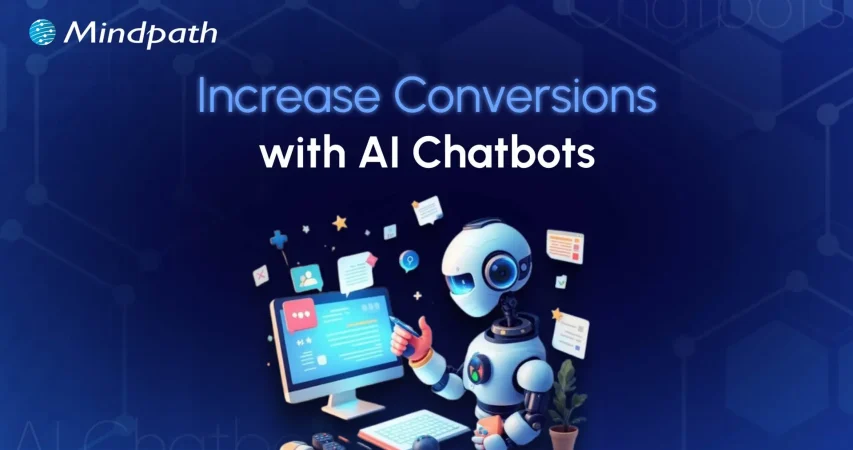
AI chatbots are molding the future of customer engagement in 2026 by providing accuracy and efficacy. The real-life chatbot examples demonstrate how intelligent systems analyze user interactions, offer relevant and timely recommendations, and aid in decision-making as it unfolds. Organizations that are leveraging these types of solutions notice concrete results in user satisfaction and conversions. This clearly shows that AI chatbot assistants can convert complex customer journeys into simple, actionable experiences.

These examples of chatbots have also shown us the benefits of predictive insights and targeted communication. When brands effectively leverage AI chatbots, they minimize friction in their customer journey, maximize retention, and achieve measurable growth. By looking at these real-life use cases, we can evaluate the strategies we can adopt to improve digital experiences and obtain better data-driven results. So, keep reading this blog as we are going to showcase real-life examples of AI chatbots that have aided businesses in increasing conversion.

Want to engage your audience, provide instant support, or personalize their experience? At Mindapth, our custom chatbot development services are designed to deliver solutions that match your business requirements.

Market Demand of AI Chatbots

According to Fortune Business Insights, the global AI chatbot market is growing rapidly, from USD 9.90 billion in 2026 to USD 65.94 billion by 2032, a CAGR of 31.1%. Customer demand for instant service, cost savings through automation, advances in NLP, wider industry adoption, and the rise of generative AI with human-like conversations are driving this growth.

These important figures illustrate the strong market demand: Outgrow says that sales through chatbots are up 67%, Tidio states that 62% of users prefer to chat rather than wait for a human agent, Master of Code says 26% of sales transactions begin with a bot, and 35% of leaders said that they closed sales because of digital assistants. Outgrow also states that 57% of businesses have seen better ROI, and that 45% of businesses have seen reduced response time through chatbots. Looking at these numbers, it shows that AI chatbot examples are demonstrating how businesses can become more efficient, collaborative, and create greater sales.

Also Read: Benefits of Chatbots

How AI Chatbots Increase Conversions?

Do chatbots really increase conversions? Businesses worldwide are beginning to embrace AI chatbots to transform customer experiences and make them smoother, faster, and more personalized. Here are the insights that demonstrate that chatbots are very much influencing conversions.
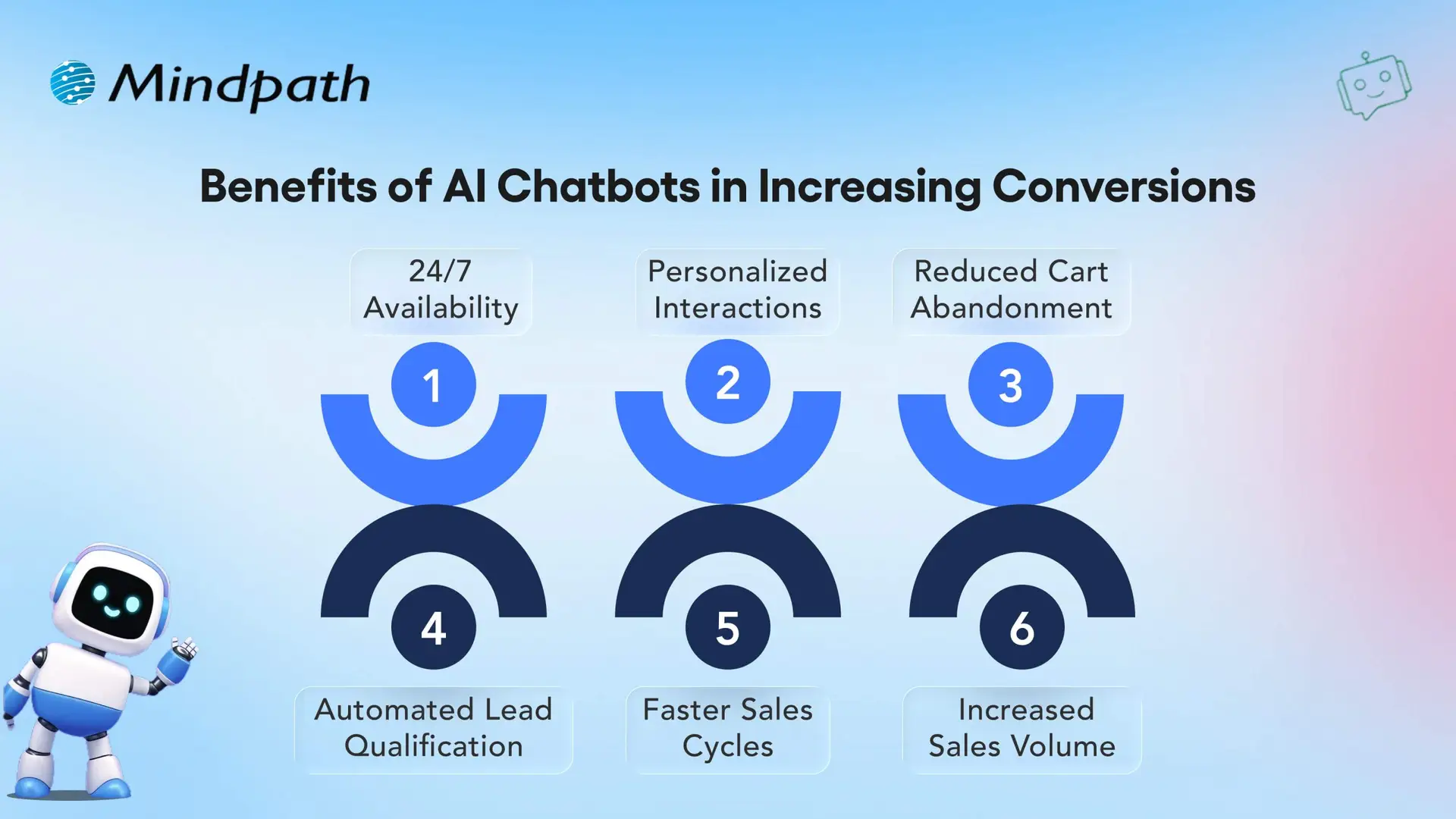
Benefits of AI Chatbots in Increasing Conversions

1. 24/7 Availability

AI chatbots are always-on and provide 24/7 access for customers to quickly find answers for whoever, whenever they want assistance. Being constantly available keeps customers engaged and increases the likelihood of execution of a purchase.

2. Personalized Interactions

Real-world Chatbot examples illustrate how AI reads customer engagement data to provide personalized recommendations, product suggestions, etc. This personalization creates more meaningful conversations and promotes higher conversion rates.

3. Reduced Cart Abandonment

AI chatbots minimize cart abandonment by helping consumers through checkout and by answering last-minute questions. This kind of assistance is simple, but improves selling and makes customers feel good about purchasing.

Also Read: AI for Customer Service

4. Automated Lead Qualification

Chatbot applications can qualify leads with the right questions and key details. The sales team will not have to waste time with any unqualified prospects.

5. Faster Sales Cycles

Utilizing conversational AI for business growth by speeding up the sales process, provides immediate support and follow-ups to customers. The quickness is what allows businesses to turn a lead into a customer quickly and effectively.

6. Increased Sales Volume

Successful chatbot examples illustrate how AI recommends products, engages customers, and inspires repeat purchases. These real-world examples show businesses can also drive revenues while lower acquisition costs.

Want to reduce operational costs while improving customer engagement? Discover how conversational AI chatbots streamline business operations and drive efficiency across teams.

10 Real-life Examples of AI Chatbots

Real-life examples of artificial intelligence chatbots highlight how companies are using artificial intelligence (AI) to innovate the way that organizations interact with potential and current customers. More and more companies are turning to chatbots for lead generation and conversions, thus effectively proving their worth as tools for enhancing sales and ultimately customer experience.
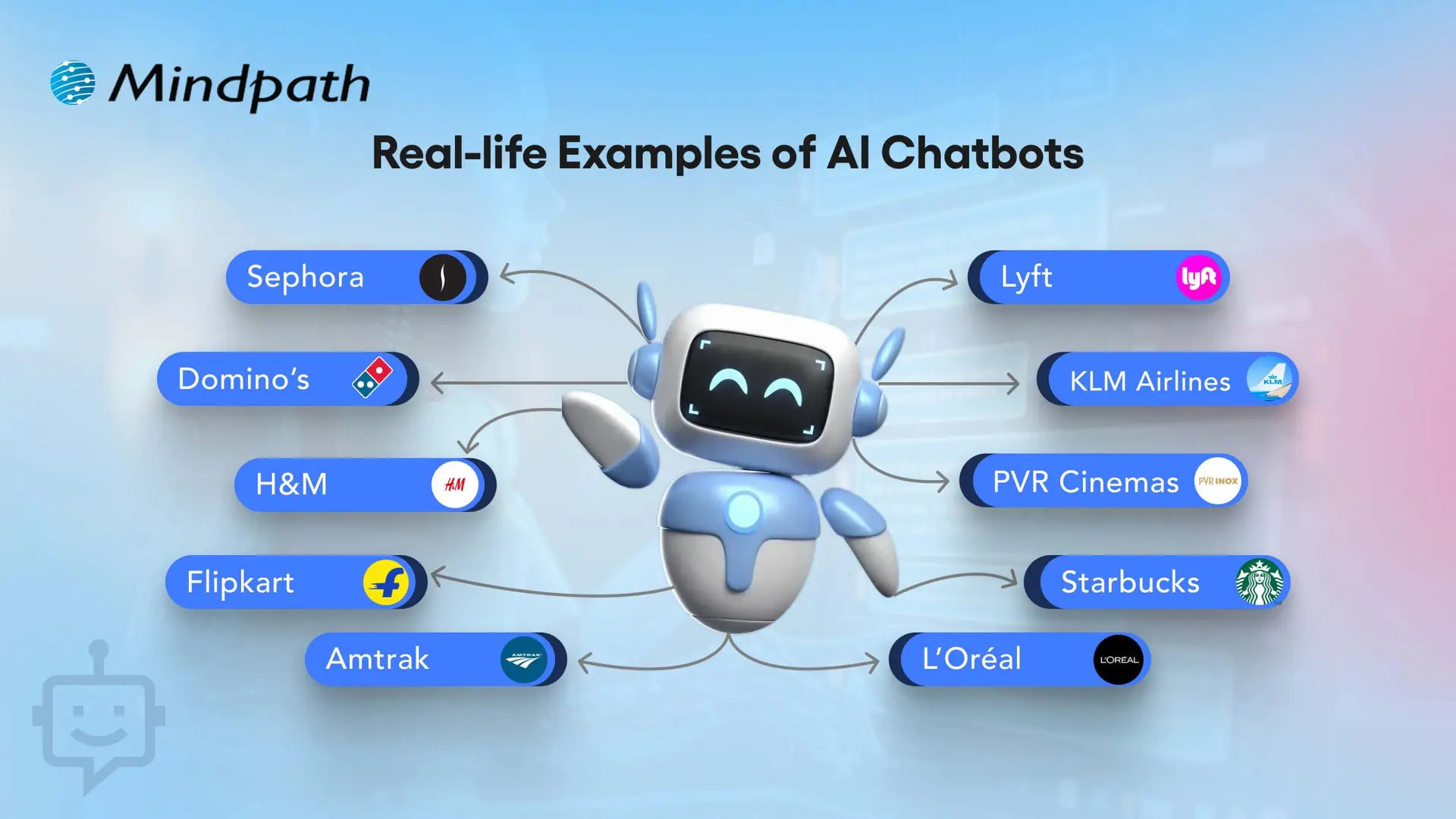
10 Real-life Examples of AI Chatbots

1. Sephora – Personalized Shopping Assistant

Sephora utilizes an AI chatbot to assist customers in selecting makeup and skincare products, to support customers based on their preferences. This chatbot example assists shoppers in finding the right products, much quicker than a human, resulting in higher conversions overall. This video definitely ranks as one of the best chatbot examples in the retail world.

2. Domino’s – Easy Food Ordering

Domino’s has incorporated a chatbot that allows the customers to order pizza directly through a messaging app. This practical application of chatbot makes ordering easy while also cutting down on wait time and increases customer satisfaction. It is one of the most effective AI chatbots that increased sales in the food industry.

3. H&M – Style Recommendations

H&M has a chatbot that suggests clothing based on user style preferences. These website-chatbot examples improve the shopping experience by making it more personal. It shows how real-life examples of AI chatbots in business can drive higher engagement.

4. Flipkart – Seamless E-commerce Recommendations

Flipkart’s chatbot provides personalized product suggestions based on browsing history and preferences. This example of chatbots enhances shopping experiences, boosts conversions, and increases customer satisfaction. It is among the best AI chatbot examples in online retail.

5. Amtrak – Julie Virtual Assistant

Amtrak’s virtual assistant Julie answers millions of passengers queries every year. These examples of chatbots on websites save time for both customers and staff. The company reported significant cost savings and better chatbot ROI examples.

Must Read: AI in E-Commerce

6. Lyft – Ride Booking Made Easy

Lyft allows users to book rides via its chatbot on Messenger or Slack. This real-life example of AI chatbots in business shows how brands can remove friction in customer journeys. It directly improves bookings and conversions.

7. KLM Airlines – Travel Assistant

KLM Airlines uses a chatbot to provide booking confirmations, flight updates, and boarding passes. This website chatbot example streamlines travel support. It is one of the AI chatbots that increased sales through seamless customer care.

8. PVR Cinemas – Movie Booking Assistant

PVR Cinemas uses a chatbot to help customers check movie schedules, book tickets, and view offers instantly. This chatbot example simplifies the booking process, improves customer engagement, and drives higher ticket sales. It is one of the best AI chatbot examples in the entertainment and cinema industry.

9. Starbucks – Coffee Ordering Chatbot

Starbucks has a chatbot that lets customers place their orders ahead via mobile. This application of chatbot reduces wait time and encourages repeat purchases. It’s among the strongest chatbot ROI examples in food service.

10. L’Oréal – Beauty Genius for Personalized Shopping

L’Oréal launched ‘Beauty Genius’, an AI chatbot that gives personalized beauty tips and product recommendations. It uses AI and AR to analyze selfies and suggest the best skincare and makeup from over 750 products. This chatbot improves customer engagement and drives more conversions for the brand.

Looking for AI systems that can plan and act independently for your business? Discover Agentic AI to learn how intelligent agents are transforming decision-making and workflow automation.

Want to Transform Your Business with Chatbot Solutions?

AI chatbots play a vital role in boosting sales, improving efficiency, and creating better customer experiences. These chatbot examples highlight how leading brands use AI to personalize interactions, reduce friction, and drive measurable growth. By learning from real-life cases, your business can adopt similar strategies to maximize ROI and conversions.

At Mindpath, we specialize in developing bespoke chatbot solutions designed to align with your unique business needs. Our tailored approach ensures your chatbot goes beyond generic automation and instead creates real value through seamless user journeys. With expertise in crafting solutions inspired by the best chatbot examples, we help you enhance engagement, streamline processes, and accelerate business growth.
Related Post

Discover the ultimate guide to hiring Node.js developers in London. Learn about the skills, benefits, and cost factors involved in finding the right talent for your project.
Discover how education software transforms learning with benefits like content management, student tracking, and cost savings. Revolutionize education with Mindpath!

Related Post

React JS Trends

Are you curious about what’s next for React JS in 2025? With the fast-paced world of web development, it’s essential to stay ahead of the curve. What new features, tools, or practices will shape the future of React JS? In this blog, we will explore the key trends and innovations that will define React JS in 2025. 

ReactJS is a popular tool for developers to create websites and applications. It makes it easier to design interactive and quick user interfaces by breaking down significant web pages into smaller, reusable elements known as components. Think of it as a website building block approach that simplifies and speeds up its construction. ReactJS is changing along with technology. Keeping up with the newest ReactJS trends for 2025 helps developers remain ahead of the competition. Understanding these trends will enable you to employ the finest tools, enhance your abilities, and design more efficient and contemporary websites. Whether you’re a newbie or an experienced developer, knowing what’s coming in ReactJS will help you stay competitive and prepared for the future. 

Let’s delve into the ReactJS trends 2025! 

ReactJS Trends 2025

1. Server-Side Rendering (SSR)

Server-Side Rendering (SSR) is a technique in which the server generates the first version of a webpage and provides it to the browser as HTML. This improves website performance and SEO since search engines can read the pre-rendered material. React JS supports SSR via frameworks like Next.js and Gatsby. These frameworks pre-render pages on the server before providing them to the client, resulting in speedier website load times and a better user experience. SSR decreases load times, particularly on slower connections. Users can see content rapidly due to SSR, which eliminates the need to load all of JavaScript. It also helps to improve search engine rankings because the material is freely available to crawlers. 

2. WebAssembly

WebAssembly is a low-level binary format that runs natively in web browsers, with performance comparable to native programs. It enables web applications to do complicated tasks considerably more quickly, making it perfect for high-performance activities like gaming, video editing, and data processing in the browser. WebAssembly improves React JS performance by offloading expensive calculations, making the app quicker and more responsive. It also enables React to interface with other languages such as Rust, C++, and WebGPU, allowing developers to combine the benefits of various technologies in a single program. As the web advances, WebAssembly is becoming an essential tool for developing high-performance online applications. Its ability to run code rapidly and operate with many technologies makes it a significant trend to watch in 2025 for React JS.  

3. Improved Developer Tools

Better developer tooling is crucial for increasing productivity and enhancing the quality of React JS development. React JS already has strong tools such as React DevTools, Create React App, and React Testing Library, which help developers work quicker and more efficiently. In the future, React JS is intended to provide even more tools and functionalities. One such feature is React Fast Refresh, which allows for hot reloading while maintaining component state, making development more efficient. Another interesting feature is React Profiler, a tool that allows developers to evaluate and optimize the performance of React JS apps, ensuring that they execute smoothly. Furthermore, the React Developer Roadmap will offer advice on learning and mastering React, allowing developers to plan their path with the framework. These tools modifications will ease the development process, allowing developers to create faster, more powerful apps.  

4. Concurrent Mode Features

Concurrent Mode is an upcoming React JS feature that allows many components to render simultaneously without interfering with the main thread or influencing user interaction. This increases the efficiency and responsiveness of React apps, allowing them to function more smoothly and quickly. Concurrent Mode enables React to handle complicated updates more effectively, allowing for additional features such as suspense, which helps manage loading states, transitions, for smoother UI changes, and error boundaries, which give improved error handling. The concurrent option is currently experimental and must be activated manually; however, it is intended to become the default rendering option in future versions of React JS. React apps that employ Concurrent Mode will be able to give a better user experience through quicker and more responsive interfaces.  

5. Focus on Mobile Development

With the increasing popularity of mobile devices, mobile-first development has become important. React JS already enables mobile app development with React Native, which blends React JS and native components to create cross-platform mobile applications. This enables developers to create apps that run on both iOS and Android using a single codebase. Looking ahead, React Native is projected to gain even more strength and complexity. It will continue to leverage React JS’s features, as well as advances in mobile technology, to improve connectivity with native platforms such as SwiftUI, Jetpack Compose, and Expo. These enhancements will accelerate mobile app development and give customers smoother, more native-like experiences. As mobile usage continues to climb, React Native will be essential in helping developers generate high-quality, cross-platform apps.  

ReactJS Development at Mindpath

Our skilled React.js developers at Mindpath have the necessary abilities and expertise to construct contemporary, engaging user interfaces that increase user engagement and satisfaction. Whether you want to create a web application from scratch, upgrade an existing one, or quickly get your product to market, Mindpath is here to help with cost-effective solutions, quick development timeframes, and dependable support. Here’s a review of the services we offer:  

1. ReactJS Front-End Development

We are involved in creating responsive and dynamic user interfaces to improve user experience and interaction with your website.  

 2. React Native App Development

Our team develops cross-platform mobile apps with React Native and gives them the native look and feel across iOS and Android devices.  

3. ReactJS Consulting

We expertly guide you on the usage of ReactJS in your projects so that the development strategy and architecture may be better optimized for the projects.  

4. ReactJS API Integration

We will integrate your ReactJS applications easily with external APIs and connect them seamlessly for smooth data and functionality exchange.  

5. ReactJS Enterprise App Development

We develop scalable and reliable applications that large organizations can use to take up complex requirements with high performance and efficiency.  

6. ReactJS Maintenance & Support

Continuous maintenance and support services that keep your ReactJS applications in motion, fixing any issues fast.  

7. React Web Design

We design engaging and user-friendly web interfaces that provide an impressive user experience through a focus on aesthetics and functionality using ReactJS.  

8. Custom React JS App Development

Build customized ReactJS applications that meet your business requirements, providing personalized solutions to all your needs. 

9. ReactJS Upgradation

Upgrade your existing ReactJS applications to their latest versions, offering you brand new features and improved performance.

10. ReactJS Product Development

We develop innovative products with ReactJS; high quality and performance-driven applications that fulfill your business needs.

11. ReactJS Ecommerce Development

We will build robust, interactive e-commerce platforms using ReactJS to ensure a great online shopping experience.  

12. ReactJS Migration

We help migrate your existing applications to ReactJS while ensuring smooth transitioning and improved performance.  

13. ReactJS Plugin Development

Developing custom plugins for ReactJS that extend functionality and fit in perfectly with other tools and systems.  

14. ReactJS Social Media & Interactive Apps

 Let us help you create engaging social media and interactive applications using ReactJS that improve user interaction and their experiences.  

15. ReactJS Customization Services

We will customize ReactJS components and applications according to your needs and wishes.  

Wrapping Note!

As we approach 2025, React JS is expected to introduce new advancements that will improve both development and user experience. Server-Side Rendering (SSR), WebAssembly, and Concurrent Mode are three key technologies that promise to increase app speed and response time. Mobile-first development using React Native will continue to advance, making it easier to create cross-platform mobile applications. By staying on top of these changes, developers can build speedier, more efficient apps while remaining competitive. Mindpath’s React JS development services are designed to help you fully use these breakthroughs, from front-end development to mobile app production and continuous maintenance. 

Ready to bring your ideas to life with cutting-edge React JS solutions?

Partner with Mindpath for expert development and innovative results.

Discover React JS trends for 2025, including SSR, WebAssembly, etc. to create faster, smarter, and future-ready applications.
full stack development

Software development has evolved beyond the traditional approaches that required separate frontend and backend development teams. The need for full-stack development is evident in the new digital landscape, where user requirements and business goals change in an instant. Full-stack software development offers a strategic option to develop user-friendly and robust applications without paying a fortune.

With the growing competition to establish a strong digital presence, business owners must pick a reliable development approach, like full-stack. However, it is also important to learn what full-stack software development entails before embracing it. Let us discover more about the full-stack approach and how businesses can use it to develop their software applications.

Thinking of adopting full-stack development for your next project? Mindpath’s full stack development services will help you with the integration of front-end and back-end expertise that your business needs.

Understanding Full Stack Fundamentals

Full-stack has emerged as the most valuable strategy for software development that allows businesses to meet the emerging user requirements and business goals. It follows an end-to-end approach for developing software applications, involving both the frontend and backend. The answers to “What is full-stack development?” also emphasize how it can enhance cost-effectiveness, agility, and efficiency. You can understand full-stack in a better way by breaking it down into the two primary components.

1. Frontend Development

The frontend development deals with the client-side aspect of the application, or the part of the application that users see. It includes everything a user sees of an application on their smartphones or web browsers. The important elements of the frontend of an application include the design, images, layout, navigation menus, buttons, text, and anything that users can interact with.

The most important technologies for frontend development in the full-stack approach include HTML, CSS, and JavaScript. In addition, full-stack developers must also have a strong command of frontend frameworks and libraries. HTML serves as the foundation for arranging web content, while CSS helps in styling the interface by controlling fonts, layout, responsiveness, and colors.

The search for answers to “what is full-stack web development” will also help you understand the significance of JavaScript. It is a popular programming language that helps developers add dynamic and interactive elements to web pages. Most important of all, frameworks and libraries like Angular, Vue, and React simplify frontend development while empowering developers to create complex user interfaces without sacrificing responsiveness.

Planning to use full-stack development for your next web project? Before that, read about the future of full-stack development for web projects

2. Backend Development

The backend of a software application focuses on the server-side aspects of the application, which drive its functionalities. Backend development deals with logic, communication, and data storage, which work in the background and are never visible to users. The full-stack development definition describes the backend as the “brains” behind the working of an application. The backend processes requests from the frontend, interacts with databases, and sends data back to the frontend.

Backend development for a software application requires fluency in programming, backend frameworks, server management, APIs, and database management. The notable programming languages used to create backend logic include Python, Java, Ruby, Node.js, and PHP. Developers should also know how to leverage the relevant backend frameworks for each programming language. For instance, Ruby on Rails is ideal for Ruby, while Express.js is for Node.js, and Django is the best backend framework for Python.

Also Read: Full-stack development with Node.js

Database management and server management are also integral requirements for full-stack developers. Backend development is incomplete without databases, as they help with the storage and management of application data. Database management may involve the use of relational databases like MySQL and SQL Server or NoSQL databases such as MongoDB. Backend development also requires an in-depth understanding of best practices for configuring and managing web servers. Another important requirement for backend development focuses on APIs that establish rules and protocols for communication between different software components.

The answer to such a question is quite obvious and points to any developer who knows frontend and backend development. One of the significant highlights in any full-stack developer definition is the proficiency in frontend and backend development technologies. On top of it, full-stack developers must be fluent in security practices and DevOps to offer productive end-to-end software development solutions. Full-stack developers know how every layer of an application works, thereby empowering them with a holistic view of the development process.

The versatility of full-stack developers makes them one of the most valuable resources for businesses in the new technological landscape. Full-stack developers can create responsive web layouts, implement database integration, manage testing and debugging, and write server-side logic. On top of it, they also work in collaboration with UI/UX designers and other teams to develop efficient applications.

Understanding the differences between front-end, back-end, and full-stack developers is key to building an effective development team. Learn more about the distinct responsibilities of each developer in our blog: Front-end vs Back-end vs Full-stack developer

Workflow of Full Stack Development

The definition of full-stack indicates that combining frontend and backend development can serve promising advantages for businesses. At the same time, it is also important to wonder about the workflow in full-stack projects. Where does full-stack begin, and how does it integrate frontend and backend development in a single workflow? You can find the answer by reflecting on the full stack definition once again, by focusing on the end-to-end aspect of the process.

Full-stack developers begin with the planning stage and end with the deployment and maintenance stage. The following steps in the full-stack workflow can help you understand how the holistic approach blends the traditionally different sides of software development.

1. Planning

The first step in the full-stack workflow involves planning and identifying essential features and technical specifications for the application. Full-stack developers collect information about essential requirements and understand the scope of the project. The developers also collaborate with different stakeholders to come up with an outline of the features desired in the application and its technical specifications.

2. Frontend Development

After finalizing the design, the next step in full-stack development focuses on the frontend of the application. The frontend development starts with a definition of the project structure and selecting the relevant technologies like HTML and CSS. The full-stack developer will implement the user interface in this step while ensuring accessibility and responsiveness.

At the same time, developers must ensure that the frontend complies with important design guidelines. The other crucial tasks in the frontend development stage include the creation of reusable components and the integration of backend APIs to fetch and display data.

Must Read: Full-stack Development Trends

3. Backend Development

The next step in the full-stack software development workflow focuses on backend development and integration of the backend logic with the frontend. Developers can create the backend of a full-stack application with server-side scripting languages like Python, Node.js, or Ruby. In addition, developers also employ the relevant database management system for the application according to its requirements.

Apart from creating and implementing the server-side logic, full-stack developers also create RESTful APIs and address data management needs. The backend development stage also calls for attention to the security and scalability of applications. Therefore, developers have to implement comprehensive authentication and authorization mechanisms and follow the best practices for data validation.

4. Testing

Before launching the application, full-stack developers will implement comprehensive testing plans to find errors and bugs. Developers have to define unit tests, end-to-end tests, functional tests, and integration tests to measure the utility of the application in different scenarios. Writing the tests in the early stages of development helps in creating applications that align with the desired goals and requirements of features. It also ensures that the application is easy to maintain, reliable, and adheres to the desired specifications.

Following the testing process, developers work to achieve seamless integration of frontend and backend components. The process involves establishing communication between the frontend and backend with uninterrupted data flow and error management. Full-stack developers rely on testing on a wide range of devices, scenarios, and browsers to identify and resolve performance issues. As a result, they can ensure easier integration of frontend and backend components without conflicts.

5. Deployment and Maintenance

The final stage in the full-stack workflow or deployment focuses on preparing the application for the production stage. The deployment stage involves the configuration of essential server environments and setting up continuous integration and continuous deployment pipelines with DevOps. Full-stack developers must also ensure that the application has been optimized for production in the deployment stage.

Some of the important requirements for deploying a full-stack web application include database migration, scaling to adapt to the user traffic, and server provisioning. Once the deployment is complete, developers monitor the application performance to identify any anomalies. If they find any issues, then developers will address them, followed by providing continuous maintenance and updates.

Hiring the right talent can make or break your MVP. Learn why hiring a Full-Stack Developer for MVP Success can make your product development faster and more efficient

Popular Technology Stacks for the Full Stack Developer

The doubts of a business owner before adopting the full-stack approach also focus on the choice of technology stack. Technology stacks refer to the combinations of technologies used by full-stack developers to create software applications. You must also know that the full-stack developer’s salary depends a lot on the candidate’s fluency in different stacks.

The most popular technology stack alternatives include MERN, MEAN, LAMP, LEMP, and Python-based stacks. Each stack features distinct technologies serving different roles in the development cycle.

1. MERN

The MERN stack represents the combination of MongoDB, Express.js, React.js, and Node.js. MongoDB serves as the NoSQL database while React.js offers the frontend development library. Node.js works as the JavaScript runtime for the backend, and Express.js is the relevant backend framework for it. Developers can work with a single programming language as all components in the MERN stack are JavaScript-based.

2. MEAN

The MEAN stack includes similar components to the MERN stack, albeit with the exception of the Angular framework for frontend development. It is a popular choice for full-stack web solutions due to Angular, which offers a more structured framework for frontend development. At the same time, developers can capitalize on the advantages of working with a complete JavaScript ecosystem in the MEAN stack.

3. LAMP and LEMP

The LAMP tech stack includes Linux as the operating system, Apache as the web server, PHP as the server-side programming language, and MySQL as the relational database. It is a traditional tech stack, implemented in content management systems such as WordPress. The LEMP stack is similar to LAMP, albeit with a different web server, Nginx, which offers high performance and efficient management of concurrent connections.

4. Python-based Stacks

Python is also one of the most popular server-side programming languages for its readability. The effectiveness of full-stack development with Python also depends on its comprehensive collection of libraries and strong community. Python-based stacks can use different Python web frameworks, frontend frameworks, and relational databases, depending on the project requirements. The common choices for Python web frameworks include Django and Flask, while frontend framework choices include React and Angular.

Looking to reduce time and costs, and take full advantage of full-stack expertise. Discover how Mastering Full-Stack Development with Node.js can help businesses in streamlining workflows as well as boost project ROI.

How Does Full Stack Help Your Business?

As a business owner, you might wonder if full-stack is an effective approach to software development. Businesses can capitalize on the full-stack development benefits to get best outcomes for their businesses.

1. Faster and Efficient Development

The most promising advantage of full-stack software development is the speed of development. It reduces the dependencies between isolated frontend and backend development teams as a single developer takes responsibility for multiple aspects of the project. Full-stack developers can achieve faster iterations, release features quickly, and ensure faster time to market for new products, services, and updates.

2. Cost Savings

The next notable highlight in full-stack developer skills is the ability to offer the services of frontend and backend developers, along with database specialists, in one package. Businesses don’t have to hire different professionals for these roles, which reduces the costs of recruitment, onboarding, and other operational costs.

3. Flexibility and Consistency

Another promising advantage of working with full-stack developers is the assurance of flexibility in agile environments that demand rapid changes. Full-stack developers will quickly adapt to address the requirement of urgent attention to specific areas of an application. On top of it, the unified and consistent architecture ensures easier integration between the frontend and backend components without compatibility issues.

Want to accelerate your development process? Explore how a freelance full-stack developer can create interactive user interfaces and oversee deployment and maintenance.

Final Thoughts

The value of full-stack development for any business is about following a holistic approach to software development. The unique approach not only reduces costs but also provides a solution to avoid delays and deliver the best user experiences in applications. With the support of a full-stack developer, your business can navigate through the complexities of the digital landscape with ease.

We at Mindpath specialize in end-to-end software development and have helped clients create intuitive applications in different industries. Our commitment to deliver the best results stems from our ability to understand the client’s requirements and identify the best resources for their projects. Contact us to figure out the ideal course for your next software development project.

AI in E-commerce

Have you ever wondered how some online stores seem to know exactly what you want? What if your shopping experience could be personalized just for you, making it faster and easier than ever? As AI continues to evolve, it’s transforming e-commerce in ways we never thought possible. How is this technology changing the way we shop, interact with brands, and make purchases? In this blog, we will explore how AI is reshaping e-commerce and what it means for the future of online shopping. 

The term artificial intelligence, or AI, describes computer programs created to carry out operations that normally call for human intellect. This includes understanding speech, decision-making, and pattern recognition. Artificial Intelligence (AI) comprises several technologies, including natural language processing (NLP), deep learning, and machine learning. 

Artificial intelligence (AI) plays a key role in e-commerce today, revolutionizing how firms run and connect with customers. E-commerce companies can employ AI to better make decisions and improve the entire buying experience by using user data. AI is a vital tool in the rapidly changing world of e-commerce since it helps online companies remain competitive and adapt to shifting customer requirements. 

Want to know more? Let’s dig in! 

How is AI Transforming E-commerce?

1. Automating Customer Help

Chatbots and virtual assistants are fantastic for offering customer care online. They make use of artificial intelligence (AI) to determine the needs of customers. Natural language processing (NLP) is the ability for chatbots to understand queries and requests. They learn and become more skilled at serving clients as they engage with them more. 

Chatbots are a great resource for customers and online retailers alike. They never require a break and are constantly accessible, even late at night. They are polite, calm, and typically know the answers to a lot of queries. They take care of basic questions so that human agents can concentrate on more complex problems. Recent advancements in AI have made chatbots even more intelligent, which gives customers greater confidence when interacting with them. Many customers are willing to purchase goods from chatbots, particularly since some of those can offer exclusive offers just for them. 

2. Reducing Manual Work

Artificial intelligence (AI) is revolutionizing e-commerce by replacing routine everyday operations that usually call for human labor. This change lessens the need for a big workforce while enabling organizations to run more effectively. 

While it is unfortunate that automation can result in the loss of certain retail associates, many businesses believe artificial intelligence (AI) offers more opportunities for cost savings and productivity gains. Businesses can optimize their processes and lower human error by entrusting AI with routine jobs. Over time, this can result in clients receiving faster service and having a more responsive purchasing experience. So, adopting AI will ensure that employees can participate in more meaningful ways and help e-commerce businesses prosper in a competitive marketplace. 

3. Preventing Online Fraud

E-commerce businesses face a serious threat from online fraud, which costs them billions of dollars annually. Thankfully, AI offers sophisticated methods to address this issue. Machine learning algorithms have made the task of manually reviewing transactions for unusual patterns, which once required a large number of personnel, faster and simpler. 

To identify suspicious activity, these algorithms can instantly evaluate millions of data points. An AI system can detect abnormalities rapidly, such as when someone tries to commit fraud by inputting the wrong delivery address and flags the entry for evaluation.  E-commerce companies can drastically lower financial losses and safeguard both themselves and their clients from fraud by utilizing AI for fraud detection. This makes everyone’s online buying experience safer. 

4. Smart Recommendations

AI-driven recommendations raise the bar for personalization in online shopping. AI is able to examine a customer’s browsing history, previous purchases, and even their interactions with items, unlike traditional businesses. This makes it possible for AI to make tailored product recommendations and anticipate what a buyer might be interested in. 

Customers will find shopping easier and more fun thanks to these very accurate recommendations that are customized to everyone’s tastes. AI helps buyers find the proper items by making relevant suggestions; this increases the likelihood of a purchase and improves the entire shopping experience. Brick and mortar establishments are just unable to match this level of customization. 

5. Easy Cross-Selling

AI enables e-commerce companies to provide customers with product recommendations while they buy. AI can employ their past purchases and preferences to suggest relevant products that customers might like to add to their basket while they are checking out. Businesses can more easily provide appropriate ideas by deploying AI-powered recommendation engines, which leverage data on frequently purchased goods. Customers are encouraged to purchase more as a result, increasing revenues through upselling and cross-selling without being intrusive.

6. Personalized Shopping

Personalization is essential in e-commerce to provide a customized purchasing experience for each unique client. Customization strengthens the bond with clients, encouraging loyalty and improving the pleasure of buying. Personalized experiences are increasingly expected by many customers, but not all merchants have completely integrated them into their platforms. 

AI has greatly enhanced the personalization of e-commerce by analyzing vast volumes of user data and providing real-time insights. This enables websites to function as personal shopping advisors by making product recommendations and presenting customized discounts. Through customization of the purchasing experience, businesses can raise revenue and establish enduring bonds with their customers. 

AI Development Services at Mindpath

At Mindpath, we offer AI development services that help businesses use the power of artificial intelligence to improve their operations. Our team creates AI solutions tailored to your needs, whether it’s automating tasks, analyzing large amounts of data, or improving customer experiences.  We use advanced AI technologies like machine learning and natural language processing to build smart systems that can make decisions, learn from data, and solve complex problems. With Mindpath’s AI development services, your business can become more efficient, make better decisions, and stay ahead of the competition in the fast-changing digital world. 

Wrapping Up!

Artificial Intelligence is rapidly transforming the e-commerce landscape, making shopping experiences more personalized, efficient, and secure. From automating customer support to offering personalized recommendations, AI has become an essential tool for businesses looking to stay competitive and meet evolving customer expectations. As AI technology continues to advance, its impact on e-commerce will only grow, offering endless possibilities for innovation and enhanced customer satisfaction. Partner with Mindpath today to leverage AI’s power and drive your e-commerce success into the future. 

Ready to transform your e-commerce business with the power of AI?

At Mindpath, we specialize in creating intelligent solutions tailored to your needs.

Transform your e-commerce business with AI solutions from Mindpath. Enhance customer experience, boost efficiency, and drive growth with smart technology.