Agentic AI 101: What You Need to Know

Join our Newsletter!

Featured Posts

Support Is One Click Away

Home

Agentic AI 101: What You Need to Know

agentic ai

Agentic AI 101: What You Need to Know

Have you been hearing a lot more about the idea of Agentic AI? It is really becoming one of the most talked about ideas in tech, right? Well, it is a new way of thinking about AI, and it takes action on its own, not just reactively waiting for a command. It can make decisions, plan, and act independently as if it possesses its own autonomous cognition. This is what makes it feel less like a tool and more like a genuinely smart collaborator who is helpfully performing the task at hand.

Even more exciting is how easily it’s intertwining with real-world activities, showcasing how AI is transforming future innovations is becoming a reality. But what does agentic AI mean, and why is it being so widely talked about right now? If you’re in tech, in business, or simply curious about the future of AI, spanning these definitions will be vital. So, in this blog, we’re going to guide you through what Agentic AI is, why it’s gaining traction, and how it may soon bring intelligence into our everyday lives. To begin with, let us know what is the concept of agentic AI.

Looking to integrate smarter, goal-driven AI into your business? At Mindpath, we offer end-to-end AI Development Services to design, train, and deploy advanced agentic solutions.

What is Agentic AI?

Agentic AI is a more sophisticated and advanced kind of artificial intelligence agent that can make its own decisions and perform actions once it is initially instructed. It is not limited to just following commands; it can understand what to do, outline a plan, execute it, and optimize the process during execution. Agentic AI is well suited for numerous, complex tasks in business and other fields, where fast thinking and independent action are often required.

Agentic AI’s potential extends far beyond automation, as it is already on track to considerably change many industries. A report from MarketsandMarkets estimates that the global market size of Agentic AI will increase from USD 13.81 billion in 2025 to USD 140.80 billion by 2032, growing at a CAGR of 39.3%. Rapid AI growth can be traced to its ability to perform tasks and activities associated with marketing, sales, and operations. In customer service, Gartner predicts that by 2029, Agentic AI will resolve 80% of support issues independently, which would lead to an estimated 30% reduction in operational costs. These numbers reflect just how transformative Agentic AI is becoming, especially in areas that demand fast, intelligent decision-making.

Also Read: AI agents types and benefits

Benefits of Agentic AI

As businesses look for smarter ways to work, Agentic AI offers powerful advantages that go beyond traditional automation. Its ability to think, act, and improve independently is unlocking new levels of efficiency and innovation across industries.
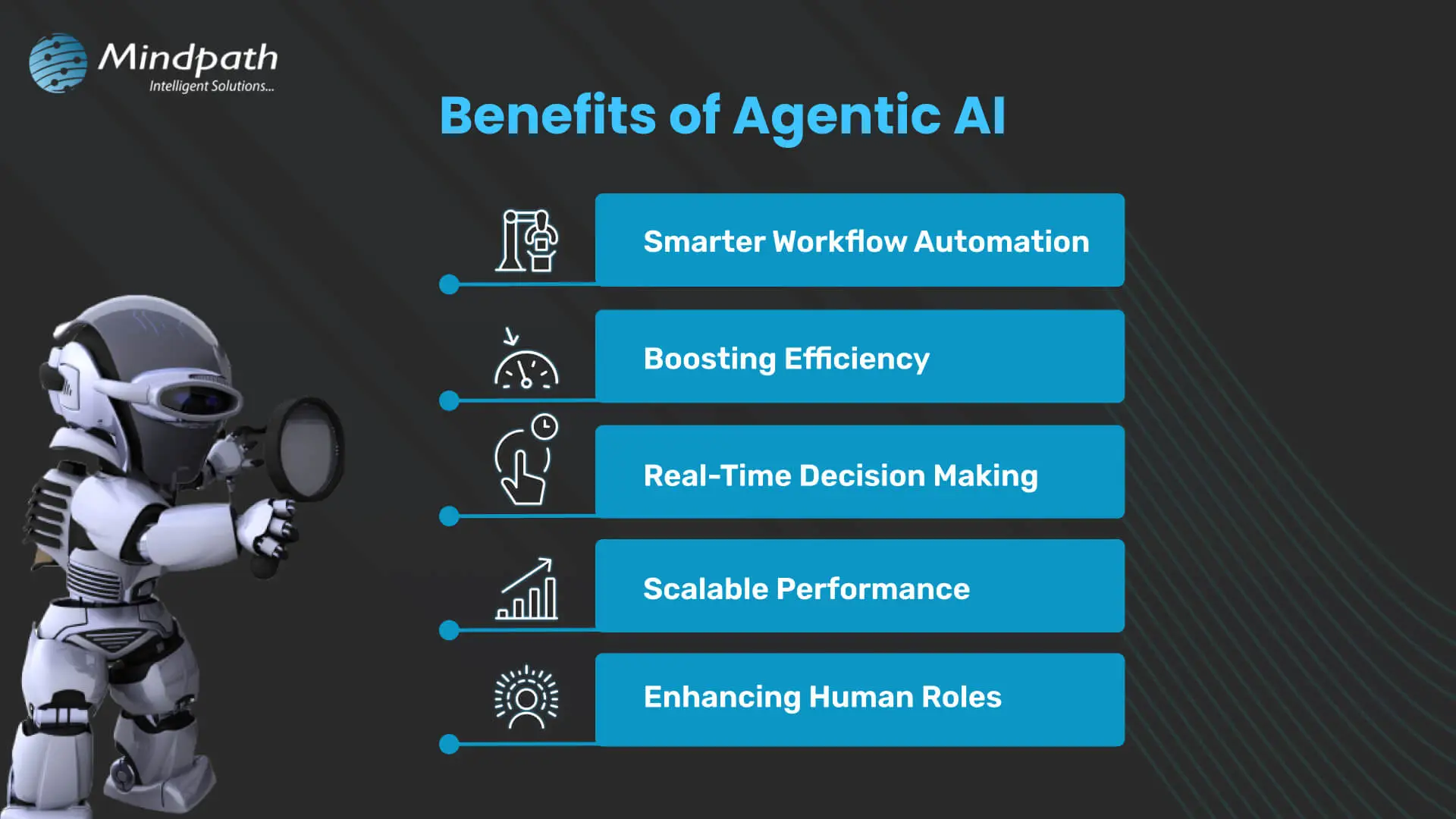
Benefits of Agentic AI 

1. Smarter Workflow Automation

Agentic AI makes it easier to manage complex workflows without needing constant human input. In supply chain operations, it can analyze data, spot issues early, and suggest the best solutions. It also tracks inventory levels and connects with suppliers to restock items on time, keeping everything efficient and well-organized.

2. Boosting Efficiency

Agentic AI helps businesses run faster and smoother by managing and improving processes on its own. It learns from results, adjusts its actions, and keeps getting better without needing to be reprogrammed. This leads to fewer delays, higher efficiency, and makes it easier to scale operations as the business grows.

3. Real-Time Decision Making

One of the key strengths of agentic AI is its ability to quickly make decisions and adapt to changing situations. Agent AI tools can process real-time data, respond to unexpected events like shipping delays, and adjust plans without human help. This makes AI in decision-making faster, more flexible, and better suited for today’s fast-moving business needs.

4. Scalable Performance

Agentic AI models help businesses grow by handling more tasks without losing speed or efficiency. They use cloud platforms, APIs, and large language models to manage increasing workloads smoothly. In setups with multiple agents working together, such as in healthcare, they share tasks like data analysis and scheduling to reduce manual work.

5. Enhancing Human Roles

Agentic AI helps people work better by taking over repetitive tasks, improving communication, and offering smart assistance. This allows employees to focus on creative thinking, problem-solving, and other work that needs human judgment. While the AI works independently, human guidance is still important to keep everything aligned with company goals and values supported by valuable insights from AI in business strategy.

Wondering how AI-powered chatbots fit into the growing shift toward agentic AI? Read our blog on how conversational AI chatbots help businesses to explore how these systems learn, adapt, and deliver human-like interactions.

Agentic AI Use Cases

Agentic AI is already being used across many industries to improve efficiency, decision-making, and customer experience. Here are some real-world agentic AI examples that show how this technology is making a meaningful impact in different areas.
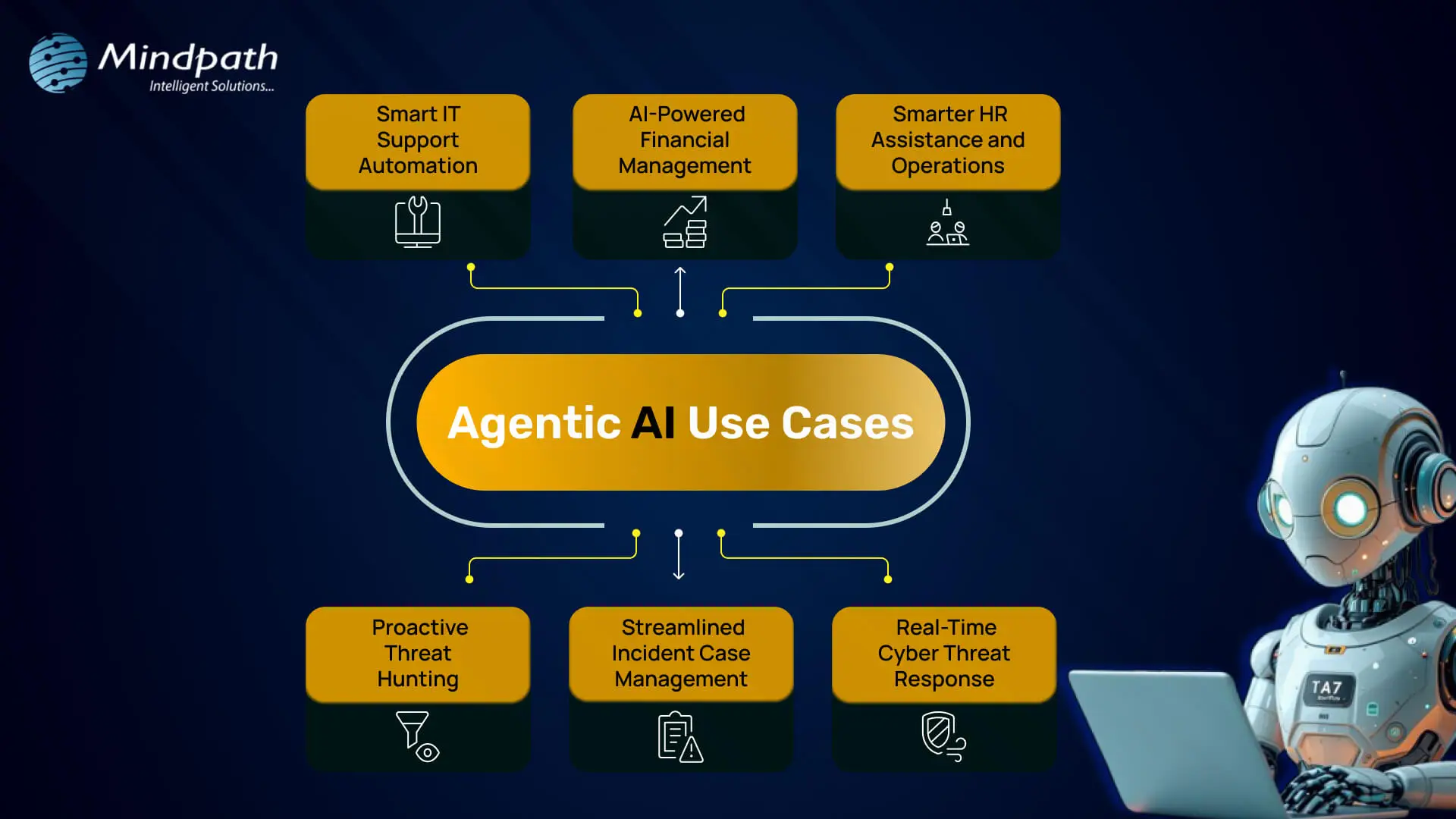
Agentic AI Use Cases

1. Smart IT Support Automation

Agentic AI is changing IT support by spotting and fixing problems on its own before they grow. It handles common tasks like password resets and software updates, while also solving complex issues by learning from past data. This shift aligns with emerging AI trends that focus on self-repairing systems and intelligent automation.

2. AI-Powered Financial Management

Agentic AI in finance can handle tasks like fraud detection, compliance checks, and forecasting by quickly analyzing large amounts of data. It also offers personalized advice by tracking spending and improving money management.

3. Smarter HR Assistance and Operations

In HR, agentic AI helps by answering employee questions, managing onboarding, and screening candidates during hiring. It gives quick, personalized support while allowing HR teams to focus on bigger goals.

4. Proactive Threat Hunting

Agentic AI actively searches for hidden threats by scanning security data for unusual patterns. It keeps learning to catch new types of attacks that older systems might miss.

5. Streamlined Incident Case Management

Agentic AI organizes and tracks cybersecurity incidents by logging details and assigning them to the right teams. It also learns from past cases to suggest better ways to handle future issues and ensures all records stay up to date. Companies often use AI consulting services to optimize these workflows and strengthen overall security operations.

6. Real-Time Cyber Threat Response

In cybersecurity, agentic AI watches for threats around the clock and reacts instantly by blocking risks or alerting teams. It learns from new attacks, so it gets better at spotting danger over time.

Curious how agentic AI is revolutionizing personalized shopping experiences and automation in online retail? Explore our blog AI in ecommerce to see how intelligent systems are reshaping customer journeys and boosting business performance.

What Is the Difference Between Agentic and Non-agentic AI?

Understanding the difference between agentic and non-agentic AI is key to recognizing how advanced AI systems are evolving. While both types serve important roles, they differ greatly in how they operate, make decisions, and adapt to new situations. The following difference table will help you clear your understanding of agentic and non-agentic AI.
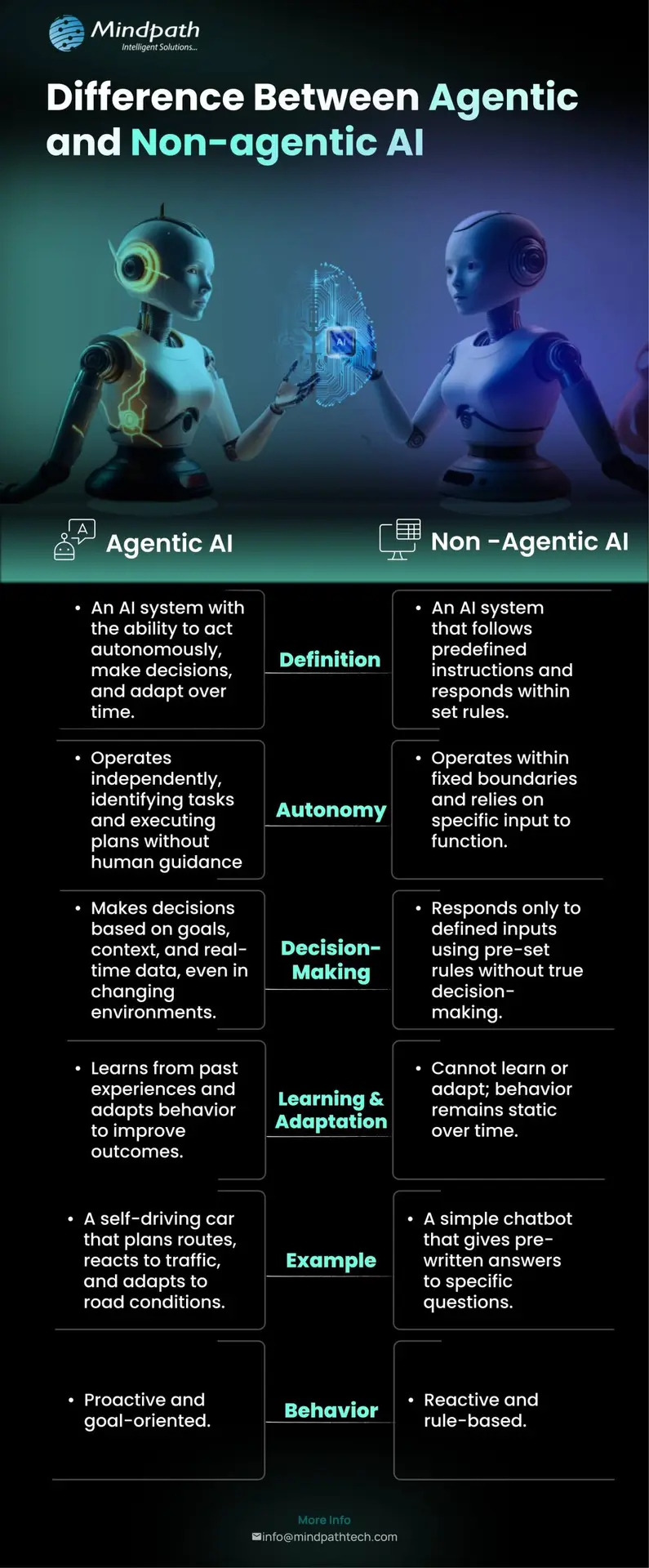
Difference Between Agentic and Non-agentic AI 

How Far Can Agentic AI Take Your Business?

Agentic AI is creating a major shift in how systems work, making them more independent, responsive, and useful across real-world situations. It’s no longer just about automation but about building intelligent support that acts on its own, learns from outcomes, and keeps improving. As industries adopt this new approach, the ability to understand and apply Agentic AI will be a clear advantage for any forward-thinking team.

At Mindpath, we help businesses bring this future to life with tailored AI development services. Our team builds intelligent, scalable, and adaptive AI solutions that align with your goals and workflows. If you’re ready to explore the power of Agentic AI in your operations, let’s connect and shape your next intelligent move.


Frequently Asked Questions

1. Is Agentic AI suitable for small and mid-sized businesses?

Yes, Agentic AI is not limited to large enterprises. With cloud-based tools and scalable platforms, small and mid-sized businesses can adopt agentic systems for workflow automation, customer support, and analytics. The key is starting with a focused use case that delivers measurable value.

2. How much control do humans have over Agentic AI systems?

Even though Agentic AI can act independently, human oversight remains essential. Businesses set the goals, boundaries, and ethical guidelines the system must follow. Regular monitoring, audits, and performance reviews ensure the AI stays aligned with company objectives and regulatory requirements.

3. What industries can benefit the most from Agentic AI?

Industries that rely on fast decision-making and large data volumes benefit greatly. This includes finance, healthcare, cybersecurity, logistics, retail, and IT operations. Any sector that requires continuous monitoring, predictive insights, or automated responses can gain significant advantages from intelligent agent-based systems.

4. Is Agentic AI difficult to implement in existing systems?

Implementing Agentic AI depends on your current infrastructure. Organizations with modern cloud systems and APIs can integrate it more smoothly. However, legacy systems may require upgrades or restructuring. A clear roadmap, proper data preparation, and technical expertise make the transition easier and more effective.

5. What risks should businesses consider before adopting agent-based AI?

Businesses should consider data privacy, ethical decision-making, system transparency, and security risks. Clear governance policies and human supervision are necessary to prevent unintended outcomes. Proper testing and phased deployment help reduce risks while ensuring the system performs reliably in real-world conditions.

Related Post

Discover the ultimate guide to hiring Node.js developers in London. Learn about the skills, benefits, and cost factors involved in finding the right talent for your project.

Related Post

ReactJS Developer Hiring Costs in New York
Hiring a ReactJS developers in New York involves several pricing considerations, including expertise level, project complexity, and engagement approach. The cost of employing a freelancer, in-house developer, or outsourcing to an agency varies greatly. Understanding these aspects allows you to efficiently manage your budget and select the best staff for your project. Here’s an overview of the major factors that determine the cost of hiring ReactJS developers in New York.

1. Experience Level

The cost of hiring a ReactJS developer in New York varies according to their expertise level. Entry-level developers often charge between $60 and $80 per hour, making them an excellent alternative for modest tasks. Mid-level developers, with greater hands-on expertise, charge between $80 and $120 per hour. Senior developers, who have substantial experience with React and complicated application development, may charge between $120 and $180 an hour. While senior developers are paid more, they deliver high-quality, scalable, and optimized solutions that save time and money in the long term. Choosing the appropriate expertise level is determined by your project’s objectives and budget.

2. Engagement Model

The engagement model you choose affects the price of hiring a ReactJS developer in New York. Freelancers charge between $50 to $120 per hour, providing flexibility but less consistency for long-term work. In-house developers make $90,000 to $150,000 per year, offering specialized assistance but incurring additional expenses like perks and office space. Agencies charge $100 to $200 per hour and provide a team of professionals for end-to-end development. Each model has advantages and disadvantages, so firms should evaluate project duration, complexity, and money before making a selection.

3. Project Complexity

The complexity of your ReactJS project has a direct influence on development expenses. Simple applications, such as basic web pages, cost between $5,000 and $15,000. Medium-complexity projects, such as bespoke dashboards or eCommerce websites, cost between $20,000 and $50,000. Highly complicated programs, such as business software or AI-powered platforms, might cost more than $100,000 owing to additional functionality, API interfaces, and security needs. More sophisticated projects necessitate developers with greater skill, raising expenses. Identifying your project’s complexity allows you to budget more wisely while also hiring the proper ReactJS talent for a scalable and efficient solution.

4. Location and Market Demand

The location and market demand in New York have a substantial impact on recruiting expenses. As a tech hub, New York has a strong demand for ReactJS engineers, resulting in higher wage expectations. Local developers often make $90,000 to $150,000 per year in-house, or $100 to $200 per hour as top freelancers and agencies. To cut expenses, several organizations are exploring recruiting remote workers from Eastern Europe or Latin America, where competent engineers are more affordable. While local developers make cooperation simpler, employing experienced remote workers can be a cost-effective choice without sacrificing quality.

Looking for expert ReactJS developers in New York? Mindpath, offers top-tier talent for your project, whether you need freelancers, in-house experts, or a full development team. We deliver cost-effective, high-quality solutions tailored to your needs. Let’s build something great together!

Contact us today

Discover the ultimate guide to hiring Node.js developers in London. Learn about the skills, benefits, and cost factors involved in finding the right talent for your project.
ai agents

Just think if there was a digital assistant that not only obeyed commands, but was able to understand goals, make decisions and learn from experience? Sounds exciting, right? What if we told you this already exists? Yes, you heard correctly. This is where AI Agent comes in, which is a smart system that is intelligent enough to work independently and get the job done without having to check in with a human often, truly showcasing how AI is transforming future possibilities.

These days, companies are turning to automation and intelligence-based tools, which would make artificial intelligence agents important, no matter where you are in business. They can assist organizations in their own endeavors. They can make a company’s operations more efficient, provide real-time personalization for customers, and provide companies with less effort or worry, especially when dealing with complex operations. Do you want to know more? Well, we have you covered. This blog will guide you through everything you need to know about AI agents. 

To start with, let’s understand the meaning of AI agent!

Want to turn AI agent concepts into real, high-performing applications? Mindpath offers AI development services, where we design and deliver intelligent systems tailored for future-ready organizations.

What is an AI Agent?

AI agents are smart computer programs that can think and act on their own. They look at everything around them and understand what is going on and then decide what they should do next in order to accomplish a specific objective. These agents gather input from their environment through sensors or data feeds and respond by carrying out actions through digital systems or physical devices. They are like good digital employees that don’t require someone to keep an eye on them at all times.

What is unique about artificial intelligence agents is that they can learn and make decisions on their own. They act according to rules, operate on data, and in some cases, learn from experience so that they become more efficient in what they do. You will encounter them in numerous fields such as business, science, and technology where they assist in accomplishing things quicker and more efficiently. These agents are increasingly becoming a significant aspect of how we utilize technology today. 

Also Read: Agentic AI

Types of AI Agents 

AI agents come in different types, each designed to handle tasks in unique ways depending on their abilities. Understanding these types helps us see how they solve problems and make decisions in various situations. Below are some common kinds of AI agents and examples of how they work in real life:

1. Model-Based Agents

These use an internal idea, or model, of their environment to make smarter choices. They can remember what happened and plan ahead based on how things are connected. A GPS navigation system is a good example as it uses traffic and map data to suggest the best route in real time, showing how AI agent architecture works with memory and planning.

2. Goal-Based Agents

This type of agents are mainly focused on reaching a goal and making decisions by thinking about what might happen next. They pick actions that move them closer to what they want to achieve. For example, a self-driving car makes choices like stopping or changing lanes based on the goal of getting passengers to their destination safely.

3. Reactive Agents

These are the simplest kind that respond only to what’s happening right now. They don’t remember anything from the past and follow basic “if this happens, then do that” rules. A common AI agent example for this is a thermostat that turns heating or cooling on based on the current room temperature.

4. Utility-Based Agents

These take it a step further by not only pursuing goals but considering what choice provides the best outcome. They opt for actions based on what is most useful or gratifying. For example, a delivery drone can take a longer route to escape adverse weather while ensuring it reaches its destination on time and securely.

5. Learning Agents

These get better over time by learning from what they do and how well it worked. They have different parts that help them act, learn, and explore new options. A Netflix-style recommendation system is one such AI agent platform, improving suggestions as it learns what users like.

Curious about how AI agents deliver faster, smarter real-time responses? Our in-depth blog on Conversational AI explains how these systems understand users, learn from interactions, and continuously improve.

As we now have a basic idea about artificial intelligence agents, here are some benefits it can offer. 

Understanding the Benefits of AI Agents

According to Grand View Research, the global AI agents market size was estimated at USD 5.40 billion in 2024 and is expected to grow at a CAGR of 45.8% from 2026 to 2030. This rapid growth is driven by the increasing adoption of open-source AI agents that offer flexibility and innovation across industries. These intelligent systems bring numerous benefits such as: 

AI Agents Market Size & Trends

1. Ensure Accuracy

These tools can check their own work, find missing details, and fix mistakes. This helps keep results more accurate, even when things move quickly. It’s a smart way to keep quality high without slowing down. 

2. Cut Operational Costs

Automation helps cut down the cost of manual work and mistakes. It also reduces the need for constant back-and-forth between teams. That means more money saved on everyday business tasks. making AI in business strategy a valuable investment for long-term growth.

3. Build Custom Applications

Companies can develop tailored tools trained on their specific data and requirements. These solutions are designed to perform tasks according to the organization’s unique workflows and preferences. This makes AI for developers more effective and aligned with individual business goals. 

4. 24/7 Availability

AI tools can keep working in the background, even after work hours. They help with projects or answer customer questions at any time. This makes support and progress continue non-stop. 

5. Free Up Team Responsibilities

By handling repetitive tasks, these tools give team members more time to focus on creative ideas and big projects. It eases the load of daily tasks. This opens space for planning, strategy, and innovation. 

6. Boost Efficiency

Agentic AI tools help teams save time by handling many small decisions in complex tasks. This means people don’t need to step in every time, which makes work faster. With the right AI agent frameworks, teams can finish more in less time. 

Curious about which technologies are truly driving the next era of AI innovation? Explore our blog on GenAI tools to discover the most powerful solutions shaping the future of AI development.

Let us next learn how to create an AI agent:

Steps to Build an Artificial Intelligence Agent

Building an artificial intelligence agent involves a clear and structured process to ensure it performs effectively. Here’s a simple overview of the essential steps involved in creating a reliable and intelligent AI agent: 

1. Set Clear Goals and Purpose

Begin by clearly defining the specific tasks and functions the artificial intelligence agent will perform. Identify the problems it should solve and the target users it will serve, ensuring its goals match your business needs. Consider real-world use cases to determine the features and capabilities required. 

2. Gather and Prepare the Right Data

Gather data that reflects the type of interactions the artificial intelligence agent will handle, such as chat transcripts, voice recordings, or past user activity logs. Clean the data by removing errors and inconsistencies, then label it to help the agent understand user intent and context. Proper preparation of high-quality data is essential for accurate learning. 

3. Pick the Right Machine – Learning Model

Select a machine learning model suitable for your AI agent’s task, like neural networks for understanding language or reinforcement learning for decision-making. With your data in mind, determine if you can use a pre-trained model, or if you need to train a model from scratch instead. Fine-tuning pre-trained models can help calibrate them to your needs. and this is an area where the role of AI consultant becomes crucial in guiding the right model selection.

4. Train Your AI Agent to Learn

You will now configure your training environment and load the cleaned/labeled data you have. In the same way as traditional essential machine learning, the data has to be separated into training and testing data. The parameters need to be set like learning rate, epochs, and start training. Be aware of the performance metrics, the training metrics to make sure the model is learning as expected and when adjustments are needed. 

5. Test It to Make Sure It Works Well

Evaluate the artificial intelligence agent by running the AI agent through designated tasks, measuring accuracy, response time, and quality interaction with the user. You will use different testing methods like unit testing, user testing, and A/B testing to figure out its relative strengths and weaknesses. Lastly, you will also informally call out any open issues about the experience such as overfitting and refining the training or changing data as required. 

6. Launch and Keep Monitoring

Launch the AI agent on a dedicated platform, website, app, or voice interface and make sure that the integration is seamless. Monitor its usability using real-time analytics and user feedback to have a clear understanding of its performance and any analytics issues as soon as they arrive. To sustain systems and achieve the original intended purpose of engagement, systems should be routinely maintained, updated and improved. 

Wondering if your business is prepared to adopt AI and harness its full potential? Check out is your business ready for AI to assess readiness and start building a smart, future-proof strategy.

Are You Looking to Experience the Power of AI Agents?

AI agents have changed the way we interact with machines by letting systems do things on their own, learn on their own, and achieve more results in a shorter time. They provide freedom from manual effort, support better decisions, and improve efficiency in most industries and business functions. 

At Mindpath, we offer AI development services that fit your business needs. Our AI agents automate the routine tasks, improve the customer engagement experience, and support smarter ways of working, so that you can do things better in an increasingly competitive and tech-driven landscape. 

Frequently Asked Questions

1. How do AI agents fit into existing business systems without disrupting current workflows?

AI agents are designed to integrate with existing tools through APIs and automation layers. They can work alongside current systems without replacing them entirely. This allows businesses to improve efficiency gradually while maintaining stability and avoiding major operational disruptions during implementation.

2. What kind of tasks are best suited for AI agents in a business environment?

AI agents perform best in tasks that involve repetitive decision-making, data analysis, or real-time responses. Examples include customer support, workflow automation, data monitoring, and recommendations. Their ability to process large data quickly makes them valuable for improving speed and accuracy in operations.

3. How secure are AI agents when handling sensitive business or customer data?

AI agents can be highly secure when built with proper safeguards such as encryption, access controls, and compliance with data protection standards. Regular monitoring and updates are essential to maintain security. A well-designed system ensures that sensitive data is handled responsibly and protected from potential risks.

4. Do AI agents require continuous human supervision to perform effectively?

AI agents are built to operate with a level of independence, but they still require periodic monitoring and updates. Human oversight ensures that the system stays aligned with business goals, adapts to changes, and continues delivering accurate and relevant outcomes over time.

5. How can businesses measure the real impact of AI agents after implementation?

The impact of AI agents can be measured through key performance indicators such as reduced operational time, improved accuracy, cost savings, and better customer response rates. Tracking these metrics helps businesses understand how effectively the agents are contributing to overall performance and efficiency.

Node.js libraries 

In the modern application development landscape, having speed, flexibility, and smart tools is paramount to success. This is why Node.js libraries are so valuable to both developers and businesses, in that they are all about making a complex task easy, reducing development time, and inspiring innovation. In fact, you can think of libraries as the building blocks of development that enable you to focus on truly valuable features rather than repeatable boilerplate code.

Now, the issue isn’t even finding libraries but just figuring out which is the right one to choose. Each year, new alternatives come out, which provide interesting features and improved performance. So, which libraries really made a difference in 2026? Looking at the top 25 libraries below gives you a good glimpse into what aspects of development are affecting Node.js. Let’s walk through the best options to help you shape your projects for speed, ease of use, and reliability.

Choosing right NodeJS libraries is just the beginning of a successful project. Mindpath’s Node.js development services help you implement latest libraries and best practices effectively for seamless development.

What is a Node.js Library?

Many developers are curious and often wonder: Is Node.js a library? The answer is no. Node.js is a runtime environment that allows JavaScript to run outside of a browser. It is the groundwork to build fast, scalable applications, but it is not a library itself. It can be used with libraries, and it has the possibility to run countless libraries.

When we refer to Node.js libraries, we will consider them as tools explicitly designed to run in the Node.js environment. These libraries are reusable chunks of code that help you with repetitive or simple tasks, such as handling a database, authentication, or file processing. They give developers the freedom to add features without having to rewrite functions. Libraries also do not dictate the structure of a project like frameworks might; they allow developers to develop more intelligently and rapidly.

Must Read: Advantages of NodeJS 

Top 25 Libraries in Node.js

Choosing a Node library can drastically improve the speed and efficiency of your application build. These libraries can provide you with a pre-packaged solution to a common challenge, so you don’t need to write the code from scratch. Let’s take a look at the top 25 libraries that Node.js developers are using in 2026.

1. Async.js

Async.js is one of the most valuable Node.js libraries that enhances asynchronous code without complication. It inhibits render-blocking JavaScript, allowing webpages to load faster and make more fluid transitions. JavaScript content loads asynchronously alongside other page elements, resulting in better overall performance and user experience.

2. Request

Request is a widely used library for making HTTP calls in Node.js apps, and it is super easy and reliable to connect with external entities such as APIs or websites through the HTTP protocol and later retrieve data from them. There are so many libraries for Node.js, but developers often choose Request for tasks like authentication and establishing communication between apps.

3. Express

Express is one of the most popular libraries in Node.js for building fast and scalable web applications. It is important because it is designed to be minimal. This means that it is flexible enough for developers to add features as they like and not worry about excessive complexity. Express is one of the most downloaded NPM packages because it’s popular for building APIs and server-side applications.

4. Socket.io

Socket.io is a reliable library to help developers create real-time applications quickly. It allows for advanced two-way communication between servers and clients, making it ideal for chat apps, live feeds, or real-time updates of any kind. Counted as one of the most popular Node packages used today, the benefits of Socket.io include speed, reliability, and platform compatibility.

5. Jest

Jest is an open-source testing framework for React, Vue, and Angular projects. It is made up of a test runner, mocking library, and assertion library, all in one. Jest is trusted amongst the best Node.js libraries and minimizes velocity, allowing developers to ensure quality with a quick and safe test process.

Is your application quality strong enough to avoid costly bugs after launch? Learn how the right NodeJS development company ensures reliable testing and long-term stability.

6. CORS

CORS is part of the Express Libraries that enables cross-origin requests for Node.js applications. It ultimately allows the server to enable which domains can access it as a resource. It is one of the essential libraries and would enable developers to build a secure and modern web application.

7. UglifyJS2

UglifyJS2 is by far one of the best libraries for minifying and compressing JavaScript files with Node.js. It will minimize the file size, take up space on computer systems, and improve the ability for your pages to load quickly. Many developers utilize this option to improve performance for their web applications.

8. Ethers.js

Ethers.js is a fairly small library that can be used to build Ethereum-based apps. It has a clean API for wallets, smart contracts, and transactions. Developers like to use it because of its security, its flexibility, and its strong community support for Ethereum.

9. Mongoose

Mongoose is an Object Data Modeling library that allows developers to connect MongoDB to Node.js with ease. It provides schemas, validations, and hooks that allow developers to organize and manage data more conveniently. This library allows for a more organized and easier workflow when working with databases.

10. Multer

Multer is a Node.js middleware for handling file uploads. It is specifically for multipart forms, which handle file uploads gracefully. It is a very fast and lightweight middleware for managing files uploaded by the user.

Do heavy file uploads slow down your app and impact user experience? Explore how hiring skilled NodeJS developers helps optimize performance at scale.

11. Gulp

Gulp is a task runner used for automating repetitive tasks in a development process. Its job includes file minifications, compiling CSS, and optimizing a workflow. Gulp is one of the popular Node.js libraries that allows teams to save time and be more effective.

12. PM2

The PM2 is a process manager built to run Node.js applications in production, and has the ability to restart apps if necessary, monitor performance, and handle scaling. PM2 keeps serious applications running without any downtime.

13. Passport

Passport is a flexible authentication middleware that works smoothly with Express applications. It is easy to add new login methods as it can be extended by many plugins. Developers like it for its modularity, simplicity, and power to secure their apps.

14. Browserify

Browserify brings Node.js modules into the browser. It bundles dependencies for convenience when writing a client. It structures and organizes front-end projects.

15. Parser

In Node.js, parser middleware allows a developer to use something with a request body. Developers create parsers to take data from forms or JSON files. Parsers give developers a fast and clean way to interact with data.

Want to leverage your application data to build smarter, AI-driven features? Explore the top Node.js libraries for AI integrations to unlock business intelligence.

16. Nodemailer

Nodemailer sends emails using Node.js. Teams often use it for alerts, notifications, and transactions. It is simple to set up and very reliable.

17. Sequelize

Sequelize is an Object-Relational Mapping tool for Node.js and databases. It works with MySQL, PostgreSQL, SQLite, and more. It simplifies how developers work with data through its query and relation methods.

18. JSHint

JSHint is a linter for JavaScript code that looks for errors, syntax issues, and bad practices. It saves time by catching issues early.

19. Axios

Axios is a client based on promises to make HTTP requests. Works in Node.js and the browser. Among other libraries for Node.js, experts consider it safe and note that it supports modern clients.

20. Morgan

Morgan is middleware for Express applications dedicated to logging. It logs requests, responses, and errors. It can help you monitor your app and even debug.

Can you track performance issues before they impact your customers? Learn the key factors to consider when hiring NodeJS developers who build reliable, well-monitored applications.

21. Dotenv

Dotenv is a module that can manage your environment variables in your project. It helps keep sensitive information like passwords private. It’s safe, small, and very simple to use.

22. Faker

Faker generates fake data to test with. It’s quick to create names, emails, and addresses. Node.js libraries, such as Faker, help you build mock datasets quickly.

23. Puppeteer

Puppeteer is a powerful tool that automates Chrome and helps with tasks like frontend testing and performance checking. It makes website crawling and UI testing much faster and easier for developers.

24. Lodash

Lodash is a utility library that offers many functions to simplify common programming tasks. It helps developers keep their code clean, short, and easy to manage.

25. Winston

Winston is a logging library that helps manage and store logs in one place. It supports multiple formats and storage options, making application monitoring more reliable.

Can your business afford downtime caused by unseen application errors? Discover how expert NodeJS developers build high-performance apps with proactive logging and monitoring.

Ready to Choose the Right Node.js Libraries?

Exploring the top Node.js libraries in 2026 shows how much they improve speed, reliability, and ease of development. These tools help developers focus on features that matter most without wasting time on repetitive work. From testing and logging to database management and performance optimization, each library adds value and creates smoother workflows for modern applications.

At Mindpath, we offer expert Node.js development services that help businesses build scalable, secure, and efficient applications. Our skilled developers use proven Node.js libraries to design solutions tailored to your goals. With deep technical expertise and a focus on quality, we deliver results that save time and enhance performance. Let us help you bring your project to life.