Top 10 Features Every High-Performing Web App Must Have in 2026

Join our Newsletter!

Featured Posts

Support Is One Click Away

Home

Top 10 Features Every High-Performing Web App Must Have in 2026

Web apps features

Top 10 Features Every High-Performing Web App Must Have in 2026

When you think about building something successful online, it’s not just the design or speed that matters. The real benefits come from the web app features that make your platform unique and the experience of your users engaging. Expectations continue to rise with the apps of today, especially as users expect their apps to be seamless, responsive, and can be able to solve problems. Isn’t it true that the users quickly leave if things feel complicated or outdated? So, that is why features play such a big role in shaping your user satisfaction.

Now imagine being in a competitive landscape in 2026 that will have elevated digital expectations. Users will certainly not be satisfied with a mediocre user experience; they will expect innovation and personalization with every click. Don’t you agree that a web app should not only function but also excite its users? Things like intelligent integrations, security, and ease of navigation won’t just be optional; rather, they’ll become baseline expectations. Let’s take a look at the top 10 features that reflect a true high-performing web app in this fast-changing world.

Building a high-performing web app requires the right expertise. Our web app development services at Mindpath ensure businesses create robust, feature-rich, and future-ready applications.

A Quick Understanding of Web Application

A web application is software that runs in a web browser, connecting users to interactive online services. While desktop applications require installation, web apps don’t need to be installed, so they’ll work on any device with internet access. Web apps combine software functionality with the ease of being on the web, which allows them to be fast, easy to use and scalable.

Web apps are powerful business tools that can drive revenue and customer engagement. They can facilitate transactions, communications, and data management. Businesses have built-in assurance that web applications are secure and can perform reliably. Companies today use web applications to automate or streamline tasks and provide a personalized service. Web applications offer the flexibility and functionality to support modern technologies, create competitive advantages in limited timeframes, and provide value to customers and businesses.

Planning a scalable web app for long-term success? Explore our web app development roadmap to discover the key stages of building high-performance applications.

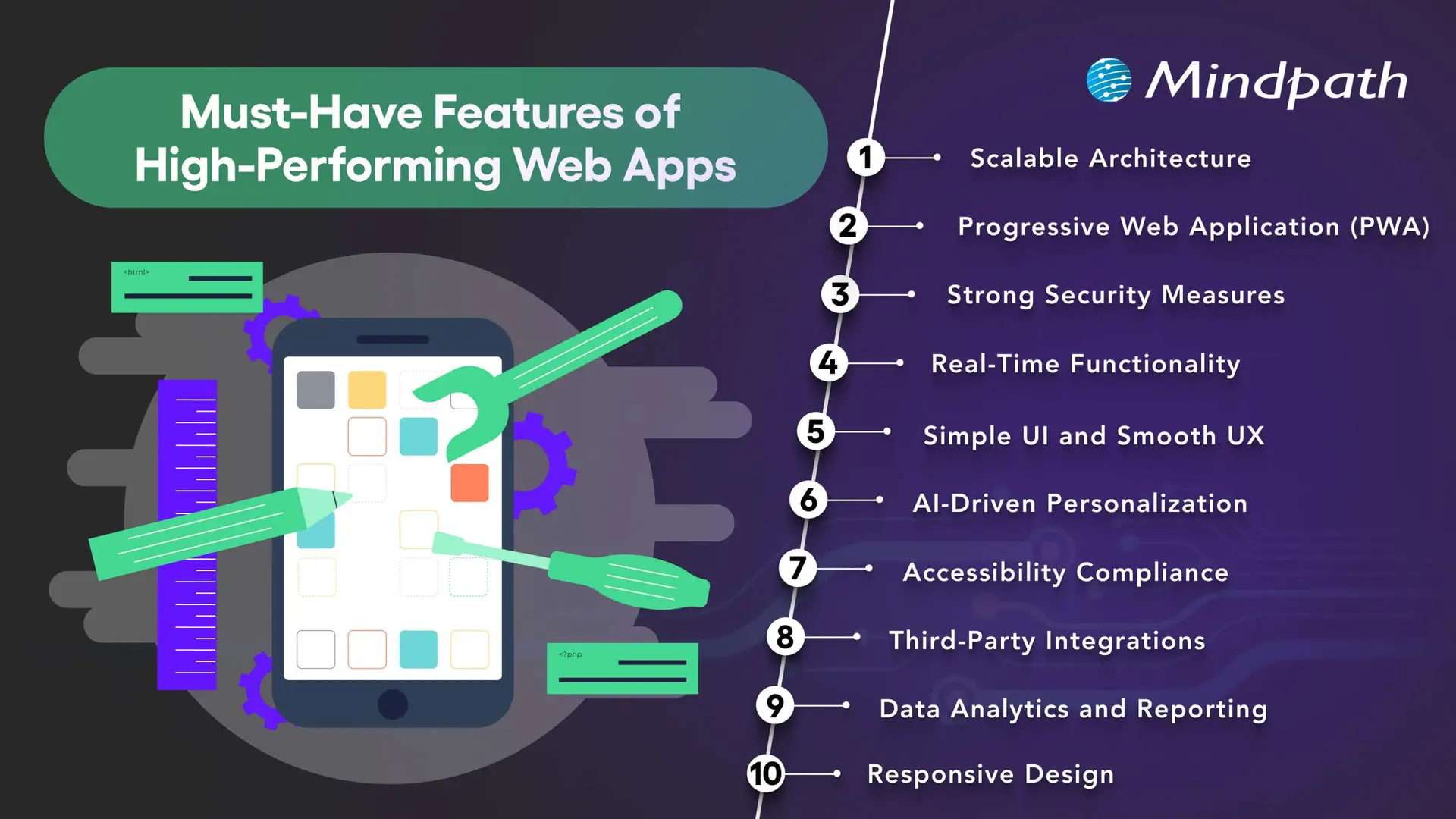
10 Must-Have Features of High-Performing Web Apps

To deliver speed, security, and usability, high-performing web applications rely on the right web app features. Nowadays, web and app development is always changing, and these features are the key to ensuring sustained success and satisfaction for users.

10 Must-Have Features of High-Performing Web Apps

1. Scalable Architecture

Growth is a keystone for any company, and scalability is what allows your web application to accommodate that growth smoothly. Proper use of cloud hosting services, load balancing, and microservices allows it to manage the increase in traffic without performance issues. Furthermore, having scaled and designed your application to work well in large increments means you will not have to completely rebuild your system as demand rises. This is one of the essential features of successful web app development.

2. Progressive Web Application (PWA)

PWAs are the perfect blend of web and mobile experiences wrapped up in one platform. They consult faster, work offline through service workers, and provide app-like usability without the hassle of installation. Research shows the PWA market is growing at a rapid pace, with a healthy number of adoptions across all industries for you to find yourself chasing. Digital solutions via a PWA will be one of the top features of web apps in 2026.

3. Strong Security Measures

Security is never optional in our current online world. Features such as SSL encryption, multi-factor authentication, and continuous vulnerability assessment are essential components of web application security to protect private data. Users want an application that they know they can trust to keep their personal and financial information safe. With web application development, security should be the foundation, not an afterthought!

4. Real-Time Functionality

Real-time updates make applications more engaging and exciting for users. Whether these components come by the way of a live chat, instant notifications, or live data streaming, users enjoy being connected without the potential delay. Businesses reap the advantages of more efficient communication systems and a greatly improved customer support system. This is just one of the many standard web app features users pretty much expect now.

5. Simple UI and Smooth UX

A clean interface and seamless navigation encourage apps to be more enjoyable as well as productive. A user is more likely to be happy using an app when there is an intuitive design with predictable layouts, immediate access to feature menus and categories, and effortless navigation. Well-consulted user experience reduces tension and frustration through session length, increases retention and creates a lasting positive experience. This is why simple and intuitively designed UX is up there with the essential features of successful web app design.

Want to know what makes users stay longer on web apps? Discover the latest UI/UX design trends in web application development, shaping high-performing apps in 2026.

6. AI-Driven Personalization

Artificial Intelligence is effectively powering personalization in web applications today. AI looks at data about users, makes content recommendations, predicts behavior, and enhances the accuracy of searches. As a result, interactions are smarter, which increases user satisfaction and retention. The use of AI in web development enables these AI-based personalized experiences, making them exceedingly valuable in the web app ecosystem and establishing them as one of the best web app features.

7. Accessibility Compliance

Achieving accessibility guarantees inclusivity among all users, including users with disabilities. Accessibility requires features like keyboard navigation, text-to-speech, high-contrast designs, etc. Accessibility makes sense because it helps all users online. Additionally, following web accessibility guidelines when creating websites, apps, and systems based on WCAG standards is the right thing to do and creates goodwill and trust across a larger audience. Accessibility is now one of the core features of successful web app development.

8. Third-Party Integrations

Modern web apps must be compatible with other tools. Payment gateways, analytics tools, and social media APIs are just a few examples of third-party integrations that greatly reduce the burden of burdensome workflows and subsequently speed things up. Third-party integrations enhance versatility and create a better user experience. Needlessly, for website application development, third-party integrations are vital in furnishing genuine value.

9. Data Analytics and Reporting

Analytics gives businesses actionable insights into user actions. They can monitor user behavior through dashboards, heatmaps, and customized reports to observe how users interact with the application. Leveraging that information can get a business closer to improving its services, maximizing its marketing, and strengthening performance. That’s why reporting is one of the most impactful web app features today.

10. Responsive Design

Responsive design is not optional, given that the majority of users are accessing the Internet with their mobile devices. A web app must be responsive across desktops, tablets, and smartphones. Responsive design means lower bounce rates, improved SEO, and better engagement. It is one of the top features of web apps that continues to be relevant in the long game for success.

Worried about vulnerabilities in your apps? Learn application security best practices for web and mobile apps to protect your users and data.

How to Develop a Web Application?

A web application is a direct bilingual service and bridge from your business to users in the interactive space; it supports developing seamless interactions, dependable functionality, and useful user experiences.

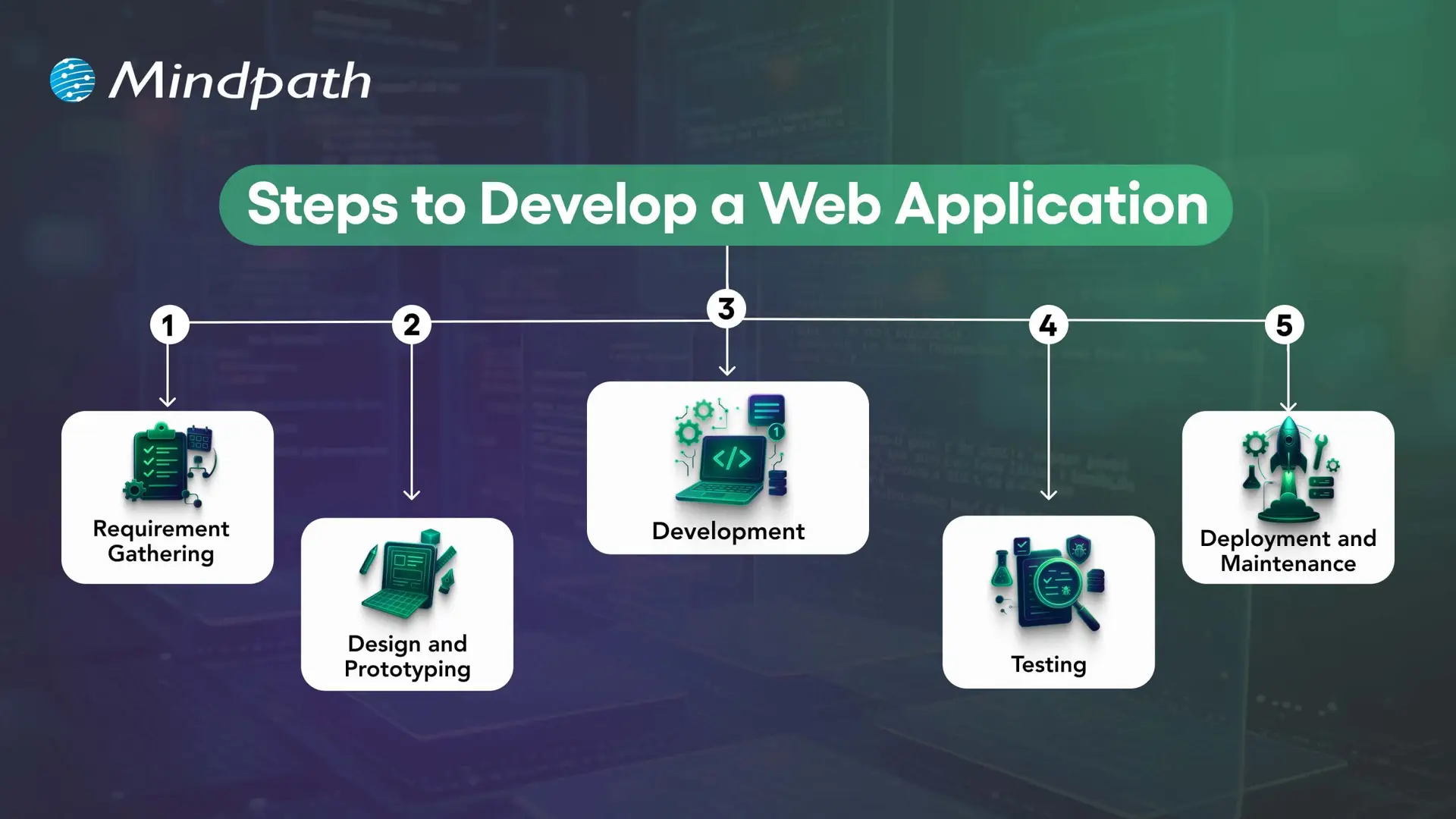
Steps to Develop a Web Application

1. Requirement Gathering and Planning

This phase analyzes the purpose of the application and the problem trying to be solved. The product objectives are informed by market research, planning the workflows, and a listing of web app features to ensure that the project begins with direction and clarity.

2. Design and Prototyping

The process of wireframing, mock-ups, and prototypes allows for the visualization of the layout, user flow, and interface design. This will be further supplemented with rigorous planning around the database and system architecture. This will ultimately provide a basis for functional and performance forms.

3. Development

Frontend development emphasizes crafting interactive and user-friendly interfaces. Backend development manages business logic, APIs, and data maintenance, and provides the groundwork for developing the functionalities of web applications.

4. Testing

Unit and integration testing assure both that the individual pieces work and that they work together. User Acceptance Testing ensures that the application meets the expectations of the user, while also performing reliable activities.

5. Deployment and Maintenance

The application will be deployed to the server and accessible to users, with ongoing monitoring, and promoted to production and changes. Maintenance will consist of bug fixes, upgrades, and implementation of new web app features based on changes in business needs.

Struggling with one-size-fits-all solutions? Explore custom web applications development for tailored functionality and seamless user experience.

Want to Create a Future-Ready Web Application?

In 2026, the success of any web application will depend on the strength of its web app features. Scalability, security, personalization, and responsive design are no longer optional but critical. Businesses that embrace these essential elements will be able to deliver seamless experiences, engage users effectively, and stay ahead in a competitive digital environment.

At Mindpath, we specialize in web application development tailored to your business goals. Our expertise ensures applications are secure, scalable, and built with the right web app features for long-term success. With a focus on innovation and usability, we deliver solutions that empower businesses to engage customers better and unlock real growth. Connect with us today to get started.

Related Post

Discover why ReactJS is perfect for Progressive Web App (PWA) development. Learn how Mindpath can help you build high-quality PWAs.
Discover how augmented analytics revolutionizes business intelligence with real-time insights, smarter decisions, and data democratization for faster growth.

Related Post

web application security

In the fast-paced digital era, a secure web application is the foundation of a reliable online business. Web application security ensures sensitive data remains protected, prevents cyber threats, and supports uninterrupted operations. Without robust protection measures, even high-performing applications are vulnerable to breaches that can disrupt business continuity and compromise user trust.

The importance of web application security goes far beyond preventing attacks. It supports compliance with regulations, protects brand reputation, and ensures consistent user experiences. Without it, businesses risk downtime, financial losses, and reputational harm. By prioritizing robust security strategies, companies position themselves for long-term success in an environment where trust and reliability define competitiveness. Are you interested in knowing more? In this blog, we will walk you through how you can protect your web application while, at the same time, building stronger trust with your customers. Keep reading to explore!

Looking for a web application that prioritizes both performance and security? Our web development services can help you explore how we can help you achieve your business goals.

What is Web Application Security?

When we talk about the definition of application security, we simply mean protecting your web applications from unwanted threats, attacks, and misuse. In other words, it focuses on keeping your applications safe. It guarantees that your data is safe, hackers are kept out of reach, and your online platforms run smoothly without any difficulty or fear. These protections start during the design and development stages of your application and continues even after the application goes live so that it is kept secure over time.

Interestingly, a report from Fortune Business Insights shows that the global application security market was valued at USD 8.86 billion in 2022 and is forecasted to reach USD 25.30 30 billion by 2030. The continued increase shows that the business community is increasingly coming to terms with security as a necessity to protect its operations, to protect sensitive information, and to protect the trust of customers in an online space.

Concerned about rising threats and how AI can help your security strategy? Explore our blog on AI in cybersecurity to discover AI‑driven approaches that boost threat detection and resilience.

Most Common Web Application Threats

Let us have a clear look at some of the most common web application security risks that each and every business should have an idea of, to keep their online platforms safe:

Most Common Web Application Threats

1. Security Misconfiguration

This usually occurs when your web application security settings are wrong or incomplete, leaving the app open to attacks.

2. Broken Access Control

This happens when users can access data or features they should not be allowed to see or use.

3. Cryptographic Failures

This occurs when sensitive data is not encrypted properly, making it easier for attackers to steal.

4. Injection Attacks

This occurs only when attackers insert malicious code into your application through the input fields or forms.

Can a better user interface design also improve security awareness in apps? Discover UI/UX design trends in web application development to learn how thoughtful design can enhance both usability and security.

5. Insecure Design

This usually means that your app’s basic design has weak points that can be easily exploited by hackers.

6. Failures in Logging and Monitoring

When you have security issues that are not logged and monitored, your attacks will go unnoticed.

7. Vulnerable and Outdated Components

This is when your apps use old or unsafe software parts that hackers can target easily.

8. Identification and Authentication Failures

This happens when you have weak login systems, which make it much easier for an attacker to steal your user accounts.

Unsure how the technology you pick affects your application’s security posture? Read our guide on choosing the right tech stack to discover how secure, scalable technologies support safer web app development.

The Importance of Web Application Security

Robust web app protection is absolutely vital to protect your organization from online attacks and data loss. When you pay for your web app security, you are protecting sensitive information and building trust with your customers, while ensuring your operations are running smoothly.

The Importance of Web Application Security

1. Safeguarding Valuable Information

Web applications collect sensitive information such as customer data, payment information, and company documentation. Any exposed information by attackers can be stolen and improperly used. Good web application security utilizes encryption, secure storage, and restricted access to protect the information.

2. Building and Keeping Customer Trust

When people use your online services, they trust you with their private information. A breach of security can cause that trust to break and hurt your business’s reputation. By focusing on web application security, you contribute to two goals: to show the customer that privacy and safety are important to you.

3. Protecting Against Financial Loss

Cyberattacks can cause massive damage to finances, from stolen funds to expensive recovery steps to legal fees, and also regulatory fines. A proper investment in web app security protects those risks and your profits.

4. Meeting Legal and Industry Standards

Numerous sectors must comply with strict data protection requirements. Failing to meet these requirements can result in costly fines and a loss of reputation. The web security basics and continual assurance will demonstrate that your web secure application meets these requirements..

5. Preserving Your Brand Reputation

A single security incident can tarnish your brand identity for years. Once lost, customers may not trust your company again, and negative word of mouth spreads quickly. By prioritizing web application security, you can avoid this type of loss and continue to preserve brand integrity.

6. Staying Ahead of Cyber Threats

Cybercriminals are always trying to exploit any weaknesses in an application. Regular web application scanning and updates may close off the weaknesses before an attacker finds them. Using a trusted web application vulnerability scanner allows you to improve your system.

7. Ensuring Service Continuity

Some ransomware and malware attacks are meant to stop or disrupt your online services. DDoS protection, load balancing, and secure configuration can keep your platform running. There are reliable web security applications to protect against these problems and keep your business producing.

Want to make sure security is built into every phase of your web development process? Explore our web app development roadmap for 2026 to discover how planning with security in mind improves reliability and trust.

Essential Best Practices for Strong Web Application Security

Securing your online properties requires more than basic protection. By implementing web application security best practices, organizations can reduce risks, better protect sensitive data, and provide a safer, trusted experience for each user.

Best Practices for Strong Web Application Security

1. Strong API Gateway Controls

APIs should be protected with advanced rate limiting that adapts to user behavior, not just request counts. Tools like Kong or Envoy help apply different limits per endpoint while blocking abusive traffic patterns without slowing legitimate users.

2. Robust Input Validation

Validation must match the exact place where data is used, such as in SQL, HTML, or JavaScript. This means building rules for each context and scanning all inputs like headers, cookies, and hidden fields to block malicious payloads.

3. Layered SSRF Protection

SSRF attacks can trick servers into accessing internal systems or cloud metadata. Use strict allowlists, block private IP ranges, and inspect resolved IPs to prevent bypass tricks hidden in DNS lookups.

4. Dependency Risk Management

Not all vulnerabilities in dependencies are equally dangerous. Context-aware scanners like OSV or npm-audit help you find and fix the risks that truly matter to your application’s security.

5. Implement Zero Trust Access

Never assume a request inside your network is safe. Segment services, enforce mutual TLS, and verify identity for every request to reduce the risk of internal compromise.

Concerned about app vulnerabilities? Read application security best practices to learn proven ways to strengthen security across platforms.

Are You Ready to Strengthen Your Web Application Security?

In today’s digital world, investing in strong web application security is no longer optional. By understanding common threats and implementing proven best practices, you protect sensitive data, maintain customer trust, and keep your online services running without disruption. The earlier you act, the stronger your defense against costly cyberattacks will be.

At Mindpath, we create secure, high-performing web applications designed to withstand evolving cyber threats. Our web application development process integrates advanced web application security measures from planning to deployment, ensuring your platform is protected and reliable. With a tailored approach, we help your business deliver safe, seamless user experiences while meeting compliance and performance goals.

IT Staff Augmentation

Are you facing challenges in scaling your projects effectively? What if you could quickly expand your team with specialized IT professionals, tailored to your project needs? IT staff augmentation offers a powerful solution to enhance your project scalability. By bringing in external experts, you can adapt to changing demands, accelerate timelines, and ensure your projects achieve their full potential. Curious about how this approach can transform your project outcomes? In this blog, we will explore the impact of IT staff augmentation on scalability. 

Scalability indicates that a system or process can handle additional work without slowing down or sacrificing quality. When it comes to software development and IT, staff augmentation can help projects scale up. With staff augmentation, a project can grow and adapt to meet new demands or obstacles. Scalability is the capacity of a project to grow or decrease in response to the needs of the business. A scalable project can accommodate extra tasks, users, data, and features without requiring significant modifications to its core structure. This implies that scalability enables a project to expand and adapt alongside the business, allowing it to remain competitive and achieve its objectives. 

So, let’s dig in to explore how IT staff augmentation transforms project scalability! 

How IT Staff Augmentation Transforms Project Scalability

1. Immediate Access to Skilled Professionals

Staff augmentation allows businesses to quickly and easily hire exceptional workers with specialized skills and knowledge. This is especially useful when firms need to upgrade their operations or handle increased workloads. With staff augmentation, businesses can bring in professionals who understand the specific procedures or methodologies necessary for a project, allowing them to hire the appropriate people at the right time. 

Quick access to skilled labor has a significant influence on project scalability. It enables businesses to simply add more team members or resources as a project expands or cut them when things slow down. For example, if a firm suddenly needs extra developers or engineers for a project, they can use it rapidly through staff augmentation, bypassing the lengthy hiring procedure.  

Once the project is completed, they can swiftly reduce back without the hassle of layoffs or long-term commitments. This adaptability guarantees that businesses can complete their projects faster and more efficiently. Instead of battling to recruit the proper personnel or straining their existing team too thin, staff augmentation offers a straightforward approach to expand teams and resources based on business objectives, allowing projects to go easily and without delay. 

2. Cost-Efficient Project Scaling

Cost-effective scaling enables businesses to develop their initiatives without incurring significant or unneeded costs. When a project requires more resources, such as more developers, designers, or industry experts, staff augmentation can be an effective alternative. Instead of recruiting full-time personnel, which can result in long-term fixed expenditures such as salary, benefits, and training, staff augmentation offers a more flexible and cost-effective solution for meeting project objectives. 

Staff augmentation allows businesses to recruit experienced specialists such as software engineers, graphic designers, and data analysts based on the project’s unique requirements. For example, if a project unexpectedly requires extra developers to fulfil a deadline or specialists in a specialized industry, the firm might bring them on board temporarily. Once the project is over, these specialists can be discharged, allowing the organization to reduce its resource requirements without making long-term commitments. 

This technique is cost-effective since it alleviates the financial burden associated with recruiting permanent staff, such as onboarding, training, and benefits. Companies may successfully manage their budgets while ensuring that they have the required skills to expand their projects by only paying for services as needed. Staff augmentation is a flexible, scalable approach that enables firms to fulfil project objectives without stretching their budget. 

3. Flexible Resource Management

Flexible resource allocation is one of the most significant benefits of IT staff augmentation. As project goals and demands shift, or new obstacles arise, staff augmentation enables businesses to seamlessly manage their teams and resources. This flexibility allows project managers to bring in the right individuals at the right time, based on the project’s current requirements. 

For example, if a project unexpectedly requires extra developers or specialized specialists, staff augmentation allows you to swiftly add those people to the team. If the project completes a phase or a job, the excess team members can be released or reallocated, ensuring that the organization is not overstaffed. This flexibility implies that the team’s size and expertise can change as the project progresses, ensuring that the project remains on track and achieves its deadlines. 

Staff augmentation assists businesses in adapting to shifting needs by efficiently assigning personnel without wasting time or money. It enables more efficient project execution by allowing you to alter team size and capabilities to fit the project’s specific timetable and requirements. 

4. On-Demand Specialized Expertise

Specialized expertise on demand is a significant advantage of staff augmentation. It enables businesses to bring in specialists with specialized skills and knowledge as needed for a project. These professionals can make significant contributions, whether by addressing complicated problems, bringing advanced technical skills, or proposing new ways to improve the project. 

Access to these specialized individuals allows existing team members to learn and improve. Working with these specialists can provide them with new abilities and insights, which can help them perform better overall. This exchange of expertise benefits the team in the long term. Furthermore, this expertise is especially useful when a project encounters dangers or problems. Their knowledge enables them to promptly resolve issues or manage any technological obstacles that can hinder the process. This guarantees that the project will continue to develop and flourish without severe disruptions, allowing the business to fulfil its objectives. 

Also Read: What Are The Primary Benefits Of IT Staff Augmentation Services Compared To Traditional Hiring Models?

Staff Augmentation Services at Mindpath

At Mindpath, we deliver the best IT staff augmentation solutions in the USA, allowing companies to scale and succeed. It is indeed our mission to integrate skilled professionals seamlessly into your team in ways that increase your capability and ensure that you can effectively deliver your project goals. Be it lending a helping hand for a specific project, having the right expertise on modernizing your technology, or being on the lookout for ways to design robust software systems, Mindpath has the right solutions for you. Here are some of our services:   

1. Dedicated Development Teams

We can provide you with experienced developers, integral parts of your team, to help with supplementary expertise and faster projects’ timeframes. Our developers blend in perfectly, ensuring smooth collaboration and delivery of results.   

2. Legacy Modernization

We can upgrade and modernize your old technology so that it can work with the best standards of today. We provide services such as an assessment of your existing systems, technology upgrade, data migration, and performance enhancements.   

3. Architectural Consultation

We consult on the design of robust and scalable software systems. Whether you are kicking off a new project or looking to better existing systems, we will help you build a solid ground and choose the best-suited technology for your needs. 

Final Thought!

IT staff augmentation is a powerful way to boost project scalability by providing quick access to skilled professionals, flexible resource management, cost-effective scaling, and specialized expertise on demand. With these benefits, businesses can efficiently adapt to changing project demands and achieve their goals without the long-term commitments of hiring full-time staff. At Mindpath, we offer tailored staff augmentation solutions to help companies scale and succeed with ease. Whether you need dedicated teams, legacy modernization, or architectural consultation, Mindpath is here to support your growth and success. 

Ready to scale your projects effectively? 

Partner with Mindpath today to explore our IT staff augmentation solutions and unlock your project’s full potential!

Discover how IT staff augmentation boosts project scalability with quick access to talent, cost-effective scaling, and expert support.
WordPress Security Plugins

Operating a website means managing constant threats that are trying to invade your data and ultimately ruin all of your hard work. This brings us to selecting the perfect WordPress security plugins, which is a necessary action for anyone who owns a website. Instead of taking risks, it’s always better to be one step ahead and protect your site with the best tools available to you that won’t compromise site performance. Ultimately, your site should have strong protection that does not detract from performance.

There is no doubt that, with intelligent attacks being developed and stronger defences put in place in 2026, there is an urgent need for updated solutions. You cannot just depend on old methods and expect them to still work. So again, the smarter choice is to explore plugins and services that professionals worldwide test, prove, and depend on. By using the best plugins and services, you will protect your site and continue its growth without interruption. In this blog, we are going to discuss some of the best security plugins for WordPress, which can protect your website in the best way.

Want to strengthen your WordPress site’s security and performance? Mindpath offers WordPress development services, providing expert assistance in building a safe and high-performing website. 

What are WordPress Security Plugins?

WordPress security plugins are tools that you install on your website to protect it from common internet threats. These tools perform functions such as scanning for malware, preventing harmful traffic, and blocking brute-force attempts. These plugins add a layer of protection to your site from malicious behavior and can help prevent serious security issues for WordPress.

These plugins enhance security by providing login protection, firewall capabilities, and monitoring for suspicious activity. The plugins protect websites in real time to interrupt hackers before they cause damage to your website. Using the right plugin can mitigate WordPress security problems early to ensure the site is running smoothly.

Worried about exploits that bypass basic WordPress security plugins? Discover safeguarding common WordPress vulnerabilities to check out best practices for stronger site defense.

Best WordPress Security Plugins in 2026

When it comes to ensuring the safety of your site, the proper security tools can make a huge difference. Here are the best WordPress security plugins in 2026 that effectively combine advanced defense with consistent performance for meeting today’s increasing online threats.

1. Wordfence Security

Wordfence Security provides protection for your site against the most common WordPress security issues by offering powerful features like a firewall, malware scanner, and brute force protection. It allows you to monitor your site by having live traffic information, login logs, and detecting suspicious activity, so you can identify and stop a threat before it can become an issue. Developers will also like Wordfence for its multi-site licenses, and other helpful features like comment spam filters and login security, which make it easy to keep all of your sites secure.

2. MalCare Security

MalCare Security is among the top WordPress security plugins that secures your site with cloud-based malware scanning, bot protection, and login security. It enables you to remove malware with a single click and blocks suspicious traffic to protect your WordPress security. The plugin monitors uptime, sends alerts when you have a problem, and does this while staying light so your website remains fast and fully secured.

Want to ensure your WordPress site is accessible to every user while staying secure? Explore our blog on web accessibility guidelines to learn how inclusive design strengthens user trust.

3. All In One WP Security & Firewall

The All-In-One WP Security & Firewall protects your website against many common WordPress security problems by enhancing the security of user accounts, login pages, and database files. The plugin has transparent graphs, which show the strength of your site’s security, and makes recommendations for improvement, so it’s useful for both novice and advanced users. As a free WP security plugin, it also blocks intruders, hides sensitive information from your site, and allows an emergency lockdown by making your site unavailable.

4. SecuPress

SecuPress is one of the best security plugins for WordPress that protects your site against malware, viruses, and suspicious activity. It offers protection against brute-force logins, blocking IP addresses, and bot protection to add layers to your website’s security. It is user-friendly, gives you security alerts when something is wrong, and scans your website in detail. In short, this plugin gives you the best control over your website’s protection.

5. BulletProof Security

BulletProof Security is a feature-rich WordPress security solution that adds a layer of security to your site with login security, database backups, malware scanners, and anti-spam features. Additionally, unique features such as folder hiding, intrusion detection, and maintenance mode expand the protection of your website. There are free and premium features that allow developers and site owners to effectively handle security.

Concerned about plugin conflicts caused by WordPress and PHP version mismatches? Check out WordPress and PHP compatibility to learn how proper alignment keeps your site secure and stable.

6. Sucuri Security

Sucuri Security is among the most reliable plugins for WordPress security, shielding your website with malware scanning and integrity checks, as well as security hardening. It observes activity and alerts you in real-time about issues that could affect your website or business. The plugin includes premium features in conjunction with your free download such as advanced firewalls, DDoS protection, and post-cleanup reports as all-encompassing tools for the management and protection of your website, regardless of the attack scenario.

7. Shield Security

Shield Security is a trustworthy WordPress security solution that protects your web from hacks, bots, and intrusions. It activates immediately to protect your site and provides features such as brute-force protection, firewalls, and two-factor authentication. Shield actively repairs any threats it detects, monitors traffic, and gives professionals advanced scans for deeper security.

8. WP Activity Log

WP Activity Log is a WordPress security plugin that monitors and records all actions on your website in real time. It keeps a record of all changes made to posts, pages, user profiles, and plugins allowing you to identify irregular activity and solve problems fast. The plugin tells you who made each change, notifies you when an issue arises, and allows you to keep your site secure by managing your users easily.

Ready to move beyond plugins for stronger and more flexible WordPress security? Discover custom WordPress development to check out how custom builds enhance site protection.

9. WP Fail2ban

WP fail2ban is a WordPress security plug-in that protects your site against brute force attacks by monitoring and logging all login attempts and blocking suspicious users from logging in to your site. It can ban users either hard or soft. The plug-in also integrates with Cloudflare (the only plugin on this list to do so), provides more surface area on WordPress multisite sites, and enhances security accordingly. WP fail2ban tracks spam, comments, and other user activity on your site, and helps to prevent attacks from reaching your login page.

10. VaultPress

VaultPress is a security plugin for WordPress that provides real-time and daily backups to keep your site secure. It allows you to quickly restore files with just one click. It keeps track of suspicious activity and provides detailed stats, logging every backup and restore action for better tracking. VaultPress will also make incremental backups, allow you to create multiple versions of your site’s data, and give you complete control of your site’s security and data.

Planning to move beyond basic plugins for long-term WordPress protection? Check out why it makes sense to hire a WordPress developer for stronger security.

Are You Ready to Secure Your WordPress Site?

Keeping your website safe is critical in 2026. Using the best WordPress security plugins ensures protection from malware, hackers, and suspicious activity while keeping your site fast and reliable. Choosing the right plugins helps you monitor, block, and repair threats. Also it gives you confidence that your website remains secure and operates smoothly for visitors and users.

At Mindpath, we offer expert WordPress development services to help you build secure, high-performing websites. Our team integrates reliable security solutions, custom features, and regular monitoring to prevent WordPress security issues. We focus on creating sites that are fast, scalable, and safe, allowing your business to grow confidently while keeping your data and visitors protected from online threats.</p>