
How Sustainable DevOps is Shaping the Future of Software Development

Join our Newsletter!

Featured Posts

Support Is One Click Away

Home

How Sustainable DevOps is Shaping the Future of Software Development

Sustainable DevOps

How Sustainable DevOps is Shaping the Future of Software Development

Have you ever wondered how DevOps practices can be both efficient and environmentally friendly? As technology evolves, so do our approaches to software development—and sustainability is now a key part of the equation. In this rapidly changing world, what role does Sustainable DevOps play in shaping the future of software development? Let’s explore how adopting eco-conscious strategies can transform the way we build, deploy, and manage applications. 

What is Meant by Sustainable DevOps?

Sustainable DevOps, also known as green DevOps, aims to make software development and delivery more ecologically friendly. It entails implementing strategies that decrease energy usage, waste, and the carbon footprint of DevOps operations. This involves optimizing the use of servers and cloud resources, automating operations to decrease human labor, and selecting environmentally friendly solutions. Teams can lower their environmental effect by making wise decisions such as decreasing the need for excessive computing power, deploying energy-efficient data centers, and using sustainable tools. Sustainable DevOps aims to strike a compromise between the requirement for rapid and efficient software delivery and the duty to safeguard the environment. As businesses become more conscious of their ecological impact, integrating sustainability into DevOps processes is becoming increasingly important for establishing a greener future while maintaining high-quality software.  

Advantages of Sustainable DevOps

1. Improved Regulatory Compliance

Governments and organizations throughout the world are enacting new regulations to encourage eco-friendly behaviors and prevent environmental harm. Following these guidelines is not an option for organizations; it is required to avoid penalties and reputational damage. Sustainable DevOps assists businesses in meeting environmental standards by improving the sustainability of their software development and delivery operations. Businesses may better match their activities with these requirements by implementing energy-efficient technologies, optimizing resources, and eliminating waste. This reduces the likelihood of sanctions or public outrage for failing to fulfil environmental standards. At the same time, it communicates to customers, suppliers, and stakeholders that the organization is dedicated to sustainability. Businesses that use sustainable DevOps not only remain compliant, but also establish a favorable reputation, fostering market confidence. This proactive approach ensures they are ahead of the curve, meeting legal requirements while contributing to a greener planet. 

2. Enhanced Competitive Edge

Customers and stakeholders are increasingly choosing which firms to support based on sustainability. People are increasingly preferring firms that care about the environment and actively lower their ecological footprint. Businesses that implement sustainable DevOps practices can demonstrate their commitment to building a greener future and taking significant action for our planet. This dedication distinguishes businesses from competition, attracts environmentally concerned clients, and strengthens ties with investors who value sustainability. A sustainable strategy also promotes a favorable brand image, which increases customer trust and loyalty. It also displays the firm as an industry leader who thinks forward and is responsible. In today’s economy, where customers “vote with their wallets,” adopting sustainable DevOps not only benefits the environment but also improves a company’s reputation, customer base, and long-term growth potential, making it a smart and impactful business strategy. 

3. Increased Resilience and Longevity

Sustainability is more than simply solving today’s environmental concerns; it is also about preparing businesses for the future. As environmental concerns rise and customer expectations shift, businesses that use sustainable DevOps practices position themselves for long-term success. Businesses can lower their reliance on finite materials and adapt to an increasingly sustainable environment by focusing on energy efficiency, waste reduction, and resource optimization. Sustainable DevOps also assists firms in mitigating environmental risks such as tougher legislation or resource scarcity, ensuring that their operations stay stable and efficient over time. This forward-thinking strategy not only saves the environment, but it also builds a solid basis for future prosperity. Businesses that embrace sustainability now are more likely to succeed tomorrow, maintaining their competitiveness and relevance in a continually changing environment. Sustainable DevOps is, thus, a key strategy for building resilience and ensuring the longevity of modern enterprises. 

4. Reduced Costs

When DevOps operations are not properly managed, they can use a lot of resources, such as electricity to power servers and infrastructure and supplies for hardware. Adopting sustainable DevOps methods enables firms to use these resources more efficiently, resulting in significant cost reductions. Companies can save energy and money by optimizing server utilization, automating procedures, and minimizing waste. For example, implementing energy-efficient infrastructure and cloud solutions lowers power expenses, whilst extending hardware lifespan lowers replacement costs. Sustainable DevOps is not just good for the environment; it is also a wise financial decision. Lowering operational expenses while maintaining high-quality services enables firms to redirect savings into innovation and development. This cost-effective method helps organizations achieve their goals while staying environmentally responsible, proving that sustainability and profitability can go hand in hand. 

DevOps Services at Mindpath

Mindpath offers DevOps services that will make your software development process faster, smoother, and more efficient. Our strategy combines development and operations teams, allowing firms to produce high-quality software rapidly while decreasing mistakes. To increase total efficiency, we automate repetitive processes, streamline procedures, and optimize resources. From establishing continuous integration and delivery pipelines to managing cloud infrastructure, we assure your systems’ dependability and scalability. Our skilled staff additionally prioritizes monitoring and maintenance to ensure that your apps work smoothly. We help you respond to changes faster and fulfil your business goals more easily by utilizing cutting-edge DevOps technologies and methods. Mindpath’s DevOps services provide you with a partner who assures efficiency, dependability, and innovation at all times.  

Final Thought!

Sustainable DevOps is reshaping the future of software development by combining efficiency with environmental responsibility. It helps businesses stay compliant, improve their competitive edge, and reduce costs while ensuring long-term resilience. At Mindpath, our DevOps services support your commitment to sustainability, helping you streamline processes, cut operational costs, and build a greener future. Let’s work together to create efficient, eco-friendly software solutions that drive both success and sustainability. 

Ready to embrace Sustainable DevOps?

Partner with Mindpath to optimize your development processes and drive eco-friendly innovation today!

Related Post

Discover how Generative AI is revolutionizing customer service with automation, efficiency, enhancing customer experience and more.
How much does hiring a ReactJS developer cost? Learn about factors affecting rates, and how to find the best talent within your budget.

Related Post

full stack development

Software development has evolved beyond the traditional approaches that required separate frontend and backend development teams. The need for full-stack development is evident in the new digital landscape, where user requirements and business goals change in an instant. Full-stack software development offers a strategic option to develop user-friendly and robust applications without paying a fortune.

With the growing competition to establish a strong digital presence, business owners must pick a reliable development approach, like full-stack. However, it is also important to learn what full-stack software development entails before embracing it. Let us discover more about the full-stack approach and how businesses can use it to develop their software applications.

Thinking of adopting full-stack development for your next project? Mindpath’s full stack development services will help you with the integration of front-end and back-end expertise that your business needs.

Understanding Full Stack Fundamentals

Full-stack has emerged as the most valuable strategy for software development that allows businesses to meet the emerging user requirements and business goals. It follows an end-to-end approach for developing software applications, involving both the frontend and backend. The answers to “What is full-stack development?” also emphasize how it can enhance cost-effectiveness, agility, and efficiency. You can understand full-stack in a better way by breaking it down into the two primary components.

1. Frontend Development

The frontend development deals with the client-side aspect of the application, or the part of the application that users see. It includes everything a user sees of an application on their smartphones or web browsers. The important elements of the frontend of an application include the design, images, layout, navigation menus, buttons, text, and anything that users can interact with.

The most important technologies for frontend development in the full-stack approach include HTML, CSS, and JavaScript. In addition, full-stack developers must also have a strong command of frontend frameworks and libraries. HTML serves as the foundation for arranging web content, while CSS helps in styling the interface by controlling fonts, layout, responsiveness, and colors.

The search for answers to “what is full-stack web development” will also help you understand the significance of JavaScript. It is a popular programming language that helps developers add dynamic and interactive elements to web pages. Most important of all, frameworks and libraries like Angular, Vue, and React simplify frontend development while empowering developers to create complex user interfaces without sacrificing responsiveness.

Planning to use full-stack development for your next web project? Before that, read about the future of full-stack development for web projects

2. Backend Development

The backend of a software application focuses on the server-side aspects of the application, which drive its functionalities. Backend development deals with logic, communication, and data storage, which work in the background and are never visible to users. The full-stack development definition describes the backend as the “brains” behind the working of an application. The backend processes requests from the frontend, interacts with databases, and sends data back to the frontend.

Backend development for a software application requires fluency in programming, backend frameworks, server management, APIs, and database management. The notable programming languages used to create backend logic include Python, Java, Ruby, Node.js, and PHP. Developers should also know how to leverage the relevant backend frameworks for each programming language. For instance, Ruby on Rails is ideal for Ruby, while Express.js is for Node.js, and Django is the best backend framework for Python.

Also Read: Full-stack development with Node.js

Database management and server management are also integral requirements for full-stack developers. Backend development is incomplete without databases, as they help with the storage and management of application data. Database management may involve the use of relational databases like MySQL and SQL Server or NoSQL databases such as MongoDB. Backend development also requires an in-depth understanding of best practices for configuring and managing web servers. Another important requirement for backend development focuses on APIs that establish rules and protocols for communication between different software components.

The answer to such a question is quite obvious and points to any developer who knows frontend and backend development. One of the significant highlights in any full-stack developer definition is the proficiency in frontend and backend development technologies. On top of it, full-stack developers must be fluent in security practices and DevOps to offer productive end-to-end software development solutions. Full-stack developers know how every layer of an application works, thereby empowering them with a holistic view of the development process.

The versatility of full-stack developers makes them one of the most valuable resources for businesses in the new technological landscape. Full-stack developers can create responsive web layouts, implement database integration, manage testing and debugging, and write server-side logic. On top of it, they also work in collaboration with UI/UX designers and other teams to develop efficient applications.

Understanding the differences between front-end, back-end, and full-stack developers is key to building an effective development team. Learn more about the distinct responsibilities of each developer in our blog: Front-end vs Back-end vs Full-stack developer

Workflow of Full Stack Development

The definition of full-stack indicates that combining frontend and backend development can serve promising advantages for businesses. At the same time, it is also important to wonder about the workflow in full-stack projects. Where does full-stack begin, and how does it integrate frontend and backend development in a single workflow? You can find the answer by reflecting on the full stack definition once again, by focusing on the end-to-end aspect of the process.

Full-stack developers begin with the planning stage and end with the deployment and maintenance stage. The following steps in the full-stack workflow can help you understand how the holistic approach blends the traditionally different sides of software development.

1. Planning

The first step in the full-stack workflow involves planning and identifying essential features and technical specifications for the application. Full-stack developers collect information about essential requirements and understand the scope of the project. The developers also collaborate with different stakeholders to come up with an outline of the features desired in the application and its technical specifications.

2. Frontend Development

After finalizing the design, the next step in full-stack development focuses on the frontend of the application. The frontend development starts with a definition of the project structure and selecting the relevant technologies like HTML and CSS. The full-stack developer will implement the user interface in this step while ensuring accessibility and responsiveness.

At the same time, developers must ensure that the frontend complies with important design guidelines. The other crucial tasks in the frontend development stage include the creation of reusable components and the integration of backend APIs to fetch and display data.

Must Read: Full-stack Development Trends

3. Backend Development

The next step in the full-stack software development workflow focuses on backend development and integration of the backend logic with the frontend. Developers can create the backend of a full-stack application with server-side scripting languages like Python, Node.js, or Ruby. In addition, developers also employ the relevant database management system for the application according to its requirements.

Apart from creating and implementing the server-side logic, full-stack developers also create RESTful APIs and address data management needs. The backend development stage also calls for attention to the security and scalability of applications. Therefore, developers have to implement comprehensive authentication and authorization mechanisms and follow the best practices for data validation.

4. Testing

Before launching the application, full-stack developers will implement comprehensive testing plans to find errors and bugs. Developers have to define unit tests, end-to-end tests, functional tests, and integration tests to measure the utility of the application in different scenarios. Writing the tests in the early stages of development helps in creating applications that align with the desired goals and requirements of features. It also ensures that the application is easy to maintain, reliable, and adheres to the desired specifications.

Following the testing process, developers work to achieve seamless integration of frontend and backend components. The process involves establishing communication between the frontend and backend with uninterrupted data flow and error management. Full-stack developers rely on testing on a wide range of devices, scenarios, and browsers to identify and resolve performance issues. As a result, they can ensure easier integration of frontend and backend components without conflicts.

5. Deployment and Maintenance

The final stage in the full-stack workflow or deployment focuses on preparing the application for the production stage. The deployment stage involves the configuration of essential server environments and setting up continuous integration and continuous deployment pipelines with DevOps. Full-stack developers must also ensure that the application has been optimized for production in the deployment stage.

Some of the important requirements for deploying a full-stack web application include database migration, scaling to adapt to the user traffic, and server provisioning. Once the deployment is complete, developers monitor the application performance to identify any anomalies. If they find any issues, then developers will address them, followed by providing continuous maintenance and updates.

Hiring the right talent can make or break your MVP. Learn why hiring a Full-Stack Developer for MVP Success can make your product development faster and more efficient

Popular Technology Stacks for the Full Stack Developer

The doubts of a business owner before adopting the full-stack approach also focus on the choice of technology stack. Technology stacks refer to the combinations of technologies used by full-stack developers to create software applications. You must also know that the full-stack developer’s salary depends a lot on the candidate’s fluency in different stacks.

The most popular technology stack alternatives include MERN, MEAN, LAMP, LEMP, and Python-based stacks. Each stack features distinct technologies serving different roles in the development cycle.

1. MERN

The MERN stack represents the combination of MongoDB, Express.js, React.js, and Node.js. MongoDB serves as the NoSQL database while React.js offers the frontend development library. Node.js works as the JavaScript runtime for the backend, and Express.js is the relevant backend framework for it. Developers can work with a single programming language as all components in the MERN stack are JavaScript-based.

2. MEAN

The MEAN stack includes similar components to the MERN stack, albeit with the exception of the Angular framework for frontend development. It is a popular choice for full-stack web solutions due to Angular, which offers a more structured framework for frontend development. At the same time, developers can capitalize on the advantages of working with a complete JavaScript ecosystem in the MEAN stack.

3. LAMP and LEMP

The LAMP tech stack includes Linux as the operating system, Apache as the web server, PHP as the server-side programming language, and MySQL as the relational database. It is a traditional tech stack, implemented in content management systems such as WordPress. The LEMP stack is similar to LAMP, albeit with a different web server, Nginx, which offers high performance and efficient management of concurrent connections.

4. Python-based Stacks

Python is also one of the most popular server-side programming languages for its readability. The effectiveness of full-stack development with Python also depends on its comprehensive collection of libraries and strong community. Python-based stacks can use different Python web frameworks, frontend frameworks, and relational databases, depending on the project requirements. The common choices for Python web frameworks include Django and Flask, while frontend framework choices include React and Angular.

Looking to reduce time and costs, and take full advantage of full-stack expertise. Discover how Mastering Full-Stack Development with Node.js can help businesses in streamlining workflows as well as boost project ROI.

How Does Full Stack Help Your Business?

As a business owner, you might wonder if full-stack is an effective approach to software development. Businesses can capitalize on the full-stack development benefits to get best outcomes for their businesses.

1. Faster and Efficient Development

The most promising advantage of full-stack software development is the speed of development. It reduces the dependencies between isolated frontend and backend development teams as a single developer takes responsibility for multiple aspects of the project. Full-stack developers can achieve faster iterations, release features quickly, and ensure faster time to market for new products, services, and updates.

2. Cost Savings

The next notable highlight in full-stack developer skills is the ability to offer the services of frontend and backend developers, along with database specialists, in one package. Businesses don’t have to hire different professionals for these roles, which reduces the costs of recruitment, onboarding, and other operational costs.

3. Flexibility and Consistency

Another promising advantage of working with full-stack developers is the assurance of flexibility in agile environments that demand rapid changes. Full-stack developers will quickly adapt to address the requirement of urgent attention to specific areas of an application. On top of it, the unified and consistent architecture ensures easier integration between the frontend and backend components without compatibility issues.

Want to accelerate your development process? Explore how a freelance full-stack developer can create interactive user interfaces and oversee deployment and maintenance.

Final Thoughts

The value of full-stack development for any business is about following a holistic approach to software development. The unique approach not only reduces costs but also provides a solution to avoid delays and deliver the best user experiences in applications. With the support of a full-stack developer, your business can navigate through the complexities of the digital landscape with ease.

We at Mindpath specialize in end-to-end software development and have helped clients create intuitive applications in different industries. Our commitment to deliver the best results stems from our ability to understand the client’s requirements and identify the best resources for their projects. Contact us to figure out the ideal course for your next software development project.

full stack development trends

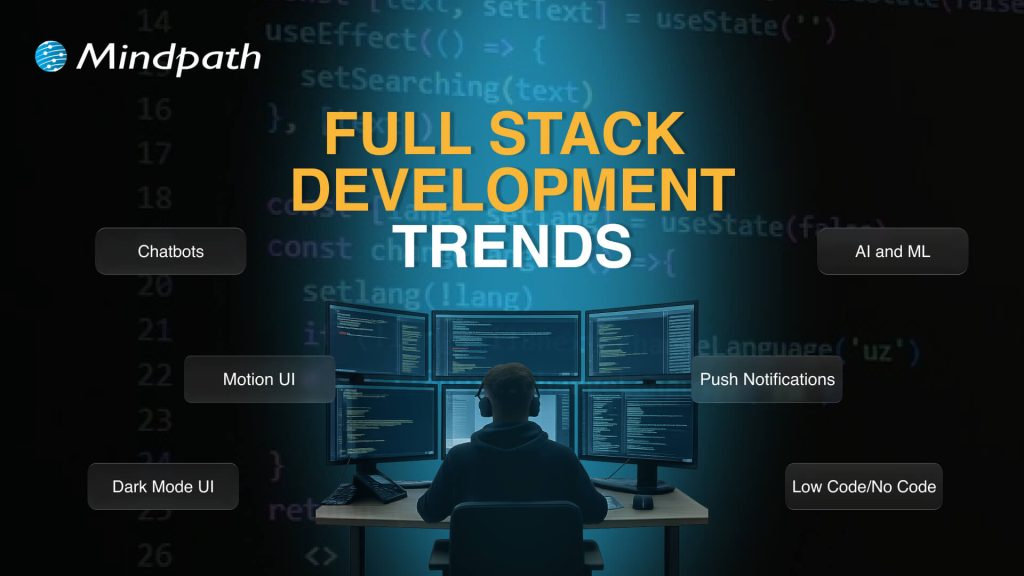
The full-stack development landscape is changing rapidly, and 2026 is already showing great possibilities for new ideas and better tools. Getting familiar with the newest full-stack development trends can help developers, startups, and businesses create smarter solutions. User needs are increasing, along with the requirement for flexible and efficient development solutions, which means teams are taking a fresh look at how they build, test, and scale applications. Knowing how to navigate these changes can have a significant impact next time whenever you develop a new item or launch a new product.

With speed, scalability, and seamless user experience as the new focus, developers are integrating advanced front-end technologies with back-end solutions to develop modern digital products. With cloud platforms available everywhere and low-code solutions evolving more rapidly, full-stack development is moving to a whole new level.  These solutions are transforming processes that not only save time but also improve quality and naturally foster greater teamwork. In this blog, we will provide further insight into the most important trends shaping full-stack development in 2026.

Looking to implement the advantages of full-stack development in your next project? Take a look at our full-stack development services, where our team will support and guide you to bring those benefits to the real world.

Understanding Full-Stack Development

Full-stack development refers to building both the front-end and back-end of a software application. Let’s dive in to understand! Every application has two main sections. The front-end is what users see and interact with, like buttons, images, and forms. The backend encompasses all the activities that take place in the background – saving data, running logic, interacting with other systems, etc.

Each side requires different skill sets and tool sets. Full-stack development combines both sides into one process. Full-stack development enables developers to create complete applications and allows us to develop the application seamlessly from the user interface through the server and database. This means that the application includes both of those components as one shared system, which makes development more efficient and organized.

Some advantages of full-stack development include:

  1. A full-stack developer saves money by doing both front-end and back-end work, minimizing the need for multiple specialists.
  2. They speed-up the development process by working across the entire tech stack, ensuring faster delivery and smooth collaboration.
  3. With strong knowledge of current tools and trends, they support modern full-stack development by integrating advanced features like AI and responsive design.
  4. Full-stack developers take full ownership of the codebase, simplifying responsibility and streamlining debugging.
  5. They deliver well-rounded, quality solutions by working across the UI, backend logic and business processes, database activities and data expansion, and testing.
  6. They even provide ongoing support and maintenance, which ensures long-term stability, security, and enhancement.

Read in detail: Full-stack development benefits.

Full-Stack Development Trends 2026

As technology continues to grow, developers are embracing smarter tools and faster methods to build complete applications. The emerging trends in full-stack development are shaping how teams work, improve performance, and deliver better user experiences in 2026. Here are the top trends to watch:

full-stack development trends


1. Artificial Intelligence

Artificial Intelligence is one of the key full-stack development trends shaping how modern applications are built. It helps solve complex problems faster and allows systems to work without human interruption. Full-stack developers are well-suited for AI roles because they understand both design and logic, making it easier to build intelligent solutions. As the future of full-stack development evolves, AI will play a major role in improving performance and user experience.

2. Cloud Computing

Cloud computing is a fast-growing technology that allows access to data storage, processing power, and other resources over the internet. It supports the future tech stack for developers by offering flexibility, easy scaling, and pay-as-you-go pricing. Full-stack cloud developers are in demand to build and manage cloud-based applications that support collaboration and performance. To grow in this area, developers should understand IaaS, PaaS, SaaS and gain hands-on experience with platforms like AWS, Azure, and Google Cloud.

Also Read: Cloud Computing Trends

3. DevOps

DevOps is a practice that combines development and operations to improve how software is built, tested, and deployed. It helps teams work better together and use tools like continuous integration and delivery to release updates faster. DevOps plays an important role in improving application speed, quality, and reliability. As part of full-stack development trends, it supports the demand for efficient workflows and strong collaboration in building modern applications.

4. Progressive Web Apps

Progressive Web Apps (PWAs) are web applications that offer an app-like experience using modern browser features. They work offline, load quickly, send push notifications, and can be installed on devices without using much storage. As part of web development trends 2026, PWAs help businesses reach more users, especially on mobile, while keeping development simple and cost-effective. Their flexibility and performance make them a smart choice for companies looking to improve user experience.

5. Blockchain

Blockchain is a secure and transparent technology that stores data across a network of computers, making it difficult to change or hack. It is widely used in industries like finance and healthcare to protect transactions and manage decentralized systems. As part of full-stack development trends and the latest trends in web development, blockchain allows developers to build safer and more reliable applications. To work in this area, full-stack developers need skills in decentralized tools, enterprise systems, and Web3 architecture.

Must Read: AI in Cybersecurity

6. Cybersecurity

Cybersecurity is the practice of protecting systems, networks, and applications from online threats like malware, phishing, and DDoS attacks. It has become a key part of full-stack development trends as developers need to build secure applications from the ground up. Companies are now including cybersecurity in their future tech stack for developers to keep data and systems safe. Full-stack developers aiming to work in this field should learn network security, web application security, cryptography, and secure coding practices.

7. Low-Code and No-Code Development

Low-code and no-code development platforms allow users to build websites and apps with minimal or no programming skills. These tools are growing as part of full-stack development trends because they save time, reduce costs, and make development accessible to more people. While they are great for simple projects, they may not be suitable for complex or large-scale solutions. As part of the trends in software development, LCNC tools offer fast results and full-stack capabilities for quick product launches.

Looking for the best way to scale your digital growth? Discover why full stack development for web projects is becoming the smart choice for businesses.

Ready to Leverage Full-Stack Development Trends for Your Next Project?

Full-stack development trends are shaping how modern applications are built, improved, and maintained. With advancements like AI, cloud, DevOps, and PWAs, developers and businesses can achieve faster, smarter, and more secure results. Staying updated with these trends will help you build stronger digital products that meet the growing demands of users in 2026 and beyond.

At Mindpath, we offer expert full-stack development services tailored to your business goals. Our skilled developers handle everything from front-end design to back-end logic, delivering complete, scalable solutions. If you’re looking to hire full-stack developers who understand the latest tools and technologies, our team is here to help you build your web and mobile applications with confidence and efficiency.

Mobile app development 

In this fast-paced digital world, mobile app development has become a key channel for businesses to help grow and support their customers. Every tap, click and swipe is part of the user’s experience and lasting commitment to the brand. As customers rely more on their smartphones for shopping, entertainment, and other services, those companies that develop an intuitive e-commerce mobile app will have a better competitive advantage and will have their customers engaged with them.

As technology progresses every day, businesses can no longer rely solely on traditional platforms. Mobile apps now offer convenience, personalization, and live interaction that websites often cannot provide. Mobile apps help brands deliver seamless experiences and help build awareness and growth. This blog post will provide key advantages of mobile app development and help take your business to new heights.

Want to fully experience the benefits of mobile app development in your business? Mindpath offers mobile app development services, which help your business unlock new opportunities through innovative design and seamless functionality.

What is Mobile App Development?

Mobile app development refers to building software applications that are operated on mobile devices such as smartphones and tablets. Mobile app development is simply the process of designing the app’s interface and coding the app itself. These apps are designed to serve particular functions, which means they will facilitate the ability for a user to use services, shop online, or stay connected to others.

Mobile applications are capable of making use of the integrated functionality offered by a device, such as GPS, camera, bluetooth, and microphone, which sets them apart from traditional software. Developers today create the majority of applications for the Android or iOS platforms because these two dominate the worldwide market. Developers may use various frameworks & tools to construct applications that function smoothly, are visually attractive, and work seamlessly across devices.

Must Read: Mobile App Development Trends 

What is the Process of Mobile App Development?

Developing a mobile application involves several necessary steps to take your idea to a working app. Each step plays a role in enabling usability, reliability, and scalability of the mobile app that is aligned with the business goals.

Process of Mobile App Development

1. Ideation and Conceptualization

The first step in the mobile app development process is coming up with a concept for your app. The teams think of an exciting mobile app development idea, find a way to solve problems for users, depict their target audiences, and identify key features.

2. Planning and Analysis

During this step, the teams conduct market research, determine app features, and establish goals. A proper framework documents timelines, budgets, and resources that will enable mobile app development startups and teams to stay on track.

3. Design

Designers create the aesthetic design and layout of the app to ensure it looks pleasing and is easy to use. Designing with simplicity and enjoyment in mind will allow users to navigate the app easily and have a positive experience while working.

4. Development

This is where developers start coding and building both the front and back ends of the app. The mobile app development process at this stage focuses on creating functional features that bring the design to life.

5. Testing

Before an app is launched, several tests are conducted to identify any malfunctions, like bugs or performance problems. This is a necessary step in order to ensure that the app is performing normally and responding correctly for the users.

6. Deployment

After the application has successfully gone through the testing stage, the app is published on the app stores, i.e., Google Play or Apple App Store. Companies that provide mobile app development will also develop a listing and promotional materials to be prepared for the launch.

7. Maintenance

Once the app has launched, it should be updated on a regular basis to fix bugs and continue to work with new devices or software versions. Maintaining the app will give users satisfaction, and enjoying the app for an extended period of time will keep users active.

Is your business app prepared to handle today’s security challenges? Discover how application security best practices for web and mobile apps keep user data safe while supporting sustainable growth.

Benefits of Mobile App Development

The advantages of mobile app development support businesses in more easily reaching customers and accelerating growth. By utilizing a mobile app development service, businesses can build simple and effective mobile apps that enhance user experience and increase engagement.

1. Enhance Customer Engagement

Mobile apps enable users to engage with your brand more often, keeping your business top of mind and relevant. Mobile app development allows businesses to develop features such as favorites, shopping lists, and review capabilities, all of which act as tools to enhance engagement.

2. Build Strong Brand Identity

An app that is well-designed becomes a permanent ambassador for your brand. Mobile app developers can collect relevant user data through the app, which can help improve your brand and continue to deliver value to your audience.

3. Increase Customer Loyalty

Mobile applications can host loyalty programs that encourage customers to revisit and repeat purchases. By giving discounts or rewards instantly, the app creates a sense of engagement with the app and helps build longer-term positive relationships.

4. Improve Customer Interaction

Mobile applications provide a convenient way for customers to purchase products because the app saves payment details and even previously favorite products. This all allows for an easier customer experience, which leads to convenience, improves customer satisfaction, and increases future conversions.

5. Personalize Marketing Efforts

Businesses can provide targeted offers and recommendations based on how users interact with their app. Personalized communication helps make users feel appreciated and encourages engagement.

Looking to build apps faster and smarter? Explore how mobile app development tools streamline development and boost productivity.

6. Boost Profits

Mobile apps typically drive sales and reduce marketing expenses by improving engagement, loyalty, and the overall user experience. Investing in the app is worthwhile because it is an efficient means of maximizing return.

7. Leverage Social Media Integration

Mobile applications can seamlessly connect to their social media channels, allowing individuals to easily share products or submit reviews. This advertising practice provides brands with exposure and social proof.

8. Provide Unique Value to Customers

Apps can offer features that are not available anywhere else, such as augmented reality try-ons, AI in mobile app development for intelligent chat support, and app-exclusive discounts. This adds convenience and encourages individuals to visit again.

9. Target Your Niche Market

Mobile apps provide a competitive advantage over other markets with specialized features and experiences. Businesses can effectively target and engage a broader segment of their target market.

10. Strengthen Communication

Push notifications ability and geotargeting gives businesses the ability to communicate with users in real time. Apps allow businesses to send relevant and time-sensitive messages without interruption from other communication channels.

Want to stay ahead in app innovation? Discover how mobile app development technologies power scalable, future-ready applications.

Ready to Elevate Your Business with Mobile Apps?

Mobile app development offers businesses a powerful way to engage customers, build loyalty, and boost growth. By leveraging AI in mobile apps, companies can deliver smarter personalization, real-time support, and data-driven user experiences that stand out in competitive markets.. Leveraging the benefits of mobile apps helps businesses strengthen their brand, improve customer experience, and maximize sales in today’s digital world.

Mindpath provides professional mobile app development services to help businesses turn ideas into functional, user-friendly apps. Our team of experts focuses on designing apps that engage users, integrate key features, and deliver measurable results. With Mindpath, companies can launch high-quality apps that drive growth, enhance customer experience, and ensure long-term success.