

Hire ReactJS Developer: What You Need to Know

Join our Newsletter!

Featured Posts

Support Is One Click Away

Home

Hire ReactJS Developer: What You Need to Know

hire reactjs developer

Hire ReactJS Developer: What You Need to Know

ReactJS has been one of the most popular JavaScript libraries for user interface development. You might want to hire ReactJS developer for your next project to capitalize on the interesting features of ReactJS. Since its arrival in 2013, ReactJS has been a leading tool for frontend development with capabilities to develop high-performance user interfaces. Let us discover how you can find the best React developers in 2025 for your team.

Are you planning your next project and you need a ReactJS developer? Explore how Mindpath’s ReactJS development services can help bring your concept to life and help you achieve your business objectives.

Why is ReactJS Popular in 2025?

With so many libraries and frameworks emerging every year, it is reasonable to wonder about the reasons for which ReactJS is still popular. You should know that the demand for skilled ReactJS developers is still strong in 2025 as React is the cornerstone of modern web development. Businesses want to hire ReactJS developers for their web projects to capitalize on the various features of ReactJS.

One of the foremost reasons to choose React for frontend development is the backing of Meta, a tech giant. ReactJS was created by Meta, and even after becoming open-source, the library gets maintenance and support at par with the highest standards.

The other promising reasons to pick ReactJS for interface development include the component-based architecture, declarative syntax, cross-platform capabilities, and the virtual DOM. Each feature of ReactJS gives a strong reason to pick the best ReactJS developers for your next project.

The component-based architecture ensures that developers can create reusable UI components, thereby reducing the development time and ensuring easier maintenance. The declarative syntax of ReactJS enhances the predictability of code, which makes it easier to debug. On top of it, the virtual DOM helps in improving performance by avoiding direct modifications to the browser DOM.

Many companies also want to hire react native developers as ReactJS offers cross-platform development support with React Native. ReactJS is a versatile choice for businesses that want to leverage mobile apps for expanding their digital presence. Most important of all, ReactJS is still popular because it has a strong community that is growing continuously with new tools, libraries, continuous updates, and extensive resources.

Must Read: ReactJS Trends

Know Your Requirements to Hire React Developers

The search for skilled React developers might be a challenging task for hiring managers in 2025. Why? The competition among businesses to hire react developer also means that you can find a crowd of applicants for the job of React developers. Therefore, hiring managers must start their search for talented React developers with a clear understanding of their specific requirements. You have to keep the following points in mind while creating the job listing or description of the role.

1. Definition of Project Scope and Complexity

The first thing that you need to know before hiring React developers is the scope of your project. Are you building a single-page application or a complex web portal? Do you need interactive visualizations or have plans to scale up in the future? The answers to these questions can guide you through the React developer hiring process without obstacles. For instance, simpler projects will require a junior developer while complex web applications need senior developers who know API integration, state management and performance optimization.

2. Experience of the Developers

The next aspect of determining your hiring requirements from ReactJS developers is their seniority and experience. It is important to remember that the complexity of a project provides a clear direction when you have to determine the experience level you need in React developers. Junior developers might have less than two years of experience while mid-level React developers have two to five years of experience. Senior developers are the ideal picks for leading projects and making critical decisions, owing to their experience of more than five years.

3. Technical Skills of ReactJS Developers

Another prominent highlight in the process of creating a job description for ReactJS developers is the list of technical skills. You must specify the exact ReactJS developer skills that you need from a React developer in your team. The most important technical skills required from React developers include strong command over JavaScript and core ReactJS concepts, JSX, API integration and state management. You should also know that ReactJS developers must be fluent in HTML and CSS, testing frameworks, debugging and version control.

4. Soft Skills of ReactJS Developers

If you want ReactJS developers who can solve your problems, then you must focus on soft skills. Developers with problem-solving ability, communication skills, adaptability and attention to detail can serve as valuable assets for any organization. For instance, problem-solving skills can empower developers to break down complex problems and come up with efficient solutions. Similarly, adaptability enables ReactJS developers to understand new technologies and embrace change. Furthermore, communication skills and teamwork can help developers work effectively in different environments while tapping into the benefits of collaboration.

Are you missing out on the potential efficiency ReactJS offers for modern web apps? Discover the essential benefits of ReactJS development services to maximize your investment.

Searching for ReactJS Developers in the Right Places

The competition between ReactJS developers is high and with a vast talent pool, hiring managers often worry about the places to recruit React developers. If you know the right place to post listings for React developer jobs, then you can have an easier hiring process. Here are some of the top places to search for the best ReactJS developers.

1. Online Job Search Platforms

The best place to start listing ReactJS developer jobs is LinkedIn, the most popular professional networking platform. It is a great choice for posting job vacancies and searching directly for candidates with advanced filters, based on skills and experience. Some of the other notable job search platforms to hire dedicated developers for ReactJS projects include Indeed, Glassdoor and Monster. Hiring managers can use these job portals to post detailed job descriptions and attract a larger base of applicants for ReactJS development roles. Special job boards such as Stack Overflow Jobs and Discord communities can also help you find talented ReactJS developers.

2. Freelance Platforms

Another notable approach to hire resources for any business is freelancing. Some businesses want to hire remote ReactJS developers according to their budget or strategic plans. For example, remote work can empower developers to improve their productivity with better work-life balance. You can come across multiple freelance platforms such as Upwork and Fiverr to find ReactJS developers for small tasks or short-term projects. Freelance platforms also help you discover developers with specialized skills required for certain projects. One of the reasons to choose freelance platforms is the safety net of their rigorous scrutiny process, which ensures that you work with top-tier ReactJS developers.

3. Professional Networks, Communities and References

If you don’t find a React developer for your next project on different online platforms, job boards and freelance platforms, then you must choose the next best option. Businesses can hire expert ReactJS developers from professional networks and communities. For instance, GitHub is one of the best places to find a lot of ReactJS developers and measure their skills on the basis of their open-source contributions, coding style and portfolio. Developer conferences or React forums can help in obtaining references and identifying skilled developers. Always remember that references from industry contacts can help in identifying talented candidates who can also be the perfect cultural fit in your organization.

Is your current team struggling to handle large-scale React applications? Learn why hiring a React Development Company might be the smarter choice. 

Steps for Hiring the Best ReactJS Developers in 2025

After identifying the important requirements from ReactJS developers and the sources to hire top-tier talent, you need a strategic plan. The plan can not only streamline the hiring process but also offer the ideal template to make informed hiring decisions. You must keep the following points in mind to ensure the most productive hiring process to add talented ReactJS developers in your team.

Step 1: Design an Appealing Job Description

If you want the best ReactJS developers for your next project, then you must create an appealing advertisement. The job description serves as the ad to hire React developer on different platforms and makes the first impression on potential candidates. Experts recommend that the job description must be clear and concise to attract top talent among ReactJS developers. How can you design an attractive job description for React developer roles? You can start by mentioning a clear title that reflects the duties desired from the candidate. The job description must also provide a detailed company overview which shows why your company is a great place to work.

The job description must also include a list of the responsibilities for ReactJS developers in your organization. At the same time, you should also add the list of required skills for the job. While listing the responsibilities and skill requirements, you must be specific about them. On top of it, you must mention some additional skills that you need from ReactJS developers. The most important element that will complete your ReactJS developer job description is the outline of compensation and benefits.

Step 2: Use the Best Screening Techniques

Once you put the job description as a listing on different platforms, you will receive a lot of applications. The initial screening process is mandatory in all cases, whether you want to hire JavaScript developers or ReactJS developers. You can begin the initial screening process with a review of the resume and portfolio of candidates. It is important to check the experience of applicants in ReactJS projects and their work history. Hiring managers must also find out if candidates have contributed to open-source projects with ReactJS.

The effectiveness of the initial screening procedure for ReactJS developers also depends on how effectively you review their code. You should check the quality, structure and ease of maintenance of the code in different projects in a candidate’s portfolio. Automated coding assessment platforms can prove useful in measuring the proficiency of candidates in ReactJS development. The initial screening process may also involve a phone call for reviewing the communication skills, interests in role and salary expectations of applicants.

Must Read: React vs Vue

Step 3: Follow a Structured Approach to Interviews

Interviews for ReactJS developer roles might not be as simple as you have imagined. You should hire React programmers only after a multi-stage interview process for comprehensive evaluation of all candidates. The essential stages that you should include in an interview for ReactJS developer jobs include technical interview, system design interview and behavioral interview. Technical interviews must involve live coding exercises focused on core ReactJS concepts, algorithms and data structures. Hiring managers can provide real-world scenarios with coding challenges to evaluate the hands-on coding proficiency of candidates.

The system design interview is a type of advanced technical interview tailored for senior roles. The primary focus in the system design interview is on scalability, design patterns, complex systems and architecture. Candidates for senior React developer roles must be asked to design scalable React applications or recommend the structure for a large-scale project. Finally, the behavioral interview can serve as a useful tool to measure the soft skills of candidates. Behavioral interviews help in evaluating whether the candidate will be a perfect fit in an organization.

Step 4: Salary of ReactJS Developers in 2025

Another important step in the process for hiring ReactJS developers in 2025 focuses on determining the ideal salary. Awareness of the salary expectations can help a business identify the best compensation for React developers working on their projects. The cost of hiring ReactJS developer depends on various factors including location, experience, employment type, company size and specialized skills. The average annual salary of ReactJS developers in the USA varies between $70,000 and $180,000.

Seeking a development approach that reduces complexity while enhancing functionality? Read why React Web Development is ideal for modern projects.

Mistakes You Should Avoid While Hiring ReactJS Developers

The most crucial step in the process of hiring ReactJS developers is to acquire awareness of common mistakes. For instance, some employers focus a lot on the cost of hiring and go for cheaper options that lead them to problems in the long run. It is important to choose talent that will pushes your project forward on the path to long-term success. Ambiguity in the job description might also be one of the notable mistakes while hiring React developers.

If you want to hire dedicated ReactJS developers, then you must also pay attention to common pitfalls in technical and behavioral assessment of candidates. On top of it, recruiters must also pay attention to the references of a candidate and use updated interview questions.

Final Thoughts

You can hire the best talent for ReactJS development in 2025 by focusing on a systematic plan for the hiring process. Hiring managers can rely on professional ReactJS development services to find a way around the intricacies of the hiring process. Professional service providers can help you work with top-tier talent that you can choose according to your project requirements.

Mindpath Tech is your one-stop destination for hiring the best ReactJS developers with years of professional experience. We have been crafting visually appealing web apps and strengthened our reputation as one of the top end-to-end IT solutions provider. Consult with our experts and find ReactJS developers with the most relevant skills for your next project now.

Related Post

Explore how Generative AI in Human Resources is revolutionizing recruitment, making HR processes smarter and more efficient.
Discover the essential factors for hiring a top WordPress developer. Learn about expertise, communication, experience, cost, and finding the right platform.

Related Post

Augmented IT Staff Onboarding

Are you ready to take your IT team to the next level? Imagine having skilled professionals join your organization seamlessly, enhancing productivity and innovation. But how do you ensure that their integration is smooth and effective? In this blog, we’ll explore the best practices for onboarding augmented IT staff, helping you create a welcoming environment that sets them up for success.

Staff augmentation refers to the process by which companies hire highly skilled workers on a temporary basis to complement their workforce on information technology-based projects. This model gives businesses an avenue through which to outsource extra talents as and when necessary while still staying in control of the team and the projects. Compared to project outsourcing, whereby a company hires another business to handle an entire project, staff augmentation involves the hiring of individual experts to work with the in-house team on projects. This approach is particularly helpful for businesses with projects that change frequently, thus enabling them to adapt quickly to various needs by hiring temporary experts. Staff augmentation provides flexibility in that a business can manage its temporary workers directly while meeting the demands of the projects efficiently.

Let’s dive into the best practices for onboarding augmented IT staff, helping you create a welcoming environment that sets them up for success!

How to Integrate IT Augmented Staff

Augmented IT Staff
Augmented IT Staff

1. Understanding Your Team’s Needs

The first step in integrating IT augmented workforce is determining what your team genuinely needs. This begins with an assessment of your team members’ present skills and abilities, as well as the identification of any gaps that can jeopardize the success of your project. By carefully examining where your team lacks specialized knowledge, you can readily identify which areas might benefit from outside assistance. This might range from technical expertise to specialized understanding in certain areas of development, design, or IT infrastructure.

Once you have a firm knowledge of these gaps, consider how the newly expanded personnel will fit into the existing team. Consider not just the specific abilities they will offer, but also how they will fit into the current tasks and the broader team environment. For example, if your team is working on a complicated software project and you detect a dearth of front-end development capabilities, employing IT specialists with a strong history in front-end technologies will successfully bridge that gap.

In addition to talents, you should grasp your team’s work style and culture. Augmented employees that can adjust to your team’s workflow and communication style will integrate more quickly, resulting in better cooperation. When the new staff’s competencies are aligned with your project goals, it helps to establish a cohesive, high-performing team where everyone can successfully contribute to the same aims.

2. Choosing the Right IT Staff

After determining the capabilities your team requires, the next essential action to take is to select the appropriate IT staff augmentation. It is not enough to just hire specialists with the necessary technical competence; you must also ensure that they can seamlessly integrate into your team and contribute productively.
Begin by seeking applicants with a track record of effective collaboration in comparable jobs. Strong communication skills are vital because they enable new employees to integrate quickly, convey ideas openly, and collaborate effectively with the current team. Cultural compatibility is another important issue. The more closely the new recruits connect with your team’s work environment and beliefs, the simpler it will be for everyone to interact and create a good, cohesive workplace.
To make the optimal decision, do extensive interviews and assessments. These should not just encompass technical abilities, but also include soft skills like problem-solving, flexibility, and collaboration. These characteristics are essential for ensuring that new hires can handle problems and adapt to your team’s workflow without affecting production.
Furthermore, assembling a team with varied experiences and viewpoints might result in unique ideas. A diverse set of experiences and perspectives promotes a culture of creativity and continual growth, which can help both the team and the project as a whole.

3. Onboarding and Training

Once you’ve decided on the ideal IT augmentation personnel, the following step is to guarantee a seamless onboarding and training process. This is essential to bringing new team members up to speed on the team’s goals, workflow, and expectations. A well-planned onboarding process offers the structure and resources required for effective integration, enabling new employees to immediately become productive and contribute to the team’s success.

Effective onboarding entails more than simply describing job duties. It’s about introducing new employees to the corporate culture and helping them grasp the values and dynamics that motivate your team. This fosters a sense of belonging and strengthens ties with current team members, which is crucial for effective cooperation.

During the onboarding process, good communication is essential. Ensure that new personnel understand what is expected of them and offer regular feedback to help them. Support should not end after the first few days; regular coaching, check-ins, and training opportunities help new employees thrive in their responsibilities. By fostering open communication and providing the appropriate assistance, you foster a climate in which the augmented staff can thrive, resulting in a more unified and efficient team.

Staff Augmentation Services at Mindpath

Staff Augmentation Services

At Mindpath, we deliver the best IT staff augmentation solutions in the USA, allowing companies to scale and succeed. It is indeed our mission to integrate skilled professionals seamlessly into your team in ways that increase your capability and ensure that you can effectively deliver your project goals. Be it lending a helping hand for a specific project, having the right expertise on modernizing your technology, or being on the lookout for ways to design robust software systems, Mindpath has the right solutions for you. Here are some of our services:

1. Dedicated Development Teams

We can provide you with experienced developers, integral parts of your team, to help with supplementary expertise and faster projects’ timeframes. Our developers blend in perfectly, ensuring smooth collaboration and delivery of results.

2. Legacy Modernization

We can upgrade and modernize your old technology so that it can work with the best standards of today. We provide services such as an assessment of your existing systems, technology upgrade, data migration, and performance enhancements.

3. Architectural Consultation

We consult on the design of robust and scalable software systems. Whether you are kicking off a new project or looking to better existing systems, we will help you build a solid ground and choose the best-suited technology for your needs.

Final Thoughts!

Incorporating augmented IT workers into your organization can be a game changer, allowing you to swiftly address skill shortages, fulfil project objectives, and increase team efficiency. By assessing your team’s needs, carefully choosing the right specialists, and offering a comprehensive onboarding and training procedure, you provide the groundwork for seamless and effective integration.

At Mindpath, we recognize the value of having the right people in place. Our staff augmentation services are designed to help you expand successfully while keeping control of your projects. Whether you want specialized development teams, legacy modernization, or architectural consultancy, Mindpath has the experience and solutions to take your IT capabilities to the next level.

Looking to boost your team’s capabilities with expert IT professionals?

Mindpath offers seamless staff augmentation solutions tailored to your project needs.


Contact Us!

Discover best practices for onboarding augmented IT staff, from identifying team needs to seamless integration, ensuring success.
custom software development

Custom software development is becoming the primary driver for businesses to get ahead of the curve in 2026. Businesses no longer rely on ready-made tools as existing tools fall short of meeting unique requirements. More recently, there is a higher need for tailored solutions that incorporate an organization’s goals and can scale as the firm grows. So, how will businesses ensure their software not just helps with their operations, but ultimately provides a legitimate competitive advantage?

In today’s fast-paced digital landscape, the right software is not only technology but also a strategy in practice. With custom software, businesses foster solutions that face specific challenges and ignite innovation. This guide walks through the core aspects of custom software development, including its definition, different types, benefits, key factors, and process. With a successful approach, adequately designed custom-built systems will enable progress and lead to long-term success.

At Mindpath, our custom software development services deliver secure and scalable services that  meet your business goals and enhance your business performance.

What is Custom Software Development?

Custom software development builds software solutions designed for a business’s specific needs. Instead of using generic tools developed for all businesses, many companies are developing their own custom software applications to support their unique company goals, internal workflows, and their customers. The custom software process includes planning, designing, developing custom software, and then ongoing software updates. This proactive approach might help a business increase efficiency, allow the business to expand, and create a steady stream of revenue.

The basis of this method is personalization. Developers create each feature with intention, supporting groups like marketing or sales, and enhancing customer brand participation through apps and platforms. These tailored solutions align and integrate smoothly into existing processes, improving productivity. When businesses select the right design and functionality, they receive a competitive advantage and increase their ability to outgrow the competition in a rapidly evolving digital landscape.

Must Read: Software Development Cost

Types of Custom Software Solutions

Businesses face unique challenges, so they will need specific solutions to meet their goals. When used effectively, there are many kinds of custom software development solutions that can take advantage of that to drive efficiency and growth.

Types of Custom Software Solutions

1. E-commerce and Online Platforms

Online businesses require more than a basic website. Custom platforms take care of payment, inventory, and customers quickly and accurately.

2. Data Management and Analytics Tools

Companies generate a never-ending amount of data every day. Analytics tools provide actionable insights from that data, which decision-makers can invest in, as there is confidence in the analytics.

3. Compliance and Regulatory Tools

The industries with strict rules continue to change at a breakneck speed. Compliance software can help you track, report, and reduce risks.

4. Customer-Facing Applications

Customers expect a seamless digital experience, and mobile apps, portals, or self-service tools can provide a simple and engaging interaction.

5. Integration and Middleware Solutions

It’s not very common for systems to connect themselves. Middleware acts as a bridge between those systems and allows for the free flow of information across platforms.

6. Enterprise Grade Solutions

Large organizations need powerful systems to maintain efficiency. ERP, CRM, and BI software all gather data into one controllable system.

7. Internal Software Systems

Day-to-day operations require intelligent systems. HR management platforms, scheduling software, and inventory solutions help maintain workflow efficiency.

8. Business Process Automation (BPA)

Manual tasks challenge the organization as a whole. Custom software development will provide a BPA solution that reduces repetitive, verifiably redundant work and frees up time.

Want to know the method behind building scalable and maintainable software? Learn how the software development life cycle helps you streamline development by providing a structured approach that improves efficiency and overall project outcomes.

Benefits of Custom Software Development

Each organization operates differently, so that’s why software customizations are very important. When you choose custom solutions, companies will have the tools that meet their needs and bring value over the long term.

Benefits of Custom Software Development

1. Strong Security Measures

Every day, businesses deal with the threat of crime, and good protection is necessary. With custom solutions, businesses can create the security features that fit their unique needs.

2. Smarter Automation

Repetitive work that wastes time is unnecessary. Automated workflows make everything more efficient, giving teams more time to focus on innovative opportunities.

3. Future-Ready Upgrades

Technology will continue to change, and existing systems are often outdated. A custom solution is easy to upgrade, so businesses can stay up to date.

4. Cost Savings Over Time

It’s common to think of generic tools as the less costly option, but they come with hidden costs. A custom-built system can expand with the business and reduce your long-term costs.

5. Tailored to Your Business

Every company has its own workflows, and off-the-shelf, one-size-fits-all tools rarely truly fit. Custom software design considers workflows and goals to create solutions tailored to specific needs.

6. Full Control and Flexibility

Companies have the decision on how their software evolves. From additional feature requests to maintenance, a company is in control of all aspects of software.

7. Edge Over Competitors

To be different, you need unique solutions. Custom software development allows companies to create custom tools that enhance their efficiency and develop stronger customer relationships.

Curious how businesses are building world-class software teams without geographical limits? Explore how our offshore software development can deliver skilled talent and cost-effective solutions.

Step-by-Step Custom Software Development Process

Custom software development has a well-defined process to deliver the best quality product. Using the proper methodology, a custom software development process business makes certain that everything is completed to specific objectives for each project. Here is the process:

1. Requirements and Planning

The process begins with identifying and researching the client’s needs to lay the right framework. The team documents goals, scope, and technology decisions in order to have a clear foundation. During this clarity stage, teams quickly put together custom-made software with a common understanding.

2. UX/UI & System Design

Once they define the requirements, designers and architects start creating wireframes, prototypes, and system architecture for the solution. They start defining the database structure, user experience (UX), and technical workflow in order to ensure everything flows and goes according to plan. Designers create all custom software to be easy to use, scalable, and low-risk.

3. Development Execution

Developers write code based on the approved design and requirements. They develop using agile and best practices and build the functional modules incrementally. Organizations will receive reliable solutions designed to promote their long-term success.

4. Testing & Quality Assurance

Testing validates both functional and performance on devices, platforms, and use cases. Testers perform unit, integration, and regression tests to detect any issues as soon as possible. This step guarantees quality standards in custom software development solutions before delivery.

5. Deployment & Continuous Support

Once testing verifies quality, the team deploys the software on-premises or in cloud environments. The team will continually provide updates, fixes, and improvements to help maintain the effectiveness of the system. We will perform a continuous improvement process to generate value and to prolong the entire application lifecycle.

Concerned about risks that could slow down your custom software build? Explore the major custom software development mistakes that can disrupt progress and find out how to avoid them.

Key Factors to Consider When Building Custom Software

When it comes to building a custom piece of software, it’s more than just writing the code. It’s important to pay attention to the factors that drive the success and make sure your software aligns with your vision of the future in your business.

1. Build vs Buy Decision

Evaluate if building from scratch or buying ready-made solutions best supports your custom software development goals.

2. In-House Team or Outsourcing

Choose between in-house development and outsourcing based on expertise, resources, and project scope.

3. Right Development Methodology

Select the right approach, like Agile or Waterfall, to match your project’s complexity and goals.

4. Focus on User Experience

Design software with intuitive navigation, usability, and efficiency to boost adoption

5. Scalability and Future Growth

Plan for growth by ensuring the custom software development solution can scale easily as your business expands and technology evolves.

Trying to understand the common pitfalls in creating custom software? Check out our blog to learn the essential custom software development dos and don’ts that every business should follow for a smooth process.

Ready to Transform Your Business with Custom Software?

Custom software development continues to be the core driver of innovation, growth, and competitive advantage. By focusing on tailored solutions, businesses overcome unique challenges, streamline operations, and stay prepared for the future. With the right approach, companies build systems that scale seamlessly, improve efficiency, and deliver long-term results in today’s fast-moving digital world.

Partnering with a trusted custom software development company gives you access to expert guidance, advanced technologies, and proven strategies. At Mindpath, our custom software development services empower businesses to create secure, scalable, and future-ready solutions. From strategy to execution, we ensure every step adds measurable value, helping organizations achieve their vision with confidence and clarity.

tech stack for web app success

Have you ever asked yourself what makes a web application run perfectly while another one continues to crash, raise issues, or slow down? The answer often relates to tech stack alternatives. Think of technology stack choices as the foundation and building blocks of your project. They can make your web application more robust or scalable, and easier or harder to maintain. So, how do you know which technologies should run your next big idea? It’s a decision that impacts the success of your project.

The options can seem endless, but if you understand your desired outcomes and the function of every piece of the technology stack, then this decision doesn’t need to feel too overwhelming. When you pick the right combination of tools, you could save yourself a lot of time and money. In this blog, we are going to explain the basics/fundamentals for web application tech stacks, highlight important considerations, and hopefully help you feel confident in regard to choosing the right technology stack for your web application project. So, let’s explore!

Planning to build a new web application? Mindpath’s web development services will help you in choosing the right tech stack and developing applications as per your business needs.

What is a Technology Stack?

A technology stack, or tech stack, is a combination of tools, frameworks, and programming languages that work together to build and run a web application. It serves as the base for your project. Each part of the stack reflects a specific function. Whether handling user actions or managing data behind the scenes, and effectively, they all need to work together if your application is going to function well.

Finding the right combination will have a significant effect on how your application performs and compounds. A prudent choice will allow you to build an organized, flexible, and scalable web application that you can easily maintain and grow as your needs change.

To understand how technology choices fit into the complete development journey, explore our detailed guide on the web application development process.

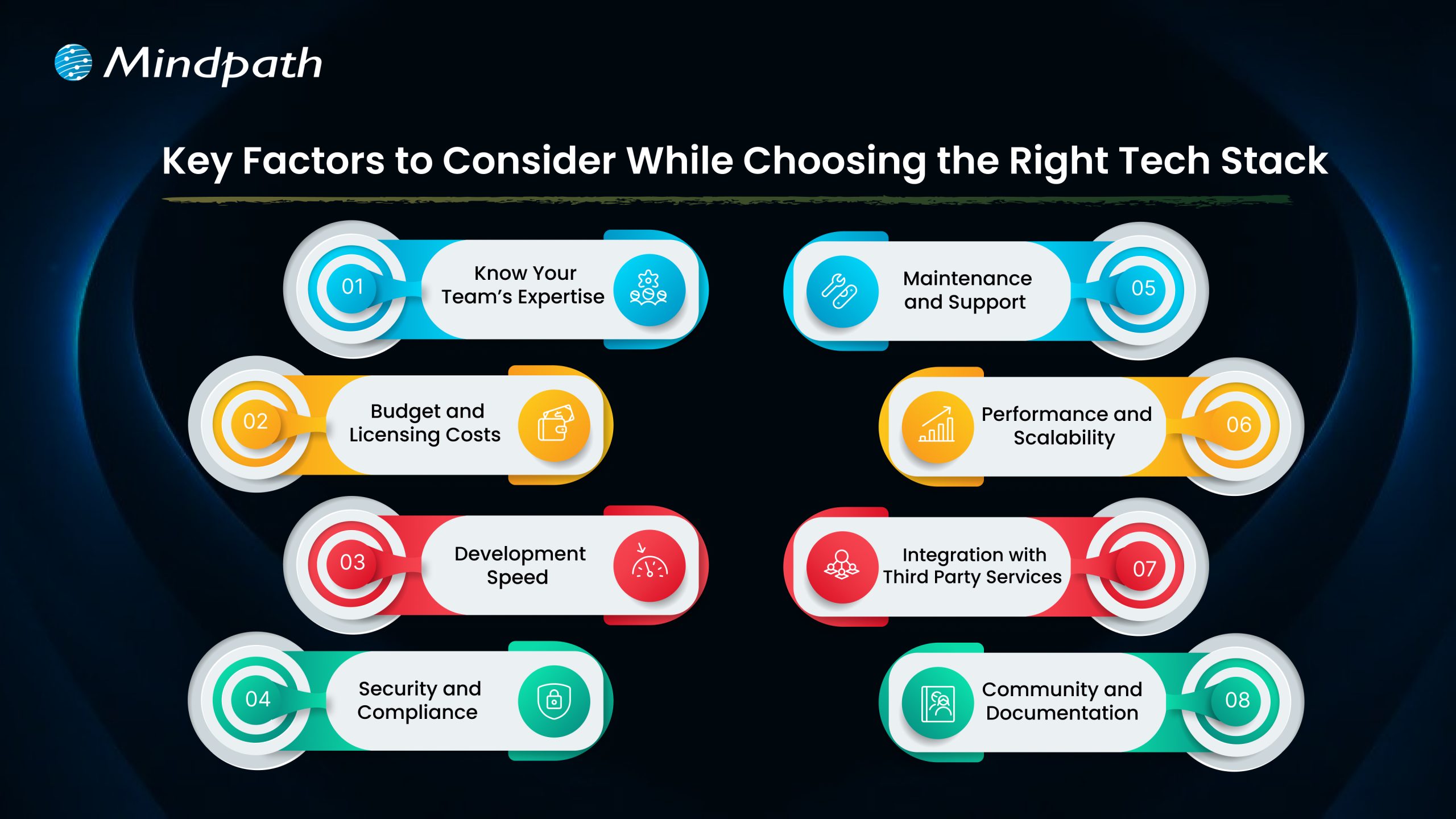
Key Factors to Consider While Choosing the Right Tech Stack

Choosing the right tech stack for web development is one of the most important things you’ll do to ensure the success of your project. The tools and technologies you decide to use will dictate how your application performs, scales, and is kept secure. Here are some key factors to keep in mind while selecting the best tech stack for web development.

Key Factors to Consider While Choosing the Right Tech Stack

1. Know Your Team’s Expertise

Look at what technologies your team already knows well. Using familiar tools can help you develop faster and avoid extra training costs. Make sure the tech stack matches your team’s size and experience to keep the project on track.

2. Budget and Licensing Costs

Think about any licensing fees for paid tools and compare them with free, open-source options. Remember to plan for costs related to maintenance, updates, and security. Also, include cloud service expenses that may grow as your project expands.

3. Development Speed

Getting your product ready fast can be a big advantage, especially for new businesses. Choosing proven frameworks and useful libraries can help your team build features quickly. This saves time and lets you focus on improving your web app for users.

4. Security and Compliance

Prioritizing security is essential, especially if your application handles sensitive data. Choose a tech stack that supports robust security features and aligns with industry regulations. This will help protect user information and maintain compliance as your project grows.

Must Read: Application Security Best Practices 

5. Maintenance and Support

Choose technologies that have strong community or vendor support so you can get help when needed. A reliable tech stack with regular updates will make it easier to fix issues and improve your application over time. This helps you avoid unexpected costs and keeps your project stable in the long run.

6. Performance and Scalability

Make sure your tech stack can handle the speed and load your application needs. If you expect real-time processing or heavy traffic, choose tools that keep response times fast. This helps your web app run smoothly as more users come on board.

7. Integration with Third-Party Services

Check that your tech stack works well with the third-party services your app needs. Good API compatibility makes it easier to connect features like payments, analytics, or social media. This saves time and helps your app deliver a smooth user experience.

8. Community and Documentation

Choose technologies with an active developer community and plenty of shared resources. Strong documentation makes it easier for your team to build, test, and maintain your web application. This support can save time and help solve issues more quickly.

Wondering how your tech stack fits into the bigger picture of web app development? Explore our comprehensive Web App Development Roadmap for 2026 to see how each decision impacts your project’s success.

Top 8 Tech Stack Examples

Exploring technology stack examples can help you see what works best for different types of projects. Here are some of the most popular examples to consider in 2026.

Top 8 Tech Stack Examples  

1. MERN Stack

MERN includes MongoDB, Express.js, React, and Node.js for flexible, dynamic sites. It’s widely chosen as a modern web application stack for responsive interfaces.

2. LAMP Stack

The LAMP stack combines Linux, Apache, MySQL, and PHP to build reliable, cost-effective websites. It is one of the oldest and most trusted web stacks in use today.

3. .NET Stack

The .NET stack is known for secure, large-scale enterprise applications. Many companies choose this web dev stack for its strong integration with Microsoft tools.

4. MEAN Stack

The MEAN stack uses JavaScript across MongoDB, Express.js, Angular, and Node.js. This tech stack for web development is popular for real-time and single-page apps.

5. Ruby on Rails Stack

Ruby on Rails offers a simple, clean approach for rapid web projects. This technology stack example is still a favorite for startups and MVPs.

6. Python-Django Stack

The Python-Django stack helps developers build powerful sites quickly. Many prefer this as a flexible web development stack with great community support.

7. JAM stack

JAM stack uses JavaScript, APIs, and Markup to deliver fast static sites. It is considered one of the best tech stacks for web development for content-heavy projects.

8. Serverless Stack

Serverless architecture removes the need to manage servers directly. It’s a growing example of a tech stack that cuts costs and improves scalability.

Not sure if your business really needs a custom web application? Discover the key signs that your business needs a custom web application that indicate it’s time to invest in a tailored solution for your needs.

Need Help Choosing the Right Tech Stack for Your Web Project?

Selecting the right tech stack for web development shapes how well your application performs, scales, and adapts over time. By knowing your goals, team strengths, and key factors like security, costs, and integrations, you can make informed choices that save you time and money. A thoughtful approach will help you build a reliable, future-ready web application that supports your business growth.

At Mindpath, we help you build secure, high-performing web applications with the best-fit tech stack for your needs. Our experts offer end-to-end web application development services, covering design, development, testing, and support. We make sure your solution stays flexible, scalable, and easy to maintain as your business grows. Let’s create a web app that works for you.