Full-Stack Development Benefits Every Business Should Know

Join our Newsletter!

Featured Posts

Support Is One Click Away

Home

Full-Stack Development Benefits Every Business Should Know

full stack development benefits

Full-Stack Development Benefits Every Business Should Know

In our fast-paced digital world, businesses are seeking better and smarter solutions for their digital presence. One proven method is embracing full-stack development benefits to handle both visual and functional components of web and app development projects. Full-stack development enables a company to be more responsive to market demand and build a seamless overall digital experience. One approach to ensure you are keeping up and growing with the pace of technology is to study full-stack development for long-lasting success.

By combining front-end and back-end development in one united team, it serves to harmonize your collaboration and streamline your processes. When one team completes the entire process, it enables faster turnarounds, greater risk control, and cost savings. Full-stack development is a workable option whether you’re a startup or a large organization looking for an efficient way to scale. In this blog, we’ll explore how full-stack development can bring these advantages to your business. So, let’s dig in!

Want to use full-stack development benefits in your business? Mindpath’s full-stack development services will help you in designing an effective way to scale your business.

What is Full-Stack Development?

Full-stack development is the complete process of building a web application from beginning to end, including both the client-side and server-side aspects. Full-stack developers will work with front-end technologies like HTML, CSS, and JavaScript, as well as back-end technologies such as Node.js and PHP, or Ruby on Rails. They deal with the interface that the user sees, as well as the server-side logic that operates behind the scenes as it interacts with APIs and databases.

A full-stack developer is comfortable working on both front-end and back-end development, which means they can handle the entire application lifecycle. They write code, test and deploy that code, and interact with databases. They often integrate third-party services into their applications as well. These professionals know how each layer of the web application connects, from the user interaction to processing data. Their variable skill set makes them important in a team setting where communication is essential between the layers, specifically for performance, scalability, and maintenance.

Explore: Full-stack vs traditional web development 

Key Components of Full-Stack Development

Getting an idea of the major components of full-stack development for business is necessary for creating effective and scalable digital products. These different components ensure that each piece of the application operates seamlessly together.

Key Components of Full-Stack Development

1. Front-end Development

Front-end development focuses on building the user interface using technologies like HTML, CSS, and JavaScript. It ensures that users can interact smoothly with the application through a responsive and visually clear layout.

2. Back-end Development

Back-end development handles the server-side logic, managing tasks like database operations, server communication, and authentication. Developers use languages such as Python, Java, or Node.js to ensure that the core application functions run efficiently.

Looking for an effective way through which you can build scalable applications? Discover how full-stack development with Node.js can enhnace your business growth.

3. API Development

API development allows applications to communicate with each other by creating structured pathways for data exchange. One of the full-stack development benefits is the ability to build and manage APIs that integrate various services into a single application.

4. Database Management

This involves designing and maintaining structured databases using systems like MySQL, MongoDB, or PostgreSQL. Efficient database management is key to ensuring secure data storage, fast retrieval, and overall system reliability.

5. Version Control

Version control helps teams manage code changes and collaborate effectively using tools like Git. It keeps track of every update, allowing developers to maintain stability, fix bugs quickly, and work on features without conflicts.

Full-Stack Development Benefits for Businesses

Many businesses today are choosing full-stack development to streamline their digital projects and improve overall efficiency. Here are some key advantages of full-stack development for businesses that highlight why this approach is gaining popularity across industries.
full stack development benefits for business

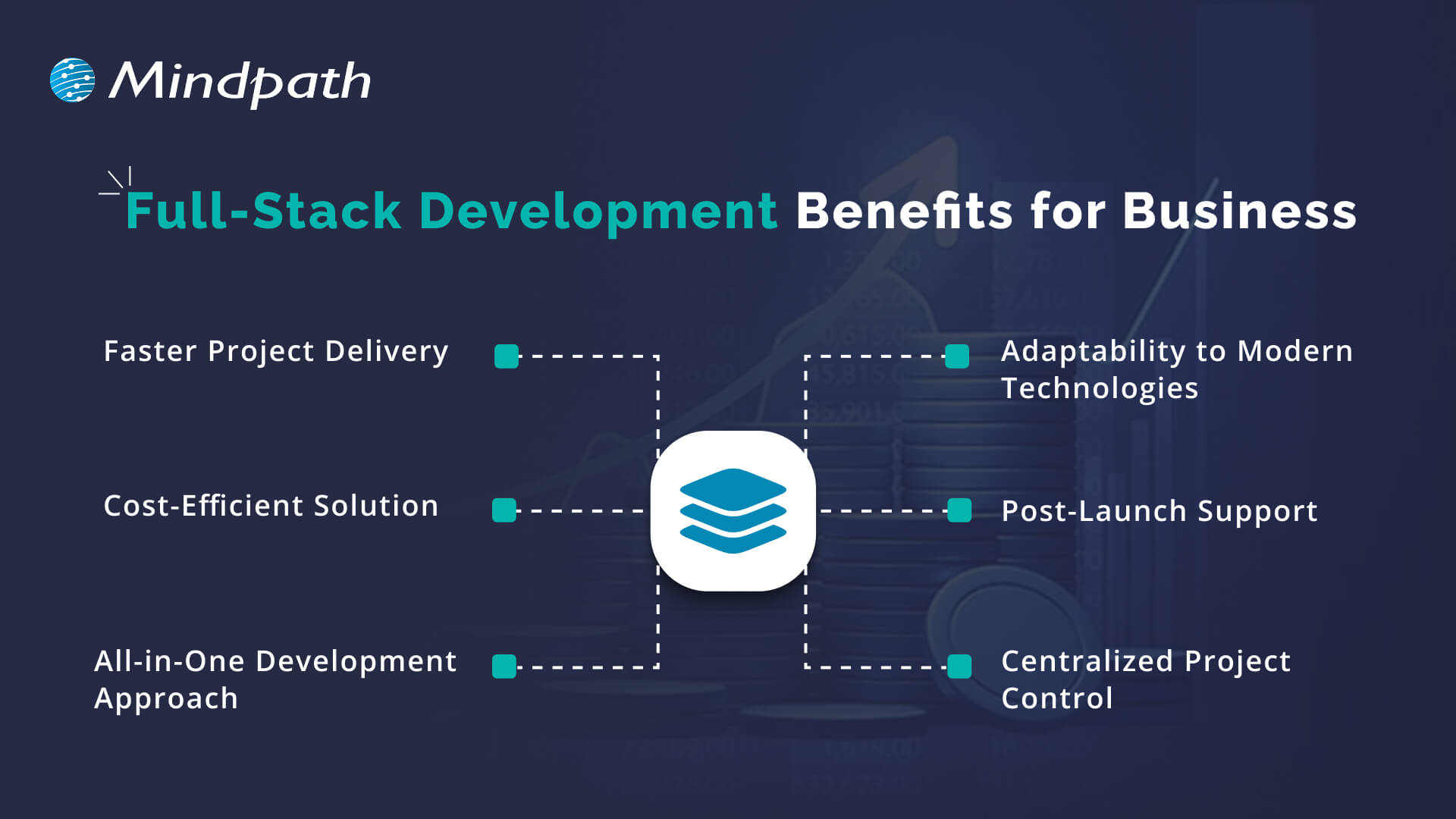
1. Faster Project Delivery

One of the key full-stack web development advantages is faster project completion, as the same team handles both front-end and back-end tasks. This reduces delays caused by waiting on separate teams and keeps the development flow going smoothly. With better collaboration and fewer hands-off, businesses can launch products more quickly and efficiently.

2. Cost-Efficient Solution

Hiring freelance Full-stack developers helps cut costs by handling the entire development process without needing multiple experts. This simplifies team structure and lowers overall development expenses. This business benefit of full-stack developers is especially valuable for startups and growing companies with limited budgets.

3. All-in-One Development Approach

Full-stack developers have the skills to manage every layer of a web application, including frontend, backend, and databases. Their broad knowledge allows them to build efficient, stable, and well-integrated solutions. This results in fewer errors, faster development, and a smoother launch process.

4. Adaptability to Modern Technologies

Full-stack development benefits include staying aligned with evolving technologies like AI, machine learning, and modern web frameworks. Developers apply the right tools to build responsive, feature-rich applications that match today’s user expectations. Their up-to-date knowledge of full-stack development trends supports faster innovation and long-term system improvements.

5. Post-Launch Support

Full-stack development benefits businesses by offering complete support even after the product goes live. Developers can manage updates, fix bugs, and maintain both frontend and backend systems efficiently. This ongoing support ensures long-term stability and performance for digital applications.

6. Centralized Project Control

Full-stack developers take full responsibility for the entire codebase, covering both front-end and backend. This avoids delays caused by switching between separate teams and helps solve issues faster. With complete control, the development process stays organized and efficient.

Also Read: Full-stack Development for Web Projects.

Business Use Cases of Full-Stack Development

Full-stack development offers flexible solutions that fit a wide range of business needs. Here are some practical use cases where this approach adds value across different industries and project types.

1. Enterprise Applications

Companies use full-stack development to build scalable enterprise tools that support internal workflows and boost productivity. These applications can connect departments, automate tasks, and improve overall business performance.

2. Content Management Systems (CMS)

With full-stack development, businesses can create flexible CMS solutions tailored to their content strategies. These systems make it easier to manage digital assets, add SEO tools, and track performance through built-in analytics.

3. Real-time Applications

Applications like messaging platforms and live dashboards rely on real-time data updates and user interactions. Full-stack development benefits these projects by ensuring fast communication between front-end and back-end components.

4. E-commerce Platforms

Full-stack development supports building responsive and secure e-commerce websites with integrated features like product search, payments, and user accounts. It allows businesses to deliver a seamless shopping experience while managing inventory and customer data effectively.

5. Big Data and Analytics Platforms

Businesses use full-stack development to build platforms that handle and visualize large volumes of data efficiently. Full-stack development benefits these solutions by enabling the smooth integration of data processing, analysis tools, and user-friendly dashboards.

Curious about how different developer roles can transform your business needs?? Explore our detailed blog on front-end vs back-end vs full-stack.

Looking to Scale Smarter with Full-Stack Development?

Full-stack development benefits help businesses simplify workflows, reduce costs, and build stronger digital solutions. With complete control over the front-end and back-end, it brings speed, flexibility, and long-term support. From e-commerce platforms to real-time apps, full-stack development continues to be a smart choice for businesses aiming to stay competitive in a fast-changing digital world.

At Mindpath, we offer expert full-stack development services tailored to your business needs. Our skilled team brings deep technical knowledge, reliable support, and fast delivery. If you’re ready to hire full-stack developers who deliver results, we’re here to help you scale with confidence.


Related Post

How much does hiring a ReactJS developer cost? Learn about factors affecting rates, and how to find the best talent within your budget.
Discover how AI enhances cybersecurity with smarter threat detection, faster responses, and proactive vulnerability management to protect your business in the digital age.

Related Post

ai and business

Have you ever considered how AI and business actually fit together? You may have heard a lot about AI being faster and smarter, but is your business actually prepared for it? Many people are excited about new technology, but they often overlook whether they have a solid foundation. Take a second to think about it- is your business possibly ignoring some signs that say you are not prepared for AI yet?

AI can help any business develop, but starting without preparation can create issues. There are companies that jump into AI without having the right tools or people, or even ideas. This could waste valuable time and resources and lead to frustration. Integrating AI in business strategy from the start ensures you’re prepared and can identify potential challenges early. In this blog post, you’ll learn five easy indicators that show your business may not be ready for AI yet.

Want to future-proof your business with AI? We at Mindpath offers exceptional AI development services that help your business get AI-ready and unlock next level of growth! 

What Being ‘AI Ready’ Really Looks Like?

Being ready for AI means your business has the right people, tools, and plan to make it work well. When you think about AI and business together, it’s more than just buying new software. You need good data that’s easy to use, a team that knows how to work with AI, and clear goals that AI can help you reach. A business ready for AI knows how to bring people and smart technology together.

Look at Amazon. They show how AI in e-commerce can work side by side with business to help customers and save money at the same time. This happens because they plan ahead and know exactly how AI will help. If you want your business to be ready to use AI, start by checking your data, training your team, and making a simple plan that fits your real needs. When you get this right, AI in business can really help you grow.

Must Read: Benefits of AI

What is an AI Readiness Checklist?

An AI Readiness Checklist is a simple tool that helps you see if your business is really ready to use AI in the right way. It covers important things like your data, your technical tools, and how well your team understands AI. When you think about AI helping your business grow, this checklist shows you what’s strong and what needs more work.

A good AI checklist looks at your technical setup, the quality of your data, your team’s skills, and whether your company is open to new ways of working. This way, you can fix any gaps before you bring AI into your business. By using an AI checklist, you can make sure you’re set up for success and get real value from AI in business.

How is AI reshaping the way websites are built and optimized? Explore our detailed article on AI in Web Development to see how it’s driving smarter design, faster deployment, and better user experiences.

AI Readiness Checklist for Businesses

Before you bring AI into your daily operations, it’s important to know where you stand. A good AI readiness checklist will help you see if your business is truly prepared for this step. Here are the key areas to focus on as you plan your AI and business journey.

AI Readiness checklist for businesses

1. Robust Data Foundations

Good data is the backbone of any artificial intelligence business idea. Check that your data is clean, organized, and ready for AI tools to use well. Strong data governance keeps your insights trusted and prepares your business for AI integration.

2. Leadership and Team Alignment

A strong AI and business plan starts with people who believe in it. Make sure leaders fully support your strategy and teams understand the goals. A clear roadmap and open communication help everyone move toward strategic AI adoption together.

3. Technology and Process Readiness

Your tools and workflows must support AI smoothly. Research the best AI solutions for your existing systems and test them with pilot projects. Use simple frameworks to track results and find the best areas for automation.

4. Governance, Ethics, and Security

Responsible AI needs strong rules and security in place. Create clear ethical guidelines and monitor how AI works in your company. A good AI checklist helps protect your artificial intelligence business ideas and builds trust for the long term.

5. Financial Planning and ROI

Every digital transformation roadmap needs clear budget planning. Create realistic budgets, show expected returns, and track savings as you go. This makes it easier to get leadership buy-in and keeps AI and business costs under control.

Looking to streamline your business operations and enhance customer experiences? Discover how conversational AI chatbots can help your business transform its workflows and boost efficiency in our blog.

5 Signs Your Business is Not Ready for AI

Many companies jump into AI without checking if they’re really prepared. Missing a few basics can lead to wasted time and money. Here are five signs that show your business is not ready for AI yet.

5 Signs Your Business is Not Ready for AI

1. Stuck in Paper-Heavy Processes

Paper forms, files, and manual approvals slow down daily work and limit growth. AI needs clean, digital data that is easy to find and process. If you’re still tied to paper, you’ll struggle to get real results from AI. Going digital is the first step to connect AI and business ideas that really work.

2. Running on Outdated Technology

Old systems can hold you back from adding smart AI tools. If your technology can’t talk to modern platforms, your AI plans won’t go far. Keeping rigid, legacy software in place only adds roadblocks. Updating your systems is essential for future-proofing your business with AI.

3. Poor Data Quality and Structure

Messy or incomplete data will confuse even the best AI tools. AI needs clear, well-organized data to find patterns and deliver insights. If your data is spread everywhere and filled with errors, you’re not ready yet. A strong data foundation helps your AI and business strategy succeed.

4. No Clear Data Strategy in Place

Without a clear plan, your data might be scattered, outdated, or not useful at all. AI can’t do much if it doesn’t have good data to work with every day. A strong data strategy shows what to collect, how to store it, and who can use it. This is key for turning business ideas AI into real results and leveraging AI in decision-making.

5. Lack of Real-Time Data Insights

AI works best when it has fresh, up-to-date information at its fingertips. If you only rely on old monthly reports, you will miss the full power of AI. Real-time data helps AI spot changes and take action fast. It’s a big step for future-proofing businesses with AI in any industry.

Want to future-proof your AI strategy? Don’t miss our insights on the Top AI Trends in 2025 every business should be ready for.

Ready to Make AI and Business Work Together?

Preparing your business for AI means more than just buying new tools. It’s about building strong data foundations, modern systems, and a clear strategy that connects people and technology. Knowing the signs that you’re not ready yet can save time, money, and stress. With the right plan, AI can help your business grow stronger together and bring real results.

Mindpath’s expert AI development services help you create practical, future-ready solutions. Our team works closely with you to plan, build, and integrate AI into your daily operations. We focus on clean data, secure systems, and smart strategies that fit your business needs. Let us help you connect AI and business in ways that truly work.

Mobile app development technologies

Mobile app development technologies are important in the fast-paced environment of technology because they define how companies engage with users and keep them engaged. Each swipe, tap, and click is based on technology that is getting faster, smarter, and more interactive. If you’ve ever noticed, some apps feel effortlessly smooth, and others do not. The difference is usually related to the frameworks and platforms chosen for the business objectives and user expectations, and understanding these technologies provides a big advantage over others.

Delving into the newest trends in mobile application development often presents a plethora of choices that can seem confusing. However, choosing the appropriate technology can improve app performance, security, and the overall user experience. Developers routinely test technologies, frameworks, languages, and software solutions to create apps that can more easily rise above the fray. In this blog, we will explore the latest trends and the specific technologies that power the successful mobile app today.

Want to use top mobile app development technologies into a functional app? Mindpath offers mobile app development services, which will turn your imagination into a fully working, high-quality app.

What are Mobile App Development Technologies?

Mobile app development technologies refer to the programming languages, frameworks, and tools used to develop applications for mobile devices. These technologies provide developers with the means to develop compatible applications that would run across devices on platforms such as Android and iOS.

The landscape of mobile development technologies consists of native development tools, cross-platform frameworks, and backend services. The combination of these tools enables the development of applications that provide rich user experiences, work with cloud services, and utilize the native features provided by the device. Choosing the appropriate technology allows developers to build all of these easily, efficiently, and in a scalable way.

Also Read: AI in Mobile Apps

Top Mobile App Development Technologies in 2025

In order to remain competitive as an app developer, it is important to stay informed about the best technology for mobile app development in 2025. The choice of development tools can positively affect the performance, usability, and scalability of modern applications.

1. Flutter 3.22

Flutter 3.22 is a highly favored mobile app development platform to help developers develop applications for mobile devices, the web, desktop, and embedded devices. It provides high-performance and smooth animations that allow applications to run quickly and feel responsive. Developers also appreciate its professionally designed UI components, making it easy for developers to create stunning and consistent user interfaces.

2. Kotlin Multiplatform Mobile (KMM)

Kotlin Multiplatform Mobile (KMM) is a mobile app development framework that allows developers to share code for Android and iOS apps. It utilizes the modern, efficient programming language Kotlin to simplify the process of creating a mobile app for two platforms at once. This translates into a significant time saving, might help to reduce errors, and assure consistent behavior across your Android and iOS devices.

3. C++

C++ is among the most robust mobile app development technologies currently available for building high-performance applications. It enables developers to take direct control of system resources, which is often favored for complex applications or graphics-intensive applications. Also, by using C++, you can rest assured your apps are running as efficiently as possible, even as they traverse between different platforms.

4. Swift

Swift, a mobile application technology developed by Apple, is for building native iOS applications. It is fast, safe, and reliable, while also allowing seamless integration into AI and machine learning. With Swift, developers can build iPhone and iPad apps that are fast, safe, and modern.

5. AR/VR Integration Tools

AR/VR integration tools are tools for mobile app development that help developers add augmented reality and virtual reality features to an app. Integrating augmented and virtual reality features into apps is a valuable way to engage users while making an experience much more entertaining or immersive. These integrations are extremely popular in gaming and even found in some education and retail apps to enhance user experiences.

Ready to build smart mobile apps, but still wondering how AI can transform your development approach? Discover our blog on the benefits of AI in mobile app development to understand how AI can reshape modern app development.

6. AI-Assisted Development Tools

AI-Assisted Development Tools refer to tools such as GitHub Copilot and Amazon CodeWhisperer that support the automation of coding tasks. They streamline developers’ efforts in application development through code suggestions, error detection, and execution of tests. The upshot is that developers can create apps faster and also more efficiently.

7. React Native

React Native is another top mobile app development technology that enables developers to create apps for both iOS and Android using JavaScript. It provides a native look and feels with one complete codebase, reducing development time and duplication of effort. Companies are drawn to React Native because of its quick development period and strong support from the community.

8. Ionic

Ionic is a hybrid app framework and is a popular option among mobile app development technologies, allowing developers to write cross-platform apps using HTML, CSS, and JavaScript. It allows developers to write one codebase to operate on multiple devices. Ionic is very much favored by developers to create efficient and visually striking apps.

9. NativeScript

NativeScript is a flexible framework that matches the up-to-date trends in mobile application development with the ability to create fully native apps using JavaScript, TypeScript, Angular, or Vue.js. With NativeScript, you have full access to the native APIs offered by the OS, meaning that your application will work and perform like a truly native solution. NativeScript enables developers to build highly efficient and rich-featured mobile applications.

10. Xamarin (.NET MAUI)

Xamarin (.NET MAUI) is a framework aligned with mobile app development trends through the creation of native apps for Android, iOS, Windows, and macOS. While using C# and the .NET ecosystem, developers can share code and have a consistent experience across all platforms. Overall, this reduces development time, and provides high-quality apps.

Want to understand where custom mobile applications are creating real competitive advantages across the market? Discover our blog on the Custom Mobile Application Development Services to uncover high-impact opportunities and emerging trends.

Ready to Build the Next Successful Mobile App?

Mobile app development technologies continue to evolve, offering smarter tools and faster frameworks to help developers create better apps. Choosing the appropriate technology guarantees improved performance, security, and scalability. With the growth of innovation, staying up to date with current tools is critical for a company to provide seamless and engaging mobile experiences.

At Mindpath, we provide expert mobile app development services intended to turn your ideas into strong digital solutions.  Our experienced developers create secure, high-performing, and easy-to-use applications by applying modern tools and proven approaches. Partner with us to build an app that empowers your brand and creates long-lasting value for your users.

types of artificial intelligence  

Artificial intelligence is quickly becoming the backbone technology of our modern day, enabling a wide-ranging variety of advanced technologies, from smart assistants on our phones to an advanced analytics platform. AI enables machines to translate data into useful information by recognizing patterns in the data and eventually making decisions that once required human intelligence. Learning the different types of artificial intelligence is critical to understanding how such human-like systems function and advance from there. As innovation unfolds in real-time, AI is quickly becoming the key enabler of automation, personalization, and intelligent decision-making across industries.

At present, AI development aims toward systems that can reason, adapt, and improve efficiency in the real world. The advancement of these changing and evolving technologies is increasing limitations and changing the way we interact with digital systems. In this blog, we will cover the main types of AI that exist and how each level leads to the next generation of intelligent technology.

Want to step into the future of technology with AI? Mindpath’s  AI development services will help you provide smart and intelligent solutions tailored to your business demands.

Understanding the Types of Artificial Intelligence

Artificial intelligence uses data, logic, and algorithms to simulate human thought processing and action in machines, enabling computers to recognize patterns, make decisions, and learn from past experience. According to SAS, AI systems can manage vast amounts of data and apply logic in real time to intelligently and effectively handle functions like speech processing, visual analysis, image recognition, and natural language understanding.

It is important to understand the types of artificial intelligence, as they indicate how sophisticated a system is and what it can actually do. Knowing about the various AI classifications will provide clarity regarding what AI systems exist today, and what systems are theoretical at this point in time. This knowledge can help businesses select the proper technology, manage risk, and plan strategies more confidently in a world that is becoming increasingly unified through intelligent automation.

Here are the three types of artificial intelligence:

1. Artificial Narrow Intelligence (ANI)

2. Artificial General Intelligence (AGI)

3. Artificial Super Intelligence (ASI)

What is ANI AI?

Artificial narrow intelligence, or ANI artificial intelligence, operates within a specific functional role, or related functions, within a narrow field of inquiry. ANI does this very effectively, but it cannot go beyond what it has been programmed to do. Businesses use ANI to promote efficiency in work, and individuals employ ANI daily in ways such as digital assistants and recommendation systems to help them work more efficiently, quickly, and accurately.

ANI works by identifying data from prescribed sources and performing assigned tasks with accuracy. It improves business processes from manufacturing to services to customers. ANI also learns over time and employs machine learning and deep learning techniques. Businesses can rely on ANI to increase productivity, reduce risk, and support humans in executing rote or specialized tasks.

Here are the benefits of ANI AI:

1. Higher Efficiency

ANI automates repetitive tasks like data entry and scheduling. Employees can instead work on creative and complex work.

2. Faster Decisions

ANI analyzes large datasets quickly. Companies can confidently make decisions that are based on data.

3. Stronger Security

ANI monitors transactions and user activity in real time. It detects fraud faster than individuals can.

4. Better Customer Support

AI chatbots help customers with whatever they want 24/7. Human agents will manage more complex customer questions.

5. Smarter Marketing

Recommendation engines make intelligent suggestions around helpful products and content. This increases engagement and sales.

What is AGI AI?

AGI artificial intelligence is a kind of system that can think, learn, and understand like a human being. It does not only refer to a system that is limited to specific tasks like ANI. AGI can reason logically, solve problems, and understand languages in varying contexts. It is significant progress in the domain of artificial intelligence types.

AGI uses information collected previously to create new experiences and applicability of information in a new experience. It can also make decisions relating to healthcare, finance, and technology without the need for detailed programming. AGI artificial intelligence is set apart by its adaptability and flexibility and gives a clear guide to the extent of sophistication apparent between different types of artificial intelligence in ability to cross over between a humanistic understanding of the world and efficiency of a machine.

Here are the benefits of AGI Artificial Intelligence:

1. Faster Research

AGI examines enormous datasets at incredible speeds. It speeds and improves advances in medicine, science, and technology.

2. Solve Big Problems

AGI can help tackle global challenges, including climate change and resource management. It may create sustainable or efficient solutions.

3. Boost Productivity

AGI can automate mundane or advanced activities. This will allow humans to focus their time on creative and strategic input.

4. Personalized Services

AGI can personalize education and healthcare for them. It can suggest educational paths and treatment plans based on specific personalized information.

5. Better Collaboration

AGI reads tone, intention, and context in conversations. It guides humans and gives insights about what is happening in real-time.

What is ASI AI?

ASI, artificial intelligence, is a stage of AI that is beyond human intelligence. It is capable of thinking, learning, and solving problems in many areas independently. It handles complex tasks with superhuman speed and accuracy, unlike ANI and AGI, which have limitations. ASI sits at the top of the types of artificial intelligence levels.

ASI or Artificial Super Intelligence could create profound change in areas such as science, medicine, and the arts, by processing greater amounts of data, making choices, and understanding emotions greater than human capacity. Although ASI technology is still hypothetical, investigating the implications and possibilities prepares researchers and organizations for the next generation of artificial intelligence and its social benefits.

Here are the benefits of ASI Artificial Intelligence:

1. Smarter Decisions

ASI examines vast sets of data and simulates complicated systems. It can help solve problems like health, climate change, and poverty.

2. Faster Innovation

ASI automates research and experimentation. It brings breakthroughs in science, technology, and even space exploration.

3. Higher Productivity

ASI efficiently performs any cognitive task. While efficiency increases, humans can spend their time on more creative and strategic work.

4. Personalized Customer Experience

ASI is accurate in anticipating customer needs. ASI provides personalized marketing and services that are well-targeted.

5. Stronger Risk Management

ASI can quickly identify potential threats. It can protect against fraud and strengthen cybersecurity across operations.

ANI vs AGI vs ASI: A Detailed Comparison

Comparing ANI, AGI, and ASI shows how these different forms of intelligence operate. This table explains their capabilities, learning ability, and impact within the types of artificial intelligence.

Category ANI (Artificial Narrow Intelligence) AGI (Artificial General Intelligence) ASI (Artificial Superintelligence)
Intelligence Level Performs specific tasks well Performs human-level tasks across all areas Performs tasks beyond human intelligence
Learning Ability Learns only in its trained tasks Learns and applies knowledge across multiple areas Learns independently and creates new knowledge
Capabilities Limited to single tasks Matches human reasoning and problem-solving Solves complex problems instantly and invents new methods
Development Status Already in use Theoretical, may take decades to develop Hypothetical, comes after AGI
Resource Needs Moderate computing power and data High computing power and advanced hardware Extremely high computing power and energy required
Applications Chatbots, recommendations, image recognition Scientific research, education, creative industries Global problem-solving, advanced research, innovation

Ready to Unlock Your Business Growth with the Power of AI?

Understanding types of artificial intelligence like ANI, AGI, and ASI helps businesses and individuals see the potential of AI in everyday life and industry. From improving efficiency and decision-making to driving innovation and solving complex problems, AI is transforming the way we work, create, and interact with technology in ways that were once unimaginable.

Mindpath offers professional AI development services to help companies implement ANI, AGI, and ASI solutions. Our team builds intelligent systems that enhance business productivity, automate processes, and deliver personalized experiences. With expertise in the latest types of artificial intelligence, Mindpath ensures your AI projects are efficient, scalable, and aligned with your strategic goals for measurable results.