





Latest Insights On

GenAI, Tech, and Digital Transformation 

Stay updated with expert insights, success stories, and real-world applications of cutting-edge technology.

Hire ReactJS developers in Canada

The pace of digital transformation makes every business think about the best ways to create intuitive, user-friendly, and visually appealing web applications. Thus, many businesses have been looking for the best ways to hire ReactJS developers in Canada and capitalize on the economies of scale. As one of the most business-friendly countries, Canada offers many reasons to choose it for any business venture.

ReactJS is the most powerful framework for frontend development, trusted by big companies such as Netflix. You can capitalize on the skills of ReactJS developers to create web apps that not only resonate with your values but also help you achieve business goals. Let us discover the notable aspects that you should keep in mind to find competent React developers for your next web project.

Want to take your web projects to new heights? Mindpath’s ReactJS developers in Canada deliver tailored solutions by creating responsive and engaging applications that will align with your business needs.

Tapping Into the Tech Scene in Canada

Many readers would have assumed that Canada is not the ideal destination for hosting technology-based businesses. On the contrary, hiring ReactJS developers in Canada might be easier than in other locations due to its tech-savvy workforce and innovative spirit. Canada has emerged as one of the prime destinations for top-tier tech talent for many reasons. Along with a highly educated workforce, the country also hosts a thriving startup ecosystem.

Canada has some of the most popular educational institutions in the world, such as the University of British Columbia and the University of Toronto. The institutions produce graduates with impeccable fluency in technical skills, and many institutions offer specialized programs for software engineering. As a result, the workforce in Canada boasts a significant number of developers who are fluent in ReactJS.

Another prominent reason to consider Canada as a prime tech hub is the growing ecosystem of tech companies. For instance, Toronto harbors the Silicon Valley of the North, while Vancouver is home to multiple startups. Businesses can look for options to hire React developers in Canada, as the country attracts top talent and also hosts events where React developers showcase their skills. Most important of all, the cost of hiring React developers in Canada is more competitive than the hiring costs in the USA or other major destinations.

Want to improve your application’s speed without increasing development time or infrastructure costs? Discover how optimizing React performance benefits business owners looking for efficiency and ROI.

Weighing the Relevance of ReactJS in 2025

New technologies and frameworks for web development can make old frameworks obsolete. However, ReactJS is still a powerhouse for web development even after more than a decade of its arrival. It was created by Meta, which still takes responsibility for its maintenance even after making it open-source. Apart from the fact that it was created by a tech giant, ReactJS is a powerful frontend development framework due to its distinctive features.

Business owners and hiring managers want to explore the React developer job market in Canada to capitalize on the utility of ReactJS. The component-based architecture of the framework helps in creating reusable UI components that ensure better speed and scalability in development. The other notable features of ReactJS include the virtual DOM and its declarative syntax, which make it easier for developers to develop high-performance web apps.

Virtual DOM is a revolutionary feature of ReactJS as it ensures code stability and better performance with the assurance of a limited number of direct modifications in the actual DOM of browsers. On top of it, the thriving ReactJS community also offers a collection of tools and learning resources that help developers address project complexities with ease.

Also Read: ReactJS Development Services Benefits

Skills Required in Top ReactJS Developers

Almost anyone in the tech landscape can become a ReactJS developer, as it is comparatively easier to learn than other frameworks. However, basic knowledge of ReactJS concepts does not make a developer the ideal pick for your web projects. The answers to “What skills should a ReactJS developer in New York have?” will help you understand that React developers’ skills must have a mix of technical and soft skills. In addition, companies searching for React developers in Canada will need developers who understand the local tech landscape.

1. Technical Skill Requirements from React Developers

Since ReactJS is a JavaScript framework, hiring managers should choose developers who have an in-depth understanding of JavaScript. It is important to ensure that ReactJS developers have a strong command of the latest ES6+ specifications of JavaScript. Fluency in functional and asynchronous programming is an essential skill that helps ReactJS developers in creating syntactically effective solutions. The important technical skills of ReactJS developers also include mastery of ReactJS concepts such as props, state management, hooks, and components. Professional ReactJS developers are also fluent in advanced features such as the React Router, Redux, and Context API.

The list of ReactJS developer skills to look for also focuses on knowledge of frontend development tools. For instance, developers must know how to work with build tools like npm and yarn. On top of it, proficiency in HTML and CSS makes a ReactJS developer capable of optimizing web apps for easier navigation. The other important skills required for ReactJS developers include the ability to understand API integration and testing. Recruiters should check whether candidates for React developer jobs know how to work with testing frameworks like the React Testing Library.

2. Soft Skill Requirements from ReactJS Developers

As a business owner, you must understand the importance of having ReactJS developers who know how to work in an organization. You cannot have technical experts who don’t know how to communicate or solve problems with innovative approaches. Most of the React developer hiring tips emphasize the necessity of having soft skills that help a developer navigate the business aspect of their job. The essential soft skills required from ReactJS developers include critical thinking, adaptability, communication, and attention to detail.

Developers without critical thinking abilities are likely to be stuck with emerging problems. Critical thinking skills can help ReactJS developers think of innovative solutions to problems from unconventional perspectives. React developers must also be adaptable to changes in the technological landscape and stay updated with new features of ReactJS. Furthermore, a React developer with attention to detail can ensure that a business gets the most efficient web apps without multiple reworks.

Want your app to be future-ready and easy to maintain? Learn how ReactJS for app development helps businesses create flexible, efficient, and scalable applications.

Ideal Hiring Model for ReactJS Developers

The hiring model defines the approach a business adopts to use the services of ReactJS developers. You can find different hiring models, such as in-house developers, freelancers, remote developers, or professional agencies. If you want to know ReactJS developer hourly rates, then you might need developers for short-term projects or to address specific skill requirements. Depending on the requirements, businesses can choose one of the following hiring models to tap into the expertise of ReactJS developers.

1. In-House Developer Teams

Many organizations have in-house developer teams to work on web development projects. However, organizations without a hefty budget for hiring developers, such as startups, will find it difficult to recruit in-house developers. In-house ReactJS developers can offer many advantages, such as direct control over how they work. On top of it, businesses can ensure that in-house developers align with the company culture in their work. In-house React developers are more likely to follow the company’s vision and values.

2. Remote ReactJS Developers

The next big option for any hiring manager to bring ReactJS developers on board is remote work. Recruiters can choose remote ReactJS developers in Canada from various platforms that offer access to pre-vetted talent. Remote developers can help a business avoid the trouble of hiring a full-time employee. The biggest advantage of choosing remote developers for ReactJS projects is the assurance of capitalizing on a global talent pool.

3. Professional ReactJS Development Services

Among the many options to add the most competent ReactJS developers to your organization, professional development services will stand tall. Why? Business owners don’t have to worry about how to hire ReactJS developers while working with professional development services. Professional ReactJS development agencies have teams of experienced developers who have worked on multiple web development projects. As a result, businesses can get the output of an in-house developer team from professional React development services without any concerns about managing resources.

Looking to scale your tech team without the overhead of traditional hiring? Read the key benefits of hiring remote developers to access global talent, reduce costs, and boost productivity.

Strategic Process for Hiring ReactJS Developers in Canada

The awareness of essential skills and hiring models to welcome ReactJS developers into your organization can provide a strong foundation to create the hiring process. You don’t have to think about ReactJS developer cost in Canada from the beginning. On the contrary, the following steps will help you with a strategic approach to pick the right talent for ReactJS web development projects.

1. Prepare a Job Description for Top-Tier Talent

The hiring process always starts with the creation of a job description that outlines key responsibilities, job title, and skills required for the job. Some hiring managers also choose to add the estimated salary in the job description. However, it is important to understand that the job description is the best resource to attract the top ReactJS talent in Canada to any company. Applicants for ReactJS developer jobs use the job description to understand what to expect from the job.

The job description helps in understanding the complexity of projects that developers have to work on and the level of experience required for the projects. As a result, the job description ensures that only qualified candidates apply for the ReactJS developer jobs.

2. Explore the Ideal Platforms to Find Talent

Hiring managers can use the job description to find the best talent only when published on the right platforms. The ideal platforms that can support your efforts to hire ReactJS developers in Canada include professional networking platforms and job boards. LinkedIn is one of the best examples of professional networking platforms to find skilled ReactJS developers. You can publish job listings on LinkedIn and also review the qualifications of candidates from their profiles directly.

The other notable places to find expert ReactJS developers include job boards like Glassdoor and Indeed. Businesses should also consider exploring online forums and visiting community meetings for ReactJS developers to pick the best talent for their web projects.

Also React: ReactJS Web development

3. Screening and Interview Process

The most crucial part of the hiring process deals with the screening of candidates and the interview process. The screening process must focus on the assessment of the job applications and resumes of applicants. Hiring managers can also call candidates to interact with them over the phone or via video calls. It will help in determining whether they will be an ideal fit for the job. The first call helps in finding a lot about the communication skills and technical fluency of candidates in React development.

Once you have completed the screening, the hiring process will shift towards interviews. The interviews for hiring ReactJS developers must include a comprehensive assessment of coding capabilities and understanding of React concepts. Live coding sessions, simulated coding challenges, and questions on core React concepts can help in testing the candidate’s practical skills.

4. Know the Hiring Costs

Another crucial aspect of hiring React developers is the hiring cost. Many people assume that hiring costs only focus on the salary of ReactJS developers. The answers to “What is the cost of hiring a ReactJS developer in Canada?” will also include the recruitment and onboarding costs. Recruitment costs include the costs of publishing job descriptions and the expenses for the screening and interview process. The onboarding costs include costs for training and the resources and equipment provided to qualified candidates after the interview.

The average annual salary of a ReactJS developer in Toronto is around CAD $68,000 for entry-level roles (Source). You can also find some platforms that predict that the average salary of React developers is almost $140,000 per year (Source). While the salary forms a major chunk of the hiring costs, it can vary according to location, experience, and responsibilities.

Do you want your web project to succeed with the right React development partner? Explore how choosing the right ReactJS development company can maximize ROI, speed, and long-term scalability.

Final Thoughts

The insights into the process of hiring professional React developers in Canada can help you recruit the best talent. With a tech-savvy workforce and thriving ecosystem of innovation, Canada is a promising destination for business growth. As businesses grow, they need proficient ReactJS developers to create engaging and intuitive web apps for their digital presence.

Mindpath offers Canada-based ReactJS development services to businesses of all sizes across various industries. Our reputation as an end-to-end IT solutions provider revolves around catering to the client’s vision and requirements. On every project, all our team members use their experience as well as insights to design elegant solutions. Connect with us and discover the ideal roadmap to create your next web project right now.

Discover the key factors influencing software development costs and how to optimize your budget. Learn how Mindpath can help.
Hire ReactJS developers in New Jersy

New Jersey is gradually emerging as a popular tech hub with many big enterprises and budding startups setting up their base in the Garden State. These organizations want to hire ReactJS developers in New Jersey to create the most attractive interfaces that grab the attention of customers. The demand for skilled ReactJS developers is on the rise due to the growing competition among businesses to establish a robust online presence.

Do you want to build dynamic web apps that can stand up to the emerging benchmarks of performance? ReactJS offers you the best open-source framework to translate your ideas into real web solutions that bridge the gap between your business and customers. This post offers a comprehensive guide to understanding the important things to keep in mind while hiring React developers in New Jersey.

Looking to engage your users with an interactive and seamless web application? Mindpath’s expert ReactJS developers in New Jersey specialize in creating solutions that are perfectly aligned with business goals.

Exploring the Tech Landscape in New Jersey

The first thing that you must know before hiring ReactJS developers is the way in which New Jersey is an ideal place for ReactJS projects. The demand for Hiring ReactJS developers in New Jersey is growing consistently as the state harbors a vibrant and thriving tech landscape. It is also important to remember that cities like Princeton, Jersey City, and Newark are gradually emerging as notable technology hubs. On top of it, the arrival of major corporations and startups in New Jersey has also made the state more attractive for skilled tech professionals.

Another prominent factor that contributes to the growth of the tech landscape in New Jersey is the presence of academic institutions that contribute to the state’s talent pool. The React Developer Job Market in New Jersey has also been gaining momentum owing to its geographical proximity to New York. New Jersey might have a higher cost of living than the national average. However, it has a lower living cost than New York, which makes it a promising choice for top-tier tech talent.

Also Read: ReactJS Trends 2025

Is ReactJS Still Relevant in New Jersey in 2025?

The world has progressed a lot since the arrival of ReactJS in 2013. With many new frontend development tools and frameworks in the market, it is reasonable to wonder about the reasons to choose ReactJS. Before you hire React developer in New Jersey, you must know why ReactJS is still a powerful framework for designing intuitive web apps. The one thing that no one can take away from ReactJS is the fact that it was developed by Meta, one of the biggest tech giants in the world. On top of it, it is an open-source JavaScript library, making it easier to access and understand.

The most prominent features of ReactJS that have been responsible for its popularity are the component-based architecture, declarative syntax, and virtual DOM. Component-based or modular architecture of ReactJS enables developers to break down UIs into smaller and reusable components. The reusable components play a crucial role in accelerating development and improving efficiency. On top of it, the declarative syntax helps in declaring exactly how you want the user interface to look. The virtual DOM helps in enhancing performance by identifying the most efficient approach to update the actual DOM.

Businesses have been searching for React developer hiring tips to capitalize on these features and build high-performance, maintainable, and scalable web applications. ReactJS is also a powerful choice for web UI development with its massive community that offers a treasure of libraries, tools, and resources. The actively growing community also offers the assurance of faster and efficient development alongside support for troubleshooting.

Curious why businesses are choosing ReactJS for their web projects? Discover the top benefits of React JS development services that make web applications more scalable and maintainable.

Crucial Skills to Look for in ReactJS Developers

Choosing the best ReactJS developers in New Jersey is not all about finding developers who know ReactJS. Business owners and hiring managers must verify whether candidates for React developer jobs have the essential skills required to address the responsibilities. The list of crucial ReactJS developer skills to look for in candidates includes a blend of technical and soft skills. Furthermore, employers should also keep an eye on candidates with skills that may add more value to web projects.

1. Core Technical Skills

You cannot expect to hire ReactJS developers without any technical skills. Every ReactJS developer must have an in-depth understanding of ReactJS and its core principles. The candidate must know about the component lifecycle, React hooks, the virtual DOM, state management, and props. In addition, React developers must be fluent in the ES6+ specifications of JavaScript with proficiency in new JavaScript features. The notable modern JavaScript features include arrow functions, modules, restructuring, and promises.

The answers to “What skills should a ReactJS developer in New York have?” will also focus on state management libraries such as Redux, routing libraries like React Router, and version control tools like Git. ReactJS developers must have a strong command of these aspects of ReactJS development to deliver effective results. On top of it, candidates for ReactJS developer jobs should know how to work with HTML and CSS, build tools, and API integration.

2. Must-Have Soft Skills

The skill requirements for React developer jobs also focus beyond the code as technical fluency alone cannot lead to success. Hiring managers must look for developers who have the soft skills required to work as part of an organization in changing environments. The essential soft skills required for a ReactJS developer include problem-solving, communication, collaboration, attention to detail, and adaptability.

Soft skills are the most crucial influencers of ReactJS developer cost in New Jersey as businesses need developers who create and nurture projects with other teams. You cannot expect a ReactJS developer without problem-solving skills to come up with an innovative UI design for your next web app. On the contrary, a developer with critical thinking can break down the problem and come up with elegant solutions.

Communication and collaboration are essential skills for React developers as they help in fostering teamwork. With multiple experts working in coordination on web development projects, ReactJS developers can achieve the best output. Furthermore, adaptability is a useful skill in the modern technology landscape, where new technologies and trends can lead to changing requirements for web development.

3. Bonus Skills

The search for skilled ReactJS developers may also bring you across some candidates with additional skills. Will the additional skills of the candidates be of any value to your business? Organizations that want to hire ReactJS developers in New Jersey must know the bonus skills that are nice to have in React developers. For instance, developers with fluency in server-side rendering frameworks like Next.js are a huge plus for employers.

The other additional skills that you can look for in React developer job applicants include TypeScript, testing frameworks, performance optimization, and UI component libraries. Each additional skill enhances how developers work and offers the assurance of a better final output. On top of it, knowledge of web accessibility standards and practical experience with cloud platforms like AWS and Azure can make ReactJS developers more useful.

Is your business looking for a reliable framework to power modern web experiences? Learn how React web development can improve performance, usability, and scalability.

Selecting the Ideal Hiring Model to Recruit React Developers

The choice of a hiring model is also another crucial decision in the hiring process. Most important of all, the answers to “What is the cost of hiring a ReactJS developer in New Jersey?” depend significantly on the hiring model adopted by an organization. Businesses can choose in-house developers, remote developers, freelancers, or professional ReactJS development services. Each hiring model presents distinct implications for your web development project, and you should choose one according to your requirements.

1. In-House ReactJS Developers

In-house ReactJS developers become a part of an organization’s internal teams and its culture. Business owners can have direct control over in-house developers and their work. In-house developers will be deeply integrated into the business as they align with the company’s values and vision. The biggest setback of choosing in-house ReactJS developers is the time-intensive recruitment process and the higher cost of hiring.

2. Remote Developers and Freelancers

Hiring managers can choose remote ReactJS developers in New Jersey to avoid the troubles that come with hiring in-house developers. Remote developers can work dedicatedly on web projects without imposing the costs of hiring a full-time employee. Freelancers, vetted thoroughly for their skills and experience, can also help businesses complete web projects with desired results.

3. Professional ReactJS Development Services

As a business owner, you must know that professional service providers are a trusted pick for any project. The experience of New Jersey-based ReactJS development services in web development projects across different industries can work in your favor. For instance, you will get to work with the best ReactJS developers without the need to manage them. As a result, businesses can also get relief from the burden of management overhead.

Is your business struggling to find the right tech talent locally? Discover the Key benefits of hiring remote developers to explore how remote teams expand your access to skilled developers worldwide.

Steps in the Process to Hire ReactJS Developers

Once you are familiar with the prerequisites before hiring, the next step is about preparing for the hiring process. Hiring managers might come up with many complex ideas to make the hiring process more meticulous and effective. On the contrary, you can rely on the following steps to hire the best ReactJS developers for your web projects.

1. Create an Attractive Job Description

Many people don’t know that the job description gets half the job done in the hiring process. How? The job description provides an outline of the job title, key responsibilities, skill requirements, and complexity of the job. As a result, the right applicants who check all the boxes in the job description will apply for the job.

Hiring managers can attract top ReactJS talent in New Jersey with job descriptions when created in the best way possible. You can create better job descriptions with details about the web projects and the level of experience required for the job.

2. Find the Best Platforms to Discover Talent

The job description is obviously the most powerful resource to help businesses get the best ReactJS developers. At the same time, hiring managers need to identify the right places to publish the job descriptions and seek talent. Professional networking platforms like LinkedIn or job boards can be some of the top places to begin with.

Hiring managers can also opt for unconventional approaches and visit online forums, conferences, and meetings between React developers to interact with them. Business owners can always rely on professional ReactJS development services to capitalize on the skills and experience of pre-vetted developers.

3. Comprehensive Screening and Interview

The screening process helps in picking the most capable candidates from the multiple applications for React developer jobs. In the initial screening, hiring managers must review the resume and portfolio of applicants. Hiring managers can also opt for a phone call or video call to evaluate their communication skills and experience of candidates.

After the screening is complete, you must have a structured interview process. The mandatory steps in an interview to hire ReactJS developers in New Jersey include coding challenges in simulated exercises, live coding sessions, and code reviews. The interview questions should test the depth of knowledge of the applicants about React concepts, JavaScript fundamentals, and UI design. Most important of all, the interview must also include questions to test the behavioral competence of candidates. Behavioral interview questions should measure whether the applicant will fit into the organization’s culture.

4. Know the Costs of Hiring ReactJS Developers

The most crucial aspect in any hiring process is the cost of hiring ReactJS Developers to the organization. Hiring managers look for ReactJS developer hourly rates when they need freelancers or remote developers. On the contrary, the salary or the hourly compensation does not represent all hiring costs.

According to ZipRecruiter, the average annual salary of ReactJS developers in New Jersey is almost $130,000 (Source). On the other hand, Glassdoor indicates that ReactJS developers can earn around $119,000 on average in New Jersey (Source). The hiring costs will not only include the salary but also the recruitment and onboarding costs.

Looking for a trusted partner to build scalable and high-performing React applications for your business? Explore how a React development company can turn your ideas into reliable, growth-driven digital solutions.

Final Thoughts

The task of finding a competent and experienced ReactJS developer in New Jersey can be significantly challenging for hiring managers. After reading a guide on how to hire ReactJS developers, you can get the confidence to pick the top ReactJS talent for your business. If you think that hiring ReactJS developers is a tough job, then you can rely on professionals.

We have the solutions for end-to-end web development at Mindpath with a team of experienced developers. Our specialization in ReactJS has helped us earn the trust of clients with outputs that deliver desired results. We strive to complete every project in alignment with the client’s vision while offering the assurance of cost-effectiveness and efficiency. Reach out to us for developing elegant as well as scalable web applications.

Discover the ultimate guide to hiring Node.js developers in London. Learn about the skills, benefits, and cost factors involved in finding the right talent for your project.
Hire ReactJS developers in California

California has emerged as the focal point of global innovation, alongside being the top destination for all the Hollywood glitz. Business owners in California want ReactJS developers to transform groundbreaking ideas into real-world solutions. If you want to hire ReactJS developers in California, you have found the right post. Let us learn the best way to recruit top-tier ReactJS developers for your next web project.

Are you looking to build modern and scalable web apps in California’s fast-moving, competitive market? Mindpath connects you with expert ReactJS developer in California  who turn your ideas into high-performance digital products.

Understanding the Tech Scene in California

California has become the hub of technological innovation in the world, with unparalleled advantages for different types of businesses. Big tech giants, as well as newly created startups, choose California as the ideal spot for growing their business. With Silicon Valley located in California, the Golden State attracts some of the brightest minds in tech. The job market in California offers promising opportunities to recruit skilled and experienced ReactJS developers.

Business owners want to hire React developer in California to capitalize on new technologies, best practices, and trends. Every business is competing to craft the most appealing user experiences, and there could be no better place than California for the competition. Another notable reason to focus on California is the easier access to various networking opportunities. Hiring managers can find a lot of companies and professionals to take references for finding ReactJS developers.

Missing out on the potential efficiency ReactJS offers for modern web apps? Discover the essential benefits of ReactJS development services to maximize your investment.

Unraveling the Relevance of ReactJS in 2025

Many critics have been advocating the use of new frameworks for frontend development to capitalize on new features. However, it is important to understand why ReactJS is still the top pick of web developers worldwide. How has a framework launched in 2013 managed to stay relevant till now? The distinctive features of ReactJS are the only reason why employers search for ReactJS developers’ hourly rates in California on different platforms. One of the most noticeable features of ReactJS is the component-based architecture, which allows the creation of reusable UI components.

The next prominent feature of ReactJS is the virtual DOM, which helps in optimizing updates, thereby offering a seamless user experience with faster rendering. Unlike other JavaScript frameworks, ReactJS supports optimization for search engines. As a result, your web projects become more visible to your target audience with ReactJS serving visually attractive interfaces and SEO appeal. 

React developers can also make the most of an extensive collection of resources in the globally accessible ecosystem, such as libraries, development tools, and support systems. Another notable reason for the ReactJS developer cost in California is the increasing popularity of React Native. ReactJS developers can use React Native to craft native mobile apps, thereby empowering businesses to have a digital presence on web and mobile platforms. 

Must Read: ReactJS Trends 2025

Important Skills of ReactJS Developers

The primary theme of any guide on hiring React developers should revolve around identifying important skill requirements. Once you identify the essential ReactJS developer skills, you can measure the quality of candidates applying for React developer jobs. Awareness of the important React developer skills also helps hiring managers and employers determine the ideal compensation for developers. Every ReactJS developer must have a combination of the following technical and soft skills. 

1. Technical Skills of ReactJS Developers

The search for answers to “What skills should a ReactJS developer in California have?” will find the first stop at technical skills. React developers should have proficiency in React concepts as well as frontend web development. The core React concepts that a developer must know are props, React Hooks, and state management. ReactJS developers should be fluent in the use of popular state management libraries such as Context API and Redux. 

The list of technical skills of ReactJS developers also includes the fundamental web development technologies, such as HTML and CSS. On top of it, expertise in JavaScript ES6+ specifications is also a mandatory requirement for React developers. ReactJS developers should also know the best practices for using build tools and package managers.

The other important technical skills for ReactJS developers include knowledge of testing frameworks, routing libraries, and UI libraries. Version control with Git is also a mandatory skill of React developers that can promote easier collaboration with other teams. Business owners also look for additional skills like backend development expertise for full-stack roles and fluency in using cloud platforms. 

2. Soft Skills of ReactJS Developers

Employers need developers who are not only technically proficient but also capable of working in their organization. Every organization has a different set of beliefs, values, mission statements, and goals. Therefore, hiring ReactJS developers in California is not all about technical skills only. Hiring managers seek React developers who have soft skills like problem-solving, communication, adaptability, and attention to detail. 

Professional ReactJS developers have to work with a critical mindset and the ability to view problems from different perspectives. Communication skills can help developers capitalize on the support of experts from other teams while fostering collaboration. Adaptability ensures that React developers can cope with new changes while avoiding conflicts with emerging advancements and trends. Most important of all, developers should pay attention to detail to ensure efficient completion of projects. For instance, the ability to identify bottlenecks and errors before full deployment can help save a lot of money.

Seeking a development approach that reduces complexity while enhancing functionality? Read why React Web Development is ideal for modern projects.

Which Hiring Model Should You Choose for ReactJS Developers?

The hiring model or engagement model of a business for ReactJS developers represents the way in which the business uses developer services. The cost of hiring developers in California depends directly on the hiring model you choose for your business. Hiring managers can choose in-house developers, freelancers, contract developers or outsource projects to professional development services. Take a look at the implications of each hiring model to understand its value for your web project.

1. In-house ReactJS Developers

An in-house ReactJS developer is one who becomes an integral part of your company culture. The best thing about hiring an in-house developer is the assurance of direct control and deeper integration with your business. However, business owners have to spend a lot on hiring in-house developers, and the recruitment process takes more time. 

2. Freelancers and Remote Developers

Another choice for business owners to make the most of ReactJS is through freelancers or remote developers. Business owners can pick freelancers from top platforms, based on their skills and experience, to work on short-term projects or fill specific skill gaps. On the other hand, remote ReactJS developers in California can fulfill the responsibilities of a dedicated ReactJS developer in your organization. The best thing about freelancing and hiring remote developers is the opportunity to work with experts from all over the world.

3. Professional ReactJS Development Services

The most trusted solution to make the most of ReactJS in web development projects is a professional development service agency. Professional development agencies build teams to serve end-to-end solutions for ReactJS development and nurture their teams for years. Business owners must know that professional agencies offer the assurance of working with the best developers in the business. On top of it, California-based ReactJS development services can help in ensuring the reduction of management overhead. With the help of professional developers, your web projects can be completed efficiently without spending a lot.

Are you looking for a cost-effective way to scale your development team without compromising quality? Read the key Benefits of hiring remote developers to see how global talent can drive faster growth.

Strategic Roadmap to Hire ReactJS Developers

After learning about the essential prerequisites to hire React developers, business owners can follow a strategic roadmap for the hiring process. Some hiring managers might be worried about the special steps required for the strategic roadmap. Interestingly, you don’t have to think about any complex steps or requirements while hiring ReactJS developers. On the contrary, you can just follow the simple steps mentioned below to hire the best ReactJS developers.

1. Design the Job Description

The job description might seem like an outline of the job title, responsibilities, and skill requirements. However, many business owners don’t know that the top ReactJS talent in California or anywhere in the world will apply for jobs where the job description is appealing. Apart from thinking about the viewpoint of applicants, hiring managers must also consider the perspective of the business owner while creating the job description. 

While creating the job description, you should be specific about the project scope, complexity, and skills required for the job. The job description must clearly state which type of project you are hiring for, whether it is a single-page application or a complex SaaS platform. In addition, the job description must indicate the level of experience required for the job alongside the essential skills required. 

2. Choose the Ideal Platforms to Find Talent

The answers to “What skills should a ReactJS developer in California have?” can help you identify the type of React developer you need for your web project. However, there is no use in the answers if you don’t know where to look for the best talent. Where will you post the job listing? The foremost answer would obviously point to online job boards, such as Indeed and Glassdoor. Professional networking platforms like LinkedIn are also great places to begin your search for competent ReactJS developers.

Business owners can search for expert ReactJS developers through referrals as well as developer communities. Professional meetings of React developers, online forums, and conferences are also great places to interact with developers and identify ideal candidates. The easiest way to search for top-tier ReactJS developers is through professional development service agencies. You can find pre-vetted ReactJS developers with years of experience to work on your web project by choosing professional development services.

3. Effective Screening and Interview Process

The success of a hiring process depends a lot on the screening and interview process. Anyone who wants to know how to hire ReactJS developers must remember that the initial screening helps in filtering out a lot of undeserving candidates. The initial screening must involve a detailed review of the resume and portfolio of applicants. Some hiring managers also opt for a phone call to discuss the experience of candidates and their communication skills. The phone call might prove to be the best solution to measure the interest of candidates in the company and the job.

Once you are done with the screening process, the attention should shift towards the interview. Many business owners believe that the interview for ReactJS developers is all about asking technical questions. It is important to check the technical fluency of applicants through coding challenges and automated code reviews. Live coding sessions can offer the ideal platform to check the problem-solving skills of candidates. Interviewers should also dive deeper into technical topics while testing the understanding of React concepts, architecture, and JavaScript fundamentals.     

Want to improve your application’s speed without increasing development time or infrastructure costs? Discover how optimizing React performance benefits business owners looking for efficiency and ROI.      

4. Check the Behavioral and Culture Fit

Candidates who can complete the technical interviews effectively are the best picks for your next web project. At the same time, you must know that the hiring process is complete only after checking the behavioral and cultural fit of a candidate. Business owners don’t want expert developers who are constantly at loggerheads with other teams or stakeholders. Therefore, behavioral fit is a crucial requirement for hiring ReactJS developers in any organization.

The interview process should also include comprehensive questions to test the soft skills of the candidate. Interviewers must evaluate the work style of applicants and the approaches they follow to manage feedback and challenges. Candidates who follow the company’s values and vision can be more useful picks for any business. 

5. Understand the Hiring Costs

The most prominent aspect of the hiring process that often goes unnoticed is the hiring cost. You might think that the answers to “What is the cost of hiring a ReactJS developer in California?” would focus primarily on the salary. The average annual salary of ReactJS developers in California varies from $60,000 to $113,000. Will your hiring costs be limited to the salary cost? The hiring costs will encompass other costs such as onboarding costs, cost of work equipment, and recruitment costs.

Looking for specialists who can handle complex front-end challenges in your business? Learn why partnering with an expert React Development Company is a smart move.

Final Thoughts

The React developer hiring tips showcase that a few simple steps can help you find the ideal React developer for your next project. On the other hand, business owners might come across different challenges in the hiring process, such as a lack of clarity regarding job descriptions and hiring costs. 

Mindpath can help you hire the best ReactJS developers for your web projects with the assurance of transparent cost estimates and proven results. We have been one of the leading platforms for end-to-end IT solutions with specialization in ReactJS development services. Our web projects have helped our clients achieve their business goals on their desired terms. Partner with us today and create the most effective top-tier web applications for your business now.

Discover the ultimate guide to hiring Node.js developers in London. Learn about the skills, benefits, and cost factors involved in finding the right talent for your project.
Hire ReactJS developers in New York

New York is one of the prominent business hubs and destinations for technological innovation in the world. If you want to hire ReactJS developers in New York to build a dynamic and user-friendly web presence for your business, then you have arrived at the right place. Every business owner in New York must know the best way to recruit top ReactJS developers to tap into the advantages of ReactJS. Let us learn the best practices for hiring ReactJS developers in New York now. 

If you are looking to hire the right ReactJS developer, Mindpath’s expert ReactJS developer in New York  are committed to understanding your goals and then transforming them into a scalable web application.

Demand for React Developers in New York

The vibrant tech scene in New York has become extremely competitive with professionals aspiring to create high-performance and scalable solutions. You can find numerous startups, agencies, and big players looking for the best frontend developers in New York. The React developer job market is still robust in 2026, with options to capitalize on numerous full-time, freelance, and outsourcing opportunities. ReactJS developers have become one of the most invaluable assets in the technology job market for building single-page applications as well as complex, large-scale applications.

Business owners in New York also need ReactJS developers to make the most of their skills for optimizing application performance. React developers also offer the facility of integration with different APIs, with skills to use GraphQL and RESTful principles. The demand for ReactJS developers is also increasing for their fluency in ES6+ specifications of JavaScript and TypeScript. On top of it, the skills of ReactJS developers also focus on the implementation of robust state management solutions. 

Must Read: ReactJS Development Services Benefits

Is ReactJS Still Relevant in New York in 2026?

For a framework that has been around since 2013, ReactJS has definitely set some impressive benchmarks for frontend development. Business owners want to hire a React developer in NYC because it is still the top favorite for creating visually appealing user interfaces. The distinctive features of ReactJS, such as the component-based architecture, declarative programming, and virtual DOM, have made it a powerful frontend development tool. 

The component-based architecture allows developers to create and capitalize on reusable components, thereby reducing the development time while ensuring consistency. ReactJS follows a declarative syntax, which ensures a simpler process for developing intuitive user interfaces with fewer bugs. The virtual DOM feature enables faster rendering, alongside improving performance by reducing the need for direct manipulation of the actual DOM of the browser.  

Some of the other prominent features of ReactJS that have increased the demand for React developers in NYC include cross-platform development capabilities and an expanding ecosystem. ReactJS offers support for cross-platform development with React Native that can help business owners deliver a consistent experience on web and mobile platforms. 

On top of it, React also has a continuously expanding ecosystem of tools and libraries to capitalize on new functionalities. With the assurance of easier access to such resources, React facilitates faster development of high-performance solutions. You can think of it as a powerful collection of tools that helps you create engaging and fast digital products. 

Do you know how current ReactJS trends can influence performance and user experience? Read the key ReactJS trends every business owner should understand before investing in development.

Which Skills Should You Look for in ReactJS Developers?

The foremost thing that you should keep in mind while hiring React developers is the list of essential skills. The answers to “What skills should a ReactJS developer in New York have?” must include a blend of technical and soft skills. When you have to check the technical skills of React developers, you must not only evaluate their core React expertise but also their broader understanding of frontend development. Similarly, hiring managers must look for other soft skills beyond communication and teamwork in ReactJS developers.

1. Technical Skills of ReactJS Developers

Employers focus mostly on the technical skills of candidates while hiring for the role of React developers. It is important to note that the list of ReactJS developer skills to look for in NYC will have a mix of core ReactJS skills and fundamental web development expertise. 

2. Core ReactJS Skills

The core ReactJS skills include an in-depth understanding of ReactJS fundamentals, such as React components, hooks, lifecycle methods, prop and state management. React developers must also know how to work with semantic JSX code to write clean, efficient, and maintainable code. 

The other core ReactJS skills required of developers include expertise in state management and the ability to use React Router. Hands-on experience in state management libraries helps in managing complex application states, while React Router enables seamless navigation in single-page applications.

3. Web Development Skills

The next important highlight in skill requirements in a guide on how to hire ReactJS developers focuses on web development expertise. ReactJS developers must have hands-on expertise in fundamental web development skills. The essential web development skills include a deep understanding of modern JavaScript features in the ES6+ specifications. Applicants must know how to work with asynchronous programming and array methods, along with a practical understanding of TypeScript. 

ReactJS developers should also showcase fluency in HTML5 and CSS3. The importance of HTML and CSS in enhancing accessibility, responsiveness and aesthetic appeal of web apps makes them mandatory additions to the skills of ReactJS developers. During the process of hiring ReactJS developers in New York, you must also check whether they know version control and API integration. Proficiency in version control tools like Git can help you with the benefits of collaborative development. ReactJS developers should also know how to build tools used in React web projects and package managers like npm.      

4. Additional Technical Skills

The task of finding the most efficient ReactJS developers in the NYC job market can become easier with attention to additional technical skills. While the additional technical skills may not be a necessity, they are good to have in a ReactJS developer. The skills include an understanding of Next.js to improve SEO, server-side rendering, and static site generation, performance optimization, and knowledge of testing frameworks.

Candidates applying for React developer jobs in New York must also know the fundamental principles of UI and UX design. At the same time, they must have a basic understanding of popular cloud platforms and their capabilities for deploying React apps. Furthermore, fluency in agile methodologies such as the Scrum framework makes React developers more valuable to any team. 

6. Soft Skills of ReactJS Developers

While technical skills are the primary requirements for React developer jobs, business owners cannot undermine the importance of soft skills. Hiring managers can find the top ReactJS talent in New York only by checking whether candidates can work in dynamic work environments. The notable soft skills that you should look for in React developers include problem-solving, adaptability, communication, teamwork, and a proactive attitude. 

Business owners expect ReactJS developers to understand their problems and craft user interfaces that solve them. React developers must have a critical thinking mindset to review every problem from different perspectives before making decisions. The dynamic changes in the technological landscape also provide strong reasons to look for React developers with adaptability skills. Developers who can embrace new technology trends without any conflicts can help businesses make the most of the full potential of ReactJS.

ReactJS developers must also have excellent communication abilities that help them share details of the web project with different stakeholders. Communication skills complemented by teamwork can empower developers to capitalize on the benefits of cross-disciplinary collaboration. Furthermore, the proactive attitude of React developers helps them take the initiative to solve existing problems or identify new areas for improvement. 

Want to keep your large React app fast and responsive as it scales? Discover the best practices for optimizing React performance for large applications.

Which Hiring Model is the Best for Your Business?

Hiring a ReactJS developer may be one of the toughest decisions that you can take as a business owner. Why? Isn’t ReactJS supposed to be beneficial for your web projects? While ReactJS is a powerful tool for frontend development, business owners are worried about finding skilled developers. Interestingly, the search for answers to “How do I find a skilled ReactJS developer in NYC?” might have you thinking about hiring models. 

Business owners might have to choose an option from different hiring models, such as in-house, freelance, remote developers, or professional development agencies. The review of the benefits of each hiring model can help you determine which one would align with your business needs. Let us check out the benefits of each hiring model to capitalize on the skills of React developers.

1. In-house Hiring

The most common approach for welcoming ReactJS developers to your organization is in-house hiring. It enables deep team integration and strong cultural benefits, albeit with the challenge of a longer recruitment process. Companies that need stronger team cohesion can choose in-house teams.

2. Freelance and Remote Hiring

The other two prominent alternatives to hiring React developers in New York include freelancing or hiring remote developers. The biggest advantage of choosing freelancers or remote ReactJS developers in New York is the assurance of cost reduction. On top of it, you can also find the opportunity to capitalize on the expertise of a global talent pool. Business owners should consider these hiring models for short-term projects, filling crucial skill gaps, and hiring within budget restraints.

3. Professional Development Agencies

Another powerful alternative that can help business owners find trusted ReactJS developers for their web projects in New York is professional development services. You can choose New York-based ReactJS development services to avoid the trouble of hiring a dedicated in-house developer. The most promising advantage of professional ReactJS development services is access to a team with diverse skills. Developers working with professional agencies can take on large and complex projects without incurring management overhead. 

Wondering how businesses are building high-performing teams while reducing overhead costs? Explore the Key Benefits of Hiring Remote Developers to understand why remote hiring is a smart strategic move.

Ideal Roadmap for ReactJS Developer Hiring Process

The ability to navigate the evolving technology job market in NYC makes a hiring manager capable of identifying top-tier talent. Business owners must pay attention to the following points in the process for hiring ReactJS developers for their web projects. 

1. Design an Attractive Job Description

The estimates for ReactJS developer hourly rates in NYC suggest that you need talent that can contribute more value to web projects. Therefore, you need a clear and attractive job description that would bring in top talent to your organization. You should create a job description that mentions the specific skills required in React developers for your web project. The job description must outline the required experience level and preferred tech stack to attract developers with relevant skills.

2. Discover the Right Hiring Platforms

One of the most crucial aspects in the hiring process is the choice of platforms used for hiring resources. As the ReactJS developer cost in New York continues rising, business owners want to discover new alternatives. For instance, freelance marketplaces offer easy access to pre-vetted talent for cost-effective work. On the other hand, professional development services can serve as the best option to get the job done by experts. 

3. Use Effective Screening and Interview Techniques

The importance of effective screening and structured interviews for finding the right talent can never be undermined. Hiring managers know the rising cost of hiring developers in NYC and should ensure that the owner’s money goes in the right place. Effective screening of React developers involves more than a resume review with a focus on automated technical assessment and code reviews. Interviews must be tailored to evaluate the capabilities of developers to solve real-world problems with their ReactJS skills. The interviews should not only test the technical skills but also the behavioral skills and cultural fit of candidates.

4. Understand the Cost of Hiring ReactJS Developers

The answers to “What is the cost of hiring a ReactJS developer in New York?” can help you a lot during the hiring process. How? The salary of ReactJS developers forms a significant share of the hiring costs. The average annual salary of ReactJS developers depends on their skills, experience, and specific skillset. Professional development services can help you find ReactJS developers who fulfill all these essential criteria. You can expect the annual salary of ReactJS developers to vary between $100,000 and $155,000.

Looking for specialists who can handle complex front-end challenges in your business? Learn why partnering with an expert React Development Company is a smart move.

Final Thoughts

Most of the guides on React developer hiring tips focus on the steps in the hiring process. However, it is important to understand that hiring becomes easier when you know the essential prerequisites. For instance, awareness of essential ReactJS developer skills helps in improving the screening process. 

Mindpath is one of the trusted destinations to find the services of expert ReactJS developers in New York. You can move beyond the answers to “Is it better to hire freelance or in-house React developers?” with our team of professional ReactJS developers. We have helped our clients craft visually appealing and intuitive web experiences from raw ideas with the help of the latest technologies. Contact us now for all your ReactJS developer staffing needs in New York.

Discover the ultimate guide to hiring Node.js developers in London. Learn about the skills, benefits, and cost factors involved in finding the right talent for your project.
Hire ReactJS developers in London

The vibrant tech space in London, with the rise of new startups, has been fostering innovation and attracting top-tier talent. As the trend of hiring ReactJS developers in London gains momentum, you might be worried about selecting the best developers for your next project. Whether you are a budding startup or a large corporation, this ultimate guide will help you learn everything required to hire expert ReactJS developers in London.

Looking for an experienced ReactJS developer who delivers quality as well as innovation? Hiring ReactJS developers in London through Mindpath will provide you with the combination of technical expertise and creativity to build custom solutions that drive business growth.

The ReactJS Status in London

Before you learn the best practices to hire ReactJS developers, you must know the popularity of the framework. With more than 2,200,000 websites built using ReactJS in the UK, you can notice how it attracts job opportunities (Source). As the tech capital of the UK, companies in London have been exploring new avenues for innovation. Companies can foster innovation due to the robust economy of the city, diverse talent pool, and easier access to funding. 

Despite being a prime tech destination in Europe, London has to experience some challenges. You might find it difficult to hire ReactJS developers in London as the market becomes more saturated with growing demand and limited supply. At the same time, ReactJS developers have higher salary expectations due to the higher cost of living in the UK. 

Furthermore, finding a ReactJS developer with the desired level of expertise can be difficult. For instance, hiring a senior developer only to create a single web page application might not be the best decision. Therefore, business owners must recognize the challenges of hiring React developers in the UK before they make major decisions. 

Must Read: Benefits of ReactJS Development Services

Why Should You Hire ReactJS Developers?

The concerns regarding best practices to hire ReactJS developers also draw attention to the reasons. You can find out how to hire ReactJS developers only after learning the “why” for the same. React is the world’s leading frontend development framework that drives more than 52 million websites (Source). Another prominent factor that validates the credibility of React is the fact that it was created by Meta. You can also notice the popularity of React in the list of more than 1700 contributors on GitHub (Source). 

The biggest strength of React is its ecosystem that promotes innovation, driven by the efforts of Meta and the global community. For instance, community tools such as Redux and React Router make frontend development more efficient and resource-effective. According to a 2024 survey by Stack Overflow, almost 42% of professional developers use ReactJS, making it the most popular web framework (Source).    

If you think that the top ReactJS talent in London enjoys demand because of the popularity of React, then think twice. While community strength and popularity among developers are one thing, ReactJS stands out for its functional benefits. ReactJS helps you craft scalable and high-performance web applications with visually appealing user interfaces. 

The features of ReactJS also make it a trusted framework to accelerate the development lifecycle with a modular architecture. Expert ReactJS developers can help you capitalize on these benefits while making the most of the tools and support by the global ReactJS community.  

Want to keep your large React app fast and responsive as it scales? Discover the best practices for optimizing React performance for large applications.

Identify the Essential Skills of ReactJS Developers in London

The most crucial part of hiring ReactJS developers is the awareness of key skills. With a clear understanding of the ReactJS developer skills to look for, you can pick the best talent for your projects. Every expert ReactJS developer must have a proportionate blend of technical and soft skills. You should look for the following technical and soft skills in candidates for ReactJS developer jobs.

1. Technical Skills

Professional ReactJS developers must have an in-depth understanding of new JavaScript features and React fundamentals. The developer must know the different concepts in React, such as components, lifecycle methods, Hooks, props, and state. ReactJS developers should also have a practical understanding of state management libraries, such as Redux, which help in managing complex application states. Another core technical skill of a React developer is TypeScript, since TypeScript integration in React 19 provides the foundation for more scalable and maintainable code. 

The other prominent skills mentioned in React developer hiring tips point to knowledge of frontend tooling, API integration, and version control. ReactJS developers must know how to work with frontend build tools and package managers like yarn or npm. Developers should also know the best practices for efficient API integration with backend services by using GraphQL and RESTful principles. In addition, ReactJS developers must know how to work with version control on Git for collaborative development.      

The technical skills of ReactJS developers also focus on testing frameworks and performance optimization techniques. Developers should have practical experience of testing libraries such as the React Testing Library and performance optimization techniques like code splitting. React developers must also know how to craft responsive UIs with popular CSS frameworks. On top of it, developers with expertise in Next.js can be the most valuable assets for your organization. 

2. Soft Skills

The search for answers to “What skills should a ReactJS developer have?” will also lead you to soft skills. ReactJS developers must have essential soft skills, such as problem-solving, communication, teamwork, a proactive attitude, and adaptability. Each soft skill contributes to the efficiency and productivity of React developers in their work. For instance, problem-solving skills empower developers to critically evaluate every problem and identify the root cause to craft effective solutions. 

ReactJS developers must be good communicators as they have to work in collaboration with other teams. Effective collaboration with designers, product managers, backend teams, and stakeholders is important for the work of every React developer. At the same time, React developers must also have the ability to take the initiative to identify potential issues or areas that require improvement. 

The most crucial soft skill for any ReactJS developer is adaptability, which contributes to the scope for collaboration with other teams. ReactJS developers who are adaptable can adjust to the working conditions in any environment. On top of it, adaptability ensures that developers can cope with new technologies and trends in the React ecosystem.    

Looking for specialists who can handle complex front-end challenges in your business? Learn why partnering with an expert React Development Company is a smart move.

Important Considerations before Hiring ReactJS Developers

Another important aspect that you must keep in mind while hiring React developers in London is the set of critical considerations. The critical considerations for any business owner or hiring manager while choosing ReactJS developers include project complexity, budget limit, and the preferred hiring model. Some business owners might find the ReactJS developer hourly rates in UK beyond their budget. With complete awareness of the budget limit, business owners can choose the right hiring model. The budget of a ReactJS development project generally depends on the complexity of the project. 

You can notice how the three important factors connect with each other as complex projects will require senior developers, thereby increasing the cost of the project. Depending on your budget, you can choose in-house teams, freelance developers or remote ReactJS developers for your project. This is where you have to think about the hiring model for web application projects. 

Is it better to hire freelance or in-house React developers? The answer to such questions depends on the preference of the business owner. For instance, business leaders seeking direct, real-time collaboration in web projects can build in-house teams. On the other hand, outsourcing ReactJS development projects to professional service providers helps in tapping into a global talent pool. Freelance developers or professional development services can offer a cost-effective option to complete ReactJS web projects within the desired budget.

Essential Steps in Hiring ReactJS Developers

Once you have learned all the crucial factors to take into account before hiring ReactJS developers, you must familiarize yourself with the hiring process. As one of the most popular frontend development frameworks, ReactJS has also become a top favorite of developers. Therefore, it is difficult to find talented developers from the crowd, especially when you urgently need one for your next web project. 

The concerns regarding the cost of hiring ReactJS developers in the UK might have you thinking twice before searching for ReactJS developers. If you want to capitalize on the full potential of ReactJS, then you must pay attention to the following steps in the hiring process. 

1. Clear Definition of Project Requirements

The first step of the hiring process for any job begins with identification of project requirements and skill requirements. You should have a clear outline of the scope of your project, including details of the project’s complexity and resource requirements. The project requirements can help you create the ideal ReactJS developer job description to find the right talent. Hiring managers must also find out the essential skills required for the project, depending on the complexity. For instance, some businesses may need developers with only front-end expertise while others may need developers with full-stack capabilities.

2. Develop an Appealing and Unique Job Description

The job description serves as an integral component of every job listing for ReactJS developers. It also works as an advertisement for the organization to attract top-tier talent. Most of the answers to “How do I find a skilled ReactJS developer in the UK?” will suggest that creating an effective job description gets half the job done. The job description for ReactJS developers must provide a clear understanding of the job title, responsibilities, and qualifications required for the job. Hiring managers should also include the details of specific technologies which candidates must know to apply for the job. Most important of all, the job description must help in understanding the complexity of the project.

Also Read: React Roadmap

3. Find the Right Places to Find ReactJS Developers

Many hiring managers complain about the difficulties in finding proficient ReactJS developers due to a lack of awareness regarding places to search for talent. LinkedIn is one of the most common sources used by business owners to search for ReactJS developers in the UK. While it may be the first choice of thousands of hiring managers to acquire top-tier talent in ReactJS development, you need to dive deeper into the job market. For instance, specialized tech job boards like Dice or IT Jobs Watch and developer communities like Stack Overflow Jobs can help you find more productive developers. 

4. Comprehensive Screening Process and Interview

The most crucial phase while hiring in-house or remote ReactJS developers in London is the screening process. Hiring managers should evaluate the resumes of applicants and review their portfolios to identify whether they have the relevant skills. Automated coding assessments are one of the proven screening methods to evaluate the practical expertise of applicants. The technical interviews for candidates should focus on the evaluation of their knowledge of React concepts, problem-solving abilities, and skills in state management. Recruiters must check whether the applicants can use their skills in real-world projects to solve business problems.

Are you looking for a cost-effective way to scale your development team without compromising quality? Read the key Benefits of hiring remote developers to see how global talent can drive faster growth.

How Much Should You Pay ReactJS Developers?

The cost of hiring expert React developers in the UK might be one of the biggest challenges for companies, especially burgeoning startups. Finding the answer to “What is the cost of hiring a ReactJS developer in London?” can help you establish realistic expectations in your job listing. According to Glassdoor, the average annual salary of ReactJS developers in London varies between £42,000 and £69,000. Hiring a React developer in London may eat up a huge share of the budget for web projects. 

The salary is not the only factor that determines the cost of hiring React developers in the UK. Some of the other notable factors that influence the hiring costs of hiring React developers include experience and geographical location. For instance, a senior React developer may command up to £103,000 per year, while junior developers can be hired at an annual salary of almost £33,000. 

Are You Ready to Hire the Best ReactJS Developers in London?

Building a stronger digital presence requires special attention to the effective use of frameworks like ReactJS. It is the most desired open-source library for frontend development and powers more than 50 million websites worldwide. If you want to hire proficient developers, then you must learn about ReactJS developer cost in London and other factors, such as skill requirements and reasons to trust ReactJS. 

The good news for every business owner reading this right now is that we at Mindpath deliver the best ReactJS development solutions. We have been striving to take London-based ReactJS development services to a whole new level. With years of professional experience, we have served clients with the most productive solutions and high-performance web apps. Reach out to our experts and find the ideal talent for your ReactJS development needs.  

How much does hiring a ReactJS developer cost? Learn about factors affecting rates, and how to find the best talent within your budget.
Reactjs web development

Are you looking forward to finding out what makes ReactJS web development incredibly popular among both developers and businesses today? All those smooth and dynamic websites and apps you use daily, many of them are built with ReactJS. If you’ve ever wanted to know how you can build something just as interactive and amazing, you’re in the right spot because ReactJS development unlocks so many possibilities for bringing your ideas to life.

ReactJS enables you to create UIs that will appear fast and be easy to use for users. Also, developers love that it is component-based and allows projects to progress from simple to complex as you grow them. The real-world project examples will display how individuals are leveraging ReactJS in different industries and how they solve problems using it. If you’re ready to bring your ideas to life, you’ll find plenty to learn in this blog.

Want to present your ReactJS project idea to the world, but don’t know how to bring it to life? At Mindpath, we offer ReactJS development services where our seasoned developers will provide full guidance from concept to launch, ensuring your project’s success.

What is ReactJS?

ReactJS is a popular tool that helps developers build the parts of a website that people see and use. It’s not a programming language, but a JavaScript library used for creating user interfaces. ReactJS makes it easier to build websites and apps that are fast and simple to manage. It uses Webpack to put all the code together and make sure everything runs smoothly in the browser. According to W3Techs, React is used by 7.1% of websites using a well-known JavaScript library, which is 5.8% of all websites.

ReactJS was first created by Jordan Walke, a software engineer at Facebook, in 2011. It was inspired by a tool called XHP that helped Facebook work with HTML better. ReactJS was first used for Facebook’s newsfeed, and then Instagram used it too. Today, it’s one of the most popular front-end tools.

Looking to future-proof your web applications with a technology that scales as your business grows? Discover the strategic top reasons to choose ReactJS for Progressive Web App development for business owners.

Benefits of ReactJS

When it comes to modern web development, understanding React JS benefits can help you decide if it’s the right fit for your projects. Many developers choose this library because it makes building user interfaces simpler and faster. Let’s look at some key ReactJS advantages that make it so popular.

1. Component-Based Structure

A big benefit of React development is its reusable components that make updates and maintenance simple. This keeps your project organized as it grows.

2. Faster Performance

React uses a virtual DOM that makes updates quick and smooth. This keeps websites and apps fast for a better user experience.

3. Cross-Platform Flexibility

With React Native, you can reuse your code for mobile apps too. This saves time when you want to create a React app for both web and mobile devices.

4. Easy to Learn and Use

Many developers choose web development with React because it’s simple to learn yet powerful. Its clear structure and helpful tools make building projects smooth for everyone.

5. Strong Community Support

ReactJS Web Development has a large, active community with helpful resources and tools. This makes building and fixing projects much easier for developers.

Wondering what separates a good ReactJS project from a truly successful one? Read the essential ReactJS Developer Skills for successful web projects to make smarter hiring and development decisions.

What are the Best Projects to Build with ReactJS?

React web development is trusted by businesses and developers to build many kinds of web apps that work smoothly and look great. It’s flexible enough to handle different goals, whether you want something simple or more advanced. You’ll see just how many possibilities open up when you choose ReactJS.
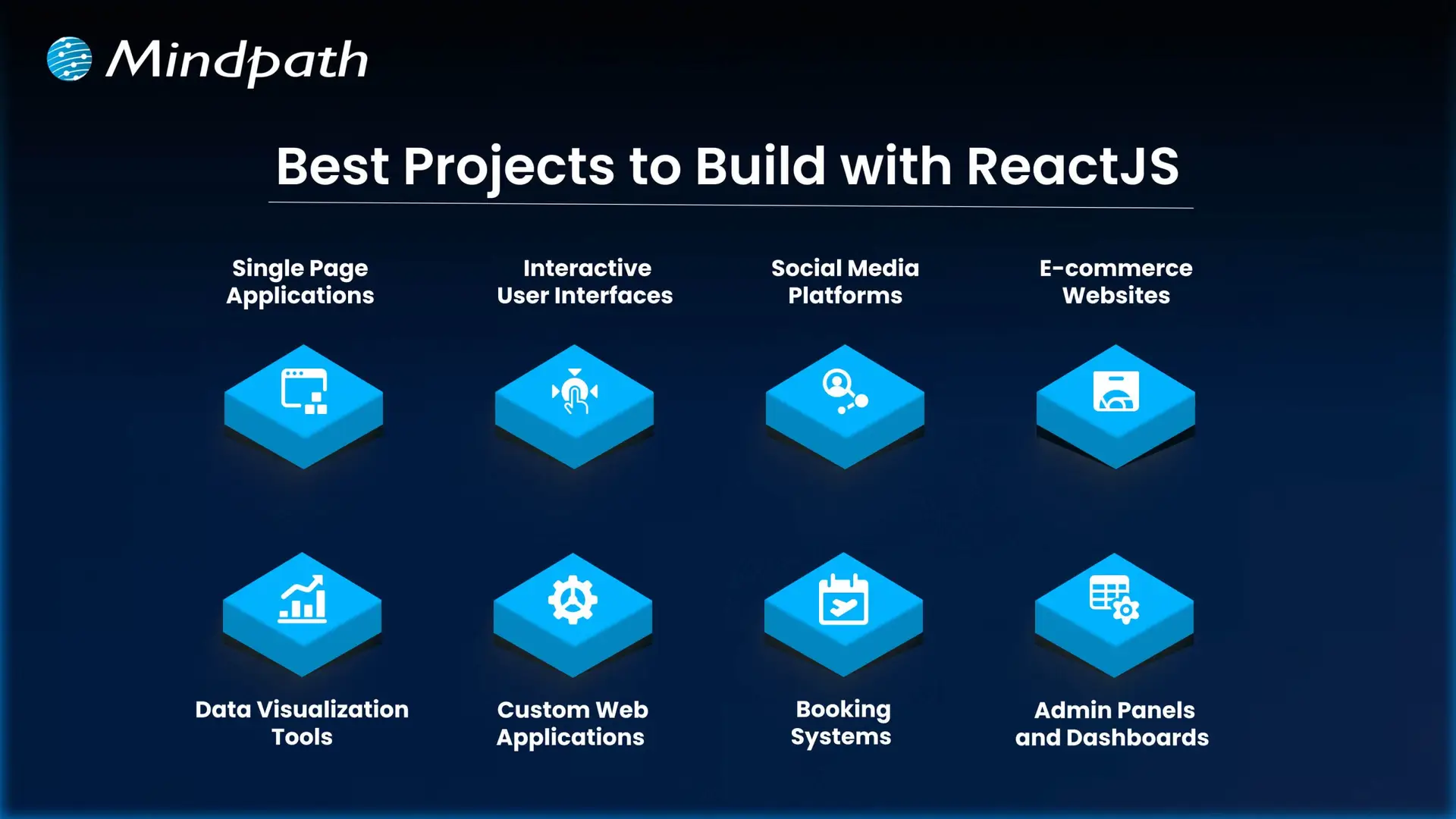
Best Projects to Build with ReactJS

1. Single Page Applications (SPAs)

SPAs load one main HTML page and update content without refreshing the whole page. This makes the user experience faster and smoother. Many developers use ReactJS Web Development to build SPAs like Trello or modern email platforms.

2. Interactive User Interfaces

Apps that need frequent user actions benefit from React’s component-based setup. It keeps interfaces dynamic and responsive to every click or input. Dashboards and social platforms are great examples of this.

3. Social Media Platforms

Social apps handle lots of data and need to stay quick and easy to use. React works well for feeds, notifications, and real-time chats. Platforms like Instagram and Facebook show how powerful it can be.

4. E-commerce Websites

Online stores have many parts, like product pages, shopping carts, and checkout steps. React helps keep all these features organized and easy to update. It’s a smart choice for anyone planning an online store.

Also Read: React vs Vue

5. Data Visualization Tools

React lets you build charts, graphs, and dashboards that help people see and understand data. These tools often need real-time updates as new data comes in. Using React makes complex data feel simple to explore.

6. Custom Web Applications

Businesses often need apps designed just for their work. ReactJS web development gives developers the tools to build custom features and workflows. This could be anything from task trackers to learning portals.

7. Booking Systems

Booking apps help people reserve flights, hotels, or services quickly. React keeps the process smooth with fast updates and clear forms. It’s trusted by many companies to handle large numbers of users at once.

8. Admin Panels and Dashboards

Businesses use admin panels to track performance and manage users or data. React’s reusable components make building these panels efficient. A well-built dashboard makes complex info clear and easy to manage.

Is your current team struggling to handle large-scale React applications? Learn why hiring a React Development Company might be the smarter choice. 

Real-World Examples of ReactJS Web Development

Many well-known companies rely on ReactJS Web Development to power their websites and apps. It helps them build fast, interactive experiences that keep users coming back. Here are some real-world examples of how ReactJS is used successfully.
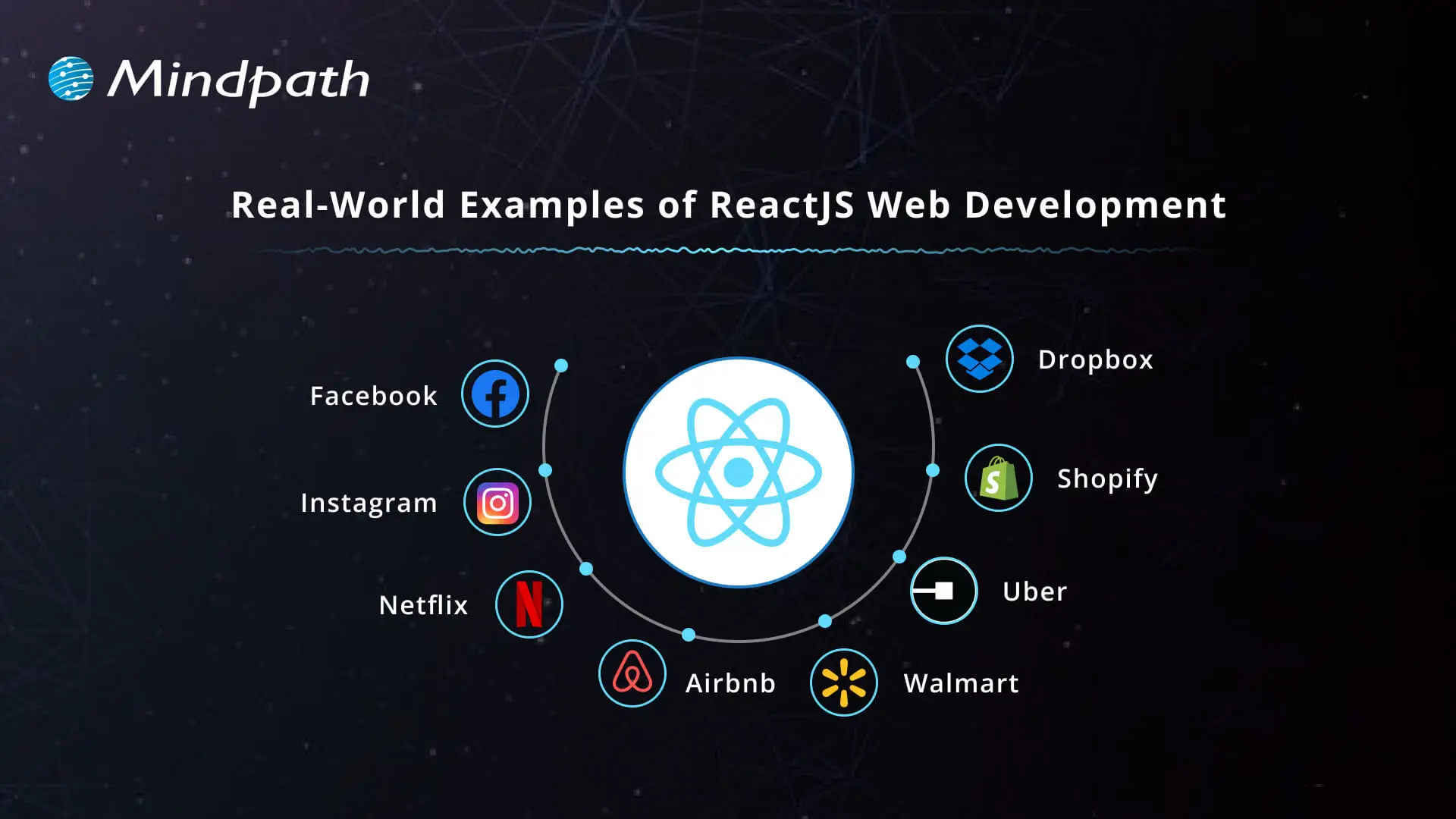
Real-World Examples of ReactJS Web Development

1. Facebook

Facebook uses React to handle its entire web interface. They also depend on React Native to keep their mobile app running smoothly.

2. Instagram

Instagram depends on React to manage its photo feeds, stories, and user interactions. React’s virtual DOM makes the app fast and helps deliver an easy browsing and sharing experience.

3. Netflix

Netflix uses React to manage its user interface, from browsing shows to streaming. React’s efficient rendering keeps the platform responsive and smooth for millions of viewers.

4. Airbnb

Airbnb relies on React to display listings, filters, and booking options. Its component-based structure makes the platform simple to update with new features.

5. Walmart

Walmart’s online store uses React to manage its huge product catalog and shopping features. React helps deliver a consistent shopping experience with fast page updates.

6. Uber

Uber’s web dashboard for drivers and riders uses React for live updates like ride tracking and driver status. React makes real-time changes visible without slowing down the app.

7. Shopify

Shopify uses React to build dynamic storefronts and checkout pages. This keeps the shopping process smooth for both store owners and customers.

8. Dropbox

Dropbox uses React to create an easy-to-use file storage and sharing experience. The interface stays clear and quick to navigate thanks to React’s reusable components.

Looking to build a high-performance frontend that scales with your business and delivers real ROI? Learn from our ReactJS for App Development guide to understand how React empowers business owners to make smarter, future-ready technology decisions.

Ready to Unlock the Power of ReactJS Web Development?

ReactJS web development has proven its value for businesses and developers who want faster, interactive, and scalable web apps. From single-page applications to custom dashboards, React makes it easier to build projects people enjoy using. Real-world examples show just how flexible and powerful this library can be. With React, your ideas can become smooth, engaging digital experiences.

At Mindpath, we have built successful React and React Native projects for clients in many industries. Our team has strong expertise in developing user-friendly web apps and mobile apps that work beautifully together. We focus on clean code, reusable components, and performance that scales with your business. Let Mindpath be your trusted partner for professional ReactJS development services that bring your ideas to life.

Frequently Asked Questions

1. Is ReactJS suitable for beginners who want to start web development?

Yes, ReactJS is considered beginner-friendly due to its simple structure and component-based approach. It allows learners to build small parts of an application step by step. With strong community support and learning resources, beginners can gradually move toward building complete, real-world projects.

2. How does ReactJS help in handling large and complex applications?

ReactJS simplifies complex applications by breaking them into smaller, reusable components. This modular structure makes it easier to manage, update, and scale applications over time. It also improves collaboration, as different teams can work on separate components without affecting the entire system.

3. Can ReactJS be used for both web and mobile app development?

Yes, ReactJS supports web development, while React Native allows developers to build mobile applications using similar concepts. This shared approach helps save time and effort, as parts of the logic can be reused across platforms, making development faster and more efficient.

4. What kind of businesses benefit the most from ReactJS development?

Businesses that require fast, interactive, and scalable user interfaces benefit greatly from ReactJS. This includes e-commerce platforms, SaaS products, social media apps, and dashboards. Its flexibility makes it suitable for both startups aiming for quick launches and enterprises managing large-scale applications.

5. How important is performance optimization in ReactJS projects?

Performance optimization is essential in ReactJS to ensure smooth user experiences. Techniques like using the virtual DOM efficiently, optimizing component rendering, and managing state properly help maintain speed. Well-optimized applications reduce load times and improve user satisfaction, especially in high-traffic environments.

Explore top projects built with ReactJS, from personal websites to SaaS apps. Learn why ReactJS is ideal for scalable, high-performance web solutions.
cloud computing trends

Have you been following the newest cloud computing trends? It seems that every day, there is something new to change how we store, share, and secure data. Perhaps you’ve been wondering if your business is missing out on smarter ways of working, or worried about staying ahead of the game in this digital world. Whatever your thoughts are, there is one thing for sure: cloud technology is not just for tech giants anymore; it is shaping the way we all connect, create, and grow.

As we move to 2026, these cloud trends will continue to open bigger opportunities for businesses, no matter how big or small. With faster, many times AI-driven services, greener cloud solutions, a flexible and secure future is more promising than ever. Being aware of what is next will enable you to make an informed decision about the future and give you a competitive edge. If you’re wanting to find out more about where the cloud is headed, continue reading. In this blog, you will learn what’s coming next.

Looking to build scalable, secure cloud applications that drive business growth? Mindpath offers expert cloud development services to help you design and optimize cloud solutions tailored to your needs

Understanding Cloud Computing

Cloud computing is simply the storing and accessing of data and programs over the internet instead of your computer’s hard drive. It is considered internet-based computing, allowing businesses and individuals to use servers, storage, and software that is also provided by cloud providers. One of the benefits is that maintenance is limited, which means there are lower costs associated with users storing files, documents, images, etc. Cloud computing offers flexibility in keeping important data secure and available.

It works through remote servers hosted online that store, manage, and process data rather than relying on local hardware. Users can access these resources whenever they need and scale them up or down as their needs change. This makes it easy to save money on physical infrastructure, increase efficiency, and keep operations running smoothly with more reliability and speed.

The market for this technology keeps expanding rapidly as more businesses adopt cloud solutions. According to Grand View Research, the global cloud computing market size was around USD 752.44 billion in 2024 and is projected to reach USD 2,390.18 billion by 2030. This growth is mainly driven by the rise of big data, artificial intelligence, and machine learning, which all depend on powerful and scalable cloud infrastructure.

Curious how modern cloud apps run without servers? Explore our blog on Serverless Architecture in Cloud Computing to see how serverless solutions are shaping the future of cloud trends.

What are the Latest Trends in Cloud Computing?

Staying updated with cloud computing trends 2026 can help your business stay competitive and ready for what’s next. Companies everywhere are paying close attention to the current trends in cloud computing to boost efficiency and security. Here are some key developments you should watch for in the coming year.

Latest Cloud Computing Trends in 2025

1. Rise of Multi & Hybrid Cloud

Many companies now use a multi-cloud strategy and hybrid cloud approach to run workloads across different cloud providers and their own data centers. This setup lets them combine the strengths of public and private clouds while keeping sensitive data secure. Using multi and hybrid cloud solutions also gives businesses more flexibility and better control over risks.

2. Automation

One of the latest trends in cloud computing is using automation to make systems work faster and more efficiently. Good automation helps teams deliver better results, reduce downtime, and improve overall quality. With better AI tools and user-friendly platforms, cloud providers are making automation easier for everyone to use.

3. AI/ML Capabilities

Better AI and machine learning are becoming the next big thing in cloud computing. Many providers now offer smart tools that help businesses use advanced analytics and automation. These cloud computing trends make it easier to build intelligent applications and boost efficiency without needing deep technical skills.

4. Cloud Cost Management

Managing expenses is a big part of the future of cloud computing as more businesses move to the cloud. New tools and services help companies track and control their spending more easily. These cost management features make it simple to budget, monitor usage, and find ways to save money.

5. Edge Computing

Edge computing is one of the cloud latest trends bringing data processing closer to where it’s created. This helps reduce delays and cuts down on the amount of data that needs to travel long distances. By doing this, businesses can work faster and use their networks more efficiently.

6. Low-Code and No-Code Services

One of the growing cloud services trends is using low-code and no-code tools to build apps faster. These solutions help people create software without needing advanced programming skills. Such cloud computing trends save time and lower development costs for businesses.

7. Open-Source Cloud Solutions

One of the growing cloud computing trends is the move toward open-source cloud solutions. These solutions give businesses more control and flexibility to adjust their cloud setup as needed. Open-source options can also help companies save money compared to traditional cloud providers.

8. Cloud-Native Applications

Building cloud-native applications is an important part of the future of cloud computing. These apps are made to run smoothly on cloud systems and use all the benefits the cloud offers. More tools are now available to help businesses create and launch these apps quickly and easily.

9. Focus on DevSecOps

DevSecOps brings security into every step of software development instead of adding it later. This approach helps teams find and fix issues early, keeping systems safe. Many cloud providers now offer tools that make it easier for businesses to build secure applications from the start.

10. Green Computing Initiatives

One of the important cloud computing trends is the push for greener solutions. Providers are using renewable energy and building energy-efficient systems to cut down on carbon emissions. These efforts help businesses meet their sustainability goals while using cloud services.

Struggling with speed, collaboration, or automation in DevOps? Our DevOps Challenges and Solutions blog explains how modern businesses address these issues.

Which Industries are Adopting Cloud the Fastest?

Many industries are moving to the cloud to work faster and serve their customers better. Companies see cloud solutions as a way to cut costs and stay flexible in a changing market. Let’s look at which sectors are adopting cloud the fastest right now.
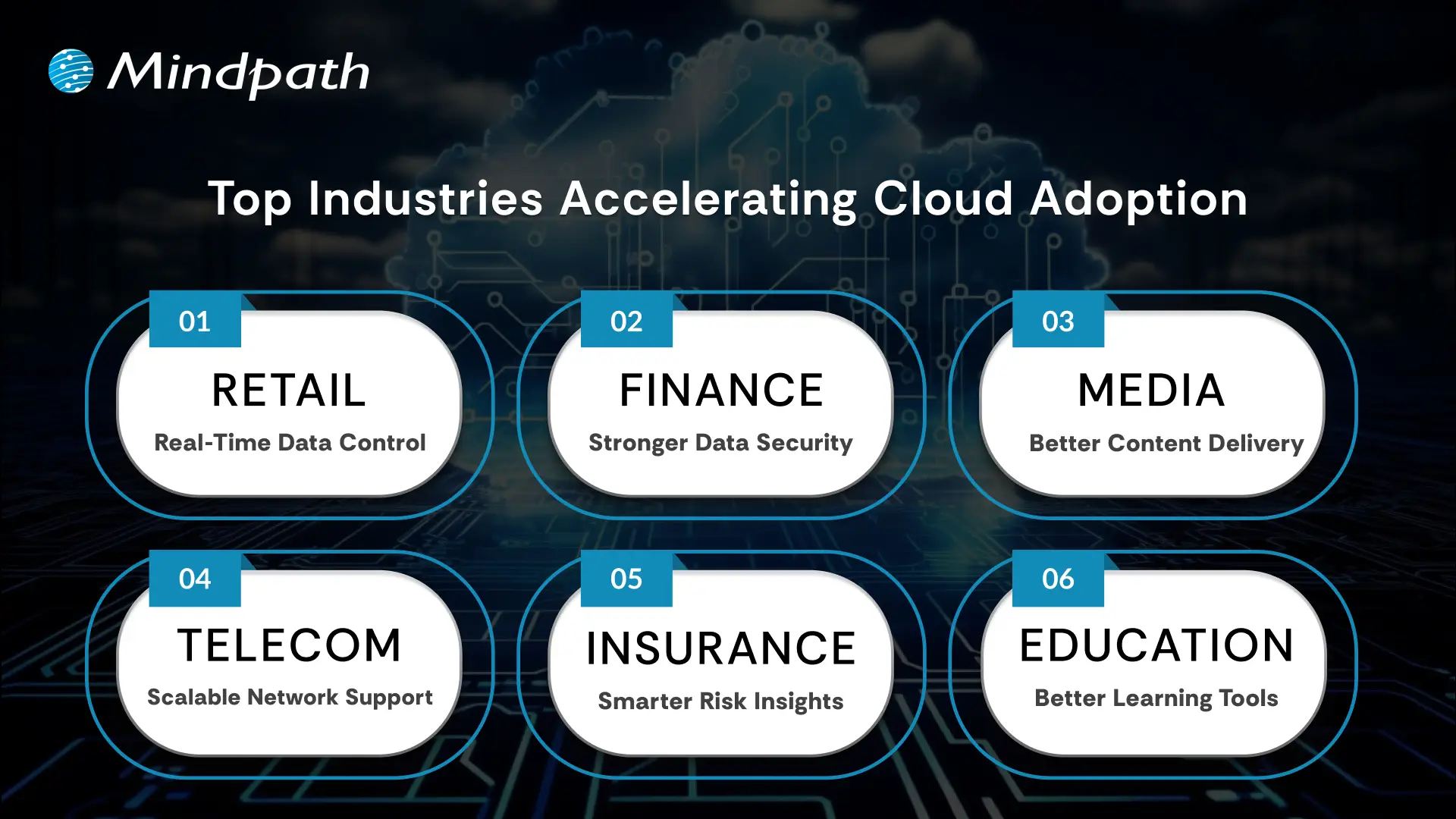
Top Industries Accelerating Cloud Adoption

1. Retail: Real-Time Data Control

Retailers use the cloud to manage sales, stock, and customer data in one system. Real-time updates improve supply chains and marketing campaigns. This boosts profits and keeps work going smoothly.

2. Financial: Stronger Data Security

Banks and financial firms trust the cloud for secure data storage and better protection. They can handle tasks like billing and client help more easily. Better security helps them grow safely.

3. Media: Better Content Delivery

Media companies use the cloud to create, store, and share content worldwide. Teams can work together from different places and finish faster. They handle big audiences without spending more.

4. Telecom: Scalable Network Support

Telecom companies use cloud solutions to manage networks and huge data. This helps them handle changing demands and roll out 5G and IoT services. Cloud computing trends keep people connected and ready for new tech.

5. Insurance: Smarter Risk Insights

Insurance companies use the cloud for flexible data and cost savings. They analyze big data to predict risks and detect fraud early. This helps them stay competitive with better customer service.

6. Education: Better Learning Tools

Schools adopt the cloud to manage tight budgets and get new technology. Teachers and students can share lessons and resources in one secure place. This makes learning flexible and improves teamwork.

Looking for ways to optimize your cloud strategy? Explore our Multi-Cloud Strategy blog to see why businesses are spreading workloads across multiple clouds.

Is Your Business Cloud Ready for 2026?

Staying on top of cloud computing trends can help any business unlock new opportunities, save money, and stay secure. As you’ve seen, trends like automation, AI, green computing, and smart cost management are shaping the way companies grow and compete. Keeping an eye on what’s next means you’re always ready to adapt and make smarter technology decisions.

At Mindpath, we help you stay ahead with trusted cloud computing services designed to match your goals. Our team can support your move to the cloud, help manage costs, and keep your data secure. We focus on delivering solutions that fit your business needs today and tomorrow. Connect with us and see how we can make your cloud journey easier.

Discover the top cloud computing trends for 2025, including AI, quantum computing, and hybrid solutions, and learn how they can shape your business’s future.
cloud computing trends

Have you been following the newest cloud computing trends? It seems that every day, there is something new to change how we store, share, and secure data. Perhaps you’ve been wondering if your business is missing out on smarter ways of working, or worried about staying ahead of the game in this digital world. Whatever your thoughts are, there is one thing for sure: cloud technology is not just for tech giants anymore; it is shaping the way we all connect, create, and grow.

As we move to 2026, these cloud trends will continue to open bigger opportunities for businesses, no matter how big or small. With faster, many times AI-driven services, greener cloud solutions, a flexible and secure future is more promising than ever. Being aware of what is next will enable you to make an informed decision about the future and give you a competitive edge. If you’re wanting to find out more about where the cloud is headed, continue reading. In this blog, you will learn what’s coming next.

Looking to build scalable, secure cloud applications that drive business growth? Mindpath offers expert cloud development services to help you design and optimize cloud solutions tailored to your needs

Understanding Cloud Computing

Cloud computing is simply the storing and accessing of data and programs over the internet instead of your computer’s hard drive. It is considered internet-based computing, allowing businesses and individuals to use servers, storage, and software that is also provided by cloud providers. One of the benefits is that maintenance is limited, which means there are lower costs associated with users storing files, documents, images, etc. Cloud computing offers flexibility in keeping important data secure and available.

It works through remote servers hosted online that store, manage, and process data rather than relying on local hardware. Users can access these resources whenever they need and scale them up or down as their needs change. This makes it easy to save money on physical infrastructure, increase efficiency, and keep operations running smoothly with more reliability and speed.

The market for this technology keeps expanding rapidly as more businesses adopt cloud solutions. According to Grand View Research, the global cloud computing market size was around USD 752.44 billion in 2024 and is projected to reach USD 2,390.18 billion by 2030. This growth is mainly driven by the rise of big data, artificial intelligence, and machine learning, which all depend on powerful and scalable cloud infrastructure.

Curious how modern cloud apps run without servers? Explore our blog on Serverless Architecture in Cloud Computing to see how serverless solutions are shaping the future of cloud trends.

What are the Latest Trends in Cloud Computing?

Staying updated with cloud computing trends 2026 can help your business stay competitive and ready for what’s next. Companies everywhere are paying close attention to the current trends in cloud computing to boost efficiency and security. Here are some key developments you should watch for in the coming year.
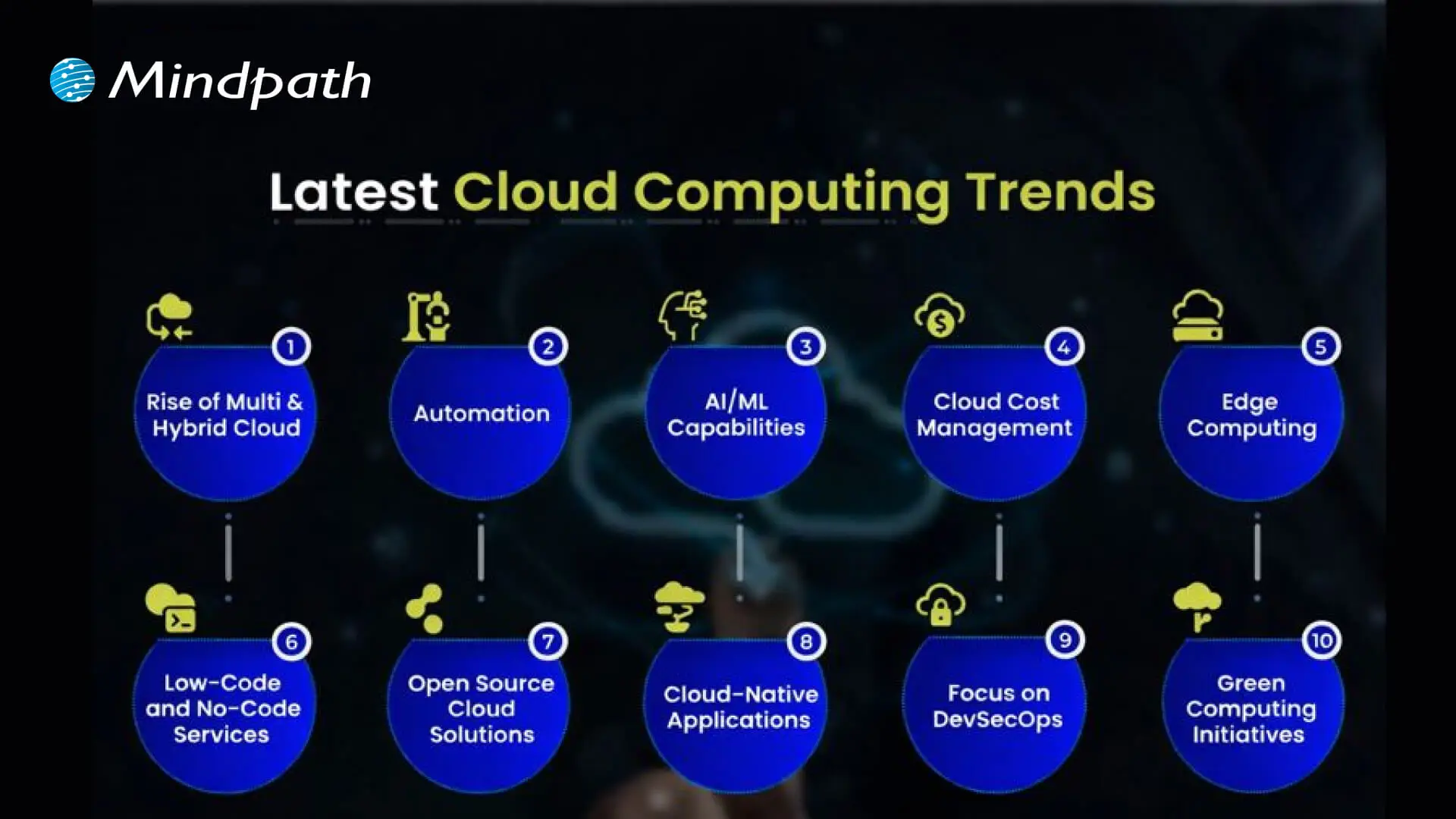
Cloud computing trends

1. Rise of Multi & Hybrid Cloud

Many companies now use a multi-cloud strategy and hybrid cloud approach to run workloads across different cloud providers and their own data centers. This setup lets them combine the strengths of public and private clouds while keeping sensitive data secure. Using multi and hybrid cloud solutions also gives businesses more flexibility and better control over risks.

2. Automation

One of the latest trends in cloud computing is using automation to make systems work faster and more efficiently. Good automation helps teams deliver better results, reduce downtime, and improve overall quality. With better AI tools and user-friendly platforms, cloud providers are making automation easier for everyone to use.

3. AI/ML Capabilities

Better AI and machine learning are becoming the next big thing in cloud computing. Many providers now offer smart tools that help businesses use advanced analytics and automation. These cloud computing trends make it easier to build intelligent applications and boost efficiency without needing deep technical skills.

4. Cloud Cost Management

Managing expenses is a big part of the future of cloud computing as more businesses move to the cloud. New tools and services help companies track and control their spending more easily. These cost management features make it simple to budget, monitor usage, and find ways to save money.

5. Edge Computing

Edge computing is one of the cloud latest trends bringing data processing closer to where it’s created. This helps reduce delays and cuts down on the amount of data that needs to travel long distances. By doing this, businesses can work faster and use their networks more efficiently.

6. Low-Code and No-Code Services

One of the growing cloud services trends is using low-code and no-code tools to build apps faster. These solutions help people create software without needing advanced programming skills. Such cloud computing trends save time and lower development costs for businesses.

7. Open-Source Cloud Solutions

One of the growing cloud computing trends is the move toward open-source cloud solutions. These solutions give businesses more control and flexibility to adjust their cloud setup as needed. Open-source options can also help companies save money compared to traditional cloud providers.

8. Cloud-Native Applications

Building cloud-native applications is an important part of the future of cloud computing. These apps are made to run smoothly on cloud systems and use all the benefits the cloud offers. More tools are now available to help businesses create and launch these apps quickly and easily.

9. Focus on DevSecOps

DevSecOps brings security into every step of software development instead of adding it later. This approach helps teams find and fix issues early, keeping systems safe. Many cloud providers now offer tools that make it easier for businesses to build secure applications from the start.

10. Green Computing Initiatives

One of the important cloud computing trends is the push for greener solutions. Providers are using renewable energy and building energy-efficient systems to cut down on carbon emissions. These efforts help businesses meet their sustainability goals while using cloud services.

Struggling with speed, collaboration, or automation in DevOps? Our DevOps Challenges and Solutions blog explains how modern businesses address these issues.

Which Industries are Adopting Cloud the Fastest?

Many industries are moving to the cloud to work faster and serve their customers better. Companies see cloud solutions as a way to cut costs and stay flexible in a changing market. Let’s look at which sectors are adopting cloud the fastest right now.

Top Industries Accelerating Cloud Adoption

1. Retail: Real-Time Data Control

Retailers use the cloud to manage sales, stock, and customer data in one system. Real-time updates improve supply chains and marketing campaigns. This boosts profits and keeps work going smoothly.

2. Financial: Stronger Data Security

Banks and financial firms trust the cloud for secure data storage and better protection. They can handle tasks like billing and client help more easily. Better security helps them grow safely.

3. Media: Better Content Delivery

Media companies use the cloud to create, store, and share content worldwide. Teams can work together from different places and finish faster. They handle big audiences without spending more.

4. Telecom: Scalable Network Support

Telecom companies use cloud solutions to manage networks and huge data. This helps them handle changing demands and roll out 5G and IoT services. Cloud computing trends keep people connected and ready for new tech.

5. Insurance: Smarter Risk Insights

Insurance companies use the cloud for flexible data and cost savings. They analyze big data to predict risks and detect fraud early. This helps them stay competitive with better customer service.

6. Education: Better Learning Tools

Schools adopt the cloud to manage tight budgets and get new technology. Teachers and students can share lessons and resources in one secure place. This makes learning flexible and improves teamwork.

Looking for ways to optimize your cloud strategy? Explore our Multi-Cloud Strategy blog to see why businesses are spreading workloads across multiple clouds.

Is Your Business Cloud Ready for 2026?

Staying on top of cloud computing trends can help any business unlock new opportunities, save money, and stay secure. As you’ve seen, trends like automation, AI, green computing, and smart cost management are shaping the way companies grow and compete. Keeping an eye on what’s next means you’re always ready to adapt and make smarter technology decisions.

At Mindpath, we help you stay ahead with trusted cloud computing services designed to match your goals. Our team can support your move to the cloud, help manage costs, and keep your data secure. We focus on delivering solutions that fit your business needs today and tomorrow. Connect with us and see how we can make your cloud journey easier.

Frequently Asked Questions

1. How can a business choose the right cloud model for its needs?

Choosing the right cloud model depends on factors like data sensitivity, budget, and scalability needs. Businesses should evaluate whether public, private, or hybrid cloud fits their operations best. A clear understanding of workloads and long-term goals helps in making a practical and cost-effective decision.

2. What are the biggest risks businesses should consider when moving to the cloud?

Common risks include data security concerns, vendor dependency, and unexpected costs. Without proper planning, businesses may face compliance issues or performance challenges. Implementing strong security practices, monitoring usage, and choosing reliable providers can help reduce these risks effectively.

3. How does cloud computing support business growth in competitive markets?

Cloud computing allows businesses to scale resources quickly, launch services faster, and respond to market changes efficiently. It supports innovation by enabling access to advanced tools like analytics and AI, helping companies stay competitive and deliver better customer experiences.

4. Is it expensive to maintain cloud infrastructure over time?

Cloud costs vary based on usage and management. While it reduces upfront investment in hardware, ongoing costs can increase without proper monitoring. Using cost management tools and optimizing resources ensures businesses maintain efficiency while keeping expenses under control over time.

5. How can businesses ensure data security in cloud environments?

Data security requires a combination of strong encryption, access controls, and regular monitoring. Businesses should follow best practices like multi-factor authentication and compliance standards. Working with trusted cloud providers and maintaining clear security policies helps protect sensitive information effectively.


hyperautomation technology

The rapid evolution of the business landscape has made organizations think about approaches to improve efficiency and customer satisfaction while reducing costs. The adoption of hyperautomation technology is a testament to the fact that businesses want more than traditional automation. Hyperautomation represents a huge paradigm shift that helps businesses achieve comprehensive automation in all their operations. 

Many people believe that automation is the sole answer to queries regarding the adaptability of businesses in competitive markets. However, the scope of automation is limited to specific tasks. Hyperautomation calls for using multiple technologies together to optimize their business operations with an integrated approach. Let us learn more about hyperautomation and how it is better than simple automation.  

Ready to take advantage of Hyperautomation for your business? Contact us to discover the customized solutions can bring to the table, which streamline your processes and boost efficiency.

Understanding the Fundamentals of Hyperautomation

The definition of hyper automation by Gartner describes it as a disciplined and business-centric approach used to recognize, refine, and ensure automation of different business and IT processes. The distinctive highlight of hyperautomation is the fact that it involves the coordinated use of different technologies, tools, and platforms. Some of the notable technologies that drive hyperautomation include robotic process automation or RPA, low-code/no-code tools, business process management, event-driven architectures, and machine learning. 

Upon diving deeper into answers to “what is hyperautomation,” you will also find how each technology helps with hyperautomation. The following technologies serve distinct advantages to every business that adopts hyperautomation.

Also Read: AI Trends

1. Robotic Process Automation

Robotic process automation serves as the foundation layer for automation of repetitive tasks in high volumes. The working of RPA systems is almost similar to how human users would interact with digital systems. 

2. Artificial Intelligence

You might come across queries like “what is the difference between AI and hyperautomation” when you learn about hyperautomation. The primary difference between AI and hyperautomation is that artificial intelligence is a technology that drives hyperautomation. AI technologies such as machine learning, computer vision, and natural language processing offer the cognitive capabilities required to understand, analyze, and draw predictions or decisions.

3. Low-code/No-code Platforms

The effectiveness of hyperautomation strategies also depends on how a business utilizes low-code or no-code platforms. These platforms can help developers craft and deploy applications with minimal coding. As a result, businesses can automate processes while enjoying the benefits of faster time to market and accelerated adoption.

4. Business Process Management Suites

Business process management tools and intelligent BPM suites also play a major role in fostering hyperautomation in 2026 through optimized workflows. The BPM tools and suites offer the ideal framework to design, execute, monitor, and optimize complex business workflows alongside managing different automation components. 

5. Process Mining, Task Mining, and Analytics

The effectiveness of hyperautomation strategies depends significantly on the identification of the right processes and tasks for automation. Process mining and task mining are crucial processes for the discovery, mapping, and analysis of existing processes. The two mining methods help in identifying opportunities for automation as well as the potential bottlenecks for the same. On top of it, real-time analytics and reporting can offer useful insights before, during, and after automation to ensure data-backed decisions and continuous improvement. 

The combined use of these technologies explains the hyperautomation vs. automation difference, as hyperautomation focuses on more than automating tasks. On the contrary, hyperautomation emphasizes adaptability and a cycle of continuous improvement in the automation process.      

Struggling to scale automation across your business without a clear strategy? Explore digital transformation for businesses to see how end-to-end automation and modern technologies work together to drive efficiency and growth.

How Does Hyperautomation Work?

Many of you might be wondering about the necessity of adopting hyperautomation when businesses can opt for automation of individual steps. The focus on end-to-end automation makes hyperautomation better than simple automation. Hyperautomation aims to ensure automation of all business processes from their beginning to completion. The scope of hyperautomation can include processes that span different systems and departments. You can rely on hyperautomation for automation of processes that rely on structured data and even the ones that use unstructured data.

You can use a simple example of a customer onboarding process to understand how hyperautomation works. If you use a traditional RPA system for the customer onboarding process, it will automate the data entry process. The RPA system will only facilitate automated entry of data from a structured form into CRM systems.

Hyperautomation delivers more than just automated data entry for the customer onboarding process. You can notice the end-to-end automation with hyperautomation in business processes with the customer onboarding process, where other technologies like NLP, AI, and ML come into play. For instance, NLP will help in extracting information from unstructured data, like customer emails. Subsequently, hyperautomation can leverage RPA for populating multiple systems with the data and use AI/ML for risk assessment and identity verification. The use of BPM tools can help in managing approvals, while analytics can support monitoring of the onboarding process to ensure compliance and efficiency.

Almost all answers to “what is an example of hyperautomation” will help you understand that hyperautomation is a holistic approach. It focuses on achieving seamless integration between different systems and processes, thereby reducing manual handoffs and errors. Hyperautomation breaks down departmental silos and supports a unified workflow for all business operations rather than relying on fragmented automation.

Looking to automate processes without increasing energy costs or resource usage? Discover how energy-efficient computing supports sustainable, high-performance automation across end-to-end business operations.

Unraveling the Advantages of Hyperautomation

The effectiveness of hyperautomation is clearly visible in the different ways in which it helps in transforming automation. The following benefits of hyperautomation will encourage more businesses to embrace it right away.

1. Reduced Costs

The most obvious benefit of hyperautomation is the assurance of cost reduction. Businesses can reduce operational costs across various processes by replacing manual efforts, reducing errors, and time invested in administrative tasks. The combination of hyperautomation tools and technologies with redefined operations and processes can reduce operational costs by a significant margin.        

2. Better Productivity

The automation of repetitive and time-intensive tasks with lower chances of human errors helps in reducing the workload of employees. As a result, employees can focus on more strategic activities that require critical thinking, empathy, and human creativity. Organizations can achieve improvements in overall productivity as hyperautomation empowers employees to add more value to the business.

3. Agility and Scalability

The widespread adoption of hyperautomation technology also empowers businesses to adapt quickly to fluctuating market conditions. Hyperautomation also helps in adapting to changing customer demands and regulatory requirements, thereby improving agility. On top of it, hyperautomation also enables easier scaling of processes to meet changing workloads and achieve competitive advantage.

4. Enhanced Customer and Team Experience

The benefits of hyperautomation, such as reduced manual errors and faster processing times, ensure that employees can have better experience. In addition, the customer experience also gets better with round-the-clock availability of automated services. The utility of intelligent tools in hyperautomation plays a vital role in ensuring job satisfaction and improving customer engagement.

5. Accurate and Timely Decisions

The keyword in any hyperautomation meaning is automation with an integrated approach. The innovative approach to automation ensures better precision and consistency with the use of technologies like AI and ML. Furthermore, the technologies for hyperautomation also help in drawing more insights from process data. As a result, the organization can take improved data-driven decisions and draw predictions for future trends with ease.

Wondering how to streamline automated workflows while maintaining speed and reliability? Explore devOps best practices to learn how optimized pipelines and continuous automation support scalable, end-to-end hyperautomation.

Ready to Unlock the Full Potential of Hyperautomation in Your Business?

As the world steps into a new age of digital transformation, automation becomes more important than ever. The benefits derived from hyperautomation use cases across different industries encourage more businesses to choose hyperautomation. It is an integrated approach to automation that focuses on automating all business processes from initiation to completion. 

At Mindpath, we aim to deliver the best end-to-end automation solutions tailored to your business requirements with different technologies. We believe in crafting our hyperautomation approach in alignment with the client’s business goals and vision to achieve the ideal results. Consult with us and discover the promising advantages of hyperautomation right now.

Frequently Asked Questions

While the introduction to hyperautomation may have helped you learn its fundamentals, there might be many other doubts on your mind. Let us take a look at some of the common FAQs to resolve the biggest doubts regarding hyperautomation.

1. What is the difference between RPA and hyperautomation?

The primary difference between RPA and hyperautomation is that RPA, or Robotic Process Automation, is one of the technologies used in automation. On the other hand, hyperautomation is a novel approach to automation that relies on the integrated use of different technologies, including RPA.

2. How does hyperautomation work?

Hyperautomation works by using different tools and technologies to recognize and vet organizational processes and tasks for automation. It involves coordinated use of technologies such as RPA, AI, machine learning, business process management tools, and low-code or no-code platforms. 

3. What are the benefits of hyperautomation?

The benefits of hyperautomation include reduced costs, limited chances of human error, and better overall productivity of an organization. Hyperautomation also empowers businesses with the essential tools to draw accurate insights from process data to make relevant and informed decisions.

4. How is hyperautomation different from traditional automation?

Hyperautomation is different from traditional automation in the fact that it does not focus on a single task or process. On the contrary, it aims to achieve comprehensive automation of all business processes and workflows while ensuring continuous improvement.

5. Which industries use hyperautomation?

Hyperautomation has found applications in various industries, such as finance, telecommunications, retail, healthcare and manufacturing. The use cases of hyperautomation in these industries help in reducing costs, enhancing decision-making, and improving efficiency in different tasks.

Discover how hyperautomation can transform your business by boosting efficiency, productivity, and ROI. Learn how Mindpath can help.
cloud native development

Cloud-native development is redefining the way organizations are evolving in the digital-first world. It enables teams to develop applications that are resilient, can be easily updated, and allow sophisticated scaling without compromising development speed. An increasing number of organizations are gravitating towards a cloud-native approach to meet the modern-day demands for agility, innovation, and customer experience. If your organization values being competitive and evolving at the speed the digital world enables, but not constrained by legacy solutions, cloud-native development could be the evolution opportunity you are seeking.

This method of breaking up large applications into smaller constituents via microservices allows organizations the opportunity to manage and improve everything much easier. With new technologies enabling containers and automation, organizations with the right supporting tools are able to deliver, test, and fix features faster than ever. It is no longer just about trying to keep pace; it is about leading a system that embraces change. In this blog post, we will discuss how cloud-native development enables organizations to scale up their businesses with greater control, pace, and certainty. So, let’s explore!

Looking to elevate your business with Cloud-Native Development? Contact us, and our experts will turn your ideas into high-performing cloud-native solutions.

What Is Cloud Native?

Cloud-native computing is a way of building and running applications that are built for the cloud. Cloud-native development provides developers with a way to build software that is flexible, adaptable, and able to handle dramatic change without breaking the overall architecture. Instead of building one huge system or application, the developer builds the application in independent pieces called microservices that work together. This approach allows for building and testing in more manageable pieces over time.

According to MarketsandMarkets, the cloud native applications market is expected to grow from USD 5.9 billion in 2023 to USD 17.0 billion by 2028. This shows that more companies are choosing this method to stay competitive and meet user demands. Tools like containers and automation help developers launch updates quickly without stopping the service. Cloud native makes it possible to move faster, reduce costs, and build stronger, more reliable software.

Must Read: Multi Cloud vs. Hybrid Cloud

Components of Cloud-Native Development

Cloud-native relies on a set of modern tools and practices that work together to build fast, flexible, and reliable applications. Here are the key components that make this approach effective:

1. Containers

Containers bundle code with everything it needs to run, making apps work smoothly across different environments. Tools like Kubernetes and Amazon ECS manage these containers to help with deployment, scaling, and maintenance. They are a key part of cloud native technologies, ensuring consistency and efficiency.

2. APIs

APIs, or Application Programming Interfaces, allow different software parts to communicate with each other. In cloud native development, microservices rely on APIs to share data and functions. This setup is lightweight and uses fewer resources compared to traditional systems.

3. Microservices

Microservices are small, independent parts of an application that work separately but communicate with each other using APIs. They are easy to update without affecting the whole system, which makes the app more stable. This structure supports cloud native development by making applications easier to build, test, and scale.

4. CI/CD Pipelines

CI/CD pipelines are used to automate the process of building, testing, and deploying code. They allow developers to work faster and reduce errors by using shared code repositories and automated workflows. This approach plays an important role in the cloud native landscape.

5. DevOps

DevOps brings together development and operations teams to automate and streamline the app development process. It helps in delivering software quickly and reliably with a focus on collaboration. DevOps practices are essential in the cloud native landscape to keep up with modern development needs.

Struggling with speed, collaboration, or automation in DevOps? Our DevOps Challenges and Solutions blog explains how modern businesses address these issues.

Benefits of Cloud Native Development

Cloud-native approach offers clear advantages that go beyond just building applications differently. These benefits are helping businesses improve the way they deliver, manage, and scale digital solutions across industries.

1. Reduced Operational Costs

Using open-source tools and serverless models helps cut down infrastructure and licensing costs. Businesses only pay for what they use, saving money and resources.

2. Effortless Scaling and Deployment

Cloud-native workflows automate how apps and infrastructure are deployed. With container orchestration, apps scale easily based on real-time demand.

3. Modernized Legacy Applications

Older apps can be updated to work better with modern cloud systems. Cloud-native development makes it easier to improve and connect them with new projects.

4. Greater Development Flexibility

Containers package apps with everything they need to run across different setups. This gives developers the freedom to build without being tied to one system.

5. Efficient Microservice Management

Kubernetes helps manage and scale container-based apps more efficiently. It simplifies deploying microservices while ensuring better performance.

6. Improved Application Stability

Cloud systems stay available even when one part fails. Microservices architecture ensures the app keeps working smoothly without full downtime.

7. Aligned Tech and Business Goals

A product-based approach aligns tech efforts with business goals. It boosts teamwork and supports faster responses to changing needs.

8. Boosted DevOps Efficiency

Cloud-native practices help speed up development, testing, and deployment. This leads to quicker, more reliable updates with fewer manual steps.

9. Low-Code and No-Code

Low-code and no-code platforms allow more people to build apps with simple tools. This makes development faster and less dependent on technical teams.

10. Minimized Vendor Lock-In

Cloud-native applications can run across multiple cloud platforms. This gives businesses the freedom to switch providers and avoid getting locked in.

Want to know what’s next for the cloud in 2025? Read our blog on Cloud Computing Trends to discover the technologies and innovations shaping the future of business.

Best Practices for Cloud-Native Development

To get the most out of cloud-native development, it’s important to follow proven methods that support speed, reliability, and scalability. These best practices help teams build stronger applications while keeping systems flexible and efficient.

1. Use Containers Effectively

Containers package apps with their dependencies, making them easy to run across different environments. This boosts reliability and simplifies deployment, helping teams work faster and more efficiently.

2. Take Ownership of Products

Following a product-focused mindset gives teams control over development from start to finish. It encourages innovation and quality, aligning with the goals of the cloud native foundation.

3. Automate CI/CD Pipelines

Continuous Integration and Continuous Deployment (CI/CD) automate testing and delivery, reducing errors and saving time. This helps teams release updates faster with higher confidence.

4. Build with Microservices

Microservices divide the application into smaller, focused services that can be built, deployed, and managed independently. This structure improves fault tolerance, speeds up development, and supports scalable cloud native solutions.

5. Apply Infrastructure as Code (IaC)

IaC lets teams manage infrastructure with code, allowing easy updates, version control, and automation. It brings consistency and reduces the chances of manual errors during setup or changes.

6. Focus on Resilience and Fault Tolerance

Design apps to handle failure using retries, timeouts, and automated recovery. This ensures your cloud native applications stay stable and available during unexpected problems.

Want to cut costs and speed up app deployments? Read our blog on Serverless Architecture in Cloud Computing to see how your business can scale efficiently.

Unlocking the Power of Cloud-Native Development

Cloud-native development is helping businesses move faster, scale smarter, and build more resilient applications. From modernizing legacy systems to enabling flexible and efficient operations, it’s shaping the future of digital transformation. By adopting the right strategies and tools, organizations can respond to change with greater confidence and deliver value to customers more effectively.

At Mindpath, we help businesses transform their software approach with our expert cloud-native development services. From planning architecture to seamless deployment, our team supports every step. We simplify operations, modernize infrastructure, and create scalable applications that align with your goals. With Mindpath, you build software that’s fast, flexible, and ready for what’s next.

Frequently Asked Questions

1. How is cloud-native development different from traditional application development?

Cloud-native development focuses on building applications specifically for cloud environments using microservices, containers, and automation. Traditional development often relies on monolithic systems that are harder to scale and update. This modern approach allows faster releases, better resilience, and easier scalability across environments.

2. What kind of businesses benefit the most from cloud-native development?

Businesses that require scalability, frequent updates, and high availability benefit the most. This includes startups, SaaS companies, and enterprises handling dynamic workloads. It is especially useful for organizations aiming to innovate quickly and deliver consistent digital experiences across multiple platforms.

3. Is migrating to cloud-native architecture a complex process?

Migration can be complex depending on existing systems and architecture. It often involves breaking down monolithic applications, adopting new tools, and retraining teams. A phased approach, starting with smaller components, helps reduce risk and ensures smoother transition without disrupting ongoing operations.

4. How does cloud-native development improve application reliability?

Cloud-native systems are designed with fault tolerance in mind. If one microservice fails, others continue to function without affecting the entire application. Features like automated scaling, monitoring, and self-healing systems help maintain performance and ensure minimal downtime for users.

5. What skills are important for teams working with cloud-native technologies?

Teams need skills in containerization, microservices architecture, cloud platforms, and automation tools. Knowledge of CI/CD pipelines, DevOps practices, and infrastructure as code is also important. Continuous learning is essential as cloud-native technologies evolve rapidly and require up-to-date expertise.

Discover the power of cloud-native development! Learn its benefits and how it helps businesses enhance security, efficiency, and performance.
digital transformation for businesses

Do you think about your company’s future and ask yourself what digital transformation for businesses means? If so, you’re not alone! Many business owners and leaders are trying to figure out how they will continue to be relevant and competitive in a world that is constantly changing. Digital transformation is changing how you work, how you serve and support customers, and how your team grows. So why is it so important?

Digital transformation for businesses impacts every area of a business, from routine activities to strategic targets. It allows you to work smarter, make better decisions, and respond rapidly to changing customer demands. Adopting digital tools and an alternative mindset can help businesses maximise productivity and create new opportunities. Understanding the process is a prerequisite to helping your business flourish in today’s environment. In this blog, you’ll discover how.

Implementing digital transformation in your business can be challenging; you need expert guidance. Partnering with Mindpath will help you in exploring personalized strategies that will reshape your business. Contact us to start your transformation journey.

What is Digital Transformation?

Digital transformation is the use of modern technology across all areas of a business to change how it works inside and how it connects with customers. It can involve updating old systems, adding new tools, and finding better ways to get work done. Companies take this step to keep up with industry changes and market trends. It is a serious shift in how work is planned and delivered every day.

The digital transformation process requires the involvement of people at every level, from leaders to staff. It is not a single project but an ongoing effort, as technology and business needs keep evolving. Companies must stay open to new ideas and improvements to remain competitive. Digital transformation helps an organization stay prepared and flexible in a fast-changing world. It is a commitment to keep moving forward.

Curious which technologies can give small businesses a competitive edge? Explore emerging technologies for small businesses to see the innovations driving digital transformation.

Why is Digital Transformation Important?

Digital transformation is important because it helps companies keep up with changes in their industry and meet customer needs in new ways. It improves how businesses work by using smarter tools and systems, which makes daily tasks more organized and efficient. Focusing on digital transformation for small businesses can help smaller companies compete with bigger ones and stay prepared for what’s next.

One big reason companies choose digital transformation is to replace outdated manual work with better technology. This makes daily tasks easier and helps the whole company run more smoothly. According to digital transformation McKinsey research, 68% of people said they transform their operations mainly to modernize how they work. A clear plan helps every company adapt and stay ready for what comes next.

What are the 4 Types of Digital Transformation?

There are different ways a company can approach digital transformation depending on its goals and needs. Here are four main types of digital transformation every business should know about:
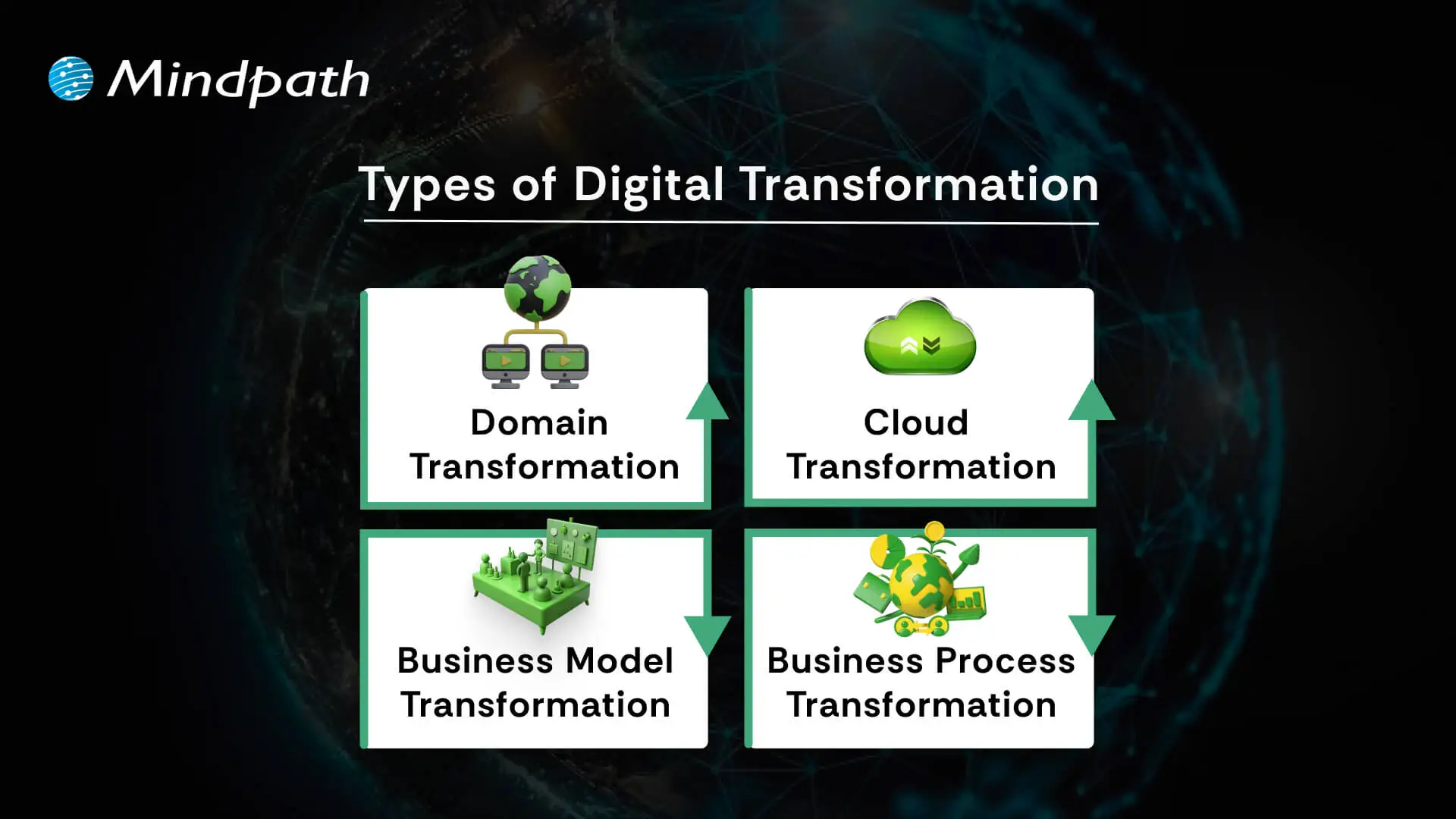
4 types of digital transformation

1. Domain Transformation

Domain transformation happens when a company enters a new market beyond its usual industry. This is often made possible by advanced digital transformation technologies.

2. Cloud Transformation

Cloud transformation moves data and systems to the cloud for better access and storage. Companies can choose public, private, or hybrid models for flexibility.

3. Business Model Transformation

Business model transformation means changing how a product or service is delivered by using modern digital tools. It’s a smart move within any digital transformation framework.

4. Business Process Transformation

Business process transformation improves how work gets done inside the company. It’s a big step in digital transformation for business success.

Benefits of Digital Transformation for Businesses

Digital transformation helps companies improve how they work and respond to changing demands. Below are some of the main benefits it can offer:

1. Cost Savings

One of the biggest advantages of digital transformation for businesses is saving money by removing outdated processes. With better systems in place, companies can spot problems sooner and use resources more wisely.

2. Better Customer Experiences

When processes run smoothly and technology is up to date, customers enjoy faster service and better support. Digital transformation for businesses also makes it easier to adapt based on customer feedback.

3. Support for Sustainability

Modern tools help companies design products and processes that use less energy and fewer materials. This cuts down waste and supports long-term environmental goals.

4. Faster Processes and Higher Productivity

When companies use smart tools and automation, everyday tasks become quicker and more accurate. This gives employees more time to focus on work that adds real value instead of getting stuck on repetitive jobs.

5. Valuable Data Insights

Digital transformation for businesses makes it easier to collect useful data and turn it into insights that help leaders make better choices. This way, different departments can understand trends and work together with clear, reliable information.

6. New Business Models

Following a clear digital transformation roadmap lets companies create fresh ways to reach customers and stay ahead in the market. New ideas and flexible services open the door to growth and higher revenue.

7. Strong Profit and Growth Potential

Companies that have a solid digital transformation strategy often see steady profit growth because they work more efficiently and serve more people. It also helps them expand into new areas over time.

8. Strong Competitive Edge

Digital transformation for businesses helps them stand out with fresh ideas and unique services. Companies that keep innovating stay ahead of the competition and handle change more easily.

9. Quick Adaptation to Change

Digital transformation for businesses gives them the tools to adjust plans when the market changes suddenly. This helps keep things running smoothly and protects the company’s future.

10. Simple Compliance and Regulations

Smart systems help track the right data to meet industry rules and quality standards. This makes it easier to share reports and pass audits without extra stress.

What are the 5 Main Areas of Digital Transformation?

Every successful digital transformation covers key parts of a business to make sure changes bring real value. Here are the five main areas of digital transformation that companies focus on:
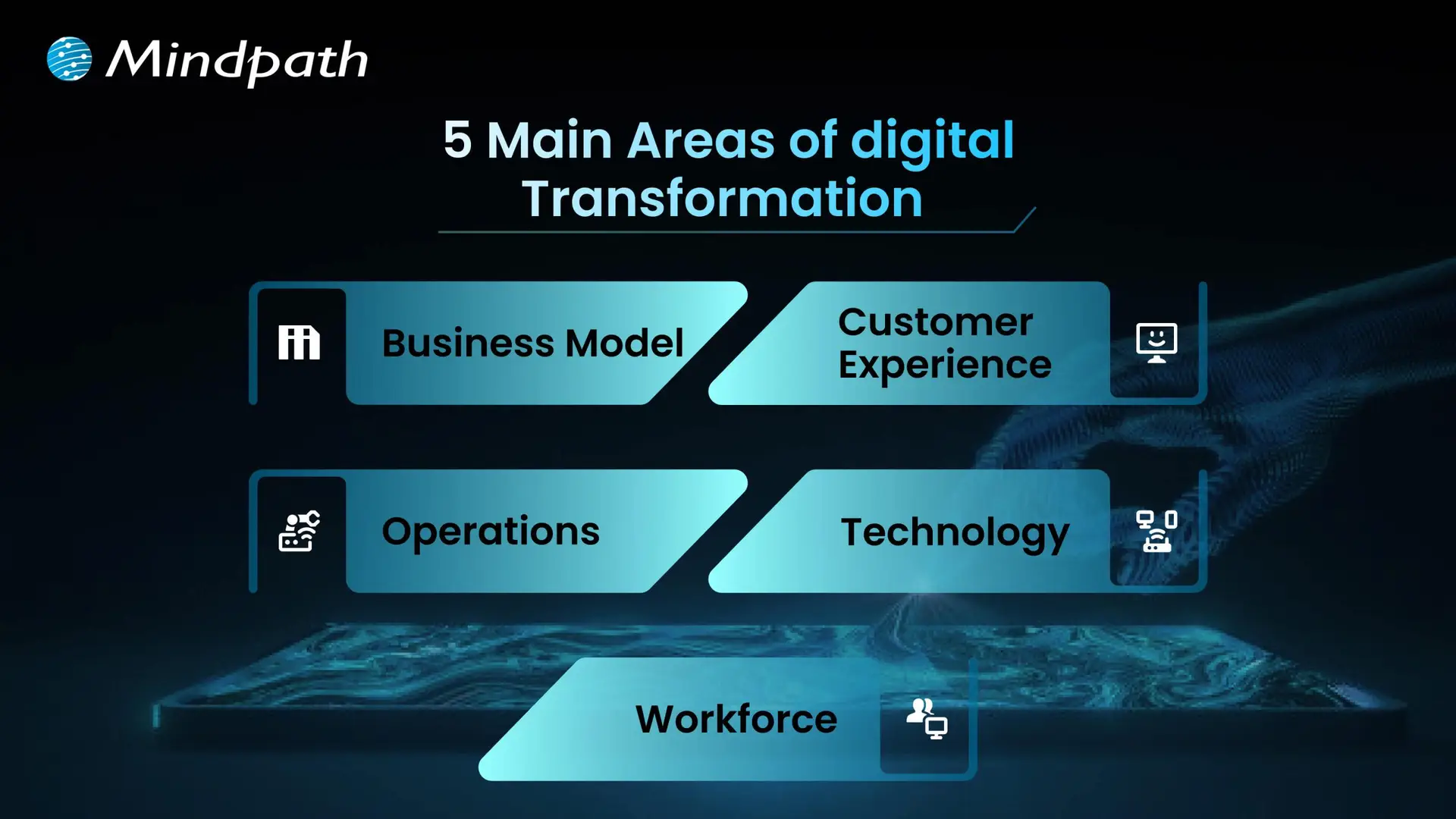
5 main areas of digital transformation

1. Business Model

Digital transformation often means rethinking how a business makes and delivers its products or services. Companies may find new ways to earn revenue using online platforms or new technologies. This helps them stay competitive and reach more people.

2. Customer Experience

Customer experience means using technology to make every interaction better for your customers. This could be through faster service, easier online tools, or more personal communication. The goal is to keep customers happy and loyal to your business.

3. Operations

Improving operations means making everyday work run more smoothly with digital tools. Automation and better systems help teams save time and avoid mistakes. This keeps the business running efficiently and ready for growth.

4. Technology

Every digital transformation depends on using the right technology, like cloud services, AI, or smart data tools. These tools help companies collect information, solve problems, and create new ideas. Staying updated with technology is key to long-term success.

5. Workforce

Employees need the skills to work well with new digital systems. Companies should train their teams and encourage learning new things regularly. This builds a flexible workforce that can handle changes and keep the business moving forward.

Real-world Examples of Digital Transformation

Knowing about real Digital transformation examples makes it easier to understand how technology can truly change a business. Here are some real-world cases that show what’s possible when companies embrace digital transformation.
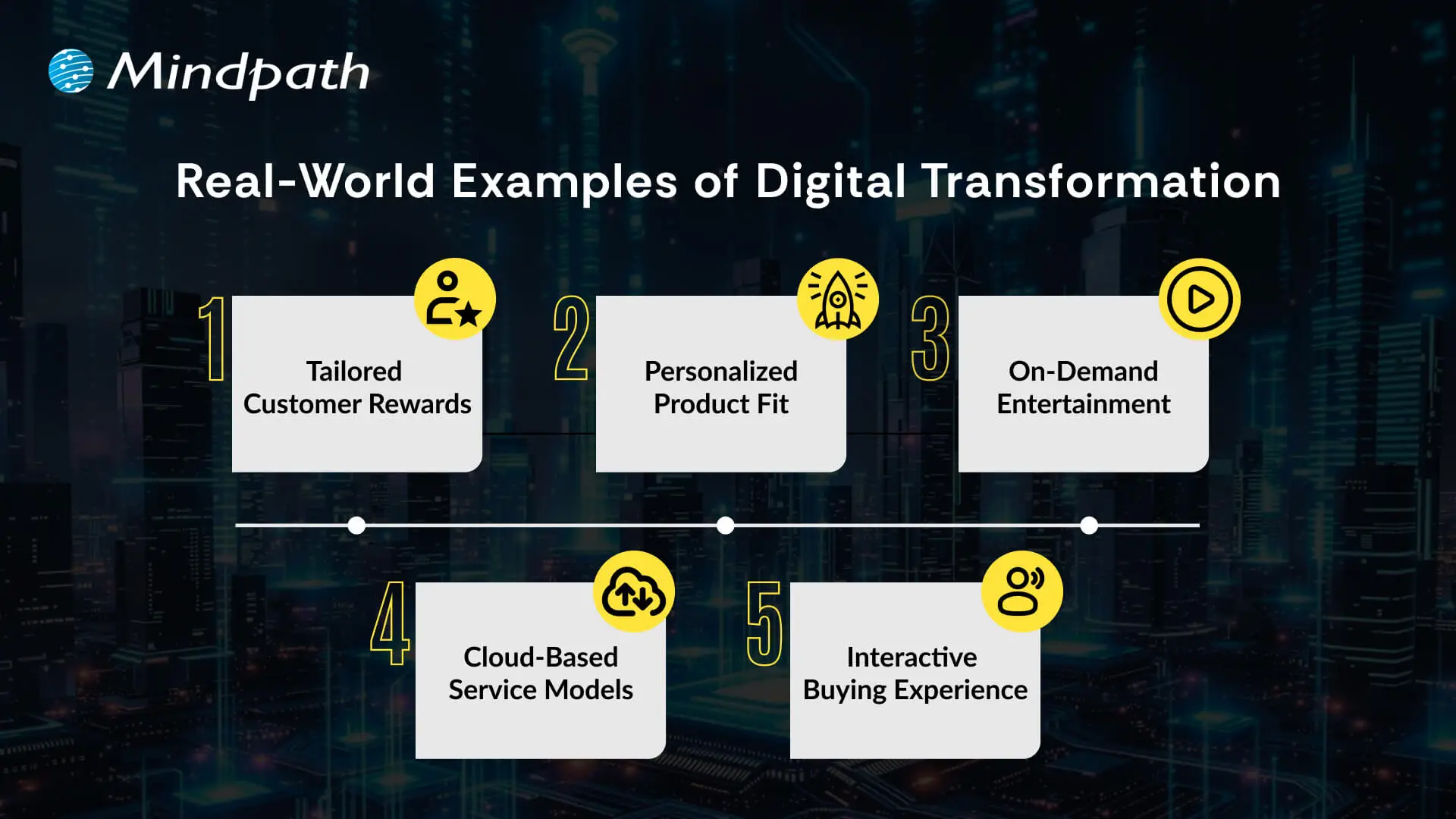
Real World exmaples of Digital Transformation

1. Tailored Customer Rewards

Starbucks uses AI in its app to create rewards and suggestions that feel personal to each customer. This digital approach keeps customers happy and loyal to the brand.

2. Personalized Product Fit

Nike’s SNKRS app and foot scan tool help customers find shoes that fit perfectly. This smart use of technology makes shopping easier and gives Nike useful data for better designs.

3. On-Demand Entertainment

Netflix changed how people enjoy movies by moving from renting DVDs to streaming online. This gave people freedom to watch what they want, when they want, without late fees.

4. Cloud-Based Service Models

Adobe transformed from selling boxed software to offering cloud subscriptions like Creative Cloud and Document Cloud. This makes their tools easier to use and keeps customers updated with the latest features.

5. Interactive Buying Experience

Audi introduced Audi City, a digital showroom where people explore cars using large screens and virtual tools. This makes the car-buying process modern, fun, and more convenient in small spaces.

Ready to Future-Proof Your Business?

Digital transformation for business helps you stay competitive, meet customer needs, and grow in a fast-changing world. Using AI and business technology together lets you work smarter, adapt quickly, and make better choices every day. Embracing this change now opens the door for fresh ideas and keeps your company strong in any market.

At Mindpath, we empower you to develop a clear approach to digital transformation by bridging people, processes, and technology. Our experts will guide you through every step of the journey and will ensure your team is employing the best tools to drive ongoing digital transformation. Let’s make your organization agile, productive, and ready for growth using intelligent digital solutions tailored specifically to you.

Frequently Asked Questions

1. How can a business know if it is ready for digital transformation?

A business is ready when it clearly understands its goals, current challenges, and areas that need improvement. Readiness also depends on leadership support, willingness to adopt change, and having a plan to train employees and integrate new technologies into daily operations.

2. What are the common mistakes businesses make during digital transformation?

Many businesses focus only on technology and ignore people and processes. Lack of clear strategy, poor communication, and resistance to change often lead to failure. Successful transformation requires alignment between teams, continuous learning, and a well-defined roadmap that guides every step.

3. How long does digital transformation typically take to show results?

Digital transformation is an ongoing process rather than a one-time project. Some improvements, like automation or process optimization, may show results quickly, while larger changes in business models or customer experience can take months or even years to deliver full value.

4. Is digital transformation only relevant for large enterprises?

Digital transformation is equally important for small and medium-sized businesses. It helps them compete with larger organizations by improving efficiency, reducing costs, and enhancing customer experiences. Even small changes, such as adopting cloud tools or automation, can create meaningful impact.

5. How can businesses measure the success of digital transformation?

Success can be measured through key metrics such as improved productivity, faster processes, customer satisfaction, and revenue growth. Businesses should track both operational and strategic outcomes to understand how well digital initiatives are contributing to overall performance and long-term goals.


Explore how digital transformation reshapes businesses, boosts efficiency, enhances customer experiences, and drives sustainable growth for success.
serverless architecture in cloud computing

Have you heard a lot about serverless architecture in cloud computing and are still unsure of what it is? If so, you’re not alone. Many developers, startups, and business owners wonder how this model works and how their approach to building and deploying apps will change with it. So, what is the hype about, and why is it catching everyone’s attention in 2026?

Serverless architecture in cloud computing is a smarter way of providing a scalable application without the hassle of server management. With serverless computing, you rely on the cloud provider to do all the provisioning, scaling, and maintenance, leaving you to deal with just the code and get features delivered faster. Since more companies are evolving into modern cloud solutions, serverless is becoming a common approach to delivering applications. In this blog, we will cover everything you need to know. So, let’s dig in!

Ready to transform your cloud infrastructure with serverless architecture? Connect with us, and our team will guide you from planning to deployment, ensuring maximum efficiency and scalability.

What is Serverless Architecture in Cloud Computing?

Serverless architecture in cloud computing is a modern way to bring software to market. Rather than having to manage a server’s infrastructure, developers develop and run applications without having to deal with the environment. The developer doesn’t need to worry about servers, updates, scaling, and instead just writes code and deploys. The cloud provider takes away all of the backend tasks, such as server provisioning, maintenance and scaling, making the team’s development as a whole faster without focusing on technology-driven software engineering.

In a serverless model, application code is decomposed into independent functions, commonly known as Function as a Service (FaaS). Each function performs a specific function with the ability to respond to events such as HTTP requests or file uploads. Once the application is deployed, the cloud provider executes the function when required. If no servers are available, the provider spins one up for you automatically. Developers do not take part in this process; it is handled for them on their behalf without the developers noticing.

Must Read: Cloud Computing Trends

Fundamental Concepts in Serverless Computing Architecture

To understand how serverless computing truly works, it’s important to grasp its core principles. Here are the fundamental concepts that define serverless architecture and how they support modern application development:

1. Cold Start

If a function hasn’t run in a while, it might take longer to start up. This is called a cold start.

2. Warm Execution

When a function runs quickly because it was recently used, it’s called a warm execution.

3. Invocation

Every time a serverless function runs, it’s called an invocation.

4. Duration

This is the total time a function takes to run from start to finish.

5. Orchestration

Orchestration means managing how different serverless functions work together in a sequence.

6. Function-as-a-Service (FaaS)

FaaS lets developers write small functions that run automatically when certain events happen.

7. Event

An event is what triggers a function to run, like an HTTP request or file upload.

8. Stateless

Serverless functions don’t remember anything from one run to the next.

Ever wondered how cloud apps grow without server management? Read our blog on Cloud-Native Development to see how it powers agile and resilient serverless architectures.

Advantages of Serverless Architecture

Serverless architecture helps businesses build and deploy apps faster with less infrastructure management. According to Grand View Research, the global serverless architecture market was valued at USD 9.42 billion in 2023 and is expected to grow at a 28.2% CAGR from 2024 to 2030. Here are some key advantages that make serverless a popular choice in cloud computing today:

1. Cost-Effective Usage Model

Serverless platforms charge only for actual function execution time. There are no costs for idle servers, making it highly economical, especially for applications that run on demand or infrequently.

2. Faster Time-to-Market

Cloud functions enable developers to build and deploy features quickly. This rapid development approach helps businesses stay agile and respond faster to market needs.

3. Auto Scaling Capabilities

Applications built on cloud functions can easily scale up or down based on real-time user demand. This automatic scaling ensures performance stays smooth during traffic spikes without any manual effort.

4. Simplified Backend Management

With serverless architecture in cloud computing, developers no longer need to manage servers, updates, or scaling. It allows teams to focus on development while the cloud provider handles operations behind the scenes.

5. Modular and Clean Code

Each function in a serverless setup performs a specific task, promoting modular design. This leads to easy maintenance, especially when working with components like a serverless database or microservices.

6. Ideal for Event-Based Solutions

Serverless architecture in cloud computing supports event-driven applications, making it perfect for real-time analytics, chatbots, IoT, and more. It allows seamless integration with tools that react instantly to user actions or data changes.

How do teams deploy serverless apps faster and more reliably? Explore our DevOps blog to learn how automation and collaboration make it possible.

Serverless Architecture Use Cases

Serverless architecture in cloud computing is changing the way developers build and manage applications. It’s perfect for handling tasks that run occasionally or need to scale quickly without manual setup. Here are some common and practical use cases:

1. Automated CI/CD Workflows

Serverless tools help speed up software delivery by automating tasks. For example, pushing code can trigger a function to build the app or run tests right away.

2. Scalable APIs

You can use serverless Lambda with tools like Amazon API Gateway to build RESTful APIs. These APIs grow with your traffic, so you never have to worry about performance limits.

3. Event-Driven Actions

Serverless architecture in cloud computing is ideal for user actions that trigger automated tasks. For example, when someone signs up, it can update a serverless database and send a welcome email using cloud functions.

4. Background Processing

Serverless functions are great for behind-the-scenes work like video processing or updating product details. These tasks run in the background without slowing down the main app.

5. Flexible Growth

With serverless architecture in cloud computing, teams can move parts of an app one step at a time. It’s easy to expand later by adding more functions or connecting to a serverless database.

6. Smarter Security Tasks

Cloud functions can check new containers for security risks or support safer login methods. They’re also useful for things like two-factor authentication and SSH key validation.

Securing serverless applications can be challenging, how is it done? Discover about DevSecOps to see how security is built into every stage of cloud development.

What is the Difference Between Serverless Architecture and Cloud Architecture?

While both serverless architecture and cloud architecture use cloud environments to run applications, they differ in how infrastructure is managed and how applications are built. Here’s a quick comparison to help you understand the key differences between the two:

Aspect Cloud Architecture Serverless Architecture
Definition A broad model where computing resources are delivered over the internet. A model where apps run without managing servers directly.
Infrastructure Management Developers may manage virtual machines or containers or use managed services. All server management is handled by the cloud provider.
Scalability Manual or auto-scaling needs to be configured. Automatically scales based on demand.
Cost May include fixed costs for allocated resources, even if unused. Pay only for the time and resources your code actually uses.
Development Focus Requires DevOps involvement for setup, monitoring, and updates. Developers focus only on writing and deploying code.
Flexibility Offers a range of service models like IaaS, PaaS, and SaaS with customizable resources. Designed for small, modular functions that respond to specific events.
Examples AWS (EC2, S3), Microsoft Azure (VMs), Google Cloud (Compute Engine) AWS Lambda, Azure Functions, Google Cloud Functions

Is Your Business Ready to Go Serverless in the Cloud?

Serverless architecture in cloud computing offers a powerful way to build fast, scalable, and cost-efficient applications. With no server maintenance to worry about, developers can focus fully on innovation. As businesses aim for agility and flexibility in 2026, serverless becomes the smart choice for modern app development and digital transformation.

At Mindpath, we offer expert cloud computing services tailored to your business goals. From setting up serverless frameworks to managing cloud resources and infrastructure, we help you scale with ease. Partner with us to streamline your operations and deliver high-performing cloud-based solutions with confidence.

Frequently Asked Questions

1. When does serverless architecture make the most sense for a business?

Serverless architecture works best for applications with unpredictable traffic, event-driven workflows, or rapid scaling needs. It is especially useful for startups and growing platforms that want to reduce infrastructure management while focusing on faster development and efficient resource utilization.

2. Does serverless architecture completely eliminate the need for backend management?

Serverless reduces infrastructure management, but backend responsibilities still exist. Developers must manage application logic, APIs, databases, and integrations. Monitoring performance, handling errors, and ensuring security remain important to maintain a reliable and scalable application environment.

3. How does serverless impact application performance during high traffic?

Serverless platforms automatically scale based on demand, allowing applications to handle sudden traffic spikes efficiently. However, performance can sometimes be affected by cold starts. Proper architecture design and optimization strategies help ensure consistent and smooth performance even under heavy loads.

4. Is serverless architecture suitable for large and complex applications?

Serverless can support complex applications, but it requires careful planning. Breaking applications into smaller, independent functions improves scalability and maintainability. For highly complex systems, a hybrid approach combining serverless with traditional cloud services may offer better flexibility and control.

5. What should be considered before adopting serverless architecture?

It is important to evaluate factors like application type, execution frequency, cost patterns, and vendor dependency. Understanding limitations such as cold starts, debugging complexity, and monitoring challenges helps in making informed decisions and ensures successful adoption of serverless architecture.

Discover the benefits of serverless architecture, from cost savings to faster development, and learn how Mindpath can help your business thrive.

Join our Newsletter!

categories

Join the world's largest training library and unlock new opportunities!

Featured Posts

Ready to Leverage GenAI for
Software Development?

Form automation to innovation, let’s turn your ideas into intelligent, AI-driven solution.