Hiring React Developers: The Ultimate Checklist for Success

Home

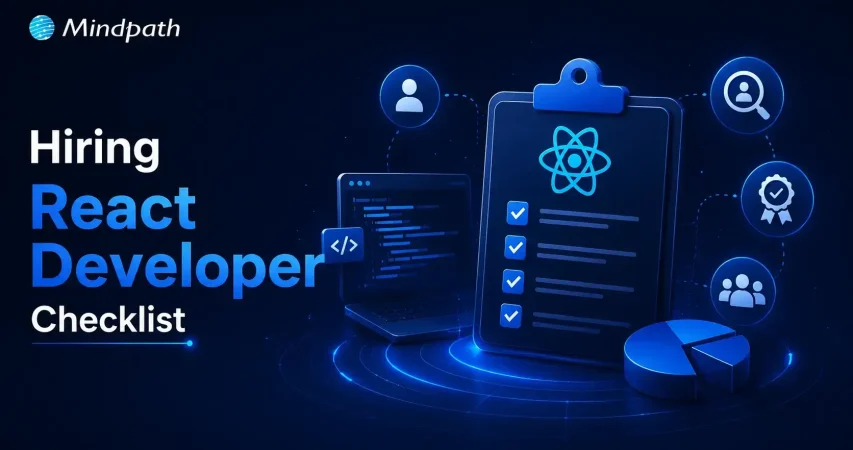
Hiring React Developers: The Ultimate Checklist for Success

Hiring React Developers: The Ultimate Checklist for Success

Join our Newsletter!

hiring react developer

You should know what a react developer does in real life before you start hiring. A React developer’s main job is to use JavaScript and the React library to create user interfaces that people can use. They want to know how well front-end apps work and how they do it.

Making UI components, keeping track of the application’s state, integrating APIs, and speeding things up are some of the things they do every day.

Planning to bring your web application idea to life using React? Mindpath offers ReactJS development services designed to deliver smooth performance and great user experience.

A react js developer’s real-life tasks and responsibilities include:

  • Creating reusable UI components
  • Managing data flow and state
  • Optimizing application performance
  • Collaborating with backend and DevOps teams
  • Maintaining clean and scalable codebases

It’s important to be clear about the job because hiring someone without knowing what it is can lead to problems with expectations.

Also Read: ReactJS Trends

Why Hiring the Right React Developer Matters?

ReactJS development services are in high demand right now because people need web apps that can grow and work well. If you hire the wrong developer, the project could take longer to finish, you could have more technical debt, and the user experience could get worse.

But skilled developers can:

  • Deliver clean and maintainable code
  • Optimize performance at scale
  • Build seamless user interfaces

More and more businesses are hiring Dedicated React developers who can help with long-term product growth instead of just getting things done quickly.

Wondering why businesses are increasingly choosing React for their projects? Discover the key benefits of ReactJS for web development and how it improves performance and scalability.

Core Skills Required for React Developer

The first step in a structured hiring process is to find out what skills you need to have to be a React developer. These skills are more than just being able to write code. They know how to build front-end architecture from the ground up.

1. Strong JavaScript Fundamentals

You need to know ES6+ because React is built on JavaScript. Developers should know about things like closures, async/await, and array methods.

2. React Fundamentals and Architecture

You need to know a lot about JSX, the virtual DOM, the component lifecycle, and how to handle state in order to make apps that work well.

3. State Management Expertise

To deal with complicated states in modern apps, you need to know how to use tools like Redux or the Context API.

4. HTML, CSS, and UI/UX Understanding

React is a framework for building front-end applications. This means that programmers need to know how to make user interfaces that are simple to use and work well.

5. API Integration and Backend Communication

Developers need to know how to connect backend services and use REST APIs.

6. Version Control and Development Tools

To get a job today, you need to know how to use Git, Node.js, and npm.

You should never compromise on these reactjs developer skills because they are the technical foundation.

Looking to understand the step-by-step journey to becoming a successful React developer? Explore detailed ReactJS roadmaps to guide your learning and hiring decisions effectively.

Evaluating Advanced ReactJS Developer Skills

The best developers know more than just the basics. They know advanced skills that affect how well the system works and scales.

1. Performance Optimization

A good developer knows how to make big datasets work better, use lazy loading, and cut down on the number of times they have to render.

2. Testing and Debugging

If you know how to use tools like Jest and debug, you will have fewer problems in production and be able to release things faster.

3. Component-Based Thinking

Since React’s architecture is based on reusable parts, it’s important to know how to make designs that can be used again.

4. Problem-Solving Ability

Developers should be able to quickly find and fix bugs and handle problems that come up in the real world.

These advanced skills are often what make a candidate stand out from the rest when hiring a developer.

Looking to create applications that can grow with your business needs? Discover how building scalable applications with React can help you achieve long-term success.

The Role of React Developer 

How much work a modern developer can get done depends a lot on how well they know react developer tools and ecosystem utilities.

These tools are helpful:

  • React DevTools for debugging component trees
  • Redux DevTools for state inspection
  • Build tools like Webpack and Vite
  • Testing libraries like Jest and React Testing Library

These tools can help the developer do well in real life, not just in theory.

Soft Skills You Should Not Ignore

When you hire react developers, make sure they have both hard and soft skills.

Here are some important soft skills:

  • Communication and teamwork
  • Attention to detail
  • Adaptability and collaboration 

React developers often have to work with people from other departments, so being able to get along with others can make a big difference in how well a project goes.

Want to know how artificial intelligence is shaping modern front-end frameworks? Read how ReactJS and AI are working together to create smarter and more dynamic applications.

Practical Hiring Checklist for React Developers

Based on real-life hiring frameworks, this is a helpful list of things you can do to hire people faster:

1. Define Your Requirements Clearly

Find out if you need a freelancer, a developer who works for you, or a team of React developers who will work on your project full-time.

2. Evaluate Technical Skills

Learn how to use APIs, how to manage state, and the basics of JavaScript and React.

3. Review Portfolio and Past Work

Check out real projects to see how well they code, how easy it is to add new features, and how good their user interface is.

4. Conduct Technical Assessments

Give someone coding tests and put them in real-life situations to see how good they are at solving problems.

5. Assess Communication Skills

Make sure the developer and your team can work well together.

6. Check Adaptability and Learning Ability

React changes a lot, so developers need to stay up to date on new features and how to use them correctly.

This list will help you stay on top of things and organized while you hire people.

Curious about how much it really costs to hire skilled React professionals? Explore the cost of hiring ReactJS developers and what factors influence pricing.

Choosing the Right Hiring Model

When companies need to hire ReactJS developers, they usually choose one of three types of models:

  • Freelancers for short-term tasks
  • In-house developers for long-term projects
  • Outsourced or dedicated teams for scalability

There are good and bad things about each model, but companies that want to grow steadily over time usually hire Dedicated React developers.

Final Thoughts

You can’t just hire someone who knows how to use React; you also need to find people who can build apps that are fast, can grow with your business, and meet your needs. You can greatly lower the risks of hiring by using a structured checklist and focusing on the right skills for a React developer.

One of the best things your business can do in a world where user experience is the most important thing for success is hire the right React people.

FAQs:

1. What does a react developer do?

A React developer builds user interfaces using JavaScript and React, focusing on UI components, state management, and performance optimization.

2. What are the key skills required for react developer roles?

Key skills include JavaScript (ES6+), React fundamentals, state management, API integration, and UI/UX knowledge.

3. Why should I hire dedicated React developers?

Dedicated developers ensure consistency, better collaboration, and long-term scalability for complex projects.

4. What tools should a React developer know?

Important react developer tools include React DevTools, Redux DevTools, Jest, and build tools like Webpack.

5. How do I evaluate ReactJS developers for hire?

Assess their technical skills, portfolio, problem-solving ability, and communication skills through structured interviews and tests. 

Related Post

woocommerce vs shopify

In the e-commerce landscape, businesses need to make a number of critical decisions. In case you are planning to venture into the e-commerce space, it is imperative to choose the right platform. This decision can certainly influence the success of your business in the dynamic e-commerce arena. 

The platform that you choose for your e-commerce store can undoubtedly influence the overall performance and success of your business. The top names that are ruling the e-commerce platform setting are Shopify WooCommerce. You need to dive into the world of WooCommerce Shopify so that you can make a proper comparison between these platforms. You need to know how these e-commerce platforms differ from one another so that you can make the ideal selection.

Planning to grow your online business and make a real difference in sales and customer experience? At Mindpath, we provide expert web development services that create user-friendly online stores designed to boost conversions and engage your customers.

An Insight into Shopify

Shopify refers to a cloud-based e-commerce platform. It offers a diverse range of tools for business entities so that they can sell their offerings online as well as in person. It is undoubtedly considered to be one of the most popular platforms that empowers entrepreneurs and large brands to not only create but also manage their online store. It has a diverse range of features that you can capitalize on in order to give an edge to your business in the competitive space. 

You must get a holistic insight into Shopify and its features to understand its true capabilities as an e-commerce platform. One of its distinguishing features is related to the creation of a store. Businesses can also use their selling tools and payment processing features to streamline their practices and operations. 

An Insight into WooCommerce

WooCommerce is an open-source e-commerce plugin for WordPress. It is completely free for users. WooCommerce enables users to transform a WordPress website into an entirely functional online store. It offers a diverse range of tools so that you can add products and set up payment options for your target audience. 

A unique thing about WooCommerce is that it is ideal for experienced sellers in the e-commerce domain. You can extend its functionality with the help of a number of add-ons and themes. Businesses need to familiarize themselves with the core features of WooCommerce so that they can make use of the platform in an optimal manner. Its key features that you need to know about include the availability of a large library of themes and high extensibility.  

Must Read: AI in E-commerce

Difference Between WooCommerce and Shopify

Now that you have a basic understanding of Shopify and WooCommerce, it is time to look at them at a closer level. Businesses that plan to establish themselves on the online platform need to know the key differences between these platforms so that they can have clarity on WooCommerce vs Shopify. The insight into this area is crucial to choosing the suitable platform and thriving in the market. 

1. Cost

While talking about WooCommerce vs Shopify, one of the key differences between the two options revolves around their cost. WooCommerce and Shopify have entirely different pricing structures. WooCommerce is entirely free for users, so you do not have to pay anything to use it for your online business. Thus, it offers ample flexibility with variable costs for users. 

On the other hand, when it comes to Shopify, it has a subscription model for its users. WooCommerce vs Shopify pricing is a major point of difference that you need to take into consideration for your e-commerce business. The ultimate budget of businesses can play a catalytic role in choosing their ideal e-commerce option.  

2. User-Friendliness

The ease of use or user-friendliness is a key dimension that you need to bear in mind while selecting between WooCommerce and Shopify. You must keep in mind that both these e-commerce solutions offer a diverse user experience. As WooCommerce is an open-source plugin for WordPress, which is self-hosted, it requires manual setup. 

Every aspect has to be handled separately by businesses while using the plugin. Moreover, businesses should know that it requires ongoing management as well. When it comes to Shopify, it has an all-in-one dashboard that users can use for their needs.  Thus, users can have a hassle-free experience if they choose Shopify. 

Not sure which technologies will give your e-commerce business the best performance and scalability? Explore our blog tech stack for your web app success to learn how to choose the right tools for long-term growth.

3. Themes as well as Templates

While talking about shoplift vs WooCommerce, it is key to understand how they differ in terms of available themes and templates. WooCommerce offers a humongous library of premium as well as free WordPress themes. You can choose the specific theme that is ideal for your business. The good news for users is that there is an opportunity to customize the themes on WooCommerce. 

When it comes to Shopify, businesses can use professionally designed themes. Such themes can certainly give an edge to your business. But you have to bear in mind that there are limited options to customize the themes. You need to take into account WooCommerce vs Shopify themes while choosing the ideal option out of the two options.

4. Scalability

Scalability is an important dimension that every e-commerce business needs to prioritize. You need to make sure that your online store grows in a seamless manner as your business expands. Your store must be able to handle additional product offerings and additional users. WooCommerce serves as a highly flexible option for e-commerce businesses. 

However, in order to leverage the flexibility that it offers, businesses must be aware of how to use the available tools. Shopify undoubtedly simplifies the degree of flexibility by offering built-in tools for businesses. You can leverage these tools as they will handle most of the work for your business. 

5. Security

Security is undoubtedly a non-negotiable element you need to look at while understanding the difference between WooCommerce and Shopify. If you plan to use WooCommerce, you need to know that, since it is a self-hosted solution, the onus of security lies with you. Although it offers certain security features, most of the security depends on elements such as the hosting environment and plugins. 

Similarly, the manner in which businesses maintain their websites also influences the quality of security. On the other hand, Shopify offers robust security to e-commerce businesses. This specific platform has in place holistic security measures that can safeguard both customer and store-related data. 

Concerned about keeping your online store and customer data secure? Read our blog application security best practices for web and mobile apps to learn proven methods to protect your business.

6. Payment Gateway 

As a majority of online customers are making online payments, it is essential for e-commerce businesses to have in place a robust payment gateway mechanism. Both Shopify and WooCommerce offer a diverse range of payment gateway options that you need to be aware of. As WooCommerce is integrated with WordPress, it offers a high degree of flexibility when it comes to payment gateways. 

It is possible to integrate almost any gateway. But the particular process may require additional setup for businesses. When it comes to Shopify, it comes with built-in options. The built-in payment option offered by Shopify makes it simpler for businesses to accept payments from customers without requiring additional setup. Moreover, it supports international payments, thereby creating value for modern businesses. 

7. Customization

The difference between WooCommerce and Shopify arises when looking at the customization dimension. You can look at WooCommerce as a blank canvas. It offers high power to businesses to customize their online store based on their needs and requirements. On the other hand, Shopify keeps things simple for businesses. 

It offers limited customization ability as a business. Without having to do much customization, businesses can have a professional-looking online store. You can take advantage of the drag-and-drop editor to build your store. However, this feature limits the ability to customize for users. 

Looking for innovative ways to stand out in the crowded e-commerce space? Learn from our blog, augmented reality in e-commerce, and see how AR technology can transform your online store.

The table presented below gives an overview of the main differences between Shopify and WooCommerce. Businesses can certainly refer to it while making the selection between WooCommerce or Shopify.

Basis WooCommerce Shopify
Cost Free  Monthly subscription model 
User-friendliness Not beginner-friendly and requires manual setup Beginner-friendly and intuitive
Themes and Templates Offers a large library of WordPress themes and high customization ability Offers professionally developed themes and low customization ability
Scalability Flexible but requires good hosting and optimization Effortless scaling with business
Security Security level depends on hosting and manual updates Security is fully managed and comprehensive 
Payment Gateway Multiple payment gateways with no additional charge Shopify payments and external payments with applicable fees
Customization High customization Limited customization

Selecting Between WooCommerce and Shopify

It is crucial for businesses to remember that the ultimate choice of WooCommerce and Shopify depends on the goals as well as the needs of businesses. You need to keep in mind your budget and WooCommerce vs Shopify payments while choosing the ideal platform for your e-commerce business. You must remember that both platforms offer a unique set of advantages for businesses. 

As the pros and cons of each of these options vary, you need to carefully consider them while making your choice. WooCommerce empowers businesses to customize their online stores. On the other hand, Shopify offers a professional-looking store thanks to its drag-and-drop option. 

Struggling to make informed platform decisions for your e-commerce business? Explore our blog on the  importance of data-driven decision-making for businesses to learn how data insights can guide your choices.

Final Words

In the cut-throat competitive business space, it is mandatory to choose the ideal platform for e-commerce success. In order to make the right choice, you need to have clarity on your basic requirements. This insight can guide you to choose the best platform that perfectly meets your needs and expectations. 

Mindpath provides web development services that understand the need to choose the right platform for e-commerce businesses. Businesses can undoubtedly rely on our experts to make use of high-quality WooCommerce and Shopify solutions. These high-quality solutions can make sure that your business can thrive in the unpredictable e-commerce realm and gain an edge over its competitors. 

The ultimate eCommerce showdown: WooCommerce vs. Shopify! Explore their features, benefits, and which platform is right for your business.
custom mobile application development services

In an ever-quickening pace of digital development, businesses strive for differentiators that can engage their audiences in new ways. Custom mobile application development services provide the means to actually deliver, providing a way for businesses to develop apps that serve their needs perfectly. Using unique features connected to smooth user experiences, organizations build engagement, access to efficiencies, and value delivery. Have you noticed how apps designed with intention often make a bigger impact than off-the-shelf solutions?

Keeping up with mobile app development trends ensures that these custom solutions remain relevant, innovative, and aligned with evolving user expectations. These services create opportunities for organizations to reconsider customer engagement and organizational workflows in a fundamentally different way. Through dedicated solutions, organizations can have a competitive advantage and respond quickly to the changes in market demands. The custom mobile application’s ability to do so goes beyond its convenience. It helps to shape strategies, improve growth potential, and establish connections. In this blog, we are exploring the top seven industries that have benefited from custom mobile application development services and how. So, let’s dig in!

Looking to stay ahead in today’s fast-paced technology world, businesses are looking to customize apps that are tailored to meet their specific demands. Mindpath’s mobile app development services will deliver high-performing solutions that give real results.

A Quick Dive into Custom Mobile Application Development Services

Custom mobile app development services involve developing mobile applications for a particular objective or purpose, rather than depending on off-the-shelf solutions. This process involves the planning, design, development, testing, and deployment of mobile applications, resulting in applications that provide personalized user experiences, enhanced usability, integration with existing systems, and strong security. Custom applications also allow the business flexibility and scalability to tailor the app to its needs as it evolves over time.

These services are developed to deliver applications that are agile, scalable, and secure. Custom solutions can effortlessly merge with an existing system and adapt to changing needs in the business. When companies invest in their respective user experience, they can enhance their engagement while properly managing sensitive information. Custom mobile app development services will provide sustainability for the long term, and a strategic and effective digital presence that supports competitiveness and adaptability.

Industries Benefiting from Custom Mobile Application Development Services

Many sectors are changing how they operate and engage customers with custom app development services. These services help businesses create mobile apps that cater to their specific goals, workflows, and the needs of their customers. Through customization, companies from many sectors can enhance efficiency, increase engagement, and achieve measurable growth.

1. E-Commerce and Retail

Custom app development services plays a significant role. It provides seamless and engaging shopping experiences to brands in the e-commerce and retail industry. Personalized recommendations, customer-friendly navigation, and secure payments are some of the app features that businesses can create to keep customers happy. Retailers not only increase customer loyalty by incorporating features such as loyalty programs and real-time updates but also can gain steady sales growth.

2. Healthcare

The healthcare industry is changing rapidly, as you would expect from a sophisticated mobile application development platform. Making use of customized healthcare apps will allow patients to have much simpler access to booking their visits and managing online consultations.

Hospitals also enjoy a more efficient patient care process. The implementation of electronic prescriptions and the employment of telemedicine innovations. All of which results in the saving of time and resources and the maintenance of high-quality care.

3. Education

One of the innovations that the education sector is adopting is the use of tailor-made mobile applications. The implementation of these applications has brought ease in the management of virtual classes, assignments, and attendance for schools, universities, and e-learning platforms.

Through the use of custom apps, education can be more stimulating, adaptable, and available to students from any location as these apps provide interactive learning experiences and instant communication.

4. Finance

One of the major trends in the finance and banking industry is the use of custom mobile application development services to revolutionize customer experience. These applications not only allow the users to carry out banking, investing, and loan activities effortlessly but also ensure that the data security is at a very high level.

Some of the latest security and convenience features, such as biometric authentication, instant payments, and personalized insights, have empowered customers to become more loyal. This makes them feel more comfortable with their financial institutions.

Looking to prioritize security in your application lifecycle? Discover useful strategies in our blog on application security best practices and explore how to make security a core part of your development roadmap.

5. Logistics and Transportation

One of the main factors for better efficiency in the logistics and transportation industry is custom application development services which develop various applications for business use. This kind of apps will allow companies to manage their routes, shipments tracking, and fleet operations. Not only in person but also in real time.

Advanced analytics and the usage of GPS as standard technology in many different fields have definitely helped in optimizing fuel consumption as well as in savings and in making sure deliveries are on time and are reliable.

6. Real Estate

Custom mobile application development services have a major impact on the real estate sector, which changes the way the market has been operating for a long time. With these new applications, end-users can go through listings, practically visit properties, and get in touch with agents at once. Thus, it speeds up and clarifies the entire process.

Apart from that, real estate companies are also benefiting from these applications. They can manage their leads more efficiently and correspond with clients comfortably. Thus making the property experience more productive and enjoyable.

7. Travel and Hospitality

Innovative custom mobile application development services have become an effective way for the travel and hospitality industry to improve customer experience. By using these apps, individuals can quickly reserve trips, keep track of their schedules and have seamless access to different departments at any time.

As a result of incorporating functionalities such as up-to-the-minute updates, location maps, and tailored gifts & services, travel companies. They have the opportunity to create customer loyalty and provide their travellers with a more exciting and integrated outing.

Curious about the tools and frameworks driving the future of mobile apps? Explore and discover key innovations in our blog on mobile app development technologies that can empower your business to build smarter, more efficient apps.

Ready to Transform Your Business with a Custom Mobile App?

Custom mobile application development services are helping industries innovate, improve customer engagement, and achieve lasting growth. Businesses across sectors now rely on tailored apps to enhance user experience, streamline operations, and stay competitive. With the right strategy and expert support, these apps can become a long-term asset for business success.

As a trusted custom mobile app development company, Mindpath delivers powerful website and mobile app development solutions designed for your unique goals. Our expert team builds secure, scalable, and user-friendly apps that help your business connect better with customers and perform efficiently. Partner with Mindpath to bring your app idea to life and move your business ahead with confidence.

Support Is One Click Away

Featured Posts

Related Post

Hire skilled Node.js developers in Canada with expertise in scalability, security, and compliance. Find the right talent with Mindpath!