AI vs Automation: What Business Leaders Actually Need to Invest In?

Home

AI vs Automation: What Business Leaders Actually Need to Invest In?

AI vs Automation: What Business Leaders Actually Need to Invest In?

Join our Newsletter!

AI vs automation

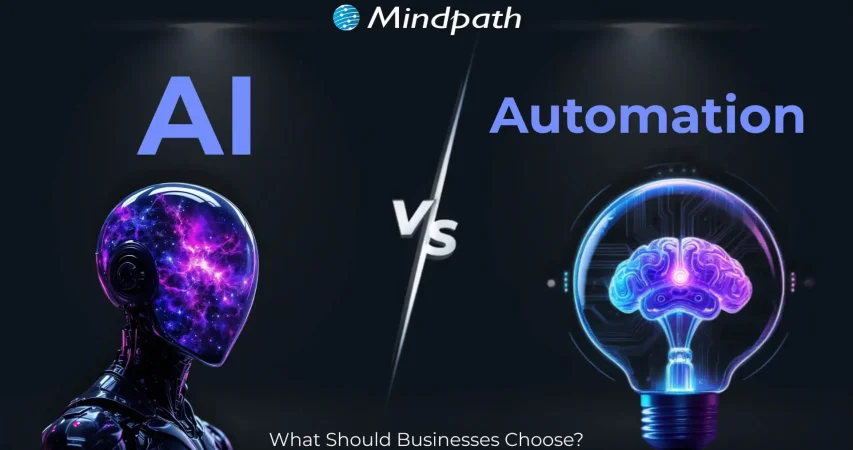
The significant impact of artificial intelligence on every industry has made every business leader think about embracing it in their enterprise strategy. CEOs want to stay updated with new trends and reduce costs by reducing dependence on manual processes. However, the AI vs automation debate has emerged as a crucial concern for business leaders. It is important to find out whether AI will deliver the benefits you want as a standalone technology or it needs seamless automation.

Is AI delivering the value that business leaders want from it? According to IDC, global spending on AI will increase by 1.7 times in the next three years (Source). At the same time, the 2026 AI Report by Deloitte revealed that only 42% of companies believed that they have the right strategy for AI adoption (Source). Even with the growing inclination towards adopting AI technologies, only a few companies can scale beyond pilot stages. Business leaders should understand the difference between automation and AI to make the ideal decision for digital transformation.

Struggling to keep up with rapidly evolving technology and data-driven demands? At Mindpath, we offer scalable artificial intelligence development services that streamline operations and unlock new business opportunities.

Understanding Automation and Why Businesses Need It

Automation has been around for quite some time, probably before the AI revolution gained momentum. Business leaders have been investing in automation for many years and with everyone talking about AI, they want to know whether they picked the wrong technology. The fact is that a well-planned business automation strategy will trump random AI adoption any day. Automation is all about executing predefined rules with accuracy, consistency and most important of all, without fatigue.

When you implement automation in the right way, it brings discipline to all business processes at scale. All you have to do is define the workflow and automation sees that the workflow runs exactly in the same way every time. It does not falter in the event of changing volumes, operational pressure or time of the day. Business leaders embrace automation to achieve benefits like,

  • Reduction in operational costs
  • Significantly fewer human errors
  • Predictability of outcomes
  • Faster cycle times

Must Read: Top AI Trends

Defining the Right Time for Business Process Automation

Automation delivers promising benefits but only when you have clear understanding of the process that you want to automate. The term ‘intelligent automation’ fits perfectly in scenarios where,

  • You have a repetitive and stable process.
  • The inputs for the process align with a specific format.
  • The decision logic of the process is always consistent.
  • You have possibility of predictable errors in the post.

If your business has to spend a lot of time in doing the same tasks repetitively, then you need automation.

Planning to implement AI in your organization but unsure how to structure a clear and effective path forward? Discover our guide on AI roadmap to explore the key steps for successful planning and execution.

Where Can You Apply Automation in Real Business Use Cases?

Business leaders wondering about the ideal use cases of automation should look for applications that deliver maximum ROI. You can leverage automation in use cases like,

1. Data Entry and Synchronization

Automation can play a vital role in enhancing tasks that require entering data and transferring data between internal systems without manual efforts.

2. File Handling and Document Management

Automation can help in reducing time required for renaming files, organizing documents and sending them to the relevant teams or systems.

3. Invoice Processing and Reconciliation

Business leaders can rely on automation for automatic extraction of standard fields, reporting mismatches and matching invoices with purchase orders.

4. Rule-based Approval Workflows

The power of automation can introduce new efficiencies that require approval for requests on the basis of value, policy rules and roles.

All the use cases of automation in business revolve around operational improvements with little to no innovation. The primary outcomes of embracing automation in business focus on reducing costs, enhancing efficiency and saving the time of teams.

Planning to implement AI in your business but unsure about the potential hurdles you might face? Discover the challenges of AI adoption to explore how to overcome barriers and ensure a successful implementation.

Artificial Intelligence and Moving Away from Rules

The role of artificial intelligence begins where you need to move beyond the ‘if-this-then-that’ logic in real business scenarios. When you have many variables, exceptions and ambiguity in the equation, it is inevitable to think how AI can add value. Businesses should integrate AI in their digital transformation roadmap to transition from following rules to thinking of possible solutions.

Automation works by following fixed instructions while AI learns from data and identifies patterns before making decisions. On top of it, AI uses the data it learns from to improve its capabilities with new interactions.

Choosing the Right Time for AI Adoption

Artificial intelligence might seem like just another trend that businesses have been pursuing for digital transformation. On the contrary, it is important to know that AI is a valuable resource to resolve bottlenecks in decision making. AI adoption is a reasonable decision in situations where,

  • The decision making process depends on multiple variables.
  • You don’t have static or predictable patterns in decision making.
  • The system can provide more accurate outcomes as it learns and processes more data.
  • The business has to make decisions at scale and in real time.

You have to understand that AI is the ideal technology to complement decision-making in scenarios where humans struggle.

Looking to reduce guesswork and make more confident business decisions? Discover our guide on AI in decision making to explore how it enables data-driven success.

Where is AI Useful in Real Business Use Cases?

Artificial intelligence has become one of the priorities of almost every business in 2026, with global spending expected to increase by huge margins. At the same time, it is reasonable to think how the AI vs automation debate turns in favor of AI in certain use cases. You will find the best business use cases of AI in the following areas,

1. Demand Forecasting

Businesses can leverage AI to predict future demand with the help of historical data, external signals and seasonality. As a result, businesses can ensure efficient inventory management and expand revenue opportunities.

2. Fraud Detection and Risk Management

AI tools can analyze transaction patterns of customers at different locations and time while evaluating behavior. It can serve as a valuable resource for flagging and prioritizing risks for the business.

3. Customer Sentiment Analysis

One of the biggest and most prolific use cases of AI in business right now is the ability to evaluate customer sentiment. Businesses can find out what their customers think about them by analyzing unstructured data from chats, emails and reviews.

Must Read: GenAI for Customer Service

4. Personalizing Customer Experiences

You will also find the ideal example of benefits of AI decision making in use cases for personalizing customer experiences. Businesses can use AI to suggest relevant products and content to their customers on the basis of use behavior insights.

5. Predictive Maintenance

Businesses should rely on AI for predictive maintenance to anticipate failures before they happen. AI tools can analyze usage and performance patterns through real-time data sourced from equipment to predict failures in advance.

The use cases of AI in business clearly show that it is the ideal option when predefined rules will fail to achieve the desired results. Business leaders can adopt AI in use cases where decision-making at scale in real-time is the biggest challenge.

Wondering how startups can benefit from AI-driven tools and automation? Explore our guide on AI solutions for small businesses and startups to discover growth-focused use cases.

Final Thoughts

Many business leaders want to find the ideal choice between AI and automation in the race for digital transformation for businesses. However, it is important to understand the differences in an AI vs automation debate to figure out that both of them complement each other. You cannot create a strong foundation for AI adoption without automation as it helps in cleaning and standardizing data and creating predictable pipelines for AI inputs.

Mindpath is a trusted AI development service provider, known for delivering solutions tailored to the vision and business goals of clients. We have created automation workflows for businesses in multiple industries and continue to grow our specialization in AI development. Consult with our experts to discover the ideal choice between AI and automation for your business now.
FAQs

1. What are the key traits of automation?

The most significant trait of automation is that it works according to pre-programmed rules in a structured approach. Automation is deterministic as it leads to the same output in the same conditions every time. While automation is efficient at scale, it cannot adapt in the event of changing conditions.

2. How is AI different from automation?

AI is different from automation as it does not stick to a specific set of pre-defined rules. On the contrary, AI learns continuously and improves performance as it interacts with and learns from more data. AI tools and systems have reasoning capabilities which makes them capable of evaluating multiple outcomes before arriving on specific decisions.

3. What are the real use cases of automation in business?

Businesses can leverage automation in various use cases that follow predefined workflows. You will find the best outcomes from automation in manufacturing operations, data entry and synchronization and invoice processing and reconciliation. It is also a great tool for document management, especially in HR onboarding.

4. Where can you use AI in real business scenarios?

AI usage in business has been increasing in various areas, including customer support and predictive maintenance. You will also notice use cases of AI in demand forecasting, personalization of customer services and customer sentiment analysis. Many businesses have also embraced AI as a reliable tool for fraud detection and risk management.

Related Post

healthcare software

Ever pondered how doctors can diagnose faster now-a-days? Or what helps hospitals and clinics to carry out all the operations smoothly? What’s powering the virtual health check-ups? Well, the answer to all these questions in your mind lies in one powerful solution and that is healthcare software. In this blog, we will walk you through the top 20 types of healthcare software in 2026. 

Before learning about the types, let us learn what is the meaning of healthcare software and some of its benefits. 

Looking to reduce manual errors and speed up patient care? Mindpath’s Healthcare Software Development Services build intelligent systems that enhance decision-making and patient satisfaction.

What is Healthcare Software?

Healthcare software is a software that is created to help hospitals, clinics, doctors and patients in managing health related tasks smoothly. It assists in various tasks like booking appointments, keeping digital health records of patients, sending reminders, managing billing process and even making sure medicines get delivered on time. This kind of software makes it easier for the medical staff to focus on their work and help patients to get better care, both in person as well as online. 

The majority of people often get confused between medical software and healthcare software. Medical software is mainly used with medical devices to check and analyze a patient’s health which helps to decide the right treatment. On the other hand, healthcare software mainly focuses on improving the daily operations in healthcare and making patient experience organized and smoother. 

The demand for software in healthcare industry is growing rapidly around the world. According to Dimension Market Research, the global healthcare software as a service market was projected to reach about USD 36.8 billion and experts believe that this number will keep going up every year by around 10.9%, and by 2033, it can reach USD 93.4 billion which indicates that more hospitals and clinics are using this software to make their healthcare better and easier for everyone. 

healthcare software as a service

Benefits of Healthcare Software

Now that we have an idea about the definition of healthcare software and what it can do to the industry, let us know about some of its benefits: 

1. Boost Hospital Operations

It helps hospitals run more smoothly by making tasks like scheduling, billing, and patient record-keeping much faster and easier for staff. 

2. Better Data Handling

Doctors and nurses can quickly access up-to-date patient information, which helps them make better and faster decisions during treatment. 

3. Cost-Effective

By reducing paperwork and cutting down on mistakes, hospitals can save a lot of time and money in their daily operations. 

4. Easy Bookings for Patients

Patients can easily book their appointments online without the stress of long phone calls or waiting in line. 

5. Improve Patient Care from Anywhere

Even if someone lives far from a hospital, they can still talk to their doctor through video calls and get care from the comfort of home. 

6. Easy Monitoring and Health Tracking

Health apps and reminders make it easier for patients to take their medicine on time and keep track of how they’re feeling every day. 

Curious how AI is transforming industries and healthcare? Explore Generative AI use cases across diverse sectors and see how it’s reshaping healthcare platforms.

Let us come to our main topic now, the types of healthcare software: 

Top Healthcare Software in 2026

Having the best healthcare software is very important for making daily tasks easier in clinics, hospitals and labs. Today, many types of software in hospitals help doctors, nurses, and patients to work together and smoothly. Let’s have a look at some of them: 

1. Electronic Health Record (EHR) Software

EHR software stores patient data like medications, procedures, and doctor notes which helps doctors make better decisions and often includes billing features and a patient portal for easy access to health records and prescriptions. 

2. Medical Diagnosis Software

Medical diagnosis software allows doctors to share anonymized patient records to fill information gaps and improve diagnoses. It often uses AI to analyze data and suggest probable diagnoses. There are apps available for individuals to help users assess if they need medical attention. 

3. Medical Imaging Software

Medical imaging software processes MRI/CT/PET scans and creates 3D models. It helps with human anatomy modeling for individual patients, like creating a 3D print of teeth for orthodontics, or designing medical equipment such as artificial limbs. 

4. Medical Research Software

Medical research software aids in education and sharing research within the medical community. It trains healthcare professionals and supports diagnoses by referencing external cases, while also streamlining research processes to reduce costs and improve financial outcomes. 

5. Appointment Scheduling (Booking) Software

This software helps healthcare facilities manage appointments online. It allows patients to schedule appointments through an app or website, with email notifications and automatic reminders for both doctors and patients about upcoming appointments. 

6. Medical Database Software

This medical computer software stores data by disease, not by patient. It helps doctors make better treatment decisions by comparing similar cases and supports learning by offering access to detailed clinical case histories. 

7. Telemedicine Software

Telemedicine software lets doctors see patients online through apps or browsers. Some tools also offer e-prescriptions and billing. It’s super convenient for both patients and doctors, which is why it’s growing fast in the healthcare world. 

8. E-prescribing Software

E-prescribing software helps doctors manage prescriptions easily. They can track, renew, or cancel them digitally. It also connects with national drug databases, making the whole process quicker, safer, and more accurate for both doctors and patients. 

9. Medical Billing Software

Medical billing software helps hospitals manage invoices, payments, and other financial tasks. It’s often built into larger systems like EHRs, making it easier for accounting teams to handle everything in one place, quickly and accurately. 

10. Medical Equipment Management Software

Medical equipment management software helps clinics avoid manual tracking by automating maintenance schedules and sending inventory alerts. It keeps everything running smoothly and reduces the risk of missing important upkeep. 

Must Read:  Hospital Management System Guide

11. Hospital Management Software

Hospital management software helps hospitals handle daily tasks like billing, accounting, patient management, inventory, bed management and others. It automates these operations to make hospital workflows smoother and more efficient for staff and administrators. 

12. Mobile Health (mHealth) Apps

mHealth apps make healthcare easier by helping patients book appointments, pay bills, and consult doctors online. They connect with EHR systems, so doctors can see medical records during virtual visits, improving care and saving time. 

13. Laboratory Information Management Systems (LIMS)

LIMS helps labs track samples, manage test data, and stay compliant with regulations. It reduces errors, speeds up processing, and keeps lab operations smooth, making sure patients get accurate and timely results. 

14. Personal Health Record Software (medical diaries)

Personal Health Record software, like the Tulipa app for Parkinson’s disease, allows patients to track symptoms, medication, and treatments. It helps generate health reports for doctor visits and alerts healthcare providers if a patient’s condition worsens. 

15. Radiology Information System (RIS)

A Radiology Information System (RIS) manages and stores radiology images and results. It works alongside PACS to streamline radiology department operations, ensuring efficient image storage and integration with EHR/EMR systems for enhanced patient care. 

16. ERP System

An ERP system for healthcare focuses on operational management, optimizing financial, supply chain, and human resources processes. It supports strategic planning, including expansions and mergers, without directly managing patient-facing tasks or data. 

17. Pharmacy Management Software

Pharmacy management software helps control and monitor inventory by classifying medicines, ensuring adequate stock, and avoiding shortages. It also supports drug price management and integrates with prescription systems for seamless access to medication information. 

18. Clinical Trial Management Software

Clinical trial management software records all the information related to the trials, such as patient information, study files, and approval from regulatory bodies. It is utilized mostly in top-class hospitals undertaking large-scale research to maintain compliance and proper trial management. 

19. Health Tracking Apps

Health tracking apps assist users in tracking fitness, diet, stress, and sleep. Many syncs with IoT devices like FitBit or Oura Ring to collect data. They’re popular for making healthy habits easier and more trackable every day. 

20. Remote Patient Monitoring (RPM)

Remote Patient Monitoring (RPM) enables healthcare professionals to gather patient information beyond the confines of standard settings, i.e., hospitals and clinics. RPM encompasses devices like blood glucose meters and heart rate monitors, which improve post-operative care and chronic disease care. 

Looking to speed up hospital operations and reduce errors? See how AI in healthcare is making hospital management smarter and more efficient.

Ready to Revolutionize Your Healthcare Solutions?

Healthcare is changing at a lightning pace, and software is leading the charge. From helping hospitals operate more effectively to making it easier for patients to access care, healthcare software is making a difference. In 2026, these technologies will continue to expand and make care easier, quicker, and more patient centered. 

At Mindpath, we recognize the need for state-of-the-art technology in the healthcare industry. Our healthcare software development services are built to improve operations, enhance patient care, and increase overall efficiency. Let Mindpath help you empower your health care business with robust, scalable, and innovative software that keeps up with the evolving healthcare environment. Let’s create a healthier tomorrow together! 

Frequently Asked Questions

1. How do I choose the right healthcare software for my organization?

Choosing the right healthcare software depends on your facility size, patient volume, budget, and operational needs. Start by identifying workflow challenges, integration requirements, and compliance standards. Always look for scalable solutions that can grow with your organization and support future technological advancements.

2. Is healthcare software secure for storing patient information?

Yes, most modern platforms are built with strong security measures such as encryption, access controls, and regulatory compliance standards. However, healthcare providers must ensure proper implementation, regular updates, and staff training to maintain data privacy and protect sensitive patient information from cyber threats. 

3. Can small clinics afford advanced healthcare software in 2026?

Absolutely. Many healthcare software solutions are now available through cloud-based or SaaS models, making them more affordable for small clinics. These subscription-based systems reduce upfront costs and allow smaller healthcare providers to access advanced features without investing heavily in infrastructure. 

4. How does healthcare software improve patient satisfaction?

Healthcare software enhances patient satisfaction by reducing waiting times, simplifying appointment bookings, enabling digital communication, and ensuring accurate records. When systems run smoothly, patients experience faster service, clearer communication, and more personalized care throughout their treatment journey. 

5. Will healthcare software replace administrative staff in hospitals?

No, healthcare software is designed to support administrative teams, not replace them. It automates repetitive tasks like billing and scheduling, allowing staff to focus on higher-value responsibilities such as patient coordination, service improvement, and overall operational management. 

AI in Decision Making

Do you know that 75% of leaders believe that AI gives them a major edge when it comes to making smart decisions? That’s a big number, isn’t it? Through this, we get an idea of how much trust today’s decision makers are placing in AI. If you ever thought about how AI can help in better business decisions, you are not alone. Today, AI in decision-making has developed into a legitimate, trusted resource for leaders embracing the opportunity to work with greater clarity and confidence.

Artificial intelligence is becoming more prevalent in various industries today to aid in planning, minimize uncertainty, and achieve increased efficiency. It is assisting teams with understanding the needs of customers, forecasting demand, and many other areas. AI is quickly becoming a valuable business partner in day-to-day decision-making. Pretty fascinating, right? In this blog, we will review practical implementations and the advantages of using artificial intelligence in decision-making. So, let us dive in!

Ready to elevate your decision-making with AI? Discover how Mindpath’s advanced AI solutions can transform your business strategies and drive success. 

What is AI Decision Making?

Artificial intelligence decision-making refers to computer systems that support intelligent decision-making based on data. Think of it as a super advanced program to assess large volumes of data (i.e., numbers, text, images, sensors, etc.) and determine the best action. These systems process information and provide intelligent actions following rules or models, including sophisticated models like neural networks. AI systems can also learn from previous decisions and improve performance over time through machine learning.

Unlike conventional methods that require human effort for collecting, cleaning, and analyzing information, AI can take any combination of messy and complicated input and not get confused with too many opinions or fatigued by too many details. AI moves quickly, doesn’t miss patterns, and continually learns. This makes artificial intelligence a useful mechanism for businesses that deal with enormous amounts of data and need to make clean decisions quickly and accurately.  

Curious about bringing AI into your business but unsure how to begin? Read our blog: Is Your Business Ready for AI?

Benefits of AI in Decision Making

Using AI for decision-making is becoming a key part of how modern businesses operate. With AI adoption on the rise, it’s important to understand what makes this technology so valuable in today’s decision-making process.  

1. Boost Productivity

AI works like a nonstop helper that gives decision makers quick answers and useful insights. It saves time by handling data and helps people focus on bigger tasks. With decision maker AI, you can get more done without working extra hours.

2. Lower Risks

AI benefits help in spotting problems early by studying past data and finding patterns. It can warn decision makers about things like fraud or sudden changes in the market. This helps businesses act early and avoid big mistakes.

3. Make Faster Decisions

AI looks at data quickly and gives answers in real time, helping businesses respond fast. It saves time by doing the hard work of sorting and studying information. This helps decision makers act faster and stay ahead in a fast-moving market.

4. Improve Efficiency

AI helps speed up tasks by collecting and studying data without delays. It shows decision makers the right information fast and helps fix weak spots in the process. This means teams can work better and get more done every day.

5. Ensure Consistency

AI follows the same rules every time, which helps make decisions fairer and steadier. It removes personal bias and uses data to guide choices in the same way for everyone. This helps businesses build trust and keep their work smooth and reliable.  

Curious to know how AI can enhance your e-commerce strategy and give your business a competitive edge? Read our detailed blog on how AI in e-commerce is transforming the future.

Real World Use Cases of AI in Decision Making

Real-world use cases of AI in decision-making highlight how this technology supports smarter choices in everyday business. Many industries are using AI to handle complex tasks, spot patterns, and guide important decisions with greater confidence.

1. Sales

In sales, AI in business strategy studies customer data to help teams focus on the best leads and plan better strategies. It suggests the right prices, products, and ways to talk to customers based on what works best. AI also checks team performance and gives ideas to improve sales results.

2. Manufacturing

The role of AI in decision-making is helping manufacturers keep machines running smoothly by spotting problems before they happen. It also helps manage materials, workers, and production by studying live data and showing the best way to use resources. AI gives useful ideas to improve processes and keep product quality high at every step. 

3. Marketing

In marketing, AI for customer service helps teams understand different customer groups and choose the best ones to focus on. It studies what people like and helps create content and ads that feel more personal and effective. By checking results from ads and social media, AI supports better decisions that improve marketing success.

Also Read: AI in Healthcare

4. Finance

AI helps financial experts find market trends by studying large amounts of data and giving clear insights. It also checks for possible risks and suggests safer ways to manage money and plan investments. With this support, decision makers can adjust portfolios and make smarter financial choices.

5. Customer Relationship Management

AI helps businesses understand what customers need by studying their behavior and feedback. It supports better decisions in improving service, keeping customers happy, and reducing the chance of losing them. AI also shows the best ways and times to talk to customers for stronger relationships. 

6. HR Operations

AI helps HR teams find the right candidates faster by quickly checking resumes and matching skills. It also looks at how employees are doing at work and gives useful ideas to support their growth. AI suggests fair pay and benefits by studying company budgets and market trends, helping keep employees happy and motivated.

Ready to leverage the transformative power of AI? Explore our blog AI transforming the future, to learn how to create a clear strategy and successfully adopt AI technologies in your organization

Ready to Make Smarter Business Decisions with AI?

AI in decision-making is helping businesses move faster, reduce risk, and improve results. It supports better planning, smarter insights, and more consistent actions. Many industries are now using AI as a trusted tool for everyday decisions. With the right approach, AI becomes a reliable partner that helps businesses grow with confidence.

At Mindpath, we deliver AI development services tailored to your unique business goals. Our expert team builds intelligent solutions that help you work smarter and stay ahead. With a focus on innovation, performance, and simplicity, we are here to support your digital journey. Let’s build intelligent systems that shape your future. 

Frequently Asked Questions

1. How can AI really help in making faster business decisions?

AI can process large volumes of data in real time, identify patterns, and provide actionable insights quickly. This allows decision-makers to respond promptly to market changes, optimize operations, and reduce delays in critical business decisions without relying solely on manual analysis.

2. Does AI completely replace human judgment in decision-making?

AI does not replace human judgment but complements it. It provides data-driven insights, highlights trends, and reduces errors, enabling decision-makers to focus on strategy and creativity while leaving repetitive or data-heavy analysis to the AI system.

3. Can AI help reduce risks in business operations?

Yes, AI identifies potential risks by analyzing historical and real-time data. It can detect early signs of fraud, supply chain disruptions, or market fluctuations, allowing businesses to act proactively and minimize losses, improving overall decision accuracy and reliability.

4. How does AI improve efficiency in decision-making?

AI processes data faster than manual methods, highlights critical insights, and identifies weak spots in operations. This allows teams to make better decisions quickly, streamline workflows, and achieve higher productivity.

5. How does AI ensure consistent and unbiased decision-making?

AI applies the same rules and data-driven models every time it analyzes information. Unlike humans, it is not influenced by emotions or personal bias, ensuring fair, repeatable, and consistent decisions, which builds trust and reliability across business operations.

Support Is One Click Away

Featured Posts

Related Post

Discover top tech trends transforming the travel industry, from AI to IoT, and learn how Mindpath can help your business stay ahead.
Unlock the power of Node.js to boost web performance and scalability. Learn how Node.js development services can transform your web app.
Discover how ReactJS development enables scalable, high-performance applications with benefits like optimized routing, state management, etc.