Top Benefits of Mobile App Development for Your Business 

Join our Newsletter!

Featured Posts

Support Is One Click Away

Home

Top Benefits of Mobile App Development for Your Business 

Mobile app development 

Top Benefits of Mobile App Development for Your Business 

In this fast-paced digital world, mobile app development has become a key channel for businesses to help grow and support their customers. Every tap, click and swipe is part of the user’s experience and lasting commitment to the brand. As customers rely more on their smartphones for shopping, entertainment, and other services, those companies that develop an intuitive e-commerce mobile app will have a better competitive advantage and will have their customers engaged with them.

As technology progresses every day, businesses can no longer rely solely on traditional platforms. Mobile apps now offer convenience, personalization, and live interaction that websites often cannot provide. Mobile apps help brands deliver seamless experiences and help build awareness and growth. This blog post will provide key advantages of mobile app development and help take your business to new heights.

Want to fully experience the benefits of mobile app development in your business? Mindpath offers mobile app development services, which help your business unlock new opportunities through innovative design and seamless functionality.

What is Mobile App Development?

Mobile app development refers to building software applications that are operated on mobile devices such as smartphones and tablets. Mobile app development is simply the process of designing the app’s interface and coding the app itself. These apps are designed to serve particular functions, which means they will facilitate the ability for a user to use services, shop online, or stay connected to others.

Mobile applications are capable of making use of the integrated functionality offered by a device, such as GPS, camera, bluetooth, and microphone, which sets them apart from traditional software. Developers today create the majority of applications for the Android or iOS platforms because these two dominate the worldwide market. Developers may use various frameworks & tools to construct applications that function smoothly, are visually attractive, and work seamlessly across devices.

Must Read: Mobile App Development Trends 

What is the Process of Mobile App Development?

Developing a mobile application involves several necessary steps to take your idea to a working app. Each step plays a role in enabling usability, reliability, and scalability of the mobile app that is aligned with the business goals.
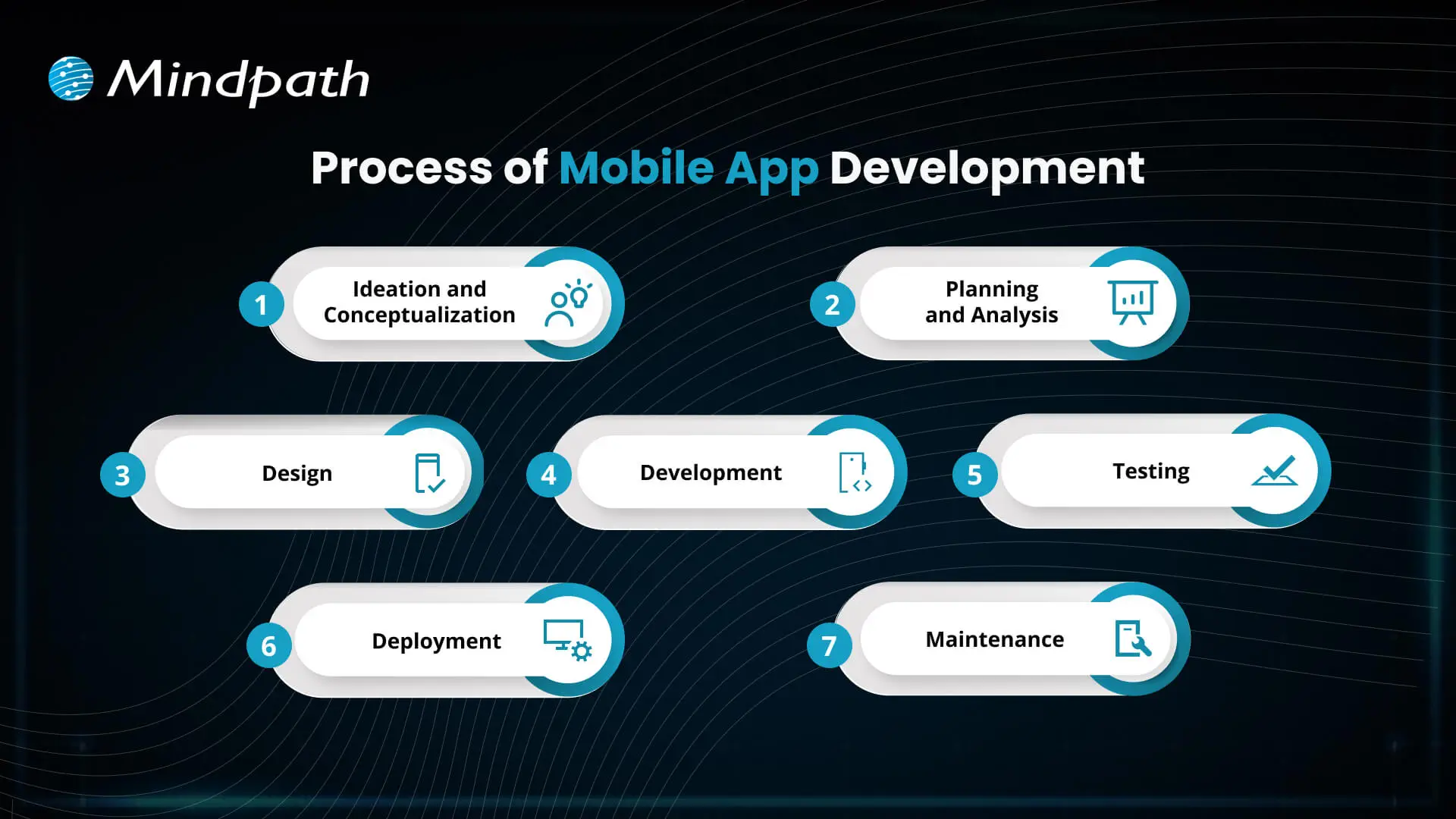
Process of Mobile App Development

1. Ideation and Conceptualization

The first step in the mobile app development process is coming up with a concept for your app. The teams think of an exciting mobile app development idea, find a way to solve problems for users, depict their target audiences, and identify key features.

2. Planning and Analysis

During this step, the teams conduct market research, determine app features, and establish goals. A proper framework documents timelines, budgets, and resources that will enable mobile app development startups and teams to stay on track.

3. Design

Designers create the aesthetic design and layout of the app to ensure it looks pleasing and is easy to use. Designing with simplicity and enjoyment in mind will allow users to navigate the app easily and have a positive experience while working.

4. Development

This is where developers start coding and building both the front and back ends of the app. The mobile app development process at this stage focuses on creating functional features that bring the design to life.

5. Testing

Before an app is launched, several tests are conducted to identify any malfunctions, like bugs or performance problems. This is a necessary step in order to ensure that the app is performing normally and responding correctly for the users.

6. Deployment

After the application has successfully gone through the testing stage, the app is published on the app stores, i.e., Google Play or Apple App Store. Companies that provide mobile app development will also develop a listing and promotional materials to be prepared for the launch.

7. Maintenance

Once the app has launched, it should be updated on a regular basis to fix bugs and continue to work with new devices or software versions. Maintaining the app will give users satisfaction, and enjoying the app for an extended period of time will keep users active.

Is your business app prepared to handle today’s security challenges? Discover how application security best practices for web and mobile apps keep user data safe while supporting sustainable growth.

Benefits of Mobile App Development

The advantages of mobile app development support businesses in more easily reaching customers and accelerating growth. By utilizing a mobile app development service, businesses can build simple and effective mobile apps that enhance user experience and increase engagement.

1. Enhance Customer Engagement

Mobile apps enable users to engage with your brand more often, keeping your business top of mind and relevant. Mobile app development allows businesses to develop features such as favorites, shopping lists, and review capabilities, all of which act as tools to enhance engagement.

2. Build Strong Brand Identity

An app that is well-designed becomes a permanent ambassador for your brand. Mobile app developers can collect relevant user data through the app, which can help improve your brand and continue to deliver value to your audience.

3. Increase Customer Loyalty

Mobile applications can host loyalty programs that encourage customers to revisit and repeat purchases. By giving discounts or rewards instantly, the app creates a sense of engagement with the app and helps build longer-term positive relationships.

4. Improve Customer Interaction

Mobile applications provide a convenient way for customers to purchase products because the app saves payment details and even previously favorite products. This all allows for an easier customer experience, which leads to convenience, improves customer satisfaction, and increases future conversions.

5. Personalize Marketing Efforts

Businesses can provide targeted offers and recommendations based on how users interact with their app. Personalized communication helps make users feel appreciated and encourages engagement.

Looking to build apps faster and smarter? Explore how mobile app development tools streamline development and boost productivity.

6. Boost Profits

Mobile apps typically drive sales and reduce marketing expenses by improving engagement, loyalty, and the overall user experience. Investing in the app is worthwhile because it is an efficient means of maximizing return.

7. Leverage Social Media Integration

Mobile applications can seamlessly connect to their social media channels, allowing individuals to easily share products or submit reviews. This advertising practice provides brands with exposure and social proof.

8. Provide Unique Value to Customers

Apps can offer features that are not available anywhere else, such as augmented reality try-ons, AI in mobile app development for intelligent chat support, and app-exclusive discounts. This adds convenience and encourages individuals to visit again.

9. Target Your Niche Market

Mobile apps provide a competitive advantage over other markets with specialized features and experiences. Businesses can effectively target and engage a broader segment of their target market.

10. Strengthen Communication

Push notifications ability and geotargeting gives businesses the ability to communicate with users in real time. Apps allow businesses to send relevant and time-sensitive messages without interruption from other communication channels.

Want to stay ahead in app innovation? Discover how mobile app development technologies power scalable, future-ready applications.

Ready to Elevate Your Business with Mobile Apps?

Mobile app development offers businesses a powerful way to engage customers, build loyalty, and boost growth. By leveraging AI in mobile apps, companies can deliver smarter personalization, real-time support, and data-driven user experiences that stand out in competitive markets.. Leveraging the benefits of mobile apps helps businesses strengthen their brand, improve customer experience, and maximize sales in today’s digital world.

Mindpath provides professional mobile app development services to help businesses turn ideas into functional, user-friendly apps. Our team of experts focuses on designing apps that engage users, integrate key features, and deliver measurable results. With Mindpath, companies can launch high-quality apps that drive growth, enhance customer experience, and ensure long-term success.
Related Post

Discover expert strategies to hire top education software developers and create innovative solutions that enhance learning experiences and adapt to new trends.
Discover how Generative Engine Optimization (GEO) transforms digital marketing, enhancing visibility and brand authority in AI-driven world.

Related Post

software development in the transportation and logistics industries
Have you ever wondered how something you ordered online magically arrives at your doorstep only a few days after clicking “buy”? Or how companies manage to deliver millions of packages all around the world so fast? The answer lies in the digitization in the transportation and logistics industries. In this blog, we are going to explore the notable real-world use cases of digital transformation of logistic and transportation industry. So, let us dive in! 

What Is Digital Transformation In Logistics And Transportation Industry?   

In today’s fast-moving world, old ways of doing things in logistics and transportation simply make it very difficult to keep up with increasing demands for speed and great service. Many logistics companies these days seek to solve the problem by digital transformation: basically, updating archaic systems with modern technologies that automate tasks and provide a better experience for customers. Though the logistics industry is far ahead of most digital technology applications compared to many other sectors, several gaps remain.   Digital transformation is important in package delivery as it plans routes better by using GPS and optimization software to deliver goods quickly; improves customer experience through the ability of real-time tracking; and makes operations more efficient by automating recurring tasks like sorting packages or inventory.   However, difficulties persist in the form of high costs of new technology and employee training, and problems of data security. Despite these challenges, the opportunities for growth and improvement remain immense. A digital transformation in logistics businesses would keep them well ahead of their competition and meet the ever-raising expectations of the consumer of the present day. Digital transformation is no longer an option for logistics and transportation companies; it is a necessity. Companies that refuse to innovate are left behind; those ready for change will thrive in the digital age. 

Statistic Report For Digital Transformation In Logistics And Transportation Industry.   

The digital transformation in transport and logistics is growing rapidly. In 2018, the global market of the Digital Transformation in Transportation and Logistics industry was US$54.92 billion and is pegged to reach US$145.28 billion by 2025, at a CAGR of 13.0%. The market is expected to reach USD 22.17 billion by 2028 from an estimated value of USD 7.15 billion in 2018, growing at a CAGR of 11.5% during the forecast period. The growth rate underscores robust digital technology adoption that solves problems like underutilized assets, supply chain inefficiencies, and poor demand-supply matching. Digital transformation improves connectivity and visibility across traditionally isolated systems that helps stakeholders collaborate with each other more effectively along the supply chain.   The major names associated with making this change a reality include IBM, Oracle, Samsung, SAP, and Tech Mahindra. Each of these vendors is developing robust new platforms that will be useful in driving this change. While the market expands across regions such as North America, Europe, Asia Pacific, South America, and the Middle East and Africa, operational and customer experience efficiency lies in automation and real-time data analytics. This demand for technologies underpins the requirement of innovation in the creation of effective and resilient logistics networks that answer today’s demand for speed and excellence. 

Benefits Of Digital Transformation In Logistics And Transportation Industry    

1. Cost Reduction  

Digital transformation saves a lot of money for logistics companies. Automation decreases labor costs, as repetitive tasks are taken care of, hence requiring fewer people to do those jobs. Data helps in the optimization of delivery routes, hence cutting fuel costs and the carbon emission rate. Digital tools make it possible to do more with less, whether it be warehousing, managing inventory, or handling transportation and last-mile delivery. That means companies will work more efficiently and reduce their operational costs. 

2. Improve In Efficiency 

Digital transformation solves these very issues in many ineffective supply chains that lack real-time transparency. Automated warehousing and inventory management reduce manual labor and, in turn, human error. With the digital tools available, firms can track their shipments and inventory in real time, knowing where everything is at any moment. Greater visibility allows one to respond to change in the fastest way possible without any delays. Digital technology also projects demand so that a company can have the right product at the right time, therefore reducing overstock and/or running out of stock items.  

3. Improves Customer Experience 

Processing orders at speed and with transparency—these are the current demands of customers in the marketplace. Companies that outperform these expectations will create satisfied customers with the help of digital tools. Web and mobile apps empower customers to track their orders in real-time and raise issues. AI-driven chatbots extend instant support, answering questions within a snap of fingers, round the clock. Predictive analytics enables personalized product recommendations, letting customers feel important. Digital solutions ensure that customers are kept happy and loyal by making services faster, more transparent, and more personalized. 

4. New Business Model  

The digital transformation opens new, exciting ways of providing services beyond simple transportation. For example, delivery takes on a different dimension with speed through drone deliveries and self-driving trucks. Digital freight marketplaces connect shippers to extra space carriers, easing the way to find and work available resources. Such solutions open opportunities for value growth and increasing revenues. The accomplishment and differentiation of leading logistics players in a changing market can be driven by such technologies. 

Use Cases of Digital Transformation in Logistics and Transportation Industry 

 1. Predictive Analytics and Big Data 

Predictive analytics and big data greatly help in doing tasks related to forecasting demand and inventory management. Advanced algorithms embedded in predictive analytics examine large amounts of data for discovering patterns and trends. In doing so, this greatly assists businesses in predicting what may be needed later and adjusting the level of inventory accordingly. Something like Snowflake enables organizations to share past and current data in a bid to improve planning and make information more accessible to all. 

2. Telematics and Internet of Things (IoT)   

Telematics and IoT bridge the gap in asset monitoring and shipment tracking. IoT-enabled devices close the blind spots by sensing and transmitting the data in real-time. For instance, GPS and RFID tags assist in locations and conditions, like the tracking of shipment location, which allows route optimization and, therefore, better utilization of the assets. 

3. Cloud-based Computing 

It allows flexibility, remote access, and security by transcending the constraints of traditional on-premises data centers and legacy IT systems. Cloud computing is one of the technologies that will help companies involved in shipping and logistics scale easily, allow access to any data from any part of the world, and increase overall efficiency. With the ability to rapidly adapt through cloud-based solutions, companies can easily streamline their operations, securing their data much better and increasing manifoldly in performance as well as competitiveness. 

4.  Artificial Intelligence (AI)   

Artificially intelligent technologies can come up with advanced algorithms that analyze heaps of data and deliver valuable insights from them. These technologies are focused on the optimization of logistics operations by calculating multitudes of variables and learning from new data continuously available. AI improves route planning, reduces inefficiency, and raises overall operational performance. This will give rise to more efficient and effective logistic operations if companies apply AI in making smarter decisions, streamlining processes, and better meeting customer needs. 

5. Mobility as a Service (MaaS)   

Traditional modes of transportation usually do not rise to the convenience and sustainability expected of them today. Mobility as a Service looks to bridge this gap and provide one amazing app in which users can discover and book a ride from a range of choices, including public transit, ride-hailing, car-sharing, bikes, or scooters. MaaS makes getting around easier while reducing the environmental effect by integrating the services of all different means of transport. Research has demonstrated that people could be flexible with their travel; this would mean that they no longer require their own vehicle with the integration of these services.  

Looking to revolutionize your logistics?

Mindpath offers cutting-edge solutions to boost efficiency and cut costs.

Transportation and Logistic Development Services at Mindpath 

We, at Mindpath, provide a range of services that can empower logistics companies, transportation providers, and supply chain managers to take on the challenge of using technology for much smoother and more efficient operations. 

1. Custom Chatbot Development: 

Our chatbots help customers who are running transportation and logistics businesses provide better customer support: answer inquiries, manage bookings, track shipments, and be available 24/7 to keep customers happy at a reduced cost. 

2. Website Development: 

Strong presence in online media is quite important. Our group creates user-friendly, visually appealing, and search engine-friendly websites for logistics businesses. This would provide dual benefit to the business by making it visible and growing. 

3. Mobile App Development: 

We develop mobile applications for the management of Logistics and Transportation on the go. Our apps are quite solid at both iOS and Android devices with a smooth experience and useful features. 

4. Inventory Management System: 

We can design a tailored system to assist you in effective inventory management. Real-time data, automation, and actionable insights of stock position are some of the salient features of our systems. 

5. Fleet Tracking Software: 

Our fleet tracking software lets you track your vehicles in real time. It helps in performance tracking, route optimization, and timely deliveries, which in turn increase efficiency and reduce costs. 

6. Software Maintenance & Support: 

We keep updating your logistic and transportation software to run smoothly. This means technical support, updating features, or just ensuring that everything works well. 

Conclusion  

Digital transformation is disruptions in logistics and transport due to efficiency, cost reduction, and improved customer experience. With the speed of technological change accelerating, it’s highly important to be one step ahead about innovation, whether AI, cloud computing, or predictive analytics. At Mindpath, we believe in empowering businesses to lead this change. That’s why we deliver custom technology solutions to help your business thrive in a transforming world—from custom chatbots to advanced fleet tracking. 

Ready to embrace the future of logistics?

Let Mindpath guide you every step of the way.

Explore how digitization transforms logistics with real-world use cases, benefits, and cutting-edge technologies that boost efficiency, reduce costs, and enhance customer experience.
benefits of ai

Can you envision a world where everyone works better, decisions are easier to make, and your team has more time to concentrate on important work? Well, this is the power behind the benefits of AI. A growing number of companies are discovering how AI can take away the recoil of repetitive, mind-numbing tasks while recognizing patterns of behavior that weren’t on your radar. These companies are now opening new opportunities that once seemed impossible!

This intelligent technology is enabling businesses to improve efficiency, satisfy customers, and keep pace with competition in an evolving marketplace. For large and small companies alike, it’s becoming a real growth engine. In this article, we will review the top 10 AI benefits for business and how they can help you unlock real, lasting growth. So, let us dive in!

Want to take advantage of AI technology to accelerate your business? Discover how Mindpath’s AI development services can help you with customized solutions that will boost the overall performance of the business.

What is Artificial Intelligence?

Artificial Intelligence (AI) is an intelligent technology that can execute tasks that, ideally, you would expect a human to do. Through AI, a system can learn from data, use that data to solve problems, make decisions, and understand and use human language.

AI is used in a wide variety of everyday tools and services today, from voice assistants and chatbots to advanced tools that help organizations analyze trends and automate business processes. One of the most prevalent areas of focus within AI at the moment is generative AI, which refers to the ability for these tools to create new text, images, videos, and more. AI, in its most basic form, is accomplished through the use of various technologies like machine learning and deep learning, which allow these systems to gain expertise while processing greater amounts of information.

Also Read: Gen AI revolution

What are the Benefits of AI for Business?

AI and business are becoming more connected than ever, opening up fresh possibilities for companies of all sizes. Understanding the artificial intelligence business benefits can help you see why so many organizations are investing in this smart technology. Let’s explore how AI helps businesses make the most of these opportunities.

1. Enhanced Customer Experience

One of the biggest advantages of AI in business is making customers happier. AI can give quick answers through chatbots any time of day. AI in customer services also learns what customers like and gives ideas just for them. This is how AI improves customer experience and keeps people coming back.

2. Smarter Business Decisions

A key example of how AI helps businesses is by supporting better decision-making. AI in decision-making can quickly study large amounts of data and find important patterns that people might miss. Teams can use AI tools to get clear answers without spending hours on research. This makes it easier for businesses to make confident, informed choices.

3. Increased Work Efficiency

AI helps teams complete tasks faster by taking care of repetitive work. It can handle things like data entry and report creation with fewer mistakes. This gives employees more time for important and creative tasks. In the end, everyone works more efficiently and gets better results.

4. Boosts Business ROI

One way AI increases ROI is by helping companies save time and money. AI can do tasks faster and with fewer mistakes. This means businesses spend less and earn more money. Over time, AI helps companies grow their profits in smart ways.

5. Improved Team Accessibility

A clear reason why businesses should adopt AI is that it is now easy for everyone to use. Employees do not need coding skills to work with AI tools. They can simply use everyday language to get help from AI. This makes it possible for more people to help improve how work gets done.

Are you missing out on the benefits AI can bring to your business? Learn how the role of an AI consultant helps organizations drive digital transformation and make smarter, faster decisions.

6. Greater Accuracy and Quality

AI helps keep work accurate by doing tasks the same way each time. It handles things like data and numbers without small slip-ups. AI can also catch and fix mistakes before they grow into bigger problems. Over time, it learns and makes work even more reliable.

7. Expanded Business Capabilities

One of the key advantages of AI in business is that it opens up new ways of working. AI can understand complex or messy data that older tools cannot handle. This makes it possible to automate tasks like reading emails and handling customer questions. It helps businesses operate more smoothly and achieve better results.

8. Improved Workplace Environment

AI helps employees by making their daily work easier and smoother. It takes care of boring tasks like data checks or planning work. This gives people more time for important and interesting projects. When work feels better, people stay happier and more engaged.

9. Enhances Innovation and Growth

AI supports teams in developing new ideas for products and services. AI trends can analyze past and current demand patterns to identify future opportunities. This helps companies plan more effectively and stay ahead in their industry. By using AI, businesses can drive continuous innovation and sustainable growth.

10. Scalable Business Operations

Using AI for digital transformation makes it easier for companies to scale their work. Cloud-based AI tools can read, write, and interact to support many tasks. They adjust quickly when business needs or workloads grow. This helps organizations expand without always needing more staff.

Is your business ready for the AI revolution? Explore our blog on AI is transforming the future, to see how AI is reshaping industries and everyday life.

Use Cases of AI in Business

AI is now part of everyday work for many companies. It helps businesses work smarter and stay ahead in a busy market. Here are some practical ways AI is used in business today.

1. Enhanced Customer Engagement

AI helps companies understand and connect with customers in smarter ways. It shares helpful ideas, predicts what people may want, and makes communication smoother. This keeps customers happy and loyal.

2. Employee Skills Development

AI shows what skills employees need and suggests good training options. It helps people learn and grow in their roles. This keeps teams ready for new challenges.

3. Streamlined Operations

AI takes care of repetitive tasks, so employees can focus on more valuable work. It helps use time and resources wisely. This keeps daily work running smoothly.

4. Valuable Market Insights

AI studies large amounts of data to spot what customers like and what trends are changing. It gives useful information for making better business plans. This helps companies stay competitive.

5. Increased Team Productivity

AI handles small, time-consuming tasks so employees can work on bigger projects. It supports tasks like notetaking and email management. This helps teams work better together.

Want to leverage AI in your business but unsure which programming languages make it possible? Read our blog on AI Programming Languages to understand the tools behind AI solutions and how they can drive growth for your company.

6. Support for Creative Work

AI brings fresh ideas for design, writing, and planning. It makes creative tasks faster and easier to manage. This helps teams deliver high-quality work.

7. Improved Data Security

AI monitors online threats and finds problems early. It helps protect important company and customer data. This keeps the business safe every day.

8. Personalized Customer Service

AI learns what people like and offers suggestions tailored to them. It helps match customers with the right products or services. This makes customers feel special and keeps them coming back.

9. Better Strategic Decisions

AI in business strategy reviews lots of information and finds helpful patterns. It supports leaders in making smart choices for the future. This makes business planning stronger and clearer.

10. Stronger Talent Acquisition and Management

AI helps companies find the right people by reviewing resumes and spotting good fits. It also helps keep employees satisfied with their roles. This helps businesses build strong teams.

How is AI reshaping the way websites are built and optimized? Explore our detailed article on AI in Web Development to see how it’s driving smarter design, faster deployment, and better user experiences.

Looking to Unlock the True Benefits of AI?

The benefits of AI are transforming how companies operate, grow, and stay ahead in today’s fast-moving market. From happier customers to smarter choices and better teamwork, AI brings practical advantages that help businesses do more with less effort. By understanding how to use AI well, your company can boost efficiency, spark new ideas, and unlock real growth for the future.

Partner with Mindpath, providing expert AI development services to turn these benefits into reality for your business. Our team designs smart, custom AI solutions that automate work, improve decision-making, and create new ways for you to succeed. Let’s shape the future of your business together with intelligent AI tools built to deliver lasting results.

Discover how AI is transforming the world. Explore the top 10 benefits of artificial intelligence, from solving complex problems to enhancing customer experiences.
Ultimate Guide to Hiring Expert Node.js Developers for High-Performance Applications

As the demand for fast, scalable, and efficient web applications continues to grow, businesses are increasingly turning to Node.js. Known for its speed and ability to handle a large number of concurrent connections, Node.js has become a go-to technology for building everything from real-time chat applications to large-scale enterprise platforms.

But choosing the right NodeJS developer can be a challenge. With the vast pool of developers available, how can you ensure that the candidate you hire will help you achieve your project goals? In this guide, we’ll explore why hiring expert Node.js developers are crucial for your project, the factors to consider when hiring, the skills to look for, the cost of hiring, and much more. By the end of this guide, you will be well-equipped to make an informed decision and hire a developer who can take your application to the next level.

Why Hire Node.js Developers?

Before we dive into the hiring process, it’s important to understand why Node.js is an excellent choice for modern web applications. Node.js is a powerful, event-driven JavaScript runtime built on Chrome’s V8 JavaScript engine. It is ideal for building fast and scalable network applications and is used by major companies like Netflix, Uber, and LinkedIn. To leverage its full potential, businesses should hire expert Node.js developers for high-performance apps, ensuring efficient development, seamless scalability, and top-tier application performance.

Here’s why you should consider hiring a Node.js developer for your project:

1. Speed and Performance

Node.js is known for its remarkable speed. Unlike traditional web servers, which use a multi-threaded model to handle requests, Node.js uses a single-threaded, non-blocking event loop that can handle thousands of requests simultaneously. This makes it an ideal solution for applications that require real-time data processing, such as instant messaging systems, live updates, and collaborative applications. An experienced Node.js developer knows how to leverage the event-driven nature of Node.js to build applications that can handle significant amounts of traffic without compromising on performance. Whether you’re building a real-time chat application or a live-streaming platform, hiring the right developer ensures your application runs smoothly and efficiently.

2. Scalability

Node.js’s non-blocking I/O model allows applications to scale more easily. As your user base grows, your application needs to be able to handle more requests without slowing down. Node.js is particularly well-suited for building scalable applications due to its asynchronous nature, which allows it to process multiple requests in parallel, resulting in faster response times. Hiring an expert Node.js developer will ensure that your application is built with scalability in mind. Whether you’re building a small-scale application or an enterprise-level platform, scalability should be a priority from the start, and a skilled developer will know how to design your system to scale as your needs grow.

3. Real-Time Applications

Node.js is the go-to technology for real-time applications, such as chat systems, collaborative tools, and live content updates. Its event-driven architecture makes it perfect for applications that require low-latency communication between the client and the server. For instance, chat apps, live scoreboards, and real-time collaboration platforms all rely on Node.js’s ability to process large volumes of data quickly. By hiring a Node.js developer who understands the intricacies of real-time applications, you can ensure that your users will experience seamless, uninterrupted interaction, even under high traffic conditions.

4. Cross-Platform Development

Node.js is highly compatible across different operating systems, including Windows, macOS, and Linux. Its cross-platform capabilities make it easier for developers to create applications that work seamlessly across different devices and environments. If your application needs to be deployed on multiple platforms, hiring a Node.js developer with cross-platform expertise will save you time and money, as you won’t need to develop separate versions for each operating system. In addition, Node.js’s ability to integrate with various platforms and services gives it an edge over other technologies. Whether you’re integrating third-party APIs, working with cloud platforms, or connecting to databases, a skilled Node.js developer can ensure that your application is compatible with all of your chosen tools.

5. Faster Development with JavaScript

Node.js allows developers to write both server-side and client-side code in JavaScript, which streamlines the development process. This reduces the need for switching between multiple languages, making the overall development faster and more efficient. JavaScript is one of the most widely used programming languages, and most developers are already familiar with it, which makes finding a qualified Node.js developer easier. By hiring a Node.js developer who is proficient in both JavaScript and Node.js, you can accelerate your development timeline and reduce costs associated with language barriers and training.

Factors to Consider When Hiring a Node.js Developer

Now that you know why Node.js is such a powerful technology, it’s time to focus on how to hire the right developer. To ensure you find the best candidate for your project, it’s essential to evaluate key factors to consider while hiring Node.js developers. By assessing the following factors, you can hire a skilled developer who meets your project requirements and delivers high-performance results.

1. Experience with Node.js

A strong understanding of Node.js’s core features is essential for any developer. Look for candidates with experience working on real-time applications, RESTful APIs, and server-side rendering with Node.js. They should also be familiar with Node.js frameworks like Express.js, Koa.js, or Nest.js, as these tools can significantly speed up development.
When reviewing a developer’s experience, consider the types of projects they’ve worked on in the past. Have they built applications similar to yours? Do they have experience handling high traffic volumes or integrating third-party services? The more relevant experience they have, the better they will be at tackling the challenges your project presents.

2. Knowledge of Asynchronous Programming

Node.js is built on an event-driven architecture, meaning it uses asynchronous programming to handle multiple requests simultaneously. A skilled Node.js developer should have a deep understanding of callbacks, promises, and async/await syntax. When evaluating candidates, ask about their experience with asynchronous programming and how they’ve handled concurrency issues in the past. Their ability to manage asynchronous processes will directly impact the performance and reliability of your application.

3. Familiarity with Front-End Technologies

Although Node.js is primarily used for back-end development, many Node.js developers also have experience with front-end technologies like HTML, CSS, and JavaScript frameworks such as React, Angular, or Vue.js. Hiring a full-stack developer with expertise in both front-end and back-end technologies can simplify your project, as you won’t need to hire separate developers for each part of the application. In addition, developers who understand the client-side aspect of the application can ensure better integration between the front-end and back-end, resulting in a smoother user experience.

4. Understanding of Databases

Node.js is often used in conjunction with databases, and your developer should have experience with both relational and non-relational databases. Familiarity with SQL databases like PostgreSQL and MySQL, as well as NoSQL databases like MongoDB, is essential for building robust applications that require data storage. Moreover, knowledge of ORMs (Object Relational Mappers) like Sequelize or Mongoose will help the developer interact with databases more efficiently. A skilled Node.js developer should be comfortable writing efficient queries, handling data models, and optimizing database performance.

5. Problem-Solving and Debugging Skills

Node.js development often involves tackling complex issues, such as managing concurrency, optimizing performance, and debugging application errors. A good Node.js developer should be adept at identifying problems and finding efficient solutions. Ask candidates about their approach to debugging and performance optimization. Do they use tools like the Chrome Developer Tools, Node.js Debugger, or New Relic to troubleshoot issues? Can they identify performance bottlenecks and improve the application’s responsiveness?

6. Security Best Practices

Security is a critical consideration for any web application. Node.js developers should be aware of common security threats such as SQL injection, cross-site scripting (XSS), and cross-site request forgery (CSRF), and they should know how to protect the application from these risks. Look for developers who are familiar with security best practices and tools, such as HTTPS, data encryption, and input validation. A security-conscious developer will help safeguard your application and user data from malicious attacks.

7. Communication Skills

Effective communication is essential in a development team. A good Node.js developer should be able to clearly explain complex technical concepts to non-technical stakeholders, as well as collaborate effectively with other team members. Whether working with designers, product managers, or other developers, the ability to communicate well will help ensure the success of your project.

Node.js Developer Hiring Costs

The cost of hiring a Node.js developer can vary significantly depending on several factors, such as experience level, project complexity, and location. Let’s break down the cost considerations:

1. Experience Level

Junior Developers: Entry-level Node.js developers typically charge lower rates, but they may need more supervision and training. They are suitable for smaller projects or tasks that require minimal expertise.

Mid-Level Developers: Mid-level developers with a few years of experience can handle more complex tasks and can deliver faster results without much guidance. Their rates tend to be more affordable than senior developers while still providing a good level of expertise.

Senior Developers: Senior Node.js developers are highly skilled and have extensive experience in building scalable, high-performance applications. They are often required for large, complex projects, and their hourly rates can be significantly higher. However, their expertise is invaluable in ensuring that your project is executed flawlessly.

2. Project Complexity

The complexity of your project will also affect the cost of hiring a Node.js developer. Simple applications with minimal functionality will cost less to develop, while larger applications with advanced features (e.g., real-time chat, video streaming, or large-scale e-commerce platforms) will require more resources and time.

3. Location

The location of your Node.js developer can significantly impact the cost. Developers in countries with lower living costs may offer lower hourly rates, but they may also be less expensive overall. On the other hand, developers in countries like the US, UK, or Canada may charge higher rates due to higher living expenses, but they may also offer a higher level of service and expertise. You can decide whether you prefer a local developer or if you’re open to hiring remote talent. Remote developers can offer cost savings and access to a broader talent pool.

5 Major Skills to Look for in a Node.js Developer

When hiring a Node.js developer, it’s important to focus on the core skills that ensure the developer can effectively handle the complexities of modern applications. Here are the top 5 essential skills that every Node.js developer should have:

1. Proficiency in JavaScript (ES6+)

Node.js is built on JavaScript, making it essential for developers to have a strong command of the language. A solid understanding of JavaScript (including ES6+ features such as arrow functions, async/await, destructuring, and modules) is crucial for writing clean, efficient, and maintainable code. Node.js developers should be comfortable with both synchronous and asynchronous programming patterns, as Node.js is heavily reliant on non-blocking I/O. Understanding JavaScript allows developers to harness the full power of Node.js, building scalable applications that can handle large volumes of traffic efficiently.

2. Experience with Asynchronous Programming

Asynchronous programming is at the core of Node.js. Since Node.js uses a single-threaded event loop, it’s designed to handle many operations simultaneously without blocking the main thread. This is achieved through asynchronous programming using callbacks, promises, and async/await. A Node.js developer must be proficient in these asynchronous patterns to build applications that can handle multiple requests concurrently without running into performance issues. Mismanagement of asynchronous code can lead to performance bottlenecks, so a good understanding of this concept is essential.

3. Strong Knowledge of Express.js

Express.js is one of the most widely used frameworks for building web applications with Node.js. It simplifies routing, middleware handling, and HTTP request/response management, enabling developers to create APIs and web apps efficiently. A skilled Node.js developer should be proficient in Express.js, as it helps streamline application development. They should be able to set up routes, manage middleware, and handle HTTP requests effectively. Express.js is particularly useful for building RESTful APIs, a common requirement for many modern applications.

4. Experience with Databases (SQL and NoSQL)

Handling data is a critical aspect of Node.js development, and a good developer must know how to interact with both SQL (relational) and NoSQL (non-relational) databases.

SQL: Familiarity with relational databases like MySQL or PostgreSQL is essential for managing structured data with complex relationships.

NoSQL: Developers should also be familiar with NoSQL databases like MongoDB, which are ideal for handling unstructured or semi-structured data.

A well-rounded Node.js developer should be able to design efficient database schemas, write queries, and understand data modeling techniques for both types of databases.

5. Security Best Practices

Security is one of the most critical aspects of building robust applications, and Node.js developers should be well-versed in implementing security best practices.

Authentication: Knowledge of user authentication methods such as JWT (JSON Web Tokens), OAuth, or Passport.js is vital to ensure users can safely log in and interact with the application.

Data Protection: Developers should know how to protect sensitive data through encryption, both in transit (using HTTPS) and at rest.

Vulnerability Management: Awareness of common web security vulnerabilities like SQL injection, cross-site scripting (XSS), and cross-site request forgery (CSRF) is crucial.

Wrapping Note!

Hiring the right Node.js developer is crucial to the success of your web application. By considering factors like experience, skills, cost, and the complexity of your project, you can find a developer who will help you build a high-performance, scalable application that meets your business goals.

Node.js is an excellent choice for building real-time, scalable applications, and a skilled Node.js developer can leverage its strengths to create a solution that meets your specific needs. Whether you’re building a chat app, an e-commerce platform, or a collaborative tool, hiring an expert Node.js developer ensures that your application will be fast, scalable, and secure.

If you’re looking for experienced Node.js developers who can bring your vision to life, consider partnering with Mindpath. Our team of skilled developers has extensive experience in building high-performance applications using Node.js, and we’re ready to help you take your project to the next level.

Ready out today to discuss your project needs and get started on building your perfect Node.js application!

Learn how to hire expert NodeJS developers to build high-performance apps. Discover essential skills, factors, and costs with Mindpath’s guide.