WordPress development services help businesses build, customize, and maintain websites that support their operational goals, customer experience, and online growth. Depending on business requirements, these services can include custom website development, e-commerce functionality, third-party integrations, performance optimization, security, and ongoing maintenance.
Choosing the right solution involves more than selecting a theme or installing plugins. Businesses need a website that reflects their brand, supports their customers’ needs, performs reliably, and can adapt as the organization grows. Working with the right website development company can help align technical decisions with these goals.
Key Takeaways
- 01
WordPress development services cover custom websites, plugins, integrations, e-commerce, performance, security, and maintenance. - 02
Businesses should select services based on their goals, website complexity, customer needs, and future growth plans. - 03
A well-built WordPress website can support usability, search visibility, operational efficiency, and digital sales. - 04
Businesses should evaluate security practices, performance, integration requirements, ownership, and ongoing support before choosing a development partner. - 05
Regular maintenance and performance monitoring help keep a WordPress website reliable as business requirements change.
What are WordPress Development Services?
WordPress development services involve building, customizing, improving, and maintaining websites using WordPress, a content management system (CMS). These services help businesses create websites that match their brand identity, deliver the required functionality, and provide a manageable platform for publishing and updating content.
Depending on project requirements, a WordPress development team may create custom themes, develop plugins, integrate third-party systems, configure WooCommerce, improve website speed, and implement security measures. The scope can range from developing a business website to building a more complex digital platform with specialized functionality.
For example, a professional services company may need a lead-generation website with service pages and contact forms, while an online retailer may require product catalogs, payment processing, inventory integrations, and order management.
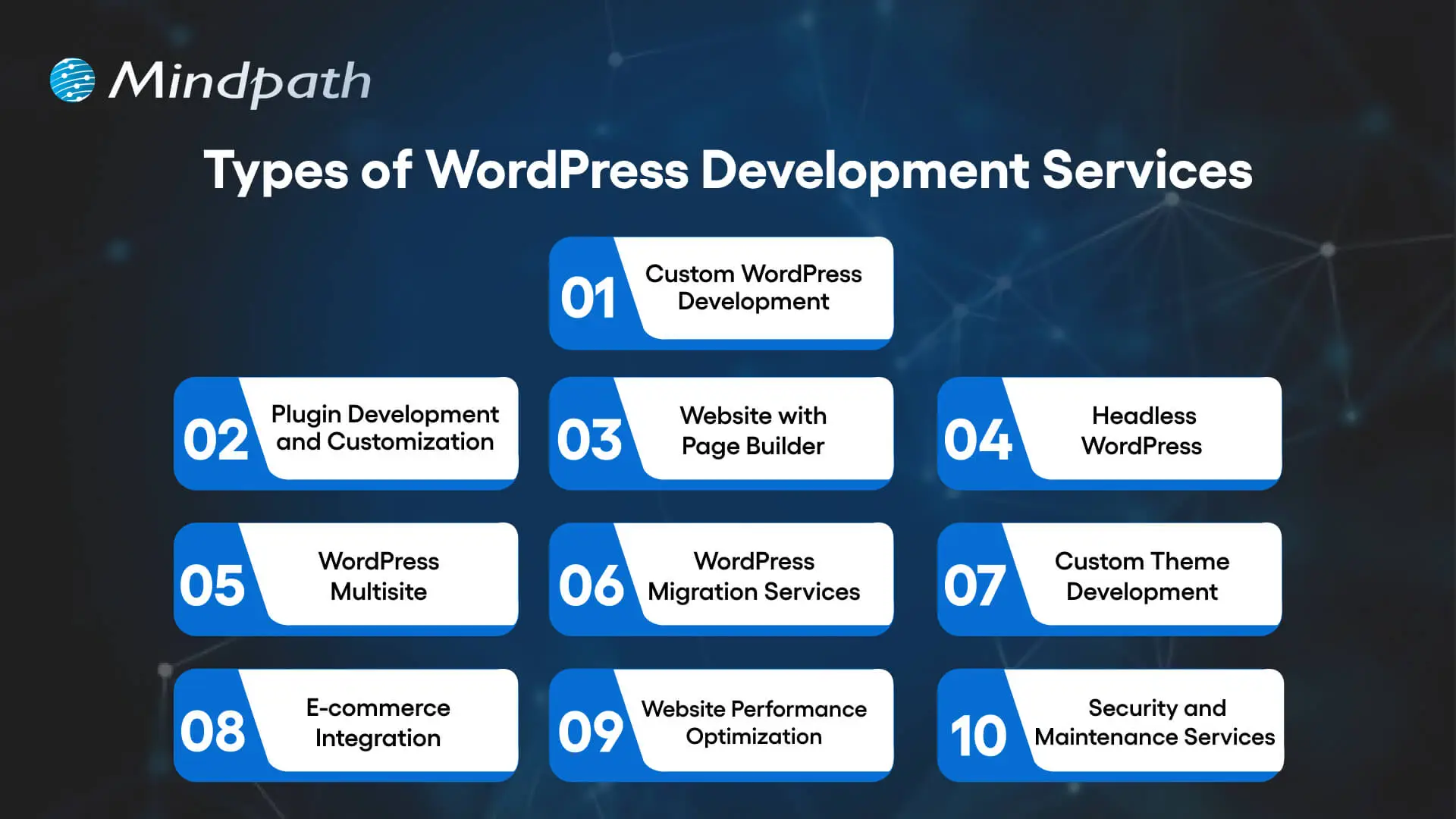
Types of WordPress Development Services Businesses Can Choose
Businesses can choose individual WordPress services or combine several based on their website’s current condition and long-term goals. Understanding the main options helps organizations identify the capabilities they need before starting a project.
1. Custom WordPress Development
Custom WordPress development creates website functionality and layouts around specific business requirements. Instead of relying entirely on a ready-made theme, a development team can build tailored page templates, content structures, custom fields, and workflows.
Business use case: A consulting firm may need industry-specific service pages, detailed case studies, and lead forms connected to its customer relationship management (CRM) system.
Learn more about custom WordPress development and how it supports tailored website requirements.
2. Plugin Development and Customization
WordPress plugins add functionality to a website. Businesses can use existing plugins for common requirements or commission custom plugin development when their workflows need capabilities that available solutions do not adequately support.
Business use case: A company may need a custom booking workflow, a specialized reporting dashboard, or an integration between its website and an internal business application.
Before adding a plugin, businesses should evaluate its maintenance history, compatibility, security, licensing, and effect on website performance.
3. Page Builder Website Development
Page builder solutions such as Elementor, Divi, and Beaver Builder help teams create and manage page layouts through visual editing interfaces. They can be useful when marketing teams need to update landing pages and campaign content without relying on developers for every change.
Business use case: A marketing team can build campaign landing pages and update calls to action while following an established design system.
The choice of page builder should consider editing flexibility, accessibility, maintainability, and its impact on page performance.
4. Headless WordPress Development
Headless WordPress separates the WordPress content management back end from the front-end experience. WordPress manages content, while a separate front end built with technologies such as React can display that content through APIs.
This architecture can offer greater front-end flexibility and support content delivery across multiple interfaces. However, it also introduces additional development, hosting, integration, and maintenance requirements.
Business use case: An organization that delivers content across a website and other digital channels may consider headless WordPress when a traditional WordPress setup cannot meet its requirements efficiently.
5. WordPress Multisite Development
WordPress Multisite allows multiple websites to run within a single WordPress installation. It can help organizations manage related websites centrally while sharing selected administrative resources.
Business use case: A company with multiple brands, regional websites, or departmental sites may benefit from centralized administration.
Businesses should assess user permissions, plugin compatibility, content ownership, and the consequences of shared infrastructure before choosing Multisite.
6. WordPress Migration Services
WordPress migration services help businesses move a website from another CMS, hosting environment, or existing WordPress installation. A structured migration process covers content, media files, databases, redirects, integrations, and testing.
Business use case: A company moving from a legacy CMS to WordPress may need to preserve important URLs, maintain access to existing content, and reduce disruption during the transition.
Migration planning should include backups, redirect mapping, staging tests, analytics checks, and post-launch monitoring to identify issues early.
7. Custom WordPress Theme Development
Custom theme development creates the visual structure and reusable page layouts of a WordPress website. A theme can be designed around a company’s brand guidelines, content requirements, and user journeys.
Business use case: A growing company may need a consistent design across service pages, landing pages, case studies, and blog articles.
A well-structured theme can also make future design updates easier to manage, provided the implementation follows maintainable development practices.
8. E-commerce Development and WooCommerce Integration
WooCommerce extends WordPress with e-commerce capabilities. Development services can include product catalogs, shopping carts, checkout flows, payment gateways, shipping configuration, and integrations with inventory or order management systems.
Business use case: A retailer can manage products and online orders through a WordPress-based store while integrating relevant payment and fulfillment services.
Businesses should review transaction security, checkout usability, mobile performance, product management, and expected traffic before launching an online store.
9. WordPress Performance Optimization
Performance optimization improves how quickly and reliably a WordPress website loads and responds. Depending on the underlying issues, work may include image optimization, caching, database maintenance, code improvements, hosting configuration, and reducing unnecessary scripts or plugins.
Business use case: An e-commerce business experiencing slow product pages can investigate performance bottlenecks to improve browsing and checkout experiences.
Businesses can monitor Core Web Vitals, server response times, page load behavior, and real-user performance to assess improvements.
10. WordPress Security and Maintenance
Security and maintenance services help keep a WordPress website updated, monitored, and recoverable. Depending on the agreement, they may include core, theme, and plugin updates; backups; vulnerability checks; access controls; malware monitoring; and incident support.
Business use case: A business that relies on its website for leads or online sales may need scheduled maintenance, tested backups, and a defined process for resolving security or availability issues.
For additional guidance, read our resource on safeguarding against common WordPress vulnerabilities.
What Should Businesses Expect From a WordPress Development Partner?
Businesses should expect a development partner to understand their goals, define the project scope, explain technical decisions, and establish clear criteria for evaluating the finished website. The exact deliverables depend on the project, but several practices are important across most engagements.
| Expectation | What it should include | Business value |
|---|---|---|
| Requirements and planning | Defined scope, priorities, timelines, and acceptance criteria | Reduces misunderstandings and scope-related delays |
| Design and usability | Brand alignment, responsive layouts, accessible navigation, and clear user journeys | Helps visitors find information and complete important actions |
| Technical development | Appropriate themes, plugins, integrations, and maintainable implementation | Supports required functionality without unnecessary complexity |
| Performance and security | Testing, optimization, updates, access controls, and backup planning | Reduces avoidable operational risks |
| SEO readiness | Crawlable pages, suitable URL structures, metadata support, and redirect planning where needed | Helps search engines discover and understand website content |
| Testing and launch | Functional, mobile, browser, integration, and launch checks | Helps identify issues before they affect visitors |
| Post-launch support | Documented ownership, maintenance responsibilities, and support arrangements | Makes ongoing website management more predictable |
Business Benefits of Professional WordPress Development Services
Professional WordPress development can help businesses create a website that supports marketing, sales, customer service, and day-to-day operations. The value depends on how well the website is planned, implemented, and maintained.
1. Website Functionality Aligned With Business Goals
A website should support specific business objectives rather than simply look attractive. Custom page templates, forms, integrations, and content structures can help visitors find relevant information and take actions such as requesting a quote, booking a consultation, or purchasing a product.
2. Better User Experience Across Devices
Responsive design, clear navigation, readable content, and accessible interactions help people use a website across desktop, tablet, and mobile devices. A well-planned user experience can reduce friction when visitors explore services or complete important tasks.
Businesses can also review our WordPress web accessibility guidelines to understand how inclusive design practices support a wider range of users.
3. More Manageable Website Operations
WordPress provides a content management interface that allows authorized team members to update pages, publish articles, and manage media. Appropriate roles, reusable templates, and editorial workflows can reduce the effort required for routine website updates.
4. A Foundation for Search Visibility
A technically sound WordPress website can support SEO through accessible content, logical internal links, suitable page titles, descriptive metadata, mobile usability, and efficient performance. These foundations help search engines access and interpret content, although they do not guarantee higher rankings.
Businesses should also review indexing, canonical URLs, structured data where appropriate, XML sitemaps, redirects, and the quality of the content published on the website.
5. Improved Security and Reliability
A structured development and maintenance process can reduce avoidable risks associated with outdated software, excessive permissions, vulnerable plugins, and inadequate backups. Security measures should reflect the website’s functionality, data sensitivity, and business importance.
For related technical guidance, see our WordPress and PHP compatibility guide.
6. Flexibility as the Business Grows
A well-planned WordPress website can be extended as requirements change. Businesses may add new service pages, integrate marketing systems, introduce e-commerce functionality, or improve existing workflows without rebuilding the entire website for every new requirement.
The ability to scale depends on the site’s architecture, hosting resources, integration design, and the quality of its implementation.
7. Better Control Over Website Costs
The right development approach can help businesses avoid unnecessary plugins, duplicated functionality, and expensive rework. However, the total cost of ownership also includes hosting, premium extensions, maintenance, security, licensing, and future improvements.
Businesses should compare the expected long-term cost of a proposed solution rather than choosing a provider based only on the initial development quote.
How to Choose the Right WordPress Development Services
The right service provider should be able to connect technical recommendations with your business objectives. Before making a decision, evaluate the following areas.
1. Define Your Website Requirements
Identify the website’s main purpose, target audience, essential features, content needs, integrations, and expected growth. A company website, an online store, and a content-heavy publishing platform will have different technical requirements.
2. Review Relevant Experience
Look for projects that demonstrate experience with similar functionality, industry requirements, integrations, or performance challenges. Ask how the provider approached the work and how the finished website meets the original requirements.
3. Assess Technical and Security Practices
Ask about plugin selection, code quality, access permissions, backups, update procedures, testing, and recovery plans. The provider should be able to explain the approach in terms your business team can understand.
4. Confirm SEO and Performance Requirements
Discuss URL structures, redirects, mobile usability, page performance, indexing, and analytics before development begins. If the project replaces an existing website, make sure the team has a plan to preserve valuable URLs and monitor changes after launch.
5. Clarify Ownership and Ongoing Support
Confirm who owns the website code, domain, hosting account, licenses, content, and administrator credentials. Review the support agreement, maintenance schedule, response expectations, and costs for future changes.
6. Compare Scope, Not Just Price
Review each proposal against the same requirements. Compare deliverables, exclusions, testing, integrations, documentation, launch support, and post-launch services before evaluating the total price.
Businesses evaluating external partners can also read our guide to choosing the right website development company.
How Much Do WordPress Development Services Cost?
The cost of WordPress development services depends on the website’s scope, design requirements, custom functionality, integrations, migration needs, performance targets, and ongoing support. A straightforward business website generally requires a different level of effort from a custom e-commerce platform or a complex, integrated digital experience.
| Cost factor | What affects the cost |
|---|---|
| Design complexity | Custom layouts, responsive behavior, accessibility, and design system requirements |
| Custom functionality | Specialized workflows, custom plugins, user roles, and advanced features |
| Integrations | CRM, payment, inventory, marketing, analytics, and other external systems |
| Migration requirements | Content volume, URL mapping, data transformation, redirects, and testing |
| Performance and security | Optimization, infrastructure configuration, security controls, and monitoring |
| Ongoing maintenance | Updates, backups, troubleshooting, licenses, hosting, and support coverage |
Before approving a proposal, ask for a clear breakdown of development deliverables, recurring expenses, assumptions, exclusions, and change-request costs. This helps businesses budget more accurately and compare providers on a consistent basis.
Common Mistakes to Avoid When Investing in WordPress Development
Even a well-funded website project can create avoidable problems when business requirements and technical decisions are not aligned. Businesses should watch for these common mistakes.
- Choosing based only on the initial quote: A low upfront price may exclude testing, integrations, documentation, or maintenance.
- Installing too many plugins: Unnecessary or poorly maintained plugins can increase complexity and security risks.
- Ignoring performance during development: Heavy themes, oversized images, and excessive scripts can affect user experience.
- Leaving SEO until launch: URL changes, missing redirects, and incorrect indexing settings can create avoidable search visibility issues.
- Skipping backup and recovery planning: Businesses need a practical process for restoring the website after a failure or security incident.
- Failing to clarify ownership: Domain access, hosting accounts, licenses, and administrator credentials should be clearly assigned.
Build a WordPress Website Around Your Business Goals
WordPress development services can help businesses build websites that support their brand, customer experience, marketing activities, and digital operations. The right approach depends on the required functionality, integration needs, security expectations, performance goals, and plans for future growth.
Before starting a project, define the outcomes your website needs to deliver and evaluate providers against those requirements. A clear scope, appropriate technical choices, thorough testing, and a practical maintenance plan can help create a website that remains useful as your business evolves.
At Mindpath’s WordPress development services, businesses can explore solutions for custom themes, plugin development, e-commerce integration, performance optimization, and website maintenance. Discuss your requirements with a development team to identify an approach that fits your website goals.