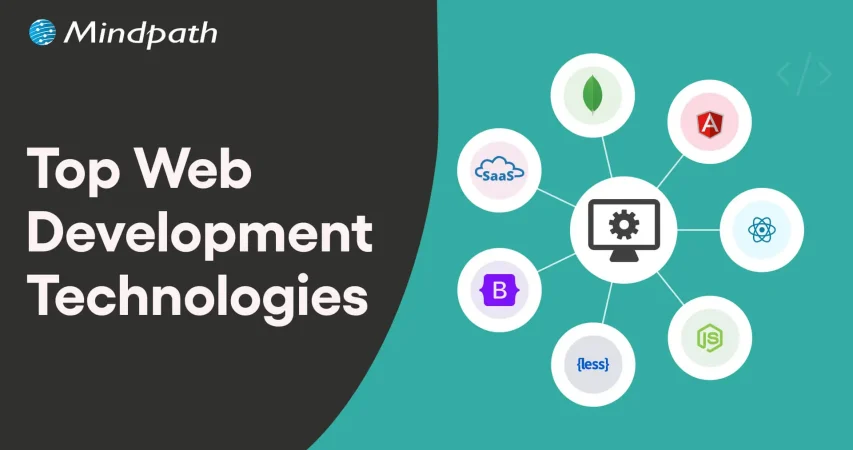
Top Web Development Technologies to Drive Business Growth in 2026

Join our Newsletter!

Featured Posts

Support Is One Click Away

Home

Top Web Development Technologies to Drive Business Growth in 2026

Web development technologies

Top Web Development Technologies to Drive Business Growth in 2026

If you think that web development is all about building a website, you are wrong! Web development is more about creating a scalable, intelligent digital experience that can help businesses convert visitors into loyal customers. In 2026, new web development technologies are changing how web apps and websites are developed and scaled, unlocking more engagement, efficiency, and growth potential. 

Whether you are an enterprise or a startup, here are the top website development technologies that would play an important role in your business growth in 2026. 

Looking to unlock new possibilities by integrating the latest web development technologies into your business? Partnering with Mindpath Web development services will offer you professional expert guidance on how to implement these technologies for your business growth.

What are Web Technologies?

Before exploring the latest web development technologies, let’s understand what it means. Web technologies are the tools, protocols, languages, and frameworks used to create as well as maintain websites and web apps. They include everything like front-end and back-end technologies, Web APIs, full-stack technologies, performance optimization tools, and more. 

Leveraging the right set of web development tools and technologies is crucial to creating a fast, scalable, and secure website that can support business growth. 

Major Technological Trends to Consider in 2026

A number of overarching web development trends are significantly shaping the process of web development. These are: 

1. Technologies and web development practices that focus on efficiency and speed will be important.

2. Accessible, engaging, and intuitive interfaces are necessary to retain users and drive conversions.

3. Businesses are looking for solutions that can grow with them, easily accommodating expanding features and increasing traffic. 

4. Customizing experiences for users through machine learning and AI will become a necessity for businesses. 

5. Businesses would focus more on sustainable web development practices. 

With these key trends in mind, let’s explore the vital web development technologies that every business should consider in 2026. 

Need solutions tailored to your business requirements? Explore more about custom web application to see how personalized apps improve performance and engagement.

Key Web Development Technologies List

Staying updated with the latest web development technologies is crucial for crafting websites and web apps that are flexible, future-ready, and fast. Here is a list of pivotal technologies shaping the process of web development. 

1. Machine Learning and Artificial Intelligence

While creating the top web technologies list, it would be wrong to avoid machine learning and AI in web development. AI-powered tools are automating various web development processes, like coding and testing. Besides, these tools also help streamline content generation and boost user personalization. 

On the other hand, Machine Learning models and libraries such as Scikit-learn, TensorFlow.js, and PyTorch help make a website capable of real-time analytics and more adaptive. As a result, businesses can now make intelligent/informed decisions. 

2. Headless CMS Architecture

Headless separates the front-end from the back-end. This allows developers to utilize modern programming languages, tools, and frameworks to develop customized websites and apps that perform smoothly across different platforms. 

With the help of tools such as GraphQL and WordPress REST API, WordPress’s capabilities can be combined with advanced front-end technologies such as Next.js, Vue, and React. 

3. Progressive Web Apps

Progressive Web Apps or PWAs combine mobile and web experiences, enabling seamless performance, push notifications, and offline access to enhance user engagement as well as retention. PWAs can be installed from the browsers; users don’t need to use app stores for this. Furthermore, these apps utilize HTTPS or TLS for data exchange to keep data secure. 

4. Jamstack

Jamstack combines JavaScript, APIs, and Markup together, allowing developers to separate front-end and back-end. This web development architecture ensures quick load times, improved SEO, robust CDN distribution, and higher security. This can be used for content-heavy websites, service booking platforms, or landing pages. 

Also Read: Application Security Best Practices for Web and Mobile Apps

5. Edge Computing and Serverless Platforms

Serverless platforms such as Oracle Cloud Functions, AWS Lambda, and Microsoft Azure allow the creation and deployment of web solutions without managing infrastructure. While using these platforms, developers just need to focus on writing code, and the cloud service providers will handle tasks like server provisioning, maintenance, scaling, etc. 

Edge computing helps bring processing near to the sources, significantly reducing latency and cost while improving privacy, security, and other features for businesses. 

6. HTMX

It allows developers to create dynamic web interfaces utilizing HTML attributes, lowering the use of heavy JavaScript frameworks. HTMX simplifies the development process and makes web apps offer faster performance. It can be an excellent option while developing form-heavy web apps, admin dashboards, and internal CRMs. 

7. WebAssembly

WebAssembly, or Wasm, allows browsers to run high-performance code like Rust and C++ at high speed. This means heavy or complex computations, such as video editing, gaming, cryptography, and 3D rendering, can now be done on the web. It is an ideal option for interactive learning platforms and simulation tools. 

8. Motion UI

Using motion UI frameworks, it is possible to animate interfaces. Businesses can boost user engagement through smart navigation cues, dynamic transitions, polished visual effects, and more. In short, motion UI elevates the intuitiveness and appeal of your websites and web applications.  

Want to build faster and dynamic websites? Check out our ReactJS Web Development Guide to learn how ReactJS powers modern web apps.

Most Popular Web Development Frameworks For 2026

Here is a table of the most popular web development frameworks businesses must adopt for a successful web development process. 

Front-end Technologies (List)

Framework Key Features Ideal For
Tailwind CSS  Rapid prototyping and utility-first Landing page and modern UI
React Virtual DOM, and reusable components Interactive dashboards, SPAs
Vue.js Flexibility, reactive components, and lightweight Small to medium-sized web applications
Next.js React-based, SSR, API integration, and routing Scalable and SEO-friendly platforms
Svelte Compact code, fast, and no virtual DOM Lightweight web applications
Framer Motion, and Animation Dynamic and engaging UI
Vite A huge plugin system, TypeScript support, and CSS processing Small to large web applications

Back-end Technologies (List)

Frameworks Key Features Ideal For
Laravel MVC, PHP, and elegant syntax  APIs, CMS, and e-Commerce
Node.js JS on server, and non-blocking I/O Real-time web apps and APIs
Express.js  Minimalist Node.js, performant, and clean Microservices and APIs
Supabase Open-source, REST API, branching, and custom domain Data-driven and scalable web applications
Ruby on Rails Convention over Configuration, active record, dynamic data magic, and scaffolding Web platforms and MVPs
Go Scalable, fast, and concurrency APIs and microservices
Spring Boot Java-based, auto-configuration, command line interface, and externalized configuration Large-scale and enterprise-grade web apps

Want to boost your website’s speed and scalability? Learn about web performance with Node.js to see how it powers web applications.

Why Businesses Should Embrace New Web Development Technologies?

Modern web development plays a vital role in shaping the way businesses interact with their customers. It can influence market share, conversion rates, operational efficiency, and engagement. However, some significant advantages of using new technologies in web development are: 

1. PWAs, motion design, and voice UIs can make the digital experience for users more memorable. 

2. APIs and the use of low-code platforms mean businesses can launch new products and features quicker than ever. 

3. Fast-loading web architectures like Jamstack or AMP and semantic code lead to improved visibility, increasing the reach.

4. Blockchain and serverless platforms make it easier to handle global users as well as business compliance. 

To witness these benefits, businesses should have a solid plan regarding the adoption of these web development technologies. Check out the section below to know more. 

Planning a web app as part of your technology strategy? Check out our web app development roadmap blog to understand each stage for building scalable and efficient applications.

How to Adopt These New Web Development Technologies?

If you are considering using these new web development technologies, then here are some tips to keep in mind to make the process hassle-free.

1. Ensure that the technology you want to use can support your business growth.

2. Choose one that offers enough documentation, resources as well as community support. 

3. Check whether the new technology will work well with your existing tools. 

4. Verify whether it meets data protection and compliance needs. 

5. Ensure that the new tool can help boost speed, UX, UI, and accessibility. 

6. While choosing between proprietary and open-source technologies, consider the cost factor and capabilities of both technologies. 

Want your web applications to be user-friendly and engaging? Read our UI/UX Design Trends blog to learn design practices that enhance usability and retention.

Creating a Course for Digital Dominance

Well, it is quite clear that businesses in 2026 must consider web development not just as a functional need, but as a crucial element for growth and innovation. With the help of the web development technologies list outlined above, businesses will be able to position themselves to engage with their customers effectively, innovate, and streamline their processes while supporting substantial growth. 

This is where Mindpath comes in. With a team of experienced and certified developers and a successful track record in creating dynamic and responsive websites, Mindpath empowers organizations through its web development services to translate their visions into digital reality. Besides, we leverage cutting-edge web development technologies. We understand the latest web development trends and can help you make informed technological decisions so that you can maintain your digital dominance. 

If scaling your digital presence and attaining measurable growth is your goal, Mindpath brings a perfect combination of skills, innovation, collaboration, and strategy to convert your vision into results. Begin your journey to a successful digital transformation in this evolving digital landscape with us! 

Related Post

Discover the ultimate guide to hiring Node.js developers in London. Learn about the skills, benefits, and cost factors involved in finding the right talent for your project.

Related Post

how much hire react developer

The Ultimate Guide to React JS Developer Cost of Hiring is a complete guide on budgeting and recruiting React developers. With its coverage of important cost considerations including expertise, geography, and hiring practices, it provides you with the necessary knowledge to guide your decision-making for your web development project. 

Are you prepared to use React JS to revolutionize your web development approach but are concerned about the costs of bringing in top talent? Understanding the importance of hiring ReactJS developers can help you make an informed decision, ensuring that your investment leads to high-quality, efficient, and scalable solutions. If so, you are not alone in this. Explore “The Ultimate Guide to React JS Developer Cost of Hiring” to learn all you require to adequately plan your budget to hire React JS Developer

Facebook created the widely regarded JavaScript library React to create dynamic and interactive user interfaces. React’s outstanding efficiency, adaptability, and sustainability have made it an essential technology for several leading companies since its initial release in 2013. The construction of reusable user interface components is made possible by this library, which accelerates development procedures and decreases long-term maintenance expenses.  

One notable aspect of React is its virtual Document Object Model (DOM), which streamlines the rendering and updating operations. The extensive ecosystem that surrounds React provides complete solutions for the building of modern web applications. Examples of these tools are Redux for state management and React Router for routing. It is also used by well-known businesses like Netflix, Instagram, and Airbnb, proving its scalability and dependability for busy applications.  

In this blog, we will take a deep dive into the potential cost for hiring a ReactJS developer in 2024. So, let’s dive right in!  

Rate Dynamics and Considerations 

Hiring a React developer is an important investment; therefore, companies looking to develop or improve their online apps must be aware of the associated costs. A React developer hourly rate often ranges between $50 and $200 or more. Also, React native Developer Hourly Rates in India ranges between $22 to $30 depending upon the experience of the developers.  Senior developers with years of expertise and specialized abilities command higher prices, while junior developers, who are just starting in their careers, usually charge on the lower end of this range. Developers in high-cost regions—like Western Europe and North America—generally charge more than developers in lower-cost regions—like Eastern Europe, Asia, and the Caribbean. In addition to hourly costs, organizations ought to consider the entire cost of ownership when employing a React developer. This covers not just the direct expenditures related to the developer’s hourly rate but also other costs like hiring, onboarding, training, and any tools or software that may be required. Long-term initiatives can accumulate significant costs, therefore it’s important to properly plan and budget for these costs.  


Key Factors Influencing React JS Developers Cost 

Several crucial factors influence React JS developer cost, impacting budgeting and decision-making for businesses: 

  • Experience Level 

React developer hourly rates are heavily influenced by their amount of experience. Junior developers—those with less than two years of experience—usually charge between $50 and $80 per hour. Mid-level developers (two to five years) bill more, often between $80 and $120 per hour. Senior developers (five years or more), who possess advanced skills and leadership qualities, typically charge $120 to $200 per hour or more. 

  • Location  

Developer rates vary significantly by location. In North America and Western Europe, higher living costs and demand result in higher prices. Conversely, countries like India ($22-$30/hour), Ukraine, and Brazil offer competitive rates with a large, skilled talent pool. Eastern Europe, including Ukraine and Poland, provides top-notch developers at more affordable rates, making these regions popular for outsourcing due to their cost-effectiveness and qualified professionals.  

  • Hiring Model 

The cost-benefit ratio should be considered when deciding how to assemble your team. Freelancers may be more expensive for short-term projects, while in-house teams incur additional costs for overhead and perks. With the ability to utilize worldwide talent without the costs associated with standard office settings, remote developers provide an affordable alternative. ReactJS can significantly benefit your web project by offering a flexible, efficient, and scalable solution. This strategy guarantees adaptability and access to specialized expertise catered to the requirements of your project.

  • Complexity level 

The amount of expertise needed from the developer depends on how complex the project is. While complicated apps needing sophisticated state management, API integration, or real-time data processing may just require fundamental frontend development abilities, they may require more experienced developers, which will increase expenses. 

  • Duration of Contract 

Short-term contracts often have higher hourly rates due to the transient nature of employment. Negotiated reduced rates or salaries, which demonstrate consistency and commitment, are frequently the outcome of long-term contracts or full-time employment. 

 Cost Estimation 

Estimating the entire ReactJS developer cost requires numerous factors to guarantee appropriate budgeting and project planning. When recruiting for software development projects, there are additional expenditures to consider in addition to direct developer fees. These consist of overhead expenses related to upkeep of actual office space, furnishings, and utilities.  

Employing in-house developers also means paying more for insurance, perks, and maybe higher wages to compete in regional markets. In addition, there are expenses for hiring, integrating new team members into current workflows, and providing training. It is important to incorporate these additional costs into budgetary planning to guarantee thorough financial transparency and effective resource distribution over the project. 

Tips to Optimize Hiring Budget   

  • Defining Project Scope 

To begin with, make sure the project’s scope is clear. Establish clear expectations for potential developers by outlining precise goals, deliverables, and deadlines. This transparency guarantees that developers can precisely predict costs and durations while minimizing scope creep. 

  • Leverage Hybrid Teams 

Employ a hybrid team strategy by bringing in outside resources like contractors or freelancers to supplement in-house developers. With this tactic, you may keep core team cohesiveness while utilizing specialized abilities for certain project stages or tasks. 

  • Consider Remote Developers 

Adopt remote hiring procedures to get access to a worldwide talent pool and maybe cut expenses related to typical office-based teams. The flexibility that remote developers provide in terms of schedule and location makes it simpler to locate qualified experts who meet the needs of your project. Project management software and video conferencing are two examples of tools that make it easier for distant teams to collaborate and communicate effectively. 

Conclusion 

To sum up, the current employment patterns for React engineers highlight a change in project management towards adaptability, efficacy, and economy. Companies are using remote recruiting and hybrid team strategies more and more to maximize resource allocation and tap into a variety of international talent pools. To reduce costs and expedite development processes, it is still critical to clearly define the project scope and ensure that developer expectations are in accordance with project objectives. These tactics help businesses not only improve project outcomes but also encourage creativity and scalability in contemporary web development endeavors as they negotiate the ever-changing world of tech talent acquisition. 

Whether you’re looking for junior developers to start your project or seasoned experts to lead complex initiatives, mindful budgeting is crucial. At Mindpath, we specialize in connecting businesses with top-tier ReactJS developers skilled to meet your project needs. If you’re searching for skilled developers who can bring your vision to life, contact us today to discuss how we can support your development journey effectively. 

Looking for a ReactJS Developer for your next project?

Get insights on React developer hiring costs, including experience, location, and hiring models. Plan your budget effectively with our comprehensive guide.
ReactJS and AI

The demand for interactive user interfaces has gone beyond expectations. The requirement for an app that will learn from users’ behavior and adapt according to the user preferences is an essential part of modern web development. So, this effective resolution has pushed developers to rethink how modern frontends are built. This is where ReactJS and AI come together. 

The market size of AI is most likely to reach USD 826.73 billion by 2030. So, every reputed ReactJS development company has been fueling its strategies through AI tools. By combining React’s component-driven architecture with AI, your team can build frontends that continuously improve experiences. This blog explores how AI and React are shaping smarter frontend development and why this combination is necessary for your future-rich applications. 

Planning to combine ReactJS with AI for smarter web applications? Mindpath offers AI development services to build intelligent and scalable solutions for your business.

Why ReactJS Remains the Top Pick for Modern Frontend Development?

ReactJS is tagged as an open-source JavaScript library developed by Facebook to create user interfaces specifically for single-page apps. It allows you to generate large web apps that can render and upgrade effectively in response to your data changes. This is why the library has become a top preference of the developers. 

1. Reusable Components

Components are more likely to be building blocks. So, once they are created, your developers can reuse them across multiple parts of the application. 

2. Easy to Learn

The learning curve of React is comparatively much lower than Angular or Vue.js. So, if you are well aware of JavaScript, you can easily get started with ReactJS. 

3. Effective Rendering

The virtual DOM of ReactJS encourages rendering performance. Additionally, it enables you to leverage seamless user experiences. 

4. Precise Adaptability

The developer tools browser extension of React can help you inspect your component hierarchies. This approach can help your team debug more easily. 

5. SEO-Effectiveness

It is easy for you to render React on the server with the use of Next.js or similar frameworks. This can increase your search engine optimization. 

Ready to select a front-end framework that supports AI-enhanced features? Discover React vs Vue to check out their pros, cons, and ideal use cases.

How AI Impacts Frontend Development?

Artificial intelligence has become much more than just being used in backend analytics and experimentation. Moreover, it has become an essential force that shapes modern frontend experiences. In the recent scenario, AI is influencing the user interactions with apps and how interfaces respond to user behavior. Additionally, AI in React ensures frontend development is shifting from static design to futuristic interactions. 

1. Captures User Behavior

AI-driven React applications can assist you in analyzing the user behavior, patterns, and preferences. This is how your audience can expect a seamless user experience from your application that also builds trust. 

2. Real-time Content Personalization

React frontends can make you acquainted with custom content through the behavior of your audience and AI models. Starting from product recommendation to custom dashboards, AI ensures your users see data that aligns with their preferences and intent. 

3. Prompt UI Testing

AI-integrated testing features can easily assess the inconsistencies present in your UI, along with usability gaps and performance risks. This concept fastens the development cycles in AI and React environments. Further, it can reduce manual testing efforts while continuously optimizing your user experience. 

4. Better Accessibility and Interactive Design

AI plays a vital role in enhancing accessibility by adopting interfaces for users with multiple abilities. Moreover, React applications have the power to adjust your text size and assistive features along with the navigation flow. This ensures your customers are gaining credible digital experiences. 

Ready to get the most value from AI in your front-end projects? Discover the benefits of AI consulting to check out how guidance from specialists can improve outcomes and efficiency.

How ReactJS and AI Can Enhance Your Frontend Development?

Developers can elevate their front-end development efforts with the combined approaches of ReactJS and AI. React can make sure your UI is functioning properly while maintaining your customer interactions. Similarly, AI prioritizes futuristic predictions & pattern learning. So, when you make sure to leverage the work of ReactJS and AI together, it gives rise to a continuous feedback loop that directly enhances the interface. 

1. Assesses Behavior

AI models use the data captured from the interaction to assess trends and search patterns of the audience. Further, such models can detect frequently used features or engagement signals. This helps in forming a foundation for smarter UI decisions within AI/React applications. 

2. Catches User Interactions

React can seamlessly trace user interactions by assessing your customers’ clicks and scrolling behavior. Such interactions are extremely important as they make you aware of customers’ preferences and intent. So, by managing state changes in real time, React offers a structure and potential way to gather frontend behavioral data. 

3. UI Upgrades

React strongly sticks to the data and updates leveraged by AI, and accordingly refines the interface. This encourages customized content while streamlining your UI elements to be much more goal-oriented.

4. Access Intelligent Decision Making

Implementation of AI insights into the React components can help your application to abide by real-time decision-making. Moreover, this leverages faster responses and reduces friction for a more effective digital experience. So, the AI+React stack changes frontends from static presentation layers into adaptive systems. 

5. Ensures Continuous Learning

As users interact with your updated UI, new data is processed in the AI models. This gives rise to a continuous improvement cycle where your frontend becomes smarter with every interaction it makes. Moreover, it also enhances long-term user experience. 

Ready to achieve peak performance in your ReactJS applications? Discover the best techniques to optimize ReactJS performance to check out expert approaches for enhancing efficiency.

What are Some Real Use Cases of AI and React Applications?

Here, you can go through some real use cases of ReactJS and AI that have helped a series of companies establish their relevance in the digital space. 

1. Smart Search

Search experience through AI and React has gone beyond keyword assessment. AI can easily assess the search intent and relevance. Similarly, React values instant UI feedback. This component can offer faster searches while satisfying your customers with better results. 

2. Personalized User Interfaces

AI models have the power to understand what your customers demand. Further, React renders recommendations, customized layouts, and content in real time. This approach is widely valued in platforms like e-commerce and streaming services. 

3. Predictive Assessment

With React development with AI, applications can easily detect the behavior of your customers and what they are most likely to do. Whether they click, scroll, or convert, the UI flow will be adjusted proactively. This feature can increase user retention, conversion rates, and overall efficiency of your user experience. 

Planning to integrate AI into your next web or mobile app? Learn about AI app development to discover strategies for building intelligent and responsive applications.

What are Some Ethical Considerations You Need to Adopt In AI-Driven Frontends?

No doubt AI development with React can energize your frontend abilities. However, it also gives rise to critical security and ethical responsibilities. As per the trends, around 97% share of organizations reported an AI-related security incident. AI-driven interfaces generally process sensitive user data. So, it becomes necessary to be transparent in decision-making efforts. Further, users should understand how predictions and recommendations are generated to ensure trustworthiness. 

1. It is also important for you to avoid bias in data inputs. AI models processed with inefficient datasets can leverage misleading UI behavior. This can negatively hamper your user experience and brand credibility. 

2. You must consider regular audits and bias evaluation to keep the outcomes ethically positive. Further, securing data is an essential requirement in AI and React apps. Further, this reduces data exposure.

3. Compliance with privacy regulations is extremely important. So, a well-curated AI+React stack balances your innovation with responsibility. Further, this ensures your intelligent experiences are ethical and secure. 

Want to stay ahead in front-end development with AI-powered solutions? Discover AI trends to learn how the latest advancements are shaping smarter, more interactive interfaces.

Conclusion

Combining AI and React is no longer a future concept in 2026. It has turned out to be a competitive necessity. Starting from personalization to accessibility and automation, this combination can assure you of smarter and user-centric frontend experiences. Moreover, you can predict what your customers demand and how their search patterns have been evolving with time. 

However, proper success with AI in React is far beyond just adopting the trending tools. Your architectural vision should be very clear. Further, your performance optimization knowledge should strive to leverage goal-oriented results. So, if you are someone who is looking forward to adopting AI in React, you require a development partner that has plenty of experience in understanding the frontend architecture. 

This is where Mindpath can become your ultimate partner. Our expertise in AI development services and ReactJS development services have already helped a series of clients with scalable frontend development. Further, we ensure the solution matches your vision while putting you ahead in the competition. 

FAQs

1. Can Using AI and React Upgrade My App’s Performance?

If you leverage the help of experts and take care of the structure, AI combined with React can easily update your app. Further, it can optimize rendering while enhancing the resource loading strategies. 

2. Is It Viable to Consider AI React Development for My Small Business?

Your small business can discover a series of benefits through AI React development, including customization, authentic predictions, and smart search. 

3. How Can We Integrate AI with React Applications?

It is possible to integrate AI through API or microservices. Further, React handles UI updates while AI models process data and return predictions. 

4. What Type of Industries Benefits Mostly from AI and React Solutions?

Industries like e-commerce and healthcare can be beneficial through AI and React solutions. 

5. Is It Necessary to Follow Ethical Usage in React-based Frontends?

You must keep your AI logic transparent in the recent scenario and avoid biases in your datasets. 

Learn how combining React and AI enhances front-end development, offering smarter, personalized user experiences and dynamic features.
AI in mobile app development

Artificial intelligence is rapidly transforming from a buzzword to a necessity for businesses in all industries. You must have noticed the impact of AI in mobile app development with examples of voice assistants like Google Assistant and Siri. Why is artificial intelligence useful for mobile app development? Mobile app developers can use AI to capitalize on a broad range of capabilities, including smart automation and better efficiency.

AI is no longer just about science fiction as businesses leverage it for different operations. The adoption of AI for developing mobile apps creates a new perspective on how companies pursue growth. Artificial intelligence not only simplifies the work of developers but also ensures seamless experiences for users. An overview of the benefits of AI in developing mobile apps can help you understand its significance. 

Using AI in mobile applications can be beneficial, but many businesses struggle to implement it. Mindpath’s mobile app development services will deliver full-proof planning and execution, ensuring innovation and efficiency in every project.

Understanding the Fundamentals of AI in Mobile App Development

Artificial intelligence changed many traditional assumptions about it once the world witnessed real-world use cases in everyday lives. AI can empower machines to think, learn, adapt and take decisions like humans by training on huge datasets. The scope for improving app development with AI revolves around the potential implications of different AI technologies. With the help of AI technologies like machine learning, computer vision and natural language processing, developers can enhance mobile apps.

You can create smarter and more intuitive mobile apps with artificial intelligence. Mobile apps with AI can use predefined instructions to analyze data and make intelligent decisions, thereby delivering exactly what users want. The best thing is that mobile apps can achieve all this without human intervention. 

The utility of different technologies in mobile apps can help you understand how AI revolutionizes mobile app development. AI mobile apps can leverage machine learning to learn from user interactions and improve their services according to user expectations. 

Developers can capitalize on the benefits of AI in mobile apps to deliver a broad range of functionalities to users. For instance, natural language processing can help chatbots in mobile apps understand user queries and deliver natural responses. AI mobile applications deliver more than just automation as you can rely on artificial intelligence to create next-gen apps that can adapt to the future. 

Also Read: Benefits of Mobile App Development

How Have Developers Used AI for Mobile Apps?

The distinct functionalities of AI technologies for mobile app development reveal crucial insights about growing popularity of AI-powered mobile apps. You can come across many new AI features in mobile applications used by millions worldwide. The functionalities of artificial intelligence in modern mobile apps can help you understand why AI-powered mobile apps are a necessity now.

1. Chatbots and Virtual Assistants

You must have seen or used chatbots on many mobile apps that make intelligent conversations with users. Chatbots and virtual assistants use AI for customer service without the involvement of humans. For instance, healthcare apps can rely on AI chatbots to provide accurate medical diagnosis on the basis of symptoms. Voice assistants like Siri and Alexa can interact with users and help them with different tasks, like searching information and setting reminders. 

2. Personalization of User Experiences

Developers have discovered that AI can play a major role in personalizing user experiences according to each user’s preferences. The use of AI tools for mobile app development ensures that artificial intelligence can analyze user behavior, past interactions and preferences to find personalized content and recommendations. As a result, your mobile app can be more engaging for users by delivering the relevant services. Netflix is one of the biggest examples of using AI for personalizing user experiences as it recommends content on the basis of your watch history.

3. Facial Recognition

Computer vision is one of the formidable AI technologies that have gained recognition in mobile app development workflows. An overview of new mobile app development trends reveals how facial recognition has become a necessity in modern apps. Developers can use computer vision in their mobile apps to recognize faces and patterns. AI-powered mobile apps can leverage facial recognition to offer better security. The best example of using AI for facial recognition in mobile apps is Instagram, which offers AR filters with computer vision.

4. Power of AI Automation

Developers cannot think about using artificial intelligence for developing mobile apps without incorporating automation. As a matter of fact, automation is the biggest strength of AI that helps in streamlining repetitive tasks. With AI taking care of manually intensive tasks, mobile apps can offer better efficiency and productive user experiences. You can notice the best example of AI automation in mobile apps in Gmail, which automatically classifies emails into different categories.

Want to streamline your operations and build smarter workflows using the latest tools? Explore our blog on mobile app development tools for a better understanding.

Why Should Developers Trust AI for Mobile App Development?

Artificial intelligence contributes to diverse aspects of mobile app development and offers numerous benefits. Businesses can rely on AI mobile app development experts to capitalize on these advantages and create cutting-edge apps. An overview of the advantages of AI in developing mobile apps can help you understand why AI-powered mobile apps are gaining traction.

1. Seamless Automation in Mobile Apps

Automation is one of the biggest advantages you can get from using artificial intelligence to create mobile apps. Your mobile app works on many background tasks, including data entry and content moderation, while delivering what the users want. Artificial intelligence can do the heavy lifting for your mobile apps by automating these tasks, thereby achieving better efficiency. At the same time, users can also get faster access to the app’s functionalities and services.

2. Creating Custom Experiences for Each User

Custom user experiences are the next big thing in mobile app development as user behavior trends favor personalization. Every mobile app user needs services and content personalized according to their behavior and preferences. The utility of AI in application development primarily revolves around creating apps that can adapt to each user and their needs. Artificial intelligence can empower your mobile app to provide personalized content and product recommendations to users.  

3. Smarter Decision Making

Mobile apps are not autonomous agents who can take decisions independently on behalf of customers. AI in decision-making can empower mobile apps with the capability to analyze patterns and detect trends or anomalies. The growing popularity of AI app ideas depends significantly on how artificial intelligence provides actionable insights. Mobile apps can use the insights to optimize strategies for customer engagement and pricing with the ability to make better decisions. 

4. Breaking the Language Barriers

Artificial intelligence also contributes significantly to expanding the global reach of mobile apps. Language is one of the biggest obstacles for the expansion of mobile apps in international markets. However, a reliable AI app development company can help you overcome these barriers as AI technology offers real-time language translation features in mobile apps. Artificial intelligence in mobile apps will emerge as a prominent trend to make mobile apps usable across all countries.

5. Enhanced Accessibility and Inclusivity

AI breaks the language barrier and also makes your mobile apps more accessible to different users. Users with disabilities can capitalize on voice recognition features to access all the functionalities in a mobile app. For instance, visually challenged users can access different features on your mobile app with speech-to-text typing and voice-controlled navigation. Artificial intelligence ensures that literally everyone can become a user of your mobile apps.

6. Improvements in Operational Efficiency

Artificial intelligence also helps in enhancing the operational efficiency of your mobile apps. You can rely on AI for boosting app performance with efficient resource allocation, performance monitoring and predictive maintenance tasks. It plays a crucial role in reducing downtime, optimizing backend processes and ensuring smooth functionality of your app. 

Most of the guides on how to develop an AI mobile app also emphasize how AI can optimize app performance. Artificial intelligence can help in optimizing battery consumption, reducing unnecessary background processes and managing memory usage. The enhanced operational efficiency translates directly into a more responsive and faster user experience.

Want to build high-performance digital products and stay updated on the latest mobile app development technologies shaping modern businesses? Check out our guide on mobile app development technologies to explore the best tools and frameworks for creating scalable, future-ready applications.

What are the Challenges of Adopting AI for Mobile App Development?

The benefits of AI for developing mobile apps create a strong case for developers to embrace artificial intelligence. However, developing efficient and powerful mobile apps with AI brings some formidable challenges. First of all, the development costs will be higher as developers will need expensive AI tools. Developers will also have to think about issues with data quality and privacy. On top of it, mobile processing power is limited and using AI can lead to problems with performance and battery life.

Final Thoughts

The uses of AI in mobile app development will introduce a new perspective on mobile app user experiences. Artificial intelligence not only contributes to automation but also enhances scalability and performance of mobile apps in different scenarios. You can notice how AI makes mobile apps more accessible to users by removing language barriers and introducing facial recognition and speech-to-text typing features.

Mindpath is your trusted destination for mobile app development services with the AI advantage. We have been creating mobile apps for clients from different industry verticals with the assurance of efficiency and enhanced productivity. You can rely on our experts to develop mobile apps that reflect your brand identity and achieve excellence on all benchmarks. Consult with our experts and find the best services for AI-powered mobile app development now.